




1 Introduction
By a remarkable result of Maksimova [Reference Maksimova24], precisely eight axiomatic extensions of intuitionistic propositional logic $\mathsf {IPC}$
have the following deductive interpolation property: For any formulas
$\mathsf {IPC}$
have the following deductive interpolation property: For any formulas $\alpha ,\beta $
of such a logic
$\alpha ,\beta $
of such a logic $\mathsf {L}$
, if
$\mathsf {L}$
, if $\alpha \vdash _{{\mathsf {L}}}\beta $
, then there exists a formula
$\alpha \vdash _{{\mathsf {L}}}\beta $
, then there exists a formula $\gamma $
, whose variables occur in both
$\gamma $
, whose variables occur in both $\alpha $
and
$\alpha $
and $\beta $
, such that
$\beta $
, such that $\alpha \vdash _{{\mathsf {L}}}\gamma $
and
$\alpha \vdash _{{\mathsf {L}}}\gamma $
and $\gamma \vdash _{{\mathsf { L}}}\beta $
.Footnote
1
Maksimova’s proof was essentially algebraic. First, she proved that an axiomatic extension of
$\gamma \vdash _{{\mathsf { L}}}\beta $
.Footnote
1
Maksimova’s proof was essentially algebraic. First, she proved that an axiomatic extension of $\mathsf {IPC}$
has deductive interpolation if and only if the associated variety (equational class) of Heyting algebras has the amalgamation property, and subsequently that there are precisely eight such varieties. This result was later strengthened by Ghilardi and Zawadowski [Reference Ghilardi and Zawadowski18], who, building on Pitts’ theorem establishing uniform deductive interpolation for
$\mathsf {IPC}$
has deductive interpolation if and only if the associated variety (equational class) of Heyting algebras has the amalgamation property, and subsequently that there are precisely eight such varieties. This result was later strengthened by Ghilardi and Zawadowski [Reference Ghilardi and Zawadowski18], who, building on Pitts’ theorem establishing uniform deductive interpolation for $\mathsf { IPC}$
[Reference Pitts37], proved that all eight axiomatic extensions of
$\mathsf { IPC}$
[Reference Pitts37], proved that all eight axiomatic extensions of $\mathsf {IPC}$
with deductive interpolation have this stronger property, and that the first-order theories of all eight varieties of Heyting algebras with amalgamation have a model completion.
$\mathsf {IPC}$
with deductive interpolation have this stronger property, and that the first-order theories of all eight varieties of Heyting algebras with amalgamation have a model completion.
Similar results have been established for normal modal logics. In particular, Maksimova proved that between 43 and 49 axiomatic extensions of $\mathsf {S4}$
have deductive interpolation [Reference Maksimova25], while among axiomatic extensions of Gödel–Löb logic
$\mathsf {S4}$
have deductive interpolation [Reference Maksimova25], while among axiomatic extensions of Gödel–Löb logic $\mathsf {GL}$
, there are continuum-many [Reference Maksimova26] that have this property. Less well-understood, however, is the prevalence of deductive interpolation among substructural logics. These logics are typically viewed as axiomatic extensions of the full Lambek calculus
$\mathsf {GL}$
, there are continuum-many [Reference Maksimova26] that have this property. Less well-understood, however, is the prevalence of deductive interpolation among substructural logics. These logics are typically viewed as axiomatic extensions of the full Lambek calculus $\mathsf {FL}$
—a sequent calculus presented in a language with binary operation symbols
$\mathsf {FL}$
—a sequent calculus presented in a language with binary operation symbols $\mathbin {\land },\mathbin {\lor },\cdot ,\backslash ,/$
and constant symbols
$\mathbin {\land },\mathbin {\lor },\cdot ,\backslash ,/$
and constant symbols $\textrm {e},\textrm {f}$
—with algebraic semantics provided by varieties of pointed residuated lattices (see Appendix A and [Reference Galatos, Jipsen, Kowalski and Ono14, Reference Metcalfe, Paoli and Tsinakis31]). Interpolation results have been obtained for a wide range of substructural logics (see, e.g., [Reference Galatos and Ono15, Reference Gil-Férez, Ledda and Tsinakis20, Reference Kihara and Ono23, Reference Marchioni27–Reference Metcalfe, Montagna and Tsinakis29, Reference Montagna32, Reference Ono and Komori35]), but Maksimova-style descriptions of the axiomatic extensions of a logic that have deductive interpolation are known only for a few cases. Notably, nine axiomatic extensions of the logic R-Mingle with unit have deductive interpolation (equivalently, nine varieties of Sugihara monoids have the amalgamation property) [Reference Marchioni and Metcalfe28], and, using the fact that a variety of MV-algebras has the amalgamation property if and only if it is generated by a single totally ordered algebra [Reference di Nola and Lettieri34], countably infinitely many axiomatic extensions of Łukasiewicz logic have deductive interpolation.
$\textrm {e},\textrm {f}$
—with algebraic semantics provided by varieties of pointed residuated lattices (see Appendix A and [Reference Galatos, Jipsen, Kowalski and Ono14, Reference Metcalfe, Paoli and Tsinakis31]). Interpolation results have been obtained for a wide range of substructural logics (see, e.g., [Reference Galatos and Ono15, Reference Gil-Férez, Ledda and Tsinakis20, Reference Kihara and Ono23, Reference Marchioni27–Reference Metcalfe, Montagna and Tsinakis29, Reference Montagna32, Reference Ono and Komori35]), but Maksimova-style descriptions of the axiomatic extensions of a logic that have deductive interpolation are known only for a few cases. Notably, nine axiomatic extensions of the logic R-Mingle with unit have deductive interpolation (equivalently, nine varieties of Sugihara monoids have the amalgamation property) [Reference Marchioni and Metcalfe28], and, using the fact that a variety of MV-algebras has the amalgamation property if and only if it is generated by a single totally ordered algebra [Reference di Nola and Lettieri34], countably infinitely many axiomatic extensions of Łukasiewicz logic have deductive interpolation.
Extending $\mathsf {FL}$
with the structural rules of exchange (e), weakening (i) and (o), and contraction (c) depicted in Figure 1 yields a sequent calculus for
$\mathsf {FL}$
with the structural rules of exchange (e), weakening (i) and (o), and contraction (c) depicted in Figure 1 yields a sequent calculus for $\mathsf {IPC}$
, where the operations
$\mathsf {IPC}$
, where the operations $\mathbin {\land }$
and
$\mathbin {\land }$
and $\cdot $
, and likewise
$\cdot $
, and likewise $\backslash $
and
$\backslash $
and $/$
, can be identified. From an algebraic perspective, adding combinations of (e), (i), (o), and (c) to
$/$
, can be identified. From an algebraic perspective, adding combinations of (e), (i), (o), and (c) to $\mathsf { FL}$
yields sequent calculi for varieties of pointed residuated lattices that are commutative, integral, bounded, or square-increasing, respectively, i.e., satisfy
$\mathsf { FL}$
yields sequent calculi for varieties of pointed residuated lattices that are commutative, integral, bounded, or square-increasing, respectively, i.e., satisfy $x\cdot y\approx y\cdot x$
,
$x\cdot y\approx y\cdot x$
, $x\le \textrm {e}$
,
$x\le \textrm {e}$
, $\textrm {f}\le x$
, or
$\textrm {f}\le x$
, or ${x\le x\cdot x}$
, respectively. In particular, pointed residuated lattices satisfying all these equations are term-equivalent to Heyting algebras.
${x\le x\cdot x}$
, respectively. In particular, pointed residuated lattices satisfying all these equations are term-equivalent to Heyting algebras.
Basic structural rules.

Examples of axiomatic extensions of the full Lambek calculus with exchange, $\mathsf {FL_e}$
, that have deductive interpolation are well known and abundant; indeed, continuum-many such extensions have been described in [Reference Fussner and Santschi10]. For many years, however, it was an open question as to whether exchange is derivable in every axiomatic extension of
$\mathsf {FL_e}$
, that have deductive interpolation are well known and abundant; indeed, continuum-many such extensions have been described in [Reference Fussner and Santschi10]. For many years, however, it was an open question as to whether exchange is derivable in every axiomatic extension of $\mathsf {FL}$
that has deductive interpolation (see [Reference Gil-Férez, Ledda and Tsinakis20, Problem 5]). A counterexample showing that this is not the case was given in [Reference Gil-Férez, Jipsen and Metcalfe19]. Motivated by this result, we examine here the critical role played by exchange in determining the scope of deductive interpolation in substructural logics.
$\mathsf {FL}$
that has deductive interpolation (see [Reference Gil-Férez, Ledda and Tsinakis20, Problem 5]). A counterexample showing that this is not the case was given in [Reference Gil-Férez, Jipsen and Metcalfe19]. Motivated by this result, we examine here the critical role played by exchange in determining the scope of deductive interpolation in substructural logics.
As a natural starting point, we consider a sequent calculus in which exchange is not derivable that deviates as little as possible from $\mathsf {IPC}$
. Since exchange is already derivable in the presence of weakening and contraction, we replace the weakening rules (i) and (o) with a less powerful variant, the mingle rule (m) (see Figure 1), obtaining the full Lambek calculus with mingle and contraction,
$\mathsf {IPC}$
. Since exchange is already derivable in the presence of weakening and contraction, we replace the weakening rules (i) and (o) with a less powerful variant, the mingle rule (m) (see Figure 1), obtaining the full Lambek calculus with mingle and contraction, $\mathsf {FL_{cm}}$
, corresponding to the variety of idempotent pointed residuated lattices. Not only is the exchange rule (e) not derivable in
$\mathsf {FL_{cm}}$
, corresponding to the variety of idempotent pointed residuated lattices. Not only is the exchange rule (e) not derivable in $\mathsf {FL_{cm}}$
, a growing body of work demonstrates many semantic similarities between
$\mathsf {FL_{cm}}$
, a growing body of work demonstrates many semantic similarities between $\mathsf { IPC}$
and axiomatic extensions of this logic (see., e.g., [Reference Fussner and Galatos6–Reference Fussner and Galatos8, Reference Galatos and Raftery16, Reference Galatos and Raftery17, Reference Jipsen, Tuyt and Valota22]). The logic presented in [Reference Gil-Férez, Jipsen and Metcalfe19] that has deductive interpolation but does not derive exchange is an axiomatic extension of
$\mathsf { IPC}$
and axiomatic extensions of this logic (see., e.g., [Reference Fussner and Galatos6–Reference Fussner and Galatos8, Reference Galatos and Raftery16, Reference Galatos and Raftery17, Reference Jipsen, Tuyt and Valota22]). The logic presented in [Reference Gil-Férez, Jipsen and Metcalfe19] that has deductive interpolation but does not derive exchange is an axiomatic extension of $\mathsf {FL_{cm}}$
, and we show here that there are in fact continuum-many such logics.
$\mathsf {FL_{cm}}$
, and we show here that there are in fact continuum-many such logics.
Our proof is algebraic, following the approach of Maksimova. We use the fact that an axiomatic extension of $\mathsf {FL}$
has deductive interpolation if the associated variety of pointed residuated lattices has the amalgamation property, noting that the converse holds in the presence of a local deduction theorem for the logic, or, equivalently, the congruence extension property for the variety [Reference Metcalfe, Montagna and Tsinakis29]. The proof therefore amounts to exhibiting continuum-many varieties of idempotent pointed residuated lattices that have the amalgamation property and contain non-commutative members. In fact, these varieties have a rather special form. Their members satisfy
$\mathsf {FL}$
has deductive interpolation if the associated variety of pointed residuated lattices has the amalgamation property, noting that the converse holds in the presence of a local deduction theorem for the logic, or, equivalently, the congruence extension property for the variety [Reference Metcalfe, Montagna and Tsinakis29]. The proof therefore amounts to exhibiting continuum-many varieties of idempotent pointed residuated lattices that have the amalgamation property and contain non-commutative members. In fact, these varieties have a rather special form. Their members satisfy $\textrm {e}\approx \textrm {f}$
—and are therefore referred to simply as residuated lattices—and are semilinear, that is, representable as subdirect products of totally ordered algebras. Let
$\textrm {e}\approx \textrm {f}$
—and are therefore referred to simply as residuated lattices—and are semilinear, that is, representable as subdirect products of totally ordered algebras. Let $\mathsf {SemRL_{cm}}$
denote the axiomatic extension of
$\mathsf {SemRL_{cm}}$
denote the axiomatic extension of $\mathsf {FL_{cm}}$
associated with the variety of idempotent semilinear residuated lattices, noting that this logic can also be presented as a hypersequent calculus (see, e.g., [Reference Metcalfe, Olivetti and Gabbay30]). The first main result of this article is as follows.
$\mathsf {FL_{cm}}$
associated with the variety of idempotent semilinear residuated lattices, noting that this logic can also be presented as a hypersequent calculus (see, e.g., [Reference Metcalfe, Olivetti and Gabbay30]). The first main result of this article is as follows.
Theorem A.
-
(i) Continuum-many varieties of idempotent semilinear residuated lattices have the amalgamation property and contain non-commutative members.
-
(ii) Continuum-many axiomatic extensions of $\mathsf {SemRL_{cm}}$
, in which exchange is not derivable, have the deductive interpolation property.
$\mathsf {SemRL_{cm}}$
, in which exchange is not derivable, have the deductive interpolation property.

As a natural next step, we consider how the picture presented in Theorem A changes when exchange (algebraically, commutativity) is reinstated. To this end, let $\mathsf {SemRL_{ecm}}$
denote the axiomatic extension of
$\mathsf {SemRL_{ecm}}$
denote the axiomatic extension of $\mathsf {FL_{cm}}$
associated with the variety of commutative idempotent semilinear residuated lattices (corresponding also to the hypersequent calculus for
$\mathsf {FL_{cm}}$
associated with the variety of commutative idempotent semilinear residuated lattices (corresponding also to the hypersequent calculus for $\mathsf { SemRL_{cm}}$
extended with exchange [Reference Metcalfe, Olivetti and Gabbay30]). The following result demonstrates that in this setting, reinstating exchange reduces the number of axiomatic extensions having deductive interpolation (algebraically, amalgamation) from continuum-many to finitely many.
$\mathsf { SemRL_{cm}}$
extended with exchange [Reference Metcalfe, Olivetti and Gabbay30]). The following result demonstrates that in this setting, reinstating exchange reduces the number of axiomatic extensions having deductive interpolation (algebraically, amalgamation) from continuum-many to finitely many.
Theorem B.
-
(i) Exactly 60 varieties of commutative idempotent semilinear residuated lattices have the amalgamation property.
-
(ii) Exactly 60 axiomatic extensions of
$\mathsf {SemRL_{ecm}}$
have the deductive interpolation property.

Since the first-order theory of a locally finite variety has a model completionFootnote 2 if and only if the variety has the amalgamation property [Reference Wheeler39, p. 319, Corollary 1], we also obtain the following result.
Theorem C. There are exactly 60 varieties of commutative idempotent semilinear residuated lattices whose first-order theories have a model completion.
Theorems B and C raise the obvious question as to whether we may cast our net still wider and obtain similar results for a weaker logic than $\mathsf {SemRL_{ecm}}$
. With respect to omitting semilinearity, the problem of whether only finitely many varieties of commutative idempotent residuated lattices have the amalgamation property is open and appears to be quite challenging. On the other hand, we show here that we can drop the requirement that members of the variety satisfy
$\mathsf {SemRL_{ecm}}$
. With respect to omitting semilinearity, the problem of whether only finitely many varieties of commutative idempotent residuated lattices have the amalgamation property is open and appears to be quite challenging. On the other hand, we show here that we can drop the requirement that members of the variety satisfy $\textrm {e}\approx \textrm {f}$
. Despite the additional combinatorial complexities involved in dealing with the constant
$\textrm {e}\approx \textrm {f}$
. Despite the additional combinatorial complexities involved in dealing with the constant $\textrm {f}$
, we show that there are still only finitely many varieties of commutative idempotent semilinear pointed residuated lattices that have the amalgamation property, and hence finitely many axiomatic extensions of the corresponding logic that have the deductive interpolation property. We do not give the precise number of such varieties (equivalently, axiomatic extensions), but show that these number more than 12,000,000.
$\textrm {f}$
, we show that there are still only finitely many varieties of commutative idempotent semilinear pointed residuated lattices that have the amalgamation property, and hence finitely many axiomatic extensions of the corresponding logic that have the deductive interpolation property. We do not give the precise number of such varieties (equivalently, axiomatic extensions), but show that these number more than 12,000,000.
The article is structured as follows. In Section 2, we recall basic facts about pointed residuated lattices and the relationship between deductive interpolation and amalgamation in this setting. In Section 3, we present structure theory for idempotent residuated lattices, in particular, the nested sum structure of $^\star $
-involutive idempotent residuated chains. In Section 4, we prove Theorem A, using the existence of continuum-many pairwise incomparable minimal bi-infinite words over
$^\star $
-involutive idempotent residuated chains. In Section 4, we prove Theorem A, using the existence of continuum-many pairwise incomparable minimal bi-infinite words over $\{ 0,1 \}$
to construct corresponding varieties of idempotent semilinear residuated lattices that both have the amalgamation property and contain non-commutative members. In Section 5, we prove Theorems B and C, using the structure theory of commutative idempotent residuated chains to classify the varieties of commutative idempotent semilinear residuated lattices that have the amalgamation property, and consider also the (logic corresponding to) the variety of commutative idempotent semilinear pointed residuated lattices.
$\{ 0,1 \}$
to construct corresponding varieties of idempotent semilinear residuated lattices that both have the amalgamation property and contain non-commutative members. In Section 5, we prove Theorems B and C, using the structure theory of commutative idempotent residuated chains to classify the varieties of commutative idempotent semilinear residuated lattices that have the amalgamation property, and consider also the (logic corresponding to) the variety of commutative idempotent semilinear pointed residuated lattices.
2 Preliminaries
In this section, we give a brief account of the relationship between deductive interpolation and amalgamation in the setting of pointed residuated lattices, referring to [Reference Bacsich2, Reference Czelakowski, Pigozzi, Caicedo and Montenegro4, Reference Metcalfe, Montagna and Tsinakis29, Reference Metcalfe, Paoli and Tsinakis31, Reference Pigozzi36] for a more general presentation.
Let us first recall some basic facts regarding (pointed) residuated lattices, referring to [Reference Galatos, Jipsen, Kowalski and Ono14, Reference Metcalfe, Paoli and Tsinakis31] for further details. A pointed residuated lattice is an algebraic structure $\mathbf { {A}}=({A,\mathbin {\land },\mathbin {\lor },\cdot ,\backslash ,/,\textrm {e},\textrm {f}})$
such that:
$\mathbf { {A}}=({A,\mathbin {\land },\mathbin {\lor },\cdot ,\backslash ,/,\textrm {e},\textrm {f}})$
such that:
-
1.
$({A,\mathbin {\land },\mathbin {\lor }})$
is a lattice with induced order
$x\leq y\: :\Longleftrightarrow \: x\mathbin {\land } y = x$
for
$x,y\in A$
; -
2.
$({A,\cdot ,\textrm {e}})$
is a monoid; -
3.
$\backslash $
and
$/$
are left and right residuals of
$\cdot $
with respect to
$\le $
, i.e., for
$x,y,z\in A$
,
$$ \begin{align*} y\leq x\backslash z\iff x\cdot y\leq z \iff x\leq z/ y. \end{align*} $$


A residuated lattice is a pointed residuated lattice satisfying the equation $\textrm {f}\approx \textrm {e}$
. Because the constant
$\textrm {f}\approx \textrm {e}$
. Because the constant $\textrm {f}$
is redundant in residuated lattices, they are frequently formulated in the definitionally equivalent language without
$\textrm {f}$
is redundant in residuated lattices, they are frequently formulated in the definitionally equivalent language without $\textrm {f}$
.
$\textrm {f}$
.
For readability, we often suppress the multiplication operation $\cdot $
and write
$\cdot $
and write $xy$
in place of
$xy$
in place of $x\cdot y$
, adopting the convention that multiplication has priority over
$x\cdot y$
, adopting the convention that multiplication has priority over $\backslash ,/$
and that the latter have priority over
$\backslash ,/$
and that the latter have priority over $\mathbin {\land },\mathbin {\lor }$
, dropping parentheses accordingly. Also, in order to make our discussion more transparent and compact, we make frequent use of several definable operations; in particular, we define for any pointed residuated lattice
$\mathbin {\land },\mathbin {\lor }$
, dropping parentheses accordingly. Also, in order to make our discussion more transparent and compact, we make frequent use of several definable operations; in particular, we define for any pointed residuated lattice $\mathbf {{A}}$
and
$\mathbf {{A}}$
and $x\in A$
,
$x\in A$
,
 $$ \begin{align*} x^r := x\backslash \textrm{e},\quad\: x^\ell := \textrm{e}/ x,\quad\text{and}\quad x^\star := x^\ell\mathbin{\land} x^r. \end{align*} $$
Let ${\mathbb I}$
,
${\mathbb I}$
, ${\mathbb H}$
,
${\mathbb H}$
, ${\mathbb S}$
,
${\mathbb S}$
, ${\mathbb P}$
, and
${\mathbb P}$
, and ${\mathbb P}_{\mathsf {U}}$
denote the class operators of taking isomorphic images, homomorphic images, subalgebras, products, and ultraproducts, respectively. A class of pointed residuated lattices is a variety if it is closed under
${\mathbb P}_{\mathsf {U}}$
denote the class operators of taking isomorphic images, homomorphic images, subalgebras, products, and ultraproducts, respectively. A class of pointed residuated lattices is a variety if it is closed under ${\mathbb H}$
,
${\mathbb H}$
, ${\mathbb S}$
, and
${\mathbb S}$
, and ${\mathbb P}$
, or, equivalently, by Birkhoff’s theorem, if it is the class of models of a set of equations. In particular, the class of all pointed residuated lattices is a variety. Given any class
${\mathbb P}$
, or, equivalently, by Birkhoff’s theorem, if it is the class of models of a set of equations. In particular, the class of all pointed residuated lattices is a variety. Given any class $\mathsf {K}$
of pointed residuated lattices,
$\mathsf {K}$
of pointed residuated lattices, ${\mathbb V}(\mathsf {K}):={\mathbb H}{\mathbb S}{\mathbb P}(\mathsf {K})$
is the smallest variety of pointed residuated lattices containing
${\mathbb V}(\mathsf {K}):={\mathbb H}{\mathbb S}{\mathbb P}(\mathsf {K})$
is the smallest variety of pointed residuated lattices containing $\mathsf {K}$
, called the variety generated by
$\mathsf {K}$
, called the variety generated by $\mathsf {K}$
. The set of subvarieties of a variety
$\mathsf {K}$
. The set of subvarieties of a variety $\mathsf {V}$
(i.e., varieties contained in
$\mathsf {V}$
(i.e., varieties contained in $\mathsf {V}$
) forms a lattice, ordered by inclusion.
$\mathsf {V}$
) forms a lattice, ordered by inclusion.
A pointed residuated lattice is called commutative, idempotent, or $^\star $
-involutive
Footnote
3
if it satisfies
$^\star $
-involutive
Footnote
3
if it satisfies $xy \approx yx$
,
$xy \approx yx$
, $xx \approx x$
, or
$xx \approx x$
, or $x^{\star \star } \approx x$
, respectively; it is called totally ordered if its underlying lattice order is total, and semilinear if it is isomorphic to a subalgebra of a product of totally ordered pointed residuated lattices. Since every commutative pointed residuated lattice satisfies
$x^{\star \star } \approx x$
, respectively; it is called totally ordered if its underlying lattice order is total, and semilinear if it is isomorphic to a subalgebra of a product of totally ordered pointed residuated lattices. Since every commutative pointed residuated lattice satisfies $x\backslash y \approx y/ x$
, the common value of
$x\backslash y \approx y/ x$
, the common value of $x\backslash y$
and
$x\backslash y$
and $y/ x$
is in this case denoted by
$y/ x$
is in this case denoted by $x\to y$
, and the common value of
$x\to y$
, and the common value of $x^\star $
,
$x^\star $
, $x^\ell $
, and
$x^\ell $
, and $x^r$
is denoted by
$x^r$
is denoted by $x^\star $
. For the sake of brevity, we also refer to a totally ordered residuated lattice as a residuated chain.
$x^\star $
. For the sake of brevity, we also refer to a totally ordered residuated lattice as a residuated chain.
The set of congruences of a pointed residuated lattice $\mathbf {{A}}$
forms a distributive lattice
$\mathbf {{A}}$
forms a distributive lattice $\mathrm {Con}(\mathbf {{A}})$
, ordered by inclusion. Residuated lattices are also
$\mathrm {Con}(\mathbf {{A}})$
, ordered by inclusion. Residuated lattices are also $\textrm {e}$
-regular in the sense that their congruences are determined by the congruence classes of
$\textrm {e}$
-regular in the sense that their congruences are determined by the congruence classes of $\textrm {e}$
, and these congruence classes form subalgebras satisfying certain conditions. A subalgebra
$\textrm {e}$
, and these congruence classes form subalgebras satisfying certain conditions. A subalgebra $\mathbf {{C}}$
of a residuated lattice
$\mathbf {{C}}$
of a residuated lattice $\mathbf {{A}}$
is called convex if whenever
$\mathbf {{A}}$
is called convex if whenever $x,y\in C$
,
$x,y\in C$
, $a\in A$
, and
$a\in A$
, and $x\leq a\leq y$
, then
$x\leq a\leq y$
, then $a\in C$
, and normal if whenever
$a\in C$
, and normal if whenever $x\in C$
and
$x\in C$
and $a\in A$
, then
$a\in A$
, then $a\backslash xa \mathbin {\land } \textrm {e},ax/ a\mathbin {\land } \textrm {e}\in A$
. The convex normal subalgebras of a residuated lattice
$a\backslash xa \mathbin {\land } \textrm {e},ax/ a\mathbin {\land } \textrm {e}\in A$
. The convex normal subalgebras of a residuated lattice $\mathbf {{A}}$
form a lattice under inclusion, denoted by
$\mathbf {{A}}$
form a lattice under inclusion, denoted by ${\mathrm {NC}}(\mathbf {{A}})$
, that is isomorphic to
${\mathrm {NC}}(\mathbf {{A}})$
, that is isomorphic to $\mathrm {Con}(\mathbf { {A}})$
, as witnessed by the mutually inverse order-preserving maps
$\mathrm {Con}(\mathbf { {A}})$
, as witnessed by the mutually inverse order-preserving maps
 $$ \begin{align*} \mathrm{Con}(\mathbf{{A}})\to{\mathrm{NC}}(\mathbf{{A}});&\enspace \Theta\mapsto \{ x\in A\mid (x,\textrm{e})\in\Theta \},\\ {\mathrm{NC}}(\mathbf{{A}})\to\mathrm{Con}(\mathbf{{A}});&\enspace \mathbf{{C}}\mapsto\{ (x,y)\in A^2 \mid x\backslash y\mathbin{\land} y\backslash x\in C \}. \end{align*} $$
Since the congruences of a pointed residuated lattice are the congruences of its $\textrm {f}$
-free reduct, the above characterization also applies to the pointed setting.
$\textrm {f}$
-free reduct, the above characterization also applies to the pointed setting.
A pointed residuated lattice $\mathbf {{A}}$
is called simple if
$\mathbf {{A}}$
is called simple if $\mathrm {Con}(\mathbf {{A}})$
contains only the least congruence
$\mathrm {Con}(\mathbf {{A}})$
contains only the least congruence $\mathrm {\Delta }_A := \{ ({a,a})\mid a\in A \}$
and the greatest congruence
$\mathrm {\Delta }_A := \{ ({a,a})\mid a\in A \}$
and the greatest congruence $A^2$
; if
$A^2$
; if $\mathbf {{A}}$
is simple and has no non-trivial proper subalgebras, it is called strictly simple. A pointed residuated lattice
$\mathbf {{A}}$
is simple and has no non-trivial proper subalgebras, it is called strictly simple. A pointed residuated lattice ${\mathbf {{A}}}$
is called locally finite if every finitely generated subalgebra of
${\mathbf {{A}}}$
is called locally finite if every finitely generated subalgebra of $\mathbf {{A}}$
is finite; it has the congruence extension property if for any subalgebra
$\mathbf {{A}}$
is finite; it has the congruence extension property if for any subalgebra $\mathbf {{B}}$
of
$\mathbf {{B}}$
of $\mathbf {{A}}$
and
$\mathbf {{A}}$
and $\Theta \in \mathrm {Con}(\mathbf {{B}})$
, there exists a
$\Theta \in \mathrm {Con}(\mathbf {{B}})$
, there exists a $\Phi \in \mathrm {Con}(\mathbf {{A}})$
such that
$\Phi \in \mathrm {Con}(\mathbf {{A}})$
such that $\Phi \cap B^2=\Theta $
. A class of pointed residuated lattices is said to have one of these properties if all of its members have the property.
$\Phi \cap B^2=\Theta $
. A class of pointed residuated lattices is said to have one of these properties if all of its members have the property.
A span in a class $\mathsf {K}$
of pointed residuated lattices is a 5-tuple
$\mathsf {K}$
of pointed residuated lattices is a 5-tuple $({\mathbf {{A}},\mathbf {{B}},\mathbf {{C}},i_B,i_C})$
consisting of algebras
$({\mathbf {{A}},\mathbf {{B}},\mathbf {{C}},i_B,i_C})$
consisting of algebras $\mathbf {{A}},\mathbf {{B}},\mathbf {{C}}\in \mathsf {K}$
and embeddings
$\mathbf {{A}},\mathbf {{B}},\mathbf {{C}}\in \mathsf {K}$
and embeddings $i_B\colon \mathbf {{A}}\to \mathbf {{B}}$
,
$i_B\colon \mathbf {{A}}\to \mathbf {{B}}$
, $i_C\colon \mathbf {{A}}\to \mathbf {{C}}$
. A one-sided amalgam in
$i_C\colon \mathbf {{A}}\to \mathbf {{C}}$
. A one-sided amalgam in $\mathsf {K}$
of this span is a triple
$\mathsf {K}$
of this span is a triple $({\mathbf {{D}},j_B,j_C})$
consisting of some
$({\mathbf {{D}},j_B,j_C})$
consisting of some $\mathbf {{D}}\in \mathsf {K}$
, an embedding
$\mathbf {{D}}\in \mathsf {K}$
, an embedding $j_B\colon \mathbf {{B}}\to \mathbf {{D}}$
, and a homomorphism
$j_B\colon \mathbf {{B}}\to \mathbf {{D}}$
, and a homomorphism $j_C\colon \mathbf { {C}}\to \mathbf {{D}}$
such that
$j_C\colon \mathbf { {C}}\to \mathbf {{D}}$
such that $j_Bi_B = j_Ci_C$
; it is called an amalgam in
$j_Bi_B = j_Ci_C$
; it is called an amalgam in $\mathsf {K}$
of the span if also
$\mathsf {K}$
of the span if also $j_C$
is an embedding. The class
$j_C$
is an embedding. The class $\mathsf {K}$
is said to have the (one-sided) amalgamation property if every span in
$\mathsf {K}$
is said to have the (one-sided) amalgamation property if every span in $\mathsf {K}$
has a (one-sided) amalgam in
$\mathsf {K}$
has a (one-sided) amalgam in $\mathsf {K}$
.
$\mathsf {K}$
.
Proposition 2.1 [Reference Fussner and Metcalfe9, Corollary 3.5]
Let $\mathsf {V}$
be a variety of semilinear pointed residuated lattices that has the congruence extension property. Then
$\mathsf {V}$
be a variety of semilinear pointed residuated lattices that has the congruence extension property. Then $\mathsf {V}$
has the amalgamation property if and only if the class of (finitely generated) totally ordered members of
$\mathsf {V}$
has the amalgamation property if and only if the class of (finitely generated) totally ordered members of $\mathsf {V}$
has the one-sided amalgamation property.
$\mathsf {V}$
has the one-sided amalgamation property.
Next, let $\mathbf {{Fm}}$
denote the algebra of formulas constructed for the language of pointed residuated lattices over a countably infinite set of variables. We write
$\mathbf {{Fm}}$
denote the algebra of formulas constructed for the language of pointed residuated lattices over a countably infinite set of variables. We write $\alpha (\overline {x})$
or
$\alpha (\overline {x})$
or $T(\overline {x})$
to denote that the variables of a formula
$T(\overline {x})$
to denote that the variables of a formula $\alpha $
or set of formulas T, respectively, belong to the set
$\alpha $
or set of formulas T, respectively, belong to the set $\overline {x}$
. For convenience, we assume that
$\overline {x}$
. For convenience, we assume that $\overline {x}$
,
$\overline {x}$
, $\overline {y}$
, etc. denote disjoint sets, writing
$\overline {y}$
, etc. denote disjoint sets, writing $\overline {x},\overline {y}$
to denote their union.
$\overline {x},\overline {y}$
to denote their union.
A consequence relation is associated with a variety $\mathsf {V}$
of pointed residuated lattices by defining for any
$\mathsf {V}$
of pointed residuated lattices by defining for any $T\cup \{ \alpha \}\subseteq \mathrm {Fm}$
,
$T\cup \{ \alpha \}\subseteq \mathrm {Fm}$
,
 $$ \begin{align*} T\models_{\mathsf{V}}\alpha\: :\Longleftrightarrow\enspace & \text{for every } \mathbf{{A}} \in \mathsf{V}\text{ and homomorphism }h\colon\mathbf{{Fm}} \to \mathbf{{A}},\\ & \textrm{e}\le h(\beta)\text{ for all }\beta\in T\enspace\Longrightarrow\enspace\textrm{e}\le h(\alpha). \end{align*} $$
Every axiomatic extension $\mathsf {L}$
of the full Lambek calculus
$\mathsf {L}$
of the full Lambek calculus $\mathsf {FL}$
(see Appendix A) corresponds to a variety
$\mathsf {FL}$
(see Appendix A) corresponds to a variety $\mathsf {V}_{\mathsf {L}}$
of pointed residuated lattices such that the deductive system
$\mathsf {V}_{\mathsf {L}}$
of pointed residuated lattices such that the deductive system $\vdash _{{\mathsf {L}}}$
coincides with
$\vdash _{{\mathsf {L}}}$
coincides with $\models _{\mathsf {V}_{\mathsf {L}}}$
. Indeed, this correspondence gives a dual lattice isomorphism between the lattice of axiomatic extensions of
$\models _{\mathsf {V}_{\mathsf {L}}}$
. Indeed, this correspondence gives a dual lattice isomorphism between the lattice of axiomatic extensions of $\mathsf {FL}$
and the lattice of varieties of pointed residuated lattices (see, e.g., [Reference Galatos, Jipsen, Kowalski and Ono14, Reference Metcalfe, Paoli and Tsinakis31]). We say that
$\mathsf {FL}$
and the lattice of varieties of pointed residuated lattices (see, e.g., [Reference Galatos, Jipsen, Kowalski and Ono14, Reference Metcalfe, Paoli and Tsinakis31]). We say that $\mathsf {L}$
has the deductive interpolation property if for any
$\mathsf {L}$
has the deductive interpolation property if for any $\alpha (\overline {x},\overline {y}),\beta (\overline {y},\overline {z})\in \mathrm {Fm}$
satisfying
$\alpha (\overline {x},\overline {y}),\beta (\overline {y},\overline {z})\in \mathrm {Fm}$
satisfying $\{ \alpha \}\models _{\mathsf {V}_{\mathsf {L}}}\beta $
, there exists a
$\{ \alpha \}\models _{\mathsf {V}_{\mathsf {L}}}\beta $
, there exists a $\gamma (\overline {y})\in \mathrm {Fm}$
satisfying
$\gamma (\overline {y})\in \mathrm {Fm}$
satisfying $\{ \alpha \}\models _{\mathsf { V}_{\mathsf {L}}}\gamma $
and
$\{ \alpha \}\models _{\mathsf { V}_{\mathsf {L}}}\gamma $
and $\{ \gamma \}\models _{\mathsf {V}_{\mathsf {L}}}\beta $
.
$\{ \gamma \}\models _{\mathsf {V}_{\mathsf {L}}}\beta $
.
The following well-known results relate the deductive interpolation property for an axiomatic extension $\mathsf {L}$
of the full Lambek calculus to the amalgamation property for the corresponding variety
$\mathsf {L}$
of the full Lambek calculus to the amalgamation property for the corresponding variety $\mathsf {V}_{\mathsf {L}}$
of pointed residuated lattices.
$\mathsf {V}_{\mathsf {L}}$
of pointed residuated lattices.
Proposition 2.2 (cf. [Reference Metcalfe, Montagna and Tsinakis29, Theorem 22])
Let $\mathsf {L}$
be any axiomatic extension of the full Lambek calculus.
$\mathsf {L}$
be any axiomatic extension of the full Lambek calculus.
-
(i) If
$\mathsf {V}_{\mathsf {L}}$
has the amalgamation property, then
$\mathsf {L}$
has the deductive interpolation property. -
(ii) If
$\kern1.5pt\mathsf {V}_{\mathsf {L}}$
has the congruence extension property and
$\mathsf {L}$
has the deductive interpolation property, then
$\mathsf {V}_{\mathsf {L}}$
has the amalgamation property.


3 Idempotent residuated lattices
In this section, we present basic facts and structure theory for idempotent (semilinear) residuated lattices, referring to [Reference Chen and Zhao3, Reference Fussner and Galatos7, Reference Fussner and Galatos8, Reference Galatos and Raftery17, Reference Gil-Férez, Jipsen and Metcalfe19, Reference Raftery38] for further details.
For convenience, we first give a useful criterion for homomorphisms between residuated chains to be injective.
Lemma 3.1. Let $\mathbf {{A}}$
and
$\mathbf {{A}}$
and $\mathbf {{B}}$
be residuated chains and let
$\mathbf {{B}}$
be residuated chains and let $a\in A$
be any subcover of
$a\in A$
be any subcover of $\textrm {e}$
, i.e.,
$\textrm {e}$
, i.e., $a<\textrm {e}$
and
$a<\textrm {e}$
and $a<b\le \textrm {e}$
implies
$a<b\le \textrm {e}$
implies $b=\textrm {e}$
. Then a homomorphism
$b=\textrm {e}$
. Then a homomorphism $f \colon \mathbf {{A}} \to \mathbf {{B}}$
is injective if and only if
$f \colon \mathbf {{A}} \to \mathbf {{B}}$
is injective if and only if $f(a) < f(\textrm {e})$
.
$f(a) < f(\textrm {e})$
.
Proof. The left-to-right direction is immediate. For the converse, suppose contrapositively that f is not injective. Let $\mathbf {{C}}$
be the convex normal subalgebra of
$\mathbf {{C}}$
be the convex normal subalgebra of $\mathbf {{A}}$
with universe
$\mathbf {{A}}$
with universe $C:=\{ x\in A\mid f(x)=\textrm {e} \}$
. Since f is not injective, there exists a
$C:=\{ x\in A\mid f(x)=\textrm {e} \}$
. Since f is not injective, there exists a $b\in C {\setminus }\{ \textrm {e} \}$
. Moreover, we may assume that
$b\in C {\setminus }\{ \textrm {e} \}$
. Moreover, we may assume that $b<\textrm {e}$
, since otherwise
$b<\textrm {e}$
, since otherwise $\textrm {e}<b$
, so
$\textrm {e}<b$
, so $b\backslash \textrm {e} < \textrm {e}$
and
$b\backslash \textrm {e} < \textrm {e}$
and $b\backslash \textrm {e} \in C$
. But then, since a is a subcover of
$b\backslash \textrm {e} \in C$
. But then, since a is a subcover of $\textrm {e}$
and C is convex,
$\textrm {e}$
and C is convex, $a \in C$
, yielding
$a \in C$
, yielding $f(a) =\textrm {e}$
.
$f(a) =\textrm {e}$
.
Not every pointed residuated lattice has the congruence extension property, but it is known that this property is satisfied under the assumptions of either commutativity—reflecting the fact that every axiomatic extension of the full Lambek calculus with exchange has a local deduction theorem (see, e.g., [Reference Metcalfe, Paoli and Tsinakis31])—or, as recorded below for convenience, idempotency, and semilinearity.
Lemma 3.2 [Reference Fussner and Galatos7, Corollary 4.4]
Every idempotent semilinear pointed residuated lattice has the congruence extension property.
We will make free use of basic properties of idempotent residuated lattices (chains) in performing computations, summarized in the following lemmas (for a detailed account, see, e.g., [Reference Fussner and Galatos7, Section 3]).
Lemma 3.3. Let ${\mathbf {{A}}}$
be any idempotent residuated lattice. For any
${\mathbf {{A}}}$
be any idempotent residuated lattice. For any $x,y\in A$
,
$x,y\in A$
,
-
(a)
$x\mathbin {\land } y \leq xy \leq x\mathbin {\lor } y$
; -
(b) if
$xy \leq \textrm {e}$
, then
$xy = x\mathbin {\land } y$
; -
(c) if
$\textrm {e} \leq xy$
, then
$xy = x \mathbin {\lor } y$
.


Lemma 3.4. Let ${\mathbf {{A}}}$
be any idempotent residuated chain. For any
${\mathbf {{A}}}$
be any idempotent residuated chain. For any $x,y\in A$
,
$x,y\in A$
,
 $$\begin{align*}\begin{array}{c} x y = \begin{cases} x & \text{if } y\in (x^r, x] \text{ or } y\in [x, x^r] \\ y & \text{if } x\in (y^\ell, y] \text{ or } x\in [y, y^\ell] \end{cases},\\ x\backslash y = \begin{cases} x^r \mathbin{\lor} y & \text{if } x\leq y \\ x^r \mathbin{\land} y & \text{if } y < x \end{cases}, \qquad y/ x = \begin{cases} x^\ell \mathbin{\lor} y & \text{if } x\leq y \\ x^\ell \mathbin{\land} y & \text{if } y < x \end{cases}. \end{array} \end{align*}$$
A subset of A is therefore a subuniverse of $\mathbf {{A}}$
if and only if it contains
$\mathbf {{A}}$
if and only if it contains $\textrm {e}$
and is closed under the operations
$\textrm {e}$
and is closed under the operations $x\mapsto x^\ell $
and
$x\mapsto x^\ell $
and $x\mapsto x^r$
.
$x\mapsto x^r$
.
Lemma 3.5. Let $\mathbf {{A}}$
and
$\mathbf {{A}}$
and $\mathbf {{B}}$
be any idempotent residuated chains. An injective map
$\mathbf {{B}}$
be any idempotent residuated chains. An injective map $h\colon A\to B$
is an embedding if and only if it is order-preserving and satisfies
$h\colon A\to B$
is an embedding if and only if it is order-preserving and satisfies $h(\textrm {e})=\textrm {e}$
,
$h(\textrm {e})=\textrm {e}$
, $h(x^\ell )=h(x)^\ell $
, and
$h(x^\ell )=h(x)^\ell $
, and $h(x^r)=h(x)^r$
, for all
$h(x^r)=h(x)^r$
, for all $x\in A$
.
$x\in A$
.
If an idempotent residuated chain is also $^\star $
-involutive, then its normal convex subalgebras and congruences have a special form.
$^\star $
-involutive, then its normal convex subalgebras and congruences have a special form.
Proposition 3.6. Let $\mathbf {{A}}$
be a
$\mathbf {{A}}$
be a $^\star $
-involutive idempotent residuated chain, let
$^\star $
-involutive idempotent residuated chain, let $\mathbf {{C}}$
be a convex normal subalgebra of
$\mathbf {{C}}$
be a convex normal subalgebra of $\mathbf { {A}}$
, and let
$\mathbf { {A}}$
, and let $\Theta :=\{ (x,y)\in A^2 \mid x\backslash y\mathbin {\land } y\backslash x\in C \}$
be the congruence corresponding to
$\Theta :=\{ (x,y)\in A^2 \mid x\backslash y\mathbin {\land } y\backslash x\in C \}$
be the congruence corresponding to $\mathbf {{C}}$
. Then
$\mathbf {{C}}$
. Then $[x]_\Theta = \{ x \}$
for all
$[x]_\Theta = \{ x \}$
for all $x\notin C$
. In particular, every quotient of
$x\notin C$
. In particular, every quotient of $\mathbf {{A}}$
is isomorphic to a subalgebra of
$\mathbf {{A}}$
is isomorphic to a subalgebra of $\mathbf {{A}}$
.
$\mathbf {{A}}$
.
Proof. Suppose toward a contradiction that $({x,y})\in \Theta $
with
$({x,y})\in \Theta $
with $x,y\not \in C$
and
$x,y\not \in C$
and ${x\neq y}$
. Assume further, without loss of generality, that
${x\neq y}$
. Assume further, without loss of generality, that $x<y$
. From
$x<y$
. From $(x,y)\in \Theta $
, we have
$(x,y)\in \Theta $
, we have $x\backslash y\mathbin {\land } y\backslash x\in C$
, and, by direct computation,
$x\backslash y\mathbin {\land } y\backslash x\in C$
, and, by direct computation, $x\backslash y \mathbin {\land } y\backslash x = (x^r\mathbin {\lor } y)\mathbin {\land } (y^r\mathbin {\land } x)$
. Since
$x\backslash y \mathbin {\land } y\backslash x = (x^r\mathbin {\lor } y)\mathbin {\land } (y^r\mathbin {\land } x)$
. Since $\mathbf {{A}}$
is totally ordered, either
$\mathbf {{A}}$
is totally ordered, either $x^r\mathbin {\lor } y\in C$
(in which case
$x^r\mathbin {\lor } y\in C$
(in which case $y<x^r\in C$
) or
$y<x^r\in C$
) or $y^r\mathbin {\land } x\in C$
(in which case
$y^r\mathbin {\land } x\in C$
(in which case $x>y^r\in C$
). Hence either
$x>y^r\in C$
). Hence either $x^r\in C$
or
$x^r\in C$
or $y^r\in C$
. Suppose that
$y^r\in C$
. Suppose that $x^r\in C$
. Then also
$x^r\in C$
. Then also $x^{r\ell }\in C$
. By [Reference Fussner and Galatos8, Corollary 4.5], either
$x^{r\ell }\in C$
. By [Reference Fussner and Galatos8, Corollary 4.5], either $x^{r\ell }=x$
or
$x^{r\ell }=x$
or $x^\star =x^r$
. But
$x^\star =x^r$
. But $x=x^{r\ell }\in C$
contradicts
$x=x^{r\ell }\in C$
contradicts $x\notin C$
. On the other hand,
$x\notin C$
. On the other hand, $x^\star =x^r$
implies
$x^\star =x^r$
implies $x^\star \in C$
. In this case,
$x^\star \in C$
. In this case, $x^{\star \star }=x\in C$
, since
$x^{\star \star }=x\in C$
, since $\mathbf {{A}}$
is
$\mathbf {{A}}$
is $^\star $
-involutive, again a contradiction. The assumption that
$^\star $
-involutive, again a contradiction. The assumption that $y^r\in C$
similarly leads to a contradiction.
$y^r\in C$
similarly leads to a contradiction.
Clearly, the quotient $\mathbf {{A}}/\Theta $
is obtained from
$\mathbf {{A}}/\Theta $
is obtained from ${\mathbf {{A}}}$
by collapsing the elements in
${\mathbf {{A}}}$
by collapsing the elements in $\mathbf {{C}}$
and leaving the remaining elements uncollapsed. Using [Reference Fussner and Galatos8, Corollary 4.5], it is then easy to see that the map
$\mathbf {{C}}$
and leaving the remaining elements uncollapsed. Using [Reference Fussner and Galatos8, Corollary 4.5], it is then easy to see that the map $h\colon \mathbf {{A}}/\Theta \to \mathbf {{A}}$
defined by
$h\colon \mathbf {{A}}/\Theta \to \mathbf {{A}}$
defined by $h([x]_\Theta ):=x$
if
$h([x]_\Theta ):=x$
if $x\not \in C$
and
$x\not \in C$
and $h([x]_\Theta ):=\textrm {e}$
if
$h([x]_\Theta ):=\textrm {e}$
if $x\in C$
, is an embedding.
$x\in C$
, is an embedding.
We now introduce an operator for combining a family of residuated chains that is especially well behaved for $^\star $
-involutive idempotent residuated chains, and will play a central role in our investigations below.
$^\star $
-involutive idempotent residuated chains, and will play a central role in our investigations below.
Let us say first that a residuated chain ${\mathbf {{A}}}$
is admissible if
${\mathbf {{A}}}$
is admissible if $x\backslash \textrm {e}, \textrm {e}/ x\notin \{ \textrm {e} \}$
for each
$x\backslash \textrm {e}, \textrm {e}/ x\notin \{ \textrm {e} \}$
for each $x\in A {\setminus }\{ \textrm {e} \}$
. Given a totally ordered set
$x\in A {\setminus }\{ \textrm {e} \}$
. Given a totally ordered set $({I,\leq })$
whose greatest element (if any) is denoted by
$({I,\leq })$
whose greatest element (if any) is denoted by $\top $
, we say that an indexed family
$\top $
, we say that an indexed family $({\mathbf {{A}}}_i)_{i\in I}$
of residuated chains is admissible if
$({\mathbf {{A}}}_i)_{i\in I}$
of residuated chains is admissible if ${\mathbf {{A}}}_i$
is admissible for all
${\mathbf {{A}}}_i$
is admissible for all $i\in I {\setminus }\{ \top \}$
.
$i\in I {\setminus }\{ \top \}$
.
Let $({I,\leq })$
be a non-empty totally ordered set and
$({I,\leq })$
be a non-empty totally ordered set and ${\mathbf {{A}}}_i = (A_i,\mathbin {\land }_i,\mathbin {\lor }_i,\cdot _i,\backslash _i,/_i,\textrm {e})$
an admissible residuated chain for each
${\mathbf {{A}}}_i = (A_i,\mathbin {\land }_i,\mathbin {\lor }_i,\cdot _i,\backslash _i,/_i,\textrm {e})$
an admissible residuated chain for each $i\in I {\setminus }\{ \top \}$
, assuming for simplicity of notation that
$i\in I {\setminus }\{ \top \}$
, assuming for simplicity of notation that $A_i\cap A_j = \{ \textrm {e} \}$
for
$A_i\cap A_j = \{ \textrm {e} \}$
for $i\neq j$
. We define an algebraic structure
$i\neq j$
. We define an algebraic structure $\boxplus _{i\in I} {\mathbf {{A}}}_i$
with universe
$\boxplus _{i\in I} {\mathbf {{A}}}_i$
with universe $A:=\bigcup _{i\in I} A_i$
as follows. First, we let
$A:=\bigcup _{i\in I} A_i$
as follows. First, we let $\leq $
be the smallest partial order on A satisfying:
$\leq $
be the smallest partial order on A satisfying:
-
1.
$\leq $
extends
$\leq _i$
for each
$i\in I$
; -
2. if
$i<j$
,
$x\in A_i$
,
$y\in A_j$
, and
$x<_i \textrm {e}$
, then
$x\leq y$
; -
3. if
$i<j$
,
$x\in A_i$
,
$y\in A_j$
, and
$\textrm {e}<_i x$
, then
$y\leq x$
.


It is easy to see that $\leq $
is a total order with lattice operations
$\leq $
is a total order with lattice operations $\mathbin {\land }$
and
$\mathbin {\land }$
and $\mathbin {\lor }$
. Next, for
$\mathbin {\lor }$
. Next, for $\ast \in \{ \cdot ,\backslash ,/ \}$
, we let
$\ast \in \{ \cdot ,\backslash ,/ \}$
, we let $x \ast y := x \ast _i y$
if
$x \ast y := x \ast _i y$
if $x,y\in A_i$
, and for
$x,y\in A_i$
, and for $x\in A_i$
,
$x\in A_i$
, $y\in A_j$
with
$y\in A_j$
with $i<j$
, let
$i<j$
, let $x\ast y := x\ast _i \textrm {e}$
and
$x\ast y := x\ast _i \textrm {e}$
and $y\ast x := \textrm {e}\ast _i x$
. The resulting algebraic structure
$y\ast x := \textrm {e}\ast _i x$
. The resulting algebraic structure $({A,\mathbin {\land },\mathbin {\lor },\cdot ,\backslash ,/,\textrm {e}})$
is denoted by
$({A,\mathbin {\land },\mathbin {\lor },\cdot ,\backslash ,/,\textrm {e}})$
is denoted by $\boxplus _{({I,\leq })} {\mathbf {{A}}}_i$
, and called a nested sum of
$\boxplus _{({I,\leq })} {\mathbf {{A}}}_i$
, and called a nested sum of $({\mathbf {{A}}}_i)_{i\in I}$
. Note that we can always assume that the chain
$({\mathbf {{A}}}_i)_{i\in I}$
. Note that we can always assume that the chain $({I,\leq })$
has a top element, since we can add
$({I,\leq })$
has a top element, since we can add $\top $
to I and set
$\top $
to I and set ${\mathbf {{A}}}_\top $
to be a trivial algebra. Moreover, we write
${\mathbf {{A}}}_\top $
to be a trivial algebra. Moreover, we write $\boxplus _{i=1}^k {\mathbf {{A}}}_i$
and
$\boxplus _{i=1}^k {\mathbf {{A}}}_i$
and ${\mathbf {{A}}}_1 \boxplus {\mathbf {{A}}}_2$
for, respectively,
${\mathbf {{A}}}_1 \boxplus {\mathbf {{A}}}_2$
for, respectively, $I = \{ 1, \dots , k \}$
and
$I = \{ 1, \dots , k \}$
and $I = \{ 1, 2 \}$
with the standard total order. We also stipulate that
$I = \{ 1, 2 \}$
with the standard total order. We also stipulate that $\boxplus _{i=1}^k {\mathbf {{A}}}_i$
is a trivial algebra for
$\boxplus _{i=1}^k {\mathbf {{A}}}_i$
is a trivial algebra for $k<1$
. When each
$k<1$
. When each ${\mathbf {{A}}}_i$
is integral, the nested sum is often called the ordinal sum and has been used extensively in the study of totally ordered integral residuated chains (see, e.g., [Reference Aglianò and Montagna1, Reference Fussner and Santschi12]). The binary nested sum is associative and has the trivial algebra as an identity. Intuitively, the nested sum
${\mathbf {{A}}}_i$
is integral, the nested sum is often called the ordinal sum and has been used extensively in the study of totally ordered integral residuated chains (see, e.g., [Reference Aglianò and Montagna1, Reference Fussner and Santschi12]). The binary nested sum is associative and has the trivial algebra as an identity. Intuitively, the nested sum $\mathbf {{A}}\boxplus \mathbf {{B}}$
results from ‘replacing’ the unit of
$\mathbf {{A}}\boxplus \mathbf {{B}}$
results from ‘replacing’ the unit of $\mathbf {{A}}$
by the algebra
$\mathbf {{A}}$
by the algebra $\mathbf {{B}}$
. See Figure 2 for an example depicting a nested sum.
$\mathbf {{B}}$
. See Figure 2 for an example depicting a nested sum.
Labeled Hasse diagrams for idempotent residuated chains $\mathbf {{A}}$
(left),
$\mathbf {{A}}$
(left), $\mathbf {{B}}$
(middle), and their nested sum
$\mathbf {{B}}$
(middle), and their nested sum $\mathbf {{A}}\boxplus \mathbf {{B}}$
(right). Note that the algebra
$\mathbf {{A}}\boxplus \mathbf {{B}}$
(right). Note that the algebra $\mathbf {{A}}$
is
$\mathbf {{A}}$
is ${}^\star $
-involutive.
${}^\star $
-involutive.

The following structural description is fundamental to the development of ideas in subsequent sections. Parts (i) and (ii) follow from [Reference Fussner and Galatos8, Lemma 4.18] and part (iii) is [Reference Fussner and Galatos8, Lemma 4.22].
Lemma 3.7.
-
(i) Every
$^\star $
-involutive idempotent residuated chain is admissible. -
(ii) The class of
$^\star $
-involutive idempotent residuated chains is closed under nested sums. -
(iii) Every
$^\star $
-involutive idempotent residuated chain is the nested sum of its 1-generated subalgebras.


The following result shows that embeddings between components of nested sums lift appropriately to embeddings between the nested sums themselves.
Proposition 3.8. Let ${\mathbf {{A}}} = \boxplus _{({I,\leq })} {\mathbf {{A}}}_i$
and
${\mathbf {{A}}} = \boxplus _{({I,\leq })} {\mathbf {{A}}}_i$
and ${\mathbf {{B}}} = \boxplus _{({J,\leq })} {\mathbf {{B}}}_j$
be nested sums of idempotent residuated chains and suppose that
${\mathbf {{B}}} = \boxplus _{({J,\leq })} {\mathbf {{B}}}_j$
be nested sums of idempotent residuated chains and suppose that $f\colon I \to J$
is an order-embedding with
$f\colon I \to J$
is an order-embedding with $f(\top ) = \top $
and
$f(\top ) = \top $
and $g_i \colon A_i \to B_{f(i)}$
is an embedding for each
$g_i \colon A_i \to B_{f(i)}$
is an embedding for each $i\in I$
. Then the map
$i\in I$
. Then the map $g\colon A \to B$
, defined by
$g\colon A \to B$
, defined by $g(a):=g_i(a)$
for
$g(a):=g_i(a)$
for $a\in A_i$
is an embedding. In particular, the inclusion map is an embedding of
$a\in A_i$
is an embedding. In particular, the inclusion map is an embedding of ${\mathbf {{B}}}_j$
into
${\mathbf {{B}}}_j$
into $\mathbf {{B}}$
for each
$\mathbf {{B}}$
for each $j\in J$
.
$j\in J$
.
Proof. The map g is clearly well-defined, injective, and satisfies $g(\textrm {e}) = \textrm {e}$
. Hence, by Lemma 3.5, it suffices to show that g is order-preserving and preserves the operations
$g(\textrm {e}) = \textrm {e}$
. Hence, by Lemma 3.5, it suffices to show that g is order-preserving and preserves the operations $x\mapsto x^\ell $
and
$x\mapsto x^\ell $
and $x\mapsto x^r$
. That g preserves
$x\mapsto x^r$
. That g preserves $^\ell $
and
$^\ell $
and $^r$
follows from the fact that
$^r$
follows from the fact that $g(x^\bullet ) = g_i(x^\bullet ) = g_i(x)^\bullet = g(x)^\bullet $
, for any
$g(x^\bullet ) = g_i(x^\bullet ) = g_i(x)^\bullet = g(x)^\bullet $
, for any $i \in I$
,
$i \in I$
, $x\in A_i$
, and
$x\in A_i$
, and $\bullet \in \{ \ell ,r \}$
, since the operations of
$\bullet \in \{ \ell ,r \}$
, since the operations of $\mathbf {{A}}$
and
$\mathbf {{A}}$
and $\mathbf {{B}}$
extend the operations on
$\mathbf {{B}}$
extend the operations on ${\mathbf {{A}}}_i$
and
${\mathbf {{A}}}_i$
and ${\mathbf {{B}}}_{f(i)}$
, respectively, and
${\mathbf {{B}}}_{f(i)}$
, respectively, and $g_i$
is a homomorphism. Finally, suppose that
$g_i$
is a homomorphism. Finally, suppose that $x,y \in A$
with
$x,y \in A$
with $x\leq y$
and
$x\leq y$
and $x\in A_i$
,
$x\in A_i$
, $y\in A_j$
for
$y\in A_j$
for $i,j\in I$
. There are several cases. If
$i,j\in I$
. There are several cases. If $i=j$
, then
$i=j$
, then $g(x) = g_i(x) \leq g_i(y) = g(y)$
, since the order on
$g(x) = g_i(x) \leq g_i(y) = g(y)$
, since the order on $\mathbf {{B}}$
extends the order on
$\mathbf {{B}}$
extends the order on ${\mathbf {{B}}}_{f(i)}$
and
${\mathbf {{B}}}_{f(i)}$
and $g_i$
is order-preserving. Otherwise,
$g_i$
is order-preserving. Otherwise, $i\neq j$
. If
$i\neq j$
. If $x\leq \textrm {e} \leq y$
, then clearly
$x\leq \textrm {e} \leq y$
, then clearly $g(x) = g_i(x) \leq \textrm {e} \leq g_j(y) = g(y)$
. If
$g(x) = g_i(x) \leq \textrm {e} \leq g_j(y) = g(y)$
. If $x\leq y \leq \textrm {e}$
, then
$x\leq y \leq \textrm {e}$
, then $i< j$
, yielding
$i< j$
, yielding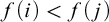 $f(i) < f(j)$
. Moreover,
$f(i) < f(j)$
. Moreover, $g_i(x)\leq \textrm {e}$
, and
$g_i(x)\leq \textrm {e}$
, and $g_j(y)\leq \textrm {e}$
. Hence, by the definition of the nested sum,
$g_j(y)\leq \textrm {e}$
. Hence, by the definition of the nested sum, $g(x) = g_i(x) \leq g_j(y)$
. Similarly, if
$g(x) = g_i(x) \leq g_j(y)$
. Similarly, if $\textrm {e} \leq x \leq y$
, then
$\textrm {e} \leq x \leq y$
, then $g(x) \leq g(y)$
.
$g(x) \leq g(y)$
.
In Section 5, we will make use of a structural description of finite commutative idempotent residuated chains that involves a number of basic building blocks. An odd Sugihara monoid is a commutative idempotent semilinear $^\star $
-involutive residuated lattice; a Brouwerian algebra is a residuated lattice satisfying
$^\star $
-involutive residuated lattice; a Brouwerian algebra is a residuated lattice satisfying $xy \approx x\mathbin {\land } y$
, and a Heyting algebra is a pointed residuated lattice satisfying
$xy \approx x\mathbin {\land } y$
, and a Heyting algebra is a pointed residuated lattice satisfying $xy \approx x\mathbin {\land } y$
and
$xy \approx x\mathbin {\land } y$
and $\textrm {f}\leq x$
; relative Stone algebras and Gödel algebras are semilinear Brouwerian algebras and semilinear Heyting algebras, respectively.
$\textrm {f}\leq x$
; relative Stone algebras and Gödel algebras are semilinear Brouwerian algebras and semilinear Heyting algebras, respectively.
Let us also fix some useful notation:
-
• For
$n\in \mathbb {N}$
, we denote by
$\mathbf {{G}}_n$
the
$(n+1)$
-element relative Stone algebra with universe
$G_n = \{ c_n < \dots < c_1 < \textrm {e} \}$
, i.e., the
$(n+1)$
-element commutative idempotent residuated chain with
$x\cdot y:=x\mathbin {\land } y$
. -
• For
$m,n \in \mathbb {N}$
, we define a commutative idempotent residuated chain as follows. The universe and underlying order of this algebra is given by . For multiplication, we let
$a_ia_j := a_{\min \{ i,j \}} =a_i\mathbin {\lor } a_j$
,
$b_kb_l := b_{\max \{ k,l \}} = b_k\mathbin {\land } b_l$
, and
$a_i b_k = b_k a_i := b_k$
for
$i,j\in \{ 0,\dots ,n \}$
,
$k,l\in \{ 0,\dots ,m \}$
, where
$\textrm {e}$
is the unit. The residual is uniquely determined by the order and definition of the multiplication by setting .




 as follows. The universe and underlying order of this algebra is given by
  . For multiplication, we let





 .
.Note that, up to isomorphism,  is the three-element odd Sugihara monoid and
  is the totally ordered $(2k + 1)$
-element odd Sugihara monoid. In what follows we will always assume that in the nested sum
$(2k + 1)$
-element odd Sugihara monoid. In what follows we will always assume that in the nested sum  we have
  .
.
Lemma 3.9 [Reference Gil-Férez, Jipsen and Metcalfe19, Proposition 3.4]
Let $\mathbf {{A}}$
be a finite commutative idempotent residuated chain. Then there exists a
$\mathbf {{A}}$
be a finite commutative idempotent residuated chain. Then there exists a $k\in \mathbb {N}$
such that
$k\in \mathbb {N}$
such that $\mathbf {{A}}$
contains an isomorphic copy
$\mathbf {{A}}$
contains an isomorphic copy $\mathbf {{B}}$
of
$\mathbf {{B}}$
of  with
with $B = \{ a \in A \mid {a}^{\star \star }= a \}$
. Moreover,
$B = \{ a \in A \mid {a}^{\star \star }= a \}$
. Moreover, $\mathbf {{A}}$
is partitioned by the family of intervals
$\mathbf {{A}}$
is partitioned by the family of intervals $\{ B_b \}_{b \in B}$
, where
$\{ B_b \}_{b \in B}$
, where $B_b := \{ a \in A \mid {a}^{\star \star } = b \}$
.
$B_b := \{ a \in A \mid {a}^{\star \star } = b \}$
.
We call the algebra $\mathbf {{B}}$
in the previous lemma the Sugihara skeleton of
$\mathbf {{B}}$
in the previous lemma the Sugihara skeleton of $\mathbf {{A}}$
.
$\mathbf {{A}}$
.
Lemma 3.10. Let $\mathbf {{A}}$
be a finite commutative idempotent residuated chain. Then
$\mathbf {{A}}$
be a finite commutative idempotent residuated chain. Then $\mathbf {{A}}$
is isomorphic to a nested sum
$\mathbf {{A}}$
is isomorphic to a nested sum  with
with $k,p\in \mathbb {N}$
and
$k,p\in \mathbb {N}$
and $m_i,n_i \in \mathbb {N}$
for each
$m_i,n_i \in \mathbb {N}$
for each $i\in \{ 1,\dots ,k \}$
.
$i\in \{ 1,\dots ,k \}$
.
Proof. Let  be the Sugihara skeleton of $\mathbf {{A}}$
, with universe
$\mathbf {{A}}$
, with universe $B=\{ b_0^1 < \dots < b_0^k < \textrm {e} < a_0^k< \dots < a_0^1 \}$
. Define
$B=\{ b_0^1 < \dots < b_0^k < \textrm {e} < a_0^k< \dots < a_0^1 \}$
. Define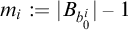 $m_{i} := \lvert B_{{b}_{0}^{i}} \rvert -1 $
and
$m_{i} := \lvert B_{{b}_{0}^{i}} \rvert -1 $
and $n_i := \lvert B_{a_0^i} \rvert -1$
for
$n_i := \lvert B_{a_0^i} \rvert -1$
for $i\in \{ 1,\dots ,k \}$
and
$i\in \{ 1,\dots ,k \}$
and $p := \lvert B_{\textrm {e}} \rvert -1$
. Also, for
$p := \lvert B_{\textrm {e}} \rvert -1$
. Also, for $i\in \{ 1,\dots ,k \}$
, let
$i\in \{ 1,\dots ,k \}$
, let $A_i := B_{b_0^i} \cup \{ \textrm {e} \} \cup B_{a_0^i}$
. Then
$A_i := B_{b_0^i} \cup \{ \textrm {e} \} \cup B_{a_0^i}$
. Then $A_i = \{ b_{m_i}^i < \dots < b_{0}^i < \textrm {e} < a_{n_i}^i < \dots < a_0^i \}$
. It is not hard to see that the map
$A_i = \{ b_{m_i}^i < \dots < b_{0}^i < \textrm {e} < a_{n_i}^i < \dots < a_0^i \}$
. It is not hard to see that the map 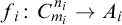 defined by $f(\textrm {e}):=\textrm {e}$
,
$f(\textrm {e}):=\textrm {e}$
, $f_i(a_j):=a_j^{i}$
,
$f_i(a_j):=a_j^{i}$
, $f_i(b_j):= b_j^i$
is an embedding. Moreover, for
$f_i(b_j):= b_j^i$
is an embedding. Moreover, for $B_{\textrm {e}} = \{ x_p < \dots < x_1 < \textrm {e} \}$
the map
$B_{\textrm {e}} = \{ x_p < \dots < x_1 < \textrm {e} \}$
the map $f_0 \colon G_p \to B_{\textrm {e}}$
, defined by
$f_0 \colon G_p \to B_{\textrm {e}}$
, defined by $f_0(\textrm {e}):=\textrm {e}$
, and
$f_0(\textrm {e}):=\textrm {e}$
, and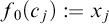 $f_0(c_j):= x_j$
for each
$f_0(c_j):= x_j$
for each $j\in \{ 1,\dots ,p \}$
is an embedding. Defining
$j\in \{ 1,\dots ,p \}$
is an embedding. Defining  , by
, by

yields the desired isomorphism. Moreover, the embedding f is surjective, since $\mathbf {{A}}$
is partitioned by
$\mathbf {{A}}$
is partitioned by $\{ B_b \}_{b\in B}$
.
$\{ B_b \}_{b\in B}$
.
Lemma 3.11. Suppose that  . Then $k=l$
and
$k=l$
and $p=q$
, and
$p=q$
, and $r_i = m_i$
and
$r_i = m_i$
and $s_i = n_i$
for each
$s_i = n_i$
for each $i\in \{ 1,\dots ,k \}$
.
$i\in \{ 1,\dots ,k \}$
.
Proof. Let  . Let
. Let $\mathbf {{B}}$
be the Sugihara skeleton of
$\mathbf {{B}}$
be the Sugihara skeleton of $\mathbf {{A}}$
. Note first that
$\mathbf {{A}}$
. Note first that $2k +1 = \lvert \{ a \in A \mid {a}^{\star \star } =a \} \rvert = 2l + 1$
. Hence
$2k +1 = \lvert \{ a \in A \mid {a}^{\star \star } =a \} \rvert = 2l + 1$
. Hence $k = l$
. Similarly we have for
$k = l$
. Similarly we have for $B = \{ b_0^1 < \dots < b_0^k < \textrm {e} < a_0^k < \dots < a_0^1 \}$
that
$B = \{ b_0^1 < \dots < b_0^k < \textrm {e} < a_0^k < \dots < a_0^1 \}$
that $m_i = \lvert B_{b_0^i} \rvert -1 = r_i$
,
$m_i = \lvert B_{b_0^i} \rvert -1 = r_i$
, $n_i = \lvert B_{a_0^i} \rvert -1 = s_i$
, and
$n_i = \lvert B_{a_0^i} \rvert -1 = s_i$
, and $p = \lvert B_{\textrm {e}} \rvert -1 = q$
.
$p = \lvert B_{\textrm {e}} \rvert -1 = q$
.
We have therefore established the following structural description of finite commutative idempotent residuated chains.
Proposition 3.12 (cf. [Reference Fussner and Galatos8, Reference Gil-Férez, Jipsen and Metcalfe19, Reference Raftery38])
Let $\mathbf {{A}}$
be any finite commutative idempotent residuated chain. Then
$\mathbf {{A}}$
be any finite commutative idempotent residuated chain. Then $\mathbf {{A}}$
is isomorphic to a unique nested sum
$\mathbf {{A}}$
is isomorphic to a unique nested sum  with
with $k,p\in \mathbb {N}$
and
$k,p\in \mathbb {N}$
and $m_i,n_i \in \mathbb {N}$
for each
$m_i,n_i \in \mathbb {N}$
for each $i\in \{ 1,\dots ,k \}$
.
$i\in \{ 1,\dots ,k \}$
.
4 Interpolation without exchange
Our main aim in this section is to prove the following result.
Theorem A.
-
(i) Continuum-many varieties of idempotent semilinear residuated lattices have the amalgamation property and contain non-commutative members.
-
(ii) Continuum-many axiomatic extensions of
$\mathsf {SemRL_{cm}}$
in which exchange is not derivable have the deductive interpolation property.

The second part of Theorem A follows from the first part, using Proposition 2.2 and the fact that the variety of idempotent semilinear residuated lattices is an equivalent algebraic semantics for $\mathsf {SemRL_{cm}}$
. To prove the first part, we make use of a construction of continuum-many atoms in the lattice of varieties of idempotent semilinear residuated lattices given in [Reference Galatos13]. Each of these atoms is generated by a single infinite non-commutative algebra
$\mathsf {SemRL_{cm}}$
. To prove the first part, we make use of a construction of continuum-many atoms in the lattice of varieties of idempotent semilinear residuated lattices given in [Reference Galatos13]. Each of these atoms is generated by a single infinite non-commutative algebra $\mathbf {{A}}_S$
, and, as we show here, has the amalgamation property.
$\mathbf {{A}}_S$
, and, as we show here, has the amalgamation property.
For any $S\subseteq \mathbb {Z}$
, let
$S\subseteq \mathbb {Z}$
, let $A_S := \{ a_i\mid i\in \mathbb {Z} \}\cup \{ b_j\mid j\in \mathbb {Z} \}\cup \{ \textrm {e} \}$
, and totally order the elements of this set by stipulating
$A_S := \{ a_i\mid i\in \mathbb {Z} \}\cup \{ b_j\mid j\in \mathbb {Z} \}\cup \{ \textrm {e} \}$
, and totally order the elements of this set by stipulating $b_i< b_j<\textrm {e}<a_j<a_i$
, for any
$b_i< b_j<\textrm {e}<a_j<a_i$
, for any $i,j\in \mathbb {Z}$
with
$i,j\in \mathbb {Z}$
with $i<j$
. For the multiplication, let
$i<j$
. For the multiplication, let $\textrm {e}$
be the multiplicative unit and, for any
$\textrm {e}$
be the multiplicative unit and, for any $i,j\in \mathbb {Z}$
, let
$i,j\in \mathbb {Z}$
, let $a_ia_j := a_{\min \{ i,j \}}$
,
$a_ia_j := a_{\min \{ i,j \}}$
, $b_ib_j := b_{\min \{ i,j \}}$
, and
$b_ib_j := b_{\min \{ i,j \}}$
, and
 $$ \begin{align*} a_ib_j := \begin{cases} a_i & \text{if }i<j\text{ or }i=j\in S \\ b_j & \text{if }i>j\text{ or }i=j\notin S \end{cases}, \qquad b_ja_i := \begin{cases} b_j & \text{if }j<i\text{ or }i=j\in S \\ a_i & \text{if }j>i\text{ or }i=j\notin S. \end{cases} \end{align*} $$
It is straightforward to check that this multiplication is residuated, and hence that the residual operations $\backslash $
and
$\backslash $
and $/$
satisfy for all
$/$
satisfy for all $x,y\in A_S$
,
$x,y\in A_S$
,
 $$ \begin{align*} x\backslash y = \max\{ z\in A_S\mid xz\leq y \},\qquad y/ x = \max\{ z\in A_S\mid zx\leq y \}. \end{align*} $$
We denote the residuated chain obtained in this way by ${\mathbf {{A}}}_S$
.
${\mathbf {{A}}}_S$
.
Lemma 4.1 [Reference Galatos13, Corollary 5.2]
Let $S\subseteq \mathbb {Z}$
. Then
$S\subseteq \mathbb {Z}$
. Then ${\mathbf {{A}}}_S$
is a strictly simple idempotent residuated chain, and hence generated by any element
${\mathbf {{A}}}_S$
is a strictly simple idempotent residuated chain, and hence generated by any element $x\in A_S {\setminus }\{ \textrm {e} \}$
.
$x\in A_S {\setminus }\{ \textrm {e} \}$
.
The algebras ${\mathbf {{A}}}_S$
encode some of the dynamics of bi-infinite words. A word over
${\mathbf {{A}}}_S$
encode some of the dynamics of bi-infinite words. A word over $\{ 0,1 \}$
is a function
$\{ 0,1 \}$
is a function $w\colon W\to \{ 0,1 \}$
, where W is an interval of
$w\colon W\to \{ 0,1 \}$
, where W is an interval of $\mathbb {Z}$
; it is said to be finite if
$\mathbb {Z}$
; it is said to be finite if $|W|$
is finite and bi-infinite if
$|W|$
is finite and bi-infinite if $W=\mathbb {Z}$
. A finite word
$W=\mathbb {Z}$
. A finite word $v\colon W\to \{ 0,1 \}$
is a subword of a word w if there exists a
$v\colon W\to \{ 0,1 \}$
is a subword of a word w if there exists a $k\in \mathbb {Z}$
such that
$k\in \mathbb {Z}$
such that $v(i) = w(i+k)$
for all
$v(i) = w(i+k)$
for all $i\in W$
. For any
$i\in W$
. For any $S\subseteq \mathbb {Z}$
, we will often consider the bi-infinite word given by the characteristic function of S,
$S\subseteq \mathbb {Z}$
, we will often consider the bi-infinite word given by the characteristic function of S,
 $$ \begin{align*} w_S\colon\mathbb{Z}\to\{ 0,1 \}; \quad i \mapsto \begin{cases} 1 & \text{if }i\in S \\ 0 & \text{if }i\notin S. \end{cases} \end{align*} $$
Indeed, every bi-infinite word is of the form $w_S$
for some
$w_S$
for some $S\subseteq \mathbb {Z}$
. We define a pre-order
$S\subseteq \mathbb {Z}$
. We define a pre-order $\sqsubseteq $
on the set of all bi-infinite words by setting
$\sqsubseteq $
on the set of all bi-infinite words by setting $w_1\sqsubseteq w_2$
if and only if every finite subword of
$w_1\sqsubseteq w_2$
if and only if every finite subword of $w_1$
is a subword of
$w_1$
is a subword of $w_2$
. For bi-infinite words
$w_2$
. For bi-infinite words $w_1,w_2$
, we write
$w_1,w_2$
, we write $w_1\cong w_2$
if and only if
$w_1\cong w_2$
if and only if $w_1\sqsubseteq w_2$
and
$w_1\sqsubseteq w_2$
and $w_2\sqsubseteq w_1$
. A bi-infinite word w is said to be minimal if it is minimal with respect to the pre-order
$w_2\sqsubseteq w_1$
. A bi-infinite word w is said to be minimal if it is minimal with respect to the pre-order $\sqsubseteq $
, i.e., if
$\sqsubseteq $
, i.e., if $w'\sqsubseteq w$
for some bi-infinite word
$w'\sqsubseteq w$
for some bi-infinite word $w'$
, then
$w'$
, then $w'\cong w$
.
$w'\cong w$
.
Example 4.2. Let $\mathbb {E}$
be the set of even integers and
$\mathbb {E}$
be the set of even integers and $\mathbb {O}$
the set of odd integers. Clearly,
$\mathbb {O}$
the set of odd integers. Clearly, $w_{\mathbb {E}}(i)=w_{\mathbb {O}}(i+1)$
for any integer i, and it follows easily that
$w_{\mathbb {E}}(i)=w_{\mathbb {O}}(i+1)$
for any integer i, and it follows easily that $w_{\mathbb {E}}\cong w_{\mathbb {O}}$
. The algebra
$w_{\mathbb {E}}\cong w_{\mathbb {O}}$
. The algebra ${\mathbf {{A}}}_{\mathbb {E}}$
is depicted in Figure 3.
${\mathbf {{A}}}_{\mathbb {E}}$
is depicted in Figure 3.
Labeled Hasse diagrams for the algebra ${\mathbf {{A}}}_{\mathbb {E}}$
.
${\mathbf {{A}}}_{\mathbb {E}}$
.

The following lemma collects some facts about the algebras ${\mathbf {{A}}}_S$
that will be needed in what follows, summarizing portions of Lemma 5.1, Theorem 5.4, and Corollary 5.5 of [Reference Galatos13].
${\mathbf {{A}}}_S$
that will be needed in what follows, summarizing portions of Lemma 5.1, Theorem 5.4, and Corollary 5.5 of [Reference Galatos13].
Lemma 4.3 [Reference Galatos13]
Let $S,T\subseteq \mathbb {Z}$
.
$S,T\subseteq \mathbb {Z}$
.
-
(i)
${\mathbb V}({\mathbf {{A}}}_S)\subseteq {\mathbb V}({\mathbf {{A}}}_{T})$
if and only if
$w_S\sqsubseteq w_T$
if and only if
${\mathbf {{A}}}_S$
embeds into the ultrapower
${\mathbf {{A}}}_T^{\mathbb {N}}/U$
for every non-principal ultrafilter U over
$\mathbb {N}$
. -
(ii) Every non-trivial
$1$
-generated totally ordered member of
${\mathbb V}({\mathbf {{A}}}_S)$
is isomorphic to an algebra of the form
${\mathbf {{A}}}_{S'}$
for some
$S' \subseteq \mathbb {Z}$
with
$w_{S'} \sqsubseteq w_S$
. -
(iii) If
$w_{S}$
is minimal, then
${\mathbb V}({\mathbf {{A}}}_S)$
is an atom in the lattice of varieties of idempotent semilinear residuated lattices.


By part (i) of this lemma, ${\mathbb V}({\mathbf {{A}}}_S)={\mathbb V}({\mathbf {{A}}}_{T})$
if and only if
${\mathbb V}({\mathbf {{A}}}_S)={\mathbb V}({\mathbf {{A}}}_{T})$
if and only if $w_S\cong w_T$
. Combining part (iii) with the fact that there exist continuum-many pairwise incomparable minimal bi-infinite words (see [Reference Morse and Hedlund33]) therefore yields the following result.
$w_S\cong w_T$
. Combining part (iii) with the fact that there exist continuum-many pairwise incomparable minimal bi-infinite words (see [Reference Morse and Hedlund33]) therefore yields the following result.
Proposition 4.4 [Reference Galatos13, Corollary 5.6]
There are continuum-many atoms in the lattice of varieties of idempotent semilinear residuated lattices of the form ${\mathbb V}({\mathbf { {A}}}_S)$
for some
${\mathbb V}({\mathbf { {A}}}_S)$
for some $S\subseteq \mathbb {Z}$
such that
$S\subseteq \mathbb {Z}$
such that $w_S$
is minimal.
$w_S$
is minimal.
Hence it remains to show that ${\mathbb V}({\mathbf {{A}}}_S)$
has the amalgamation property for any
${\mathbb V}({\mathbf {{A}}}_S)$
has the amalgamation property for any $S\subseteq \mathbb {Z}$
such that
$S\subseteq \mathbb {Z}$
such that $w_S$
is minimal. To this end, we prove several technical lemmas.
$w_S$
is minimal. To this end, we prove several technical lemmas.
Lemma 4.5. Let $S\subseteq \mathbb {Z}$
. Then
$S\subseteq \mathbb {Z}$
. Then ${\mathbf {{A}}}_S$
is a
${\mathbf {{A}}}_S$
is a $^\star $
-involutive idempotent residuated chain; in particular, each
$^\star $
-involutive idempotent residuated chain; in particular, each ${\mathbf { {A}}}_S$
is admissible.
${\mathbf { {A}}}_S$
is admissible.
Proof. Direct computation shows that, for each $i\in \mathbb {Z}$
,
$i\in \mathbb {Z}$
,
 $$\begin{align*}\begin{array}{ccc} a_i^\ell = \begin{cases} b_i & \text{if }i\in S \\ b_{i-1} & \text{if }i\notin S \end{cases}, & \quad & a_i^r = \begin{cases} b_i & \text{if }i\notin S \\ b_{i-1} & \text{if }i\in S \end{cases},\\[.2in] b_i^\ell = \begin{cases} a_i & \text{if }i\notin S \\ a_{i+1} & \text{if }i\in S \end{cases}, & & b_i^r = \begin{cases} a_i & \text{if }i\in S \\ a_{i+1} & \text{if }i\notin S. \end{cases} \end{array} \end{align*}$$
As a consequence, $b_i^\star = a_i\mathbin {\land } a_{i+1}=a_{i+1}$
and
$b_i^\star = a_i\mathbin {\land } a_{i+1}=a_{i+1}$
and $a_i^\star = b_i\mathbin {\land } b_{i-1}= b_{i-1}$
for all
$a_i^\star = b_i\mathbin {\land } b_{i-1}= b_{i-1}$
for all $i\in S$
. It follows that
$i\in S$
. It follows that $b_i^{\star \star } = a_{i+1}^\star = b_{(i+1)-1} =b_i$
and
$b_i^{\star \star } = a_{i+1}^\star = b_{(i+1)-1} =b_i$
and $a_i^{\star \star } = b_{i-1}^\star = a_{(i-1)+1} = a_i$
. Hence
$a_i^{\star \star } = b_{i-1}^\star = a_{(i-1)+1} = a_i$
. Hence $x^{\star \star } = x$
for all x and
$x^{\star \star } = x$
for all x and ${\mathbf {{A}}}_S$
is
${\mathbf {{A}}}_S$
is $^\star $
-involutive. That
$^\star $
-involutive. That ${\mathbf {{A}}}_S$
is admissible is immediate from part (i) of Lemma 3.7.
${\mathbf {{A}}}_S$
is admissible is immediate from part (i) of Lemma 3.7.
Now, for $S\subseteq \mathbb {Z}$
, let
$S\subseteq \mathbb {Z}$
, let $\mathsf {V}_S:={\mathbb V}(\mathbf {A}_S)$
be the variety generated by
$\mathsf {V}_S:={\mathbb V}(\mathbf {A}_S)$
be the variety generated by ${\mathbf {{A}}}_S$
and define
${\mathbf {{A}}}_S$
and define
 $$\begin{align*}\mathsf{K}_S := {\mathbb I}(\{ {\mathbf{{A}}}_T\mid w_T \sqsubseteq w_S \}). \end{align*}$$
It follows from parts (i) and (ii) of Lemma 4.3 that $\mathsf {K}_S$
consists of the non-trivial
$\mathsf {K}_S$
consists of the non-trivial $1$
-generated algebras of
$1$
-generated algebras of $\mathsf {V}_S$
. Moreover, since
$\mathsf {V}_S$
. Moreover, since $\mathsf {V}_S$
satisfies
$\mathsf {V}_S$
satisfies $x^{\star \star }\approx x$
, by Lemma 4.5, each totally ordered member of
$x^{\star \star }\approx x$
, by Lemma 4.5, each totally ordered member of $\mathsf {V}_S$
is isomorphic to a nested sum of algebras from
$\mathsf {V}_S$
is isomorphic to a nested sum of algebras from $\mathsf {K}_S$
by part (iii) of Lemma 3.7.
$\mathsf {K}_S$
by part (iii) of Lemma 3.7.
Lemma 4.6. Let $({I,\leq })$
be a chain,
$({I,\leq })$
be a chain, $(\mathbf {{A}}_i)_{i\in I}$
an admissible indexed family of idempotent residuated chains, and U an ultrafilter over some set X. Then the map
$(\mathbf {{A}}_i)_{i\in I}$
an admissible indexed family of idempotent residuated chains, and U an ultrafilter over some set X. Then the map $\iota \colon \boxplus _{({I,\leq })} (\mathbf {{A}}_i^X/U) \to (\boxplus _{({I,\leq })} \mathbf { {A}}_i)^X/U;\: [a]_U\mapsto [a]_U$
is an embedding.
$\iota \colon \boxplus _{({I,\leq })} (\mathbf {{A}}_i^X/U) \to (\boxplus _{({I,\leq })} \mathbf { {A}}_i)^X/U;\: [a]_U\mapsto [a]_U$
is an embedding.
Proof. First note that if an idempotent residuated chain $\mathbf {{A}}$
is admissible, then so is every ultrapower of
$\mathbf {{A}}$
is admissible, then so is every ultrapower of $\mathbf {{A}}$
, since admissibility can be expressed by the quasiequations
$\mathbf {{A}}$
, since admissibility can be expressed by the quasiequations ${x}^{\ell }\approx \textrm {e} \Rightarrow x \approx \textrm {e}$
and
${x}^{\ell }\approx \textrm {e} \Rightarrow x \approx \textrm {e}$
and ${x}^{r} \approx \textrm {e} \Rightarrow x\approx \textrm {e}$
. Hence
${x}^{r} \approx \textrm {e} \Rightarrow x\approx \textrm {e}$
. Hence $(\mathbf {{A}}_i^X/U)_{i\in I}$
is also admissible. The map
$(\mathbf {{A}}_i^X/U)_{i\in I}$
is also admissible. The map $\iota $
is well defined, since for each
$\iota $
is well defined, since for each $i\in I$
and any
$i\in I$
and any $a = (a_x)_{x\in X},b = (b_x)_{x\in X} \in A_i^X$
,
$a = (a_x)_{x\in X},b = (b_x)_{x\in X} \in A_i^X$
,
 $$ \begin{align*} [a]_U = [b]_U \text{ in } \mathbf{{A}}_i^X/U & \iff \{ x \in X\mid a_x = b_x \} \in U\\ & \iff [a]_U = [b]_U \text{ in } (\boxplus_{({I,\leq})} \mathbf{{A}}_i)^X/U. \end{align*} $$
Moreover, $\iota $
is clearly injective. To see that
$\iota $
is clearly injective. To see that $\iota $
is order-preserving, consider any
$\iota $
is order-preserving, consider any $[a]_U, [b]_U \in \boxplus _{({I,\leq })} ({A}_i^X/U) $
with
$[a]_U, [b]_U \in \boxplus _{({I,\leq })} ({A}_i^X/U) $
with $ [a]_U \leq [b]_U$
. There are three cases: either
$ [a]_U \leq [b]_U$
. There are three cases: either ${a,b \in A_i^X}$
, or
${a,b \in A_i^X}$
, or $a \in A_i^X$
and
$a \in A_i^X$
and $b \in A_j^X$
with
$b \in A_j^X$
with $i<j$
, or
$i<j$
, or $a \in A_i^X$
and
$a \in A_i^X$
and $b \in A_j^X$
with
$b \in A_j^X$
with $i>j$
.
$i>j$
.
If $a,b \in A_i^X$
for some
$a,b \in A_i^X$
for some $i \in I$
, then
$i \in I$
, then $\{ x \in X\mid a_x \leq b_x \} \in U$
, so also
$\{ x \in X\mid a_x \leq b_x \} \in U$
, so also $\iota ([a]_U) \leq \iota ([b]_U)$
. Otherwise we may assume that
$\iota ([a]_U) \leq \iota ([b]_U)$
. Otherwise we may assume that $[a]_U, [b]_U \neq [\textrm {e}]_U$
.
$[a]_U, [b]_U \neq [\textrm {e}]_U$
.
Suppose next that $a \in A_i^X$
and
$a \in A_i^X$
and $b \in A_j^X$
with
$b \in A_j^X$
with $i < j$
. Then
$i < j$
. Then $[a]_U < [b]_U < [\textrm {e}]_U$
or
$[a]_U < [b]_U < [\textrm {e}]_U$
or $[a]_U < [\textrm {e}]_U < [b]_U$
. If
$[a]_U < [\textrm {e}]_U < [b]_U$
. If $[a]_U < [b]_U < [\textrm {e}]_U$
, then
$[a]_U < [b]_U < [\textrm {e}]_U$
, then $\{ x \in X\mid a_x < \textrm {e} \}, \{ x \in X\mid b_x < \textrm {e} \} \in U$
. But then also
$\{ x \in X\mid a_x < \textrm {e} \}, \{ x \in X\mid b_x < \textrm {e} \} \in U$
. But then also $\{ x \in X\mid a_x < \textrm {e}, b_x < \textrm {e} \} \in U$
. Hence, since
$\{ x \in X\mid a_x < \textrm {e}, b_x < \textrm {e} \} \in U$
. Hence, since $i<j$
, by definition of the nested sum,
$i<j$
, by definition of the nested sum, $\{ x \in X\mid a_x <\textrm {e}, b_x < \textrm {e} \} \subseteq \{ x \in X\mid a_x < b_x \}$
, i.e.,
$\{ x \in X\mid a_x <\textrm {e}, b_x < \textrm {e} \} \subseteq \{ x \in X\mid a_x < b_x \}$
, i.e., $\{ x \in X\mid a_x < b_x \} \in U$
, so
$\{ x \in X\mid a_x < b_x \} \in U$
, so $\iota ([a]_U) \leq \iota ([b]_U)$
. If
$\iota ([a]_U) \leq \iota ([b]_U)$
. If $[a]_U < [\textrm {e}]_U < [b]_U$
, then
$[a]_U < [\textrm {e}]_U < [b]_U$
, then $\{ x \in X\mid a_x < \textrm {e} \}, \{ x \in X\mid \textrm {e} < b_x \} \in U$
. Hence clearly also
$\{ x \in X\mid a_x < \textrm {e} \}, \{ x \in X\mid \textrm {e} < b_x \} \in U$
. Hence clearly also $\iota ([a]_U) < \iota ([\textrm {e}]_U) < \iota ([b]_U)$
.
$\iota ([a]_U) < \iota ([\textrm {e}]_U) < \iota ([b]_U)$
.
Suppose finally that $a \in A_i^X$
and
$a \in A_i^X$
and $b \in A_j^X$
with
$b \in A_j^X$
with $i> j$
. Then, similarly to the previous case,
$i> j$
. Then, similarly to the previous case, $\iota ([a]_U) \leq \iota ([b]_U)$
in
$\iota ([a]_U) \leq \iota ([b]_U)$
in $(\boxplus _{({I,\leq })} \mathbf {{A}}_i)^X/U$
. Also
$(\boxplus _{({I,\leq })} \mathbf {{A}}_i)^X/U$
. Also $\iota ([\textrm {e}]_U) = [\textrm {e}]_U$
. To show that
$\iota ([\textrm {e}]_U) = [\textrm {e}]_U$
. To show that $\iota $
preserves
$\iota $
preserves ${}^{\ell }$
and
${}^{\ell }$
and ${}^{r}$
, consider any
${}^{r}$
, consider any $a = (a_x)_{x\in X} \in A_i$
for some
$a = (a_x)_{x\in X} \in A_i$
for some $i\in I$
. Then
$i\in I$
. Then $\iota ({[a]}^{\ell }_U) = \iota ([({a}^{\ell }_x)_{x\in X}]_U) = [({a}^{\ell }_x)_{x\in X}]_U = {[a]}^{\ell }_U$
, and similarly for
$\iota ({[a]}^{\ell }_U) = \iota ([({a}^{\ell }_x)_{x\in X}]_U) = [({a}^{\ell }_x)_{x\in X}]_U = {[a]}^{\ell }_U$
, and similarly for ${}^{r}$
. Hence the claim follows from Lemma 3.5.
${}^{r}$
. Hence the claim follows from Lemma 3.5.
Lemma 4.7. Let $S \subseteq \mathbb {Z}$
.
$S \subseteq \mathbb {Z}$
.
-
(i)
${\mathbb H}{\mathbb S}{\mathbb P}_{\mathsf {U}}({\mathbf {{A}}}_S)$
is the class of totally ordered members of
$\mathsf {V}_S$
. -
(ii) If
$w_S$
is minimal, then
${\mathbb H}{\mathbb S}{\mathbb P}_{\mathsf {U}}(\mathbf {{A}}_S)$
is closed under nested sums, and, in particular, the totally ordered members of
$\mathsf {V}_S$
are exactly the nested sums of members of
$\mathsf {K}_S$
.


Proof. (i) Each member of ${\mathbb H}{\mathbb S}{\mathbb P}_{\mathsf {U}}({\mathbf {{A}}}_S)$
is totally ordered by Łoś’ Theorem and Proposition 3.6. Conversely, every totally ordered member of
${\mathbb H}{\mathbb S}{\mathbb P}_{\mathsf {U}}({\mathbf {{A}}}_S)$
is totally ordered by Łoś’ Theorem and Proposition 3.6. Conversely, every totally ordered member of $\mathsf {V}_S$
is finitely subdirectly irreducible, and hence contained in
$\mathsf {V}_S$
is finitely subdirectly irreducible, and hence contained in ${\mathbb H}{\mathbb S}{\mathbb P}_{\mathsf {U}}({\mathbf {{A}}}_S)$
by Jónsson’s lemma.
${\mathbb H}{\mathbb S}{\mathbb P}_{\mathsf {U}}({\mathbf {{A}}}_S)$
by Jónsson’s lemma.
(ii) Suppose that $w_S$
is minimal. Since every member of
$w_S$
is minimal. Since every member of ${\mathbb H}{\mathbb S}{\mathbb P}_{\mathsf {U}}({\mathbf {{A}}}_S)$
is a nested sum of members of
${\mathbb H}{\mathbb S}{\mathbb P}_{\mathsf {U}}({\mathbf {{A}}}_S)$
is a nested sum of members of $\mathsf {K}_S$
, every nested sum of members of
$\mathsf {K}_S$
, every nested sum of members of ${\mathbb H}{\mathbb S}{\mathbb P}_{\mathsf {U}}({\mathbf {{A}}}_S)$
is a nested sum of members of
${\mathbb H}{\mathbb S}{\mathbb P}_{\mathsf {U}}({\mathbf {{A}}}_S)$
is a nested sum of members of $\mathsf {K}_S$
. It therefore suffices to prove that
$\mathsf {K}_S$
. It therefore suffices to prove that ${\mathbb H}{\mathbb S}{\mathbb P}_{\mathsf {U}}({\mathbf { {A}}}_S)$
contains every nested sum of members of
${\mathbb H}{\mathbb S}{\mathbb P}_{\mathsf {U}}({\mathbf { {A}}}_S)$
contains every nested sum of members of $\mathsf {K}_S$
. Since every algebra embeds into an ultraproduct of its finitely generated subalgebras, every nested sum of members of
$\mathsf {K}_S$
. Since every algebra embeds into an ultraproduct of its finitely generated subalgebras, every nested sum of members of $\mathsf {K}_S$
embeds into an ultraproduct of finite nested sums of members of
$\mathsf {K}_S$
embeds into an ultraproduct of finite nested sums of members of $\mathsf {K}_S$
. Hence it suffices to show that every finite nested sum of members of
$\mathsf {K}_S$
. Hence it suffices to show that every finite nested sum of members of $\{ {\mathbf {{A}}}_T\mid w_T \sqsubseteq w_S \}$
(recalling that
$\{ {\mathbf {{A}}}_T\mid w_T \sqsubseteq w_S \}$
(recalling that $\mathsf {K}_S:= {\mathbb I}(\{ {\mathbf {{A}}}_T\mid w_T \sqsubseteq w_S \})$
) is contained in
$\mathsf {K}_S:= {\mathbb I}(\{ {\mathbf {{A}}}_T\mid w_T \sqsubseteq w_S \})$
) is contained in ${\mathbb H}{\mathbb S}{\mathbb P}_{\mathsf {U}}(\mathbf {{A}}_S)$
.
${\mathbb H}{\mathbb S}{\mathbb P}_{\mathsf {U}}(\mathbf {{A}}_S)$
.
Consider first any non-principal ultrafilter U over $\mathbb {N}$
. Since
$\mathbb {N}$
. Since $\mathbf {{A}}_S^{\mathbb {N}}/U \in {\mathbb H}{\mathbb S}{\mathbb P}_{\mathsf {U}}(\mathbf {{A}}_S)$
, there exists a chain
$\mathbf {{A}}_S^{\mathbb {N}}/U \in {\mathbb H}{\mathbb S}{\mathbb P}_{\mathsf {U}}(\mathbf {{A}}_S)$
, there exists a chain $({I,\leq })$
and an indexed family
$({I,\leq })$
and an indexed family $(\mathbf {{A}}_{T_i})_{i\in I}$
of members of
$(\mathbf {{A}}_{T_i})_{i\in I}$
of members of $\mathsf {K}_S$
such that
$\mathsf {K}_S$
such that $\mathbf {{A}}_S^{\mathbb {N}}/U \cong \boxplus _{({I,\leq })} \mathbf {{A}}_{T_i}$
. Note that, since
$\mathbf {{A}}_S^{\mathbb {N}}/U \cong \boxplus _{({I,\leq })} \mathbf {{A}}_{T_i}$
. Note that, since $\mathbf {{A}}_S$
is infinite,
$\mathbf {{A}}_S$
is infinite, $\mathbf {{A}}_S^{\mathbb {N}}/U$
is uncountable, by [Reference Frayne, Morel and Scott5, Theorem 1.28], and hence, since each
$\mathbf {{A}}_S^{\mathbb {N}}/U$
is uncountable, by [Reference Frayne, Morel and Scott5, Theorem 1.28], and hence, since each $\mathbf {{A}}_{T_i}$
is countable, I must be infinite.
$\mathbf {{A}}_{T_i}$
is countable, I must be infinite.
Now let $S_1,\dots ,S_n$
be any subsets of
$S_1,\dots ,S_n$
be any subsets of $\mathbb {Z}$
such that
$\mathbb {Z}$
such that $w_{S_1},\dots , w_{S_n}\sqsubseteq w_S$
. The chain
$w_{S_1},\dots , w_{S_n}\sqsubseteq w_S$
. The chain ${\{ 1 < 2 < \dots < n \}}$
can be considered as a subchain of
${\{ 1 < 2 < \dots < n \}}$
can be considered as a subchain of $({I,\leq })$
and
$({I,\leq })$
and $\boxplus _{i=1}^n \mathbf {{A}}_{T_{i}} \in {\mathbb H}{\mathbb S}{\mathbb P}_{\mathsf {U}}(\mathbf {{A}}_S)$
. By assumption,
$\boxplus _{i=1}^n \mathbf {{A}}_{T_{i}} \in {\mathbb H}{\mathbb S}{\mathbb P}_{\mathsf {U}}(\mathbf {{A}}_S)$
. By assumption, $w_S$
is minimal. So
$w_S$
is minimal. So $w_{S_i} \cong w_S \cong w_{T_{i}}$
and there exists an embedding
$w_{S_i} \cong w_S \cong w_{T_{i}}$
and there exists an embedding $f_i \colon \mathbf {{A}}_{S_i} \to \mathbf {{A}}_{T_{i}}^{\mathbb {N}}/U$
, for each
$f_i \colon \mathbf {{A}}_{S_i} \to \mathbf {{A}}_{T_{i}}^{\mathbb {N}}/U$
, for each $i\in \{ 1,\dots n \}$
, by part (i) of Lemma 4.3. Hence there exists an embedding
$i\in \{ 1,\dots n \}$
, by part (i) of Lemma 4.3. Hence there exists an embedding $f\colon \boxplus _{i=1}^n \mathbf {{A}}_{S_i} \to \boxplus _{i=1}^n (\mathbf { {A}}_{T_{i}}^{\mathbb {N}}/U)$
, by Proposition 3.8. But also, by Lemma 4.6, there exists an embedding
$f\colon \boxplus _{i=1}^n \mathbf {{A}}_{S_i} \to \boxplus _{i=1}^n (\mathbf { {A}}_{T_{i}}^{\mathbb {N}}/U)$
, by Proposition 3.8. But also, by Lemma 4.6, there exists an embedding $\iota \colon \boxplus _{i=1}^n (\mathbf {{A}}_{T_{i}}^{\mathbb {N}}/U) \to (\boxplus _{i=1}^n \mathbf {{A}}_{T_{i}})^{\mathbb {N}}/U$
and composing the two maps yields an embedding
$\iota \colon \boxplus _{i=1}^n (\mathbf {{A}}_{T_{i}}^{\mathbb {N}}/U) \to (\boxplus _{i=1}^n \mathbf {{A}}_{T_{i}})^{\mathbb {N}}/U$
and composing the two maps yields an embedding $\iota \circ f \colon \boxplus _{i=1}^n \mathbf {{A}}_{S_i} \to (\boxplus _{i=1}^n \mathbf { {A}}_{T_{i}})^{\mathbb {N}}/U$
, showing that
$\iota \circ f \colon \boxplus _{i=1}^n \mathbf {{A}}_{S_i} \to (\boxplus _{i=1}^n \mathbf { {A}}_{T_{i}})^{\mathbb {N}}/U$
, showing that $ \boxplus _{i=1}^n \mathbf {{A}}_{S_i} \in {\mathbb H}{\mathbb S}{\mathbb P}_{\mathsf {U}}(\mathbf { {A}}_S)$
.
$ \boxplus _{i=1}^n \mathbf {{A}}_{S_i} \in {\mathbb H}{\mathbb S}{\mathbb P}_{\mathsf {U}}(\mathbf { {A}}_S)$
.
Lemma 4.8. Let S be any subset of $\mathbb {Z}$
such that
$\mathbb {Z}$
such that $w_S$
is minimal. Then
$w_S$
is minimal. Then $\mathsf {V}_S$
has the amalgamation property.
$\mathsf {V}_S$
has the amalgamation property.
Proof. Since $\mathsf {V}_S$
has the congruence extension property, by Lemma 3.2, it suffices, using Proposition 2.1, to show that the class of totally ordered members of
$\mathsf {V}_S$
has the congruence extension property, by Lemma 3.2, it suffices, using Proposition 2.1, to show that the class of totally ordered members of $\mathsf {V}_S$
has the one-sided amalgamation property. In fact, we show that the class of totally ordered members of
$\mathsf {V}_S$
has the one-sided amalgamation property. In fact, we show that the class of totally ordered members of $\mathsf {V}_S$
has the amalgamation property.
$\mathsf {V}_S$
has the amalgamation property.
Let ${\mathbf {{A}}}, {\mathbf {{B}}}, {\mathbf {{C}}}$
be totally ordered members of
${\mathbf {{A}}}, {\mathbf {{B}}}, {\mathbf {{C}}}$
be totally ordered members of $\mathsf {V}_S$
, and assume without loss of generality that
$\mathsf {V}_S$
, and assume without loss of generality that ${\mathbf {{A}}}$
is a subalgebra of
${\mathbf {{A}}}$
is a subalgebra of ${\mathbf {{B}}}$
and
${\mathbf {{B}}}$
and ${\mathbf {{C}}}$
, considering the span
${\mathbf {{C}}}$
, considering the span $({\mathbf {{A}},\mathbf { {B}},\mathbf {{C}}})$
with inclusion maps implicit. Then
$({\mathbf {{A}},\mathbf { {B}},\mathbf {{C}}})$
with inclusion maps implicit. Then ${\mathbf {{A}}}, {\mathbf {{B}}}, {\mathbf {{C}}}$
are nested sums of
${\mathbf {{A}}}, {\mathbf {{B}}}, {\mathbf {{C}}}$
are nested sums of $1$
-generated totally ordered members of
$1$
-generated totally ordered members of $\mathsf {V}_S$
, by Lemma 4.7, and we write
$\mathsf {V}_S$
, by Lemma 4.7, and we write
 $$ \begin{align*} {\mathbf{{B}}} = \boxplus_{(I,\leq_I)} {\mathbf{{B}}}_i,\qquad {\mathbf{{C}}} = \boxplus_{(J,\leq_J)} {\mathbf{{C}}}_j, \end{align*} $$
where each $\mathbf {{B}}_i$
,
$\mathbf {{B}}_i$
, $\mathbf {{C}}_j$
is 1-generated. Further, we may assume without loss of generality that
$\mathbf {{C}}_j$
is 1-generated. Further, we may assume without loss of generality that $I\cap J$
consists of exactly those indices where
$I\cap J$
consists of exactly those indices where ${\mathbf {{A}}}_i = {\mathbf {{B}}}_i = {\mathbf {{C}}}_i$
is a 1-generated subalgebra of
${\mathbf {{A}}}_i = {\mathbf {{B}}}_i = {\mathbf {{C}}}_i$
is a 1-generated subalgebra of ${\mathbf {{A}}}$
. Take any total order
${\mathbf {{A}}}$
. Take any total order $\leq $
on
$\leq $
on $K:=I\cup J$
extending
$K:=I\cup J$
extending $\leq _I\cup \leq _J$
. For each
$\leq _I\cup \leq _J$
. For each $k\in K$
, define
$k\in K$
, define
-
1.
${\mathbf {{D}}}_k := {\mathbf {{A}}}_k$
if
$k\in I\cap J$
; -
2.
${\mathbf {{D}}}_k := {\mathbf {{B}}}_k$
if
$k\in I {\setminus } J$
; -
3.
${\mathbf {{D}}}_k := {\mathbf {{C}}}_k$
if
$k\in J {\setminus } I$
.


Then ${\mathbf {{D}}} = \boxplus _{(K,\leq )} {\mathbf {{D}}}_k$
is an amalgam (again, with inclusion maps implicit) of the span
${\mathbf {{D}}} = \boxplus _{(K,\leq )} {\mathbf {{D}}}_k$
is an amalgam (again, with inclusion maps implicit) of the span $({\mathbf { {A}},\mathbf {{B}},\mathbf {{C}}})$
, and
$({\mathbf { {A}},\mathbf {{B}},\mathbf {{C}}})$
, and ${\mathbf {{D}}} \in \mathsf {V}_S$
, by Lemma 4.7.
${\mathbf {{D}}} \in \mathsf {V}_S$
, by Lemma 4.7.
Proof of Theorem A
(i) By Proposition 4.4, there are continuum-many atoms in the lattice of varieties of idempotent semilinear residuated lattices of the form ${\mathbb V}({\mathbf {{A}}}_S)$
for some
${\mathbb V}({\mathbf {{A}}}_S)$
for some $S\subseteq \mathbb {Z}$
such that
$S\subseteq \mathbb {Z}$
such that $w_S$
is minimal. Moreover, each such variety
$w_S$
is minimal. Moreover, each such variety ${\mathbb V}({\mathbf {{A}}}_S)$
contains a non-commutative member
${\mathbb V}({\mathbf {{A}}}_S)$
contains a non-commutative member $\mathbf {{A}}_S$
, and, by Lemma 4.8, has the amalgamation property.
$\mathbf {{A}}_S$
, and, by Lemma 4.8, has the amalgamation property.
(ii) Immediate from (i).
We conclude this section by showing that there are continuum-many axiomatic extensions in which the exchange rule is not derivable that lack the deductive interpolation property.
Proposition 4.9.
-
(i) Continuum-many varieties of idempotent semilinear residuated lattices contain non-commutative members and do not have the amalgamation property.
-
(ii) Continuum-many axiomatic extensions of
$\mathsf {SemRL_{cm}}$
in which exchange is not derivable do not have the deductive interpolation property.

Proof. The proof of [Reference Fussner and Galatos8, Theorem 5.2] provides a span $(\mathbf {{A}},\mathbf {{B}},\mathbf {{C}},i_B,i_C)$
of finite idempotent residuated chains
$(\mathbf {{A}},\mathbf {{B}},\mathbf {{C}},i_B,i_C)$
of finite idempotent residuated chains $\mathbf {{A}},\mathbf {{B}},\mathbf {{C}}$
such that no idempotent semilinear residuated lattice is an amalgam for this span. For each
$\mathbf {{A}},\mathbf {{B}},\mathbf {{C}}$
such that no idempotent semilinear residuated lattice is an amalgam for this span. For each $S\subseteq \mathbb {Z}$
, let
$S\subseteq \mathbb {Z}$
, let $\mathsf {W}_S$
be the variety generated by
$\mathsf {W}_S$
be the variety generated by $\mathsf {V}_S\cup \{ \mathbf { {B}},\mathbf {{C}} \}$
. It is not hard to see, using Jónsson’s lemma and the existence of continuum-many pairwise incomparable minimal bi-infinite words, that there are continuum-many distinct varieties of the form
$\mathsf {V}_S\cup \{ \mathbf { {B}},\mathbf {{C}} \}$
. It is not hard to see, using Jónsson’s lemma and the existence of continuum-many pairwise incomparable minimal bi-infinite words, that there are continuum-many distinct varieties of the form $\mathsf {W}_S$
, where
$\mathsf {W}_S$
, where $w_S$
is minimal. Each
$w_S$
is minimal. Each $\mathsf {W}_S$
is a variety of idempotent semilinear residuated lattices, so the span
$\mathsf {W}_S$
is a variety of idempotent semilinear residuated lattices, so the span $(\mathbf {{A}},\mathbf {{B}},\mathbf {{C}},i_B,i_C)$
has no amalgam in
$(\mathbf {{A}},\mathbf {{B}},\mathbf {{C}},i_B,i_C)$
has no amalgam in $\mathsf {W}_S$
. This proves part (i), and part (ii) follows as in the proof of Theorem A.
$\mathsf {W}_S$
. This proves part (i), and part (ii) follows as in the proof of Theorem A.
5 Interpolation with exchange
In this section, we prove the following theorem.
Theorem B.
-
(i) Exactly 60 varieties of commutative idempotent semilinear residuated lattices have the amalgamation property.
-
(ii) Exactly 60 axiomatic extensions of
$\mathsf {SemRL_{ecm}}$
have the deductive interpolation property.

Theorem C. There are exactly 60 varieties of commutative idempotent semilinear residuated lattices whose first-order theories have a model completion.
The second part of Theorem B follows from the first part, using Proposition 2.2 and the fact that the variety of commutative idempotent semilinear residuated lattices is an equivalent algebraic semantics for $\mathsf {SemRL_{ecm}}$
. Since commutative idempotent semilinear residuated lattices are locally finite [Reference Raftery38, Theorem 18] and the first-order theory of a locally finite variety has a model completion if and only if and only if the variety has the amalgamation property [Reference Wheeler39, p. 319, Corollary 1], this result also implies Theorem C. The main challenge of this section is therefore to prove the first part of Theorem B.
$\mathsf {SemRL_{ecm}}$
. Since commutative idempotent semilinear residuated lattices are locally finite [Reference Raftery38, Theorem 18] and the first-order theory of a locally finite variety has a model completion if and only if and only if the variety has the amalgamation property [Reference Wheeler39, p. 319, Corollary 1], this result also implies Theorem C. The main challenge of this section is therefore to prove the first part of Theorem B.
For a class $\mathsf {K}$
of algebras, let
$\mathsf {K}$
of algebras, let $\mathsf {K}_{\mathrm {fin}}$
denote the class of finite members of
$\mathsf {K}_{\mathrm {fin}}$
denote the class of finite members of $\mathsf {K}$
, and for a variety
$\mathsf {K}$
, and for a variety $\mathsf {V}$
of idempotent semilinear residuated lattices, let
$\mathsf {V}$
of idempotent semilinear residuated lattices, let $\mathsf {V}^{\mathrm {c}}_{\mathrm {fin}}$
denote the class of finite totally ordered members of
$\mathsf {V}^{\mathrm {c}}_{\mathrm {fin}}$
denote the class of finite totally ordered members of $\mathsf {V}$
. The following lemma allows us to restrict our attention to embeddings between finite commutative idempotent residuated chains.
$\mathsf {V}$
. The following lemma allows us to restrict our attention to embeddings between finite commutative idempotent residuated chains.
Lemma 5.1. Let $\mathsf {V}$
be a locally finite variety of idempotent semilinear residuated lattices. Then
$\mathsf {V}$
be a locally finite variety of idempotent semilinear residuated lattices. Then $\mathsf {V}$
has the amalgamation property if and only if
$\mathsf {V}$
has the amalgamation property if and only if $\mathsf {V}^{\mathrm {c}}_{\mathrm {fin}}$
has the one-sided amalgamation property.
$\mathsf {V}^{\mathrm {c}}_{\mathrm {fin}}$
has the one-sided amalgamation property.
Proof. Note first that $\mathsf {V}$
has the congruence extension property by Lemma 3.2. Moreover, the class of finitely subdirectly irreducible members of
$\mathsf {V}$
has the congruence extension property by Lemma 3.2. Moreover, the class of finitely subdirectly irreducible members of $\mathsf {V}$
consists of the totally ordered members of
$\mathsf {V}$
consists of the totally ordered members of $\mathsf {V}$
, and is closed under subalgebras. Hence
$\mathsf {V}$
, and is closed under subalgebras. Hence $\mathsf {V}$
has the amalgamation property if and only if every span of finitely generated totally ordered members of
$\mathsf {V}$
has the amalgamation property if and only if every span of finitely generated totally ordered members of $\mathsf {V}$
has a one-sided amalgam in the class of totally ordered members of
$\mathsf {V}$
has a one-sided amalgam in the class of totally ordered members of $\mathsf {V}$
, by Proposition 2.1. Since
$\mathsf {V}$
, by Proposition 2.1. Since $\mathsf {V}$
is locally finite, its finitely generated totally ordered members are exactly the members of
$\mathsf {V}$
is locally finite, its finitely generated totally ordered members are exactly the members of $\mathsf {V}^{\mathrm {c}}_{\mathrm {fin}}$
.
$\mathsf {V}^{\mathrm {c}}_{\mathrm {fin}}$
.
Our proof of part (i) of Theorem B will consist of two parts. First, we describe several classes of finite commutative idempotent residuated chains that have the one-sided amalgamation property, corresponding to generating classes for varieties of commutative idempotent semilinear residuated lattices that have the amalgamation property. Second, to show that these are all the varieties of commutative idempotent semilinear residuated lattices with the amalgamation property, we exhibit a number of closure properties—results guaranteeing that if a variety $\mathsf {V}$
of commutative idempotent semilinear residuated lattices has the amalgamation property and
$\mathsf {V}$
of commutative idempotent semilinear residuated lattices has the amalgamation property and $\mathsf {V}$
contains certain algebras, then
$\mathsf {V}$
contains certain algebras, then $\mathsf {V}$
must also contain certain other algebras.
$\mathsf {V}$
must also contain certain other algebras.
Remark 5.2. Instead of appealing to the one-sided amalgamation property, the arguments in this section could alternatively be framed in terms of the essential amalgamation property discussed in [Reference Fussner and Santschi11, Reference Fussner and Santschi12], which is well-suited to the study of amalgamation in semilinear varieties of residuated lattices.
We first develop some technical tools that will be used in the proof. For the first part of our proof, the next lemma will be useful to characterize the classes $\mathsf {V}^{\mathrm {c}}_{\mathrm {fin}}$
for the varieties
$\mathsf {V}^{\mathrm {c}}_{\mathrm {fin}}$
for the varieties $\mathsf {V}$
of commutative idempotent semilinear residuated lattices that have the amalgamation property.
$\mathsf {V}$
of commutative idempotent semilinear residuated lattices that have the amalgamation property.
Lemma 5.3 [Reference Grätzer and Quackenbush21, Theorem 2.3]
Let $\mathsf {V}$
be a locally finite variety and let
$\mathsf {V}$
be a locally finite variety and let $\mathsf {K} \subseteq \mathsf {V}$
be a class of finite algebras such that
$\mathsf {K} \subseteq \mathsf {V}$
be a class of finite algebras such that ${\mathbb H}{\mathbb S}(\mathsf {K}) = \mathsf {K}$
. Then
${\mathbb H}{\mathbb S}(\mathsf {K}) = \mathsf {K}$
. Then $({\mathbb H}{\mathbb S}{\mathbb P}_{\mathsf {U}}(\mathsf {K}))_{\mathrm {fin}} = \mathsf {K}$
.
$({\mathbb H}{\mathbb S}{\mathbb P}_{\mathsf {U}}(\mathsf {K}))_{\mathrm {fin}} = \mathsf {K}$
.
Recall that the algebras $\mathbf {{G}}_n$
and
$\mathbf {{G}}_n$
and  (
( $n,m\in \mathbb {N}$
) are defined in Section 3.
$n,m\in \mathbb {N}$
) are defined in Section 3.
Lemma 5.4.
-
(i) An injective map
$f\colon G_p \to G_q$
is an embedding of
$\mathbf {{G}}_p$
into
$\mathbf {{G}}_q$
if and only if it is order-preserving and
$f(\textrm {e}) = \textrm {e}$
. -
(ii) An injective map
is an embedding of into if and only if it is order-preserving,
$f(a_0) = a_0$
,
$f(b_0) = b_0$
, and
$f(\textrm {e}) = \textrm {e}$
.


 is an embedding of
  into
into  if and only if it is order-preserving,


Proof. (i) Note that ${x}^\star = \textrm {e}$
and
${x}^\star = \textrm {e}$
and ${y}^\star = \textrm {e}$
for all
${y}^\star = \textrm {e}$
for all $x \in G_p$
and
$x \in G_p$
and $y \in G_q$
. The claim therefore follows from Lemma 3.5.
$y \in G_q$
. The claim therefore follows from Lemma 3.5.
(ii) Note that  for all $n,m \in \mathbb {N}$
. Hence every embedding
$n,m \in \mathbb {N}$
. Hence every embedding  satisfies $f(a_0) = a_0$
and
$f(a_0) = a_0$
and $f(b_0) = b_0$
, while the other required properties are immediate. Conversely, let
$f(b_0) = b_0$
, while the other required properties are immediate. Conversely, let  be an injective order-preserving map such that $f(a_0) = a_0$
,
$f(a_0) = a_0$
, $f(b_0) = b_0$
, and
$f(b_0) = b_0$
, and $f(\textrm {e}) = \textrm {e}$
. Since f is order-preserving,
$f(\textrm {e}) = \textrm {e}$
. Since f is order-preserving, $\textrm {e} < f(a_i)$
for each
$\textrm {e} < f(a_i)$
for each $i\in \{ 1,\dots ,n \}$
. So
$i\in \{ 1,\dots ,n \}$
. So $f({a_i}^\star ) = f(b_0) = b_0 = {f(a_i)}^\star $
, and, similarly,
$f({a_i}^\star ) = f(b_0) = b_0 = {f(a_i)}^\star $
, and, similarly, $f({b_j}^\star ) = a_0 = {f(b_j)}^\star $
for each
$f({b_j}^\star ) = a_0 = {f(b_j)}^\star $
for each $j\in \{ 1,\dots ,m \}$
. Hence f is a homomorphism, by Lemma 3.5.
$j\in \{ 1,\dots ,m \}$
. Hence f is a homomorphism, by Lemma 3.5.
Lemma 5.5. Suppose that  and
and  . Then there is a one-to-one correspondence between embeddings $h\colon \mathbf {{A}}\to \mathbf { {B}}$
and triples
$h\colon \mathbf {{A}}\to \mathbf { {B}}$
and triples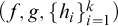 $(f,g,\{ h_i \}_{i=1}^k)$
such that
$(f,g,\{ h_i \}_{i=1}^k)$
such that $f\colon \{ 1,\dots ,k \} \to \{ 1,\dots ,l \}$
is an order-embedding,
$f\colon \{ 1,\dots ,k \} \to \{ 1,\dots ,l \}$
is an order-embedding, $g\colon \mathbf {{G}}_p \to \mathbf {{G}}_q$
is an embedding, and
$g\colon \mathbf {{G}}_p \to \mathbf {{G}}_q$
is an embedding, and  is an embedding for each $i\in \{ 1,\dots ,k \}$
.
$i\in \{ 1,\dots ,k \}$
.
Proof. Let $(f,g,\{ h_i \}_{i=1}^k)$
be a triple such that
$(f,g,\{ h_i \}_{i=1}^k)$
be a triple such that $f\colon \{ 1,\dots ,k \} \to \{ 1,\dots ,l \}$
is an order-embedding,
$f\colon \{ 1,\dots ,k \} \to \{ 1,\dots ,l \}$
is an order-embedding, $g\colon \mathbf { {G}}_p \to \mathbf {{G}}_q$
is an embedding, and
$g\colon \mathbf { {G}}_p \to \mathbf {{G}}_q$
is an embedding, and  is an embedding for each $i\in \{ 1,\dots ,k \}$
. By Proposition 3.8, the following map is an embedding of
$i\in \{ 1,\dots ,k \}$
. By Proposition 3.8, the following map is an embedding of $\mathbf {{A}}$
into
$\mathbf {{A}}$
into $\mathbf {{B}}$
:
$\mathbf {{B}}$
:

Conversely, let $h\colon \mathbf {{A}}\to \mathbf {{B}}$
be an embedding. Then for each
$h\colon \mathbf {{A}}\to \mathbf {{B}}$
be an embedding. Then for each $i\in \{ 1,\dots ,k \}$
, there is a
$i\in \{ 1,\dots ,k \}$
, there is a $f(j) \in \{ 1,\dots ,l \}$
such that
$f(j) \in \{ 1,\dots ,l \}$
such that  . So there is a map $f\colon \{ 1,\dots ,k \} \to \{ 1,\dots ,l \}$
that is injective, since h is an embedding, and order-preserving, since otherwise the definition of the nested sum would yield a contradiction to the fact that h is a homomorphism. Hence for each
$f\colon \{ 1,\dots ,k \} \to \{ 1,\dots ,l \}$
that is injective, since h is an embedding, and order-preserving, since otherwise the definition of the nested sum would yield a contradiction to the fact that h is a homomorphism. Hence for each $i\in \{ 1,\dots ,k \}$
, we can define the embedding
$i\in \{ 1,\dots ,k \}$
, we can define the embedding 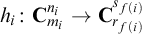 to be the restriction of h to
  . Note also that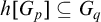 $h[G_p] \subseteq G_q$
, so we can define the embedding
$h[G_p] \subseteq G_q$
, so we can define the embedding $g\colon \mathbf {{G}}_p \to \mathbf {{G}}_q$
to be the restriction of h to
$g\colon \mathbf {{G}}_p \to \mathbf {{G}}_q$
to be the restriction of h to $G_p$
. Hence we obtain the desired triple
$G_p$
. Hence we obtain the desired triple $(f,g,\{ h_i \}_{i=1}^k)$
.
$(f,g,\{ h_i \}_{i=1}^k)$
.
Finally it is straightforward to check that the two constructions are inverse to each other.
We define the following classes of commutative idempotent residuated chains for $m,n,p \in \{ 0,1,\omega \}$
:
$m,n,p \in \{ 0,1,\omega \}$
:

Note that  is the variety of relative Stone algebras,
 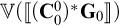 is the variety of odd Sugihara monoids, and
  is the variety of commutative idempotent semilinear residuated lattices.
The next two lemmas follow easily from the definitions of the respective classes.
Lemma 5.6. Suppose that  is a homomorphic image of
  . Then $\kern2pt l\leq k$
,
$\kern2pt l\leq k$
, $r_j \leq \max \{ m_1,\dots ,m_k \}$
,
$r_j \leq \max \{ m_1,\dots ,m_k \}$
, $s_j \leq \max \{ n_1,\dots ,n_k \}$
, and
$s_j \leq \max \{ n_1,\dots ,n_k \}$
, and $q \leq \max \{ m_1,\dots ,m_k,p \}$
for each
$q \leq \max \{ m_1,\dots ,m_k,p \}$
for each $j\in \{ 1,\dots ,l \}$
.
$j\in \{ 1,\dots ,l \}$
.
Lemma 5.7.
-
(i)
for each
$p \in \{ 0,1,\omega \}$
. -
(ii)
and for any
$m,n, p \in \{ 0,1 ,\omega \}$
with
$p\geq m$
. -
(iii)
and for any
$m,n,p \in \{ 0,1, \omega \}$
with
$p\geq m$
.
 for each
 and
and  for any

 and
and  for any

The following lemma will be helpful in amalgamating components appearing in nested sum decompositions of the pertinent algebras. We will often abbreviate a span $({\mathbf {{A}},\mathbf {{B}},\mathbf {{C}},i_B,i_C})$
by
$({\mathbf {{A}},\mathbf {{B}},\mathbf {{C}},i_B,i_C})$
by $({i_B,i_C})$
, or, more explicitly,
$({i_B,i_C})$
, or, more explicitly, $({i_B\colon \mathbf {{A}}\to \mathbf {{B}},i_C\colon \mathbf {{A}}\to \mathbf {{C}}})$
.
$({i_B\colon \mathbf {{A}}\to \mathbf {{B}},i_C\colon \mathbf {{A}}\to \mathbf {{C}}})$
.
Lemma 5.8.
-
(i) Every span
$({i_1 \colon \mathbf {{G}}_{q_1} \to \mathbf {{G}}_{q_2}, i_2\colon \mathbf {{G}}_{q_1} \to \mathbf {{G}}_{q_3}})$
in has an amalgam in , for any
$p \in \{ 0, 1, \omega \}$
. -
(ii) Every span
in has an amalgam in , for any
$m,n, p \in \{ 0,1, \omega \}$
.

 has an amalgam in
  , for any
 in
in  has an amalgam in
  , for any
Proof. Note first that, by [Reference Gil-Férez, Jipsen and Metcalfe19, Lemma 6.5], the class of finite commutative idempotent residuated chains has the amalgamation property.
(i) For $p= 0$
, the claim is trivial. If
$p= 0$
, the claim is trivial. If $p= 1$
, then, up to isomorphism,
$p= 1$
, then, up to isomorphism,  contains just $\mathbf { {G}}_0$
and
$\mathbf { {G}}_0$
and $\mathbf {{G}}_1$
, and the only embeddings are
$\mathbf {{G}}_1$
, and the only embeddings are $ \mathbf {{G}}_0 \hookrightarrow \mathbf {{G}}_0$
,
$ \mathbf {{G}}_0 \hookrightarrow \mathbf {{G}}_0$
, $ \mathbf { {G}}_0 \hookrightarrow \mathbf {{G}}_1$
,
$ \mathbf { {G}}_0 \hookrightarrow \mathbf {{G}}_1$
, $ \mathbf {{G}}_1 \hookrightarrow \mathbf {{G}}_1$
, so the claim follows. Finally suppose that
$ \mathbf {{G}}_1 \hookrightarrow \mathbf {{G}}_1$
, so the claim follows. Finally suppose that $p=\omega $
. By [Reference Gil-Férez, Jipsen and Metcalfe19, Lemma 6.5], the span
$p=\omega $
. By [Reference Gil-Férez, Jipsen and Metcalfe19, Lemma 6.5], the span $({i_1,i_2})$
has an amalgam
$({i_1,i_2})$
has an amalgam  in the class of finite commutative idempotent residuated chains. Hence $j_1[G_{q_2}] \subseteq G_{q_4}$
and
$j_1[G_{q_2}] \subseteq G_{q_4}$
and $j_2[G_{q_3}] \subseteq G_{q_4}$
, by Lemma 5.5, so
$j_2[G_{q_3}] \subseteq G_{q_4}$
, by Lemma 5.5, so $(\mathbf {{G}}_{q_4}, j_1,j_2)$
is an amalgam of the span
$(\mathbf {{G}}_{q_4}, j_1,j_2)$
is an amalgam of the span $({i_1,i_2})$
in
$({i_1,i_2})$
in  .
.
(ii) If $m\leq 1$
and
$m\leq 1$
and $n\leq 1$
, then
$n\leq 1$
, then $r_1,r_2,r_3 \leq 1$
and
$r_1,r_2,r_3 \leq 1$
and $s_1,s_2,s_3 \leq 1$
. In this case,
$s_1,s_2,s_3 \leq 1$
. In this case,  together with the inclusion maps
 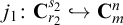 ,
,  is an amalgam of the span $({i_1,i_2})$
in
$({i_1,i_2})$
in  .
.
If $m \leq 1$
and
$m \leq 1$
and $n = \omega $
, define
$n = \omega $
, define  and
and  . Let
. Let $({\{ \textrm {e} < a_{k} < \dots < a_{0} \},g_1,g_2})$
be an amalgam of
$({\{ \textrm {e} < a_{k} < \dots < a_{0} \},g_1,g_2})$
be an amalgam of $({f_1,f_2})$
in the class of finite chains. Now define the maps
$({f_1,f_2})$
in the class of finite chains. Now define the maps 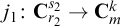 ,
,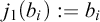 $j_1(b_i) := b_i$
,
$j_1(b_i) := b_i$
, $j_1(a_i) := f_1(a_i)$
and
$j_1(a_i) := f_1(a_i)$
and  ,
,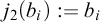 $j_2(b_i) := b_i$
,
$j_2(b_i) := b_i$
, $j_2(a_i) := f_2(a_i)$
. By Lemma 5.4, these maps are embeddings. Hence
$j_2(a_i) := f_2(a_i)$
. By Lemma 5.4, these maps are embeddings. Hence  is an amalgam of the span $({i_1,i_2})$
in
$({i_1,i_2})$
in  . The case where $m = \omega $
and
$m = \omega $
and $n\leq 1$
is very similar.
$n\leq 1$
is very similar.
Finally, suppose that $m = n = \omega $
. Then, by [Reference Gil-Férez, Jipsen and Metcalfe19, Lemma 6.5], the span
$m = n = \omega $
. Then, by [Reference Gil-Férez, Jipsen and Metcalfe19, Lemma 6.5], the span $({i_1,i_2})$
has an amalgam
$({i_1,i_2})$
has an amalgam  in the class of finite commutative idempotent residuated chains. Hence, by Lemma 5.5, there is an $i\in \{ 1,\dots ,k \}$
such that
$i\in \{ 1,\dots ,k \}$
such that 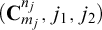 is an amalgam of the span $({i_1,i_2})$
in
$({i_1,i_2})$
in  .
.
We have now assembled the necessary ingredients to prove the positive part of our result. The following proposition shows that several families of varieties considered in this section have the amalgamation property. Subsequently, we will show that these are the only varieties of commutative idempotent residuated lattices that have the amalgamation property.
Proposition 5.9. The following varieties have the amalgamation property:
-
(a)
for any
$p \in \{ 0,1,\omega \}$
; -
(b)
for any
$m,n,p \in \{ 0,1, \omega \}$
with
$p \geq m$
; -
(c)
for any
$m,n,p \in \{ 0,1, \omega \}$
with
$p \geq m$
; -
(d)
for any
$m,n \in \{ 0,1,\omega \}$
,
$p\in \{ 1,\omega \}$
with
$p \geq m$
; -
(e)
for any
$n \in \{ 0,1, \omega \}$
,
$p\in \{ 1,\omega \}$
.
 for any
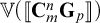 for any

 for any

 for any


 for any

Proof. Let $\mathsf {K}$
be one of the generating sets of finite chains from (a) to (e). Then
$\mathsf {K}$
be one of the generating sets of finite chains from (a) to (e). Then ${\mathbb H}{\mathbb S}(\mathsf {K}) = \mathsf {K}$
, by Lemma 5.7, and
${\mathbb H}{\mathbb S}(\mathsf {K}) = \mathsf {K}$
, by Lemma 5.7, and $({\mathbb H}{\mathbb S}{\mathbb P}_{\mathsf {U}}(\mathsf {K}))_{\text {fin}} = \mathsf {K}$
, by Lemma 5.3. Hence
$({\mathbb H}{\mathbb S}{\mathbb P}_{\mathsf {U}}(\mathsf {K}))_{\text {fin}} = \mathsf {K}$
, by Lemma 5.3. Hence $\mathsf {K}$
consists of the finite chains of
$\mathsf {K}$
consists of the finite chains of ${\mathbb V}(\mathsf {K})$
, and, by Lemma 5.1, it suffices in each case to show that every span in
${\mathbb V}(\mathsf {K})$
, and, by Lemma 5.1, it suffices in each case to show that every span in $\mathsf {K}$
has a one-sided amalgam in
$\mathsf {K}$
has a one-sided amalgam in $\mathsf {K}$
.
$\mathsf {K}$
.
(a) Immediate from Lemma 5.8(i).
(b) Let $m,n,p \in \{ 0,1, \omega \}$
with
$m,n,p \in \{ 0,1, \omega \}$
with $p \geq m$
and let
$p \geq m$
and let $({i_1\colon {\mathbf {{A}}} \to {\mathbf {{B}}}, i_2 \colon {\mathbf {{A}}} \to {\mathbf {{C}}}})$
be a span in
$({i_1\colon {\mathbf {{A}}} \to {\mathbf {{B}}}, i_2 \colon {\mathbf {{A}}} \to {\mathbf {{C}}}})$
be a span in  . Since
  has the amalgamation property, we can assume that
 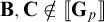 , i.e.,
  and
and  with
with $r_2,r_3\leq m$
,
$r_2,r_3\leq m$
, $s_2,s_3\leq n$
,
$s_2,s_3\leq n$
, $q_1\leq p$
. If
$q_1\leq p$
. If ${\mathbf {{A}}} = \mathbf {{G}}_{q_1}$
, then, since
${\mathbf {{A}}} = \mathbf {{G}}_{q_1}$
, then, since  has the amalgamation property, the span $({i_1\colon \mathbf {{G}}_{q_1} \to \mathbf {{G}}_{q_2}, i_2 \colon \mathbf {{G}}_{q_1} \to \mathbf { {G}}_{q_3}})$
has an amalgam
$({i_1\colon \mathbf {{G}}_{q_1} \to \mathbf {{G}}_{q_2}, i_2 \colon \mathbf {{G}}_{q_1} \to \mathbf { {G}}_{q_3}})$
has an amalgam $({\mathbf {{G}}_{q_4},f_1,f_2})$
. Also, by Lemma 5.8, the span
$({\mathbf {{G}}_{q_4},f_1,f_2})$
. Also, by Lemma 5.8, the span  has an amalgam
  in
in  . Now, by Lemma 5.5, the maps
  ,
, $j_1(x) = f_1(x)$
for
$j_1(x) = f_1(x)$
for $x\in G_{q_2}$
,
$x\in G_{q_2}$
, $j_1(x) = h_1(x)$
for
$j_1(x) = h_1(x)$
for  ,
,  ,
, $j_2(x) = f_2(x)$
for
$j_2(x) = f_2(x)$
for $x\in G_{q_3}$
,
$x\in G_{q_3}$
, $j_2(x) = h_2(x)$
for
$j_2(x) = h_2(x)$
for  are embeddings and hence
  is an amalgam of the span $({i_1,i_2})$
in
$({i_1,i_2})$
in  .
.
If 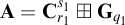 , then, since
  has the amalgamation property, the span $({i_1\mathord {\upharpoonright }_{G_{q_1}}\colon \mathbf {{G}}_{q_1} \to \mathbf {{G}}_{q_2}, i_2\mathord {\upharpoonright }_{G_{q_1}} \colon \mathbf {{G}}_{q_1} \to \mathbf {{G}}_{q_3}})$
has an amalgam
$({i_1\mathord {\upharpoonright }_{G_{q_1}}\colon \mathbf {{G}}_{q_1} \to \mathbf {{G}}_{q_2}, i_2\mathord {\upharpoonright }_{G_{q_1}} \colon \mathbf {{G}}_{q_1} \to \mathbf {{G}}_{q_3}})$
has an amalgam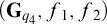 $({\mathbf { {G}}_{q_4},f_1,f_2})$
. Also, by Lemma 5.8, the span
$({\mathbf { {G}}_{q_4},f_1,f_2})$
. Also, by Lemma 5.8, the span  has an amalgam
  in
in  . Now, by Lemma 5.5, the maps
  ,
, $j_1(x) = f_1(x)$
for
$j_1(x) = f_1(x)$
for $x\in G_{q_2}$
,
$x\in G_{q_2}$
, $j_1(x) = g_1(x)$
for
$j_1(x) = g_1(x)$
for  ,
,  ,
, $j_2(x) = f_2(x)$
for
$j_2(x) = f_2(x)$
for $x\in G_{q_3}$
,
$x\in G_{q_3}$
, $j_2(x) = g_2(x)$
for
$j_2(x) = g_2(x)$
for  are embeddings and hence
  is an amalgam of the span $({i_1,i_2})$
in
$({i_1,i_2})$
in  .
.
(c) Very similar to part (b) by first amalgamating the summands and the index sets and then using Lemma 5.5.
(d) and (e) Let $m,n \in \{ 0,1, \omega \}$
,
$m,n \in \{ 0,1, \omega \}$
, $p\in \{ 1,\omega \}$
. The only spans that are not covered by parts (b) and (c) are of the form
$p\in \{ 1,\omega \}$
. The only spans that are not covered by parts (b) and (c) are of the form  and
and  . For these cases, define the one-sided amalgam
  with
with  ,
, $j_1(x) = x$
,
$j_1(x) = x$
,  ,
, $j_2(x) = \textrm {e}$
, and the one-sided amalgam
$j_2(x) = \textrm {e}$
, and the one-sided amalgam $({\mathbf {{G}}_p,f_1,f_2})$
with
$({\mathbf {{G}}_p,f_1,f_2})$
with $f_1\colon \mathbf {{G}}_p \to \mathbf {{G}}_p$
,
$f_1\colon \mathbf {{G}}_p \to \mathbf {{G}}_p$
, $f_1(x) = x$
,
$f_1(x) = x$
,  ,
, $f_2(x) = \textrm {e}$
, respectively.
$f_2(x) = \textrm {e}$
, respectively.
Note that in the previous proposition, case (a) accounts for three varieties, each one of cases (b) and (c) accounts for an additional 18 varieties, case (d) accounts for 15 varieties, and case (e) accounts for six varieties. Hence, Proposition 5.9 identifies a total of $3+18+18+15+6 = 60$
varieties of commutative idempotent semilinear residuated lattices with the amalgamation property. For a fixed
$3+18+18+15+6 = 60$
varieties of commutative idempotent semilinear residuated lattices with the amalgamation property. For a fixed $n \in \{ 0,1,\omega \}$
, the corresponding posets of the classes of finite chains from (b) and (d), and (c) and (e), are displayed in Figures 4 and 5, respectively.
$n \in \{ 0,1,\omega \}$
, the corresponding posets of the classes of finite chains from (b) and (d), and (c) and (e), are displayed in Figures 4 and 5, respectively.
Classes of finite chains from (b) and (d) of Proposition 5.9.

Classes of finite chains from (c) and (e) of Proposition 5.9.

We now turn our attention to the closure properties used to show that the list of varieties with the amalgamation property given in Proposition 5.9 is exhaustive.
Lemma 5.10. Let $\mathsf {V}$
be a variety of commutative idempotent semilinear residuated lattices and let
$\mathsf {V}$
be a variety of commutative idempotent semilinear residuated lattices and let $\mathbf {{A}} \in \mathsf { V}^{\mathrm {c}}_{\mathrm {fin}}$
. If
$\mathbf {{A}} \in \mathsf { V}^{\mathrm {c}}_{\mathrm {fin}}$
. If  , then $\mathbf {{A}} \boxplus \mathbf {{G}}_m \in \mathsf {V}^{\mathrm {c}}_{\mathrm {fin}}$
.
$\mathbf {{A}} \boxplus \mathbf {{G}}_m \in \mathsf {V}^{\mathrm {c}}_{\mathrm {fin}}$
.
Proof. Clearly, every convex normal subalgebra of a  is also a convex normal subalgebra of
  by the definition of the nested sum. It is easy to see that the interval $[b_0,a_0]$
is a convex normal subalgebra of
$[b_0,a_0]$
is a convex normal subalgebra of  and, by direct computation, that the congruence $\Theta $
corresponding to this convex normal subalgebra satisfies
$\Theta $
corresponding to this convex normal subalgebra satisfies $(x,y)\in \Theta $
if and only if
$(x,y)\in \Theta $
if and only if $x=y$
or
$x=y$
or $b_0\leq x,y$
, for any
$b_0\leq x,y$
, for any  . Now, if
  with
with $(x,y)\in \Theta $
, then
$(x,y)\in \Theta $
, then $b_0\leq x\to y \mathbin {\land } y\to x\leq a_0$
. It follows from the definition of the nested sum that
$b_0\leq x\to y \mathbin {\land } y\to x\leq a_0$
. It follows from the definition of the nested sum that 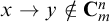 if
if  or
or  , so also $(x,y)\in \Theta $
if and only if
$(x,y)\in \Theta $
if and only if $x=y$
or
$x=y$
or $b_0\leq x,y\leq a_0$
for any
$b_0\leq x,y\leq a_0$
for any  . Hence we obtain
  .
.
Lemma 5.11. Let $\mathsf {V}$
be a variety of commutative idempotent semilinear residuated lattices, let
$\mathsf {V}$
be a variety of commutative idempotent semilinear residuated lattices, let $\mathbf {{A}}, \mathbf {{B}} \in \mathsf { V}^{\mathrm {c}}_{\mathrm {fin}}$
, and suppose that
$\mathbf {{A}}, \mathbf {{B}} \in \mathsf { V}^{\mathrm {c}}_{\mathrm {fin}}$
, and suppose that $\mathsf {V}$
has the amalgamation property.
$\mathsf {V}$
has the amalgamation property.
-
(i) If
$\mathbf {{A}} \boxplus \mathbf {{G}}_2 \in \mathsf {V}^{\mathrm {c}}_{\mathrm {fin}}$
, then
$\mathbf {{A}} \boxplus \mathbf {{G}}_n \in \mathsf {V}^{\mathrm {c}}_{\mathrm {fin}}$
for every
$n\in \mathbb {N}^{>0}$
. -
(ii) If
, then for every
$k\in \mathbb {N}^{>0}$
. -
(iii) If
for some
$n\in \mathbb {N}$
, then for every
$m\in \mathbb {N}$
. -
(iv) If
for some
$m\in \mathbb {N}$
, then for every
$n\in \mathbb {N}$
. -
(v) If
for some
$m,n \in \mathbb {N}$
, then . -
(vi) If
and , then . -
(vii) If
$\mathbf {{A}} \boxplus \mathbf {{G}}_1 \in \mathsf {V}^{\mathrm {c}}_{\mathrm {fin}}$
and
$\mathbf {{G}}_p \in \mathsf { V}^{\mathrm {c}}_{\mathrm {fin}}$
, then
$\mathbf {{A}} \boxplus \mathbf {{G}}_p \in \mathsf {V}^{\mathrm {c}}_{\mathrm {fin}}$
.


 , then
  for every
 for some
 for every
 for some
 for every
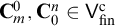 for some
 .
. and
and  , then
  .
.


Proof. Note first that, since $\mathsf {V}$
has the amalgamation property, by Lemma 5.1,
$\mathsf {V}$
has the amalgamation property, by Lemma 5.1, $\mathsf {V}^{\mathrm {c}}_{\mathrm {fin}}$
has the one-sided amalgamation property. In the following, we will use this without mentioning it explicitly.
$\mathsf {V}^{\mathrm {c}}_{\mathrm {fin}}$
has the one-sided amalgamation property. In the following, we will use this without mentioning it explicitly.
(i) Suppose that $\mathbf {{A}} \boxplus \mathbf {{G}}_2 \in \mathsf {V}$
. We prove the claim by induction on n. For
$\mathbf {{A}} \boxplus \mathbf {{G}}_2 \in \mathsf {V}$
. We prove the claim by induction on n. For $n=1$
, note that
$n=1$
, note that $\mathbf {{A}} \boxplus \mathbf {{G}}_1$
is a subalgebra of
$\mathbf {{A}} \boxplus \mathbf {{G}}_1$
is a subalgebra of $\mathbf {{A}} \boxplus \mathbf {{G}}_2$
. Suppose that the claim holds for
$\mathbf {{A}} \boxplus \mathbf {{G}}_2$
. Suppose that the claim holds for $n\in \mathbb {N}^{>0}$
, i.e.,
$n\in \mathbb {N}^{>0}$
, i.e., $\mathbf {{A}} \boxplus \mathbf {{G}}_n\in \mathsf {V}^{\mathrm {c}}_{\mathrm {fin}}$
. Consider the span of embeddings
$\mathbf {{A}} \boxplus \mathbf {{G}}_n\in \mathsf {V}^{\mathrm {c}}_{\mathrm {fin}}$
. Consider the span of embeddings $i_1\colon \mathbf {{A}} \boxplus \mathbf {{G}}_1 \to \mathbf {{A}} \boxplus \mathbf {{G}}_2$
,
$i_1\colon \mathbf {{A}} \boxplus \mathbf {{G}}_1 \to \mathbf {{A}} \boxplus \mathbf {{G}}_2$
, $i_1(c_1) = c_2$
and
$i_1(c_1) = c_2$
and $i_1(x) = x$
for
$i_1(x) = x$
for $x\in A$
, and
$x\in A$
, and $i_2\colon \mathbf {{A}} \boxplus \mathbf {{G}}_1 \to \mathbf {{A}} \boxplus \mathbf {{G}}_n$
,
$i_2\colon \mathbf {{A}} \boxplus \mathbf {{G}}_1 \to \mathbf {{A}} \boxplus \mathbf {{G}}_n$
, $i_2(c_1) = c_1$
and
$i_2(c_1) = c_1$
and $i_1(x) = x$
for
$i_1(x) = x$
for $x\in A$
. Then there exists an algebra
$x\in A$
. Then there exists an algebra $\mathbf {D} \in \mathsf {V}^{\mathrm {c}}_{\mathrm {fin}}$
, an embedding
$\mathbf {D} \in \mathsf {V}^{\mathrm {c}}_{\mathrm {fin}}$
, an embedding $j_1\colon \mathbf {{A}} \boxplus \mathbf {{G}}_2 \to \mathbf {{D}}$
, and a homomorphism
$j_1\colon \mathbf {{A}} \boxplus \mathbf {{G}}_2 \to \mathbf {{D}}$
, and a homomorphism $j_2 \colon \mathbf {{A}} \boxplus \mathbf {{G}}_n \to \mathbf { {D}}$
such that
$j_2 \colon \mathbf {{A}} \boxplus \mathbf {{G}}_n \to \mathbf { {D}}$
such that $j_1 \circ i_1 = j_2 \circ i_2$
. Since
$j_1 \circ i_1 = j_2 \circ i_2$
. Since $c_1$
covers
$c_1$
covers $\textrm {e}$
in
$\textrm {e}$
in $\mathbf {{A}} \boxplus \mathbf {{G}}_n$
and
$\mathbf {{A}} \boxplus \mathbf {{G}}_n$
and $j_2(c_1) = j_2(i_2(c_1)) = j_1(i_1(c_1)) < \textrm {e}$
, by Lemma 3.1, also
$j_2(c_1) = j_2(i_2(c_1)) = j_1(i_1(c_1)) < \textrm {e}$
, by Lemma 3.1, also $j_2$
is an embedding, so we have
$j_2$
is an embedding, so we have $j_2(c_n) < \dots < j_2(c_1) = j_1(c_2) < j_1(c_1) < \textrm {e}$
. Let
$j_2(c_n) < \dots < j_2(c_1) = j_1(c_2) < j_1(c_1) < \textrm {e}$
. Let $S = \operatorname {\mathrm {im}}(j_1) \cup \operatorname {\mathrm {im}}(j_2)$
. Then
$S = \operatorname {\mathrm {im}}(j_1) \cup \operatorname {\mathrm {im}}(j_2)$
. Then $\textrm {e}\in S$
and S is closed under
$\textrm {e}\in S$
and S is closed under ${ }^\star $
, by construction. Hence, by Lemma 3.4, it is the universe of a subalgebra
${ }^\star $
, by construction. Hence, by Lemma 3.4, it is the universe of a subalgebra $\mathbf {{S}}$
of
$\mathbf {{S}}$
of $\mathbf {{D}}$
which is clearly isomorphic to
$\mathbf {{D}}$
which is clearly isomorphic to $\mathbf {{A}} \boxplus \mathbf {{G}}_{n+1}$
.
$\mathbf {{A}} \boxplus \mathbf {{G}}_{n+1}$
.
(ii) Suppose that  . We prove the claim by induction on k. For $k=1$
, note that
$k=1$
, note that  is a subalgebra of
 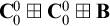 . Suppose that the claim holds for $k\in \mathbb {N}^{>0}$
, i.e.,
$k\in \mathbb {N}^{>0}$
, i.e.,  , and consider the span of embeddings
  ,
, $i_1(x) = x$
for
$i_1(x) = x$
for $x \in B$
,
$x \in B$
, $i_1(b_0) = b_0^1$
,
$i_1(b_0) = b_0^1$
, $i_1(a_0) = a_0^1$
and
$i_1(a_0) = a_0^1$
and  ,
, $i_2(x) = x$
for
$i_2(x) = x$
for $x \in B$
,
$x \in B$
, $i_2(b_0) = b_0^k$
,
$i_2(b_0) = b_0^k$
, $i_2(a_0) = a_0^1$
. Then there exists an algebra
$i_2(a_0) = a_0^1$
. Then there exists an algebra $\mathbf {{D}} \in \mathsf {V}^{\mathrm {c}}_{\mathrm {fin}}$
, an embedding
$\mathbf {{D}} \in \mathsf {V}^{\mathrm {c}}_{\mathrm {fin}}$
, an embedding  , and a homomorphism
  such that $j_1\circ i_1 = j_2 \circ i_2$
. Let
$j_1\circ i_1 = j_2 \circ i_2$
. Let $S = \operatorname {\mathrm {im}}(j_1) \cup \operatorname {\mathrm {im}}(j_2)$
. Then
$S = \operatorname {\mathrm {im}}(j_1) \cup \operatorname {\mathrm {im}}(j_2)$
. Then $\textrm {e}\in S$
and S is closed under
$\textrm {e}\in S$
and S is closed under ${ }^\star $
, by construction. Hence, by Lemma 3.4, it is the universe of a subalgebra
${ }^\star $
, by construction. Hence, by Lemma 3.4, it is the universe of a subalgebra $\mathbf {{S}}$
of
$\mathbf {{S}}$
of $\mathbf {{D}}$
. Since
$\mathbf {{D}}$
. Since $j_2$
restricts to an embedding on
$j_2$
restricts to an embedding on  , by Lemma 3.1, it is also an embedding. For each $x\in B$
,
$x\in B$
,
 $$ \begin{align*} &j_2(b_0^1) < \dots < j_2(b_0^k) = j_1(b_0^1) < j_1(b_0^2) < j_1(x) = j_2(x)\\ &j_2(x) < j_1(a_0^2) < j_1(a_0^1) = j_2(a_0^k) < \dots < j_2(a_0^1), \end{align*} $$
and it is straightforward to check that $\mathbf {{S}}$
is isomorphic to
$\mathbf {{S}}$
is isomorphic to 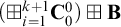 .
.
(iii) Suppose that  for some $n\in \mathbb {N}$
. We prove the claim by induction on m. First note that, since
$n\in \mathbb {N}$
. We prove the claim by induction on m. First note that, since $\mathbf {{G}}_m$
is a homomorphic image of
$\mathbf {{G}}_m$
is a homomorphic image of  , it suffices to show that
  for each $m\in \mathbb {N}$
. For
$m\in \mathbb {N}$
. For $m=1$
, note that
$m=1$
, note that  is a subalgebra of
  . Suppose that the claim holds for $m\in \mathbb {N}^{>0}$
, i.e.,
$m\in \mathbb {N}^{>0}$
, i.e.,  . We consider the span of embeddings
  ,
, $i_1(x) = x$
and
$i_1(x) = x$
and  ,
, $i_2(b_1) = b_m$
,
$i_2(b_1) = b_m$
, $i_2(x) = x$
for
$i_2(x) = x$
for $x\neq b_1$
. Then there exists an algebra
$x\neq b_1$
. Then there exists an algebra $\mathbf {{D}} \in \mathsf {V}^{\mathrm {c}}_{\mathrm {fin}}$
, an embedding
$\mathbf {{D}} \in \mathsf {V}^{\mathrm {c}}_{\mathrm {fin}}$
, an embedding 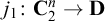 , and a homomorphism
  such that $j_1\circ i_1 = j_2 \circ i_2$
. Let
$j_1\circ i_1 = j_2 \circ i_2$
. Let $S = \operatorname {\mathrm {im}}(j_1) \cup \operatorname {\mathrm {im}}(j_2)$
. Then
$S = \operatorname {\mathrm {im}}(j_1) \cup \operatorname {\mathrm {im}}(j_2)$
. Then $\textrm {e}\in S$
and S is closed under
$\textrm {e}\in S$
and S is closed under ${ }^\star $
, by construction. Hence, by Lemma 3.4, it is the universe of a subalgebra
${ }^\star $
, by construction. Hence, by Lemma 3.4, it is the universe of a subalgebra $\mathbf {{S}}$
of
$\mathbf {{S}}$
of $\mathbf {{D}}$
. Since
$\mathbf {{D}}$
. Since $j_2$
restricts to an embedding on
$j_2$
restricts to an embedding on  , by Lemma 3.1, it is also an embedding and we get $j_2(b_1) < \dots < j_2(b_m) = j_1(b_1) < j_1(b_2)$
and
$j_2(b_1) < \dots < j_2(b_m) = j_1(b_1) < j_1(b_2)$
and $j_1(a_i) = j_2(a_i)$
for each
$j_1(a_i) = j_2(a_i)$
for each $i\in \{ 1,\dots ,n \}$
. It follows that
$i\in \{ 1,\dots ,n \}$
. It follows that $\mathbf {{S}}$
is isomorphic to
$\mathbf {{S}}$
is isomorphic to  .
.
(iv) The proof is very similar to (iii).
(v) Suppose that  for some $m,n \in \mathbb {N}$
and consider the span of inclusions
$m,n \in \mathbb {N}$
and consider the span of inclusions 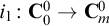 ,
, $i_1(x) = x$
and
$i_1(x) = x$
and 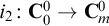 ,
, $i_2(x) = x$
. Then there exists an algebra
$i_2(x) = x$
. Then there exists an algebra $\mathbf {{D}} \in \mathsf {V}^{\mathrm {c}}_{\mathrm {fin}}$
, an embedding
$\mathbf {{D}} \in \mathsf {V}^{\mathrm {c}}_{\mathrm {fin}}$
, an embedding 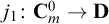 , and a homomorphism
 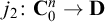 such that $j_1\circ i_1 = j_2 \circ i_2$
. Let
$j_1\circ i_1 = j_2 \circ i_2$
. Let $S = \operatorname {\mathrm {im}}(j_1) \cup \operatorname {\mathrm {im}}(j_2)$
. Then
$S = \operatorname {\mathrm {im}}(j_1) \cup \operatorname {\mathrm {im}}(j_2)$
. Then $\textrm {e}\in S$
and S is closed under
$\textrm {e}\in S$
and S is closed under ${ }^\star $
, by construction. Hence, by Lemma 3.4, it is the universe of a subalgebra
${ }^\star $
, by construction. Hence, by Lemma 3.4, it is the universe of a subalgebra $\mathbf {{S}}$
of
$\mathbf {{S}}$
of $\mathbf {{D}}$
. Since
$\mathbf {{D}}$
. Since $j_2$
restricts to an embedding on
$j_2$
restricts to an embedding on  , by Lemma 3.1, it is also an embedding, so $\mathbf {{S}}$
is isomorphic to
$\mathbf {{S}}$
is isomorphic to  .
.
(vi) Suppose that  and
and  .We consider the span of inclusions
  ,
, $i_1(x) = x$
and
$i_1(x) = x$
and 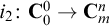 ,
, $i_2(x) = x$
. Then there exists an algebra
$i_2(x) = x$
. Then there exists an algebra $\mathbf {{D}} \in \mathsf {V}^{\mathrm {c}}_{\mathrm {fin}}$
, an embedding
$\mathbf {{D}} \in \mathsf {V}^{\mathrm {c}}_{\mathrm {fin}}$
, an embedding  , and a homomorphism
  such that $j_1\circ i_1 = j_2 \circ i_2$
. Let
$j_1\circ i_1 = j_2 \circ i_2$
. Let $S = \operatorname {\mathrm {im}}(j_1) \cup \operatorname {\mathrm {im}}(j_2)$
. Then
$S = \operatorname {\mathrm {im}}(j_1) \cup \operatorname {\mathrm {im}}(j_2)$
. Then $\textrm {e}\in S$
and S is closed under
$\textrm {e}\in S$
and S is closed under ${ }^\star $
, by construction. Hence, by Lemma 3.4, it is the universe of a subalgebra
${ }^\star $
, by construction. Hence, by Lemma 3.4, it is the universe of a subalgebra $\mathbf {{S}}$
of
$\mathbf {{S}}$
of $\mathbf {{D}}$
. Since
$\mathbf {{D}}$
. Since $j_2$
restricts to an embedding on
$j_2$
restricts to an embedding on  , by Lemma 3.1, it is also an embedding and it is straightforward to check that $\mathbf {{S}}$
is isomorphic to
$\mathbf {{S}}$
is isomorphic to  .
.
(vii) Suppose that $\mathbf {{A}} \boxplus \mathbf {{G}}_1 \in \mathsf {V}^{\mathrm {c}}_{\mathrm {fin}}$
and
$\mathbf {{A}} \boxplus \mathbf {{G}}_1 \in \mathsf {V}^{\mathrm {c}}_{\mathrm {fin}}$
and $\mathbf {{G}}_p \in \mathsf { V}^{\mathrm {c}}_{\mathrm {fin}}$
. For
$\mathbf {{G}}_p \in \mathsf { V}^{\mathrm {c}}_{\mathrm {fin}}$
. For $p=1$
, there is nothing to prove, so we may assume that
$p=1$
, there is nothing to prove, so we may assume that $p>1$
. Consider the span of embeddings
$p>1$
. Consider the span of embeddings $i_1\colon \mathbf {{G}}_1 \to \mathbf {{G}}_p$
,
$i_1\colon \mathbf {{G}}_1 \to \mathbf {{G}}_p$
, $i_1(x) = x$
and
$i_1(x) = x$
and $i_2 \colon \mathbf {{G}}_1 \to \mathbf {{A}} \boxplus \mathbf {{G}}_1$
,
$i_2 \colon \mathbf {{G}}_1 \to \mathbf {{A}} \boxplus \mathbf {{G}}_1$
, $i_2(x) = x$
. Then there exists an algebra
$i_2(x) = x$
. Then there exists an algebra $\mathbf {{D}} \in \mathsf {V}^{\mathrm {c}}_{\mathrm {fin}}$
, an embedding
$\mathbf {{D}} \in \mathsf {V}^{\mathrm {c}}_{\mathrm {fin}}$
, an embedding $j_1 \colon \mathbf { {G}}_p \to \mathbf {{D}}$
, and a homomorphism
$j_1 \colon \mathbf { {G}}_p \to \mathbf {{D}}$
, and a homomorphism $j_2 \colon \mathbf {{A}} \boxplus \mathbf {{G}}_1 \to \mathbf {{D}}$
such that
$j_2 \colon \mathbf {{A}} \boxplus \mathbf {{G}}_1 \to \mathbf {{D}}$
such that $j_1\circ i_1 = j_2 \circ i_2$
. Let
$j_1\circ i_1 = j_2 \circ i_2$
. Let $S = \operatorname {\mathrm {im}}(j_1) \cup \operatorname {\mathrm {im}}(j_2)$
. Then
$S = \operatorname {\mathrm {im}}(j_1) \cup \operatorname {\mathrm {im}}(j_2)$
. Then $\textrm {e}\in S$
and S is closed under
$\textrm {e}\in S$
and S is closed under ${ }^\star $
, by construction. Hence, by Lemma 3.4, it is the universe of a subalgebra
${ }^\star $
, by construction. Hence, by Lemma 3.4, it is the universe of a subalgebra $\mathbf {{S}}$
of
$\mathbf {{S}}$
of $\mathbf {{D}}$
. Moreover, since
$\mathbf {{D}}$
. Moreover, since $j_2$
restricts to an embedding on
$j_2$
restricts to an embedding on $\mathbf {{G}}_1$
, by Lemma 3.1, it is also an embedding and it is easy to check that
$\mathbf {{G}}_1$
, by Lemma 3.1, it is also an embedding and it is easy to check that $\mathbf {{S}}$
is isomorphic to
$\mathbf {{S}}$
is isomorphic to $\mathbf {{A}} \boxplus \mathbf {{G}}_p$
.
$\mathbf {{A}} \boxplus \mathbf {{G}}_p$
.
We finally arrive at the proof of part (i) of Theorem B, recalling that part (ii) and Theorem C follow directly from this result.
Proof of Theorem B(i)
Let $\mathsf {V}$
be a variety of commutative idempotent semilinear residuated lattices that has the amalgamation property. It suffices to show that
$\mathsf {V}$
be a variety of commutative idempotent semilinear residuated lattices that has the amalgamation property. It suffices to show that $\mathsf {V}$
is one of the varieties from Proposition 5.9. Let
$\mathsf {V}$
is one of the varieties from Proposition 5.9. Let $\mathsf {K} = \mathsf { V}^{\mathrm {c}}_{\mathrm {fin}}$
. We make a case distinction on whether algebras from the set
$\mathsf {K} = \mathsf { V}^{\mathrm {c}}_{\mathrm {fin}}$
. We make a case distinction on whether algebras from the set  are contained in $\mathsf {K}$
, noting that
$\mathsf {K}$
, noting that $\mathbf {{G}}_1 \leq \mathbf {{G}}_2$
,
$\mathbf {{G}}_1 \leq \mathbf {{G}}_2$
, 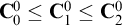 ,
, 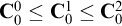 ,
,  ,
,  , and
, and 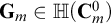 , by Lemma 5.10.
If  , then
  , yielding
  . So we may assume that
  and let
  , assuming $\sup \mathbb {N} = \omega $
. As n is fixed, our strategy is to show that
$\sup \mathbb {N} = \omega $
. As n is fixed, our strategy is to show that $\mathsf {K}$
is one of the classes in the posets in Figures 4 and 5. The two subsequent case distinctions traverse these posets starting at the top.
$\mathsf {K}$
is one of the classes in the posets in Figures 4 and 5. The two subsequent case distinctions traverse these posets starting at the top.
For 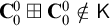 , there are 11 cases (see Figure 4):
-
1. If
, then , by Lemma 5.11, yielding . -
2. If
and , then , by Lemma 5.11, yielding . -
3. If
and , then , by Lemma 5.11, yielding . -
4. If
and , then , by Lemma 5.11, yielding . -
5. If
and , then , by Lemma 5.11, yielding . -
6. If
, then , by Lemma 5.11, yielding . -
7. If
and , then , by Lemma 5.11, yielding . -
8. If
and , then , by Lemma 5.11, yielding . -
9. If
and
$\mathbf {{G}}_2 \in \mathsf {K}$
, then , by Lemma 5.11, yielding . -
10. If
and , then , by Lemma 5.11, yielding . -
11. If
and
$ \mathbf {{G}}_1 \in \mathsf {K}$
, then , by Lemma 5.11, yielding .
 , then
  , by Lemma
  .
. and
and  , then
  , by Lemma
  .
. and
and 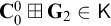 , then
 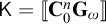 , by Lemma
  .
. and
and  , then
  , by Lemma
  .
. and
and 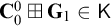 , then
  , by Lemma
  .
. , then
 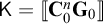 , by Lemma
  .
. and
and  , then
  , by Lemma
  .
. and
and  , then
  , by Lemma
  .
. and
and 
 , by Lemma
  .
. and
and  , then
  , by Lemma
  .
. and
and 
 , by Lemma
  .
.For  , there are another 8 cases (see Figure 5):
-
1. If
, then , by Lemma 5.11, yielding . -
2. If
and , then , by Lemma 5.11, yielding . -
3. If
and , then , by Lemma 5.11, yielding . -
4. If
and , then , by Lemma 5.11, yielding . -
5. If
and , then , by Lemma 5.11, yielding . -
6. If
, then , by Lemma 5.11, yielding . -
7. If
and
$\mathbf {{G}}_2 \in \mathsf {K}$
, then , by Lemma 5.11, yielding . -
8. If
and
$ \mathbf {{G}}_1 \in \mathsf {K}$
, then , by Lemma 5.11, yielding .
 , then
  , by Lemma
  .
. and
and  , then
  , by Lemma
  .
. and
and 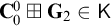 , then
  , by Lemma
  .
. and
and  , then
  , by Lemma
  .
. and
and  , then
  , by Lemma
  .
. , then
  , by Lemma
  .
. and
and 
 , by Lemma
  .
. and
and 
 , by Lemma
  .
. We conclude this section by considering amalgamation in the setting of pointed residuated lattices, i.e., without the additional assumption that $\textrm {e}\approx \textrm {f}$
. There are many additional cases to consider in this more general setting, and we just sketch the key ideas here. Let
$\textrm {e}\approx \textrm {f}$
. There are many additional cases to consider in this more general setting, and we just sketch the key ideas here. Let $\mathsf {V}$
be a variety of commutative idempotent semilinear pointed residuated lattices. Again, it is enough to consider the class
$\mathsf {V}$
be a variety of commutative idempotent semilinear pointed residuated lattices. Again, it is enough to consider the class $\mathsf {V}^{\mathrm {c}}_{\mathrm {fin}}$
of the finite totally ordered members of
$\mathsf {V}^{\mathrm {c}}_{\mathrm {fin}}$
of the finite totally ordered members of $\mathsf {V}$
. For each algebra
$\mathsf {V}$
. For each algebra $({A, \mathbin {\land }, \mathbin {\lor }, \cdot , \to , \textrm {e}, \textrm {f}}) =\mathbf {{A}} \in \mathsf {V}^{\mathrm {c}}_{\mathrm {fin}}$
one of the following six conditions holds:
$({A, \mathbin {\land }, \mathbin {\lor }, \cdot , \to , \textrm {e}, \textrm {f}}) =\mathbf {{A}} \in \mathsf {V}^{\mathrm {c}}_{\mathrm {fin}}$
one of the following six conditions holds:
-
1.
$\textrm {f}$
is on the Sugihara skeleton of
$\mathbf {{A}}$
and-
(a)
$\textrm {f} = \textrm {e}$
in
$\mathbf {{A}}$
, or -
(b)
$\textrm {f} < \textrm {e}$
in
$\mathbf {{A}}$
, or -
(c)
$\textrm {f}> \textrm {e}$
in
$\mathbf {{A}}$
.
-
-
2.
$\textrm {f}$
is not on the Sugihara skeleton of
$\mathbf {{A}}$
and-
(a)
$\textrm {f} < \textrm {e}$
and
${\textrm {f}}^\star = \textrm {e}$
in
$\mathbf {{A}}$
, or -
(b)
$\textrm {f} < \textrm {e}$
and
${\textrm {f}}^\star> \textrm {e}$
in
$\mathbf {{A}}$
, or -
(c)
$\textrm {f}>\textrm {e}$
in
$\mathbf {{A}}$
.
-


For $i \in \{ 1,2 \}$
and
$i \in \{ 1,2 \}$
and $x \in \{ \text {a},\text {b},\text {c} \}$
, we define the class
$x \in \{ \text {a},\text {b},\text {c} \}$
, we define the class
 $$\begin{align*}\mathsf{V}_{i(x)} := \{ \mathbf{{A}} \in \mathsf{V}^{\mathrm{c}}_{\mathrm{fin}} \mid \mathbf{{A}} \text{ satisfies condition } i.(x) \}. \end{align*}$$
Note that $\mathcal {P}_{\mathsf {V}} := \{ \mathsf {V}_{i(x)}\mid i \in \{ 1,2 \},\, x \in \{ \text {a},\text {b},\text {c} \} \}$
forms a partition of
$\mathcal {P}_{\mathsf {V}} := \{ \mathsf {V}_{i(x)}\mid i \in \{ 1,2 \},\, x \in \{ \text {a},\text {b},\text {c} \} \}$
forms a partition of $\mathsf {V}^{\mathrm {c}}_{\mathrm {fin}}$
such that no algebra from one class embeds into an algebra from another class, since the conditions are preserved by embeddings. Hence, to check if
$\mathsf {V}^{\mathrm {c}}_{\mathrm {fin}}$
such that no algebra from one class embeds into an algebra from another class, since the conditions are preserved by embeddings. Hence, to check if $\mathsf {V}$
has the amalgamation property, it suffices to check if each of the classes in
$\mathsf {V}$
has the amalgamation property, it suffices to check if each of the classes in $\mathcal {P}_{\mathsf {V}}$
has the one-sided amalgamation property. In particular, to show that there are only finitely many varieties of commutative idempotent semilinear pointed residuated lattices with the amalgamation property, it suffices to show that there are only finitely many possibilities for
$\mathcal {P}_{\mathsf {V}}$
has the one-sided amalgamation property. In particular, to show that there are only finitely many varieties of commutative idempotent semilinear pointed residuated lattices with the amalgamation property, it suffices to show that there are only finitely many possibilities for $\mathcal {P}_{\mathsf {V}}$
such that each class in
$\mathcal {P}_{\mathsf {V}}$
such that each class in $\mathcal {P}_{\mathsf {V}}$
has the one-sided amalgamation property. Let
$\mathcal {P}_{\mathsf {V}}$
has the one-sided amalgamation property. Let $\mathbf {{A}}$
be a pointed residuated lattice and
$\mathbf {{A}}$
be a pointed residuated lattice and $\mathbf {{B}}$
a residuated lattice. We will write
$\mathbf {{B}}$
a residuated lattice. We will write $\mathbf {{A}} \simeq \mathbf {{B}}$
if
$\mathbf {{A}} \simeq \mathbf {{B}}$
if $\mathbf {{B}}$
is (isomorphic to) the
$\mathbf {{B}}$
is (isomorphic to) the $\textrm {f}$
-free reduct of
$\textrm {f}$
-free reduct of $\mathbf {{A}}$
.
$\mathbf {{A}}$
.
For $i \in \{ 1, 2 \}$
and
$i \in \{ 1, 2 \}$
and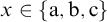 $x \in \{ \text {a},\text {b},\text {c} \}$
, we define
$x \in \{ \text {a},\text {b},\text {c} \}$
, we define $\mathbf {{S}}_{i(x)}$
to be the smallest commutative idempotent residuated chain satisfying
$\mathbf {{S}}_{i(x)}$
to be the smallest commutative idempotent residuated chain satisfying $i.(x)$
. Note that
$i.(x)$
. Note that $\mathbf {{S}}_{i(x)}$
is well-defined and for each algebra
$\mathbf {{S}}_{i(x)}$
is well-defined and for each algebra $\mathbf {{A}}$
satisfying
$\mathbf {{A}}$
satisfying $i.(x)$
we have that
$i.(x)$
we have that $\mathbf {{S}}_{i(x)}$
is isomorphic to the subalgebra of
$\mathbf {{S}}_{i(x)}$
is isomorphic to the subalgebra of $\mathbf {{A}}$
generated by
$\mathbf {{A}}$
generated by $\textrm {f}$
. In fact, the algebra
$\textrm {f}$
. In fact, the algebra $\mathbf {{S}}_{1(\text {a})}$
is just a trivial algebra,
$\mathbf {{S}}_{1(\text {a})}$
is just a trivial algebra,  with
with $\textrm {f} = b_0$
, and
$\textrm {f} = b_0$
, and  with
with $\textrm {f} = a_0$
. Moreover,
$\textrm {f} = a_0$
. Moreover, $\mathbf {{S}}_{2(\text {a})} \simeq \mathbf {{G}}_1$
with
$\mathbf {{S}}_{2(\text {a})} \simeq \mathbf {{G}}_1$
with $\textrm {f} \simeq c_1$
,
$\textrm {f} \simeq c_1$
,  with
with $\textrm {f} = b_1$
, and
$\textrm {f} = b_1$
, and  with
with $\textrm {f} = a_1$
.
$\textrm {f} = a_1$
.
In what follows, the nested sums $\mathbf {{A}}\boxplus \mathbf {{B}}$
and
$\mathbf {{A}}\boxplus \mathbf {{B}}$
and $\mathbf {{B}}\boxplus \mathbf {{A}}$
of an idempotent pointed residuated chain
$\mathbf {{B}}\boxplus \mathbf {{A}}$
of an idempotent pointed residuated chain $\mathbf {{A}}$
with an idempotent residuated chain
$\mathbf {{A}}$
with an idempotent residuated chain $\mathbf {{B}}$
are understood in the obvious way, i.e., as the nested sum of the
$\mathbf {{B}}$
are understood in the obvious way, i.e., as the nested sum of the $\textrm {f}$
-free reducts of
$\textrm {f}$
-free reducts of $\mathbf {{A}}$
and
$\mathbf {{A}}$
and $\mathbf {{B}}$
with constant
$\mathbf {{B}}$
with constant $\textrm {f}$
from
$\textrm {f}$
from $\mathbf {{A}}$
.
$\mathbf {{A}}$
.
Lemma 5.12. Let $\mathsf {V}$
be a variety of commutative idempotent semilinear pointed residuated lattices with the amalgamation property.
$\mathsf {V}$
be a variety of commutative idempotent semilinear pointed residuated lattices with the amalgamation property.
-
(i) Let
$i \in \{ 1,2 \}$
,
$x \in \{ \text {b},\text {c} \}$
. If
$\mathbf {{A}}$
is a commutative idempotent pointed residuated chain that satisfies condition
$i.(x)$
, then
$\mathbf {{A}}$
is of the form
$\mathbf {{A}}_1 \boxplus \mathbf {{A}}_2 \boxplus \mathbf { {A}}_3$
with
$\textrm {f} \in A_2$
and . Moreover,
$\mathbf {{A}} \in \mathsf {V}_{i(x)}$
if and only if
$\mathbf {{A}}_1 \boxplus \mathbf {{S}}_{i(x)} \in \mathsf {V}_{i(x)}$
,
$\mathbf {{A}}_2 \in \mathsf {V}_{i(x)}$
, and
$\mathbf {{S}}_{i(x)} \boxplus \mathbf {{A}}_3 \in \mathsf {V}_{i(x)}$
. -
(ii) If
$\mathbf {{A}}$
is a commutative idempotent pointed residuated chain that satisfies condition
$2.({\text {a}})$
, then
$\mathbf { {A}}$
is of the form
$\mathbf {{A}}_1 \boxplus \mathbf {{A}}_2$
with
$\textrm {f} \in A_2$
and
$\mathbf {{A}}_2 \simeq \mathbf {{G}}_p$
for some
$p>0$
. Moreover,
$\mathbf {{A}} \in \mathsf {V}_{2(\text {a})}$
if and only if
$\mathbf {{A}}_1 \boxplus \mathbf {{S}}_{2(\text {a})} \in \mathsf {V}_{2(\text {a})}$
and
$\mathbf {{A}}_2 \in \mathsf {V}_{2( \text {a} )}$
.




 . Moreover,







Proof. The first parts of (i) and (ii) follow from Lemma 3.10 applied to the $\textrm {f}$
-free reducts. For the second parts, the left-to-right directions are trivial and the proof of the right-to-left directions is very similar to the proof of Lemma 5.11.
$\textrm {f}$
-free reducts. For the second parts, the left-to-right directions are trivial and the proof of the right-to-left directions is very similar to the proof of Lemma 5.11.
Let $\mathsf {SemFL_{ecm}}$
be the axiomatic extension of
$\mathsf {SemFL_{ecm}}$
be the axiomatic extension of $\mathsf {FL_{ecm}}$
associated with the variety of commutative idempotent semilinear pointed residuated lattices.
$\mathsf {FL_{ecm}}$
associated with the variety of commutative idempotent semilinear pointed residuated lattices.
Proposition 5.13.
-
(i) There are only finitely many varieties of commutative idempotent semilinear pointed residuated lattices that have the amalgamation property.
-
(ii) There are only finitely many axiomatic extensions of
$\mathsf {SemFL_{ecm}}$
with the deductive interpolation property.

Proof sketch
(i) Let $\mathsf {V}$
be a variety of commutative idempotent semilinear pointed residuated lattices that has the amalgamation property. By the above discussion, it suffices to show that there are only finitely many possibilities for
$\mathsf {V}$
be a variety of commutative idempotent semilinear pointed residuated lattices that has the amalgamation property. By the above discussion, it suffices to show that there are only finitely many possibilities for $\mathcal {P}_{\mathsf {V}} = \{ \mathsf { V}_{i(x)}\mid i \in \{ 1,2 \},\, x \in \{ \text {a},\text {b},\text {c} \} \}$
such that each class has the one-sided amalgamation property. For
$\mathcal {P}_{\mathsf {V}} = \{ \mathsf { V}_{i(x)}\mid i \in \{ 1,2 \},\, x \in \{ \text {a},\text {b},\text {c} \} \}$
such that each class has the one-sided amalgamation property. For $\mathsf {V}_{1(\text {a})}$
, we have already classified all 60 possibilities.
$\mathsf {V}_{1(\text {a})}$
, we have already classified all 60 possibilities.
For $i \in \{ 1,2 \}$
and
$i \in \{ 1,2 \}$
and $x \in \{ \text {b},\text {c} \}$
, by Lemma 5.12(i), it is enough to separately classify which algebras of the form
$x \in \{ \text {b},\text {c} \}$
, by Lemma 5.12(i), it is enough to separately classify which algebras of the form  , and
, and $\mathbf { {S}}_{i(x)} \boxplus \mathbf {{A}}_3$
are contained in
$\mathbf { {S}}_{i(x)} \boxplus \mathbf {{A}}_3$
are contained in $\mathsf {V}_{i(x)}$
. First we notice that, by adapting the proof of Lemma 5.11, there are essentially the same 60 possibilities for the class
$\mathsf {V}_{i(x)}$
. First we notice that, by adapting the proof of Lemma 5.11, there are essentially the same 60 possibilities for the class $\{ \mathbf {{A}} \in \mathsf {V}_{i(x)}\mid \mathbf {{A}} \cong \mathbf {{S}}_{i(x)} \boxplus \mathbf {{A}}_3 \}$
as in the case where
$\{ \mathbf {{A}} \in \mathsf {V}_{i(x)}\mid \mathbf {{A}} \cong \mathbf {{S}}_{i(x)} \boxplus \mathbf {{A}}_3 \}$
as in the case where $\textrm {e}\approx \textrm {f}$
, and similarly for the class
$\textrm {e}\approx \textrm {f}$
, and similarly for the class $\{ \mathbf {{A}} \in \mathsf {V}_{i(x)}\mid \mathbf {{A}} \cong \mathbf {{A}}_1 \boxplus \mathbf {{S}}_{i(x)} \} $
. Moreover, it can be shown by using similarFootnote
4
closure properties as in Lemma 5.11 that there are only finitely many possibilities for the class
$\{ \mathbf {{A}} \in \mathsf {V}_{i(x)}\mid \mathbf {{A}} \cong \mathbf {{A}}_1 \boxplus \mathbf {{S}}_{i(x)} \} $
. Moreover, it can be shown by using similarFootnote
4
closure properties as in Lemma 5.11 that there are only finitely many possibilities for the class  . Hence for $i \in \{ 1,2 \}$
and
$i \in \{ 1,2 \}$
and $x \in \{ \text {b},\text {c} \}$
, there are only finitely many possibilities for
$x \in \{ \text {b},\text {c} \}$
, there are only finitely many possibilities for $\mathsf {V}_{i(x)}$
.
$\mathsf {V}_{i(x)}$
.
For $i= 2$
and
$i= 2$
and $x=\text {a}$
, note that, by Lemma 5.12(ii), it is enough to separately classify which algebras of the form
$x=\text {a}$
, note that, by Lemma 5.12(ii), it is enough to separately classify which algebras of the form $\mathbf {{A}}_1 \boxplus \mathbf {{S}}_{2(\text {a})}$
and which algebras
$\mathbf {{A}}_1 \boxplus \mathbf {{S}}_{2(\text {a})}$
and which algebras $\mathbf {{A}}_2$
with
$\mathbf {{A}}_2$
with $\mathbf {{A}}_2 \simeq \mathbf { {G}}_p$
and
$\mathbf {{A}}_2 \simeq \mathbf { {G}}_p$
and $p>1$
are contained in
$p>1$
are contained in $\mathsf {V}_{2(\text {a})}$
. As above, it follows that for the class
$\mathsf {V}_{2(\text {a})}$
. As above, it follows that for the class $\{ \mathbf {{A}} \in \mathsf { V}_{2(\text {a})} \mid \mathbf {{A}} \cong \mathbf {{A}}_1 \boxplus \mathbf {{S}}_{2(\text {a})} \}$
, there are at most 60 possibilities and for the class
$\{ \mathbf {{A}} \in \mathsf { V}_{2(\text {a})} \mid \mathbf {{A}} \cong \mathbf {{A}}_1 \boxplus \mathbf {{S}}_{2(\text {a})} \}$
, there are at most 60 possibilities and for the class $\{ \mathbf {{A}} \in \mathsf {V}_{2(\text {a})} \mid \mathbf {{A}} \simeq \mathbf {{G}}_p \text { for some } p>1 \}$
it can again be shown using similar closure properties as in Lemma 5.11 that there are only finitely many possibilities. Hence there are only finitely many possibilities for
$\{ \mathbf {{A}} \in \mathsf {V}_{2(\text {a})} \mid \mathbf {{A}} \simeq \mathbf {{G}}_p \text { for some } p>1 \}$
it can again be shown using similar closure properties as in Lemma 5.11 that there are only finitely many possibilities. Hence there are only finitely many possibilities for $\mathsf {V}_{2(\text {a})}$
.
$\mathsf {V}_{2(\text {a})}$
.
Part (ii) then follows from the fact that the variety of commutative idempotent semilinear pointed residuated lattices is an equivalent algebraic semantics for $\mathsf {SemFL_{ecm}}$
.
$\mathsf {SemFL_{ecm}}$
.
If we let 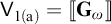 with
with $\textrm {f}$
interpreted as
$\textrm {f}$
interpreted as $\textrm {e}$
and let
$\textrm {e}$
and let $\mathsf {V}_{2(\text {a})}$
be the class of all commutative idempotent pointed residuated chains
$\mathsf {V}_{2(\text {a})}$
be the class of all commutative idempotent pointed residuated chains $\mathbf { {A}}$
with
$\mathbf { {A}}$
with $\mathbf {{A}} \simeq \mathbf {{G}}_p$
for some
$\mathbf {{A}} \simeq \mathbf {{G}}_p$
for some $p\in \mathbb {N}$
that satisfy
$p\in \mathbb {N}$
that satisfy $2.(\text {a})$
, then there are at least 60 choices for
$2.(\text {a})$
, then there are at least 60 choices for $\mathsf {V}_{1(\text {b})}$
, 60 choices for
$\mathsf {V}_{1(\text {b})}$
, 60 choices for $\mathsf {V}_{1(\text {c})}$
, 60 choices for
$\mathsf {V}_{1(\text {c})}$
, 60 choices for $\mathsf {V}_{2(\text {b})}$
, and 60 choices for
$\mathsf {V}_{2(\text {b})}$
, and 60 choices for $\mathsf {V}_{2(\text {c})}$
such that the obtained classes together form
$\mathsf {V}_{2(\text {c})}$
such that the obtained classes together form $\mathcal {P}_{\mathsf {V}}$
for some variety
$\mathcal {P}_{\mathsf {V}}$
for some variety $\mathsf { V}$
that has the amalgamation property. That there are 60 choices in each case follows by considering the cases where all chains in the respective class are of the form
$\mathsf { V}$
that has the amalgamation property. That there are 60 choices in each case follows by considering the cases where all chains in the respective class are of the form $\mathbf {{S}}_{i(x)} \boxplus \mathbf {{A}}$
, where at least 60 suitable choices for classes of algebras
$\mathbf {{S}}_{i(x)} \boxplus \mathbf {{A}}$
, where at least 60 suitable choices for classes of algebras $\mathbf {{A}}$
may be found, as in the case for
$\mathbf {{A}}$
may be found, as in the case for $\textrm {e}\approx \textrm {f}$
. That these choices actually form
$\textrm {e}\approx \textrm {f}$
. That these choices actually form $\mathcal {P}_{\mathsf {V}}$
for some variety
$\mathcal {P}_{\mathsf {V}}$
for some variety $\mathsf {V}$
follows from the fact that a homomorphic image of an algebra of the form
$\mathsf {V}$
follows from the fact that a homomorphic image of an algebra of the form $\mathbf {{S}}_{i(x)} \boxplus \mathbf {{A}}$
for
$\mathbf {{S}}_{i(x)} \boxplus \mathbf {{A}}$
for $x\in \{ \text {b},\text {c} \}$
will always be either contained again in
$x\in \{ \text {b},\text {c} \}$
will always be either contained again in $\mathsf {V}_{i(x)}$
, in
$\mathsf {V}_{i(x)}$
, in $\mathsf {V}_{1(\text {a})}$
, or in
$\mathsf {V}_{1(\text {a})}$
, or in $\mathsf {V}_{2(\text {a})}$
. Finally, to show that these classes all have the one-sided amalgamation property follows analogously as in the case where
$\mathsf {V}_{2(\text {a})}$
. Finally, to show that these classes all have the one-sided amalgamation property follows analogously as in the case where $\textrm {e}\approx \textrm {f}$
. Hence we obtain the following result:
$\textrm {e}\approx \textrm {f}$
. Hence we obtain the following result:
Proposition 5.14.
-
(i) There are at least
$60^4> 12,000,000$
varieties of commutative idempotent semilinear pointed residuated lattices that have the amalgamation property. -
(ii) There are at least
$60^4> 12,000,000$
axiomatic extensions of
$\mathsf {SemFL_{ecm}}$
with the deductive interpolation property.



A The full Lambek calculus
We restrict our attention in this appendix to formulas constructed over a countably infinite set of variables using the binary operation symbols $\mathbin {\land },\mathbin {\lor },\cdot ,\backslash ,/$
and constants
$\mathbin {\land },\mathbin {\lor },\cdot ,\backslash ,/$
and constants $\textrm {e},\textrm {f}$
, and define a sequent to be an ordered pair consisting of a finite sequence
$\textrm {e},\textrm {f}$
, and define a sequent to be an ordered pair consisting of a finite sequence $\mathrm {\Gamma }$
of formulas and a sequence
$\mathrm {\Gamma }$
of formulas and a sequence $\mathrm {\Delta }$
of at most one formula, denoted by
$\mathrm {\Delta }$
of at most one formula, denoted by $\mathrm {\Gamma }{\vphantom {A}\Rightarrow {\vphantom {A}}}\mathrm {\Delta }$
. Concatenations of finite sequences are denoted using commas, and empty sequences by an empty space. The full Lambek calculus
$\mathrm {\Gamma }{\vphantom {A}\Rightarrow {\vphantom {A}}}\mathrm {\Delta }$
. Concatenations of finite sequences are denoted using commas, and empty sequences by an empty space. The full Lambek calculus $\mathsf {FL}$
displayed in Figure A1 consists of a set of sequent rules presented schematically, where the (indexed) symbols
$\mathsf {FL}$
displayed in Figure A1 consists of a set of sequent rules presented schematically, where the (indexed) symbols $\mathrm {\Gamma }$
and
$\mathrm {\Gamma }$
and $\Pi $
stand for arbitrary finite sequences of formulas,
$\Pi $
stand for arbitrary finite sequences of formulas, $\mathrm {\Delta }$
for an arbitrary sequence of at most one formula, and
$\mathrm {\Delta }$
for an arbitrary sequence of at most one formula, and $\alpha $
and
$\alpha $
and $\beta $
for arbitrary formulas. Further well-studied sequent calculi are obtained by adding the basic structural rules of exchange (e), weakening (i) and (o), contraction (c), and mingle (m), depicted in Figure 1.
$\beta $
for arbitrary formulas. Further well-studied sequent calculi are obtained by adding the basic structural rules of exchange (e), weakening (i) and (o), contraction (c), and mingle (m), depicted in Figure 1.
The full Lambek calculus $\mathsf {FL}$
.
$\mathsf {FL}$
.

A derivation in a sequent calculus $\mathsf {C}$
of a sequent S from a set of sequents R is a finite tree of sequents with root S such that each node is either a member of R or constructed from its parent nodes using a rule of
$\mathsf {C}$
of a sequent S from a set of sequents R is a finite tree of sequents with root S such that each node is either a member of R or constructed from its parent nodes using a rule of $\mathsf {C}$
. Given a set of formulas
$\mathsf {C}$
. Given a set of formulas $T\cup \{ \alpha \}$
, we write
$T\cup \{ \alpha \}$
, we write $T\vdash _{{\mathsf {C}}}\alpha $
if there exists a derivation of
$T\vdash _{{\mathsf {C}}}\alpha $
if there exists a derivation of ${\vphantom {A}\Rightarrow {\vphantom {A}}}\alpha $
from the set of sequents
${\vphantom {A}\Rightarrow {\vphantom {A}}}\alpha $
from the set of sequents $\{ {\vphantom {A}\Rightarrow {\vphantom {A}}}\beta \mid \beta \in T \}$
. In the case of
$\{ {\vphantom {A}\Rightarrow {\vphantom {A}}}\beta \mid \beta \in T \}$
. In the case of $\mathsf {FL}$
and its extensions with basic structural rules, the relation
$\mathsf {FL}$
and its extensions with basic structural rules, the relation $\vdash _{{\mathsf {C}}}$
is a deductive system: a relation
$\vdash _{{\mathsf {C}}}$
is a deductive system: a relation $\vdash _{\mathsf {}}$
between sets of formulas and formulas that satisfies, for any set of formulas
$\vdash _{\mathsf {}}$
between sets of formulas and formulas that satisfies, for any set of formulas $T\cup T'\cup \{ \alpha \}$
:
$T\cup T'\cup \{ \alpha \}$
:
-
1. if
$\alpha \in T$
, then
$T\vdash _{\mathsf {}}\alpha $
; -
2. if
$T\vdash _{\mathsf {}}\alpha $
and
$T'\vdash _{\mathsf {}}\beta $
for every
$\beta \in T$
, then
$T'\vdash _{\mathsf {}}\alpha $
; -
3. if
$T\vdash _{\mathsf {}}\alpha $
, then
$\sigma [T]\vdash _{\mathsf {}}\sigma (\alpha )$
for any substitution
$\sigma $
; -
4. if
$T\vdash _{\mathsf {}}\alpha $
, then there exists a finite
$T_0\subseteq T$
such that
$T_0\vdash _{\mathsf {}}\alpha $
.


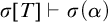


Moreover, it is common, when no confusion may occur, to denote by $\mathsf {C}$
the deductive system
$\mathsf {C}$
the deductive system $\vdash _{{\mathsf {C}}}$
induced by a sequent calculus
$\vdash _{{\mathsf {C}}}$
induced by a sequent calculus $\mathsf {C}$
.
$\mathsf {C}$
.
Funding
W.F. was supported by the Czech Science Foundation (GAČR), grant no. 25-18306M. G.M. and S.S. were supported by the Swiss National Science Foundation (SNSF), grant no. 200021_215157.


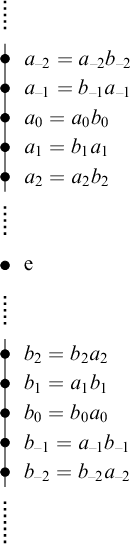

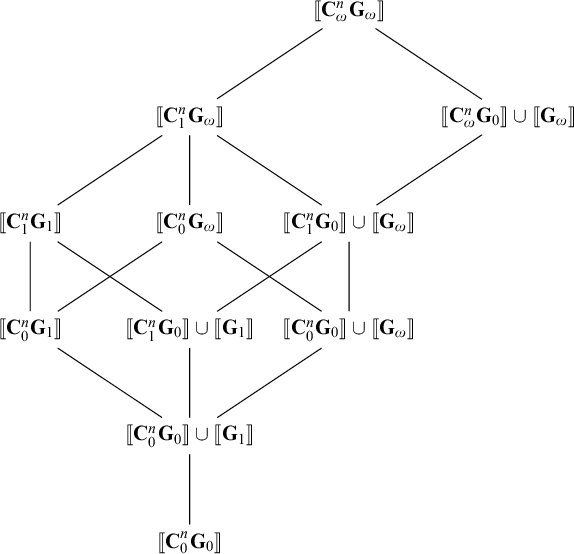

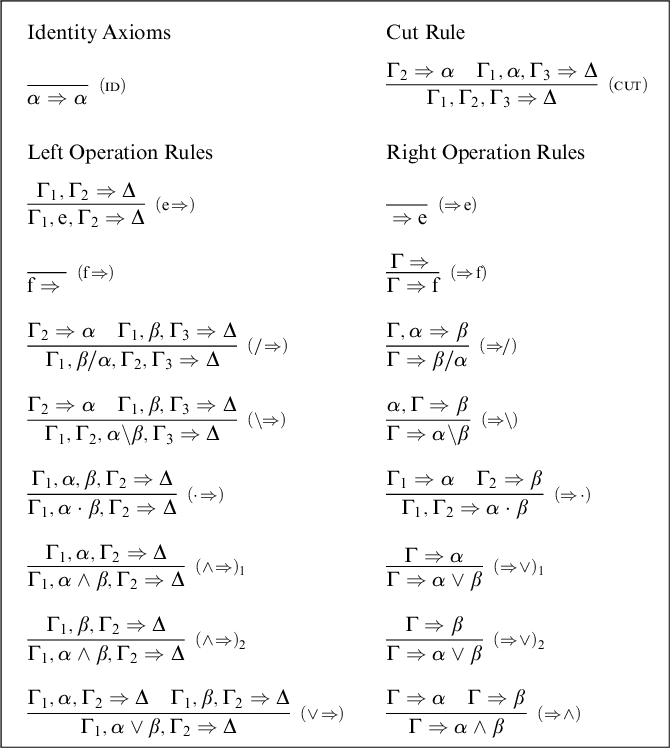


 Open access

