


1. Introduction
Constitutional ‘earthquake’,Footnote 1 ‘judicial law of the jungle’,Footnote 2 ‘Karlsruhe’s Lochner moment’Footnote 3 : there is no shortage of superlatives to describe the upshot of the ruling of the Federal Constitutional Court (BVerfG) from 5 May 2020 on the Public Sector Purchase Programme (PSPP). Karlsruhe not only declared the decisions by the European Central Bank (ECB) to establish and implement the PSPP as overstepping its competences, but also took direct aim at the Court of Justice of the European Union (CJEU), whose own assessment of the bond purchase programme it disqualified as ‘simply not comprehensible and thus objectively arbitrary’Footnote 4 – and therefore ultra vires. This resounding bang marked the climax in a longstanding lingering dispute between the Constitutional Court and the CJEU on the question of the boundaries of the mandate of the ECB.
The disagreement over the mandate and the appropriate and effective judicial review of the ECB’s actions ultimately reflect different visions and conceptualisations of the European Union (EU) and Union law: whereas the CJEU continues to be an engine of European integration that largely refrains from circumscribing the competences of EU bodies vis-à-vis the Member States, the BVerfG remains wedded to the perspective of the EU as founded on and restricted by the principle of conferral.Footnote 5 Where the CJEU has developed the doctrines of direct effect and supremacy to rationalise the autonomy of EU law,Footnote 6 so the BVerfG has since its seminal decision on the Maastricht Treaty established a doctrine that has come to be referred to by the Court itself as a ‘right to democracy’Footnote 7 and an ‘entitlement to democratic self-determination’.Footnote 8 This doctrine has served the BVerfG to maintain its role of effectively interpreting EU law.Footnote 9 As a result, constitutional complaints invoking the right to democracy have become the procedural gatewayFootnote 10 for citizens seeking to challenge both acts delegating sovereign competences from the national to the supranational level and acts of EU institutions themselves.
The legal debates that the involvement of the BVerfG in domains of EU integration – especially fiscal and monetary policy – has spurred have been discussed at length elsewhere.Footnote 11 Instead, we seek to contribute to existing research by reflecting on the strategic utility of constitutional complaintsFootnote 12 as the principal procedural channel that has delivered the cases that the BVerfG needed to develop its case law on the right to democracy. Our article expands on two observations: first, previous research has drawn a connection between the BVerfG’s institutional self-interest and the favourable interpretation of standing rights and admissibility criteria in constitutional complaint proceedings in the domain of EU integration.Footnote 13 Second, it is a striking feature that some plaintiffs in proceedings dealing with EU integration have become veritable regulars or, in Marc Galanter’sFootnote 14 influential terminology, repeat players in Karlsruhe. Apparently, the development and interpretation of a ‘right to democracy’ has served the Court to bolster its role as a representative institution and encourage plaintiffs – or rather, a special group of plaintiffs – to bring cases that would enable it to scrutinise the actions of parliament and government and issue guidelines for the politics of European integration.Footnote 15 In short, the ‘power of the people is the power of the court’.Footnote 16
Against this backdrop, we develop and advance the following argument: there is a reciprocal relationship between plaintiffs and the BVerfG. The BVerfG needs cases to adjudicate on if it wishes to expand its powers. In turn, citizens want and need continued legal standing. The judicial invention of the right to democracy forms part of the legal opportunity structure of constitutional complaint proceedings. Plaintiffs invoke the right to democracy to keep the BVerfG in the game of adjudicating on acts of EU bodies and imposing limits on the exercise of EU public authority, and to keep themselves in the game of activating and encouraging a vigorous exercise of the BVerfG’s asserted review competences. Legal opportunities associated with the right to democracy evolve and are shaped in a repeated dialogue between the BVerfG and plaintiffs.Footnote 17 This dialogue can be reconstructed by analysing how plaintiffs – in particular repeat players – draw on previous case law to craft legal arguments, and gauging the extent to which the BVerfG honours and considers these legal arguments in its decisions.
In this Article, we analyse the legal challenges against the Outright Monetary Transactions (OMT) Programme and the Public Sector Purchase Programme (PSPP), two highly controversial bond purchase programmes adopted by the Governing Council of the politically independent European Central Bank (ECB), to examine the process of litigants attempting to shape and expand the legal opportunities associated with constitutional complaints that build on the ‘right to democracy’. Unlike most other constitutional complaints that receive far less attention by academics and the media, we can draw on the original written pleadings – a data source that is only rarely available for reasons of confidentiality and anonymity.Footnote 18 The pleadings, ie, the ‘input’ side, allow us to substantiate and ascertain reciprocity in the interactions.
The article is structured as follows: in the next sections, we briefly review Galanter’s repeat player framework to develop theoretical expectations about the advantages of repeat litigation before constitutional courts, illustrating how the constitutional complaint proceeding has served as a procedural gateway for the development of the judicial doctrine underlying the ‘right to democracy’. Thereafter, we present our data and empirical approach. We then proceed with an analysis of the OMT and PSPP, focusing on the ‘input’ of legal arguments advanced by plaintiffs and the extent to which the BVerfG integrates them in its rulings. The article concludes with a discussion and reflection of the findings.
2. Who plays and why? Linking motivation and legal mobilisation
Marc Galanter’s article ‘Why the haves come out ahead: Speculations on the limits of legal change’ is among the most influential contributions in the field of socio-legal research to date.Footnote 19 In Galanter’s framework, repeat players are a specific type of ‘haves’, an ideal-type actor who has been involved in or anticipates repeated litigation, ‘which has low stakes in the outcome in any one case, and which has the resources to pursue its long-run interests’Footnote 20 through the legal system. Compared to their ideal-type counterpart, the one-shotters, repeat players enjoy considerable advantages, including (1) advance intelligence and ability to structure and plan subsequent litigation; (2) superior expertise and ready access to legal specialists; and (3) experience in interacting and liaising with decision-makers. Although Galanter does not expressly refer to the motivation of (potential) litigants, he does draw a distinction in terms of the preferred outcome: whereas one-shotters are primarily concerned with the legal outcome in the singular case they bring, repeat players also seek to shape the rules in litigation, eg, the rules that will influence legal outcomes in future cases. For repeat players, ‘anything that will favourably influence the outcomes of future cases is a worthwhile result’.Footnote 21
Galanter’s framework also appreciates the role of lawyers and institutional factors that mediate access to courts. Lawyers and the availability of specialised legal representation, access to formal institutions in the legal system, the ‘skill to navigate restrictive procedural requirements’Footnote 22 for bringing litigation, and rules that reflect specific power configurations and dominant interests, can be jointly and usefully linked to the concept of opportunity structure and the possibilities of [legal] mobilisation.Footnote 23 Following the seminal definition by Zemans,Footnote 24 legal mobilisation is understood here as ‘the act of invoking legal norms to regulate behavior’. Courts are the addressees of legal mobilisation and characterised by two institutional features: (1) they do not act ex officio (passivity); (2) due to chronic overload (congestion), courts often issue decisions with considerable delay and have strong incentives to discourage litigation and empty their dockets by applying strict admissibility standards.Footnote 25 Passivity and congestion overlap with two factors commonly associated with legal (and political) opportunity: (1) access requirements and (2) the receptivity of decision makers (eg, judges) to litigants’ arguments.Footnote 26 Applied to constitutional courts, this means that actors mobilising constitutional law and seeking a judicial decision must not only meet the formal requirements of standing; they must also convince judges of the merits of their arguments and the merits of their case for the development of constitutional law. In fact, demonstrating that the case at hand is of general importance for constitutional law, ie, that it serves to clarify a legal situation for a number of similar cases beyond the individual case, has become a routine requirement for passing the admissibility stage before constitutional courts.Footnote 27 Since the development of persuasive constitutional arguments requires considerable expertise, we expect that repeat players will enjoy a significant advantage over one-shotters (or ‘first-timers’) in presenting arguments that resonate with the favourable priorities that constitutional courts assign to cases raising novel constitutional issues. We hypothesise that the repeat players most adept at playing for rules are those that entertain durable relationships with ‘repeat lawyers’, ie, legal counsels that represent the same plaintiffs in multiple related legal proceedings.
Constitutional review, understood as ‘the authority of an institution to invalidate the acts of government […] on the grounds that these acts have violated constitutional rules, including rights’,Footnote 28 is one of the most significant political opportunities available to actors outside the political–administrative system. If courts possess the power to strike down acts of public authority for breaching constitutional principles, then actors that are able to activate constitutional review possess a potential lever to challenge policy decisions. The veto power of constitutional courts is likely to provide a powerful motivation to effectuate change in the goals of government policy through a binding interpretation of legal norms and legitimate public policy objectives.Footnote 29 This motivation is particularly plausible where litigation is not (primarily) about competing interests of resource allocation (‘who gets what’), but centres on conflicting values and cultural commitments (‘who is right’).Footnote 30 Adapted to constitutional review, Galanter’s framework suggests that one-shotters are predominantly concerned with obtaining the tangible gain of having the constitutional court strike down a law or other government action. Conversely, repeat players are motivated also by shaping the actual rules in litigation, for example, inducing an authoritative interpretation of the rules that will shape the outcome and reduce the discretion of policymakers in future court cases.
While Galanter’s framework has proven to be a fruitful resource for empirical legal research,Footnote 31 we wish to extend it in two ways: first, Galanter assumes that repeat players more often than not will be organisations, whereas individuals will typically be one-shotters. In the following, we want to build on the deviant case of individuals – in tandem with lawyers – assuming the status of repeat players.Footnote 32 Second, we suggest that (repeated) ‘playing for rules’ involves a dynamic, interactive process between litigants and courts. This interaction entails – in fact requires – an intense engagement with the case law of the courts’ jurisprudence, and warrants closer scrutiny of the claims that litigants make and the extent to which courts take up those claims and create opportunities for future litigation.
3. The rules: the right to democracy and the reservations of review
Since litigants must abide by the existing rules, it seems necessary to take at least a brief look at the legal framework of the constitutional complaint and the case law of the BVerfG, which form the basis for the constitutional complaints against the ECB’s bond purchase programmes. The German constitutional complaint qualifies as a political opportunity in the sense of an option for legal action with indeterminate consequences.Footnote 33 Under this proceeding, any individual citizen can, after exhausting all legal remedies, challenge an act of public authority alleging a personal, immediate and present violation of his or her fundamental rights. Although the constitutional complaint procedure in principle provides for individual access to the BVerfG, in practice it is almost impossible to achieve. In particular, substantiating the violation of a fundamental right is extremely difficult and requires extensive reasoning on part of the plaintiffs.Footnote 34 The range of contestable acts of public authority includes executive orders, judgements of ordinary courts, administrative decisions, and – under certain conditions – even extends to parliamentary statutes.Footnote 35 As the Basic Law only binds the German governmental bodies, in general, only acts of a German public authority are admissible subjects of complaints, which are measured against the fundamental rights enshrined in the constitution. However, the rulings of the Constitutional Court on the right to vote (Article 38(1) of the Basic Law (GG)) have contributed to the transformation of the constitutional complaint into a legal remedy against acts of public authority at the supranational level.
Since the Maastricht ruling, which itself was handed down in response to two constitutional complaints,Footnote 36 the BVerfG has construed the right to vote – beyond its content as a subjective right to participate in Bundestag elections and to comply with electoral principles – as a right of citizens to partake in the legitimation of state power.Footnote 37 According to the doctrine of the Court, the principle of popular sovereignty enshrined in Article 20(2) GG in conjunction with the so-called ‘eternity clause’ of Article 79(3) GG amounts to an immutable core constitutional norm that requires that all state power must be linked to the people as the ultimate subject of legitimation. Within the scope of Article 23 GG, which regulates European integration, the BVerfG has held that
Article 38 GG forbids the weakening […] of the legitimation of State power gained through an election, and of the influence on the exercise of such power, by means of a transfer of duties and responsibilities of the Federal Parliament, to the extent that the principle of democracy […] is violated.Footnote 38
Since the right to vote is included in the catalogue of constitutional rights (so-called rights equivalent to fundamental rights, or grundrechtsgleiche Rechte),Footnote 39 the violation of which can be challenged by means of a constitutional complaint, the right to vote has developed into a right to compliance with the constitutional limits of European integration.Footnote 40 The challenges are not restricted to an amendment of the European treaties. In its Maastricht decision, the BVerfG also declared itself competent to review whether the Union, when enacting secondary law, is acting within the competences conferred on it by the German legislature’s act of consent or exceeding them. In doing so, it asserted a further reservation – the ultra vires review – in addition to the fundamental rights review indicated in the Solange IFootnote 41 and IIFootnote 42 decisions.
In its decision on the Treaty of Lisbon, the BVerfG reaffirmed the principles of the Maastricht judgement, but extended the content of Article 38(1) GG to a claim to a ‘legitimising connection […] between those entitled to vote and European public authority’.Footnote 43 Deficits in the democratic legitimation of the European Union can now also be declared objectionable. At the same time, it established the competence of identity review, which in practice may allow the BVerfG to review EU primary law against the standard of the Basic Law. Identity review rests on the premise that any delegation of competences from the national to the supranational level must not infringe inalienable core constitutional principles – enshrined in the so-called ‘eternity clause’ of Article 79(3) GG – which includes respect for and protection of human dignity (Article 1 GG), popular sovereignty, democracy, and the rule of law. While identity review is a prerogative reserved by most constitutional courts in the EU Members States,Footnote 44 the BVerfG’s jurisprudence has been unique in delimiting and operationalising a core of policy fields that are exempt from EU integration with reference to constitutional identity: this includes fundamental decisions on fiscal policy, the exercise of the monopoly of force, and cultural issues such as family, education and religion.Footnote 45 In sum, the Lisbon judgement constitutes a central building block in a juridical edifice erected on the principle of democracy that commissions the right to vote for the development of a right to democracy and unlocks the potential of constitutional complaints to activate constitutional review of EU secondary and primary law. Importantly, the Court explicitly included the constitutional complaint in a list of potential proceedings through which it could conduct both ultra vires and identity review.Footnote 46 This was seen by many legal scholars as the beginning of the admissibility of popular actionsFootnote 47 – and arguably perceived by potential litigants with a Eurosceptic penchant as a structural legal opportunity.
The state sovereigntist – or, as some would argue, judicial-populistFootnote 48 – reading of the EU treaties has two primary implications: first, the Bundestag must retain significant (legislative) functions and competences. This includes the decision over the delegation of sovereign powers and decisions concerning the continued existence and development of the Union.Footnote 49 Second, Article 38 GG requires that the delegated powers and the so-called integration programme be specified in a sufficiently precise manner.Footnote 50 It is the constitutional obligation of German law-making bodies to circumscribe and define the scope of delegated powers to avert an expropriation of competences and prerogatives of the Bundestag and to ensure that the EU remains beholden to the principle of conferral. In its Lisbon judgement, the Court has referred to this principle as the ‘responsibility for integration’.Footnote 51 This precludes both a delegation of the Kompetenz-Kompetenz and any blanket authorisations to amend Treaty provisions short of an all-out Treaty reform.Footnote 52 If EU institutions and bodies were to interpret and apply the Treaties in a way that is incompatible with and not mandated by the German Approving Act, the resulting legal acts would be inapplicable in the Federal Republic of Germany.Footnote 53 However, in the subsequent Honeywell decision, it specified that only a sufficiently qualified breach of competence would lead to an activation of this reserve competence.Footnote 54
In its decision on the aid measures for Greece and the Euro rescue package, which was also delivered in response to a series of constitutional complaints, the BVerfG reiterated its interpretation that the connection between the right to vote and the legitimation of the exercise of state power constitutes a structural requirement that is an inviolable core of German constitutional identity, protected against both constitutional amendments and European integration. Furthermore, the Court reasserted that identity control could be activated via constitutional complaints: ‘citizens must be able to defend themselves in a constitutional court against a relinquishment of competences which is incompatible with Article 79(3) GG’.Footnote 55
4. Monetary policy, the ECB and the right to democracy
The far-reaching subjectification of the principle of democracy via Article 38 GG and the BVerfG’s expansion of its review competencesFootnote 56 have paved the way for further constitutional complaints against legal acts of European institutions. In particular, the measures of the ECB were picked by the ‘repeat players’ and challenged before the Constitutional Court. The reason for this is that in its Maastricht ruling, Karlsruhe had confirmed the independence of the ECB as a deviation from the principle of democratic legitimacy of political decisions only on the condition and to the extent that the ECB’s mandate was clearly defined and limited to maintaining price stability. At the same time, the BVerfG emphasised that only a monetary union as defined by the treaties – premised on budgetary stability, the no-bail-out principle and a ban on monetary financing by the ECB – would be compatible with the constitutional requirement of a democratically legitimated transfer of sovereign competences. Notably, the Court considered this restriction of the principle of democracy as justified by the superior effectiveness of an independent central bank removed from the vagaries of electorally accountable politics in protecting monetary value and ensuring a predictable economic basis for budgetary policy and private investment.Footnote 57 The Court confirmed this line of jurisprudence in its judgement on constitutional complaints lodged against Germany’s assent to the Economic and Monetary Union (EMU).Footnote 58 In its judgements on the EFSF/EFSM and the European Stability Mechanism (ESM), the Court interpreted the ECB’s independence and commitment to preserving monetary stability as a safeguard of the Bundestag’s overall budgetary responsibility and part of the ‘permanent constitutional requirements’ of Germany’s participation in the EMU.Footnote 59 Especially, the Court highlighted the prohibition of monetary financing (Article 123 TFEU) as ‘an essential element of safeguarding the constitutional requirements resulting from Article 20(1) and (2) in conjunction with Article 79(3) of the Basic Law in European Union Law’.Footnote 60
The ECB thus seems a natural target for critics, both for its precarious democratic legitimacy – the flipside of its intentional political independence – and for its clearly circumscribed mandate of maintaining price stability. Bond purchase programmes make it fairly easy for critics to argue that the ECB exceeds its mandate. In contrast to previous decisions taken by the governments of the Member States in the management of the eurozone crisis, the measures of the ECB were subject only to EU law. The authority for the binding interpretation of EU law rests with the CJEU, and it is the CJEU that must assess the legal admissibility of the bond purchases programmes in the light of the prohibition of monetary financing (Article 123 TFEU) and the no-bail-out clause (Article 125 TFEU). However, the right to democracy offered not only the chance of immediate gains, but also the chance to shape the conditions of monetary and fiscal integration in the future by activating the review competences of the BVerfG. As the subsequent analysis will illustrate, repeat players were well aware of the procedural requirement of the BVerfG to request a preliminary ruling by the CJEU in order to exercise its reserve competences. Nonetheless, they left no doubt that the bond purchase programmes qualified as ultra vires acts which the BVerfG could declare as inapplicable for Germany.
5. Data and empirical strategy
The empirical analysis draws on a corpus of four constitutional complaints or, more precisely, the written pleadings, as well as four decisions by the Constitutional Court. The complaints and court decisions relate to two distinct proceedings: one against the OMT decision of the ECB Governing Council, adopted on 12 September 2012; the other against the decision of the ECB Governing Council to establish and implement – inter alia – the PSPP. The respective court decisions relate (1) to the reference for a preliminary ruling – the first ever in the history of the BVerfG – to have the CJEU assess the compatibility of the OMT decision with EU primary law; (2) the respective decision on the OMT decision in the main proceedings; (3) the decision to refer the matter back to the CJEU for a preliminary ruling on the compatibility of the PSPP with EU primary law, and (4) the judgement of the BVerfG in the main proceedings, in which the court declared as ultra vires both the ECB decisions and the CJEU decision.
Unlike most constitutional complaint proceedings, some of the original written pleadings are publicly available. This is not least owed to the fact that the complaints were brought in part by repeat players in the original sense of the word – litigants with extensive experience in constitutional proceedings that had previously challenged decisions regarding European integration (eg, Treaty reforms) or the Eurozone rescue: Peter Gauweiler, who has been at the forefront of ‘Euro rebels’ and had already litigated against the Lisbon Treaty, the first Euro rescue package (EFSM/EFSF and Greece bilateral aid), and the ESM and Fiscal Compact with the same legal representatives that represented him in the complaint against the OMT; Wolf-Rüdiger Bub, with whom Gauweiler operated a law firm until the two parted ways in 2019, and Dietrich Murswiek, professor emeritus of constitutional law. Murswiek also represented Gauweiler in the PSPP proceeding (see Table 1). A second complaint against the OMT considered in this analysis was brought by Roman Huber, managing director of the executive board of the citizens’ group Mehr Demokratie (‘More Democracy’) and nearly 37,000 private individuals, as supplementary motions against the ESM and Fiscal Compact. The pleading of this group was drafted by Christoph Degenhart, professor of public and administrative law and constitutional justice at the state constitutional court of Saxony from 2010 to 2020, and Hertha Däubler Gmelin, Federal Minister of Justice from 1998 to 2002. Degenhart also acted as legal representative in another complaint against the PSPP brought by Heinrich Weiss and other businessmen that is not included in our corpus. Apart from Gauweiler’s complaint against the PSPP, a second complaint included in our analysis was brought by Bernd Lucke, professor of economics and one of the founding figures of the party Alternative für Deutschland (AfD), and an additional 1734 individuals organised in the citizens’ group Bündnis Bürgerwille (‘Citizens’ Will Alliance’). The group subsequently lodged a constitutional complaint against the Next Generation EU recovery fund with the same legal representative, Hans-Detlef Horn, professor of public law and former judge at the Higher Administrative Court of Hesse. In short, we have selected two complaints per proceeding: one complaint filed by a private individual and genuine repeat player, Peter Gauweiler, and one complaint brought by relative newcomers who subsequently litigated against other EU policy decisions. Table 1 provides an overview of the identity of the litigants and their legal representatives.Footnote 61
Overview of corpus of constitutional complaints and client-lawyer constellations

The Gauweiler complaint against the OMT programme was retrieved from a book published by his legal representative Dietrich Murswiek on the constitutional challenges against the Eurozone rescue policies.Footnote 62 The written submission of the complaint by Huber et al was available on the homepage of legal representative Christoph Degenhart.Footnote 63 The written submissions for the complaints by Lucke et al Footnote 64 and GauweilerFootnote 65 against the PSPP were obtained online, but have also been published in a book by the legal representatives in the proceedings.Footnote 66 The Court decisions were retrieved from the official homepage of the BVerfG. For the analysis, we used the official German language version, as the complaints are also in German.
All documents were imported and analysed in MAXQDA 24. Our coding system was developed deductively, with a focus on categories related to the procedural requirements and the scope of constitutional complaints claiming a violation of the right to democracy. Accordingly, apart from a category related to the right to democracy and Article 38 GG, our main categories pertain to subjects of a constitutional complaint (eg, acts of EU institutions, violations on part of constitutional bodies to assume their integration responsibility), the Court’s review competences and pertinent (admissibility) requirements, claims of breach of competences, and references to the democracy principle and constitutional identity. Our coding unit is an argument, which can consist of one or more grammatical sentences. Table 2 offers an overview of the code categories and code frequencies across the four constitutional complaints considered in our analysis.Footnote 67
What are the observable implications of the assumption that plaintiffs and the Court engage in a reciprocal relationship and a dialogue concerning the right to democracy? On the part of the plaintiffs, a dialogue requires engagement with the BVerfG’s case law. On the part of the BVerfG, substantiating the finding of a dialogue certainly does not require that the BVerfG follows the pleadings in every point. In particular, it will not even have to find the complaints founded. To prove our point that repeat players are interested in securing rule gains, ie, an interpretation that will shape the outcomes of future cases, what is arguably more consequential is the extent to which the BVerfG picks up on the plaintiffs’ explanations on the procedural requirements and substantive scope of constitutional complaints that invoke a violation of the right to democracy. Therefore, indicators of a dialogue would be an evaluative assessment and a substantive engagement with the claims on part of the BVerfG.
6. The constitutional complaints against the OMT programme
The Outright Monetary Transactions (OMT) programme, decided in September 2012, was the practical embodiment of Mario Draghi’s famous ‘whatever-it-takes’ pledge, signalling the ECB’s readiness to use all tools within its mandate to preserve the eurozone’s integrity. However, whether the ECB acted within its mandate was very much in dispute. The OMT – although never implemented – was expressly not limited in size or time and intentionally selective: purchases were targeted at Member States which, faced with higher yields on sovereign bonds, were most likely to experience difficulties servicing their debt. This led plaintiffs to argue that the OMT decision marked an ‘act of usurpation’Footnote 68 by which the ECB – without any democratic legitimation – claimed the permanent competence to undertake measures of financial assistance, without any limitations, in flagrant violation of the ban on monetary financing enshrined in EU law, and in interference with the competence of the Member States for fiscal policy.
A. The OMT decision as an admissible subject matter of a constitutional complaint?
The complaint by Gauweiler invests considerable argumentative effort in establishing the admissibility of constitutional complaints directed at acts of EU institutions, in this case against decisions by the ECB. A total of 21 statements relates to the question of an immediate challenge of EU acts by means of constitutional complaint (see Table 2). The Gauweiler complaint invokes the Maastricht judgement and cites a decision of the Second Chamber concerning a constitutional complaint against the European Patent OfficeFootnote 69 to substantiate the claim of a ‘principle of challenging supranational acts by means of a constitutional complaint’.Footnote 70 The basic argumentation of the complaint is that in its Maastricht ruling, the Constitutional Court had – in a clear and intentional departure from earlier case law – for the first time considered measures of a supranational organisation as acts of state power independent of the state power of the sovereign Member States and as such affecting the fundamental rights of German citizens. Consequently, the Court’s assertion to review these acts ought to imply that all proceedings – in particular constitutional complaints – can serve to activate these review competences. Against this backdrop, the Gauweiler complaint engages with the Court’s decision on the first Euro rescue packages to argue in favour of a competence and obligation of the Constitutional Court to review claims of ultra vires acts brought by means of a constitutional complaint – including the constitutional review of EU acts which like the ECB decisions require no further implementing measures.Footnote 71
Code categories and code frequencies in written pleadings

1 Word count based on MAXQDA document profile.
The pleading identifies the OMT decision as an untypical constellation where no other legal remedy than the constitutional complaint is available to activate judicial review.Footnote 72 Neither can the decision by the ECB Governing Council be challenged directly before the CJEU (for lack of individual concern), nor does it require any national implementing act that could be challenged before a national court, which could refer to the CJEU for a preliminary ruling. However, while the Gauweiler application goes to great lengths to argue for the admissibility of a constitutional complaint directed against acts of EU institutions, it includes an ‘ancillary motion’ (Hilfsantrag) directed against the Federal Government for violating Article 38(1) GG by not having taken legal action against ECB before the CJEU. This motion is formulated in explicit anticipation that the BVerfG could declare the reprimanded measures of the ECB as an inadmissible subject of a constitutional complaint.Footnote 73
B. Violation of the right to democracy and activation of review competences
Article 38 GG is depicted not only as a safeguard against an encompassing or indeterminate delegation of sovereignty to the EU by state bodies, but also as a warranty that citizens are protected against acts of the EU that are manifestly not mandated by the Approving Act and the integration programme specified therein.Footnote 74 Since democratic legitimacy in the EU rests in the Approving Act, and since the Approving Act determines the boundaries for admissible acts by EU bodies, acts that go beyond what is mandated (eg, ultra vires) lack democratic legitimacy. Accordingly, the complaint emphasises that enforcement of compliance with the principle of conferral of powers is understood as a subjective right, the violation of which can be challenged by a constitutional complaint.Footnote 75
Moreover, the pleading by Gauweiler complaint stresses the particular obligation – encapsulated in the notion of a ‘responsibility for integration’ – of the Federal Government to defend the constitution and its key principles against breaches of the existing division of powers. Citing both the Maastricht and Lisbon rulings and the Court’s more recent judgement on the bilateral aid for Greece and the EFS rescue packages, it argues that the objective duty of the constitutional bodies to defend the principle of democracy is paralleled by and corresponds to a subjective ‘right to democracy’.Footnote 76 The pleading also identifies an action for annulment before the CJEU as the only feasible option for the Federal Government to challenge the ECB decision and to fulfil its obligation of defending the constitution against qualified ultra vires acts.Footnote 77 According to the pleading, failure on part of the Federal Government to take appropriate legal action amounts to a violation of the subjective right to democracy enshrined in Article 38(1) GG.
The pleading by Gauweiler thus makes a case for the activation of both ultra vires and identity review by the BVerfG by means of a constitutional complaint. This is supported by a detailed consideration of the criteria established by Karlsruhe for the activation of these reservations. In pondering the particularities of the legal constellation and citing the criteria for conducting ultra vires review developed in the Honeywell decision (a total of 26 coded statements), the motion develops an argumentation geared towards convincing the BVerfG to make its first reference for a preliminary ruling to the CJEU. Interestingly, the Gauweiler complaint already hints at the possibility of the Constitutional Court to review and ‘correct’ a CJEU decision that itself meets the material Honeywell criteria of an evident breach of competences that significantly impacts the structural balance of power between the Member States and the EU.Footnote 78 This echoes a motivation to achieve not just the tangible gain of a ruling that declares the OMT inapplicable for Germany, but also a rule gain by inducing the Court to enter into a dialogue with the CJEU, offer its interpretation of EU law in light of constitutional principles and to assert its ultra vires control even vis-à-vis the CJEU. Since the BVerfG had in previous rulings defined the budgetary powers of the legislature and the free disposition of revenue and expenditures as part of the core of the democracy principle protected by the eternity clause, the complaint is also advertised as a ‘prime example for the exercise of identity control’.Footnote 79
Both the complaint by Gauweiler and the one by Huber et al draw on two basic arguments in substantiating also a violation of constitutional identity: first, the ECB lacks democratic legitimacy for expanding its mandate beyond monetary policy. Second, the OMT programme establishes an ‘undemocratic liability automatism’Footnote 80 or at least an ‘inadmissible assumption of liability’Footnote 81 by generating financial risks that are imposed on the Bundestag without the latter having given its consent. In its decision on the bilateral aid for Greece and the temporary Euro rescue mechanisms, the Constitutional Court had made every single provision of financial aid in the spirit of solidarity with budgetary implications conditional on a positive approval by the Bundestag and required sufficient parliamentary influence on fundamental decisions regarding the manner in which funds are provided.Footnote 82 The complaints argue that the bond purchase programmes violate these very conditions. According to the Gauweiler complaint, ‘[t]he ECB adopts “solidary aid measures of larger scope” at the expense of the federal budget, without the Bundestag having authorised this’.Footnote 83
The plaintiffs in the other proceeding regard the OMT decision as the establishment of a de facto fiscal union without a constitutional amendment which amounts to a ‘breach of the authorisation of the Basic Law for European integration that violates the principle of democracy’.Footnote 84 According to the argumentation, the ESM had already removed one key pillar in the stability architecture of the EMU erected under the Maastricht Treaty by circumventing the no-bail out clause by an amendment of Article 136(3) TFEU. The OMT decision – by circumventing the ban on monetary financing (Article 123 TFEU) – is interpreted as the removal of yet another pillar of the constitutional foundations of the EMU, thereby weakening essential safeguards of the constitutionally mandated principle of democracy enshrined in European law.Footnote 85
C. The OMT judgement – rule gain deferred?
The proceedings against the OMT decision mark a partial success for the litigants in terms of rule interpretation and rule gain. Perhaps the most significant rule gain obtained was the decision in favour of the first ever preliminary reference to the CJEU, which the BVerfG had established as a precondition for finding an act ultra vires in its Honeywell decision.Footnote 86 Although the BVerfG indicated in its order for reference that it regarded the OMT decision as an ultra vires act that in fact exceeded the ECB’s mandate of monetary policy and circumvented the ban on monetary financing, it did deem it possible for the CJEU to arrive at a restrictive interpretation of the OMT decision such that it would conform to EU primary law.Footnote 87
Speaking to the scope of the ‘right to democracy’ emanating from Article 38(1) GG, the Constitutional Court reaffirmed a substantive guarantee that citizens must not be subjected to the exercise of public authority that is not legitimated through democratic elections. In what it termed a ‘procedural element’ of Article 38(1) GG and its defensive dimension, Karlsruhe recognised that under circumstances of manifest and structurally significant ultra vires acts, a
citizen can […] demand that the Bundestag and the Federal Government actively deal with the question of how the distribution of powers entailed in the treaties can be restored, and that they decide which options they want to use to pursue this goal.Footnote 88
However, this interpretation of Article 38(1) GG was regarded by a minority as too far-reaching and spurred dissenting opinions. Justice Lübbe-Wolff criticised the majority decision as an ‘innovation’ and deviation from the court’s most recent case law in the decision on the Euro rescue packages, which had found positive acts of participation in intergovernmental decisions and decisions of EU bodies to constitute inadmissible subjects of a constitutional complaint. At any rate, Justice Lübbe-Wolff contested that the array of ‘options’ for reacting to ultra vires acts was determinable by legal rules, let alone derivable from constitutional law.Footnote 89 Justice Gerhardt criticised the Senate majority’s decision as a problematic expansion of the ability of individuals to activate ultra vires measures by invoking Article 38(1) GG – without any connection to the violation of a substantive fundamental right. In his view, allowing ultra vires reviews based on allegations of a violation of the right to vote opens the door to a ‘general right to enforce the law’ (allgemeiner Gesetzesvollziehungsanspruch) and an actio popularis not provided for in the Basic Law. The dissenting opinion also questioned the argument put forward in the Gauweiler complaint that the obligation of the constitutional organs to defend the constitution and its fundamental principles establishes an individual subjective right.Footnote 90 The dissenting opinions show that the judicial receptivity of the Court with regard to the scope of constitutional complaints that draw on the right to democracy very much depends on the composition of the bench.
In its decision in the main proceedings, the Second Senate clarified that acts of EU bodies, including measures of the ECB, are not acts of public authority within the meaning of the Basic Law and therefore cannot be challenged directly by means of a constitutional complaint.Footnote 91 However, the Court confirmed its competence to undertake an indirect review of acts of bodies, institutions and agencies of the EU to the extent that they either form the basis for actions taken by German state bodies or entail obligations on the part of German constitutional bodies within the purview of their integration responsibility. Accordingly, the Court declared the constitutional complaints admissible insofar as they claimed a violation of Article 38(1) GG by a failure of the Federal Government to act against the OMT decision as a sufficiently qualified breach of competences of the ECB. Confirming the argumentation of the Gauweiler complaint and contrasting the standpoint of the dissent in the decision to refer to the CJEU for a preliminary ruling, the Constitutional Court held that
[t]he Federal Government’s and the Bundestag’s duty to react, which stems from objective law and requires that they, as a consequence of their responsibility with respect to European integration […], actively deliberate on the issue of how the order of competences can be restored in case of ultra vires acts by institutions, bodies, offices, and agencies of the European Union, is paralleled by a subjective right on the part of the citizens […].Footnote 92
While the BVerfG did stress the caveats of the ’right to democracy’, it considered the admissibility requirements to be met and the complaints to be substantiated. Notably, it explicitly honoured the plaintiffs’ efforts at expounding upon the special procedural and substantive requirements of a constitutional complaint invoking ultra vires review. In the case of the pleading by Gauweiler, which was targeted at the Federal Government taking concrete action, ie, bringing an annulment action against the ECB, the Court even held that this application did not stand in the way of the admissibility of the complaint, insofar as it had set out the government’s array of possible actions.Footnote 93 The Court also elaborated on the range of potential actions to assume the responsibility of integration, picking up on the possibility of initiating Treaty amendments suggested in the Gauweiler complaint.Footnote 94
The Court saw as sufficiently substantiated the claim that the OMT decision had potentially adverse effects for the overall budgetary responsibility of the Bundestag and that the inaction of the Federal Government also violated the plaintiff’s constitutional right to democracy in this respect. Even so, the BVerfG ruled the constitutional complaints as unfounded insofar as they were admissible, and regarded the OMT decision and its technical implementation as covered by the Treaty mandate under the condition that the ECB Governing Council respects the requirements defined by the CJEU decision in Gauweiler and Others.Footnote 95 Inter alia, purchases may not be announced ex ante; the volume of purchases has to be limited, and the ECB may only buy sovereign bonds of Member States that are able to obtain financing from market sources.Footnote 96 These qualifications, together with the CJEU’s assurance that ECB actions were subject to judicial review, allowed Karlsruhe to ‘tread softly’ and refrain from declaring the OMT decision – and the CJEU ruling – as ultra vires.Footnote 97
7. Back in play: the constitutional complaints against the PSPP
The OMT programme was never implemented. The mere announcement that the ECB was ready to act as lender of last resort was sufficient to calm the financial markets and deter speculators from betting against the integrity of the Eurozone.Footnote 98 By contrast, the PSPP was put into effect as part of the Expanded Asset Purchase Programme (EAPP) in March 2015. The ‘historically unprecedented’ volume,Footnote 99 concrete implementation and different modalities in comparison to the OMT were among the key motivations for the constitutional complaints that were brought against the EAPP in September and October 2015. In contrast to the OMT programme, bond purchases under the PSPP are not selective. Instead, the ECB and national central banks buy sovereign bonds from all Eurozone Member States according to the capital key. Furthermore, bond purchases under the PSPP are not conditional, whereas a necessary condition for bond purchases under the OMT programme had been that the respective Member State undergoes an appropriate programme under the EFSF or ESM, eg, a macroeconomic adjustment programme. This led plaintiffs to reason that the real motivation behind the PSPP was to establish a de facto rescue mechanism for the Eurozone that was both more effective – by virtue of its volume – and harder to challenge by legal means – due to the non-conditionality and non-selectivity of the bond purchases.Footnote 100 According to the plaintiffs’ arguments, the rescue of the Eurozone was a matter of economic policy and thus beyond the ECB’s remit.
A. Adjusting to new case law on admissible subjects of constitutional complaints
The constitutional complaints against the PSPP were brought at a time when Karlsruhe had taken its decision to refer to the CJEU for a preliminary ruling, and when the CJEU had already delivered its judgement in Gauweiler and Others but before the BVerfG’s decision on the OMT in the main proceedings. The written submissions indicate the existence of a dialogue between plaintiffs and the BVerfG in several ways. On the one hand, the pleadings against the PSPP suggest that the plaintiffs capitalised on the rule gain associated with the OMT order for reference with regard to the ‘right to democracy’ and a protection from manifest, structurally significant transgressions of competence by EU bodies. To illustrate the benefits of repeat playing, the Gauweiler complaint against the PSPP takes up several passages verbatim from the OMT complaint, in particular where the complaint addresses the question of whether and under what conditions acts of EU bodies can be admissible subjects of a constitutional complaint. On the other hand, the pleadings were amended in light of the judgement of the Second Senate on the OMT from June 21, 2016, which clarified that acts of EU bodies are not admissible subjects of a constitutional complaint. The attentiveness to and accommodation of the Court’s jurisprudence can clearly be traced in written submissions to amend the pleadings. The complaint by Lucke et al had vigorously defended and argued for the admissibility of applications directed immediately against the applicability of ultra vires acts as standing in the tradition of the Court’s Maastricht ruling.Footnote 101 The amended pleading withdrew the applications directly challenging the decisions underlying the bond purchase programmes, but upheld the applications as preliminary questions (‘Vorfragen’) to the BVerfG to review the implications of the ECB acts for the competence order.Footnote 102 The primary target of the amended pleading therefore became the Federal Government and the Bundestag, which through their inaction had allegedly violated their responsibility for integration and the plaintiffs’ right to democracy. The ancillary motion picks up on the Court’s understanding of the implications of the responsibility for integration for subjective entitlement to democratic self-determination, as expressed in the OMT order for reference and the OMT judgement almost word by word.Footnote 103 The Gauweiler complaint was less adamant about holding on to the immediate challenge of EU acts by means of a constitutional complaint.Footnote 104 Even so, it was also amended to invoke exclusively a violation of constitutional rights by failure of the Federal Government to take appropriate action against the ultra vires acts of the ECB. On this note, the amended submission reflects a defensive interpretation of the OMT judgement in that only inaction, but not the failure to take a particular course of action, could be the valid subject of a constitutional complaint.Footnote 105 In sum, the written pleadings display careful attention to the procedural implications of the Court’s evolving case law. In the amended version, they seamlessly engage with the conception of the OMT judgement that the right to democracy gives individuals the opportunity to enlist the BVerfG in a political dispute on the competence order of the EU and to demand positive action from governmental bodies in defending and restoring the principal components of that order.
B. Violation of the right to democracy and activation of review competences
The general thrust of the constitutional complaints follows a structure very similar to the preceding complaints against the OMT programme: the PSPP (1) constitutes an ultra vires act, ie an evident breach of competences by the ECB that affects the structural balance of power between EU and Member States, and (2) transgresses the boundaries of constitutional identity by infringing on the Bundestag’s overall budgetary authority. Moreover, (3) the Federal Government and Bundestag have neglected their duty resulting from their integration responsibility to take action against the measures of the ECB and restore the competence order mandated by the Basic Law and the EU Treaties. These acts constitute violations of the right to democracy founded on the right to vote that can be vindicated by means of a constitutional complaint.
Both complaints lay out the specificities of the case to argue that the PSPP is an appropriate subject for the Karlsruhe court to exercise its competence of ultra vires and identity review. The written submissions signal a considerable effort in setting out the requirements of ultra vires and identity review as formulated in the Court’s case law to make the case for a (second) preliminary reference. This is also borne out by the number of coded segments related to ultra vires review (20 in the Lucke et al complaint vs. 14 in the Gauweiler complaint), identity review (15 vs. 19 references, respectively), responsibility with regard to integration (14 vs. 16 references) and to the Honeywell criteria (25 references in each complaint) reported in Table 2.
According to the plaintiffs, the PSPP qualifies as an ultra vires act that meets the Court’s standards as defined in the Honeywell decision. The breach of competence is considered evident, as the bond purchases are not isolated, accidental transgressions of the ECB’s mandate, but embedded in a programme with which the ECB intentionally and purposefully claims a permanent competence to carry out an ‘unconventional’ monetary policy.Footnote 106 This self-authorised extension of the mandate is claimed to be not only a violation of the principle of democracy and thus lacks democratic legitimation mandated by constitutional law; the PSPP also violates EU Treaty Law. First, the overarching objective of the bond purchases conducted by the ECB is to enhance fiscal stability, which is beyond the scope of the ECB’s mandate for monetary policy.Footnote 107 Second, under the PSPP the ECB waives all conditionalities for bond purchases that had applied in the OMT programme and which the Constitutional Court had – albeit grudgingly – accepted as safeguards against a circumvention of the ban on monetary financing (or measures of equivalent effect).Footnote 108 Finally, the PSPP is argued to be disproportionate, neither necessary to fight deflationary risks nor commensurate with the substantial risks of mutualising the risks of a sovereign default and stoking inflation by increasing money supply.Footnote 109 The breach is also argued to be structurally significant for the balance of competences between the EU and its Member States, not least because it encroaches on the overall budgetary authority of the Bundestag. For this reason, the complaints argue along the lines of the OMT proceedings that the PSPP constituted an infringement of constitutional identity. It is characterised as a mechanism of financial aid that imposes enormous, potentially incalculable risks on the national budget, for which the democratically accountable budgetary legislature had neither given nor feasibly could give its consent.Footnote 110
Questions of the compatibility of the PSPP with the precepts of German constitutional identity – the democracy principle and the overall budgetary responsibility of the Bundestag – and procedural questions regarding the activation of identity review are even more pronounced than in the OMT proceedings and closely tied to substantiating the constitutional relevance of the complaints. The plaintiffs argue that the OMT order for reference had not addressed the compatibility of ECB measures with constitutional identity.Footnote 111 The Gauweiler complaint portrays the EAPP as a ‘test case for identity control’.Footnote 112 And the Lucke et al complaint raises the question: ‘Where, if not here […] are there grounds and the urgent need to reject the policy of the ECB by means of the constitutional identity control and to remind the ECB of its constitutional obligation to respect national identity (?)’Footnote 113
With respect to the scope of identity review, the Gauweiler complaint makes the bolder claims. Referring to the EU-specific dimension of constitutional identity, the plaintiff argues that identity review extends to a review of whether the democracy principle is also observed at the EU level, since Germany may only participate and delegate competences to a Union based, inter alia, on the principle of democracy, the rule of law and fundamental rights protection. According to the argumentation of the complaint, any ultra vires act committed by the ECB infringes the democracy principle at the EU level because the modification of the democracy principle – political independence and lack of parliamentary accountability – is justified only by its limited mandate for monetary policy. Therefore, if the ECB oversteps its mandate or authorises itself to interpret its mandate widely, it acts without democratic legitimation and thus violates also the constitutional identity of the EU (!).Footnote 114
In turn, the Lucke et al complaint reads as making the more audacious claims with respect to the scope of ultra vires review. As borne out by the comparatively high number of references to the doctrinal Honeywell criterion (see Table 2), the complaint leaves no doubt that it regards the CJEU decision on the OMT programme as an ultra vires act in that it has transgressed the boundaries of a ‘methodologically reasonable legal interpretation’ (sic!) set by the principle of conferral,Footnote 115 exhausted its entitlement to ‘error tolerance’ and relieved the ECB of its legal obligation to act within its mandate.Footnote 116 Since CJEU decisions that qualify as ultra vires acts cannot claim primacy of application, they could be overruled by the Constitutional Court. While the complaint concedes that any ultra vires claim or claim of a violation of constitutional identity requires a preliminary reference, no CJEU ruling that fulfils the Honeywell criteria of an evident and structurally significant breach of competences could preclude an override by the BVerfG. In particular, no CJEU ruling could prevent the BVerfG from finding a violation of constitutional identity, as the competence to review the applicability of EU law in this domain is entirely removed from the CJEU’s jurisdiction. In fact, the Lucke et al complaint even makes the claim that an interpretation of EU law that found the EAPP to be covered by the ECB’s mandate would have to qualify as a violation of constitutional identity and be declared as unconstitutional, because the Basic Law prohibits a delegation of competences that are insulated both from constitutional amendments and European integration under the eternity clause of Article 79(3) GG.Footnote 117
C. Karlsruhe’s PSPP judgement – rule gain at last?
In its order for reference of 15 August 2017, the Court signalled serious misgivings as to whether the PSPP was compatible with the ban on monetary financing (Article 123 TFEU) and the ECB’s mandate for monetary policy. Both procedurally and substantively, the order for reference was a partial success for the plaintiffs. Speaking to Article 38(1) GG, the order for reference again confirmed the jurisprudence in the OMT proceedings that the right to vote substantiates an enforceable right to democratic self-determination that could be invoked against German constitutional bodies if these failed their constitutional obligation to ensure that acts of the EU remain within the integration agenda.Footnote 118 The Senate expressed the expectation that the CJEU would apply the criteria formulated in its decision on the OMT programme as legally binding restrictions for the PSPP. With respect to the delimitation between monetary and economic policy, the Constitutional Court pointed to the concrete economic effects of the PSPP, whose adoption had been justified on the grounds of an objective of monetary policy. The Court thus viewed the PSPP as potentially disproportionate, because the ECB had not weighed the economic effects against the monetary effects. The proportionality issue was among the questions that Karlsruhe referred to Luxembourg. With regard to the claims of a violation of constitutional identity, the Court was much more hesitant, noting that at the time of the referral, it could not be established with certainty that the PSPP adversely affected the budgetary autonomy and overall budgetary responsibility of the Bundestag.Footnote 119
The BVerfG delivered its judgement in the main proceedings on 5 May 2020, following the preliminary ruling of the CJEU in the case Weiss et al. Footnote 120 With regard to admissible subjects of a constitutional complaint, the judgement confirms the case law established with the OMT judgement. Thus, ‘acts of institutions, bodies, offices and agencies of the European Union’ are admissible subjects of constitutional review by the Court only to the extent that these acts provide the basis for measures undertaken by German state organs or generate ‘obligations, deriving from the responsibility with regard to European integration (Integrationsverantwortung) and incumbent upon German constitutional organs, to take or refrain from certain actions’.Footnote 121 Consequently, the PSPP judgement confirms the status of Article 38(1) GG as a subjective right of citizens to require the Federal Government and Bundestag to exercise their integration responsibility, ie,
to monitor whether institutions, bodies, offices and agencies of the European Union adhere to the European integration agenda (Integrationsprogramm), to refrain from participating in the adoption and implementation of measures that exceed the limits of the integration agenda […], and, where such measures constitute a manifest and structurally significant exceeding of EU competences, to actively take steps to ensure conformity with the integration agenda […] and respect for its limits.Footnote 122
The PSPP judgement thus marks a rule gain for the litigants in that it confirms that citizens can, by invoking Article 38(1) GG, initiate ultra vires review. In fact, the Court reiterates and confirms its obligation to review substantiated ultra vires challenges first expressly laid down in the Honeywell decision.Footnote 123 The Court also emphasised the protective and defensive dimension of the right to democracy in the domain of constitutional identity, maintaining that the integration responsibility also commits the constitutional bodies ‘to protect and promote the rights of the individual enshrined in Article 38(1) first sentence in conjunction with Article 20(2) first sentence GG’Footnote 124 insofar as measures of the EU exceed the domain of competences open for European integration under the Basic Law or have equivalent effects. Against these standards, the Court found the Bundestag and the Federal Government to have violated their integration responsibility for failure to take appropriate action against the fact that the ECB had neither evaluated nor laid out that the measures adopted under the PSPP were proportional.
The PSPP judgement steers a middle course – although much of the critical reviews of the decision focused on the confrontation and partial non-compliance with the CJEU judgement.Footnote 125 The BVerfG ‘threw down the gauntlet’ to the CJEU for having failed ‘to give consideration to the importance and scope of the principle of proportionality’Footnote 126 in assessing the ECB decisions. It thereby demonstrated that it does not only reserve the right to declare a CJEU judgement ultra vires and arrive at a different legal interpretation after the CJEU has delivered a preliminary ruling, but that it is indeed willing to exercise this right. In this regard, the BVerfG has arguably lived up to the expectations of the plaintiffs to ‘give teeth’ to its competence of ultra vires review. Essentially, the Constitutional Court criticises the CJEU judgement as a case of excessive judicial self-restraint which does not effectively circumvent the ECB’s competence and is unsuitable for preventing a creeping extension of its competences on its own authority.Footnote 127 The Court, however, did not concur with the central claim of the plaintiffs that the PSPP constitutes an inadmissible circumvention of the ban on monetary financing. On this point, the BVerfG accepted the CJEU’s ruling as binding, although it did express ‘considerable concerns’Footnote 128 regarding what it considered a superficial application of the ‘safeguards’ the CJEU had developed in Gauweiler and Others. Given the real possibility that the ECB observed the safeguards set out by the CJEU, the Constitutional Court did not find a ‘manifest circumvention’ of the prohibition of monetary financing. Neither did the BVerfG find a violation of constitutional identity or an infringement of the overall budgetary responsibility of the Bundestag. While retroactive changes to the risk-sharing regime between the ECB and the national central banks would affect the overall budgetary responsibility beyond the limits of what was constitutionally permissible – given the volume of the PSPP – the BVerfG recognised that the CJEU preliminary ruling had clarified that such a risk-sharing regime would not be compatible with EU primary law.Footnote 129
8. Constitutional complaints, the limits of rule gain and future research
Constitutional complaints before the BVerfG have somewhat ironically, but not without reason, been referred to as a ‘side stage of politics and wailing wall of citizens’.Footnote 130 The case of the constitutional complaints against the ECB bond purchase programmes – and the Eurozone rescue more generally – proves this point. Over the past two decades, Karlsruhe has become a central player on the pitch of European integration. Most frequently, its competence of constitutional review has been activated at the initiative of private citizens, via constitutional complaint proceedings. It is against this background that this Article has conceptualised constitutional complaints as an opportunity structure. Our underlying assumption was that litigants do not simply react to legal opportunities that are externally imposed by procedural rules, but instead seek to actively shape legal opportunities by engaging in a dialogue with the court, (creatively) interpreting the BVerfG’s case law on the right to democracy and the procedural requirements and substantive scope of constitutional complaints which invoke that right.
The complaints against the OMT and the PSPP show that the plaintiffs made considerable efforts to convince the BVerfG that the ECB’s decisions constituted an act of public authority that could be directly challenged by means of a constitutional complaint. The BVerfG judgements in the OMT and PSPP cases have clarified that this is not possible. Nevertheless, the BVerfG has confirmed that constitutional complaints can be used to initiate both ultra vires and identity review, and that actions of EU institutions are subject to ultra vires (and identity) review as a preliminary issue if the violations are sufficiently substantiated. In terms of content, the right to democracy has been somewhat cut to size. It amounts to a subjective right that obliges the government and parliament to monitor the EU institutions and to act as ‘watchdogs’ to ensure that the limits of their mandate and the absolute limits of European integration are respected. Notwithstanding the practical problems that arise from the creation of specific justiciable obligations for the government and parliament in the exercise of their responsibilities with regard to European integration,Footnote 131 the Court stands by its legal invention of the right to democracy. From the perspective of the litigants, this is arguably the most important achievement. Of course, one might argue that the plaintiffs consistently ‘lost’ the cases, failing to achieve a confirmation of their viewpoint that the programmes constituted a circumvention or breach of monetary financing, let alone the termination of ECB bond purchase programmes or a withdrawal of the Bundesbank from these programmes. But that is beside the point. Our argument was that plaintiffs capitalise on the ‘right to democracy’ in an effort to keep both themselves involved and the BVerfG allied in disputes on the competence order and the boundaries of EU integration. And in this procedural perspective, the plaintiffs have fared quite well in achieving what Galanter has termed rule gain: a recognition of rules that are likely to shape the outcome of future cases. The activation of ultra vires review by private litigants, and the demonstrated willingness of the BVerfG to exercise that review competence and hone its jurisprudence on the integration responsibility of governmental bodies, support the assumption that private citizens, in particular those with significant experience and (access to) legal expertise, are able to influence the rules of the litigation game.
Our adaptation of Galanter’s repeat player framework was owed to the observation that some individuals, in tandem with their attorneys, have established a long-standing record of bringing constitutional challenges against policy decisions in the field of EU integration. The fact that individuals can assume the status of repeat players reflects the procedural requirements of the constitutional complaint proceeding, which in spite of its objectively-legal function is conditional on a claim of the infringement of subjective fundamental rights [or rights equivalent], making individual citizens the central mobilising actors in proceedings that concern acts of public authority.Footnote 132 However, since judicial processes tend to be slow and produce only incremental change, ambitious actors with far-reaching objectives (eg, rule gain) need to engage in repeat litigation.Footnote 133 In fact, Peter Gauweiler seemed well aware of this, comparing legal action to physical therapy: ‘you need to keep pressing the same spots until the muscle is showing signs of activity’.Footnote 134 The argumentative groundwork for a justiciable entitlement or right to democracy had already been laid in the proceedings against ratification of the Maastricht TreatyFootnote 135 and was developed in subsequent proceedings that were for the most part initiated by litigant–lawyer constellations that became veritable repeat players in Karlsruhe. Similarly, the constitutional complaints against the OMT and PSPP are not isolated proceedings, but display considerable cross-links, with the latter picking up not only on the own legal argumentation, but also on the Court’s interpretation of the claims.
Our analysis of the proceedings against the OMT and PSPP has revealed that the litigants and the Court do in fact engage in a dialogue. The pleadings – especially those by repeat players – display intimate knowledge of the case law, prove adaptability in light of new jurisprudence, and raise questions that can be read as an invitation to the BVerfG to exercise its self-asserted review competences. The BVerfG, in turn, has signalled its responsiveness to the litigants’ claims not only by declaring acts of EU bodies – including the CJEU – as ultra vires, but by confirming and solidifying a subjective entitlement of citizens to demand from government and parliament the active promotion and defence of the principle of democracy and popular sovereignty in the context of EU integration. The obligation of the Court to examine sufficiently substantiated claims of ultra vires actsFootnote 136 is the logical counterpart of the right to democracy that ensures that the power of the people is the power of the court. The people-centred understanding of democracy underlying the responsibility for integration, which is invoked by ultra vires complaints, not only allows the BVerfG to enforce the accountability of parliament to the people,Footnote 137 but also empowers it to take a stand on the interpretation of EU law and to refer to the CJEU for a preliminary ruling even when the Federal Government rejects filing an action for annulment.Footnote 138
That said, a caveat is in order with regard to the external validity and generalisability of the findings derived from these cases. The constitutional complaints analysed in this article stand out from the thousands of ‘run-of-the-mill’ complaints not only in their target – acts of a politically independent EU body that raise questions at the intersection of EU and constitutional law – but also with a view to the litigants: public figures who, by virtue of legal training and/or academic expertise, possess procedural and substantive knowledge and have the patience and motivation to engage in repeat litigation over years, if not decades. Repeat litigation is time- and resource-intensive and thus a privilege that few players enjoy. Causal inference is also limited by a lack of publicly available data on the population of constitutional complaints. Of the approximately 5,000 complaints that are submitted to the BVerfG each year, only an average share of two per cent pass the admissibility stage, and even then many complaints are rejected without further reasoning.Footnote 139 In order to conclusively establish that repeat players do indeed enjoy advantages in shaping legal opportunities to their advantage, we would need evidence of unsuccessful attempts of repeat players at securing rule gains in similar cases, or conversely, evidence that one-shotters are systematically less able to enforce rules that shape the outcome in subsequent cases.
Here, we can only point to anecdotal evidence of litigation that was brought after the iconic PSPP judgement of May 2020. Orders of execution brought by Lucke et al and Gauweiler in the aftermath of the ruling, geared towards obtaining access to confidential documents of the ECB and a discontinuation of the Bundesbank’s participation in the execution of PSPP, respectively, were dismissed as both inadmissible and unfounded.Footnote 140 Despite very different procedural circumstances, this decision has been interpreted as a cautious retreat from the BVerfG’s hard-line stance on the responsibility for integration.Footnote 141 At the same time, the constitutional complaints against the Pandemic Emergency Purchase Programme (PEPP)Footnote 142 and Germany’s ratification of the amended Own Resources Decision (ORD) that underlies the financing of the Next Generation EU recovery fund,Footnote 143 both of which were filed in March 2021, suggest that claims of a violation of the right to democracy in constitutional complaint proceedings will continue to serve as the principal procedural gateway to activate the Court’s self-asserted review competences in matters of EU integration. The complaint against the EU pandemic recovery fund, submitted by Bernd Lucke and a group of more than 2,000 individuals, was declared by the BVerfG as admissible, but unfounded. In its judgement, the BVerfG reiterated and confirmed the defensive function of the right to democracy as protecting against unauthorised exercise of competences by EU bodies, the competence of ultra vires and identity review – subject to strict conditions, and the obligation of Bundestag and Federal Government to ensure and enforce adherence to the constitutional boundaries of European integration.Footnote 144 However, the BVerfG did not find a violation of the right to democratic self-determination by the ratification of the ORD. The judgement, passed with a dissenting opinion, echoes a considerably higher degree of judicial self-restraint than the PSPP decision. Against this backdrop, it stands to reason that the BVerfG will find the complaints against the PEPP,Footnote 145 which claim a violation of the integration responsibility of the Bundestag and Federal Government, as admissible, but unfounded with respect to the litigants’ subjective fundamental right to democratic self-determination.Footnote 146 In short, it would be surprising to see an expansion of the legal opportunity structure of constitutional complaints centred on the right to democracy. The interim change in the composition of the panel of judges of the competent Second Senate makes this even more unlikely. However, we do not expect a complete undoing of the case law on the right to democracy either, given the fact that abandoning the previous line of case law would require the Court to provide detailed reasoning. What remains is a complex and ambiguous overlap of subjective rights and entitlements embodied in the right to democracy and objective obligations on part of constitutional bodies culminating in the responsibility for integration that will continue to keep the BVerfG occupied.Footnote 147
This article has made use of the fact that the litigants have ‘gone public’ and published the pleadings, including in academic outlets. To date, this input of constitutional jurisprudence has remained a largely untapped resource for social scientists and legal experts. These documents do not only reveal the identity of the litigants and their legal counsel, which is a first step in linking litigation to political processes beyond the courtroom.Footnote 148 In combination with the court decisions, these legal texts also provide a unique insight into processes of legal mobilisation and the legal-discursive interaction and exchange of arguments underlying jurisprudential development of constitutional (case) law. Speaking to claims that the judicial construct of the right to democracy has transformed constitutional complaints into a sort of popular action, further research could explore the organisational foundations of (repeat) litigation and the degree to which constitutional complaints are embedded in broader mobilisation campaigns. It is noteworthy that among the complaints we analysed, two were brought by citizens’ advocacy groups who were newcomers in constitutional litigation and acted as organisational umbrellas for the claims of thousands of litigants. It has been suggested that these litigation collectives draw on support structures that can to some extent compensate for the relative lack of financial resources and access to professional legal expertise of individuals.Footnote 149 All told, we believe there is merit in further investigating repeat litigation before constitutional courts in other policy areas and in legal contexts other than Germany.
Supplementary material
The supplementary material for this article can be found at https://doi.org/10.1017/elo.2025.10068.
Data availability statement
The data that support the findings of this study are available from the corresponding author upon reasonable request.
Acknowledgments
The authors thank the two anonymous reviewers as well as Dorte Sindbjerg Martinsen, Virginia Passalacqua, Ralf Rogowksi and Alexander Thiele for constructive and insightful comments on earlier drafts of this article. Christina Claussen, Ahlke Gall and Petra Wilkins provided excellent research assistance.
Funding statement
Research for this article was supported by the German Science Foundation under Grant Agreement no TH 2604/2-1.
Competing interests
The authors have no conflicts of interest to declare.
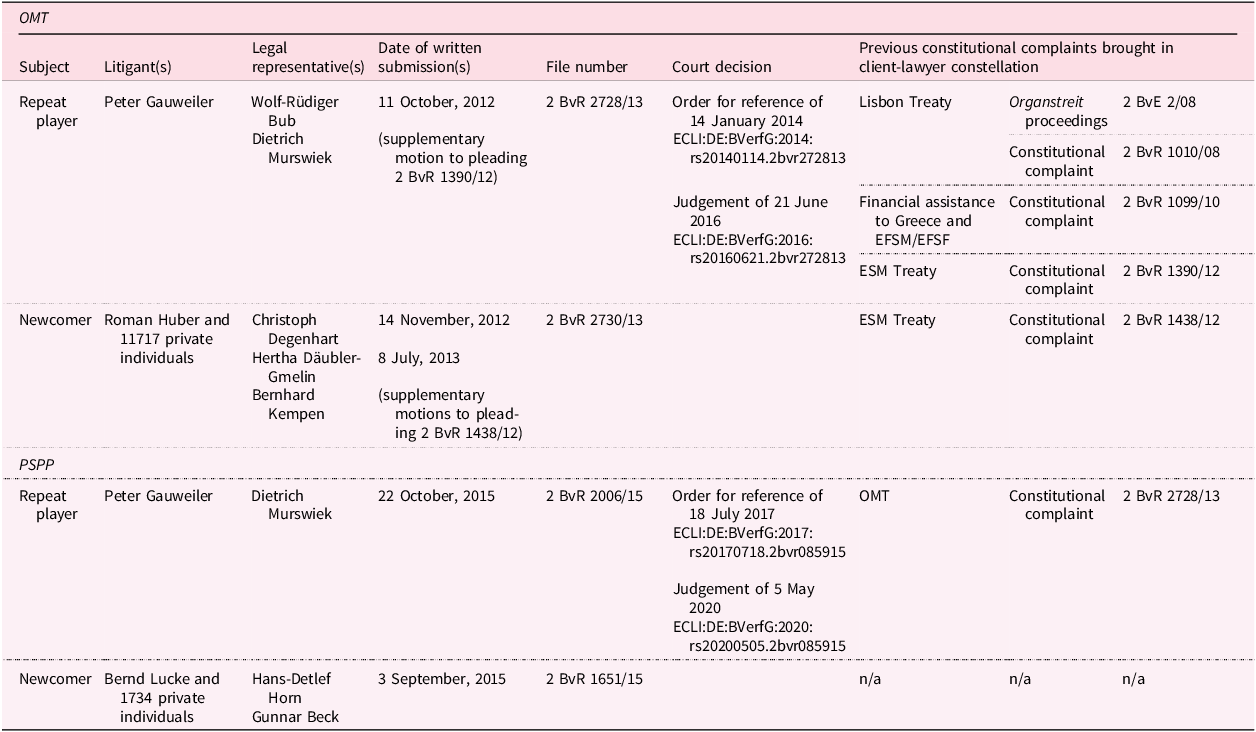
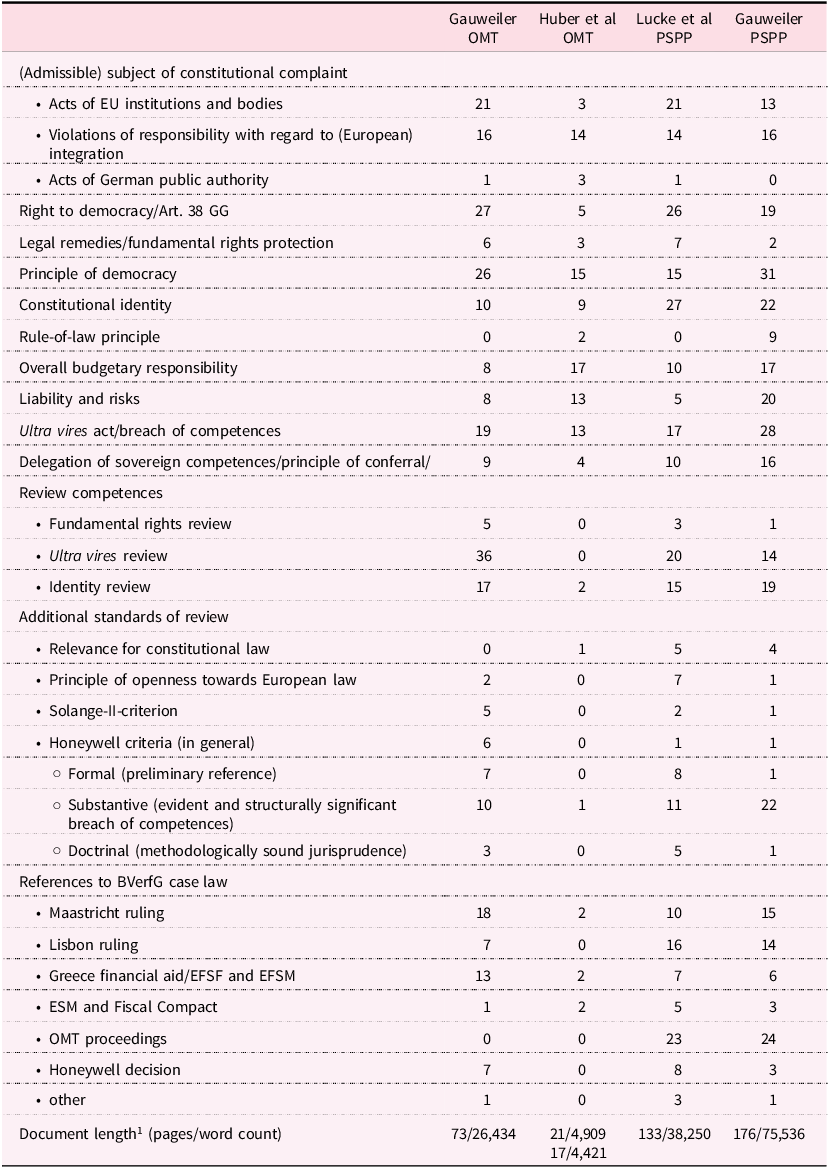


 Open access

