


Mitchell and colleagues (Reference Mitchell, Haslam, Burke and Steffense2026) provide a well-reasoned, sound, and thought-provoking case for why HR practices can promote or discourage narcissistic tendencies in leaders. Acknowledging their contribution, we offer two points of pushback and one point of extension based on those areas of pushback. The first point of pushback is that counter to the authors, we contend that hypercompetitive selection methods that seek to identify the best leadership candidate, although not ideal, are necessary. Do such processes (e.g., head hunting, in-depth assessment centers) admittedly have the potential to inflate individual egos and promote narcissistic behaviors in leaders? Yes. Does leadership have a large impact and warrant very careful selection and extensive development efforts? Also, yes. (e.g., Hogan & Kaiser, Reference Hogan and Kaiser2005; Khuong et al., Reference Khuong, Thanh and Quoc2022).
Second, although Mitchell and colleagues do a good job covering sizable ground on their core topic, something missing from their discussion is the body of work demonstrating that leader impact comes at a significant cost to leaders themselves. Spend a typical day with a CEO of a Fortune 500 firm, a morning with a small business owner, or an afternoon with the president of a university, and one question is likely to emerge: Why on earth would anyone want to be a leader? If we’re being candid, the benefits of leadership are frequently a few nontrivial perks mixed with an all-to-often awful set of daily experiences. Leaders take on every crisis and engage in near constant problem solving. Decades of research underscore the toll leadership takes on people willing to take on these roles (e.g., Byrne et al., Reference Byrne, Dionisi, Barling, Akers, Robertson, Lys, Wylie and Dupré2014; Ganster & Rosen, Reference Ganster and Rosen2013; Harms et al., Reference Harms, Credé, Tynan, Leon and Jeung2017). There is a reason U.S. presidents and world leaders seem to age so rapidly after years in office. The crown may be made of precious metals and stones (i.e., CEO salaries are admittedly exorbitant), but it is also quite heavy. Leadership comes at a significant cost.
Narcissism and the all-too-often linkage to leadership. These collective observations illustrate the intuitive observed relationship between narcissism and leadership emergence (e.g., Brunell et al., Reference Brunell, Gentry, Campbell, Hoffman, Kuhnert and DeMarree2008; Grijalva et al., Reference Grijalva, Harms, Newman, Gaddis and Fraley2015). To be sure, some individuals pursue leadership with prosocial aims: They recognize that stepping into such roles may be necessary to advance meaningful causes, or they do so reluctantly to prevent a more narcissistic colleague from embracing power. These cases exist, have significant impact, and should not be dismissed. All too often, however, leadership positions serve as magnets for those seeking power, status, and prestige for their own sake. The very way most leadership structures are designed rewards self-interest and ego, creating an environment where narcissistic tendencies are not only common but almost a prerequisite for ascending to the top of many organizations. As Mitchell and colleagues illustrate well in their work, many organizational policies and practices encourage those with narcissistic tendencies to both seek leadership positions and engage in narcissistic behavior once in those roles.
Coleadership as a possible solution
So, if leadership matters (it does) and we want leaders to take on the challenge (it is) of leading without becoming more of a jerk in the process, what can be done beyond recommendations offered by Mitchell and colleagues? In the spirit of ego-deflating HR and organizational practices, we offer a unique form of shared leadership not directly discussed by the authors: coleading (Feigen et al., Reference Feigen, Jenkins and Warendh2022; Hunter et al., Reference Hunter, Cushenbery, Fairchild and Boatman2012, Reference Hunter, Cushenbery and Jayne2017, Reference Hunter, Allen, Heinen, Cushenbery, Reiter-Palmon, Kennel and Kaufman2018 for reviews).
As noted by Mitchell and colleagues, shared leadership has been a somewhat hot topic as of late (e.g., Wassenaar et al., Reference Wassenaar, Pearce and Lorinkova2025), and although it’s tempting to suggest leadership in a form such as rotation or some other collective variant, we instead offer a unique form of shared leadership that embeds a support system to draw in the types of individuals who can better set ego aside. More to the point from the focal article, a coleadership structure sends a signal to potential applicants or member of a “Hi-Po” pool that leadership is not a singular activity where you, and you alone, must achieve all things. Instead, coleadership reminds both individuals that they, as leaders, have a partner and their dyadic approach to leading is what will drive success. They are also implicitly made aware that, if necessary, their partner could serve as an interim single leader until their half of the dyad is replaced.
Shared leadership structures are somewhat rare but rising and when they are deployed, around 90–94% are dyads (Feigen et al., Reference Feigen, Jenkins and Warendh2022). The dyadic or dual structure is a subvariant of shared leadership and is unique for a few reasons. First, with only two individuals, each leader has a roughly equal vote or say in decision making—there are no alliances to be formed with a third (or fourth or fifth) leader allowing one leader to be consistently outvoted and marginalized. Second, two leaders (rather than three or more) permit some share of ego display and credit to be given while also operating within a shared context. That is, it is not a collectivist approach to leadership where there is no formally recognized leader but is also not wholly individualistic either. Even with two leaders, the process of leading is hard. Coleadership lets egos be modestly puffed, but they are also balanced. Better illustrated by Feigen and colleagues (Reference Feigen, Jenkins and Warendh2022) sharing a lesson on coleading, reporting “In the words of Chip Kaye, for 17 years a co-CEO of a private equity firm Warburg Pincus (and now its sole CEO), the power sharing arrangement helps leaders ‘keep their egos in check’” (p. 3).
Perhaps most central to our argument here is that a leader’s well-being can be enhanced by a coleadership model (Hunter et al., Reference Hunter, Cushenbery and Jayne2017). Given the cascading effects of stress, leaders must be leery of passing down their stress and strain to followers. Another leader, however, can take on that stress and strain, and more importantly, share their own with their partner. Coleads know the challenges and trade-offs leadership requires in an intimate way. A coleader “gets it” in a way that no key lieutenant or even most trusted confidante can. The end result, then, is a leadership structure that attracts leaders who recognize the drawbacks of leading but are willing to do it with a partner. Stated differently, with coleadership, the pool widens beyond narcissists to include more servant–leadership oriented individuals and narrows for those who want all the power, credit, and influence associated with leading.
An additional benefit of dyadic shared leadership, although not often emphasized, is its potential role modeling effect. As van Knippenberg et al. (Reference van Knippenberg, Pearce and van Ginkel2025) argue, shared leadership must still be integrated with vertical leadership structures, because most organizations retain clear accountability lines. A dyadic arrangement does precisely this: It provides vertical clarity while simultaneously modeling collaborative leadership for future leaders within the team. By watching coleaders navigate power, share credit, and resolve tensions, team members absorb a nonauthoritarian model of leadership that tempers ego rather than amplifies it. In van Knippenberg et al.’s framework, this could be represented as an added mechanism under “Vertical Leadership Internal Dynamics: Role Modeling Shared Leadership.” Over time, such modeling may further erode the appeal of narcissistic approaches to leadership, as emerging leaders learn to associate authority not with dominance but with partnership.
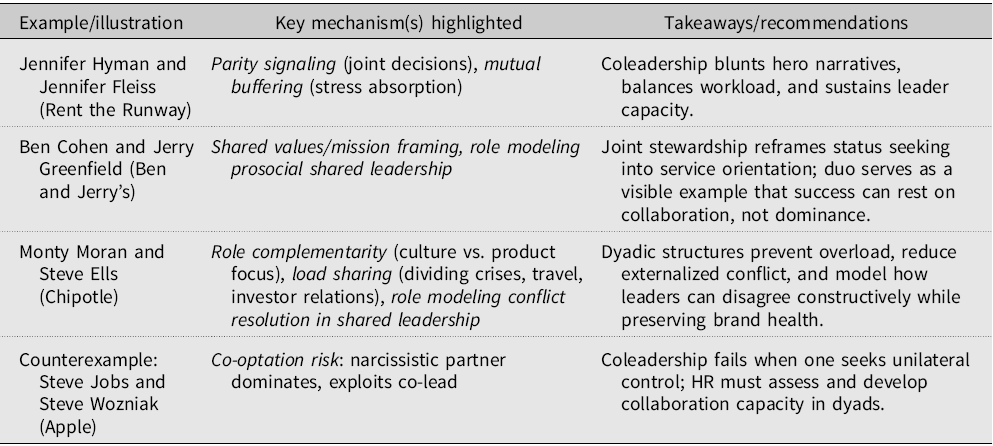
As concept of coleadership may be new to some readers, we offer the following illustrations of leader dyads who highlight a less narcissistic model of leading and hopefully, help bring the concept to life (see also, Table 1).
Jennifer Hyman and Jennifer Fleiss (Rent the Runway). The concept of Rent the Runway blossomed from a personal dilemma of exorbitant costs of wedding guest dresses to be worn once, revealing a gap for more affordable and sustainable alternatives (e.g., Eisenmann & Winig, Reference Eisenmann and Winig2012). The two leaders represent a classic founding dyad built on explicit complementarity visions and shared voice. Their partnership illustrates two ego-tempering mechanisms central to our argument: (a) parity signaling: major decisions are owned and communicated jointly, which blunts hero narratives; and (b) mutual buffering, when one coleader is under acute external or operational pressure, the other absorbs spillover and preserves bandwidth. Rent the Runway’s long-running success highlights that both mechanisms support sustainable effort rather than burnout.
Ben Cohen and Jerry Greenfield (Ben and Jerry’s). The ice cream founders not only shared a brand but also a leadership vision rooted in social responsibility (Cohen & Greenfield, Reference Cohen and Greenfield1997). More directly, this pair shows how shared values can discipline ego. By tying public credit to a joint social mission rather than individual brilliance, the pair redirected status striving into stewardship. That joint framing (one brand, two accountable leaders) both reduces incentives for narcissistic dominance and provides a built-in check when either leader’s preferences overreach.
Monty Moran and Steve Ells (Chipotle). Close friends and co-CEOs, each leader transformed Chipotle by overcoming ego for the good of the brand (Moran, Reference Moran2020). The story of Chipotle is a public-company example of role-based complementarity: One coleader emphasized culture/operations, the other product/brand. Two features map directly onto ego control and well-being, showing first that disagreements are to be resolved inside the dyad, not in the press or the boardroom. Second, load sharing architecture to include travel, investor relations, crises, and people leadership are divided to avoid chronic overload on any one leader.
Counter example—dyads are not perfect as antidotes to narcissism. Like all solutions, coleadership structures are also imperfect (e.g., Isaacson, Reference Isaacson2011). Coleading is not immune to challenges and, in some instances, is simply a way for a narcissistic leader to co-op a partner and take advantage of their expertise for their own gain. As Feigen and colleagues (Reference Feigen, Jenkins and Warendh2022) share “the model fails when one wants to run the whole thing” (p. 4). Consider an illustration of coleadership with a heavy dose of narcissism: Jobs and Wozniak, cofounders of tech giant, Apple.
Combining Wozniak’s computing and software background and Job’s marketing and communication prowess, the duo founded the current tech powerhouse, Apple. With Wozniak designing and building the products, Jobs felt he needed to compensate for not being a skilled computer engineer. So, he learned a lot about marketing principles and became the skilled communicator and salesperson that led to Apple’s success. Wozniak recounts that Job’s personality changed from a fun friend to a dead serious colleague focused on building a world-changing company, making him a notoriously difficult and demanding leader. He humiliated others, was impulsive, took credit for other’s work, and believed the rules did not apply to him (e.g., routinely parked in handicap parking spots), all to fulfill his desire to be remembered as a historical figure. Wozniak, who was solely focused on design and development, recognizes that Apple’s success was dependent on both his skills and Job’s drive and skills.
Stepping back, even when conceding the approach is imperfect, we do offer that coleadership is a sustainable if niche option for organizations leery of HR practices that promote leader narcissism. Coleadership can work at multiple organizational levels, from co-CEO to co-team lead. Most directly relevant as a commentary to Mitchell and colleagues the HR processes linked with coleadership are powerful signals to would be leaders in that organization that “we” supersedes “me.” Consider, for example, the implicit message sent via a selection system where leaders are directly assessed on how well they collaborate and make joint decisions.
Concluding comments
Mitchell and colleagues did an impressive job putting forth a novel idea: Maybe we create the context for narcissistic leaders to thrive and ask the question of whether organizations can do something to change that. We underscore the importance of leaders and how, as much as we might not like it, the decision of who becomes a leader matters. This is as true for a nonprofit as it is for a violent extremist organization, meaning whether we are trying to enhance or disrupt performance, empirical findings and historical precedence show we start with the leader. Moreover, not addressed by Mitchell and colleagues, we underscore that high performance comes at a price. Leaders work longer hours, report higher stress, and suffer the ill effects of being the person solving the problems no one else in the organization could solve. Given these areas of pushback, we offer an extension of thinking that is in line with the spirit of the focal article: altering HR practices. Specifically, we suggest that organizations consider coleadership structures where who is in charge is clear but the stress and strain is distributed between individuals. Adapted more widely, this approach will minimize the draw of narcissistic individuals to leadership positions and open the door for a more diverse group of capable individuals who can meaningfully embrace their roles as leaders through a partnership approach.
Illustrative Examples of Leader Dyads


 Open access

