


The incarceration of older people (age >50) in US prisons and jails has risen 280% in the past 30 years [Reference Williams, Goodwin, Baillargeon, Ahalt and Walter1]. Because of the accelerated aging associated with incarceration, researchers often categorize as “older adult” people with lived experience of incarceration (LEI) who are at or above age 50 [Reference Merkt, Haesen, Meyer, Kressig, Elger and Wangmo2]. When older people return to the community after incarceration, and nearly all of them do, they face many obstacles to health [Reference Onyeali, Howell, McInnes, Emerson and Williams3,Reference Barry4]. Women with LEI see higher rates and earlier onset of frailty, manage more chronic conditions, and have higher rates of premature mortality than women without LEI and more than men both without and with LEI [Reference Latham-Mintus, Deck and Nelson5–Reference Emerson, Li, Zaller and Ramaswamy8]. Older women with a history of incarceration also have significantly more depression and falls [Reference Emerson, Li, Zaller and Ramaswamy8]. In their 50s, many women still care for children (and grandchildren) as well as parents and significant others, while they struggle to meet employment and housing needs [Reference Onyeali, Howell, McInnes, Emerson and Williams3,Reference Li9]. The health problems that older women face after incarceration reflect accumulated long-term stress from poverty; housing instability; substance use; and trauma from violence, abuse, and neglect – all of which both precede and follow from incarceration [Reference Golembeski, Sufrin and Williams10–Reference Salisbury and Van Voorhis13]. Meanwhile, structural barriers stemming from racism, social stigma, and ruptured family and other relationships can further complicate women’s efforts to meet basic needs that support health [Reference Shantz and Frigon11,Reference Salem, Kwon and Ekstrand14].
About 1.9 million women are released from U.S. jails and prisons each year [Reference Sawyer15]. Yet nearly all research on aging and incarceration and especially aging after incarceration focuses on health outcomes in men. The handful of large surveillance studies that include an emphasis on justice-involved women’s health indicate that older women with LEI are at higher risk of aging-related health disability than men with and without LEI and women without LEI. But older women with LEI are rarely the topic of research, and their distinctive needs are not addressed. In a recent literature review conducted by members of our project team [Reference Thimmesch, Aponte, Krueger, Knittel and Emerson16], we located 25 studies published in 25 years (2000–2025) in which aging-related health in women with LEI – either currently or formerly incarcerated – was the focus of study. We found no interventional research, a lack also reflected in Canada et al.’s [Reference Canada, Barrenger, Robinson, Washington and Mills17] systematic review of programs developed to support health of older adults in jails and prisons, where just one of the five studies located included older women.
Also missing from the literature on frailty and other aging-related health in older women with LEI was community-based participatory or other community-engaged research [Reference Thimmesch, Aponte, Krueger, Knittel and Emerson16]. Community-engaged research works with patients or other groups in the processes of research to learn about a problem or situation experienced by the group [Reference Viswanathan, Ammerman and Eng18]. Community-engaged methodology encompasses a spectrum of involvement, from eliciting community input on a research idea; to incorporating advisory boards for project oversight; to full partnership with organizations or patient groups to plan, conduct, interpret, and disseminate research [Reference Key, Furr-Holden and Lewis19]. Community-engaged methods have been credited with improving research rigor, relevance, and reach [Reference Balazs and Morello-Frosch20] and enhancing uptake of findings [Reference Marrone, Nieman and Coco21]. A community engagement methodology may be especially needful in research that addresses health in minoritized groups who have been excluded, overlooked, and even injured by researchers in the past. There is some evidence that community-based participatory research is more effective than other approaches in recruiting and retaining participants in clinical trials and developing effective behavioral interventions [Reference De las Nueces, Hacker, DiGirolamo and Hicks22].
Much work remains to be done to effect healthier aging outcomes in women with LEI. Older Women Leading Healthy Aging Research Together (OWLHART) is a patient-centered outcomes research engagement capacity building project designed to create awareness, means, and opportunity for future comparative effectiveness research grounded in the needs and preferences of patients (women with LEI). The project brings together older women with LEI, clinician-researchers, and community advocates to explore, create, and plan for future research initiatives. In this communication, we describe OWLHART’s sequencing of sharing, learning, teaching, and outreach capacity-building activities in the project’s first eight months. We offer our account as an adaptable approach to fostering readiness for research engagement in groups that are unfamiliar with formal processes of research and may be excluded from research engagement. Our equity-grounded methods rest on the assumption that women with LEI bring rich, varied experiences and the desire to influence research and health care to facilitate healthier aging for themselves and other women.
Materials and methods
Engagement project aims and design
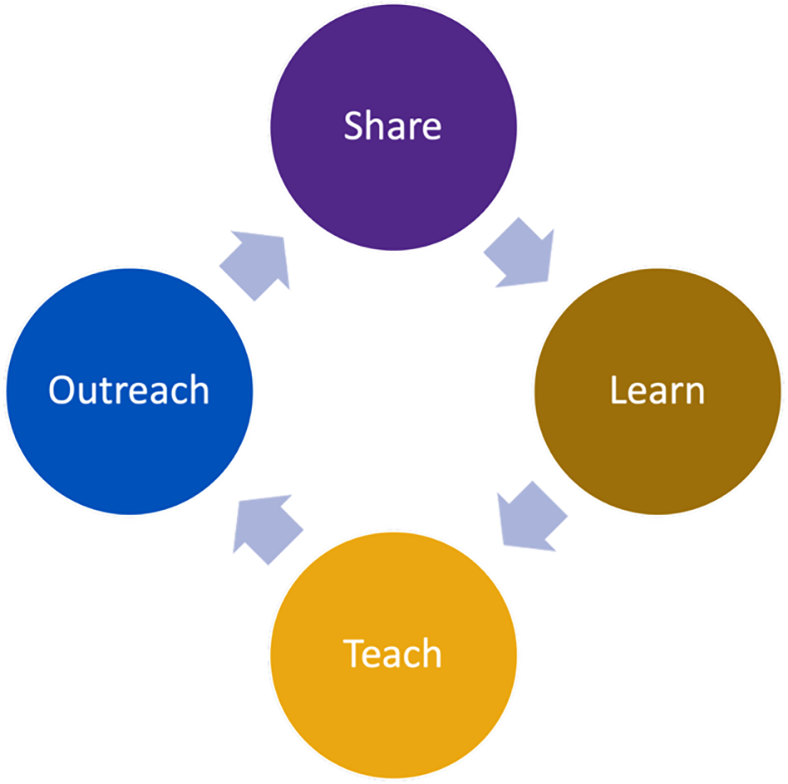
OWLHART is a community-engagement capacity-building project that aims to (a) identify priority health needs and preferences of community-dwelling older women (age >50) with LEI (i.e., the “patient” group); (b) build awareness, tools, and opportunities for engagement in health care and healthy aging research with and by older women with LEI, clinician-researchers, and community advocates; and (c) set an agenda for future patient-centered outcomes research and clinical guidance with and for older women with LEI. OWLHART seeks to facilitate older women’s opportunities for meaningful participation in planning, conducting, implementing, and delivering health care and health outcomes research to address the needs that matter to them most to them. To achieve these ends, OWLHART meets monthly to share, learn, teach, and develop outreach (Figure 1) on topics related to older women’s healthy aging after incarceration. We have focused in our first eight months on building trust, learning about research, and exploring frailty and other health challenges faced by older women with LEI.
Activity domains.

Recruitment and compensation
OWLHART network members were recruited by member referral and word of mouth through community and previous study contacts of the project team. All network members receive $50 compensation on a debit card for each two-hour monthly meeting and $50 for acting as a member on a core team (smaller planning and working sessions). Our monthly meetings take place in the evening, when members are best able to attend, and all include dinner. The OWLHART project has also included an ongoing, embedded qualitative research study in which network members have been co-planners and participated in data (deidentified) analysis. That study was approved by the University of Kansas Medical Center IRB (#00160758).
Activity domains – methodology
Sharing
OWLHART begins and ends with sharing. Sharing represents the high value the group puts on people, since sharing elevates women’s perspectives on frailty and other priority areas for healthy aging health and care-related preferences. Sharing means that OWLHART acknowledges power, intentionally placing women’s priorities on a level with what academic disciplines and scientific fields say is important. Sharing is about process because all of our activities incorporate steps that center on hearing the experiences and perspectives of women and of clinicians and community advocates and others who care for women with LEI (Table 1). Sharing is part of our monthly meeting process. Each meeting begins with a shared meal. This is a time to catch up informally on what members have been doing, hear what weighs on one another’s minds, and lift up each other’s victories and celebrations. Overall, we strive to promote equity in the group by sharing power, creating a space where all – established, new, guests, women, community advocates, team–have a voice in decision-making and leadership.
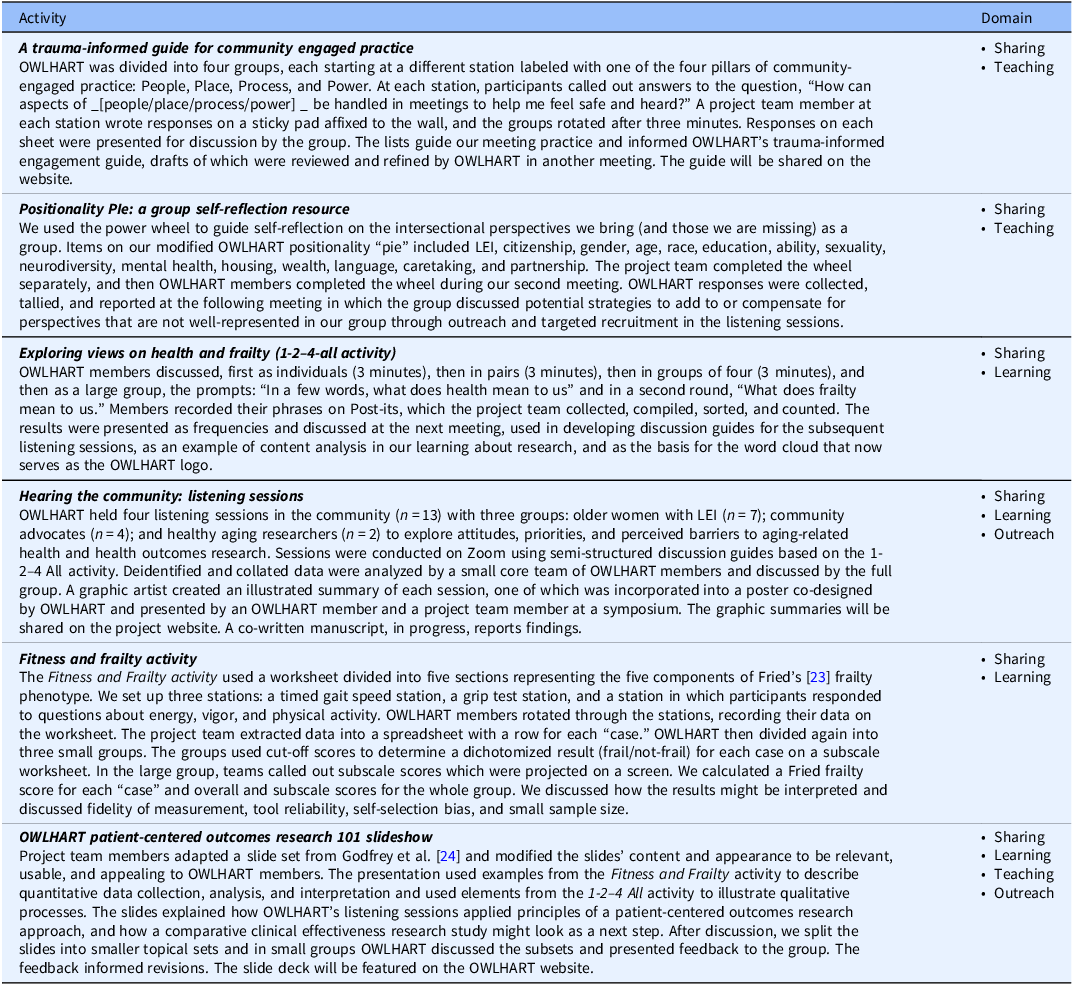
OWLHART activities by domain

Learning
Learning in OWLHART includes learning what frailty is, how frailty is measured, and why it affects some groups – like women with LEI – more than others. Members’ learning also has included hands on experiences with research, to learn the basics of its purposes and process and specifically the benefits of patient-centered outcomes research. OWLHART learning is reciprocal, drawing equally on members’ expertise in their own health and the lived experiences of incarceration and transition to the community after incarceration. In learning about the science of health and frailty after incarceration, OWLHART has used a laddered, experiential process of applying quantitative and qualitative methods of data collection, data analysis, and application to learn about research (Table 1).
Teaching
In the teaching domain, OWLHART members are working to become instigators of future learning in others by developing tools for teaching other women with LEI and engaged community partners about frailty and resilience in women aging in the community after incarceration (Table 1). Teaching in the project also includes OWLHART’s upcoming partnership with a health communications specialist to script, act in, and film three brief informational videos on the needs and opportunities of aging-related health research by and with older women with LEI and tips for clinicians and researchers on how to approach and work respectfully with older women with LEI in community-based health care delivery and health outcomes research.
Outreach
OWLHART’s activities include planning the means to disseminate what we share, learn, and teach, first, through the design and launch of our project website. In planning so far, the OWLHART website aims to display the project’s aims and share OWLHART member stories; make available healthy aging research, tools, and resources (like our training videos); and publicize healthy aging events and opportunities that connect older women with LEI and their families with clinicians, researchers, and community advocates for patient-centered outcomes research and program development.
Results
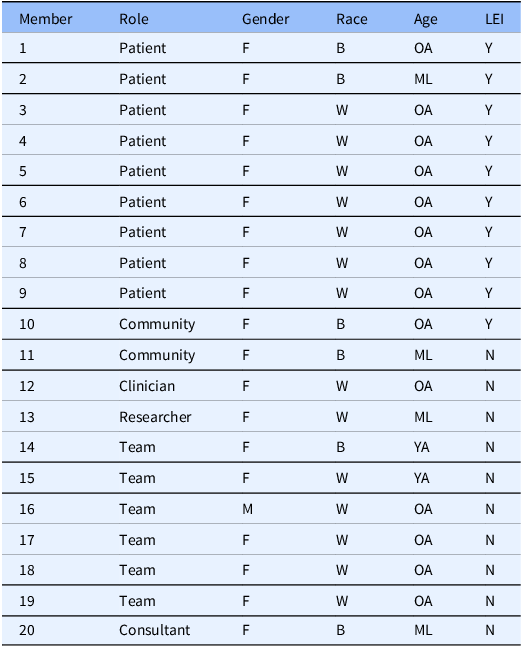
Participants
In its first eight months, the OWLHART group has fluctuated in number. At a typical monthly meeting, attendance includes between four and six returning women with LEI, one geriatrician; one healthy aging researcher; two community advocate members; and four or five project team members (Table 2). The OWLHART women or “patient” group are 49–68 years of age, live in the Kansas City Metropolitan area (spanning Kansas and Missouri), and have at least one year’s previous incarceration but are not currently incarcerated or on supervised probation. The women’s incarceration experience ranges from one year to a couple decades’ duration.
OWLHART members and project team
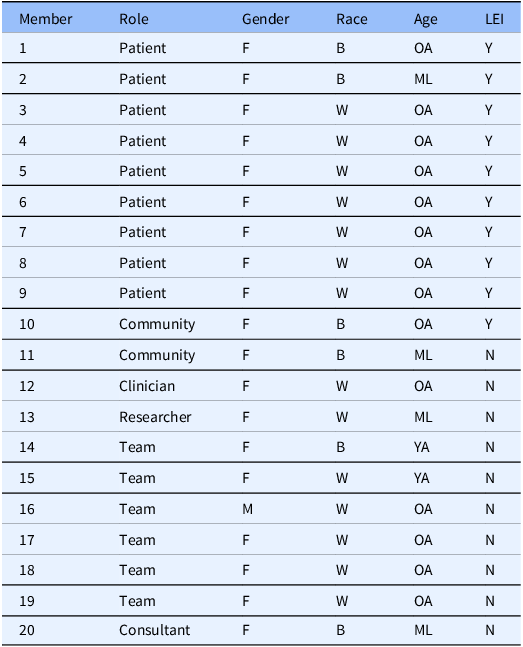
Note: B: Black or African American; F: Female; LEI: lived experience of incarceration; M: Male; ML: midlife; OA: older adult (50 and older); W: White; YA: young adult.
Among the six regular attenders, two women are Black and four are White. The two community advocates include a Black woman who runs her own non-profit, providing a range of transition services to women as they leave prison, and a White woman who has worked with women with LEI in programming to promote cervical health. The six-member OWLHART project team includes one older adult White male and one Black woman who is also the youngest member (age 24). We have not yet recruited a member who identifies as Hispanic but have consulted with a local organization that promotes Latino health to translate our materials to attract future members from that community. Additionally, one of the community advocates has LEI, and among the patient members is a trained health care worker and a certified peer specialist.
Activities
We summarized sharing, learning, and teaching activities from November 2024 to June 2025 in Table 1. OWLHART activities (a) include some combination of learning about aging-related health or frailty and learning about research, (b) cycle through two or more rounds of OWLHART involvement, (c) result in the creation of a tangible product that embodies the thought, time, and effort invested by the group, and (d) are scaffolded, so that any one activity informs and is informed by others that precede and follow it.
Engagement
Members engage in OWLHART actively as planners, designers, and participants in activities. For almost all the activities in Table 1, OWLHART members were involved in brainstorming content, trying out or discussing drafts, and providing feedback as products were refined, all the while understanding that we were creating resources destined for sharing with others. When asked to select activities that mattered most to them, five OWLHART members singled out the Fitness and Frailty activity. Members appreciated doing the Fried [Reference Fried, Tangen and Walston23] frailty phenotype test for the information they gained about their own physical status. Despite disclaiming that the activities were not diagnostic, one member noted appreciatively that the activity “highlights what I need to work on to not be more frail as I age,” and another said that the activity “showed me I was not as frail as I thought.” Others liked the physicality of the activity (e.g., grip test, gait speed measure), how simply doing the tests “made me use body parts I had not used in a while – made me feel healthier.”
Another valued activity was the very first, the group’s co-creation of a trauma-informed community practice guide which then guided OWLHART practice in meetings, influencing us in leaving doors open during sessions, sharing meeting agendas so members know what is coming next, and including more time for informal discussion and sharing so women know one another. Members also appreciated the activity for helping establish a sense of common ground. One member noted how the discussions helped her see “that what I’m experiencing after prison, others are going through the same thing.” Another member said it was a “comfort just to know I’m not alone.” Two members used the term “camaraderie,” and another noted how much she valued being able to “share with others and hear their stories.” Two members specified that they found activities like adapting and applying the power and positionality tool especially rewarding for “ask[ing] questions that make me think–dig deep;” “learn new things;” and hear “different perspectives.” Last, and related to communality, half the members mentioned how much it mattered to them that activities were designed to “help other women,” “help others understand older ladies that have been incarcerated,” or “make a difference in someone else’s life.” One member specified that she valued engagement in OWLHART activities because they have “purpose.”
Discussion
Improving the healthy aging outcomes of older women with LEI is a goal that will likely be met only with significant engagement of older women who have the experience of incarceration. This is a group of women with distinctive life pathways and exposure to environments and life circumstances that increase the risk of early functional disability and chronic disease [Reference Gehring12]. The OWLHART project was formed to involve women with LEI, clinician-researchers, and community advocates in a collaborative process of developing awareness, means, and opportunity for patient-centered outcomes research engagement around the challenges women face in achieving health in aging after incarceration. Prospectively, OWLHART aims to ready the ground for engagement at all points in the research process by older women with LEI and engaged community partners: from setting standards and priorities to co-designing interventions; creating, adapting, and implementing data collection tools; interpreting data; and evaluating and reporting findings. OWLHART goals and methods align with models like the Centers for Disease Control’s Principles of Community Engagement [Reference Cohn, McCloskey, Berman, Silberberg, Alving, Aguilar-Gaxiola and Eder25] and the Patient-Centered Outcomes Research Institute (PCORI) [26] updated guidance for partnerships between patients, researchers and other engaged communities, in both of which engagement spans multiple levels of involvement, from input to consultation and from collaboration to shared leadership. PCORI’s six pillars of partnership model includes representative involvement, early and ongoing engagement, dedicated funds for engagement, building capacity to work as a team, meaningful inclusion of partnership in decision-making, and ongoing review and assessment of engagement [26]. From its inception, OWLHART has integrated input, consultation, and shared decision making into the planning, activities, and deliverables of the project. The engagement-centered funding has helped ensure that members are fairly compensated for the substantial time and effort they commit to the project.
Equitable collaboration is the true heart of OWLHART and involves supporting members’ direct involvement in shaping the overall project and activities. Our collaboration rests on respect, trust, communication, transparency, and flexibility. Trust is especially necessary in the context of LEI, where deficits in carceral and transitional health care and a history of clinical research exploitation foster mistrust and distrust [Reference James27]. OWLHART activities frequently draw on liberating structures, mini structures of group interaction designed to promote trust through equity and inclusivity [Reference Lipmanowicz and McCandless28]. Liberating structures operate on the premise that the communities with lived experience of a need are best situated to pose the questions that matter and generate solutions that work. Liberating structures assume multiple sources of knowledge in a group and use flexible forms to support equity in participation. This is especially important because OWLHART comprises, in addition to the OWLHART network members, the six-member academic project team (Table 2) of faculty researchers, students, research assistants, and a community liaison with access to social and institutional power generally out of reach of most OWLHART network members. In this way, liberating structures contribute to trust and enhance capacity to work as a team in framing and meeting needs. The 1-2-4-All activity (Table 1) used to explore meanings of health and frailty among us was a liberating structure [Reference Lipmanowicz and McCandless28]. Similarly, OWLHART “core teams,” the smaller (3–4-member) teams that meet separately to plan specific activities, review products, and approve changes, provide a liberating structure within which the group extends engagement in collaboration to shared decision-making.
Conclusion
The advantages of meaningful patient and community partner involvement in research are considerable. Maurer et al. [Reference Maurer, Mangrum and Hilliard-Boone29] distilled five primary impacts of meaningful research engagement from interviews with investigators in 58 patient-centered outcomes research studies, and found the most frequently named impacts were research priorities and materials that better reflect patient and caregiver needs and preferences; more timely, cost-effective studies; expanded reach or compass, better study designs, and higher quality interventions; increased scope and quality of stakeholder interactions; and results that matter to patients and other stakeholders. For older women with LEI, meaningful engagement in research offers to produce better quality, more impactful outcomes, ensuring that the science is responsive to women’s needs at all points. The enthusiastic commitment to OWLHART goals and activities suggests that meaningful engagement may also function as a unique forum in which women can leverage their firsthand knowledge of incarceration and reentry, influence the science of aging and health, and act on the desire to help other women who come behind them. Such are the ripple effects that could help reestablish the public’s trust in science and reinvigorate science’s commitment to communities.
Author contributions
Sherri Anderson: Formal analysis, Investigation, Writing-review & editing; Leigh Anne Covington: Conceptualization, Formal analysis, Investigation, Writing-review & editing; Shamika Davis: Conceptualization, Formal analysis, Writing-review & editing; Amanda Emerson: Conceptualization, Formal analysis, Funding acquisition, Investigation, Methodology, Writing-original draft, Writing-review & editing; Déon Cox Hayley: Conceptualization, Formal analysis, Writing-review & editing; Catherine Johnson: Conceptualization, Formal analysis, Writing-review & editing; Jill Peltzer: Conceptualization, Formal analysis, Funding acquisition, Investigation, Methodology, Writing-review & editing; Bernard Schuster: Data curation, Formal analysis, Writing-review & editing; Janet Severine: Conceptualization, Formal analysis, Writing-review & editing; Catherine Siengsukon: Conceptualization, Formal analysis, Writing-review & editing; Sharla Smith: Conceptualization, Formal analysis, Writing-review & editing; Mary Taylor: Conceptualization, Formal analysis, Writing-review & editing; Amanda Thimmesch: Data curation, Methodology, Project administration, Resources, Writing-review & editing; Alexandria Thompson: Formal analysis, Writing-review & editing.
Funding statement
This project was funded through a Patient-Centered Outcomes Research Institute (PCORI) Eugene Washington PCORI Engagement Award (EACB-34382).
Competing interests
The authors declare none.

 Open access

