

The Relevance of the Capability Approach to Work and Employment
The capability approach (CA) is concerned with human flourishing and development and thus applies to studying the quality of life of individuals, individual well-being, social outcomes, and public policies in various occupations and countries [Reference Anand, Comim, Fennell and Anand1, Reference Fukuda-Parr, Cid-Martinez, Nissanke and Ocampo2]. In the CA, Sen offers a comprehensive framework for evaluating human well-being beyond traditional economic measures such as income or utility [Reference Sen3]. The CA emphasises what individuals are able to do and be – the capabilities and the functionings that they achieve. Measuring and studying these capabilities are essential for formulating policies that enhance human development and promote social justice, especially in the context of work. Building on Sen’s work, Nussbaum proposed a list of central human capabilities essential for a life with dignity, including life, bodily health, bodily integrity, senses, imagination, thought, emotions, practical reason, affiliation, other species, play, and control over one’s environment [Reference Nussbaum4]. These capabilities give people the freedom and opportunity to live their lives in meaningful and fulfilling ways. There is a debate between Sen and Nussbaum in which Sen’s position is that capabilities are always context- and situation-dependent and that a generally valid list of capabilities, as drawn up by Nussbaum, conflicts with this. For an extensive discussion of the debate between Sen and Nussbaum, see Robeyns [Reference Robeyns5].
Work capabilities refer to individuals’ opportunities to achieve the functioning they value in their work, such as earning a living, contributing to society, and developing skills. Understanding work capabilities, as conceptualised in the CA, across various occupations, sectors, and countries holds significant value for several reasons [Reference Bryson, O’Neil and Bryson6–Reference Zimmermann and Engelbrecht13].
First, different occupations have unique demands, resources, and contexts. Understanding the capabilities required in each occupation can help policymakers and interventionists better tailor policies and interventions to enhance employees’ capabilities. Across countries, the socio-economic, cultural, and regulatory contexts vary significantly. The CA allows appreciating these variations, ensuring that human development interventions are contextually appropriate [Reference Egdell and McQuaid8].
Second, by focusing on individuals’ capabilities, it becomes possible to identify and address inequalities in access to resources and opportunities that affect their work outcomes. This is particularly important for marginalised groups in different occupations and countries that may face systemic barriers. Understanding capabilities also helps in the design of inclusive workplaces by identifying employees’ diverse needs and aspirations across roles and regions, promoting more equitable development and well-being opportunities [Reference Dellve, Jonsson, Flisbäck, Bengtsson, Falk Erhag, Lagerlöf Nilsson, Rydberg Sterner and Skoog7, Reference Gloss, Carr, Reichman, Abdul-Nasiru and Oestereich14].
Third, the CA connects an individual’s capabilities with their well-being [Reference Barnard, Rothmann, De Beer, Lubbe and Mrayyan15–Reference Ragadu and Rothmann18]. By understanding capabilities within various work contexts, organisations and policymakers can create environments that support employees’ well-being and fulfilment. Insights into capabilities help in the design of jobs and career pathways that promote sustainable employability, ensuring that workers can thrive and remain employable throughout their careers, regardless of industry changes or geographical location.
Fourth, the nature of work is rapidly changing due to technological advancements, globalisation, and shifts in labour markets. Understanding work capabilities enables individuals and organisations to adapt by focusing on developing relevant capabilities that match the evolving demands across occupations and countries. With global migration and diverse workforces becoming common, recognising the capabilities needed in different cultural and professional contexts allows organisations to create flexible and inclusive work environments [Reference Gloss, Carr, Reichman, Abdul-Nasiru and Oestereich14]. This finding shows that capabilities include not only the individual aspects of well-being and flourishing at work but also the entitlement of the social and organisational environment to facilitate the realisation of capabilities.
Fifth, the CA emphasises individuals’ freedom to pursue the work they value. By understanding capabilities in various contexts, strategies can be developed that empower workers to have agency in their career development and job roles. Labour relations and power dynamics may vary across countries. Understanding capabilities helps create participatory environments where employees feel that they have a say in shaping their work conditions and contributing meaningfully to their workplaces.
Finally, the CA aligns well with global frameworks such as sustainable development goals [Reference Seckler and Volkert11], especially those related to decent work and economic growth. By understanding capabilities across occupations and countries, policies can be aligned with these goals, promoting sustainable and inclusive economic development. Understanding capabilities across countries also allows for comparative studies, providing valuable insights into best practices and strategies that can be adapted or scaled across regions and promoting global collaboration and development.
Global Variations in Work Capabilities
The CA has been applied to understand work capabilities in different countries, revealing disparities in income and employment opportunities. In India, individuals’ work capabilities were found to correlate with income levels [Reference Banerjee19]. In Belgium, France, and the Netherlands, institutional contexts shape work-related functioning differently for regular and self-employed workers [Reference Focacci and Pichault20]. The CA has been used to assess occupational health and safety, particularly among vulnerable workers [Reference Bernardi21], and to analyse human resource practices from an economic and human development perspective [Reference Subramanian, Miquel Verd, Vero, Zimmermann and Subramanian22]. Researchers have explored methodological challenges in operationalising the approach for cross-country comparisons [Reference Hollywood, McCarthy, Spencely and Winstone23]. Employment services in Finland have been examined for their support of immigrant women’s capabilities [Reference Steel and Jyrkinen24].
Researchers [Reference Ragadu and Rothmann18, Reference Wissing25] have criticised the tendency to focus capability assessment and development on Western, educated, industrialised, rich, and democratic (WEIRD) countries [Reference Henrich, Heine and Norenzayan26]. Work capabilities, as conceptualised in the CA, differ significantly between occupations in various socio-economic contexts, especially when comparing WEIRD and non-WEIRD countries. The criticism is unfounded. Especially in the early stages of CA research, with a strong focus on developmental economics, most research (and interventions) using CA were conducted in Africa, and to a lesser extent in Latin America. Only after the application of the CA to other domains (health, education, and social sciences) around 2000 did research interest emerge in Western countries. Moreover, there is also a large difference between autocratic and non-autocratic countries. These differences stem from variations in socio-economic structures, cultural norms, institutional frameworks, and levels of resource availability [Reference Henrich, Heine and Norenzayan26]. As noted earlier, Sen argues against a predetermined list of capabilities, suggesting that people must be asked directly about their valued beings (states) and doings (activities) [Reference Sen3].
Access to resources and opportunities may vary across countries [Reference Feng, Hu, Afshan, Irfan, Hu and Abbas27, Reference Füllemann, Brauchli, Jenny and Bauer28]. In resource-rich contexts, workers often have access to advanced tools, professional development, and supportive policies that enhance capabilities such as autonomy, learning, and well-being. In resource-constrained countries, inadequate infrastructure, limited access to training, and poor working conditions can restrict capabilities, leaving workers unable to utilise their potential or pursue valued outcomes fully.
Cultural conventions influence the perception of work competencies and capabilities [Reference Chen, Lam, Buchtel and Bond29, Reference Ryan, Boyce, Ghumman, Jundt, Schmidt and Gibby30, Reference Zou, Tam, Morris, Lee, Lau and Chiu31]. For instance, creativity and innovation may be highly valued in Western contexts, whereas collectivism and social integration are emphasised in many African and Asian contexts. Cultural norms and values complicate comparisons, as what individuals value at work (e.g., autonomy, security, or social contribution) differs across societies [Reference Nussbaum4, Reference DeJaeghere32]. Moreover, differences in personal, social, and environmental conversion factors also affect how resources translate into capabilities, making country comparisons problematic [Reference Sen3, Reference Robeyns5].
Table 13.1 shows the possible reasons for global variations in work capabilities in WEIRD and non-WEIRD countries [Reference Gloss, Carr, Reichman, Abdul-Nasiru and Oestereich14, Reference Henrich, Heine and Norenzayan26, Reference Miles33].
| Variable | WEIRD countries | Non-WEIRD countries |
|---|---|---|
| Autonomy and decision-making | The emphasis is on individual autonomy, self-direction, and decision-making. | Collectivism often takes precedence, with a greater emphasis on collaboration, loyalty, and respect for authority. |
| Social integration and relationships at work | Workplace interactions are often formalised, with a focus on individual performance and outcomes. | Social integration is central to many occupations for success and resilience. |
| Innovation and adaptability | Innovation and adaptability are highly valued capabilities, driven by access to advanced education, technology, and research opportunities. | Innovation exists, but is often constrained by limited resources and opportunities. |
| Access to resources and infrastructure | Workers typically enjoy good access to education, training, technology, and workplace infrastructure. | Many occupations are shaped by resource scarcity, informal employment, and limited access to training. |
| Job security and stability | Occupations often provide stronger labour protections and social safety nets, fostering capabilities such as job security and well-being. | Precarity and informal labour dominate, particularly in sectors such as agriculture, construction, and domestic work. |
| Equity and inclusion | The workplace diversity and inclusion initiatives of many occupations aim to enhance equity-related capabilities. | Structural inequalities, such as those based on gender, race, and social class, are more pronounced. |
Various conclusions can be drawn from comparing capabilities in the WEIRD and non-WEIRD contexts. First, the CA is universally relevant but locally grounded. The strength of the CA lies in its ability to transcend cultural boundaries while remaining sensitive to local values and constraints. Second, cross-context comparisons show that capability deprivation is often the result of institutional failure rather than individual deficits. By focusing on what people are genuinely able to do and be in their work, the CA makes visible the structural injustices that persist within and across countries. Third, the CA encourages a shift from output to freedom. This perspective encourages policymakers and employers to reframe work quality beyond economic indicators towards the real opportunities workers have to flourish.
Different countries have varying levels of economic development, labour market conditions, and social infrastructure, all of which shape the opportunities available for individuals to achieve desired work outcomes [Reference Bosch-Sijtsema, Fruchter, Vartiainen and Ruohomäki34–Reference Pearce, Xin, Xu and Rao37]. The CA holds transformative promise for work in non-WEIRD countries.
Occupational Variations in Work Capabilities
Efforts to enhance work capabilities must be occupation-specific and informed by local socio-economic realities rather than adopt a one-size-fits-all model.
Research has shown that institutional support in various countries significantly affects work capabilities, particularly for regular employees compared with self-employed workers [Reference Focacci and Pichault20, Reference Van Gorp, Van der Klink, Abma, Jongen, Van Lieshout and Arnoldus38, Reference Drobnic and Guillen Rodriguez39]. Work–home tensions vary by institutional context, with job demands and autonomy playing paradoxical roles. Additionally, the institutional context significantly shapes the work capabilities of regular versus self-employed workers.
Studies have shown that job characteristics have an impact on well-being [Reference Ellorenco, Teng-Calleja, Bertulfo, Clemente and Menguito40, Reference Suppa41]. Favourable job characteristics, such as autonomy and wage justice, enhance subjective well-being, whereas work-related stressors and inequalities reduce life satisfaction. Decision-making and earning a good income are crucial in various occupations, and capabilities have a significant effect on well-being, job performance, and the intention to stay. A study conducted on the capabilities of special education teachers in Namibia [Reference Murangi, Rothmann and Nel42] revealed that all seven work capabilities identified by Van der Klink et al. [Reference Van der Klink, Bültmann, Burdorf, Schaufeli, Zijlstra and Abma12] and Abma et al. [Reference Abma, Brouwer, De Vries, Arends, Robroek and Cuijpers43] in the Netherlands were valuable. However, not all were afforded the necessary opportunities, and not all were achieved.
Table 13.2 shows a comparison between occupations in WEIRD and non-WEIRD countries [Reference Barnard, Rothmann, De Beer, Lubbe and Mrayyan15, Reference Delclos, Bright, Carson, Felknor, Mackey and Morandi44–Reference Suvedi, Ghimire and Channa48].
Comparing work capabilities across different occupations is inherently complex due to significant variation in work tasks, job design, and contextual conditions. Occupations differ in the nature of their demands, which shape the relevance of specific capabilities [Reference Bonvin and Farvaque49, Reference Robeyns50]. For example, autonomy and creativity may be central in professional roles, whereas physical integrity and income security may be more salient in manual or precarious work. Moreover, differences in job control, access to resources, and social recognition affect how capabilities are enabled or constrained [Reference Van der Klink, Bültmann, Burdorf, Schaufeli, Zijlstra and Abma12]. Even within the same occupational category, contextual factors such as organisational setting, employment status, and labour protection vary widely, influencing workers’ real freedoms to pursue valued outcomes. The role of personal, social, and environmental conversion factors further complicates comparison, as these factors mediate the extent to which occupational characteristics translate into meaningful capabilities [Reference Sen3, Reference Robeyns50]. These challenges highlight the need for a nuanced, context-sensitive approach to analysing occupational differences in work capabilities.
Case Studies: Measurement and Use of Work Capabilities in Diverse Contexts
This section focuses on work capabilities in different contexts via the same measuring instrument: the Capability Set for Work Questionnaire (CSWQ). The CSWQ, developed to measure work capabilities, is used to analyse findings regarding work capabilities in different contexts [Reference Van der Klink, Bültmann, Burdorf, Schaufeli, Zijlstra and Abma12, Reference Abma, Brouwer, De Vries, Arends, Robroek and Cuijpers43]. The CSWQ assesses seven key work-related capabilities: (a) using knowledge and skills; (b) developing new knowledge and skills; (c) being involved in important decisions; (d) building and maintaining meaningful contacts at work; (e) setting one’s own goals; (f) earning good income; and (g) contributing to something valuable. Studies have shown that the CSWQ is a reliable and valid instrument for measuring work capabilities in Jamaica [Reference Lewis, Rothmann and Van der Klink51], the Republic of South Africa (RSA) [Reference De Wet and Rothmann16, Reference Ragadu and Rothmann18, Reference Barnard, Rothmann, De Beer and Lubbe52], Namibia [Reference Murangi, Rothmann and Nel42], and the Netherlands [Reference Abma, Brouwer, De Vries, Arends, Robroek and Cuijpers43, Reference Gürbüz, Joosen, Kooij, Bakker, Van der Klink and Brouwers53]. Table 13.3 shows the percentages of work capabilities (as measured by the CSWQ) in different occupations.
| GW (n = 1250) The Netherlands | SET (n = 200) Namibia | ENUR (n = 195) RSA | SSE (n = 141) RSA | ECDP (n = 434) RSA | EHI (n = 335) Jamaica | |
|---|---|---|---|---|---|---|
| UKS: V | 92 | 95 | 94 | 97 | 91 | 86 |
| UKS: E | 78 | 80 | 78 | 82 | 70 | 64 |
| UKS: A | 77 | 75 | 78 | 86 | 70 | 65 |
| Cap | – | 66 | 66 | 79 | 57 | 53 |
| DKS: V | 79 | 93 | 91 | 92 | 87 | 83 |
| DKS: E | 62 | 74 | 68 | 77 | 67 | 64 |
| DKS: A | 57 | 73 | 70 | 76 | 68 | 61 |
| Cap | – | 63 | 62 | 70 | 53 | 52 |
| IID: V | 71 | 82 | 78 | 82 | 69 | 71 |
| IID: E | 51 | 63 | 45 | 61 | 52 | 51 |
| IID: A | 46 | 61 | 43 | 60 | 50 | 48 |
| Cap | – | 52 | 36 | 54 | 39 | 42 |
| MRW: V | 69 | 91 | 89 | 91 | 88 | 77 |
| MRW: E | 70 | 79 | 67 | 77 | 74 | 70 |
| MRW: A | 70 | 72 | 65 | 83 | 73 | 60 |
| Cap | – | 65 | 59 | 75 | 62 | 54 |
| SOG: V | 75 | 96 | 85 | 90 | 89 | 81 |
| SOG: E | 65 | 81 | 61 | 78 | 73 | 60 |
| SOG: A | 61 | 72 | 58 | 80 | 72 | 56 |
| Cap | – | 67 | 52 | 73 | 72 | 50 |
| EGI: V | 82 | 83 | 85 | 89 | 86 | 88 |
| EGI: E | 51 | 54 | 26 | 54 | 35 | 36 |
| EGI: A | 49 | 50 | 32 | 59 | 41 | 38 |
| Cap | – | 45 | 22 | 50 | 27 | 30 |
| CSV: V | 75 | 92 | 83 | 93 | 82 | 80 |
| CSV: E | 61 | 70 | 51 | 80 | 62 | 55 |
| CSV: A | 58 | 68 | 50 | 79 | 62 | 52 |
| Cap | – | 62 | 44 | 74 | 50 | 45 |
Notes: GW = general workers; SET = special education teachers; ENUR = emergency nurses; SSE = secondary school educators; ECDP = early childhood development educators; EHI = hospitality workers; Cap = capability. Note that the data for the Netherlands did not include the combination of value, enablement, and achievement in capabilities.
Based on the results in Table 13.3, the lowest capabilities (expressed in terms of the combination of value, enablement, and achievement) were earning a good income, being involved in decision-making, and developing new knowledge and skills. In Jamaica, the lowest capabilities were earning a good income, being involved in decision-making, and contributing to something valuable. The percentages of the lowest capabilities (i.e., earning good income and being involved in decision-making) in the Namibian sample exhibited the same tendencies as those in the Dutch and Jamaican samples. Studies in South Africa have shown that the lowest capabilities in three occupations are as follows [Reference De Wet and Rothmann16, Reference Ragadu and Rothmann18, Reference Barnard, Rothmann, De Beer and Lubbe52]: earning a good income and being involved in decision-making.
The original validation study of the CSWQ in the Netherlands demonstrated significant correlations between the capability set and various work outcomes, including work ability, work performance, and sickness absence [Reference Abma, Brouwer, De Vries, Arends, Robroek and Cuijpers43]. Thus, a more comprehensive capability set is associated with better work outcomes. A capability set is a collection of options that facilitate a range of valued beings and doings, that is, opportunities in a specific context [Reference Sen3, Reference Van der Klink, Bültmann, Burdorf, Schaufeli, Zijlstra and Abma12, Reference Abma, Brouwer, De Vries, Arends, Robroek and Cuijpers43]. According to Abma et al., assessing the work-related well-being of individuals should go beyond determining whether they have particular capabilities [Reference Abma, Brouwer, De Vries, Arends, Robroek and Cuijpers43]. Instead, it requires an evaluation of the range and richness from which an individual can choose. Van der Klink et al. argued that flourishing emerges from the freedom to choose from diverse, meaningful capabilities rather than having access to isolated capabilities [Reference Van der Klink, Bültmann, Burdorf, Schaufeli, Zijlstra and Abma12].
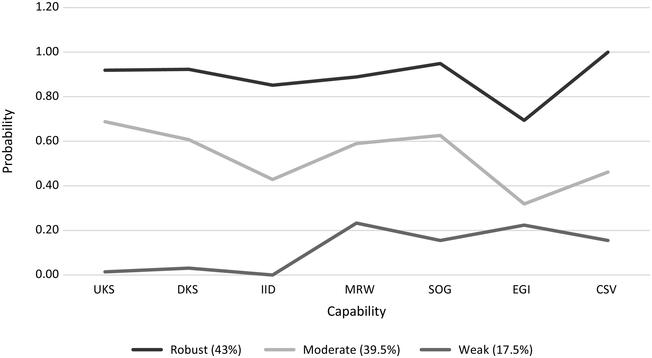
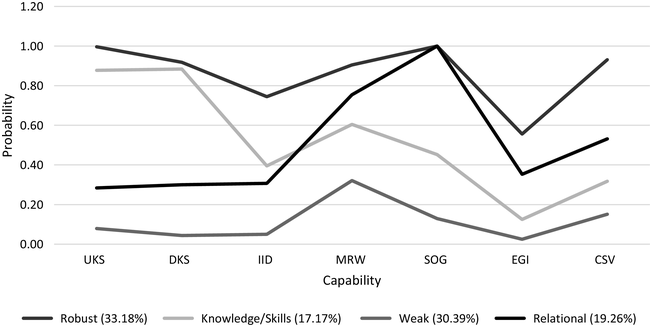
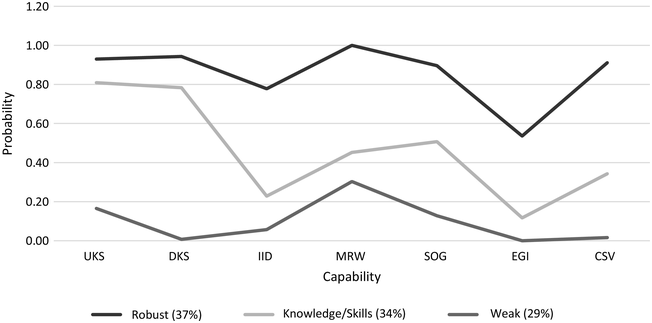
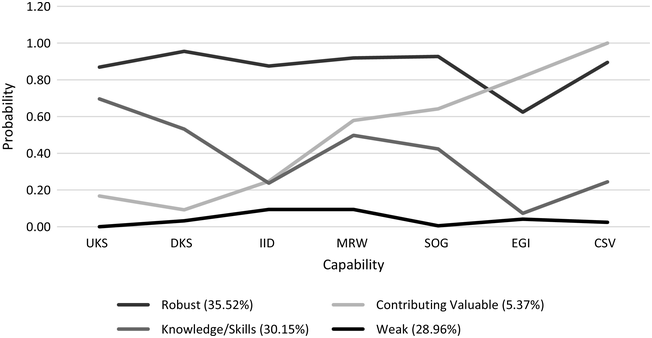
Figure 13.1 illustrates the capability sets identified via latent class analysis of special education teachers in Namibia (Figure 13.1a) [Reference Murangi, Rothmann and Nel42], early childhood development practitioners in South Africa (Figure 13.1b) [Reference Ragadu and Rothmann18], emergency nurses in South Africa (Figure 13.1c) [Reference Barnard, Rothmann, De Beer and Lubbe52], and hospitality workers in Jamaica (Figure 13.1d) [Reference Lewis54]. Other studies confirmed that larger capability sets lead to better work and organisational outcomes [Reference De Wet and Rothmann16, Reference Abma, Brouwer, De Vries, Arends, Robroek and Cuijpers43, Reference Gürbüz, Joosen, Kooij, Bakker, Van der Klink and Brouwers53, Reference Fleuren, Lai, Gruenewald-Schmitz, Larkin and Yuan55, Reference Schriemer, Roelen, Abma, Van Rhenen, Van der Klink and Bültmann56]. However, the latter studies did not identify different capability sets through latent class analyses.
Capability sets in different occupations.
Special education teachers.

Figure 13.1Figure 13.1a. Long description
The Robust group maintains the highest probability scores, generally staying above 0.80, with a peak at 1.00 for the C S V capability and a notable dip at around 0.70 for E G I. The Moderate group shows more fluctuation, starting near 0.70 for U K S, dipping to its lowest point for E G I at around 0.30, and recovering slightly for C S V. The Weak group reflects the lowest probabilities, hovering near 0.00 for U K S, D K S, I I D before rising to a peak of approximately 0.22 for M R W and E G I.
ECDP practitioners.
Notes: UKS = using knowledge and skills; DKS = developing knowledge and skills; IID = involvement in important decisions; MRW = developing and maintaining meaningful relationships at work; SOG = setting own goals; EGI = earning a good income; CSV = contributing to something valuable.

Figure 13.1Figure 13.1b. Long description
The Robust group maintains the highest probability, starting at 1.00 for U K S, dipping to approximately 0.75 for I I D, peaking again at 1.00 for S O G, and ending at roughly 0.93 for C S V. The Knowledge or Skills group shows high probability for U K S and D K S at around 0.88 but drops significantly to 0.40 at I I D. It peaks again for M R W at around 0.60 before declining toward the end. The Weak group stays consistently low, mostly below 0.10 for U K S, D K S, I I D, peaking slightly for M R W at around 0.32, and reaching its lowest point for E G I. The Relational group starts with low probabilities at around 0.30 for U K S, D K S, and I I D, but shows a sharp increase to peak at around 1.00 for S O G, matching the Robust group at that specific capability.
Emergency nurses.

Figure 13.1Figure 13.1c. Long description
The Robust group maintains the highest probability, starting at around 0.90 for U K S and D K S, dipping to approximately 0.80 for I I D, reaching its peak of 1.00 for M R W and a significant dip for E G I at around 0.55. The Knowledge or Skills group shows high probability for U K S and D K S at around 0.80 but falls significantly for I I D at around 0.22 before rising again toward S O G. The weak group remains below 0.20 for U K S, D K S, and I I D, reaching its highest point of 0.30 for M R W and dipping to 0.00 for E G I and C S V.
Hospitality workers.

Figure 13.1Figure 13.1d. Long description
The Robust group stays mostly above 0.80, with a dip for E G I at around 0.62. The Knowledge or Skills group starts high at approximately 0.70 but trends downward toward the end, specifically for E G I. The Contributing Valuable curve starts very low at around 0.18 but shows a significant upward trend, peaking at 1.00 for C S V. The Weak group remains near or below 0.10 throughout all capabilities.
Research with early childhood development practitioners in South Africa identified four distinct capability sets: robust (33.18%), relational (19.26%), knowledge/skills (17.17%), and weak (30.39%) [Reference Ragadu and Rothmann18]. Practitioners with a robust capability set reported higher levels of decent work than those with weaker capability sets did. Research involving emergency nurses highlighted three capability sets, namely, robust (37%), knowledge/skills (34%), and weak (29%) capability sets [Reference Barnard, Rothmann, De Beer and Lubbe52]. In their study with special education teachers, Murangi et al. identified three capability sets: robust (43%), moderate (39.5%), and weak (17.5%) [Reference Murangi, Rothmann and Nel42]. Lewis reported four capability sets: robust (34.7%), contributing something valuable (5.7%), using and developing knowledge/skills (32%), and weak (28.96%) [Reference Lewis54].
Studies employing the CSWQ across various contexts have consistently shown that a more comprehensive capability set is associated with improved work outcomes, including increased well-being, job satisfaction, and performance [Reference De Wet and Rothmann16, Reference Barnard, Rothmann, De Beer and Lubbe52, Reference Lewis54, Reference Murangi, Rothmann and Nel57]. A study focusing on workers with multiple sclerosis revealed that a greater capability set was associated with better work outcomes, indicating the applicability of the questionnaire in assessing sustainable employability among individuals with chronic health conditions [Reference van Egmond, van der Hiele, de Rooij, van Gorp, Jongen and van der Klink58].
Individual Agency, Structural Constraints, and Work Capabilities
The interaction between individual agency and structural constraints significantly shapes work capabilities [Reference Subramanian, Miquel Verd, Vero, Zimmermann and Subramanian22]. While personal motivation and skills (agency) are important, external factors such as workplace policies, organisational culture, and socio-economic conditions can either enhance or limit an individual’s ability to fully realise their work ability. Structural constraints can obstruct individual agency, whereas supportive structures foster success across multiple domains.
A capability-centric approach contrasts with a resource-centric approach [Reference Van der Klink, Bültmann, Burdorf, Schaufeli, Zijlstra and Abma12]. For individuals to flourish at work, they need capabilities [Reference De Wet and Rothmann16]. Individuals also need job resources (e.g., manager support, equipment, and colleague support) to be well. However, resources only have value because of what individuals can do by converting resources into valuable capabilities [Reference Van der Klink, Bültmann, Burdorf, Schaufeli, Zijlstra and Abma12]. This is referred to as a conversion factor, which explains why people have different abilities to convert resources into capabilities [Reference Robeyns50].
Wolff and De-Shalit emphasise the importance of this dynamic, noting that a supportive environment can lead to “fertile functioning”, where success in one area creates positive spillovers in others [Reference Wolff and de-Shalit59]. Conversely, structural barriers can lead to “corrosive disadvantage”, where disadvantages in one domain negatively affect multiple areas of a person’s work and the life of the organisation. Both individual agency and structural constraints and opportunities significantly influence each other in creating work capabilities that lead to valued functioning. The success or failure of individuals in the workplace is not merely a matter of personal characteristics but is deeply intertwined with the broader systemic factors in which they operate.
Research in various occupations has shown that work capabilities are associated with social well-being [Reference Barnard, Rothmann, De Beer, Lubbe and Mrayyan15, Reference De Wet and Rothmann16, Reference Ragadu and Rothmann18]. For example, Barnard et al. reported that a lack of capabilities was associated with exhaustion and mental distance among emergency nurses in South Africa [Reference Barnard, Rothmann, De Beer and Lubbe52]. De Wet and Rothmann reported that a weak capability set was associated with poor emotional well-being (feeling good), psychological well-being (functioning well), and social well-being (fitting in) among secondary school teachers in sub-Saharan Africa [Reference De Wet and Rothmann16].
Strategies to Enhance Work Capabilities
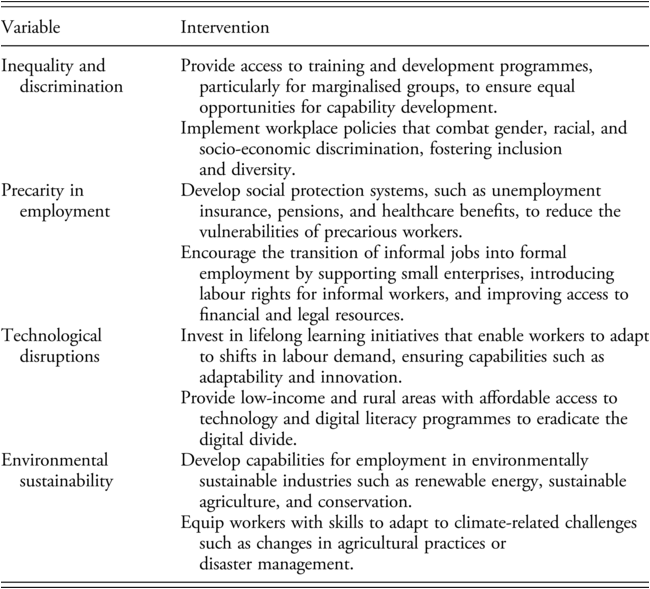
Various strategies to enhance work capabilities can be considered. Table 13.4 provides a framework for operationalising the CA to address issues such as inequality, precarity, technological disruption, and sustainability [Reference Van der Klink, Bültmann, Burdorf, Schaufeli, Zijlstra and Abma12, Reference Gloss, Carr, Reichman, Abdul-Nasiru and Oestereich14, Reference Abma, Brouwer, De Vries, Arends, Robroek and Cuijpers43, Reference Ashford, Hall, Arango-Quiroga, Metaxas and Showalter60, Reference Fernández-Baldor, Boni, Lillo and Hueso61, Reference Steel62].

Table 13.4 Long description
The table has two columns titled Variable and Intervention.
Row 1 column 1 reads. Inequality and discrimination.
Row 1 column 2 reads. Provide access to training and development programmes, particularly for marginalised groups, to ensure equal opportunities for capability development.
Implement workplace policies that combat gender, racial, and socio-economic discrimination, fostering inclusion and diversity.
Row 2 column 1 reads. Precarity in employment.
Row 2 column 2 reads. Develop social protection systems, such as unemployment insurance, pensions, and healthcare benefits, to reduce the vulnerabilities of precarious workers.
Encourage the transition of informal jobs into formal employment by supporting small enterprises, introducing labour rights for informal workers, and improving access to financial and legal resources.
Row 3 column 1 reads. Technological disruptions.
Row 3 column 2 reads. Invest in lifelong learning initiatives that enable workers to adapt to shifts in labour demand, ensuring capabilities such as adaptability and innovation.
Provide low-income and rural areas with affordable access to technology and digital literacy programmes to eradicate the digital divide.
Row 4 column 1 reads. Environmental sustainability.
Row 4 column 2 reads. Develop capabilities for employment in environmentally sustainable industries such as renewable energy, sustainable agriculture, and conservation.
Equip workers with skills to adapt to climate-related challenges such as changes in agricultural practices or disaster management.
Implications for Policy and Practice
The CA is an interdisciplinary framework that helps conceptualise and assess complex issues such as poverty, inequality, justice, and well-being [Reference Robeyns50]. Its adaptability allows for application across various disciplines. The CA offers an evaluative framework that acknowledges human diversity and emphasises the importance of freedom, agency, choice, and context as its key features [Reference Javornik, Yerkes, Jansen, Yerkes, Javornik and Kurowska63]. However, adhering to its key features is essential when the CA is integrated into organisational and institutional contexts (see also Chapter 5).
As a people-centred framework, the CA emphasises that policies should prioritise expanding individuals’ capabilities rather than merely focusing on resources and utilities [Reference Gloss, Carr, Reichman, Abdul-Nasiru and Oestereich14, Reference Kimhur64]. When incorporating the CA into any organisational or institutional framework, it is essential to uphold this principle of “each person as an end” [Reference Abreu, Comim and Jones65]. Applying the CA within an organisational context shifts the focus of human resource management from the needs of the organisation to the freedom of individuals [Reference Sferrazzo and Ruffini66]. Consequently, social policies should be viewed as a means, in other words, as resources. When policies are implemented, they should focus on how individuals can use them as resources to increase their capability to lead the lives they value [Reference Biggeri and Ferrannini67].
Addressing disparities in work capabilities requires tailored interventions, including equitable policies, resource allocation, and education systems that enhance the capabilities most relevant to each context. In non-WEIRD countries, improving access to basic capabilities such as safety, fair wages, and training is essential. In WEIRD contexts, fostering more inclusive and adaptive work environments can further enhance capabilities such as innovation and collaboration.
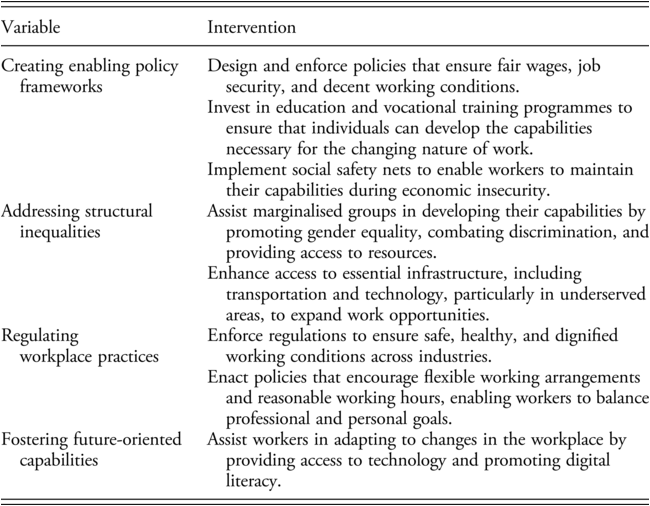
Governments and organisations play crucial roles in fostering work capabilities when conceptualised through the CA, which emphasises providing individuals with the freedom and opportunities to achieve their valued goals. Table 13.5 summarises the interventions by governments [Reference Ashford, Hall, Arango-Quiroga, Metaxas and Showalter60, Reference Bueno68, Reference Ivanyna and Salerno69, Reference Robinson70].

Table 13.5 Long description
The table has two columns titled Variable and Intervention.
Row 1 column 1 reads. Creating enabling policy frameworks.
Row 1 column 2 reads. Design and enforce policies that ensure fair wages, job security, and decent working conditions.
Invest in education and vocational training programmes to ensure that individuals can develop the capabilities necessary for the changing nature of work.
Implement social safety nets to enable workers to maintain their capabilities during economic insecurity.
Row 2 column 1 reads. Addressing structural inequalities.
Row 2 column 2 reads. Assist marginalised groups in developing their capabilities by promoting gender equality, combating discrimination, and providing access to resources.
Enhance access to essential infrastructure, including transportation and technology, particularly in underserved areas, to expand work opportunities.
Row 3 column 1 reads. Regulating workplace practices.
Row 3 column 2 reads. Enforce regulations to ensure safe, healthy, and dignified working conditions across industries.
Enact policies that encourage flexible working arrangements and reasonable working hours, enabling workers to balance professional and personal goals.
Row 4 column 1 reads. Fostering future-oriented capabilities.
Row 4 column 2 reads. Assist workers in adapting to changes in the workplace by providing access to technology and promoting digital literacy.
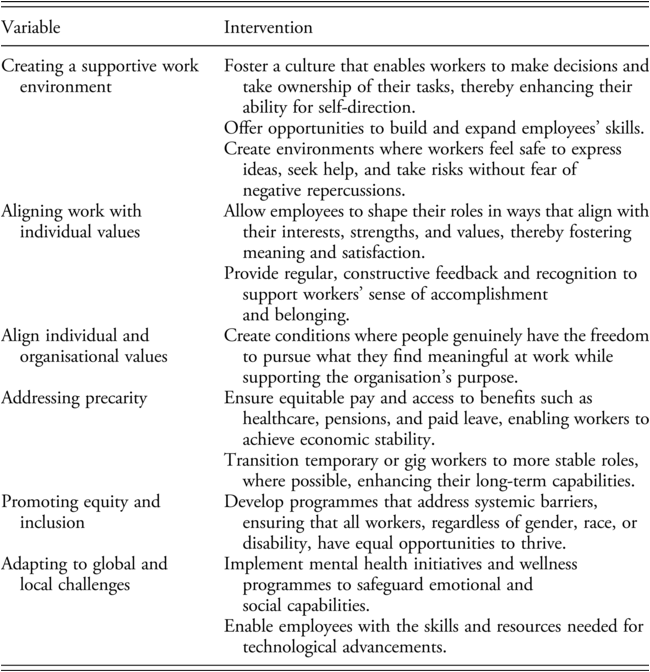
Table 13.6 summarises the interventions by organisations [Reference Montano, Hoven and Siegrist71, Reference Picco, Gragnano, Daghini and Miglioretti72, Reference Ropponen, Känsälä, Rantanen and Toppinen-Tanner73].

Table 13.6 Long description
The table has two columns titled Variable and Intervention.
Row 1 column 1 reads. Creating a supportive work environment.
Row 1 column 2 reads. Foster a culture that enables workers to make decisions and take ownership of their tasks, thereby enhancing their ability for self-direction.
Offer opportunities to build and expand employees’ skills.
Create environments where workers feel safe to express ideas, seek help, and take risks without fear of negative repercussions.
Row 2 column 1 reads. Aligning work with individual values.
Row 2 column 2 reads. Allow employees to shape their roles in ways that align with their interests, strengths, and values, thereby fostering meaning and satisfaction.
Provide regular, constructive feedback and recognition to support workers’ sense of accomplishment and belonging.
Row 3 column 1 reads. Align individual and organisational values.
Row 3 column 2 reads. Create conditions where people genuinely have the freedom to pursue what they find meaningful at work while supporting the organisation’s purpose.
Row 4 column 1 reads. Addressing precarity.
Row 4 column 2 reads. Ensure equitable pay and access to benefits such as healthcare, pensions, and paid leave, enabling workers to achieve economic stability.
Transition temporary or gig workers to more stable roles, where possible, enhancing their long-term capabilities.
Row 5 column 1 reads. Promoting equity and inclusion.
Row 5 column 2 reads. Develop programmes that address systemic barriers, ensuring that all workers, regardless of gender, race, or disability, have equal opportunities to thrive.
Row 6 column 1 reads. Adapting to global and local challenges.
Row 6 column 2 reads. Implement mental health initiatives and wellness programmes to safeguard emotional and social capabilities.
Enable employees with the skills and resources needed for technological advancements.
Governments and organisations should collaborate to co-develop training programmes, promote entrepreneurship, and address local labour market needs. Governments can provide tax incentives or subsidies to organisations prioritising capability development through training programmes, green jobs, or inclusivity. Both governments and organisations should support research to identify workers’ evolving needs and adapt strategies to foster work capabilities in different contexts. Governments and organisations play complementary roles in fostering work capabilities, with governments creating structural and policy foundations and organisations implementing these principles in workplace practices. By prioritising capability development, governments and organisations can address global challenges such as inequality, precarity, and the changing nature of work.
Future Research and Practice
Future research on work capabilities could include further application and expansion of the generic work capabilities set [Reference Van der Klink, Bültmann, Burdorf, Schaufeli, Zijlstra and Abma12, Reference Abma, Brouwer, De Vries, Arends, Robroek and Cuijpers43], focusing on its application across different organisational, geographic, and demographic settings. This could provide a deeper understanding of how capabilities vary in these diverse contexts. Larger, contextualised datasets are needed to explore the nuances of these capabilities in various work environments.
Research incorporating the prioritisation of specific work capabilities in the sets and how changes in their interactions affect both employee performance and well-being could provide further insights for policy and best practices in varying contexts. Understanding these shifts could offer practical insights for improving work environments and outcomes. Longitudinal mixed-methods studies are recommended to examine the long-term effects of corrosive disadvantages and fertile functioning on work capabilities. These studies could reveal how persistent inequalities or positive opportunities shape workforce dynamics.
Conclusion
Examining work capabilities in occupations and countries fosters inclusive growth, well-being, and freedom to pursue meaningful work. Tailoring policies to diverse cultural, socio-economic, and regulatory settings helps identify systemic barriers, especially those affecting marginalised groups, and address resource and opportunity inequalities. This approach fosters inclusive workplaces that cater to diverse needs, promote individual growth, and support sustainable employability.
Work capabilities are context dependent and shaped by complex interactions among personal aspirations, workplace conditions, and broader structural factors. Understanding and addressing these variations across occupations and countries are crucial for promoting decent work and fostering human flourishing. The CA provides a robust framework for evaluating these dynamics, ensuring that research and interventions remain people-centred and justice-oriented. The CA emphasises the importance of capability-enhancing work over purely productive labour [Reference Bueno68]. The approach offers insights into addressing inequalities [Reference Gloss, Carr, Reichman, Abdul-Nasiru and Oestereich14] and promoting worker well-being [Reference Miles33].
Operationalising and measuring work capabilities require context-specific indicators reflecting the opportunities and freedoms available in a particular setting [Reference Leßmann74]. Ubels et al. argued that existing instruments may not fully capture the burdens people experience while achieving their capabilities in specific contexts [Reference Ubels, Hernandez-Villafuerte and Schlander75]. The development of standardised measures across contexts risks oversimplification or misrepresentation of local realities [Reference Yap and Yu76]. Furthermore, in contexts with high power imbalances or systemic inequalities, such as in postcolonial or marginalised communities or autocratic systems, individuals may have limited freedom to pursue work capabilities due to structural barriers. This limitation can distort comparisons, as forces outside individual control may constrain capabilities.
Operationalising the CA to address global work-related challenges requires multilevel action involving governments, organisations, and individuals. By focusing on enabling environments, equitable policies, and adaptive practices, the approach can help workers achieve their full potential, reduce global inequalities, and foster sustainable and inclusive growth in the workforce. Identifying the capabilities essential for work, such as autonomy, skill development, job security, and social integration, is crucial. These capabilities may vary by occupation but should be in alignment with universal human needs and aspirations.
The results show that income is a critical factor when considering human capabilities. A key connection between work and human capabilities lies in paid work as a source of income, enabling individuals to develop their capabilities [Reference Bueno68]. While earning income is essential for most people to expand their central capabilities, the CA emphasises income itself and the degree to which it can be translated into meaningful capabilities. This perspective focuses on ensuring work environments that allow workers to exercise and enhance their capabilities. Jobs that offer little discretion limit meaningful relationships or restrict workers’ freedom to choose tasks, which can diminish their capabilities and overall well-being.
Studying work capabilities in diverse contexts underscores the need for tailored, context-sensitive interventions that expand individuals’ freedom and address structural inequalities, ultimately ensuring inclusive and sustainable development. This approach recognises how local conditions, such as labour protection, cultural conventions, and resource constraints, shape perceptions of meaningful work, essential competencies, and available opportunities. By adopting nuanced methodologies and comparative analyses, policymakers and organisations can derive best practices from varied settings, enrich our understanding of human flourishing, and refine policy reforms and institutional changes.
Applying the CA to different occupational and national contexts illuminates how income levels, institutional support, and cultural factors shape individuals’ freedom to pursue meaningful work. Research has shown that, compared with regular employment, resource availability and social policies significantly influence work-related functioning, particularly for self-employed workers. Tailoring interventions to address the structural and sociocultural conditions that promote or constrain people’s capability sets in different occupations and countries is essential.
Exploring work capabilities across occupations and countries highlights that social justice issues remain central to the CA. As more scholars and practitioners investigate the interplay between institutional contexts, cultural differences, and individual aspirations, the relevance of the CA continues to grow. By advancing measurement techniques, addressing methodological complexities, and identifying context-sensitive strategies, future studies can more effectively promote decent work and enhance the well-being of workers worldwide.

 Open access