

Introduction
Large quantities of yogurt acid whey (YAW) are generated during the straining step of Greek yogurt manufacturing process (Erickson, Reference Erickson2017). YAW has low pH (4.21–4.60) and contains, among others, minerals, lactose, small amounts of α-lactalbumin, while it does not contain caseins (Menchik et al., Reference Menchik, Zuber, Zuber and Moraru2019; Karastamatis et al., Reference Karastamatis, Zoidou, Moatsou and Moschopoulou2022). Concerning its calcium content, YAW is reported to contain substantial amounts (Menchik et al., Reference Menchik, Zuber, Zuber and Moraru2019; Karastamatis et al., Reference Karastamatis, Zoidou, Moatsou and Moschopoulou2022).
While calcium in milk is distributed between a soluble and a colloidal phase, with ∼70% of it present in the colloidal casein micelles (Shkembi and Huppertz, Reference Shkembi and Huppertz2022), this is not the case for YAW calcium due to the absence of caseins. Additionally, the calcium fraction associated with proteins seems to be minor in YAW, since, as shown by Patocka and Jelen (Reference Patocka and Jelen1991), the association of calcium with α-lactalbumin (the main protein found in YAW) in pH as low as this of YAW, is limited. It is obvious from the above that milk and YAW substantially differ in terms of the form that calcium exists within them.
Calcium is one of the main body elements with 99% of it present in the skeleton and teeth (Palacios et al., Reference Palacios, Hofmeyr, Cormick, Garcia-Casal, Peña-Rosas and Betrán2021). In addition to its role in bone health, calcium is implicated in several basic body and cellular functions (Palacios et al., Reference Palacios, Hofmeyr, Cormick, Garcia-Casal, Peña-Rosas and Betrán2021). Low calcium intake can lead to rickets in children and osteoporosis and osteomalacia in adults, while excessive calcium intake is suggested to increase the risk for hypercalcemia and kidney stones (IOM, 2011). There is a worldwide problem with low calcium intake, especially for certain population groups. Milk and dairy products are considered very good natural sources of calcium. However, in many countries, they are being fortified with calcium for further improving calcium intake (Palacios et al., Reference Palacios, Hofmeyr, Cormick, Garcia-Casal, Peña-Rosas and Betrán2021).
The intestinal absorption of calcium is accomplished through active intracellular absorption and passive paracellular absorption. Intracellular absorption starts with the entrance of calcium to the enterocytes via channels like the TRPV6. Next, calcium is transported to the basolateral side of the enterocytes by proteins with high calcium capacity, like calbindin-D9k (encoded by the S100G gene). Finally, calcium is exported from the enterocytes by the ion transport ATPase PMCA1 (encoded by the ATP2B1 gene) (Areco et al Reference Areco, Kohan, Talamoni, Tolosa de Talamoni and Peralta López2020; Reference Wongdee, Rodrat, Teerapornpuntakit, Krishnamra and CharoenphandhuWongdee et al., Reference Wongdee, Rodrat, Teerapornpuntakit, Krishnamra and Charoenphandhu2019). Intracellular absorption is regulated by both nutritional and physiological factors (Areco et al., Reference Areco, Rivoira, Rodriguez, Marchionatti, Carpentieri and De Talamoni2015; Wongdee et al., Reference Wongdee, Rodrat, Teerapornpuntakit, Krishnamra and Charoenphandhu2019). The luminal calcium itself is one of the diet-related factors, and the response to it is regulated through the vitamin D endocrine system (Areco et al., Reference Areco, Rivoira, Rodriguez, Marchionatti, Carpentieri and De Talamoni2015).
Taking into consideration the huge amounts of produced YAW worldwide (Erickson, Reference Erickson2017) and the value of upgrading it from a by-product of the yogurt manufacturing process to a co-product which can be reintroduced in the food supply chain, our group has evaluated the potential advantages that YAW can have on several physiological processes (Stefos et al., Reference Stefos, Dalaka, Papoutsi, Palamidi, Andreou, Katsaros, Bossis, Politis and Theodorou2024; Dalaka et al., Reference Dalaka, Stefos, Politis and Theodorou2023). Given that there is a need to increase calcium uptake in several population groups, YAW which contains substantial amounts of calcium, could be a potential food ingredient towards this direction. For investigating the idea of taking advantage of the high calcium content in YAW, there is a major unfulfilled need to benchmark the efficacy of YAW calcium's absorption by the intestinal cells, against a food that has been extensively studied in this context. Therefore, the objective of the present study was to compare the bioavailability of calcium in YAW with that of milk. We followed an in vitro approach for assessing the bioaccessibility and the calcium transport by Caco-2 cells and we quantified relevant genes. Furthermore, we investigated potential species effect on calcium bioavailability of YAW samples obtained from dairy enterprises.
Materials and methods
Samples and experimental design
YAW samples were obtained from Greek dairy product enterprises. Eighteen samples were of bovine origin, six were of ovine and six of caprine. All YAWs were concentrated 5 times by lyophilization. For the comparisons between YAW and milk, non-lyophilized YAW samples of all three species were blended, while commercial full-fat, bovine milk was purchased from a local supermarket.
The comparisons between YAW and milk were done in the base of either (a) amounts of food containing equal calcium (4.7 mg) at the in vitro digestion or (b) equal amounts of bioaccessible calcium added to Caco-2, when calcium transportation was evaluated. For the latter case (case b), the initial amounts of digested YAW/milk were adapted accordingly. For YAW and milk comparisons the experiments were repeated 3 times. For the comparisons among species, all concentrated YAW samples were analysed once. These species-related experiments were done starting with equal amounts of calcium (11.4 mg) for the in vitro digestion.
In vitro digestion
In vitro digestion was performed according to the INFOGEST 2.0 protocol (Brodkorb et al., Reference Brodkorb, Egger, Alminger, Alvito, Assunção, Ballance, Bohn, Bourlieu-Lacanal, Boutrou, Carrière, Clemente, Corredig, Dupont, Dufour, Edwards, Golding, Karakaya, Kirkhus, Le Feunteun, Lesmes, Macierzanka, Mackie, Martins, Marze, McClements, Ménard, Minekus, Portmann, Santos, Souchon, Singh, Vegarud, Wickham, Weitschies and Recio2019) with some modifications. Briefly, in the oral phase, foods (or water for blank control digests) were diluted 1:1 (vol/vol) with simulated salivary fluid without salivary amylase, the pH was adjusted to 7.0 and the total fluid was incubated for 2 min at 37°C while mixing. For simulating the gastric phase, the fluid from the previous step was diluted 1:1 (vol/vol) with simulated gastric fluid, the pH was adjusted to 3.0, porcine pepsin (P7012, Sigma) was added at a final activity 2,000 U/ml and the mixture was incubated for 2 h at 37°C rotating. The intestinal phase of the digestion started with diluting the gastric mixture with simulated intestinal fluid 1:1 (vol/vol), the pH was adjusted to 7.0, pancreatin (P3292, Sigma) was added so as the final activity of trypsin in pancreatin to be 100 U/ml, bile salts (B8631) were added at a final concentration of 4.8 mM and the mixture was incubated for 2 h at 37°C rotating. The specific activities of the digestive enzymes and the bile salts concentration were determined according to the standardized assays which are described in the INFOGEST 2.0 protocol. After the completion of the intestinal phase, the digests were incubated for 10 min at 85°C for the deactivation of the enzymes used.
Quantification of bioaccessible calcium
For the quantification of bioaccessible or soluble calcium, part of the digestion products after heat inactivation (see ‘In vitro digestion’ section), were centrifuged for 1 h at 3,500 g at 4°C and the supernatant was collected as soluble or bioaccessible fraction. Calcium concentration was quantified by atomic absorption in both the soluble fraction and the whole digestion product. Bioaccessibility or solubility was expressed as follows: bioaccessibility = 100 × [sol]/[dig], where [sol] represents the calcium concentration in the soluble fraction and [dig] represents the calcium concentration in the digest.
Quantification of calcium by atomic absorption
Milk, YAWs as well as their digestion products and soluble fractions were subjected to dry digestion at 550°C for 6–18 h. Ashes were first dissolved in 25% HNO3 and were subsequently diluted with water. Lanthanum chloride (Honeywell Fluka) was added to a final lanthanum content of 0.2% w/v for suppressing phosphate interferences. Ca content in the dilutions was determined by atomic absorption spectrometry (AAS) method at 422.77 nm. A Shimadzu instrument (Shimadzu Corporation 1, Nishinokyo-Kuwabara-cho, Nakagyo-ku, Kyoto 604-8511), model AA-6800 equipped with autosampler Shimadzu/ASC-6100 was used to perform the AAS analysis. The amount of calcium was determined using a standard curve.
Caco-2 cells
Caco-2 cells were offered by Dr. Dimitris Kletsas (National Center for Scientific Research ‘Demokritos’, Greece). The cells were maintained in high glucose Dulbecco's Modified Eagle Medium (Pan Biotech) supplemented with 10% FBS (Gibco), 1× non-essential amino acids (Pan Biotech) and 1% Penicillin/Streptomycin (Pan Biotech) in a humidified incubator at 37°C in a 5% CO2 atmosphere. Cells were passaged with trypsin (Pan Biotech) before reaching confluency. When used in assays, cells with passage number between 12 and 18 (passage was defined as 1 when arrived in the laboratory) were seeded in standard cell culture multiwell plates or on hanging inserts with pore size 0.4 μm (SPL Life Sciences) adapted on 6-well plates, and were cultured for 20 or 21 days changing the medium every 2 or 3 days.
Quantification of the calcium transported by Caco-2
For the quantification of the amount of calcium transferred by Caco-2, cells cultivated on hanging inserts, were treated with the bioaccessible fractions of food digests for 2 h at 37°C in a 5% CO2 atmosphere. The final concentrations of glucose and HEPES in the bioaccessible fractions had been adjusted to 5 and 50 mM, respectively, in a final volume of 2 ml, before added to the cells. The basolateral compartment of the wells contained only transfer buffer (130 mM NaCl, 10 mM KCl, 5 mM glucose, 50 mM HEPES). In every experiment, two wells containing transfer buffer instead of bioaccessible fractions, were included as transfer blanks. After 2 h of incubation, the basolateral medium was collected and subjected to calcium quantification with the Calcium Assay Kit (701220, Cayman). The kit was used according to the manufacturer's instruction, except that 50 μl (instead of 10 μl) of samples were used, in the same final reaction volume. The amount of calcium, transferred to the basolateral compartment, was calculated by subtracting the transfer blanks’ calcium from the samples’ calcium. The calcium transfer (or bioavailability) was expressed as bioavailability = 100 × [basolateral]/[apical], where [apical] was the amount of bioaccessible calcium given to the Caco-2 cells and [basolateral] was the amount of calcium in the basolateral compartment. For every bioaccessible fraction tested, two hanging wells with Caco-2 were used, and each well was assayed for calcium in duplicate.
Quantification of calcium-transport-related genes
For quantifying the transcripts of the genes which are related to calcium absorption, Caco-2 cells, cultivated in standard cell culture multiwell plates, were treated with the bioaccessible fractions of the food digests for 2 h at 37°C in a 5% CO2 atmosphere. Cells were lysed with NucleoZOL (Macherey-Nagel) and subsequently the RNA was extracted following the instructions of the manufacturers. Next, RNAs were treated with DNAse (NEB) to remove any remaining DNA and pure RNA was recovered by ethanol precipitation in the presence of ammonium acetate and glycogen. The quantity and quality of RNAs were measured with a spectrophotometer (Q5000, Quawell). The reverse transcription reaction was done using the PrimeScrip RT reagent Kit (Takara) with both oligo-dT and random hexamers for priming. Quantitative polymerase chain reactions (qPCRs) were done with the FastGene IC Green 2X qPCR Universal Mix (Nippon Genetics) and the primers shown in Table 1, in a SA cycler 96 (Sacace). Crossing points were calculated using the instrument's software. Concerning the genes that were quantified, TRPV6, S100G, PMCA1 and VDR are associated with the uptake of calcium by the cells and its regulation, while GAPDH and HPRT1 were used as housekeeping genes. The geometric mean of both housekeeping genes was used for normalizing gene expression (Vandesompele et al., Reference Vandesompele2002).
qPCR primer sequences

Statistical analysis
The statistical analyses were conducted in R and Microsoft Excel. The comparisons of two means were done by Students’ t-test, while groups comparisons were done with ANOVA and Tukey's test for pairwise multiple comparisons. If the data did not follow normal distribution (checked with Shapiro–Wilk test), ANOVA was conducted on log-transformed data. Statistical significance was set at P < 0.05.
Results and discussion
Comparison of the calcium bioaccessibility of YAW and milk
Calcium bioaccessibility of YAW and milk are shown in Fig. 1. YAW has about 2 times higher bioaccessibility (41.4%) than milk (17.7%). To the very best of our knowledge, there are no other existing published data in the literature regarding calcium bioaccessibility of YAW. Concerning calcium bioaccessibility of milk, the values reported in the literature show high variability, with indicative values ranging between 15.3% and 65.2% (Seiquer et al., Reference Seiquer, Delgado-Andrade, Haro and Navarro2010; Soto et al., Reference Soto, Morales, Haza, García and Selgas2014; da Paixão Teixeira et al., Reference da Paixão Teixeira, Baptista, Orlando, Gigante and Pallone2022; Costa-Santos et al., Reference Costa-Santos, Rebellato, Orlando and Pallone2024). This inconsistency in the reported values could be due to differences in examined milk type, in vitro digestion protocols and conditions for obtaining the bioaccessible fractions of digests. In our study, we used exactly the same protocol for comparing YAW and milk. Thus, it is safe to conclude that calcium bioaccessibility in YAW was significantly higher than that of full fat, heat processed, cow milk, under the in vitro conditions followed here.
Calcium bioaccessibility of YAW and milk. The plots show mean values and standard errors resulted by three repeated experiments and duplicate technical replicates. Statistical differences were tested with Student's t-test. Significance level was set to 0.05.

One possible explanation for the observed difference between YAW and milk calcium bioaccessibility could be their differences in lipids and fatty acids content. During the gastrointestinal phase of digestion, calcium can form insoluble soaps with fatty acids (Thorning et al., Reference Thorning, Bertram, Bonjour, De Groot, Dupont, Feeney, Ipsen, Lecerf, Mackie, McKinley and Michalski2017). The low fat content of YAW, which is 0–0.14% (Menchik et al., Reference Menchik, Zuber, Zuber and Moraru2019; Karastamatis et al., Reference Karastamatis, Zoidou, Moatsou and Moschopoulou2022), and is significantly lower than that of bovine, whole fat milk, supports the abovementioned hypothesis. An additional possible explanation for the difference of YAW and milk calcium bioaccessibility could be their differences in proteins, in both terms of protein content and protein profile: YAW contains small amounts of α-lactalbumin and lacks caseins (Menchik et al., Reference Menchik, Zuber, Zuber and Moraru2019). Although caseins exert a significant role in calcium bioaccessibility, the hydrolysis of κ-casein by pepsin during gastric digestion, which leads to formation of gastric curds and consequently affects soluble calcium kinetics in the gastrointestinal track (Shkembi and Huppertz, Reference Shkembi and Huppertz2022), may be relevant with our results. Concerning the role of α-lactalbumin, which is present in YAW, it is shown that its digest products bind calcium and improve its solubility (Wang et al., Reference Wang, Aalaei, Skibsted and Ahrné2023). The abovementioned protein/peptide features cannot obviously solely explain the differences between YAW and milk, but could rather be taken into consideration as potential factors. Finally, the known negative effect of heat treatment, which is applied to milk as a preservation method, on the levels of ionic calcium (Lewis, Reference Lewis2011), could also partially explain the decreased calcium bioaccessibility of milk.
Comparison of the calcium bioavailability of YAW and milk
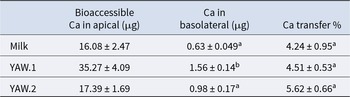
Given the higher bioaccessibility that was observed for YAW calcium compared to milk calcium, the next step was to investigate whether this increased amount of bioaccessible calcium in the case of YAW is also translated in increased calcium absorption by the intestine cells. With the assumption that the whole quantity of bioaccessible calcium is accessible by the intestinal cells, the same volumes of digestion products of YAW and milk were applied to the Caco-2 cells. This comparison of starting amounts of YAW and milk that have equal calcium quantity before digestion is shown by milk and YAW.1 in Table 2. With this procedure, the amount of bioaccessible calcium that was added to the cells was about 16 and 35 μg for milk and YAW, respectively. Obviously, the difference in the added amounts reflects the different bioaccessibility values. This increased amount of bioaccessible calcium for the case of YAW resulted in significantly higher amount of transferred calcium (1.56 and 0.63 μg, for YAW and milk, respectively). However, the bioavailability between the two foods did not differ (4.24% and 4.51%, for YAW and milk, respectively).
Calcium transfer across Caco-2 cells

YAW.1 corresponds to starting amount of digested YAW with equal calcium quantity with milk. YAW.2 corresponds to starting amount of digested YAW which resulted in similar amount of bioaccessible calcium with milk. Values shown are averages ± standard errors from three repeats. Different superscript letters indicate significant difference within the columns. Statistical differences were tested with ANOVA, followed by Tukey's test for pairwise multiple comparisons. Significance level was set to 0.05.
Here it should be underlined that, as described in the ‘Materials and methods’ section, while the amount of bioaccessible calcium added to the cells was quantified with atomic absorption, the amount of the calcium transferred by the cells to the basolateral compartment was quantified with a colorimetric method. Thus, we attribute any differences in milk's bioavailability metrics with published data, mainly to this particularity of our pipeline.
The above in vitro result shows that a given amount of calcium results in higher amount of absorbed calcium if it is contained in YAW compared to milk. Moving a step forward, next it was tested whether the same amounts of bioaccessible calcium result in the same amount of transferred calcium by the cells. In other words, whether there are factors in YAW and milk that differentially affect their calcium absorption by the intestine.
An answer to the latter question can be given by comparing milk and YAW.2 in Table 2. YAW.2 corresponds to an amount of YAW at digestion that results to similar amount of bioaccessible calcium with that of milk. Thus, when adding the same amounts of bioaccessible calcium to Caco-2, the amount of transferred calcium and the bioavailability itself do not differ between YAW and milk. This implies that the increased amount of transferred calcium when starting with equal calcium content in digestions (comparison of milk and YAW.1 in Table 2) is a result solely of the increased bioaccessibility in the case of YAW and not of an increase in calcium transfer by the cells.
To further investigate the latter, the transcription of genes related to calcium absorption by the intestine was quantified in Caco-2 cells. The results shown in Fig. 2 correspond to comparison of similar amounts of bioaccessible calcium on cells between YAW and milk. No one of the four genes tested differed between the two foods, supporting the idea of absence of factors which differentially affect calcium absorption in YAW and milk.
Effect of YAW and milk on the transcription of genes related to calcium absorption by the intestine. Equal amounts of digestion products, with similar quantities of calcium for YAW and milk were added on Caco-2 cells and the levels of gene transcription were quantified by qPCR. Mean values and standard errors from three experiments are shown in the plots. Statistical differences were tested with Student's t-test. NS: non-significant. Significance level was set to 0.05.

There are some studies showing an inductive effect of certain food components, like short-chain fatty acids (Fukushima et al., Reference Fukushima, Aizaki and Sakuma2009, Reference Fukushima, Aizaki and Sakuma2012) and peptides (Lin et al., Reference Lin, Cai, Wu, Lin and Wang2020), on the transcription of TRPV6, S100G and PMCA1b in Caco-2 cells. It should be noted though, that in these studies the differentiation stage of the cells and the time/length of application of these components on the cells were different than what was followed in our case. Concerning food ingredients derived by milk, the existing literature focuses mainly on casein phosphopeptides (CPPs). Colombini et al. (Reference Colombini, Perego, Ardoino, Marasco, Lombardi, Fiorilli, Biganzoli, Tettamantif and Ferraretto2013) report that CPPs do not affect the transcription of TRPV5 gene, neither of S100G, in Caco-2 cells. Given that CPPs are present in milk but not in YAW, the above result supports our observation about the lack of any superiority of milk over YAW. On the other hand, Liu et al. (Reference Liu, Sun, Guo, Miao, Luo, Xia, Ying, Liu, Guo, Tang, Cao and Miao2018) showed that a peptide isolated from a commercial mixture of CPPs significantly increased the calcium transport across Caco-2 as well as the expression of TRPV6 protein after 72 h. Additionally to the significant difference in the food/cells incubation time with the study of Liu et al., it should be taken into consideration that for both studies concerning CPPs, there is no available information about the digestion protocol followed for preparing the studied peptides. This means that these peptides might not be present in the digest products when following the INFOGEST protocol and even not into the digestive tract during in vivo consumption and ingestion, if the hydrolysis was done using enzymes other than those existing in the mammalian gastrointestinal tracts.
Effect of the species of origin on the calcium bioavailability of YAW
Given the previous results concerning the bioavailability of YAW calcium, a deeper investigation, focusing on potential effects of the animal origin, was conducted. Figure 3 shows that species of milk origin do not significantly affect calcium bioaccessibility of YAW. Next the effect of species on the expression of genes involved in calcium absorption was investigated. Figure 4 shows that, similarly with calcium bioaccessibility, transcription of all tested genes was not differentially affected by YAW origin in terms of species.
Effect of animal species on YAW's calcium bioaccessibility. The X symbols within the boxes correspond to the mean values and the horizontal lines correspond to the medians. Statistical differences were tested with ANOVA. NS: non-significant. Significance level was set to 0.05.

Effect of animal origin of YAW on the transcription of calcium absorbance-related genes. The X symbols within the boxes correspond to the mean values and the horizontal lines to the medians. Statistical differences were tested with ANOVA. NS: non-significant. Significance level was set to 0.05.

In a study investigating the calcium bioavailability in milk of several species, Shen et al. (Reference Shen, Robberecht, Van Dael and Deelstra1995) reported that there were no differences regarding calcium dialysability between species. Although in the present study the effect of species is investigated on the calcium bioavailability of YAW and not milk, given that the two materials have common ingredients, the results from Shen et al. still support our observation. On the contrary, da Paixão Teixeira et al. (Reference da Paixão Teixeira, Baptista, Orlando, Gigante and Pallone2022) assessed calcium bioaccessibility in bovine and caprine raw milk, pasteurized milk, yogurt and cheese and found that it was higher in all caprine milk and dairy products samples compared to their bovine counterparts. The authors attribute these differences in the different casein and fatty acid profiles between the two species’ milk. One possible explanation of the absence of any species effect in the case of YAW could be that both caseins and fatty acids are absent.
Conclusion
The bioavailability of calcium contained in YAW was investigated here for the first time. By comparing YAW to milk, a well-studied food regarding its calcium properties, our in vitro approach showed that the digestion of a given amount of calcium results in higher ratio of absorbed calcium in the case of YAW compared to milk. This difference is due to the higher bioaccessibility of YAW calcium and is not related to differences in calcium transport by the intestinal cells. The origin of milk seems to have no effect on the bioavailability of YAW calcium. Given that YAW is a material rich in calcium, our results support the idea for further investigation of its features towards reintroducing it in the food supply chain.
Acknowledgements
This research has been co-financed by the European Regional Development Fund of the European Union and Greek national funds through the Operational Program Competitiveness, Entrepreneurship and Innovation, under the call RESEARCH—CREATE—INNOVATE (project code:Τ2EDK-00783; MIS-5074577). Open access funding provided by HEAL-Link Greece.
Competing interests
The authors declare no conflict of interest.




 Open access

