




The rate of twin births has risen sharply in recent decades across most developed countries (Monden et al., Reference Monden, Pison and Smits2021), primarily due to the widespread use of assisted reproductive technology (ART) and delayed childbearing (Pison et al., Reference Pison, Monden and Smits2015). In South Korea, the twinning rate was about 5 pairs per thousand births before the ART era (Hur & Kwon, Reference Hur and Kwon2005), but has recently increased to 22–23 pairs per thousand births (Hur, Reference Hur2021).
While obstetrical and neonatal complications of twin pregnancies are well established, much less is known about the mental health of mothers of twins. The Global Twins and Multiples Priority Setting Partnership recently identified parental mental health as one of the top research priorities in this field (Lam et al., Reference Lam, Liu, Bhate, Fenwick, Reed, Duffy and Khalil2019). Several factors may increase mental health risks among mothers of twins. Before pregnancy, mothers of twins are more likely to have experienced subfertility, as assisted reproductive technology (ART) use is more frequent among them than among mothers of singletons (Dickey, Reference Dickey2007). Although some studies have found no significant differences in emotional wellbeing between mothers who conceived via ART and those who conceived spontaneously (Gambadauro et al., Reference Gambadauro, Iliadis, Bränn and Skalkidou2017; Hammarberg et al., Reference Hammarberg, Fisher and Wynter2008), others have reported that subfertility and in vitro fertility (IVF) treatment are emotionally and physically stressful, associated with elevated anxiety and depression during and after treatment (Verhaak et al., Reference Verhaak, Smeenk, Van Minnen, Kremer and Kraaimaat2005). During pregnancy and the perinatal period, mothers of twins face greater obstetric and neonatal risks, such as preterm delivery and low birth weight, than mothers of singletons (Hur, Reference Hur2023; Simpson, Reference Simpson2015). After childbirth, they encounter higher functional, financial, and caregiving demands, as they must simultaneously care for two infants, often with limited rest and support (Wenze et al., Reference Wenze, Battle, Huntley, Gaugler and Kats2023).
Despite growing interest, studies comparing the mental health of mothers of twins and singletons have yielded mixed results. These inconsistencies may stem from variations in sample size, children’s ages, and whether confounders such as ART use and family support were controlled. Generally, small-scale studies have found no significant group differences (Anderson et al., Reference Anderson, Koh, Connor, Koerner, Damario and Rueter2014; Bonanni et al., Reference Bonanni, Longo, Airoldi, Meli, Familiari, Romanzi, Pellegrino, Visconti, Serio, Lanzone and Bevilacqua2024; Glazebrook et al., Reference Glazebrook, Sheard, Cox, Oates and Ndukwe2004), whereas large, population-based studies have identified higher rates of mental health problems among mothers of twins (Egsgaard et al., Reference Egsgaard, Bliddal, Lund, Vigod and Munk-Olsen2025; Lapinsky et al., Reference Lapinsky, Ray, Brown, Murphy, Kaster and Vigod2023; Shinohara et al., Reference Shinohara, Horiuchi, Shinohara, Otawa, Kushima, Miyake, Yui, Kojima, Ooka, Akiyama, Yokomichi and Yamagata2023). For instance, Glazebrook et al. (Reference Glazebrook, Sheard, Cox, Oates and Ndukwe2004) compared mothers of twins, ART-conceived singletons, and spontaneously conceived singletons and found no group differences in emotional disturbance or depression at one year postpartum. Similarly, Bonanni et al. (Reference Bonanni, Longo, Airoldi, Meli, Familiari, Romanzi, Pellegrino, Visconti, Serio, Lanzone and Bevilacqua2024) reported no differences in depression or anxiety between parents of twins and singletons at 1 year postpartum. However, both studies were based on small samples (N < 150 per group) and, in Bonanni et al. (Reference Bonanni, Longo, Airoldi, Meli, Familiari, Romanzi, Pellegrino, Visconti, Serio, Lanzone and Bevilacqua2024), ART use was not controlled, potentially confounding results. In contrast, large-scale investigations have consistently shown higher risks of postpartum depression among parents of twins. Egsgaard et al. (Reference Egsgaard, Bliddal, Lund, Vigod and Munk-Olsen2025), analyzing all Danish twin and singleton livebirths between 1997 and 2019, found that mothers of twins had significantly elevated risk of postpartum depression within the first 6 months after childbirth, while fathers’ risk increased around 6 months postpartum. Likewise, Shinohara et al. (Reference Shinohara, Horiuchi, Shinohara, Otawa, Kushima, Miyake, Yui, Kojima, Ooka, Akiyama, Yokomichi and Yamagata2023), using a nationwide Japanese cohort of 77,419 pregnant women, reported that multiple pregnancy was significantly associated with maternal depression at 6 months postpartum.
Most previous studies have focused up to the first year postpartum, but a few have examined maternal mental health in later stages of parenting. Olivennes et al. (Reference Olivennes, Golombok, Ramogida and Rust2005) found that mothers of ART-conceived twins aged 2–5 years showed higher parenting stress and depression and reported less enjoyment in parenting than matched mothers of singletons. However, Anderson et al. (Reference Anderson, Koh, Connor, Koerner, Damario and Rueter2014) found no significant differences in parental mental health or family relationships among parents of ART-conceived twins and singletons aged 6–12 years. These discrepant findings between preschool- and school-aged twins suggest that parenting-related stress may decrease as children mature, but further research is needed to clarify age-related changes in maternal mental health among mothers of twins.
Family support is another critical determinant of maternal mental health during pregnancy (Bedaso et al., Reference Bedaso, Adams, Peng and Sibbritt2021), the postpartum period (Xie et al., Reference Xie, Yang, Liao, Xie, Walker and Wen2010), and childrearing (Spotts et al., Reference Spotts, Pedersen, Neiderhiser, Reiss, Lichtenstein, Hansson and Cederblad2005). A national survey showed that lack of emotional support tripled the risk of poor maternal mental health even after controlling for demographic covariates (Mistry et al., Reference Mistry, Stevens, Sareen, De Vogli and Halfon2007). Nevertheless, most prior studies comparing mental health mothers of twins and singletons have controlled demographic- or ART-related factors, neglecting perceived family support (PFS). Given that family support plays a crucial buffering role against stress and depression, it remains unclear whether the mental health gap between mothers of twins and singletons persists once PFS is considered. Understanding this relationship is important for developing effective interventions and prevention strategies tailored to the unique needs of mothers of twins.
Using data from South Korean mothers of twins and singletons, the present study aimed to address three questions. First, is the use of ART significantly related to maternal mental health after controlling for PFS and demographic covariates? Second, do mothers of twins report more mental health problems than mothers of singletons, even after adjusting for ART use, PFS, psychiatric treatment experience (PTE), and demographic variables? Third, have mothers of twins received psychiatric treatment more frequently than mothers of singletons after adjustments of the covariates? By examining both the presence and magnitude of group differences, this study seeks to deepen understanding of maternal mental health among mothers of twins and identify modifiable factors — such as ART-related stress and lack of family support — that could inform targeted support and intervention for mothers of twins.
Methods
Sample
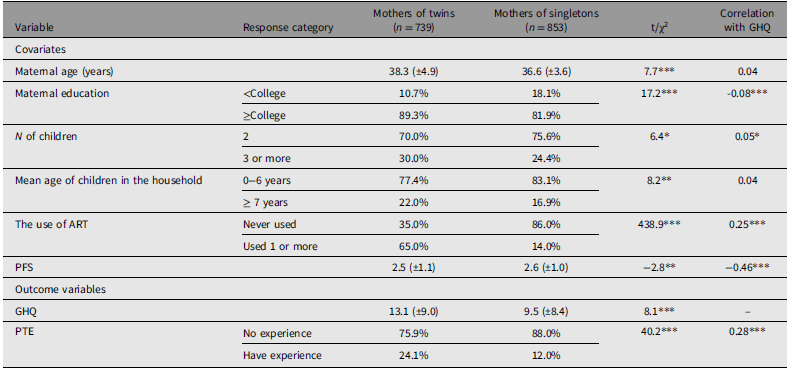
The study utilized unselected, population-based samples of South Korean mothers of twins and singletons. Demographic characteristics are shown in Table 1.
Descriptive statistics for demographic variables, perceived family support (PFS), the use of assisted reproductive technology (ART), general health questionnaire (GHQ), psychiatric treatment experience (PTE) in mothers of twins and singletons

Note. SDs are in parenthesis. *p < .05, **p < .01, ***p < .001.
Mothers of twins. Participants were recruited nationwide through social media platforms such as online parenting forums, twin mothers’ communities, Instagram, and Facebook. In South Korea, membership in these communities typically requires verification procedures, such as phone number authentication and proof of parenthood (e.g., submission of a twin birth certificate for twin mothers’ communities). Inclusion criteria were mothers with living twin children younger than 20 years of age, regardless of twin zygosity, mode of conception, or the sex of children. Exclusion criteria included mothers with any children (including twins) aged 20 years or older. An online survey link with a brief study description was posted, and participants received a mobile coupon for a cup of coffee from a well-known café upon completion (approximately 5000 Korean won). This procedure allowed us to screen duplicate online responses using verified telephone numbers. Despite specifying the age of twin children in the recruitment poster, mothers with adult twins (age ≥ 20 years) responded to the survey. These respondents were excluded, resulting in a final sample of 739 mothers of twins. Among 739 mothers of twins, 65.0% conceived via ART, with a mean age of 38.3 years (SD = 4.9). Most participants (89.3%) held a college or higher degree, 70% had only two children (twins).
Mothers of singletons. Recruitment of mothers of singletons followed the same procedure as for the twin group, using online mothers’ communities, Facebook, and Instagram (some overlapping with twin recruitment platforms). Recruitment for mothers of singletons began after completion of recruitment of mothers of twins. Inclusion criteria were mothers with at least two living singleton children younger than 20 years of age, regardless of mode of conception or the sex of children, to ensure comparability with mothers of twins. Exclusion criteria included mothers with any children aged 20 years or older, mothers with only one child, and mothers of twins. As with mothers of twins, the survey was configured to allow only a single response. Mothers of singletons received the same mobile incentive as mothers of twins. During distribution of the incentive, we also screened for duplicate entries using telephone numbers.
Despite the eligibility criteria specified in the recruitment poster, we identified respondents who had only one child, twins, or adult children (aged 20 years or older). We excluded all ineligible responses, resulting in a final sample of 853 mothers of singletons. Among these mothers, 14% reported having conceived at least one child via ART. Their mean age was 36.6 years (SD = 3.6); 81.9% held a college or higher degree, and 75.6% had only two children.
Measures
General Health Questionnaire (GHQ). Maternal mental health was measured using the 12-item Korean version of the General Health Questionnaire (GHQ; Goldberg & Hillier, Reference Goldberg and Hillier1979), a validated screening tool for psychological distress and common psychiatric symptoms. An example item includes ‘Have you recently lost much sleep over worry?’. Each item was rated on a 4-point Likert-type scale (0 = not at all true to 3 = often true), yielding total scores from zero to 36, with higher scores indicating greater psychological distress (e.g., depression, anxiety, and sleep problems). The Korean GHQ has demonstrated good validity, showing significant positive correlations with the Korean version of the Center for Epidemiologic Studies Depression Scale (Park et al., Reference Park, Kim and Cho2012). Cronbach’s alpha was .94 for both mothers of twin and singleton samples.
Psychiatric treatment experience (PTE). PTE was assessed with a single item: ‘Have you ever received mental health counseling or treatment?’ Responses were: (1) never received, (2) considered receiving but never received, (3) received once or twice, and (4) receive it regularly. To increase statistical power and address small cell counts (<5%), the responses were dichotomized into never received (82.4%) and have received (17.6%). PTE was used both as an independent covariate and a dependent variable (see Statistical Analysis).
Study covariates. Covariates included maternal age, education (no college vs. college or higher), number of children (2 vs. ≥3), PFS, and the use of ART (never vs. ever used), and the mean age of the children in the household (preschool [0–6 years] vs. school-aged [7–19 years]). Children were primarily preschool-aged in both samples. Among mothers of singletons, the mean (SD) and median ages of children were 5.1 (3.4) and 4.0 years respectively; among mothers of twins, the corresponding values were 4.6 (4.3) and 3.0 years.
PFS was measured by a single item: ‘Do you feel you get enough emotional support from your spouse or family?’ rated on a 5-point Likert-type scale (0 = not at all true to 4 = very true). Despite being a single-item measure, PFS scores were approximately normally distributed (skewness = −0.34, kurtosis = −0.50); therefore, it was treated as a continuous variable.
Statistical Analysis
All analyses were conducted using IBM SPSS Statistics for Windows, Version 29.2. Descriptive analyses included means, standard deviations, and frequencies for all study variables. Pearson correlations were calculated to examine associations between GHQ and study covariates. Group comparisons between mothers of twins and singletons were conducted using independent-sample t tests for continuous variables and Pearson’s chi-square tests for categorical variables.
Hierarchical regression analyses were conducted separately for mothers of twins and singletons to examine the first research question, namely, whether ART use explained maternal mental health after adjusting for demographic covariates, PTE, and PFS. GHQ scores were entered as the dependent variable, with demographic covariates, PTE, and PFS entered at Step 1, followed by ART use at Step 2. Changes in R 2 and their significance were evaluated.
To examine the second question, namely, whether mothers of twins exhibited greater psychological distress than mothers of singletons after controlling for ART use, PFS, PTE, and demographic covariates, an analysis of covariance (ANCOVA) was performed, with GHQ as the dependent variable and group (mothers of twins vs. singleton) as the independent factor. The magnitude of adjusted group differences was expressed as Cohen’s d (Cohen, Reference Cohen1988), calculated as the adjusted mean difference divided by the pooled standard deviation. Finally, to assess whether mothers of twins were more likely to receive psychiatric treatment than mothers of singletons after controlling for the covariates, a binary logistic regression analysis was conducted with PTE (received vs. not received) as the outcome variable. All statistical tests were two-tailed, and a p value < .05 was considered statistically significant.
The procedures of the current study were conducted in accordance with the Declaration of Helsinki, and approved by the Institutional Review Board of Kookmin University, Seoul, South Korea. All subjects were informed about the study and all provided written informed consent.
Results
Descriptive Statistics
We first examined correlations between GHQ and demographic covariates, the use of ART, PFS, and PTE. As shown in the last column of Table 1, lower maternal education and a greater number of children were significantly associated with higher GHQ scores, although the magnitudes of these correlations were very small (r ≤ .08) and likely reached significance due to the large sample size. Maternal age and mean age of the children in the household were not significantly correlated with GHQ. In contrast, the use of ART showed a significant positive association with GHQ (r = .25, p < .001), indicating higher mental health problems among mothers who had undergone ART. PFS was significantly negatively correlated with GHQ (r = –0.46, p < .001), suggesting that greater PFS was associated with fewer maternal mental health problems.
Next, we compared mothers of twins and mothers of singletons on demographic variables, ART use, PFS, and outcome measures. As shown in Table 1, mothers of twins were significantly older and more highly educated, which were consistent with the data from national statistics (Hur, Reference Hur2021). In addition, mothers of singletons were more likely to have two children (p < .05) and preschoolers (p < .01), compared to mothers of twins. ART use was substantially higher among mothers of twins than among mothers of singletons (65% vs. 14%; p < .001). However, mothers of twins reported significantly lower levels of family support than mothers of singletons (p < .01). With respect to mental health outcomes, GHQ scores were significantly higher among mothers of twins than among mothers of singletons (p < .001). Moreover, mothers of twins reported about twice the rate of PTE, compared to mothers of singletons (p < .001).
The Amount of Variance in GHQ Explained by ART After Adjustment of Covariates
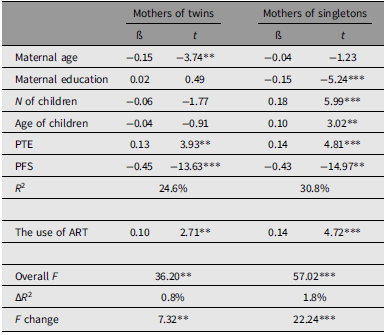
Table 2 shows the results of the final model in the hierarchical regression analysis predicting GHQ in mothers of twins and singletons. As shown in the table, the six study covariates (maternal age, education, number of children, the mean age of children, PTE, and PFS) explained 24.6% of the variance of GHQ in mothers of twins, and 30.8% of the GHQ variance in mothers of singletons. The standardized beta values for the use of ART were significant and positive in both groups (ß = 0.10 in mothers of twins, ß = 0.14 in mothers of singletons), indicating that the use of ART significantly increased mental health problems in mothers of twins and singletons. The use of ART explained additional 0.8% of the variance of GHQ in mothers of twins and additional 1.8% in mothers of singletons. Taken together, these results suggest that the variance of the use of ART explaining maternal mental health problems was significant even after adjustment of the study covariates.
The estimates of the final model in hierarchical regression analysis in predicting GHQ

Note. *p < .05, **p < .01, ***p < .001; GHQ, general health questionnaires; PTE, psychiatric treatment experience; ART, assisted reproductive technology.
Comparison of Mental Health Problems Between Mothers of Twins and Singletons After Controlling the Study Covariates
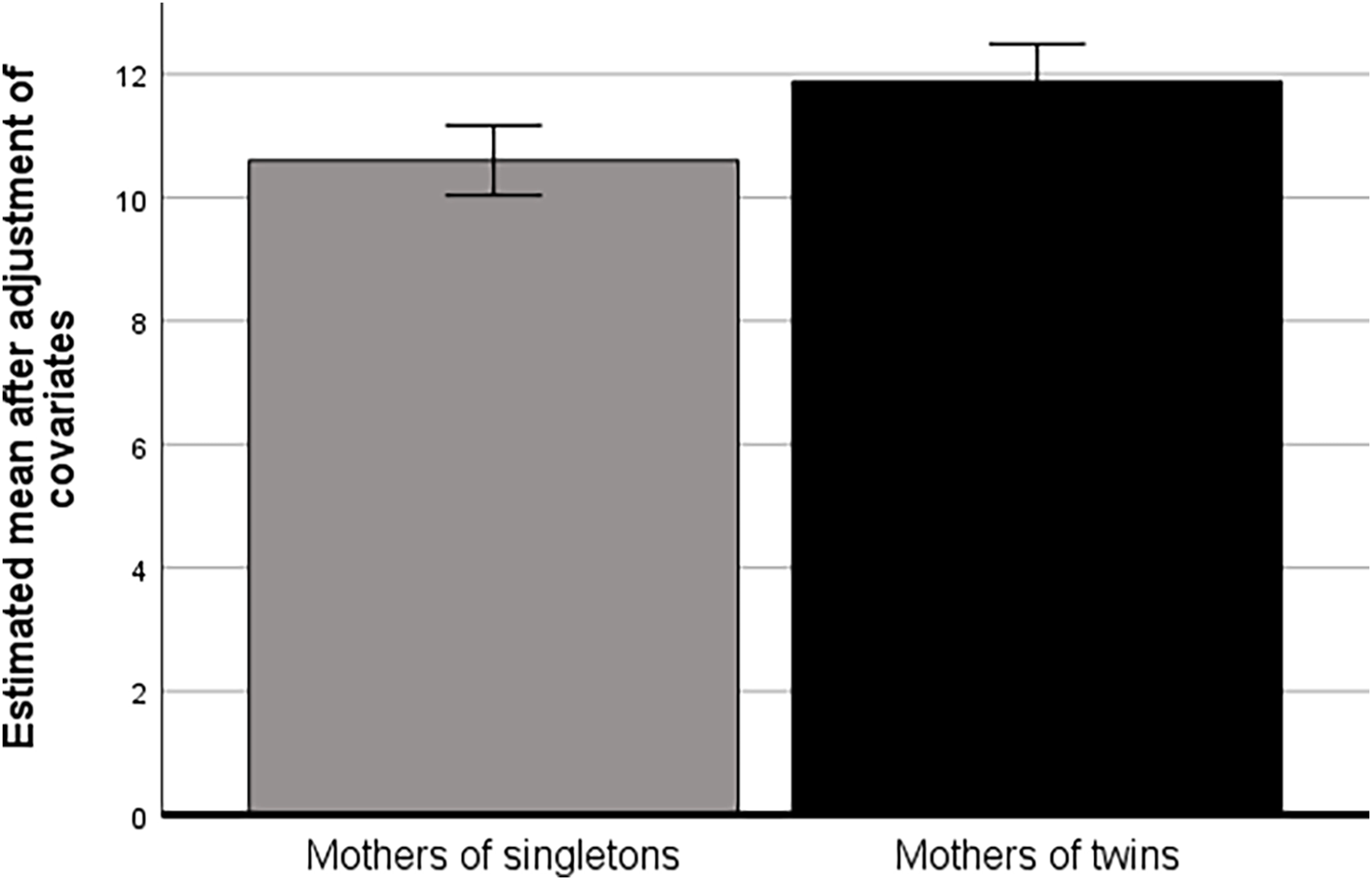
ANCOVA was conducted for GHQ, while controlling the use of ART, PFS, PTE, and demographic covariates. The results of ANCOVA revealed that the GHQ mean difference between mothers of twins and singletons was significant (F (1df) = 7.6, p < .01). Among the study covariates, maternal age (F (1df) = 16.8, p < .001), maternal education (F (1df) = 6.8, p < .01), number of children (F (1df) = 12.2, p < .001), PFS (F (1df) = 378.0, p < .001), PTE (F (1df) = 40.5, p < .001), and the use of ART (F (1df) = 47.1, p < .001) were significant. Only the age of children in the household did not attain statistical significance (F (1df) = 1.8, p =.17), consistent with the results of correlational analysis in Table 1 . Figure 1 displays the adjusted means for GHQ in mothers of twins (11.9 (95% CI [11.3, 12.5]) and singletons (10.6 (95% CI [10.0, 11.2]). The standardized mean difference (Cohen’s d) between mothers of twins and singletons was 0.16 (95% CI [0.06, 0.26]). The effect size was small, but significant (Cohen, Reference Cohen1988).
Estimated means for the General Health Questionnaire (GHQ), adjusted after study covariates for mothers of singletons and twins.

Comparison of PTE Between Mothers of Twins and Singletons After Adjustment of Covariates
Logistic regression analysis was conducted for PTE as an outcome variable, while controlling the use of ART, PFS, and demographic covariates. The results revealed that the difference in PTE between mothers of twins and singletons was significant (B = 0.90 [SE = 0.17]; Wald = 30.0, p < .001). The odds ratio for the PTE was 2.5 (95% CI [1,8, 3.4]), indicating that PTE is more than double in mothers of twins than in mothers of singletons after adjustment of the use of ART and other study covariates. Among the covariates, only PFS significantly predicted PTE (B = -0.26 [SE = 0.06], Wald = 16.8, p < .001; OR = 0.77; 95% CI [0.68, 0.87]), indicating that higher PFS is associated with lower PTE.
Discussion
Three main findings emerged from the data. First, ART use was significantly associated with poorer maternal mental health, even after adjusting for PFS and demographic variables. Second, mothers of twins reported greater mental health difficulties than mothers of singletons, though this difference became small after adjusting for all covariates including ART and PFS. Finally, mothers of twins were more than twice as likely to have received psychiatric treatment compared to mothers of singletons.
Association Between ART and Maternal Mental Health
Despite the widespread use of ART, concerns remain that mothers who conceive through ART may be at increased risk of psychological distress. Our finding that ART use was significantly associated with maternal mental health aligns with previous reports (Choi et al., Reference Choi, Bishai and Minkovitz2009; Verhaak et al., Reference Verhaak, Smeenk, Evers, Kremer, Kraaimaat and Braat2007) but contrasts with others showing no association (Gambadauro et al., Reference Gambadauro, Iliadis, Bränn and Skalkidou2017; Hammarberg et al., Reference Hammarberg, Fisher and Wynter2008). IVF is currently the most common ART procedure (Kushnir et al., Reference Kushnir, Barad, Albertini, Darmon and Gleicher2017). The financial burden, daily hormone injections, and uncertainty of treatment outcomes represent major stressors (Capuzzi et al., Reference Capuzzi, Caldiroli, Ciscato, Zanvit, Bollati, Barkin, Clerici and Buoli2020), with oocyte retrieval, embryo transfer, and the waiting period before pregnancy testing being particularly distressing (Boivin & Takefman, Reference Boivin and Takefman1995). Stigma surrounding infertility further contributes to social isolation and diminished self-worth (Yilmaz & Kavak, Reference Yilmaz and Kavak2019). Interestingly, the association between ART and mental health problems was stronger in mothers of singletons than in mothers of twins. As ART is less common among singleton mothers, these women may experience greater isolation or fewer peer networks. However, this preliminary observation requires replication.
Comparison of Mental Health Between Mothers of Twins and Singletons
Consistent with large-scale studies (Egsgaard et al., Reference Egsgaard, Bliddal, Lund, Vigod and Munk-Olsen2025; Lapinsky et al., Reference Lapinsky, Ray, Brown, Murphy, Kaster and Vigod2023), a systematic review (Wenze et al., Reference Wenze, Battle and Tezanos2015), and a meta-analysis (Collins, Reference Collins2024), mothers of twins showed higher levels of mental health difficulties than mothers of singletons. Qualitative studies (Bolch et al., Reference Bolch, Davis, Umstad and Fisher2012) have similarly described the unique emotional and physical burdens of raising multiples. However, the effect size in our study was small (d = 0.20), suggesting that earlier small-scale studies may have lacked sufficient power to detect such differences.
Physiologically, twin pregnancies involve higher estrogen and progesterone levels than singleton pregnancies (Kuijper et al., Reference Kuijper, Twisk, Korsen, Caanen, Kushnir, Rockwood, Meikle, Hompes, Wit and Lambalk2015), and the sharper postpartum hormonal drop among mothers of twins may heighten vulnerability to depression (Egsgaard et al., Reference Egsgaard, Bliddal, Lund, Vigod and Munk-Olsen2025). Psychosocially, parenting twins is more demanding due to greater sleep deprivation, delayed work return, and higher financial strain (Damato & Burant, Reference Damato and Burant2008). Mental health difficulties have been observed in mothers of preschool twins (Olivennes et al., Reference Olivennes, Golombok, Ramogida and Rust2005) but not in mothers of older twins (Anderson et al., Reference Anderson, Koh, Connor, Koerner, Damario and Rueter2014), suggesting that challenges shift as children gain autonomy and caregiving demands decrease (Coatsworth et al., Reference Coatsworth, Timpe, Nix, Duncan and Greenberg2018).
In contrast, our study found no mental health difference between mothers of preschool- and school-aged children. This may reflect our smaller subsample of school-aged children (about 25%), or sociocultural influences specific to South Korea. The strong societal emphasis on academic success in South Korea imposes substantial stress and financial burden on parents of school-aged children (Lim & Jeon, Reference Lim and Jeon2016), potentially minimizing age-related differences. Future research should include larger, balanced samples to examine developmental effects of children on maternal mental health more clearly.
PFS emerged as a significant protective factor, consistent with previous findings (Mistry et al., Reference Mistry, Stevens, Sareen, De Vogli and Halfon2007). Yet, mothers of twins reported lower PFS than mothers of singletons, possibly reflecting the heavier demands of twin care that exceed available support. Relatives and friends may underestimate ongoing needs once infants pass the newborn stage, resulting in inconsistent or insufficient assistance (Bolch et al., Reference Bolch, Davis, Umstad and Fisher2012). These factors suggest that the combination of subfertility, ART-related stress, and the challenges of parenting twins contribute to elevated maternal mental health difficulties.
Psychiatric Treatment Experience (PTE)
Our finding that PTE was more than twice as prevalent among mothers of twins than among mothers of singletons, even after adjusting for all study covariates, highlights their vulnerability. Furthermore, the difference in GHQ scores between the two groups remained significant after accounting for PTE, indicating that mothers of twins continued to exhibit poorer mental health than mothers of singletons despite having received treatment. Poor maternal mental health is associated with adverse child outcomes, including internalizing and externalizing behaviors, negative affect, and reduced cognitive performance (Baird et al., Reference Baird, Harris and Santos2023; Goodman et al., Reference Goodman, Rouse, Connell, Broth, Hall and Heyward2011). Therefore, mothers of twins represent an important target for prevention and early intervention. The nature of their mental health burdens likely change across stages — from fertility treatment and pregnancy through postpartum and school years — necessitating stage-specific screening and support programs.
Limitations and Conclusions
Several limitations warrant consideration. First, although mothers were asked about twins’ zygosity, this information was excluded from data analysis due to reliability concerns. Future work should examine whether maternal mental health differs by zygosity. Second, child age was grouped into only preschool and school-age categories, possibly obscuring finer age effects. However, the results remained unchanged when we treated the mean age of children in the household as a continuous variable. This may reflect the relatively small sample size in the school-age group. Future studies should include larger samples of school-age children to replicate our findings. Third, fathers’ mental health was not assessed, despite evidence that fathers of twins also experience elevated distress (Egsgaard et al., Reference Egsgaard, Bliddal, Lund, Vigod and Munk-Olsen2025). Fourth, PFS was assessed using a single item. Future research should employ a more comprehensive scale to improve reliability and validity. In addition, psychiatric treatment history was measured using a single self-reported item, and maternal mental health was assessed using a single self-report scale. The validity of these measures may be limited due to recall bias and social desirability bias associated with self-report. Although online self-reports of mental health have been shown to correlate significantly with in-person clinical assessments (Arrow et al., Reference Arrow, Resnik, Michel, Kitchen, Mo, Chen, Espy-Wilson, Coppersmith, Frazier and Kelly2023), the validity of the findings would be strengthened if future studies replicate these results using clinically diagnosed measures of mental health. Fifth, because participants were recruited through social media platforms, the sample may be somewhat biased toward individuals who have access to social media and are more likely to seek support online. Although social media use is highly prevalent in South Korea (approximately 89%; Korea Internet & Security Agency, 2023), participants in this study had somewhat higher educational attainment than the general population in South Korea. National data indicate that 81.4% of mothers of twins and 79.8% of mothers of singletons in South Korea have completed college or higher (Hur, Reference Hur2021). Therefore, the findings may not be fully generalizable to all mothers in South Korea. Notably, however, both groups — mothers of twins and mothers of singletons with at least two children — were recruited through social media (primarily maternal communities). Therefore, it is unlikely that this selection bias differentially affected mothers of twins relative to mothers of singletons. Sixth, parenting burden may differ between mothers whose twins are first-born and those whose twins are later-born. However, our sample was underpowered to adequately examine this issue, as the vast majority of mothers of twins had only twins. Future research should investigate whether maternal mental health differs between these groups. Finally, as all participants were South Korean, cross-cultural generalizability is limited. Although long-term pronatalist policies — such as family leave, childbirth incentives, and housing support — have led to a slight increase in South Korea’s fertility rate (from .72 in 2023 to .80 in 2025), it still remains the lowest in the world. This pattern likely reflects a social climate in which young adults, particularly women of childbearing age, experience economic burden and stress related to childrearing (Chung, Reference Chung2015). In cultural contexts where marriage and childbearing are more highly valued or less avoided, the perceived burden of raising twins may be lower, potentially leading to different findings. Comparative studies across diverse populations are warranted.
In conclusion, our findings show that mothers of twins — particularly those who conceived via ART — experience significantly higher levels of mental health difficulties than mothers of singletons. These results indicate the importance of systematic mental health screening and the development of targeted interventions for this group. Providing psychological counseling, family-based support programs, and financial assistance for families with twins could help mitigate the mental health burden associated with ART and multiple parenting.
Competing interests
The authors declare no conflicts of interest.

 Open access

