


Introduction
The East Asian population of the Greater White-fronted Goose Anser albifrons was thought to number around 130,000 individuals, 33,000 in eastern China in the mid-2000s plus 30,000 in South Korea and 70,000 in Japan, based on mid-winter average counts from 2000–2004 (Cao et al. Reference Cao, Barter and Lei2008). However, recent information suggests greatly increased numbers in South Korea and Japan (H. Lee unpubl. data; Asian Waterbird Census unpubl. data), although not in China, so the East Asian population could currently exceed 250,000.
In Japan and South Korea, as in Europe, Greater White-fronted Geese forage in agricultural habitats, mainly on spilt rice, winter wheat and improved pastures (Kear Reference Kear2005, Madsen et al. Reference Madsen, Cracknell and Fox1999, Shimada Reference Shimada2002, Syroechkovskiy Reference Syroechkovskiy, Boere, Galbraith and Stroud2006). Those wintering in the North American Pacific Flyway (the same subspecies as Chinese wintering birds) forage on a variety of cereals, potatoes, and agricultural and wild grasses (Ely and Raveling Reference Ely and Raveling2011). In contrast, in eastern China, the species feeds primarily on Carex spp. (Zhang and Lu Reference Zhang and Lu1999, Cheng et al. Reference Cheng, Cao, Barter, Xu, Zhang and Zhao2009) in natural wetlands that are seriously threatened by hydrological changes caused by the construction of thousands of water control structures, and particularly exacerbated by the commissioning of the Three Gorges Dam in 2003, the largest in the world (Xu et al. Reference Xu, Milliman, Yang and Wang2006, Yang et al. Reference Yang, Wang, Saito, Milliman, Xu, Qiao and Shi2006, Yang et al. Reference Yang, Zhang and Xu2007).
Given the small Chinese wintering population and its narrow food preference that depends on the annual natural floodplain flood-drought cycle, it is important to understand the impacts of changes in floodplain hydrology on food availability, goose numbers and distribution. The Carex sedges favoured by Greater White-fronted Geese grow rapidly in autumn as they are exposed by water table recession in the Yangtze River wetlands. Geese generally exploit short swards of graminoid plants which are highest in protein and lowest in structural carbohydrates with initial onset of growth (e.g. Cadieux et al. Reference Cadieux, Gauthier and Hughes2005), so it is important that geese start to exploit these plants during the period when they reach optimal quality and lamina length. Increased protein content of leaves is a common response of monocotyledonous plants to grazing (Ydenberg and Prins Reference Ydenberg and Prins1981, Cargill and Jefferies Reference Cargill and Jefferies1984, Fox and Kahlert Reference Fox and Kahlert2003), so if geese arrive to optimal sward length, repeated grazing can maintain the sward in a suitable condition for sustained foraging. Once sedges grow too tall, they are abandoned by geese (authors’ unpubl. data). Hence, the dates at which sedge beds are first exposed by receding water levels, and thus the extent of sedge of suitable sward length that is available, are likely to determine the number of geese a site can sustain during the winter. Since water levels within the Yangtze River floodplain are now greatly modified and levels recede as the dam is refilled in early autumn (following lowering to absorb the summer monsoonal floods) (Wang et al. Reference Wang, Lee and Cheng2005), this could be a crucial factor affecting numbers of Greater White-fronted Geese using a site.
Some of our earlier work, particularly on the impact of changing hydrological regimes on submerged macrophytes within the floodplain, provided strong indications that these changes led to greatly reduced waterbird food production (Cao et al. Reference Cao, Meng, Yang, Shan, Liu and Fox2011b, Meng et al. in prep.), with a negative impact on waterbird numbers (Cao Reference Cao and Chen2011, Cong et al. Reference Cong, Cao, Fox, Barter, Reece, Chen, Jiang, Ji, Zhu and Song2011, Fox et al. Reference Fox, Cao, Zhang, Barter, Zhao, Meng and Wang2010, Zhang et al. Reference Zhang, Cao, Barter, Fox, Zhao, Meng, Jiang and Zhu2011. However, many waterbirds graze on sedges and it is important to establish whether sedge availability, and the species which depend on them, are also affected by the recent dramatic changes in Yangtze floodplain hydrology.
In this paper, we report historical and contemporary information on the abundance and distribution of wintering Greater White-fronted Geese in east China and test the hypothesis that the recent decline in numbers at East Dongting Lake, a previously important site for Greater White-fronted Geese, is due to recent large changes in floodplain hydrology affecting their traditional sedge food supply.
Methods
Study area
The Yangtze River floodplain, stretching for 1,850 km from the Three Gorges Dam (TGD), through Hubei, Hunan, Jiangxi, Anhui and Jiangsu provinces to the estuary at Shanghai (Figure 1), is subjected to large annual variation in water levels between the summer flood and winter dry seasons (Shankman and Liang Reference Shankman and Liang2003), creating numerous, shallow, ephemeral and highly productive wetlands with an area of approximately 10,500 km2 (He and Zhang Reference He and Zhang2001).
Yangtze River floodplain from the Three Gorges Dam to the river estuary at Shanghai, showing locations of provinces, wetlands and places mentioned in the text.
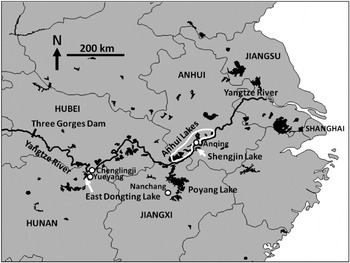
Dongting Lake (4,350 km2), the second largest lake in the floodplain after Poyang Lake (5,100 km2), is located about 450 km downstream of the Three Gorges Dam (TGD); both lakes are linked directly to the Yangtze River, filling by sheet flow during the flood season. Dongting Lake has historically been used as the major means of flood control and sediment retention in the middle reaches of the Yangtze River, but this purpose has been greatly reduced since the commissioning of the TGD in mid-2003 (Dai et al. Reference Dai, Yang, Zhu, Gao and Li2005, Wang et al. Reference Wang, Lee and Cheng2005). Water levels in numerous smaller lakes in Hubei and Anhui Provinces are controlled by sluices to allow water to enter from the Yangtze River and to exit following precipitation within the lake catchment; sluices are generally closed during May–September, to minimise flooding in the rainy season, and opened October–April, to allow water to drain into the Yangtze River to lower levels to facilitate fishing and avoid spring flooding.
Average annual rainfall across the key Greater White-fronted Geese provinces ranges from 1,361 to 1, 623 mm (average of 1,459 mm from Anqing, Nanchang and Yueyang); most falls from March to August. Annual average temperature is 18.0°C (range 17.6–18.4°C); average January temperature is 5.1°C (range 4.4–5.7°C).
Goose abundance and distribution data
Early count data during 1987–1999 are incomplete (Table 1) and to facilitate analysis, maximum annual site counts have been used; data were organised into two six-year periods: 1987/1988–1992/1993 and 1993/1994–1998/1999.
Greater White-fronted Goose numbers during the 1987/1988–2009/10 winters in the Yangtze River floodplain provinces.
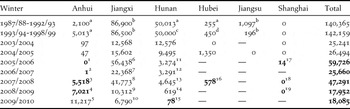
Notes:
2003/2004, 2004/2005 and 2009/2010 counts conducted in early February; italics identify incomplete counts (numbers were probably higher); “-“indicates no data available. a: Waterbird Specialist Group of Chinese Ornithological Association (1994); b: D. Lee (in litt.); c: Lei and Yang (Reference Lei and Yang1999); d: Ge et al. (Reference Ge, Cai, Hu, Liu, Cao and Liu2005). 1–4: unpubl. data from the Anhui Lakes (1 = mid-March; 2 = December–January; 3 = January–February; 4 = December-March); 5: February count (L. Cao unpubl. data); 6–9: unpubl. data from GEF Siberian Crane Project (6–8 = late December–early January; 9 = 13 February 2009); 10: unpubl. data from “Impact of Poyang Lake Dam on wetlands and waterbirds” project (count on 27 Feb. 2010); 11–14: unpubl. data from Dongting Lake (February counts); 15: February count for core areas of East Dongting Lake and Caisang Lake within East Dongting Lake, which has normally held 70-85% of Greater White-fronted Geese in Hunan in the past (L. Cao unpubl. data); 16: February count; Hu et al. Reference Hu, Liu, Tian, Luo, Li and Chen2008; 17–19: unpubl. data from Chongming Dongtan National Bird Nature Reserve, most important site in Shanghai (February counts).
In February of 2004 and 2005, the first comprehensive, synchronous waterbird surveys were conducted throughout the Yangtze River floodplain (Barter et al. Reference Barter, Chen, Cao and Lei2004, Reference Barter, Lei and Cao2006), enabling comparison of numbers and distribution to be made with more recent counts.
Key sites within East Dongting Lake were counted every month in winters 2008/2009 (February–April) and 2009/2010 (October–April; L. Cao unpubl. data). Frequent winter counts were conducted at Shengjin Lake (Anhui Province), nine times in 2008/2009 (Cheng et al. Reference Cheng, Cao, Barter, Xu, Zhang and Zhao2009), and 13 times in 2009/2010 (Meng Reference Meng2010); we also surveyed all the main Anhui Lakes twice during the 2009/2010 winter (L. Cao unpubl. data).
Counts from key floodplain wetlands in winters 2005/06–2008/09 were also available, mainly from unpublished nature reserve monitoring data. Synchronous counts were made at Dongting Lake, Poyang Lake and Chongming Island (Yangtze River estuary) but those from the Anhui Lakes were mostly collected opportunistically and occurred at different periods within and between winters. Interpretation of these non-systematic data provides useful additional information on key sites for Greater White-fronted Goose.
Carex availability at East Dongting Lake
Preliminary analysis suggested that Greater White-fronted Goose numbers had declined at East Dongting Lake, so for the years 1998–2010, we modelled changes in availability of Carex heterolepis (the dominant Carex species at the lake) during the period that geese arrived following southward migration.
We first estimated the annual total meadow area by summing the areas of the three separate Carex-dominated Greater White-fronted Goose foraging sites (those from which count data were also available). For two of the sites (Chung Feng Lake and The Corner) we used shapefiles drawn with ArcMap 9.3 (ESRI Inc., Redlands, CA, USA) on Landsat ETM+ images (EROS 2010), whilst direct measurement of the main goose meadow area (Central Management Station) was derived from a GPS track generated by walking around the Carex meadow border.
We then assessed the annual proportion of this area which was suitable for grazing by geese on their arrival from the breeding grounds. Studies of grazing preferences showed that arriving Greater White-fronted Geese fed on graminoid swards 1–8 cm high (Owen Reference Owen1972), so we excluded areas with Carex swards above 8 cm as being too tall for geese to exploit for feeding. We selected 25 October as the average arrival date because main arrivals of Greater White-fronted Geese at Shengjin Lake occurred during the last 10 days of October in 2008, 2009 and 2010 (Cheng et al. Reference Cheng, Cao, Barter, Xu, Zhang and Zhao2009, Meng Reference Meng2010, L. Cao unpubl. data).
C. heterolepis leaf growth rates were measured twice per month at East Dongting Lake, from mid-October 2010 to early February 2011, on 50 tagged individual plants in two exclosed quadrats (1 m x 1 m). Central leaves were measured from the leaf tip to the tip of the tagged leaf sheath every fortnight. Tagged Carex plants were replaced by new individuals if the original died or the tag was lost or destroyed.
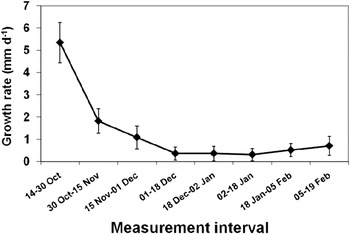
We estimated the Carex growth rate to average 5.4 mm d-1 in the second half of October (see below and Figure 2). Thus, areas of Carex plants exposed on 10 October (i.e. 15 days earlier than the estimated 25 October arrival date) would be at the maximum length for successful exploitation (i.e. leaf length would be 5.4 mm x 15 d ≈ 80 mm). On this basis, we calculated the total area of each of the three Carex meadows that was available in each year to arriving geese based on timing and pattern of exposure derived from satellite imagery.
Average growth rate of Carex heterolepis at East Dongting Lake over approximately half-month periods, commencing in mid-October 2010.
In calculating the percentage of available area as a function of total area, we assumed that meadows were exposed at a uniform rate between initial and final exposure water levels (dates determined from Chenglingji water levels, Huang Hai datum; obtained from Yangtze Water Resources Commission; initial and final exposure levels for each of the three foraging sites was determined from a series of satellite images taken at different water levels [Chung Feng Lake: 26.0–28.0 m; Management Station: 25.0–27.5 m and The Corner: 25.5–26.5 m]). The percentage available area (A) was calculated from the number of days between 10 October and final exposure date (d) and the number of days between initial and final exposure dates (n) thus:

We then regressed the number of Greater White-fronted Geese (dependent variable) counted in January or February from 1999–2010 against the estimated suitable Carex area in the previous October to test our prediction that in years with reduced areas of suitable Carex availability, goose numbers would also be lower.
Results
Historical and recent changes in abundance and distribution
Although count data for 1987/88–1992/93 and 1993/1994–1998/1999 are variable, it is evident that Greater White-fronted Geese were more abundant in both these periods than subsequently, with the maximum numbers in Jiangxi and Hunan (which held the greatest numbers) alone each greatly exceeding current total numbers (Table 1). Even allowing for goose movements during winter, it is apparent that total numbers have declined from > 140,000 to c.18,000 currently (Table 1). Declines have occurred in Jiangxi, but most markedly in Hunan (predominantly at East Dongting Lake (the most important site) where the decline has been steady since 2003/2004, with very few left from 2008/2009 onwards. Numbers have increased from very few to over 10,000 in Anhui (predominantly at Shengjin Lake) over the same time period, which now supports more Greater White-fronted Geese than Jiangxi and Hunan combined (Table 1).
C. heterolepis growth rate
The Carex growth rate declined from an average of 5.4 mm d-1 in the second half of October to less than 1 mm d-1 in mid-winter (Figure 2) . We chose 5.4 mm d-1 as the growth rate during the period prior to geese arrival in late October, as the appropriate growth period to maximum exploitable length (10–25 October) is very similar to the field measurement period (14-30 October).
Carex availability and goose numbers
The total annual areas of suitable Carex, although variable, generally declined during the 1998–2010 period, as also did the number of Greater White-fronted Geese (Table 2). The annual extent (i.e. exposed area) of suitable Carex was a statistically significant predictor of the annual numbers of geese using the site (r = 0.65, F1,8 = 5.81, P = 0.04).
Annual availability of suitable Carex heterolepis (i.e. ≤ 8 cm upon geese arrival on 25 October) at the three main Greater White-fronted Goose foraging sites at East Dongting Lake (CMS = Central Management Station), total available area and goose counts (“-“ = no data) in January-February.

Discussion
Counts indicate that Greater White-fronted Goose numbers may have declined by as much as 90% in eastern China since the 1990s. The causes remain unknown but could be linked to a combination of factors, including habitat loss and degradation in the Yangtze River floodplain (Lu and Zhang Reference Lu and Zhang1996, NWCAPC 2000, He and Zhang Reference He and Zhang2001), hunting (Lu Reference Lu, Moser and Prentice1993) and the specialised feeding ecology of the species. Short stopping may also have contributed, as global warming could have enabled birds to remain in previously less hospitable wintering areas, e.g. in South Korea where the availability of agricultural habitats and provision of refuges has extended the potential feeding and roosting areas (Syroechkovskiy Reference Syroechkovskiy, Boere, Galbraith and Stroud2006, authors’ pers. obs.). Within China, recent count data show that Shengjin Lake is now the most important site for Greater White-fronts, with East Dongting Lake holding many fewer birds than previously.
The productivity of the Yangtze River floodplain wetlands is dependent on the summer monsoonal pulse of water, laden with nutrients, followed by the autumn-winter water recession which exposes rich feeding areas for many waterbirds. It has been suggested that flooding explains 50% of the variation in wetland communities, with nutrient supply explaining a further 15% (Keddy Reference Keddy2010); both these factors are very important at East Dongting Lake, which is located just 450 km downstream of the TGD and fills by sheet flow during the summer floods.
The available area of Carex upon arrival of the geese has been very small in four of the most recent years (Table 2), whereas it was abundant in earlier years. We believe this change is due to the commencement of refilling of the Three Gorges Dam in September each year, after lowering of the water level in the spring-summer period to accommodate flood water during the monsoon season. Therefore, it is likely that the hydrological changes wrought by the dam have contributed to impacts on waterbird food supplies. This is supported by observations that show falling numbers of Greater White-fronted Geese correlate with reductions in the area of suitable Carex meadow, mainly the result of earlier exposure of these beds in recent years, which has resulted in swards too high on goose arrival to permit their exploitation.
Greater White-fronted Geese have increased in number at Shengjin Lake, indicating more suitable conditions there in recent years. Hydrological changes at this sluice-controlled lake have caused the first exposure of the Carex meadow there to vary from 7 to 11 October during 2007–2010 (i.e. maximising the area of Carex of suitable grazing length), whereas in the previous six years first exposure dates varied greatly from 27 September to 15 October (unpubl. data). Hence, the more predictable availability of Carex in recent years may have supported the rapid increase in Greater White-fronted Geese numbers since 2006/2007. The rate of drawdown has also slowed (perhaps due to changes in sluice operation), maintaining wet conditions on the meadow for 52–62 days in 2008–2010 compared to 9–15 days in 2001–2005, a factor potentially contributing to maintaining the suitability of the sward for geese. The Shengjin Lake Carex meadows are also grazed intensively by up to 1,100 buffalo, which may also contribute to maintaining optimal sward length for the geese (Cao et al. Reference Cao, Barter, Zhao, Meng and Zhang2011a). However, the causes and effects of hydrological change and buffalo grazing pressure on the vegetation require further investigation to provide a scientific basis for optimal management of water levels and buffalo numbers in order to maintain Greater White-fronted Goose numbers within the Shengjin Lake National Nature Reserve.
Acknowledgements
Special thanks go to Xin Wang for preparing the database of historical count data. The study was supported by National Basic Research Program of China (973 Program, Grant No. 2012CB956104), Chinese Academy of Sciences Innovation Project (Grant No. KZCX2-YW-QN503), Fundamental Research Funds for the Central Universities (Grant No. WK2060190007), plus a Chinese Academy of Sciences Visiting Professorship for Senior International Scientists (2011T1Z04), State Administration of Foreign Experts Affairs, PRC.



