





Introduction
Social entrepreneurship (SE) is a vibrant, multifaceted, and international phenomenon (Mair & Marti, Reference Mair and Marti2006; Nicholls & Teasdale, Reference Nicholls and Teasdale2017; Teasdale, Reference Teasdale2012). In the repertoire of definitions that the academic literature has provided since its inception as a field of research (e.g., Calo et al., Reference Calo, Sancino and Scognamiglio2024; Dacin et al., Reference Dacin, Dacin and Tracey2011; Gupta et al., Reference Gupta, Chauhan, Paul and Jaiswal2020; Müller et al., Reference Müller, Vaseková and Kročil2024; Peredo & McLean, Reference Peredo and McLean2006), one can clearly perceive that the concept of SE is full of promise and gives much to hope for. SE is geared toward transforming businesses and societies (Driver, Reference Driver2012; Steyaert & Hjorth, Reference Steyaert and Hjorth2006) by addressing grand challenges and the most serious social problems that have been neglected or unsuccessfully attended to by commercial businesses, charities, or public institutions (Roy et al., Reference Roy, Roy and Teasdale2021; Shaw & Carter, Reference Shaw and Carter2007). SE is considered a form of entrepreneurship encapsulating the potential to positively impact the world, supporting those most in need, introducing social protocols in their business models and adopting social economy approaches (Bornstein, Reference Bornstein2007; Dufays & Huybrechts, Reference Dufays and Huybrechts2014; Karanda & Toledano, Reference Karanda and Toledano2012, Reference Karanda and Toledano2018; Teasdale et al., Reference Teasdale, Roy, Ziegler, Mauksch, Dey and Raufflet2021, Reference Teasdale, Roy, Nicholls and Hervieux2023).
The popular emphasis on the social mission and the transformation that SE can bring about often ascribes to social entrepreneurs a stereotypical ethical identity (Chell et al., Reference Chell, Spence, Perrini and Harris2016). Indeed, one of most compelling aspects of SE is its alignment with a form of responsible and ethical entrepreneurship. Even though SE itself does not explicitly articulate any ethical claims, in many contexts, social entrepreneurs are regarded as ideal agents working for the common good and are therefore frequently viewed as morally commendable (Bruder, Reference Bruder2021; Bull & Ridley-Duff, Reference Bull and Ridley-Duff2019; Chell et al., Reference Chell, Spence, Perrini and Harris2016; Dey & Steyaert, Reference Dey and Steyaert2016).
Although scholars have critically examined the a priori assumption of the ethical legitimacy of social entrepreneurs, proposing various ethical frameworks to address this issue (e.g., André & Pache, Reference André and Pache2016; Bull & Ridley-Duff, Reference Bull and Ridley-Duff2019), certain aspects remain problematic. Notably, the prevalence of partial and normative ethical views, while valuable, risk overlooking the nuanced ethical dilemmas inherent in everyday entrepreneurial experience (Hägg et al., Reference Hägg, Haataja, Kurczewska and McKelvie2024; Robinson et al., Reference Robinson, Van der Mescht and Lancaster2003). To overcome these conceptual limitations and to advance on the understanding of ethics within the SE field, we pose the question of how and when we could identify SE as being ethical in the performance of everyday practices. By situating ethics within the daily realities of social entrepreneurs, we acknowledge the context-dependent nature of both SE and ethical decision-making, as highlighted in the literature (Dey & Steyaert, Reference Dey and Steyaert2016; Zahra et al., Reference Zahra, Gedajlovic, Neubaum and Shulman2009). Specifically, to shed light on this issue, we propose turning to the notion of the “economy of the gift” as understood within Paul Ricoeur’s (Reference Ricoeur2005, p. 224) practical ethical project.
The French philosopher Paul Ricoeur (1913–2005) is considered one of the most influential thinkers of the twentieth century (Dallmayr, Reference Dallmayr, Wall, Schweiker and Hall2002). Ricoeur’s works are well known among business ethicists (e.g., Deslandes, Reference Deslandes2012), and his works has been also applied to the field of entrepreneurship (e.g., Dey & Steyaert, Reference Dey, Steyaert, Pullen and Rhodes2015; Toledano, Reference Toledano2022). For the issues addressed in this article, we believe that Ricoeur’s (Reference Ricoeur1992) practice-based understanding of ethics is significant because it regards social interdependencies and collaborations, changes and everyday eventualities, which characterize the practice of SE itself (Mazzei et al., Reference Mazzei, Montgomery and Dey2021; Pless, Reference Pless2012). In addition, Ricoeur’s (Reference Ricoeur1992) notion of the economy of gift offers an ethical view that renders productive as he brings together different conceptual ethical positions to make them much suitable for the social practice (Nussbaum, Reference Nussbaum, Wall, Schweiker and Hall2002; Wall, Reference Wall2005).
By applying Ricoeur’s notion of the economy of gift and his practical ethics to the field of SE, we provide a framework enriching the ethical debate whilst promoting a practical guide to make prudent and wise decisions in everyday dilemmas. In the remainder of the paper, we first review what is known and understood about the ethical dimensions of SE; then, we introduce Ricoeur’s arguments, which we later apply to SE. In the final section, we highlight the main conclusions, limitations, and avenues for further research.
Ethical implications in SE conceptions
SE is a field rich in scholarship research, in teaching, and among practitioners (Gupta et al., Reference Gupta, Chauhan, Paul and Jaiswal2020; Teasdale et al., Reference Teasdale, Roy, Nicholls and Hervieux2023). Despite the diversity in social entrepreneurial rationalities and praxis documented in the extensive literature, there is common agreement among academics to recognize the social mission as an essential feature of SE (Mair & Marti, Reference Mair and Marti2006; Peredo & McLean, Reference Peredo and McLean2006; Teasdale, Reference Teasdale2012). On this basis, the existing literature on SE can be broadly categorized into two main perspectives: the “mission-centric” view (Bruder, Reference Bruder2021, p. 487), which defines SE primarily by its social mission as its core identifying feature (e.g., Bandinelli, Reference Bandinelli2017; Bornstein, Reference Bornstein2007; Dees, Reference Dees1998), and what we will refer to in this work as “governance-centric” SE—a distinction from the first typology—which emphasizes the governance structure of social enterprises as the defining characteristic that qualifies them as SE (e.g., Bull & Ridley-Duff, Reference Bull and Ridley-Duff2019; Defourny & Nyssens, Reference Defourny, Nyssens and Nyssens2006). Both perspectives suggest an inherent ethical aspiration in the prefix “social” (Bruder, Reference Bruder2021)—despite the lack of explicit ethical claims—yet they remain fundamentally distinct: an agent perspective, which underscores social entrepreneurs’ good intentions and is associated with a mission-centric conception of SE; and a business-centric perspective, which emphasizes the organizational democratic structures of social businesses and is linked with the governance-centric SE.
The ethical assumptions on the mission-centric SE approach
In mission-centric SE, the social dimension of the mission is adequately grounded; yet, as Bruder (Reference Bruder2021, p. 487) observes, “it also carries a positive normative connotation.” This positive normative connotation leads to the perception of SE as ethical (good) and is a pervasive theme in SE studies, having been disseminated worldwide, particularly from diverse American schools of thought (Dees & Anderson, Reference Dees, Anderson and Mosher-Williams2006; Ranville & Barros, Reference Ranville and Barros2022). Well known in the field is the American Social Innovation School, with a focus on the innovative capabilities of social entrepreneurs as changemakers from a conventional Schumpeterian standpoint (Bandinelli, Reference Bandinelli2017; Korstenbroek & Smets, Reference Korstenbroek and Smets2019; Teasdale et al., Reference Teasdale, Roy, Ziegler, Mauksch, Dey and Raufflet2021). Specifically, the image of social entrepreneurs as prominent moral actors is premised on their “moral commitment to helping people or performing good deeds” (Goss et al., Reference Goss, Jones, Betta and Latham2011, p. 224). According to Bandinelli (Reference Bandinelli2017, p. 43), they are almost “glorified as contemporary heroes,” or, as Dey and Steyaert (Reference Dey and Steyaert2016, p. 628) put it, they are considered “the proverbial embodiment of ethical virtuousness.” Prominent figures and institutions, including Bill Drayton and Ashoka, have played a crucial role in disseminating this appealing heroic narrative of social entrepreneurs—particularly “with the images of altruistic and passionate individuals skillfully captured through awards, films and case studies” (Dacin et al., Reference Dacin, Dacin and Tracey2011, p. 1023).
From this perspective, SE may embrace all forms of business initiatives, including hybrid organizations—forms non-for profits—as long as they earn income in support of the social mission (Bruder, Reference Bruder2021). Cases of mission-centric SE include, for instance, the well-publicized business created by Blake Mycoskie, TOMS Shoes, in which his original “one for one” business model—buy one, give one—was thought to subsidize the social mission of helping children in need of a pair of shoes (Toms, 2020).
While social entrepreneurs’ merits as ethical agents may be acknowledged in base to their skills, aptitudes, and deep connections to communities in the pursuit of their social mission, assuming the ethicality of SE only with these premises might imply a narrow conception of ethics. Indeed, since mission-centric SE offers no ethical standard for the quality of missions, not all missions might be worthy, informed, or well-intended. Some have also acknowledged that concerns may persist over the ethics of social entrepreneurs’ practices and the negative consequences of their works—even if unintended (Dey & Steyaert, Reference Dey and Steyaert2016; Mort et al., Reference Mort, Weerawardena and Carnegie2003; Zahra et al., Reference Zahra, Gedajlovic, Neubaum and Shulman2009).
For instance, as Zahra et al. (Reference Zahra, Gedajlovic, Neubaum and Shulman2009, p. 528) observe, certain social entrepreneurs “may spin the truth in order to gain support and obtain funding, or even fail to refund money received from donors.” In addition, the complex motivations of social entrepreneurs may change throughout the business life, or some social pressures might transform their good intentions of benefiting others toward other interests (Chandra et al., Reference Chandra, Lee and Tjiptono2021; Ometto et al., Reference Ometto, Gegenhuber, Winter and Greenwood2019; Tucker et al., Reference Tucker, Croom and Bacq2019; Zahra et al., Reference Zahra, Gedajlovic, Neubaum and Shulman2009). Tucker et al.’s (Reference Tucker, Croom and Bacq2019) study, for example, found that social entrepreneurs can be opportunistic and act like commercial entrepreneurs before the realization of an opportunity, while Chandra et al. (Reference Chandra, Lee and Tjiptono2021) have emphasized social entrepreneurs’ struggles between serving public or private interests. More plainly, Zahra et al. (Reference Zahra, Gedajlovic, Neubaum and Shulman2009, p. 529) suggested that certain social entrepreneurs ̶ specifically those categorized as “social engineers”—may, in their fervent commitment to their chosen causes, place “their egos and needs ahead of their ventures or the constituents they serve.”
Consequently, an ethical analysis necessitates the acknowledgment that, despite the inherent value of social entrepreneurs’ competencies and skills, these do not inherently preclude ethical lapses or misaligned motivations. The fundamental concern is that the mission-social assumed ethics suggests, as Dey and Steyaert (Reference Dey and Steyaert2016, p. 628) argue, an “essentialist perspective, which views social entrepreneurs as a priori ethical.” Several studies have suggested that a firm’s consistency between intentions and actions is necessary to accept the ethicality of SE; thus, the governance of the social business becomes one aspect that it is necessary to consider in ethical judgments (Bruder, Reference Bruder2021; Bull & Ridley-Duff, Reference Bull and Ridley-Duff2019).
The ethical assumptions on the governance-centric SE approach
The ethics of governance-centric SE is often assumed not only because of its social mission but also in conjunction with its formal structures and ongoing decision-making processes. Rooted in what some European countries label as the “social economy” (Defourny, Reference Defourny, Defourny, Hulgärd and Pestoff2014, p. 19) or “third sector” (Defourny, Reference Defourny, Defourny, Hulgärd and Pestoff2014, p. 18), SE from this perspective is typically associated with social enterprises that provide goods or services to their members, or to a community, while introducing participative processes of management designed to enhance organizational commitment and adaptability (Roy et al., Reference Roy, Roy and Teasdale2021). In countries such as Spain, where there is a strong tradition of cooperatives, including the internationally renowned case of Mondragon, models of democratic governance based on the principle “one member, one vote” are common (Ridley-Duff, Reference Ridley-Duff2010; Shaw & Carter, Reference Shaw and Carter2007). Moreover, mutual organizations with participative governance structures, which ensure profit reinvestment for collective benefit, have a long-standing tradition in some parts of Europe (Cornforth, Reference Cornforth2004; Defourny, Reference Defourny, Defourny, Hulgärd and Pestoff2014; Defourny & Nyssens, Reference Defourny and Nyssens2017). Other governance forms, leading to property rights structures beyond investor-owned firms, have also been identified in the literature (Battilana & Lee, Reference Battilana and Lee2014; Claassen et al., Reference Claassen, Mair and Bidet2024; Mason & Doherty, Reference Mason and Doherty2016; Pestoff & Hulgård, Reference Pestoff and Hulgård2016). Mason and Doherty (Reference Mason and Doherty2016) highlight, for instance, community-owned enterprises in the United Kingdom, which feature social ownership structures that foster collective decision-making, whereas benefit corporations are more characteristics of the United States, emphasizing the integration of accountability mechanisms within their governance structures.
Beyond the functional and pragmatic dimension that can be perceived on these models in terms of pursuing certain operational participation objectives (e.g., improving decision quality, increasing member satisfaction) (Cornforth, Reference Cornforth2004), deeper epistemic commitments to ethical principles, such us respecting every person’s voice, sharing power fairly, and promoting principles of solidarity, can also be noticed (Bull & Ridley-Duff, Reference Bull and Ridley-Duff2019; Horn, Reference Horn2013). Indeed, some social enterprises are well known for their explicit commitment to promoting social justice and community empowerment at the local level (Bacchiega & Borzaga, Reference Bacchiega, Borzaga, Anheier and Ben-Ner2003; Defourny & Nyssens, Reference Defourny and Nyssens2017; Pathak & Muralidharan, Reference Pathak and Muralidharan2018; Roy et al., Reference Roy, Roy and Teasdale2021). For instance, initiatives that pursue the empowerment of marginalized groups in local communities not only adopt participatory mechanisms but also articulate explicit commitments to mitigating systemic inequalities, thus reinforcing the ethical foundations of their governance practices. Consequently, they are viewed as ethical means to address inequities and improve societal conditions, enabling positive change that transcends the boundaries of a single social enterprise (Bacchiega & Borzaga, Reference Bacchiega, Borzaga, Anheier and Ben-Ner2003; Haugh & Talwar, Reference Haugh and Talwar2016; Roy et al., Reference Roy, Roy and Teasdale2021). Haugh and Talwar (Reference Haugh and Talwar2016) illustrate this impact through a social enterprise in rural India that empowered women economically, socially, and politically, driving broader societal change.
Although the governance-centric approach shares similarities with mission-driven SE in its orientation toward a social mission, it distinguishes itself by incorporating participatory governance and organizational transparency as core operational principles (Cornforth, Reference Cornforth2004; Jäger, Reference Jäger2010; Roy et al., Reference Roy, Roy and Teasdale2021) that are also expressions of ethical ideals rather than merely managerial tools (Bull & Ridley-Duff, Reference Bull and Ridley-Duff2019; Horn, Reference Horn2013). However, the ethical grounding of governance-centric models remains limited in scope, and existing literature frequently blurs these dimensions, treating functional participation, and ethical legitimacy as convergent without sufficiently interrogating the underlying assumptions (Teasdale et al., Reference Teasdale, Roy, Nicholls and Hervieux2023). For instance, the emphasis on participatory strategies, such as democratized decision-making, while valuable in realizing democratic ideals and respecting dignity and voice of all participants, does not inherently ensure ethical responsiveness to external stakeholders or address unforeseen consequences for other groups affected by the enterprise’s activities (Mazzei et al., Reference Mazzei, Montgomery and Dey2021; Ramus & Vaccaro, Reference Ramus and Vaccaro2017). Cornforth (Reference Cornforth2004, p. 11) particularly highlights concerns about the democratic legitimacy of boards in cooperatives and mutual associations due to low levels of member participation. Additionally, an a priori identification of stakeholders in a social enterprise can be criticized for overlooking potential unforeseen negative consequences for other groups, as Brown et al. (Reference Brown, Forster and Wicks2023) suggest. This reveals limitations in assuming the governance-centric approach to SE is inherently ethical. Furthermore, assumptions often remain in the comprehension of ethics itself, there being a lack of clarity in evaluating when and why SE might be considered as ethical. In this context, we propose to turn to Paul Ricoeur’s notion of the economy of gift integrated in his practical approach to ethics to bring insights that allow us to advance our comprehension of ethics in the SE field.
The economy of the gift in Paul Ricoeur’s approach to ethics
Paul Ricoeur’s (Reference Ricoeur1992, Reference Ricoeur, Wall, Schweiker and Hall2002) approach to ethics is founded on an understanding of the self as an interpersonal being and responsible agent. Despite human limitations, such as finitude and fragility, which could lead individuals to act selfishly out of self-love, Ricoeur (Reference Ricoeur1992) views human beings through a positive lens, emphasizing their inherent generosity and capacity for moral good. Drawing on these premises, Ricoeur (Reference Ricoeur1992, Reference Ricoeur1995a, Reference Ricoeur and Wallace1995b) develops his conception of the economy of the gift in the framework of an ethical project that includes teleological and deontological approaches as necessary and previous moments within the ethical reflection, and a magnanimous generosity as a proposal to solving ethical tensions through a logic of benevolence.
The antecedents in Ricoeur’s economy of the gift: The teleological and deontological moments
The conciliation between the teleological and deontological approaches to ethics is recognized as a key characteristic of Paul Ricoeur’s ethical project (Nussbaum, Reference Nussbaum, Wall, Schweiker and Hall2002; Wall, Reference Wall2005), which is summarized in his well-known work Oneself as Another. On the one hand, as elucidated in the seventh study of his oeuvre (Ricoeur, Reference Ricoeur1992, pp. 169–202), the first moment of Ricoeur’s understanding of ethics is firmly anchored within the Aristotelian tradition. He regards ethics as “that which is considered to be good” (Ricoeur, Reference Ricoeur1992, p. 170), and defines the ethical aim as “seeking the good life, with and for others, in just institutions” (Ricoeur, Reference Ricoeur1992, p. 172). Ricoeur (Reference Ricoeur1992, p. 172) acknowledges that the first component of the ethical aim aligns with Aristotle’s notion of “«living well» or the «good life»” in a virtue-based sense. He acknowledges, as Aristotle does, both the moral agent’s interpretation of the good and their adoption of the values and virtues embedded in broader communities of practice.
However, in contrast to the Aristotelian-teleological approach, the Ricoeurian conception of the “good life” is not confined to the autonomous pursuit of an ultimate good; rather, it is contingent on the mediating influence of other individuals. As Ricoeur (Reference Ricoeur1992, p. 194) recognizes, “it finds its privileged field of manifestation in interpersonal relations governed by the principle of respect owed to persons and institutions governed by the rule of justice.” This relational conception of the ethical aim reflected in Ricoeur’s (Reference Ricoeur1992) second component of his definition—the “with and for others”—is a key distinctive feature of his approach. While influenced by teleological ethics, it broadens this framework by integrating relational and institutional dimensions, which are often neglected in teleology.
The desire for a “good life” also suggests the virtue of “self-esteem” (Ricoeur, Reference Ricoeur1992, p. 171). For Ricoeur (Reference Ricoeur1992, pp. 180–182), self-esteem is not merely a sense of self-satisfaction (i.e., feeling good about oneself), but rather one’s attestation of the significance in the world, grounded in the conviction of making sound judgments and acting well (with others) in a provisional approximation of living well. For instance, assuming an interpretation of the good life as one dedicated to helping others, the creation of a social business that addresses some social problems may be seen as a virtuous action by the social entrepreneur, and this will develop in him or her a sense of worthiness or self-esteem at the ethical level.
On the other hand, it is widely acknowledged that the second moment of Ricoeur’s ethical theory is informed by Kantian ethics (Dallmayr, Reference Dallmayr, Wall, Schweiker and Hall2002). It concerns moral obligation, with what is just and right or, as Ricoeur (Reference Ricoeur1992, p. 170) puts it, with “the obligation to respect the norm, hence by a deontological point of view.” Although the first ethical moment presupposes justice as a goal—for justice in respect of others’ rights is concerned with getting good things to people—Ricoeur (Reference Ricoeur1992) argues that there is still a danger of treating others as mere means by reducing them to one’s teleological (good) projects. Consequently, there is “necessity for the ethical aim to pass through the sieve of the norm” (Ricoeur, Reference Ricoeur1992, p. 170) or, in other words, a deontological moment is needed to assure a more complete articulation of that good goal.
While Ricoeur takes up the Kantian categorical imperative of treating humanity as an end in itself and never simply as a means (Nussbaum, Reference Nussbaum, Wall, Schweiker and Hall2002), he departs from deontological paradigms by acknowledging the limitations of a rigid adherence to universal moral norms. Ricoeur (Reference Ricoeur1992) emphasizes the dynamics and contingencies embedded in interactions and puts over the table the need of personal deliberation and reflection on both social context and personal aspirations. In the middle of these tensions, is Ricoeur’s ethical proposal of the economy of the gift.
The kernel of Ricoeur’s economy of the gift: Generosity and the logic of benevolence
The concept of generosity represents the core of Ricoeur’s view of the economy of the gift (Hall, Reference Hall2006). Generosity is also the feature that makes Ricoeur’s ethical thinking depart more distinct from teleological and deontological paradigms. For Ricoeur (Reference Ricoeur1990, Reference Ricoeur1992, Reference Ricoeur2005), to be an ethical person means to behave generously in a context where such generous behavior must be driven by both the desire for the good (the Aristotelian or teleological ethical moment) and the respect for others through the moral norm (the Kantian or deontological ethical moment), but at the same time must transcend them. Generosity, in Ricoeurian terms, arises from interpersonal interactions and is regarded as spontaneous; it follows a “logic of superabundance, polarly opposed to the logic of equivalence that governs everyday ethics” (Ricoeur, Reference Ricoeur1990, p. 392). Therefore, Ricoeur’s (Reference Ricoeur1995a, Reference Ricoeur and Wallace1995b) interpretation of generosity is not constrained by quantifiable criteria of reciprocity, as proposed by the teleological notion, nor by formal rules motivated by universal principles and duty, as espoused by deontological ethics, but surpass both.
The Ricoeurian notion of extra-generosity echoes some ethical approaches found in spiritual and divinity studies (e.g., Burwell & Huyser, Reference Burwell and Huyser2014; Saarinen, Reference Saarinen2005). In fact, Ricoeur himself (1990, pp. 392–393) recognizes that the benevolence logic underlying his concepts of gift and generosity is expressed in several ways in the New Testament, including the parables of Jesus or Paul interpretation of the salvation story. The key distinction, however, is that Ricoeur reframes selfless giving as part of a relational ethics that arises from an interpersonal call to responsibility, rather than a divine call.
While Ricoeur acknowledges the limitations of human capacity in fully realizing the logic of benevolence toward others, the central value of his economy of the gift is that it compels us to envision a more advanced practical ethics than those proposed by deontological and teleological approaches—included the Aristotelian view of virtue ethics,Footnote 1 which influenced his thinking. Ricoeur’s (Reference Ricoeur and Pellauer2000, Reference Ricoeur, Wall, Schweiker and Hall2002) economy of the gift bridges virtue ethics with pragmatic considerations by acknowledging generosity as a virtue but intertwined with relationality and responsibility at the core of ethical actions that extend toward institutional and societal domains. Its practicality is particularly noted when decisions need to be made in a context where there are different duties and goodness that, at first, are interpreted in an irreconcilable way (Dallmayr, Reference Dallmayr, Wall, Schweiker and Hall2002; Hall, Reference Hall2006; Nussbaum, Reference Nussbaum, Wall, Schweiker and Hall2002; Wall, Reference Wall2005), such as when one tries to prioritize among different kinds of goodness that cannot be carried out simultaneously. In these cases, the application of the notion of the economy of the gift is based on the conviction that by being generous and giving without expecting anything in return is a privileged experience for establishing a genuine communication between the different desires to do good and to do right in a moral relationship between two or more people (Hall, Reference Hall2006).
Integrating the economy of the gift in the everyday SE
Having analyzed the distinctive characteristics of Ricoeur’s view of the economy of the gift, we explain in this section how it can help us to wider the understanding of ethics in SE and how we could apply it in the context of its everydayness. One useful way to see the distinctiveness that the Ricoeurian economy of the gift can bring to the SE field is to compare Ricoeur’s benevolent logic with the ethical logics associated with the mission-driven and governance-driven conceptions of SE.Footnote 2 Table 1 provides an overview of the underlying rationales of the various ethical aspects implied in the action of helping others for each logic. Clearly each has its own scope, as it delimits specific ways of helping.
Relationships between a Ricoeurian interpretation of the economy of the gift and the ethical views in social entrepreneurship’s conceptions

Table 1. Long description
The table has five columns. The first column lists conceptual categories: Anthropological view, Main aspect of the ethical identification, Social entrepreneurs’ main logic of helping, Normative discourse, Ethical approach, and Distinctive normative force of the ethical approach. The next two columns present ethical views in social entrepreneurship: Mission-centric and Governance-centric. The final two columns are merged under the heading ‘The economy of the gift.’ For the Anthropological view, mission-centric describes the heroic entrepreneur as an autonomous individual, governance-centric describes the just and cooperative entrepreneur as autonomous but committed to cooperative relationships, and the economy of the gift describes the capable entrepreneur as relational, vulnerable, and connected. For the main aspect of ethical identification, mission-centric focuses on good intentions or activities, governance-centric on right norms, and the economy of the gift on actions and relationships, integrating intention, governance, prudence, and wisdom. For the logic of helping, mission-centric emphasizes individual evaluation, governance-centric emphasizes collective evaluation, and the economy of the gift emphasizes intersubjective and dialogical evaluation with superabundant generosity. For normative discourse, mission-centric is evaluative and discretionary, governance-centric is evaluative and prescriptive, and the economy of the gift is poetic, expressing feelings and imagination. For ethical approach, mission-centric uses teleological (Aristotelian) ethics, governance-centric uses deontological (Kantian) ethics with teleological assumptions, and the economy of the gift combines both in a benevolent logic. For distinctive normative force, mission-centric is promise-making and initiative-oriented, governance-centric is legal duty and obligation, and the economy of the gift is genuine communication and moral imagination reconciling intentions and duties.
Mission-centric SE, regardless of the impact achieved or strategies employed, suggests that being a social entrepreneur is perceived as inherently ethical (or good) in itself. Typical narratives emphasize social entrepreneurs’ good intentions and their efforts to address pressing social needs, which in turn endow them with trust and ethical legitimacy (Bandinelli, Reference Bandinelli2017; Bruder, Reference Bruder2021; Dacin et al., Reference Dacin, Dacin and Tracey2011; Dey & Steyaert, Reference Dey and Steyaert2016). As previously illustrated by the example of TOMS Shoes, it is challenging to conceive of its founder as anything other than a heroic and benevolent individual, which may lead to interpreting his everyday business practices a priori as ethical.
By delving deeper into how the ethicality of social entrepreneurs is typically enacted, we seek to emphasize that they have made their own evaluations of what is considered good and have chosen to help some groups of people over others (Chandra et al., Reference Chandra, Lee and Tjiptono2021; Zahra et al., Reference Zahra, Gedajlovic, Neubaum and Shulman2009). In their hierarchical structure of evaluation, they have pondered the still unresolved pressing social problems. It is in this sense that a teleological dimension of ethics can be identified, one that gains normative force through a discretionary mode of discourse, taking the form of promise-making. Although promises can act as constitutive rules—social entrepreneurs put themselves under the obligation of doing what they say they will do—promises are not moral rules (Ricoeur, Reference Ricoeur and Pellauer2000, Reference Ricoeur, Wall, Schweiker and Hall2002). Yet, according to Ricoeur (Reference Ricoeur1992), any intended plan or promise, despite its goodness, is not enough to judge something as ethical; these promises should still pass the deontological test in order to be morally acceptable.
Governance-centric SE recognizes the importance of moral rules in a certain way. Its departure point is that any goodness enacted in a social mission must be accompanied by prescriptive moral norms and, more specifically, by moral rules for the management of the social business (Bull & Ridley-Duff, Reference Bull and Ridley-Duff2019; Horn, Reference Horn2013). As demonstrated by the case study in rural India by Haugh and Talwar (Reference Haugh and Talwar2016), inclusive governance models in social enterprises can contribute to reshaping societal norms surrounding marginalized groups. In this context, the social entrepreneur’s caring disposition is embodied in a participative structure that enhances the ethical assumptions underlying social missions. Governance rules encompass the collective evaluation of the social mission and the normative codes guiding the management of the enterprise (Defourny & Nyssens, Reference Defourny and Nyssens2017). These can drive long-term societal transformation, mediating changes in social dynamics and fostering systemic change (Pathak & Muralidharan, Reference Pathak and Muralidharan2018; Roy et al., Reference Roy, Roy and Teasdale2021). There is, therefore, a prescriptive discourse (in addition to the evaluative one) in which the source of morals comprises principles established a priori about what ought to be the right behavior in the governance of the social business. An ethics of obligation thus dominates; governance-centric SE exhibits a deontological ethical approach grounded in business management principles, where the legal duties attached to such principles become the main normative force of the ethical discourse.
Unlike these two ethical perceptions of SE, the economy of the gift from a Ricoeurian perspective would lead us to value ethics in the context of daily actions and relationships, premised on an understanding of the self as a relational self. According to Ricoeur’s (Reference Ricoeur2020), ethics is not only premised on seeking the good in one side of the relationship; nor is ethical behaviors achieved only through moral rules designed by social entrepreneurs. Conversely, the ethical situation is defined by both the agent (e.g., the social entrepreneur) and the patient (e.g., the beneficiary) in relation, and it is judged using as a guiding standard the maxim of giving with generosity and without expectation. This generosity, being Ricoeur’s (Reference Ricoeur1992) methodical basis for ethical judgments, prompts us to seek benevolent solutions to ethical conflicts. Such solutions are made operative through a poetic discourse that brings dialogical commitments, love, and abundant generosity with the other to the forefront, surpassing any prescriptive or evaluative narrative.
Transposed to the SE field, the generous and other-oriented disposition that Ricoeur (Reference Ricoeur1995a, Reference Ricoeur and Wallace1995b) proposes with the economy of the gift can, in line with virtue ethicists, function as a morality of aspiration—serving as a guiding aim for the daily efforts of benevolent social entrepreneurs. While social entrepreneurs, as exemplified in the cited cases, often pursue “good” objectives and possess the skills that enable them to be valuable ethical agents, they are, nonetheless accountable to the double bottom line at the organizational level (financial and social objectives) (Ometto et al., Reference Ometto, Gegenhuber, Winter and Greenwood2019; Peredo & McLean, Reference Peredo and McLean2006). Therefore, moral laws, duties, and norms play a critical role in ensuring the legitimacy and success of the social business. In this context, Ricoeur’s (Reference Ricoeur1992, Reference Ricoeur2005) notion of the economy of the gift provides a more nuanced understanding of benevolence within SE, emphasizing that ethical behavior transcends social entrepreneurs’ goodwill or intentions to do good and respect others. Following Ricoeur’s perspective, there is always an inherent risk that social entrepreneurs may ultimately calculate the return their actions will generate for their businesses. Ricoeur’s framework accommodates this complexity by blending an ethical view inspired in Aristotelian teleological ethics—which considers human virtues—with an acknowledgment of human interdependence, framing ethical action as a response to the needs of others in a generous manner.
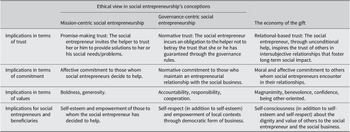
In this sense, Ricoeur’s (Reference Ricoeur1992, Reference Ricoeur2005) ethical approach is never complete but is always to be pursued through generous relationships. In practice, the departure point for introducing a Ricoeurian logic of abundant care and generosity is a disposition to kindness by which social entrepreneurs make themselves available to others, accepting the responsibility of striving for the good of the other and creating win–win encounters. Efforts to implement Ricoeur’s economy of the gift can be found, for instance, in “55+,” a European social business recognized by Ashoka as a leading work solution for people over the age of 55. Its main ethical approach exemplifies the notion of benevolence and generosity as postulated by Ricoeur; its core tenet entails the provision of complimentary services to customers, encompassing preparation, counsel, guidance, and emotional and mental support, particularly in the transition to a new phase in life for many after the age of 55, without an a priori expectation of any return. In the medium and long term, however, the introduction of Ricoeur’s notion of economy of the gift into SE may bring important benefits beyond the goodness that is done by the benevolent action. Remarkably, the notion of unconditional giving reveals concrete ways to promote important human qualities among those involved in the social business, nurturing a spirit of generosity that may spark the kind of commitment typically assumed in current conceptualizations of the ethics of SE (Ranville & Barros, Reference Ranville and Barros2022). For instance, contrary to the norm-based trust or promise-making trust typical of governance- and mission-centric conceptualizations of SE (Bruder, Reference Bruder2021; Ranville & Barros, Reference Ranville and Barros2022), Ricoeur’s logic of unconditional giving allows relationship-based trust to grow, which enables a kind of friendship and cooperation that benefit stronger commitments to flourish (see Table 2).
Predominant outcomes of a Ricoeurian interpretation of the economy of the gift and the ethical understanding in social entrepreneurship’s conceptions

Table 2. Long description
The table has four columns and five rows. The first column lists implications: trust, commitment, values, and outcomes for social entrepreneurs and beneficiaries. The second column, Mission-centric social entrepreneurship, describes promise-making trust, affective commitment, boldness and generosity, and self-esteem and empowerment for those helped. The third column, Governance-centric social entrepreneurship, details normative trust, normative commitment, accountability, responsibility, cooperation, and self-respect and empowerment of local contexts through democratic business. The fourth column, Economy of the Gift, presents relational-based trust, moral and affective commitment, magnanimity, benevolence, confidence, being other-oriented, and self-consciousness about the dignity and value of others.
Acting under a logic of abundant care may also promote noble values that can be incorporated into business culture (Deslandes, Reference Deslandes2012). These substantive goods, while not in tension with the organizational benefits (e.g., profitability, legitimate self-interest, accountability), have positive repercussions for a more responsible and humane development within and outside the social business, encouraging not only self-esteem and self-respect but also a greater self-conscience about the value of the other. Doko Recyclers, a social enterprise in Kathmandu, Nepal, described in Spanuth and Urbano’s (Reference Spanuth and Urbano2025) study, exemplifies this view in what may be considered an additional practical application of Ricoeur’s economy of the gift. Through inclusive governance and a commitment to giving, it legitimizes marginalized waste collectors not by charity but through ethical relationships based on care and recognition.
Indeed, social entrepreneurs’ benevolent giving may help people grow in confidence, enabling them to be involved in multidisciplinary collaborations that can transform societal roles from passive recipients to active contributors. In this context, moral imagination, genuine communication in relationships, and abundant generosity, as Ricoeur’s framework suggests, become intermingled, enabling the creation of a virtuous circle that is relevant to value the ethicality of social entrepreneurs and for social enterprises to thrive.
Conclusion, limitations, and further research
In this article, we have advanced the academic debate around how to understand ethics in the SE field by using Ricoeur’s (Reference Ricoeur1992, Reference Ricoeur1995a, Reference Ricoeur and Wallace1995b) notion of the economy of the gift as a framework. The main contribution to the SE field lies in providing an ethical approach in which the search for the good and the right are seen as complementary and mutual enriching, through the lens of the abundant generosity that social entrepreneurs may demonstrate in their daily encounters with others. In this sense, Ricoeur’s (Reference Ricoeur1992, Reference Ricoeur2020) view of the economy of the gift can help us understand social business as a network of benevolent relationships, where social entrepreneurs are called to be wholly other-oriented. It also opens new possibilities to conceptualize mission and governance as mutually reinforcing dimensions of a morally attuned social enterprise. Indeed, Ricoeur’s ethical framework allows us to interpret the social mission as a shared pursuit of the common good, and invites us to reimagine governance arrangements as moral practices grounded in mutual trust, attentiveness to fragility, and interpretive responsibility. This perspective moves beyond any reduction of governance to instrumental management or idealized democratic participation, and instead inspires governance configurations that foreground relational accountability, participatory discernment, and the recognition of ethical complexity in everyday decision-making.
However, some limitations accompany our proposal and critiques to Ricoeur’s (Reference Ricoeur1992, Reference Ricoeur1995a, Reference Ricoeur and Wallace1995b) application to SE may arise. For instance, some critics may argue that acting generously in relationships leads, somehow, to “bracket” all ethical questions by just acting generously, under the assumption that all relationships are good, regardless of abusive or oppressive parties that might participate in some of them. While this interpretation offers an intriguing perspective, it appears challenging to reconcile it fully with Ricoeur’s broader ethical project. Ricoeur’s relational framework emphasizes the exercise of generosity within the ethical aim of pursuing “the good life with and for others, in just institutions” (1992, p. 172). In this sense, Ricoeur’s generosity is not assumed as blind or unconditional; rather, it implies critical discernment in relationships—considering fair structures and the nature of the intentions.
Ricoeur’s emphasis on acting generously in relationships may, however, arise other problems. Specifically, although the notion of giving without expectations, as posited by Ricoeur’s (Reference Ricoeur1995a, Reference Ricoeur and Wallace1995b) economy of the gift, may be suggestive of a philosophical standpoint, it might still be criticized for not providing a clear practical guide that can be readily applied. For instance, it might offer limited practical guidance to social entrepreneurs who, despite pursuing an application of Ricoeur’s generous relationships, face conflicts of interest among their stakeholders. Difficulties may also arise as the social business grows and relationships attenuate while more bureaucratic structures replace direct interactions (Jäger, Reference Jäger2010; Ometto et al., Reference Ometto, Gegenhuber, Winter and Greenwood2019).
In this context, moral conflicts may continue to exist as well as situations where there is not a clear ethical answer. Thus, Ricoeur’s framework may be disapproved because it lacks specific guidance for addressing complex operational dilemmas in SE. However, even if not as clear as prescriptive and deontological ethical principles, Ricoeur’s (Reference Ricoeur1992, Reference Ricoeur and Pellauer2000, Reference Ricoeur2020) approach encourages reflective decision-making and, from this perspective, can help social entrepreneurs articulate their moral commitments, framing their work as relational and facilitating forgiveness, such that the recovery of confidence after conflictive situations becomes easier. Moreover, Ricoeur (Reference Ricoeur1992, Reference Ricoeur and Pellauer2000) has proposed integrating the gift into just institutions, which may inspire to value the ethics of SE not in terms of short-term interventions but with a focus on those structures that might help to institutionalize generosity, equity, and justice.
In sum, Ricoeurian philosophical and ethical ideas are not implacable for a practical field as SE. Inviting philosophy to engage with organizational practical interventions may require multiple conversations among practitioners and academics from different disciplines (Müller et al., Reference Müller, Vaseková and Kročil2024), potentially leading to the emergence of a different discourse on ethics. In this sense, we acknowledge that much work is needed. Clearly, Ricoeur’s framework cannot be considered a complete roadmap but a critical ethical lens for continue navigating the complexities of SE. Our aim here has been to open this door by rethinking the possible new horizons in the study of SE from an ethical perspective; however, this is only a first step that requires further development. Indeed, limitations in the scope of this article have prevent us to complement Ricoeur’s economy of the gift with other ethical frameworks, but we encourage future studies to work in this line, for instance, introducing more pragmatic approaches so that his ideas and ideals become easier to apply by social entrepreneurs. Moreover, empirical works might also advance this research by testing, for example, how Ricoeur’s approach contributes to social businesses’ performance and reputation. Studies that consider the Ricoeurian notion of generosity in the context of different types of social enterprises may also result in significant discussions. Finally, it might be interesting to study the political dimension of ethics in this field, considering whether (and how) social entrepreneurs’ behaviors become ethics (good, right, and generous) not only in the context of the social business’ mission, governance or social entrepreneurs’ personal encounters, but also at large for the societies in which they live.
Competing interests
The authors declare that they have no conflict of interest.
Acknowledgements
We would like to express our gratitude to the editors and the three anonymous reviewers for their valuable feedback and guidance throughout the review process. Nuria Toledano acknowledges financial support from the Spanish Ministry of Science and Innovation (Grant PID2022-141777NB-I00). Open access funding was provided by Universidad de Huelva / CBUA.


 Open access

