





Introduction
Parties routinely court voters with promises aimed at specific social groups.Footnote 1 During the 2025 electoral campaign in Germany, the Greens promised to maintain the extended child sickness leave rights introduced during the COVID-19 pandemic, initially designed as a temporary measure. The center-left SPD proposed lengthening parental leave from 14 to 18 months, while the Christian Democratic Union and its Bavarian sister party, the Christian Social Union (CDU/CSU), pledged not to cut pensions for citizens who have worked their whole lives or raised children, appealing to long-time contributors and parents, and to increase the commuter allowance, a measure particularly relevant to rural residents. Such appeals have proliferated across democracies, echoing a broader shift from broad-programmatic linkages to narrower, group–party linkages (Häusermann, Picot, and Geering Reference Häusermann, Picot and Geering2013; Thau Reference Thau2019; Horn, Kevins, Jensen et al. Reference Horn, Kevins, Jensen and van Kersbergen2021; Huber Reference Huber2022; Stuckelberger and Tresch Reference Stuckelberger and Tresch2022; Gahn Reference Gahn2024).
However, we know less about how voters respond to targeted promises – whether they genuinely appreciate the benefits tailored to their groups, and whether this appreciation translates into increased electoral support. While social group affiliation correlates with party choice (Bornschier, Häusermann, Zollinger et al. Reference Bornschier, Häusermann, Zollinger and Colombo2021), we ignore to a large extent whether targeted proposals play a role in producing these alignments, and more generally, whether they bring greater electoral rewards than non-targeted promises. Early experiments largely manipulated symbolic cues (merely naming a group) while holding policy content constant. These studies yield a mixed pattern. Campaign appeals to women boost support among some female voters (Kam, Archer, and Geer Reference Kam, Archer and Geer2017); class cues mobilize working-class citizens in both the United States and Denmark (Robison, Stubager, Thau et al. Reference Robison, Stubager, Thau and Tilley2021; see also Thau Reference Thau2021 on the UK); and place-based rhetoric lifts backing among rural voters in Germany (Haffert, Palmtag, and Schraff Reference Haffert, Palmtag and Schraff2024). A recent study by Dassonneville, Stubager, and Thau (Reference Dassonneville, Stubager and Thau2025) in the UK also finds that group appeals targeting various social categories (such as class, region, education, age, gender, and ethnicity) influence candidate support. But other studies detect little or no rewards for targeted appeals: Hersh and Schaffner (Reference Hersh and Schaffner2013) show that claiming to stand for a group does not increase support even among beneficiaries, and Robison, Stubager, Thau et al. (Reference Robison, Stubager, Thau and Tilley2021) and Haffert, Palmtag, and Schraff (Reference Haffert, Palmtag and Schraff2024) also find no payoff for, respectively, middle-class and urban voters. As Hersh and Schaffner (Reference Hersh and Schaffner2013: 532) warn, the vagueness and lack of policy implications of such cues may dampen reactions. Only a handful of recent studies isolate the effects of substantive group-targeted pledges, and these are typically confined to single groups (e.g., Elinder, Jordahl, and Poutvaara Reference Elinder, Jordahl and Poutvaara2015; Holman, Schneider, and Pondel Reference Holman, Schneider and Pondel2015; Robison et al. Reference Robison, Stubager, Thau and Tilley2021; Finseraas, Heath, Langsaether et al. Reference Finseraas, Heath, Langsæther and Smets2026).
Emerging evidence also highlights potential costs to group-targeted appeals. First, some initial findings suggest that highly tailored messages – compared to less-tailored ones – can provoke backlash even among the targeted groups themselves (Gahn Reference Gahn2024). Second, non-beneficiaries may react negatively when they perceive favoritism or status threat. For example, US candidates tend to tread carefully when courting racial minorities (Nteta and Schaffner Reference Nteta and Schaffner2013); pro-women ads dampen support among certain male independents (see Kam, Archer, and Geer Reference Kam, Archer and Geer2017, but also Holman, Schneider, and Pondel Reference Holman, Schneider and Pondel2015, for contradictory evidence); and White Democrats react negatively when Democratic outreach to Latinos is salient (Ostfeld Reference Ostfeld2019). Third, Thau (Reference Thau2024) finds that Labour benefited electorally from downplaying its symbolic ties to the working class, suggesting that renouncing a strong group focus can be rewarding, particularly outside the party’s traditional base.
Considered jointly, these findings suggest that targeted messages may produce asymmetric effects – mobilizing some voters while repelling others – though the strength and scope of such trade-offs remain underexplored. Backlash is documented almost exclusively for appeals to minority groups, with regard to whom status-threat mechanisms are most plausible. Much less is known about reactions when benefits target socially accepted or majoritarian groups, such as parents or pensioners – arguably the scenarios most frequently encountered in European campaigns. Detecting backlash in such cases would provide stronger theoretical support for the claim that targeting entails electoral risks. Last but not least, recent studies suggest that ingroup and outgroup reactions hinge on psychological moderators: group identity (Dassonneville, Stubager, and Thau, Reference Dassonneville, Stubager and Thau2025), affect toward the target group (Huber, Meyer, and Wagner Reference Huber, Meyer and Wagner2024), and perceptions of group boundaries, conflict, and status asymmetries (Thau Reference Thau2021; Haffert, Palmtag, and Schraff Reference Haffert, Palmtag and Schraff2024). Yet, few contributions integrate these factors, and none examine their joint influence on vote intentions compared to a genuinely universalistic benefit.
In a nutshell, we need more evidence on the electoral effects of targeted policy promises, accounting for the reactions of voters beyond the group of beneficiaries so as to grasp the net electoral calculus and the extent to which promises directed at a specific group pay off. This paper contributes to this research agenda with a preregistered survey experiment fielded in Germany in 2024 (N = 3,500). Respondents evaluate fictional campaign posters that all promise additional public spending either benefiting the general population (broad-based pledge) or directed exclusively at parents, pensioners, or rural residents (group-targeted pledges). We then measure their vote intention for the promising party in response.
The design allows us to (1) compare how voters respond to spending pledges with benefits diffused across the population versus those targeting a specific group and (2) examine how group membership, identification, and deservingness perceptions jointly shape these voter responses in a multiparty context. This allows us to shed new light on whether ‘going narrow’ outperforms ‘going broad’, or whether they risk alienating voters outside the target group.
Our results show no consistent evidence that group-targeted pledges generate greater electoral support than a broad-based alternative. While reactions among intended beneficiaries tend to be neutral or even mildly negative, vote intention declines more clearly among respondents who are not part of the targeted group or who view the group as undeserving. These patterns suggest that the net electoral effect of targeting is shaped less by ingroup mobilization than by exclusion-driven losses, and that membership, identity, and group affect moderate how voters respond to policy promises. Additional analyses accounting for differences in perceived issue importance across policy domains produce consistent results. This suggests that the absence of strong electoral benefits from targeting cannot be explained simply by varying interest in or importance attached to the specific policy areas addressed. Taken together, the findings suggest that in an age of fractured identities and politicized group boundaries, the electoral costs of targeting may often outweigh the benefits.
Argument
We expect group-targeted pledges to elicit more polarized voter reactions than broad-based pledges. Targeted benefits could be easier to notice than the more diffuse effects of universalistic pledges (Wilson Reference Wilson1973; Skocpol Reference Skocpol, Christopher and Paul1991), much as concentrating burdens, as Pierson (Reference Pierson1994) shows, provokes stronger resistance than diffusing them. Because they single out specific beneficiaries, such promises sharpen the perceived stakes of electoral competition and increase the salience of group-based distributive conflicts. While parties may hope to mobilize voters who stand to benefit, they also risk alienating voters who feel excluded or oppose the allocation of benefits to specific groups. We build on three theoretical mechanisms to conceptualize these reactions: self-interest, group identification, and perceptions of deservingness.
First, group-targeted pledges may prompt what the retrospective voting literature refers to as pocketbook reactions, whereby voters reward parties that promise benefits for themselves (Downs Reference Downs1957; Bechtel and Hainmueller Reference Bechtel and Hainmueller2011; Zucco Reference Zucco2013; Elinder, Jordahl, and Poutvaara Reference Elinder, Jordahl and Poutvaara2015; Holman, Schneider, and Pondel Reference Holman, Schneider and Pondel2015; Artés, García-Viñuela, Salas-Olmedo et al. Reference Artés, García-Viñuela, Salas-Olmedo and Vázquez-Carrero2022). When applied to prospective voting, this logic suggests that voters who belong to the group targeted by a pledge are more likely to support the party making that promise. However, this effect presupposes that voters recognize themselves as members of the target group and expect to benefit – a cognitive and motivational process that should not be taken for granted. Empirical evidence for pocketbook voting is mixed (Lewis-Beck and Stegmaier Reference Lewis-Beck and Stegmaier2000) and likely depends on individual awareness and issue salience.
Second, responses to targeted promises may depend on subjective group identification. According to social identity theory, individuals do not automatically identify with all social groups to which they objectively belong (Tajfel and Turner Reference Tajfel, Turner, Worchel and Austin1979; Turner Reference Turner1991). Identification entails a sense of belonging and self-categorization that makes group interests more salient and motivates political behavior (Huddy Reference Huddy, Huddy, Sears and Levy2013; Bornschier, Häusermann, Zollinger et al. Reference Bornschier, Häusermann, Zollinger and Colombo2021). As a result, individuals who are objectively part of a group targeted by a policy pledge may remain unresponsive if they do not subjectively identify with that group. By contrast, those who do identify are more likely to perceive the appeal as personally relevant and respond favorably (Conover Reference Conover1988). Identification is thus likely to act as a filter that conditions whether targeting mobilizes support, even among potential beneficiaries. Conversely, targeted appeals may provoke indifference or even suspicion among individuals who do not feel a connection to the group in question, regardless of their formal eligibility.
Third, voters may evaluate targeted pledges based on their perceptions of the deservingness of the beneficiary group. Decades of research in social policy and political behavior show that voters draw on normative heuristics about who should receive support and why (van Oorschot Reference van Oorschot2000; Appelbaum Reference Appelbaum2001; Cavaillé and Trump Reference Cavaillé and Trump2015; Goerres, Karlsen, and Kumlin Reference Goerres, Karlsen and Kumlin2020). These perceptions are structured by group stereotypes and social constructions of worthiness, based on criteria such as need, control, identity, and reciprocity (Schneider and Ingram Reference Schneider and Ingram1993; Coughlin Reference Coughlin1980; Blekesaune and Quadagno Reference Blekesaune and Quadagno2003; Petersen Reference Petersen2012; Reeskens and van der Meer Reference Reeskens and van der Meer2019). On average, groups like pensioners and parents are perceived as more deserving, whereas groups such as immigrants or the unemployed tend to elicit lower deservingness ratings. However, these perceptions are not uniform: individuals vary considerably in the deservingness they attribute to different groups (Deiss-Helbig, Guinaudeau, and Matthieß Reference Deiss-Helbig, Guinaudeau and Matthieß2026). Such judgments can shape electoral responses even among non-beneficiaries. Voters may reward parties for pledges directed at groups they view as deserving, but penalize them for promises that benefit groups they consider undeserving (see Huber, Meyer, and Wagner Reference Huber, Meyer and Wagner2024 for a similar argumentFootnote 2 ).
Taken together, these mechanisms predict conditional responses to group-directed pledges. Targeting may increase support among voters who expect to benefit, who identify with the group, or who view it as deserving. But it may also provoke backlash among voters who feel excluded or perceive the group as undeserving (Hersh and Schaffner Reference Hersh and Schaffner2013; Nteta and Schaffner Reference Nteta and Schaffner2013; Kam, Archer, and Geer Reference Kam, Archer and Geer2017; Huber, Meyer, and Wagner Reference Huber, Meyer and Wagner2024). Importantly, we argue that targeting does not merely change the content of a pledge, but also its visibility and representational meaning. By promising benefits for a group, parties claim to represent that group (Saward Reference Saward2006), inviting reactions not only from those included but also from those left out. To test these propositions, we examine whether reactions to group-directed versus broad-based campaign promises are moderated by:
-
1. objective group membership,
-
2. subjective group identification,
-
3. perceived deservingness of the group.
We develop and test six preregistered hypotheses that correspond to these mechanisms.
Preregistered hypotheses
Compared to those exposed to a broad-based pledge, citizens exposed to a group-directed pledge tend to show more support for a pledge-making party when the pledge targets:
H1a a group they are a member of,
H2a a group in which they categorize themselves, or
H3a a group they perceive as deserving.
Compared to those exposed to a broad-based pledge, citizens exposed to a group-directed pledge tend to show less support when the pledge targets:
H1b a group they are not a member of,
H2b a group in which they do not categorize themselves, or
H3b a group they perceive as undeserving.
See OSF preregistration for full wording.
Research design
Case selection and data collection
We investigate how voters respond to electoral promises that benefit specific social groups compared to those that benefit the population at large. Germany provides a relevant and broadly representative case for such an inquiry. As a parliamentary democracy with a proportional electoral system, multi-party competition, and coalition governments, it shares key features with many other advanced democracies. German parties regularly issue targeted appeals to specific constituencies alongside broad-based promises. Moreover, moderate levels of political polarization and the continued relevance of programmatic competition make Germany a suitable setting for studying the effects of targeted pledges in a context that is neither highly polarized nor entirely candidate-centered. These characteristics allow insights from Germany to inform our understanding of targeted campaign appeals in other multi-party systems.
Our analysis draws on a large-scale experiment embedded in an original online survey conducted between 25 January and 8 February 2024. The sample of 3,500 respondents was drawn by the survey company Bilendi and is quota-representative of the German electorate in terms of age, gender, region, and education.Footnote 3 Respondents were recruited from Bilendi’s panel and compensated based on the length of the questionnaire. All responses were collected from eligible German citizens aged 18 or older.
Experimental design
We implemented a randomized vignette experiment to examine how voters prospectively evaluate group-targeted versus broad-based campaign pledges. Respondents were randomly assigned to one of four conditions that differ in the group addressed by a fictional electoral promise.
The experiment builds on existing research on campaign targeting in the US context (Hersh and Schaffner Reference Hersh and Schaffner2013), but uses policy pledges – rather than rhetorical appeals – presented as stylized campaign posters mirroring real electoral materials, thereby enhancing external validity.
All respondents first read a short introductory text setting the scene for a hypothetical federal election. They were told that several parties (A, B, C, and D) were competitive, and that the next screen would show a campaign poster from Party A. Respondents were then randomly shown one of four posters presenting Party A’s core campaign promise. The posters varied only in the beneficiary of the pledge: either a broad-based pledge to improve healthcare (control condition) or a group-targeted pledge benefiting (1) rural residents, (2) parents, or (3) pensioners (treatment conditions Ta–Tc).Footnote 4 The pledges were made as similar as possible by adhering to a common format focused on increasing public spending, in order to avoid biases linked to reactions to specific policy instruments. Since different social groups are affected by different types of policies, the pledges necessarily differ in their policy domain. It would make little sense to promise pensions to families or child benefits to rural residents. Our aim was therefore not to construct artificial, interchangeable pledges, but to approximate how realistic policy appeals operate in practice while keeping their format, framing, and fiscal logic consistent. All four pledges involve higher public expenditure rather than tax cuts, regulatory changes, or symbolic recognitions, ensuring a comparable distributive structure across treatments. To address concerns that respondents might react primarily to policy domains rather than to group targeting, we conduct robustness analyses showing that our results hold when accounting for differences in issue importance across policy areas.
We selected the three target groups based on two main criteria. First, their size ensures sufficient statistical power to detect group membership and group identity effects. Second, these groups tend to elicit varied voter responses without triggering strong partisan associations. In the German context, they are perceived as differently deserving, but not in ways that are sharply polarized along ideological lines. Deiss-Helbig, Guinaudeau, and Matthieß (Reference Deiss-Helbig, Guinaudeau and Matthieß2026) show that the standard deviation of perceived deservingness for our groups is comparable to that of other frequently studied groups, such as the poor, unemployed, employers, and women. However, targeting groups like women or the poor can more readily activate partisan cues, as such pledges often align with specific parties (left-leaning parties in these cases). By contrast, our selected groups – parents, rural residents, and pensioners – are routinely addressed by parties across the ideological spectrum and not strongly associated with any of them (Deiss-Helbig, Guinaudeau and Matthieß et al. Reference Deiss-Helbig, Guinaudeau, Matthieß and Rentrop2024). This makes them comparatively uncontroversial cases where parties could, in principle, hope to mobilize support without incurring strong negative reactions.
For the broad-based pledge, we selected a promise to allocate more resources to improve the healthcare system. In Germany, this issue is not unusually salient – healthcare has not ranked among the most prominent political concerns in recent decades.Footnote 5 However, it has universal relevance, as healthcare affects all individuals when they fall ill. Our manipulation checks (see below) confirm that this pledge is perceived as universalistic, with no single group seen as its exclusive beneficiary.
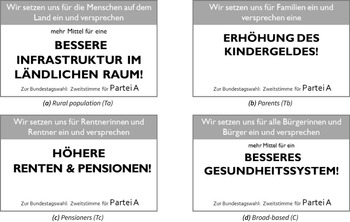
Figure 1 displays the campaign materials shown to respondents. The posters were shown in German; the English translations below reflect the original wording.
‘We stand up for …
• … people in rural areas and promise more resources for improved infrastructure in rural areas! (Ta)
• … families and promise an increase in child benefits! (Tb)
• … pensioners and promise an increase in retirement benefits and pensions! (Tc)
• … all citizens and promise more resources for a better healthcare system! (C)
At the federal election: Second vote for Party A’.
Posters with election pledges.
Note: Posters are shown to respondents in German. English translations are provided in the main text.
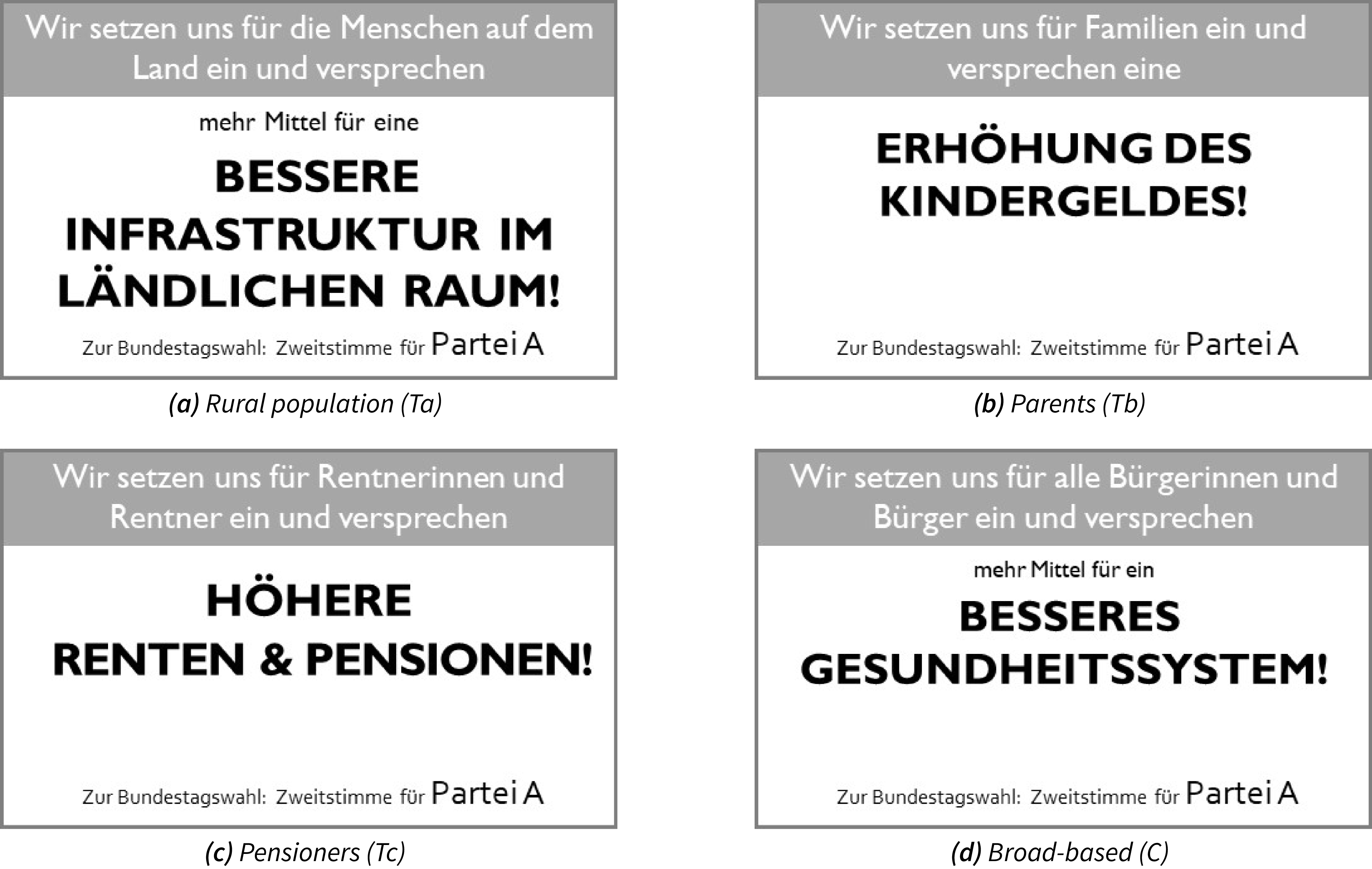
The experiment varies the target group addressed by otherwise comparable spending pledges, allowing us to assess how voters respond to realistic forms of group-targeting while keeping the general format and distributive logic as consistent as possible.
To assess whether respondents perceived the treatment as intended, we included two manipulation checks, presented in the Appendix. First, immediately after viewing the campaign poster, respondents answered an open-ended question: ‘Who do you think primarily benefits from Party A’s promise?’ Figure A2 shows that most respondents correctly identified the target group, particularly for the child care and pension pledges. Misidentifications were more frequent in the rural and control conditions but remained limited overall.
Second, respondents indicated how personally affected they felt by the pledge, using a 7-point scale from 1 (‘very negatively affected’) through 4 (‘not affected’) to 7 (‘very positively affected’). Table A4 summarizes the distribution of responses by condition. Consistent with our expectations, the control pledge on healthcare is perceived as broadly beneficial: three-quarters of respondents report feeling positively affected. As Figures A4–A6 in the Appendix show, this pattern holds across subgroups defined by health status and age as well as the groups considered in our study (i.e., parents, rural residents, and pensioners). Associations between perceived affectedness and respondents’ self-reported health condition or age (measured based on Spearman’s rank correlation coefficients) are statistically significant but weak, suggesting that these factors account for little variation in reactions to the pledge. Similarly, non-parametric comparisons between parents and non-parents, pensioners and non-pensioners, and rural and non-rural residents reveal no significant differences in perceived affectedness. This reinforces that the healthcare pledge is broadly perceived as beneficial, and does not subjectively overaffect certain segments of people. In contrast, and as expected, the targeted pledges elicit more polarized reactions. Large proportions of respondents, especially in the parents’ and pensioners’ conditions, report feeling unaffected or even negatively affected. Figure A3 further shows how perceived affectedness varied by whether respondents were part of the intended target group. As expected, those in the target group were more likely to report stronger personal benefit. However, the distributions also indicate that a non-negligible share of untargeted respondents perceived the pledge as relevant to them, underscoring the blurred boundaries of self-identification.
To operationalize our outcome variable, we use respondents’ propensity to vote (PTV) for the pledging party, measured on a 7-point scale ranging from 1 (‘very unlikely’) to 7 (‘very likely’), based on the question: ‘On a scale from 1 to 7, how likely are you to vote for this party?’
We test the impact of the hypothesized moderating variables – group membership, group identification, and perceived deservingness of the targeted group – using several items administered at the very beginning of the questionnaire, well before the experiment, to minimize potential priming effects (Heath, Smith, Gilby et al. Reference Heath, Smith, Gilby and Hoolahan2015). The item batteries for group identification and perceived deservingness included eleven additional groups, and item order was randomized. Group membership (H1a, H1b) is measured as a binary variable based on respondents’ socio-demographic characteristics, identifying membership in the group of rural residents, parents, and pensioners. The exact wording of the questions used to identify these groups is provided in Table A2 in the Appendix.
Group identification (H2a, H2b) is measured by asking respondents the extent to which they feel part of various social groups – among others pensioners, rural residents, and parents. Specifically, we ask: ‘We all have different ideas about which social groups make up our society, and we can each belong to several such groups. To what extent do you feel you belong—or do not belong—to the following groups?’ (response options: not at all belonging; rather not belonging; rather belonging; very much belonging; don’t know). For the analysis, we recode responses into a binary indicator. This item captures the self-categorization dimension of social identity – the minimal condition for perceiving a group appeal as personally relevant – rather than affective attachment or pride.Footnote 6
Finally, perceived deservingness (H3a, H3b) is assessed by asking whether respondents believe the government should take the needs of various social groups (inter alia pensioners, rural residents, and parents) more, less, or equally into account.Footnote
7
Responses were given on an eleven-point scale ranging from −5 = ‘much less’ to +5 = ‘much more’. For the analyses, we recode them into a binary variable distinguishing whether respondents deemed each group ‘deserving’ (scores $\! \gt 0$
) or ‘not deserving’ (scores
$\! \gt 0$
) or ‘not deserving’ (scores $\! \le 0$
) on the original −5 to +5 scale. While deservingness is often measured through items capturing concern for the living conditions of specific groups (e.g., van Oorschot Reference van Oorschot2000), our operationalization focuses more closely on the priority or entitlement dimension – namely, whether respondents believe a group should receive greater or lesser governmental consideration than it currently does. This formulation acknowledges that people may feel concerned about certain groups without necessarily thinking that the government ought to do more for them. In this respect, our measure differs from indicators of group affinity (Robison and Moskowitz Reference Robison and Moskowitz2019; Bornschier, Häusermann, Zollinger et al. Reference Bornschier, Häusermann, Zollinger and Colombo2021) or concrete policy support (Kootstra Reference Kootstra2016; Bell Reference Bell2021), which capture related but distinct dimensions. It thus provides a direct and interpretable gauge of whether a group is viewed as meriting additional policy attention, aligning with the ‘should receive more support’ notion in the deservingness literature (Meuleman, Roosma, and van Oorschot Reference Meuleman, Roosma, van Oorschot, van Oorschot, Roosma, Meuleman and Reeskens2017).
$\! \le 0$
) on the original −5 to +5 scale. While deservingness is often measured through items capturing concern for the living conditions of specific groups (e.g., van Oorschot Reference van Oorschot2000), our operationalization focuses more closely on the priority or entitlement dimension – namely, whether respondents believe a group should receive greater or lesser governmental consideration than it currently does. This formulation acknowledges that people may feel concerned about certain groups without necessarily thinking that the government ought to do more for them. In this respect, our measure differs from indicators of group affinity (Robison and Moskowitz Reference Robison and Moskowitz2019; Bornschier, Häusermann, Zollinger et al. Reference Bornschier, Häusermann, Zollinger and Colombo2021) or concrete policy support (Kootstra Reference Kootstra2016; Bell Reference Bell2021), which capture related but distinct dimensions. It thus provides a direct and interpretable gauge of whether a group is viewed as meriting additional policy attention, aligning with the ‘should receive more support’ notion in the deservingness literature (Meuleman, Roosma, and van Oorschot Reference Meuleman, Roosma, van Oorschot, van Oorschot, Roosma, Meuleman and Reeskens2017).
Our experimental design deliberately balances realism and control to examine the effects of group-targeted versus universalistic campaign promises. By using mock campaign posters, we simulate realistic campaign exposure – enhancing external validity – while maintaining substantial control over pledge format – crucial for internal validity. An alternative design using real party pledges from a recent election might have increased external validity further, but at the cost of internal validity. Different groups are offered policies that vary in nature, design, and ambition: using these kinds of pledges would not have allowed us to vary the target group while holding other aspects of the pledges as constant as possible. Actual campaign pledges differ not only in their target audience but also in perceived substantive importance, public salience, budgetary implications, policy design, and media visibility. This makes it difficult to isolate the effects of group targeting from confounding reactions to these other attributes and, additionally, introduces the risk of ‘pretreatment’ (Druckman and Leeper Reference Druckman and Leeper2012), particularly for well-known pledges that respondents may have encountered prior to the study. Using pledges from real parties would also introduce potential confounds related to party identification or voters’ associations of specific parties with certain social groups, which are mitigated in our design by the use of a fictional ‘Party A’. Our experimental setting provides a controlled context for detecting positive reactions to group-targeted pledges: by removing partisan cues and external noise, it reduces potential confounds while enhancing the clarity of the stimuli by presenting the appeals in a clear, tangible form. We return to the implications of this methodological choice in the discussion section.
Findings
Main analyses
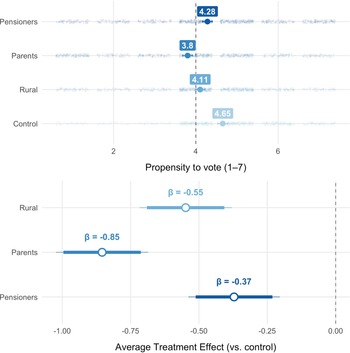
Figure 2 presents the average effects of group-targeted pledges on respondents’ vote intention, compared to the broad-based control condition. The upper panel shows the mean PTV for Party A in each treatment group, on a 7-point scale. Respondents exposed to the broad-based healthcare pledge report the highest level of vote intention (mean = 4.65), followed by those in the pensioners (4.28) and rural (4.11) treatment conditions. Support is notably lower in the parent condition (3.80). The lower panel displays average treatment effects (ATEs) relative to the control group, based on a linear model with the broad-based condition as reference. All three targeted conditions yield negative coefficients, indicating lower vote intention compared to the universalistic pledge. The negative effect is largest for the parent condition (b = −0.85), followed by rural (b = −0.55) and pensioners (b = −0.37). The confidence intervals suggest that these differences are statistically significant at conventional levels. These findings provide no evidence that group-targeted promises yield greater overall support for the pledging party than a broad-based appeal. On the contrary, targeted pledges appear to reduce average vote intention, even for target groups widely viewed as deserving, such as parents or pensioners. This motivates closer examination of whether these aggregate effects conceal heterogeneity across voters with different relationships to the targeted group.
Treatment effects of targeting.
Note: The upper panel shows raw sample means (dots) for each group. Colored bars represent 90% (thick line) and 95% (thin line) confidence intervals. The lower panel displays average treatment effects from a linear model with the control group as reference. Coefficients indicate the average difference in propensity to vote compared to the control condition (broad-based pledge).
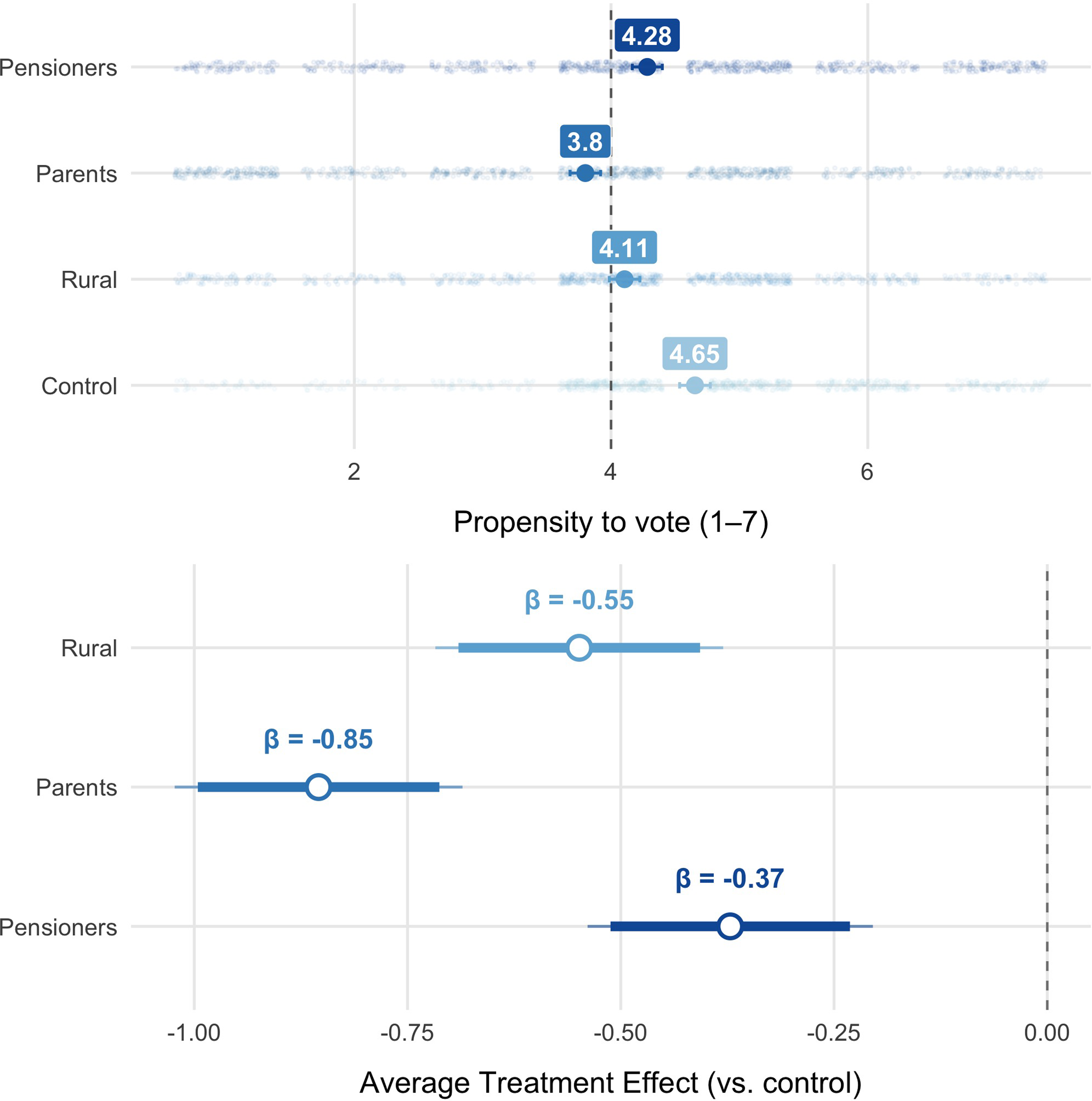
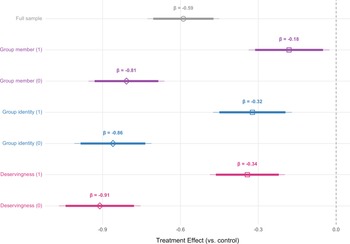
Figure 3 presents the test of our preregistered hypotheses (H1a–H3b), which concern average reactions to group-targeted versus broad-based pledges depending on respondents’ relationship to the targeted group. We estimate separate linear models to test whether support for the pledge-making party differs between targeted and broad-based conditions on average (in gray), and depending on objective group membership (purple), subjective group identification (blue), and perceived deservingness of the targeted group (pink). None of the three moderators significantly reverses the negative ATE. While the negative effects are attenuated among respondents aligned with the group, the coefficients for group members (b = −0.18), identifiers (b = −0.32), and those with positive deservingness assessments (b = −0.34) remain negative compared to the broad-based pledge. In other words, contrary to hypotheses H1a-H3a, targeted pledges do not lead to increased support even among those whom parties may hope to mobilize. This finding should be interpreted with some caution. The broad-based healthcare pledge may serve as an especially appealing baseline, which could limit the room for group-specific promises to generate additional electoral gains – even among likely beneficiaries. We explore this potential interpretation in robustness checks accounting for issue importance (see below).
Treatment effect of targeting, by subgroup.
Note: The figure displays average treatment effects from linear models comparing each subgroup exposed to a targeted pledge (rural, parent, or pensioner) to the control group (broad-based healthcare pledge). Subgroups are defined by group membership (purple), group identity (blue), or perceived deservingness (pink). For each concept, estimates are shown for respondents with the attribute (1, represented by a square) and without it (0, represented by a diamond). ‘Full sample’ (represented by a circle) represents the average treatment effect measured for all respondents exposed to a targeted pledge, regardless of subgroup status. Points indicate estimated effect sizes; colored bars represent 90% (thick) and 95% (thin) confidence intervals.
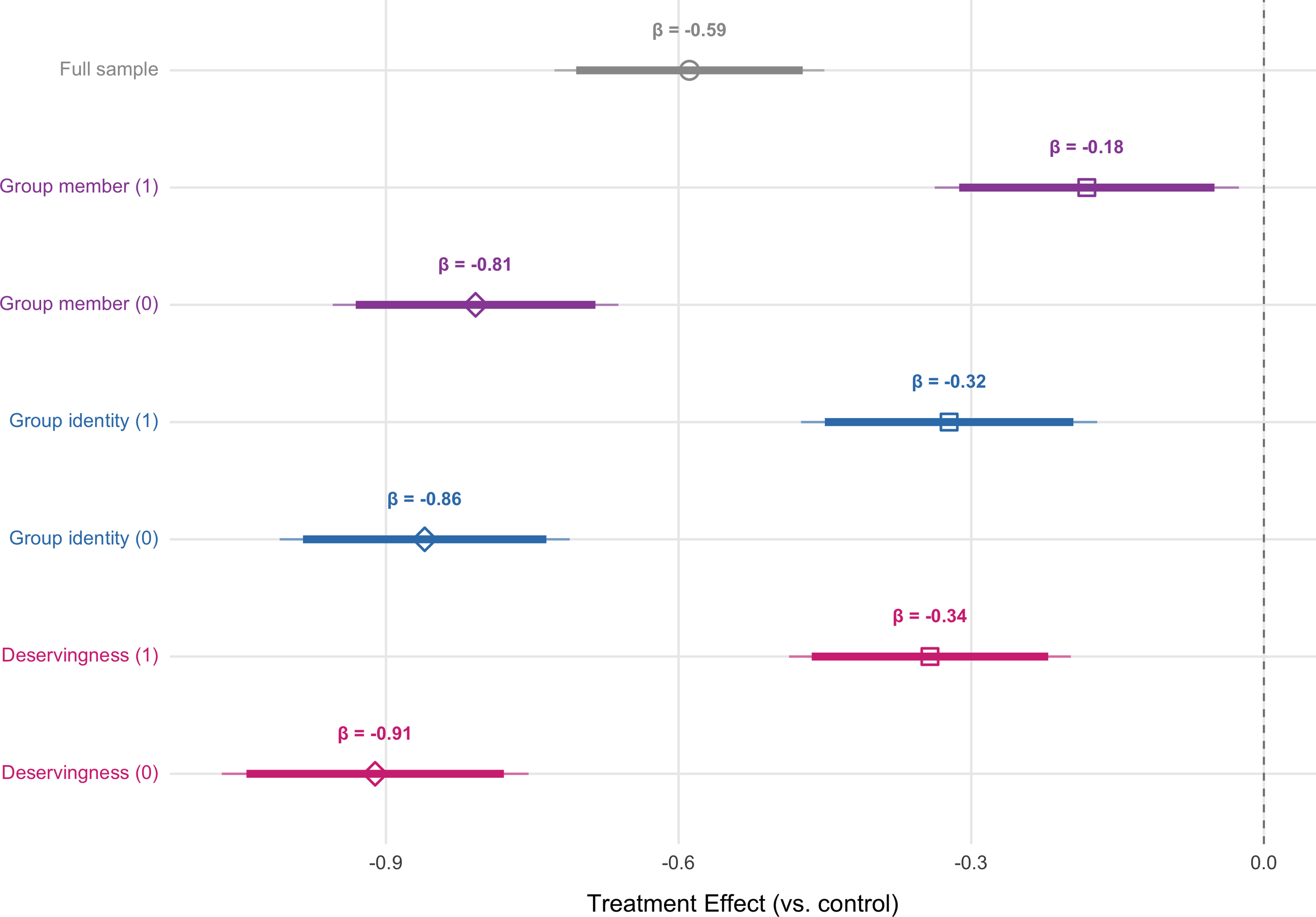
By contrast, hypotheses H1b–H3b find empirical support: targeted pledges significantly reduce the party’s appeal among voters who are not part of the targeted group, who do not identify with it, or who consider it undeserving. These voters report substantially lower vote intention for the pledge-making party. The estimated effects are substantial and statistically significant: b = −0.81 for nonmembers, b = −0.86 for non-identifiers, and b = −0.91 for respondents with low deservingness ratings. These results reveal an asymmetry: while the potential electoral benefits of targeting are limited compared to the broad-based condition – even among intended beneficiaries – the political costs among outgroup voters are more pronounced. These findings underscore the potential risks of targeting. When voters feel excluded or question the targeted group’s deservingness, targeted appeals may backfire.
Exploratory analyses
Disaggregated findings
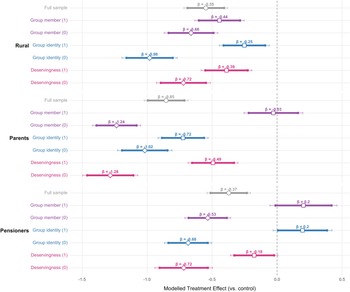
To complement this preregistered analysis, Figure 4 disaggregates the results by treatment, examining whether the same patterns of subgroup responses hold across the three targeted pledges. Based on several regression models, each panel (rural, parents, pensioners) shows estimated effects, relative to the broad-based healthcare pledge, for the full sample exposed to the respective treatment and for subgroups defined by group membership, group identity, and deservingness.
Treatment effect of targeting, by subgroup and treatment.
Note: The figure displays estimated treatment effects from linear models comparing each treatment condition (rural, parents, pensioners) to the broad-based control condition (healthcare), separately for each subgroup. Subgroups are defined by group membership (purple), group identity (blue), and perceived deservingness (pink) of the targeted group. For each concept, estimates are shown separately for respondents with the attribute (1, represented by a square) and without it (0, represented by a diamond). ‘Full sample’ (represented by a circle) refers to all respondents exposed to the respective targeted treatment, regardless of subgroup status. Points indicate estimated effect sizes; colored bars represent 90% (thick) and 95% (thin) confidence intervals.
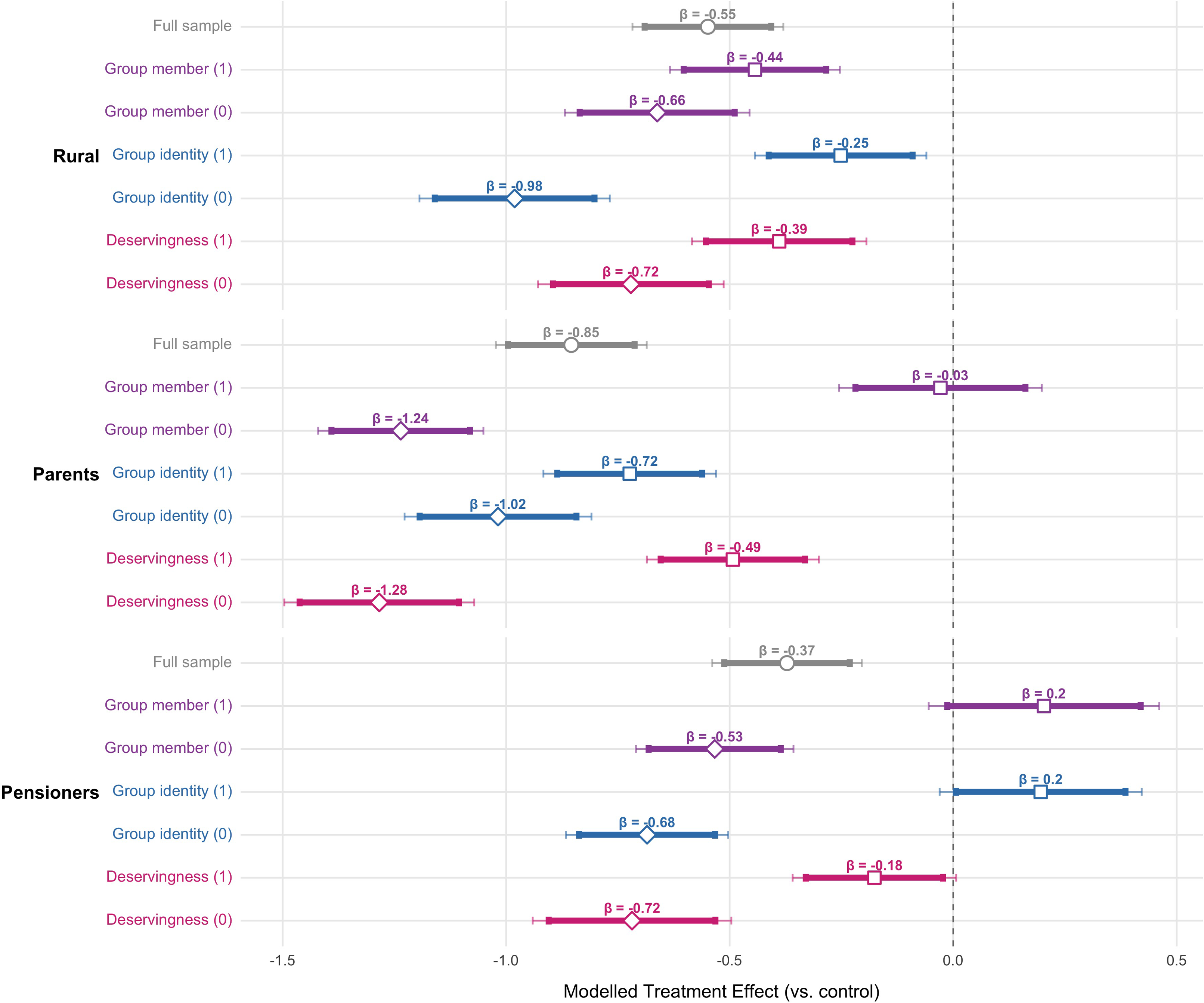
The results broadly confirm the general asymmetry observed in the pooled analysis. Compared to the broad-based pledge, targeted pledges do not elicit a stronger positive reaction among those aligned with the target group – interestingly, pensioners are the only group that comes close to giving a (small) bonus for targeted benefits. Among respondents within this group and exposed to the pension pledge, the estimated treatment effect is positive (b = 0.20), suggesting a modest substantive boost in vote intention relative to the universal healthcare pledge – an effect that does not, however, reach conventional levels of significance. The other two treatment conditions yield even weaker support for a positive ingroup response. Neither parents nor rural residents exhibit significantly higher vote intention in response to the respective pledge. Across both groups and all subgroup measures, the point estimates remain negative or close to zero, reinforcing the earlier conclusion that targeted benefits do not generate additional support among intended beneficiaries when compared to a broadly appealing universal policy.
All group-targeted pledges reveal gaps across subgroups defined by group membership, identification, and perceived deservingness, though the magnitude of these gaps varies by pledge. They are smallest for rural voters, substantial for pensioners, and most pronounced for parents – where non-beneficiaries exhibit particularly low levels of support. Interestingly, the gap based on subjective group identification is negligible for the parenting pledge but more evident for the rural and pensioner pledges. Similarly, deservingness-based heterogeneity is weakest for the rural pledge: the difference in vote intention between those who view rural residents as deserving and those who do not is small and statistically non-significant. This pattern may reflect the particular social construction of rurality as a beneficiary group. Building on findings by Haffert, Palmtag, and Schraff (Reference Haffert, Palmtag and Schraff2024), who show that non-rural respondents do not perceive territorial redistribution as zero-sum, rural targeting appears less likely to provoke resentment among outsiders than appeals to families or pensioners. At the same time, rural identity may be more politically salient and mobilized among rural residents than among urban residents, who lack a comparable counter-identity. This asymmetry may explain why we observe some favorable responses among rural identifiers but relatively muted backlash among non-rurals.
Similarly, the negative responses to the pension pledge among the non-pensioners remain limited, in line with observations that pensioners constitute a broadly supported policy constituency (van Oorschot Reference van Oorschot2000). It is also possible that most working-age voters can imagine joining the group in the foreseeable future and that the pledge is therefore not perceived as an irretrievable loss.
By contrast, the parenting pledge polarizes most sharply. Non-parents and respondents who deem parents undeserving exhibit strong backlash. Furthermore, subjective identification with the group does little to moderate the comparatively negative reactions: whether or not respondents see themselves as parents hardly moves the needle, suggesting that parental identity may be diffuse and weakly politicized. One tentative explanation is that child benefits are more likely to be perceived as selective and tied to private life choices, with limited relevance for those outside the group. Unlike pensions – which are often seen as earned entitlements and expected to benefit most people over the life course – family-targeted pledges may evoke sharper perceptions of exclusivity or zero-sum distribution. This pattern suggests that under conditions of contested deservingness, limited future self-interest, and diffuse group identity, targeted benefits may be less likely to trigger electoral support.
These disaggregated findings reinforce the core insight that group-targeted pledges do not necessarily generate substantial electoral gains compared to broad-based pledges, but can diminish support among outgroups. However, the extent of this negative effect depends on the specific group addressed and the normative resonance of the promise. This variation underscores the importance of political context and group-specific perceptions in shaping the electoral consequences of targeting.
‘Super ingroups’ vs. ‘super outgroups’
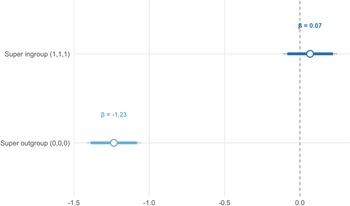
To gain additional leverage on how group targeting structures electoral responses, we contrast respondents located at the two extreme ends of the subgroup indicators. The ‘super ingroup’ includes individuals who simultaneously are members of the targeted group, identify with it, and perceive it as highly deserving (1,1,1); the ‘super outgroup’ comprises those who are neither members nor identifiers and who consider the group undeserving (0,0,0). Figure A10 in the Appendix shows that these two extreme constellations together account for roughly one third of the respondents in each treatment, with the rest falling into neither ‘super group’.
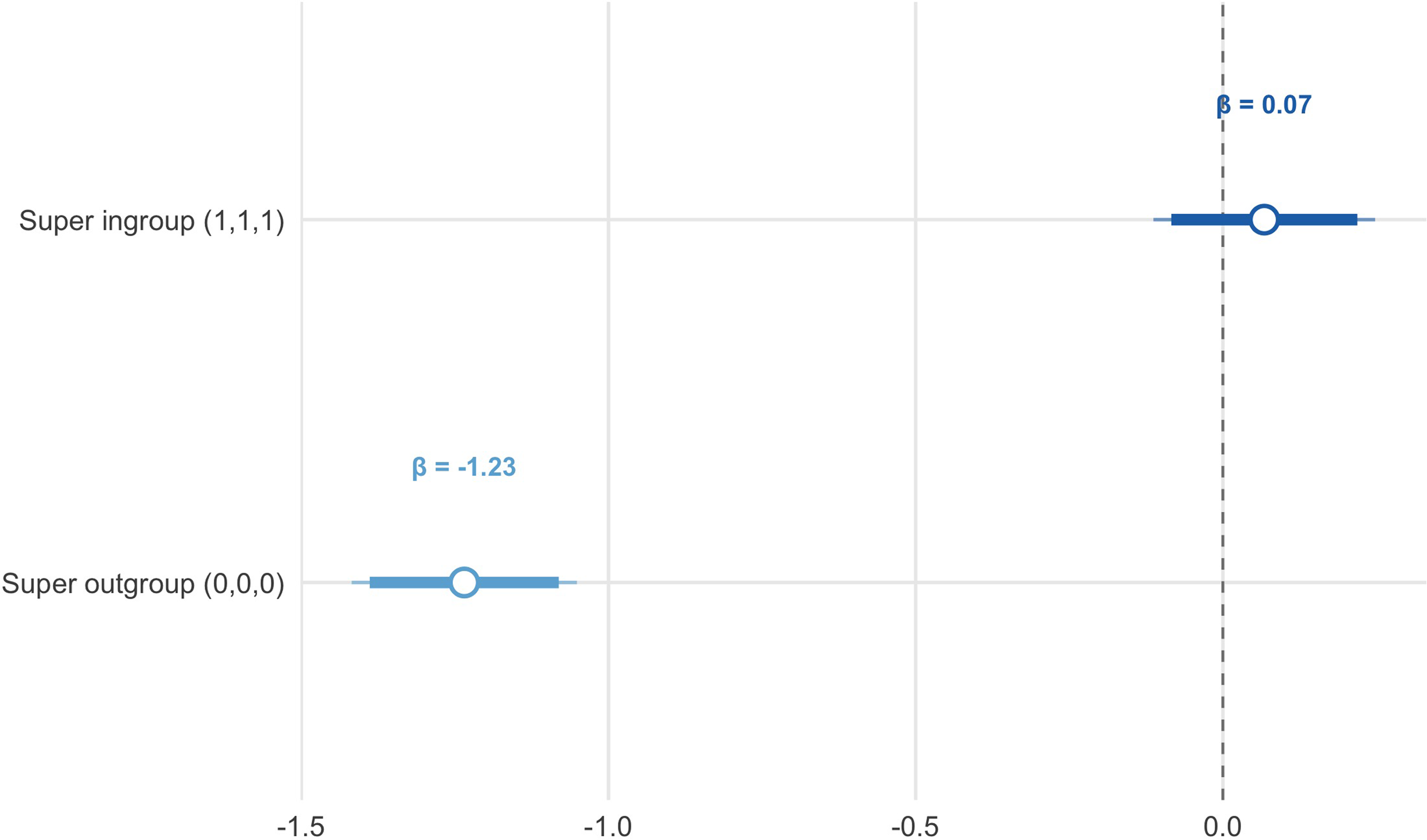
We pool all treated respondents across the three targeted pledges and estimate the average difference in vote intention between those exposed to a targeted pledge and those in the broad, universalistic control condition, contrasting ‘super ingroups’ and ‘super outgroups’. This analysis maximizes the potential for detecting a targeting bonus – that is, whether even the most favorable audience responds more positively to targeted pledges. Yet, Figure 5 reveals, again, a strong asymmetry. Respondents in the super outgroup exhibit a negative reaction to targeted pledges that is even stronger than in the main analyses (b = −1.23), whereas those in the super ingroup display only a small and not statistically significant positive effect (b = 0.07). Even among individuals who are simultaneously group members, identifiers, and sympathetic toward the targeted group, targeted pledges do not yield higher support than the broad-based benchmark.
Average treatment effect for members of the ‘super ingroup’ vs. ‘super outgroup’.
Note: Average treatment effects from linear models comparing respondents exposed to any targeted pledge (rural, parents, or pensioners) with those in the broad-based control condition. Coefficients indicate the average difference in propensity to vote between respondents seeing a targeted pledge and those seeing the universalistic pledge. Estimates are shown separately for respondents in the ‘super ingroup’ (1,1,1) and the ‘super outgroup’ (0,0,0).
Taken together, these findings reinforce the broader pattern documented in this study: compared to broad-based appeals, group-targeted ones tend to alienate outgroups more strongly than they attract ingroups. The overall balance of effects thus suggests that narrowly framed pledges offer limited electoral returns, even among those with the best predispositions.
Discussion: potential limitations, robustness, and scope conditions
A full understanding of our results requires reflection on the methodological choices that underlie them. We first examine a key concern – whether our treatments differ in substance independently of the group-targeting dimension – before turning to broader methodological considerations.
A potential limitation of our design derives from the fact that different social groups tend to be addressed through distinct policy schemes reflecting their specific circumstances and needs. Even policies targeting the same group may differ in ways that shape voters’ reactions. Different instruments – such as additional spending, tax cuts, regulatory measures, the extension of rights, or concrete outcomes – may trigger distinct responses, for instance, because of an aversion to spending or regulations as such. Likewise, policies may differ in perceived importance or normative appeal, irrespective of the group affected. To minimize such confounds while keeping the treatments realistic, all pledges take the form of additional public spending, avoiding differences in the instrument used to deliver benefits.
Still, our interpretation assumes that the observed gaps in vote intentions are driven primarily by the targeting focus, and not by reactions to the policy domains themselves. To examine this possibility, we assess whether the main results hold when accounting for differences in perceived issue importance. Respondents were asked to rate the importance of several policy areas (including those featured in our treatments) on a five-point scale ranging from ‘not important at all’ to ‘very important’. As shown in Figure A7, the healthcare system ranks as the most important issue overall, followed by old-age provision, family support, and rural infrastructure. This raises a potential concern that the higher support for the healthcare pledge observed in our main analyses partly reflects the general importance of that domain, rather than the absence of group targeting per se.
We therefore re-estimate treatment effects separately for two strata: respondents who rate the targeted domain as at least as important as healthcare, and respondents who rate it lower (Figures A8 and A9). These exploratory analyses do not suggest that relative issue importance alone accounts for the main findings. If domain preferences were decisive, targeted pledges should outperform the universalistic healthcare pledge among respondents who prioritize the corresponding issue (and the effect of targeting should become robustly positive). This pattern does not emerge. Across groups, treatment effects remain mostly negative even when the targeted issue is rated as at least as important as healthcare. The results show that higher importance of the targeted domain can attenuate the disadvantage of targeted pledges, but do not provide consistent evidence that this disadvantage is reversed. Positive estimates appear in a small number of subgroup specifications, especially among respondents who belong to or identify with the targeted group, but these findings are not consistent across treatments and are mostly not statistically significant. Overall, these robustness checks do not suggest that the main findings are driven primarily by differences in issue importance.
Three further aspects of the experimental design are particularly relevant for assessing the range of the observed effects: its prioritization of internal validity through comparable pledges that differ mainly by target group and are presented without partisan or contextual cues; the use of policy-based rather than symbolic appeals; and the focus on comparatively less contentious target groups.
First, our design seeks to enhance internal validity by using realistic pledges that differ mainly in their target group, within a preregistered setting providing as much control as possible. This control necessarily comes to some extent at the expense of external realism: real campaigns expose voters to multiple, often cross-cutting messages, partisan reputations, and repeated cues that can shape interpretation. By removing party labels and contextual noise, the experiment seeks to isolate as far as possible the causal effect of group targeting and to elicit distinct voter reactions linked to group membership, identification, and deservingness. This means, however, that we cannot capture how party images or media frames interact with such appeals. The hypothetical setting stripped of partisan and contextual signals could be seen as particularly conducive to responses to targeting. If so, our results would suggest that mobilizing voters through targeted promises is even less likely in real campaigns, given the absence of added value compared to universalistic pledges in our controlled environment. Yet partisan labels may also moderate the asymmetry we observe – dampening backlash among outsiders who trust the messenger, amplifying attraction among targeted loyalists, or generating effects of ‘surprise’. Indeed, Hersh and Schaffner (Reference Hersh and Schaffner2013) find that reactions among ingroup members can be especially strong when an appeal comes from a source not traditionally associated with their group. Analyzing such interactions between attitudes towards parties and group targeting thus constitutes a relevant avenue for future research.
Second, our experiment focuses on substantive, policy-based appeals rather than symbolic references to groups. Previous research has largely examined symbolic cues with mixed findings, leading scholars to question whether adding a material dimension would increase electoral returns to group targeting (Hersh and Schaffner Reference Hersh and Schaffner2013). Our design directly tests this proposition by presenting concrete policy pledges that deliver visible benefits to defined groups and reveal that even when targeted promises are made tangible, they do not outperform a universalistic alternative and can provoke significant backlash among outsiders. In this sense, our findings suggest that the limited payoff of group appeals in prior symbolic experiments does not simply stem from their vagueness or lack of policy substance. Rather, they point to a more general constraint on the electoral rewards of group targeting.
Third, our study focuses on broadly accepted, less politicized groups: parents, pensioners, and rural residents. This choice follows the broader design logic of neutrality: as explained, we selected groups that are frequently addressed in electoral programs (Thau Reference Thau2019; Deiss-Helbig, Guinaudeau, and Matthieß et al. Reference Deiss-Helbig, Guinaudeau, Matthieß and Rentrop2024), but carry limited partisan connotations, ensuring that the fictional party would not be automatically linked to real parties representing those constituencies. This decision could entail a conservative test of potential effects: because these groups are widely viewed as legitimate recipients of policy support, negative reactions among outsiders are likely attenuated compared to the sharper resentment that appeals to more polarized constituencies might provoke. This conservative design likely yields a lower bound of the polarization that group-targeted pledges can generate. At the same time, prior studies suggest that members of more politicized constituencies – such as those defined by class, religion, or ethnicity – may react more strongly to group cues, both positively and negatively (Robison and Moskowitz Reference Robison and Moskowitz2019; Dassonneville, Stubager, and Thau, Reference Dassonneville, Stubager and Thau2025). Appeals to such groups could therefore produce clearer ingroup mobilization, but also more intense outgroup backlash, especially when moral deservingness or partisan counter-identities are salient. Extending the analysis to more contested social categories would thus help identify the conditions under which group targeting mobilizes supporters, alienates outsiders, or deepens social divisions.
Conclusions
This study examines a growing practice in electoral politics: the use of campaign promises that target specific social groups. Parties increasingly tailor parts of their policy programs to defined constituencies, motivated by the expectation that such pledges will mobilize support among intended beneficiaries. Such pledges are expected to generate electoral returns by making policy benefits more tangible and attributable to the sponsoring party. Yet, while this strategy has become more common, empirical evidence on whether targeted policy promises actually bring electoral rewards in comparison to universalistic pledges remains limited. Moreover, most prior research has focused on symbolic appeals or assumed that targeted benefits generate positive responses primarily among ingroups, with only limited attention to how outgroups react.
To address this gap, we draw on a preregistered survey experiment in Germany. Participants evaluate fictional campaign posters promising either a broad-based healthcare benefit or a similarly structured benefit targeted at parents, pensioners, or rural residents. Our design allows us to assess whether targeted policy promises lead to distinct reactions across voters depending on group membership, identification, and perceived deservingness. Results point to a clear asymmetry in voter responses. On the one hand, we observe no consistent evidence that targeted policy pledges outperform a universalistic one – neither on average nor among those voters parties might hope to mobilize. Even among beneficiaries, additional electoral support for the targeted pledges compared to the universalistic pledge is non-existent or at best statistically uncertain. By contrast, we observe significantly lower support among non-beneficiaries – compared both to the universalistic pledge and to the reactions of targeted group members. Voters who do not belong to the target group, do not identify with it, or perceive it as undeserving consistently report reduced vote intention for the pledging party. Exploratory analyses provide further support for this asymmetry. The pattern holds across all target groups: while minor variations emerge – for instance, pensions elicit somewhat milder reactions among outsiders, whereas child benefits provoke sharper resentment – the overall tendency for targeted pledges to underperform remains consistent. It also extends to the extremes of group alignment. Among ‘super ingroups’, defined as respondents who belong to, identify with, and view the target group as deserving, targeted appeals do not outperform the universalistic pledge. Conversely, ‘super outgroups’, who neither belong to nor identify with the target group and see it as undeserving, display especially pronounced backlash.
These results carry important substantive implications. Contrary to theories of policy design that expect concentrated benefits to increase visibility and electoral responses (Wilson Reference Wilson1973; Pierson Reference Pierson1994) and to campaigners’ widespread reliance on group targeting as a vote-maximizing strategy, our experiment provides no clear evidence that policy-based group targeting brings additional votes when compared to a popular universalistic pledge. However, we do find robust evidence of negative reactions among non-beneficiaries of targeted pledges. While it may be overstated to claim that targeting is bound to backfire, our findings clearly challenge the assumption that targeted pledges tend to bring electoral advantages. This asymmetry in electoral reactions is crucial: while mobilizing intended recipients is difficult, alienating outsiders is comparatively easy. In line with recent calls in the literature (Huber, Meyer, and Wagner Reference Huber, Meyer and Wagner2024), our findings underline the need to pay greater attention to the reactions of non-beneficiaries in research on targeted campaigning and, more broadly, to the potential of inclusive – or even universalistic – pledges in campaigns.
Several avenues merit further exploration. A first line of research could extend our design with complementary approaches. Re-introducing partisan and contextual cues would clarify how such information moderates voters’ reactions to targeting. Likewise, while our treatments held the delivery instrument constant (additional spending), future work could test whether voters respond to the instrument itself – for example, tax relief, regulatory changes, or rights expansions – and whether these tools shift support even when the target group is held constant. A second line of research should systematically examine pledge ‘bundles’. Real party programs bundle multiple promises: a voter who dislikes a family-specific subsidy may simultaneously welcome a pension or tax measure in the same manifesto. Experiments and field studies that vary the mix and sequencing of universal and targeted benefits could establish whether negative reactions to one item are neutralized – or even reversed – when voters see themselves compensated elsewhere. A third direction concerns variation across social groups. Our disaggregated results show that the moderating force of membership, identity, and deservingness differs across target groups, pointing to the need for a comparative research agenda that treats these group attributes as moderating variables. Extending this analysis to more politicized constituencies – such as those defined by class, religion, or ethnicity – would clarify when group cues amplify polarization or instead reinforce ingroup mobilization. Future studies could array groups along theoretically salient dimensions – boundary clarity (fixed vs. fluid), temporal inclusiveness (life-cycle universal vs. conditional), moral consensus over deservingness, and the presence of a politicized counter-identity – and test whether those properties predict when targeted appeals mobilize, polarize, or backfire. Such designs might compare, for example, students, high-income earners, or minority groups, or manipulate frames that raise or lower perceived deservingness for the same group. Mapping how these constructions shape the interplay of self-interest, identity, and fairness perceptions will refine our understanding of the electoral calculus of policy targeting. Last but not least, further research should explore how campaigning parties perceive and navigate the trade-offs surrounding the distribution of promised benefits, and how these strategic choices shape patterns of group representation. Understanding how parties weigh the risks of backlash against the potential gains of targeted appeals will shed light on the dynamics of inclusion and exclusion in electoral competition and public policy.
Supplementary material
The supplementary material for this article can be found at https://doi.org/10.1017/S1475676526101285
Data availability statement
The data and replication code necessary to reproduce all analyses reported in this article are openly available in Replication Data for: Risky Appeals: The Electoral Consequences of Group-Targeted Campaign Pledges at https://doi.org/10.1017/S1475676526101285.
Acknowledgements
The authors would like to thank the participants in the 2025 EPSA panel “Group Identities in Party Competition” for their very helpful feedback. We are particularly grateful to Michael Bechtel for his technical advice, to Markus Wagner for his constructive discussion, and to Benjamin Guinaudeau for his generous guidance on the analyses. We also thank the anonymous reviewers for their helpful comments and suggestions. Any remaining errors are our own.
Funding statement
This work was supported by a grant from the Deutsche Forschungsgemeinschaft (DFG, German Research Foundation) to the GROUPTA project [466129675].
Competing interests
No potential conflicts of interest were reported by the author(s).
Ethical standards
Our survey was conducted in compliance with APSA’s Principles and Guidance for Human Subjects Research. Ethical approval for this study was obtained from the Ethics Committee of the University of Göttingen.


 Open access

