


Introduction
Media framing, public discourse, and the impact of COVID-19 on life in America, the murders of Rayshard Brooks, George Floyd, Andre Hill, Atatiana Jefferson, Breonna Taylor, Daunte Wright that have been extensively covered by the media, and increasing hostile political, social, and economic contexts inside and outside of the US are a few examples of occurrences since 2020 that likely impact the emotions of Americans. Scholars examine how emotions influence different forms of political behavior. Americans express feeling an array of emotions - November 2020 Pew Research Center survey data suggests that 65% of Americans felt “fearful” about the state of the US, noting that 41% and 64% of Black Americans say they feel angry and hope, respectively. Anger is one of the most extensively studied negative emotions and high levels of anger influence perceptions/assessments of candidates and promote participation (Abelson et al. Reference Abelson1982; Best and Krueger Reference Best and Krueger2011; Conover and Feldman Reference Conover and Feldman1986; Ragsdale Reference Ragsdale1991; Valentino et al. Reference Valentino2011). With increasing levels of diversity in the US and variation in the life experiences of Americans based on different characteristics it is critical to study how well expectations related to affect provide insight on the political participation of different groups in the US. This line of argument aligns with a growing number of political scientists who extend attention to how affect impacts the political preferences and behavior of Black Americans (Banks Reference Banks2014; Burge, Wamble and Laird Reference Burge, Wamble and Laird2020; Philpot et al. Reference Philpot, White, Wylie, McGowen, Philpot and White2010; Scott and Collins Reference Scott and Collins2020; Towler and Parker Reference Towler and Parker2018; White et al. Reference White2007).
In this paper, we examine the extent to which affect explains the political participation of Black women. We join an expanding line of research that focuses on how affect influences the political participation of specific groups in the US. Building on the theoretical motivation of research that examines the effects of race-gender trauma on the experiences of Black women (Jordan-Zachery Reference Jordan-Zachery2017), we argue that emotions will be able to explain the non-voting political participation of this politically engaged and influential group of voters. We utilize the 2016 and 2020 Collaborative Multiracial Post-Election Survey (CMPS) data to evaluate our argument that positive and negative emotions will lead to different forms of political participation among Black women. Namely, we argue that positive emotions will be associated with high-cost acts of participation, while negative emotions will be associated with low-cost acts. We note the uniqueness of the CMPS in that it includes oversamples of Black women, which allows us to speak to the variation within the group without sample size limitations (see Barreto et al. Reference Barreto, Frasure-Yokley, Vargas and Wong2018). We find that the relationship between Black women’s emotive responses to political stimuli and their non-voting participation depends on the context in which they are asked to express emotions about politics. Our findings underscore the importance of group-specific theories and the importance of affect in shaping the political behavior of the public. In the next section, we provide an overview of existing research, offer additional details on the research design, discuss findings and implications, and conclude with promising pathways for future research.
Literature Review
The Effect of Affect: Emotions, Political Behavior, and Preferences
There is a lengthy body of research that explores how political behavior and public opinion are influenced by affect. Emotions influence perceptions of candidates (Abelson et al. Reference Abelson1982) and evaluations of presidents and the economy (Conover and Feldman Reference Conover and Feldman1986; Ragsdale Reference Ragsdale1991). Different emotions have different effects—voter turnout is influenced by pride (Gerber et al. Reference Gerber, Green and Larimer2010) and anger (Valentino et al. Reference Valentino2011), anger and joy reduce the willingness to change evaluations of presidential candidates and fear and sadness reduce polarized views of candidates (Fridkin and Gershon Reference Fridkin and Gershon2021), while anger, compassion, and perceptions of policy beneficiaries explain opinions toward welfare policies (Petersen et al. Reference Petersen2012). Anxiety influences how people interpret information related to immigration (Brader, Valentino, and Suhay Reference Brader, Valentino and Suhay2008; Gadarian and Albertson Reference Gadarian and Albertson2014) and the concept of disgust leads to greater profiling of undocumented immigration and support for greater abortion restrictions (Kam and Estes Reference Kam and Estes2016).
The effects of emotions can vary across different groups in society. While negative emotions, such as anxiety and shame, promote activity in low and high propensity voters, positive emotions like pride have the strongest effect on high propensity voters (Panagopoulos Reference Panagopoulos2010). Anger and fear promote support for different ideological parties (Vasilopoulous et al. Reference Vasilopoulos2019). Race and ethnicity significantly shape life in the US and impact the effects of some emotions. For example, levels of explicit and implicit racism influence the effects of anger, fear, and even in being relaxed (Banks and Hicks Reference Banks and Hicks2016). There is a tight connection between anger and thoughts related to race (Banks Reference Banks2014) and anger has unique effects—compared to disgust or fear—on negative racial attitudes among White racial conservatives (Banks and Valentino Reference Banks and Valentino2012).
Despite extensive diversity in the US and the significant influence of race and ethnicity on life in America, a sizable portion of existing affect research focuses on White people with the implicit assumption that the results are relevant for people who belong to other racial and ethnic groups. We build on the increasing number of studies that center Black Americans in affect research by applying intersectionality to explore two related questions: To what extent do emotions influence the political behavior and preferences of Black women in the US? Are these effects different from findings in existing research? On the one hand, studies focusing on race and ethnicity find negative emotions can have similar effects on the mobilization of Blacks and Whites (Towler and Parker Reference Towler and Parker2018). On the other hand, there is growing evidence of differences in an array of emotional responses between Blacks and Whites (McGowen and Wylie Reference McGowen, Wylie, Brown, Block and Stout2020). White et al. (Reference White2007) is one of the earliest studies of Black affect - they find differences in the emotional responses of Blacks and Whites to events following Hurricane Katrina with Blacks displaying more anger and depression. There are racial differences in emotional responses to other political events (Philpot et al. Reference Philpot, White, Wylie, McGowen, Philpot and White2010) and questions about how these racial differences impact expected links between emotions and political preferences and behavior (Phoenix and Chan Reference Phoenix and Chan2019). Studies that focus on Black Americans yield important insight, including that anger and pride shape Blacks’ consideration of running for office (Scott and Collins Reference Scott and Collins2020), different forms of political participation (Banks et al. Reference Banks, White and McKenzie2019), and how advertisement content influences candidate perceptions (Burge, Wamble, and Laird Reference Burge, Wamble and Laird2020).
While many studies explore the influence of anger, several emotions warrant more attention from scholars. For example, hope is a positive emotion and was a major theme reflected in former President Obama’s Presidential campaign and rhetoric (Webster and Albertson Reference Webster and Albertson2022). Phoenix (Reference Phoenix2020) finds that hope increases non-voting forms of political participation in Blacks but not Whites, noting the potential of collective efficacy and positive emotions in promoting the participation of Blacks. Fear is a negative emotion that is also ripe for exploration in political science research (Salamon and van Evera Reference Salamon and Van Evera1973). When race and ethnicity and gender are not the theoretical focus, fear/anxiety is associated with less political participation (Valentino et al. Reference Valentino2011), though it promotes information seeking behavior of the public (Weber Reference Weber2013), women are more likely to express fear than men (Fridkin, Gershon, and LaPlant Reference Fridkin2019), and the effects of fear on political participation may change over time.Footnote 1 Greater attention to fear is particularly important given responses to the COVID-19 pandemic, extensive media coverage of violence against Blacks in the US, and other occurrences that have dire consequences for Black Americans.
Intersectionality: The (Not So) Angry Black Woman?
Though insightful, existing research rarely explores the intersection of race, ethnicity, and gender. Affect research yields promising insight through separate attention to race and ethnicity or gender (Albertson and White Reference Albertson and White2022), however, people are composed of multiple characteristics important in shaping their emotions and the extent that emotions influence their political behavior and Black women, specifically, place importance on their race/ethnicity and gender identities (Gay and Tate Reference Gay and Tate1998). We aim for this study to contribute insight by “answering” scholarly calls for more application of intersectionality in affect research (Burge Reference Burge2020). Though many conceptualizations exist (Hancock Reference Hancock2015), intersectionality centers on the idea that people are comprised of multiple identities that interactively impact their power, experiences, and the social inequality they face (Crenshaw Reference Crenshaw1989; Crenshaw Reference Crenshaw1991; Truth Reference Truth1851; Weiss Reference Weiss2014).
While there are many different minority women in the US, we explore the effects of race, ethnicity, and gender by studying Black women because of their unique experiences in the US, particularly in relation to their ability to express emotions, and note scholarly attention to other minority women as a promising area for scholars to explore in the future. Women in general face societal pressures to regulate their emotions and avoid all types of emotional outbursts (Traister Reference Traister2023). Recognizing high levels of political engagement and political influence of Black women voters on American Politics, we argue a robust understanding of the factors that influence their political participation is important and requires meaningful theorizing that accounts for their experiences (Alberston Reference Alberston2020). Since slavery, social and political contexts that Black women navigate make it uncomfortable—at times dangerous or even life-threatening - for these women to identify and/or express a full range of emotions. Controlling images about Black women remain racialized and stereotyped (Hancock Reference Hancock2004). Perceptions surrounding these women impact their emotions. For example, the “strong Black woman” perception can contribute to anger, distress, and frustration in Black women (González-Prendes and Thomas Reference González-Prendes and Thomas2011; Harris-Lacewell Reference Harris-Lacewell2001).
We expect these historical and contemporary legacies to influence the extent to which anger, fear, and hope explain the political behavior of Black women. The unique history, ongoing traumatic experiences, and stereotypes faced by Black women will influence how emotions—such as anger, fear, and hope—are socialized, displayed, and include their political behavior. Research that focuses on Black women yields intriguing conclusions related to anger and promising questions around the effects of hope and fear. Phoenix (Reference Phoenix2019) unveils an “anger gap” as Black Americans express lower levels of anger and anger is less likely to contribute to increase their political participation compared to White Americans. This critically important work includes an intersectional analysis that highlights an anger gap for Black women and finds that anger only influences some political behaviors. Dittmar (Reference Dittmar2020) also underscores the importance of affect research focused on Black women by highlighting that anger does not motivate political ambition among Black women the same way it does for other race-gender groups.
Furthermore, we argue that different contexts in which we ask about Black women’s emotions matter how different emotions influence their political behavior. We consider three contexts—emotions about race relations, emotions about personal finance, and emotions about elections. Why do we focus on these contexts? Attitudes about race and race relations have been and continue to be an important consideration for Black people, but for our purposes, Black women. Scholars have theorized about how Black women have sought to police themselves to fit what is “acceptable” behavior under the white gaze (Giddings Reference Giddings1985; Harris-Perry Reference Harris-Perry2011; Higginbotham Reference Higginbotham1994). This “acceptable” behavior was not about vanity, it was about trying to ensure the safety of Black people under laws that would not respond to the harm done to Black people. What’s more, we have seen how the tides turn on rights and freedoms for marginalized people when dominant political narratives and power are in favor of marginalized groups and that Black women have fought to participate, and remain highly engaged, in politics.
The unique economic placement of Black women makes attention to their emotions related to finances important. Black women are outpacing other race-gender groups in educational attainment but tend to earn less than their counterparts (AAUW 2023; Hale 2023). Not to mention, these women are most likely to have student loan debt (Hale 2023). This suggests that there can be an inordinate financial burden on Black women that influence the correlation between their emotions and political participation. Beyond impacting their emotions, being financially constrained may mean that Black women are also constrained in their ability to engage in political activity, having the resources to make a political donation, or the capacity to use hours that could be spent working for other causes. Despite these considerations, previous work finds that Black women participate more than we might expect based on traditional explanations for political participation (see Brown Reference Brown2014; Simien Reference Simien2005).
Scholars have long recognized the importance of studying emotions concerning elections. More recent work has focused on the implications of emotions for Black people and finds evidence that both negative and positive emotions can explain Black people’s political participation (see Phoenix Reference Phoenix2020). For Black women, specifically, we take guidance from past work and argue that attention to different types of political participation—and the costs associated with them—are also critically important. We expect the relationship between emotion and political participation (as it relates to elections) will depend on the type of activity in question as some activities require more attention, effort, and time than others. Since there are different types of political participation, we focus on non-voting forms of political participation. More specifically, we differentiate political activities by what we deem to be low and high-cost activities. In being thoughtful about the intersectional framework we employ, we recognize that not only are some acts of participation more costly because of the time involved with the act, but also that being subject to multiple layers of disadvantage may mean the stakes involved with more costly acts are even higher for Black women.
We expect positive emotion will be correlated with increased participation in high-cost activities. Positive emotions—our focus is on hope—will promote increased participation in high costs political action. Hope has a strong and consistent effect in mobilization Black Americans (Phoenix Reference Phoenix2020). Dowe suggests that Black women’s high political participation might be due to their determination to make a way for themselves, regardless of the circumstances (Dowe Reference Dowe2023). We interpret this “boundless” determination as reflecting hope in change and we expect that Black women who respond to the three contexts we study in this paper by saying they feel “hope” will be likely to engage in political actions that involve individual risk and require meaningful time commitments. Despite the injustices, challenges, and negative experiences many Black women face, these women are often referred to as the “backbone of the Democratic Party” because of their high levels of mobilization and engagement in American Politics. We expect that Black women will be more willing to engage in time-consuming and risky tasks if they are hopeful. Stated differently, we expect that hope is an emotion that encourages Black women to engage in costly political activities.
Hypothesis 1 We expect hope will increase the high-cost participation of Black women.
We expect Black women who express anger will be more likely to participate in low-cost activities. Black women have faced—and continue to face—lingering consequences of slavery, ongoing race-related inequality, sizable pay gaps when their salaries are compared to White males, persistent stereotypes with negative consequences that significantly shape their lives, and countless other experiences that warrant a response of anger. Despite a history of these and numerous other experiences, Black women are quite engaged in American Politics. Although existing studies find anger is negatively associated with engagement in politics—we expect that Black women will engage in more of some forms of political participation. Here we emphasize the importance of accounting for the “costs” of participating in politics and studying non-voting forms of participation. For many Black women the “costs” of abstaining from participating in politics are too grave and while anger may not mobilize these women to engage in high-costs activity, we expect that anger, especially concerning elections, will be correlated with more participation in less time-consuming tasks as these actions allow these women to make use of their power by meaningfully engage in politics, but do not require significant amounts of time and energy.
Hypothesis 2 We expect anger will increase the low-cost participation of Black women.
Lastly, we expect a significant association between fear and engagement in less time-consuming tasks but are agnostic about the direction of this correlation because we know less about how fear might influence Black women’s participation. Many of the experiences that Black women face likely evoke fear and it is plausible that fear can be correlated with more political participation. Fear is widespread in discussions by the media, politicians, and among the public (Altheide Reference Altheide2003). There is some evidence that fear can lead to engagement in low-cost or cheap activities and other evidence that suggests fear is not a powerful mobilizer. The mixed results in existing research and the limited studies exploring the effects of fear on the political participation of Black women lead us to posit a non-directional hypothesis on effects of fear.
Hypothesis 3 We expect fear to be related to the low-cost participation of Black women.
Data and Methods
To test our hypotheses, we make use of the Collaborative Multiracial Post-Election Surveys (CMPS) from 2016 and 2020. This data is useful for our purpose of understanding the relationship between Black women’s emotions and political participation as these surveys oversample marginalized populations in the United States (see Barreto et al. 2018). These types of efforts are meaningful for making inferences about groups for whom we often do not have enough data. In particular, the 2016 survey includes 2,141 non-Hispanic Black women, while the 2020 survey includes 2228 non-Hispanic Black women. Moreover, both surveys include many questions that allow us to capture Black women’s attitudes, beliefs, and political activities along with standard demographic questions.
In our modeling approach, we are careful to think about how Black women’s emotions (fear, anger, and hope) may look different based on the stimuli we ask them to evaluate and have different implications for our dependent variable—political participation. That is, the 2020 CMPS survey asks respondents how hopeful, angry, or fearful they feel about race relations in the United States and their personal economic situation, while the 2016 CMPS survey asks respondents how hopeful, angry, or fearful they feel about the election. We scale each of these emotive responses from 0 to 1 and treat them as continuous variables. In our first set of models, we focus on Black women’s anger, fear, and hope as it relates to race relations in the United States. We compare the effect of each of these emotions on our dependent variable, political participation.Footnote 2 Our second set of models focuses on Black women’s emotions in relation to their personal economic situation. We follow the same practice of comparing the emotions in their effect on political participation. Our final set of models looks at election-related anger, hope and fear. These models mirror previous work that has examined emotions in the political science realm (see Phoenix Reference Phoenix2020; Valentino et al. Reference Valentino2011), but are novel in our focus on Black women alone.
As it pertains to our dependent variables, we differentiate between political activities that might be considered less costly to engage in (low-cost)Footnote 3 versus those political activities that might be considered more costly to engage in (high-cost).Footnote 4 We do this in consideration of the fact that all acts of participation are not created equal. Some acts require more time than others and some acts require a personal sacrifice or risk—like donating from, for some, limited funds, or risking the consequences of protest involvement. Finally, we account for all the items in a participation index to speak to what the relationship between emotions and participation is when we are not sensitive to the stakes involved with different types of participation.Footnote 5 All of our models are estimated with ordinary least squares regression.
We include control variables in our models to account for the influence of other factors that influence the political participation of Black women (see Brown Reference Brown2014; Farris and Holman Reference Farris and Holman2014; Simien Reference Simien2005; Verba et al. Reference Verba, Schlozman, Brady and Nie1993). In particular, we account for demographic variables such as age, education, income, marital status, parenthood, employment, and nativity. We also account for ideology, partisanship,Footnote 6 interest in politics, political efficacy,Footnote 7 social capital, linked fate, religiosity, and region. The aforementioned variables, such as marital status (married or not), parenthood (parent or not), employment (employed or not), and nativity (born in the US or not), are dichotomous variables. Region is measured as a categorical variable, while all other variables are measured as continuous variables. Demographic factors, such as education (see Brown, 2014), as well as social and political engagement within one’s community, can influence Black women’s participation (see Farris and Holman 2014; Dowe Reference Dowe2023). We expect each control (Abrajano and Alvarez Reference Abrajano and Alvarez2010) variable to impact political participation in the directions widely established in existing research.
To account for the political context and how Black women navigated the time points in which the surveys were fielded, we include a measure that captures the difference in favorability between Donald Trump and his electoral opponents (in 2016, Hilary Clinton, and in 2020, Joe Biden). Here, positive values indicate stronger favorability for Trump, while negative values indicate stronger favorability for Trump’s opponent in that political context. Measures of favorability of political figures in the United States are consistent in both the 2016 and 2020 surveys. Further, we cannot ignore how Trump’s presidency and presence in American politics has had implications for Black Americans lived experiences, as well as other marginalized groups, and has arguably reversed a pattern of Black Americans being able to rely on the federal government for protection (see Clayton et. al Reference Clayton, Moore and Jones-Eversley2019)—from the decimation of agencies in place to protect civil rights to Trump’s recomposition of the Supreme Court with a conservative majority.
Finally, we account for trust in government as one of our control variables. While trust in government among native born Black Americans has traditionally been low (see Nunnaly Reference Nunnally2012), the CMPS data include more than just Black women who identify as native born. Trust among immigrant populations tends to be higher due to a positive orientation toward their new political system (Michelson Reference Michelson2003; Abrajano and Alvarez Reference Abrajano and Alvarez2010). Additionally, Black immigrant identifiers do not always behave in the same ways as their native-born Black counterparts (see Greer Reference Greer2013; Smith Reference Smith2014). Furthermore, as noted by Clealand (Reference Clealand2025), just because a respondent is Latino and racialized as Black does not mean that she necessarily feels a sense of closeness to the United States’ Black experience.
Findings
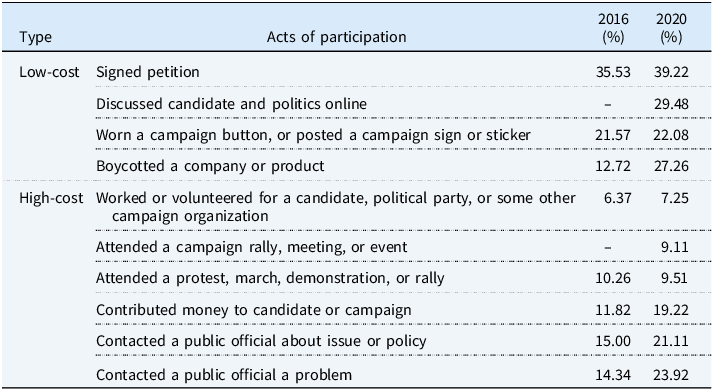
Before presenting our substantive results, we note in Table 1 who among Black women participates in low- and high-cost political activities. We note that the activity with the highest percentage of participation, in both 2016 and 2020, is a low-cost activity (signing a petition). On the other hand, the activity with the lowest percentage of engagement is a high-cost activity (working or volunteering for a candidate, political party, or some other organization). This provides some initial evidence that our categorization of political activities is meaningful. We might expect those activities that are low-cost would be the ones that more Black women would participate in, while fewer Black women would participate in high-cost activities. Notably, however, the percentage of Black women engaging in both low-cost and high-cost activities is higher in 2020 than it was in 2016. The exception here is participation in protests, marches, demonstrations, and rallies. While the cross-sectional nature of the data and shift in sampling frameFootnote 8 do not allow us to make comparisons between the 2016 and 2020 respondents, we can speculate about how the electoral context affects how Black women think about their political engagement. This makes it even more crucial to consider how the political moment influences the relationship between Black women’s emotions and non-voting political participation.
Types of acts of participation
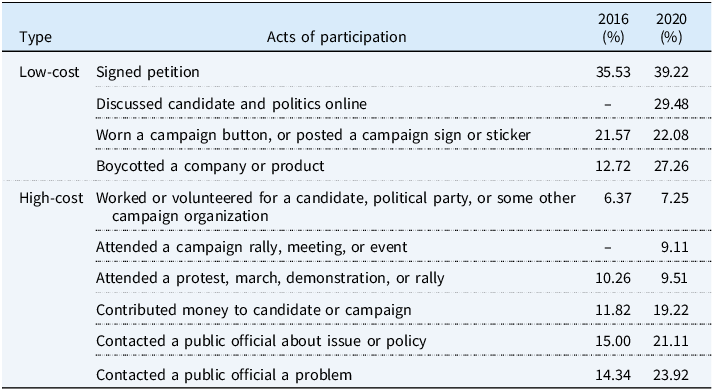
Note: The table includes weighted percentages of Black women’s political activity. The missing percentages indicate that those acts of participation were not asked about in 2016.
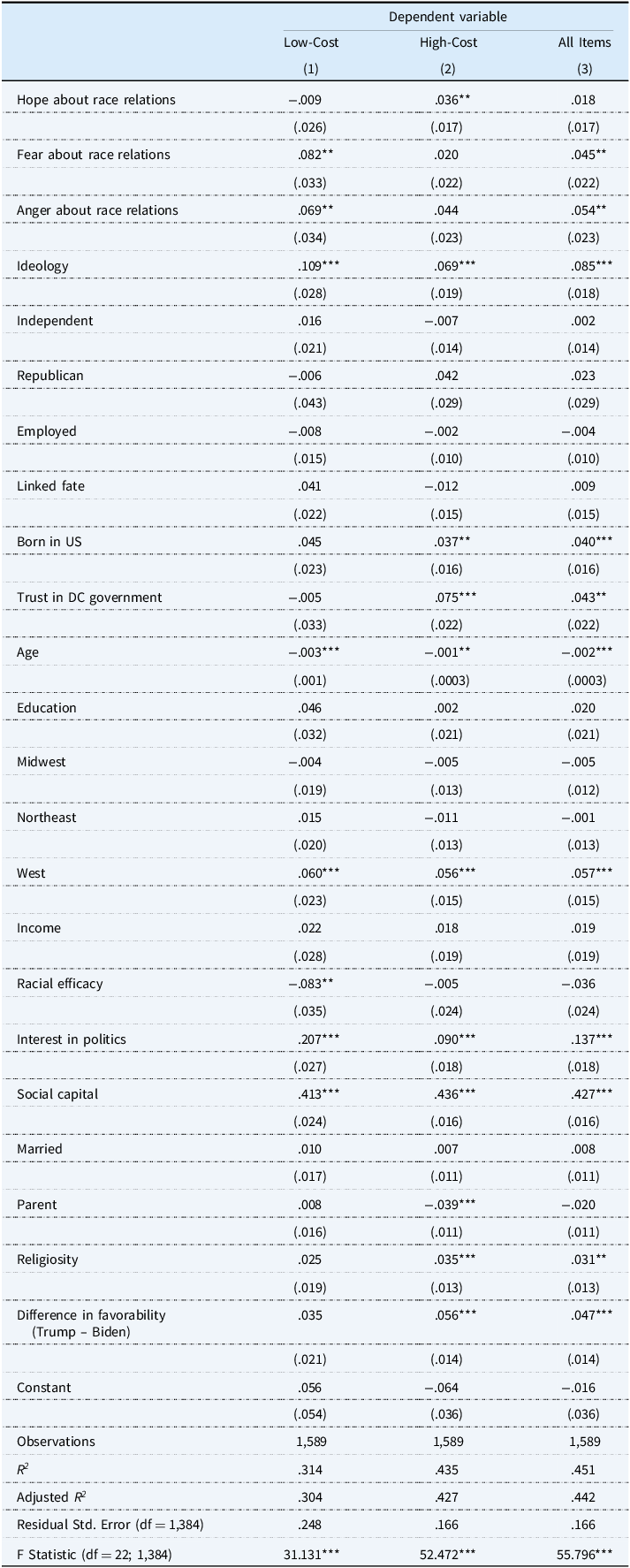
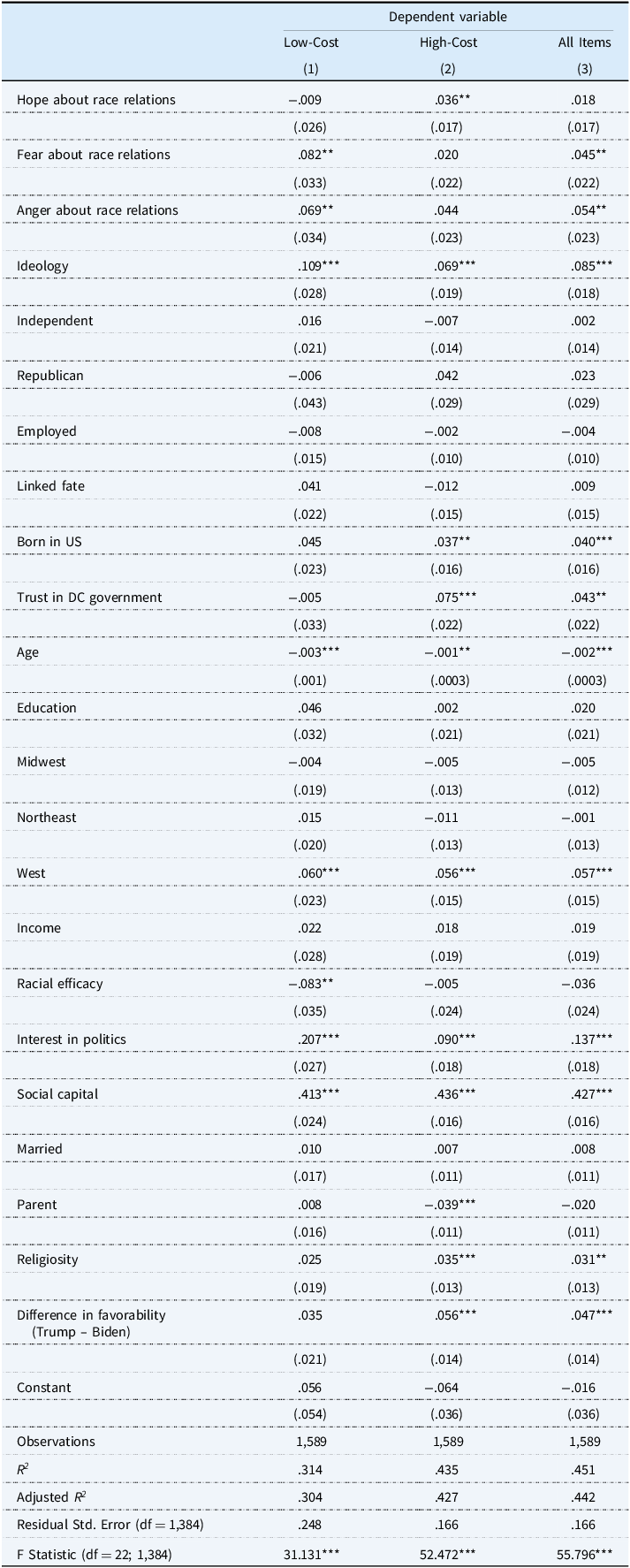
Turning to Table 2, we examine the relationship between emotions about race relations and political participation. Before discussing our main variables of interest, we examine the significance of some of our control variables, as they address the factors that influence Black women’s engagement with politics, beyond their emotions regarding race relations. Across all models, we note that age is a negative predictor of participation, while social capital, political interest, the region indicator for the West, and ideology are positive indicators across models. This suggests that as Black women age, fewer of them engage in non-voting acts of participation. In addition, as Black women’s engagement with their community (social capital) and their interest in politics increases, so does their participation. Liberal Black women engage in acts of participation more than their less liberal counterparts. Further, Black women in the West are engaging in significantly more non-voting actors of participation then their counterparts in the South.
Race related emotions and its implications for political participation (CMPS 2020 data)
Note: **p<.05; ***p<.01.
Next, we examine the effects observed in specific models when we take into account emotions related to race relations. We first look at Model 1 (low-cost participation). We note that racial efficacy is negatively and significantly related to low-cost participation. Racial efficacy largely captures how respondents perceive the government’s responsiveness toward their racial or ethnic group, which is similar to traditional measures of external political efficacy (see Phoenix and Chan Reference Phoenix and Chan2024). That there is a negative relationship between low-cost participation and racial efficacy for Black women, when emotions are accounted for, suggests that Black women who are more willing to engage in low-cost political acts do not feel that their actions can effect change in politics. This is not the case for models 2 and 3, which account for high-cost acts of participation and all acts of participation, respectively. The indicators for racial efficacy are not significant in models 2 or 3. Altogether, this suggests that low-cost political activity among Black women does not require the same level of “buy-in” or engagement with the political system that high-cost political acts require.
Models 2 and 3 show similar patterns for the significance of control variables. Namely, in both models, being born in the United States, religiosity, and trust in government are positively related to non-voting participation. This suggests that Black women who were born in the United States engage in more high-cost acts of participation, and more acts of participation overall, than their counterparts who were not. Similarly, more religious Black women engage in more acts of non-voting participation than their counterparts, as do Black women who trust the government. The difference in favorability between Trump and Biden is significant in both models, indicating a higher preference for Trump among Black women compared to Biden in terms of favorability ratings. Notably, the average difference in favorability between Biden and Trump among Black women favors Biden (at −.71), which speaks to Black women’s long-standing support for the Democratic Party (see Slaughter et al. Reference Slaughter, Crowder and Greer2024) and their electoral support during the 2020 election cycle. However, when controlling for several factors, it is favorability toward Trump that leads to Black women’s costly non-voting participation and non-voting participation overall. While a great deal of attention goes to how Black women behave electorally, particularly their reliability as Democratic voters, there is indeed variation in what motivates their political engagement outside of the voting booth.
Looking at our main variables of interest, emotions about race relations in the United States, we see different emotions related to low and high-cost acts of participation. In particular, holding all else equal, fear and anger about race relations are the emotions that are positively and significantly related to low-cost acts of participation (Model 1). On the other hand, hope about race relations is positively and significantly related to high-cost acts of participation (Model 2). This finding highlights the complexity of Black women’s lived experiences and political engagement in the United States, aligning with our expectations. Both negative and positive emotions about racial relations motivate Black women to be engaged in politics. When we examine all participatory acts as an index (Model 3), we see that both fear and anger about race relations are related to an effect for fear and anger about race relations. However, we would have missed how hope factors into Black women’s political engagement story had we not examined what emotions motivate costly acts of non-voting participation.
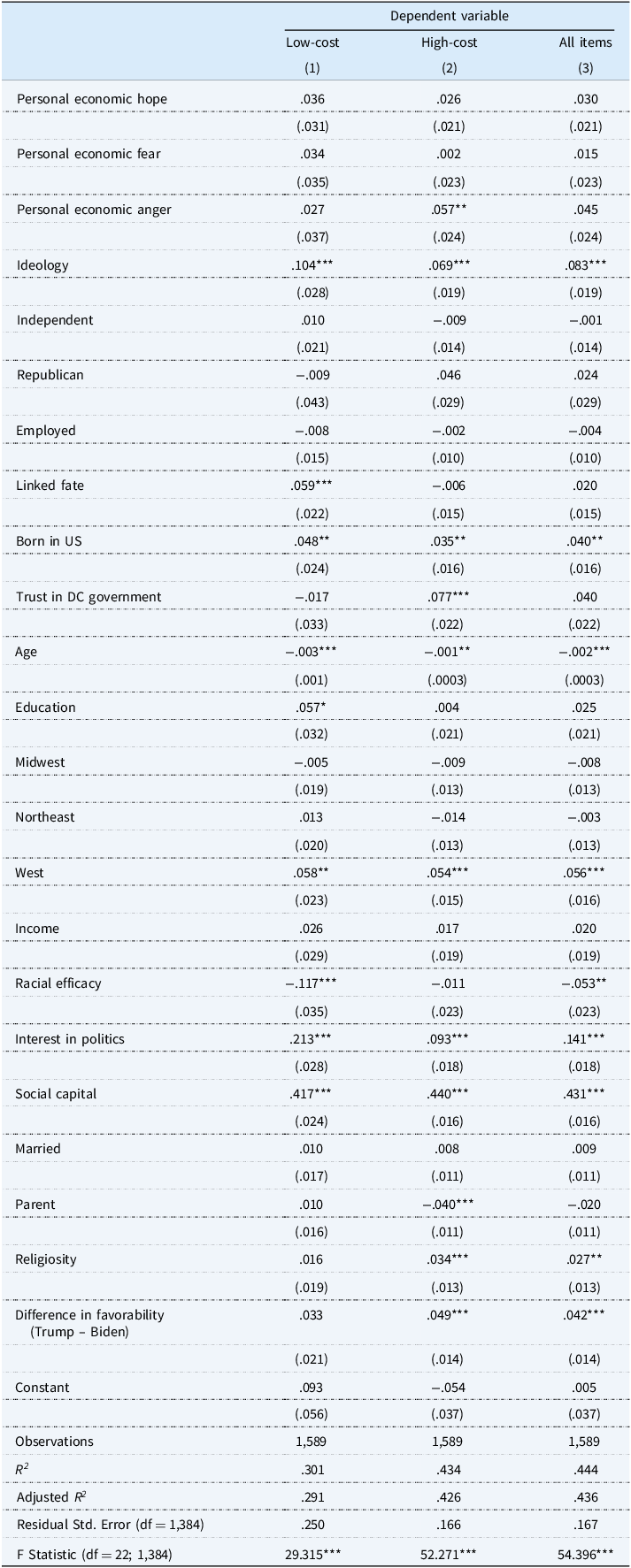
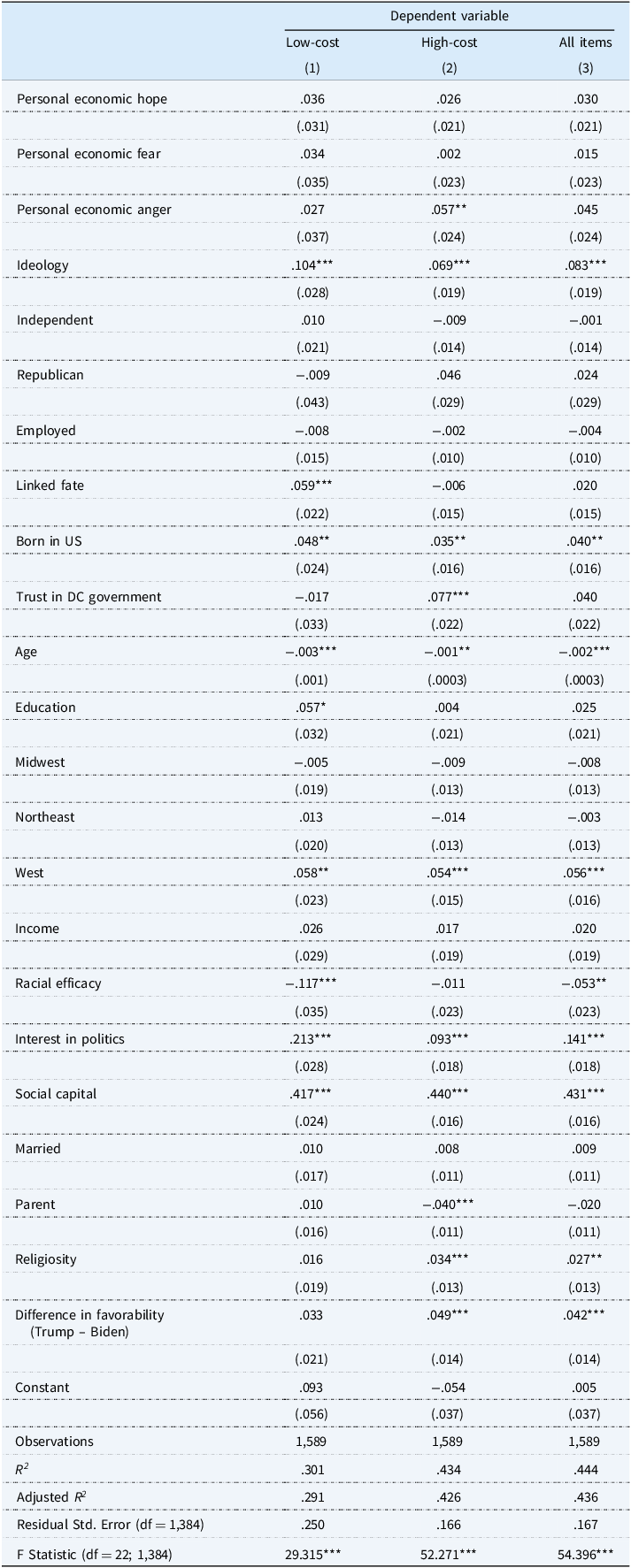
Next, we turn to Table 3, in which we examine how Black women’s emotions about their economic situation influence their political participation. As shown in Table 2, we observe some of the same significant control variables. In particular, age remains a negative predictor across models, while ideology, interest in politics, being born in the United States, the region indicator for the West, and social capital remain positive predictors across models.
Emotions related to personal economic situation and its implications for political participation (CMPS 2020 data)
Note: **p< 05; ***p<.01.
Examining individual model effects, we observe similar patterns to those presented in Table 2. Specifically, in Model 1 (low-cost acts of participation), we see that linked fate is a positive predictor, and racial efficacy remains a negative predictor. This suggests that Black women’s sense of connection to the larger racial group is important for their engagement in low-cost acts of participation, but so too is their perception that the government is not responsive to their racial group. In Model 2, trust in government is positively related to high-cost acts of participation, whereas having children is negatively related to these high-cost acts. In both Models 2 and 3, religiosity and the difference in favorability measure significantly predict non-voting participation. This again suggests that Black women who are more religious and those who favor Trump are more engaged in high-cost activities, as well as acts of participation more broadly.
While the significance of our control variables is, in many ways, consistent with the effects from Table 3, the significance of our main variables of interest is not. That is, we see that emotive responses related to Black women’s personal economic situation are not significant predictors of low-cost non-voting participation nor overall participation. However, anger is significantly related to high-cost non-voting participation. This suggests that how Black women feel about their finances motivates some of their political engagement, but not all of it. This represents a departure from our findings in Table 2 regarding emotions related to race relations, as well as a departure from our expectations. Instead of hope about personal economic circumstances leading to high-cost acts of non-voting participation, it is anger about their personal economic circumstances. The relationship between Black women’s emotive responses about their finances and their political engagement is indeed complex. Further, if we had not differentiated between low and high-cost participatory acts, we would have missed the role that anger plays as one of Black women’s emotive responses to their finances.
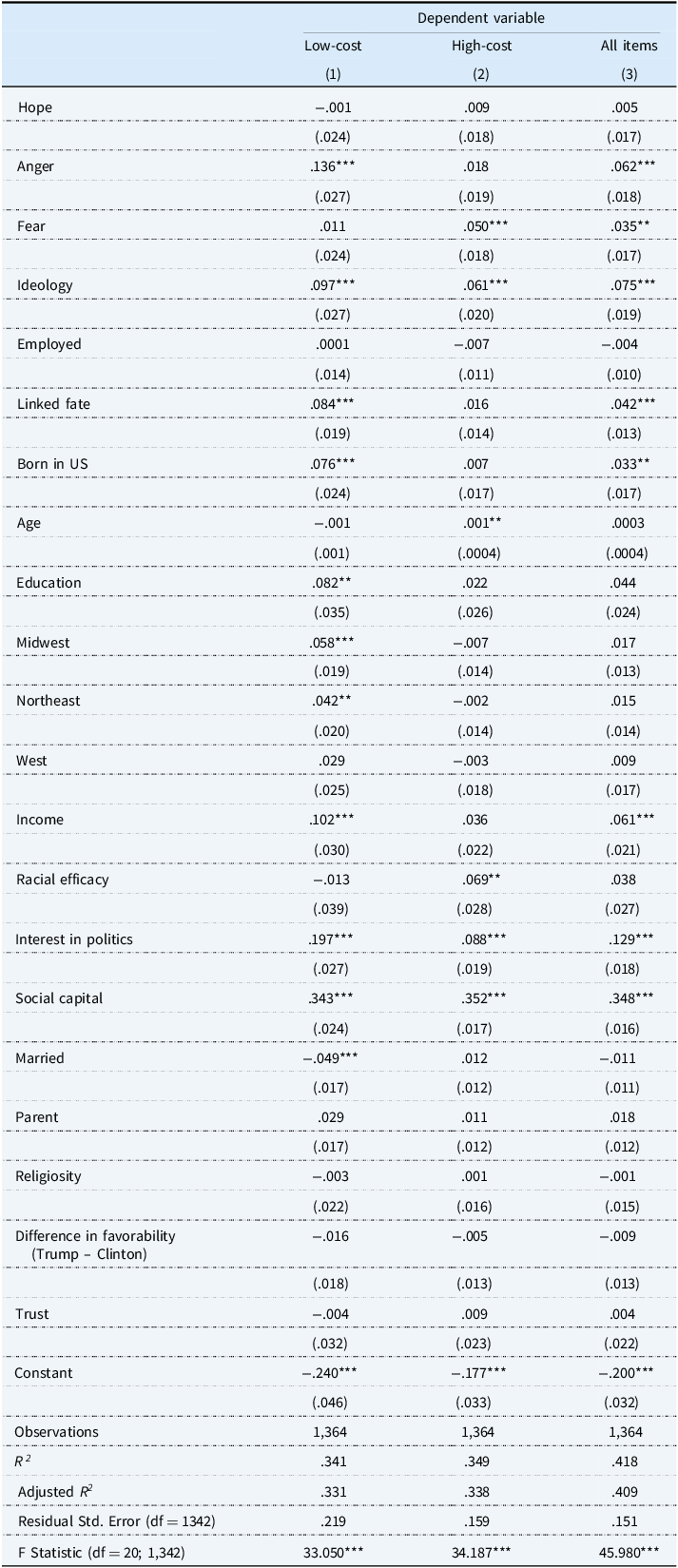
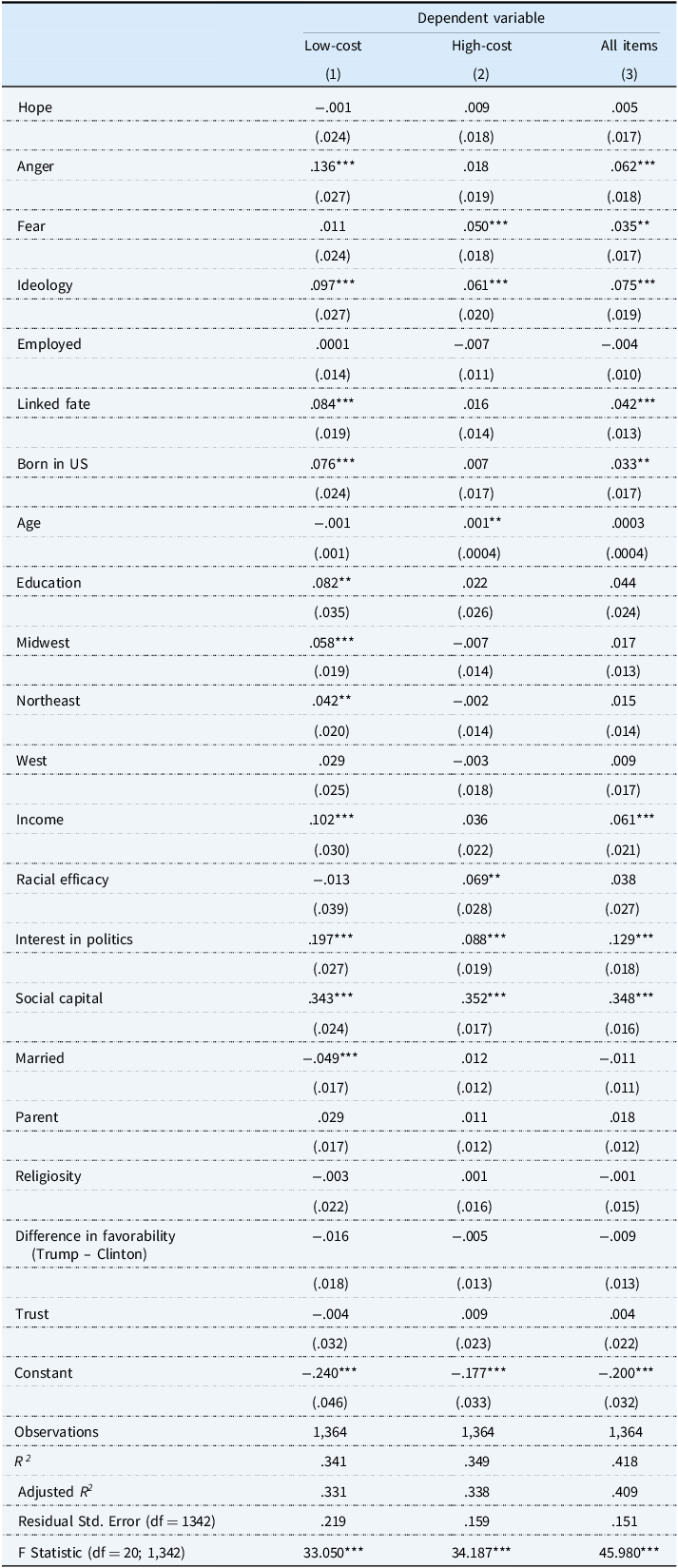
Finally, we turn to Table 4, our examination of emotions related to an election. Again, we note that these models are estimated using the 2016 CMPS data. Moreover, these models more closely mirror how the extant literature has examined the relationship between emotions and participation. Though our model estimates stem from different sets of data, we see some of our same control variables are significantly related to participation when we account for emotions. Namely, social capital, ideology, and interest in politics are positive indicators of participation across models. Being born in the United States, income, and linked fate are positive and significant predictors of non-voting participation in two of three models (low-cost participation and all non-voting participation).
Emotions related to election and its implications for political participation (CMPS 2016 data)
Note: **p<.05; ***p<.01.
There are some differences in what predicts non-voting participation in the 2016 data versus the 2020 data. What is distinct about the predictors for low-cost non-voting participation in this table is that education is significant, an indicator that is consistent with the extant literature, as is marriage, but in the negative direction. One distinct predictor of high-cost participation here is age. While age was negatively related to participation in Tables 2 and 3, it is a positive indicator here. This suggests that accounting for election-related emotions brings forth unique considerations in this context.
Turning to our main variables of interest, we see two different effects when we consider emotions related to low-cost and high-cost participation. In particular, we see that anger is significantly related to low-cost acts of participation. On the other hand, fear is related to high-cost acts of participation. While the existing literature would lead us to expect anger to motivate participation, fear has traditionally been associated with information seeking rather than action. That we see Black women engaging in high-stakes political activities out of fear represents a significant distinction from the existing literature. In addition, the findings in Table 4 contradict our observations in Table 2 regarding high-cost participation. That hope motivates Black women’s high-cost participation when it comes to considerations of race, and fear motivates their high-cost participation when it comes to considerations about elections, speaking to how emotions about political stimuli can lend to varying effects on who among Black women want to engage in politics. Finally, we note that our third model in Table 4 reflects both anger and fear as being motivators of political participation among Black women. While our specification does not obscure our findings as it did in Tables 2 and 3, we believe the distinction between low-cost and high-cost participation is no less meaningful.
Discussion and Conclusion
In this paper, we study how affect influences the non-voting participation of Black women. We argue that the unique historical and current social, political, and economic contexts these women navigate as well as their political engagement and influence in the US make this focus critically important. Moreover, we make a distinction between the types of participation that Black women can participate in (low and high-cost activities). This distinction is meaningful because it accounts for the stakes involved with participation and the fact that these stakes might be even higher for Black women. Using an intersectional approach, we find that the stimuli we ask about to elicit emotive responses from Black women are not only meaningful but also lead to the influence of different emotions. For instance, we see that hope about race relations and negative emotions (fear and anger) about the election outcome both influence Black women’s participation in high-cost activities. Similarly, negative emotions about race relations and anger about the election are predictors of low-cost participation. Our work speaks to the importance of thinking beyond how anger matters for engagement in politics and joins with a growing set of work that thinks about the implications of positive emotions and the implications of fear.
Although our study is insightful and contributes to a scholarly understanding of how affect influences Black women, there are limitations. Namely, the acts of participation that we include in our measures may not fully reflect the full menu of activities that Black women think about when they consider their political engagement. Shingles (Reference Shingles1981) points to the inclusion of involvement in political clubs and organizations focused on public issues as meaningful parts of political participation that we are not able to include here. Black women have long been part of service and political organizations (like the National Council of Negro Women, Links, and historically Black sororities) that we are not able to account for here. In addition, our use of two surveys, run at two different time points, to examine Black women’s emotive responses to political stimuli means that we cannot model how hope about race relations, for instance, might compare to fear about election outcomes. Nor can we tell if these emotive responses are time-bound.
There are several promising directions for future research to build on the argument and analysis that we put forth in this paper. In particular, our results lend to the importance of thinking about why fear motivates Black women to participate when this is not expected to be the case given the literature. Black women move beyond the expected information-searching here and lean into engagement. This perhaps speaks to how Black women have been conditioned to respond to their emotions—even when they are negative. Furthermore, there is room to more strongly consider how the stimuli we ask about shape emotive responses. While we do find an effect for emotions about race relations and elections with low and high cost participatory acts, we find limited effects for emotions about personal finances. This suggests that asking Black women about the issues they care about is not only a useful task, but also might help us to better understand under what conditions Black women’s emotions matter for their political behavior. Lastly, theoretically centering other minority women to examine how affect influences a range of politically related behavior is a natural extension of this study.
Supplementary material
The supplementary material for this article can be found at https://doi.org/10.1017/rep.2026.10060
Funding statement
The authors received no financial support for the research and authorship of this article.


 Open access

