


1. Introduction
The decarbonisation of existing housing stock is a key challenge of the European and UK climate transition in terms of the rate and extent of retrofitting necessary to meet policy ambitions and carbon budgets (Reference SerinSerin, 2023; Reference Santarsiero, Misceo, Aversa, Candigliota, Di Micco, Hugony and LupranoSantarsiero et al., 2024). The policy and delivery context usually positions retrofit as a techno-economic challenge: enhancing building performance, minimising air tightness, promoting electric heating, and encouraging the uptake of these measures through financial support (Reference SerinSerin, 2023). However, despite these improvements, schemes remain characterised by low participation, knowledge gaps, and persistent gaps between predicted and actual performance (Reference Gram-HanssenGram-Hanssen, 2014; Reference FawcettFawcett, 2020). These issues suggest that retrofit is more than a technical measure applied to a passive housing stock, but a socio-material process that is enacted through everyday practices of dwelling, learning, and caring (Reference Shove, Pantzar and WatsonShove et al., 2012; Reference Gram-HanssenGram-Hanssen, 2014).
Three interrelated dynamics underpin this research. Firstly, the adoption of retrofit is a socially mediated process, whereby trust, the legitimacy of the intermediary, and visibility are as important as technical or economic considerations (Reference Maller, Horne and DaltonMaller et al., 2012; Reference Walker, Lowery and TheobaldWalker et al., 2014; Reference Zhu, Wang, White, Inch and PayneZhu et al., 2025). Secondly, the achievement of performance requires maintenance and user literacy, such that the co-production of outcomes through everyday practices is more important than technological achievement per se (Reference FawcettFawcett, 2020). Thirdly, retrofit transforms material and ecological relationships through new supply chains, indoor spaces, and relationships with non-human systems, although these aspects are often not prominent in delivery or assessment structures (Reference Houston, Hillier, MacCallum, Steele and ByrneHouston et al., 2018). Fourthly, retrofit can produce rebound effects, whereby improvements in efficiency are partially offset by changed practices and expectations, for example, higher indoor comfort standards, longer heating periods, or increased use of newly “affordable” energy services, contributing to the persistent gap between predicted and actual savings. These dynamics imply that the design challenge is not simply which technologies are used, but how the capabilities, relationships, and infrastructures that underpin retrofit are configured. This paper reinterprets retrofit as a practice of ecological citizenship: a civic practice through which environmental responsibility is expressed through learning, making, organising, and stewarding. Retrofit is thus understood in this paper as the deliberate transformation of existing dwellings to lower energy consumption and emissions, as well as enhance comfort, resilience, and health throughout the entire retrofit process from assessment to use and maintenance (Reference Gram-HanssenGram-Hanssen, 2014; Reference FawcettFawcett, 2020). Ecological citizenship is conceptualised not as an identity but as a practice facilitated by design infrastructures such as artifacts, spaces, organisational forms, and finance systems. Although retrofit research is increasingly acknowledging the role of social practices and participation, three gaps exist. Firstly, participation is seldom conceptualised in terms of particular design interventions and toolchains that link household activity to neighbourhood and regional systems. Secondly, assessment frameworks are predominantly concerned with carbon and cost, and there is little articulation of social and ecological outcomes such as learning, trust, stewardship, and biodiversity. Thirdly, retrofit is conceptualised as a transactional process rather than as a system of roles and infrastructures (Reference Rutherford and CoutardRutherford and Coutard, 2014; Reference FawcettFawcett, 2020; Reference Zhu, Wang, White, Inch and PayneZhu et al., 2025). This paper fills these gaps by conceptualising a design-operational account of retrofit as ecological citizenship.
The study asks: (RQ1) What roles facilitate household and community participation in retrofit, and how do they relate to one another? (RQ2) What design interventions and infrastructures support these roles across household, street, and regional scales? (RQ3) How can environmental outcomes be assessed alongside social and ecological dimensions, and fed back into practice? These questions are explored through a research-through-design, mixed-method multiple case study of three UK initiatives operating at complementary scales. Cross-case synthesis is used to develop a role-based framework linking participation, infrastructures, and outcomes. The remainder of this paper is structured as follows: Section 2 positions the research within transition design, social practice, participatory design and regenerative perspectives; Section 3 sets out the methodological approach and case study rationale; Section 4 presents the empirical findings and cross-case synthesis; Section 5 discusses the implications for participatory retrofit and ecological citizenship; and Section 6 concludes with the contributions, limitations and directions for future research.
2. Research context and theoretical positioning
2.1. Transition design, circularity and sufficiency in retrofit
Domestic retrofit, therefore, is a highly complex area where building physics, policy implementation, and lived and personal experience interact. While the know-how for lowering the use of operational energy is well understood, the issues of adoption, effectiveness, and equity suggest that retrofit should be conceptualised as a transition process rather than a technical solution (Reference Gram-HanssenGram-Hanssen, 2014; Reference FawcettFawcett, 2020). In design research, this paradigm shift is represented by the transition from product-oriented eco-design to design for sustainability and transition design, where sustainability performance is conceptualised as the outcome of systems of artefacts, practices, infrastructures, and institutions, rather than isolated technical solutions (Reference Ceschin and GaziulusoyCeschin & Gaziulusoy, 2016; Reference ManziniManzini, 2015; Reference IrwinIrwin, 2015). The literature on circular economy also endorses this systemic perspective by emphasising life extension, virgin material substitution, and design for repair and reuse, rather than linear substitution (Reference StahelStahel, 2019; Reference Geng, Sarkis and BleischwitzGeng et al., 2019). Sufficiency research also complements this by challenging demand growth and articulating “enough” as a guiding principle for design and policy (Reference PrincenPrincen, 2005; Reference Fischer and GrießhammerFischer & Grießhammer, 2013). This section therefore does not report a systematic literature review; rather, it provides a positioning synthesis that brings these bodies of work into dialogue in order to locate the research gap and justify the analytical framing of retrofit as ecological citizenship. In retrofit, these perspectives imply that the design challenge extends beyond improving building performance to creating the conditions in which lower-carbon ways of living become durable. However, transition-oriented design literature often remains programmatic at the level of principles. Participation, system change, and new governance arrangements are identified as necessary, but there is limited operational specification of how these are realised through concrete design interventions, artefacts, and organisational formats in retrofit delivery. This paper addresses this limitation by developing a role-based, design-operational account of participatory retrofit.
2.2. Social practice and participatory design in retrofit
A central reason for retrofit underperformance is that housing is not only a technical system but a site of everyday practice. Social practice theory demonstrates that energy demand and comfort are constituted through the interaction of materials, competencies, and meanings; consequently, performance is enacted rather than delivered (Reference Shove, Pantzar and WatsonShove et al., 2012). The results of retrofitting, therefore, are contingent on learning, maintenance practices, and domestic narratives, as well as technical performance (Reference Gram-HanssenGram-Hanssen, 2014; Reference Judson and MallerJudson & Maller, 2014; Reference FawcettFawcett, 2020). Participatory design offers a different take on the issue by considering users and communities as co-producers of socio-technical change, rather than as targets for solution delivery (Reference Binder, Brandt, Ehn and HalseBinder et al., 2015; Reference Björgvinsson, Ehn and HillgrenBjörgvinsson et al., 2012). In the context of sustainability transitions, participatory design practices facilitate the expression of local constraints, the construction of shared meanings, and the creation of social infrastructures for learning and support. Research on citizen innovation and maker culture also illustrates that knowledge about technology can be distributed and produced in a collective manner (Reference Von HippelVon Hippel, 2005; Reference Kuznetsov and PaulosKuznetsov & Paulos, 2010). Nonetheless, the research on retrofitting seldomly gives a clear mapping between the types of participation, the design interventions that make these possible, and their outcomes in the environment and society. As stated by Reference FawcettFawcett (2020) and Reference Zhu, Wang, White, Inch and PayneZhu et al. (2025), the lack of operational connections makes it difficult to evaluate and scale. This research fills this gap by mapping the mechanisms of participation into role-practices and toolchains.
2.3. Regenerative, bioregional and more-than-human perspectives
The mainstream retrofit discourse typically specifies environmental performance in terms of operational energy and carbon. Bioregenerative design provides a more expansive perspective that aims not only to mitigate but to provide for the conditions of ecological flourishing. Bioregional design also aims to reconnect material, skill, and practice to ecological systems and identities (Reference McGinnisMcGinnis, 1999; Reference ThackaraThackara, 2006). In retrofit, these perspectives focus on embodied carbon, material provenance, habitat provision, and biodiversity integration. Research in civic ecologies and more-than-human studies also highlights the significance of urban and domestic environments in promoting care practices that extend beyond the human (Reference Houston, Hillier, MacCallum, Steele and ByrneHouston et al., 2018; Reference Puig de la BellacasaPuig de la Bellacasa, 2017). The sensory and material properties of the home can make ecological processes visible and tangible in experience, increasing associations between domestic practice and ecological processes and relations. Nevertheless, these ecological dimensions are very weakly integrated into mainstream delivery, procurement, and assessment practices. Provenance, biodiversity, and ecological performance are treated as secondary considerations to cost and operational carbon (Reference Zhu, Wang, White, Inch and PayneZhu et al., 2025). This paper takes up their integration as a design problem, exploring the role of artefacts, practices, and organisational roles in retrofit to facilitate ecological stewardship.
2.4. Intermediaries, delivery infrastructures and finance
Organisational and financial structures are important to enable retrofit acceleration. Community energy and retrofit intermediary research demonstrates that trust, social influence, and local visibility play a significant role in adoption (Reference Walker and Devine-WrightWalker & Devine-Wright, 2008; Reference Seyfang, Park and SmithSeyfang et al., 2013; Reference Wade, Bush and WebbWade, 2020). Evidence reviews demonstrate the importance of delivery infrastructures, such as household support services, trusted messengers, and geographically focused engagement (Reference Zhu, Wang, White, Inch and PayneZhu et al., 2025). Finance also operates as a socio-technical system. The failure of the UK Green Deal illustrates how policy instability, perceived risk, and low consumer confidence can undermine technically viable solutions (Reference Rosenow and EyreRosenow and Eyre, 2016). The persistent “missing middle” households ineligible for grants yet unable or unwilling to self-finance, demonstrates that financial mechanisms must be interpretable, trustworthy, and socially embedded (Reference Palm and ReindlPalm & Reindl, 2018). Despite this, finance and engagement infrastructures are rarely treated as objects of design that can be prototyped, iterated, and evaluated. This study frames them as integral components of participatory retrofit systems.
2.5. Research gap and positioning of ecological citizenship
Through these bodies of literature, an implication that can be derived is that the outcome of retrofitting is a result of co-production between technology, practice, organisational infrastructure, and ecology. However, current research tends to focus on each of these factors in a separate manner and does not provide much operational insight into how they can be connected across scales ranging from the household to the regional level (Reference Rutherford and CoutardRutherford & Coutard, 2014; Reference FawcettFawcett, 2020; Reference Zhu, Wang, White, Inch and PayneZhu et al., 2025). Ecological citizenship is adopted here as an integrating design-operational framework. Building on environmental and energy citizenship scholarship (Reference DobsonDobson, 2003; Reference HobsonHobson, 2013; Reference Devine-Wright and MurphyDevine-Wright, 2012; Reference MacGregorMacGregor, 2014), retrofit is conceptualised as a civic practice through which ecological responsibility is enacted via learning, making, organising, and stewardship. The contribution of this paper is to translate this perspective into a role-based mapping that specifies: the practices through which participation occurs, the artefacts and infrastructures that enable those practices, and the environmental, social, and ecological outcomes that result.
3. Methodology
The research adopts an embedded, design-led qualitative multiple case study to examine domestic retrofit as an evolving socio-material configuration rather than a bounded intervention. It combines research-through-design with an action research sensibility and cross-case comparative analysis (Reference Zimmerman, Forlizzi and EvensonZimmerman et al., 2007; Reference Sanders and StappersSanders & Stappers, 2008; Reference Binder, Brandt, Ehn and HalseBinder et al., 2015). This approach is suited to transition processes where knowledge is generated through situated engagement as initiatives unfold, and where artefacts, organisational formats, and learning environments serve as both outcomes and analytical entry points. Research-through-design (RTD) structured the research by considering the artefacts, engagement formats, and organisational prototypes developed in the cases as both interventions and sources of knowledge. Participatory co-design functioned as the process through which the artefacts and formats were developed and refined with project partners and participants, yielding situated knowledge about roles, capabilities, and infrastructuring. Mixed-method evaluation integrated qualitative observation, artefact analysis, reflective discussion, and available programme data to assess the performance of these interventions and their effects on participation and outcomes. The three approaches were thus sequentially and iteratively related: co-design produced the socio-material configurations investigated in RTD, and mixed-method evaluation provided the basis for comparison in the cross-case analysis. Empirical material was collected through ongoing engagement with three initiatives between late 2024 and early 2026.
The study comprises three purposively selected UK initiatives forming a theoretical sample. The Wild House (University of Brighton) operates at the household scale as a regenerative retrofit show home in a social housing context, focusing on interpretability, learning, and everyday stewardship. Ag.Lab: Harvest to House (University of Exeter) operates at the regional scale by developing distributed production of plant-based insulation using agricultural skills and equipment, linking retrofit to material provenance, circularity, and regulatory legitimacy. Retrofit Community Champions (Stockholm Environment Institute) operates at the neighbourhood scale through a street-by-street mobilisation and finance model that foregrounds trust, peer diffusion, and engagement of households typically excluded from grant support. Each case addresses a distinct participation problem and mobilises different design infrastructures, enabling comparison of mechanisms across scales and supporting analytical generalisation through transferable participation patterns. The research involved two complementary forms of embedded involvement. From late 2024 to late 2025 the author participated as a supporting researcher within the Ecological Citizens network+ project, which provided research support and knowledge exchange across The Wild House and Ag.Lab. This included regular attendance at meetings and workshops, contribution to reflective discussions with project leads, and analytical engagement with the development of participatory and regenerative strategies. From mid-2025 to early 2026 the author acted as an active researcher within the Retrofit Community Champions project, working with delivery partners on the development and observation of champion training formats, neighbourhood engagement approaches, and reflective evaluation sessions. This differentiated positioning enabled examination of participation infrastructures from both a network-level perspective and within live delivery, while requiring explicit reflexivity about how involvement shaped access and interpretation (Reference Akama, Pink and SumartojoAkama et al., 2019). Analytic memos were maintained alongside project documentation to distinguish operational participation from research interpretation.
Empirical material combined artefact analysis, situated observation, and reflective dialogue. In The Wild House, material included documentation and photographic records of interpretive elements, material provenance labels, embodied carbon narratives, and environmental monitoring interfaces, designed as conversational devices rather than concealed technical systems. Field notes from open days, guided visits, and project meetings documented how these elements supported discussion between occupants, installers, designers, and visitors, including how insulation materials were handled, what questions arose about ventilation and moisture, and how monitoring data was interpreted in relation to comfort and seasonal change. In Ag.Lab: Harvest to House, the corpus centred on the socio-technical development of distributed insulation production: iterations of open-source recipes, moisture and dimensional testing protocols, and quality assurance guidance for farm-based fabrication. Notes from technical and coordination meetings documented machinery adaptation, negotiation of acceptable tolerances, and interpretation of certification and insurance constraints. Observations from peer workshops documented knowledge exchange and how provenance and regional identity were articulated in retrofit narratives. For Retrofit Community Champions, material included training resources, playbooks, engagement scripts, and Geographic Information System (GIS) informed targeting tools used to structure street-by-street mobilisation. Observational notes from training sessions, delivery meetings, and engagement activities documented how retrofit was framed in conversation with householders, how finance options were explained in relation to comfort and predictability, and how champions drew on local credibility to reduce perceived risk. Reflective evaluation discussions with delivery partners captured how messaging, training formats, and finance narratives were adapted in response to household concerns and programme learning.
Analysis proceeded in two stages. Within-case analysis examined each initiative in terms of the participation problem addressed, the infrastructures and artefacts mobilised, and the practices enabled. Sensitising concepts from social practice theory, particularly the coupling of materials, competences, and meanings, supported interpretation of how learning, maintenance, and decision-making were enacted rather than delivered (Reference Shove, Pantzar and WatsonShove et al., 2012). Cross-case synthesis then used iterative comparison to identify recurring configurations of practice, abstract these into role archetypes, map the design interventions and organisational formats supporting roles at different scales, and derive outcome domains extending beyond operational carbon to include learning, trust, stewardship, and material connection. Rival explanations, such as uptake patterns driven primarily by financial incentives or programme maturity rather than participation infrastructures, were considered to test interpretive robustness. Rigour was strengthened through triangulation across artefacts, observation, partner reflections, and available programme indicators; maintenance of an audit trail (field notes, artefact documentation, analytic memos); and explicit reflexivity regarding the author’s dual role. Emerging interpretations were discussed with project partners as interpretive validation. The study does not aim for statistical generalisability; it offers an analytically grounded account of participatory retrofit mechanisms to inform further empirical testing. The same methodological strengths entail limitations. Quantitative indicators vary in depth and comparability across cases, and the initiatives represent relatively well-supported innovation contexts, shaping the scope of claims. The study therefore contributes a design-operational framework derived from comparative analysis of situated practice rather than causal attribution of specific outcomes to single interventions.
4. Findings
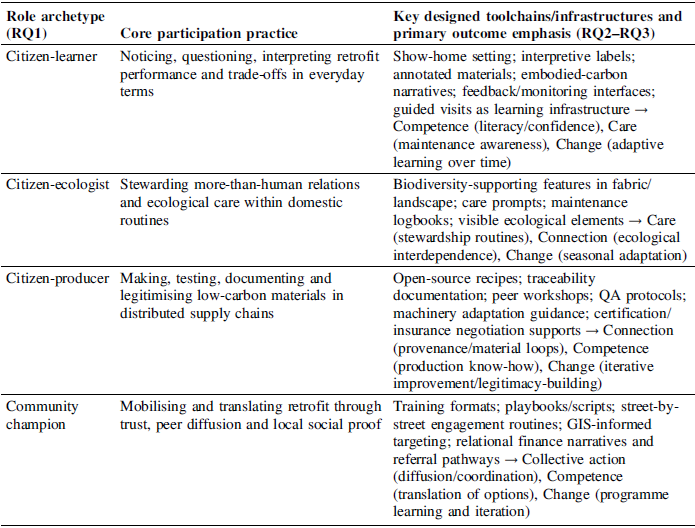
The findings follow the two-stage analytic procedure outlined in Section 3. Within-case analysis examined how each initiative framed the participation challenge and what kinds of infrastructures were mobilised in response. Cross-case synthesis then identified recurring role-practices, their enabling toolchains, and the associated outcome domains. The relationship between roles, practices and infrastructures is summarised in Table 1, which provides an at-a-glance overview of the cross-case configuration.
4.1. The Wild House: learning and stewardship through interpretability infrastructures
The Wild House addresses a participation problem centred on interpretability and confidence in relation to ventilation, moisture and material trade-offs. Rather than treating performance as hidden expertise, the project makes retrofit tangible and discussable through visible and interactive elements that prompt handling, comparison and questioning during visits and everyday use. This configuration enables the citizen-learner and citizen-ecologist roles identified in the cross-case analysis (see Table 1).
The empirical material indicates that learning is produced through situated interaction with artefacts and with other actors, and that post-installation activity is reframed as ongoing stewardship rather than technical burden. The case therefore demonstrates how interpretability infrastructures make competence and care repeatable in practice and how ecological relations can become perceptible within the domestic setting.
4.2. Ag.Lab: harvest to house: citizen production, provenance, and legitimacy in distributed manufacturing
Ag.Lab addresses a different participation problem: the feasibility and legitimacy of localised circular material production. The initiative develops repeatable production approaches and simple quality assurance supports that allow agricultural skills and equipment to be reconfigured for insulation manufacture. This activates the citizen-producer role (Table 1).
The empirical material shows that participation occurs through making, testing and documenting, and that provenance and traceability function both as compliance mechanisms and as narrative devices connecting retrofit to regional material loops. At the same time, the case reveals how certification and insurance regimes oriented to industrial production constrain the scaling of distributed systems, demonstrating that participation is shaped by governance arrangements as well as by household decision-making.
4.3. Retrofit community champions: trust infrastructures, neighbourhood diffusion, and finance as social support
The Champions initiative addresses participation as a problem of trust, perceived risk and comparability of options, particularly for households outside grant support. It builds agency through locally credible intermediaries and structured engagement routines, activating the community champion role (Table 1).
Observations indicate that conversations are anchored in comfort, wellbeing and everyday concerns, with technical and financial options introduced relationally. Finance therefore operates as part of the participation infrastructure rather than as background economics. The case shows how uptake clusters socially and how interpretability and trust shape willingness to proceed.
4.4. Cross-case synthesis: roles, toolchains, and outcome domains
Across the three initiatives, four interdependent role-practices recur as participation mechanisms. These roles are not demographic categories but repeatable configurations of practice enabled and constrained by specific infrastructures. Their core practices, enabling toolchains and primary outcome emphases are summarised in Table 1.
Roles, practices and infrastructures

The cross-case comparison shows that participation is an effect of how retrofit systems are organised: actions become intelligible, repeatable and socially supported when appropriate learning environments, production protocols, engagement formats and relational finance arrangements are in place. Outcomes extend beyond operational carbon and cost to include literacy, trust, stewardship, diffusion and material connection. These domains are mutually reinforcing, with competence supporting care, trust enabling finance acceptance, and stewardship sustaining performance over time.
From this synthesis, a broader evaluative space emerges, structured around five dimensions: competence, care, collective action, connection and change. These dimensions describe what participatory retrofit produces and provide a basis for linking environmental outcomes to the socio-material infrastructures that make them durable.
5. Discussion
Rather than treating participation as an adjunct to technical delivery, the analysis suggests that retrofit operates as a socio-material transition in which environmental outcomes are contingent on the configuration of practices, artefacts and institutions. This underpins the long-standing claims of social practice theories that energy demand and comfort are performed through the alignment of materials, competences, and meanings, and extends these by specifying how these alignments can be intentionally composed through design and organisational formats (Reference Shove, Pantzar and WatsonShove et al., 2012; Reference Gram-HanssenGram-Hanssen, 2014). In this way, the ecological citizenship framing is more than a normative addition, and instead an analytical tool that reveals the civic and infrastructural nature of retrofit, in which ecological citizenship is possible when citizens are provided with resources (Reference DobsonDobson, 2003; Reference HobsonHobson, 2013; Reference Devine-Wright and MurphyDevine-Wright, 2012).
A key contribution of the study is to move the debate on participation from questions of motivation and communication to questions of capability and infrastructure. Retrofit research has repeatedly shown that information provision alone does not secure uptake or performance (Reference FawcettFawcett, 2020; Reference Zhu, Wang, White, Inch and PayneZhu et al., 2025), yet policy continues to assume that awareness and incentives will trigger action. The role-based analysis indicates instead that participation depends on whether programmes create stable socio-material conditions in which households and communities can act with confidence. This resonates with participatory design’s concept of infrastructuring as the ongoing work of assembling and maintaining the supports that enable collective action over time (Reference Binder, Brandt, Ehn and HalseBinder et al., 2015; Reference Akama, Pink and SumartojoAkama et al., 2019). By linking forms of participation to specific artefacts, routines and organisational formats, the paper addresses a persistent gap in transition-oriented design research, which often calls for participation and system change without specifying how they are operationalised in delivery contexts (Reference Ceschin and GaziulusoyCeschin & Gaziulusoy, 2016; Reference IrwinIrwin, 2015). Participation, in this reading, is neither a precondition nor an outcome; it is an effect of how retrofit systems are designed. The findings also complicate the dominant efficiency paradigm by showing that the durability of operational performance is inseparable from the conditions of its maintenance. Sufficiency scholarship has argued that sustainable outcomes depend on infrastructures that support living well with less through adjustment, repair and care rather than through escalating technical optimisation (Reference PrincenPrincen, 2005; Reference Fischer and GrießhammerFischer & Grießhammer, 2013). The analysis extends this argument to retrofit by demonstrating that performance is partly a function of learnability and maintainability. This reframes the performance gap not simply as a discrepancy between predicted and measured energy use but as a structural consequence of delivery models that treat installation as the end point of intervention. When retrofit is understood as an ongoing practice, competences and routines of care become central to environmental outcomes, aligning with empirical studies that identify maintenance and everyday use as decisive for long-term performance (Reference Judson and MallerJudson & Maller, 2014; Reference FawcettFawcett, 2020). Circularity can be interpreted in similar terms. Rather than being achieved through the substitution of low-carbon materials, it depends on systems that make alternative material flows credible and accountable within existing regulatory and procurement regimes (Reference StahelStahel, 2019; Reference Geng, Sarkis and BleischwitzGeng et al., 2019). The analysis therefore supports the argument that sufficiency and circularity are not additional ambitions but delivery conditions for durable decarbonisation.
Another implication is related to legitimacy and finance. There is evidence that trust, social influence, and the role of credible intermediaries are crucial for the adoption of retrofitting (Reference Maller, Horne and DaltonMaller et al., 2012; Reference Walker, Lowery and TheobaldWalker et al., 2014; Reference Seyfang, Park and SmithSeyfang et al., 2013), but these are usually considered as context variables, rather than as part of the socio-technical system. The discussion suggests that legitimacy is actively produced through institutional devices, standards, certification, procurement criteria, and through relational practices that make risk interpretable. The Green Deal experience demonstrated that technically sound financial mechanisms can fail when they are not socially embedded and trusted (Reference Rosenow and EyreRosenow & Eyre, 2016), and the persistent “missing middle” indicates that affordability alone does not generate agency (Reference Palm and ReindlPalm & Reindl, 2018). Interpreting finance as participation infrastructure aligns with energy citizenship scholarship by emphasising that the capacity to act is shaped by the socio-technical arrangements through which options are made meaningful and credible (Reference Devine-Wright and MurphyDevine-Wright, 2012). It also has implications for regenerative and bioregional approaches: unless alternative materials and ecological performance become legible within assurance and procurement regimes, they will remain marginal to mainstream delivery. The evaluative framework proposed in the paper responds to the widely recognised limitation that retrofit programmes are assessed primarily in terms of carbon and cost. By linking competence, care, collective action, connection and change to the mechanisms that produce them, the framework shifts the focus from outcome measurement alone to the infrastructures that make outcomes durable. This is consistent with practice-theoretic accounts of change and with transition design’s emphasis on adaptive capacity and institutional learning (Reference IrwinIrwin, 2015; Reference Ceschin and GaziulusoyCeschin & Gaziulusoy, 2016). Methodologically, it also strengthens the analytical generalisability of the study. The value of the contribution, however, does not reside in the representativeness of the cases but in the specification of transferable relationships between participation practices, enabling infrastructures, and outcome domains that can be validated in other settings (Reference Zimmerman, Forlizzi and EvensonZimmerman et al., 2007). However, the analysis also points to structural tensions that obstruct the straightforward scaling of civic infrastructures. These infrastructures need to be supported in the long term; otherwise, they will remain best practices rather than systemic changes. Regulatory frameworks that are biased towards the standardisation of industry can make place-based and distributed systems invisible, even if they are technically feasible, and inclusion depends on access rather than assumed pro-environmental values. Ecological citizenship, therefore, as practice, also has an institutional component, namely that governance and procurement practices need to acknowledge and support the infrastructures through which participation is exercised (Reference DobsonDobson, 2003; Reference MacGregorMacGregor, 2014). The general lesson is that the decarbonisation of existing housing stock cannot be accomplished by technology and finance alone. It requires the organisation of retrofit as a civic process in which environmental responsibility is learned, negotiated and sustained in everyday life, and in which socio-material conditions for competence, care and collective action are treated as core components of delivery rather than as peripheral supports.
6. Conclusion
This paper began from the observation that, despite technical advances and strong policy focus, domestic retrofit still faces uneven uptake, performance gaps, and persistent questions of legitimacy and equity. It argued that these challenges stem partly from framing retrofit as a techno-economic optimisation problem while under-specifying the socio-material conditions, learning, trust, maintenance, and material connection, through which outcomes are produced. By reframing retrofit as ecological citizenship and analysing three UK initiatives through a research-through-design approach, the study shows that participation is not attitudinal but infrastructural. Across the cases, ecological citizenship appeared as a set of practices enabled by designed supports: interpretive devices that made performance intelligible, open recipes and quality routines that stabilised distributed production, and training and relational finance narratives that built trust and diffusion. These arrangements activated four interrelated role-practices, citizen-learner, citizen-ecologist, citizen-producer, and community champion, sustained through specific toolchains. Retrofit participation therefore emerges as a socio-material capacity distributed across households, neighbourhoods, and regional material systems. The study contributes in three ways. First, it extends efficiency framings by showing that durable decarbonisation depends on sufficiency and circularity as delivery conditions, intelligibility, repairability, maintenance cultures, and place-based material systems, where performance is co-produced and maintained. Second, it maps participatory roles to the artefacts and organisational formats that enable them, specifying how participation is enacted in transitions. Third, it proposes an expanded evaluative lens, competence, care, collective action, connection, and change, that links carbon outcomes to the infrastructures that make them durable and legitimate. Scaling participatory and regenerative retrofit, the cases suggest, requires civic infrastructures: show-home laboratories, champion networks, distributed production, adaptive certification, and relational finance. Yet structural tensions remain, including industrially oriented regulation, and the long-term resourcing of trust and stewardship. Ecological citizenship therefore depends on alignment between governance, procurement, and finance as well as design.
Acknowledgement
This work was funded by a UKRI grant (EP/W020610/1). The Ecological Citizen(s) Network is a cross-RCA research network led by Dr. Rob Phillips, with Professor Sharon Baurley, and Tom Simmonds, in partnership with Professor Sarah West of the Stockholm Environment Institute (SEI) at the University of York, and Professor Alec Shepley of the Faculty of Arts, Science and Technology at Wrexham University. The work was supported by the EPSRC Network+ award (EP/W020610/1). We also thank the Wildhouse and Ag.Lab teams along with the retrofit champion consortium.

 Open access

