

"La Cerrada de los Santos" is an Iron Age cremation cemetery. It lies in the eastern edge of the Spanish Plateau, in the Iberian Mountain System; an area of crucial importance for communications between the Spanish mainland and the Mediterranean coast.
Exploration of the site was carried out between 1990 and 1995 with the excavation of several trenches over an area of 358m2. These excavations revealed some details of the internal structure of the cemetery and the rituals that were performed there (Arenas & Cortés 1995).
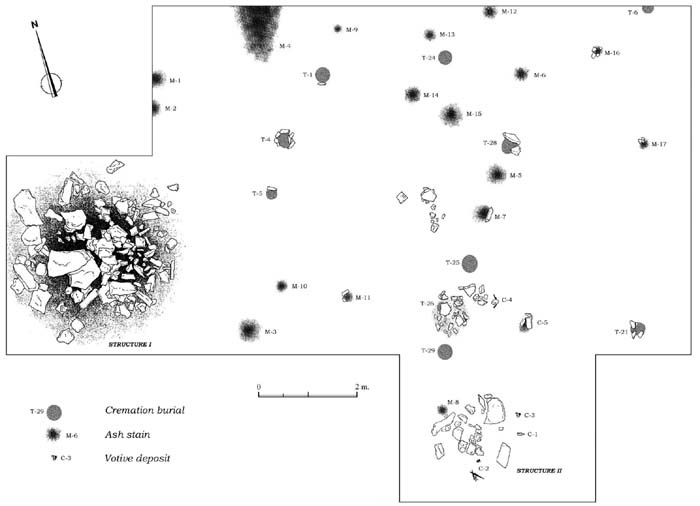
Plan of the excavated Sector B of "La Cerrada de los Santos". The remains date to the 6th century BC (Phase I).

Weaponry included in the grave goods of Grave 17, La Cerrada I.

The site is associated with the Iron Age settlement of "El Palomar", and covers its entire occupation sequence; a long period that can be articulated in two general phases:
- La Cerrada I: 6th century BC. The graves of this period show a varied typology. However, cremations without a funerary urn placed directly in a hole in the ground are predominant. In this phase the grave goods are abundant, comprising iron and bronze ornaments and weapons. It is interesting to note the presence of animal offerings and deposits of votive weaponry as a component of the funerary ritual.
- La Cerrada II: 4th-2nd centuries BC. In this phase the cremations are always placed in ceramic urns, with few grave goods, if they occur. Unlike the previous stage, funerary ritual comprises liquid consumption, as is shown by the presence of a large silicernium with plenty of deliberately broken ceramic cups and jars.
Votive deposit comprising spearhead, spearbutt and shield handles, La Cerrada I.

From a social perspective, the ritual variations observed between the two phases of the cemetery can be interpreted as the activities of two different organizational systems. On the one hand, the observed differentiation in the rich grave goods of La Cerrada I could reflect certain wealth differences, but not necessarily the existence of elites within a strong hierarchical social system, as has been suggested elsewhere (Reference LorrioLorrio 1994, 226: Lorrio 1997, 312 ff.). Instead, comparison of the sex and age associations of the grave goods shows a high degree of heterogeneity, and the complexity and wealth of the graves does not seem to be clearly linked to a specific element of the population (Arenas 1999, 240). In this respect, it has to be said that the weapons appear in both female and male graves, as do the personal ornaments, such as bracelets, fibulae and glass bead necklaces. In contrast, there is no discernible differentiation within the La Cerrada II phase, and there are no clear markers of wealth or status in the grave morphology or their components. On the other hand, the investment in the earlier funerary ritual, illustrated by large quantities of metal and animal resources, clearly contrasts with the low presence of such products in the later phase. Instead, funerary ritual centred on drinking ceremonies, possibly involving wine.
Double cremation burial in ceramic urn, La Cerrada II.

The general interpretation of these differences is that the users of La Cerrada I, clearly practised conspicuous consumption in their funerary ritual. This community was involved in a process of socio-economic readjustment, possibly status re-ordering and the consolidation of new social positions. This is a logical framework when we take into account the fact that the 6th century BC is the formative period of the local Iron Age, the so-called Celtiberian culture. During the second phase of the cemetery, coeval with the heyday of the local Celtiberian culture, the lower investment of primary resources and the consumption of secondary products might reflect the social and economic stability achieved by the local Iron Age communities. The conspicuous consumption of wealth within funerary practices was replaced by other forms of social reproduction within the boundaries of the emergent urban centres.