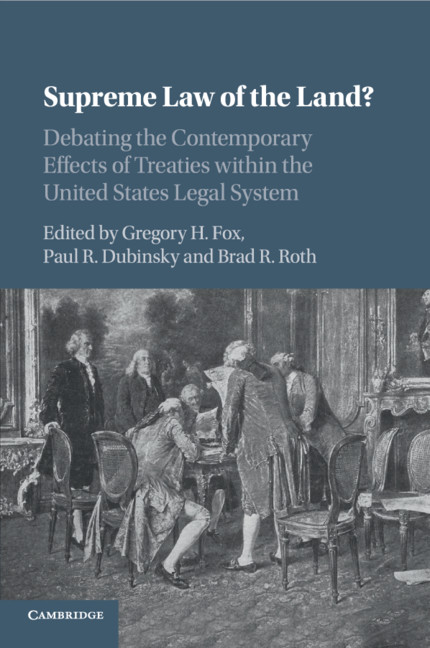

How do treaties function in the American legal system? This book provides a comprehensive analysis of the current status of treaties in American law. Its ten chapters examine major areas of change in treaty law in recent decades, including treaty interpretation, federalism, self-execution, treaty implementing legislation, treaty form, and judicial barriers to treaty enforcement. The book also includes two in-depth case studies: one on the effectiveness of treaties in the regulation of armed conflict and one on the role of a resurgent federalism in complicating US efforts to ratify and implement treaties in private international law. Each chapter asks whether the treaty rules of the 1987 Third Restatement of Foreign Relations Law accurately reflect today's judicial, executive, and legislative practices. This volume is original and provocative, a useful desk companion for judges and practicing lawyers, and an engaging read for the general reader and graduate students.
'Featuring an array of leading scholars, this excellent collection provides a much-needed update on recent developments in treaty law in the US legal system. By showing the growing hurdles facing domestic treaty enforcement, the in-depth essays in this volume together should greatly assist in overcoming the challenges they describe.'
Martin S. Flaherty - Leitner Family Professor of International Human Rights Law and Founding Co-Director, Leitner Center of International Law and Justice, Fordham University School of Law
Loading metrics...
* Views captured on Cambridge Core between #date#. This data will be updated every 24 hours.
Usage data cannot currently be displayed.
This section outlines the accessibility features of this content - including support for screen readers, full keyboard navigation and high-contrast display options. This may not be relevant for you.
Accessibility compliance for the HTML of this book is currently unknown and may be updated in the future.
