


INTRODUCTION
After a period of rapid increase, HIV prevalence has stabilized in several countries in recent years. In Malawi this has been seen in national estimates [1] and in epidemiological studies [Reference Crampin2]. Trends in HIV incidence are less well known but are crucial for planning and evaluating interventions. Past as well as current incidence determines the proportion of individuals living with HIV who have been infected for different lengths of time, and hence the likely proportion of HIV-infected individuals who would benefit from the introduction of antiretroviral therapy (ART).
In Karonga District, Malawi, information on HIV prevalence has been available since 1981, based on population surveys, community samples and antenatal clinic (ANC) surveillance [Reference Crampin2, Reference Glynn3]. This study demonstrates how these data can be used to estimate age- and sex-specific HIV prevalence and incidence trends from the first introduction of HIV until 2004, and to predict the initial need for antiretrovirals. ART roll-out, under the Malawi national scheme was started in 2004 and the first ART clinic in Karonga District opened in mid-2005.
METHODS
Data
Karonga District is in the north of Malawi. It is a rural area with a current population of around 238 000. The data described here were collected within the context of the Karonga Prevention Study, a long-term epidemiological research programme, whose methods have been described in detail [Reference Crampin2, Reference Glynn3]. House-to-house total population surveys were conducted in 1980–1984 and 1986–1989 [Reference Ponninghaus4]. HIV prevalence was measured in all individuals living in two areas of the district during these surveys using dried blood spots collected on filter papers [Reference Glynn3]. Case-control studies of HIV as a risk factor for tuberculosis and leprosy were conducted between 1988 and 1993 [Reference Ponnighaus5, Reference Glynn6], and between 1998 and 2004 [Reference Crampin7]. The controls at each period were randomly selected from the whole district population but with an age, sex and area distribution similar to that of tuberculosis and leprosy cases. Controls were interviewed and blood was taken for HIV testing, after counselling and if consent was given. ANC sentinel surveillance for HIV started in four clinics in the district in 1999. Women attending for their first visit for that pregnancy were interviewed and venous blood was taken for syphilis testing and subsequently anonymized, unlinked from personal identifiers and tested for HIV. Each year, data collection continued in each clinic until 250 women had been seen.
For dried blood spot specimens collected in 1981–1984 and 1986–1989 HIV testing used a particle agglutination assay for anti-HIV-1 (Edgware modification of the Serodia; Mast Diagnostics Ltd, Bootle, Merseyside, UK), with confirmation of positive samples using an ELISA (Vironostika HIV kit, Organon Teknika, Cambridge, UK) and a particle agglutination assay (Serodia; Fujirebio Inc., Tokyo, Japan). In 1988–1993, initial testing on the venous blood samples used an enzyme-linked immunosorbent assay (ELISA Organon Vironostika, Durham, NC, USA) and particle agglutination test (Edgware modification of the Serodia). Positives were confirmed using a further ELISA, Wellcozyme (Wellcome Diagnostics, Dartford, UK) or Behring Enzygnost (Marburg, Germany) and particle agglutination assay (Fujirebio). From 1998, the first two tests were conducted as before, and samples giving discrepant results were repeated in duplicate using the same two tests. Repeated discrepancies were analysed by Western blot. HIV testing in each study and of the archived samples was approved by the National Health Sciences Research Committee of Malawi and the Ethics Committee of the London School of Hygiene and Tropical Medicine.
Direct standardization was used to estimate HIV prevalence for the whole district adjusted by age and area of residence, separately for men and women. District data from the 1998 national census were used for the age distribution. The district was divided into six areas and the 1986–1989 survey data were used for the percentage of the population in each [Reference Crampin2]. The ANCs were held in four of these areas but women resident in all six areas attended; area of residence was used for the standardization.
HIV prevalence data from 1981–1984 and 1987–1989 were available from two of the areas. The HIV prevalence for the whole district in 1981–1984 and 1987–1989 was estimated by assuming that the relative prevalence of HIV in these areas and in the whole district was the same as that among the community controls in 1988–1990.
Mathematical model
We extended methods that have been used previously to estimate HIV incidence during the growth phase of the HIV epidemic [Reference Williams8, Reference Gouws9]. These previous models have assumed that the prevalence of HIV was increasing exponentially and that the median survival time of HIV positive individuals, modelled as a Weibull distribution, was either 7 years, irrespective of the age at infection [Reference Williams8], or decreased with the age at infection but was identical to that measured in developed counties (overall median=10 and 11 years for males and females respectively [Reference Gouws9]). Here, we estimated the age-, sex- and time-specific incidence of HIV in Karonga allowing for (i) a levelling off or a decrease in the HIV incidence, and (ii) age-dependent survival among HIV-positive individuals measured in developing countries, as described below.
The HIV incidence for individuals of age a at time t was given by the expression i(a, t)=r(a)f(t) where r(a) describes the dependence of the HIV incidence on age a of individuals at a given time t, and f(t) describes the dependence of the HIV incidence on time t for individuals of age a. r(a) was assumed to follow a Weibull distribution, with the youngest and oldest age at HIV infection being 13 and 75 years respectively. Two alternative assumptions for the change in the HIV incidence over time f(t) were explored. In the first, simpler model 1, the HIV incidence was permitted to rise and level off over time, but not fall. In the second model 2, the HIV incidence was permitted to rise and then either level off or fall over time. In these two models f(t) was described using a single or double-logistic function respectively:
Model 1: No decline in HIV incidence

Model 2: Decline in HIV incidence permitted
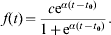

where c is the annual incidence when the epidemic has levelled off (% per year), t 0 determines the timing of the epidemic (year), α determines the rate of increase in the incidence during the growth phase of the epidemic (% per year), and b determines the peak incidence (% per year). The parameters defining models 1 and 2, together with those of the Weibull distributions defining the change in the HIV incidence with age were estimated simultaneously by maximum-likelihood methods for males and females separately (see below).
In line with Gouws et al. [Reference Gouws9] we assumed age-specific survival by time since infection followed a Weibull distribution. Gouws and colleagues fitted Weibull distributions to age-specific survival data measured in Europe, North America and Australia [10]. Recent data support a shorter time from HIV infection to death in the developing world [Reference Morgan11, Reference Van de Paal12] than in the developed world, and therefore we proportionally adjusted the age-specific survival to model a median survival time of 9·8 years among the 25–34 years age group (compared to 10·9 years among the same age group in the CASCADE data [10]). The median survival times among individuals infected between 5–14, 15–24, 25–34, 35–44, 45–54, 55–64 and ⩾65 years were 12·5, 11·1, 9·8, 8·3, 7·1, 5·8 and 3·7 years respectively.
The HIV incidence over time and by age was estimated by fitting expressions for the age- and time-specific HIV prevalence as given in Williams et al. [Reference Williams8], taking into account age and time-dependent HIV incidence as described above, to all the available age-specific and overall age- and area-standardized HIV prevalence data, using maximum-likelihood methods [Reference Williams and Dye13, Reference Press14], for males and females and for models 1 and 2 separately. Goodness-of-fit was assessed by calculating the deviance for males and females and for models 1 and 2 separately, using the expression:

where S(a, t) is the observed number of individuals of age a at time t who are not infected, N(a, t) is the observed number of individuals of age a at time t who were tested for HIV and p(a, t) is the model prediction of the proportion positive and  is the observed proportion positive.
The models calculate the proportion of the population infected by HIV and the time since infection, by age [Reference Williams8]. Because the survival by age at infection is known, the time until death can also be calculated. By assuming that the limited ART roll-out in Karonga District to date has had little impact on HIV/AIDS mortality, and by assuming a period of eligibility for ART before death, the model was then used to predict the proportion and number of adults in Karonga District that were in need of ART in 2005, by age and sex. The current estimates made by UNAIDS assume that all those within 2 years of death from HIV/AIDS are eligible for ART, regardless of the age of infection [Reference Boerma15] based on a literature review by Schneider et al. [Reference Schneider, Zwahlen and Egger16]. To allow comparison between our estimates and those made by UNAIDS we make the same assumption in our default scenario. However, the data supporting this assumption are equivocal [Reference Boerma15, Reference Schneider, Zwahlen and Egger16] and, therefore, we also present estimates that (a) assume that all that those within 1·5 or 2·5 years of death from HIV/AIDS are eligible for ART, regardless of age of infection, and (b) assume that the eligible period decreases with increasing age at infection in line with the data on survival. In the latter scenario individuals aged 15–24, 25–34, 35–54, and ⩾55 years at infection, were assumed to be eligible for ART if they were within 2·5, 2·0, 1·5 and 1·0 years of death respectively.
The results were compared with those from the combined UNAIDS EPP [17] and Spectrum [18] models. These use overall estimates of adult prevalence by year, usually from ANC data. We ran these standard models using our estimates of prevalence among 15- to 44-year-old males and females separately to assess the reliability of the output of these models for other settings.
RESULTS
Observed HIV prevalence
The top two panels in Figure 1 show the age- and area-standardized estimates of HIV prevalence among males and females aged ⩾15 years. HIV prevalence rose quickly in the late 1980s and early 1990s. Since the early 1990s, the prevalence has been relatively stable at around 12%.
Top panels: Observed and estimated trend in HIV prevalence (%) among individuals in the community aged ⩾15 years, by sex and year (%). Bottom panels: Estimated annual HIV incidence in the community among individuals aged ⩾15 years, by sex and year (% per year). Two models were used in which the trend in HIV incidence was or was not permitted to decrease from its peak. Bars show 95% confidence intervals around data-point estimates.

Age- and area-standardized HIV prevalence among women aged 15–44 years attending ANCs was also stable from 1999–2002, around 10% (not shown). Overall HIV prevalence among ANC women was lower than among community controls of the same age. Adjusting for parity [Reference Zaba19], and assuming 21·5% of women were childless [Reference Malawi20], we estimated that the mean HIV prevalence in women aged 15–44 years in the community between 1999 and 2002, was 15·0%. This was consistent with estimates from women in the community of the same age [1998–2001: 14·2% (95% CI 10·1–18·2); 2002–2004: 13·0% (95% CI 5·4–20·6)].
Observed and estimated overall HIV prevalence
The top two panels in Figure 1 also show the HIV prevalence trend among adults in the community predicted by the two models. Both models fitted the HIV prevalence well before 1990 and in 2000. Model 2, in which HIV incidence was permitted to fall from its peak, provided a slightly better fit to both the male and female HIV prevalence data, especially for females in 1992 and 2003 (Fig. 1).
Estimated overall HIV incidence
The bottom two panels in Figure 1 show the estimated trend in annual HIV incidence among males and females in the community aged ⩾15 years. Both models predicted that HIV incidence rose quickly in the late 1980s. Model 1, in which HIV incidence was not permitted to decline, predicted that the annual HIV incidence had levelled off by the mid-1990s, at 1·6% among males and 1·8% among females. Model 2, in which HIV incidence decline was permitted, predicted that the annual HIV incidence peaked in the early 1990s at 2·2% among males and 3·1% among females, and then levelled off at 1·3% among males and 1·1% among females by the late 1990s.
Observed and estimated age-specific HIV prevalence
Both models provided a very good fit of HIV prevalence by age, with most model estimates lying within the 95% CIs associated with the observed data (Fig. 2). The exceptions were: among males in 1987–1989, both models overestimated the HIV prevalence among the 15–24 years age group, and underestimated the HIV prevalence among the 25–34 years age group; in 1988–1990 the models overestimated HIV prevalence among females aged 45–54 years; and in 2002–2004 the models overestimated HIV prevalence among males aged 25–34 years.
Observed and estimated trend in male and female HIV prevalence among individuals in the community aged ⩾15 years, by age, sex and year. Two models were used in which the trend in HIV incidence was or was not permitted to decrease from its peak. Bars show 95% confidence interval around data-point estimate. □, Data;, model (no decline in HIV incidence); ■, model (decline in HIV incidence).

Model 2 in which HIV incidence was permitted to decrease, led to a slightly higher projected HIV prevalence in all age groups between 1991 and 1993 and slightly lower HIV prevalence in all age groups between 2002 and 2004 than model 1, but otherwise the HIV prevalences by age projected by both models were very similar.
Estimated age-specific HIV incidence
The estimated age at highest risk of HIV infection was much older among males (33 years) than females (25 or 23 years old using models 1 or 2 respectively) (Fig. 3).
Estimated annual HIV incidence among susceptible individuals in the community aged ⩾15 years, by age, sex and year (% per year). Two models were used in which the trend in HIV incidence was not permitted (top panels) or was permitted (bottom panels) to decrease from its peak. Lines for 1996 and 2001 were coincident for the no-decrease scenario.

Prevalence by time since infection, time to death from HIV/AIDS
Since model 2 provided a better fit to the HIV prevalence data than model 1, for both males (deviance of model 1=47·6 on 31 d.f. and model 2=44·9 on 29 d.f.) and females (deviance of model 1=49·8 on 32 d.f. and model 2=32·8 on 30 d.f.), it was used to estimate the HIV prevalence by time since infection and time to death and the need for ART.
The proportion of HIV-infected adults who had been infected for <5 years fell from 100% at the start of the HIV epidemic to an estimated 46% of infected males and 40% of infected females by 2005 (Fig. 4, top panels). The model predicted that the proportion of adults who had been infected between 5 and 9 years peaked at 45% of males in 1998 and 53% of females in 1999, before falling to 32% of males and 31% of females in 2005. The proportion estimated to have been infected for ⩾10 years peaked in 2004 for both sexes, at 22% for males and 30% for females and had not fallen appreciably by 2005.
Estimated prevalence by time since infection (top panels) and time to death (bottom panels) among individuals in the community aged ⩾15 years, by sex and year (%). The model permitted HIV incidence to decrease from its peak.

Initial ART need
The estimated initial need for ART varied considerably with the assumed period of eligibility. In the default scenario, assuming that all those within 2 years of death from HIV/AIDS would be eligible for ART, 2·1% (2·0% of males and 2·2% of females) of adults aged ⩾15 years in Karonga District were estimated to be in need of ART in 2005 (Fig. 4, bottom panels). In this scenario, assuming that there were ∼119 000 adults in Karonga District this equates to 1206 males and 1324 females in need of ART in Karonga District in 2005. In the absence of treatment, the proportion of the population in need of ART peaked in 2001 at 2·1% of males and 2·5% of females (Fig. 4, bottom panels). The model suggests that there is need for ART over a wide age range in both sexes, peaking among the 35–44 years age group (Fig. 5).
Estimated prevalence by time to death from AIDS among individuals in the community aged ⩾15 years in 2005, by age and sex (%). The model permitted HIV incidence to decrease from its peak.

However, if instead we assume that all those within 1·5 or 2·5 years of death from HIV/AIDS would be eligible, then 1·6% (1·5% of males and 1·7% of females) or 2·6% (2·5% of males and 2·8% of females) of adults in Karonga District would be in need of ART, respectively. The predictions were less sensitive to the assumption that the period of eligibility did not vary by age. If we assume that the eligible period decreased with increasing age at infection, then the proportion of adults aged ⩾15 years in need of ART was estimated to be 2·2% (2·1% of males and 2·3% of females).
Comparison with EPP and Spectrum
Using the standardized HIV prevalence data for adults aged 15–44 years a good fit of the HIV prevalence trend was obtained by the EPP model (not shown). Based on this HIV prevalence trend, the Spectrum model predicted the HIV incidence for males aged ⩾15 years peaked around 5·7% per year in 1990 and had levelled off around 1·5% per year by 2005. Among females, the projected HIV incidence peaked around 3·3% per year in 1991 and had levelled off around 1·7% per year by 2005. In 2005, the initial need for ART was predicted to be 2·1% (2·0% of males and 2·2% of females) of adults aged ⩾15 years.
DISCUSSION
We estimated the age-specific HIV incidence trend and initial need for ART from age-specific prevalence trend data. Both our models permitted the HIV incidence trend to rise and level off, while the second model also allowed the incidence trend to fall from its peak, if this provided a better fit to the prevalence data.
Both models fitted the overall and age-specific prevalence trend well (Fig. 1, top panels and Fig. 2) and both suggested that current incidence is stable and similar among men and women (Fig. 1, bottom panels). The estimated overall and age-specific prealence trends were similar using the two models particularly among males, but the historic incidence trends differed markedly (Fig. 1, bottom panels). The HIV prevalence data were better fitted by the model in which HIV incidence fell from its peak. In this model, the peak HIV incidence was estimated to have occurred in the early 1990s, over 10 years ago.
A fall in the incidence rate during an epidemic is expected for the spread of an infectious disease in a population in which there is heterogeneity in risk behaviour [21]. HIV spreads more quickly and saturates amongst those at most risk, for example those with highest rates of partner change. The remaining susceptibles in the population have lower risk behaviour and therefore the average incidence rate may fall. In addition, the proportion of the population in the highly infectious primary HIV stage [Reference Wawer22] is largest early in an HIV epidemic. As this proportion falls due to progression to the less infectious asymptomatic phase [Reference Wawer22], the incidence rate may fall. This will be countered to some extent later in the epidemic as a larger proportion of HIV-infected individuals progress to the more infectious AIDS stage, but this rise may be partially mitigated by reductions in sexual activity [Reference Wawer22] due to ill health. If secular reductions in risk behaviour had also occurred in Karonga District, this incidence decline would have been hastened, but by itself, this predicted fall in incidence does not imply reductions in risk behaviour. Corroborating behavioural data are not yet available for this population.
This study suggests there is considerable uncertainty about the initial need for ART due to lack of definitive data on the likely period of eligibility [Reference Boerma15, Reference Schneider, Zwahlen and Egger16]. Estimates of the percentage of adults in Karonga District that were in need of ART ranged between 1·6% and 2·6% if the period of eligibility, prior to the introduction of treatment, was assumed to be 1·5 or 2·5 years. In contrast, the study suggested that these predictions for Karonga District were relatively robust to the assumption that ART eligibility does not vary by age at infection.
In the default scenario that assumed that the period of eligibility was 2 years and did not vary by age, the model predicted that around 2500 (2·1%) adults in Karonga are currently in need of ART (Fig. 4, bottom). As around 50 new clients are being enrolled into ART each month this initial need for ART could be met within 4 years, but in practice, access and resource constraints may hinder rollout to those in need, and the ongoing need for ART is expected to increase due to reduced rates of HIV/AIDS mortality. Maintaining availability of ART in the face of improving survival and the associated increase in the cumulative pool of eligible individuals will be a major challenge for ART programmes, unless there is a concurrent decrease in incidence as a result of behavioural change or reduction in infectivity due to ART. Predicting the ongoing need for ART is beyond the current scope of this model but planned studies will give direct estimates of ART uptake and its impact on mortality and HIV transmission in Karonga District, and these data will be used to estimate the ongoing need for ART in this population.
These predictions suffer from the limitations of the model on which they are based [Reference Williams8]. It was assumed that the overall risk of HIV infection could vary over time, but the relative risk of HIV infection by age did not. This is unlikely to be true over an HIV epidemic because HIV initially spreads among higher risk groups and then among the general population, and the age distributions of these two groups will differ. HIV incidence by age was assumed to follow a Weibull distribution rather than a log-normal distribution [Reference Williams8] and may thus have predicted HIV incidence rates that were too high in the very young of both sexes and in older women (Fig. 3). However, despite these limitations the models provided good fits to the observed HIV prevalence trend by age (Fig. 2) suggesting that the effect of these model limitations was not great. The methodology presented here requires more data than the Williams et al. model [Reference Williams8] but does allow the HIV incidence trend over time to be predicted, and age- and sex-specific HIV incidence and ART-need to be estimated. An alternative, but probably equally productive approach would have been to extend the methods developed by Gregson et al. [Reference Gregson23] that were used to estimate HIV incidence from HIV prevalence assuming stable endemic conditions. In the same way, more data would have been required to parameterize this extended model, but it could have been used to provide estimates of HIV incidence and initial ART need over the epidemic and endemic stages of HIV spread throughout Karonga District.
The standard EPP and Spectrum models, although based only on overall prevalence data and although predicting a shorter, sharper peak for the incidence curve, gave very similar estimates of initial ART need to the estimates provided by our model, if we assumed the same 2-year eligibility period. This supports the usefulness of EPP and Spectrum for assessing ART need in other settings with fewer data. However, our study does highlight the sensitivity of the predictions of both models to the assumed period of ART eligibility.
This study has presented a simple extension to a previous method and allows age-specific prevalence trend data to be used to estimate the trend in age-specific HIV incidence and time since infection. These predictions can be used for estimating the initial need for ART.
ACKNOWLEDGEMENTS
We thank the Government of the Republic of Malawi for their interest in and support of the Project and the National Health Sciences Research Committee of Malawi for permission to publish the paper. R.G.W. thanks the UK Medical Research Council for funding. Data used in this study come from the Karonga Prevention study, initially funded by the British Leprosy Relief Association (LEPRA), and since 1996 by The Wellcome Trust. J.R.G. is partially funded by the UK Department of Health (Public Health Career Scientist award).
DECLARATION OF INTEREST
None.



