




The principles of Classic Maya hieroglyphic writing were rediscovered over more than a century of hard and often contentious epigraphic research and argument, including by one of the present authors. We will not review those principles here. Instead, we would draw our readers’ attention to a different, but equally widely known, rule of Maya epigraphy, which one of us thinks of as “Houston’s law”: the greater the interest an epigrapher has in some historical datum in a text, a crucial name or verb, the lower the probability that it will have survived the centuries in legible condition.
And yet, as long as a glyph has not been totally destroyed, some hope remains. Even eroded details can sometimes be recognized in a flash of insight and raking light. Infrared photography can bring out faded inks and paints. And three-dimensional digital models of monuments, made by structured light scanning or photogrammetry, can be moved about and lit from any direction under simulated conditions in greater comfort and leisure than can usually be enjoyed in the field—sometimes with the result that inscriptions too eroded or lichen-covered to read securely in person at last yield up their secrets.
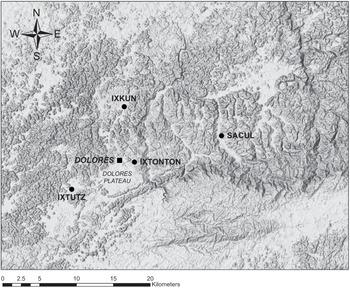
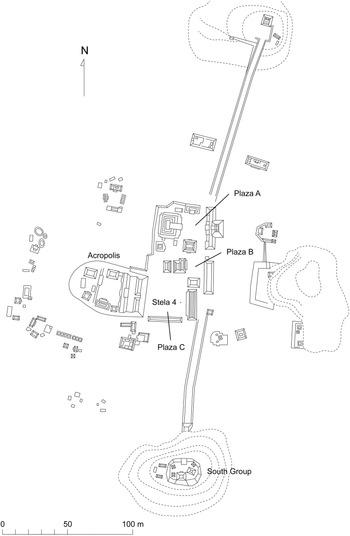
This is the case for Stela 4 at Ixkun, an ancient, modestly sized Maya royal capital located a little less than 8 km north of the present town of Dolores, Peten, Guatemala, in a relatively flat basin ringed by hills (Figure 1, Figure 2, Figure 3). A single hill near the middle has a spring of clear water flowing at the base year-round; this, surely, inspired Maya farmers to settle there by the Late Preclassic period, although the place did not have a king until the late 700s a.d. (see Carter 2016). With the king’s arrival came a great remodeling of the settlement: the ancient E-Group in the site core came to house royal monuments celebrating rituals and victories; it was expanded to the south by the construction of two new plazas; and an elevated royal residence was built on the western side of the southernmost plaza (Laporte et al. 1994:34). As Alfred Maudslay says, “[Ixkun] could not have been a town of very great importance, as the buildings are small and the masonry is of an inferior class, but the sculptured monoliths and hieroglyphic inscriptions show that it belonged to a good period” (Maudslay 1889–1902:21).
Map showing sites mentioned in this article. By Nicholas Carter.

Map of the Dolores region showing the four local royal capitals. By Nicholas Carter.

Map of the site core of Ixkun (after Laporte and Mejía Reference Laporte and Mejía2005:14 and Graham Reference Graham1980:135). Drawing by Nicholas Carter.

In this paper, we will present a new photogrammetric model and line drawing of Ixkun Stela 4 in which most of its hieroglyphic inscription is shown to be legible or reconstructible. We will offer our best interpretation of the text and its implications for Maya history and political strategies at the end of the Classic period. Much of what we have to say will be speculative, but it is at least informed speculation, and we think our reconstructions, epigraphic and historical, fit well with what is known from other sources about the people and polities involved in the narrative.
Ixkun Stela 4
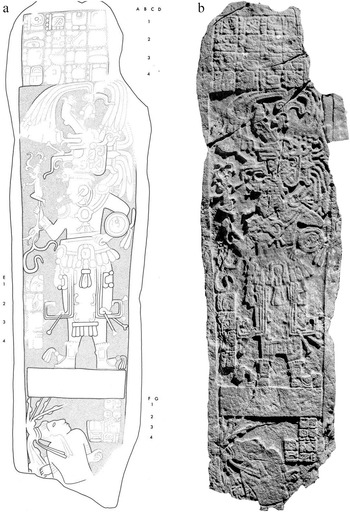
Stela 4 (Figure 4) lies on its back where it once stood, on the eastern side of the southern plaza opposite the palace. It fell some hundreds of years ago, and today the bottom part of the carved surface is missing—the butt is in situ—while the upper part is riven with deep fissures and, of course, is eroded and covered in microflora (Graham Reference Graham1980:147). The top right corner has broken away, but with no loss to the text or imagery. The monument remains impressive, more than 4 m tall, and its front surface is carved in relief with a scene of a ruler in his ceremonial finery standing above a bound prisoner—a fine example of what Tatiana Proskouriakoff (Reference Proskouriakoff1950:18) called the Dynamic Phase of Classic Maya sculpture. Above this is a text panel of 16 glyph blocks, and there are two shorter captions in the scene below, one referring to the king and the other to the prisoner at his feet.
Ixkun Stela 4: (a) drawing by Ian Graham, © President and Fellows of Harvard College, Peabody Museum of Archaeology and Ethnology, 2004.15.6.4.5; (b) photograph (CC) by Bruce Love, from Love (Reference Love2018).

Stela 4 was drawn, possibly by Eusebio Lara and not with notable accuracy, during a visit to Ixkun in 1852 by Colonel Modesto Méndez, corregidor of Peten. The original drawing appears lost; but a copy made the following year was submitted to the Society of Antiquaries of London by Frederick Chatfield, the British chargé d’affaires in Central America, and it remains in the Society’s collection. Another copy, omitting the inscriptions, was published in the same year by Carl Ritter (Reference Ritter1853:Figure 11; see Hammond Reference Hammond1984 for the history of these drawings). Alfred Maudslay saw the monument but did not publish any images of it; later, in 1914, Herbert Spinden and Sylvanus Morley photographed the known monuments of Ixkun during an expedition for the Carnegie Institution (Graham Reference Graham1980:134, 147). Ian Graham photographed Stela 4 in the early 1970s and published a photograph and his line drawing in a volume of the Corpus of Maya Hieroglyphic Inscriptions (Graham Reference Graham1980:147–148; Figure 4a). Graham’s drawing clarified the date in the main text panel, which Proskouriakoff (Reference Proskouriakoff1950:141) had not been able to make out, and a more recent photograph by Bruce Love (Reference Love2018; Figure 4b) renders most of the inscription more crisply. Yet the poor condition of the glyphs has to a large extent stymied their interpretation until the present time (see Laporte and Mejía Reference Laporte and Mejía2005:197–205).
An intriguing—but, until now, little understood—feature of the text is the presence of a royal title, k’uhul mutuul ajaw, in glyph blocks A4–B4 of the upper inscription. Besides the Calendar Round date, these are almost the only legible glyphs in Graham’s photograph and drawing. The MUT logogram is of the old form favored at Tikal; but the lord’s name, at A3, remained illegible, and it could not be ruled out that the reference was to some lord of the Dos Pilas branch of the dynasty, which by the late eighth century had fragmented into multiple families ruling at several sites in the Petexbatun region (Houston and Mathews Reference Houston and Mathews1985:18–24; Martin and Grube Reference Martin and Grube2008:64–65). The desire to identify this person and the associated verb at position A2 substantially motivated this project.
Iconography of the scene
The standing ruler appears to be the same king who was responsible for all other inscribed monuments at Ixkun. He has variously been referred to in the literature as “Rabbit-God K” (Schele Reference Schele1982:144) and “Yukuul Chan Ahk” or “Yukuul Kan Ahk” (Carter Reference Carter2016:245; Carter and MacLeod Reference Carter and MacLeod2021:14). However, he seems to be identified by multiple names or titles in various inscriptions, and so, pending a closer investigation, we will call him “Ixkun Ruler A” here.
Ruler A wears the Late Classic royal costume typical for period-ending celebrations, although no period-ending date is carved on the stela. As it does on Ixkun Stelae 1 and 3, his headdress includes a mask of the Waterlily Serpent, witz’, the deity of floodwaters and waterfalls (Stuart Reference Stuart2007). His left arm bears a small, round shield with the face of the Jaguar God of the Underworld, with plumes curving out from behind the shield. This is the same kind of shield which Ruler A and his counterpart, the king of Sacul, wear on Stela 1. In his other hand, he holds up a K’awiil scepter. No monuments at Sacul depict such an object; they do not seem to have been important to the performance of kingship at that site, or perhaps, as discussed below, they were not available. K’awiil scepters do appear on Ho’kab’ monuments: on Stela 2 at Ixtonton, and on the very eroded Stelae 2 and 3 at Ixtutz. At Ixkun, Stela 3 depicts a lord (presumably also Ruler A) holding a K’awiil scepter, but there is no date on the surviving portion of the monument. Stela 4 is thus the only dateable sculpture at the site which portrays this scepter.
In many Classic Maya kingdoms, to “take [the] K’awiil [scepter]” (k’am/ch’am k’awiil) was a crucial act in the ritual of royal accession; but, as David Stuart has pointed out, it was not synonymous with an elevation to royal status in the strictly political sense. Instead, it involved receipt of a sacred object and the supernatural powers and authority that went with it. For instance, when K’ihnich Yax K’uk’ Mo’ became the first king of Copan’s Classic dynasty, he “took the K’awiil” in a temple, perhaps at Teotihuacan, before beginning the journey to his new kingdom; when his distant descendant, Waxaklajuun U Baah K’awiil, was captured and executed by his former vassal K’ahk’ Tiliw Chan Yopaat, the latter “took the K’awiil” in turn, though he had been crowned king of Quirigua 14 years earlier (Stuart Reference Stuart, Bell, Canuto and Sharer2004:233). A few archaeological examples of K’awiil scepters and effigies which could have been thus “taken” have survived (e.g., Coe Reference Coe1967:57; M. Miller and Martin Reference Miller and Martin2004:Plate 3), and they were obviously regalia for the rulers who held them (Rice Reference Rice2012). On lintels at Yaxchilan, when kings are depicted holding the K’awiil scepter, the queen is often present holding a bundle; this suggests that the scepter was kept safe in that bundle when not in use.
But, according to the conventions of Maya kingship, could any self-proclaimed king commission such an object to be made for him? We suspect not. In some inscriptions, k’awiil refers to some concept of legitimate authority and supernatural power, instead of or in addition to the deity K’awiil or effigies of him. Thus, Sihyaj K’ahk’, the kaloomte’ or overlord who overthrew Chak To’k’ Ich’aak of Tikal and installed the young Yax Nuun Ahiin I in his place, is called “the western K’awiil” (ochk’in k’awiil) on Tikal Stela 31. In describing the end of K’ihnich Yax K’uk’ Mo’s journey to Copan, Altar Q of that site calls him “K’awiil, the western kaloomte’.” And on the hieroglyphic steps looted from Caracol in the seventh century by Naranjo and its allies, in a section discussing the relocation of Yuhknoom Ch’een’s court from Dzibanche to Calakmul, we read that “K’awiil was extinguished” (mahchaj k’awiil) in the former location, and “made” or “fashioned” (patlaj k’awiil) in the latter (Helmke and Awe Reference Helmke and Awe2016:13–15). We think that k’awiil, in the sense of this kind of authority and the scepters that embodied it, had to be received from someone who already had the social and moral right to it. And, as discussed below, we think the K’awiil scepter’s presence on Stela 4 is not an accident.
The prisoner in the lower panel (Figure 5a) has a ritually significant costume element of his own: beads strung along the disheveled locks of his hair. While rulers at some sites are occasionally shown with beaded hair (Krempel et al. Reference Krempel, Matteo and Boot2014:Figure 5; M. Miller and Brittenham Reference Miller and Brittenham2013:Figure 283), captives also sometimes wear such adornment, as on a carved bone from Burial 116 at Tikal and an unprovenienced polychrome vase (K0638) (Figure 5b, c; Trik Reference Trik1963:14). Beaded hair also features in depictions of lords, prisoners, and slain sacrificial victims in some of the murals of Chichen Itza (V. Miller Reference Miller, Tiesler and Lozada2018:134–137).
Persons with beaded hair: (a) the captive on Ixkun Stela 4 (drawing by Nicholas Carter after a photograph by Bruce Love and Blender images by Aliyah Anderson); (b) a captive on a carved bone from Tikal Burial 116 (drawing by Linda Schele, © David Schele, photo courtesy Ancient Americas at LACMA); (c) a captive on a polychrome painted vase (K0638, drawing by Aliyah Anderson); (d) the Maize God on a carved-incised vase (K4331, drawing by Nicholas Carter).

The norm in Classic Maya art is for prisoners, after the moment of surrender, to appear naked or nearly so, stripped of all finery, their ear ornaments replaced with strips of rag or paper. Those who wear beads in their hair are not otherwise better dressed than their counterparts who do not. Beaded hair on prisoners should thus have some ritual significance. The Maya Maize God is associated with precious stones and sometimes appears with beads in his hair (e.g., Martin Reference Martin and McNeil2006:Figure 8.1; Taube Reference Taube1996:Figure 20f; see Figure 5d). Captives with beaded hair may thus have impersonated the Maize God in his period of captivity in the underworld, whether in preparation for sacrifice or not. The captive on Stela 4 may have escaped that fate—at least, as we show below, he had certainly escaped it for about the past five years, and likely for closer to 16.
Documentation and modeling
In 2022, two of this paper’s authors took 418 close-up, digital photographs of Stela 4, comprising full coverage of its carved front surface from all angles. Later, we used Agisoft Metashape to create a digital, three-dimensional, photogrammetric model of the stela. Following an approach that has been successful with other eroded monuments (see Carter et al. Reference Carter, Krause and Lozano2024), we changed the View mode in Metashape to Model solid, rendering the stela in a monochrome gray so that patches of light and dark microflora would not create the illusion of shadows under simulated raking light.
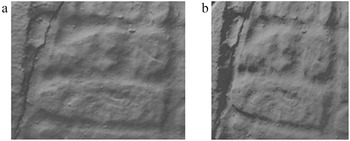
This monochrome version was then exported as an .OBJ file, which was subsequently imported into Blender 3.5 for virtual photography. Blender permits a variety of virtual light sources—Point, Sun, Spot, and Area—which can be adjusted as to size, position, angle, and intensity. We used the Spotlight and Area lights at 10–15 W to produce more than 300 images, including frontal shots of the whole carved surface of the stela and close-up shots of certain sections. The lighting in these photographs was variously general or raking, with area lights placed at different locations, orientations, and distances to enhance features of the figural carving and text. For badly eroded areas, raking area lights were brought closer in order to enhance the shadows. Virtual photographs taken from other than frontal angles clarified the shapes and identities of certain troublesome glyphs, for instance the proposed T’AB’ in glyph block A2 and the he in block C1 (see below). We relied mainly on close-up photographs for our reading of the stela text. We found nothing new to add to the iconography as shown in Graham’s drawing, and so we offer here new line drawings of the text alone (Figure 6).
The upper text panel on Ixkun Stela 4: (a) line drawing by Nicholas Carter; (b) photogrammetric model imaged by Aliyah Anderson.

These virtual photographs permitted almost all of the glyph blocks on the stela to be read. Only three (blocks D3, E3, and E4) were too damaged to read beyond the recognition of bar-and-dot numerals. Two others (C3 and D3) could not be read phonetically, but, in context, we identified them as the name of Ixkun’s first (and very likely only) ruler and the Ixkun Emblem Glyph, respectively. The new images also facilitated the recognition that the lowest caption, referring to the prisoner at the bottom of the stela, reads from right to left, contrary to the usual reading order. Long epigraphic work by two of the authors afforded us the hope of a more or less complete and accurate reading of the surviving text, and of a reasonably good understanding of its implications.
Historical background
Before presenting our reading of the stela, we wish to put the monument and the people and events it deals with in their historical context. Much of the significance of Stela 4 lies in how it connects earlier events to the next act of the sprawling drama of Late Classic Maya political history in the eastern lowlands.
Based on a reference on Pusilha Stela P (a.d. 573), the oldest kingdom in the Dolores region was Ho’kab’, likely founded in a.d. 81 with support from Chihcha’—a powerful Late Preclassic kingdom which has not yet been conclusively identified with an archaeological site, although several possibilities have been suggested (Stanley Guenter, unpublished presentation, cited in Wanyerka Reference Wanyerka2009:384; Martin and Velásquez García Reference Martin and Velázquez García2016:30, note 27; Prager Reference Prager2013:265; Prager et al. Reference Prager, Volta, Braswell and Braswell2014:Figure 10.19b; Stuart Reference Stuart2014, Reference Stuart2018; van Akkeren Reference van Akkeren, Savkić and Bader2019). We think Ixtonton was the primary Ho’kab’ capital during most of the kingdom’s history, and that a ruler of Chihcha’ supported the dynasty in order to secure access to or control over a natural travel route that runs north–south across the Maya Mountains through the Dolores Plateau, connecting kingdoms north of the mountains with the fertile agricultural land and the volcanic highlands to the south of them (see Carter et al. Reference Carter, Santini, Barnes, Opitz, White, Safi, Davenport, Brown and Witschey2019). We have no further epigraphic data about the relationship between Ho’kab’ and Chihcha’ after that foundation event, but Chihcha’ seems not to have been active in the Classic period. Two polychrome vessels from the court of Aj Numsaaj Chan K’ihnich which reference “Ho’kab’ cacao” suggest that, by the late sixth century, Ho’kab’ had a new patron in the Sa’al kingdom at Naranjo, a close ally of the Kaanul dynasty (Martin and Grube Reference Martin and Grube2008:72; Stuart et al. Reference Stuart, MacLeod, Polyukhovich, Houston, Martin, Reents-Budet and Stuart2005).
We also have no data about Ho’kab’s potential involvement in the wars of the seventh century between Naranjo, Caracol, and at least one branch of the Kaanul royal house (Martin Reference Martin2017; Martin and Grube Reference Martin and Grube2008:74). We suspect that Naranjo may have temporarily lost its hegemony over the Dolores region in or before a.d. 680, when a combined Kaanul–Caracol force defeated Naranjo and wiped out much of its ruling family. This is because the new Kaanul-appointed queen of Naranjo, acting on behalf of her young son, conquered the kingdom of Ucanal, near the Mopan River between Naranjo and the Dolores Plateau, in 698 (Houston Reference Houston1983). Since Ucanal was not under Naranjo’s control in the years shortly before that date and had to be subjugated, we think the Ho’kab’ kingdom, lying beyond Ucanal, was probably also effectively independent.
Also at the turn of the eighth century, the Dolores region was incorporated into the Kaanul-centered alliance network. This was achieved in part through the foundation of two new kingdoms, Juluup and B’aax Tuun. Based near the cave of Naj Tunich, B’aax Tuun apparently answered directly to the Kaanul king; the earliest dated text that references the new kingdom, Naj Tunich Drawing 29 (a.d. 692), describes the local ruler as “the vassal lord of” (yajaw) someone whose Emblem Glyph is consistent with that of Kaanul (Carter and MacLeod Reference Carter and MacLeod2021). The second dynasty was called Juluup. Its capital was the site of Sacul in the rugged country east of the Dolores Plateau, and royal costumes shared between the two kingdoms, connected to sacred warfare, suggest that Juluup may have been subject to Naranjo (Carter and Santini Reference Carter and Santini2019). Similar costume elements are present on the Late Classic Ixtonton Stela 1, although that monument does not have a hieroglyphic date, and so friendly relations between Ho’kab’ and Naranjo may have been reestablished around the same time.
In 744, an army from Tikal invaded and occupied Naranjo, carrying away the king. In the decades that followed, Naranjo’s power seems to have been greatly diminished, and it may have been subject to additional attacks from Tikal (Martin Reference Martin and Trejo2000; Martin Reference Martin and Sabloff2003:31; Martin and Grube Reference Martin and Grube2008:79). By 760, Ucanal partially filled the power vacuum, asserting hegemony over Sacul and El Chal, and, conjecturally, maintaining its alliance with Ho’kab’ (Carter Reference Carter2016:244). In that way, Ucanal had access to three natural travel routes: the San Juan River valley, where El Chal is located, leading toward the Petexbatun region, and the Dolores Plateau and Sacul River valley, extending south across the Maya Mountains toward the fertile cacao-growing country to the south (see Caso Barrera and Aliphat Fernández Reference Caso Barrera and Fernández2006). But in 779, the Sacul ruler K’iyel Janaab’ established his own vassal kingdom at Ixkun, inaugurating Ruler A on April 6, and sending him to live at Ixkun on May 19. The move may have been precipitated by the death of K’iyel Janaab’s overlord Kokaaj B’ahlam II and the succession of his heir (Carter Reference Carter2016).
Perhaps significantly, according to Ixkun Stela 12, Ruler A did not “take [the] K’awiil scepter,” nor was he “seated in lordship” (chumlaj ta ajawlel), nor was the “white headband raised to his head” (k’ahlaj sak huun tu b’aah)—any of the phrases that usually describe Classic Maya royal accession. Instead, we read that he was “consecrated” or “gifted” (k’uhb’aj), a rare verb that elsewhere seems to indicate gift offerings to living or dead people (Carter Reference Carter2016:245). The distinction may indicate that the Ixkun lord was not a full-fledged king, and that his dependence on K’iyel Janaab’s goodwill was explicit in the type of ceremony in which he was raised to office.
Formerly a small settlement like others in the Dolores region, Ixkun was quickly built up into a royal capital whose layout imitates that of Ixtonton at a smaller scale (Laporte and Mejía Reference Laporte and Mejía2005:27–53). This was an aggressive move by K’iyel Janaab’ against his erstwhile allies: not only was he declaring independence from Ucanal, but Ixkun is located along the presumed trade route just north of the Dolores Plateau. By controlling it, he laid claim to his own piece of that route and may have aimed to supplant Ixtonton (Carter Reference Carter2016:248–249; Carter et al. Reference Carter, Krause and Lozano2024:308–309).
The king of Ucanal responded by raiding Sacul, or some dependent town nearby, on December 22, 779. But his forces did not achieve a decisive victory, since K’iyel Janaab’ launched a retaliatory raid the next morning against a settlement which may have been El Rosario, located about 15 km north of Sacul and 20 km south of Ucanal (Carter et al. Reference Carter, Krause and Lozano2024:314). In February of the next year, warriors from Sacul—and, we imagine, Ixkun—struck Ucanal itself, securing their kingdoms from the threat to the north. Then it was time to deal with Ho’kab’. We have little epigraphic information about that conflict, but the Sacul–Ixkun alliance came out on top: Sacul Stela 9 indicates that someone with the Ho’kab’ royal title was taken prisoner less than a month after the attack on Ucanal (Carter and Santini Reference Carter and Santini2019:8).
In the aftermath of that war, we think that the Ho’kab’ court moved from Ixtonton to Ixtutz. The evidence, briefly, is as follows. The three stelae at Ixtutz whose inscriptions are totally illegible due to erosion can be dated on stylistic grounds to between about 761 and 810 (Laporte Reference Laporte2009:117). All of the legible monuments so far discovered there date to the reign of a single king, “Ruler 1,” who was in office by December 3, 780—the 9.17.10.0.0 half-k’atun ending, commemorated on Ixtutz Stela 4—and who ruled at until at least June of 804 (Carter et al. Reference Carter, Reyes, Stuart, Houston, Lukach and O’Neil2022:267–269). We infer from Ruler A’s decades of construction and monument erection, which apparently began only after the war with Sacul and Ixkun, that he needed to make Ixtutz into a suitable royal capital, which it had not been previously.
Be that as it may, all three kings in the Dolores area used the 9.17.10.0.0 period ending to strengthen their positions in the new political order. At Ixtutz, Ruler 1’s celebrations were attended by lords from other polities, including one of the Mutuul courts that existed in the Petexbatun region to the west after the fall of Dos Pilas (see Zender Reference Zender2002). Meanwhile, at Sacul and Ixkun, K’iyel Janaab’ and Ruler A erected two pairs of monuments, with one member at each site. One pair (Sacul Stela 3 and Ixkun Stela 2) tell the story of the war with Ucanal; the other pair (Sacul Stela 2 and Ixkun Stela 1) show the two victorious kings standing above prisoners who, as we will argue here, both came from Ho’kab’.
A reading of Ixkun Stela 4
The upper panel
The upper panel (Figure 6) reads in two double columns from left to right. It opens with the date 9 Imix 9 Uo (9-IMIX 9-IHK’-AT-ta) in glyph blocks A1 and B1. This date corresponds to 9.18.5.8.1—that is, to February 24, a.d. 796 according to the 584,286 correlation between the Maya and Gregorian calendars (for which see Martin and Skidmore Reference Martin and Skidmore2012).
The date is followed at A2 by a verb which ends with the syllabogram yi, indicating that we have here either (1) a root transitive verb in the mediopassive voice, (2) a root intransitive verb of the form CVy-i, or (3) a root intransitive verb of motion of the form CVC-Vy-i. Seen from multiple angles, the upper half of the glyph block is comprised of two elements: a rounded component at right, and at left, a sinuous shape like the letter W (Figure 7a, b). The shape is inconsistent with the more common logograms for verbs of motion, such as HUL (“to arrive”), JUB’ (“to go down”), K’A’ (“to depart”), LOK’ (“to go out”), and the “God N” and “footprint-and-steps” signs for T’AB (“to go up”). Considerations that there might be two separate glyphs above yi also proved fruitless. We think the most likely possibility is that the two upper elements together comprise a variant of the logogram T’AB’, “to go up,” and that the word here is t’ab’ayi, in this case “they go up.” T’ab’ayi is one of the more common verbs in the surviving corpus, appearing very often in dedicatory texts on ceramic vessels or buildings. In those contexts, it denotes the dedication or presentation of a venerated object; in contexts describing movement from one political center to another, it often seems to carry the implication that the person “going up” is, at least in the moment, of lower status than the ruler of his destination.
(a) and (b): views of a photogrammetric model showing glyph block A2 in Blender. Images by Aliyah Anderson.

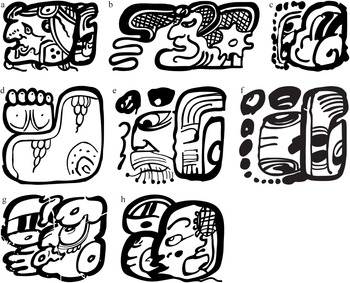
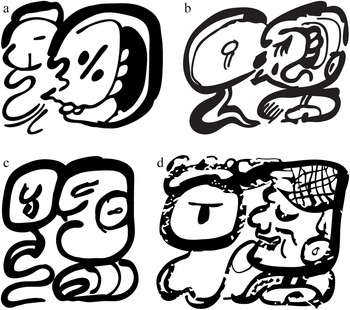
In most cases, T’AB’ is written with a sign depicting the head of God N (Figure 8a, b) or with another sign showing a foot or footprint ascending steps (Figure 8c, d). Occasionally these forms are conflated (Figure 8e). The footprint can also be used alone, without the stairs (Figure 8f), making it confusingly visually similar to HUL. In another variant, the head of God N in his role as the patron of the number five, with a HAAB’, “year” sign on his head, is paired with the face of another deity, often but not always God D (Figure 8g, h). But there is another form of T’AB’ which usually consists of a death’s head with an ascending “breath” element emerging from the mouth (Stuart et al. Reference Stuart, MacLeod, Polyukhovich, Houston, Martin, Reents-Budet and Stuart2005; Figure 9a, b). Often this element is marked with IK’, “wind,” “breath,” and it has a sinuous “tail” to indicate its rising. Occasionally the death’s head is replaced by a livelier face (Figure 9c) or even the head of God N (Figure 9d). This range of graphic variation is unsurprising given the visual playfulness of many Maya scribes and the frequency with which the word needed to be written. We propose that the logogram at A2 extends those known variations, following already established principles: the “breath” element (or perhaps the wavy, netted headscarf of God N) has been dissociated from the usual death’s head, the way the “footprint” element is in Figure 8f, and has been rotated 90° to make room for the yi below.
Forms of the logogram T’AB’: (a) and (b) depicting the head of God N; (c) and (d) depicting a foot on a stairway; (e) conflating the foot and God N forms; (f) depicting only the foot; (g) and (h) depicting God N, as the God of the Number Five, with other gods (after photographs by Justin Kerr Reference Kerr2024: (a) K4464; (b) K8234; (c) K8007; (d) K0508; (e) K0927; (f) K8622; (g) K1383; (h) K4997). Drawings by Nicholas Carter.

The “ascending breath” variant of T’AB’: (a) and (b) with a death’s head; (c) with an apparently living head; (d) with the head of God N (after photographs by Justin Kerr Reference Kerr2024: (a) K0791; (b) K5366; (c) K6437; (d) K2914). Drawings by Nicholas Carter.

An alternative suggestion, for which we thank Dmitri Beliaev (personal communication, April 2025), is that the verb at A2 is NUM, “to pass through,” which is discussed in a recent paper by Sandra Khokhriakova (Reference Khokhriakova2025). In the hieroglyphic corpus, NUM is best attested in calendrical settings, for instance at Palenque, where it effectively means “since [a date or event]”; but it also occurs in other contexts, including the name of the Naranjo ruler Aj Numsaaj Chan K’ihnich. Nearer to Ixkun, NUM occurs in a painted text in the cave of Santo Domingo, not far from Naj Tunich (Figure 10). If the verb here is numuyi, “they passed through,” instead of t’ab’ayi, “they went up,” it would not substantially change the historical implications of the inscription.
A painted inscription from Santo Domingo Cave, Guatemala, in which the verb numuyi records two pilgrimages to the cave. Drawing by Sergei Vepretskii, used by permission.

At B2, we find U-WINIK, written with the “toad” sign for WINIK (T741a) with its characteristic poison gland and the curled element at the corner of its mouth. We think the sense here is of “person” or “people,” not the number 20. Being possessed, winik can be understood here specifically as “servant(s).” U-PAKAL, “his shield(s),” follows at A3. Though damaged, the PAKAL logogram can be recognized by its square shape, its curved internal lines, and the tabs at the two upper corners where hide or human skin is stretched across the front of the shield. The phrase u winik u pakal is as far as we know unique in the hieroglyphic corpus, giving us no precedent to aid in interpretation. Plausible readings would be “his servants and his shields” or “the servants of his shields.” We feel justified in using the plural because no personal names are given; who these men were was less important than what they were and whom they represented. As discussed below, we think they were a protective escort of soldiers, because b’aah pakal (“head shield”) is a title for military leaders attested at Bonampak and Chichen Itza (Houston Reference Houston2008). We considered the possibility that the phrase is instead u took’ u pakal (“his flints and shields”), a kenning for armies and war. However, the details of the WINIK toad at B2, including the cheek curl, the three dots of the poison gland, and the shape of the profile, leave us in no doubt as to the sign’s identity.
From B3 to B4 we have the name and title of the shield-servants’ liege. Our photogrammetric model confirmed that A4 and B4 read K’UHUL-MUT AJAW-wa, exactly as in Graham’s (Reference Graham1980) line drawing. We were also able to read all three components of the Mutuul lord’s name, in B3. The upper right element has the scalloped profile and internal details of YAX, “blue/green” or “first.” The sign at left is the “twisted” variant of NUUN, “great,” “huge.” Finally, the lower right glyph shows the eye, upturned snout, and reptilian mouth of AHIIN, “alligator,” “caiman.” We have here, then, the name of Yax Nuun Ahiin II, the twenty-ninth ruler of Tikal. This is significant because the latest previously known mention of this king, on a polychrome painted vase (K2695 in Justin Kerr’s [Reference Kerr2024] photographic database) from the Central Acropolis at Tikal, dates to a.d. 794, two years before the events discussed on Stela 4.
By imaging glyph block C1 in Blender using different angles and lighting conditions, we were able to establish that it reads ta-he-wa. The tall, oval sign at left has the horizontal bar, with vertical elements extending above and below it, that characterize ta. The larger sign at right has the curling, broken top of he and, inside, vertical lines running down from a curving line that follows the curl. And the lower right glyph consists not of two ovals, but of an oval and a hooked element whose end points to the left; this can only be wa. We interpret this as ta heew, “on the [same] day.” The word heew (or, in a regional variation, heen) usually occurs in Distance Numbers, where it signifies “days later” (for variable spellings, see Carter Reference Carter2009:15, 34; Kelly Reference Kelly2022:191–194; Lacadena and Wichmann Reference Lacadena and Wichmann2005). Nevertheless, heew sometimes indicates “on that day,” as in the inscription on a polychrome vase from the area of Naranjo (K1398; Figure 11), and that is what we think it does here. On that interpretation, ta heew begins a new sentence.
Detail of the painted inscription on K1398: 13-OC 18-IHK’-K’AT-ta HEEW ni-CH’AM-wa ni-[…] yi-ta 9-OK K’UH (“On 13 Oc, 18th Uo, [on that] day, I took my ‘God L hat’ in the company of B’ahluun Okte’ K’uh”) (after a photograph by Justin Kerr Reference Kerr2024). Drawing by Nicholas Carter.

We ought to expect a verb next, at D1. What we find are two signs, ye and ta. Although eroded, the ye can be identified by its characteristic outline and by a dot in the interior, upper portion of the glyph. The ta, in turn, has its horizontal bar with ascending and descending vertical lines. We interpret ye-ta as the derived transitive verb yetaaj or yetaj, a Yucatecan cognate of the Classic Ch’olti’an yitaaj, “he accompanied him/them.” Similar spellings are attested in a number of late inscriptions, including Ceibal Stela 11 (a.d. 849; ye-ta-ji), Ch’anal Stela 1 (a.d. 810; ye-ta-ji; see Kovác et al. Reference Kovác, Grube, Pallán Gayol, Krempel, Drápela, Arroyo, Salinas and Rojas2014), Jimbal Stela 1 (a.d. 879; ye-ta-ja), an unnumbered monumental fragment from Tonina (a.d. 836–837; ye-ta-ji; see Sheseña et al. Reference Sheseña, Sánchez Gamboa, Krempel and Tovalín Ahumanda2024, who read it as CHOK-ch’a-ji), and Uxul Stela 8 (ye-ta-ji).
At C2, we seem to have a-CHA’, Aj Cha’, which translates literally as “he of the metate” or “the man of [the] Metate [Place].” Diagnostic elements of the a are clear enough. It is possible that one of the two “stone” elements of CHA’ was actually another sign which modified the name, but they are too eroded to tell. We initially considered that this glyph block might record the attested place-names Kocha’ (also known as “Ko-Bent Cauac”) or Chihcha’ (“Maguey Metate”; see Stuart Reference Stuart2014, Reference Stuart2018), but simulated raking light revealed the details of the initial a, inconsistent with both those possibilities. The identification of yetaj at D1 certified that C2 had to indicate a person, since a toponym logically could not follow yetaj. Structurally, Aj Cha’ resembles an occupational title like those attested in the Chiik Nahb’ complex at Calakmul (see Martin Reference Martin, Golden, Houston and Skidmore2012) or a title of origin, but it is perhaps more likely to be a personal name. “Acha” (probably also Aj Cha’) was a name in use among the Chontal-speaking Mactun people of Acalan in Colonial times (e.g., Paxbolon-Acha and Isabel Acha; Scholes and Roys Reference Scholes and Roys1968:66; see Keller and Luciano G. Reference Keller and Plácido Luciano1997:77). Whoever he was (and our proposal follows below), the Aj Cha’ named on Ixkun Stela 4 evidently joined or accompanied the shield-servants from Tikal on the day they departed.
Glyph block D2 is almost totally destroyed, but can be reconstructed from context and a few surviving details as U-KAB’-ya, u kab’ijiiy, “he oversaw it.” Likewise, C3 and D3 are badly damaged, yet we infer that at least C3 gave the name of Ixkun Ruler A. D3 includes a numeral 14 or 19 plus another sign; this may have been a personal name or a title. The upper panel concludes with two royal titles of Ixkun: the Ixkun Emblem Glyph, still undeciphered, at C4, and 8-PIIT, “Eight Palanquins,” at D4. The latter title is also attested for Ruler A on Ixkun Stela 4, and it is shared with K’iyel Janaab’ of Sacul (Carter et al. Reference Carter, Krause and Lozano2024:311).
Our best reading of the upper panel, then, is as follows:

The middle caption
The caption in the figural scene, in front of the ruler’s right leg, consists of four glyphs in a single column (Figure 12). The top two, E1 and E2, read U-B’AAH ti-CHOK, u b’aah ti chok, “it is his image in scattering.” Glyph block E3 is badly damaged and quite unreadable. E4 includes a tall, narrow sign at left, a possible numeral 9 in the upper right, and a larger, almost square sign below it. These traces are consistent with the name or title applied to Ruler A in the main figural panel of Ixkun Stela 1, which differs from his name as given in the longer inscriptions on that monument and this one.
The middle caption on Ixkun Stela 4: (a) line drawing by Nicholas Carter; (b) photogrammetric model by Aliyah Anderson.

The lower caption
In front of the prisoner in the lower panel are two glyphic columns, the left containing two glyph blocks and the right four, carved in relief at a slightly smaller scale than the two inscriptions above (Figure 13). This caption ought to name the captive, yet it was never successfully read until our photogrammetric model revealed previously unrecognized details, including the presence of two signs depicting heads facing to the right. This orientation implied that the caption should be read from right to left, and when this was done, its contents and historical import became clearer.
The lower caption on Ixkun Stela 4: (a) line drawing by Nicholas Carter; (b) photogrammetric model by Aliyah Anderson.

This text begins in position G1 with a-chi. This might be understood as aj chih, “he of the pulque,” a title that elsewhere applies to a youth at a drinking party depicted on a polychrome painted vase (K1092; Kerr Reference Kerr2024). In this case, the prisoner, though always in danger of execution, might have been admitted to courtly life at Ixkun and to the company of other royal youth. Alternatively, we might see G1 as aj chij, “he of the deer” or “deer person,” given iconographic associations elsewhere between war captives and deer (e.g., at Yaxchilan, on Step 6 of Hieroglyphic Stairway 3; Stephen Houston, personal communication to the first author, June 2024).
At G2 we have SAK-[…]-ya, followed at G3 by a compound that includes AJAW-wa. In front of the AJAW face, at the right side of G3, is a somewhat eroded element, perhaps a. Next, at G4, is 9-xa-[…]. Glyph blocks G2–G4 seem to present the same name and titles that belong to Ruler A’s captive on Ixkun Stela 1. On that monument, the prisoner is called ch’a-ho-ma SAK[…]-ya AJAW 9-[…]-[…] ?B’AK-?ka, that is, “the ch’ahoom, Sak […]y Ajaw, Nine […], the captive” (Figure 14a). We think that “Ajaw” is part of his personal name phrase, not part of an Emblem Glyph. Returning to Stela 4, and moving left to column F, we find the spelling ch’o-ko at F3, giving ch’ok, “sprout,” “youth,” “prince.” Even though Sak […]y Ajaw lacks an Emblem Glyph, this title suggests that he belonged to a royal family. The caption concludes at F4 with B’AAK-?ki or B’AK-?ka, for b’aak or b’ak, “captive.” (B’AAK-ki is the standard spelling, but elsewhere at Ixkun B’AK-ka is used.) The caption thus reads:

Discussion
Our reading of Ixkun Stela 4 has some important implications for the history of the Dolores region and of the wider Maya lowlands, as well as for Classic Maya political anthropology. First, we are confident that the prisoner shown on Stela 4 is Sak […]y Ajaw, one of the two captives represented on Ixkun Stela 1, which was carved nearly five and a half years previously for the 9.18.0.0.0 k’atun ending. The first author of the present paper had assumed that both prisoners were sacrificed on that occasion, but now it appears that at least one of them was retained alive. On Stela 1, the captive at the feet of K’iyel Janaab’ is a K’ahk’ ajaw, a member of the Ho’kab’ royal family (Figure 14b; see Carter et al. Reference Carter, Reyes, Stuart, Houston, Lukach and O’Neil2022:267 for K’ahk’ ajaw as an alternate Emblem Glyph for that dynasty), and, as mentioned above, we think Sak […] Ajaw most likely came from that court too. Perhaps these two captives were taken in late February or early March of a.d. 780, since a royal prisoner bearing the Ho’kab’ Emblem Glyph arrived at Sacul on March 7, less than a month after the decisive raid on Ucanal (Carter and Santini Reference Carter and Santini2019:8). That prisoner, formerly named on Sacul Stela 6 (only his Emblem Glyph survives), may well be the K’ahk’ ajaw shown on Ixkun Stela 1.
The names of the captive Ho’kab’ princes on Ixkun Stela 1: (a) Ruler A’s prisoner, Sak […]y Ajaw; (b) K’iyel Janaab’s prisoner, a K’ahk’ ajaw. Drawings by Nicholas Carter.

It was previously speculated that the Ho’kab’ court’s move from Ixtonton to Ixtutz could have been prompted by a military threat from Sacul and Ixkun (Carter et al. Reference Carter, Reyes, Stuart, Houston, Lukach and O’Neil2022:272). But in that case, why is there no evidence that Ho’kab’ regrouped and attempted to retake their territory over the next 30 years? Our identification of Sak […]y Ajaw suggests a possible explanation: K’iyel Janaab’ and Ixkun Ruler A may have held the two Ho’kab’ notables as hostages, and the relocation might have been the price of their lives. A few other cases are known in which elite prisoners survived a period of captivity, returning home in exchange for some presumed ransom (e.g., Stuart Reference Stuart2003), but the case of Sak […]y Ajaw is to our knowledge the first one in which we can infer some of the specific concessions extracted.
More significant is the involvement of Tikal. For one thing, our new reading extends Yax Nuun Ahiin’s career by two years. Dynastic succession at Tikal has been unclear for the period between a.d. 794 (the date on K2695) and 810 (when the ruler “Dark Sun” erected Stela 24). One possibility is that Yax Nuun Ahiin was succeeded during that period by another ruler, Nuun U Jol K’ihnich, who ruled only briefly before Dark Sun took the throne. Another is that Nuun U Jol K’ihnich was instead the twenty-eighth king of Tikal, Yax Nuun Ahiin’s elder brother and predecessor in office, and that Dark Sun directly succeeded Yax Nuun Ahiin (Martin and Grube Reference Martin and Grube2008:51–52). While the question remains unresolved, our reading of Stela 4 reduces the gap between Yax Nuun Ahiin’s and Dark Sun’s reigns to a maximum of 14 years.
Naranjo’s defeat by Tikal in 744 inaugurated 36 years of reduced power and near monumental quiescence. But around 780, a quarter century into his reign, the Sa’al ruler K’ahk’ U Kalaw Chan Chahk began to reassert Naranjo’s regional authority, attacking other settlements and taking captives. By 784, he had died and been succeeded by his teenaged son Kokaaj(?) K’awiil. One or the other of those kings reestablished the old alliance between Naranjo and Ucanal—a connection perhaps first created by force, when Naranjo captured a king of Ucanal in 698, and later broken in the same way, when Tikal’s victory in 744 left Ucanal as the head of a reduced alliance network that included Sacul, El Chal, and probably Ho’kab’. This rump alliance persisted until the wars of 779–780, which ended with Sacul and Ixkun dominating the Dolores Plateau and the upper Mopan, Xaan, and Sacul river valleys (Carter Reference Carter2016:247–250).
Now, in February of 796, Naranjo and Tikal were preparing to contend once again for control of eastern Peten—at first through allied proxies and eventually through more direct conflict. In August of the same year, war would break out between Tikal-allied Yaxha and Naranjo-allied Ucanal, resulting in the capture of the Ucanal king Xuxub’ Chahk (Stuart Reference Stuart2019). In 799, Kokaaj(?) K’awiil and his allies, including a new king of Ucanal, would wage a devastating war against Yaxha and other settlements in the region, with Yaxha in turn supported by Tikal (Helmke et al. Reference Helmke, Beliaev and Vepretskii2020). Figure 15 summarizes, in visual form, the shifting and complicated political relationships in the eastern lowlands between a.d. 712 and 800; some key events are presented in Table 1.
Chart showing relationships among kingdoms discussed in this article between AD 712 and 800. TIK = Tikal.

Key events in the history of the Dolores region and neighboring areas.

The Mutuul dynasty of Tikal probably already controlled territory in the Peten Lakes region, ruling through cadet branches of the royal family based at towns including Zacpeten and the still-unidentified site of Sakte’ (Helmke et al. Reference Helmke, Beliaev and Vepretskii2020:14). In turn, Naranjo had long held some sway over the Dolores region, although its nature and intensity varied over time. Two ritual costumes important at Naranjo, including one connected to a form of the Jaguar God of the Underworld which may have been a Sa’al patron god, are attested on monuments at Ixkun, Ixtonton, and Sacul; of these, at least the examples from Ixkun and Sacul postdate Naranjo’s political dominance in the Dolores area, bespeaking an enduring ideological influence (Carter and Santini Reference Carter and Santini2019).
Under the circumstances, Yax Nuun Ahiin may have had good reason to be concerned about whether the Sacul–Ixkun partnership would side with their old friend Naranjo in the coming conflicts, or against their more recent enemy Ucanal. Furthermore, in the wake of his defeat in 780, the king of Ho’kab’—now based at Ixtutz—had sought support from one of the Mutuul kings of the Petexbatun, whose branch of the dynasty were longstanding rivals of the court at Tikal. If the war were to spread to the western Maya Mountains, Ho’kab’ could be expected to be hostile to Tikal, and so it would have been prudent to co-opt its enemies at Sacul and Ixkun. And, of course, so long as Ixkun and Sacul controlled part of the travel route through the mountains, their friendship would have been desirable.
In this context, we think that the visit to Ixkun by Yax Nuun Ahiin’s soldiers was to confirm an alliance between Tikal and Ixkun—and, presumably, Sacul, whose rebel king lived until at least a.d. 800. But confirm it how? We think Aj Cha’ is the key. The shield-servants are anonymous; only the two kings and Aj Cha’ are named. His “accompanying” of the delegation is the rhetorical pivot of the narrative in the upper panel, while the kings are in the background, sending soldiers or overseeing the action. And Stela 4 itself was erected not in Ixkun’s E-Group, where most of the site’s stelae are, but in the southern plaza, across from and facing the royal residence. To us, these clues suggest that Aj Cha’ could have been a prince of Ixkun, the son of Ruler A, and that he was sent to Tikal to be brought up and educated in the Mutuul court. Conceivably, Yax Nuun Ahiin II bestowed k’awiil, in the sense of royal legitimacy and that of a K’awiil scepter, on Ruler A as part of this arrangement.
Guardianship of princes from other kingdoms was an important part of Maya international politics, at least in the Late and Terminal Classic periods. It took two forms. In the first, one kingdom would send an older courtier to another kingdom, where he would act as tutor to royal youth. For instance, a panel carved at Dos Pilas in the middle of the eighth century presents a nobleman from the Kaanul kingdom who served as u chanahn ch’ok, “the guardian of the princes” (Houston Reference Houston2018:103–106). Another courtier, a lakam (“banner” or “standard-bearer”) from the Kaanul-allied Sak Muk kingdom, likewise claimed on a hieroglyphic stairway at El Palmar to have been the “guardian” of the Copan king Waxaklajuun U B’aah K’awiil, presumably in his youth (Tsukamoto and Esparza Olguín Reference Tsukamoto, Esparza Olguín, Golden, Houston and Skidmore2014:45).
Alternatively, princes could be sent to live in another royal court. That was the case with a youth from the ruling family of La Corona, who in the seventh century went to Calakmul at the age of 19 for a period of training and service before going home to succeed his father (Houston and Stuart Reference Houston, Stuart, Inomata and Houston2001:67). At Cancuen, two different heirs traveled to the overlord’s city to become king: the first journeyed back to Calakmul to receive the crown from the long-lived Yuhknoom Ch’een, and the next went to the Dos Pilas king Uchan K’in B’ahlam for the honor, since that branch of the Mutuul bloodline had by then taken control of the Pasión River. In the Terminal Classic, after the breakdown of political order in the Petexbatun region, a prince from Ceibal may have been fostered at Ucanal, returning in 829 to take the throne with the support of the Ucanal ruler Kan Ek’ Ho’ Pe’t (earlier Naranjo’s ally in the war with Yaxha) and of other members of the Ceibal ruling house (Carter Reference Carter2014:196–197). Such fostering relationships strengthened ties of loyalty between vassals and overlords—and if those ties threatened to fray, a ward was also a hostage. “So Abram rose, and clave the wood, and went…” (Owen Reference Owen1920:9).
In the event, the new relationship between Ixkun and Tikal was not to last. Stela 4 is, after all, the last known monument to mention Yax Nuun Ahiin II, who was soon succeeded by Nuun U Jol K’ihnich and/or Dark Sun. In the meantime, the Naranjo alliance prevailed against Yaxha (Helmke et al. Reference Helmke, Hoggarth and Awe2018; Helmke et al. Reference Helmke, Beliaev and Vepretskii2020; Martin and Grube Reference Martin and Grube2008:82; Schele and Mathews Reference Schele and Mathews1998:148–149). Dark Sun erected a stela at Tikal in 810, and was probably buried in a magnificent mortuary temple, but no sculpture commemorates the great baktun ending of 830. Dark Sun’s monuments—unlike those of some earlier kings—were deliberately smashed in antiquity, royal tombs were looted, and he was the last epigraphically attested Mutuul lord to rule at Tikal until a brief restoration between about 869 and 879 (Coe Reference Coe1958:76; Jones and Satterthwaite Reference Jones and Satterthwaite1982:52; Martin and Grube Reference Martin and Grube2008:52–53). Drought surely played a major role in the Terminal Classic collapse of once-powerful cities, Tikal included (see e.g., Hodell et al. Reference Hodell, Brenner and Curtis2005; Medina-Elizalde et al. Reference Medina-Elizalde, Burns, Lea, Asmerom, von Guntent, Polyak, Vuille and Karmalkar2010; Webster et al. Reference Webster, Brook, Railsback, Cheng, Edwards, Alexander and Reeder2007), but other centers flourished and grew, including Nakum (Źrałka and Hermes Reference Źrałka and Hermes2012) and Ucanal (Halperin et al. Reference Halperin, Flynn-Arajadal, Katherine, Miller and Carolyn2021). One wonders what role wars that were ongoing at the onset of severe droughts played in the major centers’ downfall.
What of the Dolores region during the Terminal Classic period? The latest monuments at Ixkun (Stela 5), and at Sacul (Stela 10), both date to a.d. 800. A remodeling project at Ixkun’s Acropolis was evidently abandoned unfinished (Laporte et al. Reference Laporte, Escobedo, Morales, Roldán, Torres, Gómez and Fernández1994:36, 46). Sacul and Ixkun were both occupied through the Terminal Classic and into the Postclassic era, but there is no epigraphic evidence for kings at either site after the reigns of K’iyel Janaab’ and Ixkun Ruler A. In the Ho’kab’ realm, on the other hand, population declined at Ixtutz but increased at Ixtonton. There, some monumental fragments (had they been broken in the war of 780?) were moved from the Central Plaza to the Acropolis, where Puuc-style mosaic masks were constructed over older stucco work (Laporte Reference Laporte, Demarest, Rice and Rice2004:203–208; Laporte and Mejía Reference Laporte, Héctor, Laporte, Escobedo and Arroyo2002:71, 82; Laporte and Quezada Reference Laporte, Quezada, Laporte and Escobedo1998:847–877). In the West Plaza, a Ho’kab’ king erected a stela with the very late date of 889 (Carter et al. Reference Carter, Reyes, Stuart, Houston, Lukach and O’Neil2022:273).
We think that, soon after the turn of the ninth century, the Juluup and Ixkun courts were effectively defunct, and that power shifted decisively toward Ho’kab’. The shift may well have been triggered by the death of K’iyel Janaab’, not necessarily by violence: by that time, he would have ruled for 40 years. We must consider also the fact that monuments at Sacul and Ixkun were not defaced in antiquity, even those which memorialized the humiliation of the Ho’kab’ princes, whereas such vandalism was not uncommon in Classic Maya wars (e.g., Houston Reference Houston, Miller and Martin2004:276; O’Neil Reference O’Neil2014:181; Stuart Reference Stuart, Escobedo and Houston1998). Perhaps some settlement was negotiated, and Ho’kab’ had no need to invade their rivals. What became of Aj Cha’ and the Ho’kab’ princes, we expect never to know. What seems certain is that Aj Cha’ did not succeed Ruler A in any meaningful sense, and that Tikal was unable to intervene.
Conclusion
This paper contributes to a growing number of photogrammetric success stories, in which this efficient and relatively inexpensive method has clarified eroded and obscured inscriptions (e.g., Carter et al. Reference Carter, Krause and Lozano2024; Helmke et al. Reference Helmke, Bercu, Drug, Jakovlev, Kjær, Saulins and Vepretskii2022; Prager et al. Reference Prager, Gronemeyer and Wagner2020; Vepretskii and Beliaev Reference Vepretskii, Beliaev, Beliaev and de León2020). We hope the methodology presented above will prove useful to other researchers in their own work.
According to our reading of Stela 4, the monument was erected to memorialize the departure of Aj Cha’, a prince of Ixkun, to be fostered at Tikal under the tutelage of Yax Nuun Ahiin II. We think this journey marked a strategic alliance between Tikal, Ixkun, and, by extension, Sacul. Tikal would have benefited from such a relationship by gaining access to the transmontane trade route passing through the Dolores Plateau, and by keeping the Sacul–Ixkun alliance from joining Naranjo and Ucanal in the wars to come. In exchange, the king of Ixkun would have received a powerful ally, a first-class royal education for his son, and, perhaps, elevation to a higher status with the possession of k’awiil.
At the more general level of Classic Maya political anthropology, our interpretation of the stela text—if correct—offers further evidence for the role of young men as pawns in Classic Maya power politics, whether as hostages or as fosterlings. It also adds one more hegemonic power (Tikal) to the two others (Chihcha’ and Kaanul) whose interest in the Dolores area was already epigraphically attested. To us, that bespeaks the enduring importance of long-distance travel routes to Classic Maya political dynamics over the long term.
Acknowledgements
We thank Péter Bíró, Dmitri Beliaev, Stephen Houston, and Katharine Lukach for their insightful comments on this paper; Antonio Beardall for his assistance in the field; and Mara Antonieta Reyes for her generous welcome to Dolores. We also thank Angela Vandenbroek for the use of computer resources in the Innovative Anthropologies Laboratory at Texas State University. Bruce Love, Sergei Vepretskii, and the Peabody Museum of Archaeology and Ethnology generously shared images for this publication. Finally, we wish to honor the memory and life’s work of the late Jim Garber, whose benevolence assisted in the collection of data presented here.
Competing interests declaration
The authors declare no competing interests.
Data availability
The data used in this study, including photographs and 3D models, are available from the corresponding author upon request.
Funding
This work was supported by start-up funding from Texas State University and travel funds made available by Jim Garber to graduate students.





 Open access

