





Introduction
Schizophrenia (SZ) and bipolar disorder (BD) have been conceptualized as distinct chronic psychiatric disorders in the current diagnostic system and are often studied individually (Barch, Reference Barch2020). However, it is now clear that the two conditions share some common clinical features and genetic risk factors (Grande et al., Reference Grande, Berk, Birmaher and Vieta2016; Kahn et al., Reference Kahn, Sommer, Murray, Meyer-Lindenberg, Weinberger, Cannon and Insel2015; Murray et al., Reference Murray, Sham, Van Os, Zanelli, Cannon and McDonald2004; Whalley, Reference Whalley2023), potentially challenging the traditional diagnostic categories in psychiatry. For instance, while psychotic symptoms are central to SZ and affective symptoms are thought to be more characteristic of BD, both types of clinical symptoms can occur in the context of either diagnosis (Bora, Reference Bora2016; Kempf et al., Reference Kempf, Hussain and Potash2005; Murray et al., Reference Murray, Sham, Van Os, Zanelli, Cannon and McDonald2004). In parallel, genetics evidence from genome-wide and transcriptome-wide association studies has shown that several genes are implicated in the risk for both SZ and BD (Cross-Disorder Group of the Psychiatric Genomics Consortium, 2013; Gandal et al., Reference Gandal, Zhang, Hadjimichael, Walker, Chen, Liu and Geschwind2018; Lichtenstein et al., Reference Lichtenstein, Yip, Björk, Pawitan, Cannon, Sullivan and Hultman2009; Prata et al., Reference Prata, Costa-Neves, Cosme and Vassos2019; Schizophrenia Working Group of the Psychiatric Genomics Consortium, 2014; Stahl et al., Reference Stahl, Breen, Forstner, McQuillin, Ripke, Trubetskoy and Sklar2019), emphasizing a shared genetic basis. Despite this growing literature, whether SZ and BD are the clinical outcomes of discrete or common causative processes is still highly debated. Critically, the intermediate phenotype concept represents a strategy for characterizing neural abnormalities in psychiatric disorders, which may help to bridge the gap between genetic susceptibility and clinical phenotype (Meyer-Lindenberg & Weinberger, Reference Meyer-Lindenberg and Weinberger2006; Rasetti & Weinberger, Reference Rasetti and Weinberger2011).
Close relatives (RELs) of SZ or BD patients share up to 50% of the genes of the patients and thus are at greater genetic risk for developing these disorders (Maier et al., Reference Maier, Zobel and Wagner2006). The study of unaffected RELs is not influenced by many confounding factors pertinent to the disease, such as exposure to acute illness status, medication use, illness chronicity, and substance abuse. Therefore, investigations into brain functional and structural alterations in unaffected RELs of SZ or BD patients may help to elucidate the neurobiological mechanisms underlying genetic vulnerability to these diseases. Neuroimaging, and magnetic resonance imaging (MRI) in particular, has strengthened its position as the most widely applied tool in psychiatry research (Li et al., Reference Li, Sun, Biswal, Sweeney and Gong2021; Luo et al., Reference Luo, You, DelBello, Gong and Li2022). Although appropriately scrutinized for irreproducible results, brain functional and structural measures derived from neuroimaging techniques are closer to genetic effects relative to the diagnosis itself and have revealed important insights into the neuropathology of psychiatric disorders (Etkin, Reference Etkin2019; Lui et al., Reference Lui, Zhou, Sweeney and Gong2016). By leveraging neuroimaging measures, extensive research has established the presence of brain functional and structural damage in either SZ- or BD-RELs (Cao et al., Reference Cao, Bertolino, Walter, Schneider, Schäfer, Taurisano and Meyer-Lindenberg2016; Cattarinussi et al., Reference Cattarinussi, Di Giorgio, Wolf, Balestrieri and Sambataro2019; Cattarinussi et al., Reference Cattarinussi, Kubera, Hirjak, Wolf and Sambataro2022; de Zwarte et al., Reference de Zwarte, Brouwer, Agartz, Alda, Aleman, Alpert and van Haren2019; Ivleva et al., Reference Ivleva, Bidesi, Keshavan, Pearlson, Meda, Dodig and Tamminga2013; McDonald et al., Reference McDonald, Marshall, Sham, Bullmore, Schulze, Chapple and Murray2006; Rasetti et al., Reference Rasetti, Sambataro, Chen, Callicott, Mattay and Weinberger2011; Saarinen et al., Reference Saarinen, Huhtaniska, Pudas, Björnholm, Jukuri, Tohka and Lieslehto2020; Scognamiglio & Houenou, Reference Scognamiglio and Houenou2014; Skudlarski et al., Reference Skudlarski, Schretlen, Thaker, Stevens, Keshavan, Sweeney and Pearlson2013; Zhang et al., Reference Zhang, Sweeney, Yao, Li, Zeng, Xu and Nery2020). Moreover, a recent coordinate-based neuroimaging meta-analysis has demonstrated common and distinct brain damage patterns between SZ- and BD-RELs, suggesting shared and differential genetic influences on the brain (Cattarinussi et al., Reference Cattarinussi, Kubera, Hirjak, Wolf and Sambataro2022).
The conventional coordinate-based meta-analyses of neuroimaging data evaluate the spatial convergence of anatomical regions associated with a given disorder across different studies (Eickhoff et al., Reference Eickhoff, Laird, Grefkes, Wang, Zilles and Fox2009). However, there is an increasing agreement that many disorders and symptoms map to connected brain networks better than they do to single brain regions (Fornito et al., Reference Fornito, Zalesky and Breakspear2015; Fox, Reference Fox2018; Taylor et al., Reference Taylor, Siddiqi and Fox2021), as neuropathological phenomena do not act in isolation, but are instead interconnected via distributed networks. Functional connectivity network mapping (FCNM) is a novel and well-validated approach that can localize a disease, symptom, or psychological process to a common brain network, by integrating brain locations of interest (e.g. lesion, structural damage, functional abnormality, and neural activation) with the human brain connectome derived from large-scale functional neuroimaging data (Cheng et al., Reference Cheng, Cai, Liu, Yang, Pan and Zhu2025; Darby et al., Reference Darby, Joutsa and Fox2019; Joutsa et al., Reference Joutsa, Moussawi, Siddiqi, Abdolahi, Drew, Cohen and Fox2022; Mo et al., Reference Mo, Zhao, Li, Cai, Song, Wang and Zhu2024; Peng et al., Reference Peng, Xu, Jiang and Gong2022; Taylor et al., Reference Taylor, Lin, Talmasov, Ferguson, Schaper, Jiang and Fox2023; Xu et al., Reference Xu, Zhang, Zhou, Guo, Mo, Ma and Qian2024 ; Zhang et al., Reference Zhang, Xu, Ma, Qian and Zhu2024). This network-based framework has been broadly applied to neuropsychiatric conditions and has enjoyed significant success in advancing our understanding of disease mechanisms from a network perspective (Cotovio et al., Reference Cotovio, Talmasov, Barahona-Corrêa, Hsu, Senova, Ribeiro and Fox2020; Cotovio et al., Reference Cotovio, Faro Viana, Fox and Oliveira-Maia2022; Darby et al., Reference Darby, Joutsa and Fox2019; Jones et al., Reference Jones, Zhukovsky, Hawco, Ortiz, Cipriani, Voineskos and Husain2023; Padmanabhan et al., Reference Padmanabhan, Cooke, Joutsa, Siddiqi, Ferguson, Darby and Fox2019; Taylor et al., Reference Taylor, Siddiqi and Fox2021; Taylor et al., Reference Taylor, Lin, Talmasov, Ferguson, Schaper, Jiang and Fox2023; Tetreault et al., Reference Tetreault, Phan, Orlando, Lyu, Kang, Landman and Darby2020; Trapp et al., Reference Trapp, Bruss, Manzel, Grafman, Tranel and Boes2023; Zhukovsky et al., Reference Zhukovsky, Anderson, Coughlan, Mulsant, Cipriani and Voineskos2021). Despite this progress, studies investigating network localization of genetic risk for SZ and BD are still lacking.
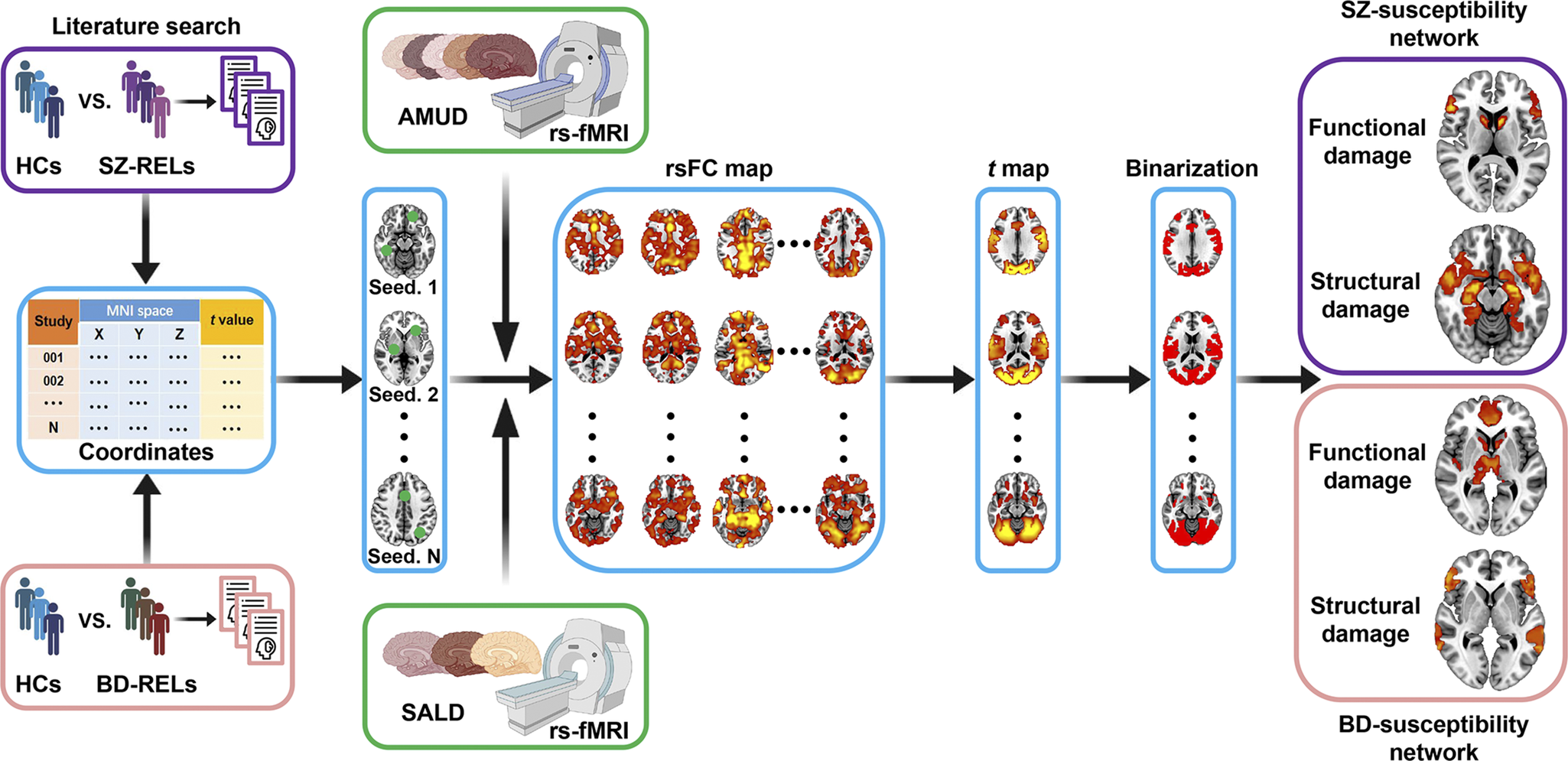
To address this missing gap, we adopted the FCNM approach to investigate the brain network substrates underlying SZ- and BD-RELs, potentially unifying the heterogeneous findings across prior neuroimaging studies from a network perspective. Specifically, we initially synthesized published literature to identify brain functional and structural damage locations in SZ- and BD-RELs. By combining these affected brain locations with large-scale discovery and validation resting-state functional magnetic resonance imaging (fMRI) datasets, we then adopted the FCNM approach to construct four disorder-susceptibility networks (i.e. SZ- and BD-susceptibility functional and structural damage networks). In addition, we assessed the spatial similarity between the SZ- and BD-susceptibility networks to examine shared and differential genetic effects. Schematic representation of the study design and analytical procedure is provided in Figure 1. Building on previous evidence, we hypothesized that differences and commonalities would exist in the susceptibility networks across disorders and imaging modalities.
Study design and analytical procedure. We initially synthesized published literature to identify brain functional and structural damage locations in SZ- and BD-RELs. By combining these affected brain locations with large-scale discovery (AMUD) and validation (SALD) rs-fMRI datasets, we then adopted the FCNM approach to construct disorder-susceptibility networks (i.e. SZ- and BD-susceptibility functional and structural damage networks). Specifically, spheres centered at each coordinate of a contrast were first created and merged together to generate a contrast-specific combined seed mask. Second, based on the rs-fMRI data, we computed a contrast seed-to-whole brain rsFC map for each subject. Third, the subject-level rsFC maps were entered into a voxel-wise one-sample t test to identify brain regions functionally connected to each contrast seed. Fourth, the resulting group-level t maps were thresholded and binarized at p < 0.05 corrected for multiple comparisons using a voxel-level FDR method. Finally, the binarized maps of the contrasts were overlaid to produce four network probability maps, which were thresholded at 60% to yield SZ-susceptibility functional and structural as well as BD-susceptibility functional and structural damage network, respectively. Abbreviations: AMUD, Anhui Medical University Dataset; BD, bipolar disorder; FCNM, functional connectivity network mapping; FDR, false discovery rate; HCs, healthy controls; RELs, relatives; rs-fMRI, resting state functional magnetic resonance imaging; rsFC, resting state functional connectivity; SALD, Southwest University Adult Lifespan Dataset; SZ, schizophrenia.
Methods
Study selection and classification
We performed a comprehensive and systematic literature search in PubMed and Web of Science to identify relevant studies examining brain functional or structural damage in SZ- or BD-RELs, published before February 1, 2023, following the Meta-analysis of Observational Studies in Epidemiology guidelines (Stroup et al., Reference Stroup, Berlin, Morton, Olkin, Williamson, Rennie and Thacker2000). The study selection process is detailed in Supplementary Methods and Figure S1 in the Supplementary Materials. The protocol was registered on PROSPERO (https://www.crd.york.ac.uk/PROSPERO/, registration number: CRD42023467611). A total of 103 studies with 2364 SZ-RELs, 864 BD-RELs, and 4114 healthy controls (HCs) were selected and included in our analysis. The number of studies for each imaging modality was (SZ-RELs/BD-RELs): 81 task fMRI studies (n = 58/23) and 26 voxel-based morphometry (VBM) studies (n = 16/10). Sample information of the selected studies is provided in Tables S1–S5 in the Supplementary Materials. Since a single study may contain multiple contrasts (i.e. brain activation or volume differences between SZ-RELs and HCs or between BD-RELs and HCs), we focused our analysis on contrasts rather than studies. Coordinates of peak voxels of significant clusters reported in each contrast were extracted, and coordinates in Talairach space were converted to Montreal Neurological Institute (MNI) space.
Discovery and validation datasets
Our study used Anhui Medical University Dataset (AMUD) as a discovery dataset and Southwest University Adult Lifespan Dataset (SALD) (Wei et al., Reference Wei, Zhuang, Ai, Chen, Yang, Liu and Qiu2018) as a cross-scanner validation dataset. AMUD included 656 healthy adults of Chinese Han and right handedness (396 female, mean 26.57 ± 8.57 years), who were enrolled from local universities and communities through poster advertisements. Participants with neuropsychiatric or severe somatic disorders, a history of head injury with consciousness loss, MRI contraindications, or a family history of psychiatric diseases among first-degree relatives were excluded. This study was approved by the ethics committee of The First Affiliated Hospital of Anhui Medical University, and all participants provided written informed consent after being given a complete description of the study. SALD included 329 healthy adults (207 female, mean 37.81 ± 13.79 years). For the SALD dataset, the exclusion criteria included MRI contraindications, current psychiatric or neurological disorders, use of psychiatric drugs within 3 months, pregnancy, or a history of head trauma. Full details regarding the sample have been described in the data descriptor publication (Wei et al., Reference Wei, Zhuang, Ai, Chen, Yang, Liu and Qiu2018). It is noteworthy that all included participants were restricted to an age range of 18–60 years to exclude the potential effects of neurodevelopment and neurodegeneration. Demographic information of the discovery and validation datasets is provided in Table S6 in the Supplementary Materials.
The authors assert that all procedures contributing to this work comply with the ethical standards of the relevant national and institutional committees on human experimentation and with the Helsinki Declaration of 1975, as revised in 2008. All procedures involving human subjects in the AMUD dataset were conducted following approval by the ethics committee of The First Affiliated Hospital of Anhui Medical University (approval number 20200094), and all participants provided written informed consent after being given a complete description of the study. As for the SALD dataset, it is a publicly available resource, and detailed ethical information can be found at http://fcon_1000.projects.nitrc.org/indi/retro/sald.html.
fMRI data acquisition and preprocessing
Resting state fMRI data of AMUD were collected on a 3.0-Tesla General Electric Discovery MR750w scanner, and those of SALD on a 3.0-Tesla Siemens Trio scanner. The fMRI parameters of the two datasets are provided in Table S7 in the Supplementary Materials. Participants with poor image quality (e.g. visible artifacts) and incomplete brain coverage were excluded.
Resting-state fMRI data were preprocessed using Statistical Parametric Mapping software (SPM12, http://www.fil.ion.ucl.ac.uk/spm) and Data Processing & Analysis for Brain Imaging (DPABI, http://rfmri.org/dpabi) (Yan et al., Reference Yan, Wang, Zuo and Zang2016). The first 10 volumes for each participant were discarded to allow the signal to reach equilibrium and the participants to adapt to the scanning noise. The remaining volumes were corrected for the acquisition time delay between slices. Then, realignment was performed to correct the motion between time points. Head motion parameters were computed by estimating the translation in each direction and the angular rotation on each axis for each volume. All participants’ BOLD data were within the defined motion thresholds (i.e. maximal translational or rotational motion parameters less than 2 mm or 2°). We also calculated frame-wise displacement (FD), which indexes the volume-to-volume changes in head position. Several nuisance covariates (the linear drift, the estimated motion parameters based on the Friston-24 model, the spike volumes with FD >0.5 mm, the global signal, the white matter signal, and the cerebrospinal fluid signal) were regressed out from the data. Since global signal regression can enhance the detection of system-specific correlations and improve the correspondence to anatomical connectivity (Murphy & Fox, Reference Murphy and Fox2017), we included this step in the preprocessing of resting state fMRI data. Next, the datasets were band-pass filtered using a frequency range of 0.01–0.1 Hz. In the normalization step, individual structural images were first coregistered with the mean functional images; the transformed structural images were then segmented and normalized to MNI space using a high-level nonlinear warping algorithm, that is, the diffeomorphic anatomical registration through exponentiated Lie algebra technique (Ashburner, Reference Ashburner2007). Then, each filtered functional volume was spatially normalized to MNI space using the deformation parameters estimated during the earlier step and resampled into a 3-mm isotropic voxel. Finally, all data were spatially smoothed with a Gaussian kernel of 6 × 6 × 6 mm3 full width at half maximum.
Functional connectivity network mapping
The FCNM approach was employed to construct four disorder-susceptibility networks (i.e. SZ- and BD-susceptibility functional and structural damage networks) based on the extracted coordinates of brain functional and structural damage in SZ- and BD-RELs, respectively (Figure 1). First, 4-mm radius spheres centered at each coordinate of a contrast were created and merged together to generate a combined seed mask specific to that contrast (henceforth referred to as the contrast seed). Second, based on the preprocessed resting state fMRI data of AMUD, we computed a contrast seed-to-whole brain functional connectivity (FC) map for each subject, by calculating Pearson’s correlation coefficients between time courses of the contrast seed and each voxel within the whole brain, followed by Fisher’s Z transformation to improve normality. Third, the 656 subject-level FC maps were entered into a voxel-wise one-sample t test to identify brain regions functionally connected to each contrast seed. Note that we only considered positive FC as the biological meaning of negative FC is still a matter of debate (Murphy et al., Reference Murphy, Birn, Handwerker, Jones and Bandettini2009; Murphy & Fox, Reference Murphy and Fox2017). Fourth, the resulting group-level t maps were thresholded and binarized at p < 0.05 corrected for multiple comparisons using a voxel-level false discovery rate (FDR) method. Finally, the binarized maps of the contrasts were overlaid to produce four network probability maps, which were thresholded at 60% to yield SZ- and BD-susceptibility functional and structural damage networks, respectively. In the interest of completeness, we combined the resultant disorder-susceptibility functional and structural damage networks to further obtain disorder-susceptibility brain damage networks.
To quantify the similarity of network patterns between disorders, we assessed the spatial overlap between the SZ- and BD-susceptibility networks by calculating a Dice coefficient, defined as 2 × (overlapping voxels)/(network #1 voxels) + (network #2 voxels). A higher Dice coefficient indicates more similar networks.
Relation to canonical brain networks
For ease of interpretability, we examined the spatial relationships between the disorder-susceptibility networks and 14 well-established canonical brain networks (Shirer et al., Reference Shirer, Ryali, Rykhlevskaia, Menon and Greicius2012). The proportion of overlapping voxels between each disorder-susceptibility network and a canonical network to all voxels within the corresponding canonical network was calculated to quantify their spatial relationship.
Validation analyses
We conducted several validation analyses to test the robustness of our results. First, to exclude the impact of dataset selection, we carried out the same analyses based on an independent validation dataset (i.e. cross-scanner SALD). Second, to determine whether our findings were influenced by seed size, we repeated the FCNM procedure using 1 mm and 7 mm radius spheres. Finally, to further exclude the influence of neurodegeneration, we repeated our analyses in the young adults within an age range of 18–30 years.
Results
SZ-susceptibility functional damage network
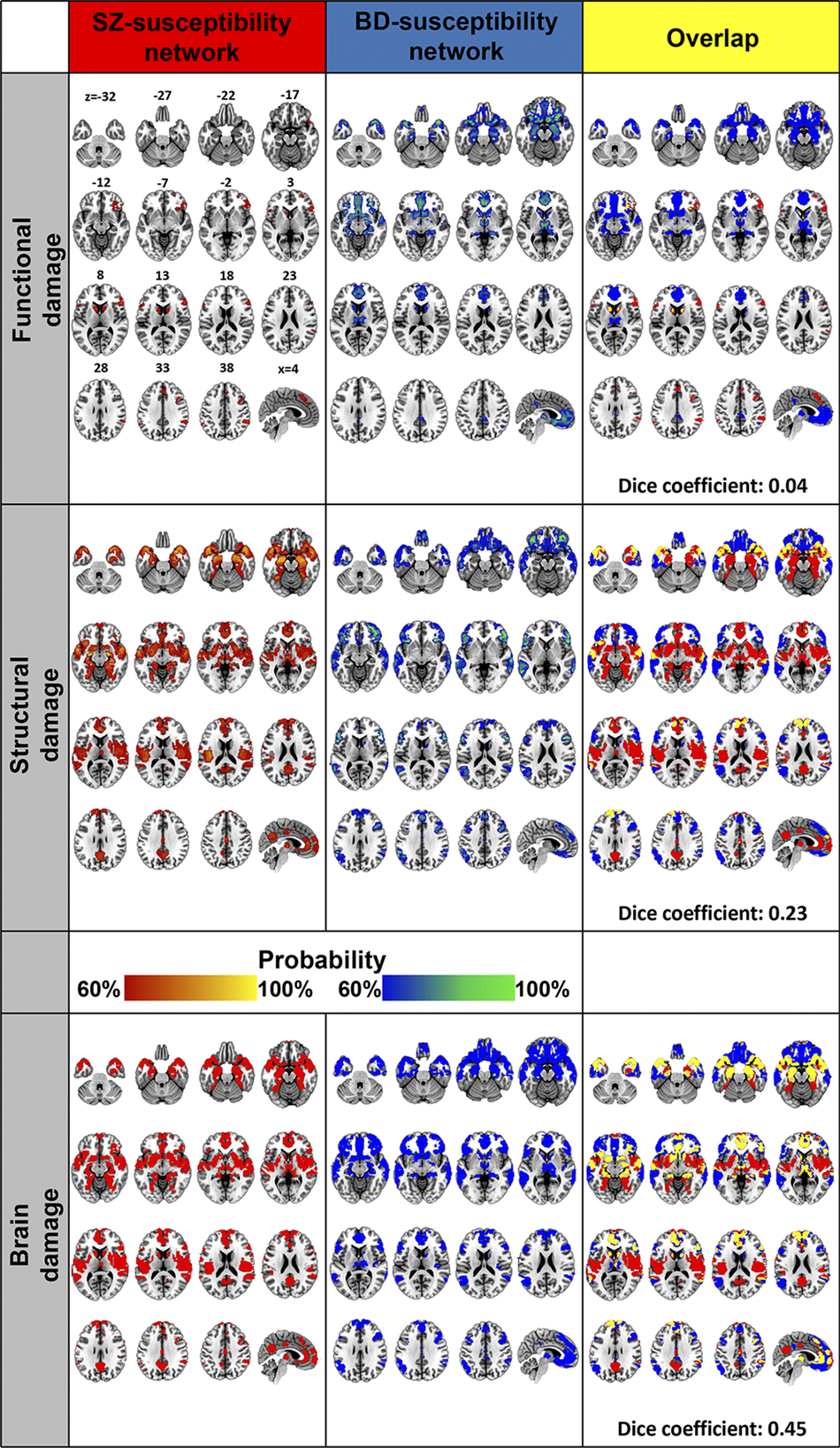
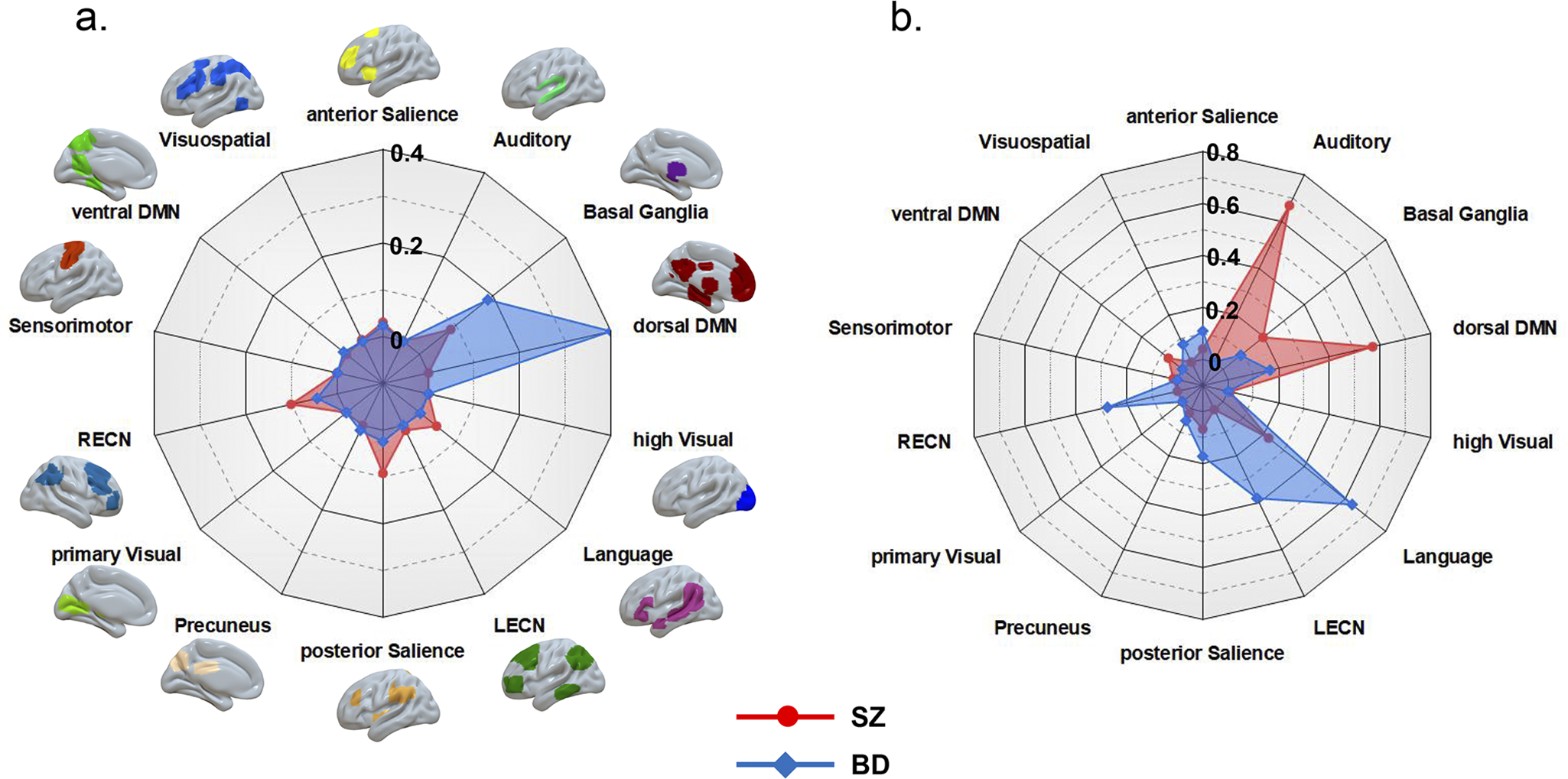
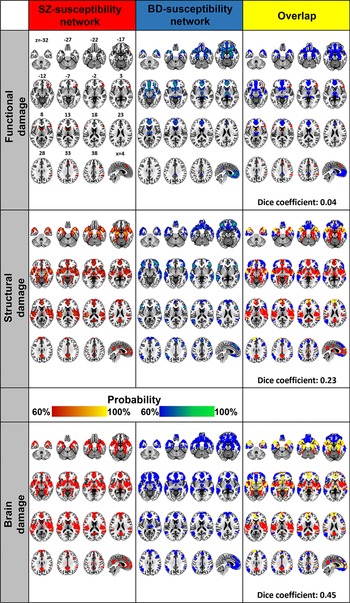
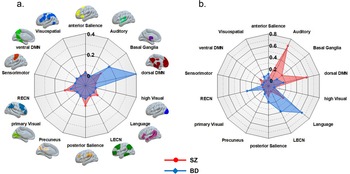
SZ-susceptibility functional damage network comprised a sparsely distributed set of brain regions including the bilateral dorsal medial prefrontal cortex, inferior parietal lobule, inferior frontal gyrus and caudate, and the right superior frontal gyrus, temporal pole, orbitofrontal cortex and insula (Figure 2). With regard to canonical brain networks, SZ-susceptibility functional damage network primarily involved the right executive control (overlapping proportion: 10.2%) and posterior salience (9.2%) networks (Figure 3a).
Schizophrenia and bipolar disorder susceptibility networks. Left panel: SZ-susceptibility functional, structural, and combined brain damage networks. Middle panel: BD-susceptibility functional, structural, and combined brain damage networks. Right panel: spatial overlap between SZ- and BD-susceptibility networks. Abbreviations: BD, bipolar disorder; SZ, schizophrenia.
Schizophrenia and bipolar disorder susceptibility networks in relation to canonical brain networks. (a) Functional damage networks. (b) Structural damage networks. Polar plots illustrate the proportion of overlapping voxels between each disorder-susceptibility network and a canonical network to all voxels within the corresponding canonical network. Abbreviations: BD, bipolar disorder; DMN, default mode network; LECN, left executive control network; RECN, right executive control network; SZ, schizophrenia.
BD-susceptibility functional damage network
BD-susceptibility functional damage network mainly consisted of the bilateral ventral medial prefrontal cortex, anterior and middle cingulate cortex, temporal pole, medial temporal cortex, insula, thalamus, hippocampus, amygdala, and striatum (Figure 2). As to canonical networks, BD-susceptibility functional damage network principally implicated the dorsal default mode (41.5%) and basal ganglia (18.7%) networks (Figure 3a).
SZ-susceptibility structural damage network
SZ-susceptibility structural damage network comprised widespread brain areas chiefly including the bilateral anterior, middle, and posterior cingulate cortex, ventral medial prefrontal cortex, temporal pole, superior temporal gyrus, insula and operculum, medial temporal cortex, thalamus, hippocampus, amygdala, and striatum (Figure 2). With respect to canonical networks, SZ-susceptibility structural damage network predominantly involved the auditory (66.9%) and dorsal default mode (57.1%) networks (Figure 3b).
BD-susceptibility structural damage network
BD-susceptibility structural damage network was primarily composed of the bilateral dorsal medial prefrontal cortex, orbitofrontal cortex, lateral prefrontal cortex, lateral temporal cortex, and posterior parietal cortex, and the right caudate (Figure 2). Regarding canonical networks, BD-susceptibility structural damage network mainly implicated the language (63.5%) and left executive control (38.2%) networks (Figure 3b).
Network similarity between disorders
When focusing on a single imaging modality, we observed low spatial similarities between SZ- and BD-susceptibility functional damage networks (Dice coefficient = 0.04) and between SZ- and BD-susceptibility structural damage networks (Dice coefficient = 0.23) (Figure 2). By combining the functional and structural damage networks, we found that the resultant SZ- and BD-susceptibility brain damage networks had a substantially increased spatial similarity (Dice coefficient = 0.45), (Figure 2). The overlapping regions included the medial prefrontal cortex, anterior cingulate cortex, temporal pole, hippocampus, amygdala, thalamus, caudate, and nucleus accumbens. The SZ-specific regions included superior temporal gyrus, insula and operculum, medial temporal cortex, posterior cingulate cortex, putamen, and globus pallidus. The BD-specific regions included the orbitofrontal cortex, lateral temporal cortex, lateral prefrontal cortex, and posterior parietal cortex.
Validation analyses
First, the SZ- and BD-susceptibility networks derived from the validation SALD dataset were similar to those from the discovery AMUD dataset, with subtle differences largely attributed to variation in sample sizes (656 vs. 329) (Figure S2 in the Supplementary Materials). Second, when repeating the FCNM procedure using 1 mm and 7 mm radius spheres, we observed that the resulting SZ- and BD-susceptibility networks were nearly identical to those using the 4 mm radius sphere (Figures S3 and S4 in the Supplementary Materials). Finally, our analyses in the young adults within an age range of 18–30 years yielded results similar to those of the main analyses in all participants (Figure S5 in the Supplementary Materials). These findings verified the robustness of our results to distinct datasets and methodological differences.
Discussion
By a combination of the novel FCNM approach and large-scale human brain connectome data, this study investigated network localization of genetic risk for SZ and BD based on brain damage locations in SZ- and BD-RELs reported in previous literature. We found four disorder-susceptibility networks with respect to different imaging modalities. SZ-susceptibility functional damage network primarily involved the executive control and salience networks, while its BD-counterpart principally implicated the default mode and basal ganglia networks. SZ-susceptibility structural damage network predominantly involved the auditory and default mode networks, yet its BD counterpart mainly implicated the language and executive control networks. These disparities endorse the concept that SZ and BD represent distinct diagnostic entities from the perspective of network localization. Although neither SZ-susceptibility functional nor structural damage networks were similar to their BD-counterparts, the combined SZ- and BD-susceptibility brain damage networks had quite similar spatial distributions, which may be the expression of the shared genetic mechanism underlying both disorders and could contribute to their overlapping clinical features.
Neuroimaging has been appropriately scrutinized for irreproducible results (Poldrack et al., Reference Poldrack, Baker, Durnez, Gorgolewski, Matthews, Munafò and Yarkoni2017), which has limited its clinical application in psychiatric diagnosis and treatment (Etkin, Reference Etkin2019). This lack of reproducibility can be ascribed to a number of factors, such as small samples, clinical heterogeneity, and methodological differences (Etkin, Reference Etkin2019; Poldrack et al., Reference Poldrack, Baker, Durnez, Gorgolewski, Matthews, Munafò and Yarkoni2017). Conventional coordinate-based neuroimaging meta-analyses offer a useful method to examine the spatial convergence of anatomical regions related to a given disorder across multiple studies (Eickhoff et al., Reference Eickhoff, Laird, Grefkes, Wang, Zilles and Fox2009). Nevertheless, it is generally accepted that neuropathological phenomena or neural processes do not act in isolation, but are instead interconnected via distributed brain networks (Fornito et al., Reference Fornito, Zalesky and Breakspear2015), such that localization of a disorder, symptom, or psychological process has recently shifted from a predominant regional approach to an updated connectomic paradigm. The conceptual and methodological advancements largely benefit from the development of the FCNM approach that integrates brain locations of interest (e.g. lesion, structural damage, functional abnormality, and neural activation) with large-scale human brain connectome data (Darby et al., Reference Darby, Joutsa and Fox2019; Joutsa et al., Reference Joutsa, Moussawi, Siddiqi, Abdolahi, Drew, Cohen and Fox2022; Peng et al., Reference Peng, Xu, Jiang and Gong2022; Taylor et al., Reference Taylor, Lin, Talmasov, Ferguson, Schaper, Jiang and Fox2023). By use of FCNM, researchers have mapped various disorders, many of which have eluded conventional regional localization, to specific brain networks (Cotovio et al., Reference Cotovio, Talmasov, Barahona-Corrêa, Hsu, Senova, Ribeiro and Fox2020; Cotovio et al., Reference Cotovio, Faro Viana, Fox and Oliveira-Maia2022; Darby et al., Reference Darby, Joutsa and Fox2019; Jones et al., Reference Jones, Zhukovsky, Hawco, Ortiz, Cipriani, Voineskos and Husain2023; Padmanabhan et al., Reference Padmanabhan, Cooke, Joutsa, Siddiqi, Ferguson, Darby and Fox2019; Taylor et al., Reference Taylor, Siddiqi and Fox2021; Taylor et al., Reference Taylor, Lin, Talmasov, Ferguson, Schaper, Jiang and Fox2023; Tetreault et al., Reference Tetreault, Phan, Orlando, Lyu, Kang, Landman and Darby2020; Trapp et al., Reference Trapp, Bruss, Manzel, Grafman, Tranel and Boes2023; Zhukovsky et al., Reference Zhukovsky, Anderson, Coughlan, Mulsant, Cipriani and Voineskos2021), with the assumption that abnormalities in multiple different brain locations that cause the same disorder can localize to a common network. With respect to neural correlates of genetic risk for SZ and BD, a recently published coordinate-based neuroimaging meta-analysis found reduced thalamic volume in both SZ- and BD-RELs, corticostriatal-thalamic changes in SZ-RELs, and thalamocortical and limbic alterations in BD-RELs, indicating shared and differential genetic influences on regional brain function and structure (Cattarinussi et al., Reference Cattarinussi, Kubera, Hirjak, Wolf and Sambataro2022). Complementing and extending this prior study, we used the FCNM approach to disentangle the nature and extent of SZ and BD genetic effects on the brain from a network perspective. Our work, in conjunction with these previous network-based efforts, highlights the potential usefulness of FCNM as a promising tool to improve our understanding of disease mechanisms.
SZ-susceptibility functional damage network primarily involved the executive control and salience networks. The executive control network is typically responsible for processes related to goal-directed behaviors, working memory, and attention control (Chen et al., Reference Chen, Oathes, Chang, Bradley, Zhou, Williams and Etkin2013; Menon, Reference Menon2011; Reuveni et al., Reference Reuveni, Dan, Canetti, Bick, Segman, Azoulay and Goelman2023; Shen et al., Reference Shen, Welton, Lyon, McCorkindale, Sutherland, Burnham and Grieve2020). The disruption of the executive control network has been well documented in SZ (Anhøj et al., Reference Anhøj, Ødegaard Nielsen, Jensen, Ford, Fagerlund, Williamson and Rostrup2018; Kraguljac et al., Reference Kraguljac, White, Hadley, Visscher, Knight, ver Hoef and Lahti2016; Supekar et al., Reference Supekar, Cai, Krishnadas, Palaniyappan and Menon2019). The salience network is crucial for sustaining human emotion and cognition, especially during the detection and processing of salient information (Cai et al., Reference Cai, Ryali, Pasumarthy, Talasila and Menon2021; Craig, Reference Craig2002; Seeley et al., Reference Seeley, Menon, Schatzberg, Keller, Glover, Kenna and Greicius2007). Salience network deficits, occurring across different stages of SZ (Huang et al., Reference Huang, Botao, Jiang, Tang, Zhang, Tang and Wang2020; Pu et al., Reference Pu, Li, Zhang, Ouyang, Liu, Zhao and Wang2012; Wang et al., Reference Wang, Ji, Hong, Poh, Krishnan, Lee and Zhou2016), have been shown to associate with SZ core symptoms, such as hallucinations and delusions (Palaniyappan et al., Reference Palaniyappan, Mallikarjun, Joseph, White and Liddle2011; Palaniyappan & Liddle, Reference Palaniyappan and Liddle2012; Pu et al., Reference Pu, Li, Zhang, Ouyang, Liu, Zhao and Wang2012; White et al., Reference White, Joseph, Francis and Liddle2010). Furthermore, accumulating evidence suggests the critical role of the salience network in switching between the executive control and default mode networks (Molnar-Szakacs & Uddin, Reference Molnar-Szakacs and Uddin2022; Sridharan et al., Reference Sridharan, Levitin and Menon2008), highlighting that the functional organization and dynamic interaction of these three networks underlie a wide range of mental disorders including SZ, resulting in the triple network model of psychopathology (Hogeveen et al., Reference Hogeveen, Krug, Elliott and Solomon2018; Menon, Reference Menon2011, Reference Menon2018; Menon et al., Reference Menon, Palaniyappan and Supekar2023). Different from SZ, BD-susceptibility functional damage network principally implicated the default mode and basal ganglia networks. The default mode network, whose activity is maximum at rest and suppressed during tasks, reflects intrinsic or endogenous neural activity (Gusnard et al., Reference Gusnard, Akbudak, Shulman and Raichle2001; Mason et al., Reference Mason, Norton, Van Horn, Wegner, Grafton and Macrae2007). Moreover, the high heritability of default mode network function makes it a candidate intermediate phenotype in the study of the genetic basis of psychiatric illnesses (Glahn et al., Reference Glahn, Winkler, Kochunov, Almasy, Duggirala, Carless and Blangero2010; Korgaonkar et al., Reference Korgaonkar, Ram, Williams, Gatt and Grieve2014; Xu et al., Reference Xu, Yin, Ge, Han, Pang, Liu and Friston2017). Indeed, default mode network abnormalities have been evident in BD patients and their RELs (Doucet et al., Reference Doucet, Bassett, Yao, Glahn and Frangou2017; Meda et al., Reference Meda, Gill, Stevens, Lorenzoni, Glahn, Calhoun and Pearlson2012; Meda et al., Reference Meda, Ruaño, Windemuth, O’Neil, Berwise, Dunn and Pearlson2014; Ongür et al., Reference Ongür, Lundy, Greenhouse, Shinn, Menon, Cohen and Renshaw2010). Despite the traditional view of its prominent involvement in motor learning and movement execution, knowledge about basal ganglia physiology has evolved during the last decades and this network is now considered as a key regulator of important cognitive and emotional processes (Mancini et al., Reference Mancini, Ghiglieri, Parnetti, Calabresi and Di Filippo2021). The frequently reported neural circuits (e.g. the corticolimbic and prefrontal–striatal–thalamic circuits) affected in BD commonly involve the basal ganglia (Brooks & Vizueta, Reference Brooks and Vizueta2014; Strakowski et al., Reference Strakowski, Delbello and Adler2005; Vai et al., Reference Vai, Bollettini and Benedetti2014; Vai et al., Reference Vai, Bertocchi and Benedetti2019; Zhang et al., Reference Zhang, Gao, Cao, Kuang, Niu, Guo and Lu2022), emphasizing its significant contribution to the pathophysiology of BD.
SZ-susceptibility structural damage network predominantly involved the auditory and default mode networks. The auditory network is engaged in auditory perception and processing. Extensive research has revealed structural and functional abnormalities in the auditory network in SZ patients and their RELs (Cui et al., Reference Cui, Liu, Guo, Chen, Chen, Xi and Yin2017; Joo et al., Reference Joo, Yoon, Jo, Kim, Kim and Lee2020; Liemburg et al., Reference Liemburg, Vercammen, Ter Horst, Curcic-Blake, Knegtering and Aleman2012; Oertel-Knöchel et al., Reference Oertel-Knöchel, Knöchel, Matura, Stäblein, Prvulovic, Maurer and van de Ven2014; Rajarethinam et al., Reference Rajarethinam, Sahni, Rosenberg and Keshavan2004). Numerous studies have also demonstrated an intimate link between auditory network deficits and auditory hallucinations (Ćurčić-Blake et al., Reference Ćurčić-Blake, Ford, Hubl, Orlov, Sommer, Waters and Aleman2017; Mallikarjun et al., Reference Mallikarjun, Lalousis, Dunne, Heinze, Reniers, Broome and Upthegrove2018; Oertel-Knöchel et al., Reference Oertel-Knöchel, Knöchel, Matura, Stäblein, Prvulovic, Maurer and van de Ven2014; Richards et al., Reference Richards, Hughes, Woodward, Rossell and Carruthers2021; Upthegrove et al., Reference Upthegrove, Broome, Caldwell, Ives, Oyebode and Wood2016; Xie et al., Reference Xie, Guan, Cai, Wang, Ma, Fang and Wang2023), a core psychotic symptom affecting up to 60–80% of SZ patients. Regarding the default mode network, its relationships with SZ as well as psychotic symptoms have been well established (Bluhm et al., Reference Bluhm, Miller, Lanius, Osuch, Boksman, Neufeld and Williamson2007; Camchong et al., Reference Camchong, MacDonald, Bell, Mueller and Lim2011; Garrity et al., Reference Garrity, Pearlson, McKiernan, Lloyd, Kiehl and Calhoun2007; Lynall et al., Reference Lynall, Bassett, Kerwin, McKenna, Kitzbichler, Muller and Bullmore2010; Rotarska-Jagiela et al., Reference Rotarska-Jagiela, van de Ven, Oertel-Knöchel, Uhlhaas, Vogeley and Linden2010; Zhou et al., Reference Zhou, Liang, Tian, Wang, Hao, Liu and Jiang2007). van Buuren et al. (Reference van Buuren, Vink and Kahn2012) also found that healthy siblings of SZ patients exhibited abnormal intrinsic connectivity within the default mode network. Distinct from SZ, BD-susceptibility structural damage network mainly implicated the language and executive control networks. The language network predominantly implicates Broca’s and Wernicke’s areas in the inferior frontal gyrus and temporal–parietal junction of the left hemisphere, respectively. There is strong evidence for structural and functional alterations in these brain regions in BD patients and their RELs (Drobinin et al., Reference Drobinin, Slaney, Garnham, Propper, Uher, Alda and Hajek2019; Hafeman et al., Reference Hafeman, Bebko, Bertocci, Fournier, Bonar, Perlman and Phillips2014; Hajek et al., Reference Hajek, Cullis, Novak, Kopecek, Blagdon, Propper and Alda2013; Liang et al., Reference Liang, Zhou, Zhang, Cai, Wang, Cheung and Chan2022; Romeo et al., Reference Romeo, Marino, Angrilli, Semenzato, Favaro, Magnolfi and Spironelli2022; Stoddard et al., Reference Stoddard, Gotts, Brotman, Lever, Hsu, Zarate and Leibenluft2016). Although BD is characterized by emotion processing abnormalities, BD patients and their RELs present with prominent executive function impairment and its underlying neural correlate, that is, executive control network dysfunction (Arts et al., Reference Arts, Jabben, Krabbendam and van Os2008; Singh et al., Reference Singh, Chang, Kelley, Saggar, Reiss and Gotlib2014; Wu et al., Reference Wu, Lu, Passarotti, Wegbreit, Fitzgerald and Pavuluri2013).
When combining functional and structural damage networks, we found that the resultant SZ- and BD-susceptibility brain damage networks showed substantially increased spatial similarity, with the convergent abnormalities primarily localized to the medial prefrontal cortex, anterior cingulate cortex, temporal pole, hippocampus, amygdala, thalamus, caudate, and nucleus accumbens. These affected regions across disorders are consistent with findings from previous transdiagnostic studies, emphasizing the involvement of the salience and subcortical networks (Caseras et al., Reference Caseras, Tansey, Foley and Linden2015; Goodkind et al., Reference Goodkind, Eickhoff, Oathes, Jiang, Chang, Jones-Hagata and Etkin2015; McIntosh et al., Reference McIntosh, Job, Moorhead, Harrison, Forrester, Lawrie and Johnstone2004; Rimol et al., Reference Rimol, Hartberg, Nesvåg, Fennema-Notestine, Hagler, Pung and Agartz2010). The Psychiatric Genomics Consortium and other large-scale genome-wide association studies (GWAS) have identified multiple genetic variants associated with the risk for SZ and BD (Schizophrenia Working Group of the Psychiatric Genomics Consortium, 2014; Stahl et al., Reference Stahl, Breen, Forstner, McQuillin, Ripke, Trubetskoy and Sklar2019). Moreover, numerous imaging genetics studies have combined genetic data with brain MRI to investigate how these risk genes contribute to brain functional and structural abnormalities. For example, large-scale imaging genetics research has found that several psychiatric risk variants significantly influence subcortical brain structure, suggesting that genetic risk may confer disease susceptibility through its impact on the structural architecture of specific brain regions (Hibar et al., Reference Hibar, Stein, Renteria, Arias-Vasquez, Desrivières, Jahanshad and Medland2015). Additionally, imaging genetics studies in SZ reveal that carriers of multiple risk genes and genetic variants, including CACNA1C, NRG1, DRD2 (rs1076560), COMT (Val158Met), miR-137, and others, as well as high-risk populations, exhibit significant brain functional and structural abnormalities in regions such as the prefrontal cortex, temporal cortices, precuneus, thalamus, and striatum (Erk et al., Reference Erk, Meyer-Lindenberg, Schmierer, Mohnke, Grimm, Garbusow and Walter2014; Grimm et al., Reference Grimm, Heinz, Walter, Kirsch, Erk, Haddad and Meyer-Lindenberg2014; Jagannathan et al., Reference Jagannathan, Calhoun, Gelernter, Stevens, Liu, Bolognani and Pearlson2010; Jamadar et al., Reference Jamadar, Powers, Meda, Gelernter, Gruen and Pearlson2011; Liu et al., Reference Liu, Li, Liu, Li, Wang, Sun and Liu2020; Luykx et al., Reference Luykx, Broersen and de Leeuw2017; Sambataro et al., Reference Sambataro, Fazio, Taurisano, Gelao, Porcelli, Mancini and Bertolino2013; Tunbridge et al., Reference Tunbridge, Farrell, Harrison and Mackay2013; van Erp et al., Reference van Erp, Guella, Vawter, Turner, Brown, McCarthy and Potkin2014; Wright et al., Reference Wright, Gupta, Chen, Patel, Calhoun, Ehrlich and Turner2016). Although imaging genetics studies in BD are relatively limited in sample size, existing research indicates that BD-related risk genes, such as CACNA1C and ANK3, are associated with functional and structural abnormalities in prefrontal and limbic regions (Dima et al., Reference Dima, Jogia, Collier, Vassos, Burdick and Frangou2013; Erk et al., Reference Erk, Meyer-Lindenberg, Schmierer, Mohnke, Grimm, Garbusow and Walter2014; Perrier et al., Reference Perrier, Pompei, Ruberto, Vassos, Collier and Frangou2011; Soeiro-de-Souza et al., Reference Soeiro-de-Souza, Lafer, Moreno, Nery, Chile, Chaim and Vallada2017). The SZ- and BD-susceptibility brain damage networks identified in our work show high spatial concordance with these imaging genetics findings.
Notably, we observed pronounced dissociations between the functional and structural findings in both disorders. While the relationship between brain functional and structural abnormalities in psychiatric disorders remains incompletely understood, emerging evidence suggests both compensatory network reorganization and independent pathological processes. The breakdown of functional connectivity between brain regions can drive adaptive changes, such as over- or under-utilization of established pathways without requiring physical fiber disruption (Skudlarski et al., Reference Skudlarski, Jagannathan, Anderson, Stevens, Calhoun, Skudlarska and Pearlson2010), whereas structural and functional abnormalities may also arise through distinct mechanisms, as evidenced by their dissociations in SZ and depression (Gong et al., Reference Gong, Lui and Sweeney2016; Guo et al., Reference Guo, Liu, Xiao, Zhang, Yu, Liu and Zhao2015, Reference Guo, Liu, Yu, Zhang, Zhang, Liu and Zhao2014; Ren et al., Reference Ren, Lui, Deng, Li, Li, Huang and Gong2013; Zhuo et al., Reference Zhuo, Zhu, Wang, Qu, Ma, Tian and Qin2017). Our findings demonstrate that the dissociations between functional and structural brain damage networks are already present in unaffected relatives of SZ and BD patients, indicating that modality-specific vulnerability patterns independently shape disease neuropathology.
There are several limitations to our study. First, we utilized resting state fMRI data from healthy adults to examine network localization of genetic risk for SZ and BD. It seems preferable to use fMRI data from samples well matching the SZ- and BD-RELs in terms of demographic and clinical features. Nevertheless, earlier studies have demonstrated that sample selection makes little impact on network localization (Boes et al., Reference Boes, Prasad, Liu, Liu, Pascual-Leone, Caviness and Fox2015; Fox et al., Reference Fox, Buckner, Liu, Chakravarty, Lozano and Pascual-Leone2014; Horn et al., Reference Horn, Reich, Vorwerk, Li, Wenzel, Fang and Fox2017). Second, our study design was retrospective rather than prospective. Some RELs included in our analyses, adolescents in particular, may ultimately develop a major psychiatric disorder, which may influence our interpretation. Future prospective investigation is warranted to verify our preliminary findings. Third, a less conservative overlapping threshold (60%) was adopted to identify brain regions that were functionally connected to 60% of the contrast seeds since many sources of variance, for example, differences of the selected studies in their statistical power, participants’ age ranges, and scanners, may prevent us from finding a common brain network. There has been no consensus yet on how to account for these factors. Further investigation of their influences, in concert with analytical advances in the future, will help address this issue. Fourth, our analysis was restricted to task-based fMRI, while emerging evidence suggests resting-state and dynamic functional connectivity may provide complementary mechanistic insights into neuropsychiatric disorders (Wang et al., Reference Wang, Li, Yao, He, Tang, Chen and Li2024; You et al., Reference You, Luo, Yao, Zhao, Li, Wang and Li2022). Future studies should incorporate these modalities to fully characterize brain network alterations in RELs of SZ and BD. Fifth, while we focused on neuroimaging biomarkers, integrating multidimensional data such as genetics and behavioral/cognitive assessments could enhance clinical translation, as highlighted in recent frameworks (Li et al., Reference Li, Yao, You, Liu, Deng, Li and Gong2023; Wang et al., Reference Wang, Huang, Wu, Xiong, Chen, Li and Li2025). These integrative approaches may help bridge the gap between underlying biological mechanisms and the heterogeneous clinical profiles seen in psychiatric disorders. Moreover, recent evidence demonstrates that neuroimaging features have potential to predict clinical prognosis and inform clinical practice (Long et al., Reference Long, Chen, Zhang, Li, Wang, Wang and Li2025). Future studies should therefore investigate whether the shared neuroimaging features identified in RELs of SZ and BD could serve as stratification markers for early intervention in high-risk populations and predictors of disease progression trajectories. Finally, this work might not mitigate concerns with regard to small sample sizes, heterogeneous clinical populations, and methodological variability that jointly contribute to the lack of reproducibility in neuroimaging studies on psychiatry. Continued efforts will be needed to address these challenges.
In summary, the present work integrated the novel FCNM approach with large-scale human connectome data to localize brain functional and structural damage in SZ- and BD-RELs to four disorder-susceptibility networks, which showed cross-disorder inconsistencies when focusing on either imaging modality alone, but had a considerably increased spatial similarity with two modalities combined. These findings may not only support the notion that SZ and BD are distinct diagnostic categories from a neurobiological perspective, but also help to clarify the neural substrates that link the shared genetic mechanism underlying both disorders to their overlapping clinical phenotype.
Supplementary material
The supplementary material for this article can be found at http://doi.org/10.1017/S0033291725101992.
Data availability statement
The data and analysis codes used in the preparation of this article are publicly available at https://github.com/mfmaplestory/FCNM/ .
Acknowledgments
The study was supported by the National Natural Science Foundation of China (grant numbers: 82471952 and 82371928), the STI2030-Major Projects (grant number: 2022ZD0205200), the Anhui Provincial Natural Science Foundation (grant number: 2308085MH277), the Scientific Research Key Project of Anhui Province Universities (grant number: 2022AH051135), and the Scientific Research Foundation of Anhui Medical University (grant number: 2022xkj143).
Competing interests
The authors declare none.


 Open access

