


Introduction
The Reference KambKamb (1987) and the (Reference FowlerFowler1987, Reference Fowler1989) theories of glacier surging lead to predictions that certain glacier geometries are conducive to surging. In outline, the Kamb theory proposes that surges are triggered by the transition from a localized subglacial water system to a distributed network of linked cavities and that this transition can occur when a dimensionless stability parameter Ξ falls below some critical value Ξ*. For a step cavity Ξ takes the form

where θ is the longitudinal hydraulic gradient (assumed to equal surface slope), Λ is the "head gradient concentration factor", T is the average tortuosity, D0 = 31 km is a natural length scale, M is the Manning roughness, η is the ice viscosity, v is the ice sliding velocity, p’ is the effective pressure and h is the cavity step height. Of particular interest is the appearance of the surface slope θ in the numerator of the stability parameter; assuming all other influences are held constant, this implies that low slope is conducive to surging. The Fowler theory models a surge-type glacier as a spatially varying relaxation oscillator and is more abstract than the Kamb theory in its description of physical processes. Reference FowlerFowler (1989) introduced a surging criterion which may be expressed as ω < ω*, where

and ω* is some critical value of ω that distinguishes surging from non-surging glaciers. In the above expression θ is the mean bedrock slope, ω is glacier width and β ≈ 2 Since the mean surface slope and mean bed slope are approximately equal, I shall regard θ in Equation (2) as the surface slope.
Predictions of the Kamb and Fowler theories can be subjected to statistical testing by examining a large population of glaciers and determining whether surge-type (S-type) glaciers and normal (N-type) glaciers have significant geometric differences. The Canadian Glacier Inventory (CGI) of the Yukon Territory provides a suitable data set for testing this idea. A previous publication (Reference Clarke, Schmok, Ommanney and CollinsClarke and others, 1986) examined the length, elevation and slope influences on surging as well as the non-random geographical distribution of surge-type glaciers. One of the major conclusions claimed in Reference Clarke, Schmok, Ommanney and CollinsClarke and others (1986) is that long glaciers have a high probability of being surge-type and short glaciers have a high probability of being normal. Because length and slope for both N- and S-type glaciers have a strong inverse correlation, there is some confusion about whether length and slope correlations with surging are independent or whether the primary correlation with length (or slope) and the secondary correlation with slope (or length) are entirely a consequence of the length-slope correlation. A similar concern arises if width and ice thickness are added to the scheme. Large glaciers tend to be thick, wide and long, having low surface slope; small glaciers tend to be thin, narrow and short having high surface slope. Thus the problem of correlations between observational variables such as length l, width ω, surface slope θ and thickness d are inescapable.
(Reference KambKamb 1987, p. 9099) has used this ambiguity to claim that our CGI analysis supports the prediction of his theory that slope influences surging:
"Despite these difficulties, a test of the ability of the linked cavity model to distinguish predictively in a statistical way between surge-type and nonsurge-type glaciers is provided by the observed correlation between glacier length and probability of surging in a large sample of Yukon glaciers [Reference Clarke, Schmok, Ommanney and CollinsClarke et al., 1986, Figure 2b]. Glacier length docs not directly enter as a parameter of the model, but since there is a strong inverse correlation between length and surface slope in the sample studied [Reference Clarke, Schmok, Ommanney and CollinsClarke et al., 1986, Figure 4a], the observed correlation can be considered an inverse correlation between surge probability and slope θ, which is a parameter in the model. [Reference Clarke, Schmok, Ommanney and Collins[Clarke et al. 1986] concluded that the correlation was really with length alone and the slope had no effect, but a compelling statistical argument that required this conclusion was not given."
Reference FowlerFowler (1989, p. 261) echoed this concern and called for a statistical test of the ω stability parameter defined in Equation (2):
"Their conclusion was that surging behavior correlated with length but not (independently) with surface slope. However, since long glaciers are also less steep, this could equally well be interpreted as meaning that gently-sloping glaciers tend to surge. Clarke et al. did not report the widths of the glaciers in their data set. It would be interesting to test for the validity of a criterion such as (4.8) [Equation (2) above], which involves purely geometrical criteria."
The aims of this paper are to seek correlations between surge tendency, length, width and slope and to test whether the observed correlations lend support to the predictions of the Kamb and Fowler theories.
Data
The objective of the CGI is to complete an inventory of all glaciers in Canada as well as an inventory of glacier-related features such as glacierets, remnant glaciers, neves, snow patches, rock glaciers and pro-talus ramparts. Each glacier entry includes geographical coordinates, assorted geometrical data, and qualitative information on special features of the glacier. A complete description of formats and procedures is presented in Reference Ommanney, Clarkson and StromeOmmanney and others (1973), and further information is given in Reference OmmanneyOmmanney (1980). The Yukon Territory component of the CGI was accomplished by a single investigator, Mr S. G. Collins, working for a period of 5 years. Research materials used by Collins include all available Canadian Government aerial photographs taken prior to 1965, a limited quantity of post-1965 vertical photographs, oblique aerial photographs from private sources, together with published and unpublished maps, scientific reports and mountaineering accounts. The Yukon Territory inventory contains a total of 4C75 glaciers and glacier-related features. A purge of 2207 non-glacier features and 112 other unacceptable entries reduces the data set to 2356 glaciers. Not all glaciers are suitable for the present analysis. Several entries lack complete length or elevation information and when these have been removed the data set is reduced to 1984 entries. Reference Clarke, Schmok, Ommanney and CollinsClarke and others (1986) showed that tributary glaciers had a higher probability of being S-type than trunk glaciers. The likely explanation is that a surge occurring in a trunk glacier can induce surges of its tributary glaciers whereas the reverse situation is unusual. A further complication associated with tributary glaciers is that their lengths and slopes are measured as if they are themselves complete glaciers. For example, the length of a tributary glacier is taken as the distance from the farthest upflow point in the accumulation zone to the point at which the tributary joins the trunk glacier; unlike the trunk, the tributary has no proper terminus. Elimination of tributary glaciers further reduces the included data set. The final glaciers that are excluded from consideration are those that, for whatever reason, were recorded in the CGI as having no accumulation zone or no ablation zone. Culled in this way, the remaining glacier population is N = 1754.
The CGI glacier data that form the basis of this paper are the maximum length l, the mean width ω of the main stream, the highest glacier elevation Z H and the lowest glacier elevation Z L. Of these measurements, the least clearly defined, and presumably the most vulnerable to subjective influences, is the determination of glacier width. Mean glacier slope is not tabulated in the CGI but can be calculated using the relation

Sample of glaciers from the CGI data set

Figure 1 and Table 2 show the distribution of glaciers among the various i levels. Note the preponderance of glaciers in the i 0 bin and the sparse distribution of glaciers in categories i = 4 and i = 5. At my request, S. G. Collins made post hoc estimates of the correspondence between i levels and the conditional probabilities P(S = l|i), i.e. the probability that a glacier having surge-index value i is S-type. These conditional probabilities are included in Table 2 and one can note that the probability a glacier in the i = 5 category is S-type is estimated at 97.5% whereas for a glacier in the i = 0 category the probability is 0.5%. Examination of Table 2 leads to the conclusion that i = 4 and i = 5 glaciers have a strong likelihood of being S-type and the remaining ilevels match to glaciers that are predominantly N-type.
Histogram showing distribution of surge-index values for 1754 glaciers in the Yukon Territory CGI data set. The vertical axis has been normalized so that the sum of the bar heights is unity.

Distribution of surge index i within Yukon Territory CGI data set

Examination of histograms for l and ω reveals that the length and width distributions tend to be log-normal. i therefore introduce the logarithmic transformations L = log10 l and ω = logl0 ω to obtain variables that are approximately Gaussian-distributed (Fig 2a and b). The presence of "empty bins" in histograms of Figure 2a and b is not a cause for concern. Visual smoothing shows that area missing from any of these bars is added to nearest neighbours and the overall result is approximately Gaussian. The explanation for these gaps is that length and width are recorded to the nearest 0.1 km; the logarithmic transformation produces empty bins unless the bar widths ∆L and ∆W are taken to be large. Slope-angle data require no transformation to yield a histogram that is approximately Gaussian (Fig 2c). A histogram of Ω = log10 ω, the logarithm of Fowler’s parameter, is included for later reference (Fig 2d). All of the foregoing histograms have been normalized to unit area and Gaussian curves of the form

have been overplotted to illustrate the match between the two. In Equation (3) the variable x is intended to represent any one of


Sample variances are denoted by s2 and computed from

In Equation (5), a denominator of N rather than N 1 leads to a biased estimate of the variance i ≥ 4; thus Equation (5) is the preferred definition of sample variance.
Histograms calculated from the Yukon Territory CGI data. act. These have been normalized to give unit area. Glaciers likely to be surge-type (those having surge index values of Ω = log10 ω)are represented by the unshaded upper part of individual histogram bars. Gaussian curves having mean and variance valves identical to the sample mean and sample variance have been superimposed. (a) Logarithmic length L = log10l. (b) Logarithmic width w = log10w. (c) Surface-slope angle 0. (d) Logarithm of Fowler’s parameter σ2= σ2 E [(x–β)2];

In addition to the length, width and slope attributes it is necessary to incorporate the less precise attribute of "surge tendency". The simplest approach is to define a dichotomous variable S that takes the value S = 0 for normal glaciers and S 1 for surge-type glaciers. Examination of Table 2 suggests that glaciers having surge index 4 ≤ i ≤ 5 should be designated as type S and glaciers having 0 ≤ i ≤ 3 should be designated type N. An alternative to this approach is to regard S as a measure of surge probability and adopt the definition

where p(S=1|i) is the probability that a glacier is surge-type given that its surge-index value is i. By performing the complete analysis presented in this paper using each of the two definitions, i have established that, although numbers differ, the results are insensitive to which approach is followed. Thus the probability-based definition of S defined in Equation (6) will be adopted.
Correlation Analysis
The covariance between pairs of the attributes S, L, w and θ can be expressed in the general form

and these elements can be organized to form the covariance matrix C. Note that diagonal elements of C are simply the sample variances


These sample correlations are estimators of the correct (but unknown) population correlations pjk
Test of Length, Width and Slope Influences
The covariances between S, L, w and θ can be visually represented by scatter diagrams (Fig. 3a–f). In these diagrams a distinction between S- and N-type glaciers is indicated by assigning an X symbol to glaciers having i = 4 or i = 5 and a solid dot to all others. In the CGI, l and ω are recorded to the nearest 0.1km and the effects of this discretization are most apparent in Figure 3d. A problem with scatter diagrams involving discrete variables, and this is especially true of Figure 3a–c, is that substantial overplotting can occur making it impossible to distinguish whether a single plotted point represents one or many samples.
Scatter diagrams for 1754 glaciers in the Yukon Territory CGI data set. (a) S vs L. (b) S vs W. (c) S vs 8. (d) L vs W. (e) L vs 8. (f) w vs θ.

Information qualitatively expressed by scatter diagrams can be quantitatively summarized as a sample covariance or correlation matrix. Calculating these matrices for the attributes S, L, w and θ gives for the co-variance matrix C:

and for the correlation matrix R:

The null hypothesis, that off-diagonal terms of R vanish, can be tested using standard procedures and confidence intervals can be assigned to individual elements of the correlation matrix. To avoid burdening this section with technical discussion concerning significance testing, I shall simply state results and defer detailed discussion to a subsequent part of this paper. In matrix form, the 95% confidence limits for the off-diagonal terms of Expression (10) can be expressed as

From Expression (11) it is apparent that the expected magnitude of error in the correlation estimates of Expression (10) is not large and would not alter the ranking of length and slope influences on surging. Close scrutiny of Expression (10) leads to the following conclusions:
-
1. Among L, w and 9, the attribute most strongly correlated with S is glacier length. Thus long glaciers tend to be surge-type.
-
2. The correlations of ω and θ with S are of comparable magnitude and significantly less than that between L and S. The S-W correlation is direct (wide glaciers tend to be S-type) and the S–θ correlation is inverse (glaciers having low slope tend to be S-type).
-
3. The strongest correlation of all is the inverse correlation between L and θ. Long glaciers tend to have low slope. This raises the possibility that some component of the observed S-L correlation arises because of linkage from L to θ to S.
-
4. The correlation between L and ω indicates that long glaciers tend to be wide.
-
5. The inverse correlation between ω and θ indicates that wide glaciers tend to have low slope.
Sorting out the tangle of intercorrelations is the main difficulty in settling whether it is length or low slope that favours surging. The technique that allows the various possibilities to be analyzed is a standard method of multivariate statistics known as multiple-correlation analysis (e.g. Reference Mardia, Kent and BibbyMardia and others, 1979, p. 170).
Applying the basic approach of multiple-correlation analysis to the problem of surging, one postulates the existence of a linear relationship of the form

where βm are constant coefficients and, for the present work, M = 3, x1 = L, x2 and x 3 = θ. The covari-ance between S and Y can be computed using Equation (7) and will differ according to the values assigned to βm Using the method of Lagrange multipliers (e.g. Reference LanczosLanczos, 1970, p. 43-48), values of βm can be found that maximize the covariance csy subject to appropriate constraints (Reference MorrisonMorrison, 1990, p.94-90). From this, a maximized value of the correlation T$y can be calculated. This correlation is referred to as the multiple correlation between S and the remaining variables L, W, and θ, and is denoted r 1·2...M in the general case and r s·LWθ for the present application. For the M = 3 case, the multiple correlation r 1·234 is evaluated by partitioning the correlation matrix into the following sub-matrices:


and evaluating

where


which represents the fraction of the multiple correlation rs.LWθ that is unexplained by the simple correlation rsL, and

which represents the fraction of the multiple correlation that is unexplained by the simple correlation rsθ. For the CGI Yukon Territory data set, sample values of Equations (17) and (18) are J SL = 0.00315 and J Sθ = 0.39371. If these sample values correctly represent the population statistics, then the following statements can be made: less than 0.32% of the multiple correlation between S and L, w and θ is unexplained by the correlation between S and L; less than 39.4% of the multiple correlation is unexplained by the correlation between S and θ. Equivalently, more than 99.68% of the multiple correlation is explained by the correlation between S and L; more than 60.6% of the multiple correlation is explained by the correlation between S and θ. To summarize, virtually all of the correlation between surge tendency and length, width and slope can be attributed to the correlation between surge tendency and length. In contrast, the Kamb theory would seem to predict that the (inverse) correlation between surge tendency and slope should be the predominant one. The statistical significance of these assertions is high, but this matter will be treated separately.
Test of Influence of Fowler’s Parameter
My final task is to seek correlations between surge tendency and the Fowler parameter. This could be introduced as a fifth variable into the correlation matrix of Expression (10) but there is no reason to be interested in correlations between Ω and ωor θ since itself involves both of these quantities. Thus I simply consider the intercorrelations of S, L and Ω. For this analysis

and

Multiple-correlation analysis of Equation (20) yields


Tests of Statistical Significance
Questions of statistical significance cannot be left un-addressed, but the following section can be skipped by those who have no appetite for these matters.
Correlation Estimates
Off-diagonal terms r jk of the sample correlation matrix can be tested one at time againstthe null hypothesis that the true population correlation is p jk. = 0. (To reduce visual clutter, subscripts will henceforth be dropped from r and p except when they are essentialfor clarity.) For the case p 0, the sampling distribution of r can be found from the statistic

which has a Student t distribution with N 2 degrees of freedom. The criterion for rejecting the null hypothesis is

where

Confidence limits can also be placed on the estimated correlation coefficients r jk of Expression (10). To obtain these, I used the standard procedure developed by Reference FisherFisher (1921) and described in (Reference MorrisonMorrison 1990,p. 101-06) and elsewhere. For each off-diagonal element of the correlation matrix, the sample correlation r has a non-Gaussian distribution about the true correlation p. The transformed variable

known as Fisher’s z statistic, can be shown for large N to be normally distributed with mean value

and variance

It is therefore a simple matter to perform significance tests on z and then, by performing the reverse transformation

obtain corresponding values of r. Following this approach, the probability that the sample correlation r lies within a given range can be evaluated using the relation

where tanh is a hyperbolic tangent and za/2 is the upper lOOa percentage point of the unit-normal distribution (e.g. Reference MorrisonMorrison, 1990, p.8-9). Applying Inequality (27) to off-diagonal elements, the correlation matrix of Expression (10) yields estimates of the error magnitudes for the individual matrix elements. This procedure has been followed to obtain the error estimates given in Expression (11). Because the statistic z as defined in Equation (23) is normally distributed, it follows that the sampling distribution of any correlation coefficient r jk has the form

a fact that will be used in subsequent Monte Carlo simulations.
Multiple-Correlation Estimates
Confidence limits can be placed on estimates of the multiple-correlation coefficient once the sampling distribution of r s.LW0 has been determined. The sampling distribution for multiple-correlation coefficients was first found by Reference FisherFisher (1928) who showed that for r 2 the distribution was

where the correlation matrix R is p × p, T(.) is the gamma function (Reference Press, Flannery, Teukolsky and VetterlingPress and others, 1986, p. 156-57), and N is the sample size. This important result is widely quoted in the literature on multivariate analysis (e.g. Reference AndersonAnderson, 1958, p. 93-9G). The sampling distribution of |r| is found from Equation (29) using the fact that

Numerical evaluation of Equation (29) presents several minor difficulties. The arguments of the gamma function can be large and the actual function values can far exceed the overflow limits of digital computers. It is therefore essential to evaluate each term of Equation (29) by logarithmic additions and subtractions rather than by multiplications and divisions. Both the numerator and denominator of terms in Equation (29) can be huge but the net result is not. A second cautionary point is that the summation at first diverges then converges and terms near m = 0 as well as those for m → ∞ can be vanish-ingly small.
It might be asked if the error magnitude of individual elements of the matrix R can be large enough to alter the conclusion that width and slope are not independently correlated with surge tendency. The answer is not immediately apparent from separate examination of the confidence limits on estimates of TsL (using Inequality (27)) and rsLW0 (using evaluations of Equation (30)). The root of the difficulty is apparent from Figure 4. The sampling distributions for both rSL and rsLW0 appear roughly Gaussian. If both statistics were independent of each other, the difference between individual pairs r s.LW0 and r SL could be as large as 0.10. This would occur if rs.LW0 lay at the high end of its range and rSL at the low end. In fact, the two statistics are strongly correlated but. it is not self-evident what the likely range of differences might be. i know of no statistical theory that treats this question and have therefore employed Monte Carlo methods to estimate the sampling distributions of the statistics J SL and J Sθ
ResuLts of Monte Carlo simulation to estimate the sampling distribution of simpleand multipLe-cor-relation coefficients. It is assumed that the correLation ma.tr-ix for the infinite population is identical to that given by Expression (10) and that the size of individual samples drawn from this population is N = 1754. The number of Monte Carlo simulations used to estimate the sampling distributions is 100 000. Popu Lation values of the simple- and multiple-correlation coefficients are indicat ed by a vertical line. The solid curves are theoretical sampling distributions and confirm that the Monte Carlo estimates closely approximate the conect distributions. (a) Comparison of theoretical and simulated distributions of rSL about the assumed population Value of PSL = 0.46548. (b) Comparison of theoreticaL and simuLated distributions of rS.LW0 about assumed population value PS.LIVO = 0 46695.

A naive and incorrect approach to this Monte Carlo simulation is to start with the assumption that the correlation matrix R as given in Expression (10) correctly describes the population correlations and then use Equation (28) to introduce random perturbations to off-diagonal elements of Expression (10). The problem with this thinking is that it ignores the fact that off-diagonal elements of R are mutually correlated and a perturbation in any one element should affect all others. A correct procedure that respects the influence of these intercorrelations is outlined below.
I begin by assuming that the covariance matrix of Expression (9) correctly describes the population values of c jk. Correlation matrices are necessarily symmetric and, by standard methods of linear algebra (e.g. Reference StrangStrang, 1980, p. 190-95), such matrices can be diagonalized by a rotational transformation VTCV = D, where V and V T are respectively the transformation matrix and its transpose. To determine V and D, I employed the Jacobi method described in Reference Press, Flannery, Teukolsky and VetterlingPress and others (1986, p.342-49). Once rotated to diagonal form, the diagonal elements correspond to sample variances of some new set of variables u 1 = v 11 S + v 12 L + v 13ω + v 14 0, v 2 = v 22 L + v 23ω + v 24 0, etc. These are obviously not directly observed quantities but they can be treated as such. The diagonal elements d 11, d 22, d 33 and d 44 of D are simply the respective sample variances


where
and f(x) is a x 2 distribution having v = N 1 degrees of freedom. For large values of v the variable

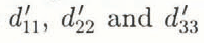
Off-diagonal elements of D vanish but off-diagonal elements of D’ do not. These off-diagonal perturbations can be found by noting that the correlation matrix associated with the diagonalized covariance matrix is simply the identity matrix I. Off-diagonal perturbations to this correlation matrix are governed by the sampling distribution described by Equation (28) with ζ = 0. The corresponding off-diagonal perturbations to D can be found using Equation (8) to obtain the relation


The simulated sampling distribution and cumulative distribution function for the J SL, and J S0 statistics are given in Figure 5. The intention of Figure 5 is to show the sensitivity of sample values of the J statistic to correctly distributed random error in the correlation matrix. As mentioned, these sampling distributions have been calculated by making the a priori assumption that the population values of R are known and correspond to Expression (10), but in reality R in Expression (10) is a sample from some population having unknown correlation attributes. For this reason, Figure 5 cannot be used as the starting point for significance testing of the J statistics for the CGI sample. Nevertheless, we can sec that the sampling distribution of J SL about the assumed population mean (Fig. 5a) suggests that sample values are likely to be within 1-2% per cent of the population value (indicated by a vertical line). Thus the conclusion that virtually all the multiple correlation p s.LW0 is explained by the simple correlation p SL, is not at risk. The sampling distribution for J S0, on the other hand, is very broad (Fig. 5b) so the percentage discrepancy between sample values and the population value for this statistic is likely to be large. Fortunately, important conclusions do not hinge on this statistic.
Results of Monte Carlo simulation to estimate the sampling distribution of the J statistics for the correlations S-L and S-0. It is assumed that the correlation matrix for the infinite population is identical to that of Expression (10) and that the size of individual samples drawn from this population is N 1754. The number of Monte Carlo simulations used to estimate the sampling distributions is 100 000. The lefthand ordinate measures the amplitude of the probability density function for the J statistic. The righthand. ordinate is the amplitude of the cumulative function (solid line) obtained by integrating the density function for the J statistic. The assumed population value for the J statistic is indicated by a vertical line. (a) Sampling distribution of JSL. (b) Sampling distribution of JS0.

Conclusions
Venn diagrams provide an efficient representation of the possible correlation relationships between length, slope and surge tendency. Several of these are summarized in Figure 6. Of particular interest ares Figure 6d–f because they clarify the distinction i wish to make between the results of this study and other possibilities. For each of these cases, slope and length are mutually correlated and each correlates with surge tendency. In Figure 6d, slope and length each have explanatory value whereas in the remaining diagrams slope (Fig. 6e) or length (Fig. 6f) alone have explanatory value. The present analysis of the CGI Yukon Territory data set and that of Reference Clarke, Schmok, Ommanney and CollinsClarke and others (1986) points to the conclusion that the correlation between slope and surge tendency is that depicted in Figure 6f and that slope has no explanatory value.
Venn, diagrams illustrating several, possible correlation relationships between surge tendency S, slope 0 and logarithmic length L. (a) Surge tendency, slope and length are uncorrelated. (b) Slope and length are uncorrelated but both correlate with surge tendency, (c) Slope and length are correlated but neither correlate with surge tendency, (d) Slope and length are mutually correlated and both correlate with surge tendency. The correlations between slope and surge tendency and length and surge tendency are not completely independent of each other but both have separate explanatory value, (e) Slope and length are mutually correlated and both correlate with surge tendency. All of the correlation between surge tendency and length can be explained in terms of the correlation between slope and length. Length has no explanatory value not already accounted for by the correlation between slope and surge tendency. (f) Slope and length are mutually correlated and both correlate with surge tendency. All of the correlation between surge tendency and slope can he explained in terms of the correlation between slope and length. Slope has no explanatory value not already accounted for by the correlation between length and surge tendency. This is the result of the present study.

How are we to regard Kamb’s prediction that low slope favours surging? For insight, let us apply the Kamb theory to the following artificial situation: a sample of N glaciers is selected from a population having statistics identical to those of the CGI Yukon Territory data set. These glaciers are chosen to have identical length but to have slopes that are randomly distributed about the sample mean. The Kamb theory would predict that glaciers having lower than average slope have a greater tendency to be S-type than those having a greater than average slope. The CGI correlation analysis would predict that slope yields no information concerning surge tendency. From this perspective, the results of this paper contradict predictions of the Kamb theory. From a more generous perspective, the Kamb theory is a local theory of sub-glacial hydrology and necessarily employs local physical variables such as slope, effective pressure and step-cavity height. In contrast, length is a global variable which could not appear in a local theory, so no purely local theory would be capable of predicting a length influence.
With the Fowler prediction the situation is clearer. The prediction fails. None of the variables I have considered had a lower correlation with surge tendency than the parameter Ω. In fairness, the predicted correlation between S and Ω seems incidental to the main structure of Fowler’s theory.
Acknowledgements
This research was supported by grants from the Natural Sciences and Engineering Research Council of Canada. i thank S, Ommanney and S. Collins for their huge contributions to the Canadian Glacier Inventory effort. Without this foundation to work from, the present project would have been inconceivable.
The accuracy of references in the text and in this list is the responsibility of the author, to whom queries should be addressed.



