


1. Introduction
Speculative design provides a framework for exploring alternative futures by questioning the current situation and imagining how things could be otherwise (Reference Dunne and RabyDunne & Raby, 2013). As design practice increasingly engages with systemic global challenges and quickly evolving technologies, generative artificial intelligence (GAI) offers new ways to expand and mediate future-oriented thinking. In alignment with critical future studies (Reference Goode and GodheGoode & Godhe, 2017), this approach situates speculative design as a way to challenge futures taken for granted and reopen space for alternative social, cultural, and technological futures.
Design fiction has further framed speculative design not only as a mode of representation but as a method for investigating possible futures (Reference Markussen, Knutz and LenskjoldMarkussen et al., 2020). Through narratives, artefacts, and situated imaginaries, designers explore how emerging technologies and societal shifts may reshape everyday life (Reference BlytheBlythe, 2014). Within educational contexts, speculative design becomes a way to foster systems thinking, critical reflection, and imaginative engagement with complex challenges.
As GAI tools gradually enter design studios, they do not simply accelerate workflow, but they reshape how speculative futures are imagined, articulated, and materialised. Recent studies suggest that AI can function as a co-creative partner in early ideation (Reference Wang, Khinvasara, Creijghton, Scholing, Wang, Zhou, Childs and YinWang et al., 2025), while also introducing biases, aesthetic defaults, and embedded assumptions (Reference Popescu and SchutPopescu & Schut, 2023). Parallel research on AI literacy prompting as an emerging design competence, raising new questions about authorship, creative control, and the negotiation of agency between human and machine (Reference Kalving, Colley and HäkkiläKalving et al., 2024). In this body of work, we will focus on how GAIs are integrated into iterative speculative design processes, particularly in educational settings where authorship, agency, and reflection are central.
We examine both the outcomes and processes of GAI-supported speculative design within a master´s-level studio context. This research is guided by two research questions: RQ1. How does the integration of GAI influence the characteristics and formats of speculative scenarios developed within a multi-perspective design framework? RQ2 How do students engage with GAI during the speculative design process in terms of prompting strategies, interaction patterns, and reflections on authorship and creativity?
The study draws on two consecutive iterations (2024-2025) of a master´s-level design course, Studio 1, structured around three future-oriented perspectives. Each perspective invites students to frame design challenges through a different temporal lens: Perspective 1 focuses on long-term futures; Perspective 2 considers near-future artefacts; Perspective 3 addresses systemic futures situated between the short and long term. These perspectives encourage design exploration of different zones of future thinking, inspired by frameworks such as Dunne and Raby’s speculative design approach (Reference Dunne and RabyDunne & Raby, 2013) and the Futures Cone (Reference VorosVoros, 2003). As shown in Figure 1, each perspective engages with a different temporal space within the spectrum of plausible, probable, possible, and even preferred futures.
Course perspectives through the futures cone

Figure 1 Long description
A diagram of the futures cone representing different perspectives on possible futures. The cone is divided into several layers, each representing a different type of future. Perspective 1, Perspective 2, and Perspective 3 are indicated by dotted lines extending from the apex to the outer edge of the cone. The layers from the innermost to the outermost are labeled as Probable future, Preferred future, Plausible future, Possible future, and Impossible future. The diagram shows a narrowing cone shape, indicating that as we move from the present towards the future, the range of possible outcomes broadens.
In Perspective 1, students explored long-term futures by identifying historical disruptions and extrapolating their implications. GAI was proposed as a tool to help materialise early concepts through short-form narratives, visuals, and speculative artefacts, allowing the work to remain efficient and imaginative. This kept the exploration manageable within the course timeline.
Perspective 1 served as a foundation for exploration, encouraging experimentation with alternative futures before progressing to the more grounded and systemic interventions of Perspectives 2 and 3. The integration of GAI accelerated the process and supported key learning objectives: articulating interdisciplinary contributions to complex challenges, applying systems thinking, and communicating speculative outcomes.
While the thematic scope of the course addressed sustainable futures related to food, consumption, and waste, this paper focuses specifically on how GAI shaped speculative exploration within the first perspective and how AI collaboration was negotiated across the broader design process.
2. Methodology
2.1. Study context and participants
This study is based on work produced within a master´s-level design course focused on speculative and future-oriented design. Over two consecutive iterations of the course (2024–2025), fifty-one students from diverse design backgrounds participated. The course maintained the same structure through both iterations, organised around three interrelated design perspectives that encouraged students to approach design at different temporal scales. All the participants were enrolled in a Master’s level design programme and presented a background in different research areas. The group included both national and international students, whose participation was embedded in regular coursework. Prior experience with GAI varied across the groups.
The course builds on a similar structure built by Nazli Özkan and Renee Wever, which introduced a triple-perspective model for exploring design and repair through time (Reference Özkan and WeverÖzkan & Wever, 2021). In this iteration, the structure was reoriented towards speculative design and food consumption, drawing on design fiction as a means of critically examining social and technological change. Following Reference Markussen, Knutz and LenskjoldMarkussen et al. (2020), design fiction was approached not only as a mode of representation but as a method for investigating possible futures (Reference Markussen, Knutz and LenskjoldMarkussen et al., 2020). In both iterations, the course maintained this pedagogical framework while broadening the range of prototype formats, including propaganda posters, interactive maps, and AI-assisted musical compositions, supporting richer multimodal explorations of speculative scenarios.
2.2. Design process and course structure
In the first perspective, students examined a food-related product, service, or object, tracing its historical evolution and identifying a disruption, policy, material, or cultural, to explore its social and technical implications. GAI tools were then used not to define directions but to enrich ideas through narrative, visual, or artefactual outputs, following Reference HalesHales (2013) and Reference AugerAuger (2013)framing of design fiction as a method grounded in situated knowledge and intentional speculation (Reference AugerAuger, 2013; Reference HalesHales, 2013). While students were encouraged to speculate freely, the exploratory space was framed by the course´s theme on future food systems and by the expectation that scenarios remain grounded within possible directions aligned with more sustainable futures. When grounding their fictions in real historical, technological, or policy developments, students were asked to critically assess and cross-check such references. The resulting scenarios took forms such as comics, speculative articles, short films, and fictional service blueprints.
In the second perspective, students focused on designing a tangible artefact grounded in a near-future challenge. The third and final perspective required the development of a systemic intervention for a near-to-mid future, synthesising their learning from the previous phases.
2.3. Material for analysis
The material analysed includes the final speculative outputs from Perspective 1, together with individual student reflections, prompt lists, screenshots of their interactions with GAI tools, and notes collected during presentations and discussion sessions from 51 students. These materials provide insight into both the creative outcomes and the generative processes behind them. During the two course iterations, students primarily used GPT-4 for textual development, for image generation, they used tools such as DALL-E and Midjourney, and in some cases, complementary platforms such as Sudowrite and Vizcom. The students had the flexibility to choose the most suitable tool.
2.4. Analytical approach
The analysis proceeded in two stages. First, the final outputs from Perspective 1 were examined to identify patterns across the speculative scenarios. This involved exploring recurring themes and narratives, types of futures envisioned, and the artefacts or systems proposed. Attention was also paid to the stylistic variation in how students represented futures, some leaned towards narrative-driven works such as short stories, while others focused on highly visual or artefact-based formats. This layer of analysis allowed the identification of representational tendencies, speculative ideas, and multimodal strategies in the students’ future scenarios. This first phase addresses RQ1, which examines how the interaction of GAI influenced the characteristics and the format of speculative scenarios.
The second layer of analysis focused on the integration of GAI within the students’ design processes. Reflections, screenshots, and prompt lists were examined to better understand how the AI was used and how it influenced the speculative outcomes. The coding structure included the role of GAI in the process, such as ideation, narrative co-construction, visualisation, or worldbuilding, as well as the strategies used to engage with the tools. One key focus was whether students approached GAI in an exploratory way, using it to generate new or surprising possibilities, or with a more goal-oriented mindset, seeking specific answers or outcomes.
Patterns of interaction were also considered, particularly the degree of iteration (e.g., prompt modification, rejection, or remixing of outputs), and how students chose to integrate AI-generated content. Lastly, students’ reflections were analysed to understand their perceptions of GAI’s influence on their creativity, their sense of authorship, and the constraints or affordances encountered during the process. This second phase addresses RQ2. The analytical process across both phases is summarised in Table 1.
Analytical and coding structure

3. Findings
3.1. Findings from prototyping and results
3.1.1. Commonalities across speculative scenarios
GAI enabled students to produce more detailed and coherent speculative futures, enriching key elements such as personas, norms, systems, or social environments, visible across multiple scenarios. Figure 2 summarises some of these recurring elements across the speculative scenarios.
Visual representation of thematic commonalities in speculative projects

Personas were given greater realism and context. One narrative begins, “The year was 2045, and in the small town of Strömstad, fourteen-year-old Elias tugged at the straps of his backpack as he walked along the familiar path toward Stjärnholm School.” This situates the character in a clear time and place, grounding the speculative future in human experience. Norms, social, governmental, and cultural, were also represented. In another scenario, “Every bite, every meal was recorded in the government’s ledgers. Rations were calculated for each person, ensuring that no one consumed more than prescribed.” Such detail illustrates the authoritarian systems regulating daily life in imagined worlds.
Systems and infrastructures were similarly expanded as instruments of change. One project described Brazil’s transformation through “a multimodal transportation system that would unite the entire country,” showing how technology reshapes both space and community. Social practices were also re-imagined. In one example, “Samuel planned a night of ‘can pairing,’ experimenting with combinations of edible cans to create gourmet-like dining experiences.” This fragment shows how convenience and innovation could redefine everyday routines like dining.
Environments and material details further grounded these futures. The speculative supermarket, for instance, was portrayed as “shelves divided by flavour profile—savoury, spicy, sweet—and nutritional needs,” creating a picture of consumption practices. Students also designed artefacts and technologies that played both symbolic and functional roles, from modular packaging and smart kitchen tools to home devices capable of producing artificial meat.
Some projects explored rituals as speculative prototypes, expressing how belief and communal practices might evolve. Songs, artefacts, and gestures served as symbolic forms of future spirituality and shared meaning. Likewise, community structures were re-imagined, emphasising collaboration and connection. In one example, “The Central Yakhchal is more than a private pantry; it is a shared system that bridges the gap between neighbours in surprising and delightful ways.” Such examples show how speculative design envisioned technology as a medium for renewed social interaction and collective experience.
3.1.2. Prototyping formats
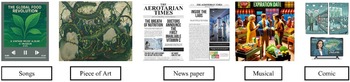
Students employed a variety of prototyping formats to communicate their speculative futures, each offering a distinctive way of conveying ideas and experiences, as shown in Figure 3. Videos were among the most common media, combining audio, short clips, and images to create dynamic representations of future scenarios. Some were embedded in interactive maps, allowing viewers to navigate imagined worlds and experience different locations and perspectives. Audio-based works also expanded speculative expression: several students composed songs or soundscapes to evoke atmosphere and emotion. An example of this is a ten-track concept album with an AI-generated cover, using tone and lyrics to explore shifts in food culture and collective behaviour or a composition of a musical. Music, in this sense, became a performative tool for world-building and emotional storytelling.
Images and comics were used to visualise systems, artefacts, and environments while reinforcing narrative intent. By pairing text and image, students translated abstract concepts, such as automated food production or packaging innovation, into tangible representations. This visual practice reflects one of the most common uses of GAI in speculative design (Reference Østvold Ek, Paulsen and TrondsenØstvold Ek et al., 2024). Comics provided a narrative-driven means to explore future interactions, combining dialogue and illustration even when stylistic consistency was difficult to maintain.
Multiple projects adopted textual media to explore communication and collective meaning-making. Interactive maps, built with digital mapping and AI-assisted world-building tools, allowed users to move through locations and access contextual information about personas and artefacts. Short stories offered character-centred reflections on adaptation and technological change, for example, one narrative described a family sharing their last home-grown meal before automated food distribution became mandatory. Other students simulated journalism and propaganda through fictional news articles, advertisements, and posters, using AI-generated images to imagine how information might circulate in future societies.
Format variety created by GAI

3.2. Findings from reflective essay and prompting report
Throughout the speculative design process, GAI was employed by the students in different ways. One main use was idea generation, particularly in the early stages of scenario building. Students frequently used GAI to prompt new concepts, worldbuilding elements, and future events that they might not have considered otherwise. Others employed GAI for visual or narrative development, using it to build stories or generate pictures that represented their futures. In the different results, there are noticeable differences in the ways of prompting and selecting the outputs from the GAI tools.
3.2.1. Prompting strategies and experimentation
Prompting strategies varied within projects, revealing two main types of engagement with GAI: exploratory and goal-oriented. Across the 51 projects, 21 participants predominantly employed broad and short prompts aimed at open-ended exploration. This prompting strategy allowed for serendipitous discoveries and fostered a more divergent mode of future thinking. Some students presented their initial questions to ChatGPT to explore initial ideas, such as “What if dehydration technology never existed? How would hikers preserve food?” In contrast, 16 participants adopted a more descriptive and structured prompting strategy, crafting detailed prompts to achieve specific narrative and visual outcomes. The remaining 14 students presented a mixed approach, shifting between exploratory and goal-oriented prompting across different phases of their project. Those two types of prompting approaches are presented in Figure 5 in Section 4.
Regardless of their initial approach, iterative prompting emerged as a shared behaviour across both groups. Many students repeatedly refined or reformulated their inputs, learning over time how to phrase prompts to achieve more relevant, accurate, or creatively interesting results in the direction they desired. Through this process, they developed personalised prompting techniques to create more effective or surprising content. A student said, “While writing prompts, I kept in mind that I should create a boundary inside which Chat should generate my ideal response… Over time, I improved the prompts.”
To guide GAI more accurately, some students used multimodal tools like Vizcom, which allowed for visual input alongside written prompts. In these cases, sketches or reference images were used to ground the AI’s interpretations in more clearly defined visual intentions. Other students, instead of using images as reference, used descriptive visuals: “A simple and natural kitchen scene at night, depicting… a chef resembling the man on the right side of the reference image. Elio is wearing a plain black apron with some colourful sauce stains on it. The background shows a large window …Elio’s expression is…” This level of detail helps to reduce the number of iterations of image generation.
On the other hand, other students employed much shorter prompts for textual outputs, relying on tools to continue narratives or synthesise concepts. Examples include: “Continue writing a design fiction based on this world. Use the character Caroline as the user’s point of view and describe a day in her life with the floating restaurant,” or “Summarise the main technologies of this floating dining and the stakeholders of this service.” These concise prompts allowed for quick ideation, often used in earlier stages of scenario development or to test multiple directions from which they, in some cases, could cut, reduce, change or mix with other outcomes. In other cases, students, after using GAI for brainstorming or worldbuilding, they had a defined idea of what they wanted to present in their future scenarios, and after multiple iterations, GAI was just used as a tool to include small details or redefine grammar, the text or the narrative but in some cases, the curation phase was make completely by the students. A student mentioned in her reflection, “After some debate with Chat GPT about what makes no sense, I realised I cannot fully rely on AI. Therefore, I decided to write the storyline by myself and gave it to ChatGPT to improve it”
3.2.2. Integration of AI output
Students adopted a spectrum of approaches when incorporating AI-generated material into their design work. At one end, some maintained a high degree of fidelity to the AI output, integrating text or images with minimal edits. This approach often involved extensive prompting, with students investing time in carefully refining prompts until the results aligned closely with their envisioned aesthetic or narrative. In these cases, the process of working with GAI was not only about generation but also about clarification, requiring students to articulate and sharpen their ideas to prompt more accurately. One student noted that “over time, I improved the prompts… I started to be more precise on the content and moved to the bullet point system to be more understandable,”.
On the other hand, many students treated GAI outputs as raw material, selecting, remixing, and adapting fragments to suit their intent. One of them mentioned in her report, “As I generated more text, I kept changing, adding, paraphrasing and removing some parts, to reach what I envisioned.” Text was rewritten, rearranged, or expanded, images were layered, edited, or used as inspiration rather than final assets. In doing so, students positioned themselves not as passive users but as co-authors, actively shaping the AI’s contributions into coherent design artefacts, reflecting on the multiple answers of their ideas and making sure the combinations of inputs align with their thoughts.
3.3. Reflections on GAI’s Role in the Creative Process
While many students valued GAI for expanding creative possibilities, they were also critical of its limitations in maintaining creative control or aesthetic fidelity.
One of the most frequently cited benefits was GAI’s ability to introduce novelty and surprise into the design process, also mentioned by students in other studies (Reference Tang, Windham and BushTang et al., 2025). Students valued the tool’s capacity to produce unexpected associations, enabling them to imagine futures that felt less predictable. As one student reflected, “Alongside ChatGPT, I used Sudowrite to rewrite and rephrase certain parts of the text… also seemed important to have a more believable futuristic reality.”
Others noted that AI encouraged new directions by making them consider formats or narrative turns they had not previously envisioned. For example, a student observed how default AI responses often steered stories towards overly positive conclusions: “Some of my classmates pointed out that when using AI to generate stories, the AI often tends to default to a happy ending… I wondered if… I had been subconsciously constrained by the AI’s suggestions, limiting the direction of my narrative.” This use of AI-generated content as a starting point for narrative experimentation aligns with Reference BlytheBlythe’s (2014) notion of design fiction as a method of crafting “real and imaginary abstracts,” where fiction becomes a generative tool for critical exploration (Reference BlytheBlythe, 2014).
Several reflections pointed to the reproduction of stereotypes and limited gender or cultural perspectives. One participant remarked, “There were a lot of stereotypes ChatGPT generated in the story… I manually changed the text… such as the year the story takes place, countries that are mentioned…” A visual example of the struggle of removing locations or flags in the stories is shown in Figure 4, where the USA flag can be seen in the background.
Location bias with a country flag

This kind of active curation was common, suggesting that students rarely accepted GAI outputs at first, but instead treated them as raw material to be reshaped and reinterpreted. Another reflected on the limitations of visual tools such as DALL-E: “It was a bit difficult to make Dall-E not use real food or to actually create natural food-looking gelatine, making it always neon rainbow colours.” Or “AI can’t understand what I mean by fruit with unique appearance” This tension between the tool’s capabilities and the designer’s intent was a recurring theme when students wanted to create elements different from the existing ones. Similar challenges were described in projects involving sound or videos, where maintaining coherence throughout AI-generated components, lyrics, melodies, or visual aesthetics required extensive iteration and manual curation.
Students also reflected on authorship and creative agency. Delegating parts of their design thinking to the chats often felt uncomfortable. One wrote, “I believe that AI strips you from the creative control of your work and makes it blunt.” Nevertheless, constraints such as time pressure often made AI an attractive collaborator.
The integration of GAI across media formats also varied along with the reflections. While some students relied heavily on AI-generated visuals, others found these outputs lacking in consistency or aesthetic nuance. “The biggest challenge I faced was how to maintain a consistent style across such a large number of images,” one participant noted, describing an iterative process of refining Midjourney outputs. Others chose not to use AI-generated visuals at all, citing: “When I looked at those kinds of images, I think that they are kitsch… I had a very clear idea of how I wanted the book to look, and I knew I couldn’t get the desired effects with the use of AI.”
3.4. Students’ visions of the future of food
Within both course iterations, students’ speculative scenarios revealed recurring themes around modularity, rationing, and control as central aspects of future food systems. Many projects imagined futures in which governmental or corporate entities regulated food access, dictating not only the types, textures, and quantities of food available but also the materials and formats of packaging. These imagined futures presented highly regulated systems of food production and distribution, where efficiency and standardisation shaped how food was produced, delivered, consumed or rationalised.
In several cases, cooking was not presented as an individual or domestic activity, but instead, the act of food preparation was delegated to industrial producers or automated systems, leaving people to consume standardised rations or compact meals. This centralisation of food production also transformed everyday spaces such as supermarkets and restaurants, which became highly regulated and offered limited, uniform choices.
4. Discussion on teaching speculative design with GAI
GAI introduces new steps in the design process that might require intentional teaching. One of the most significant shifts observed was the emergence of prompting as central to students’ creative workflows. Learning to craft, iterate, and refine prompts was not just a technical skill, but it became a conceptual design activity. Prompts functioned as design artefacts for shaping the direction, tone, and speculative potential of projects. For many students, the ability to prompt well determined the quality of their AI collaboration. This positions prompts literacy as a new competence (Reference Haugsbaken and HageliaHaugsbaken & Hagelia, 2024; Reference HuHu, 2025).
Another noticeable change was in how students initiated their projects. Instead of beginning the design with ideation, followed by sketching, using visuals to externalise early concepts, with GAI, this process shifted. Students moved directly from ideas to prompts, bypassing sketching and instead relying on text, narrative, and descriptive texts to generate initial outputs. Moving earlier to the creating phase in the learning process (Reference Jiménez Romanillos and AnderssonJiménez Romanillos & Andersson, 2024). This process is presented in Figure 5. This could require teaching students how to translate abstract or system-level ideas into language that can guide AI generation, while also developing iterative habits that help them test and refine these prompts as part of their design exploration. The speculative imagination becomes rooted in how students speak to the GAI tool, what they emphasise, overlook, or exaggerate in their scenes.
Prompting and workflow dynamics

At the same time, students did not treat AI outputs as final or neutral. Curation appeared as a critical practice. Whether they were working with text, images, or hybrid content, students routinely edited, rewrote, or discarded generated material. They became active negotiators, deciding what to keep, what to reshape, and what to reject based on narrative alignment, ethical values, and aesthetic sensibility. The ability to recognise ethical and cultural critique, bias, question defaults, and maintain coherence became more important than generating content, making the curation phase operate as a reflective act.
Drawing from dialogic pedagogy(Reference Kim and WilkinsonKim & Wilkinson, 2019), the presence of GAI introduces a new kind of interlocutor in the learning environment, a “third voice” or co-creator (Reference Chandrasekera, Hosseini and PereraChandrasekera et al., 2025; Reference Simeone, Mantelli and AdamoSimeone et al., 2022). Rather than a passive tool, the GAI offers outputs that students must interpret, negotiate, or reject. This reframes prompting as a dialogic process, where students learn to engage the AI tools not for answers, but in an ongoing exchange of meaning. Additionally, GAI amplifies the importance of reflective practice, aligning with Donald Schön’s concept of “reflection-in-action”(Reference SchönSchön, 2017). Students moved fluidly between prompting, reviewing, and editing, learning not just to use the tool but to think with it, making their strategy and judgment visible.
To improve the integration of GAI in future courses, several adjustments could be made based on the experiences and challenges observed. First, clearer guidance on prompt crafting and iteration could be provided early in the course rather than a presentation of the tools, emphasising its role as both a technical and conceptual skill. This would help students refine their ability to direct AI outputs more effectively from the start. Additionally, incorporating more structured exercises for reflecting on their process and results would encourage students to engage more critically with AI-generated content, moving beyond their final reflection based on their experience, but reflections during the beginning, middle and end phases of the design. A more explicit focus on speculative design consistency and how to maintain a productive balance between novelty and plausibility in speculative futures could also help students navigate the tension between vision and viability.
5. Conclusions
GAI provided support in expanding creative possibilities and accelerating the development of future scenarios, although there are also several challenges within speculative design practice. A positive aspect of the results is that GAI assists in making designs more detailed in multiple aspects, rather than just one, and all related and connected consistently, providing a better definition of the future scenario. However, a central tension appeared around the speculative balance, the need to imagine futures that are novel and visionary without drifting into the realm of the implausible. Students often found it difficult to stay in this productive middle ground. On one hand, GAI tended to generate outputs rooted in existing norms, objects, and aesthetics, limiting the potential for true innovation. On the other hand, when students attempted to push boundaries and imagine completely new artefacts or systems, such as packaging, kitchen tools, or service technologies, they struggled to maintain coherence or clarity, sometimes ending up with visions that felt too abstract, complex, or fantastical. This stresses a design challenge: creating futures that feel unfamiliar enough to inspire yet grounded enough to resonate when applying GAI in the design process.
Additionally, students perceived that AI’s outcomes often tended towards the generic or overly optimistic, requiring more precise prompting and critical curation to maintain creative direction and narrative depth. These challenges emphasise the need for thoughtful and intentional integration of AI into speculative design practice to ensure it shapes, rather than flattens, the design futures. The balance between applying AI’s generative abilities and maintaining design coherence remains an important consideration in the role of AI within speculative design.
At the same time, GAI made it possible to generate a more “colourful”, detailed first perspective that students would not have been able to present as thoroughly without AI. This level of descriptive and narrative depth opened up space for students to explore the other two perspectives with more freedom and a built background. The process structure used in the course was effective in enabling this outcome, but also offers potential for future application in shorter speculative design workshops, as an exploratory phase early in the design process, following a parallel sequence of steps, similar to the workshop from Muller et al. (Reference Muller, Bardzell, Cheon, Su, Baumer, Fiesler, Light and BlytheMuller et al., 2020).
The students’ results aligned with the intended learning objectives of the course. They were able to apply and reflect on interdisciplinary design skills, understand different historical and systemic perspectives, engage critically with contemporary technologies, and to identify and communicate their design intentions in different ways through fast prototyping.
Acknowledgement
The authors would like to acknowledge the contributions of Suzan Boztepe in shaping the first iteration of this assignment.





 Open access

