





INTRODUCTION
Sediment cores are commonly used as climate archives, whose proxy-data interpretation relies on age-depth models. In particular, proxies need to represent the time of deposition, but significant lag times potentially occur on the riverine to marine pathways and in large lake catchment areas before a climate signal is deposited into sediments (Eglinton et al. Reference Eglinton, Benitez-Nelson, Pearson, McNichol, Bauer and Druffel1997). A proxy group which is especially prone to such lag times is terrestrial organic biomarkers, e.g., long-chain n-alkanes derived from leafs and roots of terrestrial plants, which are frequently used as hydroclimatic indicators (Eglinton and Hamilton Reference Eglinton and Hamilton1967; Castañeda and Schouten Reference Castañeda and Schouten2011). This is mainly because of significant residence time in soils due to high recalcitrance of compounds, their transport via rivers, as well as mixing processes, resuspension, and redistribution of material from floodplains from which it was reworked after a long accumulation time (Pearson and Eglinton Reference Pearson and Eglinton2000; Ohkouchi et al. Reference Ohkouchi, Eglinton and Hayes2003; Smittenberg et al. Reference Smittenberg, Hopmans, Schouten, Hayes, Eglinton and Sinninghe Damsté2004; Mollenhauer et al. Reference Mollenhauer, Kienast, Lamy, Meggers, Schneider, Hayes and Eglinton2005; Mollenhauer and Eglinton Reference Mollenhauer and Eglinton2007; Eglinton and Eglinton Reference Eglinton and Eglinton2008; Vonk et al. Reference Vonk, Semiletov, Dudarev, Eglinton, Andersson, Charkim An, Heim and Gustafsson2014; Winterfeld et al. Reference Winterfeld, Mollenhauer, Dummann, Köhler, Lembke-Jene, Meyer, Hefer, McIntire, Wacker, Kokfelt and Tiedemann2018; Berg et al. Reference Berg, Jivcov, Kusch, Kuhn, Wacker and Rethemeyer2020; Bliedtner et al. Reference Bliedtner, von Suchodoletz, Schäfer, Welte, Salazar, Szidat, Haas, Dubois and Zech2020).
Compound-specific radiocarbon analysis (CSRA), i.e. analysis of radiocarbon (14C) contents of specific biomarker compounds, can give information about their mean residence time in the respective compartment (Eglinton et al. Reference Eglinton, Aluwihare, Bauer, Druffel and McNichol1996; Ingalls and Pearson Reference Ingalls and Pearson2005; Rethemeyer et al. Reference Rethemeyer, Dewald, Fülöp, Hajdas, Höfle, Patt, Stapper and Wacker2013), which has mostly been applied for marine study sites (Pearson et al. Reference Pearson, McNichol, Benitez-Nelson, Hayes and Eglinton2001; Mollenhauer et al. Reference Mollenhauer, Eglinton, Ohkouchi, Schneider, Müller, Grootes and Rullkötter2003; Ohkouchi and Eglinton Reference Ohkouchi and Eglinton2008; Kusch et al. Reference Kusch, Rethemeyer, Schefuß and Mollenhauer2010; Galy and Eglinton Reference Galy and Eglinton2011; Schefuss et al. Reference Schefuß, Eglinton, Spencer-Jones, Rullkötter, De Pol-Holz, Talbot, Grootes and Schneider2016).
Lacustrine systems (Uchikawa et al. Reference Uchikawa, Popp, Schoonmaker and Xu2008; Douglas et al. Reference Douglas, Pagani, Eglinton, Brenner, Hodell, Curtis, Ma and Breckenridge2014; Gierga et al. Reference Gierga, Hajdas, van Raden, Gilli, Wacker, Sturm, Bernasconi and Smittenberg2016; Douglas et al. Reference Douglas, Pagani, Eglinton, Brenner, Curtis, Breckenridge and Johnston2018; Aichner et al. Reference Aichner, Ott, Słowiński, Noryśkiewicz, Brauer and Sachse2018; Yamamoto et al. Reference Yamamoto, Miyairi, Yokoyama, Suga, Ogawa and Ohkouchi2020; Freimuth et al. Reference Freimuth, Diefendorf, Lowell, Schartman, Landis, Stewart and Bates2021) have been comparably less studied. Also here, ages of plant waxes from catchment soils range from several hundreds to thousands of years at both temperate and warm/humid study sites. Further, significant offsets between biomarker ages and conventional age models have been observed.
No such data so far exist for a cold and arid high altitude lake system. The main purpose of this study was to identify discrepancies between the ages of plant wax-derived long-chain n-alkanes and the conventional age model, which may result in misinterpretation of the biomarker records. The study was performed in Lake Karakul and its catchment, a well-studied lake system in the Pamirs, Tajikistan (Taft et al. Reference Taft, Mischke, Wiechert, Leipe, Rajabov and Riedel2014; Heinecke et al. Reference Heinecke, Epp, Reschke, Stoof-Leichsenring, Mischke, Plessen and Herzschuh2017a, Reference Heinecke, Mischke, Adler, Barth, Biskaborn, Plessen, Nitze, Kuhn, Rajabov and Herzschuh2017b, Reference Heinecke, Fletcher, Mischke, Tian and Herzschuh2018; Mischke et al. Reference Mischke, Lai, Aichner, Heinecke, Mahmoudov, Kuessner and Herzschuh2017; Aichner et al. Reference Aichner, Makhmudov, Rajabov, Zhang, Pausata, Werner, Heinecke, Kuessner, Feakins, Sachse and Mischke2019; Figure 1). The cold and arid conditions are assumed to result in low carbon turnover and biomarker fluxes to sediments, which may result in significantly higher n-alkane ages compared to the bulk sediment. We measured 14C contents of long-chain n-alkanes in surface soils of the lake catchment and in the sediment cores. Hereby we aimed (1) to determine the ages of soil-derived n-alkanes, as a likely source of sedimentary biomarkers, and (2) to quantify potential offsets between the ages of n-alkanes and sediments, the latter estimated by means of accelerator mass spectrometry (AMS) 14C dating of total organic carbon (TOC) and optically stimulated luminescence (OSL) dating.
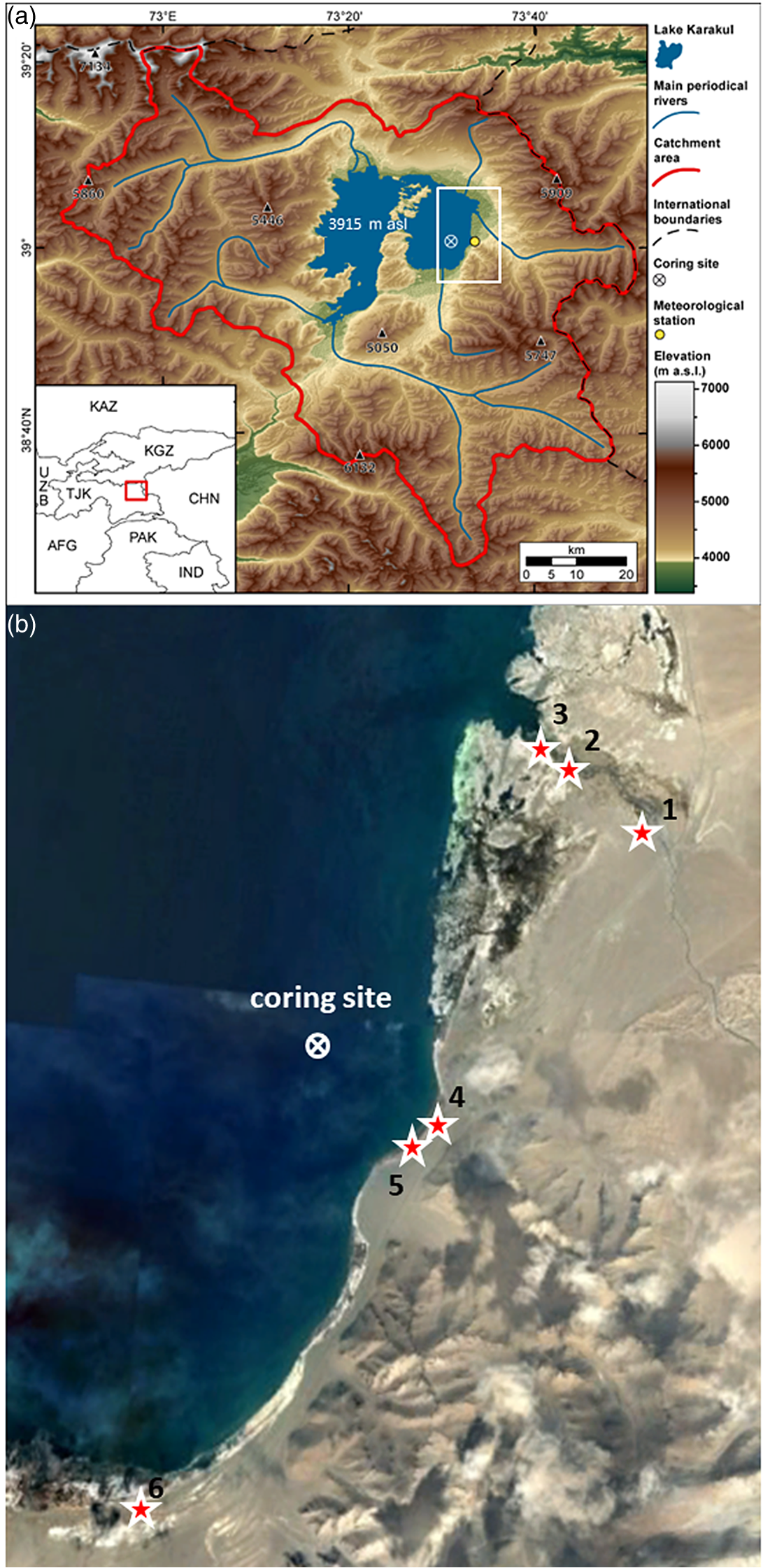
(a) Topographic map of Lake Karakul and its catchment, modified after Taft et al. (Reference Taft, Mischke, Wiechert, Leipe, Rajabov and Riedel2014) with permission from Springer Nature; (b) locations of soil samples (red stars) and sediment core KK12-comp. (For color versions of all figures the reader is referred to the web version of this article.)
MATERIAL AND METHODS
Study Site
Lake Karakul (approx. 39°N and 73°25′E) is a closed-basin lake in the eastern Pamirs, Tajikistan, located in an active extension basin within a graben structure (Strecker et al. Reference Strecker, Frisch, Hamburger, Ratschbacher, Semiletkin, Samoruyev and Sturchio1995; Komatsu Reference Komatsu, Kreutzmann and Watanabe2016). While the lake covers 388 km2 at an altitude of 3915 m a.s.l., its catchment area extends over 4464 km2 and reaches up to peaks at 6780 m a.s.l. (Figure 1a). The mean annual precipitation (MAP) within the shielded lower basin is <100 mm, but often exceeds 1000 mm at higher altitudes, mainly due to enhanced winter precipitation. Mean January, July and annual temperatures are −18.1, 8.5, and −4.0°C, respectively (Williams and Konovalov Reference Williams and Konovalov2008).
The vegetation around the lake consists mainly of species from the Cyperaceae family. At wetter sites they form either dense saline meadows dominated by Carex and Kobresia species or saline marshes dominated by Blysmus species, the latter usually located close to the lake shore. Sites where soil moisture is lower are characterized by sparse vegetation with Carex pseudofoetida. At dry sites, species from the Cyperaceae family are replaced by plants adapted to dry and stony soils, such as Krashenninikovia ceratoides, Artemisia pamirica or Ajania tibetica (Safarov Reference Safarov2003; Mętrak et al. Reference Mętrak, Chachulski, Navruzshoev, Pawlikowski, Rojan, Sulwiński and Suska-Malawska2017, Reference Mętrak, Szwarczewski, Bińka, Rojan, Karasiński, Górecki and Suska-Malawska2019).
Since the year 2008, several sediment cores spanning the last ca. 4–31 ka BP were obtained from Lake Karakul and investigated by sedimentological, geochemical and biological analyses (Mischke et al. Reference Mischke, Rajabov, Mustaeva, Zhang, Herzschuh, Boomer, Brown, Anderson, Myrbo, Ito and Schudack2010, Reference Mischke, Lai, Aichner, Heinecke, Mahmoudov, Kuessner and Herzschuh2017; Taft et al. Reference Taft, Mischke, Wiechert, Leipe, Rajabov and Riedel2014; Heinecke et al. Reference Heinecke, Epp, Reschke, Stoof-Leichsenring, Mischke, Plessen and Herzschuh2017a, Reference Heinecke, Mischke, Adler, Barth, Biskaborn, Plessen, Nitze, Kuhn, Rajabov and Herzschuh2017b, Reference Heinecke, Fletcher, Mischke, Tian and Herzschuh2018; Aichner et al. Reference Aichner, Makhmudov, Rajabov, Zhang, Pausata, Werner, Heinecke, Kuessner, Feakins, Sachse and Mischke2019). The obtained results, and paleoshorelines 35 m above the present lake level, dating to 15 ka BP (Komatsu and Tsukamoto Reference Komatsu and Tsukamoto2015), indicate past lake-level changes, which were mainly driven by changes in the seasonality of the precipitation-evaporation balance (Aichner et al. Reference Aichner, Makhmudov, Rajabov, Zhang, Pausata, Werner, Heinecke, Kuessner, Feakins, Sachse and Mischke2019).
Sampling
The collected soil samples were selected to represent the variety of soils in the catchment and hence cover multiple potential source material of the lake sediment. Pictures of sampling spots are provided in the Supplementary Figures S1. Soil samples #1–3 were collected along a stream that runs from the Sarikol Range on the border between Tajikistan and China and enters a small bay at the northeastern part of Karakul Lake (Figure 1b; Table 1). Sample #1, located farthest from the lake, was taken from an area covered with sparse vegetation typical for slightly moist places. A dominating species there is Carex pseudofoetida characterized by long creeping rhizomes. It is accompanied by Rheum reticulatum and species from genera Potentilla and Kobresia. Samples #2 and #3 were collected closer to the lake, with sample #3 placed within the stream delta. Both locations are covered by dense wetland vegetation (small sedge meadows) dominated by species belonging to Cyperaceae family (e.g., Carex orbicularis, Carex microglochin, C. pseudofoetida, Eleocharis sp.). Soil samples #4 and #5 were collected on the narrow beach south of Karakul village. The beach represents dense saline marshes dominated by Blysmus rufus and, in drier places, by Carex microglochin. All soil samples were collected as blocks of approximately 10 cm width, 10 cm length and 20 cm depth, cut with a serrated knife and packed separately into linen bags after removal of the surficial live vegetation layer and dense roots. Air-dried samples were crushed by hand, mixed thoroughly and sieved (1-mm mesh) to remove coarse matter and fine roots. Sample #6 was collected from a large alluvial plain close to the southern shore of Lake Karakul. Here, the top 0–10 cm of soil above a layer with increased inclusion of stones/gravel, were sampled.
Description of analyzed soil and sediment core samples.

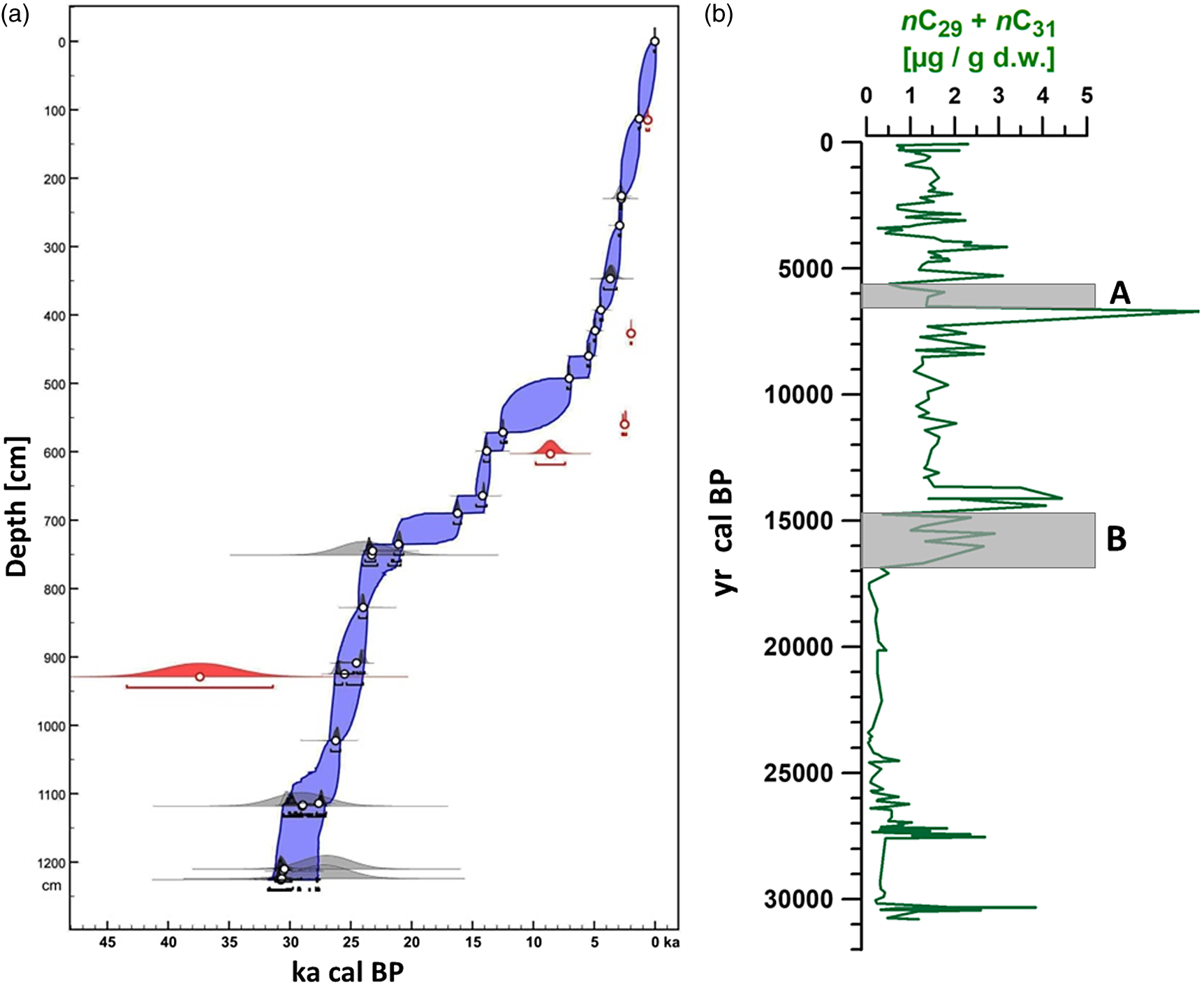
For sediment samples, two sections of the sediment core KK12-1 (Heinecke et al. Reference Heinecke, Epp, Reschke, Stoof-Leichsenring, Mischke, Plessen and Herzschuh2017a, Reference Heinecke, Mischke, Adler, Barth, Biskaborn, Plessen, Nitze, Kuhn, Rajabov and Herzschuh2017b; Mischke et al. Reference Mischke, Lai, Aichner, Heinecke, Mahmoudov, Kuessner and Herzschuh2017) were selected (Figure 2). Based on the concentrations of nC29- and nC31-alkanes (Aichner et al. Reference Aichner, Makhmudov, Rajabov, Zhang, Pausata, Werner, Heinecke, Kuessner, Feakins, Sachse and Mischke2019), the needed sediment amount for CSRA was estimated. Hence, one core section from 488–465 cm depth and another one from 695–669 cm depth were chosen, representing the middle Holocene (6792–5760 cal BP) and the Late Glacial (16,877–14,673 cal BP).
(a) Age model (2σ uncertainty range) of core KK12-comp, based on 14C-TOC (black) and OSL dates (gray). Original calibrated ages shaded in light gray, modeled ages in dark gray. Five omitted ages in red. White dots and brackets mark µ and 2σ of the modeled ages (reused with permission from Elsevier from Mischke et al. Reference Mischke, Lai, Aichner, Heinecke, Mahmoudov, Kuessner and Herzschuh2017). (b) Concentrations of nC29- and nC31-alkanes in sediment core KK12-2 (Aichner et al. Reference Aichner, Makhmudov, Rajabov, Zhang, Pausata, Werner, Heinecke, Kuessner, Feakins, Sachse and Mischke2019). Gray shaded areas A and B indicate core sections that were extracted for CSRA.
Age Model
Details of age modeling of the composite sediment core KK12-comp have been published previously (Mischke et al. Reference Mischke, Lai, Aichner, Heinecke, Mahmoudov, Kuessner and Herzschuh2017; Figure 2a). Briefly, this age model is based on AMS 14C ages of TOC and OSL dates and was computed with OxCal 4.2, using IntCal13 (Bronk Ramsey and Lee Reference Bronk Ramsey and Lee2013; Reimer et al. Reference Reimer, Bard, Bayliss, Beck, Blackwell, Bronk Ramsey, Buck, Cheng, Edwards, Friedrich, Grootes, Guilderson, Haflidason, Hajdas, Hatte, Heaton, Hoffmann, Hughen, Kaiser, Kromer, Manning, Niu, Reimer, Richards, Scott, Southon, Staff, Turney, van der Plicht and Hogg2013). Two parallel cores (KK12-1 and KK12-2) were correlated by means of elemental data derived from XRF scanning at 2-mm resolution. Samples for 14C dating of TOC were taken from both parallel cores. Resulting 14C ages were corrected for a lake-reservoir effect of 1368 yr before calibration. The lake-reservoir (LRE) effect was estimated by using average ages determined on material of two living aquatic plants, collected on the coring location (Mischke et al. Reference Mischke, Lai, Aichner, Heinecke, Mahmoudov, Kuessner and Herzschuh2017). Radiocarbon ages were complemented by OSL dating results from core KK12-2.
To allow comparison with this published TOC/OSL age model, 14C ages of biomarkers as listed in Table 2 have been calibrated with OxCal using IntCal13 (Reimer et al. Reference Reimer, Bard, Bayliss, Beck, Blackwell, Bronk Ramsey, Buck, Cheng, Edwards, Friedrich, Grootes, Guilderson, Haflidason, Hajdas, Hatte, Heaton, Hoffmann, Hughen, Kaiser, Kromer, Manning, Niu, Reimer, Richards, Scott, Southon, Staff, Turney, van der Plicht and Hogg2013), despite a newer version of IntCal that has been published in the meantime.
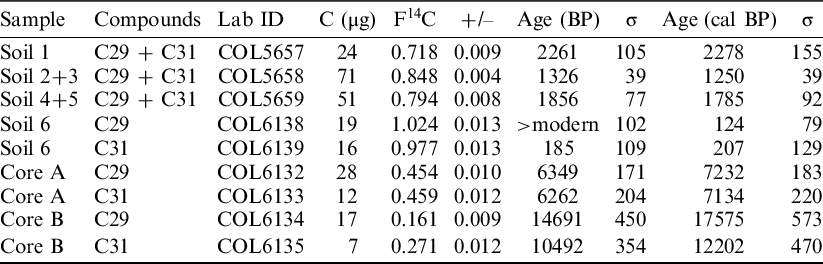
AMS 14C results for n-alkanes from soil and sediment samples. The total amount of C (µg) obtained for analysis as determined on the vacuum line (soil #1, #2/3, #4/5) and by EA (soil #6, core A, B). Calibrated ages were computed with OxCal using IntCal13 (Reimer et al. Reference Reimer, Bard, Bayliss, Beck, Blackwell, Bronk Ramsey, Buck, Cheng, Edwards, Friedrich, Grootes, Guilderson, Haflidason, Hajdas, Hatte, Heaton, Hoffmann, Hughen, Kaiser, Kromer, Manning, Niu, Reimer, Richards, Scott, Southon, Staff, Turney, van der Plicht and Hogg2013) and reported as mean ages (µ) with 1σ uncertainties.
Sample Preparation
All sediment and soil samples were freeze-dried, homogenized and solvent extracted (ASE 350, Dionex, USA) with a mixture of dichloromethane and methanol (9:1 v/v) at 100°C and 75 bar for two cycles. Between 35 and 278 g of dry soil and 57 and 88 g of dry sediment were extracted per sample (Table 1). The aliphatic fraction containing n-alkanes was separated with silica gel chromatography (5 cm × 40 mm; pore size 60 Å, 230–400 mesh size, 40–63 μm particle size) with n-hexane. The aliphatic fraction of the sediment samples was further purified by removing unsaturated compounds with AgNO3-coated silica gel. Individual n-alkanes were identified and quantified relative to an external standard by gas chromatography (GC) using an Agilent 7890B system equipped with a flame ionization detector (FID).
Individual n-alkane homologs were isolated by repeated injection on a preparative gas chromatography system (prepGC). The prepGC consists of a 7690 Agilent GC (Agilent, USA) equipped with an ultralow bleed fused silica capillary column (30 m, film thickness 0.5 μm, 0.53 mm ID, RTX-1, RESTEK, USA), a CIS 4 injection system (Gerstel, Germany), and coupled to a preparative fraction collector (PFC, Gerstel, Germany). Individual n-alkanes were collected at room temperature in glass traps attached to the PFC and later flushed with 1 ml dichloromethane. Purity and amount of the isolated compounds were determined by GC-FID. Average recovery of target compounds after prepGC was 24% (Table S1).
In order to achieve quantities large enough for reliable 14C dating of CO2 using a gas ion source (Schiffer et al. Reference Schiffer, Stolz, López, Spanier, Herb, Müller-Gatermann, Heinze, Binnie, Melchert, Kivel, Schumann, Rethemeyer, Dunai and Dewald2019; Melchert et al. Reference Melchert, Stolz, Dewald, Gierga, Wischhöfer and Rethemeyer2020), some of the individual compounds of the soil samples were combined as given in Table 2: For Soil #1 nC29- and nC31-alkanes were pooled, nC29- and nC31-alkanes from soil #2 and #3, as well as from soil #4 and #5 were combined to one sample respectively. For soil #6 and the sediment samples n-alkane homologues were dated individually. The nC27-alkane was not considered for CSRA, as it was not possible to chromatographically separate this homologue from another unknown compound via prepGC. The samples were prepared in two batches at different times. While the isolation with prepGC remained the same, the preparation for 14C analyses differed. The n-alkanes isolated from the soil samples #1, #2/3 and #4/5 were prepared by sealed tube combustion using the gas injection system (GIS) interface (Stolz et al. Reference Stolz, Dewald, Altenkirch, Herb, Heinze, Schiffer, Feuerstein, Müller-Gatermann, Wotte, Rethemeyer and Dunai2017), as described in Rethemeyer et al. (Reference Rethemeyer, Gierga, Heinze, Stolz, Wotte, Wischhöfer, Berg, Melchert and Dewald2019). In contrast, the n-alkanes purified from soil #6 and sediment core A, B were transferred into tin capsules to be analyzed via direct combustion in an elemental analyzer (EA) coupled with the GIS interface (Stolz et al. Reference Stolz, Dewald, Heinze, Altenkirch, Hackenberg, Herba, Müller-Gatermann, Schiffer, Zitzer, Wotte, Rethemeyer and Dunai2019).
Data Correction
In order to correct the results for possible contamination added during the purification procedure and to determine contributions of extraneous C, two standards of known 14C concentration were processed and dated. We used (1) squalane, a C30 isoprenoid with a modern 14C signature (Fluka, PN 85629-50ml, Lot. 0001418796; F14C 1.0187 ± 0.0033) and (2) a C18 n-alkane (Fluka, PN 74691-5g, Lot. 0001448903, F14C < 0.0008) free of 14C, i.e. as a blank.
Since all samples were expected to be of similar size, two replicates of the modern standard and blank were measured along with the samples and the correction was performed as described in BATS (Wacker et al. Reference Wacker, Christl and Synal2010). Recoveries of the standards after prepGC accounted for ≈60%. The F14C values of the squalane and nC18 scattered by 1‰ and 20%, respectively. The δ13C values scattered by 1.4‰ and 0.2‰. The reported errors include the Poisson errors of the AMS measurements of the standards and of the individual samples. However, according to the model of constant contamination as described in Hanke et al. (Reference Hanke, Wacker, Haghipour, Schmidt, Eglinton and McIntyre2017), an additional error is expected that comes from the measurement uncertainties of the sample masses, which are proportionally larger for smaller sample amounts. The most extreme influence is therefore expected for the sample COL6135 (7 µg), which in fact shows a relatively high deviation of the analyzed isotope ratios of about 70%. With the measured blank values, the constant contamination is estimated to be about 2 µg, assuming a F14C value of the contaminant of 0.4.
RESULTS
Except for sample #1, which shows larger relative amounts of nC27-alkane, all soil samples are characterized by a pronounced dominance of nC29- and nC31 alkanes. The absolute amounts of extracted n-alkanes range from 13 to 231 µg before and from 5 to 23 µg after prepGC, (Table S1). The F14C values for the soil samples, which are based on either pooled or individual compounds, range from 0.718 to 1.024, equivalent to conventional 14C ages ranging from 2261 ± 105 BP to modern (–187 ± 102 BP) (Table 2).
The sediment samples exhibit n-alkane amounts from 62 to 92 µg before and 4 to 22 µg after prepGC (Table S1). In core sample A, the F14C values are 0.454 ± 0.010 (nC29) and 0.459 ± 0.012 (nC31), while in core sample B the results span from 0.161 ± 0.009 (nC29) to 0.271 ± 0.012 (nC31). The values correspond to conventional ages of 6349 ± 171 (nC29) and 6262 ± 204 (nC31) BP (sample A), as well as 14,691 ± 450 (nC29) and 10,492 ± 354 (nC31) BP (sample B) (Table 2).
DISCUSSION
Variability of n-alkane Ages in Surface Soils
The mean residence times of soil organic matter is believed to be relatively short, i.e., a few decades (Kögel-Knabner and Amelung Reference Kögel-Knaber, Amelung, Holland and Turekian2014; Feng et al. Reference Feng, Shi, Jiang, Xia, Liang and Zhou2016). However, a number of studies identified a significantly older carbon pool, i.e., several hundreds to a few thousands of years old, which may consist of more recalcitrant or physically stabilized compounds (Schöning and Kögel-Knabner Reference Schöning and Kögel-Knabner2006; Smittenberg et al. Reference Smittenberg, Eglinton, Schouten and Sinninghe Damsté2006; Trumbore Reference Trumbore2009; Douglas et al. Reference Douglas, Pagani, Eglinton, Brenner, Hodell, Curtis, Ma and Breckenridge2014, Reference Douglas, Pagani, Eglinton, Brenner, Curtis, Breckenridge and Johnston2018; Van der Voort et al. Reference van der Voort, Zell, Hagedorn, Feng, McIntyre, Haghipour, Graf Pannatier and Eglinton2017).
In the Karakul catchment, surface soils were sampled along a transect from sites covered with sparse vegetation not affected by rivers/streams in the catchment (#1), via soils covered with sedge meadows developed on the alluvial plains of rivers and creeks (pooled sample #2/#3 and sample #6), to samples from the saline marshes in the vicinity to the shore of Lake Karakul (pooled sample #4/#5) (Figure 1). The highest calibrated age of all dated compounds (2278 ± 155 cal BP) was measured in sample #1 (Table 2). The n-alkanes in the pooled saline marsh samples #4/#5 exhibit the second oldest age (1785 ± 92 cal BP). Alluvial samples show mixed results, but principally the lowest ages ranging from modern in #6, to 1250 ± 39 cal BP in the pooled samples #2/#3.
Thus, there is a tendency towards higher n-alkane ages in the surface soils with lowest influence of river water. We hypothesize that there are three major reasons behind this observation: (I) different exposure to ground and surface water and hence proneness to surface erosion and translocation of organic matter (OM). Precipitation amounts in the lower parts Karakul basin are low but significantly higher at higher altitudes. This leads to a strong increase of riverine discharge during the spring/early summer snow melt and large alluvial plains, such as around sampling spot #6, are partially flooded. From soils located in such alluviums or closer to rivers, mobilization and removal of OM is probably efficient and faster. In the saline mashes (spots #4/#5) OM might be protected from translocation due to dense vegetation cover, which could explain the relatively old biomarker age in the sample from those locations.
A second major cause may be (II) different production rates of biomass at wet sites compared to dry sites. We suggest that river flooding delivers nutrients to the soil and supports faster plant growth, resulting in larger inputs of fresh OM and hence a younger organic carbon (OC) pool. Regions further away from rivers are most likely areas of lower OM input and slower OC cyling because they are drier and vegetation is more sparse.
Another possible factor of relevance (III) is the degree of inclusion of deeper soil layers. Sub-recent and older OM is more likely included in the C pool beneath the uppermost soil layer (Douglas et al. Reference Douglas, Pagani, Eglinton, Brenner, Hodell, Curtis, Ma and Breckenridge2014). Therefore, at spot #6, the smaller sampling depth of 0–10 cm could partly explain the youngest ages of the biomarkers, compared to the other sites where sampling depths were 0–20 cm. The saline marshes (spots #4/#5) are characterized by a gray and loamy B-horizon, located under a thin carpet of living roots, i.e., the contribution of sub-recent OM to the sample might be relatively large.
The variable ages of soils in the lake catchment give evidence for varying accumulation and translocation dynamics of organic biomarkers in the Karakul catchment. This is important in context of the question which kind of material is preferentially transported to the lake and deposited in sedimentary sequences. The data suggest that locations under riverine and lake water influence are less prone to accumulation of OM over longer time-scales. Accelerated and increased riverine discharge after snowmelt could facilitate erosion of topsoils at those spots. Therefore they are more likely originators of biomarkers deposited as part of the lake sediments. In contrast, plant waxes from the sparse alpine meadows, which are mainly precipitation fed, are less prone to be transported to the lake.
In addition to surface water, eolian transport cannot be ruled out as an additional factor for translocation of leaf waxes to the lake. Long range transport has been shown to be an important source of dust in Central Asian mountains (Wu et al. Reference Wu, Xu, Zhang, Gao and Yao2009, Reference Wu, Zhang, Zhang, Xu, Yan and Gao2015; Mętrak et al. Reference Mętrak, Szwarczewski, Bińka, Rojan, Karasiński, Górecki and Suska-Malawska2019). It is unclear whether this is relevant for our study area due to the shielded nature of the Karakul basin. Locally, strong winds connected to the mountain-lake system, could at least facilitate short range transport of leaf waxes—either directly from the leaf surfaces or indirectly via dust particles derived from dry soils.
Age Discrepancies of n-alkanes and Sediments
The radiocarbon ages of the sedimentary nC29- and nC31-alkanes were compared with the published age model, which is based on TOC/OSL ages, of the respective sediment core (Figure 3). Relatively large sections of the core had to be extracted to obtain sufficient concentrations of the long-chain n-alkanes for CSRA, i.e., 23 cm for sample A and 26 cm for sample B (Figure 3). As a consequence, the respective core sections cover relatively wide age ranges of ca. 1000 years (6792–5760 cal BP) for sample A, and ca. 2200 years (16,877–14,673 cal BP) for sample B. Taking the 1σ-uncertainty intervals into account, these ranges significantly increase to ca. 2000 years (i.e., 7254–5274 cal BP; sample A) and >4100 years (18,036–13,911 cal BP; sample B), respectively.
µ and 1σ uncertainty of calibrated radiocarbon ages of nC29- and nC31-alkanes (green) in the sediment core sections A (top) and B (bottom) in comparison to the age model (black line: median ages; gray line: 1σ uncertainty) based on sedimentary TOC (orange) and on OSL ages (red). To maintain consistency with the published age model (Mischke et al. Reference Mischke, Lai, Aichner, Heinecke, Mahmoudov, Kuessner and Herzschuh2017), all biomarker ages were calibrated with IntCal13 (Reimer et al. Reference Reimer, Bard, Bayliss, Beck, Blackwell, Bronk Ramsey, Buck, Cheng, Edwards, Friedrich, Grootes, Guilderson, Haflidason, Hajdas, Hatte, Heaton, Hoffmann, Hughen, Kaiser, Kromer, Manning, Niu, Reimer, Richards, Scott, Southon, Staff, Turney, van der Plicht and Hogg2013). Gray-shaded interval on the depth-axes indicate the core section extracted for CSRA. Arrows towards the x-axes mark the extents of the 1σ-range of the extracted core sections. The vertical dashed black line indicates the average age of the extracted core section based on the published age model (TOC/OSLavg). Right panels display δ13C values of nC29 and nC31 alkanes.

14C dating of sediments of lakes on the Tibetan Plateau is often complicated by a significant LRE (hard water effect), which might change over time (Lee et al. Reference Lee, Lee, Lim, Lee, Choi and Yoon2011; Hou et al. Reference Hou, D’Andrea and Liu2012; Zhang et al. Reference Zhang, Liu, Wu, Liu and Zhou2012; Mischke et al. Reference Mischke, Weynell, Zhang and Wiechert2013; Lei et al. Reference Lei, Tian, Bird, Hou, Ding, Oimahmadov and Gaodev2014; Haberzettl et al. Reference Haberzettl, Henkel, Kasper, Ahlborn, Su, Wang, Appel, St-Onge, Stoner, Daut, Zhu and Mäusbacher2015; Xu et al. Reference Xu, Lu, Jin, Gu, Zuo, Dong, Wang, Wang, Li, Yu, Jin and Wu2021). Hence, if dating of terrestrial plant remains is not possible, radiocarbon dating of bulk TOC might generate wrong age estimates. In case of the sediment core KK12-comp from Lake Karakul, it was attempted to achieve better age control by including OSL ages. In six of total ten cases, OSL dates corresponded well with 14C dates of TOC (Figure 2a; Mischke et al. Reference Mischke, Lai, Aichner, Heinecke, Mahmoudov, Kuessner and Herzschuh2017), suggesting a relatively constant LRE throughout the core. However, offsets of ca. 5000 years between the two dating methods occurred around 600 cm depth (Figure 3b). Based on a general outlier model run with 5% probability in OxCal (Bronk Ramsey Reference Bronk Ramsey2009), the respective OSL date of 8600 ± 600 yr BP was considered as outlier and hence omitted in favor of two 14C-TOC dates from 570 and 600 cm depth (Figure 3b; Mischke et al. Reference Mischke, Lai, Aichner, Heinecke, Mahmoudov, Kuessner and Herzschuh2017).
In three of four cases the calibrated ages of individual n-alkanes fall close to the lowest end of the 1σ-uncertainty interval of the TOC/OSL-age model:
For core sample A, the ages of both measured n-alkanes are similar (nC29: 7232 ± 183 cal BP; nC31: 7134 ± 220 cal BP), taking their age uncertainties into account (Figure 3a). This is despite the fact that on average 2–3‰ higher δ13C values of nC29 in contrast to nC31 provide evidence for partially different sources of these compounds (Figure 3a; Aichner et al. Reference Aichner, Makhmudov, Rajabov, Zhang, Pausata, Werner, Heinecke, Kuessner, Feakins, Sachse and Mischke2019). Higher δ13C values can be explained by contribution of aquatic macrophytes to the sedimentary nC29-alkane pool, which has been frequently observed in high altitude lakes of the Tibetan Plateau (Aichner et al. Reference Aichner, Herzschuh and Wilkes2010; Liu et al. Reference Liu, Yang, Wang, An, Wang and Leng2015) and recently also in a temperate lake system (Andrae et al. Reference Andrae, McInerney and Kale Sniderman2020). In case of Lake Karakul, macrophytes dominated organic compounds in the middle to late Holocene (Aichner et al. Reference Aichner, Makhmudov, Rajabov, Zhang, Pausata, Werner, Heinecke, Kuessner, Feakins, Sachse and Mischke2019). A partial contribution of macrophytes to the nC29 pool in core section A is therefore plausible.
The two n-alkanes in sample A are ca. 1000 years older than the average TOC/OSL age (dashed black line in Figure 3a) of the extracted core section. This age difference could indeed be evidence for a delayed sedimentation of terrestrial compounds, due to transport processes and/or “pre-aging” as a relevant factor, indicated by ages of soil n-alkanes. On the other hand, ages of sedimentary n-alkanes are still within the 1σ-uncertainty range of the conventional age model, which excludes a definite statement about such processes.
Similarly, in core sample B, the age of the nC29-alkane (17575 ± 573 cal BP) falls close to the lower end but lies still within the 1σ-uncertainty range of the conventional age model. In this case, the nC29-alkane is ca. 1900 years older than the average age based on the TOC/OSL-age model (Figure 3b). In contrast, the nC31-alkane exhibits a significant age offset (12202 ± 470 cal BP), with an age ca. 5300 years younger than that of nC29, i.e., far off the conventional age model.
The two possible explanations for the large offset of the nC31-alkane age are (I) different sources of the two compounds and overestimation of ages of the conventional age model; or (II) analytical reasons.
Possibility (I) is only plausible with the younger age of nC31 reflecting the true timing of sedimentation. This would imply significant pre-aging of nC29 and a conventional age model that provides too old ages for the respective core section. Assuming that the outlier OSL date at 600 cm more precisely reflects the timing of sediment accumulation, the modeled ages in the respective core section would be too old. Similarly, also the modeled ages in the section sampled for CSRA, which are constrained by two 14C dates of TOC, could be overestimated. However, different sources of nC29 and nC31 in the sedimentary pool are unlikely due to the sparse vegetation in the catchment and generally similar δ13C values of the two compounds in the respective core section (Figure 3b). An aquatic contribution to nC29 during the Late Glacial can also be excluded (Aichner et al. Reference Aichner, Makhmudov, Rajabov, Zhang, Pausata, Werner, Heinecke, Kuessner, Feakins, Sachse and Mischke2019). Therefore, if the TOC/OSL-age model is not correct, we would expect similar offsets for both dated n-alkanes. For these reasons we consider possibility (I) as unlikely.
Possibility (II) for the age offset is that the age of nC31 encompasses larger uncertainty because of analytical reasons. Sample size, i.e., the amount of isolated C after prepGC, is crucial for CSRA (Gierga et al. Reference Gierga, Hajdas, van Raden, Gilli, Wacker, Sturm, Bernasconi and Smittenberg2016). The nC31 isolated from sample B exhibited by far the lowest amount of datable material (7µg C; Table 2). It is therefore the sample most susceptible for contamination with material containing a modern 14C-signature. In addition, the smaller the sample size, the higher is the potential proportion of contamination, which is unaffected by the applied data calibration and correction strategies. For these reasons, we consider analytical bias due to low amounts of C to be the most likely cause for the age offset between the two n-alkanes in core sample B.
Overall, the mean residence times of n-alkanes, i.e., the offsets of 1000–1900 years between the TOC/OSL-age model and the ages of n-alkanes, are larger than in most previous studies from lacustrine systems (Uchikawa et al. Reference Uchikawa, Popp, Schoonmaker and Xu2008; Douglas et al. Reference Douglas, Pagani, Eglinton, Brenner, Hodell, Curtis, Ma and Breckenridge2014, Reference Douglas, Pagani, Eglinton, Brenner, Curtis, Breckenridge and Johnston2018; Gierga et al. Reference Gierga, Hajdas, van Raden, Gilli, Wacker, Sturm, Bernasconi and Smittenberg2016; Yamamoto et al. Reference Yamamoto, Miyairi, Yokoyama, Suga, Ogawa and Ohkouchi2020; Freimuth et al. Reference Freimuth, Diefendorf, Lowell, Schartman, Landis, Stewart and Bates2021). On the other hand, they are in range of average ages as determined in soils from the Karakul catchment. This speaks for either a mixed origin of compounds, i.e., from multiple sites characterized by variable pre-aging, or for sources mainly from spots with young to intermediate ages of biomarkers, such as the alluvial plains under riverine influence (samples #2/#3 and #6). An explanation for higher offsets in the glacial period (sample B) is higher soil erosion induced by increased summer humidity in the Late Glacial (from ca. 17 to 14 ka BP; Aichner et al. Reference Aichner, Makhmudov, Rajabov, Zhang, Pausata, Werner, Heinecke, Kuessner, Feakins, Sachse and Mischke2019), which could have led to mobilization of older OM that has been stored in soils during the glacial.
CONCLUSIONS
Three of four dated compounds in two sediment core samples are 1000–1900 years older than average sediment ages modeled by means of 14C-TOC and OSL dates. On the other hand, these plant wax ages still fall within the lowermost margins of the age models 1σ-uncertainty ranges, which do not yet include additional factors such as changes of LRE.
Based on ages of biomarkers extracted from soil samples, we hypothesize that sedimentary biomarkers are most likely originated from spots with short to intermediate turnover time of organic matter. These are for example the alluvial plains close to the southern and eastern shores and comparable spots with relatively short transport paths and times via surface runoff.
Overall, the data suggest that terrestrial n-alkanes are potentially older than the TOC/OSL-based age model indicates. However, in context of the relatively large uncertainties of such age models, the offsets to plant wax ages appear moderate. We therefore conclude that conventional age models can be potentially applied to terrestrial biomarkers, but care must be taken especially when interpreting such proxy data with respect to short-term events.
ACKNOWLEDGMENTS
We acknowledge the German Science Foundation (DFG project Ai 134/2-2) and the Polish National Science Centre (Grant No 2013/09/B/ST10/01662) for funding. We thank Muzaffar Shodmonov, Foteh Rahimov and Yakub Shoev (Tajik Hydromet) for logistical support during fieldwork in 2018. Assistance in the field was provided by Grzegorz Górecki, Natalia Khomutovska, and Anne Köhler. Marcin Sulwiński, PhD is acknowledged for help with identification of plant species. We are further grateful to Bianca Stapper and Sonja Berg for help with compound-specific radiocarbon measurements. The constructive comments of two anonymous reviewers helped to significantly improve the manuscript.
Supplementary material
To view supplementary material for this article, please visit https://doi.org/10.1017/RDC.2021.78


 Open access

