


Introduction
The Corncrake Crex crex was classified as ‘Near Threatened’ (BirdLife International 2004) but has recently been downgraded to ‘Least Concern’ because the vast majority of the global population breeds in Russia and has remained relatively stable over the last decade (BirdLife International 2011). However, the species has undoubtedly declined sharply within its western breeding distribution and has become very rare in many European countries which practise mostly intensive agriculture (Green et al. Reference Green, Rocamora and Schäffer1997, Koffijberg and Schäffer Reference Koffijberg and Schäffer2006, Green Reference Green2008). Much knowledge of its biology and ecology has been gathered in its Palearctic breeding areas, leading to the protection and active management of some sites. However, the same cannot be said of the African migration and wintering areas.
Several studies in the 1990s (Stowe and Hudson Reference Stowe and Hudson1991, Stowe and Becker Reference Stowe and Becker1992, Stowe and Green Reference Stowe and Green1997) showed that Corncrakes overwinter mainly in the savannas of south-central and south-eastern Africa, from southern Tanzania to northern South Africa. These studies suggested that Corncrakes are not under threat in their sub-Saharan wintering quarters. However, the published species action plans (Crockford et al. Reference Crockford, Green, Rocamora, Schäffer, Stowe, Williams, Heredia, Rose and Painter1996, Crockford et al. Reference Crockford, Green, Rocamora, Schäffer, Stowe and Williams1997, Koffijberg and Schäffer Reference Koffijberg and Schäffer2006) regarded the threat of habitat loss in the wintering quarters as unknown and the need for protection of this species’s wintering habitats as possibly high. Therefore, the need for an update was given medium priority.
Given that the last desk study stopped gathering data in 1987 (Stowe and Hudson Reference Stowe and Hudson1991, Stowe and Becker Reference Stowe and Becker1992, Stowe and Green Reference Stowe and Green1997), a new desk study into the African wintering areas of the Corncrake was initiated in January 2006 and finished in January 2011. The aim was to collect all available records so that more can be done to monitor this species on its wintering grounds. This is part of a larger study to collate geographical and ecological information on migrant birds in Africa (Walther et al. Reference Walther, van Niekerk, Thuiller, Baumann, Dean, de Bruijn, Gutteridge, Jones, Nikolaus, Pearson, Robinson, Salewski, Schäffer, Taylor, Tushabe, Williams, Rahbek, Harebottle, Craig, Anderson, Rakotomanana and Muchai2010) which has already led to a publication of all the African recovery records of the Corncrake (Walther Reference Walther2008).
While our database has greatly expanded knowledge of the whereabouts of the Corncrake (this study) and various other migrant species (summarised in Walther et al. Reference Walther, van Niekerk, Thuiller, Baumann, Dean, de Bruijn, Gutteridge, Jones, Nikolaus, Pearson, Robinson, Salewski, Schäffer, Taylor, Tushabe, Williams, Rahbek, Harebottle, Craig, Anderson, Rakotomanana and Muchai2010), large parts of Africa remain undersampled, leading to large potential gaps in the recorded distributions. Therefore, we here use statistical modelling techniques (Scott et al. Reference Scott, Heglund, Morrison, Haufler, Raphael, Wall and Samson2002, Guisan and Thuiller Reference Guisan and Thuiller2005) that use the known localities of the Corncrake to model its potential wintering distribution, as was done, for example, for the Aquatic Warbler (Walther et al. Reference Walther, Schäffer, van Niekerk, Thuiller, Rahbek and Chown2007) and all other sub-Saharan passerine migrants that breed in the Palearctic (Wisz et al. Reference Wisz, Walther and Rahbek2007, Walther et al. Reference Walther, van Niekerk, Thuiller, Baumann, Dean, de Bruijn, Gutteridge, Jones, Nikolaus, Pearson, Robinson, Salewski, Schäffer, Taylor, Tushabe, Williams, Rahbek, Harebottle, Craig, Anderson, Rakotomanana and Muchai2010). Potential distributions based on such distribution models fill in sampling gaps and provide useful guidelines for further field research.
Methods
Data acquisition and selection
To gather as many records from the African continent as possible (including the Sinai peninsula but excluding all surrounding island groups and Madagascar), we contacted all relevant European and African ringing schemes as well as many other African contacts that included BirdLife Partners and BirdLife representatives, Wetlands International country co-ordinators, members of the African Bird Club, tour operators who run holidays in the relevant areas, private individuals with expert knowledge, and most relevant natural history museums (some accessed through the Global Biodiversity Information Facility website); all respondents are mentioned in the Acknowledgements. A large amount of unpublished data collected by the second author is referenced below using his initials (PBT). Unfortunately, the data from the last desk study (Stowe and Becker Reference Stowe and Becker1992) could no longer be retrieved (T. J. Stowe, in litt. 2007) so that those records from that study which were given without details or references could not be entered into our database. We also conducted a comprehensive literature and internet search. Further details on data acquisition, entry, verification and restriction are provided in Walther et al. (Reference Walther, van Niekerk, Thuiller, Baumann, Dean, de Bruijn, Gutteridge, Jones, Nikolaus, Pearson, Robinson, Salewski, Schäffer, Taylor, Tushabe, Williams, Rahbek, Harebottle, Craig, Anderson, Rakotomanana and Muchai2010).
Each record was entered into an ACCESS database with the following information (if available): sex; age; number of individuals recorded; habitat; date; locality if possible with geographical coordinates attached; and sources. Each of our records has an estimate of the accuracy of the date and geographical coordinates attached to it (for details, see Walther et al. Reference Walther, van Niekerk, Thuiller, Baumann, Dean, de Bruijn, Gutteridge, Jones, Nikolaus, Pearson, Robinson, Salewski, Schäffer, Taylor, Tushabe, Williams, Rahbek, Harebottle, Craig, Anderson, Rakotomanana and Muchai2010). For some specimens, additional information on food items found in the crop, gizzard or stomach, body weights, and causes of injury and death were also included (this information is summarised in Appendix S3). All records by R. Meinertzhagen were excluded a priori because it is impossible to know whether they are fraudulent or not (Knox Reference Knox1993, Dalton Reference Dalton2005).
In this study, we used all records that were assignable to a country, no matter how accurate their geographical coordinates were, and which were also assignable to a month for our temporal analysis (Table 1). However, for the spatial analysis (Figure 1), we included only those records where the geographical coordinates were at least accurate at the ± 1 degree level (corresponding to categories 0–9 in Walther et al. Reference Walther, van Niekerk, Thuiller, Baumann, Dean, de Bruijn, Gutteridge, Jones, Nikolaus, Pearson, Robinson, Salewski, Schäffer, Taylor, Tushabe, Williams, Rahbek, Harebottle, Craig, Anderson, Rakotomanana and Muchai2010). For the spatio-temporal analysis of migration (Figures S1–S5 in online Supplementary Materials), we only used records which were assignable to a month and at least accurate at the ± 1 degree level. Finally, for the species distribution model (Figure 2), we further restricted records to those (1) south of the Sahara, (2) the months of November through February (i.e. Palearctic winter months) and (3) where the geographical coordinates were at least accurate at the ± 5 km level (corresponding to categories 0–2 in Walther et al. Reference Walther, van Niekerk, Thuiller, Baumann, Dean, de Bruijn, Gutteridge, Jones, Nikolaus, Pearson, Robinson, Salewski, Schäffer, Taylor, Tushabe, Williams, Rahbek, Harebottle, Craig, Anderson, Rakotomanana and Muchai2010).
All African records of Corncrake Crex crex with geographical coordinates accurate at the ± 1 degree level (n = 1,219) in our database (overlapping records are not indicated), including records with inexact or no dates that are excluded from Figures S1-S5 (which show the Corncrake’s bimonthly distribution in Africa).

The Corncrake’s modelled wintering distribution given as a probability surface, but only showing those presence values which are above the threshold maximizing the sum of sensitivity and specificity (for details, see Methods), with darker values indicating a higher probability of presence.

1,284 records documenting the migration of the Corncrake Crex crex across continental Africa (excluding all surrounding island groups and Madagascar). Details and references can be found in Appendix S1. For each month, the number of records in the respective country is given. The total number of records for each month is given in the bottom row, and the total number of records for each country is given in the last column, followed by the number of records that were without information on month given in brackets. To display the migration across Africa, countries are listed roughly from west to east and north to south. A similar table containing only specimen records was published in Stowe and Becker (Reference Stowe and Becker1992).

Environmental data layers
We assembled 12 environmental coverage layers obtained at a resolution of 2.5 arc-seconds (i.e. roughly a 4.5 x 4.5-km pixel) across Africa. The first layer was extracted from the land-cover layer for Africa provided by Mayaux et al. (Reference Mayaux, Bartholomé, Fritz and Belward2004), rescaled at a 2.5 arc-second scale by retaining the main cover as describing a pixel. We extracted three topographical variables from the Hydro-1K dataset of the US Geological Survey (Anonymous 2011a), namely slope, aspect and the compound topographic index. The slope describes the maximum change in the elevations between each cell and its eight neighbours. The aspect describes the direction of maximum rate of change in the elevations between each cell and its eight neighbours. It can essentially be thought of as the slope direction, measured in positive integer degrees from 0 to 360. The compound topographic index models the relationship of slope and runoff; it is a secondary topographic attribute, or compound index, that is calculated using a complex of primary topographic attributes (such as slope, aspect, upstream contributing area, etc.; see Anonymous 2011a).
We further used eight bioclimatic traits extracted from the BioClim database (Anonymous 2011b), which are integrative annual, seasonal or monthly climatic variables: (1) mean annual temperature; (2) maximum temperature of the hottest month; (3) minimum temperature of the coldest month; (4) temperature seasonality (standard-deviations of mean monthly temperatures); (5) mean annual precipitation; (6) precipitation of the wettest month; (7) precipitation of the driest month; (8) precipitation seasonality (coefficient of variation of monthly precipitations). Such variables are known to perform well when modelling bird distributions (e.g., Wisz et al. Reference Wisz, Walther and Rahbek2007, Araújo et al. Reference Araújo, Thuiller and Yoccoz2009, Barbet-Massin et al. Reference Barbet-Massin, Walther, Thuiller, Rahbek and Jiguet2009, Reference Barbet-Massin, Thuiller and Jiguet2012, Walther et al. Reference Walther, van Niekerk, Thuiller, Baumann, Dean, de Bruijn, Gutteridge, Jones, Nikolaus, Pearson, Robinson, Salewski, Schäffer, Taylor, Tushabe, Williams, Rahbek, Harebottle, Craig, Anderson, Rakotomanana and Muchai2010, Jiguet et al. Reference Jiguet, Barbet-Massin and Chevallier2011).
Modelling species distribution
The suitability distribution was generated with a maximum entropy technique using the software Maxent (Phillips et al. Reference Phillips, Anderson and Schapire2006). Maxent aims at finding the probability distribution of maximum entropy subject to constraints imposed by the information available regarding the observed distribution of the species and environmental conditions across the study area. Maxent was in the highest performing class of models in a comparative performance test (Elith et al. Reference Elith, Graham, Anderson, Dudík, Ferrier, Guisan, Hijmans, Huettmann, Leathwick, Lehmann, Li, Lohmann, Loiselle, Manion, Moritz, Nakamura, Nakazawa, Overton, Peterson, Phillips, Richardson, Scachetti-Pereira, Schapire, Soberón-Mainero, Williams, Wisz and Zimmermann2006). We implemented version 3.2.19 of Maxent (downloaded from www.cs.princeton.edu/%7Eschapire/maxent) using the logistic output of probabilities.
A set of 10,000 points was randomly selected from the overall area to calibrate the model. The spatial resolution of the environmental layers was in scale with the spatial accuracy of the presence locations we used, and we considered only one presence data per environmental pixel if multiple presences were available resulting in 523 efficient presences used in our models. From a general African cover layer, we clipped all environmental data layers to areas south of 20°N so that the set of random points was chosen within all African areas which may possibly be suitable for the Corncrake during the Palearctic winter (given that the northernmost winter presence location used in our modeling exercise was at 16º33’N, 11º25’W).
Maxent computed a probability distribution based on the environmental variables spread over the entire study area and assigned a probability of suitability to each grid cell within the study area. The predictive performance of the model was estimated using a threshold independent method, the area under the relative operating characteristic (ROC) curve (AUC). We performed a cross-validation of the model producing 50 replicate models to produce confidence intervals around the final mean AUC value. The AUC of the global model using all the data was 0.905, while the mean and standard deviation of the test AUC obtained with the cross-validation procedure was 0.885 ± 0.039.
To transform the results of the species distribution model from a continous probabilistic niche suitability to a binary presence/absence distribution, we used the sensitivity-specificity sum maximization threshold (Liu et al. Reference Liu, Berry, Dawson and Pearson2005) to separate predicted presence pixels from absence pixels. Sensitivity and specificity are statistical measures of the performance of a binary classification test (Fielding and Bell Reference Fielding and Bell1997). Sensitivity measures the proportion of actual presences which are correctly predicted as such, while specificity measures the proportion of pseudo-absences which are predicted as absences. By maximising the sum of sensitivity and specificity, the associated threshold corresponds to the point on the ROC curve (i.e. sensitivity against 1-specificity) whose tangent slope is equal to one (Kaivanto Reference Kaivanto2008).
Results
Spatial and temporal distribution of Corncrake records
To our best knowledge, Corncrakes have been recorded in 35 African countries (summarised in Appendix S1 and Table 1). Corncrakes have been observed on the African continent during all months of the year (Table 1), but with a clear peak of records during December through March with > 100 records per month, and a clear trough during the months June through August with < 10 records per month. There are June records from Algeria, Kenya and South Africa, and one July record from Zimbabwe. These records are distributed over the African continent during different periods of the year (Figures S1 to S5), mirroring the results of Table 1. Most records during the Palearctic winter (Figures S1 and S5) are concentrated in central, central-eastern, south-central and south-eastern Africa. During the other times of the year, more records are located in northern Africa, as Corncrakes migrate from and to their Palearctic breeding areas.
Corncrake distribution and potential wintering distribution
Figure 1 shows all African records of the Corncrake. It is likely that some clusters as well as gaps of records are due to sampling bias (see Discussion). To overcome sampling bias, we modelled the Corncrake’s potential wintering distribution (Figure 2). The value of the maximum training sensitivity plus specificity in this distribution model was 0.273, so that only pixels with a niche suitability value above this threshold are shown in Figure 2 as areas where the species is considered as present. For this threshold, the species is predicted to be present over 0.189 (or 18.9%) of the study area. The omission rate of the global model was 0.141, while the mean and standard deviation of the test omission rate obtained with the cross-validation procedure was 0.121 ± 0.016 for the training data and 0.190 ± 0.139 for the test data.
We obtained two metrics of the relative importance of the environmental variables to the Maxent model (percent contribution and permutation importance). The percent contribution is the sum of the contribution of the corresponding variable and of the increase in regularised gain, in each of the 500 iterations of the training algorithm. These percent contribution values are only heuristically defined: they depend on the particular path that the Maxent code uses to get to the optimal solution, and a different algorithm could get to the same solution via a different path, resulting in different percent contribution values. In addition, when there are highly correlated environmental variables, the percent contributions should be interpreted with caution. To estimate the permutation importance, the contribution of each variable is determined by randomly permuting the values of that variable among the training points (both presence and background) and measuring the resulting decrease in training AUC. A large decrease indicates that the model depends heavily on that variable. Values are normalised to give percentages. This measure depends only on the final Maxent model, not the path used to obtain it.
In our model, the relative contributions of the 12 environmental variables were ranked according to their decreasing permutation importance (percent contribution followed by the permutation importance given in parentheses): maximum temperature of the hottest month (18.7%; 29.1); mean annual precipitation (18.4%; 22.7); temperature seasonality (9.3%; 20.1); precipitation of the wettest month (3.4%; 8.4); precipitation of the driest month (2.9%; 6.7); slope (1.6%; 3.7); mean annual temperature (30.7%; 2.5); land-cover (4.5%; 2.4); aspect (0.7%; 1.4); minimum temperature of the coldest month (9.0%; 1.2); compound topographic index (0.2%; 1.1); precipitation seasonality (0.6%; 0.8).
Corncrake habitats and vegetation
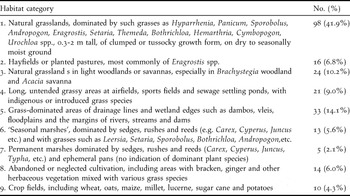
In Africa, Corncrakes have been recorded in a variety of habitats from sea level to 3,000 m (Cave and Macdonald Reference Cave and Macdonald1955, Britton Reference Britton1980, Urban et al. Reference Urban, Fry and Keith1986, Taylor Reference Taylor, del Hoyo, Elliott and Sargatal1996, Taylor and van Perlo Reference Taylor and van Perlo1998), the vast majority of which have grass species as the main vegetational component. We analysed a total of 234 descriptions of Corncrake wintering habitats taken from the literature, museum specimens and our own unpublished observations contained in our database (Table 2). This analysis shows that 67.9% (n = 159) of records are from grassland, 21.8% (n = 51) from wetland and 10.3% (n = 24) from other habitats, with grass-dominated habitats making up 82.1% (n = 192) of all records. A much more detailed description of passage and wintering habitats is given in Appendix S2.
Summary of 234 descriptions of Corncrake Crex crex wintering habitats placed into nine habitat categories as defined in detail below. Of these, categories 1–4 refer to grassland habitats, categories 1–5 to grassland-dominated habitats, and categories 5–7 to wetland habitats.
Discussion
Building on earlier efforts to document the African migration routes and wintering distribution of the Corncrake (Moreau Reference Moreau1972, Curry-Lindahl Reference Curry-Lindahl1981, Urban et al. Reference Urban, Fry and Keith1986, Stowe and Becker Reference Stowe and Becker1992, Taylor and van Perlo Reference Taylor and van Perlo1998), we here greatly expand the spatio-temporal knowledge of the migration and overwintering of the Corncrake by using a unique database containing 1,284 records (Table 1). Although we took great care with data verification and selection, we cannot exclude the possibility that some repeat records still remain in our database because the details of some records, especially atlas records, are simply insufficient to identify repeat records conclusively. We estimate that repeat records are definitely < 5% and probably around 1–2% of the total. While this is an unavoidable drawback of studies like this, and may bias the results in Table 1 a little, repeat records do not bias the results presented in Figures 1 and 2 because we subsumed records from the same locality or grid pixel, respectively.
Although the records have a comprehensive spatio-temporal coverage, the density distribution of the wintering records still partly reflects the intensity of ornithological fieldwork. For example, several field studies were conducted along the eastern Mediterranean coast of Egypt (Petersen and Sørensen Reference Petersen and Sørensen1981, Reference Petersen and Sørensen1981/2, Stouthamer and Bennett Reference Stouthamer and Bennett1982, Baha El Din and Salama Reference Baha El Din and Salama1984, Reference Baha El Din and Salama1991, Baha El Din Reference Baha El Din1993, Baha El Din et al. Reference Baha El Din, Salama, Grieve and Green1996, U. G. Sørensen in litt. 2007) which show up as a cluster of records in Figure 1.
To overcome such sampling bias, we used one of the best statistical models, Maxent (Elith et al. Reference Elith, Graham, Anderson, Dudík, Ferrier, Guisan, Hijmans, Huettmann, Leathwick, Lehmann, Li, Lohmann, Loiselle, Manion, Moritz, Nakamura, Nakazawa, Overton, Peterson, Phillips, Richardson, Scachetti-Pereira, Schapire, Soberón-Mainero, Williams, Wisz and Zimmermann2006), to built a probabilistic distribution model based on (1) the most comprehensive dataset so far, (2) records with a high degree of spatial accuracy, and (3) records exclusively from the Palearctic winter months. Our model achieved an AUC of 0.905 for the global model and of 0.885 for the cross-validation procedure which indicate very good model performance. Therefore, we have high confidence in the accuracy of our suitability surface to depict the continental ecological niche of wintering Corncrakes.
The first interesting result from the model is that there are large parts of Angola, Mozambique, north-eastern Namibia, and Tanzania which are predicted as suitable for wintering Corncrakes (Figure 2) but from which we have no records (Figure 1). We conclude that our suitability model does not just model the presence data, but extrapolates to areas which are potentially suitable for wintering Corncrakes but are probably undersampled and should therefore be targeted for future field work.
The second interesting result is that our model predicts the Corncrake to be absent from most of sub-Saharan West Africa, and the few areas which are predicted there all have low probabilities. Because both the actual number of records (only six November-February records in Table 1 from countries west of and including Chad and Cameroon) as well as the predicted probabilities (Figure 2) are low, our results support Stowe and Becker’s (Reference Stowe and Becker1992) assessment that the status of the Corncrake in sub-Saharan West Africa is that of an occasional migrant. Perhaps sub-Saharan West Africa supported some wintering populations when western breeding populations were larger, but we have no evidence to support this supposition.
Rather, the actual number of records and the distribution model indicate that the vast majority of Corncrakes migrate through, and overwinter in, the eastern parts of Africa. If we define the eastern part of Africa as all countries east of and including Egypt, Sudan, Democratic Republic of Congo, Zambia, Botswana and South Africa (Figure 1), the records from all the remaining western countries add up to only 87 (7%) out of the total of 1,284 records (Table 1). The only western countries predicted to have relatively large areas suitable for Corncrakes are Angola and Namibia (Figure 2) from which we have a total of four records (Table 1). Either these two countries have not been well searched, which is most certainly true for war-torn Angola (Dean Reference Dean2000), or they really are not used by Corncrakes.
The third interesting result is that a very small number of Corncrakes oversummer in Africa (June-August records in Table 1). However, we strongly suggest that these individuals are possibly unable to migrate due to sickness or injury, or may be first-year birds that are not ready to breed.
The fourth interesting result is that five climatic variables contributed to 86.1% of the variables’ gain of our distribution model, while land-cover, the three topographical variables and the remaining climatic variables explained the remainder. We conclude that climate is the overriding factor determining the Corncrake’s continental distribution (Figure 2), while availability of suitable habitats (Table 2) explains its local distribution. Because the importance of land-cover was only 4.5% (and 2.4% in permutation importance), we refrained from using our land-cover layer to estimate the areas covered by different land-cover classes within the boundaries of our continental distribution model. Moreoever, the modelled distribution certainly includes many areas unsuitable for Corncrakes, such as dense forests. Rather, we would expect Corncrakes to clump into smaller areas of suitable habitats within the larger modelled distribution (Figure 2), an assertion which is supported by the following calculations on population densities.
Given that the Corncrake’s global population ranges somewhere between 5.5 and 9.7 million individuals, “the apparent scarcity of the species in its non-breeding areas in sub-Saharan Africa” (BirdLife International 2011) has been puzzling. In a crude first analysis, we calculated the total area of the Corncrake’s wintering distribution estimated from Figure 2 to be 3,467,933 km2. Using the population estimates above, the average population density would be between 1.6–2.8 individuals/km2. Given that suitable habitats (Table 2) cover only a fraction of this area, population densities in suitable habitats should be considerably higher, and the few field-based estimates of Corncrake population densities support this assertion. In Zambia, individuals occupied up to four discrete areas of 4.2, 4.9, 8.7 and 8.9 ha, but only about half the area of the two larger sites was used for most of the time, giving a mean density of 22 individuals/km2 of suitable habitat (Taylor Reference Taylor1984). In South Africa, Corncrakes wintering in mixed grassland and Acacia savanna at Ukulinga Research Farm, Pietermaritzburg, were estimated to occur at a density of 20–33 individuals/km2, while at Underberg, KwaZulu-Natal, wintering birds occupied mixed habitat of Eragrostis hayfields, grassy drainage lines and maize field margins at a density of approximately 20 individuals/km2 (PBT). Furthermore, five individuals " were found in one small area of suitable habitat” on the Kafue Flats, Zambia, in January 1997 (Dodman et al. Reference Dodman, de Vaan, Hubert and Nivet1997, Leonard and Peters Reference Leonard and Peters1998), a maximum of 10 individuals were flushed “in 2 km of grassland” in north-west Mara Game Reserve, Kenya, on 11 April 1991 (Turner Reference Turner1993, Zimmerman et al. Reference Zimmerman, Turner and Pearson1996), and six individuals were flushed by Greg Davies in about an hour’s walking in the grassland of La Mercy Airfield near Umdloti, north-east of Durban, KwaZulu-Natal, on 1 January 2004 (H. A. Campbell and M. Kriek in litt. 2007). All this evidence supports clumping of Corncrakes within suitable habitats wherever they are found within the continental distribution shown in Figure 2. Therefore, estimating land-cover classes within the continental distribution would lead to a misrepresentation of the fine-scale habitat utilisation of the Corncrake; the in situ observations presented in Table 2 give a much more reliable estimate of what habitats Corncrakes actually utilise.
As previously discussed in Walther (Reference Walther2008), point locality records tell us very little about actual migration pathways taken by individual Corncrakes. Nevertheless, the evidence strongly suggests that there are at least two migration routes into Africa. Besides the obvious eastern route (through the eastern Mediterranean down to Kenya and further south) outlined by the majority of records as well as a few ringing records (Walther Reference Walther2008), there is also a western route supported by ringing recoveries from France and Spain and records from the Azores, the Canaries and Madeira (Glutz von Blotzheim Reference Glutz von Blotzheim1973: 458) and western Africa (Figure 1). As a result, Stowe and Becker (Reference Stowe and Becker1992) and Taylor and van Perlo (Reference Taylor and van Perlo1998) advanced the hypothesis that there exists a second route whereby Corncrakes pass through north-west Africa and then make a south-east crossing of the Sahara to reach their destination. These individuals may actually fly via the Tassili Mountains of south-east Algeria where Laferrère (Reference Laferrère1968) reported the Corncrake to be abundant in September. In concordance with this idea, the only two records from Chad are also from September (Appendix S1). Given that there are also small numbers of spring passage migrants in north-west Africa (Table 1), we should assume that some individuals or subpopulations from the western part of the breeding distribution use the western and others the eastern route (Walther Reference Walther2008).
Our data do not allow for speculation of what determines intra-African movements of Corncrakes (see also Walther Reference Walther2008). However, there is anecdotal evidence suggesting that Corncrakes perform itinerant movements determined by rainfall patterns. For example, during the 2003/2004 Palearctic winter, a marked increase in the number of South African Corncrake and other migrant records was linked to unusual rainfall patterns (Marais and Peacock Reference Marais and Peacock2004, Marais and Smith Reference Marais and Smith2004). Likewise, movements within Zambia were in response to changing water levels within grasslands (Taylor and van Perlo Reference Taylor and van Perlo1998). Because rainfall triggers the growth of suitable grassland cover and a subsequent increase in insect biomass, it is likely that the Corncrake’s wintering distribution shifts due to annually and seasonally changing environmental conditions (Appendix S2; Stowe and Becker Reference Stowe and Becker1992, Taylor and van Perlo Reference Taylor and van Perlo1998). However, to conclusively determine the effect of changing environmental variables, we need to be able to track individuals (e.g. Thorup et al. Reference Thorup, Alerstam, Hake and Kjellén2003, Trierweiler et al. Reference Trierweiler, Koks, Drent, Exo, Komdeur, Dijkstra and Bairlein2007, Catry et al. Reference Catry, Dias, Catry, Afanasyev, Fox, Franco and Sutherland2011) which has not yet been done for the Corncrake.
Because of these annually and seasonally changing movements, defining the exact extent of the Corncrake’s wintering distribution becomes a somewhat arbitrary exercise, especially if records from multiple years need to be used to model the distribution (Walther et al. Reference Walther, van Niekerk, Thuiller, Baumann, Dean, de Bruijn, Gutteridge, Jones, Nikolaus, Pearson, Robinson, Salewski, Schäffer, Taylor, Tushabe, Williams, Rahbek, Harebottle, Craig, Anderson, Rakotomanana and Muchai2010). The necessity to lump records from many decades probably overextends the species’s annual distribution. Nevertheless, the modelled distribution (Figure 2) should adequately capture the continental climatic space (or ‘ecological niche’) that the Corncrake can occupy within sub-Saharan Africa, even if it may only be partially filled in any given year.
While this study to a large extent resolves the continental distribution of the Corncrake, further studies of the species’s local and regional distribution, movements and habitat choices in Africa are strongly recommended, and “systematic searches of even small areas of suitable grassland would be valuable” (Stowe and Becker Reference Stowe and Becker1992). We recommend the use of dogs which have proved highly efficient at finding Corncrakes and other cryptic species (72 records [6%] in our database, almost all by PBT) and can therefore improve estimates of population density considerably.
Stowe and Becker (Reference Stowe and Becker1992) and Taylor and van Perlo (Reference Taylor and van Perlo1998) concluded that Corncrakes were not threatened on their African wintering areas because suitable habitat was abundant and, in some areas, grassland habitats were increasing as woods were felled and some agricultural areas were no longer farmed (R. J. Dowsett in litt. 2008). They added that suitable habitats suffered only locally, e.g. through overgrazing, and that extensive areas of suitable habitat remained protected in national parks. While these protected areas should largely remain protected, they may become negatively affected by future climate change. More worrying, however, is the recent massive land grab taking place all over sub-Saharan Africa (Friends of the Earth 2010, Vidal Reference Vidal2010), which goes in parallel with the ongoing change from low-intensity to high-intensity agriculture in many African regions (Walther in prep.). Given that vast areas of land can be rapidly converted to monocultures, constant vigilance has to be advocated through both in situ as well as remote monitoring.
Furthermore, threats may be persisting or even increasing during migration and at stop-over sites. The continuing loss of wetlands throughout Africa (Schäffer et al. Reference Schäffer, Walther, Gutteridge and Rahbek2006, Zwarts et al. Reference Zwarts, Bijlsma, van der Kamp and Wymenga2009, Walther in prep.) may also be associated with the loss of wet grasslands that could serve as crucial stop-over sites for Corncrakes. The magnitude of hunting in the Mediterranean should also be monitored (Koffijberg and Schäffer Reference Koffijberg and Schäffer2006, BirdLife International 2011). For example, 32 Corncrakes were killed on the Greek island of Lesvos in September 2007 alone (BirdLife International 2007). However, the overall impact of hunting is probably relatively low (Baha El Din et al. Reference Baha El Din, Salama, Grieve and Green1996, Stowe and Green Reference Stowe and Green1997).
While the historical decline of the Corncrake’s western populations was most likely due to negative effects in the breeding areas (Green Reference Green2008), future declines may also be caused by environmental changes in the wintering areas. Therefore, this study has laid the groundwork for better monitoring of this species on its African wintering grounds.
Supplementary Material
The supplementary materials for this article can be found atjournals.cambridge.org/bci
Acknowledgements
We thank the many people and institutions who have helped our desk study, namely Garth Aiston, Linda Armstrong, Graham Avery, Carl Beel, Jochen Bellebaum, Mark Brown, Rosalind Burr, Hamish A. Campbell, Jaroslav Cepák, Heather Chalcraft, Jacquie Clark, Katrina Cook, Olivier Dehorter, Dawie de Swardt, Chris du Feu, Mary Duncan, Michael Fink, Thord Fransson, Olaf Geiter, Jukka Haapala, Doug Harebottle, Pierre Hofmeyr, Jon Hornbuckle, Phyllis Howard, Wayne Jones, Michel Louette, Rory MacDougall, Etienne Marais, Gerald Mayr, Dieter Oschadleus, Faansie Peacock, Gidon Perlman, Robert Prŷs-Jones, Ernst Retief, Anna Rita, T. J. Stowe, Paul Sweet, Kasper Thorup, Thomas J. Trombone, Colin Valentine, Barry Walker, David Willard, Friederike Woog, Anna Zawadzka, Karcza Zsolt and those already acknowledged in Walther (Reference Walther2008). However, so many people have been involved at one stage or another that they cannot all be named here, but hopefully most of them are acknowledged on our website http://www.zmuc.dk/VerWeb/STAFF/Bawalther/migratoryBirds-africa.htm. Special thanks must go to our colleagues at the RSPB, especially Ian Dawson and Lynn Giddings in the Library at The Lodge as well as Ann Favell, Linda Birch at the Edward-Grey Library at Oxford University, Evelyne Bremond-Moslet and Jean-Marc Bremond at the Bibliothèque Mammiferés et Oiseaux, Muséum National d’Histoire Naturelle, Paris, Margaret Sandwith at the Niven Library, Percy FitzPatrick Institute of African Ornithology, Zoology Department, University of Cape Town, South Africa, and the librarians at BirdLife International, Cambridge, UK, as well as to EURING, Michael Brooks from SAFRING, Tamar Cassidy, Robert Dowsett, Mostert Kriek, Pete Leonard, Gerhard Nikolaus, David J. Pearson, Ian C. Riddell, Uffe Gjøl Sørensen, and Wanyoike Wamiti Wabunyi who all showed a special interest in our study and many of whom provided unpublished data. We thank two anonymous referees for comments. BAW was financed through grants from the RSPB, UK, and the Centre National de la Recherche Scientifique, France.



