




1 Introduction
In the novel Harry Potter and the Order of the Phoenix, Harry is angry at Draco Malfoy (Rowling, Reference Rowling2003, p. 242). Harry’s friend Hermione says: “Harry, don’t go picking a row with Malfoy, don’t forget, he’s a prefect now, he could make life difficult for you…” He answers: “Wow, I wonder what it’d be like to have a difficult life?” Those familiar with Harry Potter know that his life is far from easy and that he does not really mean what he is saying, but quite the opposite. Harry’s response exemplifies verbal irony where something opposite is intended than what is literally said (Attardo, Reference Attardo2000). It is typically used to criticize someone or something (the former is called sarcasm; e.g., Kreuz & Link, Reference Kreuz and Link2002). In a broader sense, irony can be divided into verbal irony and situational irony (see Attardo, Reference Attardo2000 for an overview of the definition). Situational irony is a state of the world that is perceived as ironic (e.g., a fire station is on fire). In this paper, we will only focus on verbal irony, as it is more important in terms of language learning and social function. Ironic language is used often in communication, and even children encounter it frequently, for example, in family conversations (Recchia et al., Reference Recchia, Howe, Ross and Alexander2010), classrooms (Piirainen-Marsh, Reference Piirainen-Marsh2011), cartoons (Dews et al., Reference Dews, Winner, Kaplan, Rosenblatt, Hunt, Lim, McGovern, Qualter and Smarsh1996), and online communication (Aguert et al., Reference Aguert, Laval, Gauducheau, Atifi and Marcoccia2016).
Irony comprehension requires going beyond the literal phrasal meaning to recognize the intention of the speaker. It is therefore not surprising that irony comprehension is challenging for children and the ability improves until early adulthood (Fuchs, Reference Fuchs2023; Pexman, Reference Pexman, Gibbs and Colston2023). Moreover, it does not develop at the same pace among all children. Children’s irony comprehension varies greatly, even in middle childhood when language and perspective-taking skills should be sufficient for comprehension (Olkoniemi et al., Reference Olkoniemi, Halonen, Pexman and Häikiö2023; Zajączkowska & Abbot-Smith, Reference Zajączkowska and Abbot-Smith2020). Irony comprehension is not only matter of language skills, as speakers use irony because it serves important social functions. It is most often used to strengthen bonds between friends and peers (e.g., Dews et al., Reference Dews, Kaplan and Winner1995), starting in the early school years (Aguert et al., Reference Aguert, Laval, Gauducheau, Atifi and Marcoccia2016; Pexman et al., Reference Pexman, Zdrazilova, McConnachie, Deater-Deckard and Petrill2009). Deficits in irony comprehension are associated with the experience of being socially excluded (Kim & Lantolf, Reference Kim and Lantolf2018). School-age peer relations bear great importance as they relate to children’s development (Hartup, Reference Hartup1996) and engagement with school (Wentzel & Caldwell, Reference Wentzel and Caldwell1997), among other things. Although irony most often serves positive social functions, irony can also be used to tease and even to bully (e.g., Rutherford & Rissel, Reference Rutherford and Rissel2004). It is, thus, important to find ways to improve children’s irony comprehension so that they can detect the ironic speaker’s intent, accurately comprehend what they read, and fully participate in everyday communication.
Here, we explored whether teaching irony in the classroom can improve 10-year-old children’s irony comprehension skills. In what follows, we describe the development of irony comprehension and review factors affecting use and comprehension of irony. We then introduce previous irony training and eye-tracking studies on written irony comprehension.
1.1 Children’s irony comprehension
Irony comprehension typically begins to emerge by the age of 6 (Fuchs, Reference Fuchs2023; Pexman, Reference Pexman, Gibbs and Colston2023), and the comprehension of simple ironic utterances may occur even earlier (e.g., Loukusa & Leinonen, Reference Loukusa and Leinonen2008). By this age, children have developed sufficient language and social skills to understand something of the intended meaning of irony (Fuchs, Reference Fuchs2023). At this early stage of development, comprehension accuracy is low and children often misinterpret irony as literal language or as a lie (Demorest et al., Reference Demorest, Christine, Phelps, Gardner and Winner1984; Loukusa & Leinonen, Reference Loukusa and Leinonen2008).
Around age 7–8, children start to understand the ironic speaker’s intent (Pexman, Reference Pexman, Gibbs and Colston2023) and comprehension accuracy typically exceeds chance level (Fuchs, Reference Fuchs2023; c.f., Olkoniemi et al., Reference Olkoniemi, Halonen, Pexman and Häikiö2023; Zajączkowska & Abbot-Smith, Reference Zajączkowska and Abbot-Smith2020). This developmental phase has been linked to the emergence of several socio-cognitive and socio-emotional skills, such as theory of mind (i.e., ability to impute one’s own and other people’s mental states, Premack & Woodruff, Reference Premack and Woodruff1978; see Quesque et al., Reference Quesque, Apperly, Baillargeon, Baron-Cohen, Becchio, Bekkering, Bernstein, Bertoux, Bird, Bukowski, Burgmer, Carruthers, Catmur, Dziobek, Epley, Erle, Frith, Frith, Galang and Brass2024 for terminology on mental state attributions) and empathy (i.e., ability to understand and feel the emotional states of others; Riess, Reference Riess2017). This also ties in with Piaget’s concrete operational stage during which children overcome egocentrism and develop the ability to understand other people’s intentions (Piaget, Reference Piaget1972). Although the development of socio-cognitive and irony comprehension skills seem to go hand in hand, the nature of the relationship between theory of mind (especially the ability to consider what people think about other people’s thoughts, i.e., second-order theory of mind, Perner & Wimmer, Reference Perner and Wimmer1985) and irony comprehension is not completely clear (Fuchs, Reference Fuchs2023; Pexman, Reference Pexman, Gibbs and Colston2023). In addition, several other cognitive skills have been linked to children’s irony comprehension, such as cognitive flexibility, inhibitory control, and working memory (Fuchs, Reference Fuchs2023; Pexman, Reference Pexman, Gibbs and Colston2023). Of these, working memory has been shown to modulate irony comprehension even in adulthood (e.g., Olkoniemi & Kaakinen, Reference Olkoniemi and Kaakinen2021).
Socio-emotional and cognitive abilities are not the only factors contributing to the development of irony comprehension. Exposure to ironic language also serves an important role in this development (Banasik-Jemielniak et al., Reference Banasik-Jemielniak, Bosacki, Mitrowska, Wyrębek, Wisiecka, Copeland, Wieland, Popovic, Piper and Siemieniuk2020; Loukusa & Leinonen, Reference Loukusa and Leinonen2008; Pexman et al., Reference Pexman, Zdrazilova, McConnachie, Deater-Deckard and Petrill2009; Recchia et al., Reference Recchia, Howe, Ross and Alexander2010). For example, Pexman et al. (Reference Pexman, Zdrazilova, McConnachie, Deater-Deckard and Petrill2009) showed that the use of irony by 3- to 15-year-old children did not correlate with their general cognitive ability or vocabulary, but with the use of irony by their parents and siblings. Moreover, Recchia et al. (Reference Recchia, Howe, Ross and Alexander2010) showed that in family conversations 4- to 6-year-old children tended to use similar kinds of figurative expressions to those their parents used most often. Consistent with these findings, Banasik-Jemielniak et al. (Reference Banasik-Jemielniak, Bosacki, Mitrowska, Wyrębek, Wisiecka, Copeland, Wieland, Popovic, Piper and Siemieniuk2020) found that eight-year-old children’s irony comprehension was associated with their mothers’ higher use of irony toward the child. These findings are not surprising as children’s communicative knowledge, and world knowledge, in general, develops by learning from others (e.g., Carpendale & Lewis, Reference Carpendale and Lewis2004; Newcomp Reference Newcombe2013), for example, in early learning by mimicking (Piaget, Reference Piaget1972; see also Newcomp, Reference Newcombe2013, for review on theories of cognitive development). Thus, it is logical that metapragmatic knowledge of irony (i.e., explicit knowledge of irony and its use; e.g., Bernicot et al., Reference Bernicot, Laval and Chaminaud2007) can be learned in interaction with family members. Although family is important for learning irony comprehension, there is evidence that irony comprehension can also be taught outside the family context. Before reviewing previous training studies, we will first describe the factors that are important for the use and comprehension of irony and thus of relevance for learners.
1.2 Factors influencing the use and comprehension of irony
Irony is context-dependent (e.g., Ackerman, Reference Ackerman1983; Grice, Reference Grice, Cole and Morgan1975). In the example from Harry Potter, above, knowledge about Harry’s life is important context, contrasting with the literal meaning of Hermione’s comment. Detecting this contrast is necessary for interpreting Harry’s comment as ironic, and contrast with context is the most important factor for irony comprehension (e.g., Ackerman, Reference Ackerman1983). Most irony comprehension theories emphasize the role of context (Fabry, Reference Fabry2021; Gibbs, Reference Gibbs1994; Grice, Reference Grice, Cole and Morgan1975; Pexman, Reference Pexman2008; Sperber & Wilson, Reference Sperber, Wilson and Cole1981). For example, the classical standard pragmatic view (e.g., Grice, Reference Grice, Cole and Morgan1975) states that the inconsistency between the literal meaning and the context in which it occurs is essential to irony processing. According to this theory, irony is comprehended via three consecutive steps: First, the reader interprets the phrase literally. Second, the reader realises that the literal interpretation does not fit the context. Third, the reader looks for an alternative interpretation and understands that the phrase is ironic. Because understanding the intended meaning of an ironic phrase is seen as a serial process, it is expected to be slower and more difficult than that of a literal phrase. Later theories of irony comprehension make a similar assumption that ironic phrases are harder and slower to comprehend, but only under certain conditions. For example, when it is not highly familiar as irony (e.g., “Yeah, right!”; the graded salience view, Giora, Reference Giora2003) and/or when the previous context gives no indications of it (the direct access view, Gibbs, Reference Gibbs1994). Experimental findings support these theoretical assumptions (see Olkoniemi & Kaakinen, Reference Olkoniemi and Kaakinen2021, for a review of eye-tracking studies on irony). Thus, the previous research suggests that the contrast between the context and the phrase is crucial for understanding irony. Therefore, learning about the contrasting nature of irony is of great importance for the development of irony comprehension.
Several other factors are important for comprehending irony. The echoic mention theory (Sperber & Wilson, Reference Sperber, Wilson and Cole1981) suggests that when an ironic phrase echoes a previous contextual statement, processing of it is facilitated. For example, if Lisa mentions that the weather will be perfect for camping tomorrow and the next day it is pouring rain, Kathy’s message “What a perfect weather for camping!” echoes Lisa’s comment and makes it easier to recognise as irony. While the theory states that the echo does not need to be direct like in the example, it has been suggested that only direct echo would facilitate comprehension because it reduces the need for inferencing (e.g., Jorgensen et al., Reference Jorgensen, Miller and Sperber1984). Empirical evidence supports the facitative role of direct echo, but the evidence on the role of indirect echo is unclear (e.g., Keenan & Quigley, Reference Keenan and Quigley1999; Kreuz & Glucksberg, Reference Kreuz and Glucksberg1989). Most relevant for this study, Keenan and Quigley (Reference Keenan and Quigley1999) showed that 6- to 10-year-old children were more likely to detect an ironic statement when it explicitly echoed a previous statement than when it did not. Thus, echoic mention could be useful for children in learning to understand irony.
Speakers use vocal cues to signal irony, which is referred to as an ironic tone of voice (e.g., Bryant, Reference Bryant2010). Studies suggest that there is no specific ironic tone of voice and that speakers use a variety of ways to signal irony (Bryant & Fox Tree, Reference Bryant and Fox Tree2005), which may be culture-specific (Cheang & Pell, Reference Cheang and Pel2009). The use of an ironic tone of voice aids in irony comprehension (Fuchs, Reference Fuchs2023; Keenan & Quigley, Reference Keenan and Quigley1999), but some studies suggest that it plays only a small role (e.g., Ackerman, Reference Ackerman1983). Studies have shown that children’s ability to understand irony can be improved by the use of an ironic tone of voice (see Fuchs, Reference Fuchs2023, for review), but this benefit is not observed in younger (< ~ 7-year-old) children (Ackerman, Reference Ackerman1983; Fuchs, Reference Fuchs2023, cf., Glenwright et al., Reference Glenwright, Parackel, Cheung and Nilsen2014). Thus, learning to pay attention to tone of voice may help school-aged children to better understand irony.
Irony is often used to express something negative while the literal meaning of the phrase is positive (Kreuz & Glucksberg, Reference Kreuz and Glucksberg1989). The tinge hypothesis suggests that activating positive literal meaning reduces the perceived negativity of ironic criticism (Dews & Winner, Reference Dews and Winner1995), which has been shown in several studies (e.g., Dews & Winner, Reference Dews and Winner1995; Thompson et al., Reference Thompson, Mackenzie, Leuthold and Filik2016). Despite this reduction in perceived negativity, both positive (humorous) and negative (critical) emotions are present in irony, (e.g., Pfeifer & Pexman, Reference Pfeifer and Pexman2023; Roberts & Kreuz, Reference Roberts and Kreutz1994). However, children struggle to recognize the humour in irony and tend to interpret ironic phrases as more critical and mean than adults do (see Pexman, Reference Pexman, Gibbs and Colston2023, for review). The humour function is also among the last developing aspects of irony comprehension (Dews et al., Reference Dews, Winner, Kaplan, Rosenblatt, Hunt, Lim, McGovern, Qualter and Smarsh1996; Pexman, Reference Pexman, Gibbs and Colston2023). As humour and laughter are important features of irony (Bryant, Reference Bryant2010; Gibbs et al., Reference Gibbs, Bryant and Colston2014), it is essential for children to learn about the humorous intent behind irony. This should help them to better understand a speaker’s motivation for using irony.
1.3 Irony training studies
Development of irony comprehension is closely linked to the development of metapragmatic knowledge, which refers to conscious knowledge about social rules of language and the ability to apply them (e.g., Bernicot et al., Reference Bernicot, Laval and Chaminaud2007). In irony’s case, this includes, for example, knowledge of what irony is, and how and why it is used. The importance of the development of metapragmatic knowledge in general is obviously not limited to the development of irony comprehension but has also been shown to be important, for example, in the development of understanding requests (Bernicot et al., Reference Bernicot, Laval and Chaminaud2007) and metaphors (Tonini et al., Reference Tonini, Lecce, Del Sette, Bianco, Canal and Bambini2022).
As described earlier, children are exposed to ironic language in family conversations, and it is likely that the required metapragmatic knowledge would often come from these conversations (Banasik-Jemielniak, Reference Banasik-Jemielniak2019; Banasik-Jemielniak et al., Reference Banasik-Jemielniak, Bosacki, Mitrowska, Wyrębek, Wisiecka, Copeland, Wieland, Popovic, Piper and Siemieniuk2020; Pexman et al., Reference Pexman, Zdrazilova, McConnachie, Deater-Deckard and Petrill2009). Variability in children’s irony comprehension accuracies, however, suggests that this is not the case for all. Moreover, Garfinkel et al. (Reference Garfinkel, Rowe, Bosacki and Banasik-Jemielniak2024) studied irony comprehension and metapragmatic awareness in eight-year-olds and showed that only 37% were able to give an explanation containing metapragmatic knowledge of irony. A few recent studies have explored how to overcome the lack of metapragmatic knowledge through training (Bouton, Reference Bouton and Hinkel1999; Kim & Lantolf, Reference Kim and Lantolf2018, Persicke et al., Reference Persicke, Tarbox, Ranick and Clair2013; Saban-Bezalel & Mashal, Reference Saban-Bezalel and Mashal2015). The majority have involved participants with a diagnosis of autism spectrum disorder (Persicke et al., Reference Persicke, Tarbox, Ranick and Clair2013; Saban-Bezalel & Mashal, Reference Saban-Bezalel and Mashal2015) or second language speakers (Bouton, Reference Bouton and Hinkel1999; Kim & Lantolf, Reference Kim and Lantolf2018). Most relevant for the current study, two studies explored the effect of irony training on typically developing children (Lee et al., Reference Lee, Sidhu and Pexman2021; Szücs & Babarczy, Reference Szücs, Babarczy and Assimakopoulos2017).
First, Szücs and Babarczy (Reference Szücs, Babarczy and Assimakopoulos2017) investigated how three one-on-one training sessions teaching metapragmatic knowledge affected 4- to 7-year-old children’s irony comprehension (n = 20) as compared to passive controls (n = 19). In the task, children listened to age-appropriate stories containing an ironic statement, for example, a father saying “What soft cookies!” after seeing burned cookies in the kitchen. After each story, children selected the correct interpretation for the target phrase from three alternatives (literal, deception, or irony). In the training, children were shown similar stories and were asked questions helping them to understand what is relevant for the interpretation. These questions concerned knowledge of the actual state of affairs, knowledge of the contrast between the literal phrasal meaning and the speaker’s knowledge of the actual state of affairs, recognition of the inappropriateness of the deceptive interpretation, and consideration of ironic use of language. After training, all children were tested again on the same irony task that had been used prior to training. The training group children’s accuracy in the irony task increased from 18% pre-test to 71% post-test, whereas the control group’s accuracy was virtually unchanged (15% pre-test and 18% post-test). Szücs and Babarczy also measured children’s language ability and theory of mind, but those measures did not correlate with irony comprehension. This finding suggests that the level of metapragmatic knowledge may be a more influential factor in explaining differences in irony comprehension among typically developed children than individual differences in language comprehension or theory of mind.
Second, Lee et al. (Reference Lee, Sidhu and Pexman2021) investigated whether short (~15-minute) one-on-one training could improve 5- to 6-year-old children’s ability to understand irony (n = 58) when compared to active controls (n = 53). In the training, children were given a definition of sarcasm (this term was used given the young age of the children, as in English the word sarcasm is acquired earlier than irony, Kuperman et al., Reference Kuperman, Stadthagen-Gonzalez and Brysbaert2012) and were shown a storybook containing illustrated stories in which ironic or literal comments were made. The experimenter read the stories aloud and explained cues and function of sarcasm: contrast between the phrase and the context, humour function of irony, and ironic tone of voice. After reading, children were given a summary of the taught content. For the controls, the experimenter read a non-ironic storybook. Prior to training, all children were shown five puppet shows of which three ended with an ironic statement. After each show, children were asked questions about the speaker’s beliefs, intent, and humour. After the training, new puppet shows were presented to all children, the same set of questions was asked as in pre-test, and additionally irony detection accuracy was measured. Children who took part in the irony training and had low ability to interpret irony at pretest (<50% correct in questions concerning speaker’s belief and intent) improved their accuracy in evaluating ironic speaker belief and intent and showed more accurate irony detection (N = 36; 68% accuracy) compared to the controls (N = 29; 51% accuracy). However, unlike the other measures, irony recognition accuracy was only measured at post-test, so we do not know to what extent it improved with training.
These studies show that one-on-one irony training is an effective way of improving children’s irony comprehension. In the present study, we investigated the effect of irony training in a classroom setting. Moreover, we measured not only change in comprehension accuracy but also tested for change in processing irony by tracking children’s eye movements while they read texts containing irony, before and after training.
1.4 Processing of written irony
Eye-tracking methodology allows detailed analysis of the time-course of reading without posing additional demands on the reader (Rayner, Reference Rayner2009). In recent years, it has been used to study how adults process irony (see Olkoniemi & Kaakinen, Reference Olkoniemi and Kaakinen2021, for review) and, very recently, in children (Olkoniemi et al., Reference Olkoniemi, Halonen, Pexman and Häikiö2023). Adults’ eye-tracking studies have shown that when the irony is unfamiliar or unsupported by context, it takes longer to process than its literal counterparts (e.g., Filik & Moxey, Reference Filik and Moxey2010). This slowdown has typically been seen in increased later rereading of (i.e., look-backs to) ironic phrases, as well as greater likelihood of rereading the context for ironic than for literal stories (Olkoniemi & Kaakinen, Reference Olkoniemi and Kaakinen2021). This rereading behavior is thought to reflect efforts to integrate the ironic meaning with the context, as predicted by theories of irony comprehension (e.g., Grice, Reference Grice, Cole and Morgan1975). This interpretation is consistent with assumptions about the role of later rereading in reading comprehension, as it is thought to reflect conscious efforts to build a comprehensive representation of the text (e.g., Hyönä et al., Reference Hyönä, Lorch and Kaakinen2002). However, processing of ironic statements is not static but changes over the course of an experimental session, which is referred to as the trial effect (Olkoniemi & Kaakinen, Reference Olkoniemi and Kaakinen2021) or Early-Late effect (Spotorno & Noveck, Reference Spotorno and Noveck2014). For example, Sportorno and Noveck (Reference Spotorno and Noveck2014) presented adult participants short texts with ironic and literal statements. Participants read the texts sentence by sentence at their own pace. They spent more time reading ironic than literal statements, but this irony effect diminished towards the end of the experiment. A similar effect was also observed for the sentence following an ironic statement (i.e., spillover region). It seems that when readers repeatedly encounter irony, an expectation of forthcoming irony is created. This makes following ironic statements easier to process, and thus, more similar to that of literal statements.
Only one previous study investigated children’s written irony comprehension and compared that to adults (Olkoniemi et al., Reference Olkoniemi, Halonen, Pexman and Häikiö2023). That study found that comprehending written irony was more challenging for 10-year-old children than for adults, although for both groups it was more difficult than comprehending literal language. Processing of ironic stories was similar for children and adults in most respects. Both groups showed increased rereading of target phrase and critical context for irony (i.e., sentence that made the target phrase ironic) and showed trial effects. The main differences were that children’s reading focused more on immediate (i.e., first-pass reading) and adults on later rereading (i.e., look-backs and look-froms). This is consistent with studies showing that when reading for comprehension, younger readers tend to spend more time on first-pass reading than adults (Kaakinen et al., Reference Kaakinen, Lehtola and Paattilammi2015). Moreover, children did not show similar sensitivity to the correct comprehension of target phrase as adults, meaning that reading patterns were the same when the irony was comprehended and when it was not. Furthermore, children who were more accurate irony comprehenders showed faster reading times, whereas the opposite was true for adults (Olkoniemi et al., Reference Olkoniemi, Halonen, Pexman and Häikiö2023). It seems that as adult reading is automatic and fluent, and literal language is generally expected, a prediction error caused by reading an ironic phrase interrupts this process and requires rereading. For children, however, the reading process is not as fluent and automatic as for adults, and predictions of text are not as accurate. This is reflected in slower reading in general and focusing more on the first-pass reading. In this process, better recognition of irony reduces the load on the interpretive process in general, which is reflected in faster reading times.
1.5 Aims of the study
In the present pre-registered study, we aimed to test, for the first time, whether teaching metapragmatic knowledge of irony in the classroom can improve 10-year-old children’s comprehension of irony. To assess improvement, we used a pre-post test design and measured children’s comprehension of stories containing ironic and literal target statements. Additionally, we used eye-tracking to explore how training affected the efficiency of children’s processing of irony. In the metapragmatic knowledge training, we taught children about factors affecting irony comprehension: the definition of irony and sarcasm, the significance of contrast, the humor function, ironic tone of voice, use of echoic mention, and with whom people might use irony. The active control group received training on reading comprehension. We hypothesized that irony training would improve irony comprehension for the training group so that at post-test, they would show more accurate comprehension and faster processing of ironic meaning than the controls. Olkoniemi et al. (Reference Olkoniemi, Halonen, Pexman and Häikiö2023) found that more accurate irony comprehension in children was associated with faster first-pass reading time of the ironic target phrase and the spillover region. Therefore, the training group was expected to show improvement in these measures.
2 Method
2.1 Transparency and openness
Prior to data collection, the planned hypotheses, sample size, materials, and the analyses were pre-registered on the Open Science Framework (OSF) (https://osf.io/z3xyc). The materials used in training, data, and analysis scripts are available via OSF https://osf.io/48bem/
2.2 Participants
Altogether 82 fourth-grade children (40 females, M = 10;5 years, SD = 0;3, range 9;11–10;10) from four classrooms in two Finnish schools from North Ostrobothnia and Southwest Finland were recruited for the study. In both schools, the first class to be tested was selected as a control and the last as a training group (more details in ‘Training and Control Lessons’ section). This resulted in 35 children in the control group, and 45 children in the training group.
Eight participants (five controls and three training participants) were absent from school due to illness during the training/control lesson. Out of these, the control group participants were kept in the data as passive controlsFootnote 1 to retain adequate statistical power. The absent training group participants were excluded from the data, as it is possible that their classmates had informed them about the content of the training lesson. Moreover, one training group participant was excluded due to poor eye-tracking data quality.
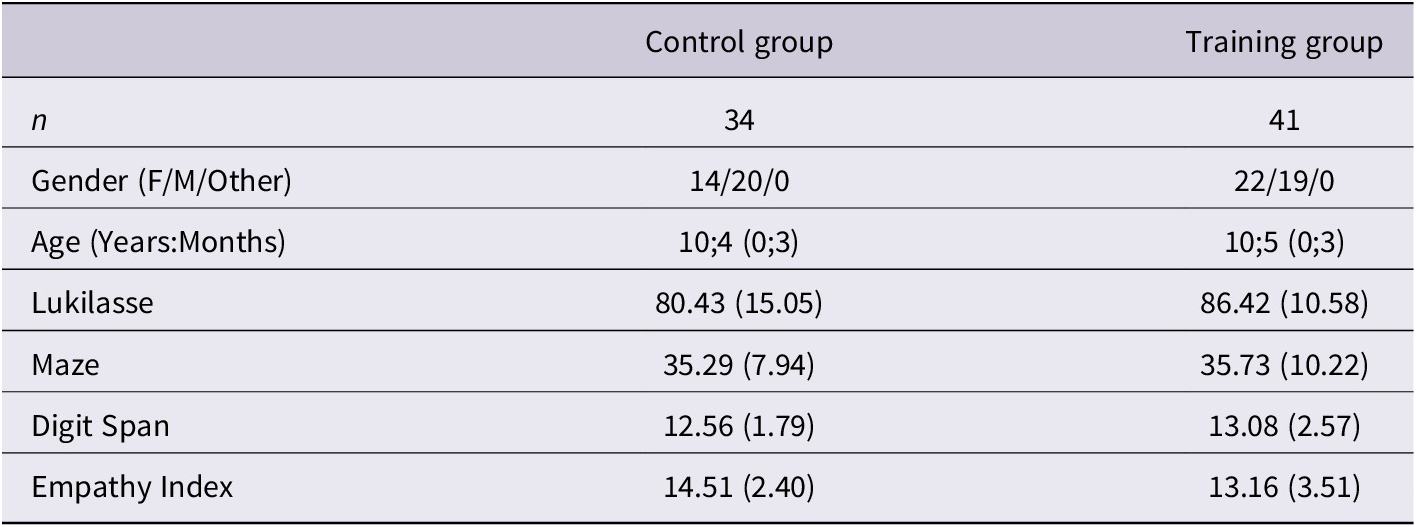
To ensure that the participants were within the typical range of abilities that might affect their irony comprehension (Fuchs, Reference Fuchs2023; Pexman, Reference Pexman, Gibbs and Colston2023) and that the results would reflect normative development, we assessed their working memory (Digit Span subtest of WISC-IV, Wechsler, Reference Wechsler2010), level of reading comprehension (Maze task, Ronimus et al., Reference Ronimus, Tolvanen and Hautala2022), technical reading skill (Word Fluency subtest of Lukilasse II, Häyrinen et al., Reference Häyrinen, Serenius-Sirve and Korkman2013), and empathy skill (Finnish translation of Index of Empathy for Children and Adolescents, Bryant, Reference Bryant1982; Olkoniemi et al., Reference Olkoniemi, Halonen, Pexman and Häikiö2023). One control group participant had lower than expected span performance for the age group (i.e., < −2 SD), and their data were excluded from analyses. For participants included in the analyses, descriptive statistics for the background measures are presented in Table 1. In total, we had 34 participants in the control group and 41 in the training group, which was higher than the number of participants required (≥ 30/group) to have adequate statistical power (power =.8, α = .05, see pre-registration for more details). Training and control group participants did not differ on the background measures, all ps > .05 (see Appendix S1 in the Supplementary materials for detailed results).
Descriptive data of the participant groups

Note. Values reported for Age, Lukilasse, Maze, Digitspan, Empathy Index are mean scores, and their respective SDs are reported in parentheses. Lukilasse = measure of technical reading skill, Maze = measure of reading comprehension, Digit Span = measure of working memory capacity, and Empathy Index = measure of empathy skill.
All children had no known reading difficulties, were Finnish native speakers, and had normal or corrected-to-normal vision. At the time of testing, they had received approximately three years and three months of formal reading instruction. Children’s parents signed a written consent form, and verbal consent was obtained from each child. For their participation, children received candy or stickers. The study was conducted in accordance with the Declaration of Helsinki and was approved by the Ethics Committee for Human Sciences at the University of Turku.
2.3 Apparatus
Eye movements were recorded using EyeLink Portable Duo and EyeLink 1000 Plus eye-trackers (SR Research Ltd. Ontario, Canada) using 500Hz sampling frequency. With Portable Duo, the stimuli were presented on a 17.3” Asus ROG G752V laptop screen, with participants seated 60 cm from the screen. With EyeLink 1000 Plus, the stimuli were presented on a 24” Asus VG248QE monitor, with participants seated 92 cm from the screen. Both monitors were set to a resolution of 1920 × 1080 pixels and a 120 Hz refresh rate. Participants’ heads were stabilized using a chin-and-forehead rest.
2.4 Materials
Each participant was shown 44 experimental stories to read on a computer screen (font: Courier New, font size: 27, line height: 3). Twenty-six stories were from Olkoniemi et al. (Reference Olkoniemi, Halonen, Pexman and Häikiö2023), and 18 new stories were created for this experiment. New stories were pre-tested to ensure that they were equivalent to the original stories (see Appendix S2 in the Supplementary materials for more details). Each story had a literal and ironic version (44 stories × 2 story types, resulting in 88 experimental stories). There were 20–41 words (MWords = 29.65, SDWords = 4.28) in each story across 4–5 sentences (see Table 2 for an example). Each story started with one or two background sentences that were the same across the story versions. These were followed by a context sentence that made the following target phrase either ironic or literal (i.e., critical context). The target phrase was identical in both story versions and was followed by a spillover region (Rayner, Reference Rayner2009) describing who had said the phrase. Each story had a final neutral sentence that described how the events of the story ended. The spillover region and the final sentences were the same between the story versions. After reading of each story, participants were asked a text memory question to test their memory for the story content and an inference question to test their comprehension of the intended meaning of the target phrase (see Table 2 for examples). For both types of questions, the proportion of correct answers was computed.
An example of an experimental story and inference and text memory questions translated from Finnish

Each participant read 22 experimental stories at both the pre-test and post-test. Participants were shown only one version of each story, and they did not read the same story twice. Presentation of the stories was counterbalanced, so that each story was shown equally often in the pre-test and post-test phases, and the presentation order of the stories was randomized within each testing phase. New and original stories were mixed so that equal proportions of new and original items were presented in pre- and post-test phases.
2.5 Training and control lessons
Both training and control lessons were designed to be in line with the Finnish National Core Curriculum for Basic Education and to be delivered to the whole classroom in a typical 45-minute school lesson, so that they could be easily implemented in the education system. The materials are consistent with several objectives in the core curriculum, for example, ‘acting in interactive situations’, ‘interpreting texts’, and ‘understanding language, literature and culture’ (Finnish National Board of Education, 2016).
Training lesson. In the lesson, the different aspects of irony were taught by showing children example stories containing irony, each presenting a new theme that was discussed with children. These themes were: (1) What irony is, (2) importance of contrast in irony, (3) humour function of irony, (4) difference between irony and sarcasm, (5) ironic tone of voice, (6) how people might use echoic mention while being ironic, and (7) with whom people might use irony. We wanted the children to actively participate in the lesson, and involvement was implemented through various tasks. First, each example story was discussed with children, and when discussing the use of ironic tone of voice, children practiced this in pairs. Second, in the middle of the lecture children filled out a questionnaire where they had to choose which of the six short stories presented were ironic (3/6 stories were ironic). After filling the questionnaire, each story was discussed with the group by asking whether this was ironic or not, and why did they think so. In the questionnaire, we also asked two binary (yes/no) questions: (1) Had you heard about irony prior to this lesson? (2) Have you learned something new during this lesson? Third, at the end of the lesson, children were to make up a short story in pairs, in which someone says something ironic. These stories were shared in the group, and each of the stories were discussed. Last, a Finnish translation of coloring book Sydney Gets Sarcastic, designed to help children understand sarcasm (Pexman & Bitterman, Reference Pexman and Bitterman2021), was given to all the pupils in the class, and they were encouraged to try to recognize the use of irony in their everyday lives.
Control lesson. The control group children were taught about: (1) eye movements and reading, (2) reading strategies to improve reading comprehension, and (3) the benefits of reading. These topics were chosen to serve reading learning purposes and to make the children in the control group feel that the topics were relevant to the experiment but clearly not related to irony so that they would not affect the results (similarly to Lee et al., Reference Lee, Sidhu and Pexman2021). Similarly to the training lesson, the subject was taught in an interactive manner. Examples of each theme were shown and discussed with the whole class. This included trying out how the hand starts to lose sharpness when it moves away from foveal vision, exploring in pairs how eye movements look when reading, and in the end of the lesson, discussing the benefits of reading and what each of them had read recently. As homework, children were asked to find and read any book that interests them.
2.6 Procedure
In each school, testing was performed one class at a time. The first class tested was assigned as the control group, and the second as the training group. Testing always started with the control group to avoid the information about the content of the training lesson spreading before the controls were tested. The experiment was blinded: the undergraduate students performing the testing were not told which class was assigned as control and which as the training group, and they did not test the class during the day a lesson was given. Children were told not to talk about the content of the lesson with the experimenter. All the lessons were given by the first author.
The study consisted of four phases. During the pre-test, participants were tested individually. Upon arrival, participants were informed that the experiment would assess reading. They were then introduced to the eye-tracking system and the experimental procedure. After the introduction, the eye tracker was set up and calibrated using a nine-point calibration. Participants were asked to read for comprehension. They read each story at their own pace and pressed spacebar on the keyboard when finished. Each story was shown on a single screen. After reading the story, text memory and inference questions were presented – one at a time – to which they responded by pressing designated “Yes” and “No” keyboard buttons. The next story was presented after both questions had been answered. Digit Span, Lukilasse, and Index of Empathy for Children and Adolescents were performed after the reading task. Each pre-test session lasted about 45 minutes, and all the children in the class were tested within two weeks.
After all the children in the class had participated in the pre-test, the first author gave the class either the control or the training lesson. Starting from the day after the lesson, the post-test was executed. The post-test was similar to the pre-test, except that only the reading task with eye-tracking was performed. The post-test session lasted for about 20 minutes. All the children in the class were tested in the post-test phase within 1–13 days after the lesson. The average delay from the lessons to post-test was three days for the controls (SD = 2.27, range: 1–6) and five days for the training group (SD = 2.86, range: 1–13). The average delay between pre- and post-test was 10 days for the controls (SD = 3.19, range: 3–16) and 14 days for the training group (SD = 5.77, range: 4–27).
Last, after the two school classes had completed the post-test, the Maze task was carried out by the children in their own class. Children were rewarded with candy or stickers for their participation and the specific nature of the experiment was explained to them. Control group participants were also given the Finnish version of the Sydney Gets Sarcastic coloring book that was part of the irony training. This final session took about 30 minutes.
3 Results
3.1 Analyses
Statistical analyses were performed with linear mixed-effects models (Baayen et al., Reference Baayen, Davidson and Bates2008) using the lme4 package (Bates et al., Reference Bates, Mächler, Bolker and Walker2015) in the R statistical software (Version 4.1.2; R Core Team, 2021). Dependent variables with a high number of zero values (i.e., number of first-pass rereading fixations on the target phrase, probability to look-back to the target phrase, probability to initiate a look-from the target phrase, and probability to look-back to critical context) were analyzed using glmmTMB package (Version 1.1.7.; Brooks et al., Reference Brooks, Kristensen, van Benthem, Magnusson, Berg, Nielsen, Skaug, Mächler and Bolker2017). More detailed descriptions of the eye movement measures, task performance, preprocessing of the data, and the analyses are reported in Appendix S3 in Supplementary materials. Separate models were built for each eye movement measure for the different text regions (i.e., target phrase, critical context, and spillover region) and for the accuracy of the inference and text memory questions. Descriptive statistics of the measures are reported in Table 3. For the eye movement analyses, we used a similar exclusion criterion for comprehension accuracy as Olkoniemi et al. (Reference Olkoniemi, Halonen, Pexman and Häikiö2023), namely, that participants should have correctly comprehended more than one ironic item (i.e., > 10% correct; see pre-registration). Three participants (1 from the control and 2 from the training group) had irony comprehension accuracy below acceptable levels. Their data were excluded from the analyses, leaving a total of 72 participants (32 control group and 40 training group participants).Footnote 2 Moreover, only correctly comprehended items were included when analyzing reading.
Descriptive statistics of the reading and comprehension measures for both story types and groups

In mixed-effects models, there is a problem in determining p-values because it is difficult to define exact degrees of freedom for the t- and z-statistics (Baayen et al., Reference Baayen, Davidson and Bates2008). Consequently, we do not report p-values; statistical significance at the .05 level is indicated by values of |t| and |z| > 1.96. For the sake of brevity, only significant effects are reported in the text and model estimates for interactions are illustrated in figures. All the model summaries are reported in Appendix S3 Tables S3 – S10 in the Supplementary materials.
3.2 Inference and text memory questions
Children’s accuracy in the pre- and post-test on text memory questions was near ceiling, suggesting that they were attentive to the task. As children showed a ceiling effect, the planned model for text memory questions was not analyzed to avoid overfitting. The t-test verified that the control and training groups did not significantly differ on text memory question accuracy, t(73) = 0.25, p = .807, d = 0.06.
The model for inference question accuracy showed two main effects (see Table S3). First, there was an effect of the Story Type, indicating that the intended meaning of ironic phrases was harder to comprehend than that of literal phrases, β = −3.18, 95% CI [−3.56, −2.80], z = −16.40. Second, there was an effect of Time, indicating that the inference question accuracy was overall higher at the post-test than at pre-test, β = 0.26, 95% CI [0.16, 0.36], z = −5.04. These main effects were qualified by a three-way interaction between Story Type, Group, and Time, β = 0.92, 95% CI [0.52, 1.33], z = 4.45 (see Figure 1a). This interaction indicates that the training group showed higher inference question accuracy for ironic items at post-test, but the groups did not differ at pre-test. Additionally, the groups did not differ at either timepoint for literal items. The interaction is supported by the observed values presented in Figure 1b and the questionnaire responses of the training group at the lesson. Questionnaire results showed that only 49% of the training group participants (SD = 50%) reported having heard about irony prior to the training, and 86% (SD = 35%) reported learning something new during the lesson. On average, they correctly detected 2.83 out of 3 (89%) ironic stories (SD = 0.37) and gave false positives (i.e., misidentified literal stories as ironic) only 0.33 out of 3 (11%) literal stories (SD = 0.64).
Inference question accuracy in pre- and post-test phase.
Note. Panel A: Model estimates for the inference question accuracy. Model values are back-transformed from log-values. Error bars represent 95% confidence intervals. Panel B: Observed inference question accuracies for ironic items in pre- and post-test phase. Lines in the middle represent the direction of change for each participant between the groups.

3.3 Reading of the Ironic and Literal Stories
The model for first-pass reading time on the target phrase revealed two main effects (see Table S4). First, there was an effect of the Story Type, indicating that children showed higher first-pass reading times for ironic than for literal target phrases, β = 0.04, 95% CI [0.002, 0.07], t = 2.08. Second, there was an effect of Time, indicating that children read target phrases faster in the post-test phase than in the pre-test phase, β = −0.08, 95% CI [−0.11, −0.05], t = −5.62. The model did not show an effect of Group or any interactions.
The model for forward-fixation time on the target phrase revealed a main effect of Time (see Table S5). Children, in both the control group and the training group, showed faster forward-fixation time in the post- than in pre-test phase, β = −0.07, 95% CI [−0.09, −0.05], t = −6.31. The model showed no effect of Story Type, Group, nor any interactions.
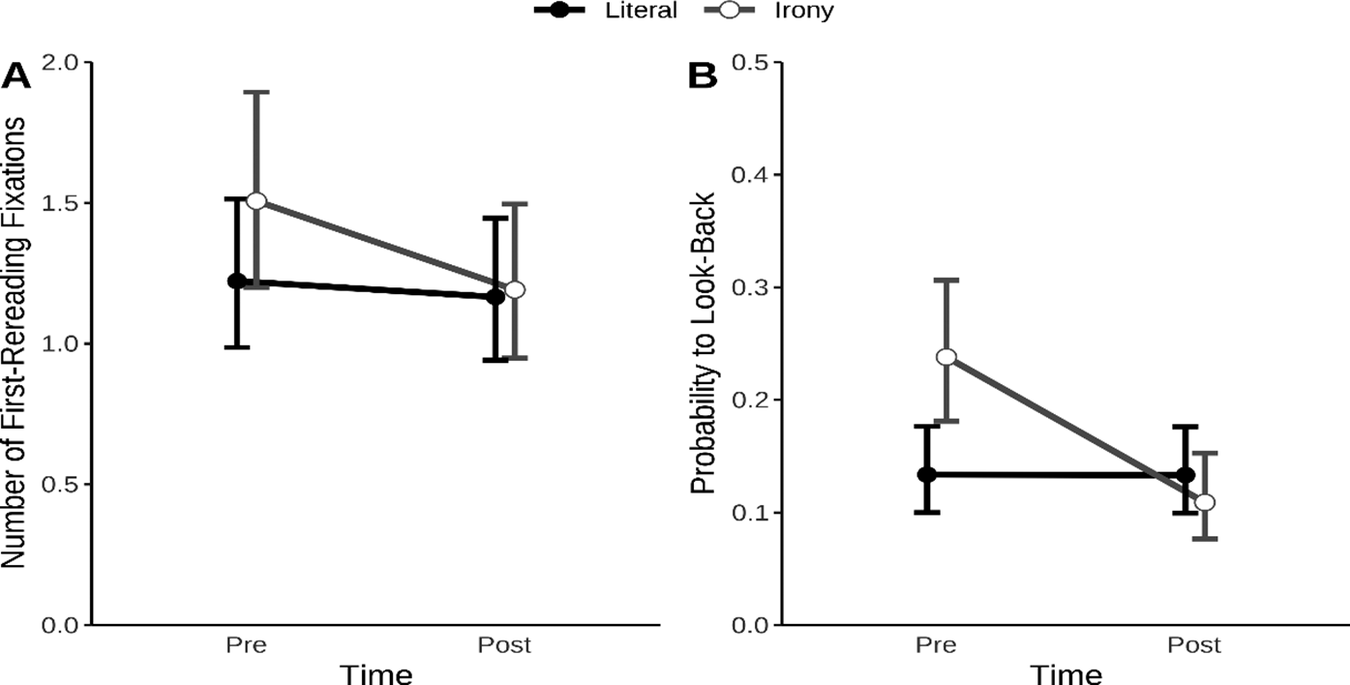
The model for the number of first-pass rereading fixations on the target phrase showed a main effect of Time (see Table S6). This effect indicates that children made less first-pass rereading in the post-test than in pre-test phase, β = −0.14, 95% CI [–0.21, −0.07], z = −3.90. This effect was qualified by an interaction between Story Type and Time, β = −0.17, 95% CI [–0.31, −0.03], z = −2.36 (see Figure 2a). The interaction indicates that children did more first-pass rereading for ironic than literal target phrases at pre-test but showed no difference at post-test. The model did not show any effect of Group.
Interactions on reading measures between Story Type and Time.
Note. Panel A: Model estimates for the number of first-pass rereading fixations on the target phrase. Panel B: Model estimates for the probability to look-back to the target phrase. Model values are back-transformed from log-values. Error bars represent 95% confidence intervals.

The model for probability of look-back fixations to target phrase revealed a main effect of Time (see Table S7). Children showed lower probability to look-back to the target phrase in the post- than pre-test phase, β = −0.48, 95% CI [−0.73, −0.24], z = −3.85. Additionally, the model revealed an interaction between Story Type and Time, β = −0.94, 95% CI [−1.43, −0.44], z = −3.73 (see Figure 2b). This interaction indicates that children showed a higher probability to initiate a look-back to ironic than the literal target phrase in the pre-test phase but showed no difference between story types in the post-test phase. The model did not show any effect of Group.
The model on probability to initiate a look-from fixation from the target phrase revealed a main effect of Time (see Table S8). This effect indicates that children showed a lower probability to initiate look-from fixation from the target phrase in the post- than pre-test phase, β = −0.31, 95% CI [−0.59, −0.04], z = −2.23. The model showed no effect of Story Type, Group, or any interaction.
The model on first-pass reading time on the spillover region revealed a main effect of Time (see Table S9), indicating that children showed faster reading times in the post- than pre-test phase, β = −0.12, 95% CI [−0.16, −0.09], z = −7.01. The model did not show any effects of Story Type, Group, or any interactions. Finally, the model on probability to look-back to critical context showed a main effect of Time (see Table S10), indicating that children showed lower probability to look back to critical context in the post- than pre-test phase, β = −0.62, 95% CI [−0.48, −0.80], z = −3.74. The model showed no effects of Story Type, Group, or any interactions.
4 Discussion
We investigated whether 10-year-old children’s irony comprehension skills can be improved by teaching irony in the classroom. We hypothesized that at post-test, the irony training group would surpass the controls by showing better learning, in terms of more accurate comprehension and faster processing of ironic meaning. Moreover, we assumed that children’s better irony comprehension accuracy would be associated with faster first-pass reading time of the ironic target phrase and the spillover region.
4.1 Effect of training on comprehending irony
The results showed that, as hypothesized, teaching irony in the classroom effectively improved children’s irony comprehension. This is consistent with the previous training studies (Lee et al., Reference Lee, Sidhu and Pexman2021; Szücs & Babarczy, Reference Szücs, Babarczy and Assimakopoulos2017) but extends the training effect to a group learning context. The results suggest that irony-specific metapragmatic knowledge is crucial for the development of irony comprehension. This is also consistent with studies showing that irony use in families is associated with children learning irony earlier (e.g., Pexman et al., Reference Pexman, Zdrazilova, McConnachie, Deater-Deckard and Petrill2009; Recchia et al., Reference Recchia, Howe, Ross and Alexander2010) and having better irony comprehension (Banasik-Jemielniak et al., Reference Banasik-Jemielniak, Bosacki, Mitrowska, Wyrębek, Wisiecka, Copeland, Wieland, Popovic, Piper and Siemieniuk2020), suggesting that some children learn the needed metapragmatic knowledge at home. When this knowledge is not yet learned, teaching it in school seems to be an effective way to fill the knowledge gap.
The improvement we observed in irony comprehension accuracy was consistent with the measured improvement in children’s awareness of their knowledge of irony: slightly under half of the training group children reported that they had heard about irony before, and the majority (86%) reported that they learned something new during training. The initial level of knowledge of irony is in line with a previous study, which showed that only 37% of eight-year-olds were able to give a metapragmatic explanation of irony (Garfinkel et al., Reference Garfinkel, Rowe, Bosacki and Banasik-Jemielniak2024). Although the majority of the training group exhibited improved irony comprehension, there were a few training group children whose comprehension accuracy dropped after the lecture. One possible reason could be that despite our best efforts, not all the pupils remained motivated throughout the course of the whole experiment. Their decreased performance at post-test could reflect boredom and inattention.
There was no indication that metapragmatic or control group training affected childrens’ reading comprehension in general. Both the control and training groups showed a ceiling effect on the text memory and comprehension questions for literal items in the pre- and post-test phases. Furthermore, the reading comprehension task administered after the post-test showed that reading comprehension scores were almost the same between the groups. Thus, the only training-related change was the improvement in irony comprehension in the experimental group. The fact that there were no other changes between pre- and post-test is not surprising as, firstly, the reading performance of 10-year-olds is already similar to that of adults for the reading of literal texts, although children are slower in general (see Blythe & Joseph, Reference Blythe, Joseph, Liversedge, Gilchrist and Everling2011, for a review). Secondly, Finnish children develop their decoding skills relatively early (Seymour et al., Reference Seymour, Aro and Erskine2003) and their literacy skills are high compared to children in many other linguistic communities (e.g., Schroeder et al., Reference Schroeder, Häikiö, Pagán, Dickins, Hyönä and Liversedge2022).
In the previous training studies (Lee et al., Reference Lee, Sidhu and Pexman2021; Szücs & Babarczy, Reference Szücs, Babarczy and Assimakopoulos2017), children’s learning was assessed immediately after training. Our study differs from that practice as the children were not tested within the same training session, but within a two-week-period after the training. The fact that training effects were observable after this delay indicates that training effects persist beyond the initial training day. Our results suggest that teaching metapragmatic knowledge of irony in early elementary school would be a feasible way of improving children’s irony comprehension and that the effect of this training would likely not wear off immediately. However, the present results leave open how well the training effect withstands longer periods of time, a topic that should be addressed in future studies. While the irony training lesson was designed to be in line with the Finnish National Core Curriculum (Finnish National Board of Education, 2016), it should be feasible to implement in other countries’ educational systems as well.
Pre-test irony comprehension accuracy for both training and control groups was similar to that reported by Olkoniemi et al. (Reference Olkoniemi, Halonen, Pexman and Häikiö2023) who also used written irony as materials but lower than in several previous studies using non-written materials (Fuchs, Reference Fuchs2023). The present results confirm the assumption made by Olkoniemi et al. that lower accuracies for written irony are observed because it sets higher demand for the interpreter. In the absence of facial and tone of voice cues, the written form might require more knowledge of what irony is to be able to interpret it reliably.
4.2 Effect of training on processing irony
In their reading times, children showed higher rates of first-pass rereading fixations on ironic target phrases at pre-test, but no difference at post-test. Although this is partly consistent with our hypothesis, this effect was observed for both the control and the training group. As both groups showed improvement, it seems likely that this reflects a trial or test-retest effect. These results are similar to the trial effect observed in previous eye-tracking studies, which would also explain why the effect was observed not only in early (i.e., first-pass rereading) but also in late measures (i.e., probability to look-back) (see Olkoniemi & Kaakinen, Reference Olkoniemi and Kaakinen2021, for a review). In other words, when the reader repeatedly encounters ironic phrases, there will be an expectation of forthcoming irony and readers adjust to the experimental context. This makes the processing of ironic phrases easier and, consequently, more similar to that of literal phrases. It seems that even an untrained reader makes adjustments over time for ironic expressions.
Contrary to our hypothesis, we did not observe improvement in irony processing in the training group. Although this was unexpected, this is consistent with studies on adults showing that online (i.e., reading times) and offline (i.e., comprehension questions) measures are not always directly linked (see Rapp & Mensik, Reference Rapp, Mensink, McCrudden, Magliano and Schraw2011, for review). There are at least two possible reasons for this null effect. First, children who just learned about irony may take longer to process its intended meaning than those who were already familiar with it. This might level out the expected improvement in reading times, hiding the learning effect and leaving the more general trial effect observed. Second, it is possible that variability in children’s eye movements rendered the measures too noisy to detect the improvement in reading times. As suggested by Olkoniemi et al. (Reference Olkoniemi, Halonen, Pexman and Häikiö2023), it is possible that as 10-year-olds still need to invest more resources to reading in general, therefore some effects may not be as evident as they are for adults for whom reading is already automatized. Future studies are needed to further investigate children’s irony processing and to adjudicate between these possibilities.
Our reliance on eye-tracking to analyze written materials limits the inferences that can be drawn. It is unclear whether teaching the recognition of ironic tone of voice would have increased efficiency in recognizing irony from speech. This is also a general issue with the studies conducted thus far – we do not know which parts of training are necessary for improving comprehension accuracy and facilitating processing. Future studies should explore the active ingredient(s) in irony training.
5 Conclusions
The present study showed that teaching metapragmatic knowledge of irony to a whole classroom in one lesson can improve children’s irony comprehension. Most of the previous studies of irony development have focused on how the emergence of cognitive and socio-emotional abilities, such as theory of mind, are associated with irony comprehension. Our intervention study shows that metapragmatic knowledge also plays a crucial role in development of irony comprehension, and it can be effectively taught in school.
This study was not designed to differentiate between theories of irony comprehension, and those theories do not explicitly take into account developmental changes. However, theories that consider individual differences, such as the parallel constraint-satisfaction framework (Pexman, Reference Pexman2008) and the predictive processing account of irony (Fabry, Reference Fabry2021), can best explain our results. When irony comprehension ability is still developing, there will be variability in how it is processed and understood. The present findings suggest that a useful addition to any theoretical model would be a detailed learning component that enables the derivation of testable hypotheses on the acquisition of irony. Future studies should refine and test these theories to determine which social and cognitive skills and aspects of metapragmatic knowledge are most related to children’s irony processing. While training studies have not been the norm in the irony literature, we believe that they can significantly advance the field by testing which aspects of social-cognitive development are most related to children’s irony comprehension at different stages of development.
Supplementary material
The supplementary material for this article can be found at http://doi.org/10.1017/S0305000925000054.
Acknowledgments
This study was supported by Research Council of Finland grant #338712 awarded to Henri Olkoniemi. We thank Dr. Seppo Vainio for his help in creating the stories, Dr. Minna Sääskilahti and primary teacher education students for the valuable feedback for improving the lessons and materials, and Mr. Atte Räinä for his help in the data collection.
Competing interest
The author(s) declare none




 Open access

