





For many children, the language of schooling is different from the language of the home and sometimes also different from the language of the community. In these cases, education involves not only the acquisition of the curriculum but also the acquisition of the language through which that curriculum is conveyed. The mismatch between the home or community language and the instructional language in school can arise either through a deliberate choice by parents to expose children to a new language for their education or as a consequence of such factors as immigration. Despite substantial differences across individual children and specific programs, all these situations in which a new language is used for school instruction are consumed under the umbrella of bilingual education (Bialystok, Reference Bialystok2018), and in all cases, children need to learn that new language to progress in school. But to what extent does children’s previous experience with learning and using other languages impact that central educational necessity? If such an impact can be observed, it extends beyond successful language learning to potentially influencing academic achievement since proficiency in the language of schooling is prerequisite to mastery of the curriculum (Pace et al., Reference Pace, Alper, Burchinal, Golinkoff and Hirsh-Pasek2019). The results could also have implications for the appropriateness of bilingual education for children with diverse language backgrounds. This is the issue addressed in the present study.
Because of the large number of factors that make bilingual education situations different from each other, it is important to hold constant the program to control the language learning experience. The present study focuses on Canadian French Immersion. These programs are a successful approach to foreign language education and constitute one form of bilingual education. The program was first established in 1962 at the Toronto French School, a private institution (Barik & Swain, Reference Barik and Swain1978), and subsequently expanded into public school systems across Canada. The structure is that English-speaking students who live in an English-speaking community are taught the curriculum entirely in French until later grades, typically Grade 4, when English is introduced. There are different varieties of the program based on various ratios of English and French instruction with different timetables for the introduction of English, but it is the standard version, Early French Immersion, that has been the focus of most research, including the present study. Typically, students in these programs have come from middle-class anglophone families, generally with no exposure to French outside of school.
In the early years of the program, many evaluation studies demonstrated the success of the program in maintaining English language proficiency and academic abilities while instilling high levels of French proficiency (Barik & Swain, Reference Barik and Swain1975, Reference Barik and Swain1976, Reference Barik and Swain1978; Lambert et al., Reference Lambert, Genesee, Holobow and Chartrand1993). For these reasons, the programs grew in popularity such that between 1998 and 2018, there was a 41% increase in enrollment nationally, with 61% of the increase accounted by the province of Ontario (Statistics Canada, 2020). Along with this growth in popularity has been a demographic shift in the students that reflects the growing diversity of the Canadian population. Accordingly, students enrolled in French Immersion now are less homogenous than when the program was first established and evaluated (Swain & Lapkin, Reference Swain and Lapkin2005). All the children are being educated in a language that is different from the community but for some children that language is also different from that in the home. Therefore, children who are initially “monolingual” are becoming bilingual, whereas children who are initially “bilingual” are becoming trilingual. Although some studies have examined the motivation of immigrant parents for choosing these programs (Dagenais & Day, Reference Dagenais and Day1998, Reference Dagenais and Day1999; Dagenais et al., Reference Dagenais, Day and Toohey2006; Dagenais & Berron, Reference Dagenais and Berron2001), the educational efficacy of these programs for diverse students who speak a different language at home remains largely unknown. Specifically, progress in French may be different for children with diverse language backgrounds for whom French is a third language than it is for the original population of anglophone children in French Immersion.
Although some previous research has addressed potential differences in language acquisition for monolingual and bilingual groups, the results are inconsistent. Most of this research has been conducted with adults to investigate differences between second- and third-language acquisition (Puig-Mayenco et al., Reference Puig-Mayenco, González Alonso and Rothman2020), but the main interest in those studies is in establishing whether acquisition of a new language occurs through holistic transfer or feature-by-feature transfer from the first or second language (White, Reference White2020). Moreover, those studies primarily investigated adults for whom the first (and in some cases, second) language was well established, making the learning conditions substantially different from those encountered by children in bilingual education.
There is some research examining this question with children learning a foreign language in a non-immersion educational context. Lorenz et al. (Reference Lorenz, Rahbari, Schackow and Siemund2020) reported no difference in the acquisition of English by monolingual (second language) and bilingual (third language) adolescents in Germany, but potential cultural and socioeconomic differences may have impacted results. Little information was provided regarding parental education, parental proficiency in English, or interaction with the English language outside of the classroom, and it is possible that there were socioeconomic differences between the language groups. However, other studies with younger children have indicated that bilingual children outperformed monolingual children on various proficiency tests in the target language (Hopp et al., Reference Hopp, Vogelbacher, Kieseier and Thoma2019; Lorenz et al., Reference Lorenz, Bonnie, Feindt, Rahbari and Siemund2019; Siemund & Lechner, Reference Siemund, Lechner and Peukert2015; see Hirosh & Degani, Reference Hirosh and Degani2018 for review). Therefore, the effect of home language experience on language learning for young children remains unclear.
There is, however, some research on this question within French Immersion programs. Au-Yeung et al. (Reference Au-Yeung, Hipfner-Boucher, Chen, Pasquarella, D’Angelo and Deacon2015) compared children who were English speakers (monolingual) with English learners (bilingual) as determined by language use at home, first language spoken, and parents’ country of origin, on English and French proficiency. For English phonological awareness and word reading, both groups performed similarly, but English speakers outperformed English learners on English expressive and receptive vocabulary across Grades 1 to 3 (6–9 years old). Moreover, there was more rapid growth by the English learners over that time. For French phonological awareness, vocabulary, word reading, and reading comprehension, the two groups performed similarly. Overall, despite differences between the two groups in English vocabulary, French Immersion did not hinder language and literacy skill development for English learners.
In contrast to those results, Bild and Swain (Reference Bild and Swain1989) reported that bilingual children in a French Immersion program outperformed monolingual children on measures of French proficiency. In a later study, Swain et al. (Reference Swain, Lapkin, Rowen and Hart1990) assessed French proficiency of students enrolled in a program in which English was the primary language of instruction until Grade 5 after which French and English were used equally. Grade 8 students with no heritage language (HL) were compared to those with various degrees of proficiency in a HL, corresponding to the groups of English speakers and English learners in the study by Au-Yeung et al. However, contrary to the results of Au-Yeung et al. (Reference Au-Yeung, Hipfner-Boucher, Chen, Pasquarella, D’Angelo and Deacon2015) with younger children, these authors reported better French proficiency for children who spoke a HL at home than for those who spoke only English, but only for those who were literate in the HL (discussion in Swain & Lapkin, Reference Swain and Lapkin2005). Similar results were reported by Bérubé and Marinova-Todd (Reference Bérubé and Marinova-Todd2012) who also found that the typology and writing system of the home language impacted children’s progress in French Immersion such that children who were literate in an alphabetic home language made greater progress in French reading than did children who were monolingual (aside from French) or whose home language was not written alphabetically. In a review of this literature, Cenoz (Reference Cenoz2013) argues that overall bilinguals learning a third language in various bilingual education programs are more successful than monolinguals.
Aside from any potential impact on learning a new language, it is well established that bilingualism impacts vocabulary size in each language. Bilingual children (Bialystok et al., Reference Bialystok, Luk, Peets and Yang2010; Meir & Armon-Lotem, Reference Meir and Armon-Lotem2017; Oller et al., Reference Oller, Pearson and Cobo-Lewis2007) and adults (Bialystok & Luk, Reference Bialystok and Luk2012) have a smaller average vocabulary in each language than monolingual speakers of that language. For example, Bialystok et al. (Reference Bialystok, Luk, Peets and Yang2010) analyzed the Peabody Picture Vocabulary Test (PPVT-III) scores of 1,738 English monolingual and bilingual children aged 3–10 years old and found significantly larger English vocabulary for monolinguals. However, an analysis of a subset of 6-year-olds indicated that this vocabulary difference was found for words typically used in the home but not for words more likely to be used in school for which children in both groups performed similarly. Vocabulary size contributes to school achievement (Murphy et al., Reference Murphy and Farquharson2016; Kastner et al., Reference Kastner, May and Hildman2001; Ouellette, Reference Ouellette2006; Rohde & Thompson, Reference Rohde and Thompson2007; Smith et al., Reference Smith, Smith and Dobbs1991), but more detailed indicators than overall vocabulary size are needed to understand these relations.
An example of the complex relation between vocabulary size and academic uses of language comes from performance on verbal fluency tests. Semantic fluency, in which participants generate words to fit a category, is primarily a measure of vocabulary, whereas phonological fluency, in which participants generate words to conform to an initial sound, additionally requires executive functioning, a more academic ability related to literacy and metalinguistic awareness. Imaging studies of adults performing fluency tests confirm the distinction between semantic and phonological fluency by identifying different brain regions implicated for each (Grogan et al., Reference Grogan, Green, Ali, Crinion and Price2009). Therefore, initial differences in vocabulary size impact both fluency tests but in different ways. In a study of children, 7 to 10 years old, analyses controlling for vocabulary showed that monolinguals and bilinguals performed similarly on both fluency measures (Friesen et al., Reference Friesen, Luo, Luk and Bialystok2015). These results indicate that the ability to use language to perform tests such as verbal fluency is different from estimates of passive vocabulary and potentially more predictive of academic success.
In all these studies, comparisons were made between children designated as monolingual or bilingual, but the definition of “bilingual” is itself a matter of some controversy. Although the term defies simple classification (Luk & Bialystok, Reference Luk and Bialystok2013), studies have defined it by referencing such factors as age of acquisition of the second language, method of language acquisition, level of proficiency, contexts of use, and presence of literacy, all of which impact outcomes (Surrain & Luk, Reference Surrain and Luk2019). Therefore, more recent studies with both children (Brito & Barr, Reference Brito and Barr2012; Guerrero et al., Reference Guerrero, Smith, Luk and Schwieter2016) and adults (DeLuca et al., Reference DeLuca, Rothman, Bialystok and Pliatsikas2019; Pot et al., Reference Pot, Keijzer and de Bot2018; Xie, Reference Xie2018) have instead considered the continuous relation between aspects of bilingual experience and specific outcomes.
The continuous nature of bilingual experience is particularly important in a diverse community consisting of many languages and different language use patterns where it is common for children to have some exposure to other languages. Such linguistically diverse contexts have been shown to influence language learning even for monolinguals. Bice and Kroll (Reference Bice and Kroll2015, Reference Bice and Kroll2019) reported that monolinguals in diverse environments produced event-related potentials (ERP) in a language learning task that were more similar to those produced by bilinguals than they were to those of monolinguals from a linguistically homogeneous environment. Further, these ERP patterns were evident early in the language learning process (Bice & Kroll, Reference Bice and Kroll2015) and were found despite no differences between groups in behavioral outcomes (Bice & Kroll, Reference Bice and Kroll2019). Therefore, the context in which language learning occurs as well as previous experience with other languages impact subsequent language learning.
The central question for the present study is whether children’s experiences with other languages impact their progress in learning French, the language of instruction in French Immersion programs. Despite mixed evidence from the literature, the prediction was that children entering the program as bilingual will make greater gains in French than children entering the program as monolingual and that this difference will be found for both vocabulary and verbal fluency measures. However, since all children begin the program with no French proficiency, the differences may not emerge until the second year when an adequate base of French has been established. Moreover, because of differences regarding how bilingualism is defined and how progress is measured, the study compared two approaches used in this literature by defining bilingualism both categorically and continuously and evaluating performance outcomes from both approaches; categorical comparisons between groups provide an overview of large patterns and continuous analyses provide a more detailed and nuanced account of small changes in individuals over the continuum. Comparing these approaches may help to resolve some contradictions in the literature.
The study used a 3-year longitudinal design, beginning when children were 6 years old, to evaluate their progress in mastering French and compared results from categorical and continuous approaches to bilingualism. The study was conducted in Toronto, Canada, a majority English-speaking city in which 47% of the households do not use English as the primary or exclusive language of the home (Statistics Canada, 2016). However, because English is the clear majority community language, all children are immersed in English regardless of the home language. Therefore, in this context, the more children are exposed to a non-English heritage language at home, the more bilingual they are because English is the common community language. In all cases, English proficiency is in the normal range for all children.
Although the study was conducted in a specific context defined by one type of bilingual education program in a linguistically diverse community, the results have implications for understanding the relation between language background and learning the language of instruction more broadly. Academic progress requires mastery of the language of instruction, so it is imperative to understand factors that potentially impact that mastery.
Method
Participants
All the children began instruction in the Early French Immersion program in Senior Kindergarten when they were 5 years old so were in their second year of the program when this study began. The initial sample included 234 children (95 boys and 139 girls; 117 monolinguals and 117 bilinguals) in first grade who were 6.5 years old (M = 80.3 months, SD = 3.5, range = 73–87 months) and were recruited from 18 public schools in Toronto. All children were following the same Early French Immersion curriculum that was regulated by the School Board. Between Grades 1 and 3, instruction is carried out completely in French, and English is introduced in Grade 4, so the study was conducted while French was the only language of instruction. Between Year 1 and Year 2 of the study, there was an attrition of 40 children (17%) due to switching schools, switching programs, or non-renewal of participation, leaving a sample of 96 monolinguals and 98 bilinguals. However, between Year 2 and Year 3, there was an attrition of 85 children (44%) because the COVID-19 pandemic closed schools in March 2020 when we were about halfway through testing, resulting in a final sample of 54 monolingual and 55 bilingual children. Note that we refer to the Year of data collection as 1, 2, or 3 to emphasize the timeline of the longitudinal study but these years correspond to the Grade that children were in at each year of testing.
Language and Social Background Questionnaire (LSBQ)
Parents of participating children completed the LSBQ (Anderson et al., Reference Anderson, Hawrylewicz and Bialystok2020) to provide demographic information about the family and information about the child’s linguistic experiences in the home and community. Ninety-three percent of children were born in Canada, with the remaining 7% born in one of ten countries: China, Costa Rica, India, Iran, Israel, Mexico, Nepal, Oman, South Korea, and the USA. Just more than half of the parents (n = 122, 52%) reported that their child understood and/or spoke one of forty-one languages other than English or French, with the most prevalent being Spanish (18), Cantonese (10), Mandarin (10), Russian (9), and Tagalog (7). Children’s proficiency in these languages varied greatly, with some children having reasonable comprehension but essentially no production of that language and others who actively used the language. Therefore, despite all of these children having bilingual experience, those experiences were very different in ways not captured by categorical assignment to language groups.
Questions about the child’s linguistic experiences included the language(s) the child understood and spoke, the degree to which they spoke and were spoken to by members of the family and the community, and the language(s) used by the family and child for reading and other activities (e.g., watching television, listening to music). Parents used a 7-point scale to indicate the degree of linguistic experience for each activity with 1 representing only in English and 7 representing only in the non-English language. Because of the English community context described above, the higher the score for non-English activities, the greater the child’s bilingual experience. The questionnaire asks parents to enter all languages used in the home, and none of the parents included French in the list. Children whose home language is French do not attend French Immersion programs but have the option of attending a parallel French language public education system.
To obtain a continuous measure of bilingual experience, these responses were used to calculate an overall score as described by Anderson et al. (Reference Anderson, Hawrylewicz and Bialystok2020). A factor analysis computed a series of correlations and derived 18 of the 37 questions clustering into three factors: adult language use in the home, child’s non-English use for media, and child’s non-English use with siblings. Scores for each factor were calculated using the Thurstone method in the factor.score function from the psych package (Revelle, Reference Revelle2020) in RStudio (RStudio Team, 2020). A weighted sum of these factors based on their contribution to the variance of the overall composite was calculated to reflect overall bilingual experience by means of a composite factor score. This composite score accounts for 74% of the variance in the experiences reported on the questionnaire. The most influential component in this bilingualism factor score was adult language use in the home. The overall factor scores reflect a continuum of monolingual-to-bilingual experience for the whole sample and were standardized to a scale ranging from 0 to 8, with lower scores indicating more monolingualism and higher scores indicating more bilingualism. The composite scores were used as an independent variable in multiple linear regression analyses investigating outcomes as a function of degree of bilingual experience.
For the categorical classification of language groups, the composite score was used to create a median split (median = 2.41) producing two groups designated as monolingual or bilingual when they began the study. Thus, the terms “monolingual” and “bilingual” are relative designations rather than absolute ones; given the range of bilingual experiences in the sample and the pervasiveness of diverse languages in the environment, an absolute designation of monolingual or bilingual would not be meaningful. Both categorical (ANOVA) and continuous (multiple linear regression) analyses were used to evaluate the effect of linguistic experience on the outcome measures. Assumptions for multiple linear regression procedures were met, including normal distribution of the dependent variable, absence of outliers, absence of homoscedasticity violation, independence and normality of errors, and absence of multicollinearity between the independent variables.
The LSBQ also asked about parents’ education level which was used as a proxy for socioeconomic status (SES). Parents indicated their highest level of education on a 5-point Likert scale in which 1 represented no high school diploma, 2 represented high school graduate, 3 represented some college or college diploma, 4 represented bachelor or first academic degree, and 5 represented graduate or professional degree. An average parental education score was calculated and subsequently used to determine mean level of education. Parents’ education is considered to be a more sensitive measure of SES than income (Pollak & Wolfe, Reference Pollak and Wolfe2020). The SES level was relatively high and not different between language groups, but the continuous scores for SES were included in the regression analyses to investigate potential subtle influences.
Procedures
Approval to conduct research was given annually by the University and School Board Ethics Committees. School principals and teachers agreed to participate, and children in those classes were given recruitment packages for their parents/guardians to complete that included a consent form and LSBQ. All children who returned completed consent forms and questionnaires were included in the study. Children provided verbal assent prior to testing.
The tasks reported here were part of a larger battery that included a different set of cognitive measures in each testing year. Children were tested individually in a quiet space in their school for two sessions, typically separated by one week, with each session lasting around 30 minutes. English tasks were always presented in the first session and French in the second. All testers were native or near-native speakers of the language of testing, and the target language of testing was the only language used with the child in each session. The tasks were presented in a fixed order as part of the larger battery.
Tasks
Raven’s standard progressive matrices (Raven et al., Reference Raven, Raven and Court2003)
In this standardized test of non-verbal spatial reasoning, children select one of six options to complete a complex pattern. Raw scores were converted to standard scores based on age (µ = 100, SD = 15).
Peabody picture vocabulary test (PPVT-4; Form A; Dunn & Dunn, Reference Dunn and Dunn2007)
This test assesses English receptive vocabulary. Children selected one of four pictures to match a word they heard. Following standard testing procedures, raw scores were converted to standardized scores (µ = 100, SD = 15).
Échelle de vocabulaire en images Peabody (EVIP; Dunn et al., Reference Dunn, Theriault-Whalen and Dunn1993)
This test of French receptive vocabulary includes two forms, A and B, each containing 170 items arranged in order of increasing difficulty. Form A was used in the Years 1 and 3 and Form B in Year 2. The task was normed on Francophone Canadians, a group whose French experience and proficiency is different from the current sample, so administration began for the youngest standardized group, ages 2½ to 3 years rather than establishing a basal starting point as described in the scoring manual. Data were recorded simply as total correct trials.
Verbal fluency
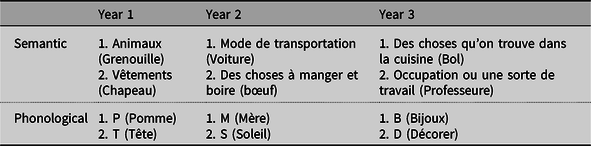
This task was administered annually in French in both semantic and phonological fluency conditions with two trials for each. Before each trial, the instruction was given with an example. Children were asked to produce as many words as they could in 60 seconds for each trial. Responses were digitally recorded, and a timer determined the end of the trial. The instructions for each year with the provided example are shown in Table 1. For phonological fluency, responses that began with the correct sound despite being written with a different letter, for example, “cent” or “certain,” for “S,” were counted as correct. Trained research assistants who were native or near-native French speakers and blind to participants’ groups scored the digital recordings using the audio recording and editing software Audacity® (Version 2.3.0). The score was the number of correct words produced for each condition. Errors such as set loss and repetition were recorded but not analyzed. The difficulty of semantic categories varied over the years, and the implications of this for results are discussed below.
French verbal fluency trials (and examples) by condition (semantic and phonology) and year
Results
Categorical analyses for differences between language groups
Background measures
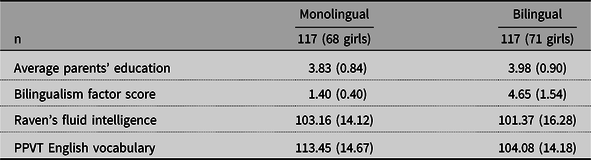
Mean scores for background variables and non-verbal intelligence by language group are presented in Table 2. Chi-square test of independence demonstrated no difference in the ratio of girls and boys by language group, χ2(1) = 0.07, p = .79. One-way ANOVAs indicated no group difference for SES (parental education), F(1,232) = 1.84, p = .18, with the majority of participants having parents that attained a college diploma or higher level of education. Higher composite scores were observed for bilingual children than monolinguals, F(1,232) = 491.63, p < .0001, reflecting the way the groups were created. Non-verbal intelligence (Raven’s) and English vocabulary (PPVT) were initially analyzed by 2-way ANOVA for language group and sex. There were no main effects of sex or interaction with language group, Fs(1,230) < 1.35, ps > .24, so subsequent analyses collapsed across this variable. There was no significant difference between language groups on Raven’s, F < 1, but consistent with previous research, monolinguals had significantly higher PPVT English vocabulary scores than bilinguals, F(1,232) = 24.71, p < .0001, η2 = .10.
Mean scores (and standard deviation) for background variables by categorical language group divisions for full sample in Year 1
French language measures
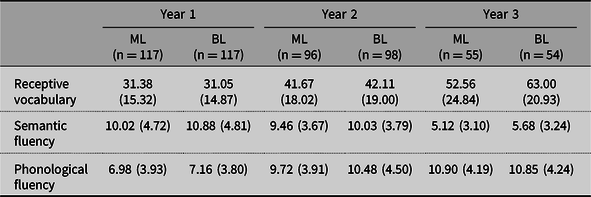
Table 3 presents mean scores for the full sample by language group over the three years. Separate analyses were conducted for each year because of the change in sample size. One-way ANOVAs for French receptive vocabulary (EVIP) revealed no language group differences in Year 1 or Year 2, Fs < 1, but in Year 3 the bilinguals obtained higher scores than monolinguals, F(1,108) = 5.62, p = .02, η2 = .05. For semantic and phonological fluency, there were no language group differences in Year 1, Fs(1,231) < 1.91, ps > .16, Year 2, Fs(1,192) < 1.14, ps > .21, or Year 3, Fs(1,103) < 0.83, ps > .36. Because there was a positive correlation between French vocabulary and semantic, r(233) = 0.47, p < .0001 and phonological fluency, r(233) = 0.27, p < .0001, ANCOVAs were conducted with EVIP score from each year as a covariate. The results confirmed no significant group effects, all Fs < 2.74, all ps > .10.
French verbal measures by year of testing for each language group for the whole sample (ML: Monolingual; BL: Bilingual). Scores are the mean scores (and SD) for French receptive vocabulary (EVIP) and mean number of correct words (and SD) produced in each of the verbal fluency tests
Longitudinal change
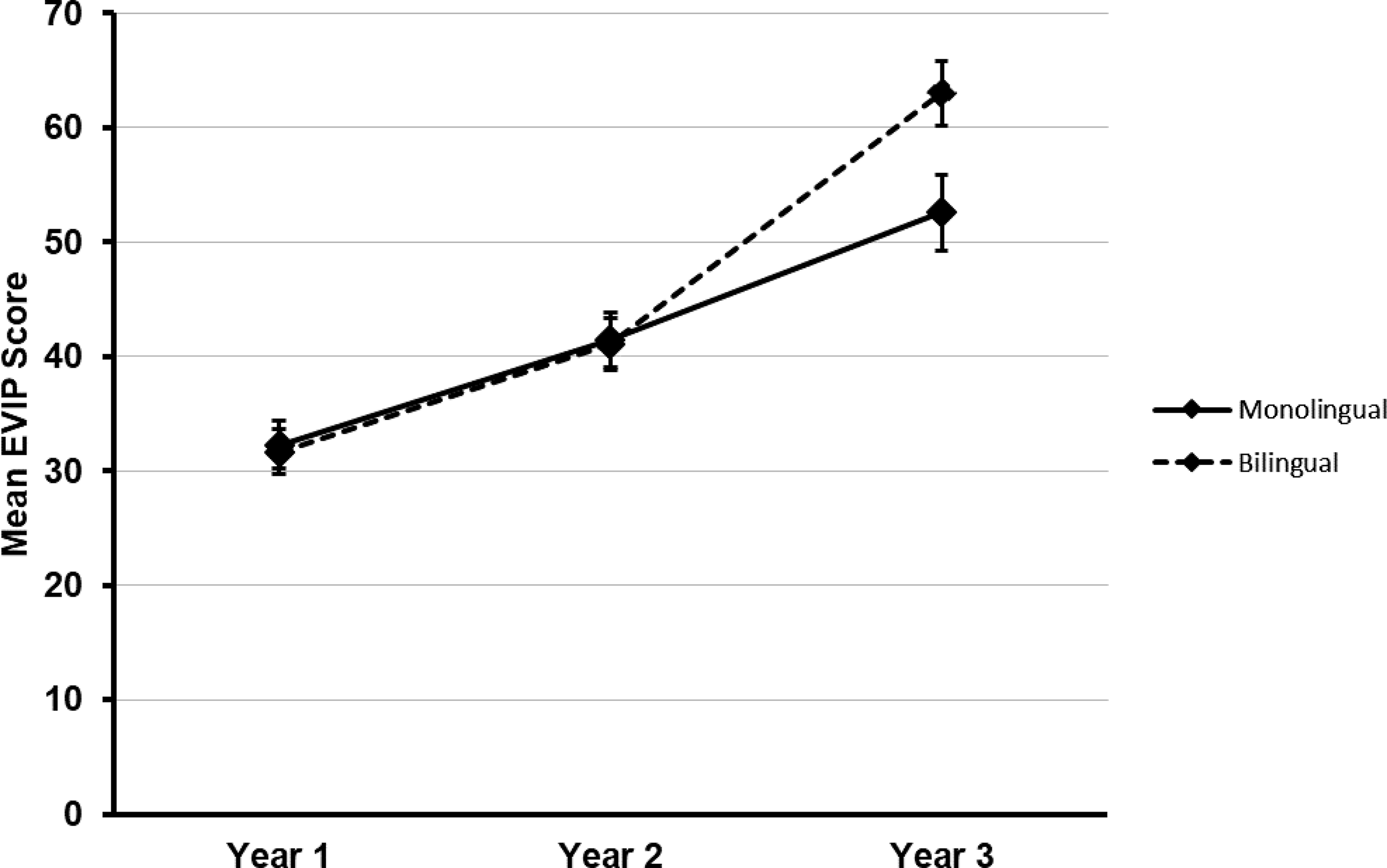
To examine trends across the three years of the study, children who participated in all three years were extracted from the full sample. Figure 1 reports the French vocabulary scores over the three years for this subset (n = 109) of participants. The data were analyzed with a 2-way repeated-measures ANOVA for language group and year. There was no main effect of language group, F(1,107) = 1.23, p = .27, but there was a main effect of year, F(2,214) = 97.38, p < .0001, η2 = .48, showing improvement across the course of the study, and a significant interaction of year and language group, F(2,214) = 5.64, p = .004, η2 = .05. A Tukey’s HSD post hoc test of multiple comparisons revealed the effect of year was significant for all successive years, adjusted ps < .0001, but that the improvement for bilinguals was significantly greater than for monolinguals in Year 3, adjusted p = .03, η2 = .04. Therefore, both language groups developed French vocabulary at a similar rate in the first two years, but by the third year, bilinguals improved significantly more than their monolingual peers.
Mean EVIP Score (and Standard Error) for Children who Completed All Three Testing Sessions by Year and Language Group.
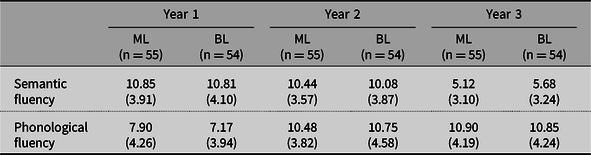
A similar analysis was calculated for verbal fluency scores for children who completed the three years. These data are presented in Table 4. In this case, however, the evaluation of year is less reliable than in the previous analysis because task difficulty changed each year depending on the cues given – some semantic categories or sounds were simply easier to generate exemplars – so these results are more suggestive than conclusive. Each task was analyzed using a repeated-measures ANOVA for language group and year. For semantic fluency, there was no effect of language group, F < 1, but a significant effect of year, F(2,204) = 132.32, p < .0001, η2 = .56, with no interaction between language group and year, F < 1. Similarly for phonological fluency, there was no effect of language group, F < 1, a significant effect of year, F(1,102) = 41.99, p < .0001, η2 = .29, and no interaction, F(1,102) = 1.01, p = .37. The important outcome is that the relation between the language groups does not change with task difficulty in that children in both language groups are affected similarly.
French verbal fluency measures showing mean number of correct words generated (and standard deviation) for the subset of participants who completed all three years of testing (n = 109) by language group (ML: Monolingual, BL: Bilingual)
Continuous analyses of bilingual experience for the whole sample
To examine the continuous effect of degree of bilingual experience on the outcome measures, multiple linear regression analyses were conducted for each dependent variable. Although SES was not included as a grouping variable in the categorical analyses, it was added to the regression models for completeness. The analyses were conducted separately for each year of testing. The models included the following terms: sex, non-verbal intelligence (Raven’s Progressive Matrices), English receptive vocabulary (Peabody Picture and Vocabulary Test), SES (parents’ education), and bilingualism (composite factor score).
French vocabulary
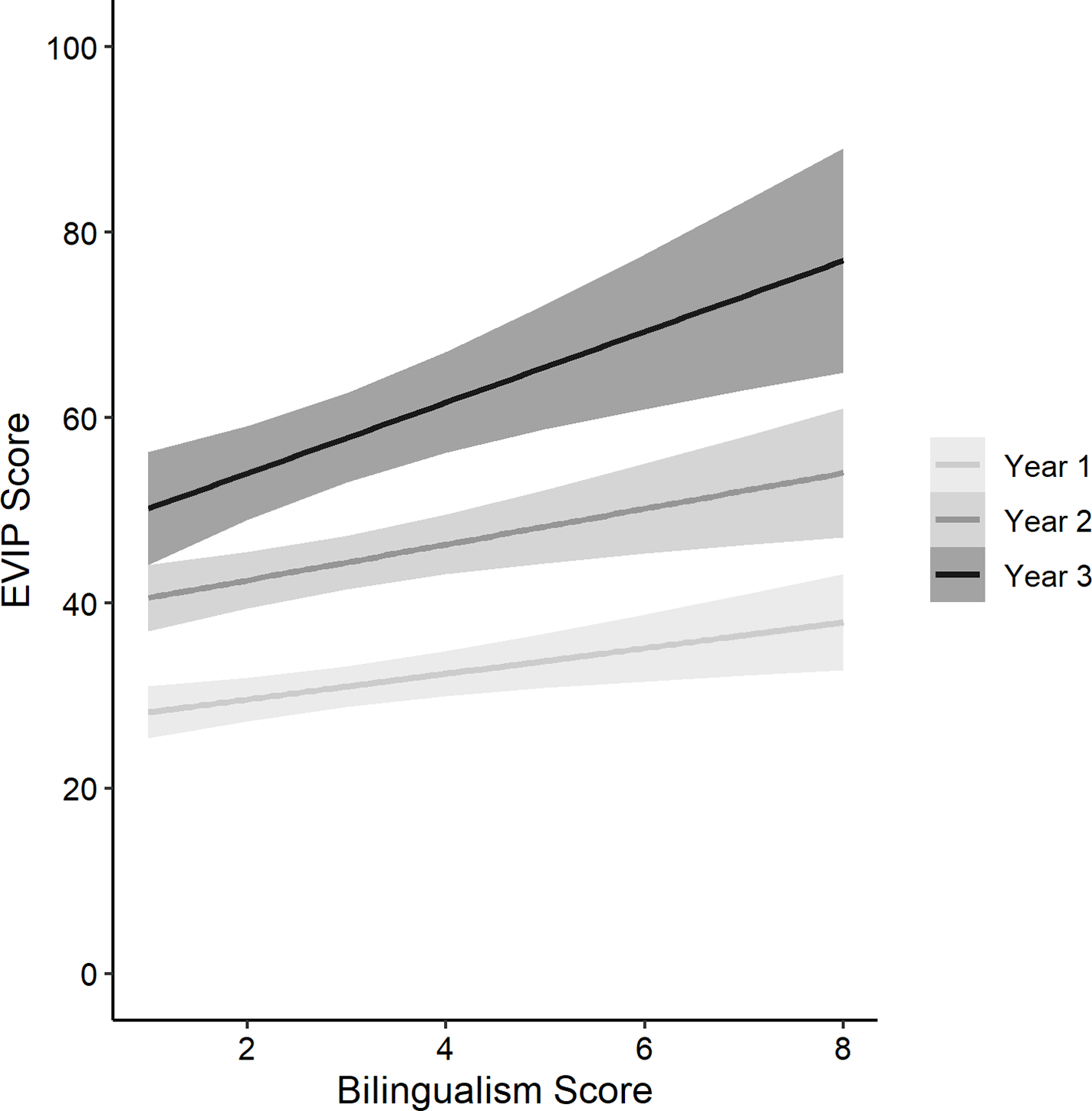
Regression models for French receptive vocabulary in each year are shown in Table 5. All three models were significant. Significant contributions to EVIP scores came from Raven’s scores, PPVT scores, and bilingualism in Years 1 and 2 and PPVT scores and bilingualism in Year 3, with Raven’s losing its effect in the final year. The contribution of bilingualism to all three models contrasts with the categorical analyses of EVIP scores for which language group was only significant in Year 3. Instead, the continuous regression models indicate a constant and increasing effect of bilingualism on French vocabulary development over time. This increasing effect of bilingualism can be seen in the increase in slope of the regression line each year shown in Figure 2.
Regression models for French receptive vocabulary (EVIP) in each year based on full sample using bilingualism as a continuous variable
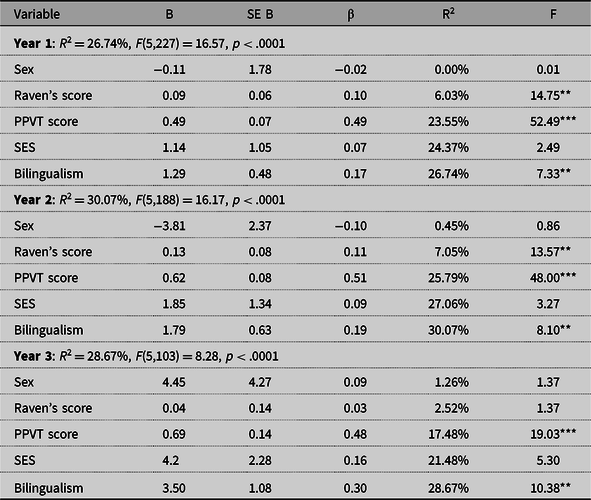
Each variable is provided with its parameter estimate (B), standard error (SE) of B, standardized estimate (β), cumulative R-square (R2), and the F-value with a symbol denoting whether the estimate is significant in the fitted model: ***< .0001, **< .01, *< .05, ∼ < .1.
Regression Lines for Relation Between EVIP Score and Degree of Bilingualism for Each of the Three Years Based on the Full Sample.
French verbal fluency
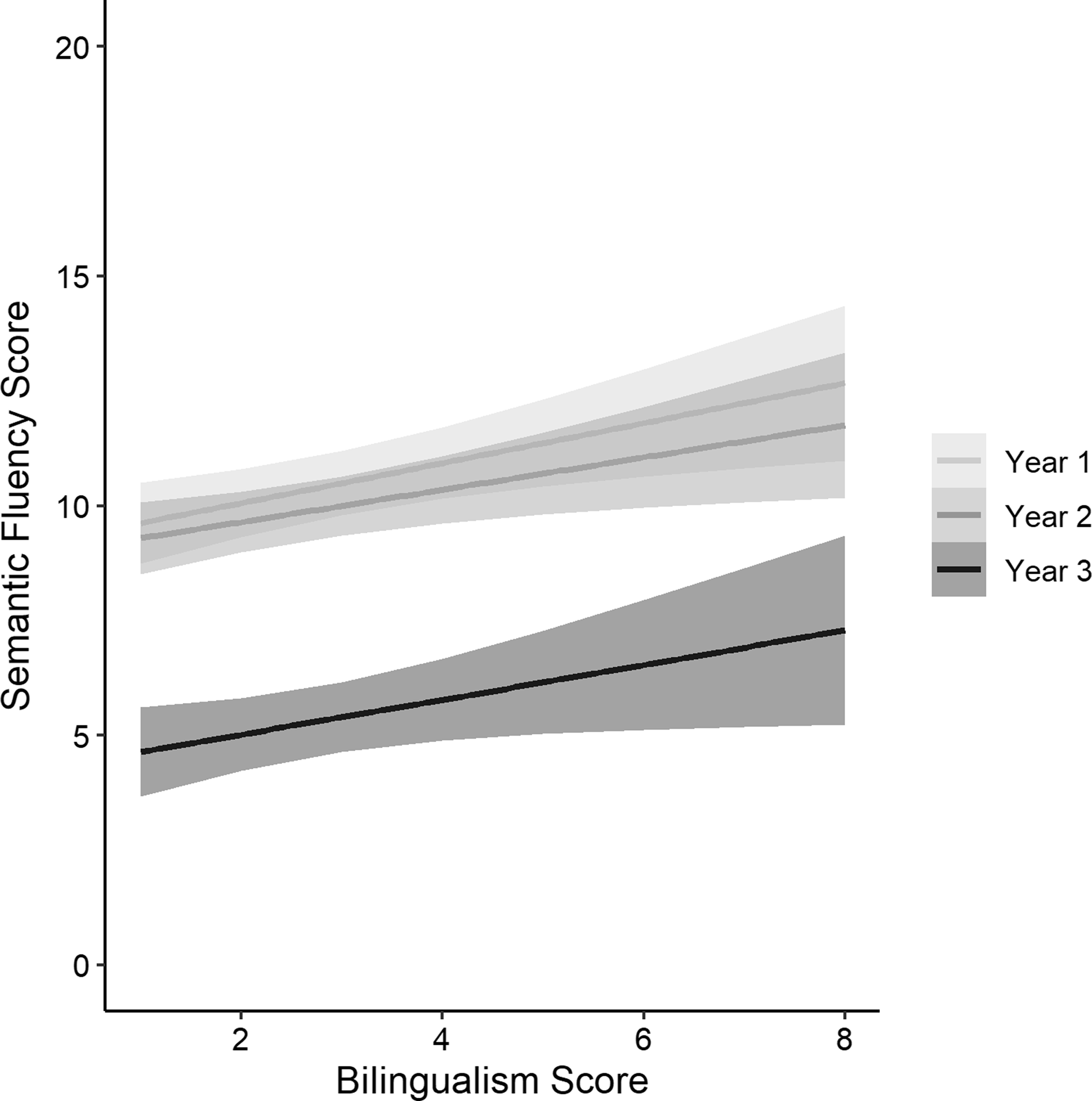
The regression models for verbal fluency included EVIP scores to control for French vocabulary. The results for semantic fluency are presented in Table 6. The model was significant in all three years. The significant factors in Years 1 and 2 were Raven’s scores, PPVT scores, EVIP scores, and degree of bilingualism, in all cases showing that higher values on these factors were associated with higher scores for semantic fluency. In Year 3, PPVT no longer provided significant explanation of the results, possibly indicating that the two languages were becoming more independent for these children; children’s proficiency in French was less tied to their proficiency in English. The regression lines displaying the relation between semantic fluency and degree of bilingualism are presented in Figure 3. Unlike the EVIP scores, there is not a general increase across the years, and in fact, the scores are lowest for Year 3, presumably because the categories that year were simply more difficult. Despite no language group difference in the categorical analyses for the first two years, the continuous analyses indicate that bilingualism positively contributed to performance in each year.
Regression models for French semantic fluency in each year based on full sample using bilingualism as a continuous variable
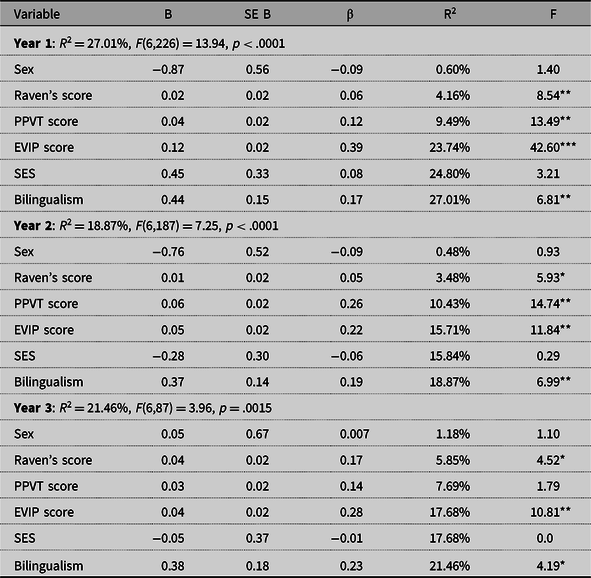
Each variable is provided with its parameter estimate (B), standard error (SE) of B, standardized estimate (β), cumulative R-square (R2), and the F-value with a symbol denoting whether the estimate is significant in the fitted model: ***< .0001, **< .01, *< .05, ∼ < .1.
Regression Lines for Relation Between French Semantic Fluency Scores and Degree of Bilingualism for Each of the Three Years Based on the Full Sample.
The results of the multiple linear regression analyses for phonological fluency are shown in Table 7. The model was significant in Years 1 and 2 but not in Year 3. SES significantly contributed to performance in Year 1 in that children produced more words as a function of their parents’ education, but none of the analyses indicated a significant contribution from degree of bilingualism and the entire model in Year 3 was not significant.
Regression models for French phonological fluency in each year based on full sample using bilingualism as a continuous variable
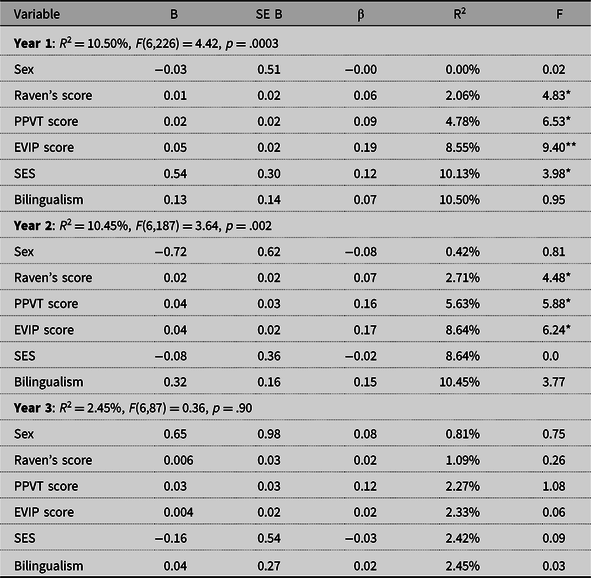
Each variable is provided with its parameter estimate (B), standard error (SE) of B, standardized estimate (β), cumulative R-square (R2), and the F-value with a symbol denoting whether the estimate is significant in the fitted model: ***< .0001, **< .01, *< .05, ∼ < .1.
Discussion
All the children in the study entered a French Immersion program the year before the study began; none of the children knew any French at that time. Over the course of the study, children gained proficiency in French both in terms of vocabulary knowledge and more academic uses of French as evident in the verbal fluency tests. Previous evaluation studies of children in these programs had reported successful learning of French and normal academic achievement, but the children in those studies were typically monolingual English speakers learning French as a second language. The question for the present study was whether home language background impacted children’s success.
Three types of analyses were applied to the data. The first was to compare children classified as monolingual or bilingual by means of a median split on a continuous measure of language experience for their performance on the French tasks. Although the creation of these groups from continuous scores is novel, the comparison of outcome measures between two groups designated as monolingual or bilingual is the method most commonly used in the literature. The second was to evaluate the longitudinal aspect of the study by conducting these categorical analyses across three years of data to evaluate the trajectories of children in each language group. Third, the full range of bilingual experience was used as a continuous independent variable in multiple linear regression along with other background variables to assess its role in outcomes. All three methods revealed somewhat different information that together provides a more detailed description of children’s progress than could be obtained from only one of them.
Considering first the group comparisons, at the beginning of the study the children in the groups designated as monolingual or bilingual were equivalent in most measures but, consistent with previous research, monolinguals had higher English receptive vocabulary scores than bilinguals (cf. Bialystok et al., Reference Bialystok, Luk, Peets and Yang2010). Moreover, the scores were comparable to those found in previous research. In the study by Bialystok et al. (Reference Bialystok, Luk, Peets and Yang2010), the average PPVT scores for 6-year-olds (the age of children in Year 1 in the present study) for the monolingual children (n = 272) were 106 and for the bilingual children (n = 458) were 96. These scores were both in the normal range, did not exceed one standard deviation (SD = 15) from the population mean (μ = 100), and were separated by 10 points. In the current study, the average PPVT score in Year 1 for the monolingual children was 113 and for the bilingual children was 104. Again, these scores are within one standard deviation of the population mean and, in this case, were separated by 9 points. Thus, the relation between English receptive vocabulary for 6-year-olds who were designated as monolingual or bilingual was similar to that found in previous research and importantly, all in the range expected for native English speakers of that age. The scores in the current study were somewhat higher than the earlier study, possibly because French Immersion is a choice, and parents may have been more willing to enroll their children if they believed them to have high verbal ability. Similarly, Au-Yeung et al. (Reference Au-Yeung, Hipfner-Boucher, Chen, Pasquarella, D’Angelo and Deacon2015) reported that PPVT scores in their study using a similar population of 6-year-old French Immersion students were 111 for monolingual children and 100 for bilingual children, similar to the results in the present study.
Unlike the development of English proficiency, all the children had the same opportunity to learn French; they all encountered French only in school and had been exposed to French for the same amount of time. Therefore, the question is whether language background affected progress in acquiring French as a second (monolingual children) or third (bilingual children) language. The issue is important because proficiency in French is essential to academic success in this program. The prediction was that bilingual children will make better progress than monolingual children in French, possibly beginning in the second year. The results from group comparisons showed no difference between language groups for French vocabulary for the first two years but significantly higher scores and greater improvement by bilinguals in the final year. Regrettably, the third-year data were based on a smaller sample than Years 1 and 2.
Similarly, group comparisons of verbal fluency indicated no significant group difference in any of the years. Verbal fluency assessments go beyond simple vocabulary and require children to use that vocabulary to generate words either in a meaningful (semantic fluency) or unusual (phonological fluency) manner. In this sense, fluency performance may be more closely aligned to academic ability than vocabulary scores. It is important to note, however, that the actual test varied over the years because the cue words used were not equivalent in difficulty. Therefore, the important measure is not absolute performance but rather relative performance by monolingual and bilingual children performing the same task. These analyses indicated no such group differences.
The second analytic approach examined trajectories of progress for the subset of children who completed all three years of the study. These analyses highlighted the greater improvement of the bilingual children than monolinguals in establishing French vocabulary by the third year. In this case, there was a general improvement in performance over the years but no evidence that the progress was different for monolingual and bilingual children.
A different picture emerged from the third approach, continuous analyses, where both French vocabulary and semantic fluency were shown to be positively related to degree of bilingualism. In all three years, higher degree of bilingual experience was positively associated with higher French vocabulary and better performance on semantic fluency. As children’s French vocabulary improved over the years, bilingual experience accounted for a greater proportion of that score. Therefore, even though categorical comparisons failed to detect significant differences between language groups at the beginning of the study, considering the entire sample showed that in each year the progress in French vocabulary was calibrated to degree of bilingual experience.
The results from the phonological fluency task were different in that there was no contribution to performance from degree of bilingual experience in any of the analyses, confirming that phonological fluency is based on different skills or processes than semantic fluency. It is interesting to note that the continuous analysis of phonological fluency scores in Year 1 was the only one in which SES emerged as a significant factor. The phonological fluency test is difficult because it requires searching lexical representations on the basis of initial word sound despite the fact that those representations are organized by meaning (Luo et al., Reference Luo, Luk and Bialystok2010). To perform this task, therefore, children require practice in that unusual way of thinking about words. Speculatively, it is parents with more education who have access to resources and engage their children in the type of word games that provides that practice. Moreover, if phonological fluency reflects academic success more directly than vocabulary knowledge as is the case for semantic fluency, as suggested earlier, then there may be implications for broader academic outcomes from these phonological fluency results. One possibility is that they suggest that the French curriculum is not differentially impacting academic success for the groups either in terms of SES or language, but further research with different measures is required to explore that idea.
There are three main conclusions from these results that address the central question of the study, namely whether children’s experiences with other languages impact their progress in learning French, the language of instruction in French Immersion programs. First, children with multilingual experience were more successful in learning the new language than monolingual children, although the difference was difficult to detect in the first two years. Thus, early stages of learning a new language are somewhat similar for children with these different experiences but once a base is established, the multilingual children progress more rapidly. This point is especially important when the language is being used for the purpose of school instruction and academic success depends on its mastery. Parents are notoriously anxious about whether learning a third language is an unnecessary burden for children; the present results suggest it is not.
Second, children in a bilingual education program for whom the language of the home and the language of the community were different, and both were different from the language of schooling, performed as well or better than monolingual children on proficiency tests in the language of instruction. These results are a strong endorsement for the appropriateness of bilingual education for all children. There is no evidence from this study that linguistic diversity of students in French Immersion programs leads to counter-indications of this program for some students. The results clearly do not rule out bilingual children from these programs; moreover, where language group differences did occur, it was generally the bilingual children who performed better. However, it must be noted that despite linguistic diversity, the sample was relatively homogeneous for socioeconomic status, a factor of immense importance in all academic and learning outcomes (Davis-Kean, Reference Davis-Kean2005). All the children in the present study were middle-class; no children lived in poverty or suffered the associated risks. For that reason, French Immersion is a special case of bilingual education in that it appeals to children of greater privilege than are often enrolled (Allen, Reference Allen2004). It is unclear, therefore, whether these results will extend to populations that are more compromised. However, a study by Thomas-Sunesson et al. (Reference Thomas-Sunesson, Hakuta and Bialystok2018) comparing performance on executive function tasks for low SES children in a bilingual education program in California found that despite overall performance being very poor, children’s degree of bilingualism was positively associated with test scores. Children who were more bilingual achieved better cognitive outcomes than did children whose bilingual proficiency was less balanced.
Third, different results were obtained from the categorical and continuous approaches to data analyses. The categorical method, which is the main approach used in the literature, led to few significant effects. Combining children into somewhat arbitrary language groups concealed important individual variation. In contrast, analyses of the continuous data revealed small but reliable incremental changes in performance on the language tasks that could be attributed to the children’s degree of bilingual experience. These analyses offered a more detailed view of the patterns and systematically accounted for the role of other factors, such as intelligence and vocabulary, in a way that categorical comparisons cannot do. Different analyses provide different information, and it is possible that some controversies in the literature could be resolved in terms of this factor.
Developing strong language skills is a key to children’s success (Pace et al., Reference Pace, Alper, Burchinal, Golinkoff and Hirsh-Pasek2019), and bilingualism provides a general boost to cognitive functioning in young childhood (Barac et al., Reference Barac, Bialystok, Castro and Sanchez2014). The possibility that it also enhances the learning of a new language, especially in an educational setting, is a significant addition to this profile. More importantly, children who spoke an additional language at home learned the language of instruction in this immersion program at least as well as children who were learning it as their second language. On this basis, diverse home language experience should not disqualify children from immersion education.
Acknowledgements
This research was funded by Grant 435-2017-0778 from the Social Sciences and Humanities Research Council, Canada, to EB. We are grateful to (in alphabetic order) Leora Goldstein, David Jesin, Gaelle Nsamba Luabeya, Claire Quenneville, Malaika Taylor, Viviana Vumbaca, for their contributions to this study. We are also grateful to the principals, teachers, and families for their participation, especially to the children.
Competing Interests
The authors declare no competing interests.


 Open access

