

“I looked [then] President Dilma [Rousseff] in the eyes and told her she is the hope of more than 60,000 ‘Mothers of May’ produced by my country. [But] she should stop celebrating the end of the dictatorship, because we live in a false democracy, a democracy that kills tens, scores, hundreds.”Footnote 1 Débora Maria da Silva – the mother of a young black man killed by São Paulo’s police in May 2006 and founder of Mães de Maio (Mothers of May), an organization of similarly afflicted mothers – routinely denounces what she calls the “democracy of massacres” (democracia das chacinas) meticulously executed by Brazil’s Military Police forces. For da Silva, who lost her brother to state security forces under the military dictatorship and her son to police under democracy, Brazil’s much-celebrated democratic transition did little to curtail the routine torture, extrajudicial killings, and massacres at the hands of the state.
Nora Cortiñas, a member of Argentina’s Mothers of Plaza de Mayo whose son was disappeared under the military dictatorship, similarly reflected on the continuity of authoritarian coercive practices in democracy, observing that “the dictatorship ended and the military had to go back to the barracks.” But, she noted, “the security forces have continuity. There is a long list of desaparecidos (disappeared) during constitutional governments … [Meanwhile] gatillo fácil (‘trigger-happy’ killings) increased because the police forces have more permissiveness – they’re given carte blanche to act.”Footnote 2
The manifest contradictions between well-documented patterns of police violence in Latin America and the promise of democracy to constrain the exercise of the state’s monopoly of legitimate force within the bounds of the rule of law have been a compelling rallying cry for human rights activists in the region. Like Mães de Maio’s memorial for “the invisible victims of democracy” (Movimento Mães de Maio 2019), Argentina’s anti-police-violence group CORREPI keeps a running tally of what they call “the invisible repression of democracy” (Reference VerdúVerdú 2009) – a count that intentionally begins in 1983, the year of Argentina’s transition to democratic rule.
Long after the onset of the “third wave” of democratization (Reference HuntingtonHuntington 1991), police institutions in many Latin American countries have constituted stubborn pockets of authoritarianism. Even as formal national democratic institutions flourished, patterns of coercion in many Latin American democracies have been characterized by widespread extralegal use of lethal force, arbitrary and discriminatory enforcement of the law, rampant corruption and predation, and weak or nonexistent external accountability. While many observers and scholars (e.g., Reference Hite and CesariniHite & Cesarini 2004; Reference PinheiroPinheiro 1994) situate these patterns of violence within the history and legacy of the police forces’ relationship to previous military dictatorships (as well as older historical processes), this book elucidates the ways in which such patterns of coercion are firmly rooted in democratic processes.
This book examines the politics of continuity and reform among coercive institutions under democracy. It asks why police forces in what are otherwise healthy democracies often exhibit sustained patterns of violence and corruption that are incompatible with democracy, and it investigates why these patterns persist and the conditions under which politicians choose to undertake reform.
The book draws on comparative analysis of periods of continuity and reform among police forces in Buenos Aires Province, Argentina; in São Paulo State, Brazil; and in Colombia, to demonstrate that the persistence of authoritarian coercive institutions is not the result of a failure of democratic processes, nor is it merely a set of structures and practices inherited from a previous period of authoritarian rule. Instead, police forces may emerge as authoritarian enclaves within otherwise democratic states as a result of ordinary democratic politics – citizens’ claims-making and expression of demands for protection, as well as politicians assessing electoral incentives based on societal demands and political competition. As I argue in Chapter 2, when societal preferences over policing and security are fragmented, irrespective of political competition, reform brings little electoral gain and carries the risk of alienating a powerful bureaucracy whose cooperation politicians need. Preference fragmentation thus favors the persistence of authoritarian coercive practices. Reform becomes likely, however, when societal preferences converge and incumbents face a robust political opposition, because politicians now face an electoral counterweight to the structural power of police. Paradoxically, then, even as coercive institutions in Latin America (and beyond) constitute an enduring blight on democracy in the region, democracy, too, may pose an important challenge for reforming coercive institutions.
The Persistence of Authoritarian Policing and Its Renewal under Democratic Rule
The chapters that follow provide detailed accounts of the seamless continuity of police practices, structures, and personnel from authoritarian periods to democratic rule. While democratization brought considerable institutional change – including the enactment of significant military reforms and new constitutions – Latin America’s transitions to democratic rule left police institutions largely intact.
But the remarkable persistence of police institutions in the face of regime change – from formal institutions such as rank structures and disciplinary systems to informal ones such as torture practices – should not be seen as an oversight, nor as vestigial remnants of previous authoritarian periods. Instead, this book demonstrates that the persistence of authoritarian modes of coercion in democracies results from a strictly democratic political logic. While previous periods of dictatorship gave birth to many current authoritarian coercive structures and practices of the region’s police forces, they have been subjected to reproduction and renewal through ordinary democratic politics.
Accounting for the persistence of decidedly authoritarian modes of coercion in democracies requires understanding policing as a political resource that can be distributed toward electoral ends. Politicians’ incentives to use the distribution of protection and repression to achieve political objectives in turn endow police forces with considerable agency to defend institutional prerogatives. As the primary entity to which the state delegates its monopoly of the legitimate use of force, police control a fundamental instrument of state making. This control over coercion endows the police with considerable structural power, enabling police to constrain the policy options available to politicians and raise the threshold for reform. Absent an electoral threat, politicians are unlikely to undertake the risks of reforming, and potentially alienating, the police forces they ostensibly control. The problem for would-be police reformers in Latin America is that such electoral threats to political leaders that neglect to rein in violent, corrupt, and unaccountable police forces have, more often than not, failed to materialize.
A key reason that authoritarian coercive structures and practices are reproduced under democracy is that they are often the result of citizens’ demands. Indeed, the challenge of reforming the police is that the types of police violence denounced by Débora Maria da Silva are actively demanded by many of her fellow citizens who, in their minds, are simply seeking protection from the state. Such demands are common throughout the region. Residents at a community security meeting in a low-income neighborhood in São Paulo, for instance, responded to an announcement by the local police commander that police had shot and killed a criminal suspect with applause and cries of “Thank God” (Graças a Deus).Footnote 3 Residents of Santo Domingo, Dominican Republic, meanwhile, are – according to the leader of a human rights organization – “tired of seeing so many muggings, so much robbery, [such that] you can’t even go outside … People wish that human rights didn’t exist here, and we recognize that. If you were to do a survey, they would say, ‘Kill all the delinquents’.”Footnote 4 Such societal contestation over the distribution of protection and repression results in the formation of fragmented preferences and demands that may render reforming the police electorally disadvantageous.
The enduring authoritarian patterns of coercion prevalent in many democracies – from extrajudicial killings and torture to politicized repression – thus cannot be attributed solely to the legacies of previous periods of authoritarian rule. While the failure to reform police at the time of transitions was an oversight of many Latin American democracies, policing in democracy can create electoral incentives and generate patterns of demand-making that reproduce authoritarian coercion irrespective of these legacies. As a reformist Brazilian police official remarked incredulously after the Constituent Assembly voted to maintain police structures intact during the transition to democracy, “the dictatorship militarized the police and now democracy has consecrated this”Footnote 5 (see Chapter 3).
The Centrality – and Dissonance – of Police in Democracy
Making democracy real entails the provision of meaningful security to citizens. As the entity to which the state delegates its coercive authority, police are central to this task. Policing shapes the construction of democratic citizenship through the distribution of protection and repression (Reference GonzálezGonzález 2017). Deficient security provision results in constrained citizenship, wherein citizens lack the security necessary to engage in the basic political, social, and economic activities that are constitutive of citizenship. Unequal security provision, meanwhile, results in stratified citizenship, where access to security and protection from state repression are determined by existing societal hierarchies, such as race, class, and geography. The ways in which police perform their central task are thus highly consequential for democracy. As the veteran police scholar David Bayley put it, “a government that cannot provide minimal safety to its citizens cannot be called a government, let alone a democratic one” (Reference BayleyBayley 2006, 22).
Meaningful security, however, has proven elusive for much of democratic Latin America. Homicide rates in post-civil-war El Salvador exceeded the average annual deaths during the civil war, becoming the second highest in the world in 1996 (Reference CallCall 2003, 840). Colombia’s homicide rate, meanwhile, skyrocketed from 32 per 100,000 inhabitants in 1980 to 86 in 1992 and 127 in 1994 (Reference Franco AgudeloFranco Agudelo 1997, 95). Even countries with relatively low homicide rates by regional standards saw a rise in crime and violence. Argentina saw its violent crime rate increase fivefold during the 1980s and 1990s (Reference UngarUngar 2002, 259), while Costa Rica saw its homicide rate double from 5.3 in the mid-1990s to 10 in 2011 (UNODC 2013). Despite considerable variation across countries, Latin America remains the most violent region in the world, with a homicide rate that is four times the global average (UNODC 2013, 23).
In the context of the high rates of crime and violence that have characterized Latin America since transitions to democracy in the preceding decades, citizens’ demands for improved protection have become increasingly urgent. Indeed, it would be difficult to overstate the significance of crime and violence for Latin America’s citizens and democratic governments. Regional surveys such as the Latinobarometer and the AmericasBarometer have documented the growing concern of the region’s citizens with crime and insecurity over the last two decades, in some instances overtaking every other issue identified by citizens as the most important problem facing their countries (Reference ZechmeisterZechmeister 2014).
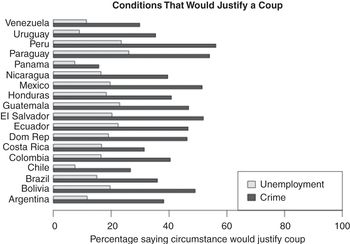
Just as urgent as citizens’ demand for security, however, is the risk it poses for democratic stability. Indeed, many citizens appear to be highly skeptical about the ability of democratic governments to protect them and keep crime under control. In particular, a large proportion of citizens in the region seemingly believe that the military regimes of previous eras might be better suited for addressing the region’s crime problem. Figure 1.1 shows responses to two survey questions asking respondents in Latin American countries about conditions that would justify “a military takeover of the state.”Footnote 6 As we can observe from the chart, large groups of citizens – ranging from one-quarter to more than half – in nearly all countries agree that “a lot of crime” would justify a military coup.Footnote 7 In comparison, far fewer citizens believe that high unemployment would justify a coup. Rather than a wholesale rejection of democracy, citizens in much of Latin America appear to doubt that democracy can keep them safe from crime and seem particularly willing to turn to undemocratic responses to address this problem.
This dilemma is not merely abstract. Scholars have provided ample evidence of how the failure to provide adequate protection for citizens undermines the broader quality of democracy and, potentially, its long-term stability. Reference DavisDavis (2006) and Reference CallCall (2003) have provided compelling analyses of the challenges of reforming coercive institutions and providing security for citizens, as well as the threat the failure to do so poses for the durability of new democratic institutions in Mexico and El Salvador, respectively. Scholars working in Central America – which has the highest rates of violence in the region – have found that crime victimization and fear of crime lead citizens to express lower support for democracy and increased support for military coups (Reference CarrerasCarreras 2013; Reference CruzCruz 2003; Reference PérezPérez 2003, Reference Pérez2009). Moreover, recent work by Reference CruzCruz (2015) found that police corruption, abuse, and outright criminality can decrease support for the incumbent administration and for the democratic regime overall.
Coercion, and the state institution primarily charged with exercising it, are thus fundamental components of democracy. Indeed, as Guillermo O’Donnell told us decades ago, “a state that is unable to enforce its legality supports a democracy of low-intensity citizenship” (Reference O’DonnellO’Donnell 1993, 1361). Thus, in instances where “what citizens can see of the state” (Reference GonzálezGonzález 2017) is a police force that not only neglects to protect them but is also unconstrained by the rule of law and accountability, democratic citizenship, as well as the quality and stability of democracy, are at risk of being severely eroded.
How Transitions to Democracy Left Police Behind
Despite the importance of policing for democracy, Latin America’s democratic governments have focused remarkably little on reforming the police, even as they prioritized overhauling other institutions. As I lay out in the chapters that follow, the decades following democratic transitions in Latin America saw political leaders enact new constitutions, reform militaries and court systems, and pass transformative policies in a range of policy areas. Police institutions, however, rarely underwent such processes of legislative reform. Venezuela’s comprehensive police reform begun in 2006, for instance, was the first such effort in nearly 100 years (Reference Gabaldón and AntillanoGabaldón & Antillano 2007, 9). Similarly, the ambitious police reforms adopted in Buenos Aires Province in the late 1990s (discussed in Chapter 7) was only the second reform effort in a century (Reference BarrenecheBarreneche 2007). Meanwhile, Colombian President César Gaviria’s “revolcón institucional” (institutional shakeup), a transformative agenda to remake the Colombian state and rebuild its legitimacy through radical institutional changes, excluded the National Police (see Chapter 5). Finally, São Paulo’s Military Police, one of the most lethal police forces in the Americas, has yet to undergo comprehensive structural reform more than three decades after the return to democratic rule (see Chapters 3 and 6). With the exception of Central American countries such as El Salvador and Guatemala, whose transitions to democracy saw the creation of entirely new police forces as part of peace agreements (Reference CallCall 2003), police reform did not appear to be a priority for the region’s democratic leaders.
The lack of urgency in reforming police following transitions to democracy stands in sharp contrast to the priority given to reforming another coercive institution – the military. Democratic leaders throughout the region sought to dismantle the political power, financial resources, coercive capacity, and intelligence apparatus of the armed forces that previously ruled over their countries (Reference DiamintDiamint 1999; Reference Pion-BerlinPion-Berlin 1997). These essential reforms accompanied transitions to democracy or followed shortly thereafter. In some cases, the imposition of civilian rule over the once-dominant National Security Doctrine (Reference BuitragoBuitrago 2003; Reference Pion-BerlinPion-Berlin 1988) was itself the product of the political incentives created by democratization (Reference HunterHunter 1997). While this emphasis on reforming militaries was wholly appropriate, the lack of reform of police institutions following transitions to democracy remains puzzling. As Chapter 3 on São Paulo State and Chapter 4 on Buenos Aires Province demonstrate, police forces were fundamental components of the machinery of repression under military dictatorships. While soldiers returned to the barracks following transitions to democracy, police officers returned to the streets, with their legal structures, repertoires of repression, and personnel left largely intact.
It is little wonder, then, that police forces throughout Latin America often bear little semblance to democratic ideals. Following the dramatic increases in crime and violence that accompanied the transition to democracy in many countries (Reference YasharYashar 2019), police forces previously dedicated to political repression were ill-equipped to carry out their formal tasks of preventing and investigating crimes, a common pattern in new democracies (Reference TannerTanner 2000). But police forces didn’t only perform poorly at protecting citizens from criminal violence: they also remained a significant source of violence against citizens, largely unconstrained by the rule of law and accountability mechanisms. In Argentina and Brazil, the years following the end of military rule saw instruments of torture common under each country’s dictatorship – the picana eléctrica (electric shock device) and pau de arara (a pole on which individuals are hanged upside down), respectively – become routine tools at the hands of police (Reference ChevignyChevigny 1995). Killings carried out by police in Brazil each year not only exceed the total number of deaths at the hands of the state during the twenty years of military rule (Arias & Goldstein 2010, 2; Reference PereiraPereira 2005), but they also constitute a significant proportion of all homicides to this day (see Chapter 3). Even in less well-known cases, the numbers of citizens dying at the hands of police are staggering. In the Dominican Republic, human rights NGOs denounced in 2010 the killing of nearly 500 people by police, many of them summarily executed after they had already been detained.Footnote 8
These extraordinarily high levels of police violence are exacerbated by the fact that, as the cases of São Paulo State, Buenos Aires Province, and Colombia show, characteristics such as race, class, or where one happens to reside are often stronger predictors of being subject to police action than is actual involvement in criminal activity. Rather than the rule of law, Latin American police forces seemingly adhere to the view attributed to patrolmen in various US cities in the 1970s by Reference WilsonWilson (1978): “What they deserve depends on what they are” (36). Moreover, the case studies also attest to the failure of other institutions of democracy to intervene to curtail these arbitrary and discriminatory policing practices. As was thoroughly researched by Reference BrinksBrinks (2008), the Latin American police forces that most contravened the rule of law in their deployment of coercion were also the least likely to be held accountable by the judiciary. Reference ChevignyChevigny (1999) argues further that opaque and weak disciplinary systems and nearly nonexistent oversight by executives and legislatures also serve to undermine accountability.
Thus, even as democratic rule has taken hold throughout Latin America and endured far longer than previous democratic episodes, police bureaucracies continue to function as authoritarian enclaves. But while these practices and structures were honed under authoritarian rule, they are sustained and reproduced by democratic processes, as I argue in Chapter 2.
Understanding Coercion: Beyond Regime Type
The experiences of Latin America’s democratic governments thus demonstrate that regime type and police force characteristics don’t always correspond in the ways we might expect. Indeed, democratic governments in Latin America (and elsewhere) have long struggled to organize police institutions such that they address citizens’ demands for order and security and so that the deployment of coercion against citizens is applied equitably and constrained by law and external accountability. Security and policing in the region exemplify what Reference Holston, Caldeira, Aguero and StarkHolston and Caldeira (1998) call “disjunctive democratization,” which is characterized by the contradictions inherent in the institutionalization of national-level democratic politics, juxtaposed with the “privatization of justice, escalation of both violent crime and police abuse, criminalization of the poor, and massive support for illegal and/or authoritarian measures of control” (265).
Indeed, the empirical chapters in this book attest to a range of coercive patterns and practices that defy notions of the rule of law and democratic citizenship. In São Paulo and elsewhere in Brazil, police officers routinely operate death squads responsible for the off-duty killing of hundreds of citizens, in addition to hundreds of extrajudicial on-duty killings. In Buenos Aires Province, police officials of all ranks have operated a lucrative criminal enterprise based upon extensive predation of the citizenry. In Colombia, the police force was profoundly infiltrated by and complicit with drug-trafficking organizations, leading to rampant violence against the population. And throughout the region, police routinely deploy coercion in the service of political and private interests.
Because of the clear mismatch between the formal democratic institutions that have taken root in most of the region and the ways in which the region’s police forces exercise the state’s coercive authority, it is essential to develop a theoretical framework about coercion that is distinct from regime type. Such theorizing can help us better understand the choices of democratic political leaders and the great variation in the deployment of coercion among the police forces they ostensibly control. After all, to paraphrase Reference LinzLinz (2000) as he contemplated his typology of authoritarian regimes, we all know that police forces are different and that it is not the same thing to be subject to one or another police force, especially in matters of daily life (49).Footnote 9
In order to conceptualize the seeming mismatch between regime type and the patterns of coercion prevalent throughout Latin America (and beyond), I begin by considering the implications of democratic institutions for the deployment of coercion in the pursuit of order and security. As the preceding discussion on Latin America illustrates, democratic governments face a twofold challenge in the provision of order and security. They must not only address urgent societal demands for improved security for the sake of democratic responsiveness and winning elections: they must also strive to do so in accordance with democratic principles.
Whether one subscribes to minimalist definitions of democracy or broader conceptions, democratic theorists offer valuable insights about what the state’s exercise of coercion ought to look like under formal democratic rule. Classic theories conceived of democracy as a primarily electoral endeavor for selecting who will govern; they were fundamentally concerned with identifying an “institutional arrangement for arriving at political decisions” (Reference SchumpeterSchumpeter 1942, 269), one “which permits the largest possible part of the population to influence these decisions” (Reference LipsetLipset 1959, 71). Reference DahlDahl (1971) extends the focus on citizens’ ability to influence governance, emphasizing participation and contestation, while Reference Schmitter and KarlSchmitter and Karl (1991) cite “channels for the expression of interests and values” (81).
What we can derive from these theories is that, as with many other actions taken by the state, citizens in democracies ought to be able to influence the exercise of coercion to ensure that it serves their interests. This represents a stark departure from the traditional role of coercion in state building, which was exercised primarily in the interest of consolidating leaders’ hold on power (Reference Bayley, Tilly and ArdantBayley 1975; Reference Tilly, Evans, Rueschemeyer and SkocpolTilly 1985). Given the impossibility of exercising the rights of democratic citizenship in the context of a “war of every man against every man” (Reference Hobbes and GaskinHobbes [1651] 1996), democratic coercion must instead have as its primary function the protection of citizens.
But democracy does not only require that coercion be exercised in the interest of citizens and with their input: it also requires that the exercise of coercion adhere to the rule of law. The implications of the rule of law for how democracies ought to deploy coercion are clear, whether understood through its standard features of predictability and equality (Reference Holmes, Przeworski and MaravallHolmes 2003), a “democratic rule of law” conceptualized as “fairness, access, universality, and legality” (Reference Holston, Caldeira, Aguero and StarkHolston & Caldeira 1998, 283), or the more expansive view of “a truly democratic rule of law that ensures political rights, civil liberties, and mechanisms of accountability which in turn affirm the political equality of all citizens and constrain potential abuses of state power” (Reference O’DonnellO’Donnell 2004, 32). Coercion exercised in accordance with the rule of law thus entails limits on police authority to provide protection and exert repression, based not only on the law but also on the premise of equal treatment of all citizens.
Finally, just as some prominent definitions of democracy require that “rulers are held accountable for their actions” (Reference Schmitter and KarlSchmitter & Karl 1991, 78), “democratic coercion” also requires that it be subject to external accountability. Per Reference Schedler, Schedler, Diamond and PlattnerSchedler (1999), accountability entails “subjecting power to the threat of sanctions; obliging it to be exercised in transparent ways; and forcing it to justify its acts” (14). Reference O’DonnellO’Donnell (1998) argues – with respect to executives – that such accountability ought to be imposed by other state entities, though Reference Schmitter, Schedler, Diamond and PlattnerSchmitter (1999) counters that horizontal accountability can also be exercised by non-state actors. Applied to police forces exercising the state’s coercive power, we ought to expect democracies to create formal external mechanisms by which civilian (i.e., non-police and non-military) state actors can monitor the use of coercion, conduct oversight in practice, and employ sanctions when such use of coercion falls outside the bounds of the law.
Nevertheless, one of the central arguments of this book is that the coercive structures and practices described here, and illustrated in greater detail in Chapters 3–5, are not simply undemocratic: they are unequivocally authoritarian. Understanding this characterization requires a definition of authoritarian coercion. Much of the literature on authoritarianism follows the reasoning that “one of the easiest ways to define a concept is to say what it is not” (Reference LinzLinz 2000, 50),Footnote 10 defining authoritarianism by “the absence of democratic processes” (Reference BrownleeBrownlee 2010). A shortcoming of this approach, as has been highlighted by a number of scholars, is that “it does not consider the possibility of authoritarianism occurring within a democratic regime.”Footnote 11
In theorizing about the relationship between regime type and modes of policing and coercion, it is similarly important to avoid definitions of authoritarian policing simply by the absence of democratic coercion. Instead, I look to the literature on coercive institutions in authoritarian regimes to conceptualize authoritarian coercion. While political science has traditionally ignored the police as an object of study, a small but robust literature on coercion and policing in autocracies has emerged in recent years, offering invaluable insights on how authoritarian rulers organize police institutions and how, as well as to what ends, they deploy coercion. As I argue, police may emerge and persist as authoritarian enclaves within otherwise democratic states, not simply due to the absence of the features of democratic coercion already described but due to structures and practices that resemble those of coercive institutions in authoritarian regimes.
Under authoritarian rule, the primary function of coercive institutions and the deployment of coercion is to keep the leader in power. Coercive institutions are organized with the objective of neutralizing or eliminating threats to the ruler – including from within coercive institutions themselves (Reference PoliczerPoliczer 2009) – and the nature of those threats will shape institutional design and the deployment of coercion (Reference GreitensGreitens 2016). Irrespective of institutional variation, however, authoritarian regimes have long deployed coercion to repress political adversaries and consolidate power, whether in Argentina in the 1930s (Reference KalmanowieckiKalmanowiecki 2000) or in Russia under Vladimir Putin in the early twenty-first century (Reference TaylorTaylor 2011). Authoritarian rulers are invariably concerned with their own political survival, such that Reference GreitensGreitens (2016), in her study of institutional variation in the design of coercive institutions and patterns of repression, finds that rulers organize coercive institutions and deploy coercion to achieve one of two objectives – “coup-proofing” and quelling popular unrest – in order to neutralize threats to the leader’s hold on power (4). The argument here is not that police forces in authoritarian settings do not offer protection from crime. Instead, what we can learn from the literature on authoritarian coercion is that leaders’ choices about the design and organization of coercive institutions, and about how coercion is deployed, are oriented not toward protecting citizens from crime but rather toward their own political survival.
Another feature of coercion in authoritarian settings is that its usage is not based on or bound by law. In autocracies, Reference Maravall and PrzeworskiMaravall and Przeworski (2003) tell us, “the law is the instrument of the sovereign, who, by definition of sovereignty, is not bound by it”; as a result, “extralegal commands are as forceful as those dressed as law” (3). This characterization resembles Taylor’s account of the “new regime of repression” used by Vladimir Putin to consolidate political and economic power in Russia: building the capacity of coercive institutions to enforce what he calls “exceptional decisions,” based on “specific circumstances that may be discretionary, or even potentially unlawful, under existing rules,” rather than “routine decisions” based on existing laws and procedures (Reference TaylorTaylor 2011, 16). It would be reductive to say that there is no place for law under authoritarian regimes, and scholars such as Reference PereiraPereira (2005) would likely caution us to take “authoritarian legality” seriously. Yet, even in Pereira’s careful study of the use of laws and courts by Southern Cone authoritarian regimes, coercion was not bounded by law. Instead, the law was used as a means of legitimizing each regime’s preferred mode of coercion. In authoritarian regimes, interpretation of the law is left “to the rulers themselves, rather than to independent objective bodies, and [applied] with a wide range of discretion” (Reference LinzLinz 2000, 59). Thus, if a defining feature of democratic coercion is that it ought to be based on the rule of law, the exercise of authoritarian coercion is instead exceptional or arbitrary, systematically deployed beyond what is in the law and unconstrained by rights and limits defined by law. The notion of “exceptional” coercion is based on the concept of “state of exception,” a legal condition in which executives grant themselves the authority to govern outside the bounds of the law, typically in times of crisis or existential threats, but which has come to be used in more expansive ways by contemporary democratic governments (Reference AgambenAgamben 2005). Exceptional or arbitrary coercion thus describes generalized structures or practices, rather than individual agents (sometimes characterized as “bad apples”) or sporadic actions that transgress the rule of law.
From this we can derive a third feature of coercion in authoritarian settings: the extent to which its use is subject to external accountability. As Reference PoliczerPoliczer (2009) observes in his study of authoritarian coercion in Pinochet’s Chile, “secrecy is the norm” (4), serving as “a basic tool of unconstrained power” (16). Although external monitoring of coercion and coercive institutions is not absent in authoritarian regimes, it does not entail accountability. Indeed, as Policzer notes, “If these [accountability] institutions existed, and if they were truly free, the regime in question would not be authoritarian” (Reference PoliczerPoliczer 2009, 18). Thus, while foreign governments and human rights groups may monitor the use of coercion in authoritarian settings and attempt to sanction abuses through “shaming” and other mechanisms, the absence of formal, systematic mechanisms of transparency and sanctions means that, in autocracies, “nothing compels the sovereign to rule by law” (Reference Maravall and PrzeworskiMaravall & Przeworski 2003, 3).
Based on the preceding discussion, we can develop a continuum of coercion (see Table 1.1). We can distinguish between the two ideal types along three dimensions: (1) whether coercion is used primarily to serve the interests of the leader or to protect citizens from crime and violence; (2) the extent to which the use of coercion is governed by law or is exceptional; and (3) the existence of meaningful formal external accountability mechanisms for the deployment of coercion. Democratic coercion is defined by the deployment of coercion for the purpose of protecting citizens from crime, based on the rule of law, and subjected to robust external accountability. Authoritarian coercion, meanwhile, is defined by the deployment of coercion whose primary function is to serve the interests of the leader to remain in power, is exceptional rather than based on law, and is subjected to weak or nonexistent external accountability mechanisms.
While there are certainly some police forces that neatly fit one of these two ideal types, the dichotomy should instead be conceived of as a continuum, with most police forces falling somewhere in between authoritarian and democratic coercion and potentially shifting between them over time.Footnote 12 Indeed, as I discuss in Chapter 2, the chief undertaking of this book will be to explain why police forces in democracies may remain closer to the authoritarian end of the continuum, as well as the conditions under which political leaders choose to enact reforms to shift coercive institutions toward the democratic end.
Conceptualizing coercion in this way is conducive to understanding the contradictions between patterns of police violence in Latin America and democratic principles. This framework decouples the type of coercion from the type of regime, allowing us to contemplate the persistence of authoritarian modes of coercion in democracies and democratic modes of coercion in authoritarian or semi-authoritarian countries. Evidence of the former abounds in Latin America (and elsewhere), and recent research has analyzed efforts to introduce forms of what I call democratic coercion in an electoral authoritarian regime (Reference LightLight 2016). Accordingly, a focus on coercive structures and practices “allows a shift away from only designating ‘regimes’ as authoritarian, recognizing that in contemporary politics, governance arrangements can be more fluid” (Reference GlasiusGlasius 2018, 523).
This framework also underscores that “authoritarian enclaves” are not only territorial or subnational jurisdictions (Reference GibsonGibson 2013; Reference GiraudyGiraudy 2015; Reference MickeyMickey 2015); they can also encompass state bureaucracies. This framework thus helps to elucidate the notion that democracies can sustain authoritarian institutions, just as they can permit “authoritarian enclaves” to flourish within their territory. Elucidating these political choices about the design of coercive institutions and the deployment of coercion will demonstrate that, as with the “persistence of local authoritarianism,” the persistence of authoritarian coercion – and the decision to reform – are “part and parcel of everyday politics within the modern nation-state” (Reference GibsonGibson 2013, 4).
The Structural Power of Police and the Politics of Coercion in Democracy
As the empirical chapters in this book demonstrate, the coercive structures and practices of many Latin American police forces following transitions to democracy have been decidedly authoritarian. But why do democracies continue to sustain police forces that systematically exercise authoritarian coercion? In the chapters that follow, I demonstrate how police forces exercise a form of “boundary control” (Reference GibsonGibson 2013). By virtue of their structural power, police organizations can induce political leaders to engage in accommodation, mutually beneficial exchange relationships wherein leaders grant police greater autonomy in exchange for cooperation.
In order to understand the persistence of these authoritarian coercive structures and practices in otherwise democratic states, it is essential to understand the relationship between coercion and democratic politics and, crucially, the structural power of the entity that exercises the state’s coercive authority. Coercion is a defining feature of the state (Reference TillyTilly 1993; Reference Weber, Gerth and MillsWeber 2009), and it is also a defining feature of police. Despite this, even theorists who understand state capacity in terms of the state’s ability to control and enforce its laws throughout its territory (e.g., Reference MannMann 1984, 189; Reference SoiferSoifer 2015, 9) nevertheless overlook the actual entity to which the state delegates its monopoly of the legitimate use of force. Indeed, for scholars of policing, the authorization to use force is the core of the policing role (Reference BayleyBayley 1985; Reference BittnerBittner 1970; Reference GoldsteinGoldstein 1977). It is little wonder, then, that leaders across a range of regime types have historically undertaken state-building efforts by “enlarging, professionalizing, and ultimately arming the police” (Reference WilsonWilson 1978, 32). Police had a central role in early state formation in Europe (Reference Bayley, Tilly and ArdantBayley 1975; Reference Reiner, della Porta and ReiterReiner 1998; Reference Tilly, Evans, Rueschemeyer and SkocpolTilly 1985) and in Latin America during the twentieth century (Reference Barreneche and GaleanoBarreneche & Galeano 2008; Reference CamachoCamacho 1993; Reference KalmanowieckiKalmanowiecki 2000). But rather than serving as a response to objective conditions of criminality, these efforts are better understood as a response to political threats (Reference Bayley, Tilly and ArdantBayley 1975, 357; Reference KalmanowieckiKalmanowiecki 2000, 48). According to these accounts, then, this building up of the police as a means of building the state followed a strictly political logic.
As with these early – largely authoritarian – states, coercion and coercive institutions play a central role in state building in contemporary democracies. While militaries may be more prominent under some authoritarian regimes, police are primarily charged with the maintenance of order in democracies (Reference BayleyBayley 1985; Reference GoldsteinGoldstein 1977).Footnote 13 As crime and violence reached historically high levels in many Latin American countries in recent decades, order and security have been among citizens’ most urgent demands (Reference ZechmeisterZechmeister 2014), placing police at the center of democratic politics in the region. But police institutions are not only the entity to which the state delegates its monopoly of the legitimate use of force. They are also a key instrument of the state’s infrastructural power, “the capacity of the state to actually penetrate civil society, and to implement logistically political decisions throughout the realm” (Reference MannMann 1984, 189). As such, for the great majority of citizens – as a former commander of the Colombian National Police told me in an interview – police officers are “the materialization of the state, what [citizens] can see of the state.”Footnote 14
Through their control of a vital policy area – order and security – police constitute the “nerve center of the state” (Reference UngarUngar 2002). Order and security are essential for any society to flourish and constitute a particularly urgent question for Latin America’s “violent democracies” (Arias & Goldstein 2010). Where citizens must endure “continual fear and danger of violent death” (Reference Hobbes and GaskinHobbes [1651] 1996), they have little possibility of enjoying what T. H. Marshall calls the “social component” of citizenship – guaranteeing the “right to share to the full in the social heritage and to live the life of a civilized being according to the standards prevailing in the society” (Reference MarshallMarshall 1950, 11) – nor what Reference Holston, Caldeira, Aguero and StarkHolston and Caldeira (1998) call the “civil component,” which entails the “rights to associate, assemble, and communicate among private individuals who thus become associated individuals and who thereby create the public sphere of society” (264). Whether or not states – and, specifically, the police – effectively provide order and security is a key determinant of the extent to which formal democratic institutions translate into the ability to engage in everyday political, economic, and social activities that are constitutive of democratic citizenship in practice (Reference Brysk, Sznajder, Roniger and FormentBrysk 2012; Reference GonzálezGonzález 2017; Reference Yashar, Sznajder, Forment and WhiteheadYashar 2012).
Because police are charged with providing a service that is essential for the functioning of society, police forces also serve as an essential instrument of political power. If the police force were to withdraw its service, it would prove to be politically catastrophic for elected leaders. Moreover, because police protection is so highly valued by citizens, police forces provide a service that can be distributed in politically beneficial ways. Indeed, even in present-day democracies, politicians have used police forces to serve their political interests and consolidate power, by selectively providing protection for favored constituents (Reference WilkinsonWilkinson 2004), shielding them from unfavorable enforcement of the law (Reference DavisDavis 2006; Reference HollandHolland 2015), punishing political opponents (Reference Saín, Epstein and Pion-BerlinSaín 2006), and raising revenue (Reference Sances and YouSances & You 2017).
This structural position of police – as a political resource and a purveyor of an essential condition of governance – means that, as Reference LindblomLindblom (1977) argued about business leaders, police occupy a “privileged position,” given their role as “functionaries performing functions that government officials regard as indispensable” (175). Just as with the business sector in market-oriented societies, police bureaucracies can be formidable assets for politicians. But they also present important constraints. By commission or omission, police forces can create politically uncomfortable situations for elected officials. For instance, apparent work slowdowns by police in cities such as New York,Footnote 15 Baltimore,Footnote 16 and São PauloFootnote 17 – during which police officers scaled back patrols and arrests, in some cases leading to increased violence – proved to be deeply embarrassing for their respective mayors. Just as Lindblom warned that “depression, inflation, or other economic distress can bring down a government” (172–173), a former secretary of security in Buenos Aires Province issued a similar warning regarding the risks posed by police: “Any governor or president knows that insecurity events can corrode an administration. You can build a lot of roads, a lot of public works, but these events can undermine your administration.”Footnote 18
As a result of the opportunities and risks posed by the police’s control of coercion, politicians have strong incentives to engage police forces in accommodation, a mutually beneficial exchange relationship in which politicians grant police autonomy in exchange for the organization’s cooperation in pursuing political objectives. Police forces not only have an interest in maximizing autonomy, a standard bureaucratic prerogative (Reference LipskyLipsky 2010, 14): they are also uniquely situated among state bureaucracies to achieve autonomy and defend institutional interests, in no small part due to a hierarchical, often-militarized structure that facilitates coordination and makes credible the threat of withdrawal of service. Indeed, scholars have noted that police can successfully resist incursions on their “turf,” exhibiting hesitation to adopt new tasks (Reference WilsonWilson 1989, 107), rejecting mechanisms of accountability to outside actors (Reference Alpert and DunhamAlpert & Dunham 2004, 9), and weakening of reforms even after they are adopted (Reference UngarUngar 2002; Reference HintonHinton 2006; Reference GoldsteinGoldstein 1977).
In order to understand the nature of the police’s agency and the patterns of accommodation that emerge between politicians and police, Taylor’s distinction between the police’s “routine” (formal, defined by law) and “exceptional” (informal, possibly extralegal) tasks may prove helpful (Reference TaylorTaylor 2011, 16). These two sets of tasks may operate as distinctly separate dimensions, such that police forces may possess capacity in performing exceptional tasks but institutional weakness in their formal role, as Taylor shows was the case in Putin’s Russia. Police may also exchange cooperation in one dimension for autonomy in another. In Buenos Aires Province, for instance, police cultivated considerable autonomy in their routine task of security provision in exchange for cooperation with politicians and political parties in an expansive network of illicit political financing (Chapter 4). The Colombian police, meanwhile, faced little civilian intervention despite widespread extralegal violence and corruption in exchange for continued cooperation with the government’s policy priority, the war against drug cartels (Chapter 5). As these examples suggest, there is variation in the specific forms of police–politician accommodation; but, as with business, their relationship is defined by “reciprocal dependence” (Reference CulpepperCulpepper 2015). Police forces are a political instrument utilized by politicians in some dimensions; but they are also a political actor, successfully exercising agency in pursuit of their own prerogatives in other dimensions.
Thus, while police forces are a potent political instrument utilized by politicians, they are also a formidable political actor, endowed with structural power due to their control of coercion. Indeed, police institutions exercise power in all its “faces,” as conceptualized by scholars such as Gaventa (1980) and Reference LukesLukes (1974). As evidenced in the cases analyzed in this book, police forces routinely prevail in specific contests, as occurred often when police commanders in Buenos Aires Province leveraged their political relationships to prevent reformist security officials from removing them from their posts due to corruption (Chapter 4). They also succeed in keeping certain issues off the agenda, as exemplified by the shelving of a police reform bill in the Colombian congress due, according to the minister of defense at the time, to opposition from the National Police (Chapter 7). Finally, police also shape discourses and understandings of the problem of crime and security, as occurred when São Paulo’s police forces convinced politicians and a majority of citizens that the governor’s reform attempts were a threat to security (Chapter 6).
The police’s structural power is key to understanding the persistence of authoritarian coercion in democracies. Rather than constituting an oversight by political leaders or a view that reforming the police was less consequential than reforming militaries – as one Argentine official argues in Chapter 4 – the police’s ability to leverage its structural power to constrain the policy agenda and thwart reform is an essential driver of its institutional persistence. The book’s main argument, developed further in Chapter 2, elucidates how ordinary democratic processes reinforce, rather than challenge, this persistence of authoritarian coercion.
The Struggle for Democratic Coercion
This book demonstrates that, because ordinary democratic politics can reproduce and sustain authoritarian coercion, a shift toward democratic coercion requires intentional comprehensive structural police reforms. But under what conditions do such reform processes emerge? Based on two-and-a-half years of qualitative fieldwork in Argentina, Brazil, and Colombia, this book shows that ordinary democratic politics can be both a barrier to and a catalyst for democratic coercion. I argue that electoral incentives are central to politicians’ decision to maintain the status quo of authoritarian coercion or to enact police reform to promote democratic coercion. When societal preferences over policing and security are fragmented, politicians will see little electoral gain in enacting reform and a substantial risk of alienating a powerful bureaucracy whose cooperation they need. In contrast, when politicians observe preference convergence through a scandal and face a robust political opposition, reform becomes more likely, since they now face an electoral counterweight to the police’s structural power.
As the empirical chapters illustrate, understanding the structural role and structural power of police institutions is essential for explaining why eradicating decidedly authoritarian coercive structures and practices within police forces has proven to be so challenging for democracies. Because of their control over coercion, police organizations are uniquely positioned to resist reform efforts. At the same time, politicians may be especially reluctant to place constraints on their ability to use police toward their own political ends. These forces are not deterministic (as is also true for the structural power of business, per Reference CulpepperCulpepper (2015)) but instead create a set of entrenched interests that raise the stakes (and risks) of reform. To a much greater extent than other policy areas, where politicians may seek to be “policy entrepreneurs” or simply act out of an adherence to democratic principles, executives seeking to reform authoritarian coercive practices and structures among the police forces under their control must contend with the likely resistance from a powerful bureaucracy whose actions, and inaction, have the potential to “corrode” their administrations. The largely failed efforts of then São Paulo governor André Franco Montoro to reform his state’s police forces in the years after the transition to democracy (Chapter 6) illustrate the challenges inherent in such reform attempts. Police forces routinely and successfully leverage their structural power to achieve considerable autonomy from the elected leaders to whom they are ostensibly accountable. It is unsurprising, then, that in much of Latin America, as in much of the United States, “police now actually have greater autonomy than other agencies of government that exercise much less authority” (Reference GoldsteinGoldstein 1977, 134).
The implication of this framework, developed further in the next chapter, is that politicians will be unlikely to incur the costs of attempting to reform the police unless not doing so poses an electoral threat. Because of their structural power, police forces can successfully leverage their control of coercion to constrain the policy options available to politicians and raise the threshold for reform. Within this constrained policy space, whether authoritarian modes of coercion persist or are subjected to reform processes is a function of how societal preferences and demands, as well as political competition, shape the electoral incentives of politicians when choosing between the status quo and reform. In this context, the emergence of police as authoritarian enclaves within the state results from the nature of ordinary democratic politics. Thus, what appears to be a failure of democratic processes to address coercive institutions that routinely and fundamentally contravene democratic principles may instead be an exercise of democratic responsiveness to the preferences and demands of large and powerful sectors of the citizenry who – like the São Paulo residents who applauded a police killing of their fellow citizen – may view such practices as necessary for their own protection.
Theoretical Contributions
In 2016 Darrell Cannon stood in front of dozens of college students and recounted his harrowing experience with torture at the hands of officers from the Chicago Police Department, remarking that it must have seemed “like something out of a Third World dictatorship.”Footnote 19 Yet, what Cannon endured took place not under an authoritarian regime but rather in the context of a consolidated democracy. Cannon was one of over 100 men – mostly Black and poor – tortured by the Chicago police to extract false confessions, a practice that went on for nearly two decades with little to no intervention from the courts or elected officials (Reference RalphRalph 2020).
This book is part of a growing literature on the limitations of democracy and the potential for democratic processes to produce undemocratic outcomes. Scholars such as Reference Achen and BartelsAchen and Bartels (2016) have demonstrated how ordinary democratic politics may actually undermine government responsiveness, while Reference GilensGilens (2014) examines how democratic processes can reproduce societal inequalities, with important implications for representation. Recent studies have also examined the susceptibility of democracy to extremism, norm erosion, and authoritarian political movements that may ultimately bring about its downfall (Reference Levitsky and ZiblattLevitsky & Ziblatt 2018), a concern that has long been the focus of democratic theorists (Reference LoewensteinLoewenstein 1937). The analysis presented here draws on these insights to explore the tensions that policing and coercion pose for democracy, emerging as authoritarian enclaves due to many of the same factors identified by these scholars.
Elucidating the processes through which patently authoritarian coercive practices can become a routine tool of policing in democracies is the central task of this book. Recent scholarship has advanced our understanding of how authoritarian leaders make choices regarding the organization and deployment of coercion to remain in power (Reference GreitensGreitens 2016; Reference PoliczerPoliczer 2009; Reference TaylorTaylor 2011). Yet, we still know relatively little about the role of coercion in democracies, despite the fact that coercion – and the primary institution charged with exercising it – may be highly consequential for the everyday lives of citizens and democratic governance. This book seeks to contribute to this new and important literature by investigating how leaders – and citizens – in established and developing democracies alike make choices about how to organize, deploy, and control coercive institutions. It demonstrates that police in democracies are also instruments of power. Far from the conventional notion of security as a public good, police provide a highly coveted and contested service that politicians can distribute selectively to pursue their political objectives, a condition police forces skillfully leverage toward their own ends. This book therefore theorizes about the agency and structural power of a bureaucracy that leverages its control of coercion to selectively provide its service in the interests of elected leaders but can also threaten leaders by withdrawing its service of providing order and security. This analysis allows us to better understand the conditions under which police bolster – or threaten – leaders’ hold on power, as well as governability and the rule of law.
In doing so, this book also adds important insights to recent scholarship exploring the contours, causes, and consequences of racialized policing and abuses in the United States in the post-Ferguson era. While much of this work probes the consequences of racialized policing for the relationship between communities of color and the state (Reference LaniyonuLaniyonu 2018; Reference Soss and WeaverSoss & Weaver 2017), and shows how political underrepresentation of Black Americans leads to unequal policing (Reference EckhouseEckhouse 2019), police institutions remain a “black box” in these analyses. Yet police forces are the only institution of the state legally empowered to use violence against its own citizens, making police distinct from other types of bureaucracies. This book theorizes police as political actors, elucidating how police successfully exercise agency in pursuit of their own prerogatives and act as a veto player, setting the bounds of policy options available to politicians choosing between continuity and reform. A key takeaway from the book’s analysis for observers of the challenges posed by unequal policing in the United States is that reforms that fail to contend with the police’s structural power will likely do little to address patterns of racialized policing and other abuses.
This book also joins a long line of scholarship exploring the endurance of police violence in established and developing democracies alike (Reference AhnenAhnen 2007; Reference Bonner, Seri and KubalBonner, Seri & Kubal 2018; Reference Caldeira and HolstonCaldeira & Holston 1999; Reference SmithSmith 2019; Reference WahlWahl 2018). Yet, even as scholars have consistently demonstrated that democratic institutions have failed to prevent the types of extrajudicial violence employed by the authoritarian regimes that preceded them, this book unpacks the mechanisms by which ordinary democratic politics may alternately reinforce such patterns and practices – or create conditions that make reform possible.
The book also develops and tests a nuanced theory of institutional persistence and change, demonstrating that societal pressures and mobilization as well as political competition can produce both continuity and reform. The analysis presented in this book demonstrates that the emergence and persistence of police forces as authoritarian enclaves are not merely the consequence of incomplete transitions from dictatorship nor of the failure of democratic institutions. Instead, this institutional persistence is sustained and reproduced by democratic processes of citizen contestation and demand-making, as well as leaders’ responsiveness based on electoral incentives. As the case studies show, these democratic processes may serve alternately as impediments to building state capacity and distinctly democratic forms of coercion or as key levers for change.
The analysis presented here also provides important insights into other prominent cases where policing, and the provision of security more broadly, comes into sharp tension with democracy. In the Philippines, President Rodrigo Duterte carried out a concerted campaign of thousands of extrajudicial killings under the pretense of a drug war, with massive popular support.Footnote 20 In South Africa, a robust human rights regime has come to be viewed by ordinary citizens as an impediment to security, leading to increased support for vigilantism and extrajudicial state violence (Reference SmithSmith 2015). Meanwhile, even consolidated democracies have not been immune from persistent authoritarian coercive practices, as evidenced by the enduring contestation over extrajudicial killings of unarmed Black men in the United States. This analysis thus sheds light not only on why democratic governments in Latin America and elsewhere have been deficient in performing the defining task of the state but also on why their police forces have in many ways continued to operate as authoritarian enclaves.
Plan of the Book
The chapters that follow develop and test a theoretical framework that builds on the central argument presented in this chapter: that democratic processes often sustain and reproduce authoritarian police. Chapter 2 presents the book’s theoretical framework, unpacking the dependent variable – the persistence of authoritarian coercive institutions or reform to promote democratic coercion – and laying out the argument that the fragmentation of societal preferences over police reform and patterns of political competition shape the incentives of political leaders choosing between the status quo and reform.
The empirical chapters are organized around variation in the dependent variable, leveraging change over time across the case studies. Part I of the book examines the persistence of authoritarian coercion among police forces in São Paulo State, Buenos Aires Province, and Colombia. In each of Chapters 3, 4, and 5, I explore entrenched authoritarian coercive structures and practices, as well as the failure of democratic institutions to constrain them. I then lay out how the police force in each case leveraged its structural power to constrain policy agendas to maintain the status quo of authoritarian coercion, and I demonstrate how fragmentation of societal preferences and contestation reinforced institutional persistence, thereby reproducing authoritarian patterns of coercion in each setting.
Part II of the book focuses on reform efforts to promote democratic coercion. Chapter 6 examines a series of failed efforts to enact structural police reform in São Paulo State, leading to the persistence of a police force that serves the political interests of leaders, exercises rampant violence outside the bounds of the law, and faces little external accountability – more than three decades after the return to democratic rule in Brazil. The chapter elucidates how the structural power of police constrains policy agendas and how societal preference fragmentation – and, crucially, weak political competition – can block efforts to enact police reforms to promote democratic coercion. Chapter 7, meanwhile, jointly considers the comprehensive and ambitious reform processes of the police forces of Buenos Aires Province and Colombia, demonstrating how shifts in societal preferences and political competition change politicians’ incentives in favor of reform.
The concluding chapter considers the implications of the persistence of authoritarian coercion for democracy and reflects upon the empirical analysis to consider the ways in which high levels of violence and inequality exacerbate these processes. Chapter 8 also sketches out how the argument might extend to other democracies, particularly those afflicted by violence and inequality.