


Legislative bodies, particularly in shared power systems, are designed to reconcile diverse interests and foster collaboration between competing parties and their members. While scholars have extensively studied legislative cooperation (e.g., Anderson, Box-Steffensmeier, and Sinclair-Chapman Reference Anderson, Box-Steffensmeier and Sinclair-Chapman2003; Kirkland Reference Kirkland2011, Reference Kirkland2014), less is known about the conditions that shape whether such cooperation endures. A central assumption in this literature is that reciprocity – legislators’ willingness to return favors for past cooperation – underpins bipartisan collaboration (Harbridge-Yong, Volden, and Wiseman Reference Harbridge-Yong, Volden and Wiseman2023). Yet, this assumption overlooks how varying institutional contexts, particularly majority security, structure incentives for cross-party reciprocity. I argue that majority security fundamentally alters the incentives shaping a legislator’s calculus for bipartisan cooperation. Specifically, majority security creates a paradox: while it facilitates collaboration, it also selectively curates the scope and nature of reciprocity.
In legislatures where party control is competitive and electoral outcomes uncertain, no party can reliably govern alone. Under these conditions, bipartisan collaboration becomes necessary for advancing legislation and demonstrating governing capacity. Despite the incentive to bolster the party brand and exhibit strong party ties, legislators must engage in bipartisan collaboration to meet with legislative success (Curry and Lee Reference Curry and Lee2020; Harbridge Reference Harbridge2015). Although bipartisan cooperation has declined in many legislative institutions over recent decades, it remains a key normative and strategic expectation under conditions of electoral uncertainty and partisan volatility.
This collaboration is structured by a key norm governing legislative interaction: reciprocity. When neither party can consistently advance its agenda independently, legislators are incentivized to support colleagues across the aisle with the expectation that such support will be returned. The risk of losing institutional power in future elections encourages lawmakers to maintain cross-party relationships, knowing that today’s minority party may soon control the agenda. In this context, reciprocity is a strategic calculus rooted in repeated interaction and mutual dependency. However, what happens to reciprocity when this mutual dependency is significantly reduced? Many US state legislatures are dominated by long-term secure majorities, where one party holds power for extended periods and can govern unilaterally (Parry et al. Reference Parry, Dowdle, Long and Kloss2022). In these environments, the incentives that sustain bipartisan cooperation shift.
Consider Hawaii, where Democrats have controlled the legislature since statehood. Cynthia Thielen, a Republican who served for 30 years in a chamber where Republicans never held more than eight seats (out of 51), cosponsored majority party bills nearly 80% of the time. Yet, the majority party members cosponsored her bills at only half that rate, reflecting an asymmetry in cross-party collaboration. A similar pattern is evident in North Dakota, where Republicans have maintained trifecta control of the state government since 1995. With Democrats reduced to just 8.5% of the chamber, Senate Minority Leader Kathy Hogan resorted to recruiting citizen volunteers to help her caucus manage basic legislative tasks. Still, she cosponsored a majority of bills nearly three-quarters of the time, but less than half of her cosponsors came from members of the majority party. These examples show that minority party legislators often continue to pursue bipartisan engagement, but majority party legislators in secure chambers can afford to reciprocate selectively. This selective cooperation challenges prevailing expectations of reciprocity in legislative interactions and decision-making.
This article offers a new theoretical framework for understanding how the majority party’s security reshapes the incentives and outcomes of bipartisan collaboration. I argue that secure majorities do not eliminate reciprocity, but they fundamentally alter its expression. I introduce the concept of selective reciprocity, which theorizes a conditional, asymmetric form of cooperation in which minority party legislators – lacking electoral leverage and formal power – invest in bipartisan behavior to build reputational capital and remain legislatively relevant. Majority party legislators, unconstrained by electoral risk or legislative dependence, reciprocate only selectively: supporting minority initiatives that are unlikely to advance or engaging in early, low-cost coalition-building that stops short of final passage. Under secure majorities, reciprocity is no longer a mechanism of mutual exchange but a tool of strategic containment, shaped by structural asymmetries in power and legislative control. I innovate on existing accounts of legislative cooperation by theorizing how institutional dominance restructures the incentives for bipartisan reciprocity – transforming it from a mechanism of mutual gain into a strategy of symbolic management. Institutional variation in state legislatures serves as an invaluable tool for identifying when bipartisan cooperation yields genuine legislative returns – and when it is merely symbolic.
To test my argument, I draw on an original dataset of 401,720 bills introduced across 43 state legislatures between 2009 and 2018. I develop two measures of bipartisan collaboration: one reflects how often a legislator cosponsors bills introduced by members of the opposing party, and the other captures the extent to which a legislator’s own bills attract cosponsors from the opposing party. I conduct a series of empirical tests designed to assess three central questions: whether bipartisan behavior by minority party legislators endures over time, whether it elicits reciprocal support from majority party members, and whether that reciprocity is shaped by the security of the majority party and, in turn, affects legislative success and policy advancement.
These tests offer a demanding and comprehensive evaluation of the theory of selective reciprocity. Each addresses a distinct mechanism – whether bipartisan behavior endures, whether it is reciprocated, and whether that reciprocation is conditional. In isolation, no single test captures the full scope of the theory. Together, however, they provide clear and converging evidence: in legislatures with secure majorities, minority party legislators invest in bipartisan cooperation, but majority party legislators reciprocate selectively, offering support only at early stages of the legislative process or on minority initiatives unlikely to advance beyond the chamber. Reciprocity endures but is constrained: selective in form, asymmetrical in effect, and structured by the institutional advantages of majority control.
Insecure majorities, collaboration, and reciprocity
Legislators operate in an environment shaped by cross-cutting incentives that often pit their individual policy ambitions against their party’s electoral goals. As polarization intensifies and parties grow increasingly competitive, legislators in insecure majority environments must navigate conflicting pressures. Party loyalty can be critical for advancing electoral prospects, while legislative success and policy achievements frequently require bipartisan collaboration (Curry and Lee Reference Curry and Lee2020; Lee Reference Lee2016). Constituents can amplify these tensions, as legislators weigh representing district interests against adhering to party agendas (Kirkland and Harden Reference Kirkland and Harden2016). Ultimately, legislators in insecure majorities must manage a trade-off: reinforcing the party’s brand or advancing member- and district-responsive policy priorities, which can diverge from party leadership (Kirkland and Harden Reference Kirkland and Harden2018).
Partisan differentiation becomes a central legislative strategy in competitive environments. Legislators prioritize party branding to highlight opponents’ shortcomings and bolster their party’s electoral standing (Koger and Lebo Reference Koger and Lebo2017). Bipartisan compromise risks undermining party cohesion, exposing legislators to charges of betrayal from copartisans (Baker Reference Baker2015). The majority party members align with leadership efforts to reinforce party brands (Cox and McCubbins Reference Cox and McCubbins1993, Reference Cox and McCubbins2005), while minority party legislators face disincentives for collaborating with the majority. Cosponsoring majority party bills or voting in favor of their initiatives can make minority party legislators electorally vulnerable (Carroll and Eichorst Reference Carroll and Eichorst2013). As Lee (Reference Lee2016) argues, minority party members often strategically refuse cooperation to signal majority ineffectiveness, preserving their party’s electoral prospects.
Despite these strong party-based pressures, bipartisan collaboration persists. Campaign commitments to bipartisanship have increased markedly since 2000, even as polarization has grown (Dobson, Volden, and Wiseman Reference Dobson, Volden and Wiseman2024). Legislators frequently deliver on these promises once elected, and patterns of bipartisan bill cosponsorship have remained relatively stable over time (Harbridge Reference Harbridge2015). Insecure majority environments make bipartisan support essential for passing legislation, as neither party’s coalition is large enough to govern unilaterally (Curry and Lee Reference Curry and Lee2020; Harbridge Reference Harbridge2015). In fact, party competition can increase legislative activity and policy investments in state legislatures, linking competitive environments and the necessity of coalition-building (Gamm and Kousser Reference Gamm and Kousser2021). Competition, in turn, prompts a recalibration of the majority agenda (Nemerever and Parry Reference Nemerever and Parry2023), which shapes how cross-party coalitions translate into bill adoption. The majority parties in competitive environments succeed less often in passing legislation alone compared to historical predecessors (Curry and Lee Reference Curry and Lee2020), underscoring the necessity of bipartisan coalitions.
It is crucial to consider the institutionalized norm of reciprocity to understand why bipartisan collaboration persists even under intense partisan competition. Legislators rely heavily on relationships with colleagues to achieve legislative success (Anderson, Box-Steffensmeier, and Sinclair-Chapman Reference Anderson, Box-Steffensmeier and Sinclair-Chapman2003; Kirkland and Kroeger Reference Kirkland and Kroeger2018). Relational legislating reflects that successful policymaking is contingent on the interactions among lawmakers (Kirkland Reference Kirkland2011). Given the long-term stakes of legislative success, reciprocity – the norm of returning favors for past support – emerges as a critical organizing principle (Kirkland and Williams Reference Kirkland and Williams2014). Reciprocity is deeply embedded in the institutional culture of Congress (Matthews Reference Matthews1960; Polsby Reference Polsby1968), shaping legislative behavior both as a social expectation and a strategic necessity. Foundational work highlights how early institutional norms embedded expectations of reciprocal behavior (Matthews Reference Matthews1960), while recent research shows that legislators may also act on intrinsic preferences to return favors – preferences activated and reinforced by legislative institutions themselves (Alexander Reference Alexander2021; Fong Reference Fong2023). Ultimately, the persistence of reciprocity is best explained by structural features such as competitive elections, narrow coalitions, and the constant risk of power shifts – factors that make bipartisan cooperation both necessary and mutually beneficial.
This norm operates at multiple levels. Reciprocity reflects intrinsic human tendencies to cooperate (Fehr and Gächter Reference Fehr and Gächter2000), but in legislative politics, it also serves a rational strategic function (Shepsle Reference Shepsle and Herbert1986). Legislators reciprocate support to secure future cooperation or to avoid potential punitive retaliation (Krehbiel Reference Krehbiel1986). In insecure majority environments, where slim margins and the threat of electoral turnover loom large, reciprocity between parties becomes vital. Majority and minority party legislators have incentives to maintain cross-party relationships, anticipating future periods of shifting partisan control (Curry and Lee Reference Curry and Lee2020; Harbridge Reference Harbridge2015). The expectation that favors will be returned sustains collaboration, even as party-based incentives push toward confrontation.
Institutional folkways and strategic considerations reinforce this norm (Alexander Reference Alexander2021; Matthews Reference Matthews1960), making reciprocity a critical glue for bipartisan collaboration under conditions of insecure majorities. In this context, the majority party legislators are strongly incentivized to engage in bipartisan collaboration. The need to demonstrate legislative productivity makes coalition-building essential (Lee Reference Lee2016). Legislative entrepreneurs, motivated by ambition for leadership roles and policy success, navigate the tension between party loyalty and coalition needs (Wawro Reference Wawro2010). With narrow majorities, passing legislation often demands bipartisan support (Curry and Lee Reference Curry and Lee2020), prompting legislators to moderate their positions and converge toward the ideological center (Black Reference Black1948; Downs Reference Downs1957).
Minority party legislators also find incentives for bipartisan collaboration. Personal electoral ambitions and the desire for tangible policy achievements drive minority legislators to seek legislative wins (Fenno Reference Fenno1973; Mayhew Reference Mayhew1974). Associating with successful legislation, including bipartisan bills, can enhance reelection prospects (Frantzich Reference Frantzich1979). Even when policy influence is limited, demonstrating responsiveness to district needs through bipartisan achievements can strengthen a legislator’s standing in her district (Butler, Karpowitz, and Pope Reference Butler, Karpowitz and Pope2012; Harden Reference Harden2016). While party loyalty remains a key motivator, personal legislative success often requires strategic bipartisan engagement (Aldrich Reference Aldrich1995; Oleszek Reference Oleszek2010). Thus, even under strong partisan pressures, the persistence of bipartisan collaboration in insecure majority environments reflects the strategic calculations and institutionalized norms that govern legislative behavior. Reciprocity, rooted both in institutional traditions and strategic necessity, sustains cooperation even as polarization and party competition intensify.
Theorizing selective reciprocity under secure majorities
While much of the literature examines legislative behavior across both competitive and secure chambers, what remains underdeveloped is a theoretical framework that emphasizes how secure majorities influence legislative incentives and actions. In particular, there is limited understanding of how these dynamics shift when the minority party’s incentive to preserve future competitiveness diminishes. Similarly, extant work has yet to explore how majority parties operate when substantial seat advantages align policy goals with the party brand, reducing tensions between policy and party cohesion. State legislatures provide a unique opportunity to examine these dynamics, as they exhibit substantial variation in majority security across statehouses. Unlike Congress, majority parties in the states are often secure. This one-party dominance facilitates investigating whether the relationship between bipartisanship and legislative success in statehouses is affected by majority security and how variation in institutional contexts structures the incentives that motivate majority and minority party legislators’ reciprocal tendencies.Footnote 1
Legislative behavior under secure majority conditions reflects a fundamental shift in the incentives facing both majority and minority party legislators. Whereas insecure majorities foster mutual dependency across party lines, secure majorities reduce the necessity of cross-party coalition-building, allowing party goals and legislative productivity to work in concert rather than opposition. Majority party legislators can advance their agendas without minority support, alleviating the need to balance party loyalty with broader collaboration. In contrast, minority party legislators, recognizing that they are unlikely to gain majority control, must emphasize bipartisan cooperation as a strategy to remain relevant in a process that no longer requires their support. These changes reshape the incentives structuring legislative behavior and the application of longstanding institutional norms of legislative reciprocity. This divergence in strategic incentives leads to contrasting patterns of bipartisan behavior. Majority party legislators, freed from the need for cross-party coalitions in secure chambers, should decrease their bipartisan collaboration. Minority party legislators, by contrast, should increase their bipartisan collaboration, as the tension between electoral party branding and policymaking goals is reduced. This logic informs my first hypotheses:
-
H1.A (Bipartisan Collaboration and Majority Security: Minority Party): In secure majority chambers, minority party legislators engage in more bipartisan collaboration than they do in insecure majority chambers.
-
H1.B (Bipartisan Collaboration and Majority Security: Majority Party): In secure majority chambers, majority party legislators engage in less bipartisan collaboration than they do in insecure majority chambers.
In insecure majority environments, reciprocity between legislators and across parties often emerges as a strategic response to institutional incentives and mutual interdependence: legislators build cross-party relationships to achieve legislative success and secure future cooperation. However, when majority parties become electorally secure, the assumptions underpinning mutual reciprocity erode, reshaping how legislators navigate collaboration. I argue that in secure majority environments, the incentive structures for bipartisanship substantially shift for both majority and minority party legislators. For the majority party legislators, the need for minority support to pass legislation diminishes, as they can rely primarily on copartisans to advance their agenda.Footnote 2 This reduced reliance assuages the traditional tension between party and policy goals. Conversely, minority party legislators face a different recalibration: with little prospect of regaining majority control, their best strategy shifts toward sustained bipartisan engagement to maintain relevance. Despite these different pressures, the theory expects that minority party legislators – regardless of majority security – maintain consistent patterns of bipartisan behavior. In competitive chambers, such behavior helps preserve cross-party cooperation and maintain legislative productivity. In secure chambers, it reflects a strategy of relevance preservation, as minority party legislators attempt to insert themselves into the policymaking process. This expectation is expressed in my second hypothesis:
-
H2 (Bipartisan Consistency): Minority party legislators consistently cosponsor majority party bills across legislative terms, regardless of whether majority control is secure or insecure.
Minority party legislators seek to leverage these efforts to build relationships that can translate into tangible support for their own legislative proposals. If reciprocity holds, even in a selective form, minority party legislators who have demonstrated support for majority initiatives should be better positioned to attract cross-party cosponsors when advancing their own bills. For minority party legislators, however, maintaining bipartisan engagement remains critical even under secure majorities. Because their influence over the agenda is diminished, minority party legislators prioritize consistent cosponsorship of majority party bills as a long-term investment in political relevance. If reciprocity operates at all under secure majorities, it should be visible in how majority party legislators respond to past cooperation. Whether in secure or insecure chambers, minority legislators who extend bipartisan support should receive reciprocal cosponsorship. This logic leads to my third hypothesis:
-
H3 (Bipartisan Reputational Capital): Minority party legislators’ cosponsorship of majority party bills in earlier terms positively predicts their ability to attract majority party cosponsors on their bills in the current term.
However, the form that reciprocity takes may differ. In insecure chambers, reciprocity is mutual and functionally necessary; bipartisan engagement facilitates lawmaking progress. In secure chambers, reciprocity becomes conditional and asymmetric: majority legislators may limit their support to early-stage legislative activity or bills with low chances of enactment, given the altered incentive structures that emerge in response to majority security. To distinguish between these conditions, I introduce the concept of selective reciprocity. Whereas reciprocity is mutual and broadly applied in legislatures with insecure majorities, selective reciprocity emerges when secure majority parties strategically limit reciprocation. Majority party legislators can afford to reciprocate selectively – supporting minority-sponsored bills only when the political costs are low, or the legislation is unlikely to succeed. This shift reflects a fundamental departure from the mutual dependency that characterizes insecure majority environments. For minority party legislators, however, maintaining bipartisan engagement remains critical even under secure majorities. Because their influence over the agenda is diminished, minority legislators prioritize consistent cosponsorship of majority party bills as a long-term investment in political relevance. To evaluate how this investment pays off under different institutional conditions, I assess the relationship between bipartisan cosponsorship and legislative advancement across four stages: bill introduction, committee action, movement beyond committee, and passage in the originating chamber. Bills that fail to progress beyond the early stages – especially those that stall in committee or never receive a floor vote – are treated as unlikely to pass. This logic leads to my final hypothesis:
-
H4 (Selective Reciprocity and Legislative Advancement): In insecure majority chambers, bipartisan cosponsorship by minority legislators leads to legislative advancement across multiple stages. In secure majority chambers, this reciprocation is selective – confined to early legislative stages or bills unlikely to pass.
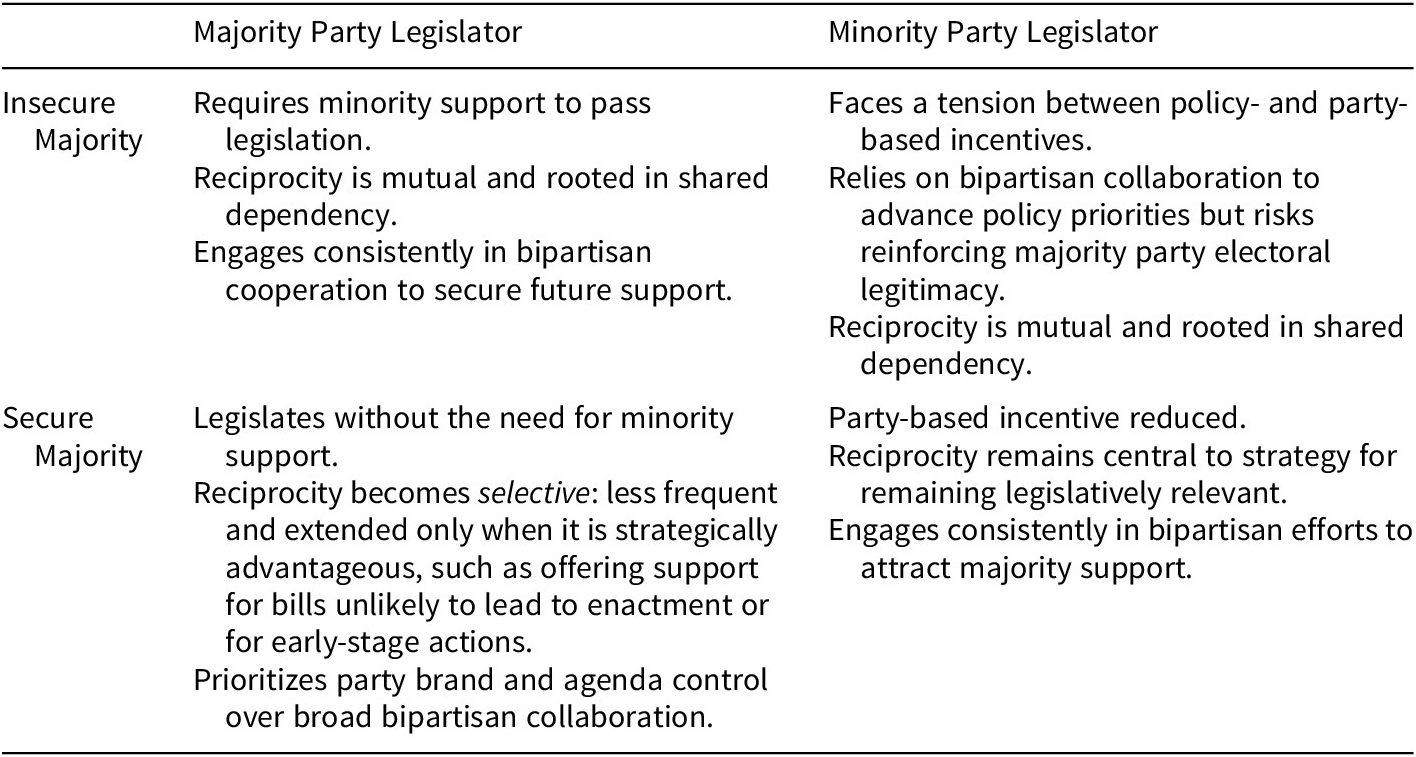
This novel theoretical framework refines our understanding of legislative behavior under conditions of majority security. Building on earlier accounts of reciprocity in legislative politics, it introduces a crucial distinction between mutual dependency and selective engagement, showing how majority security transforms not just the frequency but the structure of bipartisan collaboration. In secure majority legislatures, reciprocity does not disappear; instead, it becomes increasingly conditional and asymmetrical. Minority party legislators consistently invest in bipartisan collaboration to sustain legislative relevance, while majority party legislators reciprocate only selectively, offering support primarily on minority party initiatives unlikely to pass, or during early stages of the lawmaking process that are less politically costly. In Table 1, I summarize this framework, juxtaposing how the incentives for reciprocating bipartisan collaboration diverge across secure and insecure majority environments by legislators’ party status.
Summary of incentives structuring legislative reciprocity by majority security and party status

Assumptions and alternative pathways
The theory of selective reciprocity rests on several scope conditions. First, it assumes that legislators are strategic and forward-looking actors. In particular, minority party legislators in secure majority states are expected to engage in a long-term reciprocal calculus, investing in bipartisan collaboration not for immediate returns but because they anticipate that building reputational capital through cooperation may yield future opportunities. Second, the framework assumes that legislators interpret majority security in relatively uniform ways: insecure majorities generate mutual dependence across parties, while secure majorities reduce interdependence and allow majority legislators to reciprocate selectively. Reciprocity, in this framework, is not simply a behavioral residue of institutional norms but a deliberate strategy for maintaining legislative relevance under conditions of institutional disadvantage. However, several plausible alternative pathways could challenge this assumption.
One such alternative is that legislators prioritize the short-term interests of their party brand over any reciprocal considerations. In this scenario, legislators prioritize signaling ideological purity and party loyalty to constituents, minimizing bipartisan engagement even when operating under secure majority conditions. Bipartisanship would be rare, and reciprocal relationships across party lines would have little strategic value. Another possibility is that legislators are largely nonstrategic in their decision-making. Rather than engaging in a forward-looking reciprocal calculus, they may act myopically, neglecting the long-term implications of their behavior for future cooperation. Alternatively, minority party legislators may abandon policymaking efforts altogether, reallocating energy toward constituent services or symbolic actions that provide immediate personal or electoral rewards without fostering cross-party relationships.
Thus, while the theory of selective reciprocity posits that minority party legislators consciously invest in bipartisan cooperation to sustain future influence, it remains an open empirical question whether such a reciprocal logic actually governs legislative behavior in secure majority settings. If party brand maintenance, short-term political incentives, or non-legislative priorities dominate strategic calculations, the reciprocal calculus driving bipartisanship may not be realized. As such, it is important to empirically adjudicate between the theory of the null hypothesis and the theory of selective reciprocity.
Research design
I develop a research design that tests the core claim of my theory of selective reciprocity: that minority party legislators in secure majority chambers are strategic actors engaged in a long-term reciprocal calculus. Legislators invest in cooperative behavior to build reputational capital and cultivate opportunities for future legislative influence. Reciprocity, in this framework, is not merely a byproduct of institutional norms but a purposeful strategy for navigating structural disadvantage. Still, several alternative pathways challenge this assumption – for example, legislators may prioritize party brand maintenance, ideological signaling, or individual credit-claiming over reciprocal coalition-building. The empirical tests that follow are designed to adjudicate between these interpretations by examining whether bipartisan efforts yield legislative rewards – and, crucially, whether such rewards are structured by the partisan security of the majority.
Measuring bipartisan collaboration
To test this framework, I draw on an original dataset of 401,720 billsFootnote 3 introduced across 43 state legislatures between 2009 and 2018.Footnote 4 I define bipartisan collaboration as a legislator’s engagement in cross-party collaboration on legislative items, specifically regarding sponsorship and cosponsorship activity. As such, I conceptualize bipartisan collaboration across two dimensions: giving cosponsorships to out-party bills and receiving out-party cosponsors on one’s bills. Specifically, Proportion Bipartisan Cosponsorships Offered reflects a legislator’s willingness to cosponsor bills introduced by members of the opposing party. It captures the average proportion of a legislator’s cosponsorships that she provides to out-party sponsors relative to all the cosponsorships she gives in a legislative term. This measure reflects the legislator’s willingness to cooperate with the opposing party on legislative initiatives to build up a reputation as a bipartisan lawmaker. For example, if a legislator i cosponsors 10 bills, three of which are with members of the out-party, her Proportion Bipartisan Cosponsorships Offered would be 0.3 (or 30%). Proportion Bipartisan Cosponsors Attracted captures a legislator’s ability to attract out-party cosponsors on her own sponsored legislation. It quantifies the average density of out-party cosponsorships across all the bills sponsored by a legislator, providing insight into the extent to which a legislator attracts support from the opposing party. This score is necessary because it captures the volume and density of out-party support for a legislator’s sponsored bills, on average. A higher value indicates that a legislator is more successful at attracting out-party cosponsors across her sponsorship portfolio.Footnote 5
Together, these measures provide a holistic view of bipartisan collaboration, showing the extent to which a legislator engages with opposing party members’ bills and her ability to build bipartisan support for her initiatives. Focusing on cosponsorship offers a tangible, comparable measure of collaboration across multiple stages of the legislative process, from bill introduction through committee actions, regardless of whether bills reach a floor vote (Fowler Reference Fowler2006; Kirkland and Gross Reference Kirkland and Gross2014; Tam Cho and Fowler Reference Cho and Fowler2010). These measures also capture early coalition-building, when bipartisan ties are often forged (Campbell Reference Campbell1982; Kessler and Krehbiel Reference Kessler and Krehbiel1996; Wilson and Young Reference Wilson and Young1997) and they follow established practice in congressional research (Harbridge Reference Harbridge2015; Harbridge-Yong, Volden, and Wiseman Reference Harbridge-Yong, Volden and Wiseman2023; Rippere Reference Rippere2016).
Measuring majority security
The second measure that is key to my research design, derived from the theoretical framework, is Partisan Seat Share Difference, which serves as a proxy for majority security. This chamber-level variable captures the absolute difference in the proportion of seats held by the majority and minority parties. Larger values indicate more lopsided chambers in which the majority party controls a larger share of seats and is, therefore, more secure.Footnote 6 I assess its within-chamber temporal stability in multiple ways. Correlations across consecutive legislative terms are extremely high: 0.993 for a one-term lag, 0.986 for a two-term lag, and 0.980 for a three-term lag. These patterns indicate that while there is meaningful variation across chambers, individual chambers tend to remain relatively stable in their partisan seat share over time. Additionally, I estimate a random intercept model with state–chamber-level effects that produces an intraclass correlation coefficient (ICC) of 0.83, indicating that over 80% of the variance in majority security occurs between chambers rather than within them.
This distinction is important for how the measure functions across the empirical tests. In the test of Hypothesis 1, Partisan Seat Share Difference is used as a continuous independent variable to assess whether increasing seat share differentials predict changes in bipartisan behavior. In the tests of Hypotheses 2, 3, and 4, by contrast, I use the continuous values to classify chamber–term observations into secure and insecure subsamples. In those models, the observed temporal stability supports confidence that chambers classified as secure in one term are likely to remain secure in adjacent terms – justifying the use of chamber–term classification for disaggregated analysis. A chamber is defined as secure if the majority party holds at least two-thirds of the seats, a threshold that captures supermajority control and the institutional independence it affords.Footnote 7
Although classification is binary in the subgroup models, meaningful variation in seat share is preserved within both the secure and insecure groups. This classification reflects the theoretical framework’s emphasis on how majority security conditions legislative incentives: majority party legislators in supermajority chambers can govern unilaterally and are less reliant on minority party cooperation. By contrast, legislators in insecure chambers must often build bipartisan coalitions to pass legislation, heightening the value and mutual dependency of reciprocity.Footnote 8
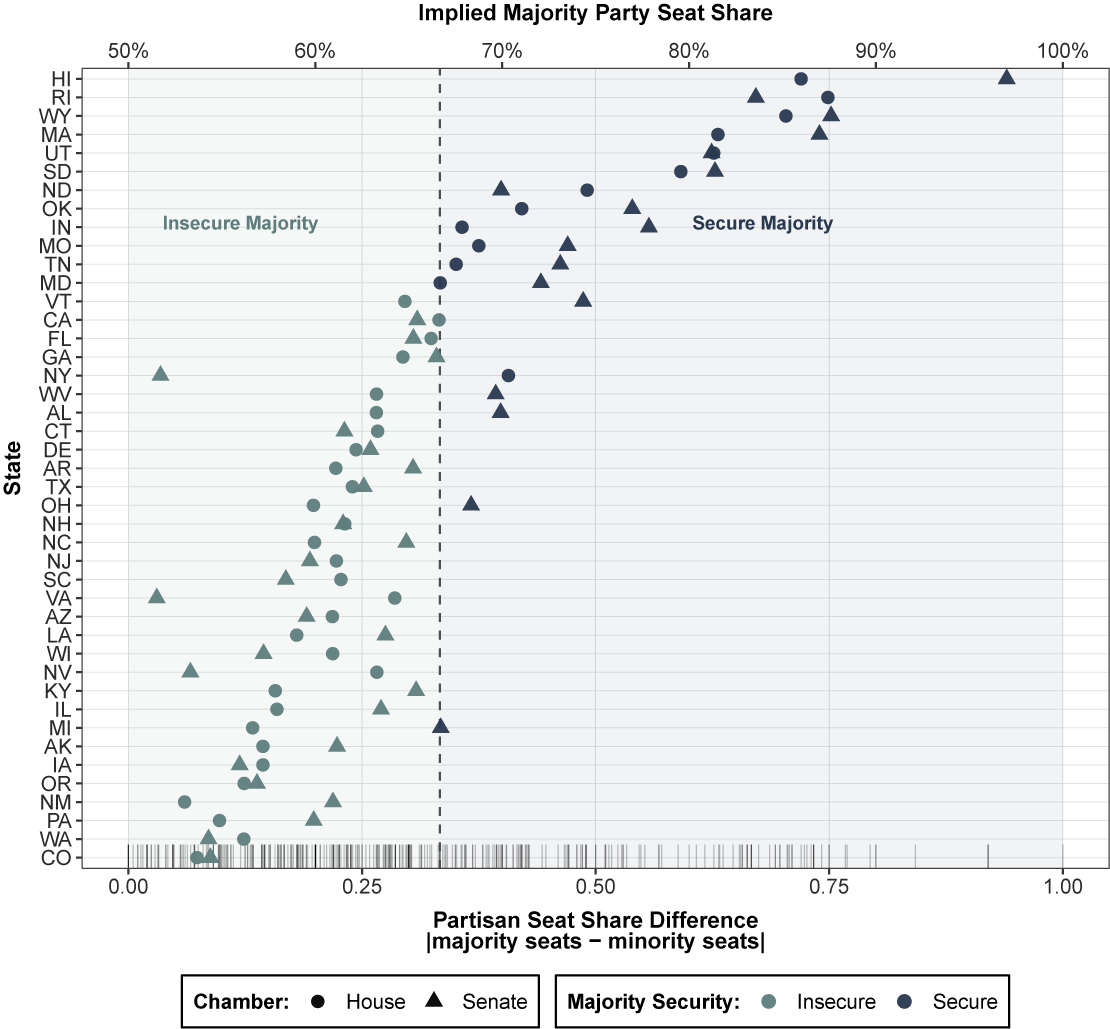
I illustrate this classification in Figure 1. Each point shows a chamber’s average Partisan Seat Share Difference, with shape indicating chamber type and color denoting whether the chamber meets the supermajority threshold. The accompanying rug plot summarizes the distribution of majority security across all chambers and terms. While the figure aggregates to chamber-level averages for clarity, all subsequent analyses rely on chamber–term classifications to preserve temporal precision.
Partisan seat share differences by state-chamber with majority security classification.
Note: The figure presents the average Partisan Seat Share Difference for each state-chamber, with point shape indicating chamber type (House or Senate) and color denoting majority security classification (insecure or secure). Secure majorities are defined as chambers in which the majority party’s Partisan Seat Share Difference is 0.33 or larger during a given term. The secondary (top) axis translates these differences into the implied majority party seat share, offering a more intuitive sense of the proportion of seats held by the majority. Each point reflects a chamber-level average for visual clarity. The rug plot along the x-axis shows the distribution of Partisan Seat Share Difference across all state–chamber–term observations.

Measuring legislative success
Finally, to measure legislative success, I utilize Bucchianeri, Volden, and Wiseman’s (Reference Bucchianeri, Volden and Wiseman2025) State Legislative Effectiveness Scores (SLES) dataset. Rather than predicting legislators’ overall SLES using measures of bipartisan collaboration, I regress their indicators of bill-level progress onto observed patterns of bipartisan behavior. This disaggregated approach allows for more targeted tests of whether and when bipartisan efforts translate into measurable lawmaking success.Footnote 9 I examine whether bipartisan collaboration facilitates legislative advancement through the following four stages of the lawmaking process: bill introduction (BILLS), action in committee (AIC), action beyond committee (ABC), and legislative passage (PASS), as each stage reflects a meaningful progression in coalition-building.Footnote 10 This bill-level, stage-specific approach allows me to test whether bipartisan efforts are reciprocated consistently or selectively. Rather than relying on composite effectiveness scores, which conflate stages and processes, I examine whether bipartisan collaboration enables measurable advancement of substantive legislation. Doing so offers a more precise lens on when, where, and for whom bipartisan behavior is rewarded.
Modeling
This article employs several models to estimate the relationship between bipartisan collaboration and legislative success by leveraging institutional variation across state legislative chambers. The analysis is organized into four tests, each focusing on a different facet of bipartisan activity. Test 1 estimates the association between Proportion Bipartisan Cosponsorships Offered and Partisan Seat Share Difference. This test evaluates H1 by asking whether legislators in insecure majority chambers engage in bipartisan collaboration at different rates than legislators in secure majority chambers, with expectations differing by party status (i.e., majority versus minority). Test 2 utilizes a within-legislator design to identify whether minority party legislators are consistently bipartisan over time. More specifically, it examines whether a minority legislator changes her level of bipartisanship across terms in both insecure and secure chambers, estimating the association between Proportion Bipartisan Cosponsorships Offered and Seniority. This model accounts for personal and institutional factors that may influence a legislator’s propensity to engage in bipartisan behavior. Test 3 examines whether previous bipartisan cosponsorship behavior predicts reciprocal cosponsorship in future terms. In this test, Proportion Bipartisan Cosponsorships Offered is included in the current term, lagged by one term, and lagged by two terms. I estimate its association with Proportion Bipartisan Cosponsors Attracted to explore whether early-term bipartisan actions by minority party legislators are associated with future bipartisan cooperation from majority party legislators. This test explores whether early-term bipartisan actions by minority party legislators are associated with future bipartisan cooperation from majority party legislators. Finally, Test 4 explores how Proportion Bipartisan Cosponsorships Offered affects minority party legislators’ substantive legislative activity at different stages of the lawmaking process that require coalition-building. The dependent variable is legislative activity at each stage of the lawmaking process. This test is designed to identify whether the majority party legislators reward bipartisan support at specific stages of the lawmaking process, conditioning on the level of majority security.
Each of the models conditions on a range of individual- and institutional-level covariates that are related to bipartisan collaboration, cosponsorship activity, and legislative success (e.g., Bucchianeri, Volden, and Wiseman Reference Bucchianeri, Volden and Wiseman2025; Harbridge Reference Harbridge2015; Harbridge-Yong, Volden, and Wiseman Reference Harbridge-Yong, Volden and Wiseman2023). These control variables include: term limits (National Conference of State Legislatures), legislative professionalism, as measured by the Squire index (Squire Reference Squire1992, Reference Squire2024), polarization, which captures the absolute difference in median Shor-McCarty ideology scores between parties (Shor and McCarty Reference Shor and McCarty2011), distance from the median, which reflects the ideological distance between a lawmaker’s ideal point and the median lawmaker’s ideal point in a chamber,Footnote 11 majority party membership, various leadership positions, including committee chairs, speaker or president positions, and party leaders, as well as legislators’ seniority, race, gender, and the proportion of votes received in the previous election (Bucchianeri, Volden, and Wiseman Reference Bucchianeri, Volden and Wiseman2025). Finally, I condition on a simulation-based measure of expected bipartisanship to assess whether observed bipartisanship reflects deliberate behavior rather than mechanical features of chamber composition. This procedure constructs chamber–term–specific “bill pools” consisting only of bills that received at least one cosponsor. These pools retain each bill’s observed sponsor and party, and therefore reflect the actual opportunity set legislators faced. For each legislator, I simulate 1,000 random draws from this bill pool, selecting the same number of bills that the legislator actually cosponsored. In each iteration, I calculate the proportion of those bills sponsored by the out-party. The mean across simulations yields a legislator-specific expected bipartisan rate under random selection from the available legislative agenda (Desmarais and Cranmer Reference Desmarais, Cranmer, Victor, Montgomery and Lubell2017). This benchmark offers the strictest test of intentionality by adjusting for both chamber behavior and legislative opportunity.
To account for differences within and between statehouses, models are estimated with fixed effects. Including state, chamber, and term fixed effects in the models ensures that unobserved, systematic differences at each level are accounted for, reducing bias in the estimated associations. State fixed effects control for time-invariant factors specific to each state, such as institutional structures or political culture. Chamber fixed effects adjust for differences between legislative chambers, while term fixed effects account for broader temporal trends or events that might influence legislative behavior across all units in a given period. Together, these fixed effects help isolate the relationships of interest by minimizing confounding from both observed and unobserved heterogeneity. In all models, standard errors are clustered by legislator to account for the potential correlation of errors within legislators over time. This approach ensures that estimates are robust to within-legislator correlation, which is especially important given that legislator-specific characteristics and behavior may influence legislative outcomes across multiple terms.
Results
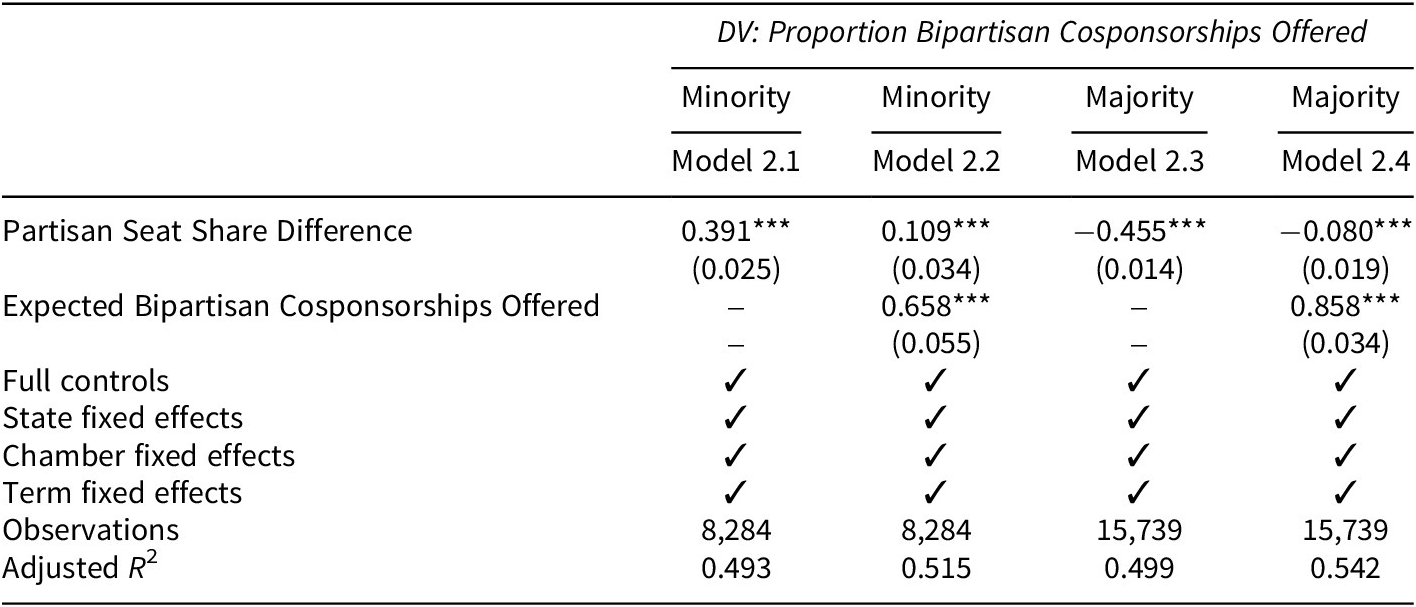
This section presents a series of empirical tests evaluating the theory of selective reciprocity. I begin by examining whether higher levels of majority security prompt minority party legislators to engage more frequently in bipartisan behavior. This forms the basis for H1, which predicts a positive relationship between majority party security and the rate at which minority legislators cosponsor bills sponsored by majority party legislators. To evaluate this relationship, I estimate four models predicting legislators’ Proportion Bipartisan Cosponsorships Offered. Models 2.1 and 2.2 restrict the sample to minority party legislators, while Models 2.3 and 2.4 include only majority party legislators. The key independent variable in each model is Partisan Seat Share Difference, a chamber–term-level measure capturing the absolute difference in seat share between the two parties. Higher values reflect greater majority party security. All models include state, chamber, and term fixed effects, and condition on several individual- and institutional-level covariates (Table 2).
The effect of majority security on bipartisanship by party status

Note: The models are estimated using OLS regression. The dependent variable across all models is Proportion Bipartisan Cosponsorships Offered. Models 2.1 and 2.2 include minority party legislators, while Models 2.3 and 2.4 include majority party legislators. Models 2.2 and 2.4 introduce control variables to mitigate the possibility that legislators’ cosponsorship offerings to out-party bills are influenced simply by the increased volume of out-party bills introduced. Standard errors are clustered by legislator and reported in parentheses.
*p < 0.1, **p < 0.05, ***p < 0.01.
The results provide strong support for H1. Among minority party legislators (Models 2.1 and 2.2), majority security is positively and significantly associated with bipartisan behavior. In the baseline specification (Model 2.1), a one-unit increase in Partisan Seat Share Difference predicts a 0.39-point increase in bipartisan cosponsorship – equivalent to 165% of the dependent variable’s standard deviation. This relationship remains robust across the alternative specification that tests for mechanical artifacts of chamber composition via a simulation-based benchmark: any deviation from this expectation suggests purposive collaboration. Crucially, even under this strictest specification (Model 2.2), the positive relationship between majority security and minority bipartisan behavior persists. A one-unit increase in Partisan Seat Share Difference predicts an increase in bipartisan cosponsorship equivalent to 46% of a standard deviation – smaller than the baseline estimate but still substantively meaningful. These results confirm that minority party legislators respond to secure majorities not with disengagement, but with strategic efforts to cooperate. Majority party legislators, by contrast, exhibit the opposite pattern.
In Models 2.3 and 2.4, the coefficient on majority security is negative and statistically significant across both specifications. In the baseline model (2.3), a one-unit increase in Partisan Seat Share Difference predicts a 0.45-point decline in bipartisan cosponsorship – an effect equal to 221% of the dependent variable’s standard deviation. The magnitude of this negative association remains consistent in Model 2.4. In the most demanding model, the estimated decline is equivalent to 39% of a standard deviation.
Together, these findings establish the foundational empirical claim of the theory: that bipartisan behavior varies systematically with majority party security. The results consistently show that as majority security increases, legislators in the minority party deliberately increase their frequency of cosponsoring majority party bills, while majority party legislators decrease the amount of cosponsorship they offer to minority party bills. This finding holds whether bipartisanship is measured directly or assessed conditional on the expected rate under random behavior. This finding strongly supports interpreting bipartisan cosponsorship as an intentional, strategic behavior rather than a mechanical byproduct.
Minority party legislators consistently cosponsor majority party bills (H2)
The next test evaluates whether minority party legislators consistently cosponsor majority party bills across multiple legislative terms. According to the theory, minority legislators have incentives to engage in bipartisan behavior under both secure and insecure majority conditions. Even in competitive chambers, cross-party collaboration may be one of the few available strategies for influencing policy from the minority. However, when majority control is secure, the incentives for minority party legislators to engage in bipartisanship become clearer and less conflicted. In these settings, minority legislators are unlikely to regain power in the near term, and the risk of reinforcing the majority’s electoral brand through cooperation is reduced. Policy-based incentives dominate, making bipartisan engagement a more straightforward and consistent strategy. In more competitive environments, the same incentives exist but are accompanied by a sharper tradeoff between pursuing policy goals and maintaining partisan distinctiveness. This logic suggests that bipartisan behavior should remain stable over time in both contexts, even if the underlying motivation differs. If so, the coefficients on time in within-legislator models should be close to zero, indicating little change in behavior across legislative terms.
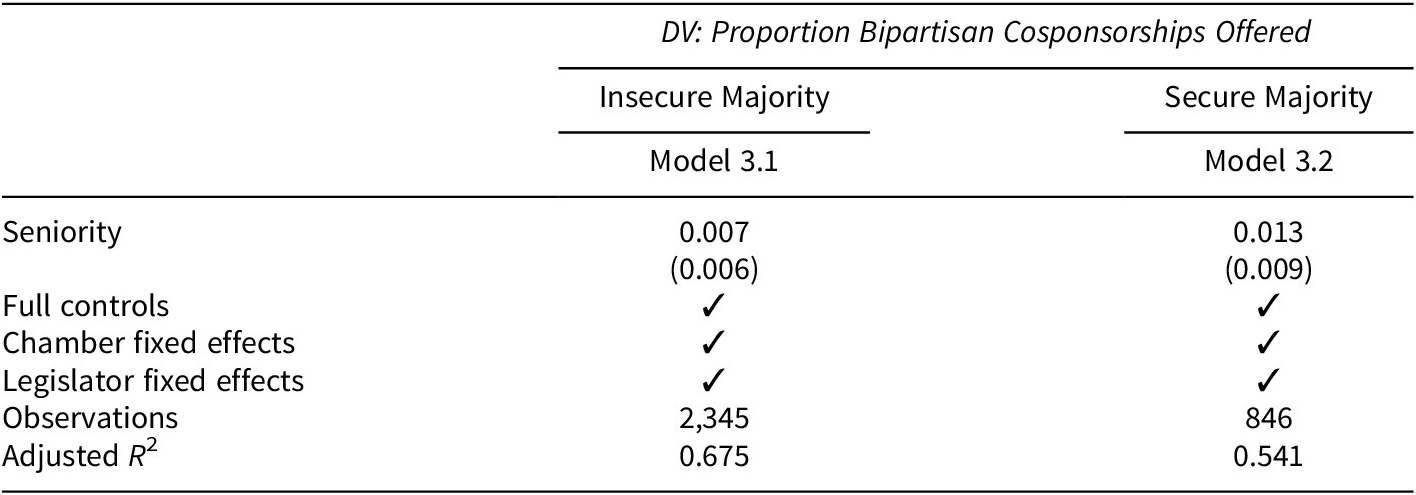
To empirically test this argument, Table 3 presents the results of a within-legislator design that utilizes time to determine whether or not minority party legislators’ cosponsorship offerings to majority party bills are enduring. The samples contain minority party legislators, disaggregated by the level of majority security. The dependent variable in each model is Proportion Bipartisan Cosponsorships Offered. The primary independent variable is Seniority, which corresponds to the specific legislative term in which a legislator is currently serving. I restrict the sample of minority party legislators to those who entered office after comprehensive bipartisan cosponsorship data became available. This restriction addresses the limitations of left censoring. This modeling strategy ensures that the analysis begins with a full observation of bipartisan cosponsorship behavior, avoiding the biases introduced by missing data in earlier terms, such as potential learning effects. The models are estimated using OLS regression and condition on relevant, time-varying confounders. Given that these models leverage time as the explanatory variable, legislator and chamber fixed effects are included to account for unobserved heterogeneity between individual legislators.
Minority party legislators are consistently bipartisan lawmakers

Note: The models are estimated using OLS regression. The dependent variable across each model is Proportion Bipartisan Cosponsorships Offered. The primary independent variable is Seniority. The models are disaggregated by level of majority security and include minority party legislators who entered office after complete bipartisan cosponsorship data became available. Standard errors are clustered by legislator and reported in parentheses.
*p < 0.1, **p < 0.05, ***p < 0.01.
Across insecure and secure majority chambers, the coefficient on Seniority is small and statistically insignificant. This suggests that minority party legislators do not substantially change their bipartisan behavior as they gain experience. This pattern reinforces the theoretical claim that legislators in the minority party internalize the need to engage in cross-party collaboration early in their careers and then sustain that behavior over time, confirming H2.
The absence of change over time strengthens the interpretation that their behavior is not circumstantial or reactive, but reflective of a stable, incentive-aligned strategy. These results lend further support to H1. They show not only that minority party legislators in secure chambers engage in more bipartisan behavior on average, but also that this behavior persists across legislative terms.
Minority party legislators engage in bipartisan relationship building (H3)
Building on the evidence that minority party legislators consistently engage in bipartisan cosponsorship, I next evaluate whether these efforts yield reputational dividends over time. I now extend this analysis by examining whether those sustained bipartisan efforts generate returns. Whereas the prior models tested the persistence of bipartisan behavior, the next set of models evaluates its payoff: do minority party legislators who consistently cosponsor majority party bills receive greater bipartisan support for their own bills in the future? This test reflects the institutionalized norm of reciprocity, which is expected to operate under both secure and insecure majority conditions. In both environments, legislators form and maintain cross-party relationships with the expectation that support will eventually be returned. The theory does not predict that reciprocity itself disappears in secure majorities; rather, it suggests that the timing and substance of reciprocation may differ. Here, however, the focus is not on selective application across bill types or legislative stages, but on whether reciprocal behavior emerges at all. Thus, regardless of majority party security, minority party legislators who invest in bipartisan engagement should be more likely to attract bipartisan support in return (H3), as consistent cosponsorship of majority-sponsored legislation represents a strategic effort to accumulate reputational capital over time.
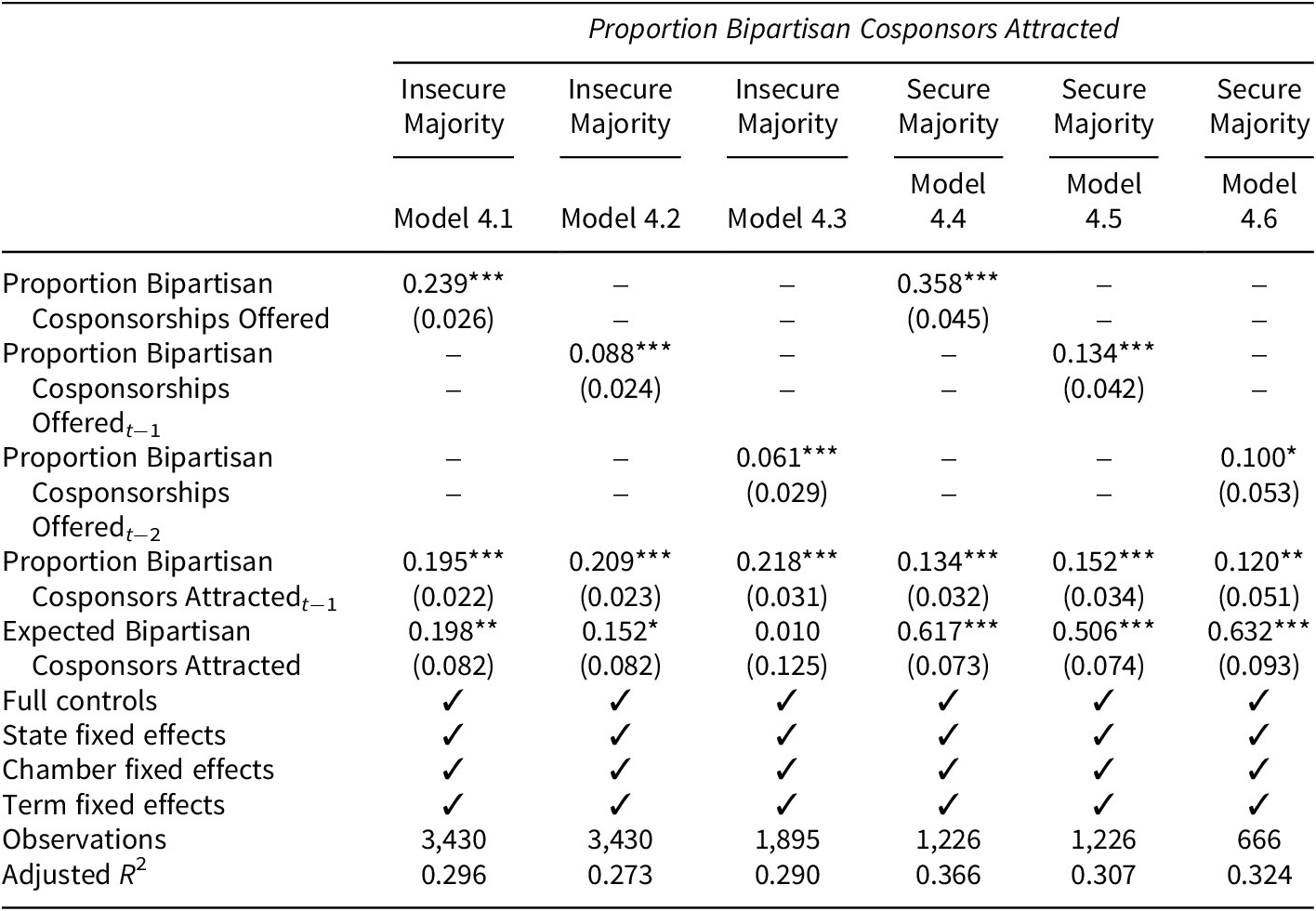
To evaluate this expectation, I estimate a series of models predicting minority party legislators’ success at attracting majority party support to their bills in term t based on their cosponsorship of majority party bills in term t, t − 1, and t − 2. This design shifts the analytic focus from behavioral stability to behavioral returns. If reciprocity is at work, legislators who extend bipartisan support should subsequently receive more support for their own legislative initiatives, regardless of whether the majority party’s control is electorally secure or tenuous. When estimating these associations, I also control for Proportion Bipartisan Cosponsors Attractedt−1 and Expected Bipartisan Cosponsors Attracted. These controls ensure that effects are not confounded by prior patterns of observed bipartisan attraction or chamber composition. More specifically, Expected Bipartisan Cosponsors Attracted is a simulation-based measure that serves as a benchmark to capture the expected rate at which a given legislator’s bills would receive out-party cosponsors under conditions of random assignment, holding fixed the number of observed cosponsors on each bill.Footnote 12 This control ensures that the positive association between past bipartisan outreach and future bipartisan support is not simply a mechanical function of exposure to large or ideologically moderate coalitions. Instead, it more precisely evaluates reputational returns based on prior bipartisan collaboration (Table 4).
Minority party legislators who cosponsor majority party bills are reciprocated by majority party cosponsors

Note: The dependent variable across all models is Proportion Bipartisan Cosponsors Attracted. The key independent variable is Proportion Bipartisan Cosponsorships Offered, at the following time points: t, t−1, and t−2. Models are disaggregated by level of majority security and include minority party legislators. In addition to the full set of controls included in the models, Proportion Bipartisan Cosponsors Attractedt−1 and Expected Bipartisan Cosponsors Attracted ensure that the association between cosponsoring majority party bills and attracting majority party cosponsors is not confounded by majority party cosponsors attracted prior, or by a mechanical effect from chamber composition. Standard errors are clustered by legislator and shown in parentheses.
* p < 0.1, **p < 0.05, ***p < 0.01.
The results provide strong support for H3. Across all three specifications of Proportion Bipartisan Cosponsorships Offered, the coefficient is positive and statistically significant. To contextualize the magnitude of these effects, consider the size of the coefficients relative to the standard deviation of the dependent variable, Proportion Bipartisan Cosponsors Attracted. A one-unit increase in minority party legislators’ Proportion Bipartisan Cosponsorships Offered during the current legislative term in insecure majority chambers is associated with a 0.239-point increase in Proportion Bipartisan Cosponsors Attracted. The effect endures over time: legislators who cosponsored majority party bills in the two prior legislative terms also attract more majority party cosponsors in the present term. These lagged effects correspond to increases of approximately 43% and 30% of a standard deviation, respectively. Interestingly, the effects are even larger in secure majority chambers. There, a one-unit increase in bipartisan cosponsorships offered during term t predicts a 0.35-point increase in cosponsors attracted, with prior support translating into gains equivalent to 61% and 45% of a standard deviation in term t−1 and term t−2, respectively. These results provide strong evidence that bipartisan reciprocity operates across various levels of majority security: legislators who extend cross-party support are more likely to receive it in return.
This pattern reinforces the theoretical expectation that reciprocity is an enduring feature of legislative behavior, grounded in institutional norms and strategic relationship-building. However, while these findings confirm that reciprocity occurs, they leave open a critical question about its structure: is majority party support extended broadly across the legislative agenda, or is it targeted in ways that minimize political cost? When majority control is secure and cross-party coalitions are no longer necessary, the theory anticipates that reciprocity becomes conditional and asymmetric. Majority party legislators may still return bipartisan support, but do so selectively – prioritizing lower risk moments of engagement, such as the early coalition-building stages of the lawmaking process, and avoiding bills with high stakes for the party’s agenda. Identifying when and how reciprocation occurs is essential for determining whether bipartisan collaboration under secure majorities reflects a meaningful legislative partnership or a more constrained, instrumental form of exchange.
Conditional cooperation: when and how majority party legislators reciprocate (H4)
While the previous test shows that minority party legislators who engage in bipartisan cosponsorship receive greater support from majority party colleagues in future terms, it remains unclear where in the legislative process this reciprocation occurs. As discussed earlier, majority party legislators in secure majorities are under less pressure to collaborate across party lines. Yet the persistence of reciprocity suggests that they may still respond to minority legislators’ bipartisan efforts – albeit in ways shaped by strategic calculation rather than mutual dependency. I argue that this reciprocation is selective rather than uniform. Majority legislators may respond to bipartisan signals, but primarily when the political cost of doing so is low – such as at the early stages of the legislative process or on bills that are unlikely to advance.
To test this expectation (H4), I draw on data from Bucchianeri, Volden, and Wiseman (Reference Bucchianeri, Volden and Wiseman2025) to disaggregate legislative success into four stages of progression: bill introduction, action in committee, action beyond committee, and passage in the chamber. Rather than predicting composite legislative effectiveness, this approach isolates whether and where bipartisan cosponsorship translates into forward momentum in the lawmaking process. This design improves on prior approaches by clarifying the timing and substance of reciprocity. It allows us to assess whether bipartisan efforts yield legislative gains only at the front end of the process, or whether they persist into later, more consequential stages. In doing so, the analysis distinguishes between surface-level collaboration and meaningful legislative advancement. If the majority of legislators respond only at early stages or on bills unlikely to progress, it would suggest that reciprocity in secure chambers reflects a strategic filtering of bipartisan cooperation. The key predictor is the proportion of bipartisan cosponsorships that a minority legislator extends to majority-sponsored bills in the prior term (t − 1). The dependent variables capture the number of minority-sponsored bills in the current term (t) that advance through successive stages of the lawmaking process: introduction (BILLS), consideration in committee (AIC), advancement beyond committee (ABC), and final passage (PASS). This design permits the assessment of whether or not prior bipartisan support for the majority predicts subsequent advancement of minority bills, thereby isolating the reciprocal mechanism at the core of the theory.
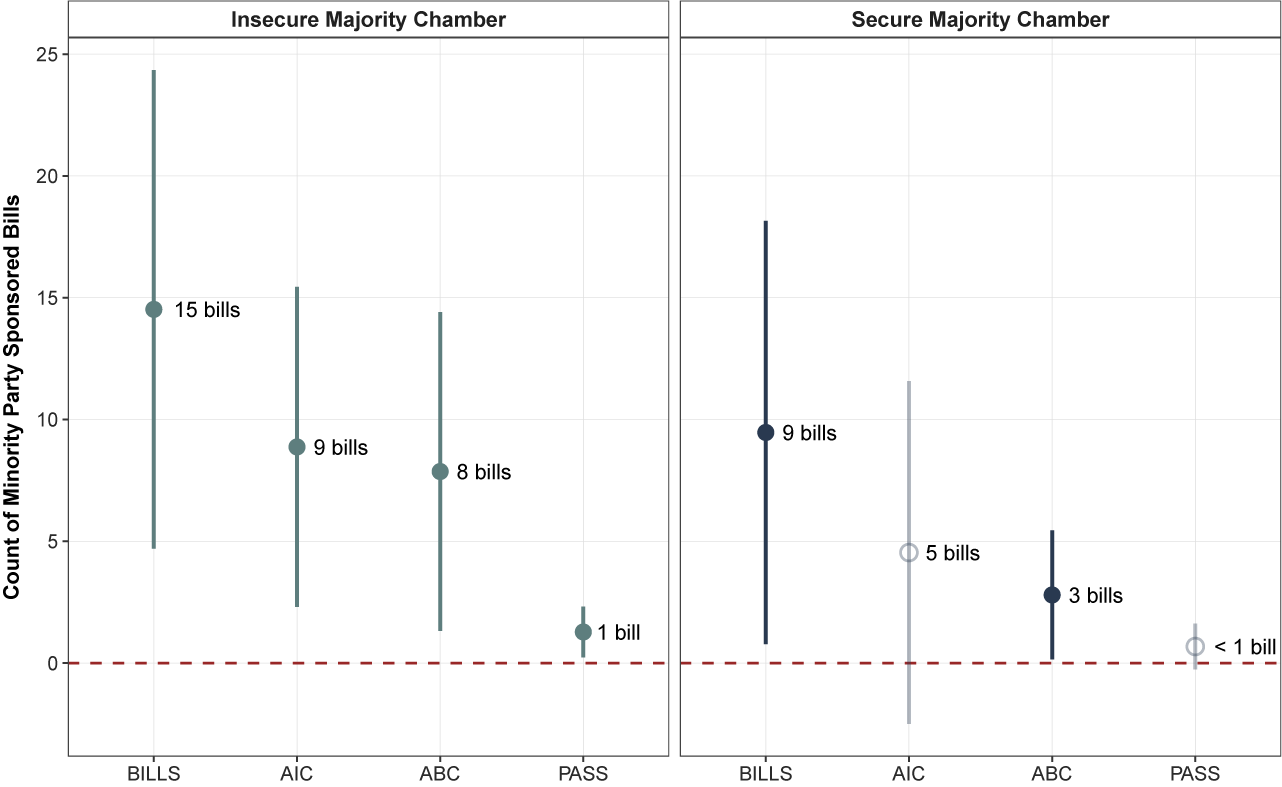
The results in Figure 2 provide evidence of the reciprocal mechanism at the heart of the theory. In each model, the dependent variable is the number of bills sponsored by a minority party legislator in term t that reach successive stages of the lawmaking process: introduction (BILLS), AIC, ABC, and final passage (PASS). The key predictor is the proportion of bipartisan cosponsorships that the legislator extended to majority-sponsored bills in the prior term (t – 1). This design directly tests whether prior bipartisan support from the minority is reciprocated by the majority in subsequent lawmaking outcomes.Footnote 13 Graphically, the estimates show that reciprocity is conditioned by majority security. In insecure majority chambers, where partisan control is tenuous and mutual dependency is greatest, prior bipartisan cosponsorship is strongly and consistently rewarded. Each one-unit increase in cross-party support in the prior term yields statistically significant increases in the number of minority-sponsored bills advancing at every stage, from introduction through final passage.
Majority party legislators selectively reciprocate on minority party legislation.
Note: The figure presents coefficient estimates and corresponding error bars across four regression models in insecure majority chambers and four regression models in secure majority chambers. The coefficient estimate represents the effect of minority party legislators’ prior bipartisan cosponsorship of majority party legislation (Proportion Bipartisan Cosponsorships Offered t−1) on the number of minority party-sponsored bills introduced (BILLS), considered in committee (AIC), advancing beyond committee (ABC), and ultimately passing (PASS), in the current term. Dark, solid points indicate statistically significant effects (p < 0.05), while more transparent hollow points indicate non-significant estimates. Numeric labels report coefficients and can be interpreted as the expected change in the number of minority party-sponsored bills reaching each stage associated with a one-unit increase in prior bipartisan cosponsorship. Substantively, the results show that bipartisanship yields meaningful returns for minority legislators only in insecure majority chambers, while such effects are absent when the majority’s position is secure.

By contrast, in secure majority chambers, where the majority can govern unilaterally, reciprocity is partial and selective. Prior bipartisan cosponsorship predicts more introductions and some action beyond committee, but the effects are weaker and do not extend to passage. The visual presentation reinforces this asymmetry. Solid, opaque markers indicate statistically significant estimates, while hollow, semi-transparent markers highlight coefficients that are indistinguishable from zero. Numeric annotations (e.g., “15 bills”) clarify the substantive effect size at each stage, underscoring that, in insecure chambers, bipartisanship can translate into sizable legislative gains, whereas, in secure chambers its returns are limited and largely symbolic.
These results support the theoretical framework of selective reciprocity in two key ways. First, they demonstrate that reciprocal returns to bipartisan behavior are not uniformly distributed: they are conditional on the degree of majority party security. Second, they show that the consequential payoffs – passing substantive legislation – occur only under the most competitive conditions. In chambers with greater party competition, minority party legislators can convert reputational investments into real policy success. In more secure chambers, the returns to bipartisanship are truncated, confined to early, less politically costly stages of the legislative process. Just as majorities in the US Congress must often secure bipartisan support to govern effectively, minority party legislators in more competitive state chambers can better convert bipartisan investments into meaningful legislative gains. Mutual reciprocity thrives where partisan competition creates uncertainty, and future cooperation cannot be taken for granted. By contrast, when majority party margins are robust, minority party legislators bear the burden of bipartisan engagement without receiving equivalent returns.
Discussion and conclusion
This study reevaluates bipartisanship in legislative institutions by emphasizing the importance of institutional variation across US state legislatures. State legislatures vary widely in terms of majority security, partisan competition, and legislative structures, which shape legislators’ incentives and strategies for cross-party collaboration. By leveraging this institutional diversity, I develop and test a theory of selective reciprocity, which argues that, while bipartisan cooperation persists even under secure majorities, its nature is fundamentally altered: minority party legislators continue investing in bipartisan engagement, but majority party legislators reciprocate selectively and strategically, primarily on low-salience or symbolic legislation. Because cosponsorship is a key pathway to early-stage agenda access, affecting which proposals receive attention, committee consideration, and floor time, the dynamics documented here bear directly on democratic representation rather than merely on legislative etiquette.
The findings reveal that bipartisan efforts alone do not guarantee meaningful legislative gains. As the majority party’s security increases, the strategic incentives surrounding bipartisan engagement shift markedly. Minority party legislators in secure majority chambers may consistently signal a willingness to collaborate – often by cosponsoring majority party bills – but those efforts rarely translate into substantive policy success. Instead, majority party legislators engage in a form of selective reciprocity: they return bipartisan support less frequently and primarily when it carries minimal political cost. Reciprocity is more likely to occur on legislation that is unlikely to advance, on issues that do not challenge the majority’s agenda, or at the early stages of the legislative process, where the risks of collaboration are lower. Critically, the results also demonstrate that the capacity for bipartisan collaboration to produce substantive legislative success is not uniform across legislatures. In legislatures where majority control is insecure, minority party legislators can more successfully convert their reputational capital as a bipartisan colleague into concrete legislative gains. In contrast, under secure majorities, bipartisan cooperation by minority legislators yields only early-stage access without ultimately influencing policymaking outcomes. Substantively, this implies uneven representational payoffs: collaborative signals from minority legislators buy access but not advancement, thereby narrowing the priorities that ultimately reach consequential stages of lawmaking.
This article offers the first comprehensive examination of how the majority party’s security shapes the nature and consequences of bipartisan collaboration in US state legislatures. It contributes in three ways. First, it challenges the assumption that reciprocity operates uniformly across legislatures, showing instead that majority party security conditions when and how legislators engage in cross-party cooperation. Second, it introduces the concept of selective reciprocity, offering a framework for understanding bipartisan behavior as context-dependent, strategically constrained, and often asymmetrical. Third, it complicates and calls into question the normative appeal of bipartisanship. In secure majority states, bipartisan cooperation may persist, but it rarely translates into meaningful influence for the minority party. Instead, it offers the appearance of inclusion while reinforcing majority control over policymaking. These findings demonstrate that the value of bipartisan behavior is not intrinsic – it depends on whether it provides genuine opportunities for legislative impact. In institutions marked by structural dominance, bipartisanship may function less as a mechanism of representation and more as a tool of symbolic containment, raising broader concerns about representation and the responsiveness of the legislative process to diverse interests. These findings have profound normative implications. If bipartisan cooperation increasingly functions as a symbolic tool rather than a mechanism for substantive representation, it raises serious concerns about democratic accountability and responsiveness. While reciprocity between parties persists even under secure majorities, its expression is fundamentally reshaped: it becomes selective, strategic, and constrained by structural power imbalances. In turn, selective reciprocity conditions whose interests are heard, whose agendas advance, and whose efforts remain confined to symbolic gestures.
This framework can also inform future research in several directions. First, it encourages scholars to disaggregate bipartisanship beyond voting behavior and examine early-stage collaboration, such as cosponsorship and agenda setting. Second, it invites inquiry into how party leaders, rules, and agenda control mediate reciprocal behavior under secure majorities. Third, it provides a foundation for examining how structural incentives influence not only whether reciprocity occurs but also how it unfolds: Which kinds of policy areas are more or less likely to elicit bipartisan cooperation? Are the bipartisan efforts of minority party legislators diffuse, reaching broadly across members of the majority party? Or are they concentrated, reflecting repeated interactions with a narrow set of reciprocators? Fourth, it provides an opportunity to extend the selectivity component identified here by modeling how majority legislators assign ex ante probabilities of passage to minority-sponsored bills. While this study demonstrates that majority members act strategically in deciding when to reciprocate, future work can specify the decision-making process itself – examining how legislators forecast which minority proposals are likely (or unlikely) to advance and how those expectations shape their bipartisan engagement. Finally, because cosponsorship opens the door to the agenda, selective reciprocity has clear representational stakes: the likely “winners” are legislators in the governing party – and their constituents – on issues central to the majority’s program. In contrast, the likely “losers” are minority legislators and their constituents, whose bipartisan efforts are more likely to remain symbolic in secure chambers. Future work should extend this line of inquiry by exploring the reputational consequences of Democratic and Republican majorities, comparing which bipartisan proposals advance in areas prioritized by the governing party versus which stall, thereby making visible whose interests are heard and whose agendas do not advance.
Ultimately, this study underscores that bipartisan collaboration cannot be evaluated solely by its presence or absence. Its consequences depend on institutional structures, strategic incentives, and partisan configurations. In legislatures with secure majorities, bipartisanship persists – but it does so selectively, asymmetrically, and often symbolically. Understanding when and how cross-party collaboration produces genuine legislative influence remains essential for theories of lawmaking and for evaluating the health and responsiveness of American democratic institutions.
Supplementary material
The supplementary material for this article can be found at http://doi.org/10.1017/spq.2026.10021.
Data availability statement
Replication materials are available on SPPQ Dataverse at https://doi.org/10.7910/DVN/W7OXER (Dobson Reference Dobson2026).
Acknowledgements
I thank Craig Volden, Jennifer Lawless, Justin H. Kirkland, Jeffrey J. Harden, James M. Curry, Jacob M. Lollis, Todd Makse, and Laurel Harbridge-Yong for reading many versions of this work and providing invaluable feedback and support. I am also grateful to members of the Representation and Politics in Legislatures Lab (RPLL) at the University of Notre Dame, attendees of the CEL State Legislative Effectiveness Conference (2025) and the State Politics and Policy Conference (2024 and 2025), and reviewers at RapidPeer (formerly Harvard PreReview) for their helpful comments and suggestions. Finally, I thank the anonymous reviewers at State Politics & Policy Quarterly for their constructive feedback throughout the publication process.
Funding statement
The author received no financial support for the research, authorship, and/or publication of this article.
Competing interests
The author declared no potential conflicts of interest with respect to the research, authorship, and/or publication of this article.
Author biography
Mackenzie R. Dobson is a Ph.D. candidate in the Department of Politics at the University of Virginia and a Visiting Scholar in the Representation and Politics in Legislatures Lab (Rooney Democracy Institute) at the University of Notre Dame.




 Open access

