




To step foot in Tehran today is to be submerged in a world of hazy, choking air. Thick layers of smoke and smog bear down on the city, obscuring vision, irritating eyes and throats, shuttering schools, and emptying public spaces. In a city long marked by steep wealth and climatic inequalities, recent decades have seen the respiratory lives of Tehran's residents further diverge as those with means undertake an increasingly expensive scramble up the slopes of the Alborz Mountains in search of clean and cool air. But such acutely poor air quality was not an inevitable outcome of Iran's 20th-century industrialization, and between the mid-1960s and the 1979 Iranian revolution it appeared that such a fate might be avoided. Repulsed by the polluted cityscapes of the industrialized world and recognizing the budding problem in their own country, those government officials responsible for the period's state-directed modernization schemes sought ways to avoid the polluted future they foresaw, in the process vesting their greatest environmental hopes in a new source of energy: natural gas.
With a focus on air pollution, this paper argues that Iran's Pahlavi-era policymakers perceived environmental limits to their industrializing policies and saw the growing availability of natural gas energy as a way to overcome them. In the 1960s and 1970s, the increasing visibility of soot, smog, and haze in their country's skies prompted an outpouring of anxiety among Iranians. Their escalating worries, periodically backed by the shah's personal interest, drove a wave of policies aimed at combating air pollution. At the same time, spurred by industrializing Iran's growing domestic energy needs, new refineries and pipelines brought natural gas to cities across the country. These two trends—declining air quality and the increasing availability of natural gas—quickly intersected as Iranian policymakers identified the new fuel as a solution not only to the country's energy needs but also its environmental ones. Mirroring the dramatic rise in public environmental consciousness in the 1990s and after, existing discussions of Iran's air quality crisis have largely focused on the postrevolutionary period, ignoring Pahlavi-era attempts to mitigate pollution.Footnote 1 In contrast, this paper argues that there was a deep and coherent interest in addressing the challenges of urban air pollution in the prerevolutionary period. In response to the crisis, a broad set of modernizing Iranian officials—working within institutions like the Plan Organization, the Department of the Environment, and the National Iranian Gas Company—folded notions of ecological preservation into their visions of industrialized prosperity, seeing in natural gas the possibility of a cleaner future that did not necessitate a retreat from their developmental policies.
Underpinning Iran's encounter with air pollution were the natural forces of topography, climate, and chemical composition, significant nonhuman factors that helped produce Iranian cities as hybrid environments.Footnote 2 Emerging from complex and contingent historical trajectories, such hybrid spaces reflect the intermingling of human and natural agencies in their creation and maintenance. Building most proximately on the work of Bruno Latour and Michel Callon and their rejection of the assumed passivity of natural and technological phenomena in historical events, scholars like Timothy Mitchell and On Barak have excavated some of the Middle East's nonhuman entanglements and demonstrated their significance in the region's modern history.Footnote 3 Such authors show us that societies are made not only in the minds and actions of people, but also in the shaping of those intentions and activities by the properties of technologies and the natural world. Said differently, and with an eye toward the central topic of this paper, such a perspective asks that we take seriously the idea that the industrializing development of places like Iran did not set people free from their environmental entanglements. Indeed, the centrality of environmental management to Middle Eastern state-making and legitimation strategies has been underlined by Toby C. Jones, Alan Mikhail, and Pernilla Ouis, and their works demonstrate the need to incorporate environmental perspectives into our analyses of such historical processes.Footnote 4
Viewed through that lens, Iran's environment becomes more than an inert field upon which people exercised their will, being instead influential in the creation of urban spaces defined by smoke and haze. In the post-1963 era of the White Revolution, as city populations boomed with rural-urban migration, industrialization surrounded residents with more and more factories and motor vehicles. Added to these factors were towering mountain chains and a predominantly semiarid climate, an assemblage of factors that concentrated emissions and enveloped urbanites in a thick blanket of dirty air.Footnote 5 Iranian officials working in organizations like the National Iranian Gas Company themselves implicitly understood their cities as hybrid, even if they didn't use that kind of language, and saw natural phenomena like mountain ranges and atmospheric inversions as significant factors in both creating the problem of air pollution as well as constraining the range of potential solutions. “Engineers did not have infinite choices,” as Gabrielle Hecht has written in another context, and the same was true for those Iranians working to address their country's declining air quality.Footnote 6 Committed to a policy of industrialization but incapable of altering the pollution-intensifying effects of terrain and climate, officials sought to reduce emissions by relying on the differing combustion properties of fossil fuels and finding in natural gas an energy source that burned cleaner than oil and its derivatives. Pahlavi officials articulated and sought to implement an early form of what Maarten Hajer calls “ecological modernization,” a viewpoint that locates both environmental problems and their solutions within society's existing structures.Footnote 7 Focusing on both the rise of concern for Iran's urban air quality and the accompanying attempts to mitigate the issue via the provision of gas to factories in Tehran and Shiraz, this paper explores how natural gas became a way to seemingly reconcile a desire for industrializing development with growing worries about the environmental violence it wrought.
Iranians’ growing environmental concern in the 1960s and 1970s coincided with a global wave of anxiety surrounding the health effects of industrial pollution, irradiated nuclear fallout, and the widespread use of persistent toxins like DDT. Epitomized by Rachel Carson's 1962 book Silent Spring and the public outcry it helped galvanize, the era saw the emergence of grassroots movements and new regulatory mechanisms for environmental protection. Pahlavi-era Iranians, or at least elite ones, actively participated in this transnational movement, and the country had a significant presence at international environmental forums like the 1972 Only One Earth conference in Stockholm. Within Iran such impulses not only gave rise to new institutions like the Department of the Environment, but also made the National Iranian Gas Company into the de facto leader of air pollution mitigation efforts through the provision of natural gas fuel. Echoing that combined effect, this paper is neither a full accounting of the creation of Iran's natural gas industry nor a comprehensive study of its troubles with declining air quality. It is instead an effort to understand how mid-20th-century Iranian development was in part created at their point of intersection and to uncover the specificities of place that shaped it.Footnote 8 At stake in such a perspective is our ability to see Iranians and the natural world as linked, to understand land and climate to be as foundational to modern Iranian history as were politics and oil revenues, and to see the country's 20th-century transformations to be the result as much of the at times fraught accommodations people made to their changing environments as of political or ideological commitments. Although much has been written on the topic of the Pahlavi shahs’ modernization efforts—particularly with reference to questions of political economy, altered social formations, and politicized notions of national authenticity—the crucial role of fossil fuels has largely been reduced to their export revenues.Footnote 9 A recent wave of scholarship has challenged that paradigm, emphasizing the significance of labor mobilization and technical disputes within the oil industry to Iran's broader history.Footnote 10 But the story of natural gas has been nonetheless overlooked.Footnote 11 Gas, part of the shah's attempt to bolster his legitimacy via what Cyrus Schayegh has termed the “politics of material promise,” was a crucial means to both pay for and power Iran's modernization.Footnote 12 But Pahlavi-era policymakers, viewing with trepidation the polluted cityscapes of developed countries like the United States, also saw it as the key to finding a better balance between industrialized development and the natural world, a way to both enjoy the benefits of intensive energy consumption and avoid the dark clouds of soot and smoke that had swept much of the globe.Footnote 13 In an era when Iranian leaders sought to cast their country as neither East nor West but as a “Great Civilization” (tamaddon-i bozorg) positioned to lead both, natural gas was to be an agent of both transformation and preservation, a technical solution for reconciling tensions inherent in the country's modernizing policies.Footnote 14 The present day reliance of Iran upon gas energy is a result of that choice, one made based on not only the imperatives of politics and economics, but also the desire of Iranians to return to an era when their skies were free of smoke and haze.Footnote 15
Natural Gas and Iranian Development
In the spring of 1972, two Italian engineers arrived in the city of Shiraz at the invitation of Mohsen Qahremani, owner of the Shiraz Brickmaking Company. Moved to action by the increasing visibility of air pollution above his city, Qahremani tasked the pair with modifying his production units to use natural gas in place of oil-based fuels. By early summer, the engineers had finished their evaluations and built a new system with piping imported from Italy at great cost. Within days of their departure, however, the Italians’ work lay in ruins, the expensive pipes unable to withstand the nearly 1000-degree heat of the kilns. Between the damaged equipment and production stoppages, financial losses for the company were considerable. But even more keenly felt by Qahremani was the failure to reduce the pollution of his factory, and he lamented their forced return to the “old materials of oil and smoke.”Footnote 16 Qahremani was not alone in his worry for air pollution in Iran. More than a year later and hundreds of miles to the north, while descending into Tehran's Mehrabad airport on 18 November 1973, Muhammad Reza Pahlavi (r. 1941–79), the shah of Iran, grew concerned by the clouds of smoke he saw rising from factories lying west of the airfield. Observing that their pollution threatened air quality across “all of Tehran,” he ordered that “these workshops and furnaces shall change location.”Footnote 17 Responding ten days later via urgent letter, Gholamreza Nikpey, the city's mayor, gently resisted the shah's directive to move, writing that factory owners had instead agreed to reduce their emissions by installing emissions scrubbers and, as Qahremani had attempted, moving to use natural gas.Footnote 18
Despite their distance, these two episodes took place against the backdrop of increasingly visible air pollution in Iranian cities and the nascent but growing availability of natural gas in the country. Both were rooted in decades-long modernization efforts of the Pahlavi shahs. Alongside controversial and heavy-handed mandates aimed at westernizing Iranian social mores and gender relations, significant investments had been made to foster industry, build transportation networks, create institutions of higher learning, and fortify the military. Under the second Pahlavi monarch, Muhammad Reza Shah, such efforts became increasingly organized into extensive five- and seven-year development plans that used the wealthy, capitalist societies of the world as implicit and explicit ideals. Following the shah's return to power after a brief interregnum during the 1950s oil crisis, Iranian policymakers, largely educated in elite American and European universities and grouped in state institutions like the Plan Organization, accelerated the pace of change.
Particularly during the third, fourth, and fifth development plans that ran consecutively between 1962 and 1978—the era of the White Revolution—nearly every aspect of Iranian society became subject to technocratic intervention aimed at catapulting Iran and its people into a new era of power and prosperity. From systems of land tenure to education to the promotion of industry, the shah's officials, steeped in the tenets of modernization theory, oversaw new policies aimed at forestalling bloody communist revolution and creating a new base of political legitimacy. Later combined with protectionist import substitution industrialization, such initiatives aimed to improve living standards and build a diversified economy less reliant on oil revenues.Footnote 19 Although the monarchy's policies would eventually prove to be tremendously destabilizing to Iranian society, they were nonetheless successful in sparking what has been termed a “minor industrial revolution,” and between the mid-1960s and the late 1970s Iran possessed one of the fastest growing economies in the world, with large numbers of new factories established all across the country and a significant expansion of both urban workforces and a middle class rooted in secular expertise.Footnote 20
Much of this growth was dependent on oil, for both revenue and fuel, and by any measure the accelerating pace of industrialization during the monarchy's final two decades was accompanied by a rapid increase in the demand for energy.Footnote 21 Between 1965 and 1979 the country's total electricity consumption more than quadrupled, from some 360 quadrillion to 1.59 quintillion joules of energy per year, a near tripling of the 14.3 gigajoules per capita rate to 42.6 gigajoules.Footnote 22 Consumption of oil products grew at similarly quick pace, and between the late 1950s and the early 1970s it averaged a yearly growth rate of 11.3 percent, eventually totaling 11.1 million tonnes (300 quadrillion joules) in 1971 and again nearly tripling to some 30.2 million tonnes (1.3 quintillion joules) in 1979.Footnote 23 Although natural gas was a small portion of Iran's total energy consumption even at the end of the 1970s, roughly one-seventh that of petroleum, with a 600-percent increase between 1965 and 1979, it also was the fastest growing source of energy in the country and among the fastest growing in the world.Footnote 24
That rapid growth in gas use, particularly after 1970, was the result of decades of attention to the issue of energy utilization in Iran. Rising petroleum consumption had presented the National Iranian Oil Company (NIOC) with a dilemma: although it was expected to provide cheap energy to Iran's accelerating economy—“amongst the most important duties to have been placed upon” the company—it also was tasked with facilitating the oil exports that paid for the monarchy's modernization programs.Footnote 25 In the 1960s the issue was addressed in part through increased investments in independent oil production and refining, but the prospect of utilizing natural gas energy was already considered to be a more compelling long-term solution by the Plan Organization.Footnote 26 Early considerations of gas utilization had come in the 1930s, when the Anglo-Iranian Oil Company (AIOC), the British-controlled firm that had produced and exported Iran's oil since 1908, bent to Iranian pressure to find uses for gas and made a half-hearted study of employing it to support mineral extraction.Footnote 27 Broader proposals came in the late 1940s when the Morrison-Knudsen International Company, hired by the Iranian government to create the country's first formal development program, outlined a plan for the creation of a natural gas distribution network, something they claimed would be “a tremendous stimulus to industry,” an “improvement of the living conditions of a large part of the population,” and allow for the “saving of costs of oil now used in Iran.”Footnote 28
Driving this interest were the enormous volumes of gas already being produced and discarded in the country's AIOC-operated oil fields. Iran's southwestern region of Khuzestan is one of the world's great areas for oil and gas, with deep layers of sedimentary rock deformed into immense petroleum-producing and -trapping waves of alternately fractured and impermeable stone. The remains of ancient life that have been transformed through the heat, pressure, and anaerobic environments of the deep earth, there is no sharp distinction between the light hydrocarbon mixtures that comprise natural gas (primarily methane and ethane) and the heavy ones of crude oil (mostly pentane and heavier). The relative cleanliness of natural gas is rooted in the predominance of methane in its composition, for it easily undergoes complete combustion, resulting in few by-products other than carbon dioxide and water. In contrast, oil is more chemically complex, and thus more likely to produce soot through incomplete combustion while also containing higher levels of polluting impurities like sulfur. Natural gas and oil are often intermingled within deposits, and typically significant volumes of gas are dissolved within the oil itself. Released from solution when brought to the earth's surface, this so-called associated gas is an inevitable by-product of oil extraction, and as long as Anglo-Iranian had been lifting oil in Iran it had been producing gas as well.Footnote 29 By the late 1940s, some 120 million cubic feet of associated gas was being produced daily in Iran, the vast majority of which was simply discarded for lack of local markets and an inability to reach those further afield.Footnote 30 Oil and gas were thus intertwined, and with the volumes of unused associated gas rising alongside increased oil production, in 1966 the National Iranian Gas Company was created as a subsidiary of the NIOC to find outlets for Iran's gas and build the infrastructures needed to reach them.Footnote 31
Urban Air Pollution
By the time Mohsen Qahremani sought to convert his facilities in the spring of 1972, natural gas had been a topic of public discussion for more than a decade in Iran. The earliest major uses for the resource had been industrial, beginning with the 1963 completion of the Shiraz Chemical Fertilizer Plant in Marvdasht, a prioritization that reflected the comparative ease and economic efficiency of supplying large volumes to small numbers of consumers.Footnote 32 At the same time, the Ministry of Petroleum and the NIOC began producing a substantial corpus of literature promoting gas energy and its potential to improve Iranians’ everyday lives. Using books, glossy promotional materials, and industry periodicals like Nameh-yi San'at-i Naft-i Iran (Journal of the Oil Industry of Iran), gas was cast as a clean, convenient, and modern fuel source.Footnote 33 Such publications celebrated the monumental structures of the gas industry as triumphs of Iran's industrialization policies while also highlighting the direct benefits that Iranians would one day see. Domestic spaces were given particular attention, and it was often emphasized that “in modern (jadīd) kitchens the use of gas-burning stoves has eliminated the smoke and filth that accompanied older stoves and turned kitchens into clean and beautiful rooms.”Footnote 34 Scholars have noted the effort to which the Pahlavi government went to make infrastructural developments visible, and gas was no different, quickly becoming a way for policymakers to both make and assert Iranian advancement.Footnote 35
Qahremani's turn to gas as a tool of environmental improvement was by no means a surprise in the Iran of the early 1970s. With the country's modernization policies intensifying during the 1960s and 1970s, it had become increasingly difficult for Iranians to escape the toxic cocktail of pollutants that loomed over their cities.Footnote 36 For years the Ministry of Oil and the national oil and gas companies had routinely emphasized both the potential environmental and economic benefits of natural gas in their publications, claiming that with expanded gas use “the air pollution of Tehran will be reduced” and “a cheaper fuel will be available to consumers.”Footnote 37 Moreover, declining urban air quality had by the mid-1960s become a significant public issue. First to sound the alarm had been Jahanshah Saleh, a trained physician and minister of health, whose public warnings a decade earlier had been mocked in the country's press and ignored by a government that saw environmental concerns through the lens of wildlife protection.Footnote 38 By 1963, however, opinions had begun to shift, and in that year the Supreme Council of City Safety declared Tehran's air to be “not fit for respiration.”Footnote 39 Three years later, Saleh, by then the head of the University of Tehran, cast the problem as having reached crisis proportions. Speaking to a group of meteorological and medical experts assembled at the Tehran Medical College, he argued that if immediate action were not taken then “within the next ten years smoke will carry us into the sky, and we will be destroyed!” Already, he said, “if you watch Tehran's daybreak or dusk from a high point, instead of the clear and beautiful sky Tehran was famous for all over the world, you will see only a black layer of smoke that makes breathing difficult,” and stressed how many had been killed by poor air quality in cities like London, New York, and Pittsburgh.Footnote 40
By the latter half of the 1960s Saleh was far from alone in his views, and between 1967 and 1971 more than a hundred meetings and seminars were held on the issue of air pollution.Footnote 41 Articles in major national dailies like Ettela'at (Information) reinforced such charged depictions with dramatic photographs of smoggy skies and headlines that screamed that “The Air of Tehran is Intolerable,” and “The Air of Tehran Threatens.”Footnote 42 Petroleum industry publications steadily reported on the issue and compared the need to mitigate air pollution to the necessity of ensuring potable water.Footnote 43 At the same 1966 seminar where Saleh spoke, the director of the Health Society of Tehran advised that
the blue and beautiful sky of Tehran pollutes this city's land. If no action is taken to prevent an increase in the level of air pollution, it will not be long before life in this city will be impossible.Footnote 44
Senator Sadeq Rezazadeh Shafaq, speaking seven weeks later to the assembled Committee to Combat Air Pollution, voiced the group's consensus that Tehran's quick industrialization had “polluted and poisoned the city's air . . . [and] made breathing intolerable.”Footnote 45 One warning from within the NIOC, authored in late 1967, forecast that without significant measures Tehran's air quality would continue to deteriorate, and, although residents had “slowly become habituated to inhaling dirty and polluted air,” it was causing increased incidences of pulmonary diseases and cancer.Footnote 46 Other high-ranking officials expressed similar sentiments, with some, like Abdul Reza Ansari, the minister of the interior, stating that “the prevention of severe air pollution has the attention of the government” due to its impact on public health.Footnote 47
In the 1960s Iran was part of a global wave of ecological consciousness rooted in both transnational networks of scientific expertise that helped define the problems of environmental degradation as well as the growth of national laws and bureaucracies intended to address them.Footnote 48 Inspired by the United States 1963 Clean Air Act, a series of regulations were proposed in Iran, including new rules on permissible locales for polluters, the height of smokestacks, the quality of fuels, and limits on total allowable emissions.Footnote 49 Change came slowly, however, and it was only with the passage of the Iran Environmental Protection and Enhancement Act and the consequent creation of the Department of the Environment in 1974 that a state organ was given a specific writ to address air pollution.Footnote 50 Moreover, the department's new regulations on fuel quality and emissions did not prove to be as effective as hoped, as a lack of reliable data hampered the organization's ability to implement targeted and effective measures.Footnote 51 With little other option, the department changed course and sought to promote the “best practicable technology to prevent emissions at the source,” in practice thereby advocating for natural gas use but trailing by several years the efforts of the National Iranian Gas Company (NIGC) and private actors like Mohsen Qahremani.Footnote 52
In the summer of 1972, several months after his ill-fated efforts, Qahremani suddenly found himself with powerful allies when Muhammad Reza Shah ordered that all Shiraz's “smoky machinery, particularly the brickmaking kilns,” be converted to gas.Footnote 53 These facilities often used cheap and dirty fuels like old engine oil, raw crude oil, mazut, sawdust, and trash, and converting the city's several dozen notoriously polluting brickmaking facilities to gas was seen as a necessary first step in any effort to fight air pollution.Footnote 54 Other factory owners in the city agreed, bemoaning that the city had become “dense with the smoke of crude oil.”Footnote 55 Their emphasis on “smoke” was emblematic. All the complexity of air pollution, its causes, and its effects notwithstanding, for many Iranians in the 1960s and 1970s “air pollution” held a particular and tangible meaning rooted in the smoke of fossil fuel combustion and the visible uncleanliness it produced. “In the not-so-distant past,” one writer lamented in Ettela'at in the summer of 1971, “old Tehran . . . had pleasant and attractive weather,” but that smoke now threatened to “suffocate” the city. The article went on to describe the “strange” and “alarming” state of the air, writing that
In San Francisco, an hour spent walking in the streets is equivalent to smoking one unfiltered cigarette. But if you wander for an hour in Tehran, it is just as if you smoked two unfiltered cigarettes! This is the actual face of Tehran, a city that for most of the provinces is a visionary one, but visionary for smoke!Footnote 56
The passage was reflective of the emphasis that observers put on the sensory experience of air quality. As something that could be seen, smelled, and felt, time and again the shifting, heterogeneous, “gloomy” clouds that lay over Iran's cities were described by observers as “smoke.” Magazines and newspapers reinforced that understanding with photographs of smoggy haze, smokestacks discharging heavy fumes, and black exhaust pouring from motor vehicles. The article in Ettela'at was accompanied by a black-and-white photograph of a thick haze smothering the city (Fig. 1). Captioned “Tehran is drowned in smoke,” the image proved that for city residents air pollution was not an abstract mixture of invisible gases but a conspicuous presence in their lives.
Photograph of smoke and haze over Tehran. “Tehran dar Dud Khafeh Mishavad!” Ettela'at, 20 Tir 1350.

Smoke's ubiquity was expressed not only through words but also in a sustained visual grammar of smokestacks, plumes of smoke and fire, and murky clouds that blocked eyesight. One striking image, published in 1971 alongside an article on the NIOC's efforts to fight air pollution, foregrounded notions of impending peril through its stylized composition (Fig. 2). Shot directly into a low, haze-distorted sun and employing shades of crimson interposed between areas of inky darkness and white brilliance, the photograph depicted a factory's “fumes” and “flares” coiling upward into a pitch-black sky, the ominous mood transmuting the image into a warning of dire threat. A year later, as part of its reporting on a symposium dedicated to air pollution, the magazine again employed this graphical idiom, highlighting notions of uncleanliness with an image of smokestacks disgorging murky clouds of smoke and soot into a sickly yellow sky (Fig. 3). Far from exceptional, such representations conjured a vision of Iran defined by industry's hazardous by-products. Other depictions, both photographic and illustrated, were even more explicit, contrasting smoky pollution with previously unsullied natural landscapes on the verge of being lost (Figs. 4 and 5). Existing scholarship has emphasized the medical and technical aspects of Iran's deteriorating air quality, but contemporary discussions of pollution ranged wider. Equally important were Iranians’ subjective experiences, and commentators decried the changes they saw in their environments. They mourned the loss of Tehran's “pleasant and attractive weather,” the “clear and beautiful sky” that Jahanshah Saleh, the former minister of health, had loved, seeing it replaced by choking fumes and obscuring haze.
Stylized photograph of industrial emissions. “Eghdamat-i Sherkat-i Melli-yi Naft-i Iran barayeh Jelugiri az Aludegi-yi Hava,” Nameh-yi San'at-i Naft-i Iran 10, no. 2 (1971), 31.

Photograph of five smokestacks emitting clouds of pollution. “Paykar ba Aludegi-yi Hava,” Nameh-yi San'at-i Naft-i Iran 10, no. 11 (1972), 35.

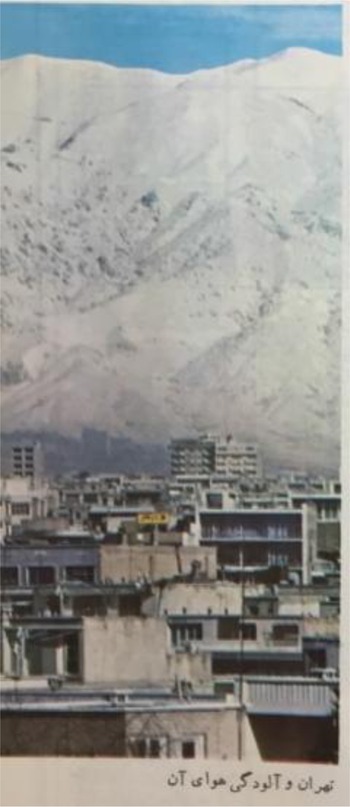
Photograph of the Alborz Mountains partially obscured by haze and smoke over Tehran. “Paykar ba Aludegi-yi Hava,” Nameh-yi San'at-i Naft-i Iran 10, no. 11 (1972), 35.

Illustrated image depicting a thick cloud of industrial emissions blanketing
Tehran with Mount Damavand rising in the background. Sazman-i Hefazat-i Mohit-i Zist, Amar-i Aludegi-yi Hava-yi Tehran, Seh Maheh-yi Sevvom-i Sal-i 1357 (Tehran[?]: Entesharat-i Sazman-i Hefazat-i Mohit-i Zist, 1978–79[?]), cover.

Topography and Climate
Few areas faced the issue of air pollution as intensely or with a knot of social, economic, topographic, and climatic causes as intractable as Tehran. A small town which had been made the country's capital in the late 18th century, by the 1960s the city had seen significant growth as Iran's integration into global markets upended the country's social and economic structures and prompted significant rural to urban migration. By the mid-1970s, more than 4.5 million people called Tehran home, and it accounted for half of Iran's GNP and some 40 percent of all national investments, including 60 percent of investments made in the industrial sector.Footnote 57 Life in the city, sprawling across hundreds of square miles and two thousand feet of elevation, had long been shaped by the dominating presence of the Alborz Mountains. With the city bounded on the north by the mountain range, flows of humid air from the Caspian Sea are blocked, leaving the city with a semiarid climate marked by dry air and a hot sun. Wealth and elevation thus became linked, with those of the greatest means often enjoying the cooler temperatures, better water, and greener surroundings of locales higher up the mountain slopes.Footnote 58 Much of Tehran's new industry was thus situated on the hot plains of the city's southern and western reaches, exactly where, as Jahanshah Saleh noted from ten years of observation, prevailing winds would carry its emissions over the city.Footnote 59
Saleh was not alone in noticing such phenomena, and they prompted sustained if disorganized investigation into air pollution during the late Pahlavi period. Enjoying little dedicated support and scattered across universities, government offices, and the research arm of the NIOC, Iranian researchers interested in air quality often worked alone or in small groups, piggybacking on existing organizations like the Iranian Oil Institute and its journal to share their findings. Possessing formal educations in the natural sciences but largely self-taught or with limited training on the topic of air pollution, many nevertheless engaged in original and relevant research which they presented at home and abroad.Footnote 60 Their work illuminated the character of Iran's urban air quality issues, and institutions like the NIOC and Ministry of Petroleum became important sponsors and disseminators of their knowledge. Such was the case in 1972 when one NIOC engineer, drawing upon six monitoring stations scattered across Tehran, reported that concentrations of air pollutants tended to be highest in the early morning hours.Footnote 61 His observations were explained by ‘Alireza Moshref Razavi, a meteorological engineer and weather forecaster who observed one the most significant causes of Tehran's intense air pollution: atmospheric inversions.Footnote 62
Atmospheric layers that increase in temperature with altitude, a reversal of the norm, inversions produce stable volumes of air devoid of convective currents. Without such currents to carry them upward and disperse them across a wide area, pollutants remain trapped near the ground, and over time significant concentrations may accumulate. Tehran's arid climate and mountainous terrain made it vulnerable to the effects of inversions, and between 1967 and 1971 Moshref Razavi observed their presence some 70 percent of the time. Most were radiational inversions, formed when the ground quickly radiated away the day's warmth on cool and clear nights. Though most reversed themselves in the heat of the next day's sun, in the right circumstances such conditions could persist for days or weeks, a possibility made more likely in Tehran by the wind-blocking effect of the Alborz.Footnote 63 As contemporary observers like Jahanshah Saleh knew, air pollution was not only caused by increased consumption of fossil fuels; it was the combined product of human actions and the specificities of their natural setting, with climate and topography integral parts of the assemblage of factors driving down Tehran's air quality.
With inversions and mountain ranges an immutable fact of life in Tehran, experts like Moshref Razavi argued that a rapid reduction in emissions was the only way to avoid repeating the deadly experiences of the world's industrialized cities.Footnote 64 Although the “progress . . . of the new industries did not have any other aim than providing . . . [for] a better life for the people,” one NIOC report warned, Tehran risked becoming like the “large cities” of Los Angeles, Chicago, and London, where air pollution had “put the health of residents . . . in danger” and made “the great country of America captive to the problem of pollution.Footnote 65 But such commentators never advocated for a retreat from industrialization, arguing instead for an even tighter embrace of it. “Anywhere you bring technology, humanity has also rushed to bring . . . new problems for the environment,” the head of the Oil Society of Iran said, adding that “confronting industrial pollution is not possible except through . . . the latest scientific and technological innovations.”Footnote 66 Or, as one advocate from the Health Society of Tehran bluntly stated in the mid-1960s, oil was “the type of fuel destroying the human race,” a fate Iranians could only avoid by putting their trust in natural gas.Footnote 67
Natural Gas and Industry
By the time Tehran's mayor Gholamreza Nikpey used the prospect of gas energy to gently push back against the shah's impulsive order to relocate Tehran's industry in the fall of 1973, the new fuel was already receiving significant support within the NIOC and NIGC for its potential environmental benefits. As early as the summer of 1971, Sa'id Shaybani, head of petrochemical research at the NIOC, had placed natural gas energy at the center of the company's efforts to prevent air pollution.Footnote 68 In a speech that was reproduced both in the company magazine and as a standalone publication, Shaybani became one of the first to systematically address the environmental benefits of gas use.Footnote 69 In a sweeping vision, he described gas as having the potential to alter the fundamental relationship of humanity with the natural world, connecting declining air quality to energy use and claiming that the two had largely gone hand in hand.Footnote 70 But natural gas was a way to break that connection, he argued, and, although an extensive program would be required to enable its widespread distribution, it was nonetheless “the simplest way of preventing air pollution.”Footnote 71 Natural gas is in reality far less environmentally friendly than once presumed. Not only does its combustion contribute to rising levels of atmospheric carbon dioxide like other fossil fuels, but the methane it contains in large proportions is itself a very potent greenhouse gas when leaked or vented directly into the air. Although Shaybani noted the rise in global CO2 levels, he did not recognize its significance, expressing air quality concerns that remained rooted in perspectives that emphasized specific social and medical maladies rather than more abstract global trends.Footnote 72
Like other experts for the NIOC and state ministries, Shaybani maintained a commitment to industrializing development and fossil fuel use and did not suggest abandoning the modernizing policies of the White Revolution. With attempts to mitigate industrial pollution through emissions filters and smokestack regulations largely failing, gas became the only untried solution that did not involve limiting or reversing the country's economic growth, something that put the NIGC in the position of being the de facto manager of Iran's air quality control efforts.Footnote 73 The NIGC's original mission had been to oversee a constellation of European firms charged with the actual design and construction of the first Iran Gas Trunkline (IGAT-1). Built in the late 1960s, IGAT-1 ran some 1100 kilometers from the oil fields of Khuzestan to the Soviet border at Astara along with major branch lines serving cities like Tehran, Shiraz, and Isfahan. By the end of the 1970s, IGAT-1 was slated to deliver approximately 10 billion cubic meters of associated gas to the Soviet Union each year—payment for a long sought-after steel mill in Isfahan—and an additional 6 billion cubic meters to domestic markets.Footnote 74 With the pipeline's completion in October 1970, the NIGC turned to evaluating Iran's potential urban gas markets and building distribution systems to serve them. Unlike Shiraz's earlier standalone project, conceived as a regional project primarily intended to deliver gas to the fertilizer factory, Tehran's system was pursued as part of a broader effort aimed at using IGAT-1 to supply gas energy to a wide area. The NIGC nonetheless continued throughout the 1970s to adhere to the policies of industrial prioritization that had been set in Shiraz in the 1960s.Footnote 75 Although rooted first in the relative technical and economic efficiency of serving comparatively small numbers of large gas users, such policies also dovetailed with efforts to improve air quality by reducing factory emissions.Footnote 76
With the NIGC being in practice one of the primary conduits by which Iran's air quality improvement efforts were made, the success of those efforts hinged on the company's ability to build gas distribution systems in a timely manner. Like the IGAT-1 pipeline, Iran's urban gas networks were designed with the aid of foreign consultants, although by the 1970s the NIGC had gained considerable experience and was much more confident, at times both overruling their hired consultants’ design decisions and ignoring local authorities who balked at the idea of tearing up streets to lay pipe.Footnote 77 With IGAT-1's spur line to Tehran running through the city's industrialized southwestern approaches, the area became a natural locus for the kind of fuel conversion programs that officials like Shaybani had called for.Footnote 78 In the spring of 1974, the NIGC was well into the process of pipe-laying in Tehran and, having given priority to “large factories,” by the fall of that year some the most heavily polluting brick, plaster, and lime kilns had begun to burn gas.Footnote 79 As notorious polluters, brickmakers were a significant priority, and in that same year a further twenty-two facilities began the process of being linked to the gas network, and nine more signed contracts stipulating their own responsibility for gas conversion.Footnote 80 Tehran's factory owners, wary of potential disruptions to their businesses, were generally willing although not always eager participants in the effort to protect the city's air quality.Footnote 81 Indeed, the conversion process was not always straightforward, and it took the “studies and efforts of . . . specialists” to resolve the “multiple safety and technical issues” that bedeviled the task. Those technical difficulties, mounting costs, and the cessation of operations that the conversions required caused many of Tehran's brickmakers to sour on the project, and it took a significant program of financial assistance from the NIGC—an agreement to pay for the cost of the conversions in cash and accept repayment over a thirty-month period—to overcome their concern.Footnote 82
Despite the comparative eagerness of Shirazi factory owners like Mohsen Qahremani to address air pollution, they too demanded support sufficient to offset any risks associated with fuel conversion.Footnote 83 Although refusing to offer financial incentives, the NIGC did promise the help of experts experienced in the conversion process, an effort amounting to little despite the company continuing to order factories to switch to gas through late 1972 and into 1973.Footnote 84 Scant progress was made until early 1974, when a report highlighting Shiraz's continued air quality problems prompted the shah to again insist that “all furnaces across the country that consume fuel oil” should “be converted to gas.”Footnote 85 Flowing through the Ministry of the Interior, the Fars provincial government, and then to the regional branch of the NIGC, the shah's directive spurred a flurry of new activity. In response, the NIGC dispatched another group of experts from Tehran who hurriedly converted one brick kiln, a result that its owner hailed as one that would “liberate the country from air pollution and provide a better natural environment.”Footnote 86
With the successful conversion of one factory, the remainder came under increased pressure to contract with the NIGC for service. Even beyond concerns related to the cost of conversions, however, factory owners worried about the gas company's actual ability to provide service, an anxiety that was enough for some to resist cooperation despite both incentives and the threat of closure.Footnote 87 Although the NIGC accepted a proposal from some owners to import their own equipment in the interests of efficiency, for the first time it and the city's Office of Environmental Health also threatened to close those that did not act.Footnote 88 The project nevertheless soon ran into delays rooted not in the inaction or resistance of owners, but in the NIGC's inability to fulfill its commitments in a timely manner. Responding to a demand in the summer of 1974 that conversions proceed for the “protection of worker's health and the cleanliness of the natural environment,” owners pushed back, complaining that progress was stalled because the NIGC had postponed pipe-laying work to March 1975.Footnote 89 Indeed, the NIGC reported that despite the readiness of industrial facilities to receive gas they could not promise the commencement of service in less than eight months.Footnote 90 Tehran too saw long waits between conversion work and the actual availability of gas.Footnote 91 With factory owners and the NIGC pointing fingers, even increased pressure from local and national leaders largely failed to accelerate the process despite the outbreaks of activity that accompanied each round of attention.Footnote 92 At root the problem was the NIGC's dependence on European imports for much of its own equipment and materials, and any promised start dates at best “approximately corresponded” to when the NIGC expected to take delivery.Footnote 93 Iran was simply not self-sufficient in meeting the gas industry's needs, and both the NIGC and its potential customers found themselves waiting for indefinitely long periods. In August 1976 it was reported that although many of Tehran's factory owners had complied with instructions to convert their facilities, the “lack of a primary [gas] network” meant that gas was still unavailable. The municipal governments of Tehran and Shiraz were not deterred by such difficulties, however, instructing the owners to maintain their readiness and await service.Footnote 94 As of March 1978, most were still waiting.Footnote 95
The push to convert Iran's industry to gas fuel demonstrates the hurdles that government plans faced when put into action in late Pahlavi Iran. Neither the NIGC's recalcitrant timelines nor resistant factory owners were easily strong-armed into compliance, and there was little officials could do besides offer incentives or issue threats. Gas conversions thus proceeded at a much slower rate than anticipated, and even that progress stalled after 1979 as the work of combating industrial emissions became less urgent in the context of revolution and war. In the chaotic wake of the Islamic Republic's rise, many environmental regulations and policies were weakened in local courts, ignored by the Iranian public at large, or undermined by interested parties.Footnote 96 Air pollution thus continued to bedevil Iranian cities as government attention turned to sustaining the war effort and, later, rebuilding the country's economy. There nonetheless remained a steady if subdued commitment to environmental protection during the period, with some of the most polluting industrial facilities closed due to their “irredeemable destruction of the environment.”Footnote 97 Iran's “severe air pollution” gained renewed attention in early 1993 when the national government named Tehran's air quality “a high priority environmental and health issue.”Footnote 98 By that point, however, industry was no longer the dominant cause of air pollution in Tehran, as transportation had grown to account for some four times the amount of emissions.Footnote 99 Efforts to transition Tehran's industry to gas nonetheless continued, a process tied to the same desires for economic efficiency and environmental benefit that had animated it decades earlier.Footnote 100 Although succeeding on its own terms, the program to move Iran's industry to gas fuel failed in its insufficiency and was ultimately unsuccessful in returning the country's skies to their preindustrial beauty.
Conclusion
Iran's move to gas energy is one of the most significant developments of the country's last seventy years, but the transition is not fully explained by reference to economic and political motives. Nor do such accounts capture the full significance of gas within Iranian society, overlooking the new energy source's connections to Iranians’ environmental concerns. Iranians faced a choice in the late Pahlavi era: prosperous industrialized life or clean air. Intensified by inescapable topographic and climatic factors, the smoke and haze that lay suspended above Iran's cities were both unsightly stains and frightening specters of an unwanted future. Air pollution and environmental degradation threatened the entire modernizing project of the Pahlavi state, and natural gas seemingly offered a path forward that enabled continued industrialization while also avoiding its worst environmental effects. It was with natural gas that the “ghoul of pollution” that was banging on the “gates of . . . health,” as one NIGC official put it in late 1974, could be vanquished.Footnote 101 For many, it seemed easier to double down on the fossil fuel use that had brought Iran to the brink of crisis than to imagine a modern society that consumed less energy or allowed environmental considerations to constrain its growth. The confidence of figures like Sa'id Shaybani that natural gas energy was the “simplest” solution to air pollution despite the huge infrastructural undertaking its use would require pointed to the hope that Iranian officials placed in technological solutions. Such convictions show both the necessity of understanding the NIGC as more than a simple supplier of gas fuel and the benefit of broadening our notions of what constitutes environmental action to include people and organizations whose interests at first blush seem antithetical. As important as the company's responsibilities as a fuel provisioner were, the NIGC's work also was a significant expression of the entangled environmental and industrializing motivations of Pahlavi-era policymakers.
In recent years species-level concepts like the Anthropocene have come to dominate our understandings of energy use and the environment, but such universalizing perspectives obscure the extent to which energy systems and their effects reflect particular social, political, and environmental contexts.Footnote 102 Such viewpoints reproduce the assumption of an infinitely scalable human mastery over nature, a tale of progress that obscures, as Anna Lowenhaupt Tsing writes, the “patchiness” of the world, the “mosaic of open-ended assemblages of entangled ways of life” that combine to make us.Footnote 103 Our failure to perceive that mosaic has blinded us to the ways that ideas of environmental stewardship have sometimes been integral to the history of modernizing development in the Middle East. Every toxic lungful that Pahlavi-era Iranians took in, every soot-smudged sky they saw, was a reminder that their new cityscapes were hybrid spaces, as much the products of an uncontrollable natural world as they were oil wealth, royal ambition, and their own consumption practices. That interconnection was one Iranian officials sought to accommodate with their energy policies, an implicit recognition of entanglement even amid a highly politicized assertion of industrializing advancement and control. Made apparent by paying heed to the multiplicities of Iran's intensifying energy use was that its environmental violence did not exist in opposition to independent efforts to protect the natural world. They were instead two sides of the same hydrocarbon coin, an expression of developmental possibilities that grew together and alongside each other.
That such alternatives did exist, and continue to exist, should sit as cold comfort. Just as Iranian officials sought to undo the environmental harm of their industrialization policies with new energy systems, so do we imagine innovating our way out of our present climate crises, oblivious to the insufficiency of the technical fix, trusting that this time our pursuit of progress will be different. But the experience of Pahlavi-era Iranians shows that nature cannot be fooled into submission, cannot be made to do our bidding through the clever substitution of one fuel for another. Through such policies we are in effect trying to trick ourselves, believing that a simple move to cleaner sources of energy will not mean more consumption, more exploitation, more extraction, and ultimately more harm. That alternatives exist should give us hope; that they thus far involve more of the same should not. Only by questioning the foundations of our industrialized consumption-oriented society, as Pahlavi officials never did, can we find new ways of living that might in the end save us.
Acknowledgments
This article is the product of research undertaken in Iran in 2017, generously supported by the Social Science Research Council. Special thanks to Majid Zanjani and Seyyed Muhammad Kazem Mar’ashi-Najafi for their aid in archival access. Early versions were presented at MESA in 2018 and the Centre for Research in the Arts, Social Sciences and Humanities at the University of Cambridge in 2019; I thank all the participants and attendees, particularly Paul Warde, for their astute comments and critiques. I am further grateful to Firoozeh Kashani-Sabet, Eve Troutt Powell, Nikhil Anand, Toby C. Jones and Nimrod Ben Zeev for the numerous and productive suggestions they offered over the years. I also thank IJMES editor Joel Gordon and the three anonymous reviewers for their efforts in helping this article reach its full potential.




 Open access

