


The prevalence one in four has been used extensively in service, policy and media contexts to quantify the extent of mental health problems in the British general population.Reference Ginn and Horder1 Ginn and HorderReference Ginn and Horder1 attempted to identify the origins of this figure and point out a lack of any consistent determination of what the figure should include. It represents a collision between psychiatric epidemiology and the popular understanding of the meaning of mental disturbance: what categories would be acceptable examples of mental disorder to members of the populace? As Ginn and HorderReference Ginn and Horder1 suggest, the figure has social as well as scientific functions: demonstrating the relevance and significance of the phenomenon of mental illness, encouraging the funding of supportive services, reducing stigma by pointing out its considerable frequency and gaining acceptance of a plausible value. For this reason, any such figure should be examined in relation to its origins and assumptions: there may be conflict between what people know or believe, and what they are being told. There are thus cultural dangers both in overselling and in underselling the frequency of mental illness.
In our view, using an undefined concept risks loss of credibility and the meaning of this figure should therefore be spelt out. The British Adult Psychiatric Morbidity Survey (APMS) programme has applied standardised and structured methods for identifying individual mental disorders in regularly repeated surveys based on randomly chosen samples of the household population. We used the surveys carried out in 2000, 2007 and 2014Reference Singleton, Bumpstead, O'Brien, Lee and Meltzer2–Reference McManus, Bebbington, Jenkins and Brugha4 to log both an overall burden of disorder (i.e. the proportion of people with one or more mental health problems) and changes in its magnitude.
Method
There are difficulties in presenting information about overall prevalence. The first concerns the disorders to be covered. There is little dispute about the inclusion of common mental conditions such as anxiety and depressive disorder, and rarer but severe disorders like psychosis and bipolar disorder. Other disorders recognised in international classifications are also candidates for inclusion, for instance post-traumatic stress disorder (PTSD) and attention-deficit hyperactivity disorder (ADHD). Likewise, including dependence on illicit drugs and alcohol is unlikely to be contentious. However, in the analyses presented here, we excluded the hazardous use of alcohol and nicotine from analysis because, although clearly a behavioural problem and a social concern, it may not conform to lay ideas of mental disorder. The inclusion of hazardous use would of course result in higher values for the prevalence of mental disorder, to a degree that might be treated with suspicion by potential consumers of this information.
The new analyses presented here are based on the three most recent APM surveys, carried out in 2000, 2007 and 2014.Reference Singleton, Bumpstead, O'Brien, Lee and Meltzer2–Reference McManus, Bebbington, Jenkins and Brugha4 The two later surveys cover only England, and we therefore restrict the analyses of the 2000 survey to respondents from England. Structured interviews were used to provide a logical, valid and clinically meaningful classification, thereby formalising the process of clinical description and case identification. These measures were not adjusted to accommodate intervening changes in the dominant classificatory schemes5,6 and are thus comparable across surveys. They are referenced and described in detail in the reports.Reference Singleton, Bumpstead, O'Brien, Lee and Meltzer2–Reference McManus, Bebbington, Jenkins and Brugha4 The values presented here are based on point prevalence for common mental disorders (CMDs) and a prevalence period of up to 1 year for the other disorders. Again, this follows the procedures adopted in the reports.
Comorbidity between psychiatric disorders is common, with the consequence that adding in a new category increases the overall percentage of people affected by less than the individual prevalence of that category. For this reason, we quantified people suffering from mental illness by incorporating disorders sequentially. Such a sequence must inevitably have an arbitrary element. We chose to start with psychotic disorder and CMDs, then moving on to include dependence disorders, as these were quantified identically in all three surveys. Disorders assessed only in the later surveys were included later in the sequence of analysis.
We first identified those suffering from probable psychosis. From the remaining group, we then added people with an identified CMD, in sequence according to their severity. Severity was estimated from their score on the instrument used to identify them, the revised Clinical Interview Schedule.Reference Lewis, Pelosi, Araya and Dunn7 Scores of 12–17 indicate a significant mental health problem requiring assessment, whereas scores of ≥18 imply treatment is almost certainly needed. From the remaining sample, we then incorporated people with signs of alcohol or drug dependence.Reference Saunders, Aasland, Babor, Dela Fuente and Grant8,Reference Drummond, McBride, Fear, Fuller, McManus, Bebbington, Jenkins and Brugha9 Next, we added those who screened positive for ADHD,Reference Kessler, Adler, Ames, Demler, Faraone and Hiripi10 and finally people screening positive for personality disorder,Reference Moran, Leese, Lee, Walters, Thornicroft and Mann11 PTSDReference Blanchard, Jones-Alexander, Buckley and Forneris12 or bipolar disorder.Reference Hirschfeld, Williams, Spitzer, Calabrese, Flynn and Keck13 The ADHD screen was not used until the 2007 survey, and the personality disorder, PTSD and bipolar disorder screens were only introduced in 2014.
Results
The results are set out in detail in Table 1. The most severe disorder, psychosis, had a prevalence of around half of 1% in the two earlier surveys, but this rose significantly to exceed 1% in 2014. (As the screen definition for psychosis includes being on antipsychotic medication, increased prescribing might have been responsible for this apparent increase in prevalence.) However, the values based on the inclusion of the other types of mental disorder are remarkable for their stability. This is driven to a considerable extent by the virtually unchanging overall frequency of CMDs. Depending on the severity threshold used to include CMDs, combining them with psychosis yields a value of one in ten or one in six. The addition of substance use disorders raises this to just over one in five, and again the values are constant over time. A value of one in four is achieved by adding in the results of screening for ADHD. Finally, incorporating personality and other disorders boosts the figure to around one in three.
The prevalence of mental disorders in England 2000–2014
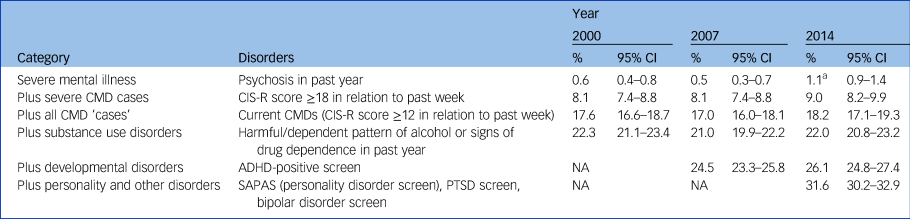
CMD, common mental disorder; CIS-R, Clinical Interview Schedule – Revised; ADHD, attention-deficit hyperactivity disorder; SAPAS, Standardised Assessment of Personality – Abbreviated Scale; PTSD, post-traumatic stress disorder; NA, not available.
Cumulative totals presented. Based on 16- to 74-year-olds living in England, data weighted to represent the national population.Reference Singleton, Bumpstead, O'Brien, Lee and Meltzer2–Reference McManus, Bebbington, Jenkins and Brugha4 See McManus et al Reference McManus, Bebbington, Jenkins and Brugha4 for details of measures.
a. As the screen definition for psychosis includes being on antipsychotic medication, increased prescribing may have been responsible for some of this increase in prevalence.
Discussion
We found that psychosis had a prevalence of around 1%, severe CMDs added about 8% and including less-severe CMDs gave a value around one in six. The figure of one in four required the inclusion of various other disorders.
A major purpose of the APMS programme is to provide information on temporal changes in the prevalence of a range of different disorders, with the expectation that these may be related to a changing social context. Problems in identifying disorders in the general population also arise from the fact that symptoms of mental illness are exponentially distributed. Imposing categories on continuous distributions is always a fraught process. So, for example, although many people have a few isolated affective symptoms, relatively few have sufficient symptoms to justify a diagnosis of mental disorder.Reference Melzer, Tom, Brugha, Fryers and Meltzer14 This problem also applies to paranoiaReference Bebbington, McBride, Steel, Kuipers, Radovanovič and Brugha15 and personality disorder.Reference Yang, Coid and Tyrer16
There is an inevitable arbitrariness both in selecting the mental conditions for consideration, and in selecting the order in which disorders are entered. The number of disorders determines the number of people who will be identified as suffering from some kind of disorder, whereas the order of entry determines the values of intermediate combinations of disorder. Our choices were based on judgements about how clinicians would probably target treatment in circumstances of comorbidity.
The most striking finding from these analyses is the absence of secular change: for people aged 16–74 years, the prevalence of mental disorders in England over a prolonged period remained remarkably constant. What does this imply? The most parsimonious inference is that the determinants of mental disorder, social or biological, have themselves not varied over that period. However, this would be surprising, certainly given the very considerable changes in social conditions and social behaviour in England since the millennium. A less parsimonious explanation is that there have been changes in a variety of influences bearing on the various disorder types, but that these have tended to cancel each other out. Such hypotheses are open to empirical testing, thereby underlining the importance of programmes like APMS for studying the nature of disorder and the implications for treatment and social policy. For example, changes between the 2014 survey and that planned for 2021 may make it possible to identify the mental health changes occurring in the context of intervening welfare policies characterised by austerity.
Acknowledgements
The current analyses were approved by the National Centre for Social Research ethical review committee and are part of independent research funded by the National Institute for Health Research (NIHR) Public Health Research Consortium (PHRC) Policy Research Programme ‘Establishing trends and understanding context in women's mental health, 1993–2014’ PHPEHF50/27. The views expressed in the publication are those of the authors and not necessarily those of the NIHR or the Department of Health and Social Care. P.E.B. acknowledges the support of University College London Hospital NIHR Biomedical Research Centre.


 Open access


eLetters
No eLetters have been published for this article.