





Introduction
Since its inception, (integral) p-adic Hodge theory has provided an immensely powerful tool for studying how the p-adic geometry of objects varies in families. Central to this idea is the notion of crystalline $\mathbb {Z}_p$
-local systems on
$\mathbb {Z}_p$
-local systems on $\mathfrak {X}_\eta $
, where
$\mathfrak {X}_\eta $
, where $\mathfrak {X}$
is a smooth formal scheme over the ring of integers
$\mathfrak {X}$
is a smooth formal scheme over the ring of integers $\mathcal {O}_K$
of a discretely valued p-adic field,Footnote 1
which promises to capture the idea of those
$\mathcal {O}_K$
of a discretely valued p-adic field,Footnote 1
which promises to capture the idea of those $\mathbb {Z}_p$
-local systems which have ‘good reduction’ relative to
$\mathbb {Z}_p$
-local systems which have ‘good reduction’ relative to $\mathfrak {X}$
. This guiding principle has recently been put on very firm footing via the introduction of the category
$\mathfrak {X}$
. This guiding principle has recently been put on very firm footing via the introduction of the category  of prismatic F-crystals on $\mathfrak {X}$
in the work [Reference Bhatt and ScholzeBS23] of Bhatt and Scholze, and related objects, which have been shown to give ‘models’ for crystalline
$\mathfrak {X}$
in the work [Reference Bhatt and ScholzeBS23] of Bhatt and Scholze, and related objects, which have been shown to give ‘models’ for crystalline $\mathbb {Z}_p$
-local systems.
$\mathbb {Z}_p$
-local systems.
Additionally, the category  also provides a good approximation to (what should be) the category of $\mathbb {Z}_p$
-motives over
$\mathbb {Z}_p$
-motives over $\mathfrak {X}$
. This makes them an attractive notion for the study of integral (local) Shimura varieties, which ought to parameterize such motivic objects. That said, to rigorously utilize prismatic F-crystals in applications to Shimura varieties, one really needs a Tannakian theory: a good theory of the category of
$\mathfrak {X}$
. This makes them an attractive notion for the study of integral (local) Shimura varieties, which ought to parameterize such motivic objects. That said, to rigorously utilize prismatic F-crystals in applications to Shimura varieties, one really needs a Tannakian theory: a good theory of the category of $\mathcal {G}$
-objects in
$\mathcal {G}$
-objects in  and related categories, where $\mathcal {G}$
is initially any smooth group scheme over
$\mathcal {G}$
is initially any smooth group scheme over $\mathbb {Z}_p$
, but is assumed reductive for many of the main results of this article.
$\mathbb {Z}_p$
, but is assumed reductive for many of the main results of this article.
The goal of this paper is to provide such a Tannakian theory in some cases, with our main theorem being the following equivalence of categories.
Theorem 1 (see Theorem 2.29)
If $\mathcal {G}$
is reductive, then there is an equivalence of categories
$\mathcal {G}$
is reductive, then there is an equivalence of categories

where 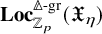 is the category of $\ \mathbb {Z}_p$
-local systems of prismatically good reduction.
$\ \mathbb {Z}_p$
-local systems of prismatically good reduction.
The applicability of Theorem 1 to the study of integral Shimura varieties is not hypothetical. In fact, this article may be seen as a companion paper to [Reference Imai, Kato and YoucisIKY23] as well as providing some foundational results needed for [Reference Imai, Kato and YoucisIKY25]. There we show the existence of a prismatic (F-gauge) realization functor on integral Shimura varieties at hyperspecial level, which has several important consequences for the theory of such integral Shimura varieties (e.g., an analogue of the Serre–Tate theorem). Theorem 1 plays a pivotal role in [Reference Imai, Kato and YoucisIKY23].
In the rest of this introduction we explicate the difficulty in proving Theorem 1 and discuss related Tannakian results established in this paper.
The Tannakian theory of (analytic) prismatic F-crystals
Throughout the following we fix a mixed characteristic complete discrete valuation ring $\mathcal {O}_K$
with perfect residue field k of characteristic p, and a smooth formal
$\mathcal {O}_K$
with perfect residue field k of characteristic p, and a smooth formal $\mathcal {O}_K$
-scheme
$\mathcal {O}_K$
-scheme $\mathfrak {X}$
(see Notation and conventions for our convention on smoothness) with generic fiber X.
$\mathfrak {X}$
(see Notation and conventions for our convention on smoothness) with generic fiber X.
In [Reference Bhatt and ScholzeBS23], Bhatt and Scholze define a category  of prismatic F-crystals on $\mathfrak {X}$
, which presents the correct notion of a ‘deformation’ of an F-crystal on
$\mathfrak {X}$
, which presents the correct notion of a ‘deformation’ of an F-crystal on $\mathfrak {X}_k$
to
$\mathfrak {X}_k$
to $\mathfrak {X}$
. They further construct a functor
$\mathfrak {X}$
. They further construct a functor  , the étale realization functor, which is a prismatic analogue of the Riemann–Hilbert correspondence. When $\mathfrak {X}=\operatorname {\mathrm {Spf}}(\mathcal {O}_K)$
, they show that
$\mathfrak {X}=\operatorname {\mathrm {Spf}}(\mathcal {O}_K)$
, they show that $T_{\mathrm {\acute {e}t}}$
induces an equivalence between
$T_{\mathrm {\acute {e}t}}$
induces an equivalence between  and the category $\mathbf {Loc}^{\mathrm {crys}}_{\mathbb {Z}_p}(X)$
of crystalline
$\mathbf {Loc}^{\mathrm {crys}}_{\mathbb {Z}_p}(X)$
of crystalline $\mathbb {Z}_p$
-local systems on X (i.e.,
$\mathbb {Z}_p$
-local systems on X (i.e., $\mathbb {Z}_p$
-lattices
$\mathbb {Z}_p$
-lattices $\mathbb {L}$
in crystalline
$\mathbb {L}$
in crystalline $\mathbb {Q}_p$
-local systems).
$\mathbb {Q}_p$
-local systems).
In general,  is not sufficient to recover every crystalline lattice on X (see [Reference Du, Liu, Moon and ShimizuDLMS24, Example 3.36]), and Guo and Reinecke in [Reference Guo and ReineckeGR24] consider an enlargement
  consisting of so-called analytic prismatic F-crystals. The functor $T_{\mathrm {\acute {e}t}}$
extends to this larger category, and [Reference Guo and ReineckeGR24] showed that the étale realization functor
$T_{\mathrm {\acute {e}t}}$
extends to this larger category, and [Reference Guo and ReineckeGR24] showed that the étale realization functor $T_{\mathrm {\acute {e}t}}$
forms an equivalence between
$T_{\mathrm {\acute {e}t}}$
forms an equivalence between  and
and $\mathbf {Loc}^{\mathrm {crys}}_{\mathbb {Z}_p}(X)$
(cf. the results of [Reference Du, Liu, Moon and ShimizuDLMS24]).
$\mathbf {Loc}^{\mathrm {crys}}_{\mathbb {Z}_p}(X)$
(cf. the results of [Reference Du, Liu, Moon and ShimizuDLMS24]).
As above, for applications of these p-adic Hodge theoretic ideas to the study of integral (local) Shimura varieties it is important to have a Tannakian version of these results. To this end, let us fix a smooth affine group $\mathbb {Z}_p$
-scheme
$\mathbb {Z}_p$
-scheme $\mathcal {G}$
, and for an exact
$\mathcal {G}$
, and for an exact $\mathbb {Z}_p$
-linear
$\mathbb {Z}_p$
-linear $\otimes $
-category
$\otimes $
-category $\mathcal {C}$
(see §A.5) we define
$\mathcal {C}$
(see §A.5) we define $\mathcal {G}\text {-}\mathcal {C}$
to be the category of
$\mathcal {G}\text {-}\mathcal {C}$
to be the category of $\mathcal {G}$
-objects in
$\mathcal {G}$
-objects in $\mathcal {C}$
(i.e., exact
$\mathcal {C}$
(i.e., exact $\mathbb {Z}_p$
-linear
$\mathbb {Z}_p$
-linear $\otimes $
-functors
$\otimes $
-functors $\omega \colon {\mathbf {Rep}}_{\mathbb {Z}_p}(\mathcal {G})\to \mathcal {C}$
).
$\omega \colon {\mathbf {Rep}}_{\mathbb {Z}_p}(\mathcal {G})\to \mathcal {C}$
).
Proposition 1 (see Propositions 2.21 and 2.23)
Let $\mathfrak {X}$
be a smooth formal
$\mathfrak {X}$
be a smooth formal $\mathcal {O}_K$
-scheme and
$\mathcal {O}_K$
-scheme and $\mathcal {G}$
a smooth affine group
$\mathcal {G}$
a smooth affine group $\mathbb {Z}_p$
-scheme.
$\mathbb {Z}_p$
-scheme.
-
1. Both
 and its quasi-inverse are exact.
 -
2. There is an equivalence
-
3. An object
$\omega $
of
$\mathcal {G}\text {-}\mathbf {Loc}_{\mathbb {Z}_p}(X)$
lies in the full subcategory
$\mathcal {G}\text {-}\mathbf {Loc}^{\mathrm {crys}}_{\mathbb {Z}_p}(X)$
if and only if
$\omega (\Lambda _0)$
is crystalline for one faithful representation
$\mathcal {G}\hookrightarrow \operatorname {\mathrm {GL}}(\Lambda _0)$
.
 and its quasi-inverse are exact.

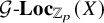
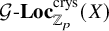


That said, the difference between  and
and  suggests a strengthening of the notion of crystalline. Namely, let
  be the category of prismatically good reduction $\mathbb {Z}_p$
-local systems: those crystalline
$\mathbb {Z}_p$
-local systems: those crystalline $\mathbb {Z}_p$
-local systems
$\mathbb {Z}_p$
-local systems $\mathbb {L}$
such that
$\mathbb {L}$
such that $T_{\mathrm {\acute {e}t}}^{-1}(\mathbb {L})$
is a prismatic F-crystal. In fact, it is this category of prismatically good reduction
$T_{\mathrm {\acute {e}t}}^{-1}(\mathbb {L})$
is a prismatic F-crystal. In fact, it is this category of prismatically good reduction $\mathbb {Z}_p$
-local systems which plays a more important role in many applications to Shimura varieties (e.g., see [Reference Imai, Kato and YoucisIKY23]) as it is
$\mathbb {Z}_p$
-local systems which plays a more important role in many applications to Shimura varieties (e.g., see [Reference Imai, Kato and YoucisIKY23]) as it is  which is closer to motivic $\mathbb {Z}_p$
-objects over
$\mathbb {Z}_p$
-objects over $\mathfrak {X}$
, for example, p-divisible groups (see [Reference Anschütz and Le BrasALB23]).
$\mathfrak {X}$
, for example, p-divisible groups (see [Reference Anschütz and Le BrasALB23]).
That said, the analogue of Proposition 1 is far more subtle in this case. Namely, while the functor  is an exact $\mathbb {Z}_p$
-linear
$\mathbb {Z}_p$
-linear $\otimes $
-equivalence, its quasi-inverse is not exact, as it involves the extension of a vector bundle on an open subset of some space over its nontrivial closed complement (e.g., see [Reference LiuLiu18, Example 4.1.4]). So, there is no a priori reason for
$\otimes $
-equivalence, its quasi-inverse is not exact, as it involves the extension of a vector bundle on an open subset of some space over its nontrivial closed complement (e.g., see [Reference LiuLiu18, Example 4.1.4]). So, there is no a priori reason for  to be exact for $\nu $
in
$\nu $
in 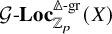 .
.
Despite this, a Tannakian equivalence still holds, at least if $\mathcal {G}$
is reductive, as in the following result which, in particular, refines Theorem 1.
$\mathcal {G}$
is reductive, as in the following result which, in particular, refines Theorem 1.
Theorem 2 (see Theorem 2.29 and Corollary 2.31)
Let $\mathfrak {X}$
be a smooth formal
$\mathfrak {X}$
be a smooth formal $\mathcal {O}_K$
-scheme and
$\mathcal {O}_K$
-scheme and $\mathcal {G}$
a reductive group
$\mathcal {G}$
a reductive group $\mathbb {Z}_p$
-scheme.
$\mathbb {Z}_p$
-scheme.
-
1. The functor
is an equivalence, that is,
$T_{\mathrm {\acute {e}t}}^{-1}\circ \nu $
is exact for any
$\nu $
in . -
2. An object
$\omega $
of
$\mathcal {G}\text {-}\mathbf {Loc}_{\mathbb {Z}_p}(X)$
belongs to the subcategory if and only if
$\omega (\Lambda _0)$
is of prismatically good reduction for some faithful representation
$\mathcal {G}\hookrightarrow \operatorname {\mathrm {GL}}(\Lambda _0)$
.


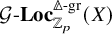 .
.
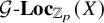
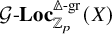 if and only if

We further remark that both  and
and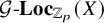 $\mathcal {G}\text {-}\mathbf {Loc}_{\mathbb {Z}_p}(X)$
may be interpreted in terms of torsors (with extra structure, for example, a Frobenius
$\mathcal {G}\text {-}\mathbf {Loc}_{\mathbb {Z}_p}(X)$
may be interpreted in terms of torsors (with extra structure, for example, a Frobenius $\varphi $
). In particular, there are equivalences
$\varphi $
). In particular, there are equivalences

where $X_{\mathrm {pro\acute {e}t}}$
is Scholze’s pro-étale site on rigid spaces as in [Reference ScholzeSch13] (see Propositions 1.29 and 2.7, respectively). Thus, Theorem 2 can be interpreted as an equivalence of categories
$X_{\mathrm {pro\acute {e}t}}$
is Scholze’s pro-étale site on rigid spaces as in [Reference ScholzeSch13] (see Propositions 1.29 and 2.7, respectively). Thus, Theorem 2 can be interpreted as an equivalence of categories

where the target of the first map is the full subcategory of $\mathcal {G}(\mathbb {Z}_p)$
-torsors
$\mathcal {G}(\mathbb {Z}_p)$
-torsors $\mathcal {P}$
on
$\mathcal {P}$
on $X_{\mathrm {pro\acute {e}t}}$
such that
$X_{\mathrm {pro\acute {e}t}}$
such that $\rho _\ast (\mathcal {P})$
is a
$\rho _\ast (\mathcal {P})$
is a $\mathbb {Z}_p$
-local system of prismatically good reduction for any (equiv., one faithful) representation
$\mathbb {Z}_p$
-local system of prismatically good reduction for any (equiv., one faithful) representation $\rho \colon \mathcal {G}\to \operatorname {\mathrm {GL}}(\Lambda )$
.
$\rho \colon \mathcal {G}\to \operatorname {\mathrm {GL}}(\Lambda )$
.
Remark 1. The main technical result needed to prove Theorem 2 may be proven independently of many of the main results of [Reference Guo and ReineckeGR24] and [Reference Du, Liu, Moon and ShimizuDLMS24], and in greater generality (e.g., including power series rings), using an adaptation of an idea of Kisin. See §2.5 for details.
Remark 2. A natural question is how the Tannakian theory developed here extends and interacts with the stacks  ,
,  , and
, and $X^{\mathrm {syn}}$
developed by Drinfeld and Bhatt–Lurie. This question is largely answered by combining the contents of this paper with [Reference Imai, Kato and YoucisIKY23, §1].
$X^{\mathrm {syn}}$
developed by Drinfeld and Bhatt–Lurie. This question is largely answered by combining the contents of this paper with [Reference Imai, Kato and YoucisIKY23, §1].
Relation to the Tannakian theory of shtukas
With applications to integral Shimura varieties in mind, it is important to understand the relationship between the Tannakian theory of (analytic) prismatic F-crystals and the Tannakian theory of shtukas. Indeed, much of the recent work on studying the p-adic Hodge theory of integral Shimura varieties, notably [Reference Pappas and RapoportPR24], uses the theory of shtukas (as developed in [Reference Scholze and WeinsteinSW20]) in a central way.
More precisely, recall that in [Reference Pappas and RapoportPR24] there is developed a theory of shtukas over $\mathscr {X}$
, where
$\mathscr {X}$
, where $\mathscr {X}$
is either a (formal)
$\mathscr {X}$
is either a (formal) $\mathbb {Z}_p$
-scheme or a
$\mathbb {Z}_p$
-scheme or a $\mathbb {Q}_p$
-scheme. Roughly, such an object is a morphism of v-stacks
$\mathbb {Q}_p$
-scheme. Roughly, such an object is a morphism of v-stacks
 $$ \begin{align*} \mathscr{X}^?\to \mathcal{G}\text{-}\mathbf{Sht}, \end{align*} $$
where the target is the v-stack of $\mathcal {G}$
-shtukas and
$\mathcal {G}$
-shtukas and $\mathscr {X}^?$
is a certain v-sheaf associated to
$\mathscr {X}^?$
is a certain v-sheaf associated to $\mathscr {X}$
.Footnote 2
$\mathscr {X}$
.Footnote 2
Suppose now that $\mathscr {X}=X$
is a smooth
$\mathscr {X}=X$
is a smooth $\mathbb {Q}_p$
-scheme. For a smooth affine group
$\mathbb {Q}_p$
-scheme. For a smooth affine group $\mathbb {Z}_p$
-scheme
$\mathbb {Z}_p$
-scheme $\mathcal {G}$
, there is developed in op. cit. a functor
$\mathcal {G}$
, there is developed in op. cit. a functor
 $$ \begin{align*} U_{\mathrm{sht}}\colon \mathcal{G}\text{-}\mathbf{Loc}^{\mathrm{dR}}_{\mathbb{Z}_p}(X^{\mathrm{an}})\to \mathcal{G}\text{-}\mathbf{Sht}(X), \end{align*} $$
where the source is the category of de Rham $\mathcal {G}(\mathbb {Z}_p)$
-local systems on
$\mathcal {G}(\mathbb {Z}_p)$
-local systems on $X^{\mathrm {an}}$
(i.e.,
$X^{\mathrm {an}}$
(i.e., $\mathcal {G}(\mathbb {Z}_p)$
-lattices in de Rham
$\mathcal {G}(\mathbb {Z}_p)$
-lattices in de Rham $\mathcal {G}(\mathbb {Q}_p)$
-local systems on
$\mathcal {G}(\mathbb {Q}_p)$
-local systems on $X^{\mathrm {an}}$
).
$X^{\mathrm {an}}$
).
The following result shows that there is a precise way to realize a $\mathcal {G}$
-object in analytic prismatic F-crystals in the category of
$\mathcal {G}$
-object in analytic prismatic F-crystals in the category of $\mathcal {G}$
-shtukas, and that the functor
$\mathcal {G}$
-shtukas, and that the functor $U_{\mathrm {sht}}$
intertwines this shtuka realization with the étale realization.
$U_{\mathrm {sht}}$
intertwines this shtuka realization with the étale realization.
Theorem 3 (see Theorem 3.21)
Let $\mathfrak {X}$
be a smooth formal
$\mathfrak {X}$
be a smooth formal $\mathcal {O}_K$
-scheme and
$\mathcal {O}_K$
-scheme and $\mathcal {G}$
a smooth affine group
$\mathcal {G}$
a smooth affine group $\mathbb {Z}_p$
-scheme. Then, there is a shtuka realization functor
$\mathbb {Z}_p$
-scheme. Then, there is a shtuka realization functor

and a comparison isomorphism

Using the comparison isomorphism in Theorem 3 we can actually upgrade our shtuka realization functor from smooth formal $\mathcal {O}_K$
-schemes
$\mathcal {O}_K$
-schemes $\mathfrak {X}$
to also include smooth
$\mathfrak {X}$
to also include smooth $\mathcal {O}_K$
-schemes
$\mathcal {O}_K$
-schemes $\mathscr {X}$
. Namely, as in Definition 3.22, let
$\mathscr {X}$
. Namely, as in Definition 3.22, let  be the category of $\mathcal {G}$
-objects in analytic prismatic F-crystals on
$\mathcal {G}$
-objects in analytic prismatic F-crystals on $\mathscr {X}$
. Essentially by definition, an object of this category consists of a triple
$\mathscr {X}$
. Essentially by definition, an object of this category consists of a triple  where
where
-
○
$\omega _{\mathrm {\acute {e}t}}$
is a de Rham
$\mathcal {G}(\mathbb {Z}_p)$
-local system on
$\mathscr {X}_K^{\mathrm {an}}$
, -
○
is an object of (with
$\widehat {\mathscr {X}}$
the p-adic completion of
$\mathscr {X}$
), -
○
is an isomorphism in
$\mathcal {G}\text {-}\mathbf {Loc}_{\mathbb {Z}_p}(\widehat {\mathscr {X}}_\eta )$
.


 is an object of
  (with
(with 

 is an isomorphism in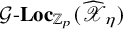
We then obtain a shtuka realization functor

given by the rule

where  is the isomorphism induced by the comparison isomorphism $\varrho $
from Theorem 3. In [Reference Imai, Kato and YoucisIKY23], Theorem 3 plays an important role in relating prismatic realization functors to shtuka realization functors, especially in proving the Pappas–Rapoport conjecture on the shtuka realization functors for Shimura varieties of abelian type at hyperspecial level.
$\varrho $
from Theorem 3. In [Reference Imai, Kato and YoucisIKY23], Theorem 3 plays an important role in relating prismatic realization functors to shtuka realization functors, especially in proving the Pappas–Rapoport conjecture on the shtuka realization functors for Shimura varieties of abelian type at hyperspecial level.
A remark on reductive hypotheses
As discussed above, while many of the results in this paper only require $\mathcal {G}$
to be a smooth affine group
$\mathcal {G}$
to be a smooth affine group $\mathbb {Z}_p$
-schemes, many of the main results (e.g., Theorem 1) require
$\mathbb {Z}_p$
-schemes, many of the main results (e.g., Theorem 1) require $\mathcal {G}$
to be reductive.
$\mathcal {G}$
to be reductive.
Pivotally, this makes use of an observation of Colliot-Thélène–Sansuc. To state it precisely, let X be an integral Noetherian scheme, $U\subseteq X$
an open subscheme such that
$U\subseteq X$
an open subscheme such that $X-U$
has depth at least
$X-U$
has depth at least $2$
,
$2$
, $\mathcal {G}$
a smooth affine group X-scheme, and
$\mathcal {G}$
a smooth affine group X-scheme, and $\rho \colon \mathcal {G}\hookrightarrow \operatorname {\mathrm {GL}}_n$
a faithful representation.
$\rho \colon \mathcal {G}\hookrightarrow \operatorname {\mathrm {GL}}_n$
a faithful representation.
We then have the following result (see §A.6 for a more comprehensive discussion).
Theorem (Colliot-Thélène–Sansuc)
Let notation be as above, and assume that $\mathcal {G}$
is a reductive group X-scheme. Then, if
$\mathcal {G}$
is a reductive group X-scheme. Then, if $\mathcal {P}$
is a
$\mathcal {P}$
is a $\mathcal {G}$
-torsor on U such that the vector bundle
$\mathcal {G}$
-torsor on U such that the vector bundle $\rho _\ast \mathcal {P}$
extends to X as a vector bundle, then the
$\rho _\ast \mathcal {P}$
extends to X as a vector bundle, then the $\mathcal {G}$
-torsor
$\mathcal {G}$
-torsor $\mathcal {P}$
extends to X.
$\mathcal {P}$
extends to X.
Ultimately, this theorem boils down to an application of Hartog’s lemma and the fact that the reductivity of $\mathcal {G}$
implies that the quotient
$\mathcal {G}$
implies that the quotient $\operatorname {\mathrm {GL}}_n/\mathcal {G}$
is affine. As a specific example of this, if
$\operatorname {\mathrm {GL}}_n/\mathcal {G}$
is affine. As a specific example of this, if $(A,\mathfrak {m})$
is a regular local ring of dimension
$(A,\mathfrak {m})$
is a regular local ring of dimension $2$
, then the condition on
$2$
, then the condition on $\rho _\ast \mathcal {P}$
is always satisfied by the Auslander–Buchsbaum formula, and so we obtain the following corollary.
$\rho _\ast \mathcal {P}$
is always satisfied by the Auslander–Buchsbaum formula, and so we obtain the following corollary.
Corollary. Suppose that $(A,\mathfrak {m})$
is a two-dimensional regular local ring and
$(A,\mathfrak {m})$
is a two-dimensional regular local ring and $\mathcal {G}$
a reductive group A-scheme. Then, any
$\mathcal {G}$
a reductive group A-scheme. Then, any $\mathcal {G}$
-torsor on
$\mathcal {G}$
-torsor on $\operatorname {\mathrm {Spec}}(A)-\{\mathfrak {m}\}$
extends to a
$\operatorname {\mathrm {Spec}}(A)-\{\mathfrak {m}\}$
extends to a $\mathcal {G}$
-torsor on
$\mathcal {G}$
-torsor on $\operatorname {\mathrm {Spec}}(A)$
.
$\operatorname {\mathrm {Spec}}(A)$
.
It is unreasonable to expect the theorem of Colliot-Thélène–Sansuc to hold when $\mathcal {G}$
is a general smooth affine group X-scheme. Namely, write
$\mathcal {G}$
is a general smooth affine group X-scheme. Namely, write $Y=\mathrm {GL}_n/\mathcal {G}$
for the quotient algebraic space. In this generality the best one can hope for is that Y is quasi-affine (e.g., see [Reference Pappas and ZhuPZ13, Corollary 11.7] for the case considered in the above corollary), and so we assume this and set
$Y=\mathrm {GL}_n/\mathcal {G}$
for the quotient algebraic space. In this generality the best one can hope for is that Y is quasi-affine (e.g., see [Reference Pappas and ZhuPZ13, Corollary 11.7] for the case considered in the above corollary), and so we assume this and set $Y^{\mathrm {aff}}=\operatorname {\mathrm {Spec}}(\mathcal {O}(Y))$
. Then, any section of
$Y^{\mathrm {aff}}=\operatorname {\mathrm {Spec}}(\mathcal {O}(Y))$
. Then, any section of $U\to Y$
extends to a section of
$U\to Y$
extends to a section of $X\to Y^{\mathrm {aff}}$
, but there is no reason to believe this avoids the boundary
$X\to Y^{\mathrm {aff}}$
, but there is no reason to believe this avoids the boundary $Y^{\mathrm {aff}}-Y$
. In fact, by considering the universal case
$Y^{\mathrm {aff}}-Y$
. In fact, by considering the universal case $U=Y$
and
$U=Y$
and $X=Y^{\mathrm {aff}}$
, one may show that the theorem of Colliot-Thélène–Sansuc fails whenever
$X=Y^{\mathrm {aff}}$
, one may show that the theorem of Colliot-Thélène–Sansuc fails whenever $\mathcal {G}$
is not reductive.
$\mathcal {G}$
is not reductive.
That said, from the perspective of Shimura varieties, the most interesting case beyond the reductive case is when $\mathcal {G}$
is a parahoric group scheme over
$\mathcal {G}$
is a parahoric group scheme over $\mathbb {Z}_p$
. In this case, while the theorem of Colliot-Thélène–Sansuc fails to hold, we expect that the above-stated corollary concerning regular local rings of dimension
$\mathbb {Z}_p$
. In this case, while the theorem of Colliot-Thélène–Sansuc fails to hold, we expect that the above-stated corollary concerning regular local rings of dimension $2$
does hold. Strong evidence in this direction is provided by [Reference AnschützAns22], which shows that the result does hold for certain A, notably
$2$
does hold. Strong evidence in this direction is provided by [Reference AnschützAns22], which shows that the result does hold for certain A, notably $A=\mathfrak {S}_{\mathcal {O}}$
for mixed characteristic discrete valuation rings
$A=\mathfrak {S}_{\mathcal {O}}$
for mixed characteristic discrete valuation rings $\mathcal {O}$
.
$\mathcal {O}$
.
Finally, while the cases of this observation of Colliot-Thélène–Sansuc relevant to proving Theorem 1 are not two-dimensional, it may still be possible to bootstrap from the two-dimensional case (or even the more specific result of Anschütz) to prove such an analogue of Theorem 1 at parahoric level.
Notation and conventions
-
○ The symbol p will always denote a (rational) prime.
-
○ All rings are assumed commutative and unital unless stated otherwise.
-
○ Reductive group schemes are assumed (by definition) to have connected fibers.
-
○ Formal schemes are assumed to have a locally finitely generated ideal sheaf of definition.
-
○ For a property P of morphisms of schemes, an adic morphism of formal schemes
$\mathfrak {X}\to \mathfrak {Y}$
, where
$\mathfrak {Y}$
has an ideal sheaf of definition
$\mathcal {I}$
, is adically P (or
$\mathcal {I}$
-adically P) if the reduction modulo
$\mathcal {I}^n$
is P for all n. If
$A\to B$
is an adic morphism of rings with the I-adic topology, for
$I\subseteq A$
an ideal, then we make a similar definition. -
○ For étaleness/smoothness of a morphism of formal schemes, we follow the conventions in [Reference Fujiwara and KatoFK18, Chapter I, §5.3. (b)–(c)]. In particular, smooth morphisms are adic.
-
○ For a nonarchimedean field K, a rigid K-space X is an adic space locally of finite type over K. We denote the set of classical points by
$|X|^{\mathrm {cl}}:=\left \{x\in X: [k(x):K]<\infty \right \}$
. -
○ For two categories
$\mathscr {C}$
and
$\mathscr {D}$
, the notation
$(F,G)\colon \mathscr {C}\to \mathscr {D}$
means a pair of functors
$F\colon \mathscr {C}\to \mathscr {D}$
and
$G\colon \mathscr {D}\to \mathscr {C}$
, with F being right adjoint to G. -
○ For an R-module M and an ideal
$I\subseteq R$
we write
$M/I$
as shorthand for
$M/IM$
. -
○ A filtration always means a decreasing, separated, and exhaustive
$\mathbb {Z}$
-filtration. -
○ For a ring A which is a-adically separated for a in A, denote by
${\operatorname {\mathrm {Fil}}}^{\bullet }_a$
the filtration with
${\operatorname {\mathrm {Fil}}}^r_a=a^r A$
for
$r> 0$
, and
${\operatorname {\mathrm {Fil}}}^r_a=A$
for
$r\leqslant 0$
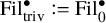
. Define . -
○ A filtration of modules (of sheaves) is locally split if its graded pieces are locally free.
-
○ For an
$\mathbb {F}_p$
-algebra R (resp.
$\mathbb {F}_p$
-scheme X), we denote by
$F_R$
(resp.
$F_X$
) the absolute Frobenius of R (resp. X).










 .
.


1 The Tannakian framework for prismatic objects
In this section we discuss the fundamental Tannakian theory of (analytic) prismatic F-crystals on a quasi-syntomic p-adic formal scheme $\mathfrak {X}$
. See Appendix A for our conventions concerning, topoi, formal schemes, and Tannakian formalism.
$\mathfrak {X}$
. See Appendix A for our conventions concerning, topoi, formal schemes, and Tannakian formalism.
Notation 1.1. We fix the following notation:
-
○ k is a perfect field extension of
$\mathbb {F}_p$
, , and , -
○ K is a finite totally ramified extension of
$K_0$
, with ring of integers
$\mathcal {O}_K$
and ramification index e, -
○
$\pi $
is a uniformizer of K, which we take to be p if
$K=K_0$
, and
$E=E(u)$
in
$W[u]$
is the minimal polynomial for
$\pi $
over
$K_0$
, -
○
$\overline {K}$
is an algebraic closure of K and C is its p-adic completion, -
○
$\pi ^\flat $
and
$p^\flat $
in
$C^\flat $
are as in [Reference Scholze and WeinsteinSW20, Lemma 6.2.2], -
○
in
$C^\flat $
is a compatible system of
$p^{\text {th}}$
-power roots of
$1$
, -
○
$q=[\varepsilon ]$
in
${\mathrm {A}}_{\mathrm {inf}}(\mathcal {O}_C)$
, and an element of
${\mathrm {A}}_{\mathrm {crys}}(\mathcal {O}_C)$
, where
${\mathrm {A}}_{\mathrm {inf}}(\mathcal {O}_C)$
and
${\mathrm {A}}_{\mathrm {crys}}(\mathcal {O}_C)$
are as in [Reference FontaineFon94, §1.2.3] and [Reference FontaineFon94, §2.2], respectively, -
○
and , elements of
${\mathrm {A}}_{\mathrm {inf}}(\mathcal {O}_C)$
, -
○
is a tensor package over
$\mathbb {Z}_p$
, with smooth over
$\mathbb {Z}_p$
(see §A.5), -
○
.

 , and
, and  ,
,


 in
in 


 an element of


 and
and  , elements of
 is a tensor package over
 smooth over
 .
.1.1 The absolute prismatic and quasi-syntomic sites
We now record notation and basic results about the prismatic and quasi-syntomic sites developed in [Reference Bhatt, Morrow and ScholzeBMS19], [Reference Bhatt and ScholzeBS22], and [Reference Bhatt and ScholzeBS23].
1.1.1 Prisms
For a $\mathbb {Z}_{(p)}$
-algebra A, a
$\mathbb {Z}_{(p)}$
-algebra A, a $\delta $
-structure is a map
$\delta $
-structure is a map $\delta \colon A\to A$
with
$\delta \colon A\to A$
with $\delta (0)=\delta (1)=0$
and
$\delta (0)=\delta (1)=0$
and
 $$ \begin{align*} \delta(xy)=x^p\delta(y)+y^p\delta(x)+p\delta(x)\delta(y),\qquad \delta(x+y)=\delta(x)+\delta(y)+\tfrac{1}{p}(x^p+y^p-(x+y)^p). \end{align*} $$
Associated to $\delta $
is a Frobenius lift
$\delta $
is a Frobenius lift $\phi \colon A\to A$
given by
$\phi \colon A\to A$
given by $\phi (x)=x^p+p\delta (x)$
, which we call the Frobenius. If A is p-torsion-free then any Frobenius lift
$\phi (x)=x^p+p\delta (x)$
, which we call the Frobenius. If A is p-torsion-free then any Frobenius lift $\phi $
on A defines a
$\phi $
on A defines a $\delta $
structure by
$\delta $
structure by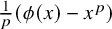 $\tfrac {1}{p}(\phi (x)-x^p)$
, establishing a bijection between the two types of structures, and we conflate the two notions. We call the pair
$\tfrac {1}{p}(\phi (x)-x^p)$
, establishing a bijection between the two types of structures, and we conflate the two notions. We call the pair $(A,\delta )$
a
$(A,\delta )$
a $\delta $
-ring. We often suppress
$\delta $
-ring. We often suppress $\delta $
from the notation, writing
$\delta $
from the notation, writing $\delta _A$
(or
$\delta _A$
(or $\phi _A$
) when we want to be clear. A morphism of
$\phi _A$
) when we want to be clear. A morphism of $\delta $
-rings is a ring map that intertwines the
$\delta $
-rings is a ring map that intertwines the $\delta $
-structures.
$\delta $
-structures.
A prism is a pair $(A,I)$
where A is a
$(A,I)$
where A is a $\delta $
-ring and
$\delta $
-ring and $I\subseteq A$
is an invertible ideal with A derived
$I\subseteq A$
is an invertible ideal with A derived $(p,I)$
-adically complete (see [Reference Bhatt, Morrow and ScholzeBMS18, §6.2]), and such that
$(p,I)$
-adically complete (see [Reference Bhatt, Morrow and ScholzeBMS18, §6.2]), and such that $I+\phi (I)$
contains p. Thus, I is finitely generated and
$I+\phi (I)$
contains p. Thus, I is finitely generated and $\operatorname {\mathrm {Spec}}(A)-V(I)$
is affine (see [SP, Tag 07ZT]), and we denote by
$\operatorname {\mathrm {Spec}}(A)-V(I)$
is affine (see [SP, Tag 07ZT]), and we denote by  the global sections of the structure sheaf. Let $j_{(A,I)}$
denote the inclusion of
$j_{(A,I)}$
denote the inclusion of  into
into $\operatorname {\mathrm {Spec}}(A)$
. For a prism
$\operatorname {\mathrm {Spec}}(A)$
. For a prism $(A,I)$
, unless stated otherwise, we view A as being equipped with the
$(A,I)$
, unless stated otherwise, we view A as being equipped with the $(p,I)$
-adic topology.
$(p,I)$
-adic topology.
A prism $(A,I)$
is bounded if
$(A,I)$
is bounded if $A/I$
has bounded
$A/I$
has bounded $p^\infty $
-torsion. The following two results will be used without comment in the sequel.
$p^\infty $
-torsion. The following two results will be used without comment in the sequel.
Lemma 1.2. Let $(A,I)$
be a bounded prism. Then, A is
$(A,I)$
be a bounded prism. Then, A is $(p,I)$
-adically complete, and
$(p,I)$
-adically complete, and $A/I^r$
is p-adically complete for all
$A/I^r$
is p-adically complete for all $r\geqslant 1$
.
$r\geqslant 1$
.
Proof. The first claim is precisely [Reference Bhatt and ScholzeBS22, Lemma 3.7 (1)]. For the second claim, let $I^r=(d_1,\ldots ,d_n)$
. Then,
$I^r=(d_1,\ldots ,d_n)$
. Then, $A/I^r=\mathrm {coker}(f)$
, where
$A/I^r=\mathrm {coker}(f)$
, where $f\colon A^n\to A$
is given by
$f\colon A^n\to A$
is given by $f(a_1,\ldots ,a_n)=\sum _{i=1}^n d_ia_i$
. As
$f(a_1,\ldots ,a_n)=\sum _{i=1}^n d_ia_i$
. As $A^n$
and A are p-adically complete, we know by [Reference Bhatt and ScholzeBS15, Lemma 3.4.14] that
$A^n$
and A are p-adically complete, we know by [Reference Bhatt and ScholzeBS15, Lemma 3.4.14] that $A/I^r$
is derived p-adically complete. But, it is then p-adically complete by the argument of Ogus given in the comments of [SP, Tag 0BKF].
$A/I^r$
is derived p-adically complete. But, it is then p-adically complete by the argument of Ogus given in the comments of [SP, Tag 0BKF].
A morphism $(A,I)\to (B,J)$
is a morphism
$(A,I)\to (B,J)$
is a morphism $A\to B$
of
$A\to B$
of $\delta $
-rings mapping I into J. By the rigidity property of morphisms of prisms (see [Reference Bhatt and ScholzeBS22, Proposition 3.5]), if
$\delta $
-rings mapping I into J. By the rigidity property of morphisms of prisms (see [Reference Bhatt and ScholzeBS22, Proposition 3.5]), if $(A,I)\to (B,J)$
is a morphism of prisms, then
$(A,I)\to (B,J)$
is a morphism of prisms, then $I\otimes _A B$
maps isomorphically onto J and, in particular,
$I\otimes _A B$
maps isomorphically onto J and, in particular, $J=IB$
. A morphism
$J=IB$
. A morphism $(A,I)\to (B,IB)$
is
$(A,I)\to (B,IB)$
is $(p,I)$
-completely (faithfully) flat (resp. étale, smooth) when
$(p,I)$
-completely (faithfully) flat (resp. étale, smooth) when $B\otimes ^L_A (A/(p,I))$
is concentrated in degree
$B\otimes ^L_A (A/(p,I))$
is concentrated in degree $0$
and
$0$
and $A/(p,I)\to B\otimes ^L_A (A/(p,I))$
is (faithfully) flat (resp. étale, smooth).
$A/(p,I)\to B\otimes ^L_A (A/(p,I))$
is (faithfully) flat (resp. étale, smooth).
Lemma 1.3. Let $(A,I)$
be a bounded prism. Let B be a
$(A,I)$
be a bounded prism. Let B be a $(p,I)$
-adically complete A-algebra. Then
$(p,I)$
-adically complete A-algebra. Then $A \to B$
is
$A \to B$
is $(p,I)$
-completely (faithfully) flat (resp. étale, smooth) if and only if
$(p,I)$
-completely (faithfully) flat (resp. étale, smooth) if and only if $\operatorname {\mathrm {Spf}}(B)\to \operatorname {\mathrm {Spf}}(A)$
is adically (faithfully) flat (resp. étale, smooth).
$\operatorname {\mathrm {Spf}}(B)\to \operatorname {\mathrm {Spf}}(A)$
is adically (faithfully) flat (resp. étale, smooth).
Proof. We put $J=IB$
. If
$J=IB$
. If $(A,I)\to (B,J)$
is
$(A,I)\to (B,J)$
is $(p,I)$
-completely (faithfully) flat then [Reference YekutieliYek18, Theorem 4.3] implies the map
$(p,I)$
-completely (faithfully) flat then [Reference YekutieliYek18, Theorem 4.3] implies the map $A/(p,I)^n\to B/(p,J)^n$
is (faithfully) flat for all n, and so
$A/(p,I)^n\to B/(p,J)^n$
is (faithfully) flat for all n, and so $\operatorname {\mathrm {Spf}}(B)\to \operatorname {\mathrm {Spf}}(A)$
is adically (faithfully) flat. Suppose that
$\operatorname {\mathrm {Spf}}(B)\to \operatorname {\mathrm {Spf}}(A)$
is adically (faithfully) flat. Suppose that $\operatorname {\mathrm {Spf}}(B)\to \operatorname {\mathrm {Spf}}(A)$
is adically (faithfully) flat. Then [Reference YekutieliYek21, Theorem 7.3] implies the ideal
$\operatorname {\mathrm {Spf}}(B)\to \operatorname {\mathrm {Spf}}(A)$
is adically (faithfully) flat. Then [Reference YekutieliYek21, Theorem 7.3] implies the ideal $(p,I)\subseteq A$
is weakly proregular in the sense of op. cit. Therefore, we deduce that
$(p,I)\subseteq A$
is weakly proregular in the sense of op. cit. Therefore, we deduce that $A\to B$
is
$A\to B$
is $(p,I)$
-completely (faithfully) flat by completeness of these modules and [Reference YekutieliYek18, Theorem 6.9]. The second claim follows from this as
$(p,I)$
-completely (faithfully) flat by completeness of these modules and [Reference YekutieliYek18, Theorem 6.9]. The second claim follows from this as $A\to B$
is
$A\to B$
is $(p,I)$
-completely étale (resp. smooth) if and only if it is
$(p,I)$
-completely étale (resp. smooth) if and only if it is $(p,I)$
-completely flat and
$(p,I)$
-completely flat and $A/(p,I)\to B/(p,J)$
is étale (resp. smooth), and
$A/(p,I)\to B/(p,J)$
is étale (resp. smooth), and $\operatorname {\mathrm {Spf}}(B)\to \operatorname {\mathrm {Spf}}(A)$
is adically étale if and only if it is adically flat and
$\operatorname {\mathrm {Spf}}(B)\to \operatorname {\mathrm {Spf}}(A)$
is adically étale if and only if it is adically flat and $A/(p,I)\to B/(p,J)$
is étale (resp. smooth).
$A/(p,I)\to B/(p,J)$
is étale (resp. smooth).
Proposition 1.4. Let $(A,I)$
be a bounded prism and
$(A,I)$
be a bounded prism and $\operatorname {\mathrm {Spf}}(B)\to \operatorname {\mathrm {Spf}}(A)$
an adically étale map, where B is
$\operatorname {\mathrm {Spf}}(B)\to \operatorname {\mathrm {Spf}}(A)$
an adically étale map, where B is $(p,I)$
-adically complete. Then, there exists a unique
$(p,I)$
-adically complete. Then, there exists a unique $\delta $
-structure on B such that
$\delta $
-structure on B such that $(A,I)\to (B,IB)$
is a morphism of bounded prisms.
$(A,I)\to (B,IB)$
is a morphism of bounded prisms.
Proof. By [Reference Bhatt and ScholzeBS22, Lemma 2.18 and Lemma 3.7 (3)], we obtain a unique $\delta $
-structure so that
$\delta $
-structure so that $(A,I)\to (B,IB)$
is a map of prisms. Then by [Reference Bhatt and ScholzeBS15, Lemma 3.4.14],
$(A,I)\to (B,IB)$
is a map of prisms. Then by [Reference Bhatt and ScholzeBS15, Lemma 3.4.14], $B/IB$
is derived p-adically complete. Hence
$B/IB$
is derived p-adically complete. Hence $(B,IB)$
is a bounded prism by [Reference Bhatt, Morrow and ScholzeBMS19, Corollary 4.8 (1)].
$(B,IB)$
is a bounded prism by [Reference Bhatt, Morrow and ScholzeBMS19, Corollary 4.8 (1)].
A prism $(A,I)$
is perfect if
$(A,I)$
is perfect if $\phi _A$
is an isomorphism, in which case it is bounded (see [Reference Bhatt and ScholzeBS22, Lemma 2.34]). For a perfectoid ring R, we have the perfect prism
$\phi _A$
is an isomorphism, in which case it is bounded (see [Reference Bhatt and ScholzeBS22, Lemma 2.34]). For a perfectoid ring R, we have the perfect prism $({\mathrm {A}}_{\mathrm {inf}}(R),\ker (\theta _R))$
where
$({\mathrm {A}}_{\mathrm {inf}}(R),\ker (\theta _R))$
where ${\mathrm {A}}_{\mathrm {inf}}(R)=W(R^\flat )$
is Fontaine’s ring, which comes equipped with a natural Frobenius
${\mathrm {A}}_{\mathrm {inf}}(R)=W(R^\flat )$
is Fontaine’s ring, which comes equipped with a natural Frobenius $\phi _R$
, and
$\phi _R$
, and $\theta _R\colon {\mathrm {A}}_{\mathrm {inf}}(R)\to R$
is Fontaine’s map. We also have the perfect prism
$\theta _R\colon {\mathrm {A}}_{\mathrm {inf}}(R)\to R$
is Fontaine’s map. We also have the perfect prism $({\mathrm {A}}_{\mathrm {inf}}(R),\ker (\widetilde {\theta }_R))$
, where
$({\mathrm {A}}_{\mathrm {inf}}(R),\ker (\widetilde {\theta }_R))$
, where 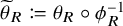 , which is isomorphic to $({\mathrm {A}}_{\mathrm {inf}}(R),\ker (\theta _R))$
via
$({\mathrm {A}}_{\mathrm {inf}}(R),\ker (\theta _R))$
via $\phi _R$
(see Remark 1.10 to see why we introduce these two choices). We often fix a generator
$\phi _R$
(see Remark 1.10 to see why we introduce these two choices). We often fix a generator $\xi _R$
of
$\xi _R$
of $\ker (\theta _R)$
and set
$\ker (\theta _R)$
and set 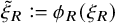 so that $\ker (\widetilde {\theta }_R)=(\tilde {\xi }_R)$
. When R is clear from context we shall omit the decoration of R at all places. When R is an
$\ker (\widetilde {\theta }_R)=(\tilde {\xi }_R)$
. When R is clear from context we shall omit the decoration of R at all places. When R is an $\mathcal {O}_C$
-algebra, we may take
$\mathcal {O}_C$
-algebra, we may take $\xi =\xi _0$
and
$\xi =\xi _0$
and $\tilde \xi =\tilde \xi _0$
which we often implicitly do.
$\tilde \xi =\tilde \xi _0$
which we often implicitly do.
1.1.2 The absolute prismatic site
Let $\mathfrak {X}$
be a p-adic formal scheme. Consider the category
$\mathfrak {X}$
be a p-adic formal scheme. Consider the category  of triples $(A,I,s)$
where
$(A,I,s)$
where $(A,I)$
is a bounded prism, and
$(A,I)$
is a bounded prism, and $s\colon \operatorname {\mathrm {Spf}}(A/I)\to \mathfrak {X}$
is a morphism, and where morphisms are maps of prisms commuting with the maps to
$s\colon \operatorname {\mathrm {Spf}}(A/I)\to \mathfrak {X}$
is a morphism, and where morphisms are maps of prisms commuting with the maps to $\mathfrak {X}$
. We often omit s from the notation. The absolute prismatic site
$\mathfrak {X}$
. We often omit s from the notation. The absolute prismatic site  of
of $\mathfrak {X}$
(see [Reference Bhatt and ScholzeBS23, Definition 2.3]) is the opposite category of
$\mathfrak {X}$
(see [Reference Bhatt and ScholzeBS23, Definition 2.3]) is the opposite category of  , endowed with the topology where $\{\alpha _i\colon (A,I)\to (B_i,J_i)\}$
in
$\{\alpha _i\colon (A,I)\to (B_i,J_i)\}$
in  corresponds to a cover if $\{\operatorname {\mathrm {Spf}}(\alpha _i)\colon \operatorname {\mathrm {Spf}}(B_i)\to \operatorname {\mathrm {Spf}}(A)\}$
is a cover in
$\{\operatorname {\mathrm {Spf}}(\alpha _i)\colon \operatorname {\mathrm {Spf}}(B_i)\to \operatorname {\mathrm {Spf}}(A)\}$
is a cover in $\operatorname {\mathrm {Spf}}(A)_{\mathrm {fl}}$
(see §A.4). That this is a site follows from the argument in [Reference Bhatt and ScholzeBS22, Corollary 3.12], which also shows that for a diagram in
$\operatorname {\mathrm {Spf}}(A)_{\mathrm {fl}}$
(see §A.4). That this is a site follows from the argument in [Reference Bhatt and ScholzeBS22, Corollary 3.12], which also shows that for a diagram in 
 $$ \begin{align*} (B,IB)\leftarrow (A,I)\to (C,IC), \end{align*} $$
with one of the maps adically faithfully flat, then its cofibered product is $(B\widehat {\otimes }_A C,I(B\widehat {\otimes }_A C))$
with the obvious
$(B\widehat {\otimes }_A C,I(B\widehat {\otimes }_A C))$
with the obvious $\delta $
-structure and map to
$\delta $
-structure and map to $\mathfrak {X}$
. We often abuse notation when working in
$\mathfrak {X}$
. We often abuse notation when working in  , writing objects and morphisms as in
  . We also shorten
  to
to  , in which case we often write $s\colon \operatorname {\mathrm {Spf}}(A/I)\to \operatorname {\mathrm {Spf}}(R)$
as
$s\colon \operatorname {\mathrm {Spf}}(A/I)\to \operatorname {\mathrm {Spf}}(R)$
as $s\colon R\to A/I$
.
$s\colon R\to A/I$
.
By [Reference Bhatt and ScholzeBS22, Corollary 3.12], the presheaves  and
and  are sheaves. By the rigidity property of morphisms of prisms,
  is a quasi-coherent ideal sheaf of
  . The association
  is a sheaf of rings as
  is flat. Define

(see [Reference Bhatt and ScholzeBS23, Remark 2.4] and [Reference Bhatt and ScholzeBS15, Proposition 3.1.10] for the second equality). The morphisms $\phi _A$
collectively form a morphism of sheaves of rings
$\phi _A$
collectively form a morphism of sheaves of rings  . We often omit the $\mathfrak {X}$
from the above notation when it is clear from context, writing
$\mathfrak {X}$
from the above notation when it is clear from context, writing  ,
,  ,
,  ,
,  ,
,  , and
, and $\phi $
.
$\phi $
.
For a morphism $f\colon \mathfrak {X}\to \mathfrak {Y}$
, the association
$f\colon \mathfrak {X}\to \mathfrak {Y}$
, the association $((A,I),s)\mapsto ((A,I),f\circ s)$
is cocontinuous, so gives a morphism of topoi
$((A,I),s)\mapsto ((A,I),f\circ s)$
is cocontinuous, so gives a morphism of topoi  .
.
1.1.3 The quasi-syntomic site
As in [Reference Bhatt, Morrow and ScholzeBMS19], call a p-adically complete ring R quasi-syntomic if it has bounded $p^\infty $
-torsion and the cotangent complex
$p^\infty $
-torsion and the cotangent complex $L_{R/\mathbb {Z}_p}$
has p-complete Tor-amplitude in
$L_{R/\mathbb {Z}_p}$
has p-complete Tor-amplitude in $[-1,0]$
(see [Reference Bhatt, Morrow and ScholzeBMS19, Definition 4.1]), which we consider as having the p-adic topology. A map
$[-1,0]$
(see [Reference Bhatt, Morrow and ScholzeBMS19, Definition 4.1]), which we consider as having the p-adic topology. A map $R\to S$
of p-adically complete rings with bounded
$R\to S$
of p-adically complete rings with bounded $p^\infty $
-torsion is called a quasi-syntomic morphism (resp. cover) if it is adically flat (resp. adically faithfully flat)Footnote 3
and
$p^\infty $
-torsion is called a quasi-syntomic morphism (resp. cover) if it is adically flat (resp. adically faithfully flat)Footnote 3
and $L_{S/R}$
has p-complete Tor-amplitude in
$L_{S/R}$
has p-complete Tor-amplitude in $[-1,0]$
. By [Reference Bhatt, Morrow and ScholzeBMS19, Proposition 4.19] a perfectoid ring R is quasi-syntomic.
$[-1,0]$
. By [Reference Bhatt, Morrow and ScholzeBMS19, Proposition 4.19] a perfectoid ring R is quasi-syntomic.
One extends these definitions to (maps of) p-adic formal schemes by working affine locally. For a quasi-syntomic p-adic formal scheme $\mathfrak {X}$
the big (resp. small) quasi-syntomic site of
$\mathfrak {X}$
the big (resp. small) quasi-syntomic site of $\mathfrak {X}$
, denoted
$\mathfrak {X}$
, denoted $\mathfrak {X}_{\mathrm {QSYN}}$
(resp.
$\mathfrak {X}_{\mathrm {QSYN}}$
(resp. $\mathfrak {X}_{\mathrm {qsyn}}$
), has objects maps (resp. quasi-syntomic maps)
$\mathfrak {X}_{\mathrm {qsyn}}$
), has objects maps (resp. quasi-syntomic maps) $\operatorname {\mathrm {Spf}}(R)\to \mathfrak {X}$
for R a p-adically complete ring with bounded
$\operatorname {\mathrm {Spf}}(R)\to \mathfrak {X}$
for R a p-adically complete ring with bounded $p^\infty $
-torsion, morphisms given by
$p^\infty $
-torsion, morphisms given by $\mathfrak {X}$
-morphisms, and covers given by quasi-syntomic covers (see [Reference Bhatt, Morrow and ScholzeBMS19, Lemma 4.17]).
$\mathfrak {X}$
-morphisms, and covers given by quasi-syntomic covers (see [Reference Bhatt, Morrow and ScholzeBMS19, Lemma 4.17]).
The functor

is cocontinuous (see [Reference Anschütz and Le BrasALB23, Corollary 3.24]), and therefore gives rise to a morphism of topoi  . The inclusion $\mathfrak {X}_{\mathrm {qsyn}}\to \mathfrak {X}_{\mathrm {QSYN}}$
, while continuous, may not induce a morphism of sites (see [Reference Anschütz and Le BrasALB23, §4.1]), but we may still consider the functor
$\mathfrak {X}_{\mathrm {qsyn}}\to \mathfrak {X}_{\mathrm {QSYN}}$
, while continuous, may not induce a morphism of sites (see [Reference Anschütz and Le BrasALB23, §4.1]), but we may still consider the functor

Following [Reference Anschütz and Le BrasALB23, Definition 4.1], we use $\mathcal {O}^{\mathrm {pris}}_{\mathfrak {X}}$
to denote
$\mathcal {O}^{\mathrm {pris}}_{\mathfrak {X}}$
to denote  and
and ${\mathcal {I}}_{\mathfrak {X}}^{\mathrm {pris}}$
for
${\mathcal {I}}_{\mathfrak {X}}^{\mathrm {pris}}$
for  . Define

There is a morphism of sheaves of rings  . When no confusion will arise, we omit $\mathfrak {X}$
from notation, writing
$\mathfrak {X}$
from notation, writing $\mathcal {O}^{\mathrm {pris}}$
,
$\mathcal {O}^{\mathrm {pris}}$
, $\mathcal {I}^{\mathrm {pris}}$
,
$\mathcal {I}^{\mathrm {pris}}$
,  , and
, and $\phi $
. There are also obvious analogues of these objects using
$\phi $
. There are also obvious analogues of these objects using $u_\ast $
in place of
$u_\ast $
in place of $v_\ast $
, which we denote by
$v_\ast $
, which we denote by $\mathcal {O}^{\mathrm {PRIS}}$
, etc.
$\mathcal {O}^{\mathrm {PRIS}}$
, etc.
A quasi-syntomic ring R is called quasi-regular semi-perfectoid (see [Reference Bhatt, Morrow and ScholzeBMS19, Definition 4.20 and Remark 4.22]), abbreviated qrsp, if there exists a surjection $S\to R$
with S a perfectoid ring.
$S\to R$
with S a perfectoid ring.
Lemma 1.5. Let $R \to R'$
be a p-adically flat morphism of p-adically complete rings. If
$R \to R'$
be a p-adically flat morphism of p-adically complete rings. If $N\geqslant 1$
is such that
$N\geqslant 1$
is such that $R[p^N]=R[p^\infty ]$
, then
$R[p^N]=R[p^\infty ]$
, then $R'[p^N]=R'[p^\infty ]$
.
$R'[p^N]=R'[p^\infty ]$
.
Proof. Let $r'$
be in
$r'$
be in $R'[p^{\infty }]$
and
$R'[p^{\infty }]$
and $n \geqslant N$
such that
$n \geqslant N$
such that $p^nr'=0$
. As
$p^nr'=0$
. As $R'$
is p-adically separated, it suffices to show that
$R'$
is p-adically separated, it suffices to show that $p^Nr'=0\mod p^m$
for all
$p^Nr'=0\mod p^m$
for all $m\geqslant 0$
. Note that the image of
$m\geqslant 0$
. Note that the image of $(R/p^{m+n})[p^n]$
in
$(R/p^{m+n})[p^n]$
in $(R/p^m)[p^n]$
is contained in
$(R/p^m)[p^n]$
is contained in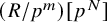 $(R/p^m)[p^N]$
, as
$(R/p^m)[p^N]$
, as $R[p^n]=R[p^N]$
. Note also that
$R[p^n]=R[p^N]$
. Note also that $(R'/p^\ell )[p^s]=(R'/p^\ell ) \otimes _{R/p^\ell } (R/p^\ell )[p^s]$
for any
$(R'/p^\ell )[p^s]=(R'/p^\ell ) \otimes _{R/p^\ell } (R/p^\ell )[p^s]$
for any $\ell ,s\geqslant 0$
by p-adic flatness. Thus, the image of
$\ell ,s\geqslant 0$
by p-adic flatness. Thus, the image of $(R'/p^{m+n})[p^n]$
in
$(R'/p^{m+n})[p^n]$
in $(R'/p^m)[p^n]$
is contained in
$(R'/p^m)[p^n]$
is contained in $(R'/p^m)[p^N]$
. This implies that the image of
$(R'/p^m)[p^N]$
. This implies that the image of $r'$
(or equivalently of
$r'$
(or equivalently of $r'\mod p^{m+n}$
) in
$r'\mod p^{m+n}$
) in $(R'/p^m)[p^n]$
is contained in
$(R'/p^m)[p^n]$
is contained in $(R'/p^m)[p^N]$
.
$(R'/p^m)[p^N]$
.
Lemma 1.6. If R is qrsp and $\operatorname {\mathrm {Spf}}(R')\to \operatorname {\mathrm {Spf}}(R)$
is an adically étale map, then
$\operatorname {\mathrm {Spf}}(R')\to \operatorname {\mathrm {Spf}}(R)$
is an adically étale map, then $R'$
is qrsp.
$R'$
is qrsp.
Proof. By [Reference Bhatt, Morrow and ScholzeBMS19, Remark 4.22] it is sufficient to show that $R'$
is quasi-syntomic,
$R'$
is quasi-syntomic, $R'/p$
is semi-perfect, and that there exists a perfectoid ring S and a morphism
$R'/p$
is semi-perfect, and that there exists a perfectoid ring S and a morphism $S\to R'$
. The last of these is clear. To prove the first claim, we observe that as
$S\to R'$
. The last of these is clear. To prove the first claim, we observe that as $R'$
has bounded
$R'$
has bounded $p^\infty $
-torsion by Lemma 1.5, that
$p^\infty $
-torsion by Lemma 1.5, that $R\to R'$
is p-completely flat by [Reference Bhatt, Morrow and ScholzeBMS19, Corollary 4.8] and so
$R\to R'$
is p-completely flat by [Reference Bhatt, Morrow and ScholzeBMS19, Corollary 4.8] and so $R'\otimes ^L_R (R/p)=R'/p$
. Thus, by [SP, Tag 08QQ] we have that
$R'\otimes ^L_R (R/p)=R'/p$
. Thus, by [SP, Tag 08QQ] we have that $L_{R'/R}\otimes ^L_{R'} (R'/p)=L_{(R'/p)/(R/p)}=0$
. For semi-perfectness, observe that as
$L_{R'/R}\otimes ^L_{R'} (R'/p)=L_{(R'/p)/(R/p)}=0$
. For semi-perfectness, observe that as $\operatorname {\mathrm {Frob}}_{R/p}\colon R/p\to R/p$
is surjective, thus so is the induced map
$\operatorname {\mathrm {Frob}}_{R/p}\colon R/p\to R/p$
is surjective, thus so is the induced map $R'/p\to R'/p\otimes _{R/p,\operatorname {\mathrm {Frob}}_{R/p}}R/p$
. But, this map is identified with
$R'/p\to R'/p\otimes _{R/p,\operatorname {\mathrm {Frob}}_{R/p}}R/p$
. But, this map is identified with $\operatorname {\mathrm {Frob}}_{R'/p}\colon R'/p\to R'/p$
as
$\operatorname {\mathrm {Frob}}_{R'/p}\colon R'/p\to R'/p$
as $R/p\to R'/p$
is étale.
$R/p\to R'/p$
is étale.
Denote by $\mathfrak {X}_{\mathrm {qrsp}}$
the full subcategory of
$\mathfrak {X}_{\mathrm {qrsp}}$
the full subcategory of $\mathfrak {X}_{\mathrm {qsyn}}$
consisting of qrsp objects, with the induced topology. By [Reference Bhatt, Morrow and ScholzeBMS19, Lemma 4.28 and Proposition 4.31],
$\mathfrak {X}_{\mathrm {qsyn}}$
consisting of qrsp objects, with the induced topology. By [Reference Bhatt, Morrow and ScholzeBMS19, Lemma 4.28 and Proposition 4.31], $\mathfrak {X}_{\mathrm {qrsp}}$
is a basis for
$\mathfrak {X}_{\mathrm {qrsp}}$
is a basis for $\mathfrak {X}_{\mathrm {qsyn}}$
. By a qrsp cover
$\mathfrak {X}_{\mathrm {qsyn}}$
. By a qrsp cover $\{\operatorname {\mathrm {Spf}}(R_i)\to \mathfrak {X}\}$
, we mean a quasi-syntomic cover where each
$\{\operatorname {\mathrm {Spf}}(R_i)\to \mathfrak {X}\}$
, we mean a quasi-syntomic cover where each $R_i$
is qrsp.
$R_i$
is qrsp.
1.1.4 Initial prisms
When R is a qrsp ring, the category  has an initial object
  , necessarily unique up to unique isomorphism (see [Reference Bhatt and ScholzeBS22, Proposition 7.2]).
Example 1.7. If R is perfectoid, then by [Reference Bhatt and ScholzeBS22, Lemma 4.8], $({\mathrm {A}}_{\mathrm {inf}}(R),(\xi ),\text {nat.})$
, or the isomorphic
$({\mathrm {A}}_{\mathrm {inf}}(R),(\xi ),\text {nat.})$
, or the isomorphic $({\mathrm {A}}_{\mathrm {inf}}(R),(\tilde {\xi }),\widetilde {\mathrm {nat}}.)$
, are initial objects. Here we denote by
$({\mathrm {A}}_{\mathrm {inf}}(R),(\tilde {\xi }),\widetilde {\mathrm {nat}}.)$
, are initial objects. Here we denote by  (resp.
  ) the natural isomorphism induced by $\theta $
(resp.
$\theta $
(resp. $\tilde \theta $
).
$\tilde \theta $
).
Example 1.8. Let R be a qrsp $\mathbb {F}_p$
-algebra. If
$\mathbb {F}_p$
-algebra. If 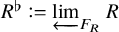 and J denotes the kernel of the composition $W(R^\flat )\to R^\flat \to R$
, set
$W(R^\flat )\to R^\flat \to R$
, set  to be the p-completed divided power envelope of $(W(R^\flat ),J)$
, which constitutes the universal pro-(PD thickening) of R over W (see [Reference FontaineFon94, Théorème 2.2.1]). Let
$(W(R^\flat ),J)$
, which constitutes the universal pro-(PD thickening) of R over W (see [Reference FontaineFon94, Théorème 2.2.1]). Let $\phi _R\colon {\mathrm {A}}_{\mathrm {crys}}(R)\to {\mathrm {A}}_{\mathrm {crys}}(R)$
denote the morphism induced from
$\phi _R\colon {\mathrm {A}}_{\mathrm {crys}}(R)\to {\mathrm {A}}_{\mathrm {crys}}(R)$
denote the morphism induced from $F_{R}$
by this universality. Then, by [Reference Bhatt, Morrow and ScholzeBMS19, Theorem 8.14],
$F_{R}$
by this universality. Then, by [Reference Bhatt, Morrow and ScholzeBMS19, Theorem 8.14], ${\mathrm {A}}_{\mathrm {crys}}(R)$
is p-torsion-free and
${\mathrm {A}}_{\mathrm {crys}}(R)$
is p-torsion-free and $\phi _R$
is a Frobenius lift on
$\phi _R$
is a Frobenius lift on ${\mathrm {A}}_{\mathrm {crys}}(R)$
and so
${\mathrm {A}}_{\mathrm {crys}}(R)$
and so $({\mathrm {A}}_{\mathrm {crys}}(R),(p))$
is a prism.
$({\mathrm {A}}_{\mathrm {crys}}(R),(p))$
is a prism.
Under the natural Frobenius-equivariant morphism $W(R^\flat )\to {\mathrm {A}}_{\mathrm {crys}}(R)$
, the ideal
$W(R^\flat )\to {\mathrm {A}}_{\mathrm {crys}}(R)$
, the ideal $\phi _R(J)$
maps to
$\phi _R(J)$
maps to $(p)$
. Indeed, as
$(p)$
. Indeed, as $\phi _R(J)$
contains p it suffices to show that if x is in J, then p divides
$\phi _R(J)$
contains p it suffices to show that if x is in J, then p divides $\phi _R(x)$
in
$\phi _R(x)$
in ${\mathrm {A}}_{\mathrm {crys}}(R)$
. But, observe that
${\mathrm {A}}_{\mathrm {crys}}(R)$
. But, observe that $x^p= p(p-1)!\tfrac {x^p}{p!}$
and so
$x^p= p(p-1)!\tfrac {x^p}{p!}$
and so $\phi _R(x)=x^p=0 \mod p{\mathrm {A}}_{\mathrm {crys}}(R)$
. We then obtain a morphism
$\phi _R(x)=x^p=0 \mod p{\mathrm {A}}_{\mathrm {crys}}(R)$
. We then obtain a morphism $\widetilde {\mathrm {nat}}.\colon R\to {\mathrm {A}}_{\mathrm {crys}}(R)/p$
obtained as the composition
$\widetilde {\mathrm {nat}}.\colon R\to {\mathrm {A}}_{\mathrm {crys}}(R)/p$
obtained as the composition

So, $({\mathrm {A}}_{\mathrm {crys}}(R),(p),\widetilde {\mathrm {nat}}.)$
constitutes an element of
$({\mathrm {A}}_{\mathrm {crys}}(R),(p),\widetilde {\mathrm {nat}}.)$
constitutes an element of  , and is initial by [Reference Anschütz and Le BrasALB23, Lemma 3.27] and [Reference Bhatt and ScholzeBS22, Proposition 7.10].
Example 1.9. Let R be a perfectoid ring, and set  . Then, the universal property of ${\mathrm {A}}_{\mathrm {crys}}(R)$
implies that the map
${\mathrm {A}}_{\mathrm {crys}}(R)$
implies that the map $\theta \colon {\mathrm {A}}_{\mathrm {inf}}(R)\to R$
extends to a map
$\theta \colon {\mathrm {A}}_{\mathrm {inf}}(R)\to R$
extends to a map $\theta \colon {\mathrm {A}}_{\mathrm {crys}}(R)\to R$
which is an initial object of
$\theta \colon {\mathrm {A}}_{\mathrm {crys}}(R)\to R$
which is an initial object of $(R/W)_{\mathrm {crys}}$
(see §2.3.1 for this notation). We write
$(R/W)_{\mathrm {crys}}$
(see §2.3.1 for this notation). We write $\phi _R$
instead of
$\phi _R$
instead of $\phi _{R/p}$
. From Example 1.8, we have a morphism of prisms
$\phi _{R/p}$
. From Example 1.8, we have a morphism of prisms $({\mathrm {A}}_{\mathrm {inf}}(R),(\tilde {\xi }),\widetilde {\mathrm {nat}}.)\to ({\mathrm {A}}_{\mathrm {crys}}(R),(p),\widetilde {\mathrm {nat}}.)$
. This is injective by [Reference Scholze and WeinsteinSW13, Lemma 4.1.7] as
$({\mathrm {A}}_{\mathrm {inf}}(R),(\tilde {\xi }),\widetilde {\mathrm {nat}}.)\to ({\mathrm {A}}_{\mathrm {crys}}(R),(p),\widetilde {\mathrm {nat}}.)$
. This is injective by [Reference Scholze and WeinsteinSW13, Lemma 4.1.7] as $R/p$
is f-adic by [Reference Scholze and WeinsteinSW13, Proposition 4.1.2] since
$R/p$
is f-adic by [Reference Scholze and WeinsteinSW13, Proposition 4.1.2] since $\ker (R^\flat \to R/p)$
is generated by the image of
$\ker (R^\flat \to R/p)$
is generated by the image of $\xi $
under
$\xi $
under ${\mathrm {A}}_{\mathrm {inf}}(R)=W(R^\flat )\to R^\flat $
.
${\mathrm {A}}_{\mathrm {inf}}(R)=W(R^\flat )\to R^\flat $
.
Remark 1.10. The morphism $({\mathrm {A}}_{\mathrm {inf}}(R),(\tilde {\xi }),\widetilde {\mathrm {nat}}.)\to ({\mathrm {A}}_{\mathrm {crys}}(R),(p),\widetilde {\mathrm {nat}}.)$
in Example 1.9 justifies the appearance of the element
$({\mathrm {A}}_{\mathrm {inf}}(R),(\tilde {\xi }),\widetilde {\mathrm {nat}}.)\to ({\mathrm {A}}_{\mathrm {crys}}(R),(p),\widetilde {\mathrm {nat}}.)$
in Example 1.9 justifies the appearance of the element $\tilde {\xi }$
. One cannot generally undo these Frobenius twists as while
$\tilde {\xi }$
. One cannot generally undo these Frobenius twists as while $\phi _R$
is an isomorphism on
$\phi _R$
is an isomorphism on ${\mathrm {A}}_{\mathrm {inf}}(R)$
, it is not on
${\mathrm {A}}_{\mathrm {inf}}(R)$
, it is not on ${\mathrm {A}}_{\mathrm {crys}}(R)$
.
${\mathrm {A}}_{\mathrm {crys}}(R)$
.
If $\operatorname {\mathrm {Spf}}(R)\to \mathfrak {X}$
is an object of
$\operatorname {\mathrm {Spf}}(R)\to \mathfrak {X}$
is an object of $\mathfrak {X}_{\mathrm {qrsp}}$
then
$\mathfrak {X}_{\mathrm {qrsp}}$
then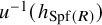 $u^{-1}(h_{\operatorname {\mathrm {Spf}}(R)})$
is equal to
$u^{-1}(h_{\operatorname {\mathrm {Spf}}(R)})$
is equal to  . Using this and the cocontinuity of u (see [Reference Anschütz and Le BrasALB23, Corollary 3.24]), one deduces the following (cf. Lemma A.8).
Proposition 1.11. If $\{\operatorname {\mathrm {Spf}}(R_i)\to \mathfrak {X}\}$
is a qrsp cover, then
$\{\operatorname {\mathrm {Spf}}(R_i)\to \mathfrak {X}\}$
is a qrsp cover, then  covers $\ast $
in
$\ast $
in  .
.
1.1.5 Small and base
$\mathcal {O}_K$
-algebras

We now discuss the rings of main interest in this article.
First definitions
Let R be a p-adically complete $\mathcal {O}_K$
-algebra with
$\mathcal {O}_K$
-algebra with $\operatorname {\mathrm {Spec}}(R)$
connected. Call R a base
$\operatorname {\mathrm {Spec}}(R)$
connected. Call R a base $\mathcal {O}_K$
-algebra if
$\mathcal {O}_K$
-algebra if $R=R_0\otimes _W\mathcal {O}_K$
where
$R=R_0\otimes _W\mathcal {O}_K$
where $R_0$
is a
$R_0$
is a $J_{R_0}$
-adically complete ring for which the pair
$J_{R_0}$
-adically complete ring for which the pair $(R_0,J_{R_0})=(A_n,I_n)$
, is obtained from the following iterative procedure. For some
$(R_0,J_{R_0})=(A_n,I_n)$
, is obtained from the following iterative procedure. For some $d\geqslant 0$
, let
$d\geqslant 0$
, let $A_0$
be
$A_0$
be  , and set $I_0=(p)$
. For each
$I_0=(p)$
. For each $i=0,\ldots ,n-1$
iteratively form the pair
$i=0,\ldots ,n-1$
iteratively form the pair $(A_{i+1},I_{i+1})$
by one of the following operations:
$(A_{i+1},I_{i+1})$
by one of the following operations:
-
○
$A_{i+1}$
is the p-adic completion of an étale
$A_i$
-algebra,Footnote 4
and
$I_{i+1}=I_iA_{i+1}$
, -
○
$A_{i+1}$
is the p-adic completion of a localization
$A_i\to (A_i)_{\mathfrak {p}}$
at a prime
$\mathfrak {p}$
containing p, and
$I_{i+1}=I_iA_{i+1}$
, -
○
$A_{i+1}$
is the I-adic completion of
$A_i$
with respect to an ideal
$I\subseteq A_i$
containing p, and
$I_{i+1}=(I_i,I)A_{i+1}$
.






While the discussion of base $\mathcal {O}_K$
-algebras implicitly entails other topologies, we always think of a base
$\mathcal {O}_K$
-algebras implicitly entails other topologies, we always think of a base $\mathcal {O}_K$
-algebra as being equipped with the p-adic topology.
$\mathcal {O}_K$
-algebra as being equipped with the p-adic topology.
A map $t\colon T_d\to R_0$
(where we implicitly have
$t\colon T_d\to R_0$
(where we implicitly have $R=R_0\otimes _W \mathcal {O}_K$
) of the form constructed above is called a presentation. In the following we use terminology from [Reference KimKim15, §2.2]. Moreover, for a map of rings
$R=R_0\otimes _W \mathcal {O}_K$
) of the form constructed above is called a presentation. In the following we use terminology from [Reference KimKim15, §2.2]. Moreover, for a map of rings $R\to S$
and an ideal
$R\to S$
and an ideal $J\subseteq S$
, we say that
$J\subseteq S$
, we say that $R\to S$
is J-formally étale if the following solid diagram
$R\to S$
is J-formally étale if the following solid diagram

can be uniquely completed along the dotted arrow assuming that A is a ring and $I\subseteq A$
is a square-zero ideal such that the image J in
$I\subseteq A$
is a square-zero ideal such that the image J in $A/I$
is nilpotent, and similarly for J-formally smooth.
$A/I$
is nilpotent, and similarly for J-formally smooth.
Proposition 1.12. A base $\mathcal {O}_K$
-algebra R is excellent and regular, and
$\mathcal {O}_K$
-algebra R is excellent and regular, and $R/\pi $
has a finite p-basis. For a presentation
$R/\pi $
has a finite p-basis. For a presentation $t\colon T_d\to R_0$
, the k-algebra
$t\colon T_d\to R_0$
, the k-algebra $R_0/J_{R_0}$
is finite type, and t is
$R_0/J_{R_0}$
is finite type, and t is $J_{R_0}$
-formally étale.
$J_{R_0}$
-formally étale.
Proof. Fix a presentation $t\colon T_d\to R_0$
. We first prove that R is excellent. As
$t\colon T_d\to R_0$
. We first prove that R is excellent. As $R_0\to R$
is finite type, it suffices to prove that
$R_0\to R$
is finite type, it suffices to prove that $R_0$
is excellent (see [SP, Tag 07QU]). We prove that
$R_0$
is excellent (see [SP, Tag 07QU]). We prove that $A_i$
is excellent by induction on i. As
$A_i$
is excellent by induction on i. As $T_d$
is the p-adic completion of
$T_d$
is the p-adic completion of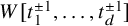 $W[t_1^{\pm 1},\ldots ,t_d^{\pm 1}]$
, which is excellent by loc. cit., we know that
$W[t_1^{\pm 1},\ldots ,t_d^{\pm 1}]$
, which is excellent by loc. cit., we know that $T_d$
is excellent by [Reference Kurano and ShimomotoKS21, Main Theorem 2]. If
$T_d$
is excellent by [Reference Kurano and ShimomotoKS21, Main Theorem 2]. If $A_i$
is excellent, then
$A_i$
is excellent, then $A_{i+1}$
is excellent regardless of which of the three constructions is applied to
$A_{i+1}$
is excellent regardless of which of the three constructions is applied to $A_i$
by combining [SP, Tag 07QU] and [Reference Kurano and ShimomotoKS21, Main Theorem 2]. To prove that t is
$A_i$
by combining [SP, Tag 07QU] and [Reference Kurano and ShimomotoKS21, Main Theorem 2]. To prove that t is $J_{R_0}$
-formally étale, it suffices by induction to prove that
$J_{R_0}$
-formally étale, it suffices by induction to prove that $A_i\to A_{i+1}$
is
$A_i\to A_{i+1}$
is $I_{i+1}$
-formally étale for each
$I_{i+1}$
-formally étale for each $i=0,\ldots ,n-1$
, but this is clear. Thus,
$i=0,\ldots ,n-1$
, but this is clear. Thus, $T_d\otimes _W \mathcal {O}_K\to R$
is
$T_d\otimes _W \mathcal {O}_K\to R$
is $J_{R_0}$
-formally étale, and thus it follows from [Reference Majadas and RodicioMR10, Theorem 6.4.2] that
$J_{R_0}$
-formally étale, and thus it follows from [Reference Majadas and RodicioMR10, Theorem 6.4.2] that $T_d\otimes _W \mathcal {O}_K\to R$
is regular and thus R is regular.Footnote 5
The final claims concerning
$T_d\otimes _W \mathcal {O}_K\to R$
is regular and thus R is regular.Footnote 5
The final claims concerning $R/\pi =R_0/p$
and
$R/\pi =R_0/p$
and $R_0/J_{R_0}$
may be checked iteratively, the latter being obvious. The former being preserved by our three operations requires [Reference de JongdJ95a, Lemma 1.1.3], and the observation that if
$R_0/J_{R_0}$
may be checked iteratively, the latter being obvious. The former being preserved by our three operations requires [Reference de JongdJ95a, Lemma 1.1.3], and the observation that if $\{x_\alpha \}$
is a p-basis for an
$\{x_\alpha \}$
is a p-basis for an $\mathbb {F}_p$
-algebra A, and
$\mathbb {F}_p$
-algebra A, and $A\to B$
is étale then
$A\to B$
is étale then $\{x_\alpha \}$
is a p-basis for B as
$\{x_\alpha \}$
is a p-basis for B as $F_A\otimes 1$
is identified with
$F_A\otimes 1$
is identified with $F_B$
via the isomorphism
$F_B$
via the isomorphism  .
.
We call a decomposition $R=R_0\otimes _W \mathcal {O}_K$
and a
$R=R_0\otimes _W \mathcal {O}_K$
and a $J_{R_0}$
-formally étale map
$J_{R_0}$
-formally étale map $t\colon T_d\to R_0$
, where
$t\colon T_d\to R_0$
, where $J_{R_0}$
is any ideal coming from a presentation, a formal framing. For a formal framing t, the ring
$J_{R_0}$
is any ideal coming from a presentation, a formal framing. For a formal framing t, the ring $R_0$
carries a unique Frobenius lift
$R_0$
carries a unique Frobenius lift $\phi _{t}$
such that
$\phi _{t}$
such that $\phi _t\circ t=t \circ \phi _0$
, where
$\phi _t\circ t=t \circ \phi _0$
, where $\phi _0$
is the Frobenius lift on
$\phi _0$
is the Frobenius lift on $T_d$
acting as usual on W and with
$T_d$
acting as usual on W and with $\phi _0(t_i)=t_i^p$
.
$\phi _0(t_i)=t_i^p$
.
Perfectoid type prisms
Let R be a base $\mathcal {O}_K$
-algebra. Write
$\mathcal {O}_K$
-algebra. Write $\mathcal {K}$
for
$\mathcal {K}$
for $\mathrm {Frac}(R)$
. Fix an algebraic closure
$\mathrm {Frac}(R)$
. Fix an algebraic closure $\overline {\mathcal {K}}$
containing
$\overline {\mathcal {K}}$
containing $\overline {K}$
, and denote by
$\overline {K}$
, and denote by $\mathcal {K}^{\mathrm {ur}}$
the maximal subfield of
$\mathcal {K}^{\mathrm {ur}}$
the maximal subfield of $\overline {\mathcal {K}}$
unramified along
$\overline {\mathcal {K}}$
unramified along  (cf. [SP, Tag 0BQJ]). Denote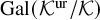 $\operatorname {\mathrm {Gal}}(\mathcal {K}^{\mathrm {ur}}/\mathcal {K})$
by
$\operatorname {\mathrm {Gal}}(\mathcal {K}^{\mathrm {ur}}/\mathcal {K})$
by $\Gamma _R$
, which agrees with
$\Gamma _R$
, which agrees with  where
where $\overline {x}$
is the geometric point determined by
$\overline {x}$
is the geometric point determined by $\overline {\mathcal {K}}$
(see [SP, Tag 0BQM]). Denote by
$\overline {\mathcal {K}}$
(see [SP, Tag 0BQM]). Denote by $\overline {R}$
(resp.
$\overline {R}$
(resp. $R^{\mathrm {ur}}$
) the integral closure of R in
$R^{\mathrm {ur}}$
) the integral closure of R in $\overline {\mathcal {K}}$
(resp.
$\overline {\mathcal {K}}$
(resp. $\mathcal {K}^{\mathrm {ur}}$
), and set
$\mathcal {K}^{\mathrm {ur}}$
), and set $\widetilde {R}$
(resp.
$\widetilde {R}$
(resp. $\check {R}$
) to be its p-adic completion.Footnote 6
The
$\check {R}$
) to be its p-adic completion.Footnote 6
The $\mathcal {O}_C$
-algebras
$\mathcal {O}_C$
-algebras $\check {R}$
and
$\check {R}$
and $\widetilde {R}$
are perfectoid by the following lemma.
$\widetilde {R}$
are perfectoid by the following lemma.
Lemma 1.13 [Reference Česnavičius and ScholzeČS24, Proposition 2.1.8]
Let A be a p-torsion-free $\mathcal {O}_C$
-algebra which is p-integrally closed in
$\mathcal {O}_C$
-algebra which is p-integrally closed in  (i.e., if $x^p$
is in A for x in
$x^p$
is in A for x in  , then x is in A). Then, the p-adic completion $\widehat {A}$
is perfectoid if and only if
$\widehat {A}$
is perfectoid if and only if $A/p$
is semi-perfect.
$A/p$
is semi-perfect.
Thus, we have the objects $({\mathrm {A}}_{\mathrm {inf}}(\check {R}),(\tilde {\xi }),\widetilde {\mathrm {nat}}.)$
and
$({\mathrm {A}}_{\mathrm {inf}}(\check {R}),(\tilde {\xi }),\widetilde {\mathrm {nat}}.)$
and $({\mathrm {A}}_{\mathrm {crys}}(\check {R}),(p),\widetilde {\mathrm {nat}}.)$
of
$({\mathrm {A}}_{\mathrm {crys}}(\check {R}),(p),\widetilde {\mathrm {nat}}.)$
of  , and their $\widetilde {R}$
counterparts.
$\widetilde {R}$
counterparts.
Breuil–Kisin type prisms
Let $R=R_0\otimes _W \mathcal {O}_K$
be a base
$R=R_0\otimes _W \mathcal {O}_K$
be a base $\mathcal {O}_K$
-algebra and
$\mathcal {O}_K$
-algebra and $t\colon T_d\to R_0$
a formal framing. We consider the following objects of
$t\colon T_d\to R_0$
a formal framing. We consider the following objects of  .
.
-
1. The object
$(R_0^{(\phi _t)},(p),q)$
. Here
$R_0^{(\phi _t)}$
is the ring
$R_0$
equipped with the
$\delta $
-strucure corresponding to the Frobenius lift
$\phi _t$
, and q is the quotient map . -
2. (Breuil–Kisin prism) The object
$(\mathfrak {S}_R^{(\phi _t)},(E),\mathrm {nat.})$
. Here is equipped with the
$\delta $
-structure corresponding to the Frobenius
$\phi _t\colon \mathfrak {S}_R\to \mathfrak {S}_R$
extending
$\phi _t$
on
$R_0$
and satisfying
$\phi _t(u)=u^p$
. The map is the natural one. -
3. (Breuil prism) Consider the Breuil ring
$S_R$
, defined to be the p-adic completion of the PD-envelope of
$\mathfrak {S}_R\twoheadrightarrow R$
, which can be explicitly described as follows: (1.1.1)The ring
has a unique Frobenius
$\phi _t$
extending that on
$\mathfrak {S}_R$
, and thus an associated
$\delta $
-structure. We then have the triple
$(S_R^{(\phi _t)},(p),\overline {i}\circ \overline {\phi }_t\circ \text {nat.})$
, where
$i\colon \mathfrak {S}_R\to S_R$
is the natural inclusion, and
$\overline {\phi }_t\colon \mathfrak {S}_R/(E)\to \mathfrak {S}_R/(\phi _t(E))$
is the map induced by
$\phi _t$
, and this composition makes sense as a map
$R\to S_R/p$
as
$\tfrac {\phi _t(E)}{p}$
is a unit in
$S_R$
.
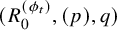


 .
.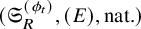
 is equipped with the



 is the natural one.


 has a unique Frobenius







We often omit the decoration $(-)^{(\phi _t)}$
when the choice of a particular formal framing is clear or unimportant, in which case we just write
$(-)^{(\phi _t)}$
when the choice of a particular formal framing is clear or unimportant, in which case we just write $\phi $
for
$\phi $
for $\phi _t$
.
$\phi _t$
.
Various morphisms of prisms
Let $R=R_0\otimes _W\mathcal {O}_K$
be a base
$R=R_0\otimes _W\mathcal {O}_K$
be a base $\mathcal {O}_K$
-algebra and choose a formal framing
$\mathcal {O}_K$
-algebra and choose a formal framing $t\colon T_d\to R_0$
. Denote by
$t\colon T_d\to R_0$
. Denote by $t^\flat $
the choice of
$t^\flat $
the choice of $p^{\text {th}}$
-power roots
$p^{\text {th}}$
-power roots $t_i^\flat $
of
$t_i^\flat $
of $t_i$
in
$t_i$
in $\check {T}_d^\flat $
.
$\check {T}_d^\flat $
.
Define $R_0\to {\mathrm {A}}_{\mathrm {inf}}(\check {R})$
, using the
$R_0\to {\mathrm {A}}_{\mathrm {inf}}(\check {R})$
, using the $J_{R_0}$
-formal étaleness of t, as the unique extension of the map
$J_{R_0}$
-formal étaleness of t, as the unique extension of the map $T_d\to {\mathrm {A}}_{\mathrm {inf}}(\check {R})$
sending
$T_d\to {\mathrm {A}}_{\mathrm {inf}}(\check {R})$
sending $t_i$
to
$t_i$
to $[t_i^\flat ]$
and inducing the natural map
$[t_i^\flat ]$
and inducing the natural map $R_0\to \check {R}$
after composition with
$R_0\to \check {R}$
after composition with $\widetilde {\theta }$
. We further define
$\widetilde {\theta }$
. We further define $\alpha _{\inf }=\alpha _{\inf ,t^{\flat }}\colon \mathfrak {S}_R\to {\mathrm {A}}_{\mathrm {inf}}(\check {R})$
to be the unique extension of this map such that
$\alpha _{\inf }=\alpha _{\inf ,t^{\flat }}\colon \mathfrak {S}_R\to {\mathrm {A}}_{\mathrm {inf}}(\check {R})$
to be the unique extension of this map such that $\alpha _{\inf ,t^\flat }(u)=[\pi ^\flat ]$
. We then have the following diagram of prisms, where each inclusion arrow is the obvious inclusion, and all other not previously defined arrows are determined uniquely by commutativity.
$\alpha _{\inf ,t^\flat }(u)=[\pi ^\flat ]$
. We then have the following diagram of prisms, where each inclusion arrow is the obvious inclusion, and all other not previously defined arrows are determined uniquely by commutativity.

Note that for all of these triples, save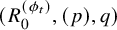 $(R_0^{(\phi _t)},(p),q)$
and
$(R_0^{(\phi _t)},(p),q)$
and $(R_0^{(\phi _t)},(p),F_{R_0/p}\circ q)$
, the structure morphism is unambiguous given the first two entries, so we often omit it. If we write
$(R_0^{(\phi _t)},(p),F_{R_0/p}\circ q)$
, the structure morphism is unambiguous given the first two entries, so we often omit it. If we write $(R_0^{(\phi _t)},(p))$
then the reader should assume we mean
$(R_0^{(\phi _t)},(p))$
then the reader should assume we mean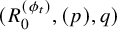 $(R_0^{(\phi _t)},(p),q)$
.
$(R_0^{(\phi _t)},(p),q)$
.
While every morphism in Diagram (1.1.2) is a morphism of prisms, the arrow labeled $(\ast )$
is the only map which may not be a morphism in
$(\ast )$
is the only map which may not be a morphism in  . In fact, this happens precisely when $\mathcal {O}_K=W$
.
$\mathcal {O}_K=W$
.
Lemma 1.14. For an integer $a\geqslant 0$
, let
$a\geqslant 0$
, let $s_{a+1}$
, denote the following composition:
$s_{a+1}$
, denote the following composition:
 $$ \begin{align*} R\xrightarrow{\mathrm{nat}.}\mathfrak{S}_R/(E)\xrightarrow{\bar\phi_t} \mathfrak{S}_R/(\phi_t(E))\xrightarrow{\overline{i}}S_R/p\xrightarrow{F_{S_R/p}^a} S_R/p. \end{align*} $$
Then $(R_0,(p),F^{a+1}_{R_0/p}\circ q)\hookrightarrow (S_R,(p),s_{a+1})$
is a morphism in
$(R_0,(p),F^{a+1}_{R_0/p}\circ q)\hookrightarrow (S_R,(p),s_{a+1})$
is a morphism in  if and only if $p^{a}\geqslant e$
.
$p^{a}\geqslant e$
.
Proof. It suffices to observe that the following diagram commutes if and only if $p^a\geqslant e$
:
$p^a\geqslant e$
:

Note that $R=R_0[\pi ]$
and that the diagram always commutes on
$R=R_0[\pi ]$
and that the diagram always commutes on $R_0$
. Then chasing where
$R_0$
. Then chasing where $\pi $
is sent, one sees this commutativity holds if and only if
$\pi $
is sent, one sees this commutativity holds if and only if $u^{p^{a+1}}$
is divisible by p in
$u^{p^{a+1}}$
is divisible by p in $S_R$
. Using Equation (1.1.1), one easily sees that this happens if and only if
$S_R$
. Using Equation (1.1.1), one easily sees that this happens if and only if $\tfrac {p^{a+1}}{e}\geqslant p$
or, equivalently, that
$\tfrac {p^{a+1}}{e}\geqslant p$
or, equivalently, that $p^a\geqslant e$
.
$p^a\geqslant e$
.
Miscellanea
Following [Reference Du, Liu, Moon and ShimizuDLMS24], we call a Zariski connected p-adically complete $\mathcal {O}_K$
-algebra R small if there exists a p-adically étale morphism
$\mathcal {O}_K$
-algebra R small if there exists a p-adically étale morphism $t\colon \mathcal {O}_K\langle t_1^{\pm 1},\ldots ,t_d^{\pm 1}\rangle \to R$
for some
$t\colon \mathcal {O}_K\langle t_1^{\pm 1},\ldots ,t_d^{\pm 1}\rangle \to R$
for some $d\geqslant 0$
, called a framing. By the topological invariance of the étale site of a formal scheme, there is a unique p-adically étale morphism
$d\geqslant 0$
, called a framing. By the topological invariance of the étale site of a formal scheme, there is a unique p-adically étale morphism $T_d\to R_0$
with
$T_d\to R_0$
with $R=R_0\otimes _W \mathcal {O}_K$
such that the composition
$R=R_0\otimes _W \mathcal {O}_K$
such that the composition $T_d\to R_0\to R$
is equal to t. We denote the map
$T_d\to R_0\to R$
is equal to t. We denote the map $T_d\to R_0$
also by t. Thus, R is a base
$T_d\to R_0$
also by t. Thus, R is a base $\mathcal {O}_K$
-algebra.
$\mathcal {O}_K$
-algebra.
By a base formal $\mathcal {O}_K$
-scheme we mean a morphism of formal schemes
$\mathcal {O}_K$
-scheme we mean a morphism of formal schemes $\mathfrak {X}\to \operatorname {\mathrm {Spf}}(\mathcal {O}_K)$
such that there exists an open cover
$\mathfrak {X}\to \operatorname {\mathrm {Spf}}(\mathcal {O}_K)$
such that there exists an open cover $\{\operatorname {\mathrm {Spf}}(R_i)\}$
of
$\{\operatorname {\mathrm {Spf}}(R_i)\}$
of $\mathfrak {X}$
with each
$\mathfrak {X}$
with each $R_i$
a base
$R_i$
a base $\mathcal {O}_K$
-algebra. By the discussion in the last paragraph, this includes smooth formal schemes
$\mathcal {O}_K$
-algebra. By the discussion in the last paragraph, this includes smooth formal schemes $\mathfrak {X}\to \operatorname {\mathrm {Spf}}(\mathcal {O}_K)$
.
$\mathfrak {X}\to \operatorname {\mathrm {Spf}}(\mathcal {O}_K)$
.
Lemma 1.15 (cf. [Reference BhattBha20, Theorem 5.16])
Let R be a base $\mathcal {O}_K$
-algebra. Then,
$\mathcal {O}_K$
-algebra. Then, $R\to \widetilde {R}$
is faithfully flat and quasi-syntomic.
$R\to \widetilde {R}$
is faithfully flat and quasi-syntomic.
Proof. The faithful flatness follows from [Reference BhattBha20, Theorem 5.16]. To prove quasi-syntomicness, first observe that $L_{\widetilde {R}/\mathcal {O}_K}\otimes ^L_{\mathcal {O}_K} (\mathcal {O}_K/p)$
is concentrated in degree
$L_{\widetilde {R}/\mathcal {O}_K}\otimes ^L_{\mathcal {O}_K} (\mathcal {O}_K/p)$
is concentrated in degree $-1$
(cf. the proof of [Reference Bhatt, Morrow and ScholzeBMS19, Proposition 4.19], using
$-1$
(cf. the proof of [Reference Bhatt, Morrow and ScholzeBMS19, Proposition 4.19], using $\mathcal {O}_K\to {\mathrm {A}}_{\mathrm {inf}}(\widetilde {R})\otimes _W \mathcal {O}_K\xrightarrow {\theta \otimes 1}\widetilde {R}$
). On the other hand,
$\mathcal {O}_K\to {\mathrm {A}}_{\mathrm {inf}}(\widetilde {R})\otimes _W \mathcal {O}_K\xrightarrow {\theta \otimes 1}\widetilde {R}$
). On the other hand, $\mathcal {O}_K\to R$
is p-completely flat, and so
$\mathcal {O}_K\to R$
is p-completely flat, and so $R\otimes ^L_{\mathcal {O}_K} \mathcal {O}_K/p=R/p$
. Thus, by [SP, Tag 08QQ] we have that
$R\otimes ^L_{\mathcal {O}_K} \mathcal {O}_K/p=R/p$
. Thus, by [SP, Tag 08QQ] we have that $L_{R/\mathcal {O}_K}\otimes ^L_{\mathcal {O}_K} (\mathcal {O}_K/p)$
is equal to
$L_{R/\mathcal {O}_K}\otimes ^L_{\mathcal {O}_K} (\mathcal {O}_K/p)$
is equal to $L_{(R/p)/(\mathcal {O}_K/p)}$
. But, as
$L_{(R/p)/(\mathcal {O}_K/p)}$
. But, as $\mathcal {O}_K/p\to R/p$
is formally smooth,
$\mathcal {O}_K/p\to R/p$
is formally smooth, $L_{(R/p)/(\mathcal {O}_K/p)}$
is concentrated in degree
$L_{(R/p)/(\mathcal {O}_K/p)}$
is concentrated in degree $0$
. So, the claim follows by the triangle property for the cotangent complex.
$0$
. So, the claim follows by the triangle property for the cotangent complex.
Proposition 1.16. Let $\mathfrak {X}\to \operatorname {\mathrm {Spf}}(\mathcal {O}_K)$
be a base formal
$\mathfrak {X}\to \operatorname {\mathrm {Spf}}(\mathcal {O}_K)$
be a base formal $\mathcal {O}_K$
-scheme, and
$\mathcal {O}_K$
-scheme, and $\{\operatorname {\mathrm {Spf}}(R_i)\}$
an open cover with each
$\{\operatorname {\mathrm {Spf}}(R_i)\}$
an open cover with each $R_i$
a base
$R_i$
a base $\mathcal {O}_K$
-algebra. Then,
$\mathcal {O}_K$
-algebra. Then, $\{(\mathfrak {S}_{R_i},(E))\}$
is a cover of
$\{(\mathfrak {S}_{R_i},(E))\}$
is a cover of $\ast $
in
$\ast $
in  .
.
Proof. The maps $\widetilde {\alpha }_{i,\inf }\colon (\mathfrak {S}_{R_i},(E))\to ({\mathrm {A}}_{\mathrm {inf}}(\widetilde {R}_i),(\tilde {\xi }))$
in
$\widetilde {\alpha }_{i,\inf }\colon (\mathfrak {S}_{R_i},(E))\to ({\mathrm {A}}_{\mathrm {inf}}(\widetilde {R}_i),(\tilde {\xi }))$
in  , shows that $\{(\mathfrak {S}_{R_i},(E))\to \ast \}$
refines
$\{(\mathfrak {S}_{R_i},(E))\to \ast \}$
refines $\{({\mathrm {A}}_{\mathrm {inf}}(\widetilde {R}_i),(\widetilde {\xi }))\to \ast \}$
. But, combining Proposition 1.11 with Lemma 1.15, we see that
$\{({\mathrm {A}}_{\mathrm {inf}}(\widetilde {R}_i),(\widetilde {\xi }))\to \ast \}$
. But, combining Proposition 1.11 with Lemma 1.15, we see that $\{({\mathrm {A}}_{\mathrm {inf}}(\widetilde {R}_i),(\widetilde {\xi }))\to \ast \}$
is a cover, and thus so is
$\{({\mathrm {A}}_{\mathrm {inf}}(\widetilde {R}_i),(\widetilde {\xi }))\to \ast \}$
is a cover, and thus so is $\{(\mathfrak {S}_{R_i},(E))\to \ast \}$
(see Lemma A.1).
$\{(\mathfrak {S}_{R_i},(E))\to \ast \}$
(see Lemma A.1).
1.2 (Analytic) prismatic torsors with F-structure
We now discuss the theory of (analytic) prismatic F-crystals, as in [Reference Bhatt and ScholzeBS22] and [Reference Guo and ReineckeGR24]. Fix a quasi-syntomic formal scheme $\mathfrak {X}$
, and an object T of
$\mathfrak {X}$
, and an object T of  , which we omit from the notation when $T=\ast $
. Although we will only need the case where
$T=\ast $
. Although we will only need the case where $T=\ast $
in the sequel, we discuss the general case for the sake of naturality, especially in order to allow us to use the framework established in Appendix A (e.g., Remark 1.27). As usual we confuse representable (pre)sheaves and the objects that represent them via the Yoneda embedding (as discussed in §A.1).
$T=\ast $
in the sequel, we discuss the general case for the sake of naturality, especially in order to allow us to use the framework established in Appendix A (e.g., Remark 1.27). As usual we confuse representable (pre)sheaves and the objects that represent them via the Yoneda embedding (as discussed in §A.1).
1.2.1 Prismatic F-crystals
Define the category of prismatic crystals in vector bundles (resp. perfect complexes) over T as follows:

Concretely, a prismatic crystal in vector bundles (resp. perfect complexes) is a collection of finite projective A-modules $M_{(A,I)}$
(resp. perfect complexes
$M_{(A,I)}$
(resp. perfect complexes $K^{\bullet }_{(A,I)}$
), indexed by objects
$K^{\bullet }_{(A,I)}$
), indexed by objects $(A,I)$
of
$(A,I)$
of  , together with (quasi-)isomorphisms
  (resp.
  ) for any morphism $(A,I)\to (B,J)$
in
$(A,I)\to (B,J)$
in  (the crystal property), satisfying the obvious compatibility conditions. The category of prismatic crystals in vector bundles carries the structure of an exact $\mathbb {Z}_p$
-linear
$\mathbb {Z}_p$
-linear $\otimes $
-category where exactness and tensor products are defined term-by-term.
$\otimes $
-category where exactness and tensor products are defined term-by-term.
Proposition 1.17 (cf. [Reference Bhatt and ScholzeBS23, Proposition 2.7])
The global sections functor

is a bi-exact $\mathbb {Z}_p$
-linear
$\mathbb {Z}_p$
-linear $\otimes $
-equivalence. Moreover, the derived global sections functor
$\otimes $
-equivalence. Moreover, the derived global sections functor

is an equivalence of $\infty $
-categories.
$\infty $
-categories.
Proof. By [Reference Bhatt and ScholzeBS23, Proposition 2.7], it remains only to verify that the first functor is a bi-exact $\mathbb {Z}_p$
-linear
$\mathbb {Z}_p$
-linear $\otimes $
-equivalence. By [Reference Bhatt and ScholzeBS23, Proposition 2.7], if
$\otimes $
-equivalence. By [Reference Bhatt and ScholzeBS23, Proposition 2.7], if $\mathcal {F}$
and
$\mathcal {F}$
and $\mathcal {G}$
are objects of
$\mathcal {G}$
are objects of  then the presheaf $(A,I)\mapsto \mathcal {F}(A,I)\otimes _A \mathcal {G}(A,I)$
is a sheaf, and so the global sections functor preserves tensor products. Indeed, as
$(A,I)\mapsto \mathcal {F}(A,I)\otimes _A \mathcal {G}(A,I)$
is a sheaf, and so the global sections functor preserves tensor products. Indeed, as $(\mathcal {F}(A,I)\otimes _A \mathcal {G}(A,I))$
forms a prismatic crystal in vector bundles by the crystal property for
$(\mathcal {F}(A,I)\otimes _A \mathcal {G}(A,I))$
forms a prismatic crystal in vector bundles by the crystal property for $\mathcal {F}$
and
$\mathcal {F}$
and $\mathcal {G}$
, there exists by [Reference Bhatt and ScholzeBS23, Proposition 2.7] a prismatic crystal
$\mathcal {G}$
, there exists by [Reference Bhatt and ScholzeBS23, Proposition 2.7] a prismatic crystal $\mathcal {H}$
with
$\mathcal {H}$
with $\mathcal {H}(A,I)=\mathcal {F}(A,I)\otimes _A \mathcal {G}(A,I)$
, and as
$\mathcal {H}(A,I)=\mathcal {F}(A,I)\otimes _A \mathcal {G}(A,I)$
, and as $\mathcal {H}$
is a sheaf the claim follows. The bi-exactness claim follows easily from Lemma 1.18.
$\mathcal {H}$
is a sheaf the claim follows. The bi-exactness claim follows easily from Lemma 1.18.
Lemma 1.18 (cf. [Reference Bhatt and ScholzeBS22, Corollary 3.12])
Let $\mathcal {E}$
be an object of
$\mathcal {E}$
be an object of  . Then for any object $(A,I)$
of
$(A,I)$
of  , we have that $H^i((A,I),\mathcal {E})=0$
for any
$H^i((A,I),\mathcal {E})=0$
for any $i>0$
.
$i>0$
.
Proof. The proof of [Reference Bhatt and ScholzeBS22, Corollary 3.12] applies as the Čech complex for $\mathcal {E}$
is the result of tensoring the Čech complex for
$\mathcal {E}$
is the result of tensoring the Čech complex for  with the flat module $M=\mathcal {E}(A,I)$
, and so is still exact.
$M=\mathcal {E}(A,I)$
, and so is still exact.
As in [Reference Bhatt and ScholzeBS23, Definition 4.1], define the category  of prismatic F-crystals over T to have objects $(\mathcal {E},\varphi _{\mathcal {E}})$
where
$(\mathcal {E},\varphi _{\mathcal {E}})$
where $\mathcal {E}$
is an object of
$\mathcal {E}$
is an object of  and
and

is an isomorphism in  , called the Frobenius, and morphisms are morphisms in
  commuting with the Frobenii. Likewise, define the category
 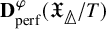 of prismatic F-crystals in perfect complexes to be the category of pairs $({\mathcal {E}}^{\bullet },\varphi _{{\mathcal {E}}^{\bullet }})$
where
$({\mathcal {E}}^{\bullet },\varphi _{{\mathcal {E}}^{\bullet }})$
where ${\mathcal {E}}^{\bullet }$
is an object of
${\mathcal {E}}^{\bullet }$
is an object of  together with a Frobenius isomorphism in

and with morphisms being those in  commuting with Frobenii. By Proposition 1.17, when $\mathbf {Vect}^\varphi (A,I)$
and
$\mathbf {Vect}^\varphi (A,I)$
and $\mathbf {D}^\varphi _{\mathrm {perf}}(A,I)$
are given the obvious meanings, then
$\mathbf {D}^\varphi _{\mathrm {perf}}(A,I)$
are given the obvious meanings, then

Observe that  inherits from
  the structure of an exact $\mathbb {Z}_p$
-linear
$\mathbb {Z}_p$
-linear $\otimes $
-category. We say
$\otimes $
-category. We say $(\mathcal {E},\varphi _{\mathcal {E}})$
is effective if
$(\mathcal {E},\varphi _{\mathcal {E}})$
is effective if $\varphi _{\mathcal {E}}$
is induced from a morphism
$\varphi _{\mathcal {E}}$
is induced from a morphism $\varphi _{\mathcal {E},0}\colon \phi ^\ast \mathcal {E}\to \mathcal {E}$
, which is automatically injective, and the minimal r such
$\varphi _{\mathcal {E},0}\colon \phi ^\ast \mathcal {E}\to \mathcal {E}$
, which is automatically injective, and the minimal r such  kills
kills $\mathrm {coker}(\varphi _{\mathcal {E},0})$
is the height of
$\mathrm {coker}(\varphi _{\mathcal {E},0})$
is the height of $(\mathcal {E},\varphi _{\mathcal {E}})$
.
$(\mathcal {E},\varphi _{\mathcal {E}})$
.
Remark 1.19. Suppose that $(A,I,s)$
is an object of
$(A,I,s)$
is an object of  with the property that $\phi _A(I)$
is an invertible ideal (e.g., if
$\phi _A(I)$
is an invertible ideal (e.g., if $\phi _A$
is flat, see [SP, Tag 02OO], or
$\phi _A$
is flat, see [SP, Tag 02OO], or $I=(p)$
). In this case
$I=(p)$
). In this case $(A,\phi _A(I),s\circ \operatorname {\mathrm {Spf}}(\overline {\phi }_A))$
is an object of
$(A,\phi _A(I),s\circ \operatorname {\mathrm {Spf}}(\overline {\phi }_A))$
is an object of  , where $\overline {\phi }_A\colon A/I\to A/\phi _A(I)$
is the natural map. Indeed, if
$\overline {\phi }_A\colon A/I\to A/\phi _A(I)$
is the natural map. Indeed, if $p=i+\phi _A(i')$
, with i and
$p=i+\phi _A(i')$
, with i and $i'$
in I, then evidently
$i'$
in I, then evidently $p=\phi _A(i)+\phi _A(\phi _A(i'))$
so that
$p=\phi _A(i)+\phi _A(\phi _A(i'))$
so that $p\in \phi _A(I)+\phi _A(\phi _A(I))$
, and A is
$p\in \phi _A(I)+\phi _A(\phi _A(I))$
, and A is $(p,\phi _A(I))$
-adically complete as
$(p,\phi _A(I))$
-adically complete as $(p,I)^p\subseteq (p,\phi _A(I))\subseteq (p,I)$
. Moreover, we observe that
$(p,I)^p\subseteq (p,\phi _A(I))\subseteq (p,I)$
. Moreover, we observe that $\phi _A\colon (A,I,s)\to (A,\phi _A(I),s\circ \operatorname {\mathrm {Spf}}(\overline {\phi }_A))$
is a morphism in
$\phi _A\colon (A,I,s)\to (A,\phi _A(I),s\circ \operatorname {\mathrm {Spf}}(\overline {\phi }_A))$
is a morphism in  so that, by the crystal property, we have an identification of A-modules

Thus, we, in particular, see that via this identification there is an isomorphism

which provides $\phi ^\ast \mathcal {E}(A,I,s)$
with a Frobenius-like structure.
$\phi ^\ast \mathcal {E}(A,I,s)$
with a Frobenius-like structure.
1.2.2 Analytic prismatic F-crystals
We now discuss the notion of analytic prismatic F-crystals as defined in [Reference Guo and ReineckeGR24], which are necessary to model every crystalline $\mathbb {Z}_p$
-local system.
$\mathbb {Z}_p$
-local system.
Basic definitions
Following [Reference Guo and ReineckeGR24, Definition 3.1], define the category of analytic prismatic crystals over T as follows (where we recall that  ):
):

We denote an object of  as
as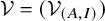 $\mathcal {V}=(\mathcal {V}_{(A,I)})$
. By the argument given in [Reference Guo and ReineckeGR24, Proposition 3.7], the following restriction is fully faithful:
$\mathcal {V}=(\mathcal {V}_{(A,I)})$
. By the argument given in [Reference Guo and ReineckeGR24, Proposition 3.7], the following restriction is fully faithful:

Endow  with the structure of a $\mathbb {Z}_p$
-linear
$\mathbb {Z}_p$
-linear $\otimes $
-category defined term-by-term in the two-limit. Then the above restriction is a
$\otimes $
-category defined term-by-term in the two-limit. Then the above restriction is a $\mathbb {Z}_p$
-linear
$\mathbb {Z}_p$
-linear $\otimes $
-functor. Denote the object
$\otimes $
-functor. Denote the object $(\mathcal {O}_{U(A,I)})$
by
$(\mathcal {O}_{U(A,I)})$
by  . As in [Reference Guo and ReineckeGR24, Definition 3.5], we then define the category
  of analytic prismatic F-crystals, denoted typically by $(\mathcal {V},\varphi _{\mathcal {V}})$
, in the same way and endowed with the analogous structure of a
$(\mathcal {V},\varphi _{\mathcal {V}})$
, in the same way and endowed with the analogous structure of a $\mathbb {Z}_p$
-linear
$\mathbb {Z}_p$
-linear $\otimes $
-category.
$\otimes $
-category.
We say that a sequence of analytic prismatic crystals
 $$ \begin{align*} 0\to \mathcal{V}^1\to \mathcal{V}^2\to \mathcal{V}^3\to 0 \end{align*} $$
is exact if the sequence of vector bundles
 $$ \begin{align*} 0\to \mathcal{V}^1_{(A,I)}\to \mathcal{V}^2_{(A,I)}\to \mathcal{V}^3_{(A,I)}\to 0 \end{align*} $$
on $\operatorname {\mathrm {Spec}}(A)-V(p,I)$
is exact for all
$\operatorname {\mathrm {Spec}}(A)-V(p,I)$
is exact for all $(A,I)$
in
$(A,I)$
in  . We define a sequence of objects of
  to be exact if the underlying sequence of analytic prismatic crystals is. This endows
  and
and  with the structures of exact $\mathbb {Z}_p$
-linear
$\mathbb {Z}_p$
-linear $\otimes $
-categories.
$\otimes $
-categories.
Criteria for exactness
Our next goal is to establish the following basic result.
Proposition 1.20. A sequence
 $$ \begin{align*} 0\to \mathcal{V}^1\to \mathcal{V}^2\to \mathcal{V}^3\to 0 \end{align*} $$
in  is exact if and only if there exists a cover $\{(A_i,I_i)\}$
of
$\{(A_i,I_i)\}$
of $\ast $
such that
$\ast $
such that
 $$ \begin{align*} 0\to \mathcal{V}^1_{(A_i,I_i)}\to \mathcal{V}^2_{(A_i,I_i)}\to \mathcal{V}^3_{(A_i,I_i)}\to 0 \end{align*} $$
is exact for all i.
Remark 1.21. Proposition 1.20 does not easily follow using fpqc descent. The latter condition implies (see Lemma A.1) that for every $(A,I)$
there exists a cover
$(A,I)$
there exists a cover $\{(B_j,IB_j)\}$
of
$\{(B_j,IB_j)\}$
of $(A,I)$
such that sequence over
$(A,I)$
such that sequence over $(A,I)$
is exact when pulled back to each
$(A,I)$
is exact when pulled back to each $U(B_j,IB_j)$
. If
$U(B_j,IB_j)$
. If $S=\{U(B_j,IB_j)\to U(A,I)\}$
were an fpqc cover we would be done. But, a priori all we know is that
$S=\{U(B_j,IB_j)\to U(A,I)\}$
were an fpqc cover we would be done. But, a priori all we know is that $\{\operatorname {\mathrm {Spf}}(B_j)\to \operatorname {\mathrm {Spf}}(A)\}$
is an adically flat cover. With Noetherian hypotheses this is sufficient (cf. [SP, Tag 0912]), but in our generality it is not even clear that S is jointly surjective (although see Proposition 1.25 below).
$\{\operatorname {\mathrm {Spf}}(B_j)\to \operatorname {\mathrm {Spf}}(A)\}$
is an adically flat cover. With Noetherian hypotheses this is sufficient (cf. [SP, Tag 0912]), but in our generality it is not even clear that S is jointly surjective (although see Proposition 1.25 below).
Using Lemma A.1, and the fact that an exact sequence of vector bundles is universally exact (see [SP, Tag 058H]), the desired result is a special case of the following.
Proposition 1.22. Let $f\colon A\to B$
be a map of rings, and suppose that the finitely generated ideal
$f\colon A\to B$
be a map of rings, and suppose that the finitely generated ideal $J\subseteq A$
is contained in the Jacobson radical of A. If
$J\subseteq A$
is contained in the Jacobson radical of A. If $f\colon A/J^n\to B/J^nB$
is faithfully flat for all n then, a sequence of vector bundles
$f\colon A/J^n\to B/J^nB$
is faithfully flat for all n then, a sequence of vector bundles
 $$ \begin{align*} P\colon \quad 0\to \mathcal{M}_1\to\mathcal{M}_2\to\mathcal{M}_3\to 0, \end{align*} $$
on $\operatorname {\mathrm {Spec}}(A)-V(J)$
is exact if and only if the sequence
$\operatorname {\mathrm {Spec}}(A)-V(J)$
is exact if and only if the sequence
 $$ \begin{align*} f^\ast P\colon \quad 0\to f^\ast\mathcal{M}_1\to f^\ast\mathcal{M}_2\to f^\ast\mathcal{M}_3\to 0, \end{align*} $$
of vector bundles on $\operatorname {\mathrm {Spec}}(B)-V(JB)$
is exact.
$\operatorname {\mathrm {Spec}}(B)-V(JB)$
is exact.
Proposition 1.22 follows from the following two lemmas as $\operatorname {\mathrm {Spec}}(B)-V(JB)$
is quasi-compact (as J is finitely generated) so that any point contains a closed point in its closure.
$\operatorname {\mathrm {Spec}}(B)-V(JB)$
is quasi-compact (as J is finitely generated) so that any point contains a closed point in its closure.
Lemma 1.23. Let $(Y,\mathcal {O}_Y)$
be a locally ringed space and S a subset of Y such that every point of Y admits an element of S as a specialization. Then, a sequence
$(Y,\mathcal {O}_Y)$
be a locally ringed space and S a subset of Y such that every point of Y admits an element of S as a specialization. Then, a sequence
 $$ \begin{align*} Q\colon \quad 0\to V_1\to V_2\to V_3\to 0, \end{align*} $$
of $\mathcal {O}_Y$
-modules, where each
$\mathcal {O}_Y$
-modules, where each $V_i$
is a vector bundle on
$V_i$
is a vector bundle on $(Y,\mathcal {O}_Y)$
, is exact if and only if for all y in S the induced sequence
$(Y,\mathcal {O}_Y)$
, is exact if and only if for all y in S the induced sequence
 $$ \begin{align*} 0\to (V_1)_{k(y)}\to (V_2)_{k(y)}\to (V_3)_{k(y)}\to 0, \end{align*} $$
of vector spaces over the residue field $k(y)$
is exact. In particular, if
$k(y)$
is exact. In particular, if $f\colon (Y',\mathcal {O}_Y)\to (Y,\mathcal {O}_Y)$
is a map of locally ringed spaces containing S in its image, then Q is exact if and only if
$f\colon (Y',\mathcal {O}_Y)\to (Y,\mathcal {O}_Y)$
is a map of locally ringed spaces containing S in its image, then Q is exact if and only if
 $$ \begin{align*} f^\ast Q\colon \quad 0\to f^\ast V_1\to f^\ast V_2\to f^\ast V_3\to 0, \end{align*} $$
is exact.
Proof. The second claim follows easily from the first, and only the if condition of the first statement requires proof. To prove this, it suffices to show that for each y in S, the sequence of projective $\mathcal {O}_{Y,y}$
-modules
$\mathcal {O}_{Y,y}$
-modules
 $$ \begin{align*} Q_y\colon \quad 0\to (V_1)_y\to (V_2)_y\to (V_3)_y\to 0, \end{align*} $$
is exact. Indeed, if $y'$
is an arbitrary point of Y and y in S is a specialization, then the sequence
$y'$
is an arbitrary point of Y and y in S is a specialization, then the sequence $Q_{y'}$
is obtained by base changing the sequence
$Q_{y'}$
is obtained by base changing the sequence $Q_y$
along the flat map
$Q_y$
along the flat map $\mathcal {O}_{Y,y}\to \mathcal {O}_{Y,y'}$
.
$\mathcal {O}_{Y,y}\to \mathcal {O}_{Y,y'}$
.
To show that $Q_y$
is exact, let
$Q_y$
is exact, let $n_i$
, for
$n_i$
, for $i=1,2,3$
, be the rank of the finite free
$i=1,2,3$
, be the rank of the finite free $\mathcal {O}_{Y,y}$
-module
$\mathcal {O}_{Y,y}$
-module $(V_i)_y$
. That
$(V_i)_y$
. That $(V_2)_y\to (V_3)_y$
is surjective follows from Nakayama’s lemma. We then see that the sequence
$(V_2)_y\to (V_3)_y$
is surjective follows from Nakayama’s lemma. We then see that the sequence
 $$ \begin{align} 0\to \ker((V_2)_y\to (V_3)_y)\to (V_2)_y\to (V_3)_y\to 0 \end{align} $$
is exact. As $V_3$
is a vector bundle, this sequence splits. So,
$V_3$
is a vector bundle, this sequence splits. So, $\ker ((V_2)_y\to (V_3)_y)$
is locally free of rank equal to
$\ker ((V_2)_y\to (V_3)_y)$
is locally free of rank equal to $n_2-n_3$
. As rank can be computed over
$n_2-n_3$
. As rank can be computed over $k(y)$
, we have that
$k(y)$
, we have that $n_1=n_2-n_3$
. Thus,
$n_1=n_2-n_3$
. Thus, $(V_1)_y\to \ker ((V_2)_y\to (V_3)_y)$
is a map of finite free
$(V_1)_y\to \ker ((V_2)_y\to (V_3)_y)$
is a map of finite free $\mathcal {O}_{Y,y}$
-modules of the same rank. Thus, it is an isomorphism if and only if it is surjective (see [Reference OrzechOrz71] for a generalization of this fact). But, by Nakayama’s lemma, it suffices to check this claim after base change to
$\mathcal {O}_{Y,y}$
-modules of the same rank. Thus, it is an isomorphism if and only if it is surjective (see [Reference OrzechOrz71] for a generalization of this fact). But, by Nakayama’s lemma, it suffices to check this claim after base change to $k(y)$
. But, as (1.2.1) is exact, and
$k(y)$
. But, as (1.2.1) is exact, and $(V_3)_y$
flat, this is equivalent to checking that
$(V_3)_y$
flat, this is equivalent to checking that $(V_1)_{k(y)}\to \ker ((V_2)_{k(y)}\to (V_3)_{k(y)})$
is surjective, which is true by assumption.
$(V_1)_{k(y)}\to \ker ((V_2)_{k(y)}\to (V_3)_{k(y)})$
is surjective, which is true by assumption.
Lemma 1.24. Let $f\colon A\to B$
be a map of rings, and suppose that the finitely generated ideal
$f\colon A\to B$
be a map of rings, and suppose that the finitely generated ideal $J\subseteq A$
is contained in the Jacobson radical. If
$J\subseteq A$
is contained in the Jacobson radical. If $f\colon A/J^n\to B/J^nB$
is faithfully flat for all n, then the map
$f\colon A/J^n\to B/J^nB$
is faithfully flat for all n, then the map $\operatorname {\mathrm {Spec}}(B)-V(JB)\to \operatorname {\mathrm {Spec}}(A)-V(J)$
is surjective on closed points.
$\operatorname {\mathrm {Spec}}(B)-V(JB)\to \operatorname {\mathrm {Spec}}(A)-V(J)$
is surjective on closed points.
Proof. Let $\mathfrak {p}$
be a prime of A constituting a closed point of
$\mathfrak {p}$
be a prime of A constituting a closed point of $\operatorname {\mathrm {Spec}}(A)-V(J)$
. We show that
$\operatorname {\mathrm {Spec}}(A)-V(J)$
. We show that $\mathfrak {p}$
is in the image of f. Suppose first that
$\mathfrak {p}$
is in the image of f. Suppose first that $\mathfrak {p}=(0)$
. In this case we see that it suffices to show that
$\mathfrak {p}=(0)$
. In this case we see that it suffices to show that $\operatorname {\mathrm {Spec}}(B)-V(JB)$
is nonempty. If it were empty, then
$\operatorname {\mathrm {Spec}}(B)-V(JB)$
is nonempty. If it were empty, then $JB$
is contained in the nilradical of B and as J is finitely generated, this implies that
$JB$
is contained in the nilradical of B and as J is finitely generated, this implies that $J^nB=0$
for some n. This implies that
$J^nB=0$
for some n. This implies that $J^nB/J^{n+1}B$
is zero, and as
$J^nB/J^{n+1}B$
is zero, and as $A/J^{n+1}\to B/J^{n+1}B$
is faithfully flat, this implies that
$A/J^{n+1}\to B/J^{n+1}B$
is faithfully flat, this implies that $J^n/J^{n+1}$
is zero. Since J is contained in the Jacobson radical of A, we deduce from Nakayama’s lemma (see [SP, Tag 00DV]) that
$J^n/J^{n+1}$
is zero. Since J is contained in the Jacobson radical of A, we deduce from Nakayama’s lemma (see [SP, Tag 00DV]) that $J^n$
is zero, but this implies that
$J^n$
is zero, but this implies that $\operatorname {\mathrm {Spec}}(A)-V(J)$
is empty, which is a contradiction.
$\operatorname {\mathrm {Spec}}(A)-V(J)$
is empty, which is a contradiction.
In general, let  ,
,  , and
, and  . Then, $\overline {J}$
is in the Jacobson radical of
$\overline {J}$
is in the Jacobson radical of $\overline {A}$
, and
$\overline {A}$
, and $\overline {A}/\overline {J}^n\to \overline {B}/\overline {J}^n\overline {B}$
is equal to the base change of
$\overline {A}/\overline {J}^n\to \overline {B}/\overline {J}^n\overline {B}$
is equal to the base change of $A/J^n\to B/J^n B$
along
$A/J^n\to B/J^n B$
along $A\to \overline {A}$
, and so faithfully flat. From the argument in the previous paragraph there exists some
$A\to \overline {A}$
, and so faithfully flat. From the argument in the previous paragraph there exists some $\overline {\mathfrak {q}}$
in
$\overline {\mathfrak {q}}$
in $\operatorname {\mathrm {Spec}}(\overline {B})-V(\overline {J}\overline {B})$
. Let
$\operatorname {\mathrm {Spec}}(\overline {B})-V(\overline {J}\overline {B})$
. Let $\mathfrak {q}$
be a prime of B lying over
$\mathfrak {q}$
be a prime of B lying over $\overline {\mathfrak {q}}$
. Observe that
$\overline {\mathfrak {q}}$
. Observe that $\mathfrak {q}$
belongs to
$\mathfrak {q}$
belongs to $\operatorname {\mathrm {Spec}}(B)-V(JB)$
, and by construction
$\operatorname {\mathrm {Spec}}(B)-V(JB)$
, and by construction $f(\mathfrak {q})$
lies in
$f(\mathfrak {q})$
lies in $V(\mathfrak {p})\cap (\operatorname {\mathrm {Spec}}(A)-V(J))$
. But, as
$V(\mathfrak {p})\cap (\operatorname {\mathrm {Spec}}(A)-V(J))$
. But, as $\mathfrak {p}$
is closed in
$\mathfrak {p}$
is closed in $\operatorname {\mathrm {Spec}}(A)-V(J)$
, one checks that
$\operatorname {\mathrm {Spec}}(A)-V(J)$
, one checks that $V(\mathfrak {p})\cap (\operatorname {\mathrm {Spec}}(A)-V(J))=\{\mathfrak {p}\}$
from where the claim follows.
$V(\mathfrak {p})\cap (\operatorname {\mathrm {Spec}}(A)-V(J))=\{\mathfrak {p}\}$
from where the claim follows.
Finally, we include the following beautiful observation of Ofer Gabber showing that the restriction to closed points is not necessary when the rings are complete.
Proposition 1.25 (Gabber)
Let $J\subseteq A$
be a finitely generated ideal, and
$J\subseteq A$
be a finitely generated ideal, and $f\colon A\to B$
a ring map. Suppose that A (resp. B) is complete with respect to J (resp.
$f\colon A\to B$
a ring map. Suppose that A (resp. B) is complete with respect to J (resp. $JB$
), and that
$JB$
), and that $A/J^n\to B/J^nB$
is faithfully flat for all n. Then, the map
$A/J^n\to B/J^nB$
is faithfully flat for all n. Then, the map $\operatorname {\mathrm {Spec}}(B)\to \operatorname {\mathrm {Spec}}(A)$
is surjective.
$\operatorname {\mathrm {Spec}}(B)\to \operatorname {\mathrm {Spec}}(A)$
is surjective.
Proof. For an ideal I of A, let us denote by $I^{\mathrm {ec}}$
the ideal
$I^{\mathrm {ec}}$
the ideal $f^{-1}(IB)$
, and similarly for the ring maps
$f^{-1}(IB)$
, and similarly for the ring maps $f_n\colon A/J^n\to B/J^nB$
. Observe that by assumption that each
$f_n\colon A/J^n\to B/J^nB$
. Observe that by assumption that each $f_n$
is faithfully flat, we have that
$f_n$
is faithfully flat, we have that $I^{\mathrm {ec}}=I$
for any ideal
$I^{\mathrm {ec}}=I$
for any ideal $I\subseteq A/J^n$
. Thus, if I is an ideal of A closed in the J-adic topology, then by passing to the limit we see that
$I\subseteq A/J^n$
. Thus, if I is an ideal of A closed in the J-adic topology, then by passing to the limit we see that $I^{\mathrm {ec}}=I$
.
$I^{\mathrm {ec}}=I$
.
Claim 1: For a finitely generated ideal $I\subseteq A$
, we have that
$I\subseteq A$
, we have that $\overline {I}^2\subseteq I$
, where
$\overline {I}^2\subseteq I$
, where $\overline {I}$
is the closure of I.
$\overline {I}$
is the closure of I.
Proof. More generally we show that for finitely generated ideals $I_1$
and
$I_1$
and $I_2$
of A, the product of their closures is contained in
$I_2$
of A, the product of their closures is contained in $I_1+I_2$
. If x is in the closure of
$I_1+I_2$
. If x is in the closure of $I_1$
we can write
$I_1$
we can write $x=\sum _n x_n$
with
$x=\sum _n x_n$
with $x_n$
in
$x_n$
in $I_1\cap J^n$
. Similarly if y is in the closure of
$I_1\cap J^n$
. Similarly if y is in the closure of $I_2$
then
$I_2$
then $y=\sum _n y_n$
, with
$y=\sum _n y_n$
, with $y_n$
in
$y_n$
in $I_2\cap J^n$
. Thus,
$I_2\cap J^n$
. Thus,
 $$ \begin{align} xy = \sum_{n\leqslant m}x_n y_m+ \sum_{n>m}x_n y_m. \end{align} $$
Let $f_k$
be a finite system of generators of
$f_k$
be a finite system of generators of $I_1$
and write
$I_1$
and write $x_n=\sum _k x_{nk} f_k$
. Then the first term on the right-hand side of (1.2.2) is
$x_n=\sum _k x_{nk} f_k$
. Then the first term on the right-hand side of (1.2.2) is $\sum _k(\sum _m(\sum _{n\leqslant m}x_{nk}) y_m)f_k$
, which is in
$\sum _k(\sum _m(\sum _{n\leqslant m}x_{nk}) y_m)f_k$
, which is in $I_1$
, and similarly the second term on the right-hand side of (1.2.2) is in
$I_1$
, and similarly the second term on the right-hand side of (1.2.2) is in $I_2$
.
$I_2$
.
Claim 2: For every ideal I of A, one has $(I^{\mathrm {ec}})^2\subseteq I$
.
$(I^{\mathrm {ec}})^2\subseteq I$
.
Proof. One reduces to the case when I is finitely generated, in which case we observe that
 $$ \begin{align*} (I^{\mathrm{ec}})^2\subseteq (\overline{I}^{\mathrm{ec}})^2=\overline{I}^2\subseteq I, \end{align*} $$
the second equality by our initial observations, and the second containment by Claim 1.
If $\mathfrak {p}\subseteq A$
is prime, then from Claim 2 we have
$\mathfrak {p}\subseteq A$
is prime, then from Claim 2 we have $(\mathfrak {p}^{\mathrm {ec}})^2\subseteq \mathfrak {p}$
. As
$(\mathfrak {p}^{\mathrm {ec}})^2\subseteq \mathfrak {p}$
. As $\mathfrak {p}$
is radical this implies that
$\mathfrak {p}$
is radical this implies that $\mathfrak {p}^{\mathrm {ec}}\subseteq \mathfrak {p}$
and thus
$\mathfrak {p}^{\mathrm {ec}}\subseteq \mathfrak {p}$
and thus $\mathfrak {p}^{\mathrm {ec}}=\mathfrak {p}$
, and so
$\mathfrak {p}^{\mathrm {ec}}=\mathfrak {p}$
, and so $\mathfrak {p}$
is in the image of
$\mathfrak {p}$
is in the image of $\operatorname {\mathrm {Spec}}(B)\to \operatorname {\mathrm {Spec}}(A)$
. Indeed,
$\operatorname {\mathrm {Spec}}(B)\to \operatorname {\mathrm {Spec}}(A)$
. Indeed, $B_{\mathfrak {p}}/\mathfrak {p}B_{\mathfrak {p}}$
is nonzero as
$B_{\mathfrak {p}}/\mathfrak {p}B_{\mathfrak {p}}$
is nonzero as $A_{\mathfrak {p}}/\mathfrak {p}=A_{\mathfrak {p}}/f^{-1}(\mathfrak {p}B)A_{\mathfrak {p}}$
is nonzero and embeds into this ring via f.
$A_{\mathfrak {p}}/\mathfrak {p}=A_{\mathfrak {p}}/f^{-1}(\mathfrak {p}B)A_{\mathfrak {p}}$
is nonzero and embeds into this ring via f.
A criterion to be a prismatic F-crystal
We now observe a simple criterion for when an analytic prismatic (F-)crystal comes from a prismatic (F-)crystal.
Proposition 1.26. Let $\mathfrak {X}$
be a base formal
$\mathfrak {X}$
be a base formal $\mathcal {O}_K$
-scheme and let
$\mathcal {O}_K$
-scheme and let $\{\operatorname {\mathrm {Spf}}(R_i)\}$
be an open cover of
$\{\operatorname {\mathrm {Spf}}(R_i)\}$
be an open cover of $\mathfrak {X}$
where
$\mathfrak {X}$
where $R_i$
is a (formally framed) base
$R_i$
is a (formally framed) base $\mathcal {O}_K$
-algebra. Then, the essential image of
$\mathcal {O}_K$
-algebra. Then, the essential image of

consists of those $\mathcal {W}$
and those
$\mathcal {W}$
and those $(\mathcal {V},\varphi _{\mathcal {V}})$
, such that
$(\mathcal {V},\varphi _{\mathcal {V}})$
, such that $(j_{(\mathfrak {S}_{R_i},(E))})_\ast \mathcal {W}_{(\mathfrak {S}_{R_i},(E))}$
and
$(j_{(\mathfrak {S}_{R_i},(E))})_\ast \mathcal {W}_{(\mathfrak {S}_{R_i},(E))}$
and $(j_{(\mathfrak {S}_{R_i},(E))})_\ast \mathcal {V}_{(\mathfrak {S}_{R_i},(E))}$
are vector bundles on
$(j_{(\mathfrak {S}_{R_i},(E))})_\ast \mathcal {V}_{(\mathfrak {S}_{R_i},(E))}$
are vector bundles on $\mathfrak {S}_{R_i}$
for all i, respectively.
$\mathfrak {S}_{R_i}$
for all i, respectively.
Proof. It suffices to prove the first claim. Moreover, we are clearly reduced to the case when $\mathfrak {X}=\operatorname {\mathrm {Spf}}(R)$
. For
$\mathfrak {X}=\operatorname {\mathrm {Spf}}(R)$
. For $i=1,2,3$
, let
$i=1,2,3$
, let $\mathfrak {S}_R^{(i)}$
be the i-fold self-product of
$\mathfrak {S}_R^{(i)}$
be the i-fold self-product of $\mathfrak {S}_R$
in the topos
$\mathfrak {S}_R$
in the topos  (see [Reference Du, Liu, Moon and ShimizuDLMS24, Example 3.4]), and let $p^{(i)}_k$
for
$p^{(i)}_k$
for $k=1,\ldots , i$
denote the projection maps, which are flat by [Reference Du, Liu, Moon and ShimizuDLMS24, Lemma 3.5]. Let
$k=1,\ldots , i$
denote the projection maps, which are flat by [Reference Du, Liu, Moon and ShimizuDLMS24, Lemma 3.5]. Let $j^{(i)}$
, for
$j^{(i)}$
, for $i=1,2,3$
denote the inclusion of
$i=1,2,3$
denote the inclusion of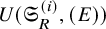 $U(\mathfrak {S}_R^{(i)},(E))$
into
$U(\mathfrak {S}_R^{(i)},(E))$
into $\operatorname {\mathrm {Spec}}(\mathfrak {S}_R^{(i)})$
. Observe that we have the
$\operatorname {\mathrm {Spec}}(\mathfrak {S}_R^{(i)})$
. Observe that we have the $2$
-commutative diagram of categories.
$2$
-commutative diagram of categories.

The top row is obviously exact, and the bottom row is exact by [Reference MathewMat22] (cf. [Reference Bhatt and ScholzeBS23, Theorem 2.2]). Observe that, by inspection, $(p,(E))$
has height
$(p,(E))$
has height $2$
in
$2$
in $\mathfrak {S}_R$
, and thus by the flatness of
$\mathfrak {S}_R$
, and thus by the flatness of $p_k^{(i)}$
, the same holds for
$p_k^{(i)}$
, the same holds for $(p,(E))$
in
$(p,(E))$
in $\mathfrak {S}^{(i)}$
for
$\mathfrak {S}^{(i)}$
for $i=1,2,3$
. Thus, we observe that the maps
$i=1,2,3$
. Thus, we observe that the maps $(j^{(i)})^\ast $
are fully faithful by Proposition A.23. Suppose now that
$(j^{(i)})^\ast $
are fully faithful by Proposition A.23. Suppose now that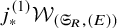 $j^{(1)}_\ast \mathcal {W}_{(\mathfrak {S}_R,(E))}$
is a vector bundle. Let us observe that
$j^{(1)}_\ast \mathcal {W}_{(\mathfrak {S}_R,(E))}$
is a vector bundle. Let us observe that
 $$ \begin{align*} (j^{(i)})^\ast (p_k^{(i)})^\ast j^{(1)}_\ast \mathcal{W}_{(\mathfrak{S}_R,(E))}\simeq (p_k^{(i)})^\ast \mathcal{W}_{(\mathfrak{S}_R,(E))}, \end{align*} $$
for each $i=1,2,3$
and
$i=1,2,3$
and $k=1,\ldots ,i$
, again by Proposition A.23. Thus, by the full faithfulness of the maps
$k=1,\ldots ,i$
, again by Proposition A.23. Thus, by the full faithfulness of the maps $(j^{(i)})^\ast $
, we may pull back the descent data on
$(j^{(i)})^\ast $
, we may pull back the descent data on $\mathcal {W}_{(\mathfrak {S}_R,(E))}$
relative to the covering
$\mathcal {W}_{(\mathfrak {S}_R,(E))}$
relative to the covering $\{p_k^{(2)}\colon U(\mathfrak {S}_R^{(2)},(E))\to U(\mathfrak {S}_R,(E))\}_{k=1,2}$
to descent data on
$\{p_k^{(2)}\colon U(\mathfrak {S}_R^{(2)},(E))\to U(\mathfrak {S}_R,(E))\}_{k=1,2}$
to descent data on $j^{(1)}_\ast \mathcal {W}_{(\mathfrak {S}_R,(E))}$
relative to the covering
$j^{(1)}_\ast \mathcal {W}_{(\mathfrak {S}_R,(E))}$
relative to the covering $\{p_k^{(2)}\colon \operatorname {\mathrm {Spec}}(\mathfrak {S}_R^{(2)})\to \operatorname {\mathrm {Spec}}(\mathfrak {S}_R)\}_{k=1,2}$
. This gives an object
$\{p_k^{(2)}\colon \operatorname {\mathrm {Spec}}(\mathfrak {S}_R^{(2)})\to \operatorname {\mathrm {Spec}}(\mathfrak {S}_R)\}_{k=1,2}$
. This gives an object $\mathcal {F}$
of
$\mathcal {F}$
of  whose image in
  is isomorphic to $\mathcal {W}$
.
$\mathcal {W}$
.
We have shown that anything satisfying the condition on the pushforward in the proposition statement is in the essential image of  . Conversely, if $\mathcal {W}$
is in the essential image, then this pushforward condition holds again by applying Proposition A.23.
$\mathcal {W}$
is in the essential image, then this pushforward condition holds again by applying Proposition A.23.
1.3 Tannakian theory
We now show the category of prismatic F-crystals (and quasi-syntomic F-torsors, see §1.3.2) possesses good Tannakian properties in the sense of Appendix A. We advise the reader to consult there for undefined terminology or notation, and to recall Notation 1.1.
1.3.1 Prismatic F-crystals
We begin by shortening some notation from §A.5:

Combining Proposition 1.17 and Theorem A.19, we see that  is reconstructible in
  , and every object of
  is locally trivial.
Remark 1.27. Although our main interest is the case where $T=\ast $
, to make sense of the notion of local triviality, it is natural to include the case of general sheaves T, at least that of the representable ones.
$T=\ast $
, to make sense of the notion of local triviality, it is natural to include the case of general sheaves T, at least that of the representable ones.
Set 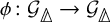 to be the morphism of group sheaves associating to every $(A,I)$
the map
$(A,I)$
the map $\mathcal {G}(A)\to \mathcal {G}(A)$
obtained from
$\mathcal {G}(A)\to \mathcal {G}(A)$
obtained from $\phi _A\colon A\to A$
. For an object
$\phi _A\colon A\to A$
. For an object $\mathcal {A}$
of
$\mathcal {A}$
of  , denote by $\phi ^\ast \mathcal {A}$
the
$\phi ^\ast \mathcal {A}$
the  -torsor $\phi _\ast \mathcal {A}$
, in the notation of §A.1. Denote by
$\phi _\ast \mathcal {A}$
, in the notation of §A.1. Denote by  the group sheaf
  and let
  be the obvious monomorphism. Finally, set
  to be
to be $\iota _\ast \mathcal {A}$
.
$\iota _\ast \mathcal {A}$
.
Definition 1.28. The category 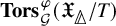 of prismatic $\mathcal {G}$
-torsors with F-structure over T has objects
$\mathcal {G}$
-torsors with F-structure over T has objects $(\mathcal {A},\varphi _{\mathcal {A}})$
where
$(\mathcal {A},\varphi _{\mathcal {A}})$
where $\mathcal {A}$
is an object of
$\mathcal {A}$
is an object of  and
and $\varphi $
is a Frobenius isomorphism
$\varphi $
is a Frobenius isomorphism

and morphisms are morphisms in  commuting with the Frobenii.
Objects of  are pairs $(\omega ,\varphi _\omega )$
with
$(\omega ,\varphi _\omega )$
with $\omega $
an object of
$\omega $
an object of  and
and  an isomorphism in
  . For an object $\mathcal {A}$
in
$\mathcal {A}$
in  there is a natural identification $\phi ^\ast \omega _{\mathcal {A}}\simeq \omega _{\phi ^\ast \mathcal {A}}$
. So, for an object
$\phi ^\ast \omega _{\mathcal {A}}\simeq \omega _{\phi ^\ast \mathcal {A}}$
. So, for an object $(\mathcal {A},\varphi _{\mathcal {A}})$
of
$(\mathcal {A},\varphi _{\mathcal {A}})$
of 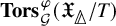 there is a natural Frobenius $\varphi _{\omega _{\mathcal {A}}}$
, and
$\varphi _{\omega _{\mathcal {A}}}$
, and $(\omega _{\mathcal {A}},\varphi _{\omega _{\mathcal {A}}})$
is an object of
$(\omega _{\mathcal {A}},\varphi _{\omega _{\mathcal {A}}})$
is an object of  .
.
On the other hand, define  to be the groupoid consisting of pairs
  where
where $(\mathcal {E},\varphi _{\mathcal {E}})$
is an object of
$(\mathcal {E},\varphi _{\mathcal {E}})$
is an object of  , the pair
  is an object of
  , and
, and  constitutes a set of tensors on $(\mathcal {E},\varphi _{\mathcal {E}})$
or, equivalently, each tensor in
$(\mathcal {E},\varphi _{\mathcal {E}})$
or, equivalently, each tensor in  is Frobenius invariant: fixed under the composition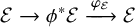 $\mathcal {E}\to \phi ^\ast \mathcal {E}\xrightarrow {\varphi _{\mathcal {E}}}\mathcal {E}$
, where the first map sends x to
$\mathcal {E}\to \phi ^\ast \mathcal {E}\xrightarrow {\varphi _{\mathcal {E}}}\mathcal {E}$
, where the first map sends x to $x\otimes 1$
.
$x\otimes 1$
.
Finally, observe that there is a natural identification

for an object $\mathcal {E}$
of
$\mathcal {E}$
of  . Moreover, there is an identification between
  and
and  . So, if
 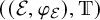 is an object of
  , then the
  -torsor
  has a natural Frobenius also denoted $\varphi _{\mathcal {E}}$
.
$\varphi _{\mathcal {E}}$
.
Our main Tannakian result concerning prismatic F-crystals is the following, where for a prism $(A,I)$
the category
$(A,I)$
the category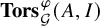 $\mathbf {Tors}^\varphi _{\mathcal {G}}(A,I)$
has the obvious meaning.
$\mathbf {Tors}^\varphi _{\mathcal {G}}(A,I)$
has the obvious meaning.
Proposition 1.29. The natural functor

is an equivalence. Moreover, we have a commuting triangle of equivalences

Results from Appendix A (notably Proposition A.18 applied to both  and
and  ) and Proposition 1.17 reduces the proof of this statement to the claim that the natural functor

is an equivalence.
To prove this, we introduce an ancillary site. Denote by  the subcategory of
  with the same objects as
  and with those morphisms $(A,I)\to (B,J)$
with
$(A,I)\to (B,J)$
with $\operatorname {\mathrm {Spf}}(B)\to \operatorname {\mathrm {Spf}}(A)$
adically étale, with the induced topology. By Proposition 1.4 (and [SP, Tag 00X5]), the functor
$\operatorname {\mathrm {Spf}}(B)\to \operatorname {\mathrm {Spf}}(A)$
adically étale, with the induced topology. By Proposition 1.4 (and [SP, Tag 00X5]), the functor 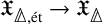 induces a morphism of sites, and there are equivalences of sites
  .
.
Proposition 1.30. The following restriction functors are equivalences of categories

Proof. Fix an object $(A,I)$
of
$(A,I)$
of  and set
  to be the full subcategory of
  consisting of covers $(A,I)\to (B,J)$
, with the induced topology. We use this notation in a similar way for other sites. The naturally defined functor
$(A,I)\to (B,J)$
, with the induced topology. We use this notation in a similar way for other sites. The naturally defined functor  is continuous and has exact pullback by [SP, Tag 00X6] and [Reference Du, Liu, Moon and ShimizuDLMS24, Lemma 3.3], and we have the equality
  . The same properties hold mutatis mutandis for
  . From the following commutative diagram

(where the vertical functors are the natural inclusions), we obtain the diagram

Note that $\mu _4^\ast $
and
$\mu _4^\ast $
and $\mu _2^\ast $
are evidently equivalences,
$\mu _2^\ast $
are evidently equivalences, $\nu _2^\ast $
and
$\nu _2^\ast $
and $\nu _3^\ast $
are equivalences by Corollary A.11, and
$\nu _3^\ast $
are equivalences by Corollary A.11, and $\mu _3^\ast $
is an equivalence by above discussion. By a diagram chase we see that
$\mu _3^\ast $
is an equivalence by above discussion. By a diagram chase we see that $\mu _1^\ast $
is essentially surjective and so it is an equivalence by Corollary A.6. Thus,
$\mu _1^\ast $
is essentially surjective and so it is an equivalence by Corollary A.6. Thus, $\nu _1^\ast $
is an equivalence. We deduce that for any object of
$\nu _1^\ast $
is an equivalence. We deduce that for any object of  , its restriction to $(A,I)$
can be trivialized on an étale cover, and thus the restriction
$(A,I)$
can be trivialized on an étale cover, and thus the restriction  is an equivalence by Corollary A.6.
To prove that  is an equivalence we exhibit a quasi-inverse. For an object $(\mathcal {A}_{(A,I)})$
of the 2-limit category define the object
$(\mathcal {A}_{(A,I)})$
of the 2-limit category define the object $\mathcal {A}$
of
$\mathcal {A}$
of 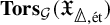 to be the one sending $(A,I)$
to
$(A,I)$
to $\mathcal {A}_{(A,I)}(A)$
. This is a presheaf carrying an action of
$\mathcal {A}_{(A,I)}(A)$
. This is a presheaf carrying an action of  and for which the action on $(A,I)$
-points is simply transitive whenever nonempty. Thus, we are done as it is simple to see that this presheaf is locally isomorphic to
$(A,I)$
-points is simply transitive whenever nonempty. Thus, we are done as it is simple to see that this presheaf is locally isomorphic to  .
.
Finally, we mention the relationship between the above discussion and analytic prismatic F-crystals. By Theorem A.19, and the ideas applied in the proof of Proposition 1.29, one has

and the restriction map

is fully faithful by [Reference Guo and ReineckeGR24, Proposition 3.7], where $\mathbf {Tors}^\varphi _{\mathcal {G}}(U(A,I))$
has the obvious meaning. For this reason, we occasionally identify
$\mathbf {Tors}^\varphi _{\mathcal {G}}(U(A,I))$
has the obvious meaning. For this reason, we occasionally identify  with the category
 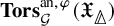 which, by definition, is the right-most term in (1.3.1).
1.3.2 Quasi-syntomic torsors with F-structure
For the sake of completeness, we compare the material from §1.3.1 to the analogous theory in the quasi-syntomic setting.
Abbreviate $\mathcal {G}_{\mathcal {O}^{\mathrm {pris}}}$
to
$\mathcal {G}_{\mathcal {O}^{\mathrm {pris}}}$
to $\mathcal {G}^{\mathrm {pris}}$
and
$\mathcal {G}^{\mathrm {pris}}$
and  to
to  . Write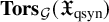 $\mathbf {Tors}_{\mathcal {G}}(\mathfrak {X}_{\mathrm {qsyn}})$
instead of
$\mathbf {Tors}_{\mathcal {G}}(\mathfrak {X}_{\mathrm {qsyn}})$
instead of $\mathbf {Tors}_{\mathcal {G}^{\mathrm {pris}}}(\mathfrak {X}_{\mathrm {qsyn}})$
. We make similar notational conventions concerning
$\mathbf {Tors}_{\mathcal {G}^{\mathrm {pris}}}(\mathfrak {X}_{\mathrm {qsyn}})$
. We make similar notational conventions concerning $(\mathfrak {X}_{\mathrm {QSYN}},\mathcal {O}^{\mathrm {PRIS}})$
.
$(\mathfrak {X}_{\mathrm {QSYN}},\mathcal {O}^{\mathrm {PRIS}})$
.
Proposition 1.31. The following are well-defined equivalences of categories functorial in $\mathcal {G}$
:
$\mathcal {G}$
:

Proof. It suffices to show that $u_\ast $
,
$u_\ast $
, $\mathrm {res.}$
, and
$\mathrm {res.}$
, and  are equivalences. To prove that $\mathrm {eval.}$
is an equivalence, take an open cover
$\mathrm {eval.}$
is an equivalence, take an open cover $\{\operatorname {\mathrm {Spf}}(R_i)\}$
of
$\{\operatorname {\mathrm {Spf}}(R_i)\}$
of $\mathfrak {X}$
and a qrsp cover
$\mathfrak {X}$
and a qrsp cover $R_i\to S_i$
. Let
$R_i\to S_i$
. Let $S_i^{\bullet }$
denote the objects of the Čech nerve of
$S_i^{\bullet }$
denote the objects of the Čech nerve of $R_i\to S_i$
, which consist of qrsp rings by [Reference Bhatt, Morrow and ScholzeBMS19, Lemma 4.30]. Then, by descent we have that the natural evaluation functor
$R_i\to S_i$
, which consist of qrsp rings by [Reference Bhatt, Morrow and ScholzeBMS19, Lemma 4.30]. Then, by descent we have that the natural evaluation functor  is an equivalence, where we have implicitly used [Reference Anschütz and Le BrasALB23, Proposition 3.30]. The fact that $\mathrm {eval.}$
is an equivalence easily follows.
$\mathrm {eval.}$
is an equivalence easily follows.
Set $\mathfrak {X}^{\prime }_{\mathrm {qsyn}}$
to have the same objects as
$\mathfrak {X}^{\prime }_{\mathrm {qsyn}}$
to have the same objects as $\mathfrak {X}_{\mathrm {qsyn}}$
, but whose morphisms are required to be quasi-syntomic. From [Reference Bhatt, Morrow and ScholzeBMS19, Lemma 4.16] and [SP, Tag 00X6], the inclusions
$\mathfrak {X}_{\mathrm {qsyn}}$
, but whose morphisms are required to be quasi-syntomic. From [Reference Bhatt, Morrow and ScholzeBMS19, Lemma 4.16] and [SP, Tag 00X6], the inclusions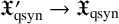 $\mathfrak {X}^{\prime }_{\mathrm {qsyn}}\to \mathfrak {X}_{\mathrm {qsyn}}$
and
$\mathfrak {X}^{\prime }_{\mathrm {qsyn}}\to \mathfrak {X}_{\mathrm {qsyn}}$
and $\mathfrak {X}^{\prime }_{\mathrm {qsyn}}\to \mathfrak {X}_{\mathrm {QSYN}}$
induce morphisms of sites. As
$\mathfrak {X}^{\prime }_{\mathrm {qsyn}}\to \mathfrak {X}_{\mathrm {QSYN}}$
induce morphisms of sites. As $\mathfrak {X}^{\prime }_{\mathrm {qsyn}}$
has the same set of covers of
$\mathfrak {X}^{\prime }_{\mathrm {qsyn}}$
has the same set of covers of $\mathfrak {X}$
as
$\mathfrak {X}$
as $\mathfrak {X}_{\mathrm {QSYN}}$
, from Corollary A.6 we deduce that the functors
$\mathfrak {X}_{\mathrm {QSYN}}$
, from Corollary A.6 we deduce that the functors $\mathbf {Tors}_{\mathcal {G}}(\mathfrak {X}_{\mathrm {QSYN}})\to \mathbf {Tors}_{\mathcal {G}}(\mathfrak {X}^{\prime }_{\mathrm {qsyn}})$
and
$\mathbf {Tors}_{\mathcal {G}}(\mathfrak {X}_{\mathrm {QSYN}})\to \mathbf {Tors}_{\mathcal {G}}(\mathfrak {X}^{\prime }_{\mathrm {qsyn}})$
and $\mathbf {Tors}_{\mathcal {G}}(\mathfrak {X}_{\mathrm {qsyn}})\to \mathbf {Tors}_{\mathcal {G}}(\mathfrak {X}^{\prime }_{\mathrm {qsyn}})$
are equivalences, and so is their composition
$\mathbf {Tors}_{\mathcal {G}}(\mathfrak {X}_{\mathrm {qsyn}})\to \mathbf {Tors}_{\mathcal {G}}(\mathfrak {X}^{\prime }_{\mathrm {qsyn}})$
are equivalences, and so is their composition $\mathrm {res.}$
By Corollary A.7, to show that $u_\ast $
is an equivalence, it suffices to show that for an object
$u_\ast $
is an equivalence, it suffices to show that for an object $\mathcal {A}$
of
$\mathcal {A}$
of  , that $u_\ast (\mathcal {A})$
is locally nonempty. Passing to a qrsp cover
$u_\ast (\mathcal {A})$
is locally nonempty. Passing to a qrsp cover $\{\operatorname {\mathrm {Spf}}(R_i)\to \mathfrak {X}\}$
we may assume that
$\{\operatorname {\mathrm {Spf}}(R_i)\to \mathfrak {X}\}$
we may assume that $\mathfrak {X}=\operatorname {\mathrm {Spf}}(R)$
where R is qrsp. By Proposition 1.30,
$\mathfrak {X}=\operatorname {\mathrm {Spf}}(R)$
where R is qrsp. By Proposition 1.30,  . Pulling back $\mathcal {A}$
along the closed immersion
$\mathcal {A}$
along the closed immersion  as in [Reference Anschütz and Le BrasALB23, Theorem 3.29], gives a $\mathcal {G}$
-torsor
$\mathcal {G}$
-torsor $i^\ast \mathcal {A}$
on
$i^\ast \mathcal {A}$
on $\operatorname {\mathrm {Spf}}(R)_{\mathrm {\acute {e}t}}$
. Let
$\operatorname {\mathrm {Spf}}(R)_{\mathrm {\acute {e}t}}$
. Let $R\to S$
be a p-adically étale morphism such that
$R\to S$
be a p-adically étale morphism such that $(i^\ast \mathcal {A})(S)$
is nonempty. By Lemma 1.6 we see S is qrsp, and so
$(i^\ast \mathcal {A})(S)$
is nonempty. By Lemma 1.6 we see S is qrsp, and so  . But, the pair
  is Henselian by [Reference Anschütz and Le BrasALB23, Lemma 4.28], and so
  is nonempty (e.g., by [Reference Bouthier and ČesnavičiusBČ22, Theorem 2.1.6]).
The proof of the following is obtained mutatis mutandis from the proof of Proposition 1.31.
Proposition 1.32 (cf. [Reference Anschütz and Le BrasALB23, Proposition 4.4] and [Reference Bhatt and ScholzeBS23, Proposition 2.13 and Proposition 2.14])
The following are well-defined rank-preserving bi-exact $\mathbb {Z}_p$
-linear
$\mathbb {Z}_p$
-linear $\otimes $
-equivalences:
$\otimes $
-equivalences:

Set $\phi =v_\ast (\phi )$
on
$\phi =v_\ast (\phi )$
on 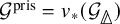 . For an object $\mathcal {B}$
of
$\mathcal {B}$
of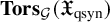 $\mathbf {Tors}_{\mathcal {G}}(\mathfrak {X}_{\mathrm {qsyn}})$
, define
$\mathbf {Tors}_{\mathcal {G}}(\mathfrak {X}_{\mathrm {qsyn}})$
, define  as the pushforward along
  , and
, and  . There are identifications $v_\ast \phi ^\ast \mathcal {A}=\phi ^\ast v_\ast \mathcal {A}$
and
$v_\ast \phi ^\ast \mathcal {A}=\phi ^\ast v_\ast \mathcal {A}$
and  . Define a quasi-syntomic $\mathcal {G}$
-torsor with F-structure to be a pair
$\mathcal {G}$
-torsor with F-structure to be a pair $(\mathcal {B},\varphi )$
where
$(\mathcal {B},\varphi )$
where $\mathcal {B}$
is an object of
$\mathcal {B}$
is an object of $\mathbf {Tors}_{\mathcal {G}}(\mathfrak {X}_{\mathrm {qsyn}})$
and
$\mathbf {Tors}_{\mathcal {G}}(\mathfrak {X}_{\mathrm {qsyn}})$
and $\varphi $
a Frobenius isomorphism
$\varphi $
a Frobenius isomorphism

A morphism of quasi-syntomic $\mathcal {G}$
-torsors with F-structure is a morphism of
$\mathcal {G}$
-torsors with F-structure is a morphism of $\mathcal {G}^{\mathrm {pris}}$
-torsors commuting with the Frobenii. Denote the category of such objects by
$\mathcal {G}^{\mathrm {pris}}$
-torsors commuting with the Frobenii. Denote the category of such objects by $\mathbf {Tors}^\varphi _{\mathcal {G}}(\mathfrak {X}_{\mathrm {qsyn}})$
. One can similarly define the categories
$\mathbf {Tors}^\varphi _{\mathcal {G}}(\mathfrak {X}_{\mathrm {qsyn}})$
. One can similarly define the categories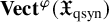 $\mathbf {Vect}^\varphi (\mathfrak {X}_{\mathrm {qsyn}})$
and
$\mathbf {Vect}^\varphi (\mathfrak {X}_{\mathrm {qsyn}})$
and $\mathcal {G}\text {-}\mathbf {Vect}^\varphi (\mathfrak {X}_{\mathrm {qsyn}})$
, as well as their analogues for
$\mathcal {G}\text {-}\mathbf {Vect}^\varphi (\mathfrak {X}_{\mathrm {qsyn}})$
, as well as their analogues for $\mathfrak {X}_{\mathrm {QSYN}}$
or
$\mathfrak {X}_{\mathrm {QSYN}}$
or $\mathfrak {X}_{\mathrm {qrsp}}$
.
$\mathfrak {X}_{\mathrm {qrsp}}$
.
Using Proposition 1.29, Proposition 1.31, and Proposition 1.32 one may deduce the following.
Proposition 1.33. There is a commuting diagram of well-defined equivalences

which is functorial in $\mathcal {G}$
. Similar assertions hold with
$\mathcal {G}$
. Similar assertions hold with $\mathfrak {X}_{\mathrm {qsyn}}$
replaced by
$\mathfrak {X}_{\mathrm {qsyn}}$
replaced by $\mathfrak {X}_{\mathrm {QSYN}}$
or
$\mathfrak {X}_{\mathrm {QSYN}}$
or $\mathfrak {X}_{\mathrm {qrsp}}$
.
$\mathfrak {X}_{\mathrm {qrsp}}$
.
2
$\mathcal {G}$
-objects in the category of crystalline local systems

In this section we derive Tannakian analogues of the results of [Reference Bhatt and ScholzeBS23], [Reference Guo and ReineckeGR24], and [Reference Du, Liu, Moon and ShimizuDLMS24]. Unless stated otherwise, we still use the notation given in Notation 1.1.
2.1 The category of
$\mathcal {G}(\mathbb {Z}_p)$
-local systems

In the statement of the main result of this section it will be helpful to have a clear notion of a $\mathcal {G}(\mathbb {Z}_p)$
-local system (on a scheme or an adic space).
$\mathcal {G}(\mathbb {Z}_p)$
-local system (on a scheme or an adic space).
2.1.1
$\mathcal {G}(\mathbb {Z}_p)$
-local systems on a scheme

For a locally topologically Noetherian scheme S (in the sense in [Reference Bhatt and ScholzeBS15, Definition 6.6.9]), recall from [Reference Bhatt and ScholzeBS15, Definition 4.1.1] that a morphism of schemes $f\colon S'\to S$
is weakly étale if f and
$f\colon S'\to S$
is weakly étale if f and $\Delta _f$
are flat. Moreover, we can associate to S the proétale site
$\Delta _f$
are flat. Moreover, we can associate to S the proétale site $S_{\mathrm {pro\acute {e}t}}$
which is the full subcategory of
$S_{\mathrm {pro\acute {e}t}}$
which is the full subcategory of $S_{\mathrm {fpqc}}$
consisting of weakly étale morphisms
$S_{\mathrm {fpqc}}$
consisting of weakly étale morphisms $S'\to S$
, with the induced topology.
$S'\to S$
, with the induced topology.
We will be interested in the ringed site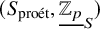 $(S_{\mathrm {pro\acute {e}t}},\underline {\mathbb {Z}_p}_S)$
, where
$(S_{\mathrm {pro\acute {e}t}},\underline {\mathbb {Z}_p}_S)$
, where

where the second equality follows from [Reference Bhatt and ScholzeBS15, Proposition 3.2.3, Proposition 3.1.10, and Proposition 4.2.8]. We often use the notation 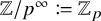 . More generally, for a topological space T, denote by $\underline {T}_S$
(or just
$\underline {T}_S$
(or just $\underline {T}$
when S is clear from context) the sheaf (see [Reference Bhatt and ScholzeBS15, Lemma 4.2.12])
$\underline {T}$
when S is clear from context) the sheaf (see [Reference Bhatt and ScholzeBS15, Lemma 4.2.12])
 $$ \begin{align*} \underline{T}_S\colon S_{\mathrm{pro\acute{e}t}}\to \mathbf{Set},\qquad U\mapsto \operatorname{\mathrm{Hom}}_{\text{cont.}}(U,T). \end{align*} $$
If T is totally disconnected, then $\operatorname {\mathrm {Hom}}_{\text {cont.}}(U,T)$
is equal to
$\operatorname {\mathrm {Hom}}_{\text {cont.}}(U,T)$
is equal to $\text {Hom}_{\text {cont.}}(\pi _0(U),T)$
, and so if
$\text {Hom}_{\text {cont.}}(\pi _0(U),T)$
, and so if $T=\varprojlim T_i$
with each
$T=\varprojlim T_i$
with each $T_i$
finite then
$T_i$
finite then $\underline {T}=\varprojlim \underline {T_i}$
where each
$\underline {T}=\varprojlim \underline {T_i}$
where each $\underline {T_i}$
is the constant sheaf.
$\underline {T_i}$
is the constant sheaf.
Lemma 2.1. With notation as in (A.5.1), there is an identification  , compatible in n and functorial in $\mathcal {G}$
, for
$\mathcal {G}$
, for $n\in \mathbb {N}\cup \{\infty \}$
.
$n\in \mathbb {N}\cup \{\infty \}$
.
Proof. We handle only the case where n is finite as the case for $n=\infty $
follows by passing to the limit. We provide for U in
$n=\infty $
follows by passing to the limit. We provide for U in $S_{\mathrm {pro\acute {e}t}}$
an isomorphism
$S_{\mathrm {pro\acute {e}t}}$
an isomorphism  bi-functorial in U and $\mathcal {G}$
and compatible in n. Let
$\mathcal {G}$
and compatible in n. Let $\{D_i\}$
be the set of discrete quotient spaces of U. Then, for any discrete space X there is an identification between
$\{D_i\}$
be the set of discrete quotient spaces of U. Then, for any discrete space X there is an identification between $\operatorname {\mathrm {Hom}}_{\text {cont.}}(U,X)$
and
$\operatorname {\mathrm {Hom}}_{\text {cont.}}(U,X)$
and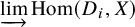 $\varinjlim \operatorname {\mathrm {Hom}}(D_i,X)$
, bi-functorial in U and X. As
$\varinjlim \operatorname {\mathrm {Hom}}(D_i,X)$
, bi-functorial in U and X. As $\mathcal {G}$
is locally of finite presentation over
$\mathcal {G}$
is locally of finite presentation over $\mathbb {Z}_p$
 $$ \begin{align*} \begin{aligned}\mathcal{G}_{\underline{\mathbb{Z}/p^n}}(U) &=\mathcal{G}(\operatorname{\mathrm{Hom}}_{\text{cont.}}(U,\mathbb{Z}/p^n))\\ &=\varinjlim \mathcal{G}(\operatorname{\mathrm{Hom}}(D_i,\mathbb{Z}/p^n))\\ &= \varinjlim \text{Hom}_{\mathbf{Alg}_{\mathbb{Z}_p}}(A_{\mathcal{G}},\text{Hom}(D_i,\mathbb{Z}/p^n)),\end{aligned} \end{align*} $$
(cf. [SP, Tag 01ZC]), where  . On the other hand we see that
 $$ \begin{align*} \begin{aligned} \underline{\mathcal{G}(\mathbb{Z}_p/p^n\mathbb{Z})}(U) &= \text{Hom}_{\text{cont.}}(U,\mathcal{G}(\mathbb{Z}/p^n))\\ &= \varinjlim \text{Hom}(D_i,\mathcal{G}(\mathbb{Z}/p^n))\\ &= \varinjlim \operatorname{\mathrm{Hom}}(D_i,\operatorname{\mathrm{Hom}}_{\mathbf{Alg}_{\mathbb{Z}_p}}(A_{\mathcal{G}},\mathbb{Z}/p^n)). \end{aligned} \end{align*} $$
Thus, we are done via the natural isomorphism of groups
 $$ \begin{align*} \operatorname{\mathrm{Hom}}(D_i,\operatorname{\mathrm{Hom}}_{\mathbf{Alg}_{\mathbb{Z}_p}}(A_{\mathcal{G}},\mathbb{Z}/p^n))\to\text{Hom}_{\mathbf{Alg}_{\mathbb{Z}_p}}(A_{\mathcal{G}},\text{Hom}(D_i,\mathbb{Z}/p^n)) \end{align*} $$
bi-functorial in $D_i$
and
$D_i$
and $\mathcal {G}$
, given by currying.
$\mathcal {G}$
, given by currying.
Denote by $\mathbf {Loc}_{\mathbb {Z}/p^n}(S)$
the category
$\mathbf {Loc}_{\mathbb {Z}/p^n}(S)$
the category $\mathbf {Vect}(S_{\mathrm {pro\acute {e}t}},\underline {\mathbb {Z}/p^n})$
of
$\mathbf {Vect}(S_{\mathrm {pro\acute {e}t}},\underline {\mathbb {Z}/p^n})$
of $\mathbb {Z}/p^n$
-local systems. By [Reference Bhatt and ScholzeBS15, Corollary 5.1.5 and Proposition 6.8.4], this is equivalent to
$\mathbb {Z}/p^n$
-local systems. By [Reference Bhatt and ScholzeBS15, Corollary 5.1.5 and Proposition 6.8.4], this is equivalent to $\mathbf {Loc}_{\mathbb {Z}/p^n}(S_{\mathrm {\acute {e}t}})$
(see [SGA5, Exposé VI]) as an exact
$\mathbf {Loc}_{\mathbb {Z}/p^n}(S_{\mathrm {\acute {e}t}})$
(see [SGA5, Exposé VI]) as an exact $\mathbb {Z}_p$
-linear
$\mathbb {Z}_p$
-linear $\otimes $
-category. We refer to objects of
$\otimes $
-category. We refer to objects of $\mathcal {G}\text {-}\mathbf {Loc}_{\mathbb {Z}/p^n}(S)$
as
$\mathcal {G}\text {-}\mathbf {Loc}_{\mathbb {Z}/p^n}(S)$
as $\mathcal {G}(\mathbb {Z}/p^n)$
-local systems.
$\mathcal {G}(\mathbb {Z}/p^n)$
-local systems.
It will also be convenient to consider the category $\mathbf {Loc}_{\mathbb {Q}_p}(S)$
of
$\mathbf {Loc}_{\mathbb {Q}_p}(S)$
of $\mathbb {Q}_p$
-local systems on S. This has the same objects as
$\mathbb {Q}_p$
-local systems on S. This has the same objects as $\mathbf {Loc}_{\mathbb {Z}_p}(S)$
, denoted by
$\mathbf {Loc}_{\mathbb {Z}_p}(S)$
, denoted by $\mathbb {L}$
of
$\mathbb {L}$
of  when clarity is necessary, but with

where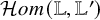 $\mathcal {H}om(\mathbb {L},\mathbb {L}')$
is the internal Hom in
$\mathcal {H}om(\mathbb {L},\mathbb {L}')$
is the internal Hom in $\mathbf {Loc}_{\mathbb {Z}_p}(S)$
. The category
$\mathbf {Loc}_{\mathbb {Z}_p}(S)$
. The category $\mathbf {Loc}_{\mathbb {Q}_p}(S)$
admits a fully faithful embedding into
$\mathbf {Loc}_{\mathbb {Q}_p}(S)$
admits a fully faithful embedding into $\mathbf {Vect}(S_{\mathrm {pro\acute {e}t}},\underline {\mathbb {Q}_p})$
, and so inherits an exact
$\mathbf {Vect}(S_{\mathrm {pro\acute {e}t}},\underline {\mathbb {Q}_p})$
, and so inherits an exact $\mathbb {Q}_p$
-linear
$\mathbb {Q}_p$
-linear $\otimes $
-structure.
$\otimes $
-structure.
Remark 2.2. The essential image of $\mathbf {Loc}_{\mathbb {Q}_p}(S)\to \mathbf {Vect}(S_{\mathrm {pro\acute {e}t}},\underline {\mathbb {Q}_p})$
consists of those
$\mathbf {Loc}_{\mathbb {Q}_p}(S)\to \mathbf {Vect}(S_{\mathrm {pro\acute {e}t}},\underline {\mathbb {Q}_p})$
consists of those $\underline {\mathbb {Q}_p}$
-vector bundles which admit a
$\underline {\mathbb {Q}_p}$
-vector bundles which admit a $\underline {\mathbb {Z}_p}$
-lattice. Equivalently, assuming S is connected, this corresponds to the embedding
$\underline {\mathbb {Z}_p}$
-lattice. Equivalently, assuming S is connected, this corresponds to the embedding $\mathbf {Rep}^{\mathrm {cont.}}_{\mathbb {Q}_p}(\pi _1^{\mathrm {\acute {e}t}}(S,\overline {s}))\to {\mathbf {Rep}}_{\mathbb {Q}_p}^{\mathrm {cont.}}(\pi _1^{\mathrm {pro\acute {e}t}}(S,\overline {s}))$
, where
$\mathbf {Rep}^{\mathrm {cont.}}_{\mathbb {Q}_p}(\pi _1^{\mathrm {\acute {e}t}}(S,\overline {s}))\to {\mathbf {Rep}}_{\mathbb {Q}_p}^{\mathrm {cont.}}(\pi _1^{\mathrm {pro\acute {e}t}}(S,\overline {s}))$
, where $\pi _1^{\mathrm {pro\acute {e}t}}(S,\overline {s})$
is the proétale fundamental group as in [Reference Bhatt and ScholzeBS15, §7] and
$\pi _1^{\mathrm {pro\acute {e}t}}(S,\overline {s})$
is the proétale fundamental group as in [Reference Bhatt and ScholzeBS15, §7] and $\overline {s}$
is a geometric point. If S is geometrically unibranch then
$\overline {s}$
is a geometric point. If S is geometrically unibranch then $\pi _1^{\mathrm {pro\acute {e}t}}(S,\overline {s})=\pi _1^{\mathrm {\acute {e}t}}(S,\overline {s})$
(see [Reference Bhatt and ScholzeBS15, Lemma 7.4.10]), and so by compactness any representation
$\pi _1^{\mathrm {pro\acute {e}t}}(S,\overline {s})=\pi _1^{\mathrm {\acute {e}t}}(S,\overline {s})$
(see [Reference Bhatt and ScholzeBS15, Lemma 7.4.10]), and so by compactness any representation $\pi _1^{\mathrm {pro\acute {e}t}}(S,\overline {s})\to \operatorname {\mathrm {GL}}_n(\mathbb {Q}_p)$
factorizes through a
$\pi _1^{\mathrm {pro\acute {e}t}}(S,\overline {s})\to \operatorname {\mathrm {GL}}_n(\mathbb {Q}_p)$
factorizes through a $\mathbb {Z}_p$
-lattice and so
$\mathbb {Z}_p$
-lattice and so $\mathbf {Loc}_{\mathbb {Q}_p}(S)\to \mathbf {Vect}(S_{\mathrm {pro\acute {e}t}},\underline {\mathbb {Q}_p})$
is an equivalence. But, this is not true in general (e.g. if S is the projective nodal curve, then
$\mathbf {Loc}_{\mathbb {Q}_p}(S)\to \mathbf {Vect}(S_{\mathrm {pro\acute {e}t}},\underline {\mathbb {Q}_p})$
is an equivalence. But, this is not true in general (e.g. if S is the projective nodal curve, then $\pi _1^{\mathrm {pro\acute {e}t}}(S,\overline {s})$
is isomorphic to
$\pi _1^{\mathrm {pro\acute {e}t}}(S,\overline {s})$
is isomorphic to $\mathbb {Z}$
with the discrete topology).
$\mathbb {Z}$
with the discrete topology).
Proposition 2.3. For every $n\in \mathbb {N}\cup \{\infty \}$
, the group
$n\in \mathbb {N}\cup \{\infty \}$
, the group $\mathcal {G}$
is reconstructible in
$\mathcal {G}$
is reconstructible in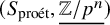 $(S_{\mathrm {pro\acute {e}t}},\underline {\mathbb {Z}/p^n})$
and every object of
$(S_{\mathrm {pro\acute {e}t}},\underline {\mathbb {Z}/p^n})$
and every object of $\mathcal {G}\text {-}\mathbf {Loc}_{\mathbb {Z}/p^n}(S)$
is locally trivial.
$\mathcal {G}\text {-}\mathbf {Loc}_{\mathbb {Z}/p^n}(S)$
is locally trivial.
Proof. Assume first that S is locally Noetherian. For the first statement, we deal only with the case $n=\infty $
. Let U in
$n=\infty $
. Let U in $S_{\mathrm {pro\acute {e}t}}$
be arbitrary. One may identify the natural map
$S_{\mathrm {pro\acute {e}t}}$
be arbitrary. One may identify the natural map $\mathcal {G}_{\underline {\mathbb {Z}_p}}(U)\to \underline {\operatorname {\mathrm {Aut}}}(\omega _{\mathrm {triv}})(U)$
with the map from
$\mathcal {G}_{\underline {\mathbb {Z}_p}}(U)\to \underline {\operatorname {\mathrm {Aut}}}(\omega _{\mathrm {triv}})(U)$
with the map from $\operatorname {\mathrm {Hom}}_{\text {cont.}}(\pi _0(U),\mathcal {G}(\mathbb {Z}_p))$
to the system
$\operatorname {\mathrm {Hom}}_{\text {cont.}}(\pi _0(U),\mathcal {G}(\mathbb {Z}_p))$
to the system $(g_\Lambda )$
of elements of
$(g_\Lambda )$
of elements of $\operatorname {\mathrm {Hom}}_{\text {cont.}}(\pi _0(U),\operatorname {\mathrm {GL}}(\Lambda ))$
for
$\operatorname {\mathrm {Hom}}_{\text {cont.}}(\pi _0(U),\operatorname {\mathrm {GL}}(\Lambda ))$
for $\Lambda $
in
$\Lambda $
in ${\mathbf {Rep}}_{\mathbb {Z}_p}(\mathcal {G})$
, which are compatible in
${\mathbf {Rep}}_{\mathbb {Z}_p}(\mathcal {G})$
, which are compatible in $\Lambda $
. The projection
$\Lambda $
. The projection $(g_\Lambda )\mapsto g_{\Lambda _0}$
from
$(g_\Lambda )\mapsto g_{\Lambda _0}$
from $\underline {\operatorname {\mathrm {Aut}}}(\omega _{\mathrm {triv}})(U)$
to
$\underline {\operatorname {\mathrm {Aut}}}(\omega _{\mathrm {triv}})(U)$
to $\operatorname {\mathrm {Hom}}_{\text {cont.}}(\pi _0(U),\operatorname {\mathrm {GL}}(\Lambda _0))$
is injective as every object
$\operatorname {\mathrm {Hom}}_{\text {cont.}}(\pi _0(U),\operatorname {\mathrm {GL}}(\Lambda _0))$
is injective as every object $\Lambda $
of
$\Lambda $
of ${\mathbf {Rep}}_{\mathbb {Z}_p}(\mathcal {G})$
is a subquotient of
${\mathbf {Rep}}_{\mathbb {Z}_p}(\mathcal {G})$
is a subquotient of $\Lambda _0^{\otimes }$
(see [Reference dos SantosdS09, Proposition 12]). As the diagram
$\Lambda _0^{\otimes }$
(see [Reference dos SantosdS09, Proposition 12]). As the diagram

commutes, and a and b are injective, to show that a is an isomorphism it suffices to show that $\mathrm {im}(b)\subseteq \mathrm {im}(c)$
. But, by functoriality
$\mathrm {im}(b)\subseteq \mathrm {im}(c)$
. But, by functoriality $\mathrm {im}(b)$
fixes
$\mathrm {im}(b)$
fixes  and thus lies in $\mathrm {im}(c)$
.
$\mathrm {im}(c)$
.
Let $\omega $
be an object of
$\omega $
be an object of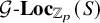 $\mathcal {G}\text {-}\mathbf {Loc}_{\mathbb {Z}_p}(S)$
. For
$\mathcal {G}\text {-}\mathbf {Loc}_{\mathbb {Z}_p}(S)$
. For $n\in \mathbb {N}\cup \{\infty \}$
consider the sheaf
$n\in \mathbb {N}\cup \{\infty \}$
consider the sheaf $\underline {\operatorname {\mathrm {Isom}}}(\omega _{\mathrm {triv}},\omega _n)$
, associating to a locally Noetherian S-scheme
$\underline {\operatorname {\mathrm {Isom}}}(\omega _{\mathrm {triv}},\omega _n)$
, associating to a locally Noetherian S-scheme $f\colon T\to S$
the set of isomorphisms
$f\colon T\to S$
the set of isomorphisms $\omega _{\mathrm {triv}}\to \omega _{n,T}$
, where
$\omega _{\mathrm {triv}}\to \omega _{n,T}$
, where  is considered as an object of $\mathcal {G}\text {-}\mathbf {Loc}_{\mathbb {Z}/p^n}(T)$
. To prove the second claim it suffices to show that
$\mathcal {G}\text {-}\mathbf {Loc}_{\mathbb {Z}/p^n}(T)$
. To prove the second claim it suffices to show that $\underline {\operatorname {\mathrm {Isom}}}(\omega _{\mathrm {triv}},\omega _\infty )$
is representable by a weakly étale cover of S. Moreover, as
$\underline {\operatorname {\mathrm {Isom}}}(\omega _{\mathrm {triv}},\omega _\infty )$
is representable by a weakly étale cover of S. Moreover, as $\underline {\operatorname {\mathrm {Isom}}}(\omega _{\mathrm {triv}},\omega _\infty )$
is the limit of
$\underline {\operatorname {\mathrm {Isom}}}(\omega _{\mathrm {triv}},\omega _\infty )$
is the limit of $\underline {\operatorname {\mathrm {Isom}}}(\omega _{\mathrm {triv}},\omega _n)$
(cf. [Reference Bhatt and ScholzeBS15, Proposition 6.8.4]) it further suffices to show that
$\underline {\operatorname {\mathrm {Isom}}}(\omega _{\mathrm {triv}},\omega _n)$
(cf. [Reference Bhatt and ScholzeBS15, Proposition 6.8.4]) it further suffices to show that $\underline {\operatorname {\mathrm {Isom}}}(\omega _{\mathrm {triv}},\omega _n)$
is represented by a finite étale cover of S for every n in
$\underline {\operatorname {\mathrm {Isom}}}(\omega _{\mathrm {triv}},\omega _n)$
is represented by a finite étale cover of S for every n in $\mathbb {N}$
. To see this, observe that the natural map
$\mathbb {N}$
. To see this, observe that the natural map
 $$ \begin{align*} \underline{\operatorname{\mathrm{Isom}}}(\omega_{\mathrm{triv}},\omega_n)\to \underline{\operatorname{\mathrm{Isom}}}(\Lambda_0\otimes_{\mathbb{Z}_p} \underline{\mathbb{Z}/p^n},\omega_n(\Lambda_0)) \end{align*} $$
is a closed embedding, cut out by the intersection of the following conditions (with terminology from [Reference dos SantosdS09, Definition 10 and Proposition 12]) on an f in $\underline {\operatorname {\mathrm {Isom}}}(\Lambda _0\otimes _{\mathbb {Z}_p} \underline {\mathbb {Z}/p^n},\omega _n(\Lambda _0))$
: for every tuple
$\underline {\operatorname {\mathrm {Isom}}}(\Lambda _0\otimes _{\mathbb {Z}_p} \underline {\mathbb {Z}/p^n},\omega _n(\Lambda _0))$
: for every tuple $(a,b,W,U,q)$
, where
$(a,b,W,U,q)$
, where $a,b$
are multi-indices, W is a special subrepresentation of
$a,b$
are multi-indices, W is a special subrepresentation of $(\Lambda _0)^a_b$
, and
$(\Lambda _0)^a_b$
, and $q\colon W\to U$
is a surjection of representations, f and
$q\colon W\to U$
is a surjection of representations, f and $f^{-1}$
preserve W and
$f^{-1}$
preserve W and $\ker q$
. Thus,
$\ker q$
. Thus, $\underline {\operatorname {\mathrm {Isom}}}(\omega _{\mathrm {triv}},\omega _n)\to S$
is finite. Moreover, by the topological invariance of the pro-étale topos (see [Reference Bhatt and ScholzeBS15, Lemma 5.4.2]), pullback along
$\underline {\operatorname {\mathrm {Isom}}}(\omega _{\mathrm {triv}},\omega _n)\to S$
is finite. Moreover, by the topological invariance of the pro-étale topos (see [Reference Bhatt and ScholzeBS15, Lemma 5.4.2]), pullback along $i\colon \operatorname {\mathrm {Spec}}(A/I)\to \operatorname {\mathrm {Spec}}(A)$
, for a square-zero ideal I of a Noetherian ring A, defines an equivalence
$i\colon \operatorname {\mathrm {Spec}}(A/I)\to \operatorname {\mathrm {Spec}}(A)$
, for a square-zero ideal I of a Noetherian ring A, defines an equivalence
 $$ \begin{align*} i^{-1}\colon \mathbf{Loc}_{\mathbb{Z}/p^n}(\operatorname{\mathrm{Spec}}(A))\to \mathbf{Loc}_{\mathbb{Z}/p^n}(\operatorname{\mathrm{Spec}}(A/I)) \end{align*} $$
for $n\in \mathbb {N}\cup \{\infty \}$
. From this we deduce that
$n\in \mathbb {N}\cup \{\infty \}$
. From this we deduce that $\underline {\operatorname {\mathrm {Isom}}}(\omega _{\mathrm {triv}},\omega _n)\to S$
is formally étale in the sense of [SP, Tag 02HG], and thus finite étale by [SP, Tag 02HM].
$\underline {\operatorname {\mathrm {Isom}}}(\omega _{\mathrm {triv}},\omega _n)\to S$
is formally étale in the sense of [SP, Tag 02HG], and thus finite étale by [SP, Tag 02HM].
To show that $\underline {\operatorname {\mathrm {Isom}}}(\omega _{\mathrm {triv}},\omega _n)\to S$
is surjective, it suffices to show that the pullback to each geometric point of S is a trivial torsor, and so we may assume that S is the spectrum of an algebraically closed field. In this case, there is a bi-exact
$\underline {\operatorname {\mathrm {Isom}}}(\omega _{\mathrm {triv}},\omega _n)\to S$
is surjective, it suffices to show that the pullback to each geometric point of S is a trivial torsor, and so we may assume that S is the spectrum of an algebraically closed field. In this case, there is a bi-exact $\mathbb {Z}_p$
-linear
$\mathbb {Z}_p$
-linear $\otimes $
-equivalence between
$\otimes $
-equivalence between $\mathbf {Loc}_{\mathbb {Z}/p^n}(S)$
and
$\mathbf {Loc}_{\mathbb {Z}/p^n}(S)$
and $\mathbf {Vect}(\mathbb {Z}/p^n)$
. But, by Theorem A.19, if
$\mathbf {Vect}(\mathbb {Z}/p^n)$
. But, by Theorem A.19, if $\nu _n$
belongs to
$\nu _n$
belongs to $\mathcal {G}\text {-}\mathbf {Vect}(\mathbb {Z}/p^n)$
then
$\mathcal {G}\text {-}\mathbf {Vect}(\mathbb {Z}/p^n)$
then $\underline {\operatorname {\mathrm {Isom}}}(\omega _{\mathrm {triv}},\nu _n)$
is a
$\underline {\operatorname {\mathrm {Isom}}}(\omega _{\mathrm {triv}},\nu _n)$
is a $\mathcal {G}$
-torsor. But,
$\mathcal {G}$
-torsor. But, $H^1(\operatorname {\mathrm {Spec}}(\mathbb {Z}/p^n),\mathcal {G})$
is trivial (e.g. by [Reference MilneMil17, Corollary 17.98] and [Reference Bouthier and ČesnavičiusBČ22, Theorem 2.1.6]), and so the claim follows.
$H^1(\operatorname {\mathrm {Spec}}(\mathbb {Z}/p^n),\mathcal {G})$
is trivial (e.g. by [Reference MilneMil17, Corollary 17.98] and [Reference Bouthier and ČesnavičiusBČ22, Theorem 2.1.6]), and so the claim follows.
To remove the locally Noetherian hypothesis, we may proceed as follows. We may assume that n is in $\mathbb {N}$
and S is connected. Consider W in
$\mathbb {N}$
and S is connected. Consider W in ${\mathbf {Rep}}_{\mathbb {Z}_p}(\mathcal {G})$
with a saturated injection
${\mathbf {Rep}}_{\mathbb {Z}_p}(\mathcal {G})$
with a saturated injection $W \hookrightarrow A_{\mathcal {G}}^*=\operatorname {\mathrm {Hom}}_{\mathbb {Z}_p}(\mathcal {O}_{\mathcal {G}}(\mathcal {G}),\mathbb {Z}_p)$
whose image in
$W \hookrightarrow A_{\mathcal {G}}^*=\operatorname {\mathrm {Hom}}_{\mathbb {Z}_p}(\mathcal {O}_{\mathcal {G}}(\mathcal {G}),\mathbb {Z}_p)$
whose image in $A_{\mathcal {G}}^*/p^n$
contains
$A_{\mathcal {G}}^*/p^n$
contains $\mathcal {G}(\mathbb {Z}/p^n)$
. We may replace S by a finite étale connected cover that trivializes
$\mathcal {G}(\mathbb {Z}/p^n)$
. We may replace S by a finite étale connected cover that trivializes $\omega _n(W)$
. We claim then that
$\omega _n(W)$
. We claim then that $\omega _n(V)$
is trivial for all V. By the locally Noetherian case, for each s in S, we have an isomorphism
$\omega _n(V)$
is trivial for all V. By the locally Noetherian case, for each s in S, we have an isomorphism
 $$ \begin{align*} \psi \colon \underline{\operatorname{\mathrm{Isom}}}(\omega_{\mathrm{triv}},\omega_n)_s \times^{\mathcal{G}(\mathbb{Z}/p^n)} W(\mathbb{Z}/p^n) \simeq \omega_n(W)_s. \end{align*} $$
Take a trivial $\mathcal {G}(\mathbb {Z}/p^n)$
-torsor
$\mathcal {G}(\mathbb {Z}/p^n)$
-torsor $\mathcal {T}$
over S and an isomorphism
$\mathcal {T}$
over S and an isomorphism $\mathcal {T} \times ^{\mathcal {G}(\mathbb {Z}/p^n)} W(\mathbb {Z}/p^n) \simeq \omega _n(W)$
extending
$\mathcal {T} \times ^{\mathcal {G}(\mathbb {Z}/p^n)} W(\mathbb {Z}/p^n) \simeq \omega _n(W)$
extending $\psi $
. For an object V of
$\psi $
. For an object V of ${\mathbf {Rep}}_{\mathbb {Z}_p}(\mathcal {G})$
and v in
${\mathbf {Rep}}_{\mathbb {Z}_p}(\mathcal {G})$
and v in $V(\mathbb {Z}_p)$
, let
$V(\mathbb {Z}_p)$
, let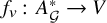 $f_v \colon A_{\mathcal {G}}^* \to V$
be the morphism induced by the map
$f_v \colon A_{\mathcal {G}}^* \to V$
be the morphism induced by the map $\mathcal {G} \to V$
sending g to
$\mathcal {G} \to V$
sending g to $gv$
. Let
$gv$
. Let $\mathrm {ev}_1$
in
$\mathrm {ev}_1$
in $A_{\mathcal {G}}^*/p^n$
be the unit section. Then
$A_{\mathcal {G}}^*/p^n$
be the unit section. Then
 $$ \begin{align*} \mathcal{T} \xrightarrow{\operatorname{\mathrm{id}} \times \mathrm{ev}_1} \mathcal{T} \times^{\mathcal{G}(\mathbb{Z}/p^n)} W(\mathbb{Z}/p^n) \simeq \omega_n(W) \xrightarrow{\omega_n(f_v|_W)} \omega_n(V) \end{align*} $$
gives a map $\mathcal {T} \times ^{\mathcal {G}(\mathbb {Z}/p^n)} V(\mathbb {Z}/p^n) \to \omega _n(V)$
. One checks this is an isomorphism over s, and so is an isomorphism as the source and target are finite étale over S.
$\mathcal {T} \times ^{\mathcal {G}(\mathbb {Z}/p^n)} V(\mathbb {Z}/p^n) \to \omega _n(V)$
. One checks this is an isomorphism over s, and so is an isomorphism as the source and target are finite étale over S.
Given Lemma 2.1, we write $\mathbf {Tors}_{\mathcal {G}(\mathbb {Z}/p^n)}(S_{\mathrm {pro\acute {e}t}})$
instead of
$\mathbf {Tors}_{\mathcal {G}(\mathbb {Z}/p^n)}(S_{\mathrm {pro\acute {e}t}})$
instead of $\mathbf {Tors}_{\mathcal {G}_{\underline {\mathbb {Z}/p^n}}}(S_{\mathrm {pro\acute {e}t}})$
, and call objects of this category
$\mathbf {Tors}_{\mathcal {G}_{\underline {\mathbb {Z}/p^n}}}(S_{\mathrm {pro\acute {e}t}})$
, and call objects of this category $\mathcal {G}(\mathbb {Z}/p^n)$
-torsors. By Proposition 2.3 and Proposition A.18 we know that there is a natural equivalence of categories between
$\mathcal {G}(\mathbb {Z}/p^n)$
-torsors. By Proposition 2.3 and Proposition A.18 we know that there is a natural equivalence of categories between $\mathcal {G}\text {-}\mathbf {Loc}_{\mathbb {Z}/p^n}(S)$
and
$\mathcal {G}\text {-}\mathbf {Loc}_{\mathbb {Z}/p^n}(S)$
and $\mathbf {Tors}_{\mathcal {G}(\mathbb {Z}/p^n)}(S_{\mathrm {pro\acute {e}t}})$
. Explicitly, this functor associates to a
$\mathbf {Tors}_{\mathcal {G}(\mathbb {Z}/p^n)}(S_{\mathrm {pro\acute {e}t}})$
. Explicitly, this functor associates to a $\mathcal {G}(\mathbb {Z}/p^n)$
-torsor
$\mathcal {G}(\mathbb {Z}/p^n)$
-torsor $\mathcal {A}$
the
$\mathcal {A}$
the $\mathcal {G}(\mathbb {Z}/p^n)$
-local system
$\mathcal {G}(\mathbb {Z}/p^n)$
-local system $\omega _{\mathcal {A}}$
given by
$\omega _{\mathcal {A}}$
given by  .
.
By a $G(\mathbb {Q}_p)$
-local system on S, we mean an exact
$G(\mathbb {Q}_p)$
-local system on S, we mean an exact $\mathbb {Q}_p$
-linear
$\mathbb {Q}_p$
-linear $\otimes $
-functor
$\otimes $
-functor ${\mathbf {Rep}}_{\mathbb {Q}_p}(G)\to \mathbf {Loc}_{\mathbb {Q}_p}(S)$
, the category of which we denote by
${\mathbf {Rep}}_{\mathbb {Q}_p}(G)\to \mathbf {Loc}_{\mathbb {Q}_p}(S)$
, the category of which we denote by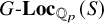 $G\text {-}\mathbf {Loc}_{\mathbb {Q}_p}(S)$
. The following trivial observation allows us to define a natural functor
$G\text {-}\mathbf {Loc}_{\mathbb {Q}_p}(S)$
. The following trivial observation allows us to define a natural functor  . Let us denote by
  the category which has the same objects as ${\mathbf {Rep}}_{\mathbb {Z}_p}(\mathcal {G})$
, denoted by either
${\mathbf {Rep}}_{\mathbb {Z}_p}(\mathcal {G})$
, denoted by either $\Lambda $
or
$\Lambda $
or  for clarity, but where we set
  to be
to be  .
.
Lemma 2.4. The functor

is an equivalence of categories.
Proof. Let $\Lambda $
and
$\Lambda $
and $\Lambda '$
be objects of
$\Lambda '$
be objects of ${\mathbf {Rep}}_{\mathbb {Z}_p}(\mathcal {G})$
, viewed as right comodules of
${\mathbf {Rep}}_{\mathbb {Z}_p}(\mathcal {G})$
, viewed as right comodules of  and view
  and
and  as right comodules of
  . Then, it suffices to show that under the natural isomorphism
  that the subsets of comodule homomorphisms are matched. But, this is obvious as $A_{\mathcal {G}}$
is a flat
$A_{\mathcal {G}}$
is a flat $\mathbb {Z}_p$
-module. To show that this functor is essentially surjective, let V be an
$\mathbb {Z}_p$
-module. To show that this functor is essentially surjective, let V be an  -comodule. An $A_{\mathcal {G}}$
-comodule lattice is obtained using [Reference BroshiBro13, Lemma 3.1] applied to V, by taking an
$A_{\mathcal {G}}$
-comodule lattice is obtained using [Reference BroshiBro13, Lemma 3.1] applied to V, by taking an $A_{\mathcal {G}}$
-comodule, locally free (and thus free) as a
$A_{\mathcal {G}}$
-comodule, locally free (and thus free) as a $\mathbb {Z}_p$
-module, containing any given
$\mathbb {Z}_p$
-module, containing any given $\mathbb {Z}_p$
-lattice of V.
$\mathbb {Z}_p$
-lattice of V.
Finally, it is useful to have a more concrete description of torsors for a pro-finite group H on $S_{\mathrm {pro\acute {e}t}}$
. We set the following notation.
$S_{\mathrm {pro\acute {e}t}}$
. We set the following notation.
Notation 2.5. Let $H=\varprojlim H_n$
be a pro-finite group, where each
$H=\varprojlim H_n$
be a pro-finite group, where each $H_n$
is a finite group.
$H_n$
is a finite group.
Consider a projective system of schemes $\{X_n\}$
, each equipped with the structure of a principal homogeneous space over S for
$\{X_n\}$
, each equipped with the structure of a principal homogeneous space over S for $H_n$
(see [SP, Tag 049A]). The quotient sheaf
$H_n$
(see [SP, Tag 049A]). The quotient sheaf $X_n/K_n$
, where
$X_n/K_n$
, where  , is representable by [SGA3-1, Exposé V, §7, Théorème 7.1], and $X_n/K_n\to S$
is naturally a principal homogeneous space for
$X_n/K_n\to S$
is naturally a principal homogeneous space for $H_{n-1}$
. We say
$H_{n-1}$
. We say $(X_n)$
is an H-covering if each
$(X_n)$
is an H-covering if each $X_n\to X_{n-1}$
is
$X_n\to X_{n-1}$
is $K_n$
-equivariant (when the target is given the trivial action) and the induced map
$K_n$
-equivariant (when the target is given the trivial action) and the induced map $X_n/K_n\to X_{n-1}$
is an
$X_n/K_n\to X_{n-1}$
is an $H_{n-1}$
-equivariant isomorphism. A morphism of H-coverings
$H_{n-1}$
-equivariant isomorphism. A morphism of H-coverings $(X_n)\to (Y_n)$
is a compatible family of
$(X_n)\to (Y_n)$
is a compatible family of $H_n$
-equivariant morphisms
$H_n$
-equivariant morphisms $X_n\to Y_n$
.
$X_n\to Y_n$
.
An S-scheme X equipped with an action of H is a principal homogeneous space for H if $h_X$
with the induced action of
$h_X$
with the induced action of $\underline {H}$
is an
$\underline {H}$
is an $\underline {H}$
-torsor. Morphisms of principal homogeneous spaces are H-equivariant morphisms of S-schemes. If
$\underline {H}$
-torsor. Morphisms of principal homogeneous spaces are H-equivariant morphisms of S-schemes. If $(X_n)$
is an H-covering then
$(X_n)$
is an H-covering then 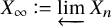 is a principal homogeneous space for H. Conversely, if X is a principal homogeneous space for H, the system $(X_n)$
with
$(X_n)$
with  (a scheme by Proposition A.10) is an H-covering with $X_\infty = X$
.
$X_\infty = X$
.
Applying [Reference Bhatt and ScholzeBS15, Lemma 7.3.9] to $\mathcal {T}\times ^{\underline {H}}\underline {H}_n$
for every n, every object
$\mathcal {T}\times ^{\underline {H}}\underline {H}_n$
for every n, every object $\mathcal {T}$
of
$\mathcal {T}$
of $\mathbf {Tors}_{\underline {H}}(S_{\mathrm {pro\acute {e}t}})$
is representable. We summarize the above as follows.
$\mathbf {Tors}_{\underline {H}}(S_{\mathrm {pro\acute {e}t}})$
is representable. We summarize the above as follows.
Proposition 2.6. For locally topologically Noetherian S, the following are equivalences:
 $$ \begin{align*} \left\{\begin{matrix}H\mathrm{-coverings}\\ \mathrm{of}\ S\end{matrix}\right\}\xrightarrow{(X_n)\mapsto X_\infty} \left\{\begin{matrix}\mathrm{Principal\ homogenous}\\ \mathrm{spaces\ for}\ H\ \mathrm{on}\ S\end{matrix}\right\} \xrightarrow{X\mapsto h_X}\mathbf{Tors}_{\underline{H}}(S_{\mathrm{pro\acute{e}t}}). \end{align*} $$
2.1.2
$\mathcal {G}(\mathbb {Z}_p)$
-local systems on an adic space

Let X be a locally Noetherian adic space over $\mathbb {Q}_p$
(cf. [Reference ScholzeSch13, p. 17]), and let
$\mathbb {Q}_p$
(cf. [Reference ScholzeSch13, p. 17]), and let $X_{\mathrm {pro\acute {e}t}}$
be the pro-étale site as in [Reference Bhatt, Morrow and ScholzeBMS18, §5.1]. As in [Reference ScholzeSch13], we call an object of
$X_{\mathrm {pro\acute {e}t}}$
be the pro-étale site as in [Reference Bhatt, Morrow and ScholzeBMS18, §5.1]. As in [Reference ScholzeSch13], we call an object of $X_{\mathrm {pro\acute {e}t}}$
affinoid perfectoid if it can be represented as
$X_{\mathrm {pro\acute {e}t}}$
affinoid perfectoid if it can be represented as $(\operatorname {\mathrm {Spa}}(R_i,R_i^+))$
with finite étale surjective transition maps, and the Huber pair
$(\operatorname {\mathrm {Spa}}(R_i,R_i^+))$
with finite étale surjective transition maps, and the Huber pair $(R,R^+)=((\varinjlim R_i)^\wedge ,(\varinjlim R_i^+)^\wedge )$
(endowed with the unique topology such that each
$(R,R^+)=((\varinjlim R_i)^\wedge ,(\varinjlim R_i^+)^\wedge )$
(endowed with the unique topology such that each $R_i\to R$
is adic) is perfectoid. In this case,
$R_i\to R$
is adic) is perfectoid. In this case, $\operatorname {\mathrm {Spa}}(R,R^+)\sim \varprojlim \operatorname {\mathrm {Spa}}(R_i,R_i^+)$
(see [Reference Scholze and WeinsteinSW13, §2.4]). The affinoid perfectoid objects of
$\operatorname {\mathrm {Spa}}(R,R^+)\sim \varprojlim \operatorname {\mathrm {Spa}}(R_i,R_i^+)$
(see [Reference Scholze and WeinsteinSW13, §2.4]). The affinoid perfectoid objects of $X_{\mathrm {pro\acute {e}t}}$
form a basis of
$X_{\mathrm {pro\acute {e}t}}$
form a basis of $X_{\mathrm {pro\acute {e}t}}$
(cf. [Reference ScholzeSch13, Proposition 4.8]). The site
$X_{\mathrm {pro\acute {e}t}}$
(cf. [Reference ScholzeSch13, Proposition 4.8]). The site $X_{\mathrm {pro\acute {e}t}}$
is not subcanonical (see [Reference Achinger, Lara and YoucisALY21, Example 4.1.7]), but
$X_{\mathrm {pro\acute {e}t}}$
is not subcanonical (see [Reference Achinger, Lara and YoucisALY21, Example 4.1.7]), but $h_Y$
and
$h_Y$
and $h_Y^\#$
have the same value on affinoid perfectoid objects (see [Reference Achinger, Lara and YoucisALY21, Proposition 4.1.8]). So, we abusively conflate the two.
$h_Y^\#$
have the same value on affinoid perfectoid objects (see [Reference Achinger, Lara and YoucisALY21, Proposition 4.1.8]). So, we abusively conflate the two.
We will again be interested in the ringed site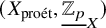 $(X_{\mathrm {pro\acute {e}t}},\underline {\mathbb {Z}_p}_X)$
, where
$(X_{\mathrm {pro\acute {e}t}},\underline {\mathbb {Z}_p}_X)$
, where
 $$ \begin{align*} \underline{\mathbb{Z}_p}_X=R\varprojlim \underline{\mathbb{Z}/p^n}_X=\varprojlim \underline{\mathbb{Z}/p^n}_X\in \mathbf{Shv}(X_{\mathrm{pro\acute{e}t}}), \end{align*} $$
where $\underline {\mathbb {Z}/p^n}_X$
is the constant sheaf on
$\underline {\mathbb {Z}/p^n}_X$
is the constant sheaf on $X_{\mathrm {pro\acute {e}t}}$
associated to
$X_{\mathrm {pro\acute {e}t}}$
associated to $\mathbb {Z}/p^n$
, and the second equality follows now from [Reference ScholzeSch13, Proposition 8.2]. Again, more generally, for a topological space T, we denote by
$\mathbb {Z}/p^n$
, and the second equality follows now from [Reference ScholzeSch13, Proposition 8.2]. Again, more generally, for a topological space T, we denote by $\underline {T}_X$
(or just
$\underline {T}_X$
(or just $\underline {T}$
when X is clear from context) the sheafFootnote 7
$\underline {T}$
when X is clear from context) the sheafFootnote 7
 $$ \begin{align*} \underline{T}_{X}\colon X_{\mathrm{pro\acute{e}t}}\to\mathbf{Set},\qquad Y\mapsto \text{Hom}_{\text{cont.}}(Y,T). \end{align*} $$
If T is totally disconnected, then $\operatorname {\mathrm {Hom}}_{\text {cont.}}(Y,T)$
equals
$\operatorname {\mathrm {Hom}}_{\text {cont.}}(Y,T)$
equals $\text {Hom}_{\text {cont.}}(\pi _0(Y),T)$
, and if
$\text {Hom}_{\text {cont.}}(\pi _0(Y),T)$
, and if $T=\varprojlim T_i$
with each
$T=\varprojlim T_i$
with each $T_i$
finite then
$T_i$
finite then $\underline {T}=\varprojlim \underline {T_i}$
where each
$\underline {T}=\varprojlim \underline {T_i}$
where each $\underline {T_i}$
is the constant sheaf.
$\underline {T_i}$
is the constant sheaf.
For $n\in \mathbb {N}\cup \{\infty \}$
, write
$n\in \mathbb {N}\cup \{\infty \}$
, write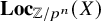 $\mathbf {Loc}_{\mathbb {Z}/p^n}(X)$
for the category
$\mathbf {Loc}_{\mathbb {Z}/p^n}(X)$
for the category $\mathbf {Vect}(X_{\mathrm {pro\acute {e}t}},\underline {\mathbb {Z}/p^n})$
of
$\mathbf {Vect}(X_{\mathrm {pro\acute {e}t}},\underline {\mathbb {Z}/p^n})$
of $\mathbb {Z}/p^n$
-local systems. By [Reference ScholzeSch13, Proposition 8.2], this category is equivalent to
$\mathbb {Z}/p^n$
-local systems. By [Reference ScholzeSch13, Proposition 8.2], this category is equivalent to $\mathbf {Loc}_{\mathbb {Z}/p^n}(X_{\mathrm {\acute {e}t}})$
as an exact
$\mathbf {Loc}_{\mathbb {Z}/p^n}(X_{\mathrm {\acute {e}t}})$
as an exact $\mathbb {Z}_p$
-linear
$\mathbb {Z}_p$
-linear $\otimes $
-category. The objects of
$\otimes $
-category. The objects of $\mathcal {G}\text {-}\mathbf {Loc}_{\mathbb {Z}/p^n}(X)$
are called
$\mathcal {G}\text {-}\mathbf {Loc}_{\mathbb {Z}/p^n}(X)$
are called $\mathcal {G}(\mathbb {Z}/p^n)$
-local systems. The following is proven, mutatis mutandis, as in Lemma 2.1 and (the locally Noetherian case of) Proposition 2.3 (or alternatively, one can use Remark 2.10 and Proposition 2.11, which is proven independently).
$\mathcal {G}(\mathbb {Z}/p^n)$
-local systems. The following is proven, mutatis mutandis, as in Lemma 2.1 and (the locally Noetherian case of) Proposition 2.3 (or alternatively, one can use Remark 2.10 and Proposition 2.11, which is proven independently).
Proposition 2.7. For $n\in \mathbb {N}\cup \{\infty \}$
, there is an identification
$n\in \mathbb {N}\cup \{\infty \}$
, there is an identification  , the group $\mathcal {G}$
is reconstructible in
$\mathcal {G}$
is reconstructible in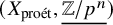 $(X_{\mathrm {pro\acute {e}t}},\underline {\mathbb {Z}/p^n})$
, and every object of
$(X_{\mathrm {pro\acute {e}t}},\underline {\mathbb {Z}/p^n})$
, and every object of $\mathcal {G}\text {-}\mathbf {Loc}_{\mathbb {Z}/p^n}(X)$
is locally trivial.
$\mathcal {G}\text {-}\mathbf {Loc}_{\mathbb {Z}/p^n}(X)$
is locally trivial.
It will again be convenient to consider the category $\mathbf {Loc}_{\mathbb {Q}_p}(X)$
of
$\mathbf {Loc}_{\mathbb {Q}_p}(X)$
of $\mathbb {Q}_p$
-local systems on X, defined again using a formula as in (2.1.1). The category
$\mathbb {Q}_p$
-local systems on X, defined again using a formula as in (2.1.1). The category $\mathbf {Loc}_{\mathbb {Q}_p}(X)$
admits a fully faithful embedding into
$\mathbf {Loc}_{\mathbb {Q}_p}(X)$
admits a fully faithful embedding into $\mathbf {Vect}(X_{\mathrm {pro\acute {e}t}},\underline {\mathbb {Q}_p})$
, and so inherits an exact
$\mathbf {Vect}(X_{\mathrm {pro\acute {e}t}},\underline {\mathbb {Q}_p})$
, and so inherits an exact $\mathbb {Q}_p$
-linear
$\mathbb {Q}_p$
-linear $\otimes $
-structure from this embedding
$\otimes $
-structure from this embedding
Remark 2.8. As in Remark 2.2, the embedding $\mathbf {Loc}_{\mathbb {Q}_p}(X)\to \mathbf {Vect}(X_{\mathrm {pro\acute {e}t}},\underline {\mathbb {Q}_p})$
is not generally essentially surjective. The same reasoning applies, except now the relevant noncompact group is the de Jong fundamental group
$\mathbf {Loc}_{\mathbb {Q}_p}(X)\to \mathbf {Vect}(X_{\mathrm {pro\acute {e}t}},\underline {\mathbb {Q}_p})$
is not generally essentially surjective. The same reasoning applies, except now the relevant noncompact group is the de Jong fundamental group $\pi _1^{\mathrm {dJ}}(X,\overline {x})$
(see [Reference de JongdJ95b] and [Reference Achinger, Lara and YoucisALY21, Corollary 4.4.2]). Here the situation is more extreme though, as even for
$\pi _1^{\mathrm {dJ}}(X,\overline {x})$
(see [Reference de JongdJ95b] and [Reference Achinger, Lara and YoucisALY21, Corollary 4.4.2]). Here the situation is more extreme though, as even for $X=\mathbb {P}^{1,\mathrm {an}}_{\mathbb {C}_p}$
the de Jong fundamental group is noncompact (cf. [Reference de JongdJ95b, Proposition 7.4]).
$X=\mathbb {P}^{1,\mathrm {an}}_{\mathbb {C}_p}$
the de Jong fundamental group is noncompact (cf. [Reference de JongdJ95b, Proposition 7.4]).
Given Proposition 2.7, we write $\mathbf {Tors}_{\mathcal {G}(\mathbb {Z}/p^n)}(X_{\mathrm {pro\acute {e}t}})$
instead of
$\mathbf {Tors}_{\mathcal {G}(\mathbb {Z}/p^n)}(X_{\mathrm {pro\acute {e}t}})$
instead of $\mathbf {Tors}_{\mathcal {G}_{\underline {\mathbb {Z}/p^n}}}(X_{\mathrm {pro\acute {e}t}})$
, and call objects of this category
$\mathbf {Tors}_{\mathcal {G}_{\underline {\mathbb {Z}/p^n}}}(X_{\mathrm {pro\acute {e}t}})$
, and call objects of this category $\mathcal {G}(\mathbb {Z}/p^n)$
-torsors. Moreover, by Proposition A.18 we know that there is a natural equivalence of categories between
$\mathcal {G}(\mathbb {Z}/p^n)$
-torsors. Moreover, by Proposition A.18 we know that there is a natural equivalence of categories between $\mathcal {G}\text {-}\mathbf {Loc}_{\mathbb {Z}/p^n}(X)$
and
$\mathcal {G}\text {-}\mathbf {Loc}_{\mathbb {Z}/p^n}(X)$
and $\mathbf {Tors}_{\mathcal {G}(\mathbb {Z}/p^n)}(X_{\mathrm {pro\acute {e}t}})$
. Explicitly, this functor associates to a
$\mathbf {Tors}_{\mathcal {G}(\mathbb {Z}/p^n)}(X_{\mathrm {pro\acute {e}t}})$
. Explicitly, this functor associates to a $\mathcal {G}(\mathbb {Z}/p^n)$
-torsor
$\mathcal {G}(\mathbb {Z}/p^n)$
-torsor $\mathcal {A}$
the
$\mathcal {A}$
the $\mathcal {G}(\mathbb {Z}/p^n)$
-local system
$\mathcal {G}(\mathbb {Z}/p^n)$
-local system $\omega _{\mathcal {A}}$
given by
$\omega _{\mathcal {A}}$
given by  .
.
We again define the category of $G(\mathbb {Q}_p)$
-local systems on X, denoted
$G(\mathbb {Q}_p)$
-local systems on X, denoted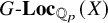 $G\text {-}\mathbf {Loc}_{\mathbb {Q}_p}(X)$
, to be the category of exact
$G\text {-}\mathbf {Loc}_{\mathbb {Q}_p}(X)$
, to be the category of exact $\mathbb {Q}_p$
-linear
$\mathbb {Q}_p$
-linear $\otimes $
-functors
$\otimes $
-functors ${\mathbf {Rep}}_{\mathbb {Q}_p}(G)\to \mathbf {Loc}_{\mathbb {Q}_p}(X)$
. Again by Lemma 2.4, we obtain a natural functor
${\mathbf {Rep}}_{\mathbb {Q}_p}(G)\to \mathbf {Loc}_{\mathbb {Q}_p}(X)$
. Again by Lemma 2.4, we obtain a natural functor  .
.
Finally, as in §2.1.1, it is convenient to have a more down-to-earth definition of torsor for a pro-finite group. We use Notation 2.5. The definition of an H-covering $(Y_n)$
and principal homogeneous spaces Y for H is verbatim to the case of schemes, and the proof of the next result is obtained mutatis mutandis from that of Proposition 2.6 (cf. [Reference Achinger, Lara and YoucisALY21, Theorem 4.4.1]).
$(Y_n)$
and principal homogeneous spaces Y for H is verbatim to the case of schemes, and the proof of the next result is obtained mutatis mutandis from that of Proposition 2.6 (cf. [Reference Achinger, Lara and YoucisALY21, Theorem 4.4.1]).
Proposition 2.9. The following functors are equivalences functorial in H:
 $$ \begin{align*} \left\{\begin{matrix}H\text{-coverings}\\ \text{of }X\end{matrix}\right\}\xrightarrow{(Y_n)\mapsto Y_\infty} \left\{\begin{matrix}\text{Principal homogenous}\\ \text{spaces for }H\text{ on }X\end{matrix}\right\} \xrightarrow{Y\mapsto h_Y}\mathbf{Tors}_{\underline{H}}(X_{\mathrm{pro\acute{e}t}}). \end{align*} $$
2.1.3 Comparison via analytification
Fix a nonarchimedean extension K of $\mathbb {Q}_p$
, S to be a finite type K-scheme, and H as in Notation 2.5. Consider the analytification
$\mathbb {Q}_p$
, S to be a finite type K-scheme, and H as in Notation 2.5. Consider the analytification  of S (see [Reference HuberHub94, Proposition 3.8]). By [Reference LütkebohmertLüt93, Theorem 3.1], we have an equivalence

On the other hand, using the morphism of sites $S^{\mathrm {an}}_{\mathrm {\acute {e}t}}\to S_{\mathrm {\acute {e}t}}$
as in [Reference HuberHub96, §3.8], we have a functor
$S^{\mathrm {an}}_{\mathrm {\acute {e}t}}\to S_{\mathrm {\acute {e}t}}$
as in [Reference HuberHub96, §3.8], we have a functor
 $$ \begin{align*} (-)^{\mathrm{an}}\colon \mathbf{Loc}_{\mathbb{Z}_p}(S)\to \mathbf{Loc}_{\mathbb{Z}_p}(S^{\mathrm{an}}), \end{align*} $$
which is a bi-exact $\mathbb {Z}_p$
-linear
$\mathbb {Z}_p$
-linear $\otimes $
-equivalence by [Reference LütkebohmertLüt93, Theorem 3.1] and the density of classical points. This induces an equivalence of
$\otimes $
-equivalence by [Reference LütkebohmertLüt93, Theorem 3.1] and the density of classical points. This induces an equivalence of $\mathcal {G}(\mathbb {Z}_p)$
-local systems agreeing with the above equivalence of
$\mathcal {G}(\mathbb {Z}_p)$
-local systems agreeing with the above equivalence of $\mathcal {G}(\mathbb {Z}_p)$
-coverings under the equivalences of Proposition 2.6 and Proposition 2.9. We denote the quasi-inverse of
$\mathcal {G}(\mathbb {Z}_p)$
-coverings under the equivalences of Proposition 2.6 and Proposition 2.9. We denote the quasi-inverse of $(-)^{\mathrm {an}}$
by
$(-)^{\mathrm {an}}$
by $(-)^{\mathrm {alg}}$
.
$(-)^{\mathrm {alg}}$
.
2.1.4 Comparison on affinoids
Let H be as in Notation 2.5. For a strongly Noetherian Huber pair $(A,A^+)$
, we have, by [Reference HuberHub96, Example 1.6.6 ii)], an equivalence
$(A,A^+)$
, we have, by [Reference HuberHub96, Example 1.6.6 ii)], an equivalence
 $$ \begin{align*} \left\{\begin{matrix}H\text{-coverings}\\ \text{of }\operatorname{\mathrm{Spec}}(A)\end{matrix}\right\}\to \left\{\begin{matrix}H\text{-coverings}\\ \text{of }\operatorname{\mathrm{Spa}}(A,A^+)\end{matrix}\right\}. \end{align*} $$
If $(A,A^+)$
is topologically of finite type over a nonarchimedean extension K of
$(A,A^+)$
is topologically of finite type over a nonarchimedean extension K of $\mathbb {Q}_p$
, this gives
$\mathbb {Q}_p$
, this gives

which is a bi-exact $\mathbb {Z}_p$
-linear
$\mathbb {Z}_p$
-linear $\otimes $
-equivalence by the density of classical points. If
$\otimes $
-equivalence by the density of classical points. If $\operatorname {\mathrm {Spec}}(A)$
is connected, then the choice of a geometric point
$\operatorname {\mathrm {Spec}}(A)$
is connected, then the choice of a geometric point $\overline {x}$
gives a further bi-exact
$\overline {x}$
gives a further bi-exact $\mathbb {Z}_p$
-linear
$\mathbb {Z}_p$
-linear $\otimes $
-equivalence
$\otimes $
-equivalence
 $$ \begin{align*} \mathbf{Loc}_{\mathbb{Z}_p}(\operatorname{\mathrm{Spec}}(A))\to{\mathbf{Rep}}_{\mathbb{Z}_p}^{\mathrm{cont.}}(\pi_1^{\mathrm{\acute{e}t}}(\operatorname{\mathrm{Spec}}(A),\overline{x})),\qquad \mathbb{L}\mapsto \mathbb{L}_{\overline{x}}, \end{align*} $$
(see [SGA5, Exposé VI, Proposition 1.2.5]). We often tacitly identify a $\mathbb {Z}_p$
-local system on
$\mathbb {Z}_p$
-local system on $\operatorname {\mathrm {Spa}}(A,A^+)$
with such a representation.
$\operatorname {\mathrm {Spa}}(A,A^+)$
with such a representation.
2.1.5
$\mathcal {G}(\mathbb {Z}_p)$
-local systems on a diamond

It will be convenient to interpret the notion of a $\mathcal {G}(\mathbb {Z}/p^n)$
-local system in terms of the language of diamonds as in [Reference ScholzeSch22, §11]. Let Y be a diamond in the sense in [Reference ScholzeSch22, Definition 11.1] and
$\mathcal {G}(\mathbb {Z}/p^n)$
-local system in terms of the language of diamonds as in [Reference ScholzeSch22, §11]. Let Y be a diamond in the sense in [Reference ScholzeSch22, Definition 11.1] and $Y_{\mathrm {qpro\acute {e}t}}$
denote the quasi-pro-étale site as in [Reference ScholzeSch22, Definition 14.1 (ii)]. Similarly as in §2.1.1–2.1.2, for a topological space T, we consider the associated sheaf
$Y_{\mathrm {qpro\acute {e}t}}$
denote the quasi-pro-étale site as in [Reference ScholzeSch22, Definition 14.1 (ii)]. Similarly as in §2.1.1–2.1.2, for a topological space T, we consider the associated sheaf $\underline {T}_Y$
(as in [Reference ScholzeSch22, Example 11.12]). In particular, we have the ringed site
$\underline {T}_Y$
(as in [Reference ScholzeSch22, Example 11.12]). In particular, we have the ringed site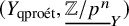 $(Y_{\mathrm {qpro\acute {e}t}},\underline {\mathbb {Z}/p^n}_Y)$
and the sheaf of groups
$(Y_{\mathrm {qpro\acute {e}t}},\underline {\mathbb {Z}/p^n}_Y)$
and the sheaf of groups $\underline {\mathcal {G}(\mathbb {Z}/p^n)}_Y$
for
$\underline {\mathcal {G}(\mathbb {Z}/p^n)}_Y$
for $n\in \mathbb N\cup \{\infty \}$
. Write
$n\in \mathbb N\cup \{\infty \}$
. Write $\mathbf {Loc}_{\mathbb {Z}/p^n}(Y)$
for the category
$\mathbf {Loc}_{\mathbb {Z}/p^n}(Y)$
for the category $\mathbf {Vect}(Y_{\mathrm {qpro\acute {e}t}},\underline {\mathbb {Z}/p^n})$
.
$\mathbf {Vect}(Y_{\mathrm {qpro\acute {e}t}},\underline {\mathbb {Z}/p^n})$
.
Remark 2.10. Let X be a locally Noetherian adic space X over $\mathbb {Q}_p$
and
$\mathbb {Q}_p$
and $X^\lozenge $
denote the diamond associated to X (see [Reference ScholzeSch22, Definition 15.5 and Lemma 15.6]). Then the morphism of sites
$X^\lozenge $
denote the diamond associated to X (see [Reference ScholzeSch22, Definition 15.5 and Lemma 15.6]). Then the morphism of sites $X^\lozenge _{\mathrm {qpro\acute {e}t}}\to X_{\mathrm {pro\acute {e}t}}$
induces a
$X^\lozenge _{\mathrm {qpro\acute {e}t}}\to X_{\mathrm {pro\acute {e}t}}$
induces a $\mathbb {Z}_p$
-linear bi-exact
$\mathbb {Z}_p$
-linear bi-exact $\otimes $
-equivalence
$\otimes $
-equivalence

and an equivalence of groupoids

Indeed, when $n\in \mathbb N$
, any of the above four categories is identified with the corresponding category for the étale site: note first that the sheaf
$n\in \mathbb N$
, any of the above four categories is identified with the corresponding category for the étale site: note first that the sheaf $\underline {\mathcal {G}(\mathbb {Z}/p^n)}$
on
$\underline {\mathcal {G}(\mathbb {Z}/p^n)}$
on $X_{\mathrm {pro\acute {e}t}}$
(resp.
$X_{\mathrm {pro\acute {e}t}}$
(resp. $X^\lozenge _{\mathrm {qpro\acute {e}t}}$
) is the pullback of the constant sheaf
$X^\lozenge _{\mathrm {qpro\acute {e}t}}$
) is the pullback of the constant sheaf $\mathcal {G}(\mathbb {Z}/p^n)$
on
$\mathcal {G}(\mathbb {Z}/p^n)$
on $X_{\mathrm {\acute {e}t}}$
(resp.
$X_{\mathrm {\acute {e}t}}$
(resp. $X^\lozenge _{\mathrm {\acute {e}t}}$
); then for the left (resp. right) hand side, use the version of [Reference ScholzeSch13, Corollary 3.17 (i)] for sheaves of sets, which is shown by the same way as [Reference ScholzeSch22, Proposition 8.5 (i)], (resp. use [Reference ScholzeSch22, Proposition 14.8]) to see that the category of étale local systems/étale torsors is fully faithfully embedded; then use the version of [Reference ScholzeSch13, Lemma 3.16] for sheaves of sets, again shown as in [Reference ScholzeSch22, Proposition 8.5 (ii)], (resp. use [Reference ScholzeSch22, Proposition 9.7, cf. Definition 10.1]) to see that any proétale (resp. quasi-proétale)
$X^\lozenge _{\mathrm {\acute {e}t}}$
); then for the left (resp. right) hand side, use the version of [Reference ScholzeSch13, Corollary 3.17 (i)] for sheaves of sets, which is shown by the same way as [Reference ScholzeSch22, Proposition 8.5 (i)], (resp. use [Reference ScholzeSch22, Proposition 14.8]) to see that the category of étale local systems/étale torsors is fully faithfully embedded; then use the version of [Reference ScholzeSch13, Lemma 3.16] for sheaves of sets, again shown as in [Reference ScholzeSch22, Proposition 8.5 (ii)], (resp. use [Reference ScholzeSch22, Proposition 9.7, cf. Definition 10.1]) to see that any proétale (resp. quasi-proétale) $\mathbb {Z}/p^n$
-local system or
$\mathbb {Z}/p^n$
-local system or $\underline {\mathcal {G}(\mathbb {Z}/p^n)}$
-torsor is étale locally trivialized. Then the equivalences follow from [Reference ScholzeSch22, Lemma 15.6]. By passage to limit we obtain the case of
$\underline {\mathcal {G}(\mathbb {Z}/p^n)}$
-torsor is étale locally trivialized. Then the equivalences follow from [Reference ScholzeSch22, Lemma 15.6]. By passage to limit we obtain the case of $n=\infty $
, using the analogues of [Reference Bhatt and ScholzeBS15, Proposition 6.8.4 (i)], which holds as any
$n=\infty $
, using the analogues of [Reference Bhatt and ScholzeBS15, Proposition 6.8.4 (i)], which holds as any $\underline {\mathcal {G}(\mathbb {Z}/p^n)}$
-torsor on
$\underline {\mathcal {G}(\mathbb {Z}/p^n)}$
-torsor on $X_{\mathrm {pro\acute {e}t}}$
(resp.
$X_{\mathrm {pro\acute {e}t}}$
(resp. $X^\lozenge _{\mathrm {qpro\acute {e}t}}$
) is trivialized by a finite étale cover.
$X^\lozenge _{\mathrm {qpro\acute {e}t}}$
) is trivialized by a finite étale cover.
Proposition 2.11. For $n\in \mathbb {N}\cup \{\infty \}$
, there is an identification
$n\in \mathbb {N}\cup \{\infty \}$
, there is an identification  , the group $\mathcal {G}$
is reconstructible in
$\mathcal {G}$
is reconstructible in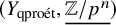 $(Y_{\mathrm {qpro\acute {e}t}},\underline {\mathbb {Z}/p^n})$
, and every object of
$(Y_{\mathrm {qpro\acute {e}t}},\underline {\mathbb {Z}/p^n})$
, and every object of $\mathcal {G}\text {-}\mathbf {Loc}_{\mathbb {Z}/p^n}(Y)$
is locally trivial.
$\mathcal {G}\text {-}\mathbf {Loc}_{\mathbb {Z}/p^n}(Y)$
is locally trivial.
Proof. The identification and the reconstructibility are proven mutatis mutandis as in Lemma 2.1 and (the locally Noetherian case of) Proposition 2.3.
To prove the local triviality, we may assume that Y is represented by a perfectoid space, in which case the assertion is proven in the proof of [Reference Scholze and WeinsteinSW20, Proposition 22.6.1].
2.1.6 Comparison with v-sheaves
There is a unique functor
 $$ \begin{align*} (-)^{\mathrm{ad}}\colon \left\{\begin{matrix}p\text{-adic formal}\\\text{schemes}\end{matrix}\right\}\to \left\{\begin{matrix}\text{Pre-adic spaces}\\ \text{over }\mathbb{Z}_p\end{matrix}\right\}, \end{align*} $$
sending open covers to open covers, and with $\operatorname {\mathrm {Spf}}(A)^{\mathrm {ad}}=\operatorname {\mathrm {Spa}}^Y(A,A)$
(see [Reference Scholze and WeinsteinSW20, §3.4]). For a p-adic formal scheme
$\operatorname {\mathrm {Spf}}(A)^{\mathrm {ad}}=\operatorname {\mathrm {Spa}}^Y(A,A)$
(see [Reference Scholze and WeinsteinSW20, §3.4]). For a p-adic formal scheme $\mathfrak {Y}$
, denote by
$\mathfrak {Y}$
, denote by $\mathfrak {Y}^\lozenge $
the v-sheaf over
$\mathfrak {Y}^\lozenge $
the v-sheaf over $\operatorname {\mathrm {Spd}}(\mathbb {Z}_p)$
associated to
$\operatorname {\mathrm {Spd}}(\mathbb {Z}_p)$
associated to $\mathfrak {Y}^{\mathrm {ad}}$
as in [Reference Scholze and WeinsteinSW20, §18.1]. Set
$\mathfrak {Y}^{\mathrm {ad}}$
as in [Reference Scholze and WeinsteinSW20, §18.1]. Set  . For an affine open $\operatorname {\mathrm {Spf}}(A)\subseteq \mathfrak {Y}$
, the pair
$\operatorname {\mathrm {Spf}}(A)\subseteq \mathfrak {Y}$
, the pair  is a Huber pair over $(\mathbb {Q}_p,\mathbb {Z}_p)$
, with
$(\mathbb {Q}_p,\mathbb {Z}_p)$
, with $\widetilde {A}$
the integral closure of A in
$\widetilde {A}$
the integral closure of A in  and
and  given the unique ring topology with the image of A in
  open. The diamond $(\mathfrak {Y}_\eta )^\lozenge $
associated to
$(\mathfrak {Y}_\eta )^\lozenge $
associated to  over
over $\mathbb {Q}_p$
(see [Reference Scholze and WeinsteinSW20, §10.1]) agrees with
$\mathbb {Q}_p$
(see [Reference Scholze and WeinsteinSW20, §10.1]) agrees with $(\mathfrak {Y}^\lozenge )_\eta $
. Denote the common object by
$(\mathfrak {Y}^\lozenge )_\eta $
. Denote the common object by $\mathfrak {Y}_\eta ^\lozenge $
.
$\mathfrak {Y}_\eta ^\lozenge $
.
Consider the quasi-pro-étale site $\mathfrak {Y}_{\eta ,\mathrm {qpro\acute {e}t}}^\lozenge $
as in [Reference ScholzeSch22, Definition 14.1]. Consider
$\mathfrak {Y}_{\eta ,\mathrm {qpro\acute {e}t}}^\lozenge $
as in [Reference ScholzeSch22, Definition 14.1]. Consider
 $$ \begin{align*} \underline{\mathbb{Z}_p}_{\mathfrak{Y}}=R\lim \underline{\mathbb{Z}/p^n}_{\mathfrak{Y}}=\lim \underline{\mathbb{Z}/p^n}_{\mathfrak{Y}} \end{align*} $$
where $\underline {\mathbb {Z}/p^n}_{\mathfrak {Y}}$
is the constant sheaf, and the second equality follows from [Reference ScholzeSch22, Lemma 7.18] and [Reference Bhatt and ScholzeBS15, Proposition 3.1.10 and Proposition 3.2.3]. Define
$\underline {\mathbb {Z}/p^n}_{\mathfrak {Y}}$
is the constant sheaf, and the second equality follows from [Reference ScholzeSch22, Lemma 7.18] and [Reference Bhatt and ScholzeBS15, Proposition 3.1.10 and Proposition 3.2.3]. Define $\mathbf {Loc}_{\mathbb {Z}_p}(\mathfrak {Y}_\eta )$
to be
$\mathbf {Loc}_{\mathbb {Z}_p}(\mathfrak {Y}_\eta )$
to be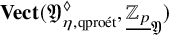 $\mathbf {Vect}(\mathfrak {Y}_{\eta ,\mathrm {qpro\acute {e}t}}^\lozenge ,\underline {\mathbb {Z}_p}_{\mathfrak {Y}})$
.
$\mathbf {Vect}(\mathfrak {Y}_{\eta ,\mathrm {qpro\acute {e}t}}^\lozenge ,\underline {\mathbb {Z}_p}_{\mathfrak {Y}})$
.
If $\mathfrak {Y}\to \operatorname {\mathrm {Spf}}(\mathcal {O}_K)$
is locally of finite type, then
$\mathfrak {Y}\to \operatorname {\mathrm {Spf}}(\mathcal {O}_K)$
is locally of finite type, then $\mathfrak {Y}_\eta $
is the rigid K-space associated to
$\mathfrak {Y}_\eta $
is the rigid K-space associated to $\mathfrak {Y}$
(see [Reference HuberHub96, §1.9] or [Reference Fujiwara and KatoFK18, §A.5]). Thus, in this case we have already defined an exact
$\mathfrak {Y}$
(see [Reference HuberHub96, §1.9] or [Reference Fujiwara and KatoFK18, §A.5]). Thus, in this case we have already defined an exact $\mathbb {Z}_p$
-linear
$\mathbb {Z}_p$
-linear $\otimes $
-category
$\otimes $
-category $\mathbf {Loc}_{\mathbb {Z}_p}(\mathfrak {Y}_\eta )$
, and so there is potential for ambiguity. But, with H as in Notation 2.5, defining H-coverings in the obvious way, one may again show that there is an equivalence of categories between such H-coverings and
$\mathbf {Loc}_{\mathbb {Z}_p}(\mathfrak {Y}_\eta )$
, and so there is potential for ambiguity. But, with H as in Notation 2.5, defining H-coverings in the obvious way, one may again show that there is an equivalence of categories between such H-coverings and $\mathbf {Loc}(\mathfrak {Y}_\eta )$
. Note [Reference ScholzeSch22, Lemma 15.6] gives
$\mathbf {Loc}(\mathfrak {Y}_\eta )$
. Note [Reference ScholzeSch22, Lemma 15.6] gives

Using this equivalence and [Reference ScholzeSch22, Proposition 14.3] (for the $\mathbb {Z}/p^n\mathbb {Z}$
-local system for each
$\mathbb {Z}/p^n\mathbb {Z}$
-local system for each $n\geqslant 1$
) one obtains a bi-exact
$n\geqslant 1$
) one obtains a bi-exact $\mathbb {Z}_p$
-linear
$\mathbb {Z}_p$
-linear $\otimes $
-equivalence
$\otimes $
-equivalence

Thus, no ambiguity actually occurs if $\mathfrak {Y}\to \operatorname {\mathrm {Spf}}(\mathcal {O}_K)$
is locally of finite type.
$\mathfrak {Y}\to \operatorname {\mathrm {Spf}}(\mathcal {O}_K)$
is locally of finite type.
If $\mathfrak {Y}$
is quasi-syntomic, then there is a natural functor
$\mathfrak {Y}$
is quasi-syntomic, then there is a natural functor
 $$ \begin{align*} \mathbf{Loc}_{\mathbb{Z}_p}(\mathfrak{Y}_\eta)\to {\mathrm{2-lim}}_{\scriptscriptstyle {\mathrm{Spf}}(R)\in\mathfrak{Y}_{\mathrm{qrsp}}}\mathbf{Loc}_{\mathbb{Z}_p}({\mathrm{Spf}}(R)_\eta). \end{align*} $$
This is a bi-exact $\mathbb {Z}_p$
-linear
$\mathbb {Z}_p$
-linear $\otimes $
-equivalence by the next lemma and [Reference ScholzeSch22, Proposition 9.7], which we apply by using a limit argument to reduce to the case of finite coefficients.
$\otimes $
-equivalence by the next lemma and [Reference ScholzeSch22, Proposition 9.7], which we apply by using a limit argument to reduce to the case of finite coefficients.
Lemma 2.12. Let $\{\mathfrak {Y}_i\to \mathfrak {Y}\}$
be a faithfully flat cover of p-adic formal schemes. Then, the collection
$\{\mathfrak {Y}_i\to \mathfrak {Y}\}$
be a faithfully flat cover of p-adic formal schemes. Then, the collection $\{\mathfrak {Y}_{i,\eta }^\lozenge \to \mathfrak {Y}^\lozenge _\eta \}$
is a cover of v-sheaves.
$\{\mathfrak {Y}_{i,\eta }^\lozenge \to \mathfrak {Y}^\lozenge _\eta \}$
is a cover of v-sheaves.
Proof. By [Reference ScholzeSch22, Lemma 12.11] it suffices to show that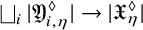 $\bigsqcup _i |\mathfrak {Y}_{i,\eta }^\lozenge |\to |\mathfrak {X}_\eta ^\lozenge |$
is surjective and any quasi-compact open of the target is covered by a quasi-compact open of the source. By [Reference ScholzeSch22, Lemma 15.6] this is equivalent to proving this claim for
$\bigsqcup _i |\mathfrak {Y}_{i,\eta }^\lozenge |\to |\mathfrak {X}_\eta ^\lozenge |$
is surjective and any quasi-compact open of the target is covered by a quasi-compact open of the source. By [Reference ScholzeSch22, Lemma 15.6] this is equivalent to proving this claim for $\bigsqcup _i |\mathfrak {Y}_{i,\eta }|\to |\mathfrak {X}_\eta |$
. This reduces to showing that if
$\bigsqcup _i |\mathfrak {Y}_{i,\eta }|\to |\mathfrak {X}_\eta |$
. This reduces to showing that if $\operatorname {\mathrm {Spf}}(B)\to \operatorname {\mathrm {Spf}}(A)$
is faithfully flat then
$\operatorname {\mathrm {Spf}}(B)\to \operatorname {\mathrm {Spf}}(A)$
is faithfully flat then $\operatorname {\mathrm {Spf}}(B)_\eta \to \operatorname {\mathrm {Spf}}(A)_\eta $
is surjective. By [Reference Scholze and WeinsteinSW13, Proposition 2.1.6], we must show that for an affinoid field
$\operatorname {\mathrm {Spf}}(B)_\eta \to \operatorname {\mathrm {Spf}}(A)_\eta $
is surjective. By [Reference Scholze and WeinsteinSW13, Proposition 2.1.6], we must show that for an affinoid field $(K,K^+)$
over
$(K,K^+)$
over $(\mathbb {Q}_p,\mathbb {Z}_p)$
and a morphism
$(\mathbb {Q}_p,\mathbb {Z}_p)$
and a morphism $\operatorname {\mathrm {Spf}}(K^+)\to \operatorname {\mathrm {Spf}}(A)$
there exists a surjection
$\operatorname {\mathrm {Spf}}(K^+)\to \operatorname {\mathrm {Spf}}(A)$
there exists a surjection $\operatorname {\mathrm {Spf}}(L^+)\to \operatorname {\mathrm {Spf}}(K^+)$
, with
$\operatorname {\mathrm {Spf}}(L^+)\to \operatorname {\mathrm {Spf}}(K^+)$
, with $(L,L^+)$
an affinoid field over
$(L,L^+)$
an affinoid field over $(\mathbb {Q}_p,\mathbb {Z}_p)$
, so that
$(\mathbb {Q}_p,\mathbb {Z}_p)$
, so that $\operatorname {\mathrm {Spf}}(L^+)\to \operatorname {\mathrm {Spf}}(A)$
lifts to
$\operatorname {\mathrm {Spf}}(L^+)\to \operatorname {\mathrm {Spf}}(A)$
lifts to $\operatorname {\mathrm {Spf}}(B)$
. This follows from the discussion in [Reference Česnavičius and ScholzeČS24, Example (2), §2.2.1], as the argument there does not use that
$\operatorname {\mathrm {Spf}}(B)$
. This follows from the discussion in [Reference Česnavičius and ScholzeČS24, Example (2), §2.2.1], as the argument there does not use that $K^+$
has rank at most
$K^+$
has rank at most $1$
.
$1$
.
2.2 The étale realization functor
Let $\mathfrak {X}$
be a quasi-syntomic flat formal
$\mathfrak {X}$
be a quasi-syntomic flat formal $\mathbb {Z}_p$
-scheme, and
$\mathbb {Z}_p$
-scheme, and $X=\mathfrak {X}_\eta ^\lozenge $
. We discuss the equivalence between
$X=\mathfrak {X}_\eta ^\lozenge $
. We discuss the equivalence between $\mathbb {Z}_p$
-local systems on X and prismatic Laurent F-crystals on
$\mathbb {Z}_p$
-local systems on X and prismatic Laurent F-crystals on $\mathfrak {X}$
given in [Reference Bhatt and ScholzeBS23, Corollary 3.7], explicating its bi-exactness.
$\mathfrak {X}$
given in [Reference Bhatt and ScholzeBS23, Corollary 3.7], explicating its bi-exactness.
Note that  induces a morphism
  .Footnote 8
As in [Reference Bhatt and ScholzeBS23, Definition 3.2], define the category
.Footnote 8
As in [Reference Bhatt and ScholzeBS23, Definition 3.2], define the category  of prismatic Laurent F-crystals on $\mathfrak {X}$
to consist of pairs
$\mathfrak {X}$
to consist of pairs $(\mathcal {L},\varphi )$
with
$(\mathcal {L},\varphi )$
with $\mathcal {L}$
an object of
$\mathcal {L}$
an object of  and
and 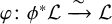 an isomorphism in
  , called the Frobenius, and morphisms are morphisms in
  commuting with the Frobenii.
We can endow  with the structure of an exact $\mathbb {Z}_p$
-linear
$\mathbb {Z}_p$
-linear $\otimes $
-category, where it inherits its exact structure from
$\otimes $
-category, where it inherits its exact structure from  . By [Reference Bhatt and ScholzeBS23, Proposition 2.7], together with an argument as in the proof of Proposition 1.17, with
  having the obvious meaning, taking global sections gives a bi-exact $\mathbb {Z}_p$
-linear
$\mathbb {Z}_p$
-linear $\otimes $
-equivalence
$\otimes $
-equivalence

where the right-hand side is given the term-by-term exact and $\mathbb {Z}_p$
-linear
$\mathbb {Z}_p$
-linear $\otimes $
-structure.
$\otimes $
-structure.
In [Reference Bhatt and ScholzeBS23, §3], Bhatt and Scholze define an étale realization functor

which is an equivalence by [Reference Bhatt and ScholzeBS23, Corollary 3.8] (cf. [Reference Min and WangMW25] and [Reference WuWu21]). When $\mathfrak {X}$
is clear from context, we shall drop
$\mathfrak {X}$
is clear from context, we shall drop $\mathfrak {X}$
from the notation. We now wish to show the following.
$\mathfrak {X}$
from the notation. We now wish to show the following.
Proposition 2.13. The functor $T_{\mathfrak {X},\mathrm {\acute {e}t}}$
is a bi-exact
$T_{\mathfrak {X},\mathrm {\acute {e}t}}$
is a bi-exact $\mathbb {Z}_p$
-linear
$\mathbb {Z}_p$
-linear $\otimes $
-equivalence.
$\otimes $
-equivalence.
Our proof essentially recounts the construction of Bhatt–Scholze, verifying exactness at each step. Let R be a qrsp ring, and define

Then, 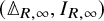 is a perfect prism and the p-adically complete R-algebra

is perfectoid and initial amongst maps from R to a perfectoid ring (see [Reference Bhatt and ScholzeBS22, Corollary 7.3]). Thus, the maps $\operatorname {\mathrm {Spf}}(R_{\mathrm {perfd}})^\lozenge \to \operatorname {\mathrm {Spf}}(R)^\lozenge $
and
$\operatorname {\mathrm {Spf}}(R_{\mathrm {perfd}})^\lozenge \to \operatorname {\mathrm {Spf}}(R)^\lozenge $
and $\operatorname {\mathrm {Spf}}(R_{\mathrm {perfd}})^\lozenge _\eta \to \operatorname {\mathrm {Spf}}(R)^\lozenge _\eta $
are isomorphisms: indeed, for a perfectoid
$\operatorname {\mathrm {Spf}}(R_{\mathrm {perfd}})^\lozenge _\eta \to \operatorname {\mathrm {Spf}}(R)^\lozenge _\eta $
are isomorphisms: indeed, for a perfectoid $(A,A^+)$
, by using [Reference Scholze and WeinsteinSW13, Proposition 2.1.6 (i)] the set
$(A,A^+)$
, by using [Reference Scholze and WeinsteinSW13, Proposition 2.1.6 (i)] the set $\operatorname {\mathrm {Spf}}(R)^\lozenge ((A,A^+))$
is identified with the set
$\operatorname {\mathrm {Spf}}(R)^\lozenge ((A,A^+))$
is identified with the set $\operatorname {\mathrm {Hom}}((R,R),(A,A^+))$
of maps of Huber pairs, which is nothing but the set
$\operatorname {\mathrm {Hom}}((R,R),(A,A^+))$
of maps of Huber pairs, which is nothing but the set $\operatorname {\mathrm {Hom}}(R,A^+)$
of maps of p-adic rings; similarly for
$\operatorname {\mathrm {Hom}}(R,A^+)$
of maps of p-adic rings; similarly for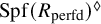 $\operatorname {\mathrm {Spf}}(R_{\mathrm {perfd}})^\lozenge $
.
$\operatorname {\mathrm {Spf}}(R_{\mathrm {perfd}})^\lozenge $
.
We now briefly recall the construction of the étale realization functor $T_{\mathfrak {X},\mathrm {\acute {e}t}}$
. When
$T_{\mathfrak {X},\mathrm {\acute {e}t}}$
. When $\mathfrak {X}=\operatorname {\mathrm {Spf}}(S)$
with S a perfectoid p-adic ring, the equivalence
$\mathfrak {X}=\operatorname {\mathrm {Spf}}(S)$
with S a perfectoid p-adic ring, the equivalence

is defined by passing to the tilt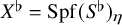 $X^\flat =\operatorname {\mathrm {Spf}}(S^\flat )_\eta $
and applying the scalar extension along
$X^\flat =\operatorname {\mathrm {Spf}}(S^\flat )_\eta $
and applying the scalar extension along $\mathbb {Z}_p\to W(\mathcal {O}_{X^\flat ,\mathrm {\acute {e}t}})$
(see [Reference Bhatt and ScholzeBS23, Example 3.5] for the details). When
$\mathbb {Z}_p\to W(\mathcal {O}_{X^\flat ,\mathrm {\acute {e}t}})$
(see [Reference Bhatt and ScholzeBS23, Example 3.5] for the details). When $\mathfrak {X}=\operatorname {\mathrm {Spf}}(R)$
with R a qrsp p-adic ring, the equivalence
$\mathfrak {X}=\operatorname {\mathrm {Spf}}(R)$
with R a qrsp p-adic ring, the equivalence $T_{\mathfrak {X},\mathrm {\acute {e}t}}$
is defined via the isomorphism
$T_{\mathfrak {X},\mathrm {\acute {e}t}}$
is defined via the isomorphism $\operatorname {\mathrm {Spf}}(R_{\mathrm {perfd}})_\eta ^\lozenge \to \operatorname {\mathrm {Spf}}(R)^\lozenge _\eta $
and the scalar extension functor
$\operatorname {\mathrm {Spf}}(R_{\mathrm {perfd}})_\eta ^\lozenge \to \operatorname {\mathrm {Spf}}(R)^\lozenge _\eta $
and the scalar extension functor

which is checked to be an equivalence by passing to mod p and using [Reference Bhatt and ScholzeBS23, Proposition 3.6]. In general, for a quasi-syntomic p-adic formal scheme $\mathfrak {X}$
, the equivalence
$\mathfrak {X}$
, the equivalence $T_{\mathfrak {X},\mathrm {\acute {e}t}}$
is defined via quasi-syntomic descent (cf. Lemma 2.12).
$T_{\mathfrak {X},\mathrm {\acute {e}t}}$
is defined via quasi-syntomic descent (cf. Lemma 2.12).
Lemma 2.14 (cf. [Reference Bhatt and ScholzeBS23, Proposition 3.6 and Corollary 3.7])
Let R be a p-torsion-free qrsp ring. Then, the base change functor

is a bi-exact $\mathbb {Z}_p$
-linear
$\mathbb {Z}_p$
-linear $\otimes $
-equivalence functorial in R.
$\otimes $
-equivalence functorial in R.
Proof. We follow the notation of [Reference Bhatt and ScholzeBS23, Proposition 3.6 and Corollary 3.7]. The only thing to be verified is that this equivalence is bi-exact. In turn, by the method of proof in loc. cit. we reduce to the claim that the equivalence  for any $\mathbb {F}_p$
-scheme S from [Reference Bhatt and ScholzeBS23, Proposition 3.4] is bi-exact. But, this is clear as the map
$\mathbb {F}_p$
-scheme S from [Reference Bhatt and ScholzeBS23, Proposition 3.4] is bi-exact. But, this is clear as the map $\mathbb {F}_p\to \mathcal {O}_S$
is faithfully flat.
$\mathbb {F}_p\to \mathcal {O}_S$
is faithfully flat.
Proof of Proposition 2.13
The only thing to verify is bi-exactness. As the proof in [Reference Bhatt and ScholzeBS23, Corollary 3.7] proceeds by descent to the case when $\mathfrak {X}=\operatorname {\mathrm {Spf}}(R)$
with R qrsp and p-torsion-free, which preserves exactness (cf. Lemma 2.12), we also reduce to this case. Further, using Lemma 2.14 and the isomorphism
$\mathfrak {X}=\operatorname {\mathrm {Spf}}(R)$
with R qrsp and p-torsion-free, which preserves exactness (cf. Lemma 2.12), we also reduce to this case. Further, using Lemma 2.14 and the isomorphism $\operatorname {\mathrm {Spf}}(R_{\mathrm {perfd}})^\lozenge _\eta \to \operatorname {\mathrm {Spf}}(R)^\lozenge _\eta $
we may reduce to the case when R is perfectoid.
$\operatorname {\mathrm {Spf}}(R_{\mathrm {perfd}})^\lozenge _\eta \to \operatorname {\mathrm {Spf}}(R)^\lozenge _\eta $
we may reduce to the case when R is perfectoid.
By [Reference Bhatt, Morrow and ScholzeBMS18, Lemma 3.21],  is a Tate perfectoid algebra, where $R'$
is the integral closure of R in
$R'$
is the integral closure of R in  . Thus, there is a bi-exact $\mathbb {Z}_p$
-linear
$\mathbb {Z}_p$
-linear $\otimes $
-equivalence
$\otimes $
-equivalence

(see [Reference ScholzeSch22, Theorem 6.3]), where $\varpi $
is a pseudo-uniformizer of
$\varpi $
is a pseudo-uniformizer of  as in [Reference Scholze and WeinsteinSW20, Lemma 6.2.2] which may be taken to lie in R. On the other hand,
  and
and $I_R=(\tilde {\xi })$
, with
$I_R=(\tilde {\xi })$
, with $\tilde {\xi }=p+[\varpi ^\flat ]\alpha $
with
$\tilde {\xi }=p+[\varpi ^\flat ]\alpha $
with $\alpha $
in
$\alpha $
in $W(R^\flat )$
(see [Reference Scholze and WeinsteinSW20, Lemma 6.2.10]). But,
$W(R^\flat )$
(see [Reference Scholze and WeinsteinSW20, Lemma 6.2.10]). But,  as both are strict p-rings (in the sense of [Reference Kedlaya and LiuKL15, Definition 3.2.1]) with the same residue ring. Thus, we will be done if the $\mathbb {Z}_p$
-linear
$\mathbb {Z}_p$
-linear $\otimes $
-equivalence between the category of
$\otimes $
-equivalence between the category of $\varphi $
-modules for
$\varphi $
-modules for  and
and $\mathbb {Z}_p$
-local systems on
$\mathbb {Z}_p$
-local systems on  is bi-exact, which was already discussed in the proof of Lemma 2.14.
Example 2.15. Let R be a base $\mathcal {O}_K$
-algebra. As
$\mathcal {O}_K$
-algebra. As $\widetilde {\theta }\colon {\mathrm {A}}_{\mathrm {inf}}(\check {R})\to \check {R}$
is
$\widetilde {\theta }\colon {\mathrm {A}}_{\mathrm {inf}}(\check {R})\to \check {R}$
is $\Gamma _R$
-equivariant, we see that
$\Gamma _R$
-equivariant, we see that $\Gamma _R$
acts on
$\Gamma _R$
acts on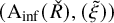 $({\mathrm {A}}_{\mathrm {inf}}(\check {R}),(\tilde {\xi }))$
as an object of
$({\mathrm {A}}_{\mathrm {inf}}(\check {R}),(\tilde {\xi }))$
as an object of  . In this way, from a prismatic Laurent F-crystal $\mathcal {L}$
on R, we obtain a finite free
$\mathcal {L}$
on R, we obtain a finite free $\mathbb {Z}_p$
-module
$\mathbb {Z}_p$
-module $\Lambda =\mathcal {L}({\mathrm {A}}_{\mathrm {inf}}(\check {R}),(\tilde {\xi }))^{\varphi =1}$
with a continuous action of
$\Lambda =\mathcal {L}({\mathrm {A}}_{\mathrm {inf}}(\check {R}),(\tilde {\xi }))^{\varphi =1}$
with a continuous action of $\Gamma _R$
, which is the
$\Gamma _R$
, which is the $\Gamma _R$
-representation associated to
$\Gamma _R$
-representation associated to $T_{\mathrm {\acute {e}t}}(\mathcal {L})$
.
$T_{\mathrm {\acute {e}t}}(\mathcal {L})$
.
2.3 Crystalline local systems and analytic prismatic F-crystals
We discuss the equivalence from [Reference Guo and ReineckeGR24] and [Reference Du, Liu, Moon and ShimizuDLMS24] and its Tannakian consequences. Unless stated otherwise, we assume that $\mathfrak {X}\to \operatorname {\mathrm {Spf}}(\mathcal {O}_K)$
is smooth and write
$\mathfrak {X}\to \operatorname {\mathrm {Spf}}(\mathcal {O}_K)$
is smooth and write $X=\mathfrak {X}_\eta $
.
$X=\mathfrak {X}_\eta $
.
2.3.1 Filtered F-isocrystals
In this subsection we record our notation and conventions concerning the crystalline site, F-(iso)crystals, and filtered F-isocrystals. The reader is encouraged to skip this on first reading, referring back only as is necessary.
PD thickenings of formal schemes
Let $\mathfrak {Z}\to \operatorname {\mathrm {Spf}}(W)$
be an adic morphism. By a PD thickening of formal
$\mathfrak {Z}\to \operatorname {\mathrm {Spf}}(W)$
be an adic morphism. By a PD thickening of formal $\mathfrak {Z}$
-schemes over W, we mean a pair
$\mathfrak {Z}$
-schemes over W, we mean a pair $(i\colon \mathfrak {U}\hookrightarrow \mathfrak {T},\gamma )$
where
$(i\colon \mathfrak {U}\hookrightarrow \mathfrak {T},\gamma )$
where $\mathfrak {U}\to \mathfrak {Z}$
is an adic morphism of formal W-schemes,
$\mathfrak {U}\to \mathfrak {Z}$
is an adic morphism of formal W-schemes, $i\colon \mathfrak {U}\to \mathfrak {T}$
is a closed immersion of adic formal W-schemes, and if
$i\colon \mathfrak {U}\to \mathfrak {T}$
is a closed immersion of adic formal W-schemes, and if  then
then $\gamma =(\gamma _n)\colon \mathcal {I}\to \mathcal {O}_{\mathfrak {T}}$
is a sequence of morphisms of sheaves so that for every open
$\gamma =(\gamma _n)\colon \mathcal {I}\to \mathcal {O}_{\mathfrak {T}}$
is a sequence of morphisms of sheaves so that for every open $\mathfrak {V}\subseteq \mathfrak {T}$
the maps
$\mathfrak {V}\subseteq \mathfrak {T}$
the maps $\gamma _n\colon \mathcal {I}(\mathfrak {V})\to \mathcal {O}_{\mathfrak {T}}(\mathfrak {V})$
form a PD structure compatible with the usual one on
$\gamma _n\colon \mathcal {I}(\mathfrak {V})\to \mathcal {O}_{\mathfrak {T}}(\mathfrak {V})$
form a PD structure compatible with the usual one on $(p)\subseteq W$
. We will often drop i and
$(p)\subseteq W$
. We will often drop i and $\gamma $
from the notation when they are clear from context.
$\gamma $
from the notation when they are clear from context.
A morphism $(f,g) \colon (i'\colon \mathfrak {U}'\hookrightarrow \mathfrak {T}',\gamma ')\to (i\colon \mathfrak {U}\hookrightarrow \mathfrak {T},\gamma )$
is a morphism
$(f,g) \colon (i'\colon \mathfrak {U}'\hookrightarrow \mathfrak {T}',\gamma ')\to (i\colon \mathfrak {U}\hookrightarrow \mathfrak {T},\gamma )$
is a morphism $f\colon \mathfrak {U}'\to \mathfrak {U}$
of formal
$f\colon \mathfrak {U}'\to \mathfrak {U}$
of formal $\mathfrak {Z}$
-schemes, and
$\mathfrak {Z}$
-schemes, and $g\colon \mathfrak {T}'\to \mathfrak {T}$
a morphism of formal W-schemes, such that the diagram
$g\colon \mathfrak {T}'\to \mathfrak {T}$
a morphism of formal W-schemes, such that the diagram

commutes, and the induced map $g\colon \mathcal {I}\to g_\ast \mathcal {I}'$
satisfies
$g\colon \mathcal {I}\to g_\ast \mathcal {I}'$
satisfies $g\circ \gamma =g_\ast (\gamma ')\circ g$
. A morphism
$g\circ \gamma =g_\ast (\gamma ')\circ g$
. A morphism $(f,g)$
is Cartesian if (2.3.1) is Cartesian, and a collection
$(f,g)$
is Cartesian if (2.3.1) is Cartesian, and a collection $\{(f_i,g_i)\colon (i_i\colon \mathfrak {U}_i\hookrightarrow \mathfrak {T}_i,\gamma _i)\to (i \colon \mathfrak {U}\hookrightarrow \mathfrak {T},\gamma )\}$
is a flat cover if each
$\{(f_i,g_i)\colon (i_i\colon \mathfrak {U}_i\hookrightarrow \mathfrak {T}_i,\gamma _i)\to (i \colon \mathfrak {U}\hookrightarrow \mathfrak {T},\gamma )\}$
is a flat cover if each $(f_i,g_i)$
is Cartesian and
$(f_i,g_i)$
is Cartesian and $\{g_i\colon \mathfrak {T}_i\to \mathfrak {T}\}$
is a cover in
$\{g_i\colon \mathfrak {T}_i\to \mathfrak {T}\}$
is a cover in $\operatorname {\mathrm {Spf}}(W)_{\mathrm {fl}}$
.
$\operatorname {\mathrm {Spf}}(W)_{\mathrm {fl}}$
.
If $\mathfrak {U}=\operatorname {\mathrm {Spf}}(B)$
and
$\mathfrak {U}=\operatorname {\mathrm {Spf}}(B)$
and $\mathfrak {T}=\operatorname {\mathrm {Spf}}(A)$
, we will often write
$\mathfrak {T}=\operatorname {\mathrm {Spf}}(A)$
, we will often write $(i\colon \mathfrak {U}\hookrightarrow \mathfrak {T},\gamma )$
as
$(i\colon \mathfrak {U}\hookrightarrow \mathfrak {T},\gamma )$
as $(i\colon A\twoheadrightarrow B,\gamma )$
, and write morphisms of such affine objects in the direction dictated by maps of rings. If
$(i\colon A\twoheadrightarrow B,\gamma )$
, and write morphisms of such affine objects in the direction dictated by maps of rings. If $i\colon A\to A$
is the identity map, we further shorten
$i\colon A\to A$
is the identity map, we further shorten $(i\colon A\to A,\gamma )$
to A. Moreover, for a PD thickening of affine formal
$(i\colon A\to A,\gamma )$
to A. Moreover, for a PD thickening of affine formal $\mathfrak {Z}$
-schemes
$\mathfrak {Z}$
-schemes $(i\colon A\twoheadrightarrow B,\gamma )$
, we have a filtration
$(i\colon A\twoheadrightarrow B,\gamma )$
, we have a filtration ${\operatorname {\mathrm {Fil}}}^{\bullet }_{\mathrm {PD}}(A)$
, or just
${\operatorname {\mathrm {Fil}}}^{\bullet }_{\mathrm {PD}}(A)$
, or just ${\operatorname {\mathrm {Fil}}}^{\bullet }_{\mathrm {PD}}$
when A is clear from context, given by
${\operatorname {\mathrm {Fil}}}^{\bullet }_{\mathrm {PD}}$
when A is clear from context, given by  . Here for an element a of A we sometimes abbreviate $\gamma _r(a)$
to
$\gamma _r(a)$
to $a^{[r]}$
, and for an ideal
$a^{[r]}$
, and for an ideal $I\subseteq A$
by
$I\subseteq A$
by $I^{[r]}$
the ideal generated by
$I^{[r]}$
the ideal generated by $\gamma _{e_1}(i_1)\cdots \gamma _{e_k}(i_k)$
with
$\gamma _{e_1}(i_1)\cdots \gamma _{e_k}(i_k)$
with $\sum e_j\geqslant r$
and
$\sum e_j\geqslant r$
and $i_j$
in I for all j.
$i_j$
in I for all j.
The big crystalline site of a formal scheme
The (big) crystalline site $(\mathfrak {Z}/W)_{\mathrm {crys}}$
is the site consisting of PD-thickenings of formal
$(\mathfrak {Z}/W)_{\mathrm {crys}}$
is the site consisting of PD-thickenings of formal $\mathfrak {Z}$
-schemes over W, endowed with the topology whose covers are flat covers. If p is locally nilpotent on
$\mathfrak {Z}$
-schemes over W, endowed with the topology whose covers are flat covers. If p is locally nilpotent on $\mathfrak {Z}$
, this coincides with the crystalline site as in [SP, Tag 07I5], and in general the proof that
$\mathfrak {Z}$
, this coincides with the crystalline site as in [SP, Tag 07I5], and in general the proof that $(\mathfrak {Z}/W)_{\mathrm {crys}}$
is a site is proven in much the same way. The site
$(\mathfrak {Z}/W)_{\mathrm {crys}}$
is a site is proven in much the same way. The site $(\mathfrak {Z}/W)_{\mathrm {crys}}$
naturally comes equipped with the sheaves
$(\mathfrak {Z}/W)_{\mathrm {crys}}$
naturally comes equipped with the sheaves $\mathcal {J}_{(\mathfrak {Z}/W)_{\mathrm {crys}}}\subseteq \mathcal {O}_{(\mathfrak {Z}/W)_{\mathrm {crys}}}$
where
$\mathcal {J}_{(\mathfrak {Z}/W)_{\mathrm {crys}}}\subseteq \mathcal {O}_{(\mathfrak {Z}/W)_{\mathrm {crys}}}$
where

so $\mathcal {J}_{(\mathfrak {Z}/W)_{\mathrm {crys}}}(i\colon A\twoheadrightarrow B,\gamma )={\operatorname {\mathrm {Fil}}}^1_{\mathrm {PD}}(A)$
. We often shorten this notation to
$\mathcal {J}_{(\mathfrak {Z}/W)_{\mathrm {crys}}}(i\colon A\twoheadrightarrow B,\gamma )={\operatorname {\mathrm {Fil}}}^1_{\mathrm {PD}}(A)$
. We often shorten this notation to $\mathcal {O}_{\mathrm {crys}}$
and
$\mathcal {O}_{\mathrm {crys}}$
and $\mathcal {J}_{\mathrm {crys}}$
. When
$\mathcal {J}_{\mathrm {crys}}$
. When $\mathfrak {Z}=\operatorname {\mathrm {Spf}}(R)$
we shall shorten
$\mathfrak {Z}=\operatorname {\mathrm {Spf}}(R)$
we shall shorten $(\mathfrak {Z}/W)_{\mathrm {crys}}$
to
$(\mathfrak {Z}/W)_{\mathrm {crys}}$
to $(R/W)_{\mathrm {crys}}$
, and similarly for other notation below.
$(R/W)_{\mathrm {crys}}$
, and similarly for other notation below.
The following example will appear frequently in the sequel (compare with Example 1.8).
Example 2.16. Let S be a p-adically complete W-algebra with $S/p$
semi-perfect. Then, if
$S/p$
semi-perfect. Then, if $S^\flat $
denotes the perfection of
$S^\flat $
denotes the perfection of $S/p$
, there exists a universal p-adic pro-thickening
$S/p$
, there exists a universal p-adic pro-thickening $\theta \colon W(S^\flat )\to S$
over W (see [Reference FontaineFon94, §1.2]). Let
$\theta \colon W(S^\flat )\to S$
over W (see [Reference FontaineFon94, §1.2]). Let $K=\ker (\theta )$
, and let
$K=\ker (\theta )$
, and let ${\mathrm {A}}_{\mathrm {crys}}(S)$
denote the p-adic PD-envelope of the pair
${\mathrm {A}}_{\mathrm {crys}}(S)$
denote the p-adic PD-envelope of the pair $(W(S^\flat ),K)$
. Then,
$(W(S^\flat ),K)$
. Then, $\theta $
extends to a p-adically continuous surjection
$\theta $
extends to a p-adically continuous surjection $\theta \colon {\mathrm {A}}_{\mathrm {crys}}(S)\to S$
. The pair
$\theta \colon {\mathrm {A}}_{\mathrm {crys}}(S)\to S$
. The pair $(\theta \colon {\mathrm {A}}_{\mathrm {crys}}(S)\to S,\gamma )$
is a final object of
$(\theta \colon {\mathrm {A}}_{\mathrm {crys}}(S)\to S,\gamma )$
is a final object of $(S/W)_{\mathrm {crys}}$
(see [Reference FontaineFon94, Théorème 2.2.1]).
$(S/W)_{\mathrm {crys}}$
(see [Reference FontaineFon94, Théorème 2.2.1]).
There is a natural functor $u_{\mathrm {crys}}\colon (\mathfrak {Z}/W)_{\mathrm {crys}}\to \mathfrak {Z}_{\mathrm {pr}}^{\mathrm {adic}}$
, where
$u_{\mathrm {crys}}\colon (\mathfrak {Z}/W)_{\mathrm {crys}}\to \mathfrak {Z}_{\mathrm {pr}}^{\mathrm {adic}}$
, where $\mathfrak {Z}_{\mathrm {pr}}^{\mathrm {adic}}$
is the category of all adic formal
$\mathfrak {Z}_{\mathrm {pr}}^{\mathrm {adic}}$
is the category of all adic formal $\mathfrak {Z}$
-schemes equipped with the pr-topology as in [Reference LauLau18, §7.1], by
$\mathfrak {Z}$
-schemes equipped with the pr-topology as in [Reference LauLau18, §7.1], by  . This functor is cocontinuous (as one can lift pr-covers along surjective closed embeddings), and so induces a morphism of topoi
 $$ \begin{align*} (u_{\mathrm{crys},\ast},u_{\mathrm{crys}}^{-1})\colon \mathbf{Shv}((\mathfrak{Z}/W)_{\mathrm{crys}})\to \mathbf{Shv}(\mathfrak{Z}_{\mathrm{pr}}^{\mathrm{adic}}). \end{align*} $$
If $\mathfrak {Z}$
is quasi-syntomic, then qrsp objects are a basis for
$\mathfrak {Z}$
is quasi-syntomic, then qrsp objects are a basis for $\mathfrak {Z}^{\mathrm {adic}}_{\mathrm {pr}}$
(cf. the proof of [Reference Bhatt, Morrow and ScholzeBMS19, Lemma 4.28]). So, one may prove the following much the same way as Proposition 1.11.
$\mathfrak {Z}^{\mathrm {adic}}_{\mathrm {pr}}$
(cf. the proof of [Reference Bhatt, Morrow and ScholzeBMS19, Lemma 4.28]). So, one may prove the following much the same way as Proposition 1.11.
Proposition 2.17. Suppose that $\mathfrak {Z}$
is quasi-syntomic. Then,
$\mathfrak {Z}$
is quasi-syntomic. Then, $\{(\theta _i\colon {\mathrm {A}}_{\mathrm {crys}}(S_i)\to S_i,\gamma _i)\}$
where
$\{(\theta _i\colon {\mathrm {A}}_{\mathrm {crys}}(S_i)\to S_i,\gamma _i)\}$
where $\{S_i\}$
runs over
$\{S_i\}$
runs over $\mathfrak {Z}_{\mathrm {qrsp}}$
forms a basis of
$\mathfrak {Z}_{\mathrm {qrsp}}$
forms a basis of $\mathbf {Shv}((\mathfrak {Z}/W)_{\mathrm {crys}})$
.
$\mathbf {Shv}((\mathfrak {Z}/W)_{\mathrm {crys}})$
.
The topos $\mathbf {Shv}((\mathfrak {Z}/W)_{\mathrm {crys}})$
is functorial. Namely, suppose that
$\mathbf {Shv}((\mathfrak {Z}/W)_{\mathrm {crys}})$
is functorial. Namely, suppose that $f\colon \mathfrak {Z}'\to \mathfrak {Z}$
is an adic morphism of formal schemes lying over a morphism
$f\colon \mathfrak {Z}'\to \mathfrak {Z}$
is an adic morphism of formal schemes lying over a morphism $W\to W$
. There is then a morphism of topoi
$W\to W$
. There is then a morphism of topoi
 $$ \begin{align*} (f_\ast,f^{-1})\colon \mathbf{Shv}((\mathfrak{Z}'/W)_{\mathrm{crys}})\to \mathbf{Shv}((\mathfrak{Z}/W)_{\mathrm{crys}}), \end{align*} $$
and $f^{-1}$
has a very concrete description, with
$f^{-1}$
has a very concrete description, with $f^{-1}\mathcal {O}_{(\mathfrak {Z}/W)_{\mathrm {crys}}}=\mathcal {O}_{(\mathfrak {Z}'/W)_{\mathrm {crys}}}$
(see [Reference Berthelot, Breen and MessingBBM82, 1.1.10]).
$f^{-1}\mathcal {O}_{(\mathfrak {Z}/W)_{\mathrm {crys}}}=\mathcal {O}_{(\mathfrak {Z}'/W)_{\mathrm {crys}}}$
(see [Reference Berthelot, Breen and MessingBBM82, 1.1.10]).
The category of (iso)crystals
Let $\mathfrak {Z}\to \operatorname {\mathrm {Spf}}(W)$
be an adic morphism. Define the category of finitely presented (resp. locally free) crystals on
$\mathfrak {Z}\to \operatorname {\mathrm {Spf}}(W)$
be an adic morphism. Define the category of finitely presented (resp. locally free) crystals on $\mathfrak {Z}$
, denoted
$\mathfrak {Z}$
, denoted $\mathbf {Crys}(\mathfrak {Z})$
(resp.
$\mathbf {Crys}(\mathfrak {Z})$
(resp. $\mathbf {Vect}(\mathfrak {Z}_{\mathrm {crys}})$
) to be the category of finitely presented (resp. locally free of finite rank) (in the sense of [SP, Tag 03DL])
$\mathbf {Vect}(\mathfrak {Z}_{\mathrm {crys}})$
) to be the category of finitely presented (resp. locally free of finite rank) (in the sense of [SP, Tag 03DL]) $\mathcal {O}_{\mathrm {crys}}$
-modules.Footnote 9
A finitely presented (resp. locally free) crystal
$\mathcal {O}_{\mathrm {crys}}$
-modules.Footnote 9
A finitely presented (resp. locally free) crystal $\mathcal {E}$
on
$\mathcal {E}$
on $\mathfrak {Z}$
is equivalent to the following data: for every
$\mathfrak {Z}$
is equivalent to the following data: for every $(i\colon \mathfrak {U}\hookrightarrow \mathfrak {T},\gamma )$
a finitely presented (locally free of finite rank)
$(i\colon \mathfrak {U}\hookrightarrow \mathfrak {T},\gamma )$
a finitely presented (locally free of finite rank) $\mathcal {O}_{\mathfrak {T}}$
-module
$\mathcal {O}_{\mathfrak {T}}$
-module $\mathcal {E}_{(i\colon \mathfrak {U}\hookrightarrow \mathfrak {T},\gamma )}$
and for every morphism
$\mathcal {E}_{(i\colon \mathfrak {U}\hookrightarrow \mathfrak {T},\gamma )}$
and for every morphism $(f,g)\colon (i'\colon \mathfrak {U}'\hookrightarrow \mathfrak {T}',\gamma ')\to (i\colon \mathfrak {U}\hookrightarrow \mathfrak {T},\gamma )$
a morphism
$(f,g)\colon (i'\colon \mathfrak {U}'\hookrightarrow \mathfrak {T}',\gamma ')\to (i\colon \mathfrak {U}\hookrightarrow \mathfrak {T},\gamma )$
a morphism $g^{-1}\mathcal {E}_{(i\colon \mathfrak {U}\hookrightarrow \mathfrak {T},\gamma )}\to \mathcal {E}_{(i'\colon \mathfrak {U}'\hookrightarrow \mathfrak {T}',\gamma ')}$
such that the induced morphism
$g^{-1}\mathcal {E}_{(i\colon \mathfrak {U}\hookrightarrow \mathfrak {T},\gamma )}\to \mathcal {E}_{(i'\colon \mathfrak {U}'\hookrightarrow \mathfrak {T}',\gamma ')}$
such that the induced morphism $g^\ast \mathcal {E}_{(i\colon \mathfrak {U}\hookrightarrow \mathfrak {T},\gamma )}\to \mathcal {E}_{(i'\colon \mathfrak {U}'\hookrightarrow \mathfrak {T}',\gamma ')}$
is an isomorphism (see [SP, Tag 07IT]). The association is as in [SP, Tag 07IN].
$g^\ast \mathcal {E}_{(i\colon \mathfrak {U}\hookrightarrow \mathfrak {T},\gamma )}\to \mathcal {E}_{(i'\colon \mathfrak {U}'\hookrightarrow \mathfrak {T}',\gamma ')}$
is an isomorphism (see [SP, Tag 07IT]). The association is as in [SP, Tag 07IN].
For each $n\in \mathbb {N}\cup \{\infty \}$
set
$n\in \mathbb {N}\cup \{\infty \}$
set  (where by definition $\mathfrak {Z}_\infty =\mathfrak {Z}$
). For
$\mathfrak {Z}_\infty =\mathfrak {Z}$
). For $m\leqslant n$
in
$m\leqslant n$
in $\mathbb {N}\cup \{\infty \}$
, denote by
$\mathbb {N}\cup \{\infty \}$
, denote by $\iota _{m,n}\colon \mathfrak {Z}_m\to \mathfrak {Z}_{n}$
the natural closed immersion. Then, one may check that
$\iota _{m,n}\colon \mathfrak {Z}_m\to \mathfrak {Z}_{n}$
the natural closed immersion. Then, one may check that $(\iota _{m,n})_\ast \mathcal {O}_{(\mathfrak {Z}_m/W)_{\mathrm {crys}}}=\mathcal {O}_{(\mathfrak {Z}_n/W)_{\mathrm {crys}}}$
, and by [Reference de JongdJ95a, Lemma 2.1.4] there are pairs of quasi-inverse equivalences
$(\iota _{m,n})_\ast \mathcal {O}_{(\mathfrak {Z}_m/W)_{\mathrm {crys}}}=\mathcal {O}_{(\mathfrak {Z}_n/W)_{\mathrm {crys}}}$
, and by [Reference de JongdJ95a, Lemma 2.1.4] there are pairs of quasi-inverse equivalences

For a crystal $\mathcal {E}$
on
$\mathcal {E}$
on $\mathfrak {Z}$
, set
$\mathfrak {Z}$
, set  . For an object $(i\colon \mathfrak {U} \hookrightarrow \mathfrak {T},\gamma )$
of
$(i\colon \mathfrak {U} \hookrightarrow \mathfrak {T},\gamma )$
of $(\mathfrak {Z}/W)_{\mathrm {crys}}$
, we have
$(\mathfrak {Z}/W)_{\mathrm {crys}}$
, we have
 $$ \begin{align*} \mathcal{E}(i\colon \mathfrak{U}\hookrightarrow\mathfrak{T},\gamma)=\mathcal{E}_n(i_n\colon \mathfrak{U}_n\hookrightarrow\mathfrak{T},\gamma) \end{align*} $$
as $\mathcal {O}_{\mathfrak {T}}(\mathfrak {T})$
-modules. Here,
$\mathcal {O}_{\mathfrak {T}}(\mathfrak {T})$
-modules. Here, $i_n$
is the composition of the canonical closed embedding
$i_n$
is the composition of the canonical closed embedding $\mathfrak {U}_n\hookrightarrow \mathfrak {U}$
with i which, as
$\mathfrak {U}_n\hookrightarrow \mathfrak {U}$
with i which, as $\gamma $
is compatible with the PD structure on W, admits a unique extension (also denoted
$\gamma $
is compatible with the PD structure on W, admits a unique extension (also denoted $\gamma $
) to
$\gamma $
) to $\ker (\mathcal {O}_{\mathfrak {T}}\to (i_n)_\ast \mathcal {O}_{\mathfrak {U}_n})=(p^n,\ker (\mathcal {O}_{\mathfrak {T}}\to i_\ast \mathcal {O}_{\mathfrak {U}}))$
.
$\ker (\mathcal {O}_{\mathfrak {T}}\to (i_n)_\ast \mathcal {O}_{\mathfrak {U}_n})=(p^n,\ker (\mathcal {O}_{\mathfrak {T}}\to i_\ast \mathcal {O}_{\mathfrak {U}}))$
.
Remark 2.18. Note that while $\mathcal {J}_{(\mathfrak {Z}/W)_{\mathrm {crys}}}$
is locally quasi-coherent (see [SP, Tag 07IS]), it does not satisfy the crystal condition. Nor is it true that
$\mathcal {J}_{(\mathfrak {Z}/W)_{\mathrm {crys}}}$
is locally quasi-coherent (see [SP, Tag 07IS]), it does not satisfy the crystal condition. Nor is it true that $(\iota _{m,n})_\ast \mathcal {J}_{(\mathfrak {Z}_m/W)_{\mathrm {crys}}}=\mathcal {J}_{(\mathfrak {Z}_n/W)_{\mathrm {crys}}}$
.
$(\iota _{m,n})_\ast \mathcal {J}_{(\mathfrak {Z}_m/W)_{\mathrm {crys}}}=\mathcal {J}_{(\mathfrak {Z}_n/W)_{\mathrm {crys}}}$
.
Finally, the category $\mathbf {Isoc}(\mathfrak {Z})$
of isocrystals on
$\mathbf {Isoc}(\mathfrak {Z})$
of isocrystals on $\mathfrak {Z}$
has the same objects as
$\mathfrak {Z}$
has the same objects as $\mathbf {Crys}(\mathfrak {Z})$
, denoted by
$\mathbf {Crys}(\mathfrak {Z})$
, denoted by $\mathcal {E}$
or the formal symbol
$\mathcal {E}$
or the formal symbol  when clarity is needed, but with the following morphisms

For any $m\leqslant n$
in
$m\leqslant n$
in $\mathbb {N}\cup \{\infty \}$
we again have an equivalence
$\mathbb {N}\cup \{\infty \}$
we again have an equivalence

We again denote by $\mathcal {E}_n$
(or
$\mathcal {E}_n$
(or  ), the pullback of $\mathcal {E}$
(or
$\mathcal {E}$
(or  ) to
) to $\mathfrak {Z}_n$
.
$\mathfrak {Z}_n$
.
The categories $\mathbf {Crys}(\mathfrak {Z})$
,
$\mathbf {Crys}(\mathfrak {Z})$
, $\mathbf {Vect}(\mathfrak {Z}_{\mathrm {crys}})$
, and
$\mathbf {Vect}(\mathfrak {Z}_{\mathrm {crys}})$
, and $\mathbf {Isoc}(\mathfrak {Z})$
carry natural exact
$\mathbf {Isoc}(\mathfrak {Z})$
carry natural exact $\mathbb {Z}_p$
-linear
$\mathbb {Z}_p$
-linear $\otimes $
-structures, and for
$\otimes $
-structures, and for $m\leqslant n$
in
$m\leqslant n$
in $\mathbb {N}\cup \{\infty \}$
the equivalences
$\mathbb {N}\cup \{\infty \}$
the equivalences $(\iota _{m,n})_\ast $
and
$(\iota _{m,n})_\ast $
and $\iota _{m,n}^\ast $
are bi-exact
$\iota _{m,n}^\ast $
are bi-exact $\mathbb {Z}_p$
-linear
$\mathbb {Z}_p$
-linear $\otimes $
-equivalences.
$\otimes $
-equivalences.
F-(iso)crystals
Let $\mathfrak {Z}\to \operatorname {\mathrm {Spf}}(W)$
be an adic morphism. The absolute Frobenius morphism
$\mathfrak {Z}\to \operatorname {\mathrm {Spf}}(W)$
be an adic morphism. The absolute Frobenius morphism $F_{\mathfrak {Z}_0}\colon \mathfrak {Z}_0\to \mathfrak {Z}_0$
lies over the Frobenius
$F_{\mathfrak {Z}_0}\colon \mathfrak {Z}_0\to \mathfrak {Z}_0$
lies over the Frobenius $\phi \colon W\to W$
, and so induces a morphism of ringed topoi
$\phi \colon W\to W$
, and so induces a morphism of ringed topoi
 $$ \begin{align*} (\phi_\ast,\phi^\ast)\colon (\mathbf{Shv}((\mathfrak{Z}_0/W)_{\mathrm{crys}}),\mathcal{O}_{(\mathfrak{Z}_0/W)_{\mathrm{crys}}})\to (\mathbf{Shv}((\mathfrak{Z}_0/W)_{\mathrm{crys}}),\mathcal{O}_{(\mathfrak{Z}_0/W)_{\mathrm{crys}}}). \end{align*} $$
The category $\mathbf {Crys}^\varphi (\mathfrak {Z})$
(resp.
$\mathbf {Crys}^\varphi (\mathfrak {Z})$
(resp. $\mathbf {Isoc}^\varphi (\mathfrak {Z})$
) of F-(iso)crystals on
$\mathbf {Isoc}^\varphi (\mathfrak {Z})$
) of F-(iso)crystals on $\mathfrak {Z}$
has as objects pairs
$\mathfrak {Z}$
has as objects pairs $(\mathcal {E},\varphi _{\mathcal {E}})$
(resp.
$(\mathcal {E},\varphi _{\mathcal {E}})$
(resp.  ), where $\mathcal {E}$
(resp.
$\mathcal {E}$
(resp.  ) is an (iso)crystal on $\mathfrak {Z}$
and
$\mathfrak {Z}$
and $\varphi _{\mathcal {E}}$
(resp.
$\varphi _{\mathcal {E}}$
(resp.  ) is a Frobenius isomorphism
  of isocrystals, with morphisms those morphisms of (iso)crystals commuting with the Frobenii. Denote by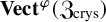 $\mathbf {Vect}^\varphi (\mathfrak {Z}_{\mathrm {crys}})$
the full subcategory of
$\mathbf {Vect}^\varphi (\mathfrak {Z}_{\mathrm {crys}})$
the full subcategory of $\mathbf {Crys}^\varphi (\mathfrak {Z})$
of F-crystal whose underlying crystal is a vector bundle. Each of the categories
$\mathbf {Crys}^\varphi (\mathfrak {Z})$
of F-crystal whose underlying crystal is a vector bundle. Each of the categories $\mathbf {Crys}^\varphi (\mathfrak {Z})$
,
$\mathbf {Crys}^\varphi (\mathfrak {Z})$
,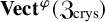 $\mathbf {Vect}^\varphi (\mathfrak {Z}_{\mathrm {crys}})$
, and
$\mathbf {Vect}^\varphi (\mathfrak {Z}_{\mathrm {crys}})$
, and $\mathbf {Isoc}^\varphi (\mathfrak {Z})$
carry natural exact
$\mathbf {Isoc}^\varphi (\mathfrak {Z})$
carry natural exact $\mathbb {Z}_p$
-linear
$\mathbb {Z}_p$
-linear $\otimes $
-structures. For every
$\otimes $
-structures. For every $m\leqslant n$
in
$m\leqslant n$
in $\mathbb {N}\cup \{\infty \}$
the morphism
$\mathbb {N}\cup \{\infty \}$
the morphism $(\iota _{m,n})_\ast $
induces quasi-inverse pairs
$(\iota _{m,n})_\ast $
induces quasi-inverse pairs $((\iota _{m,n})_\ast ,\iota _{m,n}^\ast )$

These are each bi-exact $\mathbb {Z}_p$
-linear
$\mathbb {Z}_p$
-linear $\otimes $
-equivalences.
$\otimes $
-equivalences.
Remark 2.19. Suppose that $(i\colon \mathfrak {U}\hookrightarrow \mathfrak {T},\gamma )$
is an object of
$(i\colon \mathfrak {U}\hookrightarrow \mathfrak {T},\gamma )$
is an object of $(\mathfrak {Z}/W)_{\mathrm {crys}}$
, and
$(\mathfrak {Z}/W)_{\mathrm {crys}}$
, and $\phi _{\mathfrak {T}}\colon \mathfrak {T}\to \mathfrak {T}$
is a Frobenius lift compatible with the Frobenius map
$\phi _{\mathfrak {T}}\colon \mathfrak {T}\to \mathfrak {T}$
is a Frobenius lift compatible with the Frobenius map $\phi $
on W. Fix a crystal
$\phi $
on W. Fix a crystal $\mathcal {E}$
on
$\mathcal {E}$
on $\mathfrak {Z}$
. From the morphism
$\mathfrak {Z}$
. From the morphism $(F_{\mathfrak {U}_0},\phi _{\mathfrak {T}})\colon (i_0\colon \mathfrak {U}^{\prime }_0\hookrightarrow \mathfrak {T}',\gamma )\to (i_0\colon \mathfrak {U}_0 \hookrightarrow \mathfrak {T},\gamma )$
in
$(F_{\mathfrak {U}_0},\phi _{\mathfrak {T}})\colon (i_0\colon \mathfrak {U}^{\prime }_0\hookrightarrow \mathfrak {T}',\gamma )\to (i_0\colon \mathfrak {U}_0 \hookrightarrow \mathfrak {T},\gamma )$
in $(\mathfrak {Z}_0/W)_{\mathrm {crys}}$
, and the crystal property, there is an identification
$(\mathfrak {Z}_0/W)_{\mathrm {crys}}$
, and the crystal property, there is an identification
 $$ \begin{align*} \phi^\ast\mathcal{E}_0(i_0\colon \mathfrak{U}_0 \hookrightarrow \mathfrak{T},\gamma)=\mathcal{E}(i_0\colon \mathfrak{U}_0' \hookrightarrow \mathfrak{T}',\gamma)\simeq \phi_{\mathfrak{T}}^\ast\mathcal{E}(i_0\colon\mathfrak{U}_0\hookrightarrow\mathfrak{T},\gamma)=\phi_{\mathfrak{T}}^\ast\mathcal{E}(i\colon\mathfrak{U}\hookrightarrow\mathfrak{T},\gamma). \end{align*} $$
By $\mathfrak {T}'$
(resp.
$\mathfrak {T}'$
(resp. $\mathfrak {U}'$
) we denote
$\mathfrak {U}'$
) we denote $\mathfrak {T}$
(resp.
$\mathfrak {T}$
(resp. $\mathfrak {U}$
) but with W-structure map (resp.
$\mathfrak {U}$
) but with W-structure map (resp. $\mathfrak {Z}$
-structure map) twisted by
$\mathfrak {Z}$
-structure map) twisted by $\phi $
(resp.
$\phi $
(resp. $F_{\mathfrak {Z}_0}$
), so the first equality holds by definition.
$F_{\mathfrak {Z}_0}$
), so the first equality holds by definition.
Base formal schemes and modules with connection
Let us now assume that $\mathfrak {Z}\to \operatorname {\mathrm {Spf}}(W)$
is a base formal W-scheme. Define
$\mathfrak {Z}\to \operatorname {\mathrm {Spf}}(W)$
is a base formal W-scheme. Define $\mathbf {MIC}^{\mathrm {tqn}}(\mathfrak {Z})$
to be the category of pairs
$\mathbf {MIC}^{\mathrm {tqn}}(\mathfrak {Z})$
to be the category of pairs $(\mathcal {V},\nabla )$
, where
$(\mathcal {V},\nabla )$
, where $\mathcal {V}$
is a coherent
$\mathcal {V}$
is a coherent $\mathcal {O}_{\mathfrak {Z}}$
-module, and
$\mathcal {O}_{\mathfrak {Z}}$
-module, and $\nabla \colon \mathcal {V}\to \mathcal {V}\otimes _{\mathcal {O}_{\mathfrak {Z}}}\Omega ^1_{\mathfrak {Z}/W}$
is an integrable topologically quasi-nilpotent connection (see [Reference de JongdJ95a, Remark 2.2.4]). Let
$\nabla \colon \mathcal {V}\to \mathcal {V}\otimes _{\mathcal {O}_{\mathfrak {Z}}}\Omega ^1_{\mathfrak {Z}/W}$
is an integrable topologically quasi-nilpotent connection (see [Reference de JongdJ95a, Remark 2.2.4]). Let $\mathbf {Vect}^\nabla (\mathfrak {Z})$
denote the full subcategory of
$\mathbf {Vect}^\nabla (\mathfrak {Z})$
denote the full subcategory of $\mathbf {MIC}^{\mathrm {tqn}}(\mathfrak {Z})$
of those pairs
$\mathbf {MIC}^{\mathrm {tqn}}(\mathfrak {Z})$
of those pairs $(\mathcal {V},\nabla )$
where
$(\mathcal {V},\nabla )$
where $\mathcal {V}$
is a vector bundle. By [Reference de JongdJ95a, Corollary 2.2.3], there are equivalences
$\mathcal {V}$
is a vector bundle. By [Reference de JongdJ95a, Corollary 2.2.3], there are equivalences

Here, for an $\mathcal {O}_{\mathrm {crys}}$
-module object
$\mathcal {O}_{\mathrm {crys}}$
-module object $\mathcal {F}$
, we denote by
$\mathcal {F}$
, we denote by $\mathcal {F}_{\mathfrak {Z}}$
the
$\mathcal {F}_{\mathfrak {Z}}$
the $\mathcal {O}_{\mathfrak {Z}}$
-module given by associating to a Zariski open
$\mathcal {O}_{\mathfrak {Z}}$
-module given by associating to a Zariski open $\mathfrak {U}\subseteq \mathfrak {Z}$
the value
$\mathfrak {U}\subseteq \mathfrak {Z}$
the value $\mathcal {F}(\operatorname {\mathrm {id}}\colon \mathfrak {U}\hookrightarrow \mathfrak {U},\gamma )$
. These functors are bi-exact
$\mathcal {F}(\operatorname {\mathrm {id}}\colon \mathfrak {U}\hookrightarrow \mathfrak {U},\gamma )$
. These functors are bi-exact $\mathbb {Z}_p$
-linear
$\mathbb {Z}_p$
-linear $\otimes $
-equivalences, functorial in
$\otimes $
-equivalences, functorial in $\mathfrak {Z}$
.
$\mathfrak {Z}$
.
Filtered F-isocrystals
For a rigid K-space Y, denote by $\mathbf {Vect}^\nabla (Y)$
the category of pairs
$\mathbf {Vect}^\nabla (Y)$
the category of pairs $(V,\nabla _V)$
where V is a vector bundle on Y, and
$(V,\nabla _V)$
where V is a vector bundle on Y, and $\nabla _V\colon V\to V\otimes _{\mathcal {O}_Y}\Omega ^1_{Y/K}$
is an integrable connection. Denote by
$\nabla _V\colon V\to V\otimes _{\mathcal {O}_Y}\Omega ^1_{Y/K}$
is an integrable connection. Denote by $\mathbf {VectF}^\nabla (Y)$
the category of triples
$\mathbf {VectF}^\nabla (Y)$
the category of triples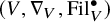 $(V,\nabla _V,{\operatorname {\mathrm {Fil}}}^{\bullet }_V)$
where
$(V,\nabla _V,{\operatorname {\mathrm {Fil}}}^{\bullet }_V)$
where $(V,\nabla _V)$
is an object of
$(V,\nabla _V)$
is an object of $\mathbf {Vect}^\nabla (Y)$
and
$\mathbf {Vect}^\nabla (Y)$
and ${\operatorname {\mathrm {Fil}}}^{\bullet }_V$
is a locally split filtration satisfying Griffiths transversality: for all
${\operatorname {\mathrm {Fil}}}^{\bullet }_V$
is a locally split filtration satisfying Griffiths transversality: for all $i\geqslant 0$
the containment
$i\geqslant 0$
the containment $\nabla _V({\operatorname {\mathrm {Fil}}}^i_V)\subseteq {\operatorname {\mathrm {Fil}}}^{i-1}_V\otimes _{\mathcal {O}_Y}\Omega ^1_{Y/K}$
holds. The category
$\nabla _V({\operatorname {\mathrm {Fil}}}^i_V)\subseteq {\operatorname {\mathrm {Fil}}}^{i-1}_V\otimes _{\mathcal {O}_Y}\Omega ^1_{Y/K}$
holds. The category $\mathbf {Vect}^\nabla (Y)$
has an obvious exact
$\mathbf {Vect}^\nabla (Y)$
has an obvious exact $\mathbb {Z}_p$
-linear
$\mathbb {Z}_p$
-linear $\otimes $
-structure, and we endow
$\otimes $
-structure, and we endow $\mathbf {VectF}^\nabla (Y)$
with an exact
$\mathbf {VectF}^\nabla (Y)$
with an exact $\mathbb {Z}_p$
-linear
$\mathbb {Z}_p$
-linear $\otimes $
-structure where
$\otimes $
-structure where
 $$ \begin{align*} {\operatorname{\mathrm{Fil}}}^k_{V_1\otimes V_2}=\sum_{i+j=k}{\operatorname{\mathrm{Fil}}}^i_{V_1}\otimes {\operatorname{\mathrm{Fil}}}^j_{V_2}, \end{align*} $$
and an exact structure where a sequence is exact if for all i the sequence of vector bundles on Y given by the $i^{\text {th}}$
-graded pieces is exact.
$i^{\text {th}}$
-graded pieces is exact.
Suppose now that $\mathfrak {Z}\to \operatorname {\mathrm {Spf}}(\mathcal {O}_K)$
is smooth with rigid generic fiber Z. In [Reference OgusOgu84, Remark 2.8.1 and Theorem 2.15], Ogus constructs an exact
$\mathfrak {Z}\to \operatorname {\mathrm {Spf}}(\mathcal {O}_K)$
is smooth with rigid generic fiber Z. In [Reference OgusOgu84, Remark 2.8.1 and Theorem 2.15], Ogus constructs an exact $\mathbb {Z}_p$
-linear
$\mathbb {Z}_p$
-linear $\otimes $
-functor
$\otimes $
-functor
 $$ \begin{align*} \mathbf{Isoc}^\varphi(\mathfrak{Z}_k)\to \mathbf{Vect}^\nabla(Z), \qquad (\mathcal{E},\varphi_{\mathcal{E}})\mapsto (E,\nabla_E). \end{align*} $$
This functor possesses the following property. For any open $\mathfrak {V}\subseteq \mathfrak {Z}$
, and any smooth model
$\mathfrak {V}\subseteq \mathfrak {Z}$
, and any smooth model $\mathfrak {W}$
of
$\mathfrak {W}$
of $\mathfrak {V}$
over W, one has
$\mathfrak {V}$
over W, one has $(E,\nabla _E)|_{\mathfrak {V}_\eta }$
is isomorphic to
$(E,\nabla _E)|_{\mathfrak {V}_\eta }$
is isomorphic to $(\mathcal {F}_{\mathfrak {W}},\nabla _{\mathcal {F}})\otimes K$
, where
$(\mathcal {F}_{\mathfrak {W}},\nabla _{\mathcal {F}})\otimes K$
, where $\mathcal {F}=(\iota _{0,\infty })_\ast (\mathcal {E}|_{\mathfrak {W}_0})$
, which is well-defined (i.e., doesn’t depend on
$\mathcal {F}=(\iota _{0,\infty })_\ast (\mathcal {E}|_{\mathfrak {W}_0})$
, which is well-defined (i.e., doesn’t depend on $\mathcal {E}$
within its isogeny class).
$\mathcal {E}$
within its isogeny class).
A filtered F-isocrystal on $\mathfrak {Z}$
is a triple
$\mathfrak {Z}$
is a triple $(\mathcal {E},\varphi _{\mathcal {E}},\mathrm {Fil}^{\bullet }_E)$
where
$(\mathcal {E},\varphi _{\mathcal {E}},\mathrm {Fil}^{\bullet }_E)$
where $(\mathcal {E},\varphi _{\mathcal {E}})$
is an object of
$(\mathcal {E},\varphi _{\mathcal {E}})$
is an object of $\mathbf {Isoc}^\varphi (\mathfrak {Z}_k)$
and
$\mathbf {Isoc}^\varphi (\mathfrak {Z}_k)$
and ${\operatorname {\mathrm {Fil}}}^{\bullet }_E$
is a locally split filtration on E satisfying Griffiths transversality. With the obvious notion of morphism, we denote by
${\operatorname {\mathrm {Fil}}}^{\bullet }_E$
is a locally split filtration on E satisfying Griffiths transversality. With the obvious notion of morphism, we denote by $\mathbf {IsocF}^\varphi (\mathfrak {Z})$
the category of filtered F-isocrystals on
$\mathbf {IsocF}^\varphi (\mathfrak {Z})$
the category of filtered F-isocrystals on $\mathfrak {Z}$
, which is seen to be identified with the fiber product
$\mathfrak {Z}$
, which is seen to be identified with the fiber product $\mathbf {Isoc}^\varphi (\mathfrak {Z}_k)\times _{\mathbf {Vect}^\nabla (Z)}\mathbf {VectF}^\nabla (Z)$
. We endow
$\mathbf {Isoc}^\varphi (\mathfrak {Z}_k)\times _{\mathbf {Vect}^\nabla (Z)}\mathbf {VectF}^\nabla (Z)$
. We endow $\mathbf {IsocF}^\varphi (\mathfrak {Z})$
with the exact
$\mathbf {IsocF}^\varphi (\mathfrak {Z})$
with the exact $\mathbb {Z}_p$
-linear
$\mathbb {Z}_p$
-linear $\otimes $
-structure inherited from this decomposition and those structures on
$\otimes $
-structure inherited from this decomposition and those structures on $\mathbf {Isoc}^\varphi (\mathfrak {Z}_k)$
and
$\mathbf {Isoc}^\varphi (\mathfrak {Z}_k)$
and $\mathbf {VectF}^\nabla (Z)$
.
$\mathbf {VectF}^\nabla (Z)$
.
2.3.2 de Rham local systems
Let Y be a smooth rigid K-space. Recall the following rings for an affinoid perfectoid space $S=\operatorname {\mathrm {Spa}}(R,R^+)\sim \varprojlim \operatorname {\mathrm {Spa}}(R_i,R_i^+)$
over C in
$S=\operatorname {\mathrm {Spa}}(R,R^+)\sim \varprojlim \operatorname {\mathrm {Spa}}(R_i,R_i^+)$
over C in $Y^{\mathrm {aff}}_{\mathrm {pro\acute {e}t}}$
:
$Y^{\mathrm {aff}}_{\mathrm {pro\acute {e}t}}$
:
-
○
, -
○
, -
○
, -
○
, given the
$\ker (\theta )$
-adic filtration, where is the base extension of
$\theta \colon {\mathrm {A}}_{\mathrm {inf}}(S)\to R^+$
, -
○
with filtration
$$ \begin{align*} {\operatorname{\mathrm{Fil}}}^i\mathcal{O}{\mathrm{B}}_{\mathrm{dR}}(S)=\sum_{j\in\mathbb{Z}}t^{-j}{\operatorname{\mathrm{Fil}}}^{i+j}\mathcal{O}{\mathrm{B}}_{\mathrm{dR}}^+(S), \end{align*} $$
 ,
, ,
, ,
, , given the
 is the base extension of
 with filtration
which extend to sheaves on $Y^{\mathrm {aff}}_{\mathrm {pro\acute {e}t}}$
. By [Reference ScholzeSch13, Corollary 6.13],
$Y^{\mathrm {aff}}_{\mathrm {pro\acute {e}t}}$
. By [Reference ScholzeSch13, Corollary 6.13], $\mathcal {O}{\mathrm {B}}_{\mathrm {dR}}^+$
carries a
$\mathcal {O}{\mathrm {B}}_{\mathrm {dR}}^+$
carries a ${\mathrm {B}}_{\mathrm {dR}}^+$
-horizontal integrable connection satisfying Griffiths transversality, extending to
${\mathrm {B}}_{\mathrm {dR}}^+$
-horizontal integrable connection satisfying Griffiths transversality, extending to $\mathcal {O}{\mathrm {B}}_{\mathrm {dR}}$
by base change.
$\mathcal {O}{\mathrm {B}}_{\mathrm {dR}}$
by base change.
An object $\mathbb {L}$
of
$\mathbb {L}$
of $\mathbf {Loc}_{\mathbb {Z}_p}(Y)$
is called de Rham if there exists an object
$\mathbf {Loc}_{\mathbb {Z}_p}(Y)$
is called de Rham if there exists an object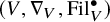 $(V,\nabla _V,{\operatorname {\mathrm {Fil}}}^{\bullet }_V)$
of
$(V,\nabla _V,{\operatorname {\mathrm {Fil}}}^{\bullet }_V)$
of $\mathbf {VectF}^\nabla (Y)$
, such that there exists an isomorphism of sheaves of modules over
$\mathbf {VectF}^\nabla (Y)$
, such that there exists an isomorphism of sheaves of modules over ${\mathrm {B}}_{\mathrm {dR}}^+$
:
${\mathrm {B}}_{\mathrm {dR}}^+$
:

where  and we endow $V\otimes _{\mathcal {O}_Y}\mathcal {O}{\mathrm {B}}_{\mathrm {dR}}$
with the tensor product filtration. By [Reference ScholzeSch13, Theorem 7.6], the object
$V\otimes _{\mathcal {O}_Y}\mathcal {O}{\mathrm {B}}_{\mathrm {dR}}$
with the tensor product filtration. By [Reference ScholzeSch13, Theorem 7.6], the object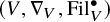 $(V,\nabla _V,{\operatorname {\mathrm {Fil}}}^{\bullet }_V)$
is functorially associated to
$(V,\nabla _V,{\operatorname {\mathrm {Fil}}}^{\bullet }_V)$
is functorially associated to $\mathbb {L}$
, and we denote it by
$\mathbb {L}$
, and we denote it by $D_{\mathrm {dR}}(\mathbb {L})$
(which we sometimes conflate with the underlying vector bundle). The category of de Rham
$D_{\mathrm {dR}}(\mathbb {L})$
(which we sometimes conflate with the underlying vector bundle). The category of de Rham $\mathbb {Q}_p$
local systems is the essential image of the natural functor
$\mathbb {Q}_p$
local systems is the essential image of the natural functor $\mathbf {Loc}_{\mathbb {Z}_p}^{\mathrm {dR}}(X)\to \mathbf {Loc}_{\mathbb {Q}_p}(X)$
and we set
$\mathbf {Loc}_{\mathbb {Z}_p}^{\mathrm {dR}}(X)\to \mathbf {Loc}_{\mathbb {Q}_p}(X)$
and we set  (which is independent of the choice of $\mathbb {L}$
).
$\mathbb {L}$
).
Denote by $\mathbf {Loc}^{\mathrm {dR}}_{\mathbb {Z}_p}(Y)$
the full subcategory of de Rham objects of
$\mathbf {Loc}^{\mathrm {dR}}_{\mathbb {Z}_p}(Y)$
the full subcategory of de Rham objects of $\mathbf {Loc}_{\mathbb {Z}_p}(Y)$
, which is seen to be stable under tensor products and duals. The functor
$\mathbf {Loc}_{\mathbb {Z}_p}(Y)$
, which is seen to be stable under tensor products and duals. The functor $D_{\mathrm {dR}}\colon \mathbf {Loc}^{\mathrm {dR}}_{\mathbb {Z}_p}(Y)\to \mathbf {VectF}^\nabla (Y)$
is an exact
$D_{\mathrm {dR}}\colon \mathbf {Loc}^{\mathrm {dR}}_{\mathbb {Z}_p}(Y)\to \mathbf {VectF}^\nabla (Y)$
is an exact $\mathbb {Z}_p$
-linear
$\mathbb {Z}_p$
-linear $\otimes $
-functor. If
$\otimes $
-functor. If $Y=\operatorname {\mathrm {Spa}}(K)$
, these notations agree with those of Fontaine.
$Y=\operatorname {\mathrm {Spa}}(K)$
, these notations agree with those of Fontaine.
Fix an object $\omega $
of
$\omega $
of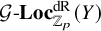 $\mathcal {G}\text {-}\mathbf {Loc}_{\mathbb {Z}_p}^{\mathrm {dR}}(Y)$
and
$\mathcal {G}\text {-}\mathbf {Loc}_{\mathbb {Z}_p}^{\mathrm {dR}}(Y)$
and $y\colon \operatorname {\mathrm {Spa}}(K')\to Y$
, for
$y\colon \operatorname {\mathrm {Spa}}(K')\to Y$
, for $K'$
a finite extension of K in
$K'$
a finite extension of K in $\overline {K}$
. Let
$\overline {K}$
. Let $\mathbf {VectF}(K')$
denote the category of finite-dimensional filtered
$\mathbf {VectF}(K')$
denote the category of finite-dimensional filtered $K'$
-vector spaces. Then, we have an exact
$K'$
-vector spaces. Then, we have an exact $\mathbb {Z}_p$
-linear
$\mathbb {Z}_p$
-linear $\otimes $
-functor
$\otimes $
-functor
 $$ \begin{align*} (\omega_{\mathrm{dR},y},{\operatorname{\mathrm{Fil}}}^{\bullet}_{\mathrm{dR}})\colon {\mathbf{Rep}}_{\mathbb{Z}_p}(\mathcal{G})\to \mathbf{VectF}(K'), \quad \Lambda\mapsto (D_{\mathrm{dR}}(\omega(\Lambda)),\mathrm{Fil}^{\bullet}_{D_{\mathrm{dR}}(\omega(\Lambda))})_y. \end{align*} $$
Fix a conjugacy class $\boldsymbol {\mu }$
of cocharacters of
$\boldsymbol {\mu }$
of cocharacters of $G_{\overline {K}}$
. We say
$G_{\overline {K}}$
. We say $\omega $
has cocharacter
$\omega $
has cocharacter $\boldsymbol {\mu }$
if for all such y and all (equiv. for one)
$\boldsymbol {\mu }$
if for all such y and all (equiv. for one) $\mu $
in
$\mu $
in $\boldsymbol {\mu }$
the following condition holds. There is an isomorphism
$\boldsymbol {\mu }$
the following condition holds. There is an isomorphism $(\omega _{\mathrm {dR},y})_{\overline {K}}\simeq \omega _{\mathrm {triv}}$
such that
$(\omega _{\mathrm {dR},y})_{\overline {K}}\simeq \omega _{\mathrm {triv}}$
such that $({\operatorname {\mathrm {Fil}}}^{\bullet }_{\mathrm {dR}})_{\overline {K}}$
is carried to
$({\operatorname {\mathrm {Fil}}}^{\bullet }_{\mathrm {dR}})_{\overline {K}}$
is carried to ${\operatorname {\mathrm {Fil}}}^{\bullet }_\mu $
where for a representation
${\operatorname {\mathrm {Fil}}}^{\bullet }_\mu $
where for a representation $\rho \colon \mathcal {G}\to \operatorname {\mathrm {GL}}(\Lambda )$
one has
$\rho \colon \mathcal {G}\to \operatorname {\mathrm {GL}}(\Lambda )$
one has ${\operatorname {\mathrm {Fil}}}^r_\mu = \bigoplus _{i\geqslant r}\Lambda _{\overline {K}}[i]$
, where
${\operatorname {\mathrm {Fil}}}^r_\mu = \bigoplus _{i\geqslant r}\Lambda _{\overline {K}}[i]$
, where $\Lambda _{\overline {K}}[i]$
is the i-weight space for the cocharacter
$\Lambda _{\overline {K}}[i]$
is the i-weight space for the cocharacter $\rho \circ \mu $
. The subcategory of
$\rho \circ \mu $
. The subcategory of $\mathcal {G}\text {-}\mathbf {Loc}_{\mathbb {Z}_p}^{\mathrm {dR}}(Y)$
of those
$\mathcal {G}\text {-}\mathbf {Loc}_{\mathbb {Z}_p}^{\mathrm {dR}}(Y)$
of those $\omega $
which have cocharacter
$\omega $
which have cocharacter $\boldsymbol {\mu }$
is denoted by
$\boldsymbol {\mu }$
is denoted by $\mathcal {G}\text {-}\mathbf {Loc}^{\mathrm {dR}}_{\mathbb {Z}_p,\boldsymbol {\mu }} (Y)$
.
$\mathcal {G}\text {-}\mathbf {Loc}^{\mathrm {dR}}_{\mathbb {Z}_p,\boldsymbol {\mu }} (Y)$
.
Finally, for a smooth K-scheme Y, denote by $\mathbf {Loc}^{\mathrm {dR}}_{\mathbb {Z}_p}(Y)$
(resp.
$\mathbf {Loc}^{\mathrm {dR}}_{\mathbb {Z}_p}(Y)$
(resp.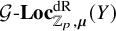 $\mathcal {G}\text {-}\mathbf {Loc}^{\mathrm {dR}}_{\mathbb {Z}_p,\boldsymbol {\mu }}(Y)$
) the full subcategory of
$\mathcal {G}\text {-}\mathbf {Loc}^{\mathrm {dR}}_{\mathbb {Z}_p,\boldsymbol {\mu }}(Y)$
) the full subcategory of $\mathbf {Loc}_{\mathbb {Z}_p}(Y)$
(resp.
$\mathbf {Loc}_{\mathbb {Z}_p}(Y)$
(resp.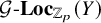 $\mathcal {G}\text {-}\mathbf {Loc}_{\mathbb {Z}_p}(Y)$
) consisting of those
$\mathcal {G}\text {-}\mathbf {Loc}_{\mathbb {Z}_p}(Y)$
) consisting of those $\mathbb {L}$
(resp.
$\mathbb {L}$
(resp. $\omega $
) such that
$\omega $
) such that $\mathbb {L}^{\mathrm {an}}$
(resp.
$\mathbb {L}^{\mathrm {an}}$
(resp. $\omega ^{\mathrm {an}}$
) belongs to
$\omega ^{\mathrm {an}}$
) belongs to $\mathbf {Loc}_{\mathbb {Z}_p}^{\mathrm {dR}}(Y^{\mathrm {an}})$
(resp.
$\mathbf {Loc}_{\mathbb {Z}_p}^{\mathrm {dR}}(Y^{\mathrm {an}})$
(resp.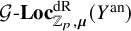 $\mathcal {G}\text {-}\mathbf {Loc}_{\mathbb {Z}_p,\boldsymbol {\mu }}^{\mathrm {dR}}(Y^{\mathrm {an}})$
).
$\mathcal {G}\text {-}\mathbf {Loc}_{\mathbb {Z}_p,\boldsymbol {\mu }}^{\mathrm {dR}}(Y^{\mathrm {an}})$
).
2.3.3 Crystalline local systems
As in [Reference Tan and TongTT19, §2A], recall the following rings for an affinoid perfectoid C-space $S=\operatorname {\mathrm {Spa}}(R,R^+)\sim \varprojlim \operatorname {\mathrm {Spa}}(R_i,R_i^+)$
in
$S=\operatorname {\mathrm {Spa}}(R,R^+)\sim \varprojlim \operatorname {\mathrm {Spa}}(R_i,R_i^+)$
in $X_{\mathrm {pro\acute {e}t}}$
:
$X_{\mathrm {pro\acute {e}t}}$
:
-
○
, filtered by
${\operatorname {\mathrm {Fil}}}^{\bullet }_{\mathrm {PD}}$
, -
○
filtered by , -
○
, with filtration given by
$$ \begin{align*} {\operatorname{\mathrm{Fil}}}^i{\mathrm{B}}_{\mathrm{crys}}(S)=\sum_{j\in\mathbb{Z}}t^{-j}{\operatorname{\mathrm{Fil}}}^{i+j}{\mathrm{B}}_{\mathrm{crys}}^+(R,R^+). \end{align*} $$
 , filtered by
 filtered by
  ,
, , with filtration given by
These rings, and their filtrations, extend to sheaves on $X_{\mathrm {pro\acute {e}t}}$
. The Frobenius on
$X_{\mathrm {pro\acute {e}t}}$
. The Frobenius on ${\mathrm {A}}_{\mathrm {crys}}$
extends uniquely to
${\mathrm {A}}_{\mathrm {crys}}$
extends uniquely to ${\mathrm {B}}_{\mathrm {crys}}^+$
as p is Frobenius invariant, and further extends uniquely to
${\mathrm {B}}_{\mathrm {crys}}^+$
as p is Frobenius invariant, and further extends uniquely to ${\mathrm {B}}_{\mathrm {crys}}$
with
${\mathrm {B}}_{\mathrm {crys}}$
with  (see [Reference Tan and TongTT19, §2C]). In particular, for any object
  of
of $\mathbf {Loc}_{\mathbb {Q}_p}(X)$
the sheaf
$\mathbf {Loc}_{\mathbb {Q}_p}(X)$
the sheaf  carries a natural Frobenius and filtration.
The Faltings formulation
For an object $(\mathcal {E},\varphi ,{\operatorname {\mathrm {Fil}}}^{\bullet }_E)$
of
$(\mathcal {E},\varphi ,{\operatorname {\mathrm {Fil}}}^{\bullet }_E)$
of $\mathbf {IsocF}^\varphi (\mathfrak {X})$
and an affinoid perfectoid space
$\mathbf {IsocF}^\varphi (\mathfrak {X})$
and an affinoid perfectoid space $S=\operatorname {\mathrm {Spa}}(R,R^+)$
over C in
$S=\operatorname {\mathrm {Spa}}(R,R^+)$
over C in $X_{\mathrm {pro\acute {e}t}}$
, which uniquely extends to a map
$X_{\mathrm {pro\acute {e}t}}$
, which uniquely extends to a map $\operatorname {\mathrm {Spf}}(R^+)\to \mathfrak {X}$
(e.g. those factorizing through
$\operatorname {\mathrm {Spf}}(R^+)\to \mathfrak {X}$
(e.g. those factorizing through $\operatorname {\mathrm {Spf}}(A)_\eta $
for an affine open
$\operatorname {\mathrm {Spf}}(A)_\eta $
for an affine open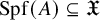 $\operatorname {\mathrm {Spf}}(A)\subseteq \mathfrak {X}$
), we have that
$\operatorname {\mathrm {Spf}}(A)\subseteq \mathfrak {X}$
), we have that ${\mathrm {A}}_{\mathrm {crys}}(S)$
is a pro-infinitesimal PD thickening of
${\mathrm {A}}_{\mathrm {crys}}(S)$
is a pro-infinitesimal PD thickening of $R^{+}$
, so we have the associated
$R^{+}$
, so we have the associated ${\mathrm {B}}_{\mathrm {crys}}(R,R^+)$
-module
${\mathrm {B}}_{\mathrm {crys}}(R,R^+)$
-module

As in [Reference Guo and ReineckeGR24, §2.3], this extends to a sheaf on $X_{\mathrm {pro\acute {e}t}}$
and inherits a Frobenius morphism
$X_{\mathrm {pro\acute {e}t}}$
and inherits a Frobenius morphism $\varphi \colon \phi ^\ast {\mathrm {B}}_{\mathrm {crys}}(\mathcal {E})\to {\mathrm {B}}_{\mathrm {crys}}(\mathcal {E})$
and a filtration
$\varphi \colon \phi ^\ast {\mathrm {B}}_{\mathrm {crys}}(\mathcal {E})\to {\mathrm {B}}_{\mathrm {crys}}(\mathcal {E})$
and a filtration ${\operatorname {\mathrm {Fil}}}^{\bullet }_{{\mathrm {B}}_{\mathrm {crys}}(\mathcal {E})}$
induced from
${\operatorname {\mathrm {Fil}}}^{\bullet }_{{\mathrm {B}}_{\mathrm {crys}}(\mathcal {E})}$
induced from $(\mathcal {E},\varphi ,{\operatorname {\mathrm {Fil}}}^{\bullet }_E)$
.
$(\mathcal {E},\varphi ,{\operatorname {\mathrm {Fil}}}^{\bullet }_E)$
.
As in [Reference FaltingsFal89, p. 67], call an object  of
of $\mathbf {Loc}_{\mathbb {Q}_p}(X)$
(resp. object
$\mathbf {Loc}_{\mathbb {Q}_p}(X)$
(resp. object $\mathbb {L}$
of
$\mathbb {L}$
of $\mathbf {Loc}_{\mathbb {Z}_p}(X)$
) crystalline relative to
$\mathbf {Loc}_{\mathbb {Z}_p}(X)$
) crystalline relative to $\mathfrak {X}$
if there exists an object
$\mathfrak {X}$
if there exists an object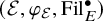 $(\mathcal {E},\varphi _{\mathcal {E}},{\operatorname {\mathrm {Fil}}}^{\bullet }_E)$
of
$(\mathcal {E},\varphi _{\mathcal {E}},{\operatorname {\mathrm {Fil}}}^{\bullet }_E)$
of $\mathbf {IsocF}^\varphi (\mathfrak {X})$
and an isomorphism of
$\mathbf {IsocF}^\varphi (\mathfrak {X})$
and an isomorphism of ${\mathrm {B}}_{\mathrm {crys}}$
-modules
${\mathrm {B}}_{\mathrm {crys}}$
-modules

compatible with Frobenius and filtration (resp. $\mathbb {L}$
is crystalline). Denote by
$\mathbb {L}$
is crystalline). Denote by $\mathbf {Loc}_{\mathbb {Q}_p}^{\mathrm {crys}}(X)$
(resp.
$\mathbf {Loc}_{\mathbb {Q}_p}^{\mathrm {crys}}(X)$
(resp. $\mathbf {Loc}_{\mathbb {Z}_p}^{\mathrm {crys}}(X)$
), suppressing
$\mathbf {Loc}_{\mathbb {Z}_p}^{\mathrm {crys}}(X)$
), suppressing $\mathfrak {X}$
from the notation, the full subcategory of crystalline
$\mathfrak {X}$
from the notation, the full subcategory of crystalline $\mathbb {Q}_p$
-local (resp.
$\mathbb {Q}_p$
-local (resp. $\mathbb {Z}_p$
-local) systems. By the arguments in [Reference Guo and ReineckeGR24, Corollary 2.35], the filtered F-isocrystal
$\mathbb {Z}_p$
-local) systems. By the arguments in [Reference Guo and ReineckeGR24, Corollary 2.35], the filtered F-isocrystal $\mathcal {E}$
is functorial in
$\mathcal {E}$
is functorial in  . We say that $(\mathcal {E},\varphi ,{\operatorname {\mathrm {Fil}}}^{\bullet }_E)$
and
$(\mathcal {E},\varphi ,{\operatorname {\mathrm {Fil}}}^{\bullet }_E)$
and  are associated, and write $D_{\mathrm {crys}}(\mathbb {L})$
for
$D_{\mathrm {crys}}(\mathbb {L})$
for $\mathcal {E}$
. We further define
$\mathcal {E}$
. We further define  for a crystalline $\mathbb {Z}_p$
-local system
$\mathbb {Z}_p$
-local system $\mathbb {L}$
. As explained in [Reference Tan and TongTT19, Proposition 3.22] and [Reference Guo and ReineckeGR24, Corollary 2.37], any crystalline local system
$\mathbb {L}$
. As explained in [Reference Tan and TongTT19, Proposition 3.22] and [Reference Guo and ReineckeGR24, Corollary 2.37], any crystalline local system $\mathbb {L}$
on X is de Rham, and if
$\mathbb {L}$
on X is de Rham, and if $D_{\mathrm {crys}}(\mathbb {L})=(\mathcal {E},\varphi _{\mathcal {E}},{\operatorname {\mathrm {Fil}}}^{\bullet }_E)$
then
$D_{\mathrm {crys}}(\mathbb {L})=(\mathcal {E},\varphi _{\mathcal {E}},{\operatorname {\mathrm {Fil}}}^{\bullet }_E)$
then $D_{\mathrm {dR}}(\mathbb {L})$
is equal to
$D_{\mathrm {dR}}(\mathbb {L})$
is equal to $(E,\nabla _E,{\operatorname {\mathrm {Fil}}}^{\bullet }_E)$
(cf. §2.3.1).
$(E,\nabla _E,{\operatorname {\mathrm {Fil}}}^{\bullet }_E)$
(cf. §2.3.1).
Let $S=\operatorname {\mathrm {Spa}}(R,R^+)$
be an affinoid perfectoid C-space
$S=\operatorname {\mathrm {Spa}}(R,R^+)$
be an affinoid perfectoid C-space $S=\operatorname {\mathrm {Spa}}(R,R^+)$
in
$S=\operatorname {\mathrm {Spa}}(R,R^+)$
in $X_{\mathrm {pro\acute {e}t}}$
, which uniquely extends to a map
$X_{\mathrm {pro\acute {e}t}}$
, which uniquely extends to a map $\operatorname {\mathrm {Spf}}(R^+)\to \mathfrak {X}$
. We consider the isomorphism
$\operatorname {\mathrm {Spf}}(R^+)\to \mathfrak {X}$
. We consider the isomorphism

from the paragraph right after [Reference Tan and TongTT19, Proposition 3.21]. Put  . Let
. Let $\theta ^+_{\mathrm {dR}}$
denote the scalar extension of
$\theta ^+_{\mathrm {dR}}$
denote the scalar extension of $\theta ^+_{\mathrm {crys}}$
along
$\theta ^+_{\mathrm {crys}}$
along $\mathcal {O}{\mathrm {B}}_{\mathrm {crys}}^+(S)\to \mathcal {O}{\mathrm {B}}_{\mathrm {dR}}^+(S)$
, and
$\mathcal {O}{\mathrm {B}}_{\mathrm {crys}}^+(S)\to \mathcal {O}{\mathrm {B}}_{\mathrm {dR}}^+(S)$
, and

be the map induced on the spaces of horizontal sections. Put 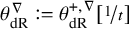 . Since, for a crystalline local system $\mathbb {L}$
on X, the isomorphism
$\mathbb {L}$
on X, the isomorphism $c_{\mathrm {Sch}}$
is given as the scalar extension of the composition
$c_{\mathrm {Sch}}$
is given as the scalar extension of the composition $\theta _{\mathrm {crys}}\circ c_{\mathrm {Fal}}$
as explained in the proof of [Reference Guo and ReineckeGR24, Corollary 2.37], we obtain the following lemma, which is used in the proof of Theorem 3.21.
$\theta _{\mathrm {crys}}\circ c_{\mathrm {Fal}}$
as explained in the proof of [Reference Guo and ReineckeGR24, Corollary 2.37], we obtain the following lemma, which is used in the proof of Theorem 3.21.
Lemma 2.20. Assume that $\mathbb {L}|_{S}$
is constant. Then the diagram
$\mathbb {L}|_{S}$
is constant. Then the diagram

commutes.
For a conjugacy class $\boldsymbol {\mu }$
of cocharacters of
$\boldsymbol {\mu }$
of cocharacters of $G_{\overline {K}}$
denote by
$G_{\overline {K}}$
denote by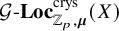 $\mathcal {G}\text {-}\mathbf {Loc}_{\mathbb {Z}_p,\boldsymbol {\mu }}^{\mathrm {crys}}(X)$
those
$\mathcal {G}\text {-}\mathbf {Loc}_{\mathbb {Z}_p,\boldsymbol {\mu }}^{\mathrm {crys}}(X)$
those $\mathcal {G}(\mathbb {Z}_p)$
-local systems which lie in both
$\mathcal {G}(\mathbb {Z}_p)$
-local systems which lie in both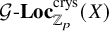 $\mathcal {G}\text {-}\mathbf {Loc}_{\mathbb {Z}_p}^{\mathrm {crys}}(X)$
and
$\mathcal {G}\text {-}\mathbf {Loc}_{\mathbb {Z}_p}^{\mathrm {crys}}(X)$
and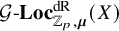 $\mathcal {G}\text {-}\mathbf {Loc}_{\mathbb {Z}_p,\boldsymbol {\mu }}^{\mathrm {dR}}(X)$
.
$\mathcal {G}\text {-}\mathbf {Loc}_{\mathbb {Z}_p,\boldsymbol {\mu }}^{\mathrm {dR}}(X)$
.
The Brinon formulation
Fix a base $\mathcal {O}_K$
-algebra
$\mathcal {O}_K$
-algebra $A=A_0\otimes _W \mathcal {O}_K$
, with formal framing
$A=A_0\otimes _W \mathcal {O}_K$
, with formal framing $t\colon T_d\to A_0$
. Consider the following rings:
$t\colon T_d\to A_0$
. Consider the following rings:
-
○
$\mathcal {O}{\mathrm {A}}_{\mathrm {crys}}(\check {A})$
is the p-adically completed PD envelope of the map
$\theta \colon A_0\otimes _W {\mathrm {A}}_{\mathrm {inf}}(\check {A})\to \check {A}$
, filtered by
${\operatorname {\mathrm {Fil}}}^{\bullet }_{\mathrm {PD}}$
, -
○
filtered by
$$ \begin{align*} {\operatorname{\mathrm{Fil}}}^r\mathcal{O}{\mathrm{B}}_{\mathrm{crys}}(\check{A})=\sum_{n\geqslant -r}t^{-n}{\operatorname{\mathrm{Fil}}}^{n+r}\mathcal{O}{\mathrm{A}}_{\mathrm{crys}}(\check{A}). \end{align*} $$



 filtered by
The tensor product Frobenius $\phi $
on
$\phi $
on $A_0\otimes _W {\mathrm {A}}_{\mathrm {crys}}(\check {A})$
uniquely extends to
$A_0\otimes _W {\mathrm {A}}_{\mathrm {crys}}(\check {A})$
uniquely extends to $\mathcal {O}{\mathrm {A}}_{\mathrm {crys}}(\check {A})$
and we can extend the Frobenius to
$\mathcal {O}{\mathrm {A}}_{\mathrm {crys}}(\check {A})$
and we can extend the Frobenius to $\mathcal {O}{\mathrm {B}}_{\mathrm {crys}}(\check {A})$
with
$\mathcal {O}{\mathrm {B}}_{\mathrm {crys}}(\check {A})$
with  . There is a natural connection
 $$ \begin{align*} \nabla \colon \mathcal{O}{\mathrm{A}}_{\mathrm{crys}}(\check{A})\to \mathcal{O}{\mathrm{A}}_{\mathrm{crys}}(\check{A})\otimes_{A_0}\widehat{\Omega}^1_{A_0/W}, \end{align*} $$
with ${\mathrm {A}}_{\mathrm {crys}}(\check {A})$
and
${\mathrm {A}}_{\mathrm {crys}}(\check {A})$
and $\phi $
horizontal (see [Reference KimKim15, Proposition 4.3]), which extends to
$\phi $
horizontal (see [Reference KimKim15, Proposition 4.3]), which extends to ${\mathrm {B}}_{\mathrm {crys}}(\check {A})$
by base change. There is a natural action of
${\mathrm {B}}_{\mathrm {crys}}(\check {A})$
by base change. There is a natural action of $\Gamma _A$
on
$\Gamma _A$
on $\mathcal {O}{\mathrm {B}}_{\mathrm {crys}}(\check {A})$
and the tautological morphism
$\mathcal {O}{\mathrm {B}}_{\mathrm {crys}}(\check {A})$
and the tautological morphism  is an isomorphism (see [Reference BrinonBri08, Proposition 6.2.9]).
For a finite-dimensional continuous $\mathbb {Q}_p$
-representation
$\mathbb {Q}_p$
-representation $\rho \colon \Gamma _A\to \operatorname {\mathrm {GL}}_{\mathbb {Q}_p}(V)$
, write
$\rho \colon \Gamma _A\to \operatorname {\mathrm {GL}}_{\mathbb {Q}_p}(V)$
, write

which is an  -module. There is a natural morphism of $\mathcal {O}{\mathrm {B}}_{\mathrm {crys}}(\check {A})$
-modules
$\mathcal {O}{\mathrm {B}}_{\mathrm {crys}}(\check {A})$
-modules

and following [Reference BrinonBri08] we say $\rho $
(or V) is crystalline if it is an isomorphism. This notion is independent of the choice of
$\rho $
(or V) is crystalline if it is an isomorphism. This notion is independent of the choice of $A_0$
(see [Reference BrinonBri08, Proposition 8.3.5]). A finite-rank free
$A_0$
(see [Reference BrinonBri08, Proposition 8.3.5]). A finite-rank free $\mathbb {Z}_p$
-representation
$\mathbb {Z}_p$
-representation $\Lambda $
of
$\Lambda $
of $\Gamma _A$
is crystalline if
$\Gamma _A$
is crystalline if  is, in which case we write
  .
.
Denote by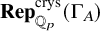 $\mathbf {Rep}^{\mathrm {crys}}_{\mathbb {Q}_p}(\Gamma _A)$
(resp.
$\mathbf {Rep}^{\mathrm {crys}}_{\mathbb {Q}_p}(\Gamma _A)$
(resp.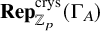 ${\mathbf {Rep}}_{\mathbb {Z}_p}^{\mathrm {crys}}(\Gamma _A)$
) the category of crystalline
${\mathbf {Rep}}_{\mathbb {Z}_p}^{\mathrm {crys}}(\Gamma _A)$
) the category of crystalline $\mathbb {Q}_p$
-representations (resp.
$\mathbb {Q}_p$
-representations (resp. $\mathbb {Z}_p$
-representations) endowed with the evident structure of an exact
$\mathbb {Z}_p$
-representations) endowed with the evident structure of an exact $\mathbb {Z}_p$
-linear
$\mathbb {Z}_p$
-linear $\otimes $
-category. If V is an object of
$\otimes $
-category. If V is an object of ${\mathbf {Rep}}_{\mathbb {Q}_p}(\Gamma _A)$
then
${\mathbf {Rep}}_{\mathbb {Q}_p}(\Gamma _A)$
then $D_{\mathrm {crys}}(V)$
has the structure of an object of
$D_{\mathrm {crys}}(V)$
has the structure of an object of $\mathbf {IsocF}^\varphi (A)$
, and [Reference BrinonBri08, Théorème 8.5.1] defines a
$\mathbf {IsocF}^\varphi (A)$
, and [Reference BrinonBri08, Théorème 8.5.1] defines a $\mathbb {Z}_p$
-linear
$\mathbb {Z}_p$
-linear $\otimes $
-functor
$\otimes $
-functor
 $$ \begin{align*} D_{\mathrm{crys}}\colon \mathbf{Rep}^{\mathrm{crys}}_{\mathbb{Q}_p}(\Gamma_A)\to \mathbf{IsocF}^\varphi(A), \end{align*} $$
which is a bi-exact equivalence onto its image, functorial in A.
Let $\Sigma $
be either
$\Sigma $
be either $\mathbb {Z}_p$
or
$\mathbb {Z}_p$
or $\mathbb {Q}_p$
. If
$\mathbb {Q}_p$
. If $\{\operatorname {\mathrm {Spf}}(A)\}$
is a small open cover of
$\{\operatorname {\mathrm {Spf}}(A)\}$
is a small open cover of $\mathfrak {X}$
, then an object
$\mathfrak {X}$
, then an object $\mathbb {L}$
of
$\mathbb {L}$
of $\mathbf {Loc}_{\Sigma }(X)$
is crystalline if and only if the
$\mathbf {Loc}_{\Sigma }(X)$
is crystalline if and only if the $\Sigma $
-representation
$\Sigma $
-representation $V_A$
associated to
$V_A$
associated to $\mathbb {L}|_{\operatorname {\mathrm {Spf}}(A)_\eta }$
is crystalline for all A (see [Reference Du, Liu, Moon and ShimizuDLMS24, Proposition A.10]). In this case we have that
$\mathbb {L}|_{\operatorname {\mathrm {Spf}}(A)_\eta }$
is crystalline for all A (see [Reference Du, Liu, Moon and ShimizuDLMS24, Proposition A.10]). In this case we have that $D_{\mathrm {crys}}(\mathbb {L})|_{\operatorname {\mathrm {Spf}}(A)_\eta }$
agrees with
$D_{\mathrm {crys}}(\mathbb {L})|_{\operatorname {\mathrm {Spf}}(A)_\eta }$
agrees with $D_{\mathrm {crys}}(V_A)$
for all A. Thus,
$D_{\mathrm {crys}}(V_A)$
for all A. Thus,
 $$ \begin{align*} D_{\mathrm{crys}}\colon \mathbf{Loc}^{\mathrm{crys}}_{\mathbb{Q}_p}(X)\to \mathbf{IsocF}^\varphi(\mathfrak{X}), \end{align*} $$
is a $\mathbb {Z}_p$
-linear
$\mathbb {Z}_p$
-linear $\otimes $
-functor which is a bi-exact equivalent onto its image. Also,
$\otimes $
-functor which is a bi-exact equivalent onto its image. Also, $\mathbf {Loc}^{\mathrm {crys}}_{\Sigma }(X)$
is closed under duals, tensor products, direct sums, and subquotients (see [Reference BrinonBri08, Théorème 8.4.2]).
$\mathbf {Loc}^{\mathrm {crys}}_{\Sigma }(X)$
is closed under duals, tensor products, direct sums, and subquotients (see [Reference BrinonBri08, Théorème 8.4.2]).
Proposition 2.21. For an object $\omega $
of
$\omega $
of $\mathcal {G}\text {-}\mathbf {Loc}_{\Sigma }(X)$
,
$\mathcal {G}\text {-}\mathbf {Loc}_{\Sigma }(X)$
, $\omega $
factorizes through
$\omega $
factorizes through $\mathbf {Loc}^{\mathrm {crys}}_\Sigma (X)$
if and only if
$\mathbf {Loc}^{\mathrm {crys}}_\Sigma (X)$
if and only if $\omega (V_0)$
is crystalline for some faithful
$\omega (V_0)$
is crystalline for some faithful $\Sigma $
-representation
$\Sigma $
-representation $V_0$
.
$V_0$
.
Proof. It suffices to prove the if condition. Moreover, as $\omega $
is crystalline if and only if
$\omega $
is crystalline if and only if  is, we may suppose that $\Sigma =\mathbb {Q}_p$
. By [Reference DeligneDel82, Proposition 3.1 (a)] every object V of
$\Sigma =\mathbb {Q}_p$
. By [Reference DeligneDel82, Proposition 3.1 (a)] every object V of ${\mathbf {Rep}}_{\mathbb {Q}_p}(G)$
occurs as a subquotient of
${\mathbf {Rep}}_{\mathbb {Q}_p}(G)$
occurs as a subquotient of $\bigoplus _i (V_0)^{\otimes m_i}\oplus (V_0^\vee )^{\otimes n_i}$
for some finite list of integers
$\bigoplus _i (V_0)^{\otimes m_i}\oplus (V_0^\vee )^{\otimes n_i}$
for some finite list of integers $m_i$
and
$m_i$
and $n_i$
. As
$n_i$
. As $\mathbf {Loc}_{\mathbb {Q}_p}^{\mathrm {crys}}(X)$
is closed under duals, tensor products, direct sums, and subquotients, the claim follows.
$\mathbf {Loc}_{\mathbb {Q}_p}^{\mathrm {crys}}(X)$
is closed under duals, tensor products, direct sums, and subquotients, the claim follows.
2.3.4 Crystalline
$\mathcal {G}(\mathbb {Z}_p)$
-local systems

Consider the étale realization functor

defined to be the composition

where the first functor is obtained by patching together the pullbacks  .
.
Theorem 2.22 ([Reference Guo and ReineckeGR24] (cf. [Reference Du, Liu, Moon and ShimizuDLMS24]))
The functor $T_{\mathrm {\acute {e}t}}$
induces an equivalence
$T_{\mathrm {\acute {e}t}}$
induces an equivalence

We devote the rest of this subsection to proving the following claim.
Proposition 2.23. The functor

is a bi-exact $\mathbb {Z}_p$
-linear
$\mathbb {Z}_p$
-linear $\otimes $
-equivalence. In particular,
$\otimes $
-equivalence. In particular, $T_{\mathrm {\acute {e}t}}$
induces an equivalence of categories
$T_{\mathrm {\acute {e}t}}$
induces an equivalence of categories

As the base extension functor  is exact, as an exact sequence of vector bundles is universally exact (in the sense of [SP, Tag 058I]), exactness of $T_{\mathrm {\acute {e}t}}$
follows from Proposition 2.13. So, we have reduced ourselves to showing that
$T_{\mathrm {\acute {e}t}}$
follows from Proposition 2.13. So, we have reduced ourselves to showing that $T_{\mathrm {\acute {e}t}}^{-1}$
is exact. But, combining Proposition 1.11 and Proposition 1.20 we are reduced to showing the following.
$T_{\mathrm {\acute {e}t}}^{-1}$
is exact. But, combining Proposition 1.11 and Proposition 1.20 we are reduced to showing the following.
Proposition 2.24. If R is a small $\mathcal {O}_K$
-algebra, then the following composition is exact:
$\mathcal {O}_K$
-algebra, then the following composition is exact:

Define

where the final completion is either the p-adic or $[p^\flat ]^p$
-adic completion.Footnote 10
We denote by
$[p^\flat ]^p$
-adic completion.Footnote 10
We denote by $\widetilde {\varphi }$
the following composition
$\widetilde {\varphi }$
the following composition

which we use to view  as an
as an 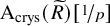 -algebra.
There is a natural pullback functor

as the natural maps $\operatorname {\mathrm {Spec}}({\mathrm {B}}_{[a,b]})\to \operatorname {\mathrm {Spec}}({\mathrm {A}}_{\mathrm {inf}}(\widetilde {R}))$
for
$\operatorname {\mathrm {Spec}}({\mathrm {B}}_{[a,b]})\to \operatorname {\mathrm {Spec}}({\mathrm {A}}_{\mathrm {inf}}(\widetilde {R}))$
for  factorize through $\operatorname {\mathrm {Spec}}({\mathrm {A}}_{\mathrm {inf}}(\widetilde {R}))-V(p,[p^\flat ]^p)$
, and are equalized when composed with
$\operatorname {\mathrm {Spec}}({\mathrm {A}}_{\mathrm {inf}}(\widetilde {R}))-V(p,[p^\flat ]^p)$
, and are equalized when composed with  . For a vector bundle M on $\operatorname {\mathrm {Spec}}({\mathrm {A}}_{\mathrm {inf}}(\widetilde {R}))-V(p,[p^\flat ]^p)$
we denote by
$\operatorname {\mathrm {Spec}}({\mathrm {A}}_{\mathrm {inf}}(\widetilde {R}))-V(p,[p^\flat ]^p)$
we denote by $M_{[a,b]}$
, for
$M_{[a,b]}$
, for  , the induced vector bundle on ${\mathrm {B}}_{[a,b]}$
.
${\mathrm {B}}_{[a,b]}$
.
Lemma 2.25 (cf. [Reference KedlayaKed20, Theorem 3.8])
The functor

is a bi-exact $\mathbb {Z}_p$
-linear
$\mathbb {Z}_p$
-linear $\otimes $
-equivalence.
$\otimes $
-equivalence.
Proof. By the proof of [Reference KedlayaKed20, Theorem 3.8], it remains to prove this functor is bi-exact. The exactness follows as an exact sequence of vector bundles is universally exact. To prove that the quasi-inverse is exact, from acyclicity of vector bundles on sheafy affinoid adic spaces and [Reference KedlayaKed20, Proposition 3.2] as a whole, we deduce exactness of the quasi-inverse to the functor in [Reference KedlayaKed20, Proposition 3.2 (a)], which we apply to (defaulting to the notation in [Reference KedlayaKed20, Definition 3.5]) $A_1\to B_{1}\oplus B_2'$
and
$A_1\to B_{1}\oplus B_2'$
and $A_2\to B_1'\oplus B_2$
to get the desired exactness.
$A_2\to B_1'\oplus B_2$
to get the desired exactness.
Remark 2.26. The proof of this lemma implies exactness of Kedlaya’s equivalence between vector bundles on $\operatorname {\mathrm {Spec}}({\mathrm {A}}_{\mathrm {inf}}(\widetilde {R}))- V\left (p,[p^\flat ]^p\right )$
and those on
$\operatorname {\mathrm {Spec}}({\mathrm {A}}_{\mathrm {inf}}(\widetilde {R}))- V\left (p,[p^\flat ]^p\right )$
and those on $\operatorname {\mathrm {Spa}}({\mathrm {A}}_{\mathrm {inf}}(\widetilde {R}))_{\mathrm {an}}$
(cf. Footnote 10), which seems well-known. Though the adic space perspective could clarify the following proof of Lemma 2.24, we have chosen to avoid it for the sake of brevity.
$\operatorname {\mathrm {Spa}}({\mathrm {A}}_{\mathrm {inf}}(\widetilde {R}))_{\mathrm {an}}$
(cf. Footnote 10), which seems well-known. Though the adic space perspective could clarify the following proof of Lemma 2.24, we have chosen to avoid it for the sake of brevity.
We now recall some structural properties of the functor $T_{\mathrm {\acute {e}t}}^{-1}$
.
$T_{\mathrm {\acute {e}t}}^{-1}$
.
Lemma 2.27. For an object $\Lambda $
of
$\Lambda $
of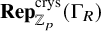 ${\mathbf {Rep}}_{\mathbb {Z}_p}^{\mathrm {crys}}(\Gamma _R)$
, set
${\mathbf {Rep}}_{\mathbb {Z}_p}^{\mathrm {crys}}(\Gamma _R)$
, set 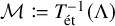 and
and  .
.
-
1. There is a natural isomorphism of
-modules -
2. Let
$\mathcal {E}=D_{\mathrm {crys}}(\Lambda )$
. Then there is a natural isomorphism (2.3.4)
 -modules
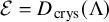

Proof. In the proof of [Reference Guo and ReineckeGR24, Theorem 4.8], the prismatic crystal $\mathcal {M}$
is described as the vector bundle
$\mathcal {M}$
is described as the vector bundle $\mathcal {M}_{\widetilde {R}}$
on
$\mathcal {M}_{\widetilde {R}}$
on $\operatorname {\mathrm {Spec}}({\mathrm {A}}_{\mathrm {inf}}(\widetilde {R})) - V\left (p,[p^\flat ]^p\right )$
constructed in [Reference Guo and ReineckeGR24, Theorem 4.15], together with a descent datum on
$\operatorname {\mathrm {Spec}}({\mathrm {A}}_{\mathrm {inf}}(\widetilde {R})) - V\left (p,[p^\flat ]^p\right )$
constructed in [Reference Guo and ReineckeGR24, Theorem 4.15], together with a descent datum on $\widetilde {R}\hat {\otimes }_R \widetilde {R}$
. In particular, M is naturally isomorphic to
$\widetilde {R}\hat {\otimes }_R \widetilde {R}$
. In particular, M is naturally isomorphic to $\mathcal {M}_{\widetilde {R}}$
. In the proof of [Reference Guo and ReineckeGR24, Theorem 4.15], the module
$\mathcal {M}_{\widetilde {R}}$
. In the proof of [Reference Guo and ReineckeGR24, Theorem 4.15], the module $\mathcal {M}_{\widetilde {R}}$
is constructed by gluing the
$\mathcal {M}_{\widetilde {R}}$
is constructed by gluing the  -module $\mathcal {M}_{3,\widetilde {R}}$
constructed in [Reference Guo and ReineckeGR24, Proposition 4.11] and the
$\mathcal {M}_{3,\widetilde {R}}$
constructed in [Reference Guo and ReineckeGR24, Proposition 4.11] and the  -module
  via the equivalence in Lemma 2.25. In particular, assertion (1) follows by definition. To prove assertion (2), note that $\mathcal {M}_{3,\widetilde {R}}$
is obtained by the Beauville–Laszlo gluing of the
$\mathcal {M}_{3,\widetilde {R}}$
is obtained by the Beauville–Laszlo gluing of the  -module

and a certain  -module (specifically the submodule $\widetilde {\mathrm {Fil}}^0_{E}$
of the
$\widetilde {\mathrm {Fil}}^0_{E}$
of the 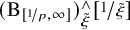 -module
  ). So, (2) again follows by definition.
Proof of Proposition 2.24
By Lemma 2.25 we are reduced to the assertions that the functors

are exact. The first functor being exact follows immediately from the first assertion of Lemma 2.27 and the fact that  is flat. As Beauville–Laszlo gluing is exact, to prove that the second functor is exact, it suffices to show that the functors

and

are exact. The functor in (2.3.5) being exact follows from the second assertion of Lemma 2.27 as $D_{\mathrm {crys}}$
is exact. To see that the functor in (2.3.6) is exact, we observe that there is an identification
$D_{\mathrm {crys}}$
is exact. To see that the functor in (2.3.6) is exact, we observe that there is an identification  , and thus we are again reduced to the first assertion of Lemma 2.27.
2.4
$\mathcal {G}$
-objects in the category of prismatically good reduction local systems

We now wish to extend some of the results of the last subsection to the case of prismatic F-crystals. For the remainder of this subsection, we assume that $\mathfrak {X}\to \operatorname {\mathrm {Spf}}(\mathcal {O}_K)$
is smooth and
$\mathfrak {X}\to \operatorname {\mathrm {Spf}}(\mathcal {O}_K)$
is smooth and $\mathcal {G}$
is reductive.
$\mathcal {G}$
is reductive.
Definition 2.28. The category  of prismatically good reduction $\mathbb {Z}_p$
-local systems on X (relative to
$\mathbb {Z}_p$
-local systems on X (relative to $\mathfrak {X}$
) is the full exact
$\mathfrak {X}$
) is the full exact $\mathbb {Z}_p$
-linear
$\mathbb {Z}_p$
-linear $\otimes $
-subcategory of
$\otimes $
-subcategory of $\mathbf {Loc}_{\mathbb {Z}_p}^{\mathrm {crys}}(X)$
consisting of those
$\mathbf {Loc}_{\mathbb {Z}_p}^{\mathrm {crys}}(X)$
consisting of those $\mathbb {L}$
with
$\mathbb {L}$
with $T_{\mathrm {\acute {e}t}}^{-1}(\mathbb {L})$
a prismatic F-crystal on
$T_{\mathrm {\acute {e}t}}^{-1}(\mathbb {L})$
a prismatic F-crystal on $\mathfrak {X}$
.
$\mathfrak {X}$
.
If $\mathfrak {X}=\operatorname {\mathrm {Spf}}(\mathcal {O}_K)$
, then every crystalline
$\mathfrak {X}=\operatorname {\mathrm {Spf}}(\mathcal {O}_K)$
, then every crystalline $\mathbb {Z}_p$
-local system has prismatically good reduction (cf. [Reference Guo and ReineckeGR24, Proposition 3.8]), but for higher-dimensional
$\mathbb {Z}_p$
-local system has prismatically good reduction (cf. [Reference Guo and ReineckeGR24, Proposition 3.8]), but for higher-dimensional $\mathfrak {X}$
this ceases to be the case (cf. [Reference Du, Liu, Moon and ShimizuDLMS24, Example 3.36]). There is a
$\mathfrak {X}$
this ceases to be the case (cf. [Reference Du, Liu, Moon and ShimizuDLMS24, Example 3.36]). There is a $\mathbb {Z}_p$
-linear
$\mathbb {Z}_p$
-linear $\otimes $
-equivalence
$\otimes $
-equivalence

This is exact as  is, and so induces a functor

That said, the quasi-inverse to the functor in (2.4.1) is not exact even for $\mathfrak {X}=\operatorname {\mathrm {Spf}}(\mathcal{O}_K)$
as its evaluation at the Breuil–Kisin prism is the functor
$\mathfrak {X}=\operatorname {\mathrm {Spf}}(\mathcal{O}_K)$
as its evaluation at the Breuil–Kisin prism is the functor $\mathfrak {M}$
from [Reference KisinKis06] (see [Reference Bhatt and ScholzeBS23, Remark 7.11]), which is known to not be exact (e.g. see [Reference LiuLiu18, Example 4.1.4]).
$\mathfrak {M}$
from [Reference KisinKis06] (see [Reference Bhatt and ScholzeBS23, Remark 7.11]), which is known to not be exact (e.g. see [Reference LiuLiu18, Example 4.1.4]).
But, despite the functor in (2.4.1) not being bi-exact, we still have the following.
Theorem 2.29. The functor

is an equivalence.
Proof. From Proposition 2.23, it is clear that this functor is fully faithful. To show that it is essentially surjective, fix $\omega $
in
$\omega $
in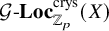 $\mathcal {G}\text {-}\mathbf {Loc}^{\mathrm {crys}}_{\mathbb {Z}_p}(X)$
such that
$\mathcal {G}\text {-}\mathbf {Loc}^{\mathrm {crys}}_{\mathbb {Z}_p}(X)$
such that $\omega (\Lambda _0)$
has prismatically good reduction. Write
$\omega (\Lambda _0)$
has prismatically good reduction. Write $(\mathcal {E}_0,\varphi _{\mathcal {E}_0})$
for the associated object of
$(\mathcal {E}_0,\varphi _{\mathcal {E}_0})$
for the associated object of  and let $(\mathcal {V}_0,\varphi _{\mathcal {V}_0})$
denotes its image in
$(\mathcal {V}_0,\varphi _{\mathcal {V}_0})$
denotes its image in  . As the functor
  is fully faithful, we see that the tensors

obtained from Proposition 2.23 uniquely lift to a set of tensors  . Set
. Set

with the Frobenius structure inherited from  . This is a pseudo-torsor for
  on
on  .
.
Proposition 2.30. The pseudo-torsor $\mathcal {Q}_\omega $
is a torsor.
$\mathcal {Q}_\omega $
is a torsor.
Proof. For any small affine open subset $\operatorname {\mathrm {Spf}}(R)$
of
$\operatorname {\mathrm {Spf}}(R)$
of $\mathfrak {X}$
, set
$\mathfrak {X}$
, set

considered as a pseudo-torsor for $\mathcal {G}$
on
$\mathcal {G}$
on $\operatorname {\mathrm {Spec}}(\mathfrak {S}_R)_{\mathrm {\acute {e}t}}$
. By Corollary 1.16, it suffices to show that
$\operatorname {\mathrm {Spec}}(\mathfrak {S}_R)_{\mathrm {\acute {e}t}}$
. By Corollary 1.16, it suffices to show that $\mathcal {Q}_{\omega ,R}$
is a torsor for all such R. But, the restriction of
$\mathcal {Q}_{\omega ,R}$
is a torsor for all such R. But, the restriction of $\mathcal {Q}_{\omega ,R}$
to
$\mathcal {Q}_{\omega ,R}$
to $U(\mathfrak {S}_R,(E))$
is identified with
$U(\mathfrak {S}_R,(E))$
is identified with

Proposition 2.23 implies that $\mathcal {Q}_{\omega ,R}|_{U(\mathfrak {S}_R,E)}$
is a torsor. As the height of
$\mathcal {Q}_{\omega ,R}|_{U(\mathfrak {S}_R,E)}$
is a torsor. As the height of $(p,E)\subseteq \mathfrak {S}_R$
is
$(p,E)\subseteq \mathfrak {S}_R$
is $2$
and
$2$
and $M_R$
is a vector bundle,
$M_R$
is a vector bundle, $\mathcal {Q}_{\omega ,R}$
is a torsor by Proposition A.28 or Remark A.29.
$\mathcal {Q}_{\omega ,R}$
is a torsor by Proposition A.28 or Remark A.29.
Let $\nu $
be the object of
$\nu $
be the object of  associated to $\mathcal {Q}_\omega $
by Proposition 1.29. We claim that
$\mathcal {Q}_\omega $
by Proposition 1.29. We claim that $T_{\mathrm {\acute {e}t}}\circ \nu $
is isomorphic to
$T_{\mathrm {\acute {e}t}}\circ \nu $
is isomorphic to $\omega $
. But, by Proposition 1.29 it suffices to observe that, by setup, both
$\omega $
. But, by Proposition 1.29 it suffices to observe that, by setup, both $T_{\mathrm {\acute {e}t}}\circ \nu $
and
$T_{\mathrm {\acute {e}t}}\circ \nu $
and $\omega $
have the value
$\omega $
have the value  when evaluated on
  .
.
As a byproduct of the above proof and Theorem A.14 (which implies every faithful representation can be upgraded to a tensor package) we obtain an analogue of Proposition 2.21.
Corollary 2.31. Let $\Lambda $
be a faithful representation of
$\Lambda $
be a faithful representation of $\mathcal {G}$
. Then, an object
$\mathcal {G}$
. Then, an object $\omega $
of
$\omega $
of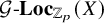 $\mathcal {G}\text {-}\mathbf {Loc}_{\mathbb {Z}_p}(X)$
belongs to
$\mathcal {G}\text {-}\mathbf {Loc}_{\mathbb {Z}_p}(X)$
belongs to 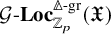 if and only if $\omega (\Lambda )$
is an object of
$\omega (\Lambda )$
is an object of  .
.
Proposition 1.29 and Theorem 2.29 yield an equivalence  which we also denote by $T_{\mathrm {\acute {e}t}}$
(or
$T_{\mathrm {\acute {e}t}}$
(or $T_{\mathfrak {X},\mathrm {\acute {e}t}}$
), which is compatible in
$T_{\mathfrak {X},\mathrm {\acute {e}t}}$
), which is compatible in $\mathfrak {X}$
and
$\mathfrak {X}$
and $\mathcal {G}$
in the obvious way.
$\mathcal {G}$
in the obvious way.
2.5 Complementary results about base
$\mathcal {O}_K$
-algebras

While the proof of Theorem 2.29 was built on the work of [Reference Guo and ReineckeGR24], Proposition 2.30 works more generally, using [Reference KisinKis10, Proposition 1.3.4] and the results of [Reference Du, Liu, Moon and ShimizuDLMS24]. This could potentially be useful in other contexts (e.g., it provides an alternative method to prove some results in [Reference Imai, Kato and YoucisIKY23]).
Let R be a (formally framed) base $\mathcal {O}_K$
-algebra. In [Reference Du, Liu, Moon and ShimizuDLMS24, §4.4],Footnote 11
there is constructed a
$\mathcal {O}_K$
-algebra. In [Reference Du, Liu, Moon and ShimizuDLMS24, §4.4],Footnote 11
there is constructed a $\mathbb {Z}_p$
-linear
$\mathbb {Z}_p$
-linear $\otimes $
-functor
$\otimes $
-functor
 $$ \begin{align*} \mathfrak{M}\colon {\mathbf{Rep}}_{\mathbb{Z}_p}^{\mathrm{crys}}(\Gamma_R)\to \mathbf{Vect}^{\mathrm{an},\varphi}(\mathfrak{S}_R,(E)). \end{align*} $$
Let j denote the inclusion $U(\mathfrak {S}_R,(E))\hookrightarrow \operatorname {\mathrm {Spec}}(\mathfrak {S}_R)$
. We say that a representation
$U(\mathfrak {S}_R,(E))\hookrightarrow \operatorname {\mathrm {Spec}}(\mathfrak {S}_R)$
. We say that a representation $\Lambda $
in
$\Lambda $
in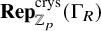 ${\mathbf {Rep}}_{\mathbb {Z}_p}^{\mathrm {crys}}(\Gamma _R)$
has prismatically good reduction if
${\mathbf {Rep}}_{\mathbb {Z}_p}^{\mathrm {crys}}(\Gamma _R)$
has prismatically good reduction if $j_\ast \mathfrak {M}(\Lambda )$
is a vector bundle on
$j_\ast \mathfrak {M}(\Lambda )$
is a vector bundle on $\operatorname {\mathrm {Spec}}(\mathfrak {S}_R)$
.
$\operatorname {\mathrm {Spec}}(\mathfrak {S}_R)$
.
Let us suppose that $\Lambda _0$
carries the structure of an object of
$\Lambda _0$
carries the structure of an object of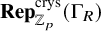 ${\mathbf {Rep}}_{\mathbb {Z}_p}^{\mathrm {crys}}(\Gamma _R)$
. Denote
${\mathbf {Rep}}_{\mathbb {Z}_p}^{\mathrm {crys}}(\Gamma _R)$
. Denote $(\mathfrak {M}(\Lambda _0),\mathfrak {M}(T_0))$
by
$(\mathfrak {M}(\Lambda _0),\mathfrak {M}(T_0))$
by  , and denote the global sections of $j_\ast (\mathfrak {M}(\Lambda _0),\mathfrak {M}(T_0))$
by
$j_\ast (\mathfrak {M}(\Lambda _0),\mathfrak {M}(T_0))$
by  .
.
Proposition 2.32. Consider the following sheaf on $U(\mathfrak {S}_R,(E))_{\mathrm {fpqc}}$
:
$U(\mathfrak {S}_R,(E))_{\mathrm {fpqc}}$
:

Set  . Then $\mathcal {Q}$
is a reflexive pseudo-torsor and if
$\mathcal {Q}$
is a reflexive pseudo-torsor and if $\mathcal {G}$
is reductive, then
$\mathcal {G}$
is reductive, then

and is a $\mathcal {G}$
-torsor on
$\mathcal {G}$
-torsor on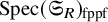 $\operatorname {\mathrm {Spec}}(\mathfrak {S}_R)_{\mathrm {fppf}}$
if and only if
$\operatorname {\mathrm {Spec}}(\mathfrak {S}_R)_{\mathrm {fppf}}$
if and only if $\Lambda _0$
has prismatically good reduction.
$\Lambda _0$
has prismatically good reduction.
Proof. Given Proposition A.27 and Proposition A.28, the latter claims will follow if we can show that $\mathcal {Q}$
is a reflexive pseudo-torsor. As
$\mathcal {Q}$
is a reflexive pseudo-torsor. As $\mathcal {Q}^{\mathrm {an}}$
is clearly affine and finite type over
$\mathcal {Q}^{\mathrm {an}}$
is clearly affine and finite type over $U(\mathfrak {S}_R,E)$
, we further deduce from Proposition A.24 that it suffices to prove
$U(\mathfrak {S}_R,E)$
, we further deduce from Proposition A.24 that it suffices to prove $\mathcal {Q}$
is a torsor after pulled back to all codimension
$\mathcal {Q}$
is a torsor after pulled back to all codimension $1$
points of
$1$
points of $\operatorname {\mathrm {Spec}}(\mathfrak {S}_R)$
.
$\operatorname {\mathrm {Spec}}(\mathfrak {S}_R)$
.
Let $\mathcal {O}_L$
(resp.
$\mathcal {O}_L$
(resp. $\mathcal {O}_{L_0}$
) denote the p-adic completion of the localization
$\mathcal {O}_{L_0}$
) denote the p-adic completion of the localization $R_{(p)}$
(resp.
$R_{(p)}$
(resp. $(R_0)_{(p)}$
). Note that
$(R_0)_{(p)}$
). Note that $\mathcal {O}_L=\mathcal {O}_{L_0}\otimes _W \mathcal {O}_K$
is a base
$\mathcal {O}_L=\mathcal {O}_{L_0}\otimes _W \mathcal {O}_K$
is a base $\mathcal {O}_K$
-algebra, and write
$\mathcal {O}_K$
-algebra, and write $(\mathfrak {S}_L,(E))$
for its Breuil–Kisin prism. Furthermore, let
$(\mathfrak {S}_L,(E))$
for its Breuil–Kisin prism. Furthermore, let $\mathcal {O}_{\mathcal {E}}$
denote the p-adic completion of
$\mathcal {O}_{\mathcal {E}}$
denote the p-adic completion of $\mathfrak {S}_R[u^{-1}]$
. As the morphism
$\mathfrak {S}_R[u^{-1}]$
. As the morphism $\operatorname {\mathrm {Spec}} (\mathfrak {S}_L)\sqcup \operatorname {\mathrm {Spec}}(\mathcal {O}_{\mathcal {E}})\to \operatorname {\mathrm {Spec}} (\mathfrak {S}_R)$
is flat (see [SP, Tag 00MB]) and its image contains all codimension
$\operatorname {\mathrm {Spec}} (\mathfrak {S}_L)\sqcup \operatorname {\mathrm {Spec}}(\mathcal {O}_{\mathcal {E}})\to \operatorname {\mathrm {Spec}} (\mathfrak {S}_R)$
is flat (see [SP, Tag 00MB]) and its image contains all codimension $1$
points, it suffices to show that
$1$
points, it suffices to show that $\mathcal {Q}$
is a
$\mathcal {Q}$
is a $\mathcal {G}$
-torsor on pullback to
$\mathcal {G}$
-torsor on pullback to $\mathfrak {S}_L$
and
$\mathfrak {S}_L$
and $\mathcal {O}_{\mathcal {E}}$
.
$\mathcal {O}_{\mathcal {E}}$
.
To prove the first claim, note that the perfection $\varinjlim _{\phi }\mathcal {O}_{L_0}$
is a discrete valuation ring that is faithfully flat over
$\varinjlim _{\phi }\mathcal {O}_{L_0}$
is a discrete valuation ring that is faithfully flat over $\mathcal {O}_{L_0}$
. In particular, its p-adic completion
$\mathcal {O}_{L_0}$
. In particular, its p-adic completion $\mathcal {O}_{L^{\prime }_0}$
is faithfully flat over
$\mathcal {O}_{L^{\prime }_0}$
is faithfully flat over $\mathcal {O}_{L_0}$
. The ring
$\mathcal {O}_{L_0}$
. The ring  is a complete discrete valuation ring with perfect residue field, and, with notation as above, $\mathfrak {S}_{L'}$
is faithfully flat over
$\mathfrak {S}_{L'}$
is faithfully flat over $\mathfrak {S}_{L}$
. Thus, it suffices to show
$\mathfrak {S}_{L}$
. Thus, it suffices to show $\mathcal {Q}_{\mathfrak {S}_{L'}}$
is a
$\mathcal {Q}_{\mathfrak {S}_{L'}}$
is a $\mathcal {G}$
-torsor. Recall though that
$\mathcal {G}$
-torsor. Recall though that $M\otimes _{\mathfrak {S}_R}\mathfrak {S}_{L'}$
is canonically identified with the (classical) Breuil–Kisin module associated to
$M\otimes _{\mathfrak {S}_R}\mathfrak {S}_{L'}$
is canonically identified with the (classical) Breuil–Kisin module associated to $\rho $
restricted to the absolute Galois group of
$\rho $
restricted to the absolute Galois group of $L'$
as in [Reference KisinKis06] (see [Reference Du, Liu, Moon and ShimizuDLMS24, Lemma 4.18 and Proposition 4.26]). Thus, from [Reference KisinKis10, Proposition 1.3.4] we see that
$L'$
as in [Reference KisinKis06] (see [Reference Du, Liu, Moon and ShimizuDLMS24, Lemma 4.18 and Proposition 4.26]). Thus, from [Reference KisinKis10, Proposition 1.3.4] we see that $\mathcal {Q}(\mathfrak {S}_{L'})$
is nonempty.
$\mathcal {Q}(\mathfrak {S}_{L'})$
is nonempty.
For the second claim, observe that (cf. [Reference Du, Liu, Moon and ShimizuDLMS24, Proposition 4.26]) there is an isomorphism
 $$ \begin{align*} M\otimes_{\mathfrak{S}_R}\widehat{\mathcal{O}}^{\mathrm{ur}}_{\mathcal{E}}\simeq \Lambda_0\otimes_{\mathbb{Z}_p}\widehat{\mathcal{O}}^{\mathrm{ur}}_{\mathcal{E}}, \end{align*} $$
in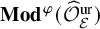 $\mathbf {Mod}^\varphi (\widehat {\mathcal {O}}^{\mathrm {ur}}_{\mathcal {E}})$
, functorial in
$\mathbf {Mod}^\varphi (\widehat {\mathcal {O}}^{\mathrm {ur}}_{\mathcal {E}})$
, functorial in $\Lambda _0$
, where
$\Lambda _0$
, where $\widehat {\mathcal {O}}_{\mathcal {E}}^{\mathrm {ur}}$
is the p-adic completion of a colimit of finite étale extensions
$\widehat {\mathcal {O}}_{\mathcal {E}}^{\mathrm {ur}}$
is the p-adic completion of a colimit of finite étale extensions $\mathcal {O}^{\mathrm {ur}}_{\mathcal {E}}$
of
$\mathcal {O}^{\mathrm {ur}}_{\mathcal {E}}$
of $\mathcal {O}_{\mathcal {E}}$
with compatible extension of
$\mathcal {O}_{\mathcal {E}}$
with compatible extension of $\phi $
(see [Reference Du, Liu, Moon and ShimizuDLMS24, §2.3]). From this functorial isomorphism, we see that
$\phi $
(see [Reference Du, Liu, Moon and ShimizuDLMS24, §2.3]). From this functorial isomorphism, we see that $\mathcal {Q}(\widehat {\mathcal {O}}_{\mathcal {E}}^{\mathrm {ur}})$
is nonempty, and so
$\mathcal {Q}(\widehat {\mathcal {O}}_{\mathcal {E}}^{\mathrm {ur}})$
is nonempty, and so $\mathcal {Q}|_{\mathcal {O}_{\mathcal {E}}}$
is a
$\mathcal {Q}|_{\mathcal {O}_{\mathcal {E}}}$
is a $\mathcal {G}$
-torsor.
$\mathcal {G}$
-torsor.
3 Shtukas and analytic prismatic F-crystals
In this final section we recall the notion of a $\mathcal {G}$
-shtuka on a (formal) scheme and discuss the relationship to (analytic) prismatic
$\mathcal {G}$
-shtuka on a (formal) scheme and discuss the relationship to (analytic) prismatic $\mathcal {G}$
-torsors with F-structure. Any undefined notation and conventions concerning shtukas, their accompanying adic spaces (e.g. the spaces
$\mathcal {G}$
-torsors with F-structure. Any undefined notation and conventions concerning shtukas, their accompanying adic spaces (e.g. the spaces $\mathcal {Y}_I(S)$
), and v-sheaves are as in [Reference Pappas and RapoportPR24, §2].
$\mathcal {Y}_I(S)$
), and v-sheaves are as in [Reference Pappas and RapoportPR24, §2].
Notation 3.1. Fix the following notation:
-
○ k to be a perfect extension of
$\mathbb {F}_p$
, -
○
and , -
○ E is a totally ramified finite extension of
$E_0$
with uniformizer
$\pi $
, -
○
$\overline {E}$
is an algebraic closure of E which induces an algebraic closure
$\overline {k}$
of k, -
○ C denote the p-adic completion of
$\overline {E}$
, -
○
, -
○
$\mathcal {G}$
is a parahoric group
$\mathbb {Z}_p$
-scheme with generic fiber denoted G, -
○
$\boldsymbol {\mu }$
is a conjugacy class of cocharacters of
$G_{\overline {E}}$
with field of definition E over
$E_0$
.

 and
and  ,
,


 ,
,


Remark 3.2. The assumption that $\mathcal {G}$
is parahoric is needed only when bounding the relative position of two lattices by
$\mathcal {G}$
is parahoric is needed only when bounding the relative position of two lattices by $\mathbb \mu $
. Otherwise, everything in this section works under the assumption that
$\mathbb \mu $
. Otherwise, everything in this section works under the assumption that $\mathcal {G}$
is a smooth affine group
$\mathcal {G}$
is a smooth affine group $\mathbb {Z}_p$
-scheme with connected fibers.
$\mathbb {Z}_p$
-scheme with connected fibers.
3.1
$\mathcal {G}$
-shtukas

In this subsection we recall the definition of a $\mathcal {G}$
-shtuka over a (formal)-scheme. We fix notation as in Notation 3.1.
$\mathcal {G}$
-shtuka over a (formal)-scheme. We fix notation as in Notation 3.1.
3.1.1
$\mathcal {G}$
-shtukas over v-sheaves

Denote by $\mathbf {Perf}_k$
the category of affinoid perfectoid spaces
$\mathbf {Perf}_k$
the category of affinoid perfectoid spaces $S=\operatorname {\mathrm {Spa}}(R,R^+)$
with
$S=\operatorname {\mathrm {Spa}}(R,R^+)$
with $R^+$
a k-algebra, endowed with the v-topology. For any v-sheaf
$R^+$
a k-algebra, endowed with the v-topology. For any v-sheaf $\mathcal {F}$
on
$\mathcal {F}$
on $\mathbf {Perf}_k$
we let
$\mathbf {Perf}_k$
we let $\mathbf {Perf}_{\mathcal {F}}$
denote the slice site over
$\mathbf {Perf}_{\mathcal {F}}$
denote the slice site over $\mathcal {F}$
. In other words, an object of
$\mathcal {F}$
. In other words, an object of $\mathbf {Perf}_{\mathcal {F}}$
is a pair
$\mathbf {Perf}_{\mathcal {F}}$
is a pair $(S,\alpha )$
where S is an object of
$(S,\alpha )$
where S is an object of $\mathbf {Perf}_k$
and
$\mathbf {Perf}_k$
and $\alpha \colon S\to \mathcal {F}$
is a morphism, a morphism
$\alpha \colon S\to \mathcal {F}$
is a morphism, a morphism $(S_1,\alpha _1)\to (S_2,\alpha _2)$
is a map
$(S_1,\alpha _1)\to (S_2,\alpha _2)$
is a map $f\colon S_1\to S$
such that
$f\colon S_1\to S$
such that $\alpha _2\circ f=\alpha _1$
, and such a map is a v-cover if f is.
$\alpha _2\circ f=\alpha _1$
, and such a map is a v-cover if f is.
Recall that if $\mathscr {X}$
is a pre-adic space over
$\mathscr {X}$
is a pre-adic space over $\mathcal {O}_E$
, then
$\mathcal {O}_E$
, then $\mathscr {X}^\lozenge $
is the v-sheaf on
$\mathscr {X}^\lozenge $
is the v-sheaf on $\mathbf {Perf}_k$
associating to S the set of pairs
$\mathbf {Perf}_k$
associating to S the set of pairs $(S^\sharp ,f)$
where
$(S^\sharp ,f)$
where $S^\sharp $
is an untilt of S and
$S^\sharp $
is an untilt of S and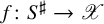 $f\colon S^\sharp \to \mathscr {X}$
is a morphism of adic spaces. This construction is functorial in
$f\colon S^\sharp \to \mathscr {X}$
is a morphism of adic spaces. This construction is functorial in $\mathscr {X}$
. We shorten the slice site
$\mathscr {X}$
. We shorten the slice site $\mathbf {Perf}_{\mathscr {X}^\lozenge }$
to
$\mathbf {Perf}_{\mathscr {X}^\lozenge }$
to $\mathbf {Perf}_{\mathscr {X}}$
and further to
$\mathbf {Perf}_{\mathscr {X}}$
and further to $\mathbf {Perf}_A$
if
$\mathbf {Perf}_A$
if $\mathscr {X}=\operatorname {\mathrm {Spa}}(A)$
. We observe that objects of
$\mathscr {X}=\operatorname {\mathrm {Spa}}(A)$
. We observe that objects of $\mathbf {Perf}_{\mathscr {X}}$
can be interpreted as pairs
$\mathbf {Perf}_{\mathscr {X}}$
can be interpreted as pairs $(S^\sharp ,f)$
where
$(S^\sharp ,f)$
where $S^\sharp $
is a perfectoid space over
$S^\sharp $
is a perfectoid space over $\mathcal {O}_E$
, and
$\mathcal {O}_E$
, and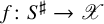 $f\colon S^\sharp \to \mathscr {X}$
is an
$f\colon S^\sharp \to \mathscr {X}$
is an $\mathcal {O}_E$
-morphism, and we often use this interpretation without comment.
$\mathcal {O}_E$
-morphism, and we often use this interpretation without comment.
Let us denote by
 $$ \begin{align*} \mathbf{Sht}\colon \mathbf{Perf}_{\mathcal{O}_E}\to \mathbf{Grpd},\quad \mathcal{G}\text{-}\mathbf{Sht}\colon \mathbf{Perf}_{\mathcal{O}_E}\to \mathbf{Grpd},\quad \mathcal{G}\text{-}\mathbf{Sht}_{\boldsymbol{\mu}}\colon \mathbf{Perf}_{\mathcal{O}_E}\to \mathbf{Grpd} \end{align*} $$
the v-stacks associating to $(S,S^\sharp ,\beta )$
the groupoid of shtukas over S with a single leg at
$(S,S^\sharp ,\beta )$
the groupoid of shtukas over S with a single leg at $S^\sharp $
, the groupoid of
$S^\sharp $
, the groupoid of $\mathcal {G}$
-shtukas over S with a single leg at
$\mathcal {G}$
-shtukas over S with a single leg at $S^\sharp $
, and the groupoid of
$S^\sharp $
, and the groupoid of $\mathcal {G}$
-shtukas over S with a single leg at
$\mathcal {G}$
-shtukas over S with a single leg at $S^\sharp $
bounded by
$S^\sharp $
bounded by $\boldsymbol {\mu }$
, respectively, as in [Reference Pappas and RapoportPR24, Definition 2.4.3].
$\boldsymbol {\mu }$
, respectively, as in [Reference Pappas and RapoportPR24, Definition 2.4.3].
Definition 3.3 [Reference Pappas and RapoportPR24, Definition 2.3.1]
For a v-sheaf $\mathcal {F}$
on
$\mathcal {F}$
on $\mathbf {Perf}_{\mathcal {O}_E}$
and
$\mathbf {Perf}_{\mathcal {O}_E}$
and $\mathscr {S}$
an element of
$\mathscr {S}$
an element of $\{\mathbf {Sht},\mathcal {G}\text {-}\mathbf {Sht},\mathcal {G}\text {-}\mathbf {Sht}_{\boldsymbol {\mu }}\}$
, we define
$\{\mathbf {Sht},\mathcal {G}\text {-}\mathbf {Sht},\mathcal {G}\text {-}\mathbf {Sht}_{\boldsymbol {\mu }}\}$
, we define $\mathscr {S}(\mathcal {F})$
to be the groupoid of maps of v-stacks
$\mathscr {S}(\mathcal {F})$
to be the groupoid of maps of v-stacks $\mathcal {F}\to \mathscr {S}$
.
$\mathcal {F}\to \mathscr {S}$
.
Equivalently, each $\mathscr {S}$
as in Definition 3.3 defines a natural stack
$\mathscr {S}$
as in Definition 3.3 defines a natural stack $p_{\mathcal {F}}\colon \mathscr {S}\to \mathbf {Perf}_{\mathcal {F}}$
and the groupoid
$p_{\mathcal {F}}\colon \mathscr {S}\to \mathbf {Perf}_{\mathcal {F}}$
and the groupoid $\mathscr {S}(\mathcal {F})$
may be identified with the groupoid of Cartesian sections of
$\mathscr {S}(\mathcal {F})$
may be identified with the groupoid of Cartesian sections of $p_{\mathcal {F}}$
(cf. [SP, Tag 07IV]). In other words, an object of
$p_{\mathcal {F}}$
(cf. [SP, Tag 07IV]). In other words, an object of $\mathscr {S}(\mathcal {F})$
as a functorial rule associating to each
$\mathscr {S}(\mathcal {F})$
as a functorial rule associating to each $(S,\alpha )$
in
$(S,\alpha )$
in $\mathbf {Perf}_{\mathcal {F}}$
an object of
$\mathbf {Perf}_{\mathcal {F}}$
an object of $\mathscr {S}(S,\alpha ')$
where
$\mathscr {S}(S,\alpha ')$
where $\alpha '$
is the composition
$\alpha '$
is the composition $S\xrightarrow {\alpha }\mathcal {F}\xrightarrow {\text {structure}}\operatorname {\mathrm {Spd}}(\mathcal {O}_E)$
. We treat these interpretations as interchangeable below.
$S\xrightarrow {\alpha }\mathcal {F}\xrightarrow {\text {structure}}\operatorname {\mathrm {Spd}}(\mathcal {O}_E)$
. We treat these interpretations as interchangeable below.
Remark 3.4. Let $\mathscr {S}$
be a v-stack on
$\mathscr {S}$
be a v-stack on $\mathbf {Perf}_{\mathcal {O}_E}$
. Then, one can naturally form the left Kan extension
$\mathbf {Perf}_{\mathcal {O}_E}$
. Then, one can naturally form the left Kan extension $\mathscr {S}\colon \mathbf {PSh}(\mathbf {Perf}_{\mathcal {O}_E})\to \mathbf {Grpd}$
, since
$\mathscr {S}\colon \mathbf {PSh}(\mathbf {Perf}_{\mathcal {O}_E})\to \mathbf {Grpd}$
, since $\mathbf {Grpd}$
is
$\mathbf {Grpd}$
is $2$
-complete. Concretely,
$2$
-complete. Concretely,

The above notions of shtuka-like objects on v-sheaves are a special case of this construction, as $\mathscr {S}$
commutes with
$\mathscr {S}$
commutes with $2$
-limits, and
$2$
-limits, and $\displaystyle \mathcal {F}=\lim _{S\to \mathcal {F}}S$
(e.g., see [SGA4-1, Exposé I, 3.4.0]). This is related to the interpretation as Cartesian sections via the Grothendieck construction.
$\displaystyle \mathcal {F}=\lim _{S\to \mathcal {F}}S$
(e.g., see [SGA4-1, Exposé I, 3.4.0]). This is related to the interpretation as Cartesian sections via the Grothendieck construction.
We call an object of $\mathbf {Sht}(\mathcal {F})$
,
$\mathbf {Sht}(\mathcal {F})$
, $\mathcal {G}\text {-}\mathbf {Sht}(\mathcal {F})$
,
$\mathcal {G}\text {-}\mathbf {Sht}(\mathcal {F})$
, $\mathcal {G}\text {-}\mathbf {Sht}_{\boldsymbol {\mu }}(\mathcal {F})$
a shtuka over
$\mathcal {G}\text {-}\mathbf {Sht}_{\boldsymbol {\mu }}(\mathcal {F})$
a shtuka over $\mathcal {F}$
, a
$\mathcal {F}$
, a $\mathcal {G}$
-shtuka over
$\mathcal {G}$
-shtuka over $\mathcal {F}$
, and a
$\mathcal {F}$
, and a $\mathcal {G}$
-shtuka over
$\mathcal {G}$
-shtuka over $\mathcal {F}$
bounded by
$\mathcal {F}$
bounded by $\mu $
, respectively. These groupoids are evidently
$\mu $
, respectively. These groupoids are evidently $2$
-functorial in
$2$
-functorial in $\mathcal {F}$
, and in fact form stacks on
$\mathcal {F}$
, and in fact form stacks on $\mathbf {Sh}(\mathbf {Perf}_{\mathcal {O}_E})$
.
$\mathbf {Sh}(\mathbf {Perf}_{\mathcal {O}_E})$
.
We often write an object of any of these shtuka-like groupoids over $\mathcal {F}$
as
$\mathcal {F}$
as $(\mathscr {P},\varphi _{\mathscr {P}})$
. For an object
$(\mathscr {P},\varphi _{\mathscr {P}})$
. For an object $(S,\alpha )$
of
$(S,\alpha )$
of $\mathbf {Perf}_{\mathcal {O}_E}$
, and an element of
$\mathbf {Perf}_{\mathcal {O}_E}$
, and an element of $\mathcal {F}(S,\alpha )$
(i.e., a morphism
$\mathcal {F}(S,\alpha )$
(i.e., a morphism $(S,\alpha )\to \mathcal {F}$
or, equivalently, an element of
$(S,\alpha )\to \mathcal {F}$
or, equivalently, an element of $\mathbf {Perf}_{\mathcal {F}}$
), we may pull back
$\mathbf {Perf}_{\mathcal {F}}$
), we may pull back $(\mathscr {P},\varphi _{\mathscr {P}})$
to an object over
$(\mathscr {P},\varphi _{\mathscr {P}})$
to an object over $(S,\alpha )$
. We denote this pullback by evaluation, that is, by
$(S,\alpha )$
. We denote this pullback by evaluation, that is, by $(\mathscr {P},\varphi _{\mathscr {P}})(S,\alpha )$
.
$(\mathscr {P},\varphi _{\mathscr {P}})(S,\alpha )$
.
Finally, let us observe that $\mathbf {Sht}(\mathcal {F})$
is actually an exact
$\mathbf {Sht}(\mathcal {F})$
is actually an exact $\mathbb {Z}_p$
-linear
$\mathbb {Z}_p$
-linear $\otimes $
-category. Indeed, for each map
$\otimes $
-category. Indeed, for each map $(S,\alpha )\to \mathcal {F}$
we get a map
$(S,\alpha )\to \mathcal {F}$
we get a map $(S,\alpha ')$
in
$(S,\alpha ')$
in $\mathbf {Perf}_{\mathcal {O}_E}$
which corresponds to a triple
$\mathbf {Perf}_{\mathcal {O}_E}$
which corresponds to a triple $(S,S^\sharp ,\beta )$
. The category
$(S,S^\sharp ,\beta )$
. The category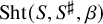 $\operatorname {\mathrm {Sht}}(S,S^\sharp ,\beta )$
is an exact
$\operatorname {\mathrm {Sht}}(S,S^\sharp ,\beta )$
is an exact $\mathbb {Z}_p$
-linear
$\mathbb {Z}_p$
-linear $\otimes $
-category in the usual way as vector bundles on
$\otimes $
-category in the usual way as vector bundles on $S\dot {\times }\operatorname {\mathrm {Spa}}(\mathbb {Z}_p)$
with meromorphic Frobenius away from a fixed locus (i.e.,
$S\dot {\times }\operatorname {\mathrm {Spa}}(\mathbb {Z}_p)$
with meromorphic Frobenius away from a fixed locus (i.e., $S^\sharp \subseteq S\dot {\times }\operatorname {\mathrm {Spa}}(\mathbb {Z}_p)$
). As the morphisms
$S^\sharp \subseteq S\dot {\times }\operatorname {\mathrm {Spa}}(\mathbb {Z}_p)$
). As the morphisms $\operatorname {\mathrm {Sht}}(S,S^\sharp ,\beta )\to \operatorname {\mathrm {Sht}}(S_1 ,S_1^\sharp ,\beta _1)$
are exact
$\operatorname {\mathrm {Sht}}(S,S^\sharp ,\beta )\to \operatorname {\mathrm {Sht}}(S_1 ,S_1^\sharp ,\beta _1)$
are exact $\mathbb {Z}_p$
-linear
$\mathbb {Z}_p$
-linear $\otimes $
-functors for a morphism
$\otimes $
-functors for a morphism $(S_1,S_1^\sharp ,\beta _1)\to (S,S^\sharp ,\beta )$
(exact because exact sequences of vector bundles are universally exact), we see that we may endow
$(S_1,S_1^\sharp ,\beta _1)\to (S,S^\sharp ,\beta )$
(exact because exact sequences of vector bundles are universally exact), we see that we may endow $\mathbf {Sht}(\mathcal {F})$
with the structure of an exact
$\mathbf {Sht}(\mathcal {F})$
with the structure of an exact $\mathbb {Z}_p$
-linear
$\mathbb {Z}_p$
-linear $\otimes $
-category by passing to the
$\otimes $
-category by passing to the $2$
-limit. It’s clear that this structure is functorial in
$2$
-limit. It’s clear that this structure is functorial in $\mathcal {F}$
.
$\mathcal {F}$
.
Remark 3.5. It is evident (cf. [Reference Scholze and WeinsteinSW20, Appendix to Lecture 19]) that, as the notation suggests, $\mathcal {G}\text {-}\mathbf {Sht}(\mathcal {F})$
is the category of
$\mathcal {G}\text {-}\mathbf {Sht}(\mathcal {F})$
is the category of $\mathcal {G}$
-objects in
$\mathcal {G}$
-objects in $\operatorname {\mathrm {Sht}}(\mathcal {F})$
. In particular, there is a natural identification
$\operatorname {\mathrm {Sht}}(\mathcal {F})$
. In particular, there is a natural identification

where the target is the full subgroupoid of shtukas over $\mathcal {F}$
of rank n. We shall make these identifications freely in the sequel.
$\mathcal {F}$
of rank n. We shall make these identifications freely in the sequel.
3.1.2 Some v-sheaves associated to (formal) schemes
We will be mostly interested in studying shtuka-like objects over v-sheaves which are obtained from (formal) schemes. In particular, we recall the following notational definitions.
-
○ If
$\mathscr {X}$
is a locally of finite type E-scheme we shorten
$(\mathscr {X}^{\mathrm {an}})^\lozenge $
to
$\mathscr {X}^\lozenge $
and shorten
$\mathbf {Perf}_{\mathscr {X}^{\mathrm {an}}}$
to
$\mathbf {Perf}_{\mathscr {X}}$
. -
○ If
$\mathscr {X}$
is a locally formally of finite type formal
$\mathcal {O}_E$
-scheme we shorten
$(\mathscr {X}^{\mathrm {ad}})^\lozenge $
to
$\mathscr {X}^\lozenge $
and shorten
$\mathbf {Perf}_{\mathscr {X}^{\mathrm {ad}}}$
to
$\mathbf {Perf}_{\mathscr {X}}$
. -
○ If
$\mathscr {X}$
is a separated locally of finite type
$\mathcal {O}_E$
-scheme then we define (3.1.1)
$$ \begin{align} \mathscr{X}^{\lozenge/}=\widehat{\mathscr{X}}^\lozenge\sqcup_{(\widehat{\mathscr{X}}^\lozenge)_E}(\mathscr{X}_E)^\lozenge. \end{align} $$


In (3.1.1) the morphism $(\widehat {\mathscr {X}}^\lozenge )_E\to (\mathscr {X}_E)^\lozenge $
is the open embedding obtained via the composition
$(\widehat {\mathscr {X}}^\lozenge )_E\to (\mathscr {X}_E)^\lozenge $
is the open embedding obtained via the composition
 $$ \begin{align*} (\widehat{\mathscr{X}}^\lozenge)_E=(\widehat{\mathscr{X}}_E)^\lozenge\xrightarrow{j_{\mathscr{X}}^\lozenge} (\mathscr{X}_E)^\lozenge, \end{align*} $$
where $j_{\mathscr {X}}\colon \widehat {\mathscr {X}}_E\to \mathscr {X}_E^{\mathrm {an}}$
is the open embedding from [Reference HuberHub96, §1.9].
$j_{\mathscr {X}}\colon \widehat {\mathscr {X}}_E\to \mathscr {X}_E^{\mathrm {an}}$
is the open embedding from [Reference HuberHub96, §1.9].
3.1.3 Shtukas over (formal) schemes
With the definitions from §3.1.2, we may import the definitions from §3.1.1.
Definition 3.6. Let $\mathscr {S}$
be an element of
$\mathscr {S}$
be an element of $\{\mathbf {Sht},\mathcal {G}\text {-}\mathbf {Sht},\mathcal {G}\text {-}\mathbf {Sht}_{\boldsymbol {\mu }}\}$
:
$\{\mathbf {Sht},\mathcal {G}\text {-}\mathbf {Sht},\mathcal {G}\text {-}\mathbf {Sht}_{\boldsymbol {\mu }}\}$
:
-
○ if
$\mathscr {X}$
is a locally of finite type E-scheme or a locally of finite type formal
$\mathcal {O}_E$
-scheme, we define , -
○ if
$\mathscr {X}$
is a separated finite type
$\mathcal {O}_E$
-scheme, we define .


 ,
,

 .
.To help contextualize this second definition, we make the following further definition.
Definition 3.7. The category $\mathbf {Tri}(\mathcal {O}_E)$
of gluing triples over
$\mathbf {Tri}(\mathcal {O}_E)$
of gluing triples over $\mathcal {O}_E$
has
$\mathcal {O}_E$
has
-
○ objects of the form
$(X,\mathfrak {X},j)$
with X a separated locally of finite type E-scheme,
$\mathfrak {X}$
a separated locally of finite type flat formal
$\mathcal {O}_E$
-scheme, and
$j\colon \mathfrak {X}_\eta \to X^{\mathrm {an}}$
an open embedding, -
○ morphisms
$(f,g)\colon (X_1,\mathfrak {X}_1,j_1)\to (X_2,\mathfrak {X}_2,j_2)$
with
$f\colon X_1\to X_2$
a morphism of E-schemes and
$g\colon \mathfrak {X}_1\to \mathfrak {X}_2$
a morphism of formal
$\mathcal {O}_E$
-schemes, such that
$f^{\mathrm {an}}\circ j_1=j_2\circ g_\eta $
.








If $\mathscr {X}$
is a separated locally of finite type flat
$\mathscr {X}$
is a separated locally of finite type flat $\mathcal {O}_E$
-scheme, one may functorially associate a gluing triple
$\mathcal {O}_E$
-scheme, one may functorially associate a gluing triple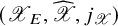 $(\mathscr {X}_E,\widehat {\mathscr {X}},j_{\mathscr {X}})$
. This in particular gives a functor
$(\mathscr {X}_E,\widehat {\mathscr {X}},j_{\mathscr {X}})$
. This in particular gives a functor
 $$ \begin{align} \mathsf{t}\colon \left\{\begin{matrix}\text{Locally of finite type}\\ \text{separated flat }\mathcal{O}_E\text{-schemes}\end{matrix}\right\}\to\mathbf{Tri}(\mathcal{O}_E),\qquad \mathscr{X}\mapsto \mathsf{t}(\mathscr{X})=(\mathscr{X}_E,\widehat{\mathscr{X}},j_{\mathscr{X}}). \end{align} $$
We use $j_{\mathscr {X}}$
to consider
$j_{\mathscr {X}}$
to consider $\widehat {\mathscr {X}}_\eta $
as an open adic subspace of
$\widehat {\mathscr {X}}_\eta $
as an open adic subspace of $\mathscr {X}_E^{\mathrm {an}}$
without comment in the sequel.
$\mathscr {X}_E^{\mathrm {an}}$
without comment in the sequel.
Proposition 3.8. The functor $\mathsf {t}$
is fully faithful.
$\mathsf {t}$
is fully faithful.
Proof. By a standard devissage, we reduce ourselves to the following. Suppose that A is a finite type flat $\mathcal {O}_E$
-algebra. Then, the preimage of
$\mathcal {O}_E$
-algebra. Then, the preimage of $\widehat {A}$
under
$\widehat {A}$
under $A_E\to \widehat {A}_E$
is A. Indeed, writing an element of
$A_E\to \widehat {A}_E$
is A. Indeed, writing an element of $A_E$
as
$A_E$
as $\tfrac {a}{\pi ^k}$
with a in A, by assumption a maps into
$\tfrac {a}{\pi ^k}$
with a in A, by assumption a maps into $\pi ^k\widehat {A}$
and thus a lies in the preimage of
$\pi ^k\widehat {A}$
and thus a lies in the preimage of $\pi ^k\widehat {A}$
which is the kernel of
$\pi ^k\widehat {A}$
which is the kernel of $A\to \widehat {A}\to \widehat {A}/\pi ^k\widehat {A}=A/\pi ^k A$
and so
$A\to \widehat {A}\to \widehat {A}/\pi ^k\widehat {A}=A/\pi ^k A$
and so $\pi ^k A$
. Thus
$\pi ^k A$
. Thus $\tfrac {a}{\pi ^k}$
is in A as desired.
$\tfrac {a}{\pi ^k}$
is in A as desired.
Remark 3.9. See [Reference Achinger and YoucisAY24] for a much stronger version of Proposition 3.8.
Now, fix a gluing triple $(X,\mathfrak {X},j)$
over
$(X,\mathfrak {X},j)$
over $\mathcal {O}_E$
. For
$\mathcal {O}_E$
. For $\mathscr {S}$
any element of
$\mathscr {S}$
any element of $\{\mathbf {Sht},\mathcal {G}\text {-}\mathbf {Sht},\mathcal {G}\text {-}\mathbf {Sht}_{\boldsymbol {\mu }}\}$
we denote by
$\{\mathbf {Sht},\mathcal {G}\text {-}\mathbf {Sht},\mathcal {G}\text {-}\mathbf {Sht}_{\boldsymbol {\mu }}\}$
we denote by $\mathscr {S}(X,\mathfrak {X},j)$
the category of triples
$\mathscr {S}(X,\mathfrak {X},j)$
the category of triples $(s_X,s_{\mathfrak {X}},\gamma )$
where
$(s_X,s_{\mathfrak {X}},\gamma )$
where $s_X$
and
$s_X$
and $s_{\mathfrak {X}}$
are objects of
$s_{\mathfrak {X}}$
are objects of $\mathscr {S}(X)$
and
$\mathscr {S}(X)$
and $\mathscr {S}(\mathfrak {X})$
respectively, and
$\mathscr {S}(\mathfrak {X})$
respectively, and  is an isomorphism in $\mathscr {S}(\mathfrak {X}_\eta )$
, with the obvious notion of morphisms. Then, for a separated finite type
$\mathscr {S}(\mathfrak {X}_\eta )$
, with the obvious notion of morphisms. Then, for a separated finite type $\mathcal {O}_E$
-scheme
$\mathcal {O}_E$
-scheme $\mathscr {X}$
there are natural equivalences
$\mathscr {X}$
there are natural equivalences
 $$ \begin{align} \mathsf{t}\colon \mathscr{S}(\mathscr{X})\to\mathscr{S}(\mathsf{t}(\mathscr{X})) \end{align} $$
functorial in $\mathscr {X}$
. Therefore, we shall often not differentiate between
$\mathscr {X}$
. Therefore, we shall often not differentiate between $\mathscr {S}(\mathscr {X})$
and
$\mathscr {S}(\mathscr {X})$
and $\mathscr {S}(\mathsf {t}(\mathscr {X}))$
below.
$\mathscr {S}(\mathsf {t}(\mathscr {X}))$
below.
3.2
$\mathcal {G}$
-shtukas and local systems

We now recall and elaborate on the relationship between $\mathcal {G}$
-shtukas and
$\mathcal {G}$
-shtukas and $\mathcal {G}$
-objects in de Rham local systems as in [Reference Pappas and RapoportPR24].
$\mathcal {G}$
-objects in de Rham local systems as in [Reference Pappas and RapoportPR24].
3.2.1 Shtukas and
${\mathrm {B}}_{\mathrm {dR}}^+$
-pairs

We begin by elaborating on the relationship between shtukas on ${\mathrm {B}}_{\mathrm {dR}}^+$
-pairs. Throughout the following we fix X to be a locally Noetherian adic space over E.
${\mathrm {B}}_{\mathrm {dR}}^+$
-pairs. Throughout the following we fix X to be a locally Noetherian adic space over E.
Theorem 3.10 [Reference Pappas and RapoportPR24, §2.5.1–§2.5.2]
There is an equivalence of categories

Let us elaborate on the notation on the right-hand side of (3.2.1):
-
○
$\mathbb {P}^\lozenge =\varprojlim (\mathbb {P}/K_n)^\lozenge $
is the diamond associated to
$\mathbb {P}$
as in §2.1.6, -
○
$\mathrm {Gr}_{G,\mathrm {Spd}(E)}$
is the
$\mathrm {B}_{\mathrm {dR}}^+$
-Grassmannian associated to G as in [Reference Fargues and ScholzeFS21, §III.3], -
○ and H is a morphism of v-sheaves over
$\mathrm {Spd}(E)$
.
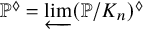


The morphisms in the target category in (3.2.1) are the obvious ones.
Remark 3.11. Although in [Reference Pappas and RapoportPR24], the target category is defined with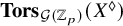 $\mathbf {Tors}_{\mathcal {G}(\mathbb {Z}_p)}(X^\lozenge )$
instead of
$\mathbf {Tors}_{\mathcal {G}(\mathbb {Z}_p)}(X^\lozenge )$
instead of $\mathbf {Tors}_{\mathcal {G}(\mathbb {Z}_p)}(X)$
, these groupoids are equivalent (see Remark 2.10).
$\mathbf {Tors}_{\mathcal {G}(\mathbb {Z}_p)}(X)$
, these groupoids are equivalent (see Remark 2.10).
Remark 3.12. The target category of the functor $\Phi _X$
fits into the Tannakian framework in the following sense. Let
$\Phi _X$
fits into the Tannakian framework in the following sense. Let $S^\sharp $
be an affinoid perfectoid space over E and
$S^\sharp $
be an affinoid perfectoid space over E and 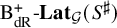 denote the target category. We let
 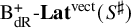 denote the groupoid of triples
  where
where $\mathbb {L}$
is a finite free
$\mathbb {L}$
is a finite free $\mathbb {Z}_p$
-local system on
$\mathbb {Z}_p$
-local system on $S^\sharp $
(or equivalently on the tilt S), M is a finite projective
$S^\sharp $
(or equivalently on the tilt S), M is a finite projective ${\mathrm {B}}_{\mathrm {dR}}^+(S^\sharp )$
-module, and
${\mathrm {B}}_{\mathrm {dR}}^+(S^\sharp )$
-module, and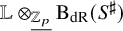 $\mathbb {L}\otimes _{\underline {\mathbb {Z}_p}}{\mathrm {B}}_{\mathrm {dR}}(S^\sharp )$
is the finite projective
$\mathbb {L}\otimes _{\underline {\mathbb {Z}_p}}{\mathrm {B}}_{\mathrm {dR}}(S^\sharp )$
is the finite projective ${\mathrm {B}}_{\mathrm {dR}}(S^\sharp )$
-module constructed as in the beginning of [Reference Scholze and WeinsteinSW20, §22.3]. Then with the notation in Definition A.16, there is an equivalence
${\mathrm {B}}_{\mathrm {dR}}(S^\sharp )$
-module constructed as in the beginning of [Reference Scholze and WeinsteinSW20, §22.3]. Then with the notation in Definition A.16, there is an equivalence

In fact, 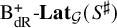 is identified with the groupoid of triples
  where
where $\mathbb {P}$
is an object of
$\mathbb {P}$
is an object of $\mathbf {Tors}_{\underline {\mathcal {G}(\mathbb {Z}_p)}}(S^\sharp )=\mathbf {Tors}_{\underline {\mathcal {G}(\mathbb {Z}_p)}}(S)$
,
$\mathbf {Tors}_{\underline {\mathcal {G}(\mathbb {Z}_p)}}(S^\sharp )=\mathbf {Tors}_{\underline {\mathcal {G}(\mathbb {Z}_p)}}(S)$
, $\mathcal {Q}$
is a G-torsor on
$\mathcal {Q}$
is a G-torsor on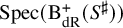 $\operatorname {\mathrm {Spec}}({\mathrm {B}}_{\mathrm {dR}}^+(S^\sharp ))$
, and
$\operatorname {\mathrm {Spec}}({\mathrm {B}}_{\mathrm {dR}}^+(S^\sharp ))$
, and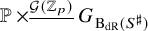 $\mathbb {P}\times ^{\underline {\mathcal {G}(\mathbb {Z}_p)}}G_{{\mathrm {B}}_{\mathrm {dR}}(S^\sharp )}$
denotes the G-torsor on
$\mathbb {P}\times ^{\underline {\mathcal {G}(\mathbb {Z}_p)}}G_{{\mathrm {B}}_{\mathrm {dR}}(S^\sharp )}$
denotes the G-torsor on ${\mathrm {B}}_{\mathrm {dR}}(S^\sharp )$
constructed via [Reference Scholze and WeinsteinSW20, Theorem 22.5.2] (cf. [Reference Fargues and ScholzeFS21, §III.3]).
${\mathrm {B}}_{\mathrm {dR}}(S^\sharp )$
constructed via [Reference Scholze and WeinsteinSW20, Theorem 22.5.2] (cf. [Reference Fargues and ScholzeFS21, §III.3]).
To explain the definition of the functor $\Phi _X$
, begin by fixing an object of
$\Phi _X$
, begin by fixing an object of $S=\operatorname {\mathrm {Spa}}(R,R^+)$
of
$S=\operatorname {\mathrm {Spa}}(R,R^+)$
of $\mathbf {Perf}_k$
as well as an untilt
$\mathbf {Perf}_k$
as well as an untilt $S^\sharp =\operatorname {\mathrm {Spa}}(R^\sharp ,R^{\sharp +})$
over E with
$S^\sharp =\operatorname {\mathrm {Spa}}(R^\sharp ,R^{\sharp +})$
over E with  . Also, for a closed subset Z of a topological space Y and a sheaf $\mathcal {F}$
on Y, we write
$\mathcal {F}$
on Y, we write $\Gamma ^\dagger (Z,\mathcal {F})$
as shorthand for
$\Gamma ^\dagger (Z,\mathcal {F})$
as shorthand for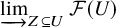 $\varinjlim _{Z\subseteq U}\mathcal {F}(U)$
.
$\varinjlim _{Z\subseteq U}\mathcal {F}(U)$
.
As in [Reference Kedlaya and LiuKL15, Definitions 4.2.2 and 5.1.1], consider the integral Robba ring (over S)

For this last object, we are considering S as a closed Cartier divisor of $S\dot {\times }\mathbb {Z}_p$
in the usual way (see [Reference Fargues and ScholzeFS21, Proposition II.1.4]). We observe that
$S\dot {\times }\mathbb {Z}_p$
in the usual way (see [Reference Fargues and ScholzeFS21, Proposition II.1.4]). We observe that $\widetilde {\mathcal {R}}^{\mathrm {int}}_S$
carries a natural Frobenius morphism, compatible with that on
$\widetilde {\mathcal {R}}^{\mathrm {int}}_S$
carries a natural Frobenius morphism, compatible with that on $S\dot {\times }\mathbb {Z}_p$
. As
$S\dot {\times }\mathbb {Z}_p$
. As $S^\sharp $
does not intersect S we see that we have a functor
$S^\sharp $
does not intersect S we see that we have a functor
 $$ \begin{align*} \mathbf{Sht}_n(S^\sharp)\to \mathbf{Mod}^\varphi(\widetilde{\mathcal{R}}^{\mathrm{int}}_S),\qquad (\mathcal{P},\varphi_{\mathcal{P}})\mapsto (\Gamma^\dagger(S,\mathcal{P}),\varphi_{\mathcal{P}}), \end{align*} $$
where the target is the category of étale $\varphi $
-modules over
$\varphi $
-modules over $\widetilde {\mathcal {R}}^{\mathrm {int}}_S$
(see [Reference Kedlaya and LiuKL15, Definition 6.1.1]).
$\widetilde {\mathcal {R}}^{\mathrm {int}}_S$
(see [Reference Kedlaya and LiuKL15, Definition 6.1.1]).
Denote by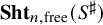 $\mathbf {Sht}_{n,\mathrm {free}}(S^\sharp )$
the full subgroupoid of
$\mathbf {Sht}_{n,\mathrm {free}}(S^\sharp )$
the full subgroupoid of $\mathbf {Sht}_n(S^\sharp )$
consisting of shtukas
$\mathbf {Sht}_n(S^\sharp )$
consisting of shtukas $(\mathcal {P},\varphi _{\mathcal {P}})$
with the property that the associated object of
$(\mathcal {P},\varphi _{\mathcal {P}})$
with the property that the associated object of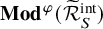 $\mathbf {Mod}^\varphi (\widetilde {\mathcal {R}}^{\mathrm {int}}_S)$
is free (which is called ‘trivial’ in loc. cit.). On the other hand, let
$\mathbf {Mod}^\varphi (\widetilde {\mathcal {R}}^{\mathrm {int}}_S)$
is free (which is called ‘trivial’ in loc. cit.). On the other hand, let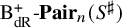 ${\mathrm {B}}_{\mathrm {dR}}^+\text {-}\mathbf {Pair}_n(S^\sharp )$
be the groupoid of pairs
${\mathrm {B}}_{\mathrm {dR}}^+\text {-}\mathbf {Pair}_n(S^\sharp )$
be the groupoid of pairs $(T,\Xi )$
, where T a finite free
$(T,\Xi )$
, where T a finite free $\mathbb {Z}_p$
-module of rank n and,
$\mathbb {Z}_p$
-module of rank n and, $\Xi $
is a
$\Xi $
is a ${\mathrm {B}}_{\mathrm {dR}}^+(S^\sharp )$
-lattice of
${\mathrm {B}}_{\mathrm {dR}}^+(S^\sharp )$
-lattice of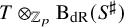 $T\otimes _{\mathbb {Z}_p}{\mathrm {B}}_{\mathrm {dR}}(S^\sharp )$
, with the obvious notion of (iso)morphisms.
$T\otimes _{\mathbb {Z}_p}{\mathrm {B}}_{\mathrm {dR}}(S^\sharp )$
, with the obvious notion of (iso)morphisms.
There is a natural morphism of groupoids
 $$ \begin{align*} \Phi_{S^\sharp}\colon \mathbf{Sht}_{\mathrm{n,free}}(S^\sharp)\to {\mathrm {B}}_{\mathrm{dR}}^+\text{-}\mathbf{Pair}_n(S^\sharp), \qquad (\mathcal{P},\varphi_{\mathcal{P}})\mapsto (T_{\mathcal{P}},\Xi_{\mathcal{P}}). \end{align*} $$
Here  , which is a free $\mathbb {Z}_p$
-module of rank n. Let
$\mathbb {Z}_p$
-module of rank n. Let $\mathcal {P}_{{\mathrm {B}}_{\mathrm {dR}}^+(S^\sharp )}$
denote
$\mathcal {P}_{{\mathrm {B}}_{\mathrm {dR}}^+(S^\sharp )}$
denote $\Gamma (\mathcal {Y}_{[0,1]},\mathcal {P})^\wedge _{\xi }$
, and set
$\Gamma (\mathcal {Y}_{[0,1]},\mathcal {P})^\wedge _{\xi }$
, and set  . Then there is a natural isomorphism

obtained by extending an element of $T_{\mathcal {P}}$
, which is a priori an element of
$T_{\mathcal {P}}$
, which is a priori an element of $\Gamma (\mathcal {Y}_{[0,r]}(S),\mathcal {P})$
for some
$\Gamma (\mathcal {Y}_{[0,r]}(S),\mathcal {P})$
for some $r>0$
, to
$r>0$
, to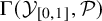 $\Gamma (\mathcal {Y}_{[0,1]},\mathcal {P})$
via
$\Gamma (\mathcal {Y}_{[0,1]},\mathcal {P})$
via $\varphi _{\mathcal {P}}$
(cf. [Reference Scholze and WeinsteinSW20, Corollary 12.4.1]). Set
$\varphi _{\mathcal {P}}$
(cf. [Reference Scholze and WeinsteinSW20, Corollary 12.4.1]). Set $\Xi _{\mathcal {P}}$
to be the
$\Xi _{\mathcal {P}}$
to be the ${\mathrm {B}}_{\mathrm {dR}}^+(S^\sharp )$
-lattice in
${\mathrm {B}}_{\mathrm {dR}}^+(S^\sharp )$
-lattice in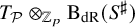 $T_{\mathcal {P}}\otimes _{\mathbb {Z}_p}{\mathrm {B}}_{\mathrm {dR}}(S^\sharp )$
corresponding under (3.2.2) to
$T_{\mathcal {P}}\otimes _{\mathbb {Z}_p}{\mathrm {B}}_{\mathrm {dR}}(S^\sharp )$
corresponding under (3.2.2) to $\varphi _{\mathcal {P}}((\phi ^*\mathcal {P})_{{\mathrm {B}}_{\mathrm {dR}}^+(S^\sharp )})$
where
$\varphi _{\mathcal {P}}((\phi ^*\mathcal {P})_{{\mathrm {B}}_{\mathrm {dR}}^+(S^\sharp )})$
where
 $$ \begin{align*} \varphi_{\mathcal{P}}\colon (\phi^*\mathcal{P})_{{\mathrm{B}}_{\mathrm{dR}}(S^\sharp)}\to \mathcal{P}_{{\mathrm{B}}_{\mathrm{dR}}(S^\sharp)}, \end{align*} $$
is the map induced by the Frobenius structure of $\mathcal {P}$
.
$\mathcal {P}$
.
If an object $(\mathcal {P},\varphi _{\mathcal {P}})$
of
$(\mathcal {P},\varphi _{\mathcal {P}})$
of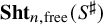 $\mathbf {Sht}_{n,\mathrm {free}}(S^\sharp )$
is obtained by restriction from an object
$\mathbf {Sht}_{n,\mathrm {free}}(S^\sharp )$
is obtained by restriction from an object $(M,\varphi _M)$
of
$(M,\varphi _M)$
of $\mathbf {Vect}^\varphi (W(R^+),(\xi ))$
then we can describe
$\mathbf {Vect}^\varphi (W(R^+),(\xi ))$
then we can describe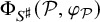 $\Phi _{S^\sharp }(\mathcal {P},\varphi _{\mathcal {P}})$
more concretely. Namely, we have the equality
$\Phi _{S^\sharp }(\mathcal {P},\varphi _{\mathcal {P}})$
more concretely. Namely, we have the equality $T_{\mathcal {P}}=(M\otimes _{W(R^+)}\widetilde {\mathcal {R}}_S^{\mathrm {int}})^{\varphi =1}$
, and
$T_{\mathcal {P}}=(M\otimes _{W(R^+)}\widetilde {\mathcal {R}}_S^{\mathrm {int}})^{\varphi =1}$
, and $\Xi _{\mathcal {P}}$
corresponds under (3.2.2) to the image of the
$\Xi _{\mathcal {P}}$
corresponds under (3.2.2) to the image of the $\mathrm {B}_{\mathrm {dR}}^+(S^\sharp )$
-lattice
$\mathrm {B}_{\mathrm {dR}}^+(S^\sharp )$
-lattice $\phi ^\ast M\otimes _{W(R^+)}{\mathrm {B}}_{\mathrm {dR}}^+(S^\sharp )$
under
$\phi ^\ast M\otimes _{W(R^+)}{\mathrm {B}}_{\mathrm {dR}}^+(S^\sharp )$
under
 $$ \begin{align*} \varphi_M\otimes 1\colon \phi^\ast M\otimes_{W(R^+)}{\mathrm {B}}_{\mathrm{dR}}(S^\sharp)\to M\otimes_{W(R^+)}{\mathrm {B}}_{\mathrm{dR}}(S^\sharp). \end{align*} $$
In any case, we have the following result, which can be proven exactly in the same way as [Reference Scholze and WeinsteinSW20, Proposition 12.4.6], as mentioned in the proof of [Reference Pappas and RapoportPR24, Proposition 2.5.1].
Lemma 3.13 (cf. [Reference Scholze and WeinsteinSW20, Proposition 12.4.6] and [Reference Pappas and RapoportPR24, Proposition 2.5.1])
The functor
 $$ \begin{align*} \Phi_{S^\sharp}\colon \mathbf{Sht}_{n,\mathrm{free}}(S^\sharp)\to {\mathrm {B}}_{\mathrm{dR}}^+\text{-}\mathbf{Pair}_n(S^\sharp), \qquad (\mathcal{P},\varphi_{\mathcal{P}})\mapsto (T_{\mathcal{P}},\Xi_{\mathcal{P}}) \end{align*} $$
is an equivalence.
When $\mathcal {G}=\operatorname {\mathrm {GL}}_{n,\mathbb {Z}_p}$
, the equivalence
$\mathcal {G}=\operatorname {\mathrm {GL}}_{n,\mathbb {Z}_p}$
, the equivalence $\Phi _X$
is then obtained from the observations that
$\Phi _X$
is then obtained from the observations that
-
(a)
$\Phi _{S^\sharp }$
defines a functor on
$\mathbf {Perf}_X$
, -
(b) the source and target are the global sections of the stackification of
$\mathbf {Sht}_{n,\mathrm {free}}$
and for the pro-étale topology, respectively, where here we consider these objects as prestacks on
$\mathbf {Perf}_{X}$
.Footnote 12


 for the pro-étale topology, respectively, where here we consider these objects as prestacks on
The case for general $\mathcal {G}$
is then obtained by applying the Tannakian formalism (see Remarks 3.5 and 3.12).
$\mathcal {G}$
is then obtained by applying the Tannakian formalism (see Remarks 3.5 and 3.12).
Let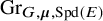 $\operatorname {\mathrm {Gr}}_{G,\boldsymbol {\mu },\operatorname {\mathrm {Spd}}(E)}$
and
$\operatorname {\mathrm {Gr}}_{G,\boldsymbol {\mu },\operatorname {\mathrm {Spd}}(E)}$
and $\operatorname {\mathrm {Gr}}_{G,\leqslant \boldsymbol {\mu },\operatorname {\mathrm {Spd}}(E)}$
be as in [Reference Scholze and WeinsteinSW20, Definition 19.2.2]. Observe that if
$\operatorname {\mathrm {Gr}}_{G,\leqslant \boldsymbol {\mu },\operatorname {\mathrm {Spd}}(E)}$
be as in [Reference Scholze and WeinsteinSW20, Definition 19.2.2]. Observe that if $\boldsymbol {\mu }$
is minuscule, then
$\boldsymbol {\mu }$
is minuscule, then $\operatorname {\mathrm {Gr}}_{G,\boldsymbol {\mu },\operatorname {\mathrm {Spd}}(E)}=\operatorname {\mathrm {Gr}}_{G,\leqslant \boldsymbol {\mu },\operatorname {\mathrm {Spd}}(E)}$
. The following lemma is just an unraveling of the definitions.
$\operatorname {\mathrm {Gr}}_{G,\boldsymbol {\mu },\operatorname {\mathrm {Spd}}(E)}=\operatorname {\mathrm {Gr}}_{G,\leqslant \boldsymbol {\mu },\operatorname {\mathrm {Spd}}(E)}$
. The following lemma is just an unraveling of the definitions.
Lemma 3.14. If $(\mathscr {P},\varphi _{\mathscr {P}})$
is an object of
$(\mathscr {P},\varphi _{\mathscr {P}})$
is an object of $\mathcal {G}\text {-}\mathbf {Sht}(X)$
, and
$\mathcal {G}\text {-}\mathbf {Sht}(X)$
, and $\Phi _X(\mathscr {P},\varphi _{\mathscr {P}})=(\mathbb {P},H)$
, then
$\Phi _X(\mathscr {P},\varphi _{\mathscr {P}})=(\mathbb {P},H)$
, then $(\mathscr {P},\varphi _{\mathscr {P}})$
is an object of
$(\mathscr {P},\varphi _{\mathscr {P}})$
is an object of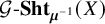 $\mathcal {G}\text {-}\mathbf {Sht}_{\boldsymbol {\mu }^{-1}}(X)$
if and only if H factorizes through
$\mathcal {G}\text {-}\mathbf {Sht}_{\boldsymbol {\mu }^{-1}}(X)$
if and only if H factorizes through $\operatorname {\mathrm {Gr}}_{G,\leqslant \boldsymbol {\mu },\operatorname {\mathrm {Spd}}(E)}$
.
$\operatorname {\mathrm {Gr}}_{G,\leqslant \boldsymbol {\mu },\operatorname {\mathrm {Spd}}(E)}$
.
Proof. Let us begin by observing that as $\operatorname {\mathrm {Gr}}_{G,\leqslant \boldsymbol {\mu },\operatorname {\mathrm {Spd}}(E)}$
is a closed subdiamond of
$\operatorname {\mathrm {Gr}}_{G,\leqslant \boldsymbol {\mu },\operatorname {\mathrm {Spd}}(E)}$
is a closed subdiamond of $\operatorname {\mathrm {Gr}}_{G,\operatorname {\mathrm {Spd}}(E)}$
(see [Reference Scholze and WeinsteinSW20, Proposition 19.2.3]). Thus, H factorizes through
$\operatorname {\mathrm {Gr}}_{G,\operatorname {\mathrm {Spd}}(E)}$
(see [Reference Scholze and WeinsteinSW20, Proposition 19.2.3]). Thus, H factorizes through $\operatorname {\mathrm {Gr}}_{G,\leqslant \boldsymbol {\mu },\operatorname {\mathrm {Spd}}(E)}$
if and only if it does so at the level of points. Moreover, as
$\operatorname {\mathrm {Gr}}_{G,\leqslant \boldsymbol {\mu },\operatorname {\mathrm {Spd}}(E)}$
if and only if it does so at the level of points. Moreover, as $\operatorname {\mathrm {Gr}}_{G,\leqslant \boldsymbol {\mu },\operatorname {\mathrm {Spd}}(E)}$
is closed in
$\operatorname {\mathrm {Gr}}_{G,\leqslant \boldsymbol {\mu },\operatorname {\mathrm {Spd}}(E)}$
is closed in $\operatorname {\mathrm {Gr}}_{G,\operatorname {\mathrm {Spd}}(E)}$
it is partially proper (see [Reference Scholze and WeinsteinSW20, Lemma 19.1.4]), and so we further see that H factorizes through
$\operatorname {\mathrm {Gr}}_{G,\operatorname {\mathrm {Spd}}(E)}$
it is partially proper (see [Reference Scholze and WeinsteinSW20, Lemma 19.1.4]), and so we further see that H factorizes through $\operatorname {\mathrm {Gr}}_{G,\leqslant \boldsymbol {\mu },\operatorname {\mathrm {Spd}}(E)}$
if and only if it does so for points of the form
$\operatorname {\mathrm {Gr}}_{G,\leqslant \boldsymbol {\mu },\operatorname {\mathrm {Spd}}(E)}$
if and only if it does so for points of the form $S^\sharp =\operatorname {\mathrm {Spa}}(C^\sharp ,C^{\sharp \circ })$
with C an algebraically closed perfectoid field. Tracing through the definitions, this means that for trivializations
$S^\sharp =\operatorname {\mathrm {Spa}}(C^\sharp ,C^{\sharp \circ })$
with C an algebraically closed perfectoid field. Tracing through the definitions, this means that for trivializations  and
and  , that the relative position of $\mathscr {P}$
and
$\mathscr {P}$
and $\varphi _{\mathscr {P}}(\phi ^\ast \mathscr {P})$
defines an element of
$\varphi _{\mathscr {P}}(\phi ^\ast \mathscr {P})$
defines an element of $\operatorname {\mathrm {Gr}}_{G,\leqslant \boldsymbol {\mu },\operatorname {\mathrm {Spd}}(E)}(C^\sharp ,C^{\sharp \circ })$
. On the other hand, by definition,
$\operatorname {\mathrm {Gr}}_{G,\leqslant \boldsymbol {\mu },\operatorname {\mathrm {Spd}}(E)}(C^\sharp ,C^{\sharp \circ })$
. On the other hand, by definition, $(\mathscr {P},\varphi _{\mathscr {P}})$
lies in
$(\mathscr {P},\varphi _{\mathscr {P}})$
lies in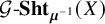 $\mathcal {G}\text {-}\mathbf {Sht}_{\boldsymbol {\mu }^{-1}}(X)$
if and only if for all such
$\mathcal {G}\text {-}\mathbf {Sht}_{\boldsymbol {\mu }^{-1}}(X)$
if and only if for all such $S^\sharp $
and all such trivializations, the relative position of
$S^\sharp $
and all such trivializations, the relative position of $\varphi _{\mathscr {P}}(\phi ^\ast \mathcal {P})$
and
$\varphi _{\mathscr {P}}(\phi ^\ast \mathcal {P})$
and $\mathscr {P}$
defines an element of
$\mathscr {P}$
defines an element of $\operatorname {\mathrm {Gr}}_{G,\leqslant \boldsymbol {\mu }^{-1},\operatorname {\mathrm {Spd}}(E)}(C^\sharp ,C^{\sharp \circ })$
. These are clearly equivalent.
$\operatorname {\mathrm {Gr}}_{G,\leqslant \boldsymbol {\mu }^{-1},\operatorname {\mathrm {Spd}}(E)}(C^\sharp ,C^{\sharp \circ })$
. These are clearly equivalent.
3.2.2 Shtukas associated to de Rham local systems
Let X be a smooth rigid E-space. In [Reference Pappas and RapoportPR24, §2.6.1–§2.6.2] there is constructed a functor
 $$ \begin{align*} U_{\mathrm{sht}}\colon \mathcal{G}\text{-}\mathbf{Loc}_{\mathbb{Z}_p}^{\mathrm{dR}}(X)\to \mathcal{G}\text{-}\mathbf{Sht}(X), \end{align*} $$
which we now recall.
Thanks to Theorem 3.10, it suffices to construct a functor
 $$ \begin{align*} \Phi_X\circ U_{\mathrm{sht}}\colon \mathcal{G}\text{-}\mathbf{Loc}_{\mathbb{Z}_p}^{\mathrm{dR}}(X)\to \left\{(\mathbb{P},H)\colon \begin{aligned}(1) & \,\,\mathbb{P}\text{ is an object of }\mathbf{Tors}_{\mathcal{G}(\mathbb{Z}_p)}(X),\\ (2) & \text{ a }\underline{\mathcal{G}(\mathbb{Z}_p)}\text{-equivariant map }H\colon\mathbb{P}^\lozenge\to \mathrm{Gr}_{G,\mathrm{Spd}(E)}.\end{aligned}\right\}. \end{align*} $$
Further, by employing the Tannakian formalism (see Remark 3.12), we may further assume that $\mathcal {G}=\operatorname {\mathrm {GL}}_{n,\mathbb {Z}_p}$
. In this case, an object of
$\mathcal {G}=\operatorname {\mathrm {GL}}_{n,\mathbb {Z}_p}$
. In this case, an object of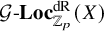 $\mathcal {G}\text {-}\mathbf {Loc}_{\mathbb {Z}_p}^{\mathrm {dR}}(X)$
is nothing but a rank n de Rham local system
$\mathcal {G}\text {-}\mathbf {Loc}_{\mathbb {Z}_p}^{\mathrm {dR}}(X)$
is nothing but a rank n de Rham local system $\mathbb {L}$
on X. Then one defines
$\mathbb {L}$
on X. Then one defines $\Phi _X(U_{\mathrm {sht}}(\mathbb {L}))$
to be
$\Phi _X(U_{\mathrm {sht}}(\mathbb {L}))$
to be $(\mathbb {P}_{\mathbb {L}},H_{\mathbb {L}})$
. Here,
$(\mathbb {P}_{\mathbb {L}},H_{\mathbb {L}})$
. Here, $\mathbb {P}_{\mathbb {L}}=\underline {\operatorname {\mathrm {Isom}}}(\underline {\mathbb {Z}}_p^n,\mathbb {L})$
is the
$\mathbb {P}_{\mathbb {L}}=\underline {\operatorname {\mathrm {Isom}}}(\underline {\mathbb {Z}}_p^n,\mathbb {L})$
is the $\underline {\operatorname {\mathrm {GL}}_n(\mathbb {Z}_p)}$
-torsor as in §2.1.2. Recall, as in §2.3.2, there is a canonical
$\underline {\operatorname {\mathrm {GL}}_n(\mathbb {Z}_p)}$
-torsor as in §2.1.2. Recall, as in §2.3.2, there is a canonical $\mathrm {B}_{\mathrm {dR}}^+$
-equivariant isomorphism
$\mathrm {B}_{\mathrm {dR}}^+$
-equivariant isomorphism

This induces a canonical $\mathrm {B}_{\mathrm {dR}}$
-equivariant isomorphism
$\mathrm {B}_{\mathrm {dR}}$
-equivariant isomorphism

So, from an isomorphism 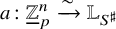 , where $S^\sharp $
is an untilt over X of some S in
$S^\sharp $
is an untilt over X of some S in $\mathbf {Perf}_k$
, we obtain an isomorphism of
$\mathbf {Perf}_k$
, we obtain an isomorphism of ${\mathrm {B}}_{\mathrm {dR}}(S^\sharp )$
-modules
${\mathrm {B}}_{\mathrm {dR}}(S^\sharp )$
-modules

We then set

a ${\mathrm {B}}_{\mathrm {dR}}^+(S^\sharp )$
-lattice in
${\mathrm {B}}_{\mathrm {dR}}^+(S^\sharp )$
-lattice in $\underline {\mathbb {Z}_p}^n(S^\sharp )\otimes _{\underline {\mathbb {Z}_p}(S^\sharp )}{\mathrm {B}}_{\mathrm {dR}}(S^\sharp )$
.
$\underline {\mathbb {Z}_p}^n(S^\sharp )\otimes _{\underline {\mathbb {Z}_p}(S^\sharp )}{\mathrm {B}}_{\mathrm {dR}}(S^\sharp )$
.
Proposition 3.15. Let $\omega $
be an object of
$\omega $
be an object of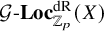 $\mathcal {G}\text {-}\mathbf {Loc}_{\mathbb {Z}_p}^{\mathrm {dR}}(X)$
and write
$\mathcal {G}\text {-}\mathbf {Loc}_{\mathbb {Z}_p}^{\mathrm {dR}}(X)$
and write $\Phi _X(U_{\mathrm {sht}}(\omega ))=(\mathbb {P},H)$
. Then, we have that
$\Phi _X(U_{\mathrm {sht}}(\omega ))=(\mathbb {P},H)$
. Then, we have that $\omega $
belongs to
$\omega $
belongs to $\mathcal {G}\text {-}\mathbf {Loc}^{\mathrm {dR}}_{\mathbb {Z}_p,\boldsymbol {\mu }}$
if and only if H factorizes through
$\mathcal {G}\text {-}\mathbf {Loc}^{\mathrm {dR}}_{\mathbb {Z}_p,\boldsymbol {\mu }}$
if and only if H factorizes through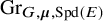 $\operatorname {\mathrm {Gr}}_{G,\boldsymbol {\mu },\operatorname {\mathrm {Spd}}(E)}$
.
$\operatorname {\mathrm {Gr}}_{G,\boldsymbol {\mu },\operatorname {\mathrm {Spd}}(E)}$
.
Proof. Observe that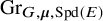 $\operatorname {\mathrm {Gr}}_{G,\boldsymbol {\mu },\operatorname {\mathrm {Spd}}(E)}$
is an open subdiamond of a closed subdiamond of
$\operatorname {\mathrm {Gr}}_{G,\boldsymbol {\mu },\operatorname {\mathrm {Spd}}(E)}$
is an open subdiamond of a closed subdiamond of $\operatorname {\mathrm {Gr}}_{G,\operatorname {\mathrm {Spd}}(E)}$
(see [Reference Scholze and WeinsteinSW20, Proposition 19.2.3]). So, if
$\operatorname {\mathrm {Gr}}_{G,\operatorname {\mathrm {Spd}}(E)}$
(see [Reference Scholze and WeinsteinSW20, Proposition 19.2.3]). So, if $\Phi _X(U_{\mathrm {sht}}(\omega ))=(\mathbb {P},H)$
, then H factorizes through
$\Phi _X(U_{\mathrm {sht}}(\omega ))=(\mathbb {P},H)$
, then H factorizes through $\operatorname {\mathrm {Gr}}_{G,\boldsymbol {\mu },\operatorname {\mathrm {Spd}}(E)}$
if and only if
$\operatorname {\mathrm {Gr}}_{G,\boldsymbol {\mu },\operatorname {\mathrm {Spd}}(E)}$
if and only if $|H|$
factorizes through
$|H|$
factorizes through $|\operatorname {\mathrm {Gr}}_{G,\boldsymbol {\mu },\operatorname {\mathrm {Spd}}(E)}|$
(see [Reference ScholzeSch22, Proposition 12.15]). But, as
$|\operatorname {\mathrm {Gr}}_{G,\boldsymbol {\mu },\operatorname {\mathrm {Spd}}(E)}|$
(see [Reference ScholzeSch22, Proposition 12.15]). But, as $|\mathbb {P}^\lozenge |=|\mathbb {P}|$
(see [Reference ScholzeSch22, Lemma 15.6]), and the projection map
$|\mathbb {P}^\lozenge |=|\mathbb {P}|$
(see [Reference ScholzeSch22, Lemma 15.6]), and the projection map $|\mathbb {P}|\to |X|$
is open (see [Reference ScholzeSch13, Lemma 3.10 (iv)]), so that the preimage of a dense set is dense, we see that H factorizes through
$|\mathbb {P}|\to |X|$
is open (see [Reference ScholzeSch13, Lemma 3.10 (iv)]), so that the preimage of a dense set is dense, we see that H factorizes through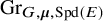 $\operatorname {\mathrm {Gr}}_{G,\boldsymbol {\mu },\operatorname {\mathrm {Spd}}(E)}$
if and only if it does so after restriction to each classical point x. Thus, we may assume that
$\operatorname {\mathrm {Gr}}_{G,\boldsymbol {\mu },\operatorname {\mathrm {Spd}}(E)}$
if and only if it does so after restriction to each classical point x. Thus, we may assume that $X=\operatorname {\mathrm {Spa}}(E)$
. By the Tannakian formalism, we are reduced to the case when
$X=\operatorname {\mathrm {Spa}}(E)$
. By the Tannakian formalism, we are reduced to the case when $\mathcal {G}=\operatorname {\mathrm {GL}}_{n,\mathbb {Z}_p}$
, and we identify
$\mathcal {G}=\operatorname {\mathrm {GL}}_{n,\mathbb {Z}_p}$
, and we identify $\omega $
with its value
$\omega $
with its value $\mathbb {L}$
at the tautological representation. Set T to be
$\mathbb {L}$
at the tautological representation. Set T to be $\mathbb {L}(C,\mathcal {O}_C)$
with its natural Galois action. By definition, H factorizes through
$\mathbb {L}(C,\mathcal {O}_C)$
with its natural Galois action. By definition, H factorizes through $\operatorname {\mathrm {Gr}}_{\operatorname {\mathrm {GL}}_n,\boldsymbol {\mu },\operatorname {\mathrm {Spd}}(E)}(C,\mathcal {O}_C)$
if and only if we can find trivializations
$\operatorname {\mathrm {Gr}}_{\operatorname {\mathrm {GL}}_n,\boldsymbol {\mu },\operatorname {\mathrm {Spd}}(E)}(C,\mathcal {O}_C)$
if and only if we can find trivializations  and
and

such that through the filtered isomorphism

the induced automorphism of $\mathrm {B}_{\mathrm {dR}}(C)^n$
given by the multiplication of an element of the double coset
$\mathrm {B}_{\mathrm {dR}}(C)^n$
given by the multiplication of an element of the double coset $\operatorname {\mathrm {GL}}_n(\mathrm {B}_{\mathrm {dR}}^+(C))\boldsymbol {\mu }(\xi )\operatorname {\mathrm {GL}}_n(\mathrm {B}_{\mathrm {dR}}^+(C))$
. Choose an element
$\operatorname {\mathrm {GL}}_n(\mathrm {B}_{\mathrm {dR}}^+(C))\boldsymbol {\mu }(\xi )\operatorname {\mathrm {GL}}_n(\mathrm {B}_{\mathrm {dR}}^+(C))$
. Choose an element $\mu $
of
$\mu $
of $\boldsymbol {\mu }$
, and write
$\boldsymbol {\mu }$
, and write $\mu (\xi )=(\xi ^{r_1},\ldots ,\xi ^{r_n})$
. Then this condition holds if and only if there exists a
$\mu (\xi )=(\xi ^{r_1},\ldots ,\xi ^{r_n})$
. Then this condition holds if and only if there exists a ${\mathrm {B}}_{\mathrm {dR}}^+(C)$
-basis
${\mathrm {B}}_{\mathrm {dR}}^+(C)$
-basis $(e_\nu )_{\nu =1}^n$
of
$(e_\nu )_{\nu =1}^n$
of $D_{\mathrm {dR}}(T)\otimes _{E}{\mathrm {B}}_{\mathrm {dR}}^+(C)$
such that the filtration
$D_{\mathrm {dR}}(T)\otimes _{E}{\mathrm {B}}_{\mathrm {dR}}^+(C)$
such that the filtration ${\operatorname {\mathrm {Fil}}}^r$
on
${\operatorname {\mathrm {Fil}}}^r$
on $D_{\mathrm {dR}}(T)\otimes _{E}{\mathrm {B}}_{\mathrm {dR}}(C)$
is given by
$D_{\mathrm {dR}}(T)\otimes _{E}{\mathrm {B}}_{\mathrm {dR}}(C)$
is given by ${\operatorname {\mathrm {Fil}}}^r=\sum _{\nu =1}^n\xi ^{r-r_\nu }{\mathrm {B}}_{\mathrm {dR}}^+(C)\cdot e_\nu $
. This is seen to be equivalent
${\operatorname {\mathrm {Fil}}}^r=\sum _{\nu =1}^n\xi ^{r-r_\nu }{\mathrm {B}}_{\mathrm {dR}}^+(C)\cdot e_\nu $
. This is seen to be equivalent $\mathbb {L}$
belonging to
$\mathbb {L}$
belonging to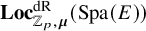 $\mathbf {Loc}_{\mathbb {Z}_p,\boldsymbol {\mu }}^{\mathrm {dR}}(\operatorname {\mathrm {Spa}}(E))$
.
$\mathbf {Loc}_{\mathbb {Z}_p,\boldsymbol {\mu }}^{\mathrm {dR}}(\operatorname {\mathrm {Spa}}(E))$
.
3.3 Analytic prismatic F-crystals and shtukas
We finally come to the shtuka realization functor from analytic prismatic F-crystals on a smooth formal $\mathcal {O}_E$
-scheme and the comparison isomorphism to the functor from §3.2.2, which will allow us to extend this realization functor to the scheme-theoretic setting.
$\mathcal {O}_E$
-scheme and the comparison isomorphism to the functor from §3.2.2, which will allow us to extend this realization functor to the scheme-theoretic setting.
We continue to fix notation as in Notation 3.1.
3.3.1 Prismatic
$\mathcal {G}$
-torsors with F-structure bounded by
$\mu $


We would first like to define a notion of prismatic $\mathcal {G}$
-torsors with F-structure bounded by a cocharacter
$\mathcal {G}$
-torsors with F-structure bounded by a cocharacter $\mu $
that will match the category
$\mu $
that will match the category $\mathcal {G}\text {-}\mathbf {Sht}_{\boldsymbol {\mu }}$
under the shtuka realization functor constructed below.
$\mathcal {G}\text {-}\mathbf {Sht}_{\boldsymbol {\mu }}$
under the shtuka realization functor constructed below.
To this end, temporarily fix the following data:
-
○ k is a perfect field of characteristic p,
-
○
, -
○
$\mathfrak {Y}$
is a quasi-syntomic p-adic formal W-scheme, -
○
$\mu \colon \mathbb {G}_{m,W}\to \mathcal {G}_{W}$
is a minuscule cocharacter.
 ,
,

Let $(A,I)$
be an object of
$(A,I)$
be an object of  . Define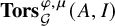 $\mathbf {Tors}^{\varphi ,\mu }_{\mathcal {G}}(A,I)$
to be the full subcategory of
$\mathbf {Tors}^{\varphi ,\mu }_{\mathcal {G}}(A,I)$
to be the full subcategory of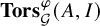 $\mathbf {Tors}_{\mathcal {G}}^\varphi (A,I)$
consisting of
$\mathbf {Tors}_{\mathcal {G}}^\varphi (A,I)$
consisting of $(\mathcal {A},\varphi _{\mathcal {A}})$
such that there exists a
$(\mathcal {A},\varphi _{\mathcal {A}})$
such that there exists a $(p,I)$
-adic faithfully flat cover
$(p,I)$
-adic faithfully flat cover $A\to A'$
such that
$A\to A'$
such that $IA'$
is principal, and there exists a trivialization
$IA'$
is principal, and there exists a trivialization  after restriction to the slice site over $(A',IA')$
such that under this trivialization
$(A',IA')$
such that under this trivialization $\varphi _{\mathcal {A}}$
corresponds to left multiplication by an element of
$\varphi _{\mathcal {A}}$
corresponds to left multiplication by an element of $\mathcal {G}(A')\mu (d)\mathcal {G}(A')$
for some (equiv. for any) generator d of
$\mathcal {G}(A')\mu (d)\mathcal {G}(A')$
for some (equiv. for any) generator d of $IA'$
. Set
$IA'$
. Set

We give the objects of the category the following name.
Definition 3.16. An object of 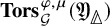 is called a prismatic $\mathcal {G}$
-torsor with F-structure bounded by
$\mathcal {G}$
-torsor with F-structure bounded by $\mu $
on
$\mu $
on $\mathfrak {Y}$
.
$\mathfrak {Y}$
.
We now return to the notation as in Notation 3.1, but assume that $\mathcal {O}_E$
is absolutely unramified. Suppose further that
$\mathcal {O}_E$
is absolutely unramified. Suppose further that $\mathfrak {X}$
is a smooth formal
$\mathfrak {X}$
is a smooth formal $\mathcal {O}_E$
-scheme, with generic fiber X, and let
$\mathcal {O}_E$
-scheme, with generic fiber X, and let $\mu \colon \mathbb {G}_{m,\mathcal {O}_E}\to \mathcal {G}_{\mathcal {O}_E}$
be a minuscule cocharacter with
$\mu \colon \mathbb {G}_{m,\mathcal {O}_E}\to \mathcal {G}_{\mathcal {O}_E}$
be a minuscule cocharacter with $\mu _{\overline {E}}$
an element of our previously fixed conjugacy class
$\mu _{\overline {E}}$
an element of our previously fixed conjugacy class $\boldsymbol {\mu }$
. Let us define
$\boldsymbol {\mu }$
. Let us define 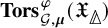 to be the full subcategory of
  consisting of those $(\mathcal {A},\varphi _{\mathcal {A}})$
such that
$(\mathcal {A},\varphi _{\mathcal {A}})$
such that $T_{\mathrm {\acute {e}t}}(\mathcal {A},\varphi _{\mathcal {A}})$
corresponds to an element of
$T_{\mathrm {\acute {e}t}}(\mathcal {A},\varphi _{\mathcal {A}})$
corresponds to an element of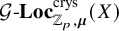 $\mathcal {G}\text {-}\mathbf {Loc}^{\mathrm {crys}}_{\mathbb {Z}_p,\boldsymbol {\mu }}(X)$
. To understand the relationship between
$\mathcal {G}\text {-}\mathbf {Loc}^{\mathrm {crys}}_{\mathbb {Z}_p,\boldsymbol {\mu }}(X)$
. To understand the relationship between 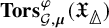 and
and 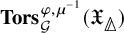 , we make the following observation.
Proposition 3.17. Let $\{\operatorname {\mathrm {Spf}}(R_i)\}$
be an open cover
$\{\operatorname {\mathrm {Spf}}(R_i)\}$
be an open cover $\mathfrak {X}$
with each
$\mathfrak {X}$
with each $R_i$
small. Then, an object
$R_i$
small. Then, an object $(\mathcal {A},\varphi _{\mathcal {A}})$
of
$(\mathcal {A},\varphi _{\mathcal {A}})$
of  lies in
 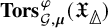 if and only if the following condition holds: for each i there exists an étale cover
  in
in $\mathbf {Perf}_E$
such that
$\mathbf {Perf}_E$
such that $\varphi _{\mathcal {A}}$
on
$\varphi _{\mathcal {A}}$
on $\mathcal {A}({\mathrm {A}}_{\mathrm {inf}}(S^{\sharp +}),\xi _{S^{\sharp +}})$
lies in
$\mathcal {A}({\mathrm {A}}_{\mathrm {inf}}(S^{\sharp +}),\xi _{S^{\sharp +}})$
lies in $G(\mathrm {B}_{\mathrm {dR}}^+(S^\sharp ))\mu ^{-1}(\xi _{S^{\sharp +}})G(\mathrm {B}_{\mathrm {dR}}^+(S^\sharp ))$
.
$G(\mathrm {B}_{\mathrm {dR}}^+(S^\sharp ))\mu ^{-1}(\xi _{S^{\sharp +}})G(\mathrm {B}_{\mathrm {dR}}^+(S^\sharp ))$
.
Proof. Observe that by Lemma 1.15 and Lemma 2.12,  (see §3.1 for notation) is a v-cover, where
 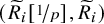 is a perfectoid Huber pair over E (cf. [Reference Bhatt, Morrow and ScholzeBMS18, Lemma 3.21]). Note that $H\colon \mathbb {P}\to \operatorname {\mathrm {Gr}}_{G,\operatorname {\mathrm {Spd}}(E)}$
, where
$H\colon \mathbb {P}\to \operatorname {\mathrm {Gr}}_{G,\operatorname {\mathrm {Spd}}(E)}$
, where $(\mathbb {P},H)=\Phi _X(T_{\mathrm {sht}}(\mathcal {A},\varphi _{\mathcal {A}}))$
, factorizing through
$(\mathbb {P},H)=\Phi _X(T_{\mathrm {sht}}(\mathcal {A},\varphi _{\mathcal {A}}))$
, factorizing through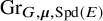 $\operatorname {\mathrm {Gr}}_{G,\boldsymbol {\mu },\operatorname {\mathrm {Spd}}(E)}$
can be checked on a v-cover. The claim is then clear since as
$\operatorname {\mathrm {Gr}}_{G,\boldsymbol {\mu },\operatorname {\mathrm {Spd}}(E)}$
can be checked on a v-cover. The claim is then clear since as $\boldsymbol {\mu }$
is minuscule, one has that
$\boldsymbol {\mu }$
is minuscule, one has that $\operatorname {\mathrm {Gr}}_{G,\boldsymbol {\mu }^{-1},\operatorname {\mathrm {Spd}}(E)}$
is the étale sheafification of
$\operatorname {\mathrm {Gr}}_{G,\boldsymbol {\mu }^{-1},\operatorname {\mathrm {Spd}}(E)}$
is the étale sheafification of
 $$ \begin{align*} (S^\sharp,S^{\sharp+})\mapsto G({\mathrm{B}}_{\mathrm{dR}}^+(S^\sharp))\mu^{-1}(\xi_{S^{\sharp+}})G({\mathrm{B}}_{\mathrm{dR}}^+(S^\sharp))\subseteq G({\mathrm{B}}_{\mathrm{dR}}(S^\sharp))/G({\mathrm{B}}_{\mathrm{dR}}^+(S^\sharp)), \end{align*} $$
a presheaf on $\mathbf {Perf}_E$
.
$\mathbf {Perf}_E$
.
Corollary 3.18. There is a containment  and so, in particular, for $(\mathcal {E},\varphi _{\mathcal {E}})$
in
$(\mathcal {E},\varphi _{\mathcal {E}})$
in 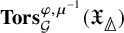 one has that $T_{\mathrm {\acute {e}t}}(\mathcal {E},\varphi _{\mathcal {E}})$
corresponds to an element of
$T_{\mathrm {\acute {e}t}}(\mathcal {E},\varphi _{\mathcal {E}})$
corresponds to an element of $\mathcal {G}\text {-}\mathbf {Loc}^{\mathrm {crys}}_{\mathbb {Z}_p,\boldsymbol {\mu }}(X)$
.
$\mathcal {G}\text {-}\mathbf {Loc}^{\mathrm {crys}}_{\mathbb {Z}_p,\boldsymbol {\mu }}(X)$
.
Remark 3.19. The assumption that $\mathcal {O}_E$
is absolutely unramified is not conceptually necessary, but without it one would be required to work with
$\mathcal {O}_E$
is absolutely unramified is not conceptually necessary, but without it one would be required to work with $\mathcal {O}_E$
-prisms as in [Reference ItoIto25, §2].
$\mathcal {O}_E$
-prisms as in [Reference ItoIto25, §2].
3.3.2 The shtuka realization functor
Let $\mathfrak {X}$
be a smooth formal
$\mathfrak {X}$
be a smooth formal $\mathcal {O}_E$
-scheme. As in [Reference GleasonGle25, Definition 4.6], we call a morphism
$\mathcal {O}_E$
-scheme. As in [Reference GleasonGle25, Definition 4.6], we call a morphism $f\colon \operatorname {\mathrm {Spa}}(R^\sharp ,R^{\sharp +})\to \mathfrak {X}^{\mathrm {ad}}$
, for
$f\colon \operatorname {\mathrm {Spa}}(R^\sharp ,R^{\sharp +})\to \mathfrak {X}^{\mathrm {ad}}$
, for $(\operatorname {\mathrm {Spa}}(R^\sharp ,R^{+\sharp }),\alpha )$
in
$(\operatorname {\mathrm {Spa}}(R^\sharp ,R^{+\sharp }),\alpha )$
in $\mathbf {Perf}_{\mathcal {O}_E}$
, formalizing if
$\mathbf {Perf}_{\mathcal {O}_E}$
, formalizing if $f=g^{\mathrm {ad}}\circ i_R$
where g is some morphism
$f=g^{\mathrm {ad}}\circ i_R$
where g is some morphism $\operatorname {\mathrm {Spf}}(R^{\sharp +})\to \mathfrak {X}$
, and
$\operatorname {\mathrm {Spf}}(R^{\sharp +})\to \mathfrak {X}$
, and $i_R\colon \operatorname {\mathrm {Spa}}(R^{\sharp },R^{\sharp ^+})\to \operatorname {\mathrm {Spa}}(R^{\sharp +})$
is the canonical map. By [Reference GleasonGle25, Proposition 4.17], such a g is unique if it exists. We call g the formalization of f. Set
$i_R\colon \operatorname {\mathrm {Spa}}(R^{\sharp },R^{\sharp ^+})\to \operatorname {\mathrm {Spa}}(R^{\sharp +})$
is the canonical map. By [Reference GleasonGle25, Proposition 4.17], such a g is unique if it exists. We call g the formalization of f. Set $\mathbf {Perf}^+_{\mathfrak {X}}$
to be the full subsite of
$\mathbf {Perf}^+_{\mathfrak {X}}$
to be the full subsite of $\mathbf {Perf}_{\mathfrak {X}}$
consisting of formalizing morphisms
$\mathbf {Perf}_{\mathfrak {X}}$
consisting of formalizing morphisms $f\colon \operatorname {\mathrm {Spa}}(R^\sharp ,R^{\sharp +})\to \mathfrak {X}^{\mathrm {ad}}$
. Evidently,
$f\colon \operatorname {\mathrm {Spa}}(R^\sharp ,R^{\sharp +})\to \mathfrak {X}^{\mathrm {ad}}$
. Evidently, $\mathbf {Perf}^+_{\mathfrak {X}}$
is a basis of
$\mathbf {Perf}^+_{\mathfrak {X}}$
is a basis of $\mathbf {Perf}_{\mathfrak {X}}$
with the analytic (i.e., topological open cover) topology, as can be seen from taking an affine open cover
$\mathbf {Perf}_{\mathfrak {X}}$
with the analytic (i.e., topological open cover) topology, as can be seen from taking an affine open cover $\mathfrak {X}$
.
$\mathfrak {X}$
.
For an object $(S,S^\sharp ,f)$
of
$(S,S^\sharp ,f)$
of $\mathbf {Perf}^+_{\mathfrak {X}}$
, with
$\mathbf {Perf}^+_{\mathfrak {X}}$
, with $S^\sharp =\operatorname {\mathrm {Spa}}(R^\sharp ,R^{\sharp +})$
and g a formalization of f, observe that the triple
$S^\sharp =\operatorname {\mathrm {Spa}}(R^\sharp ,R^{\sharp +})$
and g a formalization of f, observe that the triple $({\mathrm {A}}_{\mathrm {inf}}(R^{\sharp +}),(\xi ),g)$
defines an object of
$({\mathrm {A}}_{\mathrm {inf}}(R^{\sharp +}),(\xi ),g)$
defines an object of  . So,
. So, $\mathcal {A}({\mathrm {A}}_{\mathrm {inf}}(R^{\sharp +}),({\xi }),g)$
defines an object of
$\mathcal {A}({\mathrm {A}}_{\mathrm {inf}}(R^{\sharp +}),({\xi }),g)$
defines an object of $\mathbf {Tors}^{\mathrm {an},\varphi }_{\mathcal {G}}({\mathrm {A}}_{\mathrm {inf}}(R^{\sharp +}),(\xi ))$
. Pulling this back along the map of locally ringed spaces
$\mathbf {Tors}^{\mathrm {an},\varphi }_{\mathcal {G}}({\mathrm {A}}_{\mathrm {inf}}(R^{\sharp +}),(\xi ))$
. Pulling this back along the map of locally ringed spaces $\mathcal {Y}_{[0,\infty )}(S)\to \operatorname {\mathrm {Spec}}(W(R^+))-V(p,\xi )$
, gives a
$\mathcal {Y}_{[0,\infty )}(S)\to \operatorname {\mathrm {Spec}}(W(R^+))-V(p,\xi )$
, gives a $\mathcal {G}$
-shtuka
$\mathcal {G}$
-shtuka $\mathcal {A}_{\mathrm {sht}}(S^\sharp ,f)$
over S with one leg at
$\mathcal {A}_{\mathrm {sht}}(S^\sharp ,f)$
over S with one leg at $S^\sharp $
(cf. [Reference DanielsDan25, §3.1]). It is clear that this construction defines a sheaf on
$S^\sharp $
(cf. [Reference DanielsDan25, §3.1]). It is clear that this construction defines a sheaf on $\mathbf {Perf}^+_{\mathfrak {X}}$
for the analytic topology, and thus extends uniquely to give a section of
$\mathbf {Perf}^+_{\mathfrak {X}}$
for the analytic topology, and thus extends uniquely to give a section of $p_{\mathfrak {X}}$
, and thus an object of
$p_{\mathfrak {X}}$
, and thus an object of $\mathcal {G}\text {-}\mathbf {Sht}(\mathfrak {X})$
.
$\mathcal {G}\text {-}\mathbf {Sht}(\mathfrak {X})$
.
Construction 3.20. Let $\mathfrak {X}$
be a smooth formal
$\mathfrak {X}$
be a smooth formal $\mathcal {O}_E$
-scheme. The functor
$\mathcal {O}_E$
-scheme. The functor

is called the shtuka realization functor, and restricts to a functor

3.3.3 The comparison isomorphism
We now show that the shtuka realization functor $T_{\mathrm {sht}}$
intertwines the étale realization functor from §2.2 and the functor
$T_{\mathrm {sht}}$
intertwines the étale realization functor from §2.2 and the functor $U_{\mathrm {sht}}$
from §3.2.2.
$U_{\mathrm {sht}}$
from §3.2.2.
Let $\mathfrak {X}$
be a smooth formal
$\mathfrak {X}$
be a smooth formal $\mathcal {O}_E$
-scheme and let X be its generic fiber. Recall (see [Reference Guo and ReineckeGR24, Corollary 2.37] and [Reference Tan and TongTT19, Propositions 3.21 and 3.22]) that there is a containment
$\mathcal {O}_E$
-scheme and let X be its generic fiber. Recall (see [Reference Guo and ReineckeGR24, Corollary 2.37] and [Reference Tan and TongTT19, Propositions 3.21 and 3.22]) that there is a containment $\mathbf {Loc}_{\mathbb {Z}_p}^{\mathrm {crys}}(X)\subseteq \mathbf {Loc}_{\mathbb {Z}_p}^{\mathrm {dR}}(X)$
. Thus, associated to an object
$\mathbf {Loc}_{\mathbb {Z}_p}^{\mathrm {crys}}(X)\subseteq \mathbf {Loc}_{\mathbb {Z}_p}^{\mathrm {dR}}(X)$
. Thus, associated to an object $(\mathcal {A},\varphi _{\mathcal {A}})$
of
$(\mathcal {A},\varphi _{\mathcal {A}})$
of 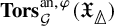 , one may build two ostensibly different shtukas on X: the shtukas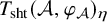 $T_{\mathrm {sht}}(\mathcal {A},\varphi _{\mathcal {A}})_\eta $
and
$T_{\mathrm {sht}}(\mathcal {A},\varphi _{\mathcal {A}})_\eta $
and $U_{\mathrm {sht}}(T_{\mathrm {\acute {e}t}}(\mathcal {A},\varphi _{\mathcal {A}}))$
. The following comparison result says that these are canonically the same.
$U_{\mathrm {sht}}(T_{\mathrm {\acute {e}t}}(\mathcal {A},\varphi _{\mathcal {A}}))$
. The following comparison result says that these are canonically the same.
Theorem 3.21. For an object $(\mathcal {A},\varphi _{\mathcal {A}})$
of
$(\mathcal {A},\varphi _{\mathcal {A}})$
of  , there is a natural identification

functorial in $(\mathcal {A},\varphi _{\mathcal {A}})$
.
$(\mathcal {A},\varphi _{\mathcal {A}})$
.
Proof. By the Tannakian formalism (see Remark 3.5), we are reduced to the case when $\mathcal {G}=\operatorname {\mathrm {GL}}_{n,\mathbb {Z}_p}$
, in which case we identify
$\mathcal {G}=\operatorname {\mathrm {GL}}_{n,\mathbb {Z}_p}$
, in which case we identify $(\mathcal {A},\varphi _{\mathcal {A}})$
with an object
$(\mathcal {A},\varphi _{\mathcal {A}})$
with an object $(\mathcal {E},\varphi _{\mathcal {E}})$
of
$(\mathcal {E},\varphi _{\mathcal {E}})$
of  and write $\mathbb {L}=T_{\mathrm {\acute {e}t}}(\mathcal {E},\varphi _{\mathcal {E}})$
. Consider an object
$\mathbb {L}=T_{\mathrm {\acute {e}t}}(\mathcal {E},\varphi _{\mathcal {E}})$
. Consider an object $S=\operatorname {\mathrm {Spa}}(R,R^+)$
of
$S=\operatorname {\mathrm {Spa}}(R,R^+)$
of $\mathbf {Perf}_k$
and let
$\mathbf {Perf}_k$
and let $(S^\sharp ,f)$
be an element of
$(S^\sharp ,f)$
be an element of $\mathbf {Perf}^+_{\mathfrak {X}}$
where
$\mathbf {Perf}^+_{\mathfrak {X}}$
where $S^\sharp \to \operatorname {\mathrm {Spa}}(\mathcal {O}_E)$
factorizes over
$S^\sharp \to \operatorname {\mathrm {Spa}}(\mathcal {O}_E)$
factorizes over $\operatorname {\mathrm {Spa}}(E)$
. Write
$\operatorname {\mathrm {Spa}}(E)$
. Write $S^\sharp =\operatorname {\mathrm {Spa}}(R^\sharp ,R^{\sharp +})$
. We must show that the shtuka given by
$S^\sharp =\operatorname {\mathrm {Spa}}(R^\sharp ,R^{\sharp +})$
. We must show that the shtuka given by $(\mathcal {E},\varphi _{\mathcal {E}})({\mathrm {A}}_{\mathrm {inf}}(R^{\sharp +}),({\xi }))|_{\mathcal {Y}_{[0,\infty )}(S)}$
and
$(\mathcal {E},\varphi _{\mathcal {E}})({\mathrm {A}}_{\mathrm {inf}}(R^{\sharp +}),({\xi }))|_{\mathcal {Y}_{[0,\infty )}(S)}$
and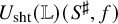 $U_{\mathrm {sht}}(\mathbb {L})(S^\sharp ,f)$
are isomorphic functorially in
$U_{\mathrm {sht}}(\mathbb {L})(S^\sharp ,f)$
are isomorphic functorially in $(S^\sharp ,f)$
.
$(S^\sharp ,f)$
.
By [Reference Guo and ReineckeGR24, Lemma 4.10], it suffices to work only with $(S^\sharp ,f)$
where
$(S^\sharp ,f)$
where $S^\sharp $
belongs to the category
$S^\sharp $
belongs to the category $X^w_{\mathrm {qrsp}}$
from [Reference Guo and ReineckeGR24, Definition 4.9]. In particular, we may assume that both of these shtukas over S lie in
$X^w_{\mathrm {qrsp}}$
from [Reference Guo and ReineckeGR24, Definition 4.9]. In particular, we may assume that both of these shtukas over S lie in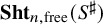 $\mathbf {Sht}_{n,\mathrm {free}}(S^\sharp )$
and so by Lemma 3.13 it suffices to show that they have the same value under
$\mathbf {Sht}_{n,\mathrm {free}}(S^\sharp )$
and so by Lemma 3.13 it suffices to show that they have the same value under $\Phi _{S^{\sharp }}$
. For both
$\Phi _{S^{\sharp }}$
. For both $(\mathcal {E},\varphi _{\mathcal {E}})({\mathrm {A}}_{\mathrm {inf}}(R^{\sharp +}),({\xi }))|_{\mathcal {Y}_{[0,\infty )}(S)}$
and
$(\mathcal {E},\varphi _{\mathcal {E}})({\mathrm {A}}_{\mathrm {inf}}(R^{\sharp +}),({\xi }))|_{\mathcal {Y}_{[0,\infty )}(S)}$
and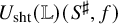 $U_{\mathrm {sht}}(\mathbb {L})(S^\sharp ,f)$
, the underlying free
$U_{\mathrm {sht}}(\mathbb {L})(S^\sharp ,f)$
, the underlying free $\mathbb {Z}_p$
-module is (by definition)
$\mathbb {Z}_p$
-module is (by definition) $T=\mathbb {L}(S^\sharp )$
. We denote by
$T=\mathbb {L}(S^\sharp )$
. We denote by $(T,\Xi _{\mathrm {GR}})$
the
$(T,\Xi _{\mathrm {GR}})$
the $\mathrm {B}_{\mathrm {dR}}^+$
-pair corresponding to the former, and by
$\mathrm {B}_{\mathrm {dR}}^+$
-pair corresponding to the former, and by $(T,\Xi _{\mathrm {dR}})$
the one attached to the latter.
$(T,\Xi _{\mathrm {dR}})$
the one attached to the latter.
The former lattice $\Xi _{\mathrm {GR}}$
is described as follows. By the description of
$\Xi _{\mathrm {GR}}$
is described as follows. By the description of $\Phi _{S^\sharp }$
(before Lemma 3.13), we have
$\Phi _{S^\sharp }$
(before Lemma 3.13), we have $\Xi _{\mathrm {GR}}=\varphi _{\mathcal {E}}((\phi ^*\mathcal {E})_{{\mathrm {B}}_{\mathrm {dR}}^+(S^\sharp )})$
. Observe that we have a commutative diagram of isomorphisms as in the proof of [Reference Guo and ReineckeGR24, Theorem 4.8] (see [Reference Guo and ReineckeGR24, Remark 4.12])
$\Xi _{\mathrm {GR}}=\varphi _{\mathcal {E}}((\phi ^*\mathcal {E})_{{\mathrm {B}}_{\mathrm {dR}}^+(S^\sharp )})$
. Observe that we have a commutative diagram of isomorphisms as in the proof of [Reference Guo and ReineckeGR24, Theorem 4.8] (see [Reference Guo and ReineckeGR24, Remark 4.12])

Thus, we have
 $$ \begin{align*} \Xi_{\mathrm{GR}}=(c_{\mathrm{Fal}}\otimes 1)^{-1}\left(D_{\mathrm{crys}}(\mathbb{L})({\mathrm{A}}_{\mathrm{crys}}(R^{\sharp+})\twoheadrightarrow R^{\sharp+})\otimes_{{\mathrm{A}}_{\mathrm{crys}}(R^{\sharp+})}{\mathrm{B}}_{\mathrm{dR}}^+(S^{\sharp})\right). \end{align*} $$
On the other hand, recall that the lattice $\Xi _{\mathrm {dR}}$
is given by
$\Xi _{\mathrm {dR}}$
is given by
 $$ \begin{align*} \Xi_{\mathrm{dR}}= (c_{\mathrm{Sch}}\otimes 1)^{-1}(D_{\mathrm{dR}}(\mathbb{L})(S^\sharp)\otimes_{S^\sharp}\mathcal{O}{\mathrm{B}}_{\mathrm{dR}}^+(S^\sharp))^{\nabla=0}). \end{align*} $$
Thus, considering the isomorphism

3.3.4 The category of analytic prismatic F-crystals over
$\mathcal {O}_E$
-schemes and shtuka realization

We now define the category of analytic prismatic F-crystals over $\mathcal {O}_E$
-schemes, and use the comparison isomorphism in Theorem 3.21 to obtain a shtuka realization functor also on such objects.
$\mathcal {O}_E$
-schemes, and use the comparison isomorphism in Theorem 3.21 to obtain a shtuka realization functor also on such objects.
Suppose that $\mathscr {X}$
is a separated locally of finite type flat
$\mathscr {X}$
is a separated locally of finite type flat $\mathcal {O}_E$
-scheme with
$\mathcal {O}_E$
-scheme with $\mathscr {X}_E$
smooth.
$\mathscr {X}_E$
smooth.
Definition 3.22. An analytic prismatic F-crystal on $\mathscr {X}$
is a triple
$\mathscr {X}$
is a triple $(\mathcal {F},(\mathcal {V},\varphi _{\mathcal {V}}),\iota )$
where
$(\mathcal {F},(\mathcal {V},\varphi _{\mathcal {V}}),\iota )$
where
-
○
$\mathcal {F}$
is an object of
$\mathbf {Loc}^{\mathrm {dR}}_{\mathbb {Z}_p}(\mathscr {X}_E^{\mathrm {an}})$
, -
○
$(\mathcal {V},\varphi _{\mathcal {V}})$
is an object of , -
○ and
is an isomorphism.

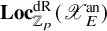

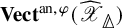 ,
, is an isomorphism.
Call $(\mathcal {F},(\mathcal {V},\varphi _{\mathcal {V}}),\iota )$
a prismatic F-crystal if
$(\mathcal {F},(\mathcal {V},\varphi _{\mathcal {V}}),\iota )$
a prismatic F-crystal if $(\mathcal {V},\varphi _{\mathcal {V}})$
is one.
$(\mathcal {V},\varphi _{\mathcal {V}})$
is one.
A morphism of analytic prismatic F-crystals over $\mathscr {X}$
 $$ \begin{align*} (f,g)\colon (\mathcal{F}',(\mathcal{V}',\varphi_{\mathcal{V}'}),\iota')\to (\mathcal{F},(\mathcal{V},\varphi_{\mathcal{V}}),\iota) \end{align*} $$
consists of a morphism $f\colon \mathcal {F}'\to \mathcal {F}$
as well as a morphism
$f\colon \mathcal {F}'\to \mathcal {F}$
as well as a morphism $g\colon (\mathcal {V}',\varphi _{\mathcal {V}'})\to (\mathcal {V},\varphi _{\mathcal {V}})$
satisfying
$g\colon (\mathcal {V}',\varphi _{\mathcal {V}'})\to (\mathcal {V},\varphi _{\mathcal {V}})$
satisfying $\iota \circ f|_{\widehat {\mathscr {X}}_\eta }=T_{\mathrm {\acute {e}t}}(g)\circ \iota '$
. Denote the category of prismatic F-crystals (resp. analytic prismatic F-crystals) on
$\iota \circ f|_{\widehat {\mathscr {X}}_\eta }=T_{\mathrm {\acute {e}t}}(g)\circ \iota '$
. Denote the category of prismatic F-crystals (resp. analytic prismatic F-crystals) on $\mathscr {X}$
by
$\mathscr {X}$
by 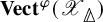 (resp.
  ).Footnote 13
It is evident that
).Footnote 13
It is evident that  carries the structure of an exact $\mathbb {Z}_p$
-linear
$\mathbb {Z}_p$
-linear $\otimes $
-category, where exactness and the notion of tensor product are defined entry-by-entry.
$\otimes $
-category, where exactness and the notion of tensor product are defined entry-by-entry.
The category  of
of $\mathcal {G}$
-objects of analytic prismatic F-crystals on
$\mathcal {G}$
-objects of analytic prismatic F-crystals on $\mathscr {X}$
may be identified with the category of triples
$\mathscr {X}$
may be identified with the category of triples  where
where
-
○
$\omega _{\mathrm {\acute {e}t}}$
is an object of
$\mathcal {G}\text {-}\mathbf {Loc}^{\mathrm {dR}}_{\mathbb {Z}_p}(\mathscr {X}_E^{\mathrm {an}})$
, -
○
is an object of , -
○ and
is an isomorphism,

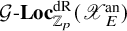
 is an object of
  ,
, is an isomorphism,
and where morphisms are defined similarly to that of analytic prismatic F-crystals over $\mathscr {X}$
. A similar statement holds for
$\mathscr {X}$
. A similar statement holds for  . We define
 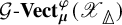 to be the full subgroupoid of
  consisting of those
  such that $\omega _{\mathrm {\acute {e}t}}$
and
$\omega _{\mathrm {\acute {e}t}}$
and  are both of type $\boldsymbol {\mu }$
.
$\boldsymbol {\mu }$
.
Using Theorem 3.21 we can define a shtuka realization functor also in this context.
Construction 3.23. The association

defines a functor

called the shtuka realization functor, which restricts to a functor

A Tannakian formalism of torsors
In this appendix we collect some results concerning torsors and the Tannakian formalism.
A.1 Basic definitions and results
A topos $\mathscr {T}$
is the category of sheaves on a site (as in [SP, Tag 03NH]), with the topology where
$\mathscr {T}$
is the category of sheaves on a site (as in [SP, Tag 03NH]), with the topology where $\{T_i\to T\}$
is a cover if it is a universal effective epimorphism (equiv.
$\{T_i\to T\}$
is a cover if it is a universal effective epimorphism (equiv. $\bigsqcup T_i\to T$
is a surjection of sheaves). Denote the final object of
$\bigsqcup T_i\to T$
is a surjection of sheaves). Denote the final object of $\mathscr {T}$
by
$\mathscr {T}$
by $\ast $
.
$\ast $
.
Fix $\mathcal {G}$
to be a group object of
$\mathcal {G}$
to be a group object of $\mathscr {T}$
. An object P of
$\mathscr {T}$
. An object P of $\mathscr {T}$
equipped with a right action of
$\mathscr {T}$
equipped with a right action of $\mathcal {G}$
is a pseudo-torsor for
$\mathcal {G}$
is a pseudo-torsor for $\mathcal {G}$
if the following morphism is an isomorphism
$\mathcal {G}$
if the following morphism is an isomorphism
 $$ \begin{align*} P\times \mathcal{G}\to P\times P,\qquad (p,g)\mapsto (p,p\cdot g), \end{align*} $$
or, equivalently, $\mathcal {G}(S)$
acts simply transitively on
$\mathcal {G}(S)$
acts simply transitively on $P(S)$
if the latter is nonempty. A pseudo-torsor P is a torsor if
$P(S)$
if the latter is nonempty. A pseudo-torsor P is a torsor if $P\to \ast $
is an epimorphism or, equivalently, P is locally nonempty. Here, we say that an object
$P\to \ast $
is an epimorphism or, equivalently, P is locally nonempty. Here, we say that an object $\mathcal {Q}$
of
$\mathcal {Q}$
of $\mathscr {T}$
is locally nonempty if there exists a cover
$\mathscr {T}$
is locally nonempty if there exists a cover $\{U_i\to \ast \}$
with
$\{U_i\to \ast \}$
with $\mathcal {Q}(U_i)$
nonempty for all i. A morphism of pseudo-torsors for
$\mathcal {Q}(U_i)$
nonempty for all i. A morphism of pseudo-torsors for $\mathcal {G}$
is a
$\mathcal {G}$
is a $\mathcal {G}$
-equivariant morphism in
$\mathcal {G}$
-equivariant morphism in $\mathscr {T}$
, which is automatically an isomorphism if the source is a torsor. A torsor P is trivial, if and only if
$\mathscr {T}$
, which is automatically an isomorphism if the source is a torsor. A torsor P is trivial, if and only if $P(\ast )\ne \varnothing $
.
$P(\ast )\ne \varnothing $
.
Denote the category of pseudo-torsors for $\mathcal {G}$
on
$\mathcal {G}$
on $\mathscr {T}$
by
$\mathscr {T}$
by $\mathbf {PseuTors}_{\mathcal {G}}(\mathscr {T})$
, by
$\mathbf {PseuTors}_{\mathcal {G}}(\mathscr {T})$
, by $\mathbf {Tors}_{\mathcal {G}}(\mathscr {T})$
the full subcategory of torsors, and by
$\mathbf {Tors}_{\mathcal {G}}(\mathscr {T})$
the full subcategory of torsors, and by $H^1(\mathscr {T},\mathcal {G})$
the set of isomorphism classes in
$H^1(\mathscr {T},\mathcal {G})$
the set of isomorphism classes in $\mathbf {Tors}_{\mathcal {G}}(\mathscr {T})$
. For an object T of
$\mathbf {Tors}_{\mathcal {G}}(\mathscr {T})$
. For an object T of $\mathscr {T}$
with localized topos
$\mathscr {T}$
with localized topos $\mathscr {T}/T$
(see [SP, Tag 04GY]), for
$\mathscr {T}/T$
(see [SP, Tag 04GY]), for  we have

(we shorten the target to $\mathbf {Tors}_{\mathcal {G}}(\mathscr {T}/T)$
). The association of
$\mathbf {Tors}_{\mathcal {G}}(\mathscr {T}/T)$
). The association of $\mathbf {Tors}_{\mathcal {G}}(\mathscr {T}/T)$
to T is a stack on
$\mathbf {Tors}_{\mathcal {G}}(\mathscr {T}/T)$
to T is a stack on $\mathscr {T}$
.
$\mathscr {T}$
.
For a $\mathcal {G}$
-torsor P and an object Q of
$\mathcal {G}$
-torsor P and an object Q of $\mathscr {T}$
with a left action of
$\mathscr {T}$
with a left action of $\mathcal {G}$
, we denote by
$\mathcal {G}$
, we denote by $P\wedge ^{\mathcal {G}}Q$
the contracted product obtained as the quotient of
$P\wedge ^{\mathcal {G}}Q$
the contracted product obtained as the quotient of $P\times Q$
by the
$P\times Q$
by the $\mathcal {G}$
-action
$\mathcal {G}$
-action  . For a morphism $f\colon \mathcal {G}\to \mathcal {H}$
of group objects,
$f\colon \mathcal {G}\to \mathcal {H}$
of group objects, $\mathcal {H}$
inherits a left
$\mathcal {H}$
inherits a left $\mathcal {G}$
-action and we have a functor
$\mathcal {G}$
-action and we have a functor

where $\mathcal {H}$
acts on
$\mathcal {H}$
acts on $f_\ast (P)$
in the obvious way (see [Reference GiraudGir71, Chapitre III, Proposition 1.4.6]).
$f_\ast (P)$
in the obvious way (see [Reference GiraudGir71, Chapitre III, Proposition 1.4.6]).
Let $\mathcal {C}$
be a site and set
$\mathcal {C}$
be a site and set  to be its category of sheaves. For an object X of $\mathcal {C}$
denote by
$\mathcal {C}$
denote by $h_X$
the associated representable presheaf and by
$h_X$
the associated representable presheaf and by $h_X^\sharp $
, or just X, its sheafification. We shall freely abuse the identification
$h_X^\sharp $
, or just X, its sheafification. We shall freely abuse the identification  (cf. [SGA4-1, Exposé IV, Corollaire 1.2.1]).
Lemma A.1. Let $\{X_i\}$
be a set of objects of
$\{X_i\}$
be a set of objects of $\mathcal {C}$
and
$\mathcal {C}$
and $\mathcal {A}$
an object of
$\mathcal {A}$
an object of $\mathscr {C}$
. Then, a collection of elements
$\mathscr {C}$
. Then, a collection of elements $f_i$
of
$f_i$
of $\mathcal {A}(X_i)$
corresponds to a cover
$\mathcal {A}(X_i)$
corresponds to a cover $\{h_{X_i}^\sharp \xrightarrow {f_i}\mathcal {A}\}$
if and only if for every object X of
$\{h_{X_i}^\sharp \xrightarrow {f_i}\mathcal {A}\}$
if and only if for every object X of $\mathcal {C}$
and element
$\mathcal {C}$
and element $f\in \mathcal {A}(X)$
there is a cover
$f\in \mathcal {A}(X)$
there is a cover $\{U_j\xrightarrow {g_j} X\}$
so that for all j there is a morphism
$\{U_j\xrightarrow {g_j} X\}$
so that for all j there is a morphism $k_j\colon U_j\to X_i$
with
$k_j\colon U_j\to X_i$
with $f_i\circ k_j=f\circ g_j$
.
$f_i\circ k_j=f\circ g_j$
.
Lemma A.2. Let X be an object of $\mathcal {C}$
, and
$\mathcal {C}$
, and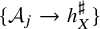 $\{\mathcal {A}_j\to h_X^\sharp \}$
a cover in
$\{\mathcal {A}_j\to h_X^\sharp \}$
a cover in $\mathscr {C}$
. Then, there exists a cover
$\mathscr {C}$
. Then, there exists a cover $\{X_i\to X\}$
in
$\{X_i\to X\}$
in $\mathcal {C}$
such that
$\mathcal {C}$
such that $\{h_{X_i}^\sharp \to h_X^\sharp \}$
refines
$\{h_{X_i}^\sharp \to h_X^\sharp \}$
refines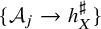 $\{\mathcal {A}_j\to h_X^\sharp \}$
.
$\{\mathcal {A}_j\to h_X^\sharp \}$
.
Set $\mathbf {PseuTors}_{\mathcal {G}}(\mathcal {C})$
to be
$\mathbf {PseuTors}_{\mathcal {G}}(\mathcal {C})$
to be $\mathbf {PseuTors}_{\mathcal {G}}(\mathscr {C})$
, and define
$\mathbf {PseuTors}_{\mathcal {G}}(\mathscr {C})$
, and define $\mathbf {Tors}_{\mathcal {G}}(\mathcal {C})$
and
$\mathbf {Tors}_{\mathcal {G}}(\mathcal {C})$
and $H^1(\mathcal {C},\mathcal {G})$
similarly. By Lemma A.1, an object
$H^1(\mathcal {C},\mathcal {G})$
similarly. By Lemma A.1, an object $\mathcal {A}$
of
$\mathcal {A}$
of $\mathscr {C}$
with right
$\mathscr {C}$
with right $\mathcal {G}$
-action belongs to
$\mathcal {G}$
-action belongs to $\mathbf {PseuTors}_{\mathcal {G}}(\mathcal {C})$
if and only if
$\mathbf {PseuTors}_{\mathcal {G}}(\mathcal {C})$
if and only if $\mathcal {G}(X)$
acts simply transitively on
$\mathcal {G}(X)$
acts simply transitively on $\mathcal {A}(X)$
whenever X is an object of
$\mathcal {A}(X)$
whenever X is an object of $\mathcal {C}$
with
$\mathcal {C}$
with $\mathcal {A}(X)\ne \varnothing $
. By the following lemma an object
$\mathcal {A}(X)\ne \varnothing $
. By the following lemma an object $\mathcal {A}$
of
$\mathcal {A}$
of $\mathbf {PseuTors}_{\mathcal {G}}(\mathcal {C})$
belongs to
$\mathbf {PseuTors}_{\mathcal {G}}(\mathcal {C})$
belongs to $\mathbf {Tors}_{\mathcal {G}}(\mathcal {C})$
if and only if for every object X of
$\mathbf {Tors}_{\mathcal {G}}(\mathcal {C})$
if and only if for every object X of $\mathcal {C}$
, there exists a cover
$\mathcal {C}$
, there exists a cover $\{X_i\to X\}$
in
$\{X_i\to X\}$
in $\mathcal {C}$
with
$\mathcal {C}$
with $\mathcal {A}(X_i)$
nonempty.
$\mathcal {A}(X_i)$
nonempty.
Lemma A.3. An object $\mathcal {A}$
of
$\mathcal {A}$
of $\mathscr {C}$
is locally nonempty if and only if for all objects X of
$\mathscr {C}$
is locally nonempty if and only if for all objects X of $\mathcal {C}$
there exists a cover
$\mathcal {C}$
there exists a cover $\{X_i\to X\}$
in
$\{X_i\to X\}$
in $\mathcal {C}$
with
$\mathcal {C}$
with $\mathcal {A}(X_i)$
nonempty for all i.
$\mathcal {A}(X_i)$
nonempty for all i.
By [Reference GiraudGir71, Chapitre III, 1.7.3.3], for any object X of $\mathcal {C}$
there is a natural identification between
$\mathcal {C}$
there is a natural identification between $\mathbf {Tors}_{\mathcal {G}}(\mathscr {C}/h_X^\sharp )$
and
$\mathbf {Tors}_{\mathcal {G}}(\mathscr {C}/h_X^\sharp )$
and $\mathbf {Tors}_{\mathcal {G}}(\mathcal {C}/X)$
, with
$\mathbf {Tors}_{\mathcal {G}}(\mathcal {C}/X)$
, with $\mathcal {C}/X$
as in [SP, Tag 00XZ]. Thus, these objects are unambiguous in their definition, and so we use the latter notation in practice.
$\mathcal {C}/X$
as in [SP, Tag 00XZ]. Thus, these objects are unambiguous in their definition, and so we use the latter notation in practice.
A.2 Vector bundles and torsors
Let $\mathcal {O}$
be a ring object of a topos
$\mathcal {O}$
be a ring object of a topos $\mathscr {T}$
. A vector bundle on
$\mathscr {T}$
. A vector bundle on $(\mathscr {T},\mathcal {O})$
is an
$(\mathscr {T},\mathcal {O})$
is an $\mathcal {O}$
-module
$\mathcal {O}$
-module $\mathcal {E}$
for which there exists a cover
$\mathcal {E}$
for which there exists a cover $\{U_i\to \ast \}$
with
$\{U_i\to \ast \}$
with $\mathcal {E}|_{U_i}$
isomorphic to
$\mathcal {E}|_{U_i}$
isomorphic to $\mathcal {O}^{n_i}_{U_i}$
for some
$\mathcal {O}^{n_i}_{U_i}$
for some $n_i$
.Footnote 14
Define
$n_i$
.Footnote 14
Define $\mathbf {Vect}(\mathscr {T},\mathcal {O})$
to be the category of vector bundles on
$\mathbf {Vect}(\mathscr {T},\mathcal {O})$
to be the category of vector bundles on $(\mathscr {T},\mathcal {O})$
, and
$(\mathscr {T},\mathcal {O})$
, and $\mathbf {Vect}_n(\mathscr {T},\mathcal {O})$
the full subcategory where
$\mathbf {Vect}_n(\mathscr {T},\mathcal {O})$
the full subcategory where $n_i=n$
for all i. Let
$n_i=n$
for all i. Let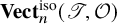 $\mathbf {Vect}^{\mathrm {iso}}_n(\mathscr {T},\mathcal {O})$
be the groupoid with the same objects as
$\mathbf {Vect}^{\mathrm {iso}}_n(\mathscr {T},\mathcal {O})$
be the groupoid with the same objects as $\mathbf {Vect}_n(\mathscr {T},\mathcal {O})$
but with only the isomorphisms as morphisms. If
$\mathbf {Vect}_n(\mathscr {T},\mathcal {O})$
but with only the isomorphisms as morphisms. If $\mathscr {C}=\mathbf {Sh}(\mathcal {C})$
we use the notation
$\mathscr {C}=\mathbf {Sh}(\mathcal {C})$
we use the notation $\mathbf {Vect}(\mathcal {C},\mathcal {O})$
and
$\mathbf {Vect}(\mathcal {C},\mathcal {O})$
and $\mathbf {Vect}_n(\mathcal {C},\mathcal {O})$
, instead.
$\mathbf {Vect}_n(\mathcal {C},\mathcal {O})$
, instead.
Define $\operatorname {\mathrm {GL}}_{n,\mathcal {O}}$
to be the group object of
$\operatorname {\mathrm {GL}}_{n,\mathcal {O}}$
to be the group object of $\mathscr {T}$
given by
$\mathscr {T}$
given by  . Consider
 $$ \begin{align*} \underline{\operatorname{\mathrm{Isom}}}(\mathcal{O}^n,\mathcal{E})\colon \mathscr{T}\to \mathbf{Set},\qquad T\mapsto \operatorname{\mathrm{Isom}}(\mathcal{O}^n_T,\mathcal{E}_T), \end{align*} $$
for $\mathcal {E}$
an object of
$\mathcal {E}$
an object of $\mathbf {Vect}_n(\mathscr {T},\mathcal {O})$
, which carries the natural structure of a
$\mathbf {Vect}_n(\mathscr {T},\mathcal {O})$
, which carries the natural structure of a $\operatorname {\mathrm {GL}}_{n,\mathcal {O}}$
-torsor. Conversely, for a
$\operatorname {\mathrm {GL}}_{n,\mathcal {O}}$
-torsor. Conversely, for a $\operatorname {\mathrm {GL}}_{n,\mathcal {O}}$
-torsor P the contracted product
$\operatorname {\mathrm {GL}}_{n,\mathcal {O}}$
-torsor P the contracted product $P\wedge ^{\operatorname {\mathrm {GL}}_{n,\mathcal {O}}}\mathcal {O}^n$
, which inherits the structure of an
$P\wedge ^{\operatorname {\mathrm {GL}}_{n,\mathcal {O}}}\mathcal {O}^n$
, which inherits the structure of an $\mathcal {O}$
-module from
$\mathcal {O}$
-module from $\mathcal {O}^n$
, is a vector bundle.
$\mathcal {O}^n$
, is a vector bundle.
Proposition A.4 (cf. [Reference GiraudGir71, Chapitre III, Théorème 2.5.1])
The functor
 $$ \begin{align*} \mathbf{Vect}_n^{\mathrm{iso}}(\mathscr{T},\mathcal{O})\to \mathbf{Tors}_{\operatorname{\mathrm{GL}}_{n,\mathcal{O}}}(\mathscr{T}),\qquad \mathcal{E}\mapsto \underline{\operatorname{\mathrm{Isom}}}(\mathcal{E},\mathcal{O}^n) \end{align*} $$
is an equivalence with quasi-inverse given by
 $$ \begin{align*} \mathbf{Tors}_{\operatorname{\mathrm{GL}}_{n,\mathcal{O}}}(\mathscr{T})\to \mathbf{Vect}^{\mathrm{iso}}_n(\mathscr{T},\mathcal{O}),\qquad P\mapsto P\wedge^{\operatorname{\mathrm{GL}}_{n,\mathcal{O}}}\mathcal{O}^n. \end{align*} $$
A.3 Torsors and morphisms of topoi
Let $\mathcal {C}$
(resp.
$\mathcal {C}$
(resp. $\mathcal {D}$
) be a site and set
$\mathcal {D}$
) be a site and set $\mathscr {C}$
(resp.
$\mathscr {C}$
(resp. $\mathscr {D}$
) to be the associated topos. Fix a morphism of topoi
$\mathscr {D}$
) to be the associated topos. Fix a morphism of topoi $(u_\ast ,u^{-1})\colon \mathscr {C}\to \mathscr {D}$
(see [SGA4-1, Exposé IV, Definition 3.1] or [SP, Tag 00XA]) and a group object
$(u_\ast ,u^{-1})\colon \mathscr {C}\to \mathscr {D}$
(see [SGA4-1, Exposé IV, Definition 3.1] or [SP, Tag 00XA]) and a group object $\mathcal {G}$
of
$\mathcal {G}$
of $\mathscr {C}$
. Observe that as
$\mathscr {C}$
. Observe that as $u_\ast $
is left exact it induces a morphism
$u_\ast $
is left exact it induces a morphism
 $$ \begin{align*} u_\ast\colon \mathbf{PseuTors}_{\mathcal{G}}(\mathscr{C})\to \mathbf{PseuTors}_{u_\ast(\mathcal{G})}(\mathscr{D}). \end{align*} $$
On the other hand, if $\mathcal {H}$
is a group object of
$\mathcal {H}$
is a group object of $\mathscr {D}$
then we similarly obtain a functor
$\mathscr {D}$
then we similarly obtain a functor
 $$ \begin{align*} u^{-1}\colon \mathbf{PseuTors}_{\mathcal{H}}(\mathscr{D})\to\mathbf{PseuTors}_{u^{-1}(\mathcal{H})}(\mathscr{C}). \end{align*} $$
When $\mathcal {H}=u_\ast (\mathcal {G})$
, the counit map
$\mathcal {H}=u_\ast (\mathcal {G})$
, the counit map $\epsilon : u^{-1}(u_\ast (\mathcal {G}))\to \mathcal {G}$
gives us a functor
$\epsilon : u^{-1}(u_\ast (\mathcal {G}))\to \mathcal {G}$
gives us a functor
 $$ \begin{align*} \epsilon_\ast\colon \mathbf{PseuTors}_{u^{-1}(u_\ast(\mathcal{G}))}(\mathscr{C})\to \mathbf{PseuTors}_{\mathcal{G}}(\mathscr{C}). \end{align*} $$
By composing these two functors we obtain a functor

We then obtain an adjoint pair $(u_\ast ,u^\ast )\colon \mathbf {PseuTors}_{\mathcal {G}}(\mathscr {C}) \to \mathbf {PseuTors}_{u_\ast (\mathcal {G})}(\mathscr {D})$
.
$(u_\ast ,u^\ast )\colon \mathbf {PseuTors}_{\mathcal {G}}(\mathscr {C}) \to \mathbf {PseuTors}_{u_\ast (\mathcal {G})}(\mathscr {D})$
.
The following result follows quickly by applying the adjointness of $u^\ast $
and
$u^\ast $
and $u_\ast $
.
$u_\ast $
.
Proposition A.5. Suppose that $u^{-1}(\mathcal {B})$
is locally nonempty for all objects
$u^{-1}(\mathcal {B})$
is locally nonempty for all objects $\mathcal {B}$
of
$\mathcal {B}$
of $\mathbf {Tors}_{u_\ast (\mathcal {G})}(\mathscr {D})$
. Then,
$\mathbf {Tors}_{u_\ast (\mathcal {G})}(\mathscr {D})$
. Then, $(u_\ast ,u^\ast )\colon \mathbf {Tors}_{\mathcal {G}}(\mathscr {C})'\to \mathbf {Tors}_{u_\ast (\mathcal {G})}(\mathscr {D})$
is a pair of quasi-inverses, where
$(u_\ast ,u^\ast )\colon \mathbf {Tors}_{\mathcal {G}}(\mathscr {C})'\to \mathbf {Tors}_{u_\ast (\mathcal {G})}(\mathscr {D})$
is a pair of quasi-inverses, where $\mathbf {Tors}_{\mathcal {G}}(\mathscr {C})'$
is the full subcategory of
$\mathbf {Tors}_{\mathcal {G}}(\mathscr {C})'$
is the full subcategory of $\mathbf {Tors}_{\mathcal {G}}(\mathscr {C})$
consisting of those
$\mathbf {Tors}_{\mathcal {G}}(\mathscr {C})$
consisting of those $\mathcal {A}$
such that
$\mathcal {A}$
such that $u_\ast (\mathcal {A})$
is locally nonempty.
$u_\ast (\mathcal {A})$
is locally nonempty.
If $u\colon \mathcal {D}\to \mathcal {C}$
is a continuous functor (see [SGA4-1, Exposé III, Definition 1.1] or [SP, Tag 00WV]) then, by [SP, Tag 00WU] we get an adjoint pair
$u\colon \mathcal {D}\to \mathcal {C}$
is a continuous functor (see [SGA4-1, Exposé III, Definition 1.1] or [SP, Tag 00WV]) then, by [SP, Tag 00WU] we get an adjoint pair $(u_\ast ,u^{-1})\colon \mathscr {C}\to \mathscr {D}$
where
$(u_\ast ,u^{-1})\colon \mathscr {C}\to \mathscr {D}$
where $u_\ast (\mathcal {A})$
is
$u_\ast (\mathcal {A})$
is $\mathcal {A}\circ u$
, and
$\mathcal {A}\circ u$
, and $u^{-1}(\mathcal {B})$
is the sheafification of
$u^{-1}(\mathcal {B})$
is the sheafification of

with $\mathcal {I}^{\mathrm {opp}}_C$
the category of pairs
$\mathcal {I}^{\mathrm {opp}}_C$
the category of pairs $(D,\psi )$
where D is an object of
$(D,\psi )$
where D is an object of $\mathcal {D}$
and
$\mathcal {D}$
and $\psi \colon C\to u(D)$
. If u induces a morphism of sites (i.e., that
$\psi \colon C\to u(D)$
. If u induces a morphism of sites (i.e., that $u^{-1}$
is left exact), then
$u^{-1}$
is left exact), then $(u_\ast ,u^{-1})$
is a morphism of topoi.
$(u_\ast ,u^{-1})$
is a morphism of topoi.
Corollary A.6 (cf. [Reference GiraudGir71, Chapitre V, Proposition 3.1.1])
If $u\colon \mathcal {D}\to \mathcal {C}$
induces a morphism of sites, then we obtain a pair of quasi-inverse functors
$u\colon \mathcal {D}\to \mathcal {C}$
induces a morphism of sites, then we obtain a pair of quasi-inverse functors $(u_\ast ,u^\ast )\colon \mathbf {Tors}_{\mathcal {G}}(\mathscr {C})'\to \mathbf {Tors}_{u_\ast (\mathcal {G})}(\mathscr {D})$
.
$(u_\ast ,u^\ast )\colon \mathbf {Tors}_{\mathcal {G}}(\mathscr {C})'\to \mathbf {Tors}_{u_\ast (\mathcal {G})}(\mathscr {D})$
.
If $u\colon \mathcal {C}\to \mathcal {D}$
is a cocontinuous functor (see [SGA4-1, Exposé III, §2] or [SP, Tag 00XI]), then by [SP, Tag 00XN] u induces a morphism of topoi
$u\colon \mathcal {C}\to \mathcal {D}$
is a cocontinuous functor (see [SGA4-1, Exposé III, §2] or [SP, Tag 00XI]), then by [SP, Tag 00XN] u induces a morphism of topoi $(u_\ast ,u^{-1})\colon \mathscr {C}\to \mathscr {D}$
. Here,
$(u_\ast ,u^{-1})\colon \mathscr {C}\to \mathscr {D}$
. Here, $u^{-1}(\mathcal {B})$
is the sheafification of
$u^{-1}(\mathcal {B})$
is the sheafification of $\mathcal {B}\circ u$
, and
$\mathcal {B}\circ u$
, and
 $$ \begin{align*} u_\ast(\mathcal{A})(D)=\lim_{(C,\psi)\in {}_D \mathcal{I}^{\mathrm{opp}}}\mathcal{A}(C) \end{align*} $$
where ${}_D \mathcal {I}^{\mathrm {opp}}$
is the category of pairs
${}_D \mathcal {I}^{\mathrm {opp}}$
is the category of pairs $(C,\psi )$
where C is an object of
$(C,\psi )$
where C is an object of $\mathcal {C}$
and
$\mathcal {C}$
and $\psi \colon u(C)\to D$
. Combining Proposition A.5 and Lemma A.8 below we obtain the following corollary.
$\psi \colon u(C)\to D$
. Combining Proposition A.5 and Lemma A.8 below we obtain the following corollary.
Corollary A.7. Let $u\colon \mathcal {C}\to \mathcal {D}$
be a cocontinuous functor. Then, for any group object
$u\colon \mathcal {C}\to \mathcal {D}$
be a cocontinuous functor. Then, for any group object $\mathcal {G}$
of
$\mathcal {G}$
of $\mathscr {C}$
we obtain a pair of quasi-inverse functors
$\mathscr {C}$
we obtain a pair of quasi-inverse functors $(u_\ast ,u^\ast )\colon \mathbf {Tors}_{\mathcal {G}}(\mathscr {C})'\to \mathbf {Tors}_{u_\ast (\mathcal {G})}(\mathscr {D})$
.
$(u_\ast ,u^\ast )\colon \mathbf {Tors}_{\mathcal {G}}(\mathscr {C})'\to \mathbf {Tors}_{u_\ast (\mathcal {G})}(\mathscr {D})$
.
Lemma A.8. Let $u\colon \mathcal {C}\to \mathcal {D}$
be a cocontinuous functor. Then, for any locally nonempty object
$u\colon \mathcal {C}\to \mathcal {D}$
be a cocontinuous functor. Then, for any locally nonempty object $\mathcal {B}$
of
$\mathcal {B}$
of $\mathscr {D}$
, the object
$\mathscr {D}$
, the object $u^{-1}(\mathcal {B})$
of
$u^{-1}(\mathcal {B})$
of $\mathscr {C}$
is locally nonempty.
$\mathscr {C}$
is locally nonempty.
Proof. Take a cover $\{\mathcal {B}_i\to \ast \}$
in
$\{\mathcal {B}_i\to \ast \}$
in $\mathscr {D}$
with
$\mathscr {D}$
with $\operatorname {\mathrm {Hom}}(\mathcal {B}_i,\mathcal {B})\ne \varnothing $
for all i, and an arbitrary cover
$\operatorname {\mathrm {Hom}}(\mathcal {B}_i,\mathcal {B})\ne \varnothing $
for all i, and an arbitrary cover $\{h^\sharp _{Z_\gamma }\to *\}$
in
$\{h^\sharp _{Z_\gamma }\to *\}$
in $\mathscr {C}$
. By Lemma A.2, for each
$\mathscr {C}$
. By Lemma A.2, for each $\gamma $
there exists a cover
$\gamma $
there exists a cover $\{D_{\beta \gamma }\to u(Z_\gamma )\}$
in
$\{D_{\beta \gamma }\to u(Z_\gamma )\}$
in $\mathcal {D}$
such that
$\mathcal {D}$
such that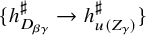 $\{h_{D_{\beta \gamma }}^\sharp \to h_{u(Z_\gamma )}^\sharp \}$
refines
$\{h_{D_{\beta \gamma }}^\sharp \to h_{u(Z_\gamma )}^\sharp \}$
refines $\{\mathcal {B}_i\times h_{u(Z_\gamma )}^\sharp \to h_{u(Z_\gamma )}^\sharp \}$
. By cocontinuity, for each
$\{\mathcal {B}_i\times h_{u(Z_\gamma )}^\sharp \to h_{u(Z_\gamma )}^\sharp \}$
. By cocontinuity, for each $\gamma $
there exists a cover
$\gamma $
there exists a cover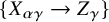 $\{X_{\alpha \gamma }\to Z_\gamma \}$
in
$\{X_{\alpha \gamma }\to Z_\gamma \}$
in $\mathcal {C}$
such that
$\mathcal {C}$
such that $\{u(X_{\alpha \gamma })\to u(Z_\gamma )\}$
refines
$\{u(X_{\alpha \gamma })\to u(Z_\gamma )\}$
refines $\{D_{\beta \gamma }\to u(Z_\gamma )\}$
, and therefore
$\{D_{\beta \gamma }\to u(Z_\gamma )\}$
, and therefore $\mathcal {B}(u(X_{\alpha \gamma }))$
is nonempty, and there is a map
$\mathcal {B}(u(X_{\alpha \gamma }))$
is nonempty, and there is a map $\mathcal {B}(u(X_{\alpha \gamma }))\to u^{-1}(\mathcal {B})(X_{\alpha \gamma })$
, so
$\mathcal {B}(u(X_{\alpha \gamma }))\to u^{-1}(\mathcal {B})(X_{\alpha \gamma })$
, so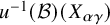 $u^{-1}(\mathcal {B})(X_{\alpha \gamma })$
is nonempty. As
$u^{-1}(\mathcal {B})(X_{\alpha \gamma })$
is nonempty. As $\{h_{X_{\alpha \gamma }}^\sharp \to \ast \}$
is a cover in
$\{h_{X_{\alpha \gamma }}^\sharp \to \ast \}$
is a cover in $\mathscr {C}$
, the claim follows.
$\mathscr {C}$
, the claim follows.
Let $(u_\ast ,u^{-1})\colon \mathscr {C}\to \mathscr {D}$
be a morphism of topoi defined by a (co)continuous functor u. For a ring object
$(u_\ast ,u^{-1})\colon \mathscr {C}\to \mathscr {D}$
be a morphism of topoi defined by a (co)continuous functor u. For a ring object $\mathcal {O}$
of
$\mathcal {O}$
of $\mathscr {C}$
one has an identification
$\mathscr {C}$
one has an identification  . Define $\mathbf {Vect}(\mathscr {C},\mathcal {O})'$
to be the full subcategory of
$\mathbf {Vect}(\mathscr {C},\mathcal {O})'$
to be the full subcategory of $\mathbf {Vect}(\mathscr {C},\mathcal {O})$
of vector bundles
$\mathbf {Vect}(\mathscr {C},\mathcal {O})$
of vector bundles $\mathcal {E}$
with
$\mathcal {E}$
with $u_\ast (\mathcal {E})$
a vector bundle over
$u_\ast (\mathcal {E})$
a vector bundle over $u_\ast (\mathcal {O})$
. Moreover, define the functor
$u_\ast (\mathcal {O})$
. Moreover, define the functor

which is compatible under Proposition A.4 with $u^\ast \colon \mathbf {Tors}_{u_\ast (\operatorname {\mathrm {GL}}_{n,\mathcal {O}})}(\mathscr {D})\to \mathbf {Tors}_{\operatorname {\mathrm {GL}}_{n,\mathcal {O}}}(\mathscr {C})'$
. Using similar ideas to above, one obtains the following.
$u^\ast \colon \mathbf {Tors}_{u_\ast (\operatorname {\mathrm {GL}}_{n,\mathcal {O}})}(\mathscr {D})\to \mathbf {Tors}_{\operatorname {\mathrm {GL}}_{n,\mathcal {O}}}(\mathscr {C})'$
. Using similar ideas to above, one obtains the following.
Proposition A.9. Suppose that $(u_\ast ,u^{-1})\colon \mathscr {C}\to \mathscr {D}$
is a morphism of topoi induced by either continuous or cocontinuous morphism. Then,
$(u_\ast ,u^{-1})\colon \mathscr {C}\to \mathscr {D}$
is a morphism of topoi induced by either continuous or cocontinuous morphism. Then, $u_\ast \colon \mathbf {Vect}(\mathcal {C},\mathcal {O})'\to \mathbf {Vect}(\mathcal {D},u_\ast (\mathcal {O}))$
is a rank preserving
$u_\ast \colon \mathbf {Vect}(\mathcal {C},\mathcal {O})'\to \mathbf {Vect}(\mathcal {D},u_\ast (\mathcal {O}))$
is a rank preserving $\otimes $
-equivalence with quasi-inverse
$\otimes $
-equivalence with quasi-inverse $u^\ast $
(see §A.5 for this terminology).
$u^\ast $
(see §A.5 for this terminology).
A.4 Torsors and vector bundles on formal schemes
Let $\mathfrak {X}$
be a formal scheme, and denote by
$\mathfrak {X}$
be a formal scheme, and denote by $\mathfrak {X}_{\mathrm {fl}}$
the category consisting of morphisms of formal schemes
$\mathfrak {X}_{\mathrm {fl}}$
the category consisting of morphisms of formal schemes $\mathfrak {Y}\to \mathfrak {X}$
, morphisms being
$\mathfrak {Y}\to \mathfrak {X}$
, morphisms being $\mathfrak {X}$
-morphisms, and endowed with the Grothendieck topology where
$\mathfrak {X}$
-morphisms, and endowed with the Grothendieck topology where $\{\mathfrak {Y}_i\to \mathfrak {Y}\}$
is a cover if
$\{\mathfrak {Y}_i\to \mathfrak {Y}\}$
is a cover if $\coprod _i \mathfrak {Y}_i\to \mathfrak {Y}$
is adically faithfully flat (see [Reference Fujiwara and KatoFK18, Chapter I, Definition 4.8.12.(2)]) and finitary in the sense of (2) in [SP, Tag 03NW]. This site is subcanonical by [Reference Fujiwara and KatoFK18, Chapter I, Proposition 6.1.5]. Denote by
$\coprod _i \mathfrak {Y}_i\to \mathfrak {Y}$
is adically faithfully flat (see [Reference Fujiwara and KatoFK18, Chapter I, Definition 4.8.12.(2)]) and finitary in the sense of (2) in [SP, Tag 03NW]. This site is subcanonical by [Reference Fujiwara and KatoFK18, Chapter I, Proposition 6.1.5]. Denote by $\mathfrak {X}^{\mathrm {adic}}_{\mathrm {fl}}$
,
$\mathfrak {X}^{\mathrm {adic}}_{\mathrm {fl}}$
, $\mathfrak {X}_{\mathrm {\acute {e}t}}$
, and
$\mathfrak {X}_{\mathrm {\acute {e}t}}$
, and $\mathfrak {X}_{\mathrm {Zar}}$
the full subcategories of
$\mathfrak {X}_{\mathrm {Zar}}$
the full subcategories of $\mathfrak {X}_{\mathrm {fl}}$
consisting of objects whose structure morphism is adic, étale, and an open embedding, respectively, with the induced topology. Denote by
$\mathfrak {X}_{\mathrm {fl}}$
consisting of objects whose structure morphism is adic, étale, and an open embedding, respectively, with the induced topology. Denote by $\mathfrak {X}_{\mathrm {ZAR}}$
, the full subcategory of
$\mathfrak {X}_{\mathrm {ZAR}}$
, the full subcategory of $\mathfrak {X}_{\mathrm {fl}}$
whose covers are given by Zariski covers. When
$\mathfrak {X}_{\mathrm {fl}}$
whose covers are given by Zariski covers. When $\mathfrak {X}$
is a scheme, we use the notation
$\mathfrak {X}$
is a scheme, we use the notation $\mathfrak {X}_{\mathrm {fpqc}}$
for
$\mathfrak {X}_{\mathrm {fpqc}}$
for $\mathfrak {X}^{\mathrm {adic}}_{\mathrm {fl}}$
. Each of these has a variant consisting only of affine (formal) schemes, but as these variants give rise to the same topos, we often confuse the two. Each of these sites is ringed via the usual structure sheaf (see [Reference Fujiwara and KatoFK18, Chapter I, Proposition 6.1.2]).
$\mathfrak {X}^{\mathrm {adic}}_{\mathrm {fl}}$
. Each of these has a variant consisting only of affine (formal) schemes, but as these variants give rise to the same topos, we often confuse the two. Each of these sites is ringed via the usual structure sheaf (see [Reference Fujiwara and KatoFK18, Chapter I, Proposition 6.1.2]).
Let $\mathcal {G}$
be a smooth affine group (formal)
$\mathcal {G}$
be a smooth affine group (formal) $\mathfrak {X}$
-scheme. As affine adic morphisms satisfy effective descent in
$\mathfrak {X}$
-scheme. As affine adic morphisms satisfy effective descent in $\mathfrak {X}_{\mathrm {fl}}$
(see [Reference Fujiwara and KatoFK18, Chapter I, Corollary 6.1.13]), and smoothness can be checked locally in
$\mathfrak {X}_{\mathrm {fl}}$
(see [Reference Fujiwara and KatoFK18, Chapter I, Corollary 6.1.13]), and smoothness can be checked locally in $\mathfrak {X}_{\mathrm {fl}}$
(see [Reference Fujiwara and KatoFK18, Chapter I, Proposition 6.1.8]) one may observe the following.
$\mathfrak {X}_{\mathrm {fl}}$
(see [Reference Fujiwara and KatoFK18, Chapter I, Proposition 6.1.8]) one may observe the following.
Lemma A.10. A $\mathcal {G}$
-torsor on
$\mathcal {G}$
-torsor on $\mathfrak {X}_{\mathrm {fl}}$
is representable by a smooth and affine surjection
$\mathfrak {X}_{\mathrm {fl}}$
is representable by a smooth and affine surjection $\mathfrak {P}\to \mathfrak {X}$
.
$\mathfrak {P}\to \mathfrak {X}$
.
As smooth surjections have étale local sections, we obtain the following from Corollary A.6, and we denote the common category of $\mathcal {G}$
-torsors on these three sites by
$\mathcal {G}$
-torsors on these three sites by $\mathbf {Tors}_{\mathcal {G}}(\mathfrak {X})$
.
$\mathbf {Tors}_{\mathcal {G}}(\mathfrak {X})$
.
Corollary A.11. The inclusions $\mathfrak {X}_{\mathrm {\acute {e}t}}\to \mathfrak {X}_{\mathrm {fl}}^{\mathrm {adic}} \to \mathfrak {X}_{\mathrm {fl}}$
give equivalences on categories of
$\mathfrak {X}_{\mathrm {\acute {e}t}}\to \mathfrak {X}_{\mathrm {fl}}^{\mathrm {adic}} \to \mathfrak {X}_{\mathrm {fl}}$
give equivalences on categories of $\mathcal {G}$
-torsors.
$\mathcal {G}$
-torsors.
Suppose that R is a ring which is J-adically complete with respect to a finitely generated ideal $J\subseteq R$
. Consider the left exact functor
$J\subseteq R$
. Consider the left exact functor

where $\mathfrak {Y}_n:=(|\mathfrak {Y}|,\mathcal {O}_{\mathfrak {Y}}/J^n\mathcal {O}_{\mathfrak {Y}})$
. If
$\mathfrak {Y}_n:=(|\mathfrak {Y}|,\mathcal {O}_{\mathfrak {Y}}/J^n\mathcal {O}_{\mathfrak {Y}})$
. If $\mathcal {F}$
is a sheaf, then
$\mathcal {F}$
is a sheaf, then $\widehat {\mathcal {F}}$
is a sheaf as the inverse limit functor is left exact. If
$\widehat {\mathcal {F}}$
is a sheaf as the inverse limit functor is left exact. If $\mathcal {F}=h_P$
for a morphism
$\mathcal {F}=h_P$
for a morphism $P\to \operatorname {\mathrm {Spec}}(R)$
, then
$P\to \operatorname {\mathrm {Spec}}(R)$
, then $\widehat {\mathcal {F}}$
is represented by
$\widehat {\mathcal {F}}$
is represented by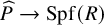 $\widehat {P}\to \operatorname {\mathrm {Spf}}(R)$
.
$\widehat {P}\to \operatorname {\mathrm {Spf}}(R)$
.
Let $\mathcal {G}$
be a smooth affine group R-scheme. Note that
$\mathcal {G}$
be a smooth affine group R-scheme. Note that $\widehat {\mathcal {G}}(\operatorname {\mathrm {Spf}}(S))=\mathcal {G}(\operatorname {\mathrm {Spec}}(S))$
when S is J-adically complete, and we denote this common group by
$\widehat {\mathcal {G}}(\operatorname {\mathrm {Spf}}(S))=\mathcal {G}(\operatorname {\mathrm {Spec}}(S))$
when S is J-adically complete, and we denote this common group by $\mathcal {G}(S)$
, and confuse
$\mathcal {G}(S)$
, and confuse $\mathcal {G}$
and
$\mathcal {G}$
and $\widehat {\mathcal {G}}$
. As
$\widehat {\mathcal {G}}$
. As $\widehat {(-)}$
commutes with products, it naturally sends pseudo-torsors for
$\widehat {(-)}$
commutes with products, it naturally sends pseudo-torsors for $\mathcal {G}$
to pseudo-torsors for
$\mathcal {G}$
to pseudo-torsors for $\widehat {\mathcal {G}}$
. Due to the following, we can unambiguously denote
$\widehat {\mathcal {G}}$
. Due to the following, we can unambiguously denote $\mathbf {Tors}_{\mathcal {G}}(\operatorname {\mathrm {Spf}}(R))$
and
$\mathbf {Tors}_{\mathcal {G}}(\operatorname {\mathrm {Spf}}(R))$
and $\mathbf {Tors}_{\mathcal {G}}(\operatorname {\mathrm {Spec}}(R))$
by the common symbol
$\mathbf {Tors}_{\mathcal {G}}(\operatorname {\mathrm {Spec}}(R))$
by the common symbol $\mathbf {Tors}_{\mathcal {G}}(R)$
.
$\mathbf {Tors}_{\mathcal {G}}(R)$
.
Proposition A.12. The functor $\widehat {(-)}$
functor induces an equivalence
$\widehat {(-)}$
functor induces an equivalence
 $$ \begin{align*} \widehat{(-)}\colon \mathbf{Tors}_{\mathcal{G}}(\operatorname{\mathrm{Spec}}(R)_{\mathrm{fpqc}})\to \mathbf{Tors}_{\mathcal{G}}(\operatorname{\mathrm{Spf}}(R)^{\mathrm{adic}}_{\mathrm{fl}}). \end{align*} $$
Proof. Let us first establish bijectivity on the sets of isomorphism classes. To do this, first observe that by Corollary A.11, we are free to replace $\operatorname {\mathrm {Spec}}(R)_{\mathrm {fpqc}}$
(resp.
$\operatorname {\mathrm {Spec}}(R)_{\mathrm {fpqc}}$
(resp. $\operatorname {\mathrm {Spf}}(R)^{\mathrm {adic}}_{\mathrm {fl}}$
) with
$\operatorname {\mathrm {Spf}}(R)^{\mathrm {adic}}_{\mathrm {fl}}$
) with $\operatorname {\mathrm {Spec}}(R)_{\mathrm {\acute {e}t}}$
(resp.
$\operatorname {\mathrm {Spec}}(R)_{\mathrm {\acute {e}t}}$
(resp. $\operatorname {\mathrm {Spf}}(R)_{\mathrm {\acute {e}t}}$
). Observe then that we have a commutative diagram
$\operatorname {\mathrm {Spf}}(R)_{\mathrm {\acute {e}t}}$
). Observe then that we have a commutative diagram

As the completion of a $\mathcal {G}$
-pseudo-torsor is a
$\mathcal {G}$
-pseudo-torsor is a $\mathcal {G}$
-pseudo-torsor, that the arrow labeled by
$\mathcal {G}$
-pseudo-torsor, that the arrow labeled by $\widehat {(-)}$
is well-defined (i.e., sends a torsor to a torsor) follows from the observation that the completion of an étale cover of
$\widehat {(-)}$
is well-defined (i.e., sends a torsor to a torsor) follows from the observation that the completion of an étale cover of $\operatorname {\mathrm {Spec}}(R)$
is an étale cover of
$\operatorname {\mathrm {Spec}}(R)$
is an étale cover of $\operatorname {\mathrm {Spf}}(R)$
. The arrow labeled as an isomorphism is obtained from the equivalence of categories
$\operatorname {\mathrm {Spf}}(R)$
. The arrow labeled as an isomorphism is obtained from the equivalence of categories

given by sending $\mathcal {A}$
to
$\mathcal {A}$
to $(\mathcal {A}_{\operatorname {\mathrm {Spec}}(R/J^n)})$
with quasi-inverse taking
$(\mathcal {A}_{\operatorname {\mathrm {Spec}}(R/J^n)})$
with quasi-inverse taking $(\mathcal {A}_n)$
to the
$(\mathcal {A}_n)$
to the $\mathcal {G}$
-torsor sending
$\mathcal {G}$
-torsor sending $\operatorname {\mathrm {Spf}}(S)$
to
$\operatorname {\mathrm {Spf}}(S)$
to $\varprojlim \mathcal {A}_n(\operatorname {\mathrm {Spec}}(S/J^nS))$
. That this quasi-inverse is well-defined (i.e., actually produces torsors) follows from the topological invariance of étale sites
$\varprojlim \mathcal {A}_n(\operatorname {\mathrm {Spec}}(S/J^nS))$
. That this quasi-inverse is well-defined (i.e., actually produces torsors) follows from the topological invariance of étale sites  , and the smoothness of each $\mathcal {A}_n$
, which shows that any étale cover of
$\mathcal {A}_n$
, which shows that any étale cover of $\operatorname {\mathrm {Spec}}(R/J)$
trivializing
$\operatorname {\mathrm {Spec}}(R/J)$
trivializing $\mathcal {A}_1$
lifts uniquely to an étale cover of
$\mathcal {A}_1$
lifts uniquely to an étale cover of $\operatorname {\mathrm {Spf}}(R)$
trivializing
$\operatorname {\mathrm {Spf}}(R)$
trivializing $\varprojlim \mathcal {A}_n$
. So, the claim follows as the vertical arrow in (A.4.1) is bijective by [Reference Bouthier and ČesnavičiusBČ22, Theorem 2.1.6. (b)].
$\varprojlim \mathcal {A}_n$
. So, the claim follows as the vertical arrow in (A.4.1) is bijective by [Reference Bouthier and ČesnavičiusBČ22, Theorem 2.1.6. (b)].
To show fully faithfulness we must show that for any two $\mathcal {G}$
-torsors
$\mathcal {G}$
-torsors $\mathcal {F}_1$
and
$\mathcal {F}_1$
and $\mathcal {F}_2$
on
$\mathcal {F}_2$
on $\operatorname {\mathrm {Spec}}(R)_{\mathrm {fpqc}}$
that the induced map
$\operatorname {\mathrm {Spec}}(R)_{\mathrm {fpqc}}$
that the induced map $\operatorname {\mathrm {Hom}}_{\mathcal {G}}(\mathcal {F}_1,\mathcal {F}_2)\to \operatorname {\mathrm {Hom}}_{\mathcal {G}}(\widehat {\mathcal {F}}_1,\widehat {\mathcal {F}}_2)$
is a bijection. As
$\operatorname {\mathrm {Hom}}_{\mathcal {G}}(\mathcal {F}_1,\mathcal {F}_2)\to \operatorname {\mathrm {Hom}}_{\mathcal {G}}(\widehat {\mathcal {F}}_1,\widehat {\mathcal {F}}_2)$
is a bijection. As $\underline {\operatorname {\mathrm {Aut}}}(\mathcal {F}_2)$
is locally isomorphic to
$\underline {\operatorname {\mathrm {Aut}}}(\mathcal {F}_2)$
is locally isomorphic to $\mathcal {G}$
, we deduce from effective descent for affine morphisms in
$\mathcal {G}$
, we deduce from effective descent for affine morphisms in $\operatorname {\mathrm {Spec}}(R)_{\mathrm {fpqc}}$
that
$\operatorname {\mathrm {Spec}}(R)_{\mathrm {fpqc}}$
that $\underline {\operatorname {\mathrm {Aut}}}(\mathcal {F}_2)$
is represented by some smooth affine group R-scheme H. Thus,
$\underline {\operatorname {\mathrm {Aut}}}(\mathcal {F}_2)$
is represented by some smooth affine group R-scheme H. Thus, $\underline {\operatorname {\mathrm {Aut}}}(\widehat {\mathcal {F}}_2)$
is represented by
$\underline {\operatorname {\mathrm {Aut}}}(\widehat {\mathcal {F}}_2)$
is represented by $\widehat {H}$
. Moreover, we may assume that
$\widehat {H}$
. Moreover, we may assume that $\mathcal {F}_1$
is isomorphic to
$\mathcal {F}_1$
is isomorphic to $\mathcal {F}_2$
, and thus by the bijectivity of isomorphism classes, that
$\mathcal {F}_2$
, and thus by the bijectivity of isomorphism classes, that $\widehat {\mathcal {F}}_1$
is isomorphic to
$\widehat {\mathcal {F}}_1$
is isomorphic to $\widehat {\mathcal {F}}_2$
. So,
$\widehat {\mathcal {F}}_2$
. So, $\operatorname {\mathrm {Hom}}_{\mathcal {G}}(\mathcal {F}_1,\mathcal {F}_2)$
(resp.
$\operatorname {\mathrm {Hom}}_{\mathcal {G}}(\mathcal {F}_1,\mathcal {F}_2)$
(resp.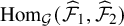 $\operatorname {\mathrm {Hom}}_{\mathcal {G}}(\widehat {\mathcal {F}}_1,\widehat {\mathcal {F}}_2)$
) is a torsor for
$\operatorname {\mathrm {Hom}}_{\mathcal {G}}(\widehat {\mathcal {F}}_1,\widehat {\mathcal {F}}_2)$
) is a torsor for $\operatorname {\mathrm {Aut}}(\mathcal {F}_2)=H(R)$
(resp.
$\operatorname {\mathrm {Aut}}(\mathcal {F}_2)=H(R)$
(resp. $\operatorname {\mathrm {Aut}}(\widehat {\mathcal {F}}_2)=\widehat {H}(R)$
). The claim follows as
$\operatorname {\mathrm {Aut}}(\widehat {\mathcal {F}}_2)=\widehat {H}(R)$
). The claim follows as $\operatorname {\mathrm {Hom}}_{\mathcal {G}}(\mathcal {F}_1,\mathcal {F}_2)\to \operatorname {\mathrm {Hom}}_{\mathcal {G}}(\widehat {\mathcal {F}}_1,\widehat {\mathcal {F}}_2)$
is equivariant for the bijection
$\operatorname {\mathrm {Hom}}_{\mathcal {G}}(\mathcal {F}_1,\mathcal {F}_2)\to \operatorname {\mathrm {Hom}}_{\mathcal {G}}(\widehat {\mathcal {F}}_1,\widehat {\mathcal {F}}_2)$
is equivariant for the bijection $H(R)\to \widehat {H}(R)$
.
$H(R)\to \widehat {H}(R)$
.
Let $\mathbf {FPMod}(R)$
denote the category of finite projective R-modules. The following is a vector bundle analogue of Proposition A.12.
$\mathbf {FPMod}(R)$
denote the category of finite projective R-modules. The following is a vector bundle analogue of Proposition A.12.
Proposition A.13. The global section functor $\mathbf {Vect}(\operatorname {\mathrm {Spf}}(R)_{\mathrm {fl}},\mathcal {O}_{\operatorname {\mathrm {Spf}}(R)})\to \mathbf {FPMod}(R)$
is a bi-exact R-linear
$\mathbf {Vect}(\operatorname {\mathrm {Spf}}(R)_{\mathrm {fl}},\mathcal {O}_{\operatorname {\mathrm {Spf}}(R)})\to \mathbf {FPMod}(R)$
is a bi-exact R-linear $\otimes $
-equivalence (see §A.5 for this terminology) which preserves rank.
$\otimes $
-equivalence (see §A.5 for this terminology) which preserves rank.
Proof. We claim the source is equal to $\mathbf {Vect}(\operatorname {\mathrm {Spf}}(R)_{\mathrm {Zar}},\mathcal {O}_{\operatorname {\mathrm {Spf}}(R)})$
. By Proposition A.9 it suffices to show that for an object
$\mathbf {Vect}(\operatorname {\mathrm {Spf}}(R)_{\mathrm {Zar}},\mathcal {O}_{\operatorname {\mathrm {Spf}}(R)})$
. By Proposition A.9 it suffices to show that for an object $\mathcal {E}$
of
$\mathcal {E}$
of $\mathbf {Vect}_n(\operatorname {\mathrm {Spf}}(R),\mathcal {O}_{\operatorname {\mathrm {Spf}}(R)})$
that
$\mathbf {Vect}_n(\operatorname {\mathrm {Spf}}(R),\mathcal {O}_{\operatorname {\mathrm {Spf}}(R)})$
that $P=\underline {\operatorname {\mathrm {Isom}}}(\mathcal {O}_{\operatorname {\mathrm {Spf}}(R)}^n,\mathcal {E})$
has a section Zariski locally on
$P=\underline {\operatorname {\mathrm {Isom}}}(\mathcal {O}_{\operatorname {\mathrm {Spf}}(R)}^n,\mathcal {E})$
has a section Zariski locally on $\operatorname {\mathrm {Spf}}(R)$
. Up to replacing R by a completed localization, we may assume by [SP, Tag 05VG] that
$\operatorname {\mathrm {Spf}}(R)$
. Up to replacing R by a completed localization, we may assume by [SP, Tag 05VG] that $P(R/JR)$
is nonempty. But, as P is represented by a smooth formal R-scheme by Lemma A.10 we deduce from Hensel’s lemma that
$P(R/JR)$
is nonempty. But, as P is represented by a smooth formal R-scheme by Lemma A.10 we deduce from Hensel’s lemma that $P(R)$
is nonempty. Then, by [Reference Fujiwara and KatoFK18, Chapter I, Theorem 3.2.8], and the fact that any finite projective R-module M is automatically J-adically complete,Footnote 15
it suffices to show that for an adically quasi-coherent sheaf
$P(R)$
is nonempty. Then, by [Reference Fujiwara and KatoFK18, Chapter I, Theorem 3.2.8], and the fact that any finite projective R-module M is automatically J-adically complete,Footnote 15
it suffices to show that for an adically quasi-coherent sheaf $\mathcal {E}$
on
$\mathcal {E}$
on $\operatorname {\mathrm {Spf}}(R)$
, that
$\operatorname {\mathrm {Spf}}(R)$
, that $M=\mathcal {E}(\operatorname {\mathrm {Spf}}(R))$
is finite projective if and only if
$M=\mathcal {E}(\operatorname {\mathrm {Spf}}(R))$
is finite projective if and only if $\mathcal {E}$
is a vector bundle, and the only if direction is clear. So, suppose that
$\mathcal {E}$
is a vector bundle, and the only if direction is clear. So, suppose that $\mathcal {E}$
is a vector bundle. Then, by [Reference Fujiwara and KatoFK18, Chapter I, Theorem 3.2.8] M is a finitely generated J-adically complete R-module. Moreover, as
$\mathcal {E}$
is a vector bundle. Then, by [Reference Fujiwara and KatoFK18, Chapter I, Theorem 3.2.8] M is a finitely generated J-adically complete R-module. Moreover, as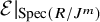 $\mathcal {E}|_{\operatorname {\mathrm {Spec}}(R/J^m)}$
is a vector bundle for all m, we know from [SP, Tag 05JM] that
$\mathcal {E}|_{\operatorname {\mathrm {Spec}}(R/J^m)}$
is a vector bundle for all m, we know from [SP, Tag 05JM] that $M/J^mM$
is finite projective for all m. Then, M is finite projective by [SP, Tag 0D4B].
$M/J^mM$
is finite projective for all m. Then, M is finite projective by [SP, Tag 0D4B].
Because of Proposition A.13 and its proof, the category of vector bundles on a formal scheme $\mathfrak {X}$
is independent of the above-defined sites. We denote the common category by
$\mathfrak {X}$
is independent of the above-defined sites. We denote the common category by $\mathbf {Vect}(\mathfrak {X})$
(omitting the structure sheaf from the notation). If
$\mathbf {Vect}(\mathfrak {X})$
(omitting the structure sheaf from the notation). If $\mathfrak {X}=\operatorname {\mathrm {Spf}}(R)$
, we shorten this notation further to
$\mathfrak {X}=\operatorname {\mathrm {Spf}}(R)$
, we shorten this notation further to $\mathbf {Vect}(R)$
, and abusively identify it with
$\mathbf {Vect}(R)$
, and abusively identify it with $\mathbf {FPMod}(R)$
.
$\mathbf {FPMod}(R)$
.
A.5 Tannakian formalism
For a ring R,Footnote 16
we say $\mathcal {C}$
is an (exact) R-linear
$\mathcal {C}$
is an (exact) R-linear $\otimes $
-category if
$\otimes $
-category if
-
○ (it is an exact category (see [Reference KellerKel90, Appendix A]),)
-
○
$\mathcal {C}$
is an additive R-linear category (see [SP, Tag 0104] and [SP, Tag 09MI]), -
○ the underlying category is Karoubian (see [SP, Tag 09SF]),
-
○ there is an R-bilinear symmetric monoidal structure
$\otimes \colon \mathcal {C}\times \mathcal {C}\to \mathcal {C}$
(see [SP, Tag 0FFJ]).


For the unit object $\mathbf {1}$
of
$\mathbf {1}$
of $\mathcal {C}$
and an object X of
$\mathcal {C}$
and an object X of $\mathcal {C}$
, an element of X means a morphism
$\mathcal {C}$
, an element of X means a morphism $\mathbf {1}\to X$
.
$\mathbf {1}\to X$
.
For (exact) R-linear $\otimes $
-categories
$\otimes $
-categories $\mathcal {C}$
and
$\mathcal {C}$
and $\mathcal {D}$
, a functor
$\mathcal {D}$
, a functor $F\colon \mathcal {C}\to \mathcal {D}$
is an (exact) R-linear
$F\colon \mathcal {C}\to \mathcal {D}$
is an (exact) R-linear $\otimes $
-functor if it (preserves exact sequences and it) is R-linear (see [SP, Tag 09MK]) and symmetric monoidal (see [SP, Tag 0FFL] and [SP, Tag 0FFY]). From [Reference Saavedra RivanoSR72, I. Proposition 4.4.2], a quasi-inverse of an R-linear
$\otimes $
-functor if it (preserves exact sequences and it) is R-linear (see [SP, Tag 09MK]) and symmetric monoidal (see [SP, Tag 0FFL] and [SP, Tag 0FFY]). From [Reference Saavedra RivanoSR72, I. Proposition 4.4.2], a quasi-inverse of an R-linear $\otimes $
-functor F is automatically an R-linear
$\otimes $
-functor F is automatically an R-linear $\otimes $
-functor, in which case we call F an R-linear
$\otimes $
-functor, in which case we call F an R-linear $\otimes $
-equivalence. If F is exact then it is not guaranteed that the same holds for its quasi-inverse (for example, the restriction functor
$\otimes $
-equivalence. If F is exact then it is not guaranteed that the same holds for its quasi-inverse (for example, the restriction functor $\mathbf {Rflx}(X)\to \mathbf {Rflx}(U)$
for a large open subset
$\mathbf {Rflx}(X)\to \mathbf {Rflx}(U)$
for a large open subset $U\subsetneq X$
when both are endowed with the exact structure inherited from the usual one on the category of coherent modules: see §A.6). If an exact R-linear
$U\subsetneq X$
when both are endowed with the exact structure inherited from the usual one on the category of coherent modules: see §A.6). If an exact R-linear $\otimes $
-functor has an exact R-linear
$\otimes $
-functor has an exact R-linear $\otimes $
-functor quasi-inverse, we say that F is a bi-exact R-linear
$\otimes $
-functor quasi-inverse, we say that F is a bi-exact R-linear $\otimes $
-equivalence.
$\otimes $
-equivalence.
Let $\mathcal {C}$
be an R-linear
$\mathcal {C}$
be an R-linear $\otimes $
-category and X a dualizable object of
$\otimes $
-category and X a dualizable object of $\mathcal {C}$
(see [SP, Tag 0FFP]). As
$\mathcal {C}$
(see [SP, Tag 0FFP]). As $\mathcal {C}$
is Karoubian, and by [SP, Tag 0FFU] and [SP, Tag 0FFT], we may construct in
$\mathcal {C}$
is Karoubian, and by [SP, Tag 0FFU] and [SP, Tag 0FFT], we may construct in $\mathcal {C}$
an object obtained from X by taking any finite combination of direct sums, duals, symmetric products, and alternating products. By a set of tensors
$\mathcal {C}$
an object obtained from X by taking any finite combination of direct sums, duals, symmetric products, and alternating products. By a set of tensors  on X we mean a finite set of elements in an object built in this way. We write this symbolically as
  .Footnote 17
For an R-linear
.Footnote 17
For an R-linear $\otimes $
-functor
$\otimes $
-functor $F\colon \mathcal {C}\to \mathcal {D}$
and a set of tensors
$F\colon \mathcal {C}\to \mathcal {D}$
and a set of tensors  we obtain the set
  of tensors on $F(X)$
.
$F(X)$
.
We define a tensor package over R to be a pair  where
where $\Lambda _0$
is a finite projective R-module and
$\Lambda _0$
is a finite projective R-module and  . Given a tensor package
  we have the group R-scheme

a closed subgroup scheme of $\operatorname {\mathrm {GL}}(\Lambda _0)$
.
$\operatorname {\mathrm {GL}}(\Lambda _0)$
.
Theorem A.14 [Reference BroshiBro13, Theorem 1.1]
Suppose that R is a Dedekind domain. Then, for every flat finite type affine group R-scheme $\mathcal {G}$
, and faithful representation
$\mathcal {G}$
, and faithful representation $\mathcal {G}\to \operatorname {\mathrm {GL}}(\Lambda _0)$
, there exists a tensor package
$\mathcal {G}\to \operatorname {\mathrm {GL}}(\Lambda _0)$
, there exists a tensor package  with
with  .
.
Remark A.15. Theorem A.14 was previously proven by Kisin in [Reference KisinKis10, Proposition 1.3.2] in the case when R is a discrete valuation ring and $\mathcal {G}$
has reductive generic fiber. As pointed out by Deligne in [Reference DeligneDel11] it is possible in this case to only consider
$\mathcal {G}$
has reductive generic fiber. As pointed out by Deligne in [Reference DeligneDel11] it is possible in this case to only consider  contained in $\bigoplus _{m,n} \Lambda _0^{\otimes m}\otimes _R (\Lambda _0^\vee )^{\otimes n}$
. This observation also applies to the situation of Theorem A.14.
$\bigoplus _{m,n} \Lambda _0^{\otimes m}\otimes _R (\Lambda _0^\vee )^{\otimes n}$
. This observation also applies to the situation of Theorem A.14.
Suppose now that  is a tensor package over R with
  . Denote by ${\mathbf {Rep}}_R(\mathcal {G})$
the natural exact R-linear
${\mathbf {Rep}}_R(\mathcal {G})$
the natural exact R-linear $\otimes $
-category of representations
$\otimes $
-category of representations $\mathcal {G}\to \operatorname {\mathrm {GL}}(\Lambda )$
, where
$\mathcal {G}\to \operatorname {\mathrm {GL}}(\Lambda )$
, where $\Lambda $
is a finite projective R-module.
$\Lambda $
is a finite projective R-module.
Definition A.16. For any exact R-linear $\otimes $
-category
$\otimes $
-category $\mathcal {C}$
a
$\mathcal {C}$
a $\mathcal {G}$
-object in
$\mathcal {G}$
-object in $\mathcal {C}$
is an exact R-linear
$\mathcal {C}$
is an exact R-linear $\otimes $
-functor
$\otimes $
-functor $\omega \colon {\mathbf {Rep}}_R(\mathcal {G})\to \mathcal {C}$
. An isomorphism
$\omega \colon {\mathbf {Rep}}_R(\mathcal {G})\to \mathcal {C}$
. An isomorphism $\omega \to \omega '$
is an invertible natural transformation, and we denote the groupoid of
$\omega \to \omega '$
is an invertible natural transformation, and we denote the groupoid of $\mathcal {G}$
-objects in
$\mathcal {G}$
-objects in $\mathcal {C}$
by
$\mathcal {C}$
by $\mathcal {G}\text {-}\mathcal {C}$
.
$\mathcal {G}\text {-}\mathcal {C}$
.
Let $\mathscr {X}$
be a topos and
$\mathscr {X}$
be a topos and $\mathcal {O}$
an R-algebra object of
$\mathcal {O}$
an R-algebra object of $\mathscr {X}$
. Then,
$\mathscr {X}$
. Then, $\mathbf {Vect}(\mathscr {X},\mathcal {O})$
is an exact R-linear
$\mathbf {Vect}(\mathscr {X},\mathcal {O})$
is an exact R-linear $\otimes $
-category, with exactness inherited from the category of
$\otimes $
-category, with exactness inherited from the category of $\mathcal {O}$
-modules. The following is a sheaf
$\mathcal {O}$
-modules. The following is a sheaf
 $$ \begin{align} \mathcal{G}_{\mathcal{O}}\colon \mathscr{X}\to \mathbf{Grp},\qquad T\mapsto \mathcal{G}(\mathcal{O}(T)), \end{align} $$
as $\mathcal {G}$
preserves all limits of rings. Observe that
$\mathcal {G}$
preserves all limits of rings. Observe that $(\operatorname {\mathrm {GL}}_{n,R})_{\mathcal {O}}=\operatorname {\mathrm {GL}}_{n,\mathcal {O}}$
. We write
$(\operatorname {\mathrm {GL}}_{n,R})_{\mathcal {O}}=\operatorname {\mathrm {GL}}_{n,\mathcal {O}}$
. We write $\mathbf {PseuTors}_{\mathcal {G}}(\mathscr {X})$
(resp.
$\mathbf {PseuTors}_{\mathcal {G}}(\mathscr {X})$
(resp. $\mathbf {Tors}_{\mathcal {G}}(\mathscr {X})$
) for
$\mathbf {Tors}_{\mathcal {G}}(\mathscr {X})$
) for $\mathbf {PseuTors}_{\mathcal {G}_{\mathcal {O}}}(\mathscr {X})$
(resp.
$\mathbf {PseuTors}_{\mathcal {G}_{\mathcal {O}}}(\mathscr {X})$
(resp.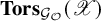 $\mathbf {Tors}_{\mathcal {G}_{\mathcal {O}}}(\mathscr {X})$
), when
$\mathbf {Tors}_{\mathcal {G}_{\mathcal {O}}}(\mathscr {X})$
), when $\mathcal {O}$
is clear from context. For any object T of
$\mathcal {O}$
is clear from context. For any object T of $\mathscr {X}$
there is, with the notation in Definition A.16, a restriction functor
$\mathscr {X}$
there is, with the notation in Definition A.16, a restriction functor

where $(-)|_T$
denotes restriction. Denote by
$(-)|_T$
denotes restriction. Denote by $\omega _{\mathrm {triv}}$
the
$\omega _{\mathrm {triv}}$
the $\mathcal {G}$
-object given by
$\mathcal {G}$
-object given by $\omega _{\mathrm {triv}}(\Lambda )=\Lambda \otimes _R\mathcal {O}$
.
$\omega _{\mathrm {triv}}(\Lambda )=\Lambda \otimes _R\mathcal {O}$
.
For an object $\mathcal {P}$
of
$\mathcal {P}$
of $\mathbf {Tors}_{\mathcal {G}}(\mathscr {X})$
we obtain the object
$\mathbf {Tors}_{\mathcal {G}}(\mathscr {X})$
we obtain the object $\omega _{\mathcal {P}}$
of
$\omega _{\mathcal {P}}$
of $\mathcal {G}\text {-}\mathbf {Vect}(\mathscr {X},\mathcal {O})$
given by
$\mathcal {G}\text {-}\mathbf {Vect}(\mathscr {X},\mathcal {O})$
given by
 $$ \begin{align*} \omega_{\mathcal{P}}\colon {\mathbf{Rep}}_R(\mathcal{G})\to \mathbf{Vect}(\mathscr{X},\mathcal{O}),\qquad \Lambda\mapsto \mathcal{P}\wedge^{\mathcal{G}}(\Lambda\otimes_R \mathcal{O}), \end{align*} $$
which is locally on $\mathscr {X}$
isomorphic to
$\mathscr {X}$
isomorphic to $\omega _{\mathrm {triv}}$
. Observe that for a representation
$\omega _{\mathrm {triv}}$
. Observe that for a representation $\rho \colon \mathcal {G}\to \operatorname {\mathrm {GL}}(\Lambda )$
, the vector bundle
$\rho \colon \mathcal {G}\to \operatorname {\mathrm {GL}}(\Lambda )$
, the vector bundle $\omega _{\mathcal {P}}(\Lambda )$
agrees, functorially in
$\omega _{\mathcal {P}}(\Lambda )$
agrees, functorially in $\mathcal {P}$
and
$\mathcal {P}$
and $\Lambda $
, with the vector bundle associated to
$\Lambda $
, with the vector bundle associated to $\rho _\ast (\mathcal {P})$
by Proposition A.4, and so we sometimes confuse the two.
$\rho _\ast (\mathcal {P})$
by Proposition A.4, and so we sometimes confuse the two.
For a pair  , where $\mathcal {E}$
is an object of
$\mathcal {E}$
is an object of $\mathbf {Vect}(\mathscr {X},\mathcal {O})$
and
$\mathbf {Vect}(\mathscr {X},\mathcal {O})$
and  , the functor

has the structure of an object of $\mathbf {PseuTors}_{\mathcal {G}}(\mathscr {X})$
. We call
$\mathbf {PseuTors}_{\mathcal {G}}(\mathscr {X})$
. We call  a twist of
  if this pseudo-torsor is a torsor. By an isomorphism of twists
  we mean an isomorphism $\mathcal {E}\to \mathcal {E}'$
carrying
$\mathcal {E}\to \mathcal {E}'$
carrying  to
to  . Denote by
  the groupoid of twists of
  .
.
Proposition A.17. The functor

is an equivalence of groupoids with quasi-inverse given by sending $\mathcal {P}$
to
$\mathcal {P}$
to  .
.
Proof. The association of T in $\mathscr {X}$
to the groupoid of pairs
$\mathscr {X}$
to the groupoid of pairs  of an object $\mathcal {E}$
of
$\mathcal {E}$
of $\mathbf {Vect}(\mathscr {X},\mathcal {O}/T)$
and
$\mathbf {Vect}(\mathscr {X},\mathcal {O}/T)$
and  , forms a stack over $\mathscr {X}$
which we denote C. This proposition is then a special case of [Reference GiraudGir71, Chapitre III, Théorème 2.5.1] as the natural map
$\mathscr {X}$
which we denote C. This proposition is then a special case of [Reference GiraudGir71, Chapitre III, Théorème 2.5.1] as the natural map  is an isomorphism, and (with notation in loc. cit.)
  .
.
For an object $\omega $
of
$\omega $
of $\mathcal {G}\text {-}\mathbf {Vect}(\mathscr {X},\mathcal {O})$
we have a pseudo-torsor
$\mathcal {G}\text {-}\mathbf {Vect}(\mathscr {X},\mathcal {O})$
we have a pseudo-torsor
 $$ \begin{align*} \underline{\operatorname{\mathrm{Isom}}}(\omega_{\mathrm{triv}},\omega)\colon \mathscr{X}\to \mathbf{Set},\qquad T\mapsto \operatorname{\mathrm{Isom}}(\omega_{\mathrm{triv},T},\omega_T), \end{align*} $$
for the group sheaf $\underline {\operatorname {\mathrm {Aut}}}(\omega _{\mathrm {triv}})$
. Call
$\underline {\operatorname {\mathrm {Aut}}}(\omega _{\mathrm {triv}})$
. Call $\omega $
locally trivial if this pseudo-torsor is a torsor, and by
$\omega $
locally trivial if this pseudo-torsor is a torsor, and by $\mathcal {G}\text {-}\mathbf {Vect}^{\mathrm {lt}}(\mathscr {X},\mathcal {O})$
the full subgroupoid of
$\mathcal {G}\text {-}\mathbf {Vect}^{\mathrm {lt}}(\mathscr {X},\mathcal {O})$
the full subgroupoid of $\mathcal {G}\text {-}\mathbf {Vect}(\mathscr {X},\mathcal {O})$
of locally trivial objects. Say that
$\mathcal {G}\text {-}\mathbf {Vect}(\mathscr {X},\mathcal {O})$
of locally trivial objects. Say that $\mathcal {G}$
is reconstructible in
$\mathcal {G}$
is reconstructible in $(\mathscr {X},\mathcal {O})$
if the natural map
$(\mathscr {X},\mathcal {O})$
if the natural map $\mathcal {G}_{\mathcal {O}}\to \underline {\operatorname {\mathrm {Aut}}}(\omega _{\mathrm {triv}})$
is an isomorphism. In this case, there is a natural equivalence
$\mathcal {G}_{\mathcal {O}}\to \underline {\operatorname {\mathrm {Aut}}}(\omega _{\mathrm {triv}})$
is an isomorphism. In this case, there is a natural equivalence $\mathbf {Tors}_{\mathcal {G}}(\mathscr {X})\to \mathcal {G}\text {-}\mathbf {Vect}^{\mathrm {lt}}(\mathscr {X},\mathcal {O})$
given by sending
$\mathbf {Tors}_{\mathcal {G}}(\mathscr {X})\to \mathcal {G}\text {-}\mathbf {Vect}^{\mathrm {lt}}(\mathscr {X},\mathcal {O})$
given by sending $\mathcal {P}$
to
$\mathcal {P}$
to $\omega _{\mathcal {P}}$
, with quasi-inverse sending
$\omega _{\mathcal {P}}$
, with quasi-inverse sending $\omega $
to
$\omega $
to $\underline {\operatorname {\mathrm {Isom}}}(\omega _{\mathrm {triv}},\omega )$
.
$\underline {\operatorname {\mathrm {Isom}}}(\omega _{\mathrm {triv}},\omega )$
.
If $\mathcal {G}$
is reconstructible in
$\mathcal {G}$
is reconstructible in $(\mathscr {X},\mathcal {O})$
, then for an object
$(\mathscr {X},\mathcal {O})$
, then for an object $\omega $
of
$\omega $
of $\mathcal {G}\text {-}\mathbf {Vect}^{\mathrm {lt}}(\mathscr {X},\mathcal {O})$
, the map
$\mathcal {G}\text {-}\mathbf {Vect}^{\mathrm {lt}}(\mathscr {X},\mathcal {O})$
, the map

given by evaluation is a morphism of pseudo-torsors where the source is a torsor, and so an isomorphism. Thus,  is an object of
  . We deduce the following.
Proposition A.18. Suppose that $\mathcal {G}$
is reconstructible in
$\mathcal {G}$
is reconstructible in $(\mathscr {X},\mathcal {O})$
. Then,
$(\mathscr {X},\mathcal {O})$
. Then,

is a commuting triangle of equivalences.
The following shows that the assumptions in Proposition A.18 are often satisfied.
Theorem A.19 [Reference BroshiBro13, Theorem 1.2], [Reference Scholze and WeinsteinSW20, Theorem 19.5.1]
Assume R is a Dedekind domain and that $\mathcal {G}$
is R-flat. Then for an R-scheme X,
$\mathcal {G}$
is R-flat. Then for an R-scheme X, $\mathcal {G}$
is reconstructible in
$\mathcal {G}$
is reconstructible in $(X_{\mathrm {fpqc}},\mathcal {O}_X)$
and every object of
$(X_{\mathrm {fpqc}},\mathcal {O}_X)$
and every object of $\mathcal {G}\text {-}\mathbf {Vect}(X)$
is locally trivial.
$\mathcal {G}\text {-}\mathbf {Vect}(X)$
is locally trivial.
Proof. The only thing not contained in loc. cit. is the reconstructibility claim, but this follows from the full faithfulness of the functors in loc. cit. applied to the trivial objects.
Remark A.20. Theorem A.19 actually implies that if $(\mathscr {T},\mathcal {O})$
is a ringed topos over R, then
$(\mathscr {T},\mathcal {O})$
is a ringed topos over R, then $\mathcal {G}$
is reconstructible in
$\mathcal {G}$
is reconstructible in $(\mathscr {T},\mathcal {O})$
. Indeed, for an object T of
$(\mathscr {T},\mathcal {O})$
. Indeed, for an object T of $\mathscr {T}$
, we must check that the map
$\mathscr {T}$
, we must check that the map $\mathcal {G}(\mathcal {O}(T))\to \operatorname {\mathrm {Aut}}(\omega _{\mathrm {triv}}|_T)$
is an isomorphism. But, observe that
$\mathcal {G}(\mathcal {O}(T))\to \operatorname {\mathrm {Aut}}(\omega _{\mathrm {triv}}|_T)$
is an isomorphism. But, observe that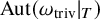 $\operatorname {\mathrm {Aut}}(\omega _{\mathrm {triv}}|_T)$
boils down to understanding compatible automorphisms of
$\operatorname {\mathrm {Aut}}(\omega _{\mathrm {triv}}|_T)$
boils down to understanding compatible automorphisms of $\Lambda \otimes _R \mathcal {O}|_T$
for
$\Lambda \otimes _R \mathcal {O}|_T$
for $\Lambda $
a representation of
$\Lambda $
a representation of $\mathcal {G}$
. But, such automorphisms are precisely the
$\mathcal {G}$
. But, such automorphisms are precisely the $\mathcal {O}(T)$
-linear automorphisms of
$\mathcal {O}(T)$
-linear automorphisms of $\Lambda \otimes _R \mathcal {O}(T)$
. Thus, as
$\Lambda \otimes _R \mathcal {O}(T)$
. Thus, as $\mathcal {O}(T)$
is an R-algebra, we know from Theorem A.19 that the natural map from
$\mathcal {O}(T)$
is an R-algebra, we know from Theorem A.19 that the natural map from $\mathcal {G}(\mathcal {O}(T))$
is an isomorphism.
$\mathcal {G}(\mathcal {O}(T))$
is an isomorphism.
In particular, using this one obtains simpler proofs for parts of Propositions 2.3, 2.7, 2.11, and A.26, as well as the claim at the beginning of §1.3.1. We leave these proofs unchanged though, in case they are helpful. The fact that a simplification should exist was pointed out to us by Mark Kisin.
Remark A.21. There is an error in [Reference BroshiBro13, Lemma 4.4 (iii)], which is necessary for [Reference BroshiBro13, Theorem 1.2]. Namely, the inclusion $\mathcal {O}_X\to \mathcal {O}_G$
Footnote 18
is not split as
$\mathcal {O}_X\to \mathcal {O}_G$
Footnote 18
is not split as $\mathcal {O}_G$
-comodules, and thus one cannot use additivity to conclude that
$\mathcal {O}_G$
-comodules, and thus one cannot use additivity to conclude that $F(\mathcal {O}_X)$
is a summand of
$F(\mathcal {O}_X)$
is a summand of $F(\mathcal {O}_G)$
. But, observe that
$F(\mathcal {O}_G)$
. But, observe that
 $$ \begin{align*} 0\to \mathcal{O}_X\to\mathcal{O}_G\to \mathcal{O}_G/\mathcal{O}_X\to 0, \end{align*} $$
is an exact sequence in $\mathbf {Rep}'(G)$
, where
$\mathbf {Rep}'(G)$
, where $\mathcal {O}_G/\mathcal {O}_X$
is flat as
$\mathcal {O}_G/\mathcal {O}_X$
is flat as $\mathcal {O}_X\to \mathcal {O}_G$
is split as
$\mathcal {O}_X\to \mathcal {O}_G$
is split as $\mathcal {O}_X$
-modules. By the exactness of F, and the flatness of
$\mathcal {O}_X$
-modules. By the exactness of F, and the flatness of $F(\mathcal {O}_G/\mathcal {O}_X)$
, we obtain the (universally) exact sequence
$F(\mathcal {O}_G/\mathcal {O}_X)$
, we obtain the (universally) exact sequence
 $$ \begin{align*} 0\to F(\mathcal{O}_X)\to F(\mathcal{O}_G)\to F(\mathcal{O}_G/\mathcal{O}_X)\to 0. \end{align*} $$
As $F(\mathcal {O}_X)=\mathcal {O}_Y$
universally injects into
$F(\mathcal {O}_X)=\mathcal {O}_Y$
universally injects into $F(\mathcal {O}_G)$
, we deduce that
$F(\mathcal {O}_G)$
, we deduce that $F(\mathcal {O}_G)$
is faithfully flat.
$F(\mathcal {O}_G)$
is faithfully flat.
Remark A.22. If $\mathcal {G}$
is R-smooth we may replace
$\mathcal {G}$
is R-smooth we may replace $X_{\mathrm {fl}}$
in Theorem A.19 with
$X_{\mathrm {fl}}$
in Theorem A.19 with $X_{\mathrm {\acute {e}t}}$
. When
$X_{\mathrm {\acute {e}t}}$
. When $X=\operatorname {\mathrm {Spec}}(A)$
, for A complete with respect to a finitely generated ideal, we may replace all instances of X in Theorem A.19 with
$X=\operatorname {\mathrm {Spec}}(A)$
, for A complete with respect to a finitely generated ideal, we may replace all instances of X in Theorem A.19 with $\operatorname {\mathrm {Spf}}(A)$
by Proposition A.12 and Proposition A.13.
$\operatorname {\mathrm {Spf}}(A)$
by Proposition A.12 and Proposition A.13.
A.6 Reflexive pseudo-torsors
Let R be a ring and X an integral locally Noetherian normal R-scheme. An open embedding $j\colon U\hookrightarrow X$
is large if
$j\colon U\hookrightarrow X$
is large if $j(U)$
contains all points of codimension
$j(U)$
contains all points of codimension $1$
. If
$1$
. If $X'\to X$
is an étale map, then
$X'\to X$
is an étale map, then $X'$
is normal and
$X'$
is normal and $U\times _X X'\hookrightarrow X'$
is large. Denote by
$U\times _X X'\hookrightarrow X'$
is large. Denote by $\mathbf {A}(U_{\mathrm {\acute {e}t}})$
the full subcategory of
$\mathbf {A}(U_{\mathrm {\acute {e}t}})$
the full subcategory of $\mathbf {Shv}(U_{\mathrm {\acute {e}t}})$
of sheaves represented by an affine U-scheme. Let
$\mathbf {Shv}(U_{\mathrm {\acute {e}t}})$
of sheaves represented by an affine U-scheme. Let $\mathbf {A}_U(X_{\mathrm {\acute {e}t}})$
be the full subcategory of
$\mathbf {A}_U(X_{\mathrm {\acute {e}t}})$
be the full subcategory of $\mathbf {Shv}(X_{\mathrm {\acute {e}t}})$
of sheaves represented by an affine X-scheme Y such that
$\mathbf {Shv}(X_{\mathrm {\acute {e}t}})$
of sheaves represented by an affine X-scheme Y such that $Y \times _X U$
is dense in Y.
$Y \times _X U$
is dense in Y.
Proposition A.23 (cf. [Reference Colliot-Thélène and SansucCTS79, Lemme 2.1])
Let $j\colon U\hookrightarrow X$
be a large open embedding. Then,
$j\colon U\hookrightarrow X$
be a large open embedding. Then, $(j_\ast ,j^\ast )\colon \mathbf {A}(U_{\mathrm {\acute {e}t}}) \to \mathbf {A}_U(X_{\mathrm {\acute {e}t}})$
is a pair of quasi-inverse functors.
$(j_\ast ,j^\ast )\colon \mathbf {A}(U_{\mathrm {\acute {e}t}}) \to \mathbf {A}_U(X_{\mathrm {\acute {e}t}})$
is a pair of quasi-inverse functors.
Proof. Suppose that $\mathcal {F}=\underline {\operatorname {\mathrm {Spec}}}(\mathcal {A})$
, where
$\mathcal {F}=\underline {\operatorname {\mathrm {Spec}}}(\mathcal {A})$
, where $\mathcal {A}$
is a quasi-coherent
$\mathcal {A}$
is a quasi-coherent $\mathcal {O}_U$
-algebra. As
$\mathcal {O}_U$
-algebra. As $\mathcal {O}_X\to j_\ast j^\ast \mathcal {O}_X=j_\ast \mathcal {O}_U$
is an isomorphism (see [Reference Colliot-Thélène and SansucCTS79, Lemme 2.1]), applying [SP, Tag 01LQ] shows that
$\mathcal {O}_X\to j_\ast j^\ast \mathcal {O}_X=j_\ast \mathcal {O}_U$
is an isomorphism (see [Reference Colliot-Thélène and SansucCTS79, Lemme 2.1]), applying [SP, Tag 01LQ] shows that $j_\ast \mathcal {F}$
is represented by
$j_\ast \mathcal {F}$
is represented by $\underline {\operatorname {\mathrm {Spec}}}(j_\ast \mathcal {A})$
. To see
$\underline {\operatorname {\mathrm {Spec}}}(j_\ast \mathcal {A})$
. To see $j_\ast \mathcal {F} \in \mathbf {A}_U(X_{\mathrm {\acute {e}t}})$
, we may assume that X is affine. Take an affine covering
$j_\ast \mathcal {F} \in \mathbf {A}_U(X_{\mathrm {\acute {e}t}})$
, we may assume that X is affine. Take an affine covering $\{V_i\}_{i \in I}$
of U. Then
$\{V_i\}_{i \in I}$
of U. Then $\mathcal {A}(U) \to \prod _{i \in I}\mathcal {A}(V_i)$
is injective. Hence
$\mathcal {A}(U) \to \prod _{i \in I}\mathcal {A}(V_i)$
is injective. Hence $\underline {\operatorname {\mathrm {Spec}}}(\mathcal {A}) \subset \operatorname {\mathrm {Spec}}(\mathcal {A}(U))$
is dense. Therefore
$\underline {\operatorname {\mathrm {Spec}}}(\mathcal {A}) \subset \operatorname {\mathrm {Spec}}(\mathcal {A}(U))$
is dense. Therefore $j_\ast $
is well-defined. It is clear that
$j_\ast $
is well-defined. It is clear that $j^*j_* \simeq \operatorname {\mathrm {id}}$
. We show that
$j^*j_* \simeq \operatorname {\mathrm {id}}$
. We show that $\operatorname {\mathrm {id}} \simeq j_* j^*$
. We may assume that X is affine. Let Y be an affine X-scheme. Take a closed immersion
$\operatorname {\mathrm {id}} \simeq j_* j^*$
. We may assume that X is affine. Let Y be an affine X-scheme. Take a closed immersion $Y \hookrightarrow \underline {\mathrm {Spec}}(\mathcal {O}_X [T_{\lambda }]_{\lambda \in \Lambda })$
over X, where
$Y \hookrightarrow \underline {\mathrm {Spec}}(\mathcal {O}_X [T_{\lambda }]_{\lambda \in \Lambda })$
over X, where $\Lambda $
is a set. Then a U-section of Y uniquely extends to an X-section of
$\Lambda $
is a set. Then a U-section of Y uniquely extends to an X-section of $\underline {\mathrm {Spec}}(\mathcal {O}_X [T_{\lambda }]_{\lambda \in \Lambda })$
by [Reference Colliot-Thélène and SansucCTS79, Lemme 2.1 (i)]. Further it factors through Y by the density of
$\underline {\mathrm {Spec}}(\mathcal {O}_X [T_{\lambda }]_{\lambda \in \Lambda })$
by [Reference Colliot-Thélène and SansucCTS79, Lemme 2.1 (i)]. Further it factors through Y by the density of $U \subset X$
. Hence the claim follows.
$U \subset X$
. Hence the claim follows.
Recall that a coherent $\mathcal {O}_X$
-module
$\mathcal {O}_X$
-module $\mathcal {F}$
is called reflexive if the natural map
$\mathcal {F}$
is called reflexive if the natural map

is an isomorphism. Equivalently, $\mathcal {F}$
is reflexive if there exists a large open embedding
$\mathcal {F}$
is reflexive if there exists a large open embedding $j\colon U\hookrightarrow X$
such that
$j\colon U\hookrightarrow X$
such that $j^\ast \mathcal {F}$
is a vector bundle and for which the unit map
$j^\ast \mathcal {F}$
is a vector bundle and for which the unit map $\mathcal {F}\to j_\ast j^\ast \mathcal {F}$
is an isomorphism (see [SP, Tag 0AY6]). Denote by
$\mathcal {F}\to j_\ast j^\ast \mathcal {F}$
is an isomorphism (see [SP, Tag 0AY6]). Denote by $\mathbf {Rflx}(X)$
the category of reflexive
$\mathbf {Rflx}(X)$
the category of reflexive $\mathcal {O}_X$
-modules, which has the structure of an R-linear
$\mathcal {O}_X$
-modules, which has the structure of an R-linear $\otimes $
-category where the tensor product is as in [SP, Tag 0EBH]. We endow
$\otimes $
-category where the tensor product is as in [SP, Tag 0EBH]. We endow $\mathbf {Rflx}(X)$
with an exact structure by declaring an sequence exact if it is exact at every codimension
$\mathbf {Rflx}(X)$
with an exact structure by declaring an sequence exact if it is exact at every codimension $1$
point. Thus,
$1$
point. Thus, $\mathbf {Rflx}(X)$
contains
$\mathbf {Rflx}(X)$
contains $\mathbf {Vect}(X)$
as a full R-linear tensor subcategory but not as an exact subcategory. With this exact structure, if
$\mathbf {Vect}(X)$
as a full R-linear tensor subcategory but not as an exact subcategory. With this exact structure, if $j\colon U\hookrightarrow X$
is a large open embedding, then
$j\colon U\hookrightarrow X$
is a large open embedding, then $j_\ast \colon \mathbf {Rflx}(U)\to \mathbf {Rflx}(X)$
is a bi-exact R-linear
$j_\ast \colon \mathbf {Rflx}(U)\to \mathbf {Rflx}(X)$
is a bi-exact R-linear $\otimes $
-equivalence (see [SP, Tag 0EBJ]). Let
$\otimes $
-equivalence (see [SP, Tag 0EBJ]). Let $\mathbf {Rflx}_n^{\mathrm {iso}}(X)$
be the category of reflexive
$\mathbf {Rflx}_n^{\mathrm {iso}}(X)$
be the category of reflexive $\mathcal {O}_X$
-modules
$\mathcal {O}_X$
-modules $\mathcal {F}$
for which there is a large open embedding
$\mathcal {F}$
for which there is a large open embedding $j\colon U\to X$
with
$j\colon U\to X$
with $j^\ast \mathcal {F}$
a rank n vector bundle, with morphisms being isomorphisms of
$j^\ast \mathcal {F}$
a rank n vector bundle, with morphisms being isomorphisms of $\mathcal {O}_X$
-modules.
$\mathcal {O}_X$
-modules.
For a smooth group X-scheme $\mathcal {G}$
, a pseudo-torsor
$\mathcal {G}$
, a pseudo-torsor $\mathcal {Q}$
for
$\mathcal {Q}$
for $\mathcal {G}$
is called reflexive if there is a large open embedding
$\mathcal {G}$
is called reflexive if there is a large open embedding $j\colon U\hookrightarrow X$
with
$j\colon U\hookrightarrow X$
with $j^\ast \mathcal {Q}$
a
$j^\ast \mathcal {Q}$
a $\mathcal {G}$
-torsor and the unit map
$\mathcal {G}$
-torsor and the unit map $\mathcal {Q}\to j_\ast j^\ast \mathcal {Q}$
an isomorphism. Denote by
$\mathcal {Q}\to j_\ast j^\ast \mathcal {Q}$
an isomorphism. Denote by $\mathbf {Rflx}_{\mathcal {G}}(X)$
the full subcategory of
$\mathbf {Rflx}_{\mathcal {G}}(X)$
the full subcategory of $\mathbf {PseuTors}_{\mathcal {G}}(X_{\mathrm {\acute {e}t}})$
of reflexive pseudo-torsors.
$\mathbf {PseuTors}_{\mathcal {G}}(X_{\mathrm {\acute {e}t}})$
of reflexive pseudo-torsors.
Proposition A.24. Suppose $\mathcal {G}$
is a smooth group X-scheme. Then, the following is true.
$\mathcal {G}$
is a smooth group X-scheme. Then, the following is true.
-
1. An object
$\mathcal {Q}$
of
$\mathbf {PseuTors}_{\mathcal {G}}(X_{\mathrm {\acute {e}t}})$
belongs to
$\mathbf {Rflx}_{\mathcal {G}}(X)$
if and only if
$\mathcal {Q}$
belongs to
$\mathbf {A}(X_{\mathrm {\acute {e}t}})$
, and
$\mathcal {Q}_x$
belongs to
$\mathbf {Tors}_{\mathcal {G}}(\mathcal {O}_{X,x})$
for all codimension
$1$
points x of X. -
2. For a large open embedding
$j\colon U\hookrightarrow X$
, the pair
$(j_\ast ,j^\ast )\colon \mathbf {Rflx}_{\mathcal {G}}(U)\to \mathbf {Rflx}_{\mathcal {G}}(X)$
are quasi-inverse. -
3. The natural functors
$\mathcal {Q}\mapsto \mathcal {Q}\wedge ^{\operatorname {\mathrm {GL}}_{n,\mathcal {O}_X}}\mathcal {O}_X^n$
is an equivalence of categories
$$ \begin{align*}\mathbf{Rflx}_{\operatorname{\mathrm{GL}}_{n,\mathcal{O}_X}}(X)\to {\mathbf{Rflx}}^{\mathrm{iso}}_n(X), \end{align*} $$
with quasi-inverse given by
$\mathcal {E}\mapsto \underline {\operatorname {\mathrm {Isom}}}(\mathcal {E},\mathcal {O}_X^n)$
.











Proof. By Proposition A.23 and Proposition A.4, it only remains to show the if part of (1). Let $Y\to X$
be a finite type affine X-scheme representing
$Y\to X$
be a finite type affine X-scheme representing $\mathcal {Q}$
. By Proposition A.23, it suffices to show that
$\mathcal {Q}$
. By Proposition A.23, it suffices to show that $Y_U\to U$
is faithfully flat for some large open U. As
$Y_U\to U$
is faithfully flat for some large open U. As $Y_{\mathcal {O}_{X,x}}$
is faithfully flat over
$Y_{\mathcal {O}_{X,x}}$
is faithfully flat over $\mathcal {O}_{X,x}$
for all codimension
$\mathcal {O}_{X,x}$
for all codimension $1$
points x, we may conclude by [SP, Tag 04AI] and [SP, Tag 07RR].
$1$
points x, we may conclude by [SP, Tag 04AI] and [SP, Tag 07RR].
For any étale map $X'\to X$
there is a restriction functor
$X'\to X$
there is a restriction functor

where $(-)|_{X'}$
denotes restriction. There is a fully faithful embedding of
$(-)|_{X'}$
denotes restriction. There is a fully faithful embedding of $\mathcal {G}\text {-}\mathbf {Vect}(X)$
into
$\mathcal {G}\text {-}\mathbf {Vect}(X)$
into $\mathcal {G}\text {-}\mathbf {Rflx}(X)$
. For an object
$\mathcal {G}\text {-}\mathbf {Rflx}(X)$
. For an object $\mathcal {Q}$
of
$\mathcal {Q}$
of $\mathbf {Rflx}_{\mathcal {G}}(\mathscr {X})$
we obtain the object
$\mathbf {Rflx}_{\mathcal {G}}(\mathscr {X})$
we obtain the object $\omega _{\mathcal {Q}}$
of
$\omega _{\mathcal {Q}}$
of $\mathcal {G}\text {-}\mathbf {Rflx}(X)$
given by
$\mathcal {G}\text {-}\mathbf {Rflx}(X)$
given by
 $$ \begin{align*} \omega_{\mathcal{Q}}\colon {\mathbf{Rep}}_R(\mathcal{G})\to \mathbf{Rflx}(X),\qquad \Lambda\mapsto \mathcal{Q}\wedge^{\mathcal{G}}(\Lambda\otimes_R \mathcal{O}_X). \end{align*} $$
For $\rho \colon \mathcal {G}\to \operatorname {\mathrm {GL}}(\Lambda )$
one checks that
$\rho \colon \mathcal {G}\to \operatorname {\mathrm {GL}}(\Lambda )$
one checks that $\omega _{\mathcal {Q}}(\Lambda )$
agrees, functorially in
$\omega _{\mathcal {Q}}(\Lambda )$
agrees, functorially in $\mathcal {Q}$
and
$\mathcal {Q}$
and $\Lambda $
, with the reflexive module associated to
$\Lambda $
, with the reflexive module associated to $\rho _\ast (\mathcal {Q})$
by Proposition A.24. If
$\rho _\ast (\mathcal {Q})$
by Proposition A.24. If $\mathcal {G}$
is reconstructible in
$\mathcal {G}$
is reconstructible in $(X_{\mathrm {\acute {e}t}},\mathcal {O}_X)$
, an object
$(X_{\mathrm {\acute {e}t}},\mathcal {O}_X)$
, an object $\omega $
of
$\omega $
of $\mathcal {G}\text {-}\mathbf {Rflx}(X)$
is called locally trivial if the pseudo-torsor
$\mathcal {G}\text {-}\mathbf {Rflx}(X)$
is called locally trivial if the pseudo-torsor $\underline {\operatorname {\mathrm {Isom}}}(\omega _{\mathrm {triv}},\omega )$
is reflexive. Denote by
$\underline {\operatorname {\mathrm {Isom}}}(\omega _{\mathrm {triv}},\omega )$
is reflexive. Denote by $\mathcal {G}\text {-}{\mathbf {Rflx}}^{\mathrm {lt}}(X,\mathcal {O}_X)$
the full subcategory of locally trivial objects.
$\mathcal {G}\text {-}{\mathbf {Rflx}}^{\mathrm {lt}}(X,\mathcal {O}_X)$
the full subcategory of locally trivial objects.
Suppose  is a tensor package over R and $\mathcal {G}$
is the base change to X of
$\mathcal {G}$
is the base change to X of  , which we abusively also denote $\mathcal {G}$
. The category
$\mathcal {G}$
. The category  of reflexive twists consists of pairs
  where
where $\mathcal {E}$
is an object of
$\mathcal {E}$
is an object of $\mathbf {Rflx}(X)$
and
$\mathbf {Rflx}(X)$
and  such that
  is reflexive. If $\mathcal {Q}$
is a reflexive pseudo-torsor for
$\mathcal {Q}$
is a reflexive pseudo-torsor for $\mathcal {G}$
, then
$\mathcal {G}$
, then  is reflexive.
Combining Proposition A.18 and Proposition A.24, one deduces the following.
Proposition A.25. Suppose that $\mathcal {G}$
is reconstructible in
$\mathcal {G}$
is reconstructible in $(X_{\mathrm {\acute {e}t}},\mathcal {O}_X)$
. Then,
$(X_{\mathrm {\acute {e}t}},\mathcal {O}_X)$
. Then,

is a commuting triangle of equivalences.
If R is a Dedekind domain, then we have an analogue of Theorem A.19.
Proposition A.26. Assume that R is a Dedekind domain. Then, $\mathcal {G}$
is reconstructible in
$\mathcal {G}$
is reconstructible in $(X_{\mathrm {\acute {e}t}},\mathcal {O}_X)$
and every object of
$(X_{\mathrm {\acute {e}t}},\mathcal {O}_X)$
and every object of $\mathcal {G}\text {-}\mathbf {Rflx}(X)$
is locally trivial.
$\mathcal {G}\text {-}\mathbf {Rflx}(X)$
is locally trivial.
Proof. Every representation $\Lambda $
of
$\Lambda $
of $\mathcal {G}$
occurs as a subquotient of some
$\mathcal {G}$
occurs as a subquotient of some  (cf. [Reference dos SantosdS09, Proposition 12]). Thus, if $\omega $
is an object of
$\omega $
is an object of $\mathcal {G}\text {-}\mathbf {Rflx}(X)$
then the natural map
$\mathcal {G}\text {-}\mathbf {Rflx}(X)$
then the natural map $\underline {\operatorname {\mathrm {Isom}}}(\omega _{\mathrm {triv}},\omega )\to \underline {\operatorname {\mathrm {Isom}}}(\Lambda _0\otimes _R \mathcal {O}_X,\omega (\Lambda _0))$
is an isomorphism onto the closed subscheme of those f such that for all m and n, and all subrepresentations
$\underline {\operatorname {\mathrm {Isom}}}(\omega _{\mathrm {triv}},\omega )\to \underline {\operatorname {\mathrm {Isom}}}(\Lambda _0\otimes _R \mathcal {O}_X,\omega (\Lambda _0))$
is an isomorphism onto the closed subscheme of those f such that for all m and n, and all subrepresentations $\Lambda \subseteq T^{m,n}$
, the induced isomorphism
$\Lambda \subseteq T^{m,n}$
, the induced isomorphism $f^{m,n}\colon T^{m,n}\otimes _R \mathcal {O}_X\to \omega (T^{m,n})$
satisfies
$f^{m,n}\colon T^{m,n}\otimes _R \mathcal {O}_X\to \omega (T^{m,n})$
satisfies $f^{m,n}(\Lambda \otimes _R \mathcal {O}_X)\subseteq \Lambda $
and
$f^{m,n}(\Lambda \otimes _R \mathcal {O}_X)\subseteq \Lambda $
and $(f^{m,n})^{-1}(\omega (\Lambda ))\subseteq \Lambda \otimes _R\mathcal {O}_X$
. As
$(f^{m,n})^{-1}(\omega (\Lambda ))\subseteq \Lambda \otimes _R\mathcal {O}_X$
. As $\underline {\operatorname {\mathrm {Isom}}}(\Lambda _0\otimes _R \mathcal {O}_X,\omega (\Lambda _0))$
is an affine finite type X-scheme, the same is true for
$\underline {\operatorname {\mathrm {Isom}}}(\Lambda _0\otimes _R \mathcal {O}_X,\omega (\Lambda _0))$
is an affine finite type X-scheme, the same is true for $\underline {\operatorname {\mathrm {Isom}}}(\omega _{\mathrm {triv}},\omega )$
. By Proposition A.24, it then suffices to show that for all codimension
$\underline {\operatorname {\mathrm {Isom}}}(\omega _{\mathrm {triv}},\omega )$
. By Proposition A.24, it then suffices to show that for all codimension $1$
points x that
$1$
points x that $\underline {\operatorname {\mathrm {Isom}}}(\omega _{\mathrm {triv}},\omega )_x$
is a torsor. But, this corresponds to the exact R-linear
$\underline {\operatorname {\mathrm {Isom}}}(\omega _{\mathrm {triv}},\omega )_x$
is a torsor. But, this corresponds to the exact R-linear $\otimes $
-functor
$\otimes $
-functor $\Lambda \mapsto \omega (\Lambda )_x$
. As
$\Lambda \mapsto \omega (\Lambda )_x$
. As $\mathcal {O}_{X,x}$
is dimension
$\mathcal {O}_{X,x}$
is dimension $1$
all reflexive modules are vector bundles, and thus this an object of
$1$
all reflexive modules are vector bundles, and thus this an object of $\mathcal {G}\text {-}\mathbf {Vect}(\mathcal {O}_{X,x})$
. The claim then follows from Theorem A.19.
$\mathcal {G}\text {-}\mathbf {Vect}(\mathcal {O}_{X,x})$
. The claim then follows from Theorem A.19.
We end with some results inspired by [Reference Colliot-Thélène and SansucCTS79]. Suppose that $\rho \colon \mathcal {G}\hookrightarrow \mathcal {H}$
is a closed embedding of reductive group X-schemes. Denote by
$\rho \colon \mathcal {G}\hookrightarrow \mathcal {H}$
is a closed embedding of reductive group X-schemes. Denote by $p\colon \mathcal {H}\to \mathcal {H}/\mathcal {G}$
the quotient sheaf in the fppf topology. Combining [Reference AlperAlp14, Corollary 9.7.7] and [SP, Tag 02KK] shows that
$p\colon \mathcal {H}\to \mathcal {H}/\mathcal {G}$
the quotient sheaf in the fppf topology. Combining [Reference AlperAlp14, Corollary 9.7.7] and [SP, Tag 02KK] shows that $\mathcal {H}/\mathcal {G}$
belongs to
$\mathcal {H}/\mathcal {G}$
belongs to $\mathbf {A}(X_{\mathrm {\acute {e}t}})$
.
$\mathbf {A}(X_{\mathrm {\acute {e}t}})$
.
Proposition A.27. Let $\mathcal {Q}$
be an object of
$\mathcal {Q}$
be an object of $\mathbf {Rflx}_{\mathcal {G}}(X)$
. Then, for any large open embedding
$\mathbf {Rflx}_{\mathcal {G}}(X)$
. Then, for any large open embedding $j\colon U\hookrightarrow X$
, the natural map
$j\colon U\hookrightarrow X$
, the natural map $\rho _\ast \mathcal {Q}\to j_\ast \rho _\ast j^\ast \mathcal {Q}$
is an isomorphism.
$\rho _\ast \mathcal {Q}\to j_\ast \rho _\ast j^\ast \mathcal {Q}$
is an isomorphism.
Proof. For $X'\to X$
étale and
$X'\to X$
étale and  , we show that $\rho _\ast \mathcal {Q}(X')\to \rho _\ast j^\ast \mathcal {Q}(U')$
is bijective. By [Reference GiraudGir71, Chapitre III, Proposition 3.1.2], the source (resp. target) is identified with the set of
$\rho _\ast \mathcal {Q}(X')\to \rho _\ast j^\ast \mathcal {Q}(U')$
is bijective. By [Reference GiraudGir71, Chapitre III, Proposition 3.1.2], the source (resp. target) is identified with the set of $\mathcal {G}$
-subtorsors
$\mathcal {G}$
-subtorsors $\mathcal {A}$
(resp.
$\mathcal {A}$
(resp. $\mathcal {B}$
) of
$\mathcal {B}$
) of $\mathcal {H}_{X'}\times \mathcal {Q}_{X'}$
(resp.
$\mathcal {H}_{X'}\times \mathcal {Q}_{X'}$
(resp. $\mathcal {H}_{U'}\times \mathcal {Q}_{U'}$
). By [Reference GiraudGir71, Chapitre III, Proposition 1.3.6],
$\mathcal {H}_{U'}\times \mathcal {Q}_{U'}$
). By [Reference GiraudGir71, Chapitre III, Proposition 1.3.6], $\operatorname {\mathrm {Hom}}_{\mathcal {H}_{X'}}(\rho _\ast (\mathcal {A}),\mathcal {H}_{X'})$
is in bijection with
$\operatorname {\mathrm {Hom}}_{\mathcal {H}_{X'}}(\rho _\ast (\mathcal {A}),\mathcal {H}_{X'})$
is in bijection with $\operatorname {\mathrm {Hom}}_{\mathcal {G}_{X'}}(\mathcal {A},\mathcal {H}_{X'})$
which is nonempty by composing
$\operatorname {\mathrm {Hom}}_{\mathcal {G}_{X'}}(\mathcal {A},\mathcal {H}_{X'})$
which is nonempty by composing $\mathcal {A}\to \mathcal {H}_{X'}\times \mathcal {Q}_{X'}$
with the projection to
$\mathcal {A}\to \mathcal {H}_{X'}\times \mathcal {Q}_{X'}$
with the projection to $\mathcal {H}_{X'}$
. So,
$\mathcal {H}_{X'}$
. So, $\rho _\ast \mathcal {A}$
, and by a similar argument
$\rho _\ast \mathcal {A}$
, and by a similar argument $\rho _\ast (\mathcal {B})$
, are trivial. Then, [Reference GiraudGir71, Chapitre III, Proposition 3.2.2] implies that
$\rho _\ast (\mathcal {B})$
, are trivial. Then, [Reference GiraudGir71, Chapitre III, Proposition 3.2.2] implies that $\mathcal {A}$
(resp.
$\mathcal {A}$
(resp. $\mathcal {B}$
) is of the form
$\mathcal {B}$
) is of the form $p^{-1}(s)$
(resp.
$p^{-1}(s)$
(resp. $p^{-1}(t)$
) where s (resp. t) is an element of
$p^{-1}(t)$
) where s (resp. t) is an element of $(\mathcal {H}/\mathcal {G})(X')$
(resp.
$(\mathcal {H}/\mathcal {G})(X')$
(resp. $(\mathcal {H}/\mathcal {G})(U')$
). Consider
$(\mathcal {H}/\mathcal {G})(U')$
). Consider

where the vertical arrows are bijections, and a is the obvious map. By Proposition A.23, $(\mathcal {H}/\mathcal {G})(X')\to (\mathcal {H}/\mathcal {G})(U')$
is bijective, and so the s and t occurring in this diagram are in bijective correspondence, and applying Proposition A.23 and Proposition A.24 shows a is bijective.
$(\mathcal {H}/\mathcal {G})(X')\to (\mathcal {H}/\mathcal {G})(U')$
is bijective, and so the s and t occurring in this diagram are in bijective correspondence, and applying Proposition A.23 and Proposition A.24 shows a is bijective.
Proposition A.28. Suppose that  is a tensor package with
  reductive. Denote by $\rho _0\colon \mathcal {G}\to \operatorname {\mathrm {GL}}(\Lambda _0)$
the tautological map and let
$\rho _0\colon \mathcal {G}\to \operatorname {\mathrm {GL}}(\Lambda _0)$
the tautological map and let  be an object of
  . Then,

In particular, $\mathcal {Q}$
is a torsor if and only if
$\mathcal {Q}$
is a torsor if and only if $\mathcal {E}$
is locally free.
$\mathcal {E}$
is locally free.
Proof. Let $j\colon U\hookrightarrow X$
be a large open embedding such that
$j\colon U\hookrightarrow X$
be a large open embedding such that $j^\ast \mathcal {Q}$
is a torsor. Applying [Reference GiraudGir71, Chapitre III, Proposition 1.3.6], we obtain a map
$j^\ast \mathcal {Q}$
is a torsor. Applying [Reference GiraudGir71, Chapitre III, Proposition 1.3.6], we obtain a map $(\rho _0)_\ast j^\ast \mathcal {Q}\to \underline {\operatorname {\mathrm {Isom}}}\left (\Lambda _0\otimes _R\mathcal {O}_U,\mathcal {E}|_U\right )$
of torsors. As the natural map
$(\rho _0)_\ast j^\ast \mathcal {Q}\to \underline {\operatorname {\mathrm {Isom}}}\left (\Lambda _0\otimes _R\mathcal {O}_U,\mathcal {E}|_U\right )$
of torsors. As the natural map $\underline {\operatorname {\mathrm {Isom}}}\left (\Lambda _0\otimes _R\mathcal {O}_X,\mathcal {E}\right )\to j_\ast \underline {\operatorname {\mathrm {Isom}}}\left (\Lambda _0\otimes _R\mathcal {O}_U,\mathcal {E}|_U\right )$
is an isomorphism from Proposition A.23 and Proposition A.24, we conclude by Proposition A.27. For the second claim, it suffices to show the if statement, which follows as there is a tautological surjection of sheaves
$\underline {\operatorname {\mathrm {Isom}}}\left (\Lambda _0\otimes _R\mathcal {O}_X,\mathcal {E}\right )\to j_\ast \underline {\operatorname {\mathrm {Isom}}}\left (\Lambda _0\otimes _R\mathcal {O}_U,\mathcal {E}|_U\right )$
is an isomorphism from Proposition A.23 and Proposition A.24, we conclude by Proposition A.27. For the second claim, it suffices to show the if statement, which follows as there is a tautological surjection of sheaves $\operatorname {\mathrm {GL}}_{n,X}\times \mathcal {Q}\to (\rho _0)_\ast \mathcal {Q}$
and thus if the target is locally nonempty, so then must be the source.
$\operatorname {\mathrm {GL}}_{n,X}\times \mathcal {Q}\to (\rho _0)_\ast \mathcal {Q}$
and thus if the target is locally nonempty, so then must be the source.
Remark A.29. We introduced reflexive pseudo-torsors because we feel they are natural extensions of ideas present in the current article, that may be useful in a Tannakian formalism of analytic prismatic F-torsors. That said, while we do use reflexive pseudo-torsors in the body of this article, this is mainly through the final claim in Proposition A.28. The reader uninterested in the formalism of reflexive pseudo-torsors should note that such a result is already obtained by the method of proof in [Reference Colliot-Thélène and SansucCTS79, Théorème 6.13], which we briefly sketch.
Let $j\colon U\hookrightarrow X$
be a large open such that
$j\colon U\hookrightarrow X$
be a large open such that $j^\ast \mathcal {Q}$
is a torsor. Moving to an étale extension of X, we may assume that
$j^\ast \mathcal {Q}$
is a torsor. Moving to an étale extension of X, we may assume that $\mathcal {E}$
is trivial. Thus
$\mathcal {E}$
is trivial. Thus $\rho _\ast j^\ast \mathcal {Q}$
is trivial, and so comes from an element of
$\rho _\ast j^\ast \mathcal {Q}$
is trivial, and so comes from an element of $(\operatorname {\mathrm {GL}}(\Lambda _0)/\mathcal {G})(U)$
. As
$(\operatorname {\mathrm {GL}}(\Lambda _0)/\mathcal {G})(U)$
. As $(\operatorname {\mathrm {GL}}(\Lambda _0)/\mathcal {G})_X$
is affine over X, this can be extended to an element of
$(\operatorname {\mathrm {GL}}(\Lambda _0)/\mathcal {G})_X$
is affine over X, this can be extended to an element of $(\operatorname {\mathrm {GL}}(\Lambda _0)/\mathcal {G})(X)$
by Proposition A.23, which gives rise to a
$(\operatorname {\mathrm {GL}}(\Lambda _0)/\mathcal {G})(X)$
by Proposition A.23, which gives rise to a $\mathcal {G}$
-torsor
$\mathcal {G}$
-torsor $\mathcal {Q}'$
. Evidently there exists an isomorphism of
$\mathcal {Q}'$
. Evidently there exists an isomorphism of $\mathcal {G}$
-torsors
$\mathcal {G}$
-torsors $f\colon j^\ast \mathcal {Q}\to j^\ast \mathcal {Q}'$
which as
$f\colon j^\ast \mathcal {Q}\to j^\ast \mathcal {Q}'$
which as $\mathcal {Q}$
and
$\mathcal {Q}$
and $\mathcal {Q}'$
are affine (the former as it is a closed subscheme of the affine scheme
$\mathcal {Q}'$
are affine (the former as it is a closed subscheme of the affine scheme $\underline {\operatorname {\mathrm {Isom}}}(\Lambda _0\otimes _R\mathcal {O}_X,\mathcal {E})$
, and the latter by Lemma A.10), extends to an isomorphism of sheaves
$\underline {\operatorname {\mathrm {Isom}}}(\Lambda _0\otimes _R\mathcal {O}_X,\mathcal {E})$
, and the latter by Lemma A.10), extends to an isomorphism of sheaves $\mathcal {Q}\to \mathcal {Q}'$
by A.23. That this is
$\mathcal {Q}\to \mathcal {Q}'$
by A.23. That this is $\mathcal {G}$
-equivariant, and thus an isomorphism of pseudo-torsors follows as
$\mathcal {G}$
-equivariant, and thus an isomorphism of pseudo-torsors follows as $f|_U$
is
$f|_U$
is $\mathcal {G}$
-equivariant, and
$\mathcal {G}$
-equivariant, and $j(U)$
is Zariski dense in X.
$j(U)$
is Zariski dense in X.
Acknowledgments
The authors would like to heartily thank Abhinandan, Piotr Achinger, Bhargav Bhatt, Alexander Bertoloni Meli, Kęstutis Česnavičius, Patrick Daniels, Ofer Gabber, Ian Gleason, Haoyang Guo, Kentaro Inoue, Mark Kisin, Emanuel Reinecke, Peter Scholze, and Koji Shimizu, for helpful discussions and comments. They would also like to thank an anonymous referee for many helpful comments which improved the readability of the paper.
Competing interests
The authors have no competing interests to declare.
Financial support
Part of this work was conducted during a visit to the Hausdorff Research Institute for Mathematics, funded by the Deutsche Forschungsgemeinschaft (DFG, German Research Foundation) under Germany’s Excellence Strategy – EXC-2047/1 – 390685813. This work was supported by JSPS KAKENHI Grant Numbers 22KF0109, 22H00093 and 23K17650, the European Research Council (ERC) under the European Union’s Horizon 2020 research and innovation programme (grant agreement No. 851146), and funding through the Max Planck Institute for Mathematics in Bonn, Germany (report numbers MPIM-Bonn-2022, MPIM-Bonn-2023, MPIM-Bonn-2024).








 as
as 

 generates the unit ideal.




 , which is a rational open subset of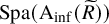

 there is a natural isomorphism

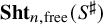
 .
.


 Open access

