

In late October 2022, I stand in a small shop, packed wall to wall with tourist souvenirs. Brightly colored porcelain and clay pottery are stacked on shelves; backpacks, handbags, and colorful textiles cover tables. Dolls made from painted corn husks hang from hooks, and carved wooden toys are scattered across display surfaces. Surrounding me are ten women, Indigenous Lenca artisans from Cofradía, Intibucá, who traveled here to Valle de Ángeles, a town outside the Honduran capital of Tegucigalpa, to participate in a nongovernmental organization’s (NGO) development training on marketing strategies. Valle de Ángeles is a popular weekend destination for Honduran tourists, and it is full of souvenir stores selling discounted crafts marketed as “cultural patrimony” and “Indigenous.”
The artisans (potters, weavers, and pine weavers from craft cooperatives in Cofradía) spend the afternoon trying to sell handmade crafts to business owners who will ideally purchase them to resell. Many vendors decline to buy, claiming their products are too expensive. Most crafts in their stores are knockoffs of items produced by Indigenous artisans, which are then sold at cheaper prices.
The artisans are preoccupied with a display in the shop, a series of photographs showing potters during craft production, accompanied by several signs. One sign reads “These are the artisans you are supporting by purchasing their handmade crafts. Here we support fair treatment of artisans.” Photos and pottery surrounding the display are labeled “Pottery from Choluteca.” The artisans are confused.
“That’s not Choluteca!” one of them says, “That photo is my neighbor! These are from Cofradía!” Some laugh in response to the error, but others are confused as to why the images are mislabeled.
The confusion reminds me of a conversation the group had the previous evening with the development promotor who coordinated their trip to Valle de Ángeles. She asked the group: What does it mean to be Lenca? She argued that being able to communicate that idea clearly would help the group sell their crafts.
Responses to that question were mixed. One artisan claimed: “The only way to identify as a Lenca woman now is having long black hair.” As the artisans express frustration in being mislabeled in the souvenir store’s marketing, the question comes to mind again: What does it mean to be Lenca in Honduras? What does this confusion surrounding identity mean for Lenca artisans who rely on craft production as a livelihood?
Lenca are the largest Indigenous group in Honduras. Yet confusion or misrepresentation surrounding their identity, history, and “traditions” is common among tourists and the general public, and it affects artisans’ ability to profit from craft production in a market that has distanced them from directly interacting with tourists. State-led promotion of Lenca crafts considered “commercially appealing” dominates national tourism marketing in Honduras today, even when it misaligns with how Lenca artisans define themselves and the crafts they produce.
This article compares pottery and other craft practices across five Lenca communities that are variably defined as “traditional” in the tourism industry and by artisans themselves. Approached through a framework of neoliberal multiculturalism, this work questions how constructions of national identity shape public perceptions of Lenca people, and how such constructions result in socioeconomic marginalization for Indigenous communities in Honduras today. This study focuses on pottery from La Campa (Lempira), Cofradía (Yamaranguila), San José de Guajiquiro (La Paz), and Orocuina (Choluteca) and woven textiles from Intibucá. To conclude, this work proposes collaborative projects with artisans, including PhotoVoice and community tourism promotion, as a potential avenue for Lenca artisans to assert ownership of their respective craft practices and how they are marketed to tourists.
Methodology
Data presented here come from fifteen months of ethnographic research in Lenca craft-producing communities and tourist spaces in western Honduras, conducted from 2019 to 2022. Research consisted of fifty-one semistructured interviews and life histories with artisans, craft vendors, and development and tourism representatives. Participants were chosen through a purposeful sample (Emmel Reference Emmel2013). Extensive participant observation was conducted with artisans during resource extraction, craft production, vending events, institutional trainings, and artisan cooperative meetings. Fieldwork involved collaboration with artisan cooperatives, including Alfarería “La Palá” (a microcredit pottery cooperative in Cruz Alta, La Campa), Red de Mujeres (Women’s Network, a microcredit group in Cruz Alta, La Campa), and CIALCOYL (an artisan cooperative in Cofradía, Yamaranguila).
Interview data were coded through thematic analysis, with overarching categories of selling methods, production, external influence from development entities, and environmental factors related to craft production. This work also involved collaborative projects with artisan cooperatives, including a PhotoVoice project documenting changing pottery production methods, and ongoing tourism promotion projects designed with artisans, including educational guides, business cards, and a community website.
This work explores the meanings of “Lenca identity” and “tradition.” It’s essential to note that the task of defining these terms does not belong to me as a white Western researcher in Honduras, to non-Indigenous development workers, to the state, or to others in the academic community who may define “tradition” differently. This study acknowledges that definitions of Indigenous identity and tradition are at the discretion of the communities who see themselves as Lenca and produce crafts; variability in how artisans define these terms across western Honduras does not invalidate their meaning as “tradition.”
With this in mind, collaborative projects presented here center artisan perspectives in defining craft practices. Outputs from this work are planned in collaboration with artisans over years of research and relationship building, and they are intended to directly contribute to artisan livelihoods while decentering my role as researcher.
Still, challenges remain in making these methods fully collaborative. Projects like PhotoVoice and collaborative tourism materials involve some level of researcher intervention due to issues in technology access and resource limitations. Ongoing work with artisans seeks to address these shortcomings by considering alternative tools (e.g., community archival projects rather than a website) and new research outputs as regional tourism and craft production continue to change. It is my hope that this research accurately reflects the deeply important traditions and livelihoods that exist in western Honduras today and that the stories presented here generate greater public interest and understanding of craft practices that continue to hold a valuable place within contemporary Lenca communities.
Defining Lenca “tradition”
The Lenca reside primarily in the western departments of Lempira, Comayagua, Intibucá, La Paz, and Ocotepeque. Primary livelihoods include agricultural activities (maize, beans, coffee) and craft production, particularly pottery (Toombs Reference Toombs2022). Since the precolonial period, Lenca have produced utilitarian pottery and exchanged it in regional trade networks, and today it is sold to tourists, representing an important income source for Lenca potters. However, this craft tradition has evolved as tourism development and political narratives on Indigenous “identity” have shifted.
It’s important to clarify how “tradition” is defined in this work. “Tradition” is variably defined in the social sciences and can be used vaguely to describe tangible and intangible culture (Toombs Reference Toombs2022; Williams Reference Williams1976). A common assumption is that “tradition” must be old and unchanging to be “authentic.” As we will see through case studies presented here, “tradition” can be redefined over time, evolving alongside socioeconomic, political, environmental, and other forces of change (Kuligowsky Reference Kuligowsky2014).
I apply Hobsbawm and Ranger’s (Reference Hobsbawm and Ranger1983) description of “genuine” and “invented” traditions to understand differences in how Lenca craft practices are interpreted. “Genuine” traditions are “specific and strongly binding social practices” that continuously hold a place in community history or identity, even where they are no longer practiced frequently (Hobsbawm and Ranger Reference Hobsbawm and Ranger1983, 10). In contrast, “invented” traditions are a “set of practices, normally governed by overtly or tacitly accepted rules and of a ritual or symbolic nature, which seek to inculcate certain values and norms of behavior by repetition, which automatically implies continuity with the past,” even when that continuity is fictitious (Hobsbawm and Ranger Reference Hobsbawm and Ranger1983, 2).
In Honduras, state institutions and development organizations have influenced the spread of “invented” Lenca traditions, commercializing Indigenous craft practices to construct a unified national identity. Yet “invented” Lenca craft traditions take on different meanings when defined and repurposed by artisans themselves rather than by external actors (Hobsbawm and Ranger Reference Hobsbawm and Ranger1983).
Variable understanding of “tradition” affects Lenca artisans, particularly in their interactions with tourists. Artisans occasionally attend festivals and events to sell crafts. Yet participation is limited by the costs of packing and transporting products, time and labor lost in traveling with no guarantee of selling, and the price of renting a formal stand. Lenca artisans compete with vendors who have established businesses and are often trained in selling and promotional strategies. Further, tourists often seek out specific crafts. Tourists typically claim that they are looking for something “old” or “authentic,” yet their definitions of what that means vary.
In national tourism campaigns, marketing of “Lenca” crafts, destinations, or events related to “Indigenous” identity often depict Lenca women wearing colorful textile pañuelos (headscarves), posed in rural communities, taking on a “frozen in time” or “nostalgic” image to appeal to tourists. When this imagery is widely distributed, tourists are led to believe that “invented” or contemporary crafts like textiles are “traditional,” compared to crafts like Lenca pottery.
These trends become clearer when situated within neoliberal multiculturalism. Novelo (Reference Novelo1976), Hale (Reference Hale2005, Reference Hale2011, Reference Hale2020), Saldívar (Reference Saldívar2018), Postero (Reference Postero2006, Reference Postero2017), Loperena (Reference Loperena, Mora and Hernández-Castillo2020, Reference Loperena2022), and others argue that within Latin America, neoliberalism has become a strategy of implementing a political society, allowing the most “marketable” or “commercially appealing” dimensions of particular Indigenous cultures to be promoted over others when they are useful to the state. In describing how this strategy came to shape Mexico’s Indigenous craft markets, Novelo (Reference Novelo1976) and Shlossberg (Reference Shlossberg2015) argue that neoliberal multiculturalism allows processes of institutionalized racism and racialization to be perpetuated under the guise of empowerment and cultural recognition, part of constructing a “national identity” that claims to celebrate Indigeneity. As Shlossberg (Reference Shlossberg2015) describes, these state identity politics make Indigeneity “not simply a distinct cultural entity but a reflection of a highly stratified contemporary society. Much of what is promoted as indigenous culture by government-appointed and other advocates is either a stereotypical construction of Indian-ness or a manifestation of poverty that is naturalized as culture. [Indigenous communities] have been placed in a contradictory position: while being preserved as a living tribute to [a] noble indigenous past, they are also being discriminated against for being Indian in a mestizo-oriented society” (12). These forces have also permeated Honduran tourism, allowing the state to select what dimensions of Indigenous cultural difference to promote based on what is perceived as contributing to economic development (Euraque Reference Euraque2010b; Frewen Reference Frewen2012; Anderson Reference Anderson, Burrell and Moodie2013; Toombs Reference Toombs2022). While tourism marketing and development projects may claim to be sustainable and aimed at supporting Indigenous communities, they are often extractive, commoditizing culture rather than recognizing its inherent value. Loperena (Reference Loperena2022, 54) argues that state multiculturalism causes unique Indigenous cultures to be “transformed into a marketable commodity for tourist consumption. In this vein, multicultural inclusion has been harnessed to superimpose economic value onto Black [and Indigenous] bodies and geographies—national resources yet to be exploited by the growing tourism industry.” As explored in previous work (Toombs Reference Toombs2022), neoliberal multiculturalism impacts Lenca artisans at the local level; limited institutional support for pottery compared to more “marketable” crafts, differential resource access based on artisans’ political affiliation, and inaccurate representations of Lenca identity in tourism marketing limit artisans’ ability to benefit from craft production while playing into the narrative that certain aspects of culture are more “valuable” than others (Toombs Reference Toombs2022).
While I offer only a condensed definition of neoliberal multiculturalism here, the following case studies put this framework in context. In what follows, I explore neoliberal multiculturalism from a historical perspective, how misconceptions of identity became embedded in Honduran sociocultural and political systems, and how these trends continue in national tourism today.
Creating a politics of national identity in Honduras
Following independence from Spain in 1821, Honduras joined the United Provinces of Central America. Political power went to landholding elites, leaving Indigenous populations marginalized. This issue worsened as competing liberal and conservative ideologies caused economic stagnation at the national scale; multiple constitutional revisions and frequently changing presidents in Honduras resulted in the collapse of the federation and complete independence by 1838 (Quesada Reference Quesada1978; Tucker Reference Tucker2008).
During this period, society remained a reflection of Spanish rule. Honduran elites recognized a need to reform colonial laws while constructing a “national imagination,” establishing culturally specific symbols to unify Hondurans (Quesada Reference Quesada1978; Amaya Reference Amaya2011). This Liberal Reform era (1876–1920) focused on institutionalizing culture: national powers secularized education, established museums, and ritualized civic identity. Amaya (Reference Amaya2011) argues that Liberal Reform leaders accomplished this by creating a “pantheon of national heroes,” constructing a national identity focused on Hondurans’ connection to notable political figures. Public monuments dedicated to politicians and celebrations of state political victories made Liberal Reform a “business that embodied the continuation of the federalist project” where “heroization” of mestizo historic figures played a fundamental role in “inventing the nation” (Amaya Reference Amaya2011, 12).
Early years of independence constructed “traditions” that strengthened the Honduran nation-state rather than acknowledging the country’s sociocultural (and Indigenous) history. This created an umbrella image of mestizaje (mixed-race Indigenous and European identity) among Hondurans, contributing to the erasure of Indigenous heritage and representation in political discourse (Euraque Reference Euraque2010b; Frewen Reference Frewen2012).
Constructions of “cultural authenticity” remained tied to state institutions over time. The 1936 Constitution written under the Tiburcio Carías Andino dictatorship (1933–1948) called for the preservation of Honduran cultural elements recognized as “valuable.” The Honduran Institute of Anthropology and History (IHAH) and the Honduran Institute of Tourism (IHT) were established following the Carías dictatorship to work toward that goal, but they remained under the control of the Ministry of Education until 1969. This extended state influence over public education, tourism, and projections of “cultural heritage,” particularly in regard to which cultural sites and “traditions” received funding and promotional support. Notably, “native cultures” remained absent from heritage preservation efforts until the 1982 Constitution (Honduras Constitution 1982, art. 173; Frewen Reference Frewen2012).Footnote 1
This approach to national identity was complicated as Honduras entered the global economy. By the early twentieth century, the United States became increasingly involved in Honduras, particularly through fruit exports. Internationalization of the banana industry drove development, allowing powerful foreign industries like United Fruit to influence political and territorial control in Honduras. Smallholder farmers were forced off their land, particularly in northern Honduras, evidencing increased discrimination against Indigenous and Afro-descendent populations, who were frequently displaced (Euraque Reference Euraque1996).
Throughout the 1970s, international financial institutions like the International Monetary Fund (IMF) and the World Bank pressured the Honduran government to adopt a free market approach to development. The state privatized public goods and resources, increasing wealth disparity within Honduras. This shift stripped Indigenous groups of land and resources. Workers’ movements throughout the 1980s and 1990s in Honduras and elsewhere in Latin America reflected widespread discontent and overall failure of the Liberal Reform (Anderson Reference Anderson, Burrell and Moodie2013).
As Honduras integrated into the global market, tourism was viewed more seriously as an avenue for economic development. When the IHT came under control of the Honduran Ministry of the Presidency in 1971, its first director, Jacobo Goldstein, was closely connected to Honduras’s private national bank Banco Atlántida, which was also owned by the banana export company Standard Fruit Co. Early leaders of institutions like the IHAH and IHT thus situated Honduran cultural heritage and tourism within a capitalist development model (Euraque Reference Euraque1996; Frewen Reference Frewen2012). Significantly, this solidified state control over selecting and promoting “marketable” aspects of Honduran culture, an issue that remains today.
A strong example of state-influenced cultural promotion is the tourism industry’s overwhelming emphasis on Honduran-built heritage, specifically the Maya archaeological site Copán Ruinas. Disproportionate promotion of Copán reflects what some scholars term the “Mayanization” of Honduran Indigenous groups, when national powers fail to acknowledge Indigenous diversity, preventing Indigenous communities from gaining political influence or autonomy over the projection of their cultural identities. As Euraque (Reference Euraque2010b) explains, Mayanization extends state control over public perceptions of heritage through tourism, emphasizing “the official rescue of an ancestral legacy for the purpose of constructing a national identity while ignoring the lived realities of the contemporary Indigenous peoples of Honduras” (31). National tourism has heavily focused on Copán Ruinas since the early twentieth century (Euraque Reference Euraque2010b; Frewen Reference Frewen2012).
This trend continues today as Honduran tourism focuses on “destination-based” marketing, particularly for locations deemed commercially appealing: Copán Ruinas, Roatán’s beaches, and ecotourism destinations are often the focus of travel campaigns. While there has been promotion for distinct Indigenous cultures in the past three decades, these state-led initiatives feed into neoliberal multiculturalism and extractivism, recognizing individual Indigenous identities when it is lucrative (Euraque Reference Euraque2010a; Frewen Reference Frewen2012; Loperena Reference Loperena2022). One such example is the IHAH-PROPAITH project.
In 1995, Honduras again redefined national identity with a focus on multiculturalism, introducing new legislation focused on “cultural recognition” (Hale Reference Hale2005, Reference Hale2006; Frewen Reference Frewen2012). In response, the IHAH established PROPAITH (Program for the Rescue and Promotion of Indigenous and Traditional Artisan Production in Honduras), a state-sponsored project focused on local economic development and cultural preservation of craft practices in Indigenous and Afro-descendent communities.Footnote 2 The project’s goals included preservation and promotion: preserving cultural heritage with a “pre-Columbian” legacy, providing income for women in rural zones, and touristic development. PROPAITH provided training, formalized artisan organizations, exported crafts internationally, and arranged technical exchanges between artisans throughout Latin America (Aid to Artisans 2003; Euraque Reference Euraque2010b; Frewen Reference Frewen2012). However, as Frewen (Reference Frewen2012) discusses at length, PROPAITH misrepresented and sometimes altered Indigenous craft traditions. PROPAITH trainings pushed nontraditional craft methods, encouraging the creation of Maya-themed replicas that are still produced in some Lenca communities today (Inter American Development Bank 2001; Frewen Reference Frewen2012; Toombs Reference Toombs2022).
Participating artisans were invited to sell in national craft festivals, and the program received external funding support (e.g., USAID, Aid to Artisans, HACER, Cooperación Suiza, AECID) (Aid to Artisans 2003; Frewen Reference Frewen2012). When the program ended in 2006 during an institutional restructuring of the IHAH, the project proved unsustainable. PROPAITH did not provide additional support to artisans despite their requests for further assistance (Euraque Reference Euraque2010b; Frewen Reference Frewen2012). While PROPAITH in some ways departed from Mayanization, it created confusion regarding Lenca identity by promoting nontraditional practices, leaving artisans disconnected from national and international craft markets (Euraque Reference Euraque2010a, 342).
Institutionalization of culture in Honduras since independence, and the “nationalist ethnology” it created, remains apparent in contemporary tourism as state-led marketing strategies again reshape public understandings of national heritage and identity.
Neoliberal multiculturalism: Culture as “competition”
While Lenca artisans rely on tourism to sell crafts, trends like Mayanization continue to leave their practices misunderstood, an issue most evident in selling spaces. In Copán Ruinas, Calle de los Artesanos (Artisans’ Street) is a major vending space. Each weekend, vendors sell in the street when there is higher tourism traffic. Vendors sell Maya sculpture replicas, jade and obsidian jewelry, and “touristic” goods (shirts, keychains, bags). During participant observation in this space in 2021, tourists often remarked they were “looking for something Maya,” or “symbols of Copán Ruinas.” What this meant varied: Some tourists were drawn to sculpture replicas, others to jade jewelry, and some to souvenirs like keychains in the form of macaws. Tourists had something specific in mind while seeking “Indigenous” or “authentic” Maya crafts.
This contrasts with how Lenca artisans and tourists interact. During participant observation with Lenca artisans at vending events from 2019 to 2022, tourists rarely sought out “Lenca” crafts. Occasionally, domestic tourists were interested in Lenca textiles, and business owners purchased pottery to resell. While tourists have some knowledge of “Maya” identity, they rarely recognize Lenca crafts (author fieldwork, August and October 2021).
Confusion surrounding Indigenous cultures persists in contemporary tourism campaigns. The year 2021 marked a transition for Honduran tourism. Impacts of COVID-19 and Hurricanes Eta and Iota dramatically affected the Honduran economy; Lenca artisans could not participate in regional tourism for nearly two years (Toombs Reference Toombs2022). The year 2021 also had a presidential election and marked two hundred years of independence in Honduras. To revitalize tourism and economic recovery, the government organized bicentennial celebrations and launched a major promotional campaign, Las 30 Maravillas de Honduras (30 Wonders of Honduras).
This campaign was intended to contribute to “sustainable” development and promote destinations and customs across Honduras (2021“30 Maravillas de Honduras”2021). While 30 Maravillas took place in 2011 to commemorate ninety years of independence, the bicentennial expanded on this event through an extensive marketing campaign. Through social media, a mobile app, and a website, the public nominated and voted for specific destinations, symbols, or Honduran cultural practices they identified as culturally “valuable,” representative of national pride (Figure 1). Competition categories included gastronomy, nature, archaeology and architecture, culture, and ecotourism and adventure. Participants were encouraged to vote through incentives like free stays at hotels and raffles. Touristic destinations or businesses associated with “winners” were awarded seed funds (“30 Maravillas de Honduras” 2021).
Marketing images from the 30 Maravillas de Honduras campaign.

The “culture” category varied widely, including everything from historical figures to famous museums, festivals, and specific Honduran municipalities. Several Lenca communities were nominated, but often in reference to noncultural attractions, like La Campa’s zip line.Footnote 3 Lenca textiles were nominated and an overarching “Lenca ethnicity” category. Pottery was not nominated (“30 Maravillas de Honduras 2021”). Participants submitted over 1,500 nominations, and the campaign received over one million votes. None of the “winning” categories included Lenca crafts or culture.
30 Maravillas de Honduras is a striking example of neoliberal multiculturalism in action. While the campaign sought to generate public interest and economic development surrounding Honduran culture, the competition-based format overshadowed already-marginalized groups like the Lenca. Forcing cultural symbols into a competitive format with economic incentives, in which there are “winners and losers,” reinforces state-constructed narratives of national identity while perpetuating the idea that particular elements of Honduran culture are more valuable than others. How have these long-standing exclusionary trends of national identity affected Lenca artisans at the local level? What strategies do artisans use to regain control of how their craft practices and identities are promoted?
Pottery and pueblos con encanto: Craft promotion in La Campa and Cofradía
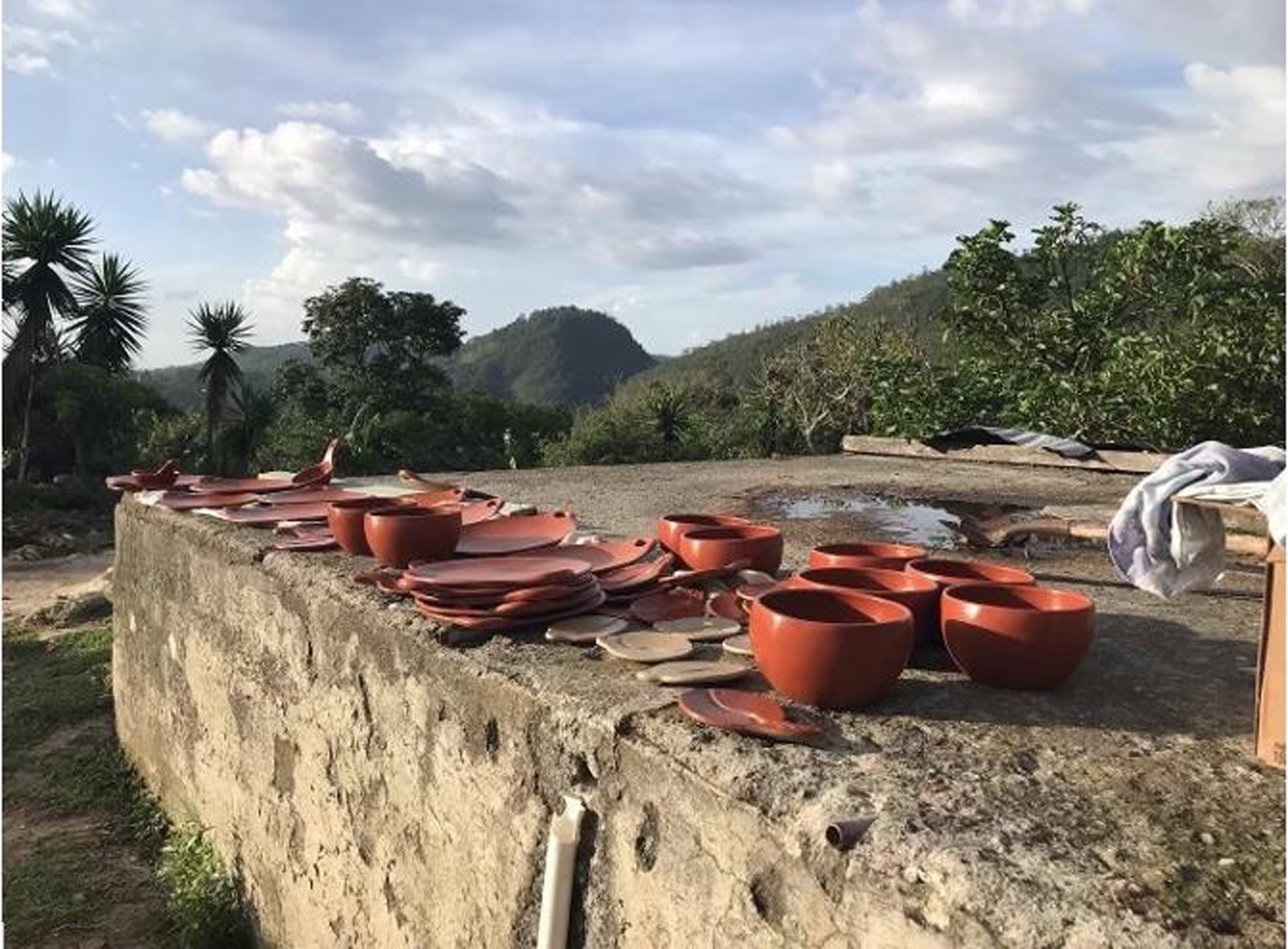
La Campa, Lempira, and Cofradía, Intibucá, are both pottery-producing Lenca communities in western Honduras. However, the way pottery has been defined and promoted at the local and national scales differs greatly between these communities. La Campa is a municipality located in a mountain valley between Camapara Mountain and Celaque Mountain in Lempira. The population of roughly 8,660 people primarily identifies as Lenca (UNAH 2022a). Pottery has a long history in La Campa, as a household good, income source, and today a tourist good (Figure 2). La Campa’s pottery is handmade, without wheels or molds, produced from local materials (clay, sand, water), and recognizable by its red color, coming from a mineral deposit on Camapara Mountain. Typical forms are utilitarian: ollas (pots), cántaros and jarros (pitchers), comales (heating dishes) (Mejía Reference Mejía2008; Guerrero Reference Guerrero2011). Potters produce and sell pottery independently or through craft cooperatives (Toombs Reference Toombs2022).
Pottery in La Campa, 2022. Photo by the author.
La Campa’s pottery represents human-environmental connections. Historically, potters believe that elements in nature, including pottery production materials, are inhabited by earthly spirits, which must be compensated through pagos a la tierra (offerings) for those resources to replenish. If potters fail to perform pagos, pottery may break during firing, resources may deplete, or potters and family members may fall ill. While these beliefs have decreased in prevalence due to influence from the Catholic Church and contemporary education systems, some potters practice pagos in secret or incorporate these beliefs into resource extraction practices (Chapman Reference Chapman1985; Mejía Reference Mejía1989, Reference Mejía2008; Tucker Reference Tucker2008, Reference Tucker2010, Reference Tucker2012).
Despite pottery’s history in La Campa, it has not been a marketing focus in national tourism. Limited support from political authorities is often cited as a barrier to market access among potters. In twenty-six interviews with La Campa’s artisans from 2019 to 2022, nearly all potters cited limited promotional support as a central issue affecting their ability to earn income from craft production:
There’s a lack of publicity, a lack of support, and a lack of motivation … we’ve tried to form a tourism committee here in La Campa, but when we requested help from the mayor’s office to create resources, they denied us … political authorities need to give more attention to our communities, because when [tourists] come to buy [pottery], they want to know more information, how it’s made … they see pottery as something important. (La Campa pottery vendor, #23, July 12, 2021)
When La Campa’s pottery is promoted, artisans have little influence over marketing. One potter described being misrepresented on social media:
“There has been publicity [for La Campa’s pottery] but in some cases, people have taken advantage of us and our crafts. What they’ve done is sell information and photographs of us … We don’t receive any benefits from those people or from the government. The sad thing is that people will come to my [family’s] workshop and say, “We’re here to see [how pottery is made], to take photos, to document this process and give you more publicity.” But they don’t buy anything and they never come back” (La Campa potter, #24, July 13, 2021).
Artisans rarely receive resources (e.g., transportation, funding) to attend tourism events outside the community. Craft markets consist of resellers and souvenir vendors with financial means to afford booth space or who are formally invited. Many argue this issue is related to economic access and political affiliation. One potter specifically stated: “If you don’t support the political party in power, there is no help” (La Campa potter, #12, July 10, 2019).
When La Campa’s potters attend craft fairs, it’s often only with institutional support, or informally if they have transportation. Institutional support is variable; local access issues, particularly the lack of cellular service or internet in rural areas, create communication problems. Artisans also risk breaking pottery in transport, losing production time and labor when traveling to sell, and facing the reality that they may sell nothing even when they access these spaces. Without access to markets, potters lose the opportunity to educate tourists about craft practices, leading to further confusion surrounding Lenca crafts and their value:
[Selling prices] are almost never fair because people don’t value our work, and so they’re always asking to bargain ….it’s important that tourists learn [about pottery]. (La Campa potter, #8, June 16, 2019)
Devaluation of pottery also reflects a lack of understanding regarding its functional history. Domestic and international tourists may not realize pottery is utilitarian:
There are people who think you can’t use [pottery] to cook … They think it’s decorative … When people come to my workshop, I explain to them [how it can be used]. (La Campa potter, #24, July 13, 2019)
Public misunderstanding is significant when compared to how artisans themselves define pottery in La Campa, as an important aspect of household economies, a source of local pride, and a tradition. Despite changes in production methods over time (oven firing, straining clay, contemporary forms), La Campa’s pottery has continuously been produced by hand using local materials, generationally taught, and is still used for cooking purposes (Mejía Reference Mejía1989; Tucker Reference Tucker2008; Toombs Reference Toombs2022).
Many potters and vendors claim that cooking and eating from clay pots is healthier and that food tastes better when prepared in clay. Potters feel La Campa’s pottery tradition will continue specifically because of its health benefits and utilitarian function:
Cooking in clay is healthy … If we eat from clay, we aren’t going to get sick … I’ve had various clients referred to me by doctors, because they have to cook in clay. This is also good for motivating new artisans to continue this tradition … I cook in my own [pottery]. (La Campa potter, #24, July 13, 2021)
Among twenty-six potters and vendors interviewed in La Campa, twenty-three (88 percent) use pottery in the household. This is significant compared to pottery use in other communities. Potters interviewed in Cofradía recalled a time when pottery was utilitarian, yet no potters interviewed currently use clay in cooking. La Campa’s potters also define their work as Lenca tradition:
Pottery here in La Campa is important because … it’s what characterizes this municipality. It’s made purely by hand, none of it with wheels or molds … all of it is natural, it’s decorative and utilitarian, and the majority is utilitarian. (La Campa potter, #18, July 1, 2021)
La Campa’s artisans clearly define pottery’s cultural and economic value as Lenca tradition. Yet barriers in market access and resource distribution created by existing socioeconomic and political structures limit their ability to sell and share pottery’s value directly with tourists. National marketing of Cofradía’s white clay pottery, and how local artisans now define this practice, provides an alternative example of how Indigenous artisans can benefit from sociopolitical support.
Cofradía is a community in Yamaranguila, Intibucá, outside the city of La Esperanza. The population of over five hundred Lenca people practices agriculture and coffee harvesting. In recent decades, craft production has become central to the local economy, through pottery, textiles, woodworking, and pine weaving (UNAH 2022b).Footnote 4
While utilitarian pottery was historically produced in Cofradía, today the community is known for pottery produced with white clay, a material said to only exist in this community. White clay pieces are decorative and are not typically functional due to the clay’s consistency. White clay has a unique story in Cofradía. Local women began to organize in production and sale of pottery in the 1980s, without institutional support. While women previously organized around agricultural activities, they recognized potential value in selling pottery to tourists. Pottery sales initially had minimal success, but development institutions began to take notice of Cofradía’s pottery practice (e.g., Peace Corps, Fundación para el Desarrollo Integral de la Mujer Hondureña [FUNDEIMH HN], Save the Children). They began supporting potters through trainings in production techniques.
In the early 1990s, artisans began experimenting with new pottery styles using white clay. Discovered accidentally in the surrounding mountains, white clay was initially used for repairing household ovens. However, potters saw potential in its use for crafts:
When I was 7 years old, my mother brought white clay to fix our oven. But then we started trying to use it to make [pottery] … the clay is unique to Cofradía. Before, we’d visited other potters when we’d been other places to sell, but no one ever brought white pieces until we discovered the white clay … White clay here is new, and it’s different. White clay is only ornamental. (Cofradía potter, #42, July 14, 2022)
This attracted attention from IHAH, which supported potters in attending craft festivals and trainings as part of the PROPAITH project. Men in Cofradía also became involved in craft production; several group members even attended the fine-arts school CICAI (Indigenous Artisanal Training Center) in La Esperanza to learn techniques like wheel-made pottery. The IHAH formalized Cofradía’s artisan group as a microcredit cooperative, CIALCOYL (Lenca Industrial Pottery Cooperative). CIALCOYL received development support (e.g., World Vision, ProLenca-Procasur) to construct a production workshop, store, and attend selling events. More recently, the IHAH and AACID (Andalusian Agency for International Cooperation) supported the establishment of a community museum (Casa Gualanáka) in the municipal center.
Political authorities in Yamaranguila also recognized white clay’s touristic potential. In 2019, then mayor José Bejarano prioritized marketing Yamaranguila as a “rural tourism destination.” In July 2019, he organized a cultural festival in Yamaranguila, inviting artisans, fruit and vegetable growers, and tourist guides to give demonstrations and sell products in a community exhibition. Representatives from the IHAH and the Municipal Association of Honduras (AMHON) attended, and Yamaranguila was named a pueblo con encanto (charming village) in a public ceremony. Part of a tourism campaign originated by former president Juan Orlando Hernández in collaboration with the IHT and AMHON, pueblos con encanto are communities recognized for preserving local natural and cultural history and symbols of Honduran “patrimony” (AMHON 2019; Honduras Tips Reference Honduras2019; Diario Roatán Reference Diario2021).
In tourism marketing, Cofradía is referred to as the “national capital of white clay,” the “treasure of Yamaranguila,” and a central destination of La Ruta Lenca (the Lenca Trail), with white clay pottery often called a “Lenca tradition.” While pottery’s history as a utilitarian good in the community is occasionally mentioned, white clay has become the central attraction, widely promoted by the IHAH, travel blogs, and social media outlets.
Support for Cofradía’s white clay pottery contrasts with pottery promotion in La Campa, despite pottery’s history in both municipalities. Further, promotion of this “new” craft practice in Cofradía, rather than traditional utilitarian forms, again reflects national focus on promoting “cultural traditions” that are commercially useful or can be used to construct a sense of national identity related to “uniqueness,” in this case, the narrative that Cofradía is the “only place where white clay exists.”
While the tourism industry has influenced the narrative surrounding Cofradía’s pottery, local potters have fought to maintain autonomy over their craft practices, particularly in how they define pottery as “tradition” and react against external intervention. Among interviews with Cofradía’s potters in 2022, all interviewees shared that one of their greatest challenges is preserving white clay, particularly protecting it from institutions and individuals who want to sell or export it outside the community. Despite attempts by IHAH to export white clay to other municipalities, Cofradía’s artisans, with local political support, prohibit the extraction and use of white clay by external entities (Cofradía potter, #43, July 14, 2022).
While Cofradía’s potters acknowledge that they have refined long-standing pottery practices through institutional support, they recognize white clay pottery as a “revived” tradition that has been discovered and preserved through community organizing:
[White clay pottery] is important because it’s how we live, it’s how the community lives. Working in pottery, selling it, the white clay is a source of community pride … it’s our goal to teach younger generations to keep these abilities … to leave this knowledge with them so it isn’t lost, just like we rescued it. (Cofradía potter, #42, July 14, 2022)
Potters in La Campa and Cofradía have different experiences in how their craft traditions are defined and promoted on the national scale. Despite sociopolitical forces that misrepresent or exclude them, artisans have not replaced traditional pottery but rather redefined how they practice and benefit from this historically important livelihood.
When outsiders shape “tradition”: Contemporary pottery and textiles
In some Lenca communities, external development interventions have had more profound effects in distancing artisans from how crafts are produced and marketed. Orocuina is a municipality in Choluteca, southern Honduras. Central livelihoods include agriculture, raising livestock, forestry, fishing, and pottery. While southern Honduras has some influence from the Chorotega Indigenous group (Orocuina is said to originate from a Chorotega word meaning pueblo de brujos (town of witches), the population identifies as Lenca, with their ancestry supported by archaeological and linguistic regional history (Municipalidad de Orocuina Reference Municipio2019; IHAH 2015).
The community of El Tamarindo, Orocuina, historically produced utilitarian pottery using local materials, including tague, a red-orange river stone, and tinaco, a mix of black clay and ash used to decorate pieces (Municipalidad de Orocuina Reference Municipio2019). While functional pottery is still produced, forms have transitioned to decorative items, created through techniques learned in institutional trainings. Pottery has gradually declined as a community practice, but artisans receive development support to preserve and commercialize pottery production:
Before, everyone here made [pottery] … but not anymore. Now many people have lost the ability … [pottery] that has greatest demand, is decorations more than anything ….more often today, [potters] make things with an economic view, because it earns more money. (Orocuina potter, #47, July 23, 2022)
In collaboration with the Peace Corps, Ayuda en Acción, World Vision, and the IHAH, Orocuina’s potters received trainings in production (particularly mold-made pottery), organizational strategies, and product valuation. In the late 1990s, the IHAH supported potters in formalizing their cooperative, Alfarería El Tamarindo. Most recently, the group received support through another IHAH-sponsored project, Manos Catrachas, which provides marketing support.
Popular pottery forms sold today in Orocuina are contemporary, decorated with varnish or synthetic paints. Notably, artisans sometimes create Maya replicas, produced using molds provided by the IHAH. Despite these changes, El Tamarindo’s potters maintain some traditional production practices and express pride in their identity and work as Lenca artisans:
Pottery is important first as a source of employment, it brings us income. It helps us to preserve [pottery], to not lose the tradition, because it’s important to have this knowledge. It’s a source of pride … a privilege to have this knowledge. It pertains to one of the most important parts of our country’s identity, because our pottery is identified as a Lenca tradition. (Orocuina potter, #46, July 23, 2022)
Another striking example of changing Lenca craft practice can be seen in San José de Guajiquiro, a municipality in the southeastern region of La Paz. The region is known for a relatively cold climate and a biodiverse environment. Primary livelihoods include agricultural activities, wine and jam production, and pottery and textile production (Perfil Municipal 2020).
San José de Guajiquiro is home to several craft producers, including potters in CIALSAJOL (Cooperative of Lenca Potters San José de Guajiquiro). CIALSAJOL has twenty-three active members (all women), a workshop, a pottery store, and a pulpería (small convenience store) that it runs as a group to supplement craft sales. While potters in San José have long produced crafts for household use, today the community is known for a decorative “black and white” pottery design. These forms are popular with tourists and marketed as “Lenca” at the national and international scale. However, this pottery style is relatively recent and was specifically learned through intervention from the development worker and ceramicist Alessandra de Foletti.
Foletti, who has a master’s degree in cultural anthropology, moved to Honduras with her husband in the early 1980s, during which time she became interested in Lenca pottery production. When she arrived in San José, potters produced only utilitarian pottery. Drawing on her background in ceramics, Foletti taught contemporary production techniques, notably a “smoking” technique, used to produce the “black” pottery that the community is known for today. In the late 1980s, Foletti encouraged artisans to formally organize and sell pottery. With funding from Cooperación Suiza (Swiss Agency for Development and Cooperation) and the PROPAITH-IHAH project, San José’s potters became a formal cooperative and began selling to tourists.
In 1998, following Hurricane Mitch, Foletti worked with a Swiss NGO to support Lenca potters affected by the storm. This work led to the establishment of ACTA (Cooperation Agency of Ticino and Associates) de Honduras, an NGO founded and operated by Foletti, focused on commercializing Lenca crafts for international export. Through ACTA, Foletti exported nontraditional pottery produced in San José to the United States, Canada, and Europe. As a ceramicist herself, she exhibited her pottery in Honduras, the US, Europe, Japan, and beyond, many pieces similar to San José’s pottery (“Principito en arcilla” Reference Chapman2016; Hasemann Lara Reference Hasemann Lara2022).
San José’s potters generally have a positive perspective regarding Foletti’s support. Potters interviewed also clearly distinguish between “traditional” utilitarian and commercial pottery:
It’s not a tradition. What’s traditional are jarros, frideras, sarténes, and ollas. Before, that was what people made. It’s not like that anymore … clay is changing, it’s for decorations. It’s a transformation. (San José potter, #49, July 30, 2022)
Regionally, Lenca and non-Lenca artisans, anthropologists, and others have mixed views regarding San José’s pottery; as one potter from Cofradía reacted to her mention during a 2022 development training, Foletti “robbed” Lenca potters by taking inspiration from their practices, exporting products in these styles, and using them for her own benefit (author fieldwork, September 10, 2022). I attempted to contact Foletti multiple times for an interview during fieldwork but never received a response.
Impacts of this “invented” pottery are startling: a Google image search of “Lenca pottery” results primarily in the “black and white” style from San José. This pottery is found on sites like Etsy, eBay, Pinterest, and online handicraft markets for prices upwards of US$100. San José’s potters sell directly to tourists for average prices of 100–400 lempiras (US$4–16). On these sites, pottery is inaccurately described as “ancient,” “pre-Hispanic,” and produced by “Indian women” (Handiwork Goods Reference Handiwork2022; WorthPoint 2022).
Marketing by ACTA and the IHAH spread the assumption that this pottery style is a historically significant “Lenca tradition.” San José’s potters, who distinguish between contemporary and traditional forms, lost control over how their crafts are defined, marketed, and sold beyond the regional level. ACTA remains active, and as recently as 2020, Foletti announced a fundraiser on the organization’s website to provide pandemic relief to Lenca artisans (ACTA de Honduras Reference ACTA2022).
A final example of how national tourism marketing creates misconceptions surrounding Indigenous craft traditions is the case of “Lenca” textiles in Intibucá. Chiligatoro and El Cacao are Lenca communities located outside La Esperanza, the highest-altitude city in Honduras. This zone is known for agricultural activities and flower production. Today, these communities are recognized as “rural tourism” destinations, particularly due to “Lenca” textile production. Like pine weaving and contemporary pottery, textiles have a recent history, becoming a touristic craft within the past forty years (IHAH 2021).
Handmade clothing and textile workshops existed in Honduras from the colonial period until the mid-twentieth century, when machine-produced clothing became widely available (IHAH 2021). Household textile production reemerged as an income-earning activity in the late 1960s, and some weavers learned production techniques generationally. However, today most weavers learn through institutional trainings. Groups like Cooperación Internacional have worked in Lenca communities throughout La Esperanza to teach weaving and create employment opportunities, particularly for women. Recently, IILA (Italo-Latin American International Organization) established a weaving school in La Esperanza (Candelori Reference Candelori2022). Several formal weaving cooperatives exist in these communities today, each with their own workshop of wooden looms, where artisans produce pañuelos (headscarves), tablecloths, and accessories using colorful synthetic thread imported from Guatemala.
Weavers receive institutional support (e.g., Peace Corps, CEPUDO, FUNDEIMH, CDE, national banks). Souvenir stores throughout Honduras sell touristic crafts made from repurposed Lenca textiles, like jewelry, shoes, and clothing. Textiles are incredibly popular among tourists, and in Intibucá they have become synonymous with “Lenca” identity. State-led marketing uses imagery of Lenca women wearing textile headscarves to promote rural tourism. Yet Lenca weavers do not necessarily define textiles as “tradition.”
In October 2021, La Esperanza celebrated its annual Wine and Mushroom Festival, a national event typically held during the mushroom-growing season in June, but rescheduled due to COVID-19. The celebration included a craft fair in the central park, where Lenca craft producers informally sold white clay pottery, woven pine goods, and textiles. The event was well attended and covered by national news outlets; reporters interviewed artisans during the festival. I accompanied two Lenca artisans at the event, a potter and her mother, a weaver, who wore a pañuelo during the fair. Multiple reporters interviewed the weaver, asked to take her photo, and filmed her as she talked about textile production. I asked what she thought of being interviewed and filmed. She laughed and responded: “I always get interviewed when I wear my pañuelo. It helps people see me as Lenca and I sell more. I don’t really wear it at home” (author fieldwork, October 8, 2021).
Other weavers express similar views. In conversation with an artisan who attended the October 2021 training in Valle de Ángeles, she shared that in Yamaranguila, she wears pañuelos only when municipal representatives, tourists, or journalists visit. A weaving cooperative member in El Cacao spoke to the idea of textiles as “tradition”; she felt that textile use among younger generations was uncommon. While she associated textiles with “older” styles of Lenca dress, the colorful patterns produced in contemporary weaving were not necessarily part of that association:
Before, people here would wear textiles, and now it’s changed because my mother wears the pañuelo still, but [younger people] don’t wear them anymore. Now we make shirts decorated with [textiles], cushions, all kinds of products, new innovations … I don’t use [textiles]. (El Cacao weaver, #22, July 8, 2021)
Cultural festivals heavily incorporate textiles into marketing. The colorful plaid patterns are featured in social media advertising, and it’s common to see public figures (politicians, news anchors, development workers) attend events in clothing incorporating Lenca textiles, associating them with Honduran “heritage” and culture.
While weavers are aware of these associations and use them to their advantage when selling, they don’t typically describe textiles as “tradition.” Conversely, third-party vendors who resell textiles sometimes describe this craft as “traditional,” even when they have limited knowledge of its origins. One souvenir store owner shared: “I really don’t know much about [textiles]. Here it’s something that tourists really like, but I don’t know the history well” (Gracias craft vendor, #19, July 2, 2021).
Some souvenir store owners are artisans, but their craft production knowledge comes from institutional trainings rather than generational learning:
For three years, I studied sewing, and I learned to make Lenca textiles. I was in a college called CICAI … [textiles] are important because they bring color to the Lenca culture. Primarily, I think they started out of necessity [for clothing]. (La Esperanza weaver, #26, July 28, 2021)
Lenca textiles reflect the power of state-led marketing in shaping public opinion surrounding cultural identity. Yet mixed perspectives among artisans, vendors, and tourists indicate clear disconnects in the interpretation and meaning of this craft and its place in Lenca history and culture.
Centering artisan perspectives
Given these complicated shifts over how Lenca crafts are defined and valued, how do artisans themselves define and benefit from their craft livelihoods today?
Artisan organizational and selling strategies support the continuation of craft livelihoods to an extent, even in periods of limited institutional support. Craft cooperatives in La Campa (La Palá), San José (CIALSAJOL), Cofradía (CIALCOYL), Orocuina (El Tamarindo), and weaving groups rely on one another to effectively distribute time and labor, attend selling events, and maintain productivity. Among independent artisans, economic diversification through collaboration with other craft producers and participation in public programs supports craft livelihoods while allowing artisans to retain some access to regional markets (Toombs Reference Toombs2022). Yet these strategies alone do not necessarily allow Lenca artisans to reclaim ownership of their traditions within the tourism industry.
Defining “Lenca tradition” is challenging, even among artisans. Artisans don’t always speak openly about identity and sometimes struggle to self-identify. In over fifty interviews with artisans, craft vendors, development workers, and tourists, all participants were asked to describe themselves in three words. While non-Indigenous participants quickly responded with descriptors like intelligent, creative, or practical, Lenca artisans had more difficulty responding. However, when asked specifically about their identity as artisans, or if they identified crafts as “Lenca,” they immediately distinguished these practices (specifically pottery) as “Lenca tradition.” In La Campa, potters shared:
[Pottery] is important because it’s a patrimony of this community. (La Campa potter, #18, July 1, 2021)
“Pottery is something Lenca because here, the olla, the pieces we make, that’s Lenca. It’s a Lenca tradition. All of that we make here” (La Campa potter, #38, November 10, 2021).
In Cofradía, potters similarly shared:
I’m Lenca, and I feel Lenca because I’m from the Lenca race. I’m from Honduras, from the Lencas, Indigenous blood, from Cacique Lempira. Pottery is Lenca because it’s from our ancestors, from our grandparents, great grandparents, it’s how we survive. We rescued it. (Cofradía potter, #42, July 14, 2022)
In Choluteca, potters shared:
Pottery is a source of pride for us. It pertains to one of the most important ancestries in our country, because our pottery is identified as a Lenca tradition … Lenca is one of the most intelligent ethnic groups, in the creation of artisan crafts. (Orocuina potter, #46, July 23, 2022)
In San José, potters expressed:
I think Lenca means not losing your culture … although [changes] have come over time, to be Lenca means defending the culture we have … [pottery] is Lenca. (San José potter, #49, July 30, 2022)
It’s important to note that there is more data to collect concerning how Lenca crafts are defined, created, and used in these communities. Given limited funding and delays related to COVID-19, fewer interviews were conducted with artisans outside La Campa. Additionally, there are fewer potters overall in these communities. Ideally, future research will expand on data collection at these sites.
PhotoVoice
To better understand and center artisan perspectives on pottery tradition, fieldwork in La Campa involves an ongoing PhotoVoice project with potters at the La Palá cooperative. PhotoVoice is a community-based participatory research (CBPR) method by which participants can identify, represent, and improve their community through photographic techniques (Wang and Burris Reference Wang and Ann Burris1997). From 2021 to 2022, potters used disposable cameras (distributed by me) to visually document pottery production, from resource extraction to completion. I developed photos and brought them back for the 2022 field season. Potters analyzed images through closed and open photo sorting. In the closed photo sort, artisans were asked to sort images on the basis of production techniques they identified as “traditional” versus “new.” In the open photo sort, potters selected their favorite photo among all images and explained why they chose it.
The analysis filled gaps in understanding regarding changing production processes and artisan perceptions of self. For instance, favorite photos selected included images of potters posing with forms, actively producing pottery, or working collaboratively with family or household members. Photos reflected artisans’ desire to document pieces they felt were strong representations of their work, or demonstrated pride in their abilities as potters. Images generated discussion around self-identity as “Lenca artisans,” a topic difficult to capture in interview data alone. When asked to analyze “favorite” photos, potters discussed their identity and pride as artisans more clearly (author fieldwork, July 5, 2022).
Given the confusion surrounding Lenca identity and crafts in the tourism industry, potters’ interpretations of photos proved significant. Placing data collection and analysis in artisans’ hands filled information gaps, allowing pottery production changes and perceptions of “Lenca” identity to become clearer. PhotoVoice also became a tool for artisans to address concerns about misrepresentation in tourism marketing; as elaborated in the following section, potters were able to use their own documentation of pottery production and direct experiences to create promotional materials that helped them to sell their wares. Incorporating Tuhiwai-Smith’s (Reference Tuhiwai-Smith1999) and Rappaport’s (Reference Rappaport2017) perspectives on collaborative ethnography centering participant views, PhotoVoice offers an example of how Lenca artisans participate in research and promotion of their own heritage in tourism marketing. Future project applications may consider how artisans use these images to develop community museum exhibits or create educational tourism experiences.
Educational and promotional resources
During my initial visit to La Campa in 2019, I asked artisans to suggest deliverables from this work that would be most useful to them. Most potters mentioned promotional support, citing access challenges like a lack of internet, communication barriers, and a poor understanding of Lenca crafts among tourists. For this reason, ongoing collaborative projects focus on promotional resources and documentary strategies carried out by artisans. Current projects include educational tourism guides on Lenca crafts, business cards for pottery cooperatives, and an interactive website, all of which include images captured by artisans and information from interviews, compiled and selected in collaboration with potters.
Tourist guides created thus far focus on pottery in La Campa and Cofradía. The trifold guides showcase pottery’s history, production, community maps, and artisan contacts. In developing the guides, artisans chose information and images to include. Guide information comes directly from artisan interviews; I compiled and formatted guide information using Canva, and each draft was shared with potters for editing. Final versions were printed and delivered to artisans, distributed during selling events, and delivered to souvenir stores and museums throughout western Honduras.
Business card designs incorporated a similar process. Potters provided images, contact information, and formatting ideas. I compiled information using MOO online print company and delivered the cards to artisans. Cards are distributed to tourists during selling events and are available in local tourism businesses.
By distributing these materials, artisans establish communication with potential buyers without social media, a resource not currently accessible to most artisans. Tourists and resellers have been receptive to these materials, taking greater interest in Lenca pottery when they are able to read about its history and function.
Another ongoing project is a website focused on Lenca crafts. Initially, the website was intended to be an educational resource about how to visit Lenca communities, pottery for purchase, and interactive resources showing craft production. Throughout the website design and ongoing fieldwork in Honduras, it became apparent that this might not be the ideal research output, given issues related to internet access and logistical challenges preventing artisans from taking over site ownership and curation. In conversation with artisans during 2024–2025 site visits, we considered revising this output to a digital community archive, incorporating PhotoVoice project images as cultural documentation while educating users about Lenca pottery. Ideally, this archive would also feature a physical component, with photographs by artisans housed in community spaces. This revised project is in initial planning stages, with plans to seek funding support for further PhotoVoice data collection. This revision speaks to the importance of sustainable, ongoing collaboration efforts with research participants. It is critical that researchers reconsider and revise projects alongside changing conditions and community needs.
Conclusion
This article has demonstrated how complicated meanings surrounding Indigenous craft “tradition” and identity in Honduras play out in five Lenca communities. Honduras’s history of neoliberal development since independence has focused on unifying citizens through a “national imagination and identity,” yet the framing of that identity has marginalized distinct Indigenous groups, like the Lenca people. While individual Indigenous groups in Honduras have received recognition in the past two decades, trends like Mayanization and neoliberal multiculturalism have continued to promote particular identities only when they are marketable to the state. Projects like IHAH-PROPAITH, development initiatives with differential impacts across Lenca communities, barriers in market access, and misrepresentation of Lenca crafts at the national and international scale create ongoing issues for artisans.
Yet Lenca artisans continue to practice and define their craft livelihoods. In La Campa, Cofradía, Orocuina, San José, and beyond, producers clearly associate craft practices with their identities as Lenca artisans. While crafts have evolved, artisans redefine and reclaim ownership of these traditions through repurposing historically important practices (white clay pottery), maintaining long-standing production techniques (La Campa’s pottery), or simply identifying differences between “traditional” and “new” (pottery in San José and Orocuina). Artisan-led collaborative projects offer one possible avenue for more directly involving Lenca artisans in cultural tourism.
While challenges in misrepresentation continue in Honduran national tourism, the strength of artisan perspectives in defining their craft practices and the pride they express in their livelihoods suggest that these traditions will continue to survive in Lenca communities and, ideally, connect artisans to the regional tourism industry.


 Open access

