





INTRODUCTION: THE CYCLADIC CONTEXT
In the Early Bronze Age (EBA) of the Aegean (third millennium BC) an extended network of connections was developed (Renfrew Reference Renfrew1972; Barber Reference Barber1987; Broodbank Reference Broodbank2000). The Cycladic islands (Figure 1), a Polynesia at the heart of the Aegean Sea, played an important role in those interactions, which reached their peak in the Early Cycladic (EC) II period (early EBA II), the time of the Keros-Syros culture. This situation is demonstrated first by the Cycladic customs and artifacts, mainly marble figurines and marble fine vessels, which were detected at many Aegean sites of that period (Stampolidis and Sotirakopoulou Reference Stampolidis and Sotirakopoulou2018; Marthari et al. Reference Marthari, Renfrew and Boyd2019); second by images of large longboats for long voyages and raids dated also from the same period, which are depicted both on Cycladic ceramic “frying pans” from the Chalandriani cemetery on Syros (Coleman Reference Coleman1985; Broodbank Reference Broodbank1989; Wedde Reference Wedde2000; Marthari 2017b) and on the rock at the site of Vathy on Astypalaea (Vlachopoulos Reference Vlachopoulos2017).
Map of the Cycladic islands, Greece, showing Skarkos and other domestic Early Cycladic sites.
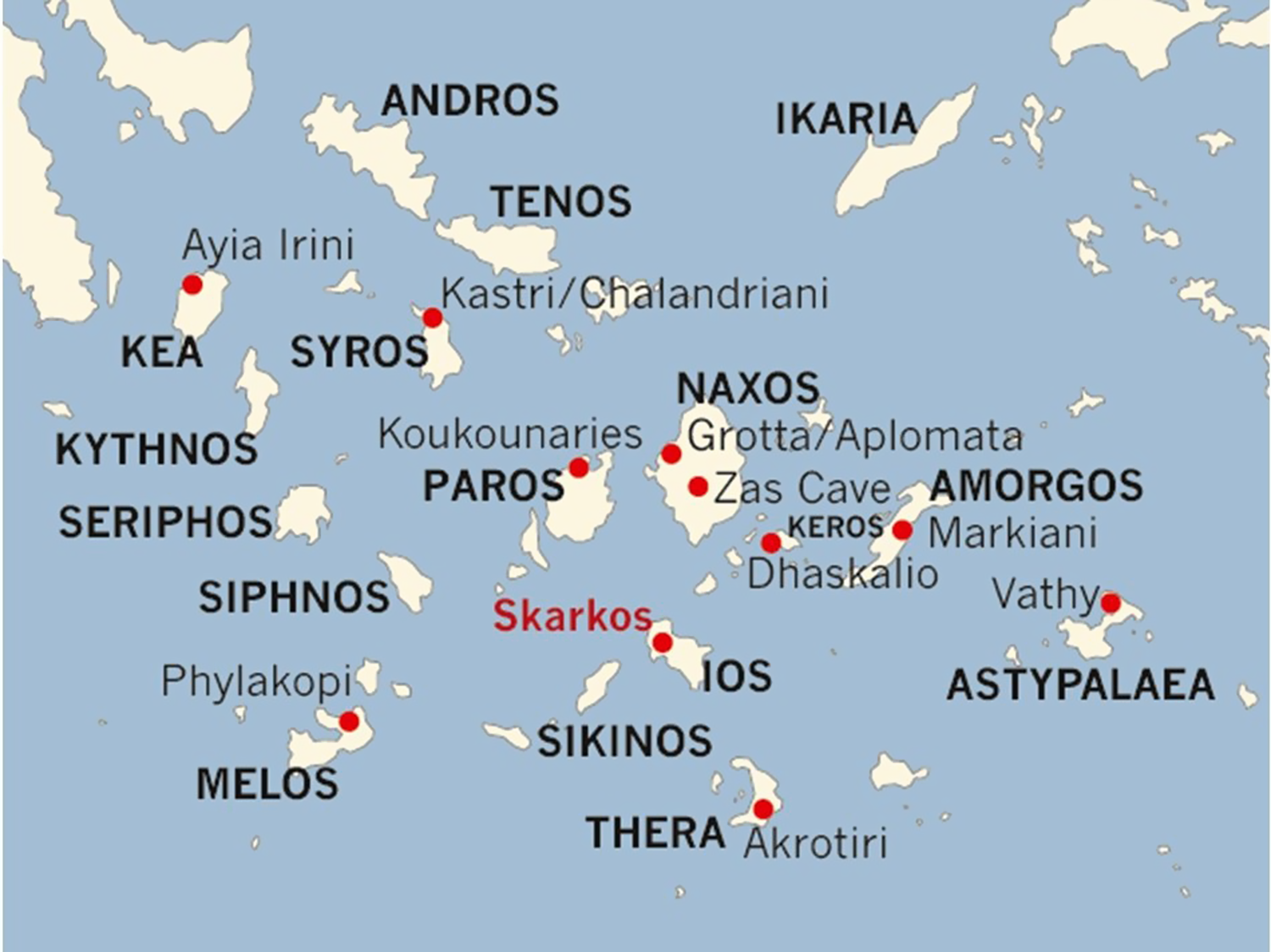
Nevertheless, until the 1970s, our knowledge was limited to only certain aspects of the culture developed during the EC II period, since very little was known about the settlements. The few identified examples were either poorly preserved, primarily since later habitation destroyed them to a large extent, or had been excavated only to a limited degree. The available evidence came mainly from the site Dhaskalio Kavos on Keros island and from cemeteries such as the Chalandriani cemetery on Syros, even though both had been partially looted. This was the reason why Colin Renfrew named the culture that developed during that period the Keros-Syros culture (Renfrew Reference Renfrew1972).
Over the years, some more EC II domestic sites were located and partially excavated. However, the level of our knowledge about the habitation and society of that period would not have changed significantly if the major settlement at Skarkos on Ios (Figure 2) had not been identified and extensively excavated. The exceptionally well-preserved site at Skarkos discovered by Marisa Marthari in the mid-1980s brings a real balance to our knowledge of the most important developmental phase of the Cycladic EBA. It is a large, thriving site, demonstrating that during the EC II period the settlement’s urban and architectural forms were quite sophisticated, the use of stamp seals common, and specialized craft production very well-developed. Those features give a more complete explanation of the potential of the Cycladic communities for large-scale interactions in the time of the Keros-Syros culture, which could now be more properly termed the Ios-Keros-Syros culture.
Map of Ios showing the site of Skarkos.

THE SITE OF SKARKOS AND ITS RELATIVE CHRONOLOGY
The site of Skarkos stands on a hill in a coastal plain, mid-way down the western side of the Cycladic Island of Ios and about 1 km from the island’s harbour, one of the largest natural harbours in the Cyclades (Figure 3). It was excavated first to a limited extent from 1986 to 1997 (Marthari Reference Marthari1997). The excavations were expanded considerably within the framework of two European Union-funded projects for the site’s conservation and promotion in 2004–2009 and 2011–2014 under Marthari’s direction bringing to light an Aegean prehistoric site of special importance (Marthari 2018).
Aerial view of the hill of Skarkos, Skarkos II settlement, and the harbor of Ios, seen from the northeast.

The site, as shown by the excavations, ranks among the notable multi-period Bronze Age sites in the Cyclades. Of particular importance is the large EC II settlement, which surmounts the hill of Skarkos. The buildings of the settlement, which are two-storeyed and most of them still stand to the height of the upper storey, cover the entire hill (Figure 4). Almost half of that settlement has come to light by excavation to date. The urban plan and the architecture can be followed over a large and continuous excavated area and do not need to be deduced from building remains exposed in small trenches. This enables us to understand the layout and aspect of settlements in the Cyclades during the period when the EC world was enjoying its heyday.
Skarkos II. Βuilding Alpha seen from the west.

Numerous well-preserved objects were excavated inside the rooms of the buildings, usually where they had been left when the settlement was abandoned. As discussed elsewhere, the pottery (Figures 5–6) (Marthari Reference Marthari, Brodie, Doole, Gavalas and Renfrew2008), as well as the marble figurines (Figures 7–8) and vessels (Figures 9–10) (Marthari 2017a), leave no doubt that the main phase Skarkos, termed Skarkos II (Marthari 2017a), should be assigned to the early EBA II (EC II), the time of the Keros-Syros culture. The Skarkos phase II pottery assemblage presents strong stylistic similarities in certain wares with other EC II domestic pottery assemblages, such as the Ayia Irini period II, Phylakopi phase A2 (Marthari Reference Marthari, Brodie, Doole, Gavalas and Renfrew2008; Wilson Reference Wilson2013) and Dhaskalio phase A (Marthari 2017a, 2018; Sotirakopoulou Reference Sotirakopoulou2016). The wares are fine (Urfirnis, mottled and dark-on-light painted), semi-fine (dark-on-light painted broad-streak collared jars), and coarse (talc ware), most imported at each of the four settlement sites. The Markiani period III pottery assemblage (Birtacha Reference Birtacha2006), which essentially comes from a single deposit, also shows strong similarities with that from Skarkos II in terms of coarse pottery. Almost all types of coarse and, as a rule, local pottery from Markiani III (Birtacha Reference Birtacha2006; Vaughan Reference Vaugan2006) find parallels in the Skarkos II local pottery. However, it should be noted that Markiani III does not include imported wares, and indeed imported fine and/or patterned painted wares are those that primarily help in chronological synchronisms.
Skarkos II. A selection of eating, drinking, serving, and cooking ceramic vessels.

Skarkos II. Ceramic amphora with grooved handles.

Skarkos II. Marble anthropomorphic figurines of the Chalandriani variety.

Skarkos II. Marble schematic figurines of the Apeiranthos type.

Marble footed bowl.

Marble horizontal lug bowl.

A habitation period earlier than the main one, termed Skarkos I (Marthari 2017a), has been recently identified at Skarkos. There are a few buildings dating from that period located only on the top of the hill, which must have been sealed for most of their part during the main occupation period (Skarkos II). The pottery assemblage and the marble vessels coming from that earlier nucleus of the settlement are representative of the EBA I (EC I) (Marthari 2017a).
There is not a single example of the diagnostic Anatolian pottery types of the Kastri group to be found on Skarkos hill. A few sherds of the EC III (Phylakopi I culture) and several of the early Middle Cycladic period are included in the surface finds, but so far none have been found in association with building remains. The late Middle Cycladic and early Late Cycladic, namely the era of Minoan influence in the Cyclades, are represented at Skarkos by a cemetery revealed to the northeast of the hill and a deposit of a domestic character excavated to the south. Both the cemetery and the domestic deposit lie above the Skarkos II settlement but caused little disturbance to it. Finally, the Mycenaean sherds retrieved from the surface finds as well as the remains of a chamber tomb on the southern foothills of Skarkos hill testify to the continuation of at least burial use in the Mycenaean period (Marthari 2009).
THE EC II SKARKOS SETTLEMENT (SKARKOS II)
The settlement plan and architecture of Skarkos II were complicated (Marthari 2018). Rectangular buildings were arranged in concentric zones, along streets, and around small squares. The settlement grew larger with the construction of new buildings, which were added to the older ones. The form and plan of the buildings underwent continuous development while respecting the community’s unwritten codes.
The settlement is not protected by a separate fortification wall; the entrance to the settlement’s public areas, however, was through gates. The site was further protected at some later point within the early EBA II period by sealing almost all the openings of its outer zone. In this way, the exterior walls of the outer zone buildings were transformed into a single perimeter wall, for demarcating and, obviously, protecting the site. The settlement had a quite complex drainage network. Both the protection system and the drainage system of the settlement indicate a high level of community planning and community work.
The houses differ in size and complexity. Some are small and of a simple layout, while others are larger, two-storeyed (Figure 4), and more complex in arrangement. This indicates differentiations in the economic circumstances and the social status of the “families” residing in them. The larger houses have 8–12 rooms in total. In addition to the ground floor rooms, some of the upper-storey rooms were used for storing large quantities of provisions. An outside stone-built staircase provides access to the upper storey in each of the two-storeyed buildings. However, it is possible that there were also interior wooden staircases leading from the ground floor to the upper storey. Cupboards, in the form of niches in the wall, are quite common, and there is evidence that they had wooden doors.
Some open spaces were used not only for circulatory purposes but for gatherings, combined with the cooking and communal consumption of food and drink. Individuals or “family” groups who participated in these feasts had the opportunity to display imported fine tableware, in this way expressing their special status.
Skarkos II developed agricultural, craft, and trading activities (Marthari Reference Marthari, Brodie, Doole, Gavalas and Renfrew2008, 2017a). Craft specialization is particularly evident in the settlement. Indeed, the most recent excavations at Skarkos provided valuable data on the craft activities of the EC communities recovering two marble workshops for the first time in the Cyclades. In addition, a building was revealed, the artifacts of which leave no doubt about the practice of metalworking at the EC settlements from so early on. The evidence demonstrates that Skarkos ΙΙ was a major marble-working centre. Luxury and/or prestige objects, such as marble figurines (Figures 7–8) and fine vessels (Figures 9–10), were produced there in considerable numbers and circulated in the regional exchange networks in which Skarkos II participated.
The first marble workshop was revealed in the so-called Building of the Figurines, in the southeastern quarter of the settlement. Sixteen figurines were found there, whereas other buildings usually yielded only one to four figurines. Furthermore, certain special finds and concentrations of finds indicate that one or more craftsmen may have been working there (on marble and possibly on a variety of other materials). The artifacts include among others an unfinished marble figurine, an unfinished marble bowl, fragments of other fine marble vessels, marble flakes, emery tools, tools and raw pieces of pumice, abundant obsidian blades, lumps of mineral red pigment, and one bone tube used as pigment container.
A second marble workshop settled in the upper storey room of Building Kappa, in the north part of the settlement, was connected to the manufacture mainly of marble vessels. The artifacts found in the room are indicative of various phases of marble processing. Most of them were recovered in situ on the upper floor and only a few had fallen into the lower ground floor. They comprise a large piece of raw white marble with traces of some initial processing, partly worked vessels including two bowls and a small palette, a huge palette in the process of manufacture, a large rectangular flat piece of marble used as a working surface, andesite, pumice, scoria and marble tools, and obsidian blades.
It is particularly important that in Building Beta-Beta, a narrow structure with two rooms next to Building Kappa, a number of artifacts were recovered showing the practice of metalworking including a portable hearth with copper residues on its inner surface and two clay tuyères. They could either be indicative of metallurgical activities in situ or could also represent the storage of these artifacts for use elsewhere. Therefore, Skarkos is added to the very few EBA domestic sites, where metalworking was practised already from the EBA.
Despite the absence of sealings, Skarkos’s rich evidence argues for a beyond-decorative use of seals in the Cyclades, beginning in the early EBA II. The most stimulating finds from Skarkos include seals, cubic seal-impressed terracotta objects in large numbers, and seal-impressed pottery, all from excellently documented contexts. The excavation data leaves no doubt that there existed sealing practices possibly for indicating ownership of the containers, the nature and/or properties of the commodities stored in them, or the origin of the containers. The stamping practices from Skarkos II and the variety and complexity of the seal motifs all show that intensive use was made of seals in EC II communities (Marthari 2004, 2018).
The importance of the site with its rich cultural activity in the EC II deserves an accurate absolute chronology with radiocarbon dating, which is the aim of this article. Furthermore, the entire series of complete ceramic vessels, as well as marble figurines and fine vessels that were uncovered at EC II Skarkos, allow for a more precise relative chronology of the period. This facilitates the treatment of radiocarbon dates in combination with other sites of the same and also preceding and succeeding periods in order to improve the precision of the Skarkos II dating. In addition, this would allow placing the settlement’s chronology within the global absolute Cycladic time framework refining in this way the overall precision for the chronology of the heyday of the EC period and of the Aegean EBA.
SAMPLES AND THEIR STRATIGRAPHY
Apart from a small nucleus near the top of the hill, where there are remains of the Skarkos I period, as mentioned above, the rest of the excavated area that spreads out on the eastern, northern, and southern slopes of the hill, is covered by remains of the Skarkos II period settlement. Radiocarbon samples from deposits of the Skarkos I period are not included in the present article since the remains of this early period had not yet been discovered when this dating work had been practically completed.
Natural bedrock was encountered directly beneath the walls and floors of the Skarkos II period buildings in the aforementioned large area with no remains from an earlier building phase. However, a temporal depth for the EC II settlement can be inferred a) from the reduction of the original area of open spaces due to the addition of new buildings next to old ones and extensions of existing buildings, and b) the sealing of most of the gates of the settlement’s outer zone at some point in time. These architectural changes are not reflected in the pottery.
The stratigraphy on the eastern, northern, and southern slopes of the hill is as follows (Marthari 2017a): The Surface Level (Level 1) exceeds 0.20 m in thickness and is disturbed. Just below this level, walls of the Skarkos II period buildings were uncovered along with the Destruction Level (Level 2) of the settlement; mostly undisturbed. The thickness of this level that is determined by the height of the surviving buildings varies from 0.60 m to 3.0 or 4.0 m. A thick undisturbed Ashy Layer (Level 3), 0.20–0.60 m thick, was found spread out and levelled over the entire area of some open spaces and on the floors of several rooms on the ground floor of the buildings. In most of these spaces, hearths were found. The ashy layers comprised all manner of discarded waste, such as fragments of ceramic eating and drinking vessels including Urfirnis sauceboats, animal bones, shells, broken obsidian blades and small finds. It seems clear that the spaces under consideration, aside from other uses, served as places for holding of communal meals during the life of the settlement. Both the destruction level and ashy layers are assigned to an EC II horizon as demonstrated by the pottery.
The choice of radiocarbon samples was determined so as to obtain absolute dates for Skarkos II (the main phase of Skarkos). Nine well-stratified samples of bone were chosen from Skarkos II levels, all of which contain diagnostic EC II pottery, marble figurines and vessels, and other artifacts. Six of the samples come from destruction debris layers, and three from ashy layers (Table 1).
Animal bone (capra/ovis) samples and their archaeological coordinates.

EXPERIMENTAL TECHNIQUES
The samples were processed at the radiocarbon Unit of the Laboratory of Archaeometry, NCSR “Demokritos” which uses the Gas Proportional Counting technique (GPC). The bones were broken into approximately equal size pieces, roughly 2 cm long. The spongy bone and any encrustations were removed with a lancet. The samples were then washed with deionised water and put in an ultrasonic bath to remove soil or dirt precipitations. This was followed by chemical treatment (Acid-Base-Acid) to extract the collagen and gelatinize it and then combustion to turn the samples into CO2. For the full treatment and measurement protocols used in the Laboratory, see Maniatis et al. (Reference Maniatis, Oberlin and Tsirtsoni2016). After the first treatment and combustion it was realised that four of the bone samples were not suitable for dating; either they did not produce enough collagen or the collagen was of poor quality not giving an adequate % of carbon, and hence they were not further processed. It is noteworthy that these samples originated either from trenches outside the settlement, although in direct proximity to its external buildings, or on its borders (Table 1). The five remaining samples deriving from the buildings and the squares of the settlement were fine and were successfully dated.
RESULTS AND DISCUSSION
The radiocarbon dating results of the five successfully dated samples, all of capra/ovis species, are shown in Table 2. The calibrated ages, given with 1σ and 2σ, were obtained using the program OxCal v.4.4.4 (Bronk Ramsey Reference Bronk Ramsey2021) with the latest dataset of 2020 (Reimer et al. Reference Reimer, Austin, Bard, Bayliss, Blackwell, Ramsey, Butzin, Cheng, Edwards and Friedrich2020).
Radiocarbon dating results of the successfully dated samples.

It is interesting to note that the δ13C values, typical for sheep and goat species during the Bronze Age in mainland Greece and the islands (Maniatis and Arvaniti Reference Maniatis and Arvaniti2015), show remarkable consistency, indicating that the bones did not suffer any alteration due to taphonomic processes and that the sample treatment and preparation was meticulous.
The radiocarbon dates and consequently the calibrated ages are very similar, verifying in this way the archaeological evidence that indicates the existence of one and only one main occupation period, Skarkos II, in the larger part of Skarkos hill, where all the analyzed samples come from. This corresponds to EC II, the time of the Keros-Syros culture. The calibrated ages cluster in the middle of the 3rd millennium BC. These dates determine the last stages of Skarkos II before its final destruction. Α statistical treatment and modelling of the results with Bayesian Analysis (Bronk Ramsey Reference Bronk Ramsey2009a, Reference Bronk Ramsey2009b) was performed using one phase model. This gave the output probability distributions for 1σ (68.2%) and 2σ (95.4%) as shown in Figure 11. Due to a wiggle in the calibration curve at this period, the calibrated age ranges split into two-peak distributions, as can be seen in this plot. Nevertheless, the Start and End boundaries despite the splitting, show an overall 2σ probability distribution with a relatively narrow width.
Modelled dates of Skarkos II using a single-phase Bayesian analysis model.

The results of the analysis are shown in Table 3. As it appears the final stage of Skarkos ΙΙ (EC II) starts at a mean date of 2549 ± 41 BC and ends at a mean date of 2497 ± 42 BC, giving a mean rounded-up duration of 2550–2500 BC. This most likely represents approximately the last 50 years of the settlement at Skarkos in the EC II period.
Summarized results of the single-phase modelling analysis of Skarkos samples.

In order to place the dates of Skarkos II within the absolute time frame of the EC chronology we ran a multi-phase Bayesian analysis model using published dates from other Cycladic islands covering the cultural phases EC I, EC I/II, EC II, EC II/III and EC III (Table 4). In particular, we used two FN/EC I dates from the Zas cave in Naxos reported by Manning (Reference Manning2008), three EC I/II dates from Markiani II (Kampos group) (Renfrew et al. Reference Renfrew, Rupert and Manning2006, Reference Renfrew, Boyd and Bronk Ramsey2012; Manning Reference Manning2008), five EC II dates from Markiani III and one date from Dhaskalio-A (Keros-Syros culture) (Renfrew et al. Reference Renfrew, Rupert and Manning2006, Reference Renfrew, Boyd and Bronk Ramsey2012; Bronk Ramsey et al. Reference Bronk Ramsey, Renfrew and Boyd2013). We also used five (EC II/III) dates from Dhaskalio-B (Early Kastri group) (Renfrew et al. Reference Renfrew, Boyd and Bronk Ramsey2012; Bronk Ramsey et al. Reference Bronk Ramsey, Renfrew and Boyd2013) and seven (EC III) dates from Dhaskalio-C (Renfrew et al. Reference Renfrew, Boyd and Bronk Ramsey2012; Bronk Ramsey et al. Reference Bronk Ramsey, Renfrew and Boyd2013). In this analysis we have not included in the phase EC II/III the samples from Markiani IV (thought to belong to EC II/III, Early Kastri group) accepting the suggestion by Renfrew et al. (Reference Renfrew, Boyd and Bronk Ramsey2012) that the pottery of Markiani IV is not well studied and might belong to a later phase, probably EC III. It should be noted that there are no radiocarbon dates available from either Ayia Irini or Phylakopi.
Samples from Skarkos and other sites included in the multi-phase EC model.

1. Manning (Reference Manning2008).
2. Renfrew et al. (Reference Renfrew, Rupert and Manning2006); Manning (Reference Manning2008); Renfrew et al. (Reference Renfrew, Boyd and Bronk Ramsey2012).
3. Renfrew et al. (Reference Renfrew, Boyd and Bronk Ramsey2012); Bronk Ramsey et al. (Reference Bronk Ramsey, Renfrew and Boyd2013).
This multi-phase analysis was approached in two slightly different models. Model 1 (Figure 12): the Skarkos dates are included in the same phase (Keros-Syros culture) with Markiani III, and Dhaskalio-A (one sample). Model 2 (Figure 13): the Skarkos dates are separated with a boundary following the Markiani III, and Dhaskalio-A (one sample) dates, treating the Skarkos II dates as a separate phase that follows the Markiani II and Dhaskalio-A.
Model 1: Bayesian analysis of the Skarkos dates together with samples from Zas Cave, Markiani and Dhaskalio using a five-phase model (FN/EC I, EC I/II, EC II, EC II/III, EC III). The Skarkos dates in this model are grouped in the same phase (EC II) with Markiani III and Dhaskalio-A (one sample).

Model 2: Bayesian analysis of the Skarkos II dates together with samples from Zas Cave, Markiani and Dhaskalio using a six-phase model (FN/EC I, EC I/II, EC II, EC II/III, EC III). The Skarkos dates in this model are separated by a boundary from Markiani III and Dhaskalio-A anticipating a possible later subphase in the EC II phase.

The first model assumes that Markiani III, Dhaskalio-A, and Skarkos are practically synchronous based on the fact that, as discussed above, the pottery assemblage of the Markiani III period of Amorgos bears a great resemblance to that of Skarkos II, despite the fact that it does not comprise fine imported wares.
The second model treats the Skarkos II dates as a separate phase that follows the Markiani III and Dhaskalio-A, given the fact that the Skarkos II dates appear to be slightly later so that by grouping them in a different phase we allow the model to calculate any time difference with the group Markiani III- i.e. Markiani III - Dhaskalio-A that may exist.
Model 1 produces an overall model agreement (Amod = 86) and all samples have an individual agreement over 70 (Figure 12).
Model 2 produces a better overall agreement (Amod = 102), but with one sample from Markiani III (OxA-3292) agreeing less well in that phase (A = 44) (Figure 13).
We believe that model 2, with Skarkos II as a separate later phase within the Keros-Syros culture period (EC II), is probably closer to reality. However, we report here both. The numerical analysis results for the phase transition boundaries from the two models are shown in Tables 5 and 6 respectively. As it appears the new Skarkos dates representing the final stages of the occupation in the EC II period, treated together with data from other Cycladic sites, modify to a certain extent the dates proposed in the past particularly for the transition boundary from Kambos group to Keros-Syros culture (EC I/II to EC II) (Manning Reference Manning2008; Renfrew et al. Reference Renfrew, Boyd and Bronk Ramsey2012; Bronk Ramsey et al. Reference Bronk Ramsey, Renfrew and Boyd2013). This transition was reported at 2650 BC by Manning (Reference Manning2008) using the dates from Zas and Markiani, and some bones from Keros-Kavos dates. The same transition boundary was increased to 2750 BC by Renfrew et al. (Reference Renfrew, Boyd and Bronk Ramsey2012) and Bronk Ramsey et al. (Reference Bronk Ramsey, Renfrew and Boyd2013) using again the Markiani II and III dates and the Dhaskalio A, B and C dates. The same date, 2750 BC was also reported by our previous paper (Arvaniti and Maniatis Reference Arvaniti and Maniatis2018), using the same date set as Renfrew et al. (Reference Renfrew, Boyd and Bronk Ramsey2012) plus the Palamari (Skyros) dates (Maniatis and Arvaniti Reference Maniatis and Arvaniti2015) grouped with Dhaskalio B in the Early Kastri group phase (EC II/III).
Numerical results of the output of Model 1 (five-phase model, with Skarkos dates in same phase as Markiani III and Dhaskalio) (Figure 12).

Numerical results of the output of Model 2 (six-phase model, with Skarkos dates in different phase from Markiani III and Dhaskalio) (Figure 13).

However, when we include the Skarkos II dates the transition boundary to the EC II phase comes down to 2700 BC for model 2, which is probably more realistic. We believe this date may represent more truly the transition (EC I/II to EC II) because the Skarkos II samples resulting from well stratified layers define much better the end of the EC II phase and hence the preceding period, than Markiani or Dhaskalio A alone. In particular, this transition was defined in the previous works with just three radiocarbon dates from Markiani II (EC I/II) and five dates from Markiani III (EC II) and two from Dhaskalio A (OxA-22754 and OxA-22757). All those dates exhibit very large age ranges due to initial large errors in the BP dates and the wiggles in the calibration curve at that period. Hence, in the Bayesian analysis model the transition boundary of EC I/II to EC II is a bit floating and its overall distribution and mean value can be influenced by the date of one or two samples still producing an output with a reasonable overall agreement. For example, the sample OxA-22757 (R45) from Dhaskalio A has a very high age for this period and pushes the transition to a higher date (2750 BC). The context of this sample together with the context of sample R44 (OxA-22756) were discussed and debated by Bronk Ramsey et al. (Reference Bronk Ramsey, Renfrew and Boyd2013). Besides, the Dhaskalio samples are small charcoal fragments and there is always the chance that may be exhibiting an old wood effect to a lesser or higher degree (Renfrew et al. Reference Renfrew, Boyd and Bronk Ramsey2012). We therefore decided to leave these two samples out from the present statistical analysis.
Nevertheless, the definition of the transition from the EC I/II (Kambos group) to EC II (Keros-Syros culture), hence the beginning of the EC II phase, relied in the past on just three dates and with large errors for the preceding period Markiani II (EC I/II). We have now added to the EC II period precise and repeatable dates from Skarkos which certainly more strongly define statistically the last stages of the EC II period.
In every case we should not consider these dates for the transition EC I/II to EC II, as securely fixed given the fact that they are based on limited available data from the preceding periods and dates with large uncertainties. The transition date would be fixed better if there were more individual dates from the preceding periods. Colin Renfrew in discussing the Markiani radiocarbon dates suggests there may possibly be a putative Early Markiani III gap (occupation gap?) of about 100 years not well represented in the radiocarbon dates or in the contexts excavated (Renfrew et al. Reference Renfrew, Rupert and Manning2006). This of course cannot be visualized at present and one cannot predict what dates such a stratigraphic layer if existed would give. We are expecting to obtain and date samples from the newly discovered preceding period of Skarkos (Skarkos I), in the near future as the study of the material proceeds
For the present time it is safe to say that the addition of the new Skarkos dates improve on previously published models, based on the same published dates, by extending the span of the dates for the EC II period with higher precision dates. Based on this we can perhaps propose a new tentative chronology for the Cycladic phases as presented in Table 7, with the reservations explained above. As expected, the period whose absolute date span is noticeably modified, is the EC II period. Accepting Model 2 as more accurate this can now be 2700–2500 BC. This is approximately the same with the dates suggested by Manning (Reference Manning2008) at 2650–2500 BC, and 50 years younger than those suggested by Renfrew et al. (Reference Renfrew, Boyd and Bronk Ramsey2012) and Bronk-Ramsey et al. (Reference Bronk Ramsey, Renfrew and Boyd2013) at 2750–2550 BC.
Approximate chronologies proposed after the Skarkos dates with the two models, using the mean dates rounded to the closest 100th.

The chronologies for the periods EC I/II, EC II/III and beginning of EC II are not much influenced by the new Skarkos dates. In comparing the Skarkos dates by themselves (2550–2500 BC) with dates from other non-Cycladic islands such as Palamari in Skyros and Aghios Ioannis Potos in Thasos, one observes the following:
Palamari phases IIa and IIb, correspond to early EBA II/III and late EBA II/III (Early Kastri group) respectively. Palamari IIa-IIb culturally follows the Keros-Syros culture (EC II). The modelled dates that cover these two phases in Palamari are 2550–2400 BC (Maniatis and Arvaniti Reference Maniatis and Arvaniti2015). This implies that the beginning of EBA II/III at Palamari is synchronous with Skarkos, but its end coincides with the end of EC II/III.
Aghios Antonios Potos in Thasos offers only two dates in the EB II period which give mean modelled dates of 2750 BC and 2600 BC (Maniatis et al. Reference Maniatis, Nerantzis and Papadopoulos2015) falling in the early part of EC II period, preceding the Skarkos dates.
CONCLUSIONS
We have radiocarbon-dated the main settlement of Skarkos (Skarkos II) on the Cycladic island of Ios, and particularly the last stages of occupation, using a set of animal bone samples. It is the first time the main settlement of Skarkos is dated in absolute terms filling the chronology of the Cycladic EBA II culture. The dates show that the absolute chronology of the last stages of Skarkos II is defined between circa 2550 and circa 2500 BC. The dates also confirm the archaeological evidence that the main occupation period is dated archaeologically to the EC II period (Keros-Syros culture).
These radiocarbon dates represent a duration of approximately 50 years for the human activity at the site prior to the destruction and abandonment of the site and define accurately the end of the EBA II Skarkos occupation and the end of EC II at 2500 BC.
Furthermore, in order to compare the new Skarkos dates with the overall Cycladic chronology and refine better the EC II phase, we treated the Skarkos dates together with published dates from other sites exhibiting preceding and following phases. We ran a multi-phase Bayesian analysis model in two versions. Model 1 with the Skarkos dates in the same phase as Markiani III and Dhaskalio A (one sample) and Model 2 with Skarkos dates as a separate phase subsequent to Markiani III and Dhaskalio A. The latter model seems to reflect more truly the events suggesting a range for the EC II period of 2700–2500 BC respectively.
The Skarkos dates (2550–2500 BC) cluster in the later part of this period. Future work and more radiocarbon dates, as planned, from the preceding EBA period at Skarkos (Skarkos I) are necessary to improve the statistical analysis and define the whole duration of Skarkos II settlement and the transition date for the beginning of the EC II more accurately.
ACKNOWLEDGMENTS
We would like to thank the technicians of the Laboratory of Archaeometry, NCSR Demokritos, Mrs Kyriaki Goggidou, and Marigo-Eirini Kyriazi for the meticulous pre-treatment of the samples. We are also indebted to Prof. Colin Renfrew, of Cambridge University for his valuable comments on the manuscript. Finally, we would like to thank the anonymous reviewer for his helpful comments/suggestions.


 Open access

