


Introduction
The deadlock and uncertainty surrounding Cyprus persisted in 2023, stemming from the failure of the last round of negotiations in 2017. This marks the longest period since the island's division in 1974 without any substantial negotiations. Ersin Tatar, leader of the Turkish Cypriot community, supported by Ankara, continued to demand equal recognition of Turkish Cypriot sovereignty and insisted on a two-state solution as a precondition for resuming negotiations.Footnote i Such a stance effectively undermines any prospect of meaningful talks. Encouraged by the hardening of Turkish positions, the Greek Cypriot side appeared more conciliatory, unequivocally returning to the internationally supported framework of a bi-communal, bi-zonal solution. This move ended a period of confusing signals regarding the settlement framework, which had seriously undermined the credibility of outgoing Greek Cypriot President Nicos Anastasiades’ commitment to resolving the Cyprus problem. Domestically, the presidential elections in February took centre stage in politics. In a three-way contest, former member of the Democratic Rally (DISY) turned independent Nicos Christodoulides, backed by four centrist and centre-left parties (Democratic Party [DIKO], Socialist Party [EDEK], Democratic Alignment [DIPA] and the Solidarity Movement), emerged victorious in the second round, defeating the independent candidate of the left Andreas Mavroyiannis. In the aftermath of the elections, three parties, the Solidarity Movement, DISY and, later in the year, the Green Party changed their leader. Meanwhile, the significant influx of migrants and a surge in xenophobic violence, fuelling the ascent of the extreme right-wing party National Popular Front (ELAM), emerged as another pressing issue. This phenomenon came to dominate both domestic and foreign policy within the Greek Cypriot-controlled Republic of Cyprus. Following the twin earthquakes in Turkey in February, the Turkish Republic of Northern Cyprus (TRNC) was shaken by the news that 49 Turkish Cypriots were among the casualties who perished under the rubble. Thirty-five of the casualties were junior high school students, along with their parents and teachers, who were staying at the Isias Hotel in Adıyaman to play in a volleyball tournament. This has been the highest casualty count in a day in the history of the Turkish Cypriot community. The whole country was under a huge trauma for several months in 2023.
Election report
Parliamentary elections
There were no parliamentary elections in 2023, but in the TRNC, there was one by-election covered under the Parliament Report below.
Presidential elections
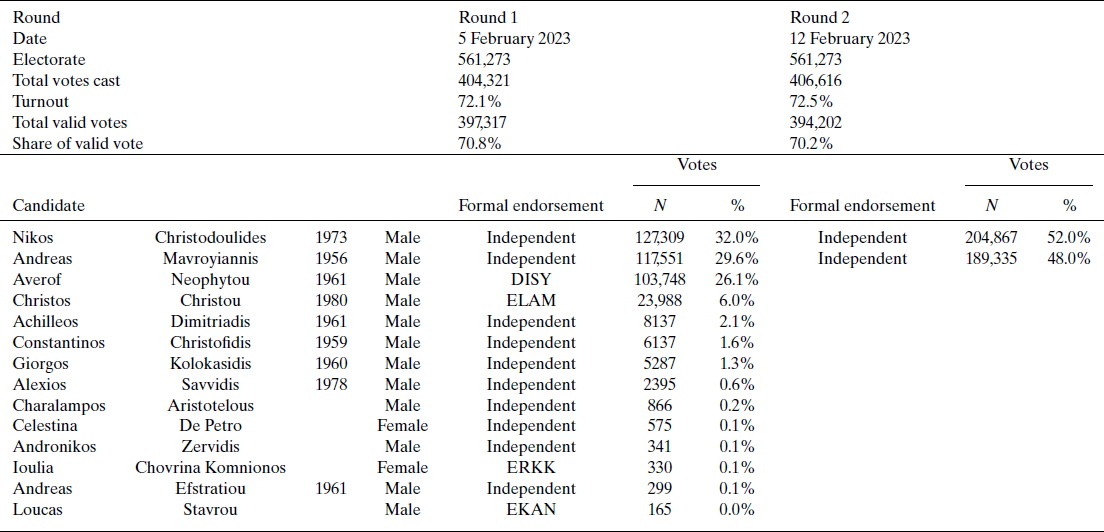
On 5 February, the first round of presidential elections took place in the Republic of Cyprus, featuring 14 candidates, although only three had realistic chances of winning. Leading consistently in the polls was Nicos Christodoulides, former Foreign Minister of the incumbent Nicos Anastasiadis (ineligible to run for a third term). Despite his long-standing membership in the ruling party DISY, Christodoulides chose to run as an independent candidate, backed by four medium-to-small-sized political parties: DIKO, EDEK, DIPA and the Solidarity Movement. His decision to run independently, despite DISY's intention to nominate its leader Averof Neophytou, resulted in Christodoulides' expulsion from the party and sparked a rift within DISY ranks. This division was exacerbated by Anastasiadis’ ambiguous support for Neophytou, indicating a preference for Christodoulides without explicitly stating so. The third contender, Andreas Mavroyiannis, former chief negotiator for Anastasiadis in the Cyprus problem talks, also ran as an independent but enjoyed support from the main opposition party, the leftist AKEL. In the first round, Christodoulides emerged victorious with 32 per cent of the vote, followed by Mavroyiannis with 29.6 per cent and Neophytou with 26.1 per cent. As none of the candidates secured the necessary absolute majority, a runoff between the top two contenders was held one week later.
On 12 February, Christodoulides was elected as the President of the Republic, securing 52 per cent of the ballot, narrowly defeating Mavroyiannis, who trailed close behind with 48.03 per cent (Table 1). The President of the Republic is elected for a five-year term, and Christodoulides was sworn in as the eighth president on 28 February.
Elections for President in Cyprus in 2023

Sources: www.electionguide.org/elections/id/4017/ (2023); https://ispd.org.cy/cyprus-2/ (2023); http://results.elections.moi.gov.cy/ (2023); http://results.elections.moi.gov.cy/greek/pres%C4%B0dent%C4%B0al_elect%C4%B0ons_2023/islandwide (2023); www.robert-schuman.eu/en/monitor/1992-nicos-christodoulides-is-the-favourite-in-the-first-round-of-the-presidential-election-in-cyprus-averof-neophytou-and-andreas-mavroyiannis-running-neck-and-neck-for-second-place (2023). See also main text.
Cabinet report
Republic of Cyprus
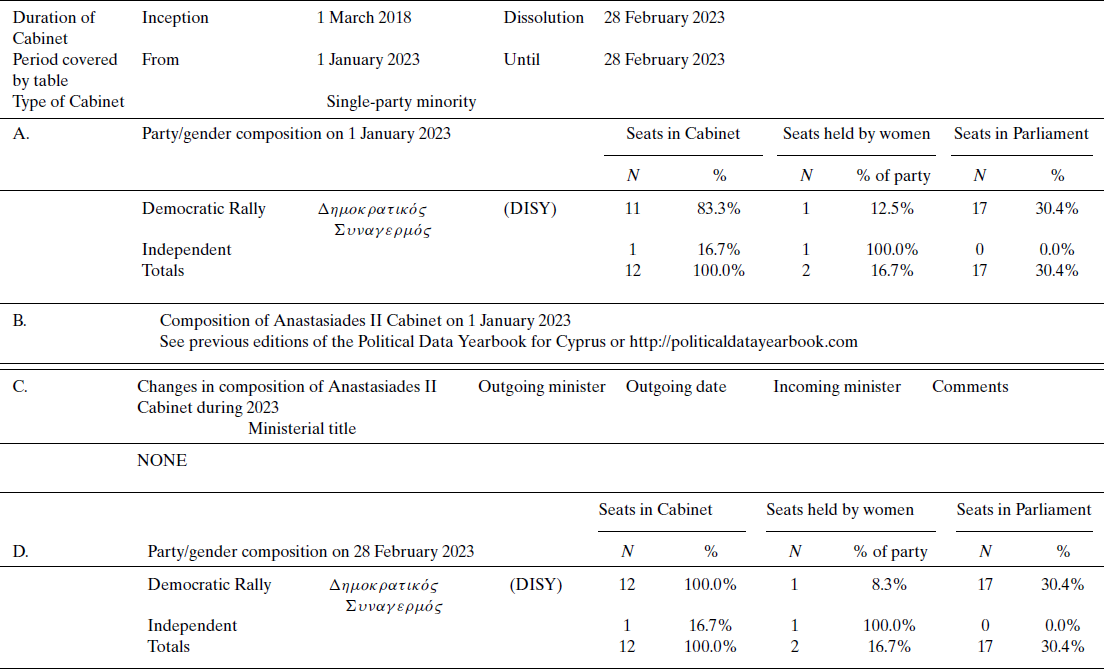
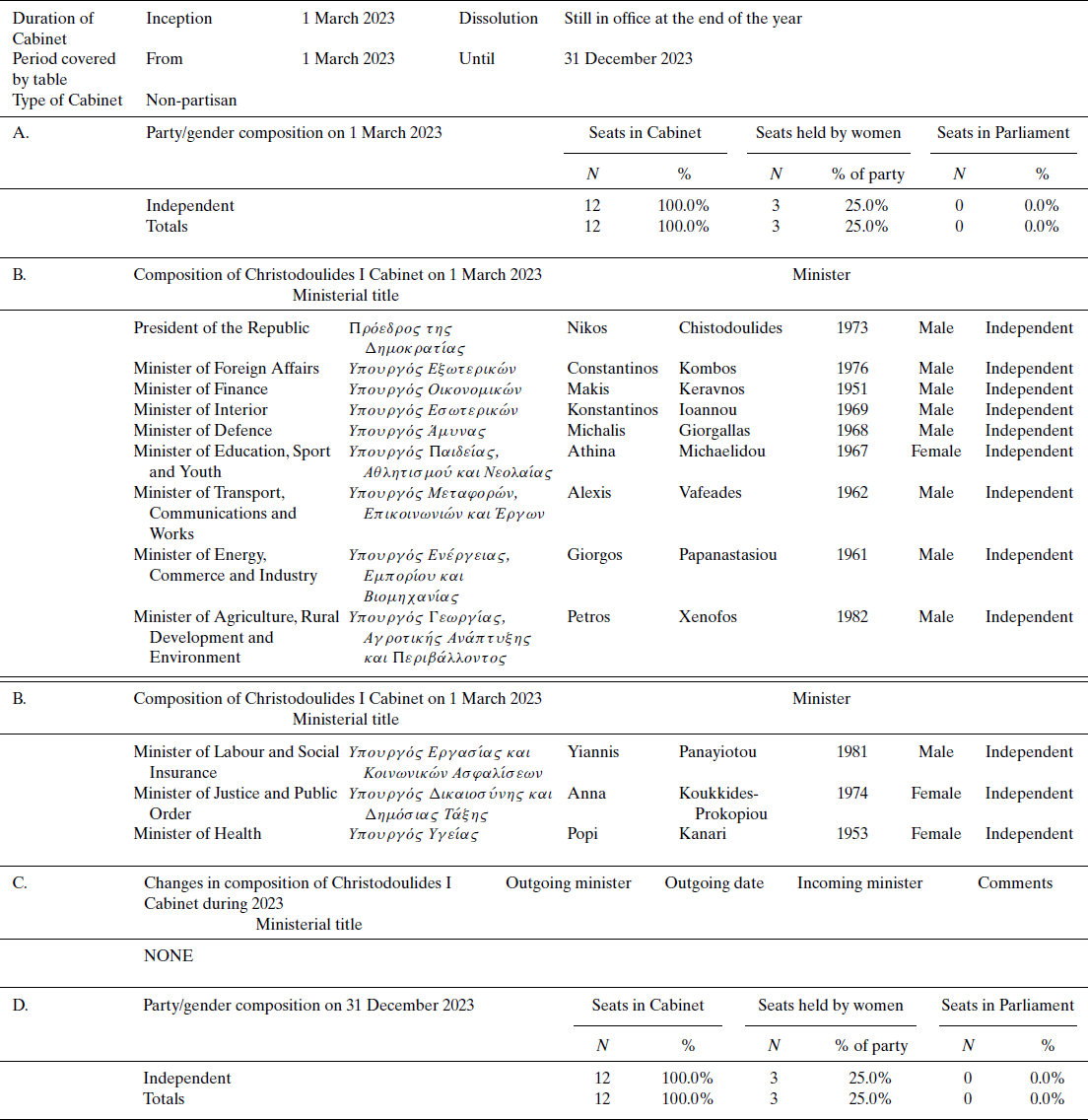
On 1 March, the new Cabinet took office (Tables 2 and 3). Christodoulides had pledged to form a purely technocratic Cabinet that comprised new faces, transcending party politics and avoiding the typical distribution of ministries among supporting parties seen during presidential elections. However, the parties supporting him held a different view. While, formally, he adhered to his promise by appointing all ministers as independents, there were negotiations with the four supporting parties (DIKO, EDEK, DIPA and the Solidarity Movement) in the selection process. Ultimately, eight men and three women were appointed as ministers, while three men and three women were chosen as deputy ministers, overseeing portfolios but lacking voting rights in the Cabinet. Although formally considered independent, some ministers maintained strong links and loyalties to the supporting political parties.
Cabinet composition of Anastasiades II in Cyprus in 2023

Source: Presidency of the Republic of Cyprus (2022) (www.presidency.gov.cy).
Cabinet composition of Christodoulides I in Cyprus in 2023

Notes:
1. Formally, according to the Constitution, 11 ministers compose the Council of Ministers in the Republic of Cyprus (which has a presidential system). The President of the Republic is added here making it 12. There are, in addition, the Government Spokesman and eight deputy ministers, who participate actively in Cabinet meetings but without the right to vote.
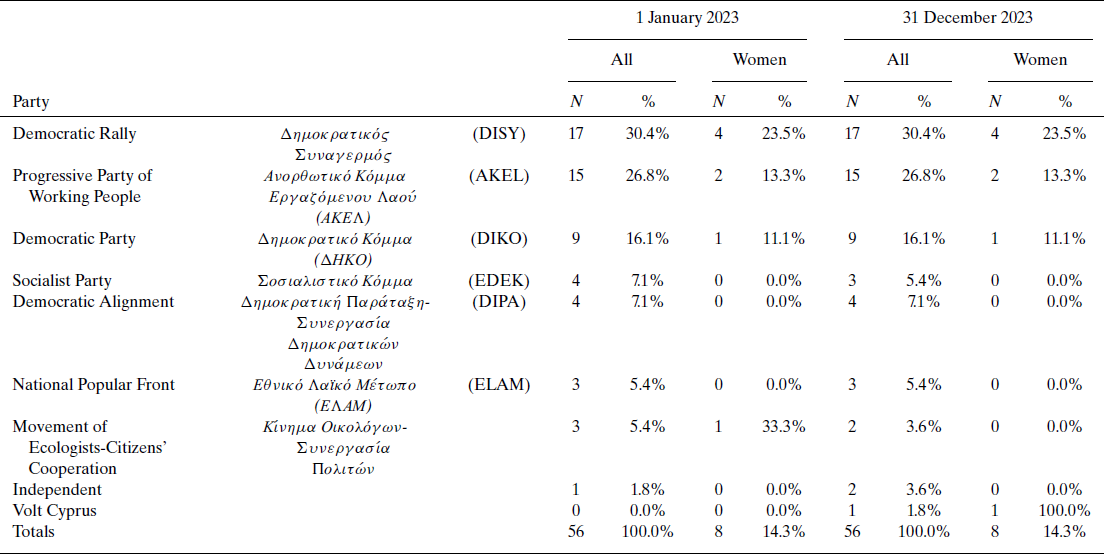
2. Christodoulides, while maintaining his independent status, was officially supported by three parties with seats in Parliament, DIKO, EDEK and DIPA, which also had a say in the appointment of ministers. Some ministers have had clearly a close affiliation and in some cases positions in these parties in the past, but they are still listed as independent here, given the official narrative of the government. Therefore, one could argue that the government enjoys the support of 17 (DIKO: 9, EDEK: 4, DIPA: 4) out of the 56 Greek Cypriot parliamentarians in January and 16 (DIKO: 9, EDEK: 3, DIPA: 4) in December 2023.
Source: Government Composition (2023) (www.presidency.gov.cy/cypresidency/cypresidency.nsf/dmlint_en/dmlint_en?OpenDocument).
Criticism arose against the president for not fulfilling his pre-election pledges of ensuring a 50–50 gender representation in his Cabinet and excluding former ministers from the government, as two of his appointed ministers (Makis Keravnos and Constantinos Ioannou) had served in previous administrations.
The first reshuffle in the government occurred on 14 July when Vasiliki Kassiandiou replaced Michalis Hadjiyiannis as the new Deputy Culture Minister. Hadjiyiannis cited achieving his main goals in office—professional recognition of artists, prepaid youth cards and tax exemptions on funds for scholarships for cultural events—as reasons for his resignation, effective 11 July. However, the appointment of Hadjiyiannis, a pop singer and friend of President Christodoulides, had sparked public criticism since the Cabinet's announcement in February.
The TRNC
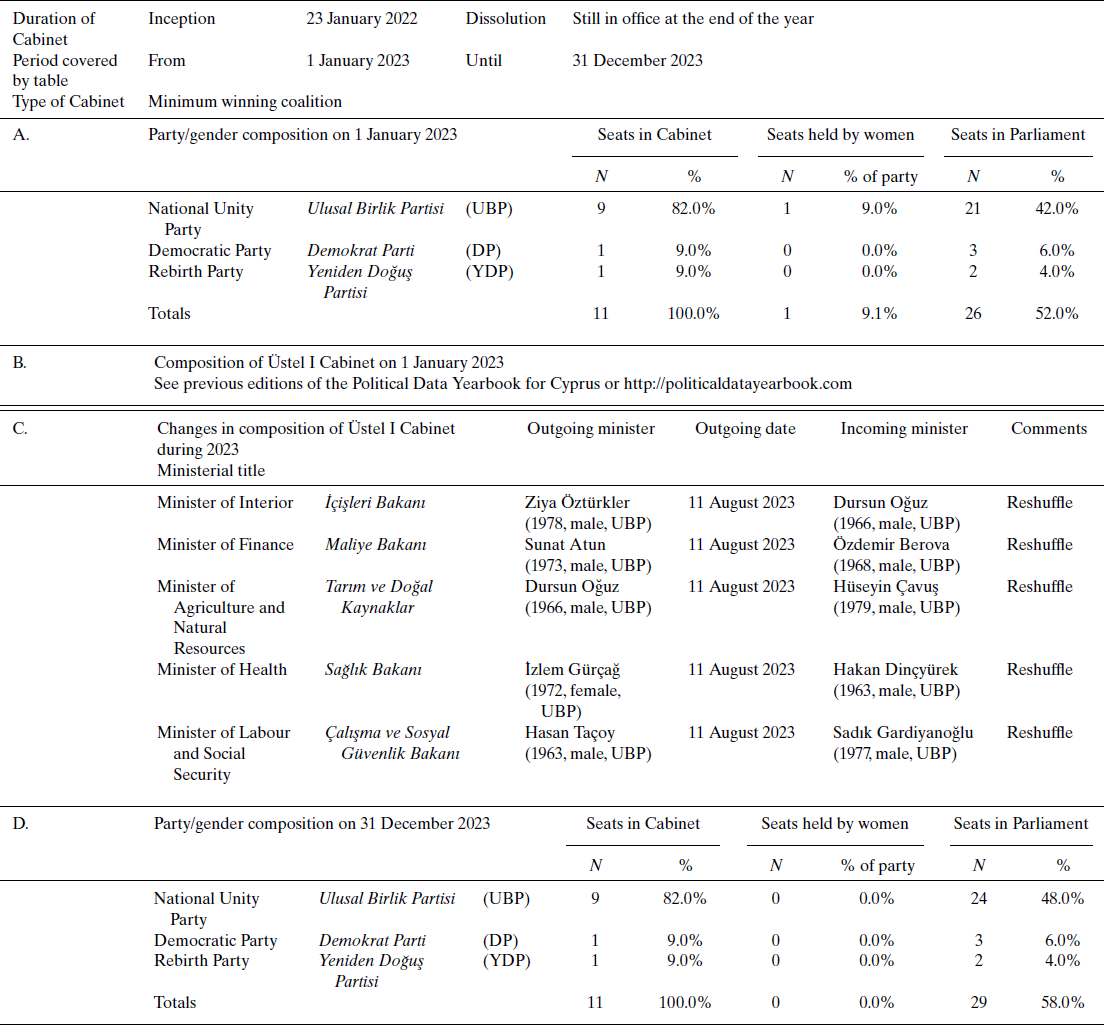
There was a major Cabinet shuffle in August (Table 4). The shuffle took place among the senior coalition partner National Unity Party (UBP) ministers of the three-party coalition between the UBP, Democratic Party (DP) and Rebirth Party. Prime Minister Ünal Üstel announced the changes on 11 August. Özdemir Berova (UBP, Kyrenia) was appointed Minister of Finance, succeeding Alişan Şan (UBP, Nicosia); Hakan Dinçyürek (UBP, Famagusta) was appointed Minister of Health, succeeding İzlem Gürçağ Altuğra (UBP, Kyrenia); Hüseyin Çavuş (UBP, Famagusta) took over from Dursun Oğuz (UBP, Famagusta) as Minister of Agriculture; and Sadık Gardiyanoğlu (UBP, Nicosia) succeeded Hasan Tacoy (UBP, Nicosia) as Minister of Labour and Social Security. Finally, Ziya Öztürkler (UBP, Morphou) was replaced as Interior Minister by Dursun Oğuz.
Cabinet composition of Üstel I in Northern Cyprus in 2023

Source: KKTC Başbakanlık (2024).
Parliament report
Republic of Cyprus
Following the decision of EDEK Socialist Party's Political Council, which was communicated to the President of the House of Representatives by President Marinos Sizopoulos on 16 January 2023, Constantinos Efstathiou was no longer part of the party's group in the House. Since that date, he has been a single-socialist representative
On 16 October, Green member of Parliament (MP) Alexandra Attalides resigned from the party. As of 17 October, she continued to serve in Parliament as an independent until 27 November, when she joined the newly established Volt Cyprus party. This move marked the party's entry into Parliament, securing its first seat.
The composition of the Republic of Cyprus Parliament in 2023 can be found in Table 5.
Party and gender composition of the House of Representatives (Βουλή των Αντιπροσώπων) in Cyprus in 2023

Note: After his expulsion from EDEK, Constantinos Efstathiou considers himself as a single-socialist representative of the Nicosia constituency. He is listed here as an independent.
Sources: https://en.wikipedia.org/wiki/List_of_members_of_the_parliament_of_Cyprus; Information provided by the Office of the President of the Parliament; www.parliament.cy/en/general-information/composition/members-of-the-house.
The TRNC
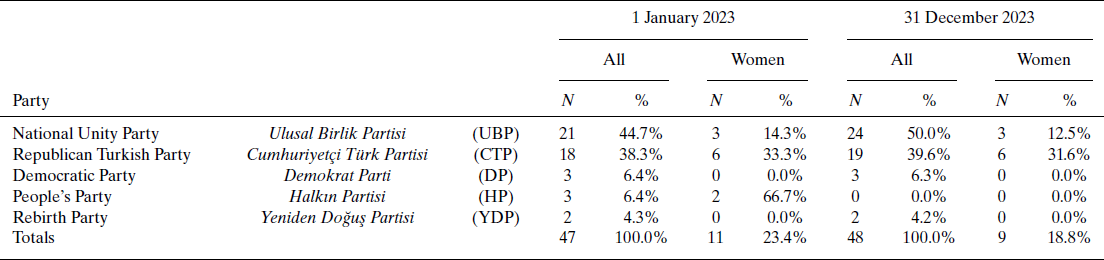
When 29.9 per cent of the voters cast ballots in a by-election on 25 June to fill a single Nicosia seat in Parliament, the TRNC saw its lowest-ever turnout for a legislative election (Table 6). A journalist running on the main opposition ticket, the Republican Turkish Party, Sami Özuslu, easily defeated his main opponent, Ali Başman of the UBP, a senior partner of the ruling coalition, with 43.7 per cent of the vote. The by-election was held to replace People's Party leader Kudret Özersay, who resigned as an MP last year, in the Nicosia seat.
Party and gender composition of the Parliament (KKTC Cumhuriyet Meclisi) in Northern Cyprus in 2023

Source: KKTC Cumhuriyet Meclisi (2024).
Political party report
Republic of Cyprus
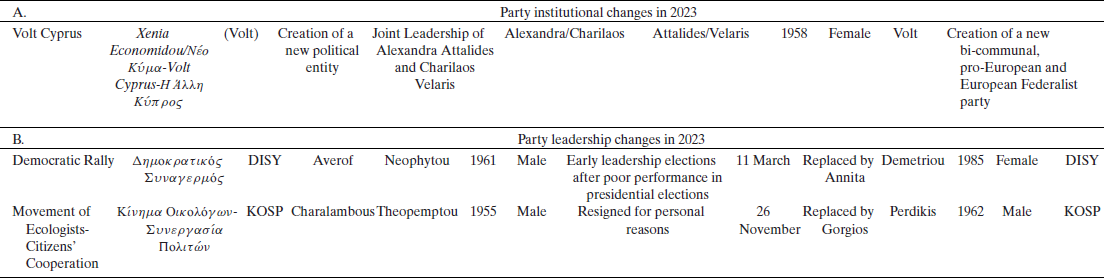
The year 2023 brought significant changes and challenges to the political landscape (Table 7), largely influenced by the presidential elections and their aftermath.
Changes in political parties in Cyprus in 2023

Note: Volt Cyprus has a dual leadership. The second leader, Charleos Velaris, is male and born in 1985.
On 27 February, alongside the announcement of Cabinet positions, Eleni Theocharous resigned as the leader of the Solidarity Movement party. Theocharous, founder of the party and a supporter of Christodoulides, reportedly felt let down by the new president's failure to consult her on ministerial appointments, which included a former high-ranking member of the Solidarity Movement. The small party did not hold any seats in Parliament in 2023.
Following suit, the largest party in Cyprus, the centre-right DISY, experienced leadership changes. The candidacy of Nicos Christodoulides, a former DISY member and not too secretly supported by former party leader and President of the Republic Nicos Anastasiadis, against incumbent party leader Averof Neophytou, led to division and turmoil within the party. Moreover, DISY's defeat in the first round of the presidential elections in February dealt a significant blow. Consequently, the party held leadership elections on 11 March. Initially, Neophytou, along with MP Demetris Demetriou and deputy party leader Harris Georgiades, were set to run. However, both Georgiades and Neophytou surprisingly withdrew from the race after the popular President of the Parliament, Annita Demetriou, entered the fray. Annita Demetriou emerged victorious over Demetris Demetriou, becoming the first female party leader in DISY's history.
On 9 March, former EDEK party member and member of the European Parliament (MEP), Demetris Papadakis, announced the formation of a new political movement centred on social-democratic values. This culminated on 27 November with the official unveiling of his new political party, Aichmi–the Democratic Movement for Change.
9 July witnessed leadership elections within the centrist party DIKO, resulting in the re-election of Nicholas Papadopoulos as party leader. George Solomou assumed the role of General Secretary, while Christina Erotokritou retained her position as Deputy Chair, running uncontested.
On 17 October, Charalambous Theopemptou resigned as leader of the Green Party, citing personal reasons. This departure came just one day after Green MP Alexandra Attalides left the party, citing issues related to the party's stance on the Cyprus issue, internal criticism of her support for same-sex couples and a perceived misalignment of the party with the principles and values of European Green parties as some reasons for her decision. On 26 November, Giorgos Perdikis was re-elected as party leader after a three-year hiatus.
On 26 October, a new political entity emerged with the official launch of Volt Cyprus. This party materialised through the amalgamation of the Famagusta–For Cyprus party and the Neo Kyma (New Wave) political movement. Positioning itself as a bi-communal party, Volt Cyprus aligns with pro-European and European Federalist ideologies, prioritising efforts towards the island's reunification.
Subsequently, on 26 November, the Communist AKEL party, the Republic's second-largest, convened for a statutory conference. At this gathering, party members ratified structural adjustments, notably empowering the party's congress to elect its leader, replacing the central committee in this capacity. Additionally, AKEL approved a two-term limit for MPs and MEPs representing the party and instituted a prohibition on elected officials from simultaneously holding positions within party offices while in public office.
The TRNC
Unlike the Republic of Cyprus, no significant changes took place in the Turkish Cypriot political parties in 2023.
Institutional change report
There were no institutional changes in Cyprus in 2023.
Issues in national politics
On 6 February, a terrible earthquake struck Turkey, killing tens of thousands of people among whom there were 49 Turkish Cypriots as part of a volleyball tournament. Thirty-five of the casualties were junior high school students, along with their teachers and parents. The group were staying at the Isias Hotel in Adıyaman. Similar to many collapsed buildings in the region, the hotel did not conform to building standards. The TRNC government applied for a criminal investigation against the owner of the Isias hotel. On 22 February, the level of preparedness for a possible earthquake and the condition of school buildings topped the parliamentary agenda in the TRNC. In March, the government was under tremendous pressure to make sure that school buildings in the TRNC were earthquake-resistant in the wake of the tragic earthquake that struck Turkey.
In 2023, efforts to resolve the division of the island remained deadlocked, continuing the stalemate since 2017. Despite various UN officials’ attempts to facilitate talks, they ultimately failed. The primary obstacle stemmed from the Turkish side's insistence on recognising sovereign equality and equal international status for the breakaway Turkish Cypriot entity, the TRNC, as a precondition for negotiations. This stance rejected the internationally accepted framework of a bi-zonal, bi-communal federation for a solution.
The newly elected President of the Republic, Nicos Christodoulides, advocated for greater EU involvement to break the impasse, a suggestion dismissed by the Turkish side due to perceived bias given the EU's membership of the Greek Cypriot-dominated Republic. Despite officially endorsing talks based on the agreed bi-zonal, bi-communal federation framework, Christodoulides’ credibility was questioned due to his perceived hard-line stance in the past and support from parties holding hard-line views on the Cyprus question.
On 12 June, Turkish President Recep Tayyip Erdogan's visit to the TRNC underscored the Turkish side's stance, insisting on recognition of the TRNC for negotiations to resume.
On 18 July, Ergün Olgun, the Special Representative of the Turkish Cypriot leader in the dormant talks, retired and was replaced by career diplomat Güneş Onar on 14 December.
During the UN General Assembly meeting in September, expectations for a breakthrough in the stalemated negotiation process were disappointed. Neither did an anticipated tri-lateral meeting between the UN Secretary-General and the two Cypriot leaders materialise nor was a UN special envoy on the Cyprus Problem appointed. The only progress made was that the Turkish Cypriot leader, Tatar, shifted his position from never accepting an envoy before his demands for the recognition of sovereign equality for the Turkish Cypriot community were met, to stating that under certain conditions, a personal (but not special) envoy could be appointed who would report directly to the UN Secretary-General rather than the UN Security Council, as it would be the case with a special envoy. By late October, the decision to appoint a personal envoy of the UN Secretary-General was made public. The task of the envoy would be to look into the prospects for the resumption of negotiations from where they left off at Crans Montana in 2017. By December, the former Minister of Foreign Affairs of Colombia, Maria Angela Holguin Cuellar, had been approved by both the Greek and Turkish Cypriot leaders as the personal envoy, expected to take up her duties by early January 2024. The Turkish side insisted that the envoy should be only given six months to complete her mission, while the Greek Cypriot side rejected a time limit.
The month of August witnessed a significant escalation of tensions in the buffer zone between members of the UN Peacekeeping Force UNFICYP and Turkish Cypriot personnel, stemming from a unilateral announcement on 17 August by Turkish Cypriot authorities to construct a road linking the village of Arsos/Yigliter in the north with the mixed village of Pyla/Pile, located within the buffer zone. The following day, UN peacekeepers were assaulted by Turkish Cypriots while obstructing unauthorised road construction in the UN-controlled buffer zone. Perpetrators, reportedly Turkish Cypriot military and police dressed in plain clothes, punched a UN peacekeeper and used tractors to forcibly move UN vehicles. Three peacekeepers sustained minor injuries. The Turkish Cypriot move was condemned by the UN Secretary-General, the UN Security Council, the European Union and several countries, including Russia and China. Turkey defended the actions of the Turkish Cypriots. On 1 September, a mutual understanding was reached following an initiative by the UN Secretary-General's Special Representative in Cyprus, Colin Stewart. The agreement allowed for the construction of the road while permitting Greek Cypriots to build residential properties and a solar farm in the area. Both sides acknowledged UNIFCYP's sole responsibility for the buffer zone, a position disputed by the Turkish side during the confrontation. Construction on the road commenced in October but halted in November, with the Turkish Cypriot side claimed they had not consented to Greek Cypriot construction in the buffer zone. Negotiations to renegotiate the mutual understanding were underway by the end of 2023, but no agreement had been reached. 23 April marked the 20th anniversary of the opening of crossing points between the divided parts of Cyprus, a division stemming from a Greek coup followed by a Turkish invasion in 1974. Over these two decades, nearly 141 million crossings have been recorded through the checkpoints. The number of crossings surged from 2.3 million in 2021 to nearly 6 million in 2022. A report by the European Commission in July highlighted a significant uptake in trade across the Green Line, which divides the island, continuing into 2023. Trade had spiked by 138 per cent in 2022, reaching a record value of €14.6 million as the island rebounded from the economic fallout of the COVID-19 pandemic. This positive trend persisted into 2023, with a 12.9 per cent increase in trade recorded in the first six months of the year. On 18 July, Turkey and the TRNC signed an agreement for the construction of a new undersea electric cable. The planned cable, with a capacity of 800 megawatts, aims to address the persistent electricity shortages in the north.
The end of August saw violent clashes between Greek Cypriots, including members and supporters of the far-right party ELAM, and Syrian migrants in the village of Chlorakas. Shops owned by migrants were vandalised during the clashes, which were believed to have been incited by ELAM. The attacks drew condemnation from all parties except the right-wing party. Tensions had been escalating in the village due to allegations of electricity theft by residents of a specific apartment complex, leading to the disconnection of water and power for the migrants. Local residents called for restored security, deportation of migrants and cessation of asylum applications, citing a high concentration of asylum seekers in the village.
The following weekend, a mob of 200 right-wing hooligans vandalised shops and assaulted migrants in Limassol, prompting a peaceful pro-migrant counter-demonstration the next day. The police faced criticism for failing to prevent the xenophobic violence.
In August, the term of the third non-Cypriot member of the Committee on Missing Persons (CMP), Paul Henry Arni, came to an end. Established in 1981, the bi-communal CMP is tasked with locating and identifying the remains of the 2,002 persons (492 Turkish Cypriots and 1510 Greek Cypriots) who went missing during the inter-communal fighting of 1963–1964 and the events of 1974. Arni reported that during his 10.5-year tenure, 571 of the 1,033 missing persons found in Cyprus had been identified and their remains were returned to their families.
In October, in the context of the war between Israel and Hamas in the Gaza strip, President Christodoulides proposed the establishment of a humanitarian corridor to facilitate the transportation of aid from Cyprus to Gaza. However, this suggestion was not acted upon until 2024 when it was finally taken up and implemented.
In 2023, the Republic of Cyprus experienced a notable decrease in the total number of asylum applications, dropping to 11,617 from 21,565 in 2022. This decline was primarily attributed to student visa restrictions introduced by Turkey and the Turkish Cypriot authorities, which significantly reduced the number of asylum applicants from African countries crossing over from the north to the south. In 2022, there were 9,384 asylum applicants from African countries, which decreased to 2,607 in 2023. However, there was a significant increase in asylum applicants from Syria during the same period. In 2022, there were 4,088 asylum applicants from Syria, which rose to 6,148 in 2023. Despite the fluctuations in asylum application numbers, the Republic of Cyprus still maintains the highest number of asylum seekers per citizens within the European Union, with at least 5 per cent of the population. This is significantly higher than the EU average of 1.5 per cent.
Inflation and rising prices in the TRNC continued in 2023 in parallel to the depreciation of the Turkish lira. December 2023 saw an 83.6 per cent increase in the consumer price index over December 2022. Just in December, there was a 5.4 per cent increase in consumer prices. The industry with the largest monthly inflation rate was the restaurant and hotel sector, up 15.1 per cent, followed closely by the healthcare sector, up 14.8 per cent. Food inflation during the month was 5.9 per cent. In 2023, the Republic of Cyprus continued its pro-Western and pro-American foreign policy shift from the previous government remaining a loyal supporter of the Western sanctions against Russia in the context of the Russian–Ukrainian war.

 Open access

