




Introduction
In the special issue of Revue de synthèse dedicated to experts and expertise in late imperial China, Christian Lamouroux prefaces his article with the apt double definition of the term in Antoine Furetière’s (1619–1688) Dictionnaire universel of 1690. To paraphrase: “expert” refers to someone skilled in his craft and, substantively, through which some skill or knowledge can be visited and reported upon. This reminds us, in Lamouroux’s words, that “[p]our qu’une compétence soit mise en œuvre comme expertise, la société doit non seulement identifier un individu par l’habilité qui lui est propre, mais il faut dans le même mouvement qu’elle crée le cadre collectif dans lequel est mobilisé ce savoir-faire,” and the author goes on from there to describe the complex web of ideas, values, social structures, and interactions that organized competency into expertise among Song (960–1279) artisans.Footnote 1 This article invites the reader to take another step back to consider everything tangled up in the question “An expert in what?”
It is increasingly difficult to find the words to describe what we study in the history of science in the ancient world. In 1959, when Joseph Needham (1900–1995) published the first topical volume of Science and Civilisation in China, Mathematics and the Sciences of the Heavens and the Earth, historians spoke with confidence about “astronomers,” “mathematicians,” and “scientists” in ancient China, but much has changed since then. For one, while there was never a consensus on the matter, the 2000s saw the explicit challenge to, if not defeat of, the truism that astronomy and mathematics had always been characterized by secrecy, state monopoly, and hereditary specialists.Footnote 2 In sinology, the last few decades have seen the deconstruction of the category “science,” followed later by “astronomy” and “mathematics.” All these terms have become, in varying degrees, taboo: relegated to scare quotes and reflexively avoided as anachronisms.Footnote 3 We abandoned the idea that “science” was somehow the exclusive domain of “Taoists,” whatever that means,Footnote 4 and realized that most “astronomers” and “mathematicians” were neither professionals nor specialists, but gentlemen polymaths.Footnote 5 Since 2018, the study of the social networks of these polymaths has also blurred the lines distinguishing the history and sociology of these fields from any other.Footnote 6 In short, the basic ontologies structuring any 1950s history of premodern Chinese science are all now confused or defunct—all perhaps but the fundamental unit of the individual person.
But not all is confusion. In the place of this structure has arisen an attention to emic/actors’ categories: the conceptual vocabulary by which our historical subjects organized their world. We noticed, for example, that what we study in the history of astronomy was divided in China between the opposite but complementary categories of tianwen 天文 (lit. “heavenly patterns”) and li 曆 (lit. “sequencing”). These words did not always mean what they do in modern Chinese (tianwen = “astronomy,” li = “calendar”), nor do they map neatly onto any Western distinction between “astrology” and “astronomy.” Rather, they refer to a division of labor, roughly speaking, between the nighttime, observational, and interpretative (tianwen) and the daytime, computational, and predictive (li).Footnote 7 Tianwen includes zhan 占 (lit. “divination,” “omen reading,” “omenology”), and while there is indeed something resembling the astrology–astronomy dichotomy at their core, even this is framed in fundamentally different terms from those with which we are familiar.Footnote 8 In the words of the famous Tang astronomer-monk Yixing 一行 (673–727):
其循度則合于曆, 失行則合于占。占道順成, 常執中以追變; 曆道逆數, 常執中以俟變。知此之說者, 天道如視諸掌。
That which follows measures is the domain of li, and that which is (unnaturally) off in its motion is the domain of zhan. The way of zhan works forwards from things as they occur, always holding to the mean in (active) search of sudden unexpected change (to interpret in political terms). The way of li, [on the other hand], works backwards from numbers, always holding to the mean in a (passive) wait for aberration (to explain away or by which to correct one’s mathematical models). He who understands this [distinction] will look upon the way of heaven as if he held it in his palm.Footnote 9
Historians now realize that the definitions and distinctions upon which our subjects insist matter for understanding the texts that they label as such.
As this example illustrates, of course, the precise contents of a historical category like li are defined not in a vacuum but by opposition, hierarchy, and interaction with others with which we may be equally unfamiliar. It also goes without saying that the conceptual landscape evolves, and not everyone agrees upon, respects, or is even aware of the sort of finer distinctions argued by capital elites like Yixing. Launched by Li Ling in 1993, the most ambitious push to reconsider actors’ categories in the history of science in China has been the reification of the term shushu 數術 (lit. “numbers and procedures”). Derived from mathematics, the term appears as a meta-category in the first-century bibliographic treatise of the Hanshu, under which are filed tianwen, li, chronology (pu 譜), and various forms of terrestrial divination. Historians of excavated divination texts have used the meta-category to argue for the equivalence, if not non-distinction, of the distinct categories thereunder as a way to collapse those of “science,” “magic,” and “religion.”Footnote 10 Actors’ categories can thus aid in the work of deconstruction, but the real challenge, in my opinion, is to reconstruct how actor’s categories articulate with people, texts, and one another in medias res. Particularly noteworthy in this regard are the recent studies of Chen Kanli and Zhu Yiwen, which show how “heavenly patterns” and the mathematics of heaven and earth (li and suan 算, lit. “computation”) were deeply intertwined with Confucian exegesis and classical ritual in imperial times.Footnote 11 It turns out—as everyone once knew—that these subjects went together hand in hand.
Building upon Nathan Sivin’s (1931–2022) visionary articles on ‘cultural manifolds’ and, essentially, penetrating actors’ categories via bibliographic rubrics,Footnote 12 this article will make a novel attempt to weigh and place “the sciences” among other fields of knowledge from Han (206 BCE–220 CE) to Tang (618–907) and, in the final section, to map the connectivity between fields using polymaths as vectors. To this end, I will resort to bibliometrics, analyzing the information on authorship, dates, and emic classification contained in the Hanshu 漢書 (111), Suishu 隋書 (656), and Jiu Tangshu 舊唐書 (945) bibliographical treatises, cross-referencing it with external data such as biography, and mapping global patterns in multi-genre authorship via network diagrams. The interest in this digital humanities approach is that it stands to decenter the author’s centers of interest and expertise, providing a relatively objective big-picture view of the medieval Chinese tree of knowledge and how its different branches were interconnected. It is also, I hope to show, an effective means of getting around etic categories and anachronisms to provide confirmation of such recent (re)discoveries as Chen and Zhu’s and, hopefully, lead us to more. My key findings are as follows. First, “the sciences” were moderately well-integrated subsidiaries of certain core fields, and their authors only moderately famous, but they appear to be among the most productive categories of written knowledge, medicine and mathematics in particular. Second, the more “mathy” the “science,” the higher works’ rate of attribution to historical authors, while divination and medicine are rampant with anonymous and pseudepigraphal works. Third, while the idea of polymathy is not new, mapping its extent and patterns in this corpus is edifying. Fourth, as a case in point, this analysis suggests that the connection between mathematics and music is one that may merit exploration. The following pages are an experiment, and they are, more than anything, an invitation to play with the underlying data, scripts, and interactive diagrams available on HAL.Footnote 13
Sources and Methodology
Biographies are replete with information about historical subjects’ various competencies: “[Zhang] Heng 張衡 (78–139) was good at mechanical inventions, but his thoughts were particularly devoted to heavenly patterns, Yin-Yang, li, and suan” (衡善機巧, 尤致思於天文、陰陽、歷筭).Footnote 14 For a comprehensive historical taxonomy of human knowledge and a large, unequivocal, and regularly formatted data set of who knew what, even better than biographies is a library catalog or an encyclopedic bibliography. Ban Gu’s 班固 (32–92) Hanshu “Yiwen zhi” 藝文志 is such a source. Based on the catalog of the Han Imperial Library by Liu Xiang 劉向 (79–8 BCE) and Liu Xin 劉歆 (d. 23 CE) it features just shy of 600 catalog entries divided into thirty-eight categories and six meta-categories. The standard entry provides a title and a number of units (“rolls” [juan 卷] or, more rarely, “chapters” [pian 篇]), and many provide an author either in the work’s name or following the units:
淮南內二十一篇, 王安。
Huainan, the Inner 21 Chapters, [by] King [Liu] An (under “Masters: Miscellaneous” [諸子·雜家]).
許商算術二十六卷。
Xu Shang’s Computational Procedures in 26 rolls (under “Numbers and Procedures: Li and Chronology” [術數·曆譜]).Footnote 15
Similar bibliographic treatises are to be found in the Suishu, the Jiu Tangshu,Footnote 16 and later dynastic histories and encyclopedias, and they become more expansive, standardized, and informative over time.Footnote 17 The exact value, meaning, and reliability of praise coming from a biographer or contemporary is up for debate: About what kind of “Yin-Yang” did Zhang Heng think? How good at it was he? Did his thoughts have an impact? However, while next to nothing is known about Xu Shang or his eponymous 26-volume work, the fact of his authorship and inclusion in this presumably selective imperial bibliographyFootnote 18 is a solid indicator that the knowledge embodied in his writing was “visited and reported upon” by others well beyond his own lifetime. There is no better proof, in other words, that Xu Shang was what we might call an expert, nor of the domain of his expertise, nor of the distinction of that domain from others.
The comprehensive taxonomies, rich, formulaic data, and relative homogeny in form across extant bibliographies from 111 to 945 are my reason for focusing on this corpus. As part of a larger project, and inspired by the recent work of Joseph Dennis on book lists and the circulation of knowledge in Ming–Qing gazetteers,Footnote 19 I have tagged digital versions of the aforementioned treatises in XML. Together, these bibliographies provide thousands of entries identifying specific individuals as authors within specific categories in a comprehensive taxonomy of written knowledge. However, to extract and make any use of this information—or to even say how many works, authors, and categories there are—I first had to settle on four points concerning definitions and data cleaning. To explain, I must switch here to precise, technical language and questions of how to make a human trace machine readable. (For readers principally concerned with results and application, I suggest skipping to the next section).
First, I had to establish the ontologies to which words refer, so as to disambiguate two people or books who share the same name and to identify different names as referring to the same person or book. This is easy for people: each physical person is given a unique identifier. In the case of works, however, I arrived with some trial and error at the following scheme. I define a “work” as the combination of a distinct author or set of coauthors with a distinct “authorial act” (e.g. “writing” [zhu 著 / zhuan 撰] or “annotating” [zhu 注]), the title of which may vary. Where the same work appears in different numbers of chapters or rolls, I count these as different “editions” of the same work. By default, the same combination of author/s, authorial act/s, title, and volumes is treated as the same edition across bibliographies, and the same combination of author/s, act/s, and title is treated as the same work. For different titles referring to the same work (e.g., Huainan 淮南, Huainanzi 淮南子, Honglie 鴻烈, Liu An zi 劉安子), I manually identified them in the XML corpus based on contextual evidence, as well as by exporting tagged title strings to tables and sorting them by the aforementioned criteria as well as by similarity as measured using the Python module SequenceMatcher. I sometimes had trouble deciding about anonymous works, e.g., the “Astronomical Office Note Records, 6 rolls” (太史注記六卷) and “Astronomical Office Record Notes, 6 rolls” (太史記注六卷) cataloged side by side in the Sui treatise.Footnote 20 Such works are of negligible importance, however, since my principal concern is the classification of authors by bibliographic category.
Second, while the organization of these three bibliographies is similar, it is not identical, nor do all three use all the same exact taxonomy. Between the Han and Sui treatises, for example, the meta-category “Numbers and Procedures” disappeared, “Heavenly Patterns” and “The Mathematics of Heaven and Earth” (Li suan 曆算) were moved to “Masters” (philosophy), and the various forms of terrestrial divination were all rolled into “Five Agents” (Wuxing 五行).Footnote 21 In quantitative terms, of the 2524 unique works in the Jiu Tangshu catalog, 2502 do not appear in the Hanshu, and 1530 do not appear in the Suishu. This is due to both chronological order and selection, and it means that the Jiu Tangshu’s is the only catalog to classify these 1530 works. Now, of the 994 unique works that the Jiu Tangshu and Suishu catalogs share, the two catalogs agree on their categorization of 889 (89.4 percent). The question is what to do with the 108 work-category pairs upon which the two catalogs disagree,Footnote 22 the 4326 works cataloged in the Suishu that do not figure in the Jiu Tangshu, and similar discrepancies with the Hanshu.
My solution was to keep all work-category identifications, to use the Old Tang History taxonomy as my framework, and to add and merge several categories as necessary. For example, the Jiu Tangshu catalog omits the Sui categories “Ancient History” (Gu shi 古史), and “Hegemon History” (Ba shi 霸史), moving the works therein elsewhere. That is fine, but to avoid manually classifying works that the Old Tang History catalog omits, I must retain the Sui categories (and double classifications). Conversely, The Old Tang History catalog divides the Sui’s “Healing and Recipes” (Yi fang 醫方) category into “Meridians and Vessels” (Jingmai 經脈) and “Healing Techniques” (Yishu 醫術), and to avoid manual classification in this case, I must roll everything in “Meridians and Vessels” and “Healing Techniques” back under a single rubric. The resulting unified taxonomy in Table 1 is thus a hybrid, but it is one that is necessary to treat all (rather than something like 89.4 percent) of the catalogs’ contents, and it is based on the principles of conservation (keeping double classifications) and rolling back distinctions to avoid editorial intervention.Footnote 23 Lastly, the equivalency between a bibliographic category, a genre, and a distinct field of knowledge is not a given, so I will introduce a couple of modifications to this taxonomy below where I shift to genres and fields.
My hybrid “four-division” bibliographic taxonomy combining those of the Hanshu, Suishu, and Jiu Tangshu treatises.

Note: Asterisks (*) mark subdivisions of “History” that will be later joined in transitioning to a discussion of coherent “fields” and author–field networks. Note also that, for the sake of accessibility, the following discussion and diagrams will opt for the English translations given here, and that these translations should be read as nothing more than awkward stand-ins for the actor’s categories in Chinese.
Third, for the purposes of this article, some data merit exclusion. Namely, since I am interested in trends among historical, human polymaths, I have excluded obviously pseudepigraphal authorship acts by immortals, divinities, and legendary figures such as Confucius, the Yellow Emperor, and the Duke of Zhou. I must also exclude those where only the author’s surname is given and I am unable to identify to whom it refers.Footnote 24 Lastly, to normalize the data concerning attribution and anonymity, I chose to remove from consideration 79 anonymous works comprising summaries and tables of contents of another work, titled mulu 目錄, mu 目, or lu 錄, which are unevenly concentrated in a handful of bibliographic categories.
Fourth, these bibliographic treatises sometimes omit authors and coauthors known from other sources, notably the author’s biography, the extant version of said work, or both. This is the case for the lost “Treatise on the Suspended Signs, 148 rolls” (垂象志一百四十八卷), cataloged in the Sui treatise, which Yu Jicai’s 庾季才 (516–603) biography in the same history lists among his works (in a different “edition” in 142 rolls).Footnote 25 Given that what matters in this article are the different rubrics under which Yu Jicai’s works are filed in the three bibliographies, then there is no good reason to ignore such external evidence. This is especially the case given that, as part of my larger project, I have already made a systematic effort to gather it for the astral and mathematical sciences.
All of these decisions introduce bias. In particular, supplementary authorship data is weighted towards my personal centers of interest, and I am not as familiar with the surname-only attributions in Taoist philosophy as I am in astronomy. There might also be good reason to include pseudepigrapha and anonymous tables of contents in relation to different questions, and I have no doubt that the figures and diagrams below will change as more bibliographies and external data are included. I thus remind the reader that this article is an experiment, and I invite him/her to inspect my data set and precise steps of cleaning and calculation.Footnote 26
With these explanations and caveats out of the way, the result after implementing the four decisions enumerated above is a combined, hybrid Han-Sui-Tang bibliographic catalog in six divisions (“Classics,” “History,” “Masters,” “Collections,” “Taoism,” and “Buddhism”) and 47 categories, with a total of 7246 distinct works in 7736 editions and 106,873 volumes (juan).
The Place of the Sciences
I have spoken thus far about “science,” its deconstruction, and the challenges of thinking through and around such etic categories. I will nevertheless retain the term—“the sciences”—with the qualification that what I mean by this is the concrete historical activities generally studied under the banner “history of science.” Among the 47 categories of my combined Han-Sui-Tang bibliographic catalog in Table 1, those at the heart of the modern history of science are “Tianwen” (Heavenly Patterns), “Li shu” 曆數/“Li suan” 曆算 (hereafter “Mathematics”), “Yifang” 醫方/“Yishu” 醫術 (hereafter “Medicine”), “Wuxing” (Five Agents) terrestrial divination, and “Nongjia” 農家 (Agronomy). Hypocritically, I will likewise be using the modern terms “mathematics” and “medicine” in arguing for the importance of actors’ categories, but I do this for two reasons: short labels make for readable diagrams, and these terms are familiar to outside readers. For those in the know, “mathematics” is to be pronounced li suan. The keen reader will also notice that missing from this list are several subjects to which the series Science and Civilisation in China devotes entire volumes, such as logic, botany, and technology. Something like “technology” certainly existed as a category of knowledge, e.g., Zhang Heng’s “mechanical inventions” (jiqiao 機巧), and people like Zhang Heng even wrote about it. However, those writings were filed under established categories like “Heavenly Patterns.”
Where do the sciences fit into the tree of knowledge as reflected in ancient Chinese bibliography? Judging from the order in which they are presented, they would seem to be an afterthought. The Han catalog places “Agronomy” second to last among the “Masters” of Warring States (481–221 BCE) philosophy, and it divides the rest between the meta-categories “Numbers and Procedures” and “Recipes and Techniques” (Fangji 方技) at the very end of the catalog. However they may be divided, the rest consistently appear in the order “Heavenly Patterns”–“Mathematics”–“Five Agents”–“Medicine,” and the accompanying descriptions are structured around elite moral values and judgments that smack, in Marc Kalinowski’s opinion, of ideological hierarchy.Footnote 27 In the Sui–Tang, the sciences were then promoted to the status of “Masters” alongside Confucianism and Taoism. Even so, the Sui–Tang catalogs place them at the very end, and if it is any consolation, the Old Tang treatise inserts several new categories in between the first three and medicine: “Military Writings,” “Encyclopedias,” and “Games” (see Table 1).
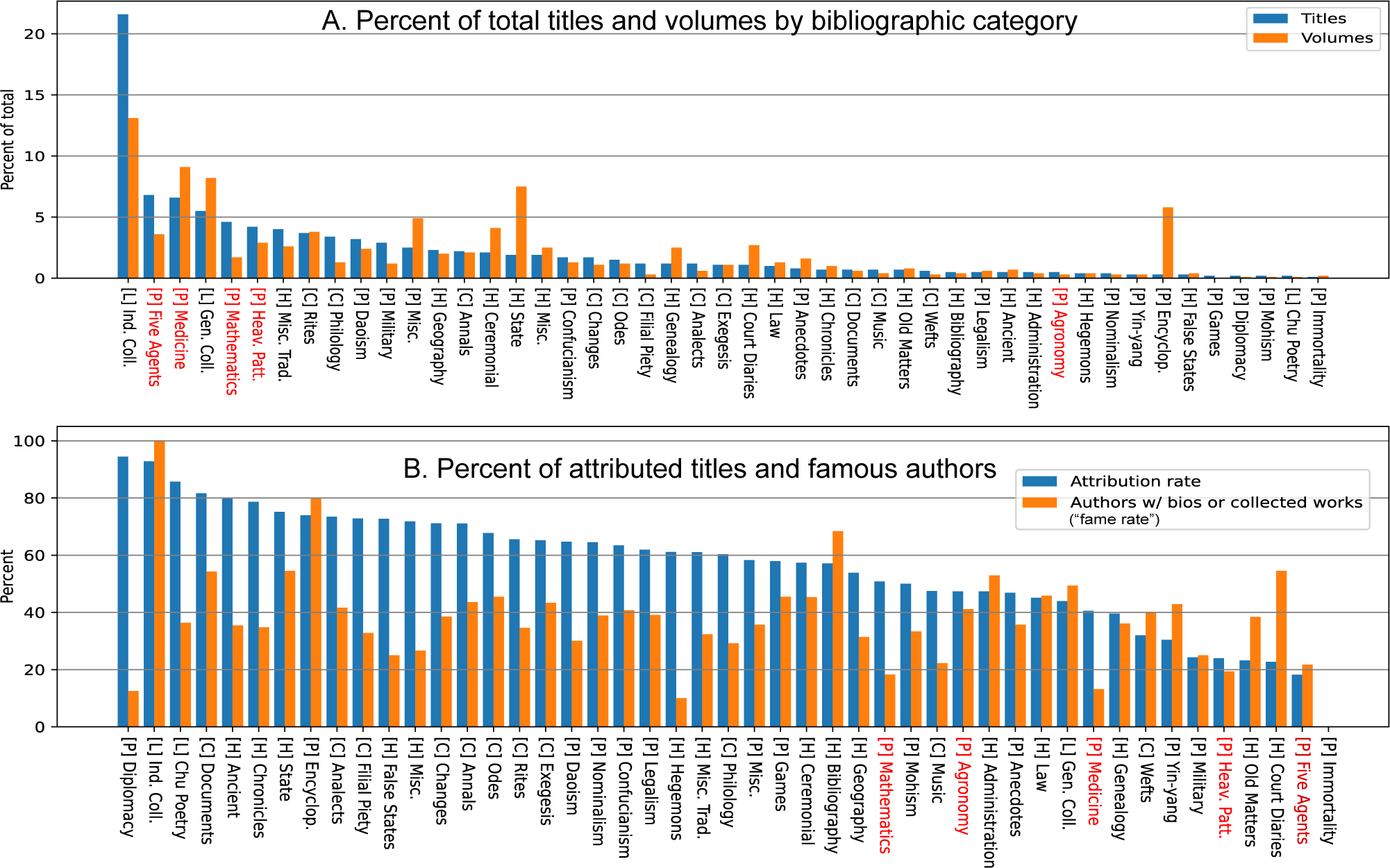
Judging by output, however, the bibliographies tell a very different story (Figure 1A). Be it by the number of titles or the number of volumes, the sciences were by far some of the most amply cataloged, if not most prolific, of any bibliographic category. Distinguishing between the meta-categories [C]lassics, [H]istory, [P]hilosophy, and Belles [L]ettres, their only contenders by number of titles are “[L] Collected Works,” “[L] Poetry,” and “[H] Miscellaneous Traditions.” And of these, “[L] Collected Works” must be considered apart, as it is a miscellaneous category based on the author rather than the subject. In terms of volumes, the contrast is less stark, with “Heavenly Patterns” and “Mathematics” dropping to tenth and eighteenth place, respectively. But regardless of the metric, the cataloged output in “Heavenly Patterns,” “Mathematics,” “Five Agents,” and “Medicine” nonetheless outstrips most of the Classical and Philosophical categories that precede them in terms of chronological and bibliographic order. The outlier is “Agronomy,” which sits next to other minor Warring States philosophies at thirty-fifth and fortieth place, respectively, in terms of titles and volumes.
Titles, volumes, attribution, and authorial fame by bibliographic category.

“Medicine” and “Five Agents” are massive categories, but what stands out in quick comparison to any other division of Philosophy is that they are awash in anonymous and pseudepigraphal titles. Little can be said about such works beyond their size, their number, and the place that they occupy. Before eliminating them from consideration, however, it is worth considering how anonymity breaks down across categories. Figure 1B combines two measures of anonymity: the percentage of titles attributed to an identifiable historical author (hereafter “attribution rate”), and the percentage of identifiable historical authors with either a collected works or extant biography (hereafter “fame rate”). By this metric, the sciences once again appear as marginal as their order in the taxonomy suggests. At thirtieth place, “Mathematics” has a 51 percent attribution rate, and that drops to 18 percent on the bottom end with “Five Agents.” In terms of authorial fame as judged by biographies and collected works, the picture is only slightly less bleak in relative terms, but with the one exception of “Agronomy,” a disproportionate number of named authors are in fact no-names beyond their field.
Let us put this in perspective by considering several extremes. At one extreme is “[L] Collected Works,” with 1671/1800 (93 percent) works attributed to identifiable historical authors; at the other is “[H] Court Diaries,” with a mere 20/88 (23 percent) attribution rate.Footnote 28 As “[L] Collected Works” is author-based, one would expect it to have one of the highest attribution rates of any category, which it does. One would likewise expect the opposite from “[H] Court Diaries,” which are routine daily court records produced for every emperor by a secretarial corps of diarists.Footnote 29 As concerns the number of famous authors with collected works and biographies, let us next consider “[P] Encyclopedias” (17/23 = 74 percent attribution rate; 80 percent fame rate) and “[P] Diplomacy” (17/18 = 94 percent attribution rate; 13 percent fame rate). The similarly high attribution rates are unsurprising: as a school of Warring States philosophy, “[P] Diplomacy” features a large number of works named after their authors, to which later thinkers added commentaries, while encyclopedias were usually colossal endeavors commissioned by the throne from preeminent scholars. Of course, it is difficult to say whether the classics of “[P] Diplomacy” such as Master Que (Quezi 闕子) or Master Guoshi (Guoshizi 國筮子) are pseudepigrapha, given that nothing survives about them or their eponymous authors, which leads us to the question of “fame.”Footnote 30 What explains the massive disparity in fame rate between these two categories is probably their respective age: “[P] Diplomacy” is one of the oldest genres, “[P] Encyclopedias” is one of the newest, and there are simply more biographies and collected works from later times.
Where do the sciences fall between these extremes? With attribution rates at 84/350 (24 percent) and 104/570 (18 percent) of titles, “[P] Heavenly Patterns” and “[P] Five Agents” are comparable to court transcripts. “[P] Mathematics” and “[P] Medicine” are double that (193/380 [51 percent] and 222/547 [41 percent]), but their attribution rates are nonetheless half that of “[P] Encyclopedias,” and the fame rate of their authors (18 percent and 13 percent) is on par with that of a minor pre-imperial philosophy like “[P] Diplomacy.” In sum, there is thus a strong divide between sciences in terms of anonymity, but it was not because the authors in “[P] Mathematics” and “[P] Medicine” were particularly famous.
Before jumping to conclusions, I must emphasize as a historian of “[P] Heavenly Patterns” and “[P] Mathematics” that these two bibliographic categories can be easily broken down into distinct genres on the basis of titles and parallels with extant works. One of the advantages of Chinese for assessing the contents of lost works from their titles is that titles often unimaginatively indicate the specific type of thing that the work is. In the case of “[P] Heavenly Patterns,” the vast majority of titles either constitute or end with the words tianlun 天論 (“cosmology,” “instrument-cosmos,” lit. “discourse on heaven”), xingjing 星經 (“star catalog,” lit. “star classic”), xingtu 星圖 (“star chart”), Boluomen tianwen 波羅門天文 (“Brahman heavenly patterns”), or Taishi zhuji 太史注記 (observational data, lit. “Astronomical Office notes”). Taishi zhuji also appears in “[P] Mathematics,” and most of the rest of this category comprises li (astronomical procedure text), qiyaoli 七曜曆 (ephemerides, lit. “li of the seven luminaries”), lü 律 (tono-metrology, lit. “standards”), louke 漏刻 (“water clocks”), suan (“computation”), and Boluomen suan 波羅門算 (“Brahman computation”). Be they extant in whole or in quotation, works sharing the same keywords in their titles generally share similar contents, and it is thus natural to assume that the same applies to lost works with similar titles filed before and after them in bibliographies.
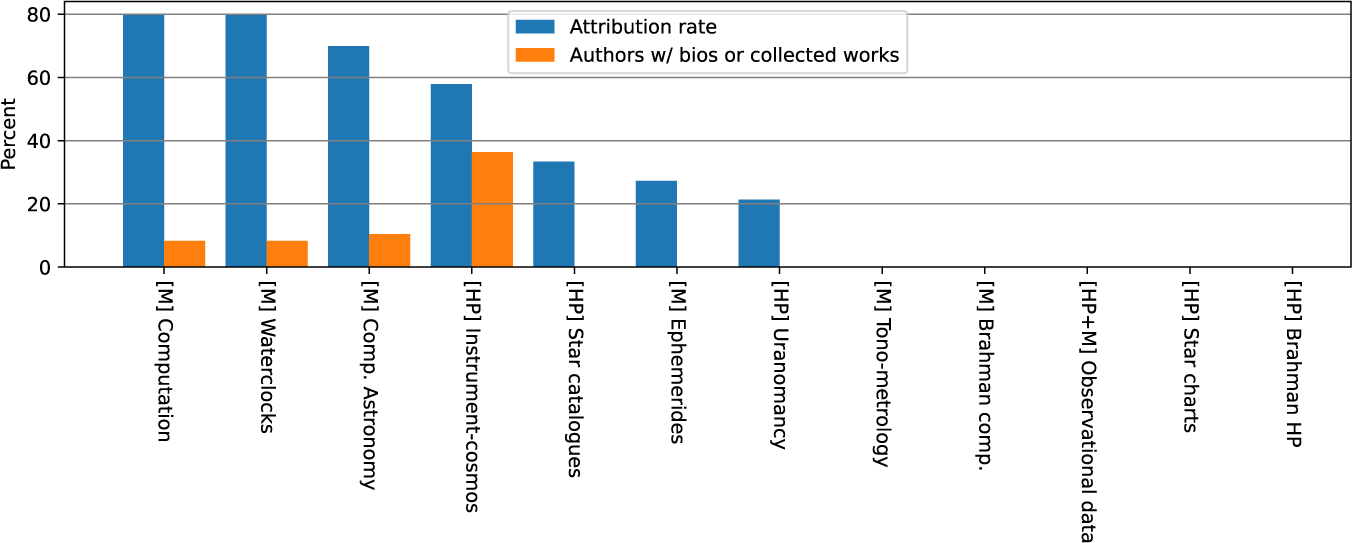
As illustrated in Figure 2, when we break down the titles under “[P] Heavenly Patterns” and “[P] Mathematics” into self-identified genre, their attribution and fame rates diverge, rivaling all of the aforementioned extremes. This distribution is also easy to explain.
Percentage of attributed works and famous authors within genres of “[P] Heavenly Patterns” and “[P] Mathematics”.

On the anonymous end, the seven “Brahman” titles appear to collectively designate either a foreign school (the Brahmapakṣa) or, simply, foreign origin, Chinese experts being somewhat less sure and/or concerned about attributions to exact foreign authors.Footnote 31 Much like “[H] Court Diaries,” observational data and ephemerides are government documents compiled by an office, and thus their low attribution rates are to be expected.Footnote 32 Most extant star charts are anonymous,Footnote 33 and the three anonymous titles in our bibliographies fit with that trend. Star catalogs and uranomancy are intertwined, and divination, as a general rule, lays the heaviest epistemological weight on ancient (usually pseudepigraphal) and revealed authority. Many of the authored works in these genres are compendia, the purpose of which is to gather, systematize, and critically assess the antiquarian/divine credentials of effectively anonymous sources.Footnote 34 Lastly, while the histories’ “Lüli zhi” 律曆志 (Treatises on Tono-Metrology and Computational Astronomy) document intellectuals’ continuing projects in lü, those projects tended to culminate not in monographs but in physical and legal benchmarks. This and the rapid dissolution of its ties with li probably explain why the bibliographical treatises only feature 3 anonymous titles on the subject.Footnote 35
At the other end of the spectrum, the attribution rates for the procedure texts of suan computation (36/45 = 80 percent) and li computational astronomy (86/123 = 70 percent) are higher, as genres, than almost any bibliographic category we might likewise call a genre. As I have argued elsewhere, li was a field defined by innovation, credit, competition, and a keen interest in its own history, which comports with the high number of works credited to historical authors.Footnote 36 By contrast (and focusing on the Han), Christopher Cullen notes that “[w]e know relatively few people whose main claim to fame was their skill in suan, and we do not know the name of anyone responsible for a major innovation in the field,” concluding that “suan in the period we are discussing was an essential skill but does not appear to have been a major focus of intellectual attention in itself.”Footnote 37 This does not mean that suan was any less interested in authorial credit, apparently, and nor that authors were significantly less famous than in li (8 percent versus 11 percent). It is worth noting, however, that out of the three famous authors whose works in suan feature in these catalogs—Liu Xiang, Zu Chongzhi 祖沖之 (429–500), and Zhang Zuan 張纘 (499–549)—the first two were also key figures in the astral sciences.Footnote 38
Tied with suan at an attribution rate of 12/15 (80 percent), the water clock genre presents something of an edge case. None of this literature survives, but two points of context seem pertinent. One is that the genre is principally comprised of self-styled “water clock classics” (louke jing 漏刻經), suggesting a more theoretical, intellectual, and, thus, individualist type of written output compared, for example, to ephemerides and government logs. The other is that the water clock is a relatively small, cheap, and simple instrument, compared to the armillary sphere, and it is situated at the intersection of astronomy, technology, and an object of potential aesthetic appreciation and connoisseurship. One of the authors of a Water Clock Classic in 1 roll was Zu Geng 祖暅 (fl. 504–525) of the Liang (502–557).Footnote 39 When he was captured as a prisoner of war by the collector Prince Yuan Yanming 元延明 (484–530) of the Northern Wei (386–535), the prince held him at his home and “made Geng author inscriptions for his curious vessels and water clocks” (使暅作欹器漏刻銘), asking him for the equivalent of his signature.Footnote 40
Lastly, at a strong 11/19 (60 percent) attribution rate and unparalleled 56 percent fame rate, the genre of tianlun (instruments and/as cosmology) provides a stark contrast with the rest of the “[P] Heavenly Patterns” category. Much of this smaller genre survives, at least in quotation, and the texts differ dramatically from others in “[P] Heavenly Patterns.” Tianlun focuses on argumentation rather than cataloging and description, and much of the argumentation is based on observation, data, reasoning, and geometry, bearing a strong overlap with suan. Quite unlike the rest of “[P] Heavenly Patterns,” Tianlun often forsakes ancient and written authority; it prioritizes the above over metaphysical argument; and it is starkly devoid of mantic contents. Furthermore, the genre only arose in the Han; and like li, it became its own historiographical subject almost as soon as it appeared.Footnote 41
In sum, the apparent gulf between “[P] Heavenly Patterns” and “[P] Mathematics” in Figure 1B is misleading: the real divide in terms of attribution and anonymity is among the concrete, self-labeled genres partitioned between them, and shared features of these genres correlate much more closely with the rate of authorial attribution versus anonymity. Namely, the more one of these genres focuses on some combination of mathematics, argumentation, and innovation, the higher the number of named authors; and the more they focus on the qualitative—catalogs of phenomena, diagnoses, and prognoses—the more they resemble “[P] Five Agents” and “[P] Medicine” in terms of anonymity and pseudepigraphy. This is a product, in my opinion, of a difference in epistemic weight given to modern experience and ancient authority in these genres, but that is a subject for a different article. Broken down by genre, lastly, we have a higher percentage of names attached to the “mathy” writings than almost any other category in Figure 1(B), but these names, as a whole, were still some of the least famous in broader politics and culture. The same level of analysis should clearly be applied to the other forty-five bibliographic categories, but I lack the courage to do so beyond my own area of expertise.
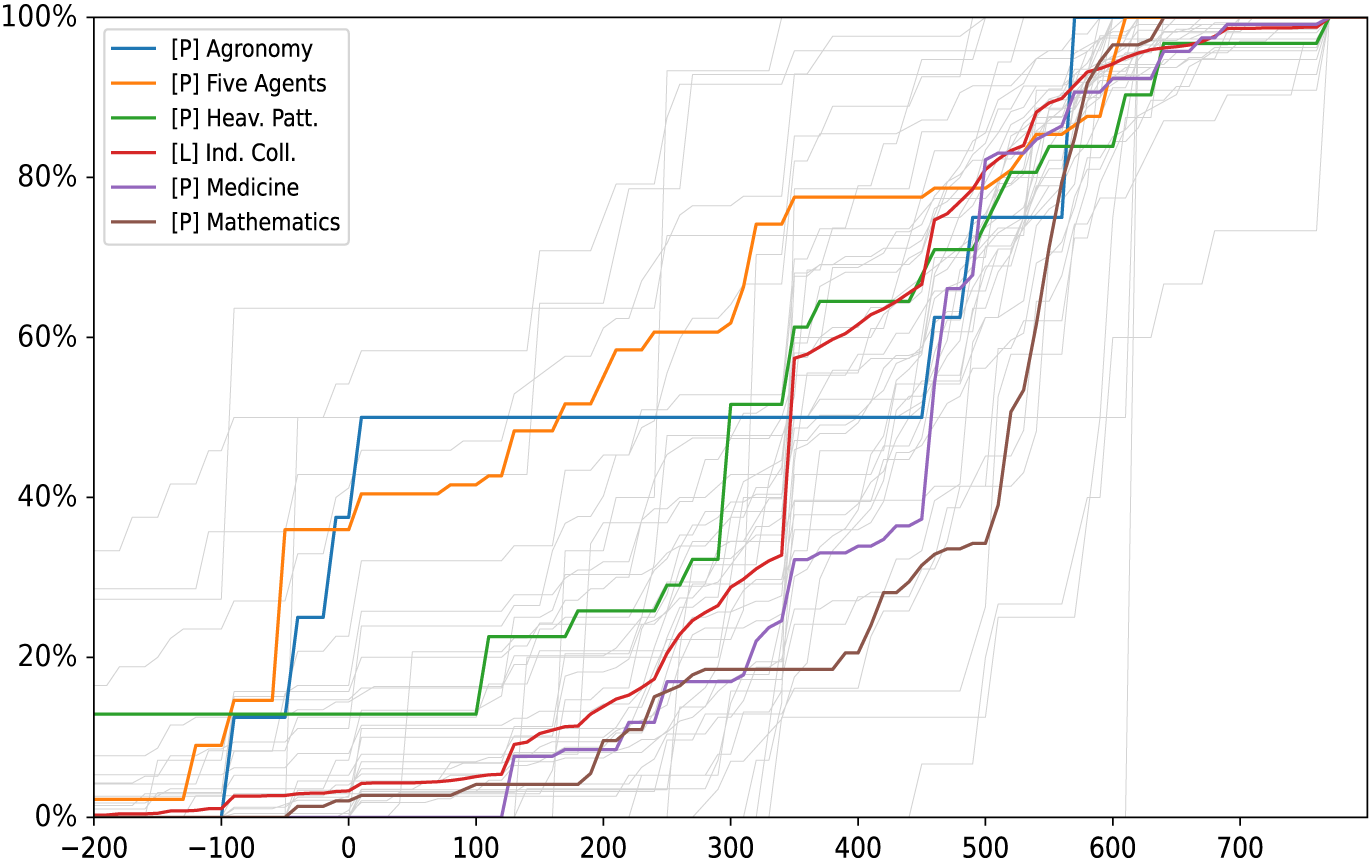
Lastly, I have twice adduced the age of a field as a potential factor in attribution and fame, so it seems prudent at this point to introduce the axis of time. We know that the genre of tono-metrology dried up in the first century, while that of the encyclopedia only really emerges under the Tang, so we might ask how literary production compares century-by-century across bibliographic categories as a measure of foci and trends in intellectual activity. To do this, I first eliminated undatable works from my sample, leaving 6999 works and 1544 authors. Where no exact date of authorship is in my database, I calculated a mean date from known upper and lower limits, e.g. the mean between an author’s known dates of birth and death or the beginning and end of the dynasty of which he was a subject. I then ordered the works in each category by mean date, calculated the cumulative sum at each date, took the cumulative sum at each decade, and calculated the percentage that this represented of the total number of dateable works within said category. The curves for all forty-seven categories are plotted in Figure 3, with those for the sciences and “[L] Collected Works” labeled and highlighted. The dates could use further refinement, but I am only concerned with the gross differences between bibliographic categories.
Cumulative progress graph of the percentage of datable cataloged titles produced in each category over time. Half of all cataloged works in “[P] Agronomy” were written prior to the Common Era, while about two thirds of those in “[P] Mathematics” were written after 500.

The reason for highlighting “[L] Collected Works” with the sciences is to serve as a baseline. As it happens, “[L] Collected Works” is also near the mean of the other production curves, and this is probably not a coincidence since it essentially stands for “people who write well,” who are present and appreciated in every period. One notes that “[P] Agronomy,” “[P] Five Agents,” and “[P] Heavenly Patterns” are significantly ahead of the baseline, and the first two are ahead of most other categories. Of the dateable works cataloged under these first two rubrics in the Han, Sui, and Old Tang bibliographic treatises, half or more were written by the end of the Han. They remained active, with more titles adding up into the sixth and seventh centuries, but their heydays were over (at least for dated and/or attributed works). “[P] Heavenly Patterns” and “[P] Medicine” run closer to the baseline for most of this period, but they had different starts: the first dateable works of “[P] Medicine” in these catalogs come from the late Western Han, while a good portion of dateable titles in “[P] Heavenly Patterns” predate that. At the other extreme from “[P] Agronomy” and “[P] Five Agents” is “[P] Mathematics,” which got a late start and which saw a fairly continuous level of activity before rapidly spiking in the sixth century. In 350 CE, 78 percent of all dateable titles cataloged under “[P] Five Agents” had already been written, while 82 percent of “[P] Mathematics” had yet to come.
How do the sciences compare to other categories of elite written knowledge in China as reflected in early imperial bibliography? To recapitulate, they are on the higher end, if not the extreme end, of productivity in terms of both titles and volumes. As a whole, they are significantly more anonymous, and their known authors are less famous. Broken down by self-identified genre, those with a focus on mathematics, argumentation, and innovation see some of the lowest rates of anonymity, but few authors were sufficiently famous to merit a biography or collected works. Lastly, certain genres and categories passed their heydays by the end of the Han, while “[P] Medicine” and especially “[P] Mathematics” saw a disproportionately high level of activity compared with all other categories of knowledge in the centuries that followed.
Polymathy and Sister Sciences
Having measured how different bodies of knowledge compare, let us now turn to the question of how they intersect. One way to answer this question would be to look at citation networks between extant texts.Footnote 42 There are several disadvantages to this,Footnote 43 and so what I propose is to use the vector of individual polymathy: I shall focus on authors who wrote under multiple categories within the combined Han-Sui-Tang bibliographic catalog and identify patterns in the aggregate as to which categories go together in the typical author’s curriculum vitae.
My focus henceforth will be on “[P] Mathematics” (again, the bibliographic category “Li suan” comprising li, suan, tono-metrology, and water clocks) and “mathematicians,” among whom I count both authors of works self-labeled and cataloged as such and anyone attested as having liked, studied, mastered, taught, or contributed to the aforementioned fields in a role beyond that of commissioner, bystander, or hierarchical superior. The application of this label is based on my survey of early imperial sources for such evidence of knowledge acquisition as found in the example of Zhang Heng’s biography, above.Footnote 44 No more than that should be read onto this label: it does not imply a class, profession, specialization, or diploma. Indeed, many of those at the center of the history of science in early imperial China are polymaths whom sinologists in other fields know by different labels: Liu Xin, Ban Gu, Zheng Xuan 鄭玄 (127–200), Wang Can 王粲 (177–217), Du Yu 杜預 (222–285), Cui Hao 崔浩 (d. 450), Kong Yingda 孔穎達 (574–648), and the list goes on. The singular focus on “[P] Mathematics” and its practitioners is decided in part by time, word limit, and my own research interests, but I reiterate that the entirety of the statistics and diagrams here can be easily re-focused on any other category with the data set and Python scripts provided on HAL.
In addition, as I would now like to move from strict bibliographic categories to more recognizable fields of knowledge, I must make several changes to my hybrid Han-Sui-Tang taxonomy. Namely, I will eliminate the miscellaneous category “[L] Collected Works” from further consideration, and I will use the label “History” to subsume “[H] State,” “[H] Chronicles,” “[H] Ancient,” “[H] Hegemons,” “[H] False States,” “[H] Miscellaneous,” “[H] Old Matters,” and “[H] Misc. Traditions” (see asterisks in Table 1).
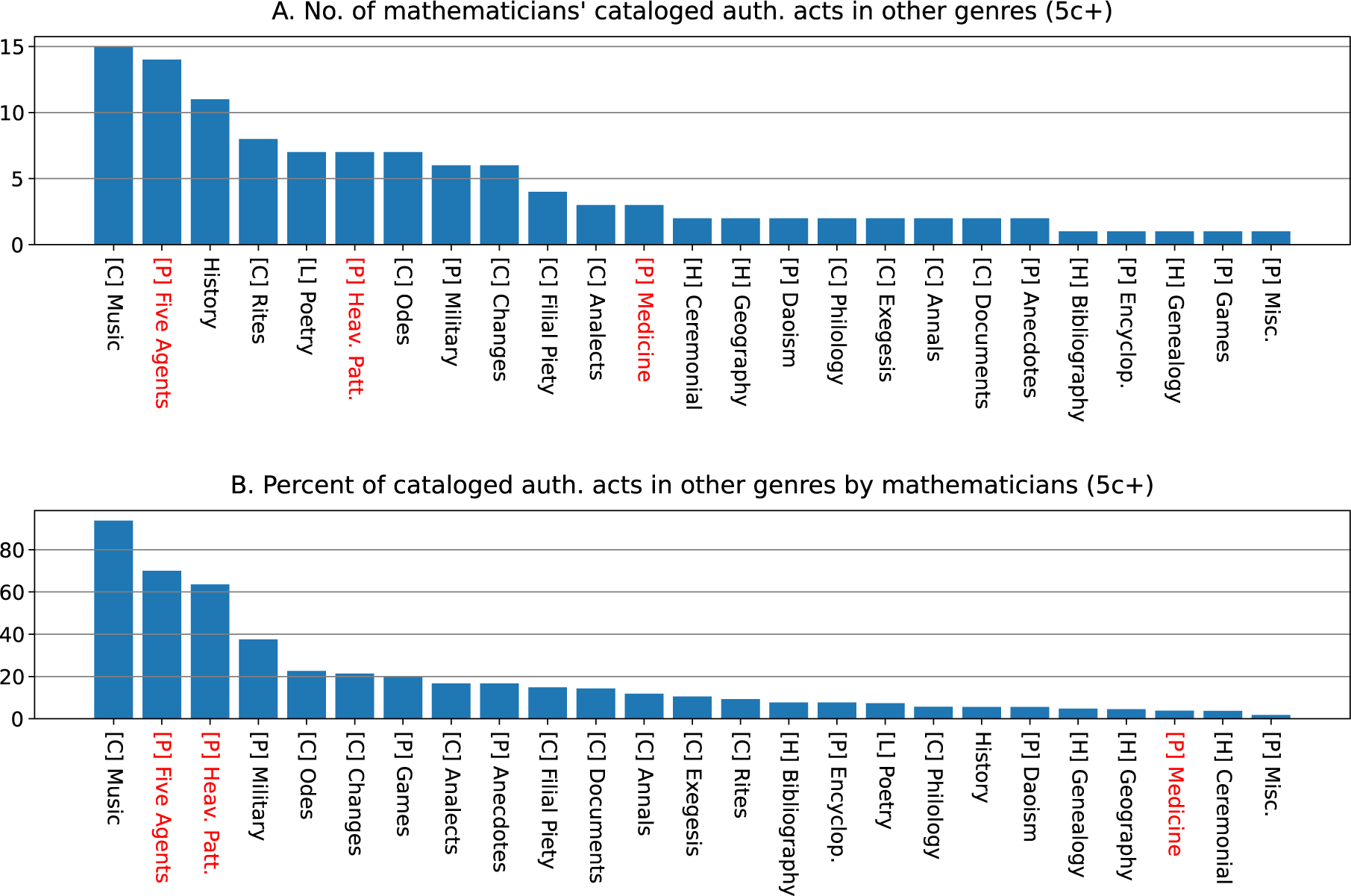
To highlight a particularly stark contrast, I will temporarily filter from the combined Han-Sui-Old Tang bibliography anything predating the Northern Wei and Liu Song (420–479) and count “authorial acts” (i.e., the number of individual contributions by individual authors). If we take a table of mathematicians, and join it with the table of post-fifth-century authorial acts we find, unsurprisingly (by definition), that “[P] Mathematics” is filled with mathematicians. Outside of “[P] Mathematics,” as illustrated in Figure 4(A), we see that mathematicians were also spread across most other fields, with 15 authorial acts in “[C] Music,” 14 in “[P] Five Agents,” 11 in “History,” and so on.
Implication of mathematicians in other genres.

But were these mathematicians just dabbling? No, their contributions were substantial. In terms of the proportion that they represent, we see in Figure 4(B) that mathematicians are responsible for 15/16 (94 percent) authorial acts under “[C] Music,” a respective 14/20 (70 percent) and 7/11 (64 percent) under “[P] Five Agents” and “[P] Heavenly Patterns,” 6/16 (38 percent) under “[P] Military,” and 7/31 (23 percent) under “[C] Odes.” In other words, “[C] Music” and “[P] Five Agents” were not only the most popular common interests among mathematicians, in terms of memorable written output, they would also appear to have been dominated by such men. By contrast, almost as many mathematicians wrote in “History” and “[C] Rites,” but because so many other writers contributed to these vast fields, their cataloged contributions there were vastly outnumbered there by those of non-mathematicians (by about 17:1 and 11:1, respectively).Footnote 45
As a group, one might say, mathematical authors thus had a near monopoly over some fields, a foothold in others, and many fingers in many pies, but is it “mathematicians” who had a foothold in “[C] Rites,” or rather “ritualists” who had a foothold in “[P] Mathematics”? These distinctions only matter if we are focused on knowledge and thinking in terms of specialization; instead, I invite the reader to shift her attention to individuals and think in terms of vectors. To illustrate what that looks like, I have mapped the aggregate of authorial engagement with different fields in my sample with a program for network visualization. This requires a list of “nodes,” for which we will use people (blue) and fields (orange). It requires a list of “edges” (i.e. a–b connections between nodes), for which we can simply extract a table of author–field relations from our bibliographies. Lastly, it requires the choice of an algorithm and several parameters by which to spatialize the ensemble of nodes and their connecting lines. For this, I have chosen to use the Yifan Hu algorithm, adjusting the optimal distance and relative force parameters appropriate to the readability of the following diagrams.
Figure 5 illustrates the network of individual ties between fields and authors in our bibliographies, the upper diagram providing the whole picture, and the lower diagram filtered to eliminate works dateable to before the fifth century. Simply put, the Yifan Hu algorithm works by exerting an outward-directed force on nodes, which is counterbalanced by the connecting force of the “edges” between them. The result is that disconnected nodes and clusters go flying off into space, while interconnected ones are held together and reorient themselves as a function of the binding force of each individual connection. In Figure 5, the blue fans coming off each orange node are single-field authors, while those on the lines criss-crossing fields are polymaths. The size of each node is determined by “degree” (the number of nodes to which it is connected), “History” and “[L] Poetry” being the largest, because they have the most authors. Likewise, the width of the “edges” is determined by the number of works an individual author has written in a single field.
Network graph of authors (blue) and fields (yellow).

What do we observe? First, Figure 5 is a tangled mess. It is a mess because, in the aggregate, polymathic authors connect every single field with every other. There is perhaps no more immediate or visceral demonstration than Figure 5 that, while there may have been “specialists” (single-category authors), no one body of written knowledge in this period was a “specialty” forming its own separate authorial community. Second, we can see that certain disciplines formed more tightly interconnected interdisciplinary webs than do others. In the bottom half of Figure 5, compare for example the zone between “History,” “[L] Poetry,” and “[C] Philology” to that between “[C] Philology,” “[H] Geography,” and “[P] Mathematics.” One is densely packed with connections, and the other dispersed. Third, Figure 5 is but one snapshot, but trust me when I say that, however many times I independently ran the same algorithm, “[P] Heavenly Patterns,” “[P] Mathematics,” and “[P] Medicine” always end up off to the side. This is reassuring, as it tells me that any bias in my data collection, cleaning, and personal interests as a historian of science are not strong enough to move them to the center of this representation of our historical subjects’ intellectual world.Footnote 46
It is my hope that the reader also sees this once prompted, though I am aware that, to the uninitiated, an author interpreting such a diagram can sound like he is reading tea leaves. It is therefore worth emphasizing that the underlying phenomena can be quantified, and that my reading of what is a visual mess is based on tidy metrics. Is polymathy prevalent and extensive? Yes, look at all the criss-crossy lines. Alternatively: Yes, 14 percent (335/2431) of authors in this sample are cataloged under multiple fields; the maximum number of fields per polymath is 19, the mean is 3.01, and our polymaths comprise between 9 percent and 76 percent (mean 38 percent) of all authors in a given field (“[P] Agronomy” is at 86 percent, “[P] Medicine” and “[P] Mathematics” are at 43 percent, and “[P]Heavenly Patterns” and “[P] Five Agents” are at 71 percent and 31 percent, respectively). Do polymaths bind all contemporary fields of knowledge into a single, fairly tight network? Yes, look at the big cobweb. Alternatively: Yes, with 38 fields (from 47 bibliographic categories, see above), the total possible number of distinct author–field connections is 38 × 2431 = 92,378, and with 2256 such attested connections, that effectively makes the “density” of the larger network 2256 ÷ 92,378 = 2.4 percent; however, the “diameter” of the resulting network—the length, in edges, of the longest path between two nodes—is 6, and the average path length is 3.8. Are the author’s favorite fields at the center of everything? No, they have fewer and smaller dots and lines, and they are off to one side. Alternatively: No, if we calculate the nodes’ eigenvector centrality or “prestige score”—relative degrees of connectedness to the most connected nodes—one finds that, compared to “History” (1.00), “[L] Poetry” (0.28), and “[C] Rites” (0.23), the sciences range from 0.16 (“[P] Medicine”) down to 0.02 (“[P] Agronomy”).Footnote 47 Is it worth trotting out these numbers? It can be, but it certainly isn’t necessary for how I intend my diagrams to be used, and they will change as more data is included.
Returning to the matter at hand, the polymathic network of authors and fields in our three bibliographic treatises suggests that mathematics was not a centerpiece of the Han–Tang intellectual world, but rather a moderately well-integrated subsidiary. This comports with what we observe in extant literature over the early imperial period: much of much of heavenly patterns and five agents, and the near entirety of li computational astronomy, is preserved in eponymous treatises in the dynastic histories; astronomical and mathematical contents figure in encyclopedic commentaries to the Ritual Classics (Zhouli 周禮, Yili 儀禮, and Liji 禮記) and the Chunqiu 春秋 annals;Footnote 48 and the star lore, imagery, and omenology of heavenly patterns figure in poetry.Footnote 49 It also comports with recent scholarship on the place of mathematics in elite education and knowledge transmission. According to G.E.R. Lloyd and Nathan Sivin, for example, experts’ “qualifications tended to be social … it was initiation that separated insiders and outsiders, and gentlemanly behavior [ and mastery of the Classics, history, and belles lettres] that marked the superior insider.”Footnote 50 According to Cullen, “suan in itself was an element whose presence in official and intellectual life was continual but not major.”Footnote 51 And as Zhu Yiwen and I have shown, a school of Classical ritual scholarship such as that of Xu Zunming 徐遵明 (475–529) and Xiong Ansheng 熊安生 (d. 578) might serve as a critical medium for the development and transmission of mathematics in the sixth-century north.Footnote 52
This brings us finally to the question at the center of this article: if “[P] Mathematics” is a middling side path in the grand scheme of authors’ interdisciplinary engagements, then what, if we zoom in, can we say about its immediate neighborhood? The answer is that it depends on how you zoom. In Figure 6, I have arbitrarily set the bar at fields within which 20 percent or more of authors are known mathematicians, and to go with Figures 4 and 5, I give both the big picture and a filtered view excluding works dateable to before the fifth century.
Network graph of the fields most closely connected to “[P] Mathematics”.

Figure 6 gives us a more complex picture than does the bar chart in Figure 4 (above), because a network is impartially focused on all the elements therein. It shows us, for example, that “History” and “[L] Poetry” share far more authors than does either with “[P] Mathematics.” More importantly, Figure 6 is but a low-resolution screenshot of what is, in Gephi, an interactive map in which one can filter, zoom, highlight clusters, identify authors, rearrange or redistribute nodes, and run a battery of statistical analyses. There are many things that one can do with this, so I will simply highlight four uses cases that come to mind in my own work.
First, the network of authors and fields illustrated in Figure 6 provides a relatively unbiased and epistemologically rigorous outside confirmation of several phenomena. As we have always known, there is a lot of authorial crossover between “Heavenly Patterns” and “Mathematics” (Li-suan), particularly li computational astronomy. And as has been brought (back) to our attention by Chen Kanli, Zhu Yiwen, and Edward Schafer, there is also significant crossover with poetry and commentary on the Ritual Classics and Chunqiu annals. My data thus provide confirmation of both common knowledge and recent scholarship, and they further allow me to quantify these claims and, thus, quantitatively assess them in relation to others.
Second, this analysis has revealed several connections that I did not expect. The one that most stands out is the penetration of mathematicians into music beyond its connection with pitch-pipes and tono-metrology. Therefore, third, used as a map, this network points me to what I should be reading if I wish to understand the context of my sources and the intellectual lives of the people that figure in their history: music and poetry.
Conclusion
To summarize, the way that we speak about “science” and “scientists” in ancient China has evolved over the last century: we have deconstructed “science,” abandoned the term as an anachronism—an observer’s category—realized that so-called “scientists” were mostly polymaths, and turned to the language that they use—actor’s categories—to understand the self-defined activities in which they were actually engaged. Insofar as we moderns still deem it legitimate to practice “the history of science” avant la lettre, it is therefore challenging to generalize about expert communities in tianwen, li, suan, wuxing, etc., and to understand how such fields articulated with one another in what is, to us, an alien taxonomy of human knowledge. Building notably upon Sivin, Chen Kanli, and Zhu Yiwen’s contributions in this regard, I add to this conversation an analysis of the bibliographical treatises of the Hanshu, Suishu, and Jiu Tangshu: historical catalogs that file thousands of extant and lost works under emic categories within comprehensive taxonomies, and that include, in many cases, information about authors and dates. Using bibliometrics, I am able to make a wholly novel attempt to weight and place “the sciences” and their practitioners among other fields of knowledge from Han to Tang and to map the connectivity between fields using polymathy as a vector.
As to how “the sciences” measure up to one another and other categories of writing, I arrived at the following findings. First, Heavenly patterns, mathematics, five agents, and medicine were among the most productive categories of written knowledge. Second, Heavenly patterns, five agents, and medicine also saw some of the highest rates of anonymous and pseudepigraphal titles. Third, broken down into self-identified genres (e.g. “computation,” “water clock classics,” and “omen reading”), the more “mathy” and/or theoretical the genre within “[P] Heavenly Patterns” and “[P] Mathematics,” the more works therein are explicitly attributed to a historical author. Fourth, authors in the sciences were, however, less famous than their counterparts in other fields, judging from the number commemorated by a biography or collected works. Fifth, mathematics and medicine were some of the newest and most active bodies of written knowledge over the Period of Division (220–589).
As to the connectivity between fields, the network diagram in Figure 5 provides a visual demonstration of the preponderance of polymathy across all fields in this period and that, in the tangled mess, there are clusters of knowledge that are more closely connected than others. Zooming in on “Li suan” (the Mathematics of Heaven and Earth), we then examined the fields with which it was clustered, confirming common sense and recent discoveries (the close relation between “astronomy,” “astrology,” and ritual) and suggesting a novel avenue for exploration (the predominance of “mathematicians” in music).
The point of this article is not to forward any one of these particular findings, however, but to show the method by which I arrived at them. Some will object: it was necessary to harmonize the catalogs’ taxonomies, double count in the rare cases where they disagree, and to add and clean data, all of which introduces bias; bibliography presents an elite taxonomy that may not figure in “popular,” regional contexts such as we see in excavated manuscripts;Footnote 53 worst of all, I chose to use modern observer’s categories like “mathematics” as stand-ins for actor’s categories (i.e., li suan) for the sake of concision and comprehensibility in communicating my results. However, it is important to emphasize what I was able to eliminate from the analysis upon which I am reporting.
First, nowhere prior to the publication of my results in English did observer’s categories figure in my data collection or analysis. Indeed, emic terms were by necessity substituted for numerical identifiers, so I was mostly working in terms of “bib_cat_id 37” versus “bib_cat_id 62.” While we may now problematize or even banish modern observer’s categories in the history of science in the ancient world, it is, in my opinion, questionable as to whether we are truly liberated or have simply changed our structuring relationship with them to one of opposition. As a “historian of science,” for example, medicine and mathematics go together in our conferences, journals, and, often, thoughts, and these two are treated as either inimical to (if you are a positivist) or indistinguishable from (if you are a relativist) such things as ritual and fortunetelling. What I have presented here is a way around—rather than for or against—these entanglements. It is one based on primary sources, data, statistics, and code that ups the epistemological ante and shows me, at least, things I already knew, things I didn’t, and the big picture beyond my own specialty.
In the same vein, if these catalogs are centered upon any one of the some forty recognized fields therein, it is by no means those that I personally prefer or master; and while I chose in the final section to zoom in to “[P] Mathematics” and its immediate vicinity, one could easily zoom in on something else. I have done so in private communications with colleagues concerning “[C] Philology” and “[H] Geography,” and the result was a similar mixture of the statistical confirmation of their intuitions and novel connections that they were able to immediately rationalize. It is my hope that by sharing my data and interactive visualizations I might help another colleague see the place of their own specialization differently and discover fruitful connections with others.
Acknowledgments
This project was first presented at the Brown Astronomy Meeting (online, April 13, 2022) and the Experts at Work II Ability and Authority Working Group Workshop (MPIWG, November 11, 2022), and I thank the participants for their encouragement and feedback. I thank Alexis Lycas and Olivier Venture for agreeing to be my guinea pigs in Paris and for sharing their detailed thoughts about my results, method, and avenues for improvement concerning reports tailored to their specific interests in geography and philology. Special thanks go to Sarah Schneewind and Yang Qiao for motivating me to publish with them, for the hard work of organizing this special issue, and for their many wise and helpful comments on my first draft. I also thank Joe Dennis for his corrections and reading suggestions.
Competing interests
The author declares none.



 Open access

