


The power of supervised discharge was introduced by the Mental Health (Patients in the Community) Act 1995. Since April 1996 psychiatrists have been able to apply for an order under which patients can be required to reside at a specified place, to attend for treatment and care and to permit access for assessment. In the event of non-compliance they can be forcibly ‘conveyed’ to a place of treatment. Since the order was introduced, further proposals for new mental health legislation have been made (Department of Health, 1999). Among the new proposals is a ‘compulsory order’ under which a tribunal could require that patients comply with the measures included in supervised discharge orders (SDOs) and also with other aspects of a care plan, including medication.
The experiences of clinicians using supervised discharge may provide a guide to the way in which they would use the proposed new powers. As part of a larger study of the use of supervised discharge and guardianship, we surveyed a representative sample of psychiatrists acting as community responsible medical officers (CRMOs) for patients on supervised discharge. We aimed to establish (a) why the CRMO used supervised discharge in each case, and (b) whether the CRMO felt that the SDO had been of benefit for the patient and for the clinical team.
Method
Data reported in this paper were obtained from a national survey of the use of SDOs in England, and also from a cohort study of patients subject to the order. Surveys of the level of use of SDOs were conducted in 1997 and 1998, as described by Pinfold et al (Reference Pinfold, Bindman and Friedli1999). A further survey using the same method was carried out between March and June 1999. In addition to enumerating patients subject to SDOs in all trusts in England, the survey established the total number of consultant psychiatrists practising in the following specialities: general adult psychiatry, old age psychiatry, forensic psychiatry and learning disabilities.
A cohort of patients subject to SDOs was identified by taking a random sample of 80 of the 178 mental health trusts in England in 1998. The 1998 survey figures suggested that this number of trusts could be expected to yield 120 prevalent cases. Ethical and management approval was obtained at trusts with cases (n=56), Mental Health Act administrators were contacted and a total of 132 prevalent cases were identified. Telephone contact with each trust on a monthly basis (October 1998 to June 1999) identified 89 new cases, which were included in a total cohort of 221 cases under the care of 133 CRMOs. Each CRMO was sent a 10-item semi-structured questionnaire to provide data on why supervised discharge was chosen as a management option with each patient and the CRMO's perception of its effectiveness.
Basic content analysis (Reference WeberWeber, 1985) was carried out on qualitative responses from the CRMO questionnaires, using the themes identified by Pinfold et al (Reference Pinfold, Bindman and Friedli1999) as a basis for exploring the data. The data were coded by two members of the research team independently, and inconsistencies were discussed before the data were recoded using the final emergent schema (Reference Mays and PopeMays & Pope, 1995). The coded data were exported into MicroSoft Excel for descriptive statistical analysis. Perceived effectiveness was analysed only on orders that had been in place for over 2 months (n=152).
Results
Use of supervised discharge by consultants in England
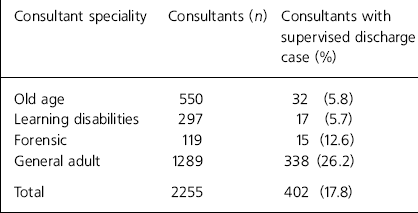
One hundred and seventy trusts were identified as providers of mental health services in 1999. In England 596 individuals were subject to SDOs at the time of the survey. A 100% response rate was achieved. Table 1 shows the use of the order by consultant psychiatrists in the main psychiatric specialities.
Consultants' use of supervised discharge by speciality in 170 mental health provider trusts in England in 1999
| Consultant speciality | Consultants (n) | Consultants with supervised discharge case (%) |
|---|---|---|
| Old age | 550 | 32 (5.8) |
| Learning disabilities | 297 | 17 (5.7) |
| Forensic | 119 | 15 (12.6) |
| General adult | 1289 | 338 (26.2) |
| Total | 2255 | 402 (17.8) |
Why is supervised discharge used?
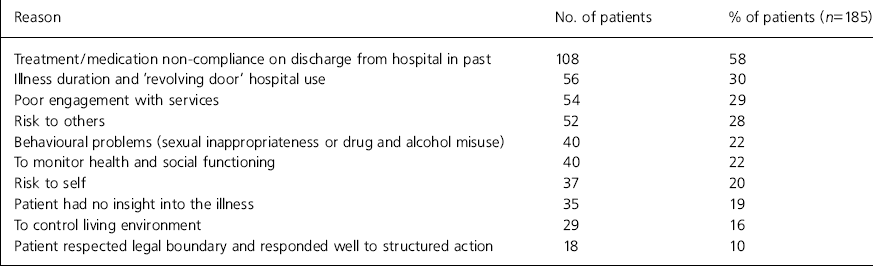
Of the 133 CRMOs responsible for patients in the cohort, 122 (92%) returned questionnaires relating to 185 patients (108 prevalent and 77 incident cases). Seventy-six of the respondents (62%) returned a questionnaire on a single case subject to the order, 37 (30%) returned two, 5 (4%) returned three, 2 (2%) returned four and 2 (2%) returned six. Table 2 shows the results of the thematic analysis of CRMOs' reasons for choosing to use SDOs.
Reasons given for the use of supervised discharge
| Reason | No. of patients | % of patients (n=185) |
|---|---|---|
| Treatment/medication non-compliance on discharge from hospital in past | 108 | 58 |
| Illness duration and ‘revolving door’ hospital use | 56 | 30 |
| Poor engagement with services | 54 | 29 |
| Risk to others | 52 | 28 |
| Behavioural problems (sexual inappropriateness or drug and alcohol misuse) | 40 | 22 |
| To monitor health and social functioning | 40 | 22 |
| Risk to self | 37 | 20 |
| Patient had no insight into the illness | 35 | 19 |
| To control living environment | 29 | 16 |
| Patient respected legal boundary and responded well to structured action | 18 | 10 |
The reasons given for the use of supervised discharge relate closely to statutory criteria for using SDOs: the presence of a mental disorder, identified risk factors; and a belief on the part of the applicant that without the imposition of the order patients would not receive after-care. However, the stated reasons also indicate the desire to control aspects of patients' lives in the community. In 58% of cases, supervised discharge was used in an attempt to improve medication compliance, despite not having the statutory power to enforce medication compliance directly. A judgement about the patient's likely response to the order also contributes to the decision to use it: 10% of cases were placed on supervised discharge because the CRMO felt that the patient would respect the authority of the order. In one example (a patient with Asperger's syndrome and a psychotic illness) the CRMO recorded:
“He is consistently uncooperative with voluntary mental health care, but very compliant when on the order. The sheer fact of being on a legal order makes him comply.”
Effectiveness of supervised discharge
Responses to the question “How helpful has the current SDO been in managing this client?” were analysed only in respect to the 152 cases that had been subject to the order for more than 2 months when the questionnaire was completed because an impression of the effectiveness of the order after a shorter time was felt to be of limited value. In 117 (77%) of these cases the CRMO considered the SDO to have been a helpful or very helpful measure in managing the patient. Fifteen (10%) felt it was not very helpful or very unhelpful and the remaining 20 (13%) were unsure. Fifteen CRMOs who described the order as helpful in an individual case were, however, unsupportive of the measure more generally. For example, one stated:
“Generally, I remain of the opinion that the legislation is fundamentally flawed, being excessively bureaucratic and crucially lacking the power to impose treatment… It may well be true that there are small groups (of vulnerable dependent patients, perhaps) who may benefit from supervised discharge.”
Effectiveness for improving medication compliance
The CRMOs were also asked to describe the ways in which supervised discharge had been helpful. As shown in Table 2, many reported that they had used SDOs in the hope of improving patients' medication compliance. In 84 such cases, where the patient had been on the order for more than 2 months, the CRMO perceived that it had been instrumental in improving compliance in 40 (46%) individuals. In an additional 22 cases, where medication compliance was not given as a reason for use, it was described as a way in which the order had been helpful. In a total of 62 (41%) cases, medication compliance was described as having been positively influenced by the use of supervised discharge.
Effectiveness for improving engagement with services
The CRMOs reported that they had used supervised discharge in the hope of improving engagement with services in 54 (29%) cases (see Table 2). In 35 of these cases, where the patient had been on the order for more than 2 months, the CRMO reported that 18 (51%) did indeed show better engagement. In an additional 78 (42%) cases where improved engagement was not given as a reason for use, it was described as a way in which the order had been helpful. In a total of 96 (63%) cases engagement was described as having been positively influenced by the use of supervised discharge.
Effectiveness of monitoring patients in the community
Forty patients (22%) were placed on SDOs in an effort to ensure that their health and social functioning were regularly monitored (Table 2). In 36 of these cases, where the patient had been on the order for longer than 2 months, the monitoring function of supervised discharge had been effective for 17 (47%).
In an additional 29 (19%) cases, where monitoring of the patient was not stated as a reason for use, the order did improve the clinical team's monitoring of the patient. In a total of 46 (30%) cases, improvement in accessing the patient was observed.
Comments
Principal findings
This study shows that although the number of cases subject to supervised discharge has risen (Reference Pinfold, Bindman and FriedliPinfold et al, 1999), only a minority of consultant psychiatrists are currently using it, although a higher proportion working in general adult psychiatry use it than those working in other specialities. While this may support the Government's view that supervised discharge is “often criticised as inadequate and (has) been used infrequently” (Department of Health, 1999), the present results show that in the majority of cases in which it is used, it is regarded as helpful. Although an important criticism of supervised discharge is that it lacks the power to enforce compulsory treatment in the community, CRMOs none the less commonly use it in an attempt to improve medication compliance, and report that it is often successful.
Limitations
The study had high response rates, and the views of CRMOs were obtained on a representative sample of almost one-third of all patients subject to SDOs in England. The principal limitation of the study is that the sample is biased towards cases that remained on SDOs long enough to be identified by the study; cases that were of short duration, owing to the order's apparent ineffectiveness or to readmission to hospital, may not have been identified. The study is also limited by its use of professional opinion as a proxy for a measure of effectiveness. Trauer and Sacks (Reference Trauer and Sacks1998) report high levels of concordance between mental health professionals in ratings of medication compliance of patients, but levels between clinicians and clients were significantly lower, and CRMOs' reports of supervised discharge being effective in helping compliance with medication may only be partly reliable.
Relationship with other studies
Evaluation of regional studies on supervised discharge have focused on rates of use and initial experiences of CRMOs since its introduction in 1996 (Reference Knight, Mumford and NicholKnight et al, 1998; Reference Davies, Bruce and FallowsDavies et al, 1999). Although descriptions of patients subject to the order, and attitudes of consultants in particular areas, have been reported, this is the first national study to seek views on perceived effectiveness of the SDO in the care of individual patients. The use of supervised discharge by CRMOs to improve medication compliance, despite this not being part of the statutory criteria for use of the order, has been noted previously by Knight et al (Reference Knight, Mumford and Nichol1998). They have suggested that CRMOs could be using the SDO much as a compulsory treatment order, despite the limited powers of compulsion that the SDO allows.
Policy implications
Although it is clear that supervised discharge can be of value in the care of some individuals, they are a select group, who may be identified by their willingness to comply with treatment when it is offered within a legal framework and to accept treatments despite the inability of the law to compel them to do so. Supervised discharge was introduced in response to political priorities (Reference EastmanEastman, 1995), and this may have contributed to the failure of the majority of consultant psychiatrists to make use of it and to a level of use far less than the 3000 cases originally anticipated (Department of Health, 1993). Professional opinion on whether further legislation to compel acceptance of community treatment is necessary remains divided (Reference BurnsBurns, 1999; Reference Moncrieff and SmythMoncrieff & Smyth, 1999). If future legislation lacks credibility with clinicians, it may not be widely used.
Acknowledgements
We are grateful to the CRMOs who completed questionnaires and to the Mental Health Act administrators who responded to the enumeration surveys and identified patients. This work was undertaken by the Institute of Psychiatry, which received funding from the Department of Health. The views expressed are those of the authors and not necessarily those of the Department of Health.


 Open access


eLetters
No eLetters have been published for this article.