


Well-known arguments underpin the claim that paying politicians higher salaries should help reduce corruption – the misuse of public resources for personal or political gain. Higher pay increases the value of holding office, imposing greater opportunity costs of corruption (Shapiro and Stiglitz Reference Shapiro and Stiglitz1984). By lowering the consumption-related need for bribes, higher salaries also decrease their marginal utility (Becker and Stigler Reference Becker and Stigler1974). In addition to improving incentives, better pay may have positive selection effects by attracting higher-quality candidates who, presumably, are also less rapacious (Besley Reference Besley2004; Bond Reference Bond2008).
Empirical evidence, however, is mixed. While some studies report positive effects of higher salaries on incentives or selection, whether with respect to corruption specifically (Di Tella and Schargrodsky Reference Di Tella and Schargrodsky2003; Klašnja Reference Klašnja2015) or related political outcomes more broadly (Ferraz and Finan Reference Ferraz and Finan2009; Gagliarducci and Nannicini Reference Gagliarducci and Nannicini2013; Kotakorpi and Poutvaara Reference Kotakorpi and Poutvaara2011; Van Ri-jckeghem and Weder Reference Van Rijckeghem and Weder2001), others find no such links (Alt and Lassen Reference Alt and Lassen2012; Dahlström et al. 2012; Treisman Reference Treisman2007), ambiguous effects (Braendle Reference Braendle2015; Fisman et al. Reference Fisman, Harmon, Kamenica and Munk2015), or even the opposite effect (Pique Reference Pique2019). This mixed evidence may in part reflect the plausibility of countervailing arguments. Wages may need to be set at prohibitively high levels to produce the intended corruption-reducing effects (Besley and McLaren Reference Besley and McLaren1993). Potential bribers may attenuate the beneficial salary effects by increasing bribes (Mookherjee and Png Reference Mookherjee and Png1995) or even threats (Pulejo and Querub (Reference Pulejo and Pablo2026)). Higher wages may even lead to negative selection if they attract less public-spirited candidates (Besley Reference Besley2004), who may be more prone to rent-seeking (Barfort et al. Reference Barfort, Harmon, Hjorth and Olsen2019; Hanna and Wang Reference Hanna and Wang2017).
This said, the mixed evidence may also in part be due to the large variation in the contexts, definitions, measures, and methodological approaches in the existing literature. Most previous studies focus on single-country cases, making it hard to assess their generalizability. Studies with broader scope conditions are typically correlational, limiting our ability to ascribe causality. Moreover, existing works vary widely in the types of outcomes examined, some of which are only indirectly related to corruption. Our contribution in this letter is to provide new evidence drawing on comprehensive data covering eleven European countries
over more than a decade, featuring comparable and well-tailored measures of corruption. In addition, we leverage a large number of plausible natural experiments in the determination of politicians’ salaries, which, combined with the use of several research designs, allows us to capture plausibly general and causal estimates. In what follows, we describe our novel data, methods, and results, with many additional details described in the Supplementary Appendix (henceforth SA).
Study Design: Sample, Data, Measures, and Empirical Strategies
Estimating the effects of politicians’ salaries is difficult because of endogeneity problems arising from a variety of strategic and contextual factors that determine salary levels. To address these challenges, we searched for all instances in countries in the European Union of changes in salaries of local government executives (led by mayors and co-governed by municipal councils)Footnote 1 tied to the population of their municipalities. This set-up is advantageous because the formula-based determination of remuneration provides a plausibly exogenous source of variation in salaries. We identified ninety-seven such instances where salaries change discontinuously at discrete population thresholds in eleven countries: Austria, Belgium, France, Hungary, Italy, Lithuania, Portugal, Romania, Slovakia, Slovenia, and Spain.Footnote 2 All thresholds are listed in Supplementary Appendix (SA) Section A.
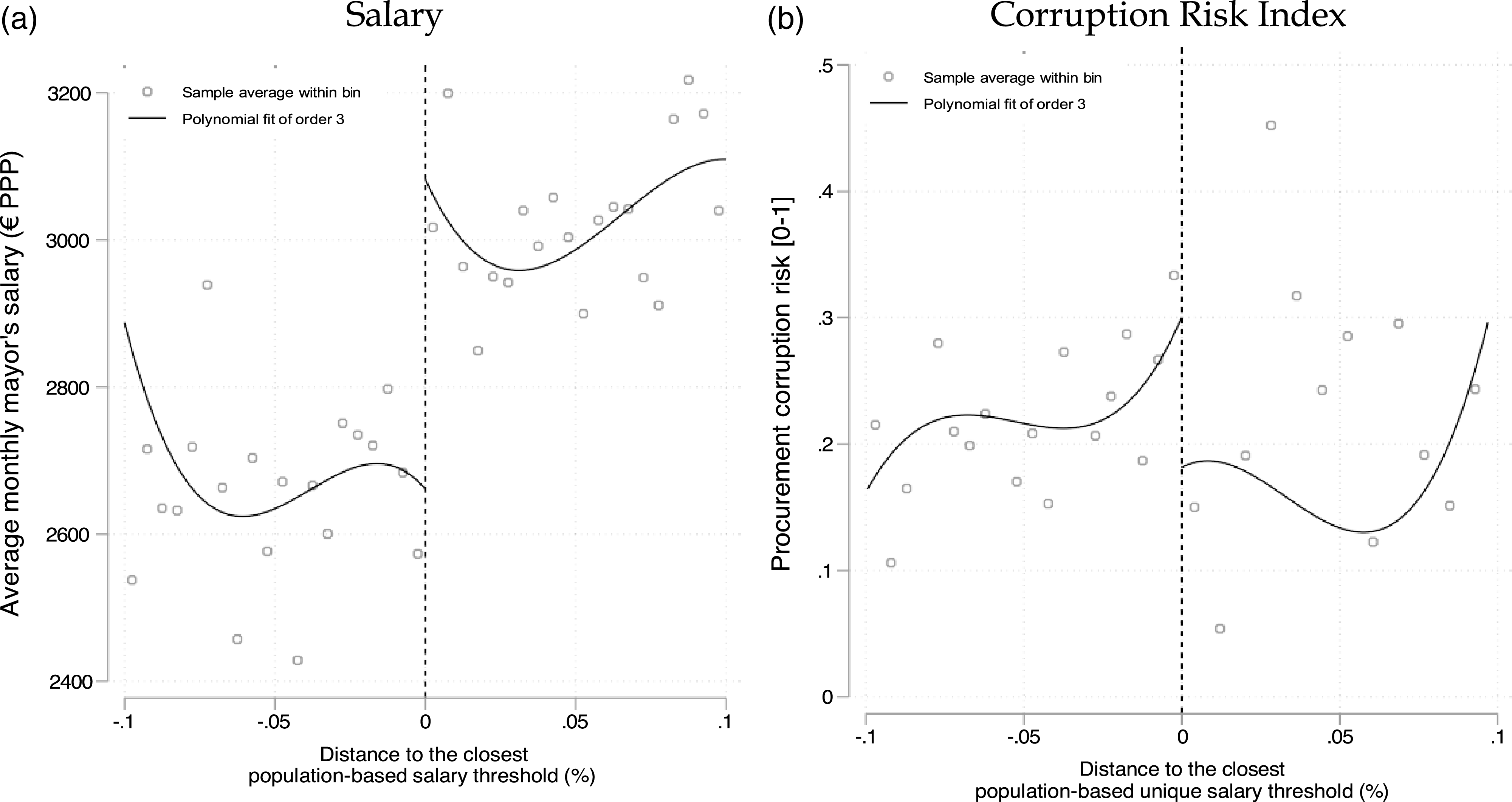
This approach has been utilized in prior research studying the effect of salaries on governance outcomes (Klašnja Reference Klašnja2015; Pulejo and Querub (Reference Pulejo and Pablo2026); Pique Reference Pique2019).Footnote 3 Our contribution is to draw on a significantly larger number of cases, as our sample comprises close to 18,000 municipalities and covers countries accounting for more than half of the European Union’s population and half of its gross domestic product (GDP). The breadth of our sample gives us rich and meaningful variation in salaries. Panel (a) of Figure 1 shows that the average increase in mayoral monthly salary across all salary thresholds is approximately 15 per cent (from about Purchasing Power Parity [PPP] €2,650 to €3,050). Salary jumps vary between less than 1 per cent and 95 per cent, with an interquartile range of 5–30 per cent (SA Figure C2).
RD plots of change in average mayoral salary and corruption risk index at the cut-off. Notes: panel (a) includes all population-based salary thresholds; panel (b) includes only the unique thresholds described in the text. Dots are averages of the y variable within small ranges (or ‘bins’) of the x (or ‘running’) variable, which represents the per cent distance of a town to the closest salary threshold (indicated by the vertical dashed line); lines on each side of the discontinuity are cubic best-fit curves fit to the data (separately on the left and right of the discontinuity). Bins of the running variable are determined with the data-driven procedure by Calonico et al. (Reference Calonico, Matias and Titiunik2015).

Our focus on local executives is warranted on more than just research design grounds. Local governments in the European Union have substantial policy responsibilities in the provision of public goods and services, such as the maintenance of local infrastructure and utilities and the administration of local safety, health, education, and social protection (Kuhlmann et al. Reference Kuhlmann, Dumas and Heuberger2022). In the countries in our sample, local governments account for a fifth of total public expenditures and revenues, two-fifths of public investments, and a third of the total value of government contracting.Footnote 4 Local executives are crucial in formulating and implementing these policies, including public procurement, which is highly discretionary and thus subject to considerable corruption risks. SA Section B gives an overview of the organization, resources, and responsibilities of local executives in each country, highlighting their central policy roles and powers.
Given the local politicians’ roles in the allocation of government resources, we focus on measuring corruption in local government spending. We assembled a large original dataset of more than 2.4 million public procurement contracts in the countries in our sample over the period 2006–20. About a third of government spending in the European Union is implemented through public procurement – around €2 trillion annually.Footnote 5 We collected the data directly from official government sources and open data repositories using web-scraping algorithms (Fazekas et al. Reference Fazekas, Tóth, Abdou and Al-Shaibani2024).Footnote 6 Using the information on contracting authorities, we focus on tenders administered by local governments (accounting for around a third of all procurement), geocoding each contract and linking it to the data on local politicians’ salaries and salary thresholds. SA Table C1 gives details for each country sample.
We define six corruption risk indicators that approximate separate, but often correlated, aspects of corrupt deals in public procurement. In terms of procurement procedure, we track: (a) the use of non-open (that is, non-competitive) tender procedures, (b) the absence of call-for-tender announcements, (c) excessively short advertisement periods, and (d) excessively short award decision periods. With respect to tender outcomes, we track two indicators: presence of only a single bidder, and the spending concentration of contracting authorities (that is, local market concentration). In isolation, these indicators may reflect idiosyncratic, benign tender characteristics rather than corruption. To reduce the potential for such misinterpretation, we average the indicators into a composite procurement Corruption Risk Index (CRI) that varies between 0 and 1, with higher values indicating higher risk. Therefore, we assume that a contract characterized by multiple red flags is more likely to represent a corrupt tender. The index varies considerably between and within countries in our sample. SA Section C.1.2 provides more details for each indicator and the composite index.
The index is comparable across countries and has been empirically validated. For example, it correlates well with survey-based measures of corruption and is strongly predictive of overpricing in procurement tenders (Fazekas et al. Reference Fazekas, Tóth and King2016; Fazekas and Kocsis Reference Fazekas and Kocsis2020). The CRI therefore hues closer to measuring resource misallocation than the measures in much of the prior literature on salaries, in which some of the outcomes are only indirectly related to or themselves influenced by corruption, such as government size, local investment, or political competition (Ferraz and Finan Reference Ferraz and Finan2009; Gagliarducci and Nannicini Reference Gagliarducci and Nannicini2013; Pique Reference Pique2019). Others also use procurement-based performance or manipulation indicators (Klašnja Reference Klašnja2015; Pulejo and Querub ın Reference Pulejo and Pablo2026); however, unlike the CRI, some are context-specific and cannot be constructed more broadly (for example, bunching around regulation-specific contract value thresholds).
Using this data, our first empirical strategy is to estimate the following fixed effects model:
 $${Y_{imtc}} = {\rm{ }}{\alpha _{imtc}} + {\rm{ }}\beta {S_{mtc}} + {\rm{ }}\delta {X_{mtc}} + {\rm{ }}{\tau _{mtc}} + {\rm{ }}{\xi _m} + {\rm{ }}{\eta _t} + {\epsilon _{imtc}}$$
where Y is the CRI for contract i in municipality m in year t and country c; S is the mayoral salary in the same municipality and year (expressed in base-2020 PPP euros and logged), X is the municipal population (logged), τ indicates the closest population-based salary threshold, and ξ and η are the municipality and year fixed effects, respectively. We estimate the model with ordinary least squares (OLS) and cluster the standard errors at the municipality level.
The key coefficient, $\hat \beta$
, utilizes both the within- and across-municipality (and across-threshold) variation in mayoral salaries,Footnote
7
allowing us to use our large dataset to comprehensively describe the association between the population-driven variation in salary and the CRI. However, there may be various unobserved, time-varying characteristics of municipalities (or their politicians) that the model may not account for.Footnote
8
To overcome that challenge, we exploit the discontinuous nature of the increases in salary to apply a regression discontinuity (RD) design. This approach aims to estimate the causal effect of salary by analyzing corruption outcomes in plausibly comparable municipalities very close to the salary thresholds. Our RD model is as follows:
$\hat \beta$
, utilizes both the within- and across-municipality (and across-threshold) variation in mayoral salaries,Footnote
7
allowing us to use our large dataset to comprehensively describe the association between the population-driven variation in salary and the CRI. However, there may be various unobserved, time-varying characteristics of municipalities (or their politicians) that the model may not account for.Footnote
8
To overcome that challenge, we exploit the discontinuous nature of the increases in salary to apply a regression discontinuity (RD) design. This approach aims to estimate the causal effect of salary by analyzing corruption outcomes in plausibly comparable municipalities very close to the salary thresholds. Our RD model is as follows:
 $${Y_{imtc}} = {\rm{ }}{\alpha _{imtc}} + {\rm{ }}\theta 1[{{\tilde X} } \ge 0]_{mtc} + {\rm{ }}\gamma f({\tilde X)_{mtc}} + {\rm{ }}\lambda \ 1[\tilde X{\rm{ }} \ge 0]]_{mtc}{\rm{ }} \times f{(\tilde X)_{mtc}} + {\rm{ }}{\psi _c} + {\rm{ }}{\eta _t} + {\rm{ }}{\epsilon _{imtc}}$$
where variables with the same notation as in Equation 1 have the same interpretation; $\tilde{X} = {X - x_0 \over x_0}$
is a municipality’s percent distance in population X to the closest threshold x
0;Footnote
9
and ψ are the country dummies.
$\tilde{X} = {X - x_0 \over x_0}$
is a municipality’s percent distance in population X to the closest threshold x
0;Footnote
9
and ψ are the country dummies. $\hat \theta$
captures the effect of a salary increase at the appropriate population-based threshold. Since we have thresholds at various population sizes, we normalize the distance of each municipality to a threshold so that the cut-off is zero for all municipalities. Therefore,
$\hat \theta$
captures the effect of a salary increase at the appropriate population-based threshold. Since we have thresholds at various population sizes, we normalize the distance of each municipality to a threshold so that the cut-off is zero for all municipalities. Therefore, $\hat \theta$
represents a weighted average of the local average treatment effects across all the included salary thresholds (Cattaneo et al. Reference Cattaneo, Keele, Titiunik and Vazquez-Bare2016).
$\hat \theta$
represents a weighted average of the local average treatment effects across all the included salary thresholds (Cattaneo et al. Reference Cattaneo, Keele, Titiunik and Vazquez-Bare2016).
We employ local linear regressions (that is, f ( $\tilde X$
) is of polynomial order 1) with a triangular kernel fit within the MSE-optimal bandwidth selected by the robust, data-driven procedure by Calonico et al. (Reference Calonico, Matias and Titiunik2014) (our key result is insensitive to bandwidth size, as shown in SA Figure C4). We report the bias-corrected point estimates and standard errors, clustered at the locality level. The key identifying assumption is that the potential outcomes are continuous and smooth across each threshold, implying that: (a) except mayoral salary, no other (pre-determined) municipality characteristics change discontinuously at the cut-off; (b) politicians do not sort their municipalities precisely on one or the other side of a salary threshold. We evaluate these implications in detail in SA Section C.1.4. Observable municipal characteristics, including lagged corruption risk indicators, are broadly balanced, and there is no evidence of potential strategic sorting.Footnote
10
$\tilde X$
) is of polynomial order 1) with a triangular kernel fit within the MSE-optimal bandwidth selected by the robust, data-driven procedure by Calonico et al. (Reference Calonico, Matias and Titiunik2014) (our key result is insensitive to bandwidth size, as shown in SA Figure C4). We report the bias-corrected point estimates and standard errors, clustered at the locality level. The key identifying assumption is that the potential outcomes are continuous and smooth across each threshold, implying that: (a) except mayoral salary, no other (pre-determined) municipality characteristics change discontinuously at the cut-off; (b) politicians do not sort their municipalities precisely on one or the other side of a salary threshold. We evaluate these implications in detail in SA Section C.1.4. Observable municipal characteristics, including lagged corruption risk indicators, are broadly balanced, and there is no evidence of potential strategic sorting.Footnote
10
Europe-Wide Results
Column 1 of Table 1 shows the results of our fixed effects (FE) model from Equation 1. Using the full sample of contracts and municipalities, a 1 per cent increase in mayoral salary is associated with a precisely estimated decrease in the CRI of 0.019 points, or about 1/13 of the sample standard deviation in CRI. Based on this estimate, an average increase in salary of 15 per cent (panel (a) of Figure 1) is associated with slightly more than a one standard deviation decrease in the CRI. To verify that this association is not idiosyncratically driven by municipalities with very low numbers of tenders, the remaining columns limit the sample to municipalities with a progressively larger minimum number of contracts per year. The estimated association is similar, and even somewhat larger.
Higher salaries associated with lower procurement corruption risks

Notes: outcome is the corruption risk index (CRI), described in the text. Model specification is given in Equation 1. Standard errors are clustered by municipality.
We next turn to the RD analyses. To unambiguously ascribe the effect to politicians’ salary, no other policy may change at the same thresholds (Eggers et al. Reference Eggers, Freier, Grembi and Nannicini2018). This is the case for twenty-five of the ninety-seven thresholds in our data, across six of the eleven countries. Henceforth, we call these thresholds ‘unique’.Footnote 11 The remaining thresholds entail compound treatments that include the effect of one or more other policies varying along with salaries, such as the size of the municipal assembly or fiscal transfers from the central government. We therefore face a trade-off: unique thresholds provide greater clarity and internal validity, but limit the sample size and generalizability of an already local RD estimand. Our preferred sample is of the unique thresholds; however, we also report the results for a broader sample of (‘compound’) thresholds with no more than two other policies co-varying (fifty-three thresholds covering ten of the eleven countries), as well as all the thresholds (as in the FE analysis). SA Section A indicates which threshold belongs to each sample.
Panel (b) of Figure 1 shows descriptively the change in the CRI at the cut-off across the unique thresholds. Similar to the correlations from the FE model, there is a clearly identifiable drop, from around 0.3 (on a 0–1 scale) below the salary discontinuity to 0.18 immediately above it. That said, there is a fair bit of variability in the CRI, especially above the cut-off (as indicated by the dots, which summarize in small ‘bins’ of the running variables the unplotted raw values of CRI for each contract). In Table 2, we therefore report the RD effects using the model in Equation 2. The first column of Table 2 shows the effect across the unique thresholds.Footnote 12 At the cut-off, the CRI decreases by 0.078 points (p < 0.01), from about 0.12 to 0.04 (on a 0–1 scale) – a 67 per cent decrease.Footnote 13 Since this estimate draws on a very limited sample of contracts (from 165 municipalities, or about 1per cent of municipalities in our data), column 2 uses the sample of compound thresholds that includes slightly more than half of all thresholds.Footnote 14 The estimated effect drops by roughly 35 per cent but remains precisely estimated (−0.051, or about a 20 per cent decrease, p < 0.01). Column 3 reports the effect using the entire sample, with the caveat that the confounding may be substantial given that (many) other policies vary alongside mayoral salaries. The point estimate is smaller and less precisely estimated, but still suggests a drop in the CRI at the cut-off of 0.02 points, or about 5 per cent. Altogether, these results point to a plausible negative effect of higher salaries on procurement corruption risk, ranging in magnitude from relatively small to relatively large.
Higher salaries reduce procurement corruption risks

Notes: outcome is the corruption risk index (CRI), described in the text. Model specification is given in Equation 2. Standard errors are clustered by municipality. RD: regression discontinuity.
These negative effects may be driven not by the decrease in corruption risks but a change in the composition of contracts that may impact our red flag indicators. For example, an average tender in higher-salary municipalities may be of higher value, which in turn may attract fewer bidders (for example, because they involve more complex products or services), and fewer bids may justify shorter submission and decision periods, or result in greater spending concentration. The RD design, however, should rule out these compositional differences. SA Table C6 confirms this, as we observe no salary effect on average contract value, contract volume, or average procurement expenditures.
To further assess the plausibility of our results, we evaluate three additional implications. First, if the effects are indeed driven by the sensitivity of corruption to wages and not some other aspects of municipalities correlated with changes in salaries, we should observe stronger effects at thresholds with larger salary increases. SA Table C7 confirms this, as the negative effect is larger at the larger-increase thresholds. Second, if CRI captures the risk of corruption rather than some other characteristic of contracts, markets, or municipalities, we should observe a stronger effect where corruption is a greater concern. SA Table C8 confirms
this, as the negative salary effect is concentrated at thresholds in municipalities located in more corrupt EU regions. Third, since corruption increases waste in public spending, we should observe that higher salaries increase the efficiency in procurement. CA Table C10 (column 1) confirms this: at the cut-off, the average ratio of the final bid price to the ex-ante estimated price falls by about 5 percentage points.
Evidence from Difference-in-Discontinuities in Romania
To further alleviate concerns about the influence of unobserved differences across municipalities (even in the vicinity of salary thresholds), we employ an alternative design that exploits changes in the location of a number of population-based salary thresholds in Romania. In 2018, six new salary thresholds were introduced and four existing thresholds abolished, with three thresholds remaining unchanged (SA Section C.2.1 gives more details). This set-up allows for a difference-in-discontinuities design, where we can compare trends in the CRI close to the salary thresholds among two groups: localities affected (treatment group) and unaffected (control group) by the 2018 reform.Footnote 15 SA Section C.2.2 shows that the key (additional) identifying assumption of parallel trends is plausible, and that pre-determined locality characteristics in both treatment and control groups are well-balanced.
If higher salaries indeed lead to lower procurement corruption, we should observe a persistent negative RD effect in the control group, but a change in the effect in the treatment group in line with the change in the salary thresholds. Patterns in Table 3 are consistent with these expectations. We run RD models similar to that in Equation 2.Footnote 16 Standard errors are again clustered by locality. Column 1 reports the placebo salary effect: it compares the CRI in localities around the cut-off in the treatment group either before the salary thresholds have been established or after they have been abolished. As we should expect, the RD effect is essentially zero, both substantively and statistically. By contrast, in column 2 the effect
Similar salary effects from difference in discontinuities in Romania

in the presence of actual salary thresholds (after their introduction or before their abolition) is much larger and statistically more precise, with CRI decreasing by 0.2 points, or about two-thirds (p < 0.05).Footnote 17 Columns 3–6 separate these effects by whether the thresholds were removed or introduced. In both cases, the patterns are consistent with expectations. In localities where the new thresholds were introduced in 2018, we see no difference in the CRI before the reform but a clear negative effect afterwards (−0.180, p < 0.01). In localities where the thresholds were removed in 2018, we see a large negative effect before the removal (−0.238, p = 0.07) but a significantly smaller and noisier difference thereafter (−0.109, p = 0.49).Footnote 18
Finally, in columns 7−9 we report the results for the localities in the control group, where the salary thresholds remained unchanged throughout the period. As expected, we observe a negative salary effect both before and after 2018, and the point estimates vary only slightly in magnitude (though somewhat more in precision). In sum, the patterns in Table 3 are consistent with our cross-national results.
Potential Mechanisms
What mechanism may be driving the observed negative effect of higher wages on corruption? As mentioned earlier, the literature outlines two common channels: (electoral) incentives and selection (Besley Reference Besley2004; Gagliarducci and Nannicini Reference Gagliarducci and Nannicini2013). The incentive mechanism
works through higher salaries augmenting re-election concerns because of the higher continuation value of occupying public office. The selection mechanism works through higher wages attracting higher-quality candidates, who may be less prone to engaging in corruption. Following Gagliarducci and Nannicini (Reference Gagliarducci and Nannicini2013), we explore the relative weight of these two mechanisms by exploiting the existence of mayoral term limits in two of the eleven countries (Italy and Portugal; SA Section C.3 provides institutional details). If re-election concerns play an important role, we should observe a weaker negative effect of higher salary on corruption among term-limited than among re-election-eligible incumbents, since re-election incentives are absent for the former but not the latter. However, if the selection mechanism predominates, we should observe similar salary effects irrespective of a mayor’s term (for mayors serving multiple terms), as the wage effects would be driven by the (presumably time-invariant) quality differences between better-paid and worse-paid mayors. While our analyses are constrained by the absence of term limits in other countries, limited sample size, and data comparability challenges, the results (SA Table C13) suggest that selection is the dominant channel. These patterns are consistent with prior findings (Gagliarducci and Nannicini Reference Gagliarducci and Nannicini2013), albeit for fiscal rather than corruption outcomes and in a narrower sample. That re-election incentives seem to play a minor role does not necessarily mean they cannot moderate the link between wages and corruption. Specifically, electoral incentives and wages may act as substitutes, so that wages matter more when mayors face weaker accountability constraints but less when such constraints are strong. We tentatively evaluate this possibility by exploiting another source of both cross-country and within-country institutional variation (described in SA Section C.3): whether mayors are elected directly by voters or indirectly through local assemblies. Direct elections may provide strong enough electoral incentives that the additional impact of salaries might be small, and vice versa for indirect elections.Footnote 19 The results (shown in SA Table C14) are mixed, though potentially consistent with the possibility of this substitution mechanism.
Discussion
In this letter, we used comprehensive public contracting data involving local governments in eleven EU countries over more than a decade to analyze objective and validated measures of procurement corruption risk (CRI). We matched more than 2.4 million tenders with almost 100 instances of plausibly exogenously determined variations in local politicians’ salaries across more than 18,000 municipalities. Applying three alternative designs, we consistently find that higher salaries reduce corruption. They also increase efficiency in procurement (SA Table C10). Simple back-of-the-envelope calculations (presented in SA Section C.1.12) suggest that an 18 per cent across-the-board increase in local politicians’ salaries could result in net savings of up to PPP €81 billion over the same period of time as covered by our data (roughly fifteen years). That is almost 4 per cent of the European Union’s annual procurement budget.Footnote 20
We note that our study primarily aimed to provide new inferential evidence rather than to comprehensively arbitrate between existing or generate new explanations (Spirling and Stewart (Reference Spirling and Brandon2025)). For example, while our additional analyses suggest that higher salaries primarily reduce procurement corruption through selection rather than incentives, we leave it to future work to evaluate such questions more thoroughly. That said, our study may be helpful in influencing the relative weights accorded to some of the existing explanations. For example, our findings indicate plausible corruption-reducing effects even for salary jumps that are not very large – on the order of 15–20 per cent – indicating that concerns that salary increases need to be unsustainably large to bear fruit (Besley and McLaren Reference Besley and McLaren1993; Van Rijckeghem and Weder Reference Van Rijckeghem and Weder2001) may be overestimated. We therefore hope our results will spur new theoretical and empirical studies on the impacts of salaries on corruption and other aspects of government performance.
Supplementary material
The supplementary material for this article can be found at https://doi.org/10.1017/S0007123426101392.
Data availability statement
Replication data and code can be found in Harvard Dataverse: https://doi.org/10.7910/DVN/TESJMM.
Acknowledgments
We are grateful for outstanding research assistance by Maria Fernanda Quintero and Tori Dykes. We are also thankful for the comments received from participants in the conference ‘20 Years of the Quality of Government Research: Taking stock and moving forward’, in particular Nicholas Charron and Victor Lapuente, and comments received at the CEU Department of Public Policy research seminar of 2025.
Author contribution
Conceptualization: M.K.; M.F. Methodology: M.K; M.F. Data curation: A.A.; M.F. Data visualization and analysis: M.K. Writing original and final draft: M.K; M.F. All authors approved the final submitted draft.
Financial support
No funding was received for this research. The Government Transparency Institute made the public procurement data available for research free of charge.
Competing interests
None.
Ethical standards
The research meets all ethical guidelines, including adherence to the legal requirements of the study country.



 Open access

