




Introduction
The nineteenth century saw British governance in South Asia spreading aggressively eastwards—from Bengal across the Indo-Burma mountain ranges to the borders of Thailand (Siam) and Yunnan.Footnote 1 But imperial maps were misleading: what looked like Pax Britannia enveloping contiguous territory was often merely a claim. British rule could be intermittent, temporary, fiercely contested, or even absent. This article looks at how, for decades, some very small polities held imperial governance at arm’s length.
The area we focus on was not a buffer region. It was neither located at the outer reaches of imperial power nor did it adjoin a large foreign polity such as the Chinese empire or Afghanistan. On the eastern frontier of British India there were several regions that served as a buffer (and were often contested) between Assam, Tibet, and Bhutan (the North-East Frontier Tracts) and between northern and eastern Burma and China (the Hukawng Valley, ‘the Triangle’, parts of the Naga country, and the Wa region of the Shan Hills). On the western frontiers of British India, similar buffer regions existed.Footnote 2 These buffer areas shared a number of characteristics and dynamics that have been studied in detail.Footnote 3 But none of them closely resembled the area that we focus on here. This space, completely surrounded by British-controlled territory without being absorbed, formed a remarkable puncture in the empire. For decades, two rival governance styles faced each other here.
It is not easy to find a term to refer to this area. As far as we know, its inhabitants had no name for it. To them, it was just a segment of the Indo-Burma mountain range that was home to many other people as well. What turned this area into a distinct region was that the British empire expanded all around it. To the British, it was a negative space. They ethnocentrically called the area ‘unadministered’, ‘unexplored’, ‘blank’, ‘undefined’, ‘unsurveyed’, and ‘uncontrolled’. They had no name for it beyond describing it circuitously as lying between areas that they did administer, explore, survey, and control. For brevity’s sake, we will refer to it here as the ‘Free Hills’.
The contours of the Free Hills took shape over a period of about 70 years. The British occupied the coastal plains of Arakan (today Rakhine state in Myanmar) in 1826 and gradually extended their reach to the uplands by moving up the rivers. They named these uplands the ‘Arakan Hill Tracts’. By the 1860s the British had established police posts on the major river, the Kaladan (Koladyne).Footnote 4 The northernmost post was at the village of Dalakmai (Daletmai), and this marked the de facto southern border of the Free Hills.Footnote 5 The early 1860s saw the British occupy the uplands northwest of Arakan, naming these the ‘Chittagong Hill Tracts’.Footnote 6 Their control remained weak, but the Chittagong Hill Tracts’ southeastern border became the western border of the Free Hills. The encirclement of the Free Hills was completed during the 1890s, when the British annexed regions to the north (dubbed the ‘Lushai Hills’)Footnote 7 and east (the ‘Chin Hills’), thereby providing the Free Hills with their northern and eastern borders.Footnote 8 None of these borders was sharply defined or fixed, so the sketch in Figure 1 should be taken simply as a rough indication of where the Free Hills were, and how they faded into British-controlled territory.
Map of the approximate borders of the Free Hills, surrounded by British India. Source: Drawn by Laurie Whiddon.Footnote 9

It is also not easy to find a single term to describe the inhabitants of this independent region. It was home to a bewildering number of language groups and a plethora of identities. Outsiders—notably Arakanese, Bengalis, and Burmese—had projected multiple labels on these identities. These exonyms permeated the earliest written sources, later cementing them into historians’ narratives. Today’s inhabitants of the region, as well as scholars, are still struggling to disentangle local self-identifications from imposed labels of identities and images. Additionally, this task is made more difficult by the fact that identities were layered, fluid, mutable, and overlapping—they could refer to a lineage, village, language group, or political alliance.Footnote 10
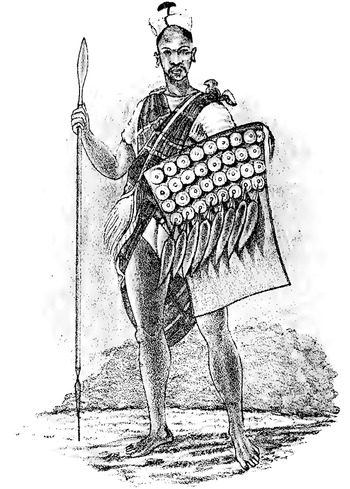
For example, British sources consistently expressed fear of a martial group that ruled the roost in the Free Hills, but with whom they had very little contact. They called them ‘Shendus’ (Shindoos, Shandoos, Shendoos, Shentoos, etc.). The identity of these mysterious people was hard to pin down. They did not use script, so they did not record their own names. The first British encounters with them appear to have occurred in 1850 and 1852, and these yielded the earliest known image (Figure 2):
the Shendoos, though well known by name and repute in Arracan, have never yet been visited by the people of the plains, nor has a single specimen of this race been seen, I believe, either by Mugh or European in Arracan, until 1850 when two emissaries or spies from them met me at a hill village some distance up the Koladyne river.Footnote 11
‘Lebbey—The “Abéu” or Chief of the Bookee Clan of the Heuma or Shendoos’, 1852.Footnote 12

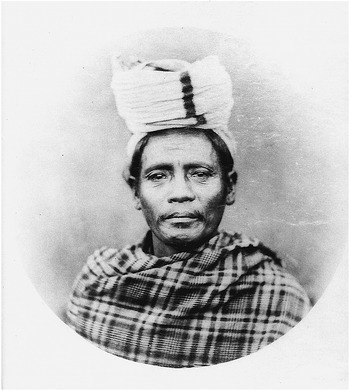
Current scholarship generally equates the Shendus with the forebears of groups who call themselves Mara and Lai. These two groups are not monolithic blocks by any means; they are divided into, and connected by, many smaller groupings.Footnote 13 Both of them belong to a much larger category commonly called Kuki-Lushai-Chin, which contains numerous similarly nested, evolving, and often contested identities, most of them sharing a broadly similar worldview.Footnote 14 One solution to this terminological conundrum has been to foreground an overarching endonym—‘Zo’—for all these groups.Footnote 15 It can be said that the inhabitants of the independent region were largely members of different groups of Zo, among whom the Mara/Lai/Shendu were the most prominent (Figures 3 and 4).Footnote 16
The first known photograph of a ‘Shendu’ person, identified as ‘Likebo, Chief of Boki Shendus’. Source: Photo by T. H. Lewin, 1866.Footnote 17

Lai/Shendu villagers ‘on the Burmese frontier’, 1896.Footnote 18

Zo governance
The Free Hills were, of course, not ‘unadministered’. Here, Zo notions of political control, legitimacy, and territoriality were paramount. It was a sparsely populated region of micro-polities and fluid governance. The basic unit was the village, headed by a chief (male or female), who was the ultimate authority over a village population that was socially stratified. Chiefship tended to be hereditary, and sons could establish their own sub-villages, thereby creating village alliances. Each village was armed (since at least the 1830s with firearms),Footnote 19 and almost all were stockaded.Footnote 20 Chiefs or other powerful individuals could command the young men of their village to act as an attack force, and alliances of chiefs (often related by marriage)Footnote 21 could jointly mount a force of hundreds. As the power of individual chiefs rose and fell, flows of tribute indicated changes in the political landscape. Tribute paid to more powerful polities—in salt, paddy, pigs, and brass cooking-pots—was an expression of subservience in exchange for protection. When power relations changed but flows of tribute failed to adapt, violent retribution came into play in the form of an armed raid on the offending village. Such attacks were about safeguarding future tribute, compensation in the form of resources, and masculine bravery and heroism. Attackers would carry off guns, cash, and gongs as well as retrieve runaway dependents. They could burn the offending village and kill its men, but women and children were led away to become bonded labour in the attacking village.Footnote 22 They were either settled there permanently, traded to other villages, or returned home after payment of ransom. Aggrieved villages could mount counterattacks, sometimes years later, and this created a complex system of vigilance, apprehension, negotiation, and alliance-building, interspersed with bursts of violence that allowed warriors to obtain fame and glory.Footnote 23 Fighting also led to village migrations in search of safety from powerful opponents. Historically, much of this Zo migration was in a northwesterly direction, pushing Zo groups closer to groups living in the foothills and plains near the Bay of Bengal.
This political system was not restricted to the Free Hills. It extended, with minor variations, across the entire Indo-Burma mountain range, well beyond the Zo-dominated zone.Footnote 24 Beyond a strong sense of village sovereignty, there appear not to have been any larger territorial claims. But this did not mean that village raids were conducted over a short distance. Raiding parties could travel stealthily for many days through the steep, thickly forested terrain to attack far-off villages.Footnote 25 This expansionary geography made the Zo well-known to communities in the surrounding foothills and plains. As the British began to annex these regions, we get a sense of the intense fear that the Zo inspired there.Footnote 26
Encountering British governance
The Zo system of micro-warfare led to a sharp confrontation with British ideas of governance. Wherever the British intruded, they introduced novel concepts of spatial control, territorial exclusivity, linear borders, sovereignty, and subjecthood. In British-occupied areas, this confrontation was violently resolved in favour of British ideas, with local adaptations made to reduce the cost of administration and accommodate some Zo sensibilities.Footnote 27 But in the Free Hills, Zo ideas about territoriality survived unhampered and British attempts to explore the area were successfully opposed.Footnote 28 It was only at the edges of the Free Hills that the Zo encountered British notions of governance.
The British found it difficult to acknowledge that the Free Hills formed a separate political universe with its own well-established rules and a completely different sense of spatiality. Only a few officials were aware of these Zo rules. One of them felt that raiders from the Free Hills, who had killed a woman in the ‘administered’ Lushai Hills, should not be punished: ‘Though the wanton murder of an innocent woman is naturally repulsive to a civilised code of ethics, I should not be inclined to look on the raiders as criminals, as by tribal law and custom their action was entirely justified.’Footnote 29
Usually, however, British sources were much less understanding of social realities in the Free Hills, which they only knew based on hearsay. Their texts are strewn with condescending remarks about the inhabitants as ‘savages’, ‘noxious tribes’, ‘wild and fickle people’, ‘inveterate raiders and marauders’, ‘lawless tribes’, ‘recalcitrant Chiefs’, ‘irresponsible tribesmen’, ‘banditti’, and ‘turbulent spirits in unadministered territory’, who were impervious to British attempts to ‘humanize them in some degree’. Life in the Free Hills was assumed to be ‘a state of superstition, fear, oppression and slavery’ and ‘subject to no law’, where travellers ran ‘a great risk of summary decapitation’.Footnote 30
Most British officials supposed that life in the areas which they controlled was infinitely preferable, so the behaviour of Free Hills people was puzzling to them: ‘Even in isolated cases, where Kamees and Shandoos have followed officers to Burma, and enjoyed all the advantages of civilization, they have almost invariably returned to their mountain homes and wild life in the hills, which have far stronger fascinations for them.’Footnote 31 And a chief in British-occupied territory asked to be allowed to move his village away from colonial authorities.Footnote 32 A Zo chief in the Free Hills, coming across a British adventurer, explained why the advantages of civilization were not all that impressive:
In their own country, he said, five days’ journey from here, they paid no tribute to their Chiefs, but lived together in community, the only acknowledgement of fealty being that each male was bound to give the Chief a third of all flesh killed by him either in hunting or for home consumption, and also to follow him upon any warlike expedition; in return for this the Chief was bound to provide his followers with salt.Footnote 33
The clash of governance styles between the Free Hills people and the British was profound. Beyond the borders of each village-level exclusion zone stretched a huge mountain landscape in which the Zo felt entitled to move and impose their political will. It was a mental map that started from the village centre, did not recognize obstructive borders, and measured distances by the number of days it took to travel on foot from the home village.Footnote 34 As one British observer remarked: ‘These people have a tradition that our villages round Ruma [in the Chittagong Hill Tracts] are their legitimate raiding ground.’Footnote 35 Wide-ranging forays by armed groups were commonplace and did not raise issues of governance between them—unless they entered another village uninvited. Jungle footpaths, often following wild elephant tracks, crisscrossed the area, and these were used for trade, hunting, and family visits, as well as for raids. In the Free Hills, borders were not imagined as lines visible in the landscape—they were sensed as flexible zones of rising danger, sometimes marked with warning signs.Footnote 36 A group of travellers, entering the Free Hills from the west, suddenly noticed ‘right in our path … two arrows set trap-fashion with a spring … it might have been accidental, but one cannot be too cautious’.Footnote 37 The dangers involved in crossing into the Free Hills could be military but also health-related—hill people could oppose any people from the plains and foothills from entering their territory for fear of the contagious diseases they might introduce.Footnote 38
The British understood Zo raids as illegal trespassing into British territory, and the killing and abduction of inhabitants as assaults on ‘British subjects’.Footnote 39 In other words, they saw the Zo of the Free Hills as foreigners, so the Foreign Department of British India usually dealt with them.Footnote 40 As one official put it:
I am not aware of any Shindoo clans who either pay tribute, or are in the slightest degree controlled by any British authority. The reason for this extraordinary state of affairs, of the existence of tribes virtually independent at our very doors, is partly the physical difficulty of travelling in the hilly country inhabited by these tribes, and partly the unhealthiness of the country during all but about four months of the year for all races, except the hill people themselves … To the north and north-east is country, similarly wild, inhabited by like tribes nominally subject to the Burmese, but practically as independent and as little known as the tribes of Central Africa before the days of Burton, Speke and Grant.Footnote 41
At the same time, however, the British claimed sovereignty not only over the territory they controlled, but also over the Free Hills and other areas where they had no presence at all. This created a spectacle of politico-legal manoeuvring among British officials: should maps show imperial territorial claims, or only the territory that the British actually controlled? How should the limits to British governance be described? British records reveal the invention of a fine-grained border vocabulary. Subtle distinctions emerged between the ‘nominal’ (or ‘territorial’) border and the ‘administrative’ (or ‘provisional’ or ‘practicable’) border, and between the ‘administered’ territory and a host of other terms: semi-administered, loosely administered, loosely controlled, uncontrolled, unsurveyed, unknown, trans-frontier, independent, and so on.Footnote 42 One official neatly summed up this inside/outside puzzle by suggesting: ‘the area concerned is surrounded by and is within British territory’.Footnote 43 The complete lack of control over the ‘unadministered’ Free Hills was certainly a concern, but at least the area could ‘not be tampered with by any external Power’.Footnote 44
Life at the edges of empire
What did the process of empire look like to those who lived in the Free Hills and faced an expanding British presence, first in the south (Arakan) and west (Chittagong Hill Tracts), and then in the north (Lushai Hills) and east (Chin Hills)?Footnote 45 Although few of their words have been recorded, their actions are all over the historical record. They did not welcome the imperial order that British aggression brought to their doorstep, and they reacted with defiance and alarm to British intrusions. This song of the late 1880s is an example:
Areu siata kiong mai phapa, pachhong tangbi zah lai sacheupa viapi Saipahra daita.
We have always shot the white-tusked elephants and clean-horned bison in the hills to the west and taken their heads to adorn our verandahs. Nowadays the foreign armies have reached Mandalay.Footnote 46
Unlike the lowlands, these hills had never been part of larger states, let alone empires, so the hill people did not see the British as successors to previous imperial rulers. On the contrary, their defiance stood in a tradition of rebelliousness against state encapsulation going back generations. They countered British expansion with open resistance and guerrilla tactics, and this resulted in frontier turbulence. It has been argued that such turbulence often spurred imperial expansion.Footnote 47 Thus, the invasions of the Chittagong and Lushai Hills were ostensibly triggered by continual raids from the east. But ‘turbulence was not merely something experienced by colonial officials: it was also produced and encouraged by them’.Footnote 48 At least one wayward official, T. H. Lewin, played a prominent role in challenging the spatial limitations of British India imposed by his superiors.Footnote 49 His unsanctioned cross-border adventures contributed to the invasion and annexation of the Lushai Hills, but in what remained the Free Hills they led to a long-term stand-off.
Shadowy bordersFootnote 50
Imperial governance showed different patterns around the encircled area of the Free Hills. The oldest pattern developed in Arakan, where British power crept into the hills along the Kaladan river flowing south from the Free Hills. The river valley and immediately adjoining hills were controlled from four riverside police stations, but British control soon faded into ‘unadministered’ tracts beyond these.Footnote 51 By the early twentieth century, there was still ‘a large stretch of unknown, unvisited and unprotected country to the west and north-west of Paletwa abutting on Chittagong and Northern Arakan’.Footnote 52 This river-valley presence, which was anything but a fixed, well-defined line, marked the southern border of the Free Hills.Footnote 53
In the west another pattern of border making developed. Here the British followed their well-established practice of selecting watersheds to create ‘natural borders’ that could appear as lines on a map.Footnote 54 After the Chittagong Hill Tracts were invaded, surveyors carefully determined the eastern border (the western edge of the Free Hills), which, however, remained undemarcated, unguarded, and ineffectual. As a result, the people in the southern Chittagong Hills paid tribute to both the British and the Mara/Lai.Footnote 55
A third pattern of border making shaped the northern and eastern edges of the Free Hills after the conquest of the Lushai and Chin Hills. Here the British refrained from defining the border, leaving the territorial question open.Footnote 56 Invading still unvisited Mara/Lai country to the south was considered highly risky, and too expensive, so for the time being the de facto border was established at a village outpost, Saikao (also known as Serkawr or SherkorFootnote 57).Footnote 58 What followed was confusion and endless (and inconclusive) correspondence between British officials on how to proceed.
However shadowy these borders around the Free Hills may have been, they did separate imperial territories from independent ones. In imperial territories power was considerably centralized, hierarchically structured, and bureaucratically legitimized. The British had disarmed and subdued the population, and they compelled villagers to perform forced labour and pay tribute.Footnote 59 In the independent Free Hills, power was dispersed among many small self-governing polities. Armed men engaged in village-level warfare, servitude existed, and local chiefs collected tribute.Footnote 60
Sub-imperial governance
With the Free Hills encircled, sub-imperial rivalries came into play. British India was divided into various administrative units (each manned by officials with their own interests) under the Government of India. The areas surrounding the Free Hills were conquered from three different provinces: Bengal, Assam, and Burma—and this turned out to be a fateful coincidence. The Chittagong Hills became a district of Bengal; Arakan and the Chin Hills fell to Burma; and the Lushai Hills, invaded from both Assam and Bengal, ended up as a district of Assam. Every British border official had to report to superiors at the district, division, provincial, colonial, and imperial levels.Footnote 61 Thus, information about the southern border of the Free Hills travelled to Paletwa, Akyab, and Rangoon. Information about the northern border would go via Lungleh, Aijal, and Gauhati. And information about the western border passed though Rangamati, Chittagong, and Calcutta.Footnote 62 Provincial officials in Rangoon, Gauhati, and Calcutta could then inform the Government of India (which resided in Calcutta), where it might be collated and, if deemed necessary, sent to London. Thus, seemingly trifling details could be adjudicated in London.
The imperial distinction between ‘territorial’ versus ‘administrative’ borders was replicated at the provincial level. The fiction that the Free Hills were British territory, yet unadministered, forced the provinces to decide which part of the area belonged to Assam and which to Burma (Bengal did not lay claim to territories east of the Chittagong Hill Tracts). But there was a problem: under a non-intervention (or non-interference) policy that the Government of India had laid down in 1879,Footnote 64 officials were not permitted to cross the line between administered and unadministered territories without express permission from their higher-ups, and this was rarely granted.Footnote 65 A visit was allowed in 1896, when officials from Arakan and Assam met in the border village of Saikao, during which ‘various matters connected with the peace of the two districts were discussed’ (Figure 5).Footnote 66 The terms ‘visit’, ‘tour’, and ‘promenade’ were soon used freely in British sources to describe imperial forays into the Free Hills—euphemisms that obscured the well-armed, violent, destructive nature of these incursions. Imperial officials could never travel without military escorts of dozens of soldiers.
British officials in charge of the South Lushai Hills and Northern Arakan meeting in Saikao village, 1896. Around them are Mara (Lakher/Shendu) villagers and Gorkha soldiers.Footnote 63

But where exactly was the line between ‘administered’ territory and the Free Hills? The vagueness of these ‘shadowy borders’ irked the authorities.Footnote 67 A succession of border officials in vain implored their superiors to fix a proper border line. They deplored that ‘British and independent villages lie interspersed throughout a considerable area and especially down a long tongue of land to the south of the village of Sherkor’.Footnote 68 But their superiors could not agree on who was responsible for—and should bear the cost of—border-making, let alone annexing the Free Hills. As one official remarked, it was ‘amusing to see how the Bengal and Burma Governments each tried to foist on to the other the responsibility of controlling’ the inhabitants of the Free Hills.Footnote 69 The result was a standoff—and a large hole in the empire—that lasted four decades.
Although the British encircled the Free Hills, the state’s presence, even on the ‘administered’ side of the border, was light and intermittent. Officials were ensconced in fortified settlements (police outposts and small forts) from which they ventured out on ‘tours’ (foot marches with armed escorts and coerced porters) around their imperial territory (Figure 6).Footnote 70 These tours could not enter the Free Hills—they stayed in British-occupied territory. Their main objective was to collect taxes, settle disputes, and showcase British power to their administered subjects. They embodied the ‘itinerant governance’ that characterized many imperial borderlands.Footnote 71 Moreover, such tours could only take place during what the British called the ‘open season’, the drier, cooler months when the intense monsoon rains had stopped.Footnote 72 As a result, in these parts the empire was merely a ‘fair-weather state’.Footnote 73
Assam Rifles marching in front of their stockade in Tuipang, near Saikao and the northern border of the Free Hills, circa 1920.Footnote 74

Inhabitants of the Free Hills seem to have considered the British presence on their doorstep to be quite weak. In 1903 the chief of a nominally British village told officials that he had allowed an independent chief to take over some of his land for cultivation because ‘he preferred at least to be on good terms with his powerful aggressor and neighbour, of whom even the Government was afraid’.Footnote 75 Not surprisingly, the British worried about their prestige across the unguarded border.Footnote 76 The population ‘on both sides of the border is so completely one, their interests are so intervened, their relations so close, and their intercourse so frequent, that a Subdivisional Officer without personal knowledge of the Chiefs and country across the border, is most seriously handicapped in all his dealings with the [people] whose fortune it is to be within the administered line’.Footnote 77
The people of the Free Hills knew far more about the British than vice versa.Footnote 78 They could move freely in British territory to visit relatives, trade partners, and markets.Footnote 79 The British found it hard to gather information on what they described as ‘trans-frontier tribes’, because ‘administered subjects’ could be tight-lipped about cross-border affairs, and there were long gaps between official tours.Footnote 80 For example, between 1907 and 1918, the Free Hills did not experience a single British incursion.Footnote 81 People from the colonized territory could travel freely in the Free Hills, but this was risky. Sometimes they were robbed, kidnapped, or killed, which enraged the British who were unable to avenge such events but uttered threats nonetheless.Footnote 82 Throughout, the Free Hills remained beyond British governance technologies such as the population census: colonial census maps showed them simply as black ‘omitted’ space.Footnote 83
Sporadic empire
Free-floating mobility in the borderlands turned into an issue of sovereignty only when Free Hills raiding spilled over into British-held territory. After 1890, when the Free Hills had become fully encircled, significant cross-border forays included the Khrum-Shekhruit raid (1900), the Pemthar-Siata raids (1906), the Bahe-Sabong raid (1907), the Zawngling raid (1907), the Laungdu raid (1909), the murder of Ma Rike Pha (1913), the Tuiship raid (1919), the Zylow raid (1927), and the Kanpetlet raid (1946).Footnote 84 Such incursions led to a flurry of official reports, witness accounts, and correspondence on how to react. Border officials would entreat their superiors to lift the non-intervention policy and permit them to enter the Free Hills and punish the culprits.Footnote 85 They would also plead unsuccessfully for the undefined border to be finally settled and for the Free Hills to be incorporated into the empire.Footnote 86
Occasionally a well-armed British counter-raid (‘punitive expedition’) was allowed to cross the border. It would move slowly through the difficult terrain (it took a nine-day march from Saikao in the north across the Free Hills to Kaletwa in the south),Footnote 87 so the offending independent villages were forewarned and often vacated. These British raiding parties were extremely destructive. They would torch the villages and fields, and, if possible, seize guns, cattle, paddy, rice, and other valuables, such as elephant’s tusks.Footnote 88 Sometimes they caught an independent village chief, whom they abducted and took to British territory and later incarcerated.Footnote 89 Essentially, the British found themselves copying—and outdoing—the Free Hills style of transitory micro-warfare.
Sub-imperial disagreements got in the way of fixing the border. Despite several earlier attempts, it was not until the 1920s that this process made any headway, not least because of a large insurgency—the Anglo-Kuki War—that had unsettled imperial rule in the neighbouring Chin Hills between 1917 and 1919.Footnote 90 The British noticed that the rebels used the Free Hills—or ‘the wild unadministered tribal land’—as a refuge and a base of operations, and that ‘the unadministered villages showed considerable hostility’.Footnote 91 The area was ‘an obstacle to free intercommunication between neighbouring administrative units … an Alsatia in which the turbulent and criminal elements of the surrounding administered areas take refuge, and a centre from which murderous raids are frequently made on the villages which are under administrative control’.Footnote 92 This ‘wild unadministered tribal land’ had to go, so Burma and Assam officials met in Maymyo, the summer capital of British Burma:Footnote 93
The decision provisionally arrived at (the matter is one on which the final decision does not rest with the local Government) was, that the more or less imaginary line, which divides administered from unadministered territory, should no longer be recognized, that Government officers should be at liberty to enter what has hitherto been unadministered territory, for the purpose of punishing evil-doers, and that the whole of the territory should be brought under administration by gradual stages … provisional arrangements were also arrived at, as to the portions of the territory which should in future fall within the sphere of influence of the Lushai Hills, the Chin Hills, the Pakôkku Hill Tracts and the Hill District of Arakan, respectively … the inhabitants should be induced to abandon their love of raiding their neighbours, which is at present so fruitful a source of unrest in these regions.Footnote 94
However, the higher echelons of imperial decision-making were still anxious about resistance by ‘stronger tribes’ and the related costs and risks of a military assault on the Free Hills.Footnote 95 Moreover, the Burma and Assam authorities had different governance approaches. Burma propagated a very loose form of control in the Free Hills—a ‘tour of inspection’ every two years and a gradual extension of more direct administration.Footnote 96 Assam wished to bring the area under settled administration, but without levying taxes or disarming the tribesmen ‘until the confidence of the people is secured’. This approach was not sanctioned.Footnote 97
In 1921 London finally gave the go-ahead to expanding loose control. During the following decade new borders began to appear on maps, allocating sections of the Free Hills to different districts, and a new bureaucratic term (‘pre-unadministered areas’) came into existence.Footnote 98 But actual control was elusive: ‘murders and raids prevail in the areas under loose political control, and the periodical tours of civil officers have been treated by the people as no more than incidents to be forgotten as soon as the civil officers have passed’.Footnote 99 Even so, according to one British official, the mood in the Free Hills was sombre during the 1930s:
All these tribes have been taken over against their will … They were not brought under British rule in their own interest; in fact, whether they liked being taken over and whether it was in their interest to be taken over or not were never considered at all … I have not the smallest doubt but that they would much rather have been left independent … Much of the joie de vivre has gone. To replace the old enthusiasm for war, the capture of slaves, the feasts over heads, the free hunting of all kinds of game whenever they pleased, the Lakher [= Mara] has been given security; this he appreciates, but it is doubtful whether security, at any rate at first, fills the place of what he has lost.Footnote 100
Local songs of the period expressed this disenchantment and the hardship that British rule brought:
Kala thang thong napadaita, hratlai chu na Salu ti cha danglei ra pa nawhleu saipina.
Government has now hemmed us in,
on the north, on the south, on the east, on the west.
Henceforth none of our young warriors will drink of the waters of the Salu river, where we always used to raid.
A ngong taka e chei tah ta, a pa nawng chhua chei la e na ti, tle kua pe la che khai aw vei e.
We have to pay two rupees house tax,
and, not content with that,
they now tell us to send fowls in for sale,
would that we were not part of the Lushai Hills.
A raw vepi pe na chhua tlei, da ei khua li theu, ra pa cha la, hre zong e teu pe me aw vei e.
Government has taken over all our country,
we shall always have to work for Government,
it were better had we never been born.Footnote 101
For years, biennial (later annual) British armed incursions continued, imposing spasmodic imperial rule. Arakan and the Lushai Hills did not officially bring their portions of the Free Hills ‘under administration’ until 1930 and 1931, respectively (Figures 7 and 8).Footnote 102 The Lushai Hills portion was ‘only being visited by Government Officers under an Assam Rifles escort, even up to 1940’.Footnote 103 In other words, the Free Hills remained mostly ‘unadministered’ up to the Second World War. The Japanese invasion of Burma obliterated British rule to the south and east of the Free Hills but appears to have largely bypassed the hills themselves.Footnote 104
Mara warriors in Chapi, a village in the Free Hills, probably shortly after it had been ‘loosely incorporated’ into the empire, circa 1930.Footnote 105

Girls in Savang, a powerful village in the Free Hills, circa 1930.Footnote 106

Counter-mapping an imperial legacy
From the 1890s to the 1940s, the Free Hills formed a hole in the British empire but ironically, during decolonization, imperial governance decisions about the surrounding lands became a fateful legacy for these hills. As British India collapsed and was partitioned during 1947/48, the provinces bordering the Free Hills fell to three different post-colonial states with distinct governance styles. Independent India took Assam, independent Burma appropriated the Chin Hills and Arakan, and the Chittagong Hill Tracts became part of Pakistan (Figure 9).Footnote 107 These nation-state borders are still in place, but by the 1970s Burma had transferred the Free Hills previously apportioned to Arakan and Pakôkku to Chin state, and Bangladesh had replaced Pakistan. Most inhabitants of the former Free Hills became Burmese citizens; a minority became Indian citizens.
Map of the Free Hills in 1947. Source: Drawn by Laurie Whiddon.

Before 1947, many inhabitants of the Free Hills had challenged imperial notions of sovereignty and territoriality. They had expressed their own sense of space by sustained ‘counter-mapping’,Footnote 108 which took the form of cross-border raiding, migration, hunting and cultivating land beyond the border,Footnote 109 and removal of imperial border markers.Footnote 110 Occasionally, they even wrote down their ideas on territoriality: in 1945, 23 Mara/Lakher chiefs signed a petition to demand a separate Lakher district covering parts of the Free Hills as well as British-held territory,Footnote 111 and there were also pleas to transfer the entire area to Burma.Footnote 112 The imperial authorities dismissed these demands out of hand.
Such protests carried over into the next era. Newly independent India and Burma upheld imperial notions of territoriality and community, retained the imperial borders, and tended to be equally unconcerned about local interests.Footnote 113 Indian authorities spoke disparagingly of ‘an inappreciable number of Lakhers’,Footnote 114 and set aside complaints about unfair loss of cross-border land to Burma.Footnote 115 Non-recognition of local place names (in Mara and Lai) was another spatial issue,Footnote 116 and so was not teaching Mara/Lai children in their mother tongue.Footnote 117 Local political organizations emerged to claim territorial rights, initially largely accepting the spatial confines of India and Burma.Footnote 118
Over time, however, a ‘cartography of self-assertion’ developed.Footnote 119 Various cross-border territorial imaginations and identities flourished, and these were increasingly supported by digital connectivity. In 1988 the first ‘World Zomi Convention’ demanded unification of all Zo people in Burma, India, and Bangladesh, and launched the Zo Re-unification Organization.Footnote 120 Soon after, the former Free Hills became part of several new and overlapping maps of self-assertion: Maraland, Zale’n-gam, Chinland, Chinram, Zoroland, Greater Mizoram, Kukiland, and Zogam. Post-colonial counter-mapping also took the form of frequent mobility on jungle paths across the still loosely demarcated and largely unguarded Myanmar/Burma–India–Bangladesh border.Footnote 121
Conclusion
The Free Hills are significant because they highlight the limits of empire. They challenge the imperial fiction that this area was British territory, yet ‘unadministered’. What makes them historically important is exactly the fact that they were beyond imperial control—an area inhabited by Zo people who, unlike most, were not subject to British rule. It was their persistent ‘illegibility’ to the imperial state that underpinned their remarkable political autonomy.Footnote 122 In these hills, a long-standing way of life and governance endured until the eve of the Second World War. British control lasted at most a few short years, and it was extraordinarily loose and intermittent. Although the British nominally claimed the Free Hills as part of their empire, they freely admitted that the region effectively remained independent, self-governing, and opaque. Therefore, the rich scholarly literature on governance in imperial India and Burma does not really apply to these Free Hills, even though we remain highly dependent on imperial sources to piece together what life there was like.Footnote 123
The Free Hills demonstrate the survival of a distinctive non-imperial cultural universe in the India-Burma borderlands up to the mid-twentieth century. Though these hills may seem anomalous, they provide a unique vantage point from which to observe the limits of imperial aggression. They throw light on the fictionality of some imperial territorial claims, and they challenge historiographical approaches that accept such assertions. Moreover, they compel us to acknowledge the dynamism of local borderland actors and small polities in the making of their own histories.Footnote 124 The Free Hills also highlight the unevenness of imperial governance by demonstrating sub-imperial divergences at their borders—between different colonial provincial governments as well as between border officials and their superiors regarding non-intervention.
The longevity of the Free Hills resulted from the interplay of several factors. Initially, the British feared the martial image of the ‘Shendus’, who were equipped with firearms and had superior knowledge of the rugged terrain. Second, the British lacked basic information about the region and its inhabitants. They could not gather intelligence except by means of occasional predatory forays; and raids from the Free Hills into imperial territory always took the British by surprise. Third, financial calculations played a role: the cost of conquering this sparsely populated, inaccessible, unknown, and probably recalcitrant region might outweigh future income from head tax and forest products—and the provinces squabbled over who should foot the bill. Fourth, top-level imperial authorities had imposed a policy of non-intervention in affairs beyond ‘administered’ areas. This curbed the territorial ambitions of military officers and civil servants serving on the turbulent borders that surrounded the Free Hills. And finally, the inhabitants of the Free Hills did not covet the fate of their tax-paying, disarmed, and regimented kin across the border. Nobody’s subjects, for as long as it lasted, they lived by their own rules, controlled their own hunting grounds and agricultural land, and could access social networks in British-ruled areas.
Holes in state territories provide an intriguing perspective on the limits of state control. But not all holes are the same. The Free Hills differed from spaces that social scientists have variously conceptualized as liberated zones, failed states, grey zones, and so on.Footnote 125 The Free Hills were self-administering, but not because insurgent or criminal forces took over parts of a state territory, nor because of bureaucratic oversight.Footnote 126 The Free Hills survived because 1) a powerful state was long held back by fierce Indigenous resistance, 2) the region formed a troublesome terrain that could fairly easily be circumvented, and 3) Britain expected meagre economic yields from this ‘unadministered’ territory.Footnote 127 Such cases of state reticence may be rare, but they do exist, even today.Footnote 128 Encapsulated and encircled, these holes of ‘illegibility’ demonstrate that, sometimes, Indigenous governance can persist for many years.
Acknowledgements
I would like to thank the members of the research group ‘Trans-Himalayan Flows, Governance and Spaces of Encounter’, whose articles also appear in this Forum, as well as the participants in the conference on shared community in China, South Asia, and Southeast Asia at Dali University, and two anonymous reviewers of Modern Asian Studies for their helpful comments. I am grateful to Laurie Whiddon for help with drawing the maps in this article.
Competing interests
The author declares none.



 Open access

