

Introduction
Within the United States, natural events beyond human control and public health emergencies are increasing in scale, complexity, and severity. 1 National-level disaster events, such as Hurricane Katrina, Superstorm Sandy, and the COVID-19 pandemic, have demonstrated that robust federal interagency collaboration is necessary to respond to complex, large-scale emergencies, protect lives, and build national resilience to future catastrophic events.
When a natural hazard or public health emergency occurs within the United States, governmental disaster response initially occurs at the state, tribal, local, and territorial levels. If the severity of an event exhausts a jurisdiction’s response capabilities, the governor of a state or territory, or tribal leader, can request federal assistance from the President of the United States. The President can then declare a disaster and authorize federal support through the Robert T. Stafford Disaster Relief and Emergency Act. 2 This law provides authority to the Federal Emergency Management Agency (FEMA) to coordinate various Emergency Support Functions (ESFs) and direct response activities by the federal entities involved. 3 Available under the National Response Framework (NRF), the 15 ESFs represent a framework for grouping functional areas of essential services, resources, and capabilities that the federal government provides to support states, tribes, territories, local governments, and the public sector during a disaster or emergency response. 4
However, in situations where the scale of a disaster exhausts civilian federal agencies’ assets, FEMA can request support from the Department of War (DoW). The DoW possesses an array of unique resources—such as tactical air and sealift capabilities and extensive logistics, communications, and distribution networks—that can be rapidly mobilized and deployed at scale to support disaster response. 5 Additionally, the DoW typically deploys units as self-sustaining force packages, ensuring that already-strained community resources are not depleted. The increasing complexity of disasters in the domestic U.S. suggests that the DoW may continue, if not increase, its role in federal disaster response. Yet the capabilities provided by military involvement in disaster response and humanitarian aid remain poorly understood relative to civilian capabilities, limiting opportunities for proactive planning and strategic resource allocation. This lack of understanding arises partially due to the dearth of empirical analyses evaluating military involvement in civilian-led disaster response efforts.Reference Grace 6 Strengthening military contributions to disaster response efforts that complement the civilian sector requires empirical data with respect to geographic location, disaster type, timing of disaster and response activities, personnel deployments, and supported ESF.
To investigate the contexts in which the DoW contributes to disaster response activities in support of civilian responses receiving federal support following Stafford Act declarations, we characterized DoW support to domestic disaster response efforts among FEMA-issued mission assignments between the years of 2012 and 2024. 7 Mission assignments represent work orders issued by FEMA to other federal agencies to leverage resources and capabilities to support disaster response efforts. Multiple, distinct mission assignments can be issued for one disaster and are assigned to each U.S. state, tribe, or territory. As such, mission assignments provide a verifiable record of requested support from the DoW for disaster response efforts. This analysis provides a foundational, data-driven understanding of how the DoW contributes to federal interagency disaster response, providing information to support operational planning and future research concerning military-civilian collaboration in disasters.
Methods
Details on the location, timing, disaster type, personnel, and ESFs provided by DoW domestic disaster response events were identified among data on FEMA mission assignments collected by FEMA’s Operations Capabilities Branch in the Department of Homeland Security (DHS). Mission assignments used for this report were extracted on May 14, 2025, from the open source National Emergency Management Information System (NEMIS). 8 Available data spanning from January 2012 to May 2025 were obtained and represented both originally issued mission assignments and any associated amendments prior to their initial issuance, which reflect adjustments in the work performed, funding, cost estimates, period of performance, or other terms of the assignment that unfolded during a disaster response. Of these, data were restricted to initial mission assignments and only those assigned from the years 2012 to 2024, to account for incompleteness of data logged in 2025 due to the ongoing nature of updates to mission assignments.
We categorized the state, tribe, or territory for which a mission assignment was issued; the calendar year in which a mission assignment’s period of performance was requested to begin; the disaster or incident type generating a mission assignment; the specific DoW entity or Service branch assigned to execute the stated work; and the specific ESF associated with each mission assignment’s stated work. We then organized and visualized the data based on observed trends. Data processing and analyses were conducted using Stata SE 18.0. 9 Changes in the observed frequency of events over time were evaluated by simple linear regression.
Results
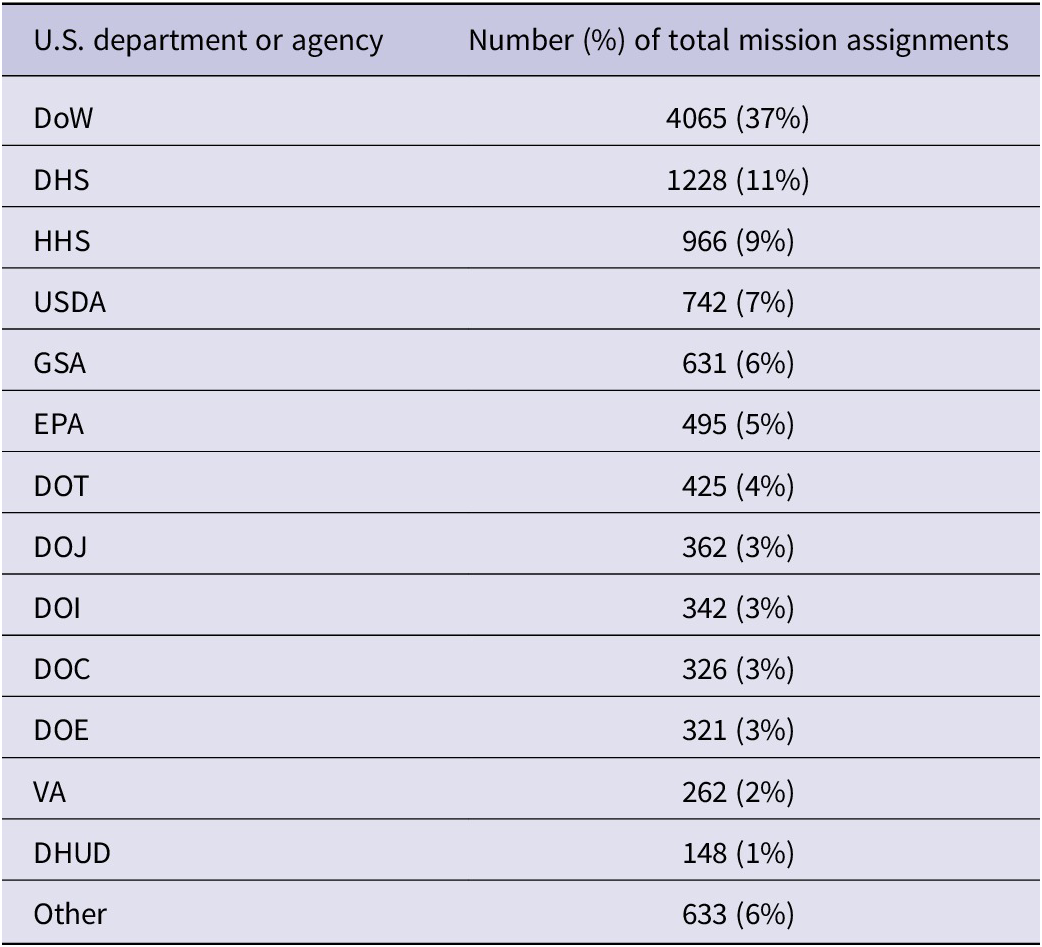
Of the 39,381 mission assignments and amendments captured in the initial dataset, 11,086 entries were original mission assignments without amendments between the years 2012 and 2025. Data from 2025 were excluded due to it being an incomplete year, resulting in 10,946 original mission assignments between the years 2012 and 2024. Missions were assigned by FEMA to multiple U.S. Departments and Agencies (Table 1). The DoW was assigned to support disaster or public health emergency incidents in 4,065 (37%) missions.
Distribution of FEMA mission assignments assigned to U.S. Departments or Agencies from 2012 to 2024

Table 1. Long description
From the top row downward, the table lists U S departments or agencies and their number and percentage of total FEMA mission assignments. DoW has 4065 assignments, 37 percent. D H S has 1228, 11 percent. H H S has 966, 9 percent. U S D A has 742, 7 percent. G S A has 631, 6 percent. E P A has 495, 5 percent. D O T has 425, 4 percent. D O J has 362, 3 percent. D O I has 342, 3 percent. D O C has 326, 3 percent. D O E has 321, 3 percent. V A has 262, 2 percent. D H U D has 148, 1 percent. Other agencies collectively have 633 assignments, 6 percent, with each individual agency comprising less than 1 percent of total assignments.
Note: Please reference abbreviation list for complete list of U.S. agencies and departments. “Other” signifies remaining organizations that each comprise <1% of total FEMA mission assignments.
Geographic Analysis
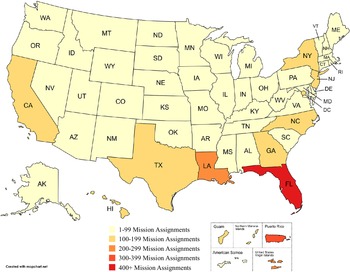
The 4,065 mission assignments from this sample encompassed all 50 U.S. states and 6 districts/territories—the District of Columbia, Puerto Rico, the U.S. Virgin Islands, Guam, American Samoa, and the Northern Mariana Islands (Figure 1). 10 From 2012 to 2024, the state of Florida generated the most mission assignments assigned to the DoW of any U.S. state or territory, encompassing 514 distinct observations (13% of total). Additional states and territories that made up notable proportions of DoW mission assignments include Puerto Rico (n = 320 [8%]), Louisiana (n = 260 [6%]), the Virgin Islands (n = 203 [5%]), and Texas (n = 198 [5%]). The South Atlantic states generated the most DoW mission assignments compared to other U.S. regions (n = 1,057 [26%]).
Frequency of DoW-assigned mission assignments to U.S. states and territories from 2012–2024. Florida represents the highest volume region with over 400 assignments (red), while Puerto Rico is the next most frequent with 300–399 assignments (dark orange), and Louisiana and Virgin Islands are the following most frequent with 200–299 assignments (orange).

Temporal Analysis
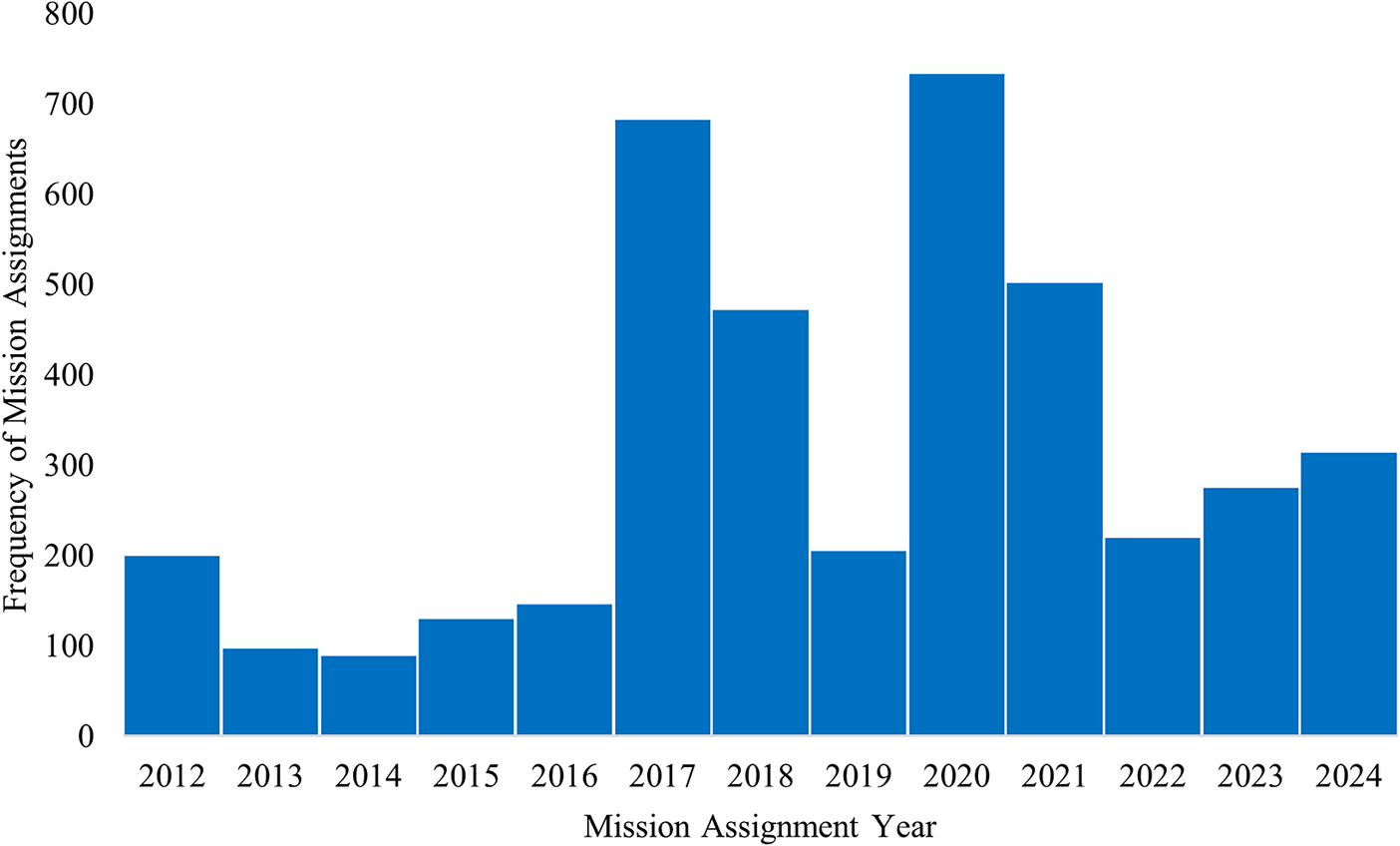
From 2012 to 2024, the DoW averaged 312 distinct FEMA mission assignments per year. The DoW received the most requests for domestic disaster response support during the periods of 2017-2018 and 2020-2021, accounting for 29% (n = 1,154) and 31% (n = 1,235) of mission assignments, respectively (Figure 2). These peaks were associated with a strong hurricane season in 2017 and the COVID-19 pandemic response, respectively, although no statistically significant change was observed in the number of mission assignments to the DoW per year over time (P = 0.20).
Frequency of DoW-assigned mission assignments from 2012–2024. The bar chart demonstrates there was relative stability in the early and late periods of observation, punctuated by significant peaks in 2017 and 2020. The highest volume of assignments occurred in 2020, reaching over 700 events.

Figure 2. Long description
The x-axis is labeled Mission Assignment Year, ranging from 2012 to 2024. The y-axis is labeled Frequency of Mission Assignments, ranging from 0 to 800 in increments of 100. From left to right, the bars show: 2012 at approximately 200, 2013 and 2014 both near 100, 2015 and 2016 around 150, a sharp increase in 2017 to about 700, 2018 at 500, a drop in 2019 to 200, a peak in 2020 at about 750, 2021 at 500, 2022 at 200, 2023 at 300, and 2024 at 350. The highest frequencies occur in 2017 and 2020, with lower frequencies before 2017 and after 2021.
Incident Type Analysis
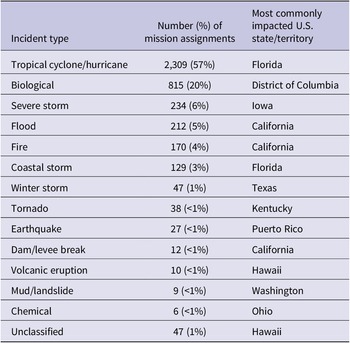
The majority of mission assignments requesting DoW support between 2012 and 2024 were in response to tropical cyclones and hurricanes (n = 2,309 [57%]) (Table 2). Additionally, biological incidents, defined by FEMA as events involving both naturally occurring or deliberately caused outbreaks of an infectious pathogen affecting people, accounted for 20% of DoW disaster response requests (n = 815). Overall, these two incident types accounted for over three-quarters of FEMA mission assignments involving DoW support within the observed time period. Mission assignments for tropical cyclones and hurricanes most commonly originated from Florida (n = 423 [18%]) and Puerto Rico (n = 282 [12%]), whereas biological disaster support requests to DoW most commonly originated from the District of Columbia (n = 63 [8%], California (n = 48 [6%]), and New York (n = 39 [5%]).
Most common U.S. incident types resulting in DoW-assigned mission assignments from 2012 to 2024

Table 2. Long description
Beginning at the top row, the incident type column lists: Tropical cyclone or hurricane, Biological, Severe storm, Flood, Fire, Coastal storm, Winter storm, Tornado, Earthquake, Dam or levee break, Volcanic eruption, Mud or landslide, Chemical, Unclassified. The number and percent of mission assignments for each are: 2,309 (57 percent) for Tropical cyclone or hurricane, 815 (20 percent) for Biological, 234 (6 percent) for Severe storm, 212 (5 percent) for Flood, 170 (4 percent) for Fire, 129 (3 percent) for Coastal storm, 47 (1 percent) for Winter storm, 38 (less than 1 percent) for Tornado, 27 (less than 1 percent) for Earthquake, 12 (less than 1 percent) for Dam or levee break, 10 (less than 1 percent) for Volcanic eruption, 9 (less than 1 percent) for Mud or landslide, 6 (less than 1 percent) for Chemical, and 47 (1 percent) for Unclassified. The most commonly impacted U S state or territory for each incident type is: Florida for Tropical cyclone or hurricane and Coastal storm, District of Columbia for Biological, Iowa for Severe storm, California for Flood, Fire, and Dam or levee break, Texas for Winter storm, Kentucky for Tornado, Puerto Rico for Earthquake, Hawaii for Volcanic eruption and Unclassified, Washington for Mud or landslide, Ohio for Chemical.
Emergency Support Function and Personnel Analysis
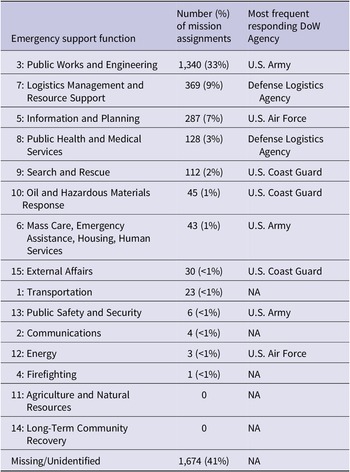
Of the 4,065 DoW-supported mission assignments, 59% of the available data identified the associated ESF (Table 3). The DoW most commonly supported ESF #3: Public Works and Engineering (n = 1,340 [33%]), followed by ESF #7: Logistics (n = 369 [9%]) and ESF #5: Information and Planning (n = 287 [7%]).
Emergency Support Functions and responding DoW agency for DoW-assigned mission assignments from 2012 to 2024

Table 3. Long description
The table has three columns: emergency support function, number and percentage of mission assignments, and most frequent responding DoW agency. From top to bottom, the functions and their values are: 3 Public Works and Engineering, 1,340 assignments (33 percent), U.S. Army; 7 Logistics Management and Resource Support, 369 assignments (9 percent), Defense Logistics Agency; 5 Information and Planning, 287 assignments (7 percent), U.S. Air Force; 8 Public Health and Medical Services, 128 assignments (3 percent), Defense Logistics Agency; 9 Search and Rescue, 112 assignments (2 percent), U.S. Coast Guard; 10 Oil and Hazardous Materials Response, 45 assignments (1 percent), U.S. Coast Guard; 6 Mass Care, Emergency Assistance, Housing, Human Services, 43 assignments (1 percent), U.S. Army; 15 External Affairs, 30 assignments (less than 1 percent), U.S. Coast Guard; 1 Transportation, 23 assignments (less than 1 percent), NA; 13 Public Safety and Security, 6 assignments (less than 1 percent), U.S. Army; 2 Communications, 4 assignments (less than 1 percent), NA; 12 Energy, 3 assignments (less than 1 percent), U.S. Air Force; 4 Firefighting, 1 assignment (less than 1 percent), NA; 11 Agriculture and Natural Resources, 0 assignments, NA; 14 Long-Term Community Recovery, 0 assignments, NA; Missing or Unidentified, 1,674 assignments (41 percent), NA. The highest number of assignments is for Missing or Unidentified, followed by Public Works and Engineering. NA indicates no agency assigned.
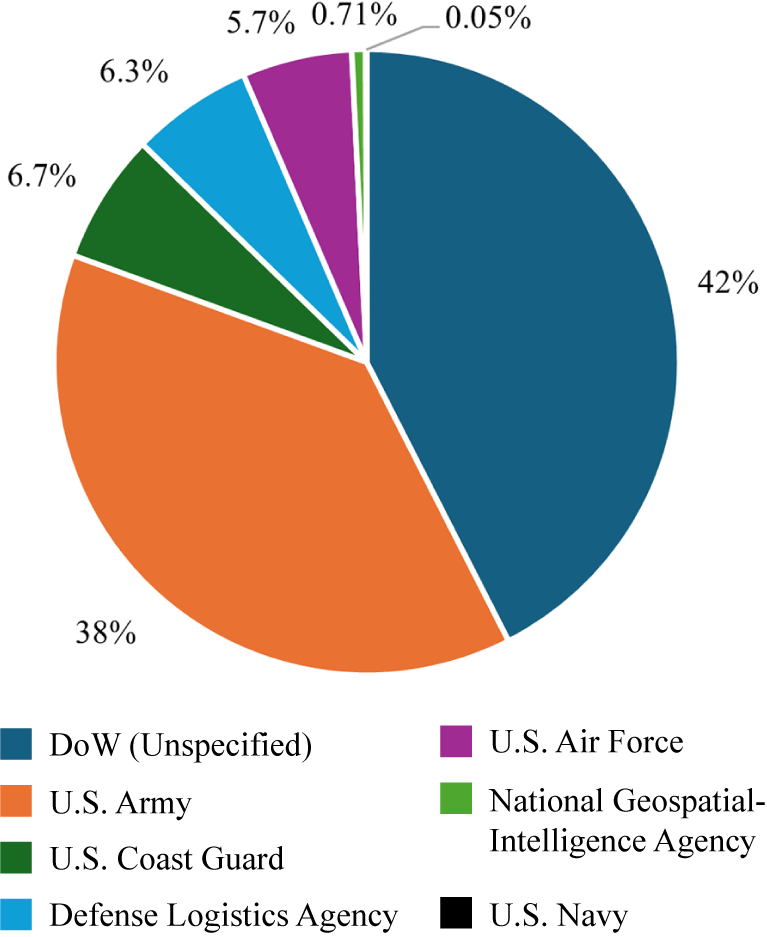
Additionally, 2,337 (57%) of observed mission assignments in the dataset identified the specific DoW entity or Service branch that was deployed to execute the assigned work (Figure 3). The most commonly referenced organization was the U.S. Army, specifically the Army Corps of Engineers (USACE), which was involved in a total of 1,547 mission assignments (38% of total). The USACE supported the majority of Public Works and Engineering mission assignments (n = 1,327 [99% of ESF #3 mission assignments]), while the Defense Logistics Agency (DLA) was responsible for more than half of Logistics support (n = 194 [53% of ESF #7 mission assignments]). Information and Planning support was commonly provided by the U.S. Air Force (n = 109 [38% of ESF #5 mission assignments]), with additional support from the U.S. Coast Guard (n = 40 [14%]) and U.S. Army (n = 11 [4%]).
DoW-associated organizations assigned to DoW-assigned mission assignments from 2012–2024. The distribution of participating organizations is dominated by DoW (Unspecified) (42%) and the U.S. Army (38%). The remaining share, by order of prevalence, is comprised of the U.S. Coast Guard, Defense Logistics Agency, U.S. Air Force, National Geospatial-Intelligence Agency, and U.S. Navy, each representing less than 7% of the total.
![Pie chart with segments labeled 42 percent (DoW [Unspecified], 38 percent (U.S. Army), 6.7 percent (U.S. Coast Guard), 6.3 percent (Defense Logistics Agency), 5.7 percent (U.S. Air Force), 0.71 percent (National Geospatial-Intelligence Agency), and 0.05 percent (U.S. Navy).](https://static.cambridge.org/binary/version/id/urn:cambridge.org:id:binary:20260603112939127-0562:S1935789326103887:S1935789326103887_fig3.png?pub-status=live)
Limitations
While this study provides an analysis of DoW support through FEMA mission assignments, several limitations warrant consideration. First, the focus on mission assignments sourced from NEMIS program records may not capture the full range of DoW disaster response assistance, such as immediate response actions or support provided outside the Stafford Act framework. Second, while the dataset is extensive, approximately 40% of mission assignments were incomplete regarding specific ESFs and deployed personnel, and the 2012-2024 timeframe may not capture longer-term historical shifts in DoW involvement with disaster response. Third, the methodological decision to exclude amendments made after initial issuance may not capture the full scope, duration, or nature of the work performed, which may evolve significantly during a response. Despite these constraints, this research offers an initial data-driven baseline of formally requested DoW support, identifying crucial trends that are foundational for potential planning adjustments. These adjustments may include strengthening of DoW capability in areas of likely future use or the development of civilian capabilities in areas where DoW dependence creates risk, especially in wartime. Future research should aim to complement these findings by examining mission assignment amendments to understand evolving needs and by investigating methodologies to capture the full spectrum of DoW domestic disaster support beyond formal mission assignments, potentially including an analysis of DoW’s internal data sources. A more holistic assessment of DoW support to disaster response simultaneous with other wartime requirements is also warranted.
Discussion
This study assessed empirical evidence for military involvement in domestic disaster response operations. By analyzing more than a decade of data on FEMA mission assignments, this analysis provides evidence of substantial DoW contributions to civilian authorities during domestic disasters, highlighting its critical support in public works, logistics, and planning during large-scale, complex disaster events.
This assessment of FEMA’s open source dataset shows that 37% of 10,946 original FEMA mission assignments issued between 2012 and 2024 were assigned to the DoW. Periods of peak activity during the 2017 hurricane season and the COVID-19 Pandemic illustrate DoW’s role in supporting U.S. government response to high-impact, catastrophic domestic disaster events. Responses to the COVID-19 Pandemic were largely concentrated in densely populated areas such as the District of Columbia, New Jersey, and California. Similarly, low-lying coastal states in the South Atlantic and small island territories were more likely to receive support than areas at higher altitudes, specifically due to cyclones and hurricanes. Both event types represented large-scale, wide-ranging, and prolonged disaster events where local, state, and federal civilian agencies’ capacities were overwhelmed.
While only ~60% of the available data identified the ESF and permitted classification of the type of support provided by the DoW, available results revealed that the DoW most commonly supported ESF #3: Public Works and Engineering, overwhelmingly through the USACE. Additional areas of frequency support were ESF #7: Logistics, most commonly provided by the DLA, and ESF #5: Information and Planning.
The USACE’s critical role in ESF #3 and the relatively high frequency of response efforts illustrate DoW’s extensive infrastructure capabilities supporting civilian disaster response. This type of disaster response can include large-scale engineering projects after major destructive events, such as debris removal, infrastructure repair, and water resource management, that are often beyond the scope or immediate capacity of civilian agencies. The USACE, however, has a long-standing civil works mission to develop and maintain civilian infrastructure. 11 This inherent expertise, combined with a region-specific organizational structure, allows units to maintain a local geographic presence and almost institutionalizes their involvement in any federal-level disaster response requiring surge capacity and capabilities.
Beyond infrastructure support, ESF #7 (Logistics) and ESF #5 (Information and Planning) were the second and third most frequent response activities by the DoW, respectively, illustrating the importance of the DoW’s capacity to coordinate and execute the movement of life-sustaining resources in disaster zones when normal supply chains are disrupted. Interestingly, while the DLA’s primary mission focuses on global supply chain logistics during conflict, the agency’s capabilities clearly have the capacity to be adapted for large-scale commodity distribution in domestic disaster events. 12 Additionally, this work is often coordinated with the U.S. Air Force and U.S. Coast Guard, leveraging air and sea supply transport, reconnaissance, and structured planning capabilities.
Overall, the proportion of FEMA mission assignments to the DoW in the observed data portrays DoW capabilities as critical contributions to federal-level disaster response. This appears true for certain types of high-magnitude, complex disaster incidents that result in substantial disruption to physical infrastructure and local supply chains. Should a complex disaster occur simultaneous with wartime obligations, it is unclear how these capabilities would be provided during domestic disaster response. Further assessment of civilian dependencies on the military, as well as potential alternative solutions when DoW is unable to respond, is needed. High-impact disaster incidents in cyclone/hurricane-prone areas are associated with higher numbers of requests for DoW assistance, and the emergence of biological disasters will likely continue to require DoW’s extensive logistics and planning capabilities. Our analysis clearly indicates DoW maintains capabilities that are essential for responding to a variety of disaster-level events, especially those of a complex or large-scale nature.
Conclusion
This study underscores the necessity for proactive and refined partnerships between the DoW and civilian federal agencies tasked with domestic disaster response operations. Given the operational significance of DoW capabilities in disaster response to the National Response Framework, potential efficiency gains could likely occur through more deeply embedded coordination mechanisms and unified military-civilian training exercises. The increasing scale and complexity of domestic disasters and public health emergencies in the U.S. necessitate a precise, data-informed picture of the DoW’s contributions for both civilian and military organizations to ensure operational planning and resource deployments are strategically aligned to best protect lives and property.
Abbreviation list
COVID-19: Coronavirus Disease 2019; DHS: United States Department of Homeland Security; DHUD: United States Department of Housing and Urban Development; DLA: United States Defense Logistics Agency; DOC: United States Department of Commerce; DOE: United States Department of Energy; DOI: United States Department of the Interior; DOJ: United States Department of Justice; DOT: United States Department of Transportation; DoW: United States Department of War; EPA: United States Environmental Protection Agency; ESF: Emergency Support Function; FEMA: Federal Emergency Management Agency; GSA: United States General Services Administration; HHS: United States Health and Human Services; NDMS: National Disaster Medical System; NEMIS: National Emergency Management Information System; NRF: National Response Framework; U.S.: United States; USACE: United States Army Corps of Engineers; USDA: United States Department of Agriculture; VA: United States Department of Veterans Affairs.
Acknowledgments
The authors acknowledge the support of NDMS Pilot leadership. The authors used Google Gemini 3.1 Pro to assist with the reformatting of citations to journal style.
Data availability statement
Data that support the findings of this study are available upon reasonable request to the authors and pending approval for distribution by program leadership.
Author contribution
Conceptualization—JF and JC; Methodology—EP, EM, KL, JF; Software—EP, EM; Data curation—SA, EP, EM; Formal analysis—EP, EM; Resources—EP; Writing—original draft, EP, EM, SA, CC, KL; Writing—review and editing, EP, EM, SA, CC, KL, JC, JF; Visualization—EM, EP; Project administration—EM, EP; Supervision—KL, JF, CC. All authors were involved in manuscript writing and approved the final manuscript.
Funding statement
I. Award No. HU00012120098: The Office of the Assistant Secretary of War for Health Affairs, 77000 Arlington Blvd., Suite 5101, Falls Church, VA 22042-5101, is the awarding office and the Uniformed Services University of the Health Sciences (USUHS), 4301 Jones Bridge Road, Bethesda, MD 20814, is the administering office.
Competing interests
None.
Disclaimer
This project is sponsored by the Uniformed Services University of the Health Sciences (USUHS); however, the information, content, and conclusions reported in this work do not necessarily represent the official position or policy of, nor should any official endorsement be inferred on the part of USUHS, the U.S. Department of War, the U.S. Government, or the Henry M. Jackson Foundation for the Advancement of Military Medicine, Inc.
Institutional clearance
Approved by USUHS Office of the Vice President for External Affairs and HJF Regulatory Affairs.

 Open access

