





Introduction
There is an increasing demand for aid workers and volunteers in countries and places experiencing heightened conflict and disasters (Centre for Research on the Epidemiology of Disasters, 2022). Estimates from the Global Humanitarian Overview for 2023 state that the number of people requiring humanitarian assistance has increased from 274 million in 2022 to 339 million in 2023, reaching record numbers (United Nations, 2022). The COVID-19 pandemic increased this demand and need for volunteers, resulting in the dramatic growth of the number of volunteers and community helping across the globe (Gray et al., Reference Gray, Randell, Manning and Cleveland2024). However, safety concerns have long been established as a major deterrent for potential volunteers in higher risk countries (International Federation of Red Cross and Red Crescent Societies, 2013). Higher risk countries for travel are often flagged as possessing higher-than-usual risk in relation to personal safety due to current law systems, crime levels, and political unrest/terrorism threats. While often in greater need of assistance from volunteers, these areas often attract less support due to the inherent risks. Thus, the need to recruit volunteers to higher risk places is clear, although a greater understanding of how to counteract the obvious barriers is needed. One potential source of volunteers in the context of higher risk, international assistance is young adults, given evidence suggesting young adults are more likely to volunteer internationally (Lough, Reference Lough2015) and are recognized as a cohort of increased risk takers compared to individuals of other ages (Duell et al., Reference Duell, Steinberg, Icenogle, Chein, Chaudhary, Di Giunta, Dodge, Fanti, Lansford, Oburu, Pastorelli, Skinner, Sorbring, Tapanya, Uribe Tirado, Alampay, Al-Hassan, Takash, Bacchini and Chang2018). This study, then, investigated what contributes to the willingness of young adults to volunteer in international locations deemed higher risk.
Volunteering internationally or “abroad” has been the focus of numerous studies, with labels of this specific volunteering type including international service/voluntary service (Rolf & Chakrabarty, Reference Rolf and Chakrabarty2022) and volunteering for development (Georgeou & Haas, Reference Georgeou and Haas2019) but with distinctions made in comparison to volunteer tourism/voluntourism where the altruistic emphasis is balanced more evenly with touristic goals (Georgeou & Haas, Reference Georgeou and Haas2019). Much of the extant literature examining volunteering abroad centers on volunteer motives (Meneghini, Reference Meneghini2016; Okabe et al., Reference Okabe, Shiratori and Suda2019; Rehberg, Reference Rehberg2005), experiences (Campbell & Warner, Reference Campbell and Warner2016), and impacts (Campbell & Warner, Reference Campbell and Warner2016; Sherraden et al., Reference Sherraden, Lough and McBride2008). For instance, researchers often draw on frameworks such as the Volunteer Functions Inventory (Clary et al., Reference Clary, Snyder, Ridge, Copeland, Stukas, Haugen and Miene1998) and variants to encapsulate the main motives of volunteers for international volunteering, noting both inward- (e.g., protective, social) and outward-focused (e.g., understanding, values) drivers (Meneghini, Reference Meneghini2016).
Fewer studies, however, have focused on people’s volunteering abroad, specifically in higher risk settings. For volunteering in developing countries, Rolf and Chakrabarty (Reference Rolf and Chakrabarty2022) found that volunteer service performance (rated by supervisors) was predicted by future intentions to participate in international voluntary service, having visited the country previously, and performance in pre-volunteer training. In addition, while not focused on volunteering abroad, Wollebaek (Reference Wollebæk2025) examined trust and motivation in high-risk volunteering among search-and-rescue volunteers in Norway, finding these volunteers have higher risk propensity and trust (in fellow volunteers) than volunteers who undertake other types of volunteering. Thus, despite these contributions to the extant literature, there is a dearth of research identifying the predictors specifically of people’s openness to volunteer abroad in contexts with higher risk associations, including among young adults.
There is a dearth of reliable data as to the global rates of volunteering abroad, including age-related differences. However, according to some sources, younger adults are more likely to volunteer (Elkins et al., Reference Elkins, Coate, Özmen and de Silva2021; McCabe et al., Reference McCabe, White and Obst2007; The Centre for Volunteering, 2023), including episodically (Almog-Bar et al., Reference Almog-Bar, Ashkenazi-Anor, Hersberger-Langloh, Compion and Butcher2022) and internationally (Lough, Reference Lough2015). These trends indicate that younger adults serve as a valuable source of volunteers for brief international stints. For riskier settings, young adults are likely to be more amenable to these scenarios given their recognized increased propensity for risk-taking compared to other age cohorts (Duell et al., Reference Duell, Steinberg, Icenogle, Chein, Chaudhary, Di Giunta, Dodge, Fanti, Lansford, Oburu, Pastorelli, Skinner, Sorbring, Tapanya, Uribe Tirado, Alampay, Al-Hassan, Takash, Bacchini and Chang2018). Acknowledging these different risk perceptions and reports of a greater prevalence of volunteering among younger adult cohorts, the present study focused on young adults as potentially the most viable volunteer pool in this context.
As volunteering abroad in a higher risk country is a context that has been historically under-researched, the aim of the current study was to explore this gap using the Prototype Willingness Model, an established decision-making model originally devised for risky behaviors among younger people, to investigate what influences young adults’ willingness to volunteer in a setting with enhanced risk factors. Young adults are ideally suited to be targeted for brief volunteering stints overseas as they display high prevalence rates for international volunteering and a greater propensity for risk-taking than other age cohorts. In addition, given the potential risks inherent in volunteering in this context, an explicit consideration of risk perceptions inherent in this type of assistance should be considered, as should the role of trust in the charitable organization, given the additional effort often required to travel abroad for the experience. Thus, the overarching research question in the present study was: What factors influence young adults’ willingness to volunteer in higher-risk countries?
Literature review
Despite the existing models and frameworks to understand and predict people’s volunteering in general, the context of volunteering abroad in a higher risk setting possesses unique characteristics without alignment to established models often employed to predict volunteering behavior. For instance, while the Volunteer Functions Inventory (Clary et al., Reference Clary, Snyder, Ridge, Copeland, Stukas, Haugen and Miene1998) comprehensively reflects a range of motives for volunteers, it does not aim to predict openness to volunteering opportunities per se and does not cater for the risks inherent in some volunteer settings. The Theory of Planned Behavior (Ajzen, Reference Ajzen1991), as a general decision-making model, has been used to predict volunteer intentions and actions (e.g., Hyde & Knowles, Reference Hyde and Knowles2013), but its pathways lead to intentional behavior rather than potential volunteering, and a distinct construct related to risk perceptions is absent. In addition, while overseas volunteering could be construed as episodic in nature, as often a one-off experience, it is not an activity comprising only a few hours, although definitions of episodic volunteering vary widely (Cnaan et al., Reference Cnaan, Meijs, Brudney, Hersberger-Langloh, Okada and Abu-Rumman2022). Models reflecting episodic volunteering, such as the Episodic Volunteer Engagement and Retention model (Hyde et al., Reference Hyde, Dunn, Bax and Chambers2016), are not designed to cater for stints overseas in countries with higher risk associations and focus more on established rather than potential volunteers. To propose a model that fits with an openness (rather than firm intention) to volunteer, the Prototype Willingness Model, originally devised for risk-taking behaviors among younger people, was considered relevant in this context.
Prototype willingness model (PWM)
The Prototype Willingness Model (PWM; Gerrard et al., Reference Gerrard, Gibbons, Houlihan, Stock and Pomery2008; Gibbons et al., Reference Gibbons, Gerrard, Lane, Suls and Wallston2003), originally devised to explain and predict adolescent risky behaviors, contends that there are two pathways that explain risk behaviors. In addition to a reasoned pathway using analytic processing to predict planned intentions, the social reactive pathway uses heuristic processing to predict people’s willingness to act. The social reactive pathway states a person’s attitudes (a person’s unique evaluation of the behavior), subjective norms (the social opinion of the behavior), prototype favorability (a person’s perception and evaluation of someone who performs the behavior) and prototype similarity (a person’s perceived similarity to someone who performs the behavior) are antecedents to a person’s willingness to perform a behavior, leading to their engagement in the given behavior. Differentiating it from other models is the outcome of behavioral willingness and the impact of social images of the typical performer contributing to commitment to a behavioral outcome. Previous literature supports the use of the PWM, highlighting its predictive utility above and beyond previous social cognitive models (Rivis et al., Reference Rivis, Sheeran and Armitage2010) and with meta-analytic evidence (Todd et al., Reference Todd, Kothe, Mullan and Monds2016). The model has been used effectively to predict altruistic and prosocial behaviors (Duncan et al., Reference Duncan, Caughey and White2023; Hyde & White, Reference Hyde and White2014) and is recognized for its suitability among younger populations (Todd et al., Reference Todd, Kothe, Mullan and Monds2016).
The first link of the PWM, acknowledging the extensive established evidence in attitude-behavior relations, proposes that attitudinal beliefs reflecting the costs and benefits of performance impacts on people’s openness to engage in an action. In the context of volunteerism, people’s personal beliefs about volunteering have been recognized as a reliable antecedent of decision-making whereby the feelings individuals have about volunteering lead to stronger intentions to do so, including for younger adults (Hyde & Knowles, Reference Hyde and Knowles2013). For forms of volunteering with a greater consideration of risk factors, one’s personal attitude evaluating the favorability of engaging in volunteering is likely an essential precursor to determining decisions related to both performance and non-performance. For the present study, based on the tenets of the social reaction pathway of the PWM, it was expected that:
H1: Attitude toward volunteering in higher risk countries will be positively associated with willingness to volunteer abroad in higher risk countries.
In addition to personal beliefs encapsulated by attitudes, most well-established decision-making models incorporate a construct reflecting social influences. In a similar vein to other decision-making models (e.g., the theory of planned behavior; Ajzen, Reference Ajzen1991), the PWM proposes a consideration of others’ approval to contribute to behavioral decisions. Decisions such as volunteering in a more extreme setting would usually involve input from significant others in one’s life. Across volunteering literature in general, the impact of others’ influence has been shown to be associated with volunteering decisions (e.g., Kragt & Holtrop, Reference Kragt and Holtrop2019). Given the role others play in contributing to decisions, especially decisions that possess higher levels of risk and, for young adults, where family and friends’ opinions and concerns often dominate, it is expected that:
H2: Subjective norm, reflecting the approval of important others, will be positively associated with willingness to volunteer abroad in higher risk countries.
For the social reaction pathway of the PWM, the image one has of the typical performer of the behavior (i.e., prototype) is argued to play an important role in determining willingness to act via the mechanisms of social comparison processes. Hyde and White (Reference Hyde and White2014) found support for the fact that favorable evaluations and similarity to the image of an organ donor increased willingness to become a donor. As young people are particularly vulnerable to the impact of social images and social comparison processes, the perceptions about the type of person who volunteers are likely salient to their decision making and, thus, it would be expected that:
H3: Prototype favorability toward the image of the typical volunteer in higher risk countries will be positively associated with willingness to volunteer abroad in higher risk countries.
H4: Prototype similarity, reflecting how relatable the image of the volunteer in a high-risk country is, will be positively associated with willingness to volunteer abroad in higher risk countries.
Risk perceptions
While the PWM possesses utility for examining people’s willingness to perform a behavior, the model does not include a comprehensive independent consideration of risk perceptions. Given the risks inherent in the study’s target behavior, the Health Belief Model’s (Rosenstock, Reference Rosenstock1974) constructs of perceived susceptibility (perceived susceptibility to negative outcomes) and perceived severity (anticipated severity of the consequences of negative outcomes) were assessed for their relevance in predicting young adults’ willingness to volunteer in a higher risk country.
Although not extensively used to predict volunteering behaviors in general, some studies have shown support for risk perceptions in predicting general risky travel behaviors (Hüsser & Ohnmacht, Reference Hüsser and Ohnmacht2023; Suess et al., Reference Suess, Maddock, Dogru, Mody and Lee2022). In addition, a study investigating Vietnamese participants’ willingness to volunteer during COVID-19 indicated that the fear of the potential risks to their own family was a major barrier to volunteering (Tran et al., Reference Tran, Pham, Dao, Pham, Ngo and Dewey2022). Given young people’s increased propensity for risk-taking compared to other age cohorts (Duell et al., Reference Duell, Steinberg, Icenogle, Chein, Chaudhary, Di Giunta, Dodge, Fanti, Lansford, Oburu, Pastorelli, Skinner, Sorbring, Tapanya, Uribe Tirado, Alampay, Al-Hassan, Takash, Bacchini and Chang2018), it is prudent to account for their perspectives on the identified risks in this context of international volunteering. Thus, in the present study, it was expected that:
H5: The perceived susceptibility to the risks associated with volunteering in higher risk countries will be negatively associated with willingness to volunteer abroad in higher risk countries.
H6: The perceived severity of risks associated with volunteering in higher risk countries will be negatively associated with willingness to volunteer abroad in higher risk countries.
Trust in the charitable organization
Linked to engagement in risky volunteering behaviors is the element of trust in those who are facilitating the volunteering experience. This construct refers to an individual’s need to trust and believe the organization facilitating the potential volunteering in a higher risk country will act in the best interests of the cause. Hyde and Knowles’ (Reference Hyde and Knowles2013) qualitative study of young adults indicated that, for some participants, the reason to volunteer was their trust in the organization. Another study demonstrated that charitable confidence (the confidence that organizations will act in expected ways) had a direct impact on giving to the charity (Hager & Hedberg, Reference Hager and Hedberg2016). These results are further supported by Sargeant and Lee’s (Reference Sargeant and Lee2004) research, illustrating that trust is correlated with the strength of a donor’s commitment to a nonprofit organization. In their systematic review and meta-analysis for general charitable giving, Chapman et al. (Reference Chapman, Hornsey and Gillespie2021) demonstrated that organizational trust (trust in the specific charity) was strongly related to giving. For young adults with often limited volunteering opportunities and life experiences in general, reliance on the reputation of the organization may be central to their decision making, given the absence of concrete experiences to draw upon, leading them to be reassured by trustworthy entities. Based on the established role of trust in charitable giving and the scenario of volunteering in an often unfamiliar international setting with possible risks, in the present study, it was expected that:
H7: Trust in the organization will be positively associated with willingness to volunteer abroad in higher risk countries.
Materials and methods
Participants
The participants comprised young adults aged 18–24 years residing in Australia. As the United Nations’ definition of youth is up to 24 years (United Nations, 2023) and the Australian Volunteers Program states people must be above 18 years to partake in their international volunteer opportunities (Australian Volunteers Program, 2023), the inclusion criteria for participants had a minimum age of 18 years and a maximum age of 24 years. A summary of the demographic information is displayed in Table 1.
Demographic information of the participants (N = 163)

Note. M = Mean; SD = Standard Deviation.
As shown in Table 1, around two-thirds of the participants identified as female, with an average age of 21 years, and about half of the participants were currently in a romantic relationship. A majority of participants were studying (either full- or part-time), with gross personal incomes of <AUD $50,000 per annum. The majority (61%) of the participants were from major cities, with a further 31% living in inner regional areas, and the remainder (8%) living in outer regional, remote, or very remote areas of Australia, suggesting a higher representation of those living outside of major urban areas than reported in national statistics (AIHW, 2025). The majority (63%) of the participants identified as Caucasian, with 13% identifying as Pacific and 10% as Asian, aligning with national statistics indicating around a quarter of Australians are born overseas (AIHW, 2021). Only 1.3% of participants identified as Aboriginal/Torres Strait Islander, below the national average of 3.2% of Australian adults (AIHW, 2022).
Design and procedure
An online survey was conducted using Qualtrics, with an initial pilot study undertaken to check the clarity, understanding, and timing of the study. Survey participants (N = 163) were recruited by convenience sampling, snowballing through networks, a university first-year psychology participant pool, a university research participation page, handing out flyers at a university, and social media advertising nationally. The target behavior of the study was volunteering for at least 2 weeks in a higher risk country (“level 2” risk country as defined by the Australian Government; see Table 2). Volunteering in the survey was defined as providing any type of skill or labor with no monetary compensation (Volunteering Australia, 2023). A higher risk country was defined for participants as a country with a level 2 risk, as determined by the Department of Foreign Affairs and Trade (2022), and was described as a location with more or higher risks than a typical large Australian city. These risks include: a weak law-and-order system, violent crime, lack of public services, political unrest, and a short-term increase in domestic terrorism level. While specific country examples were not provided, given regular changes in classifications, pilot participants reported they understood the volunteering context based on the description provided. The volunteering time frame of 2 weeks was chosen as it is the most common time people spend volunteering internationally (Lough, Reference Lough2015).
Definitions of volunteering and a higher risk country from the survey

Before commencing the survey, participants indicated their informed consent and eligibility based on the inclusion criteria. Survey questions covered demographics, background questions about charitable giving, PWM constructs, risk perceptions, and trust in the organization. Upon completion of the survey, participants were given two options to complement their participation. The first option was an opportunity to vote for one of three charities (Australian Red Cross, Save the Children Australia, and YWAM Medical Ships—Australia & Papua New Guinea). The charity with the most votes received AUD$100, the second AUD$60, and the third AUD$40. For eligible students, the second option available was course credit (or the charity voting option). The study was approved by the Queensland University of Technology (QUT) Human Research Ethics Committee (Approval Number 7174).
Measures
Demographics
The first set of questions in the survey covered general demographic/background factors, including age, ethnicity, employment status, gender identity, relationship status, educational level, and past volunteering/donation experiences. Participants also reported their general levels of empathy (using the Brief Form of the Interpersonal Reactivity Index (B-IRI; Ingoglia et al., Reference Ingoglia, Lo Coco and Albiero2016) which was reliable (α = .84) and altruism (using a simplified 9-item version of the Self Report Altruism (9-SRA); Manzur & Olavarrieta, Reference Manzur and Olavarrieta2021, with the item “I have made change for someone I did not know” changed to “I have shared food or other items with someone I did not know” due to Australians carrying and using less cash (Caddy et al., Reference Caddy, Delaney, Fisher and Noone2020) and the scale was reliable [α = .84]).
PWM measures
The survey questions used to measure the constructs from the PWM (Gibbons et al., Reference Gibbons, Gerrard, Lane, Suls and Wallston2003) were adapted for the current study. Overall scale scores were obtained by averaging the responses across all scale items. Higher scores indicated a stronger endorsement of the construct.
Attitude was measured using six questions with participants rating “I think volunteering in a level 2 risk country for up to two weeks in the future would be?” on 7-point semantic differential scales (e.g., “1 Good to 7 Bad”). The scores on these items were reversed. The scale was reliable (α = .78).
Subjective norm was measured with three questions (e.g., “Most people who are important to me would approve of me volunteering in a level 2 risk country in the future.”) on 7-point Likert scales (1 Strongly disagree to 7 Strongly agree). The scale was reliable (α = .76).
Prototype favorability was measured with two questions. An example item was “In general, how favourably do you view the typical person who volunteers in a level 2 risk country?” on a 7-point Likert scale (1 Extremely unfavorable to 7 Extremely favorable). The scale was reliable (α = .87).
Prototype similarity was measured with two questions. An example item was “In general, how similar are you to the type of person who volunteers in level 2 risk countries.” using a 7-point Likert scale (1 Extremely dissimilar to 7 Extremely similar). The scale was reliable (α = .84).
Willingness was measured with two questions: “How willing would you be to volunteer in a level 2 risk country for two weeks” and “How willing would you be to not volunteer in a level 2 risk country for two weeks” which were answered using a 7-point Likert scale (1 Extremely unwilling to 7 Extremely willing). As in PWM studies, the questions were answered in relation to a hypothetical situation. The scenario was “Imagine you are given an opportunity to volunteer in a level 2 risk country for at least two weeks, you are financially able to cover the cost of flights, accommodation, and food, and the program fee is free of charge. Any work and/or study commitments will not be affected by your participation in the volunteering program” The overall score was calculated by reversing the score of the negatively worded item, then averaging the responses across both items. The scale was moderately reliable (α = .62).
The risk-related constructs to assess perceived vulnerability in the PWM were adapted for the current study from Hüsser and Ohnmacht (Reference Hüsser and Ohnmacht2023). Risk susceptibility was measured with three questions using a 7-point Likert scale (1 Strongly disagree to 7 Strongly agree). An example question was “While volunteering in a level 2 risk country it’s likely that I will be exposed to risks such as weak law-and-order system, violent crime, lack of public services and political unrest.” The scale was reliable (α = .90). Risk severity was measured with four questions using a 7-point Likert scale (1 Strongly disagree to 7 Strongly agree). An example question was “Being exposed to these sorts of risks will have severe consequences on my physical health.” The scale was reliable (α = .76).
Trust in the organization
The question used to measure trust in the organization was based broadly on Hyde and Knowles (Reference Hyde and Knowles2013). The question was “If I were to volunteer in a level 2 risk country, I would need to trust the volunteer organization to always act in the best interest of the cause” on a 7-point Likert scale (1 Strongly disagree to 7 Strongly agree).
Statistical analysis
Following a confirmatory factor analysis of the measurement model, theoretical models specifying the hypothesized relationship between the study’s variables were investigated using structural equation path modeling generated by AMOS 30.0. The models were tested using the maximum likelihood estimation method. The χ2 test provided a statistical test of model fit. Using established cut-off values (Browne & Cudeck, Reference Browne and Cudeck1992; Byrne, Reference Byrne2010; Hu & Bentler, Reference Hu and Bentler1999), a number of absolute and incremental fit indices were also examined to evaluate model fit using established cut-off values (Comparative Fit Index [CFI] > .95 = good fit, > .90 = adequate fit; Root Mean-Square Error of Approximation [RMSEA] < .05 = close fit, < .08 = reasonable fit; Standardized Root Mean-square Residual [SRMR] < .08). R2 values were used to establish the model’s predictive power. Additional paths were incorporated if modification indices indicated significant improvements, provided these paths were theoretically justified. Bootstrap analyses (1000 samples, 95% confidence intervals) were used to confirm the presence of any mediational paths.
Results
The analyses were performed using IBM SPSS version 29. One outlier with undue influence on the results was removed from the analyses, leaving 162 data points. Significance level was set at $ p<.05 $
. The data are available at https://doi.org/10.25912/RDF_1723171181862.
$ p<.05 $
. The data are available at https://doi.org/10.25912/RDF_1723171181862.
Descriptive analysis
The vast majority of participants had not registered as an organ donor, and approximately two-thirds had not tried to donate blood. Just over a third of participants very rarely donated money to a charitable organization or cause and had never volunteered formally or informally. The vast majority of participants had never volunteered overseas before. Participants scored high on empathy but only moderately high on altruism. For the study’s main outcome variable, on average, participants were somewhat willing to volunteer in a higher risk country.
Predicting young adults’ willingness to volunteer in a higher risk country
Bivariate analysis
To assess the reliability of the measures, a confirmatory factor analysis (CFA) was performed on the measurement model comprising the key latent constructs and their respective observed variables (the standard PWM constructs of willingness, attitude, subjective norm, prototype favorability, and prototype similarity and the additional constructs of risk susceptibility and risk severity; trust in the organization was not included as a 1-item measure). In this model, all constructs were free to covary, and no constraints were placed on the model. The default estimation method in AMOS (Maximum Likelihood) was used and the CFA showed an adequate fit (χ2 = 353.73, df = 173, p < .001; CFI = .90, RMSEA = .08). All indicators significantly loaded (all loadings > .50, p < .001) on their corresponding constructs except for two indicators of attitude and risk severity which were retained in the scale construction to enable comparability to previous studies and given the overall reliability of these scales. Thus, item averages of constructs were used for subsequent analyses.
The means, standard deviations, and bivariate correlations of all variables are displayed in Table 3.
Means, standard deviations, and correlations at the bivariate level between all variables in the model (N = 157)

Note. All variables were measured using a 7-point scale; SD = Standard Deviation. * $ p<.05 $
. **
$ p<.05 $
. ** $ p<.01 $
. ***
$ p<.01 $
. *** $ p<.001 $
.
$ p<.001 $
.
As seen in Table 3, participants in general had a favorable attitude toward volunteering, indicated there were no extreme negative or positive social pressures to volunteer, and had positive views of people who volunteer in a higher risk country, but only felt somewhat similar to them. Participants felt they would be very susceptible to the risks of volunteering in a higher risk country, but did not consider them to be overwhelmingly severe. Participants indicated a strong need for trust in the organization to volunteer in a higher risk country.
At the bivariate level, the PWM constructs (attitude, subjective norm, prototype favorability, prototype similarity) were significantly positively correlated with willingness to volunteer. Risk susceptibility had a (unexpected) significant positive correlation with willingness to volunteer, and risk severity had a significant negative correlation with willingness. Trust in the organization had a significant positive correlation with volunteer willingness. In a check for common method variance, pre-analysis confirmed all VIF (variance inflation factor) values to be <3 (Kock, Reference Kock2015), suggesting the absence of bias. In addition, Harman’s single-factor test was <50% (Harman, Reference Harman1967), confirming the absence of common method bias.
Modelling the proposed relationships predicting volunteer willingness in a higher risk country
The hypothesized relationships between volunteer willingness, PWM variables, risk perceptions, and trust in the organization were explored using structural equation models generated by AMOS. The PWM predictor variables (and risk perceptions) were allowed to co-vary. This initial model was not a good fit to the data, χ2(6) = 34.28, p < .001, CFI = .890, RMSEA = .174, SRMR = .094. Modification indices suggested improvements to the model with paths added between trust and risk severity, prototype favorability, and prototype similarity (at a second iteration of modifications).
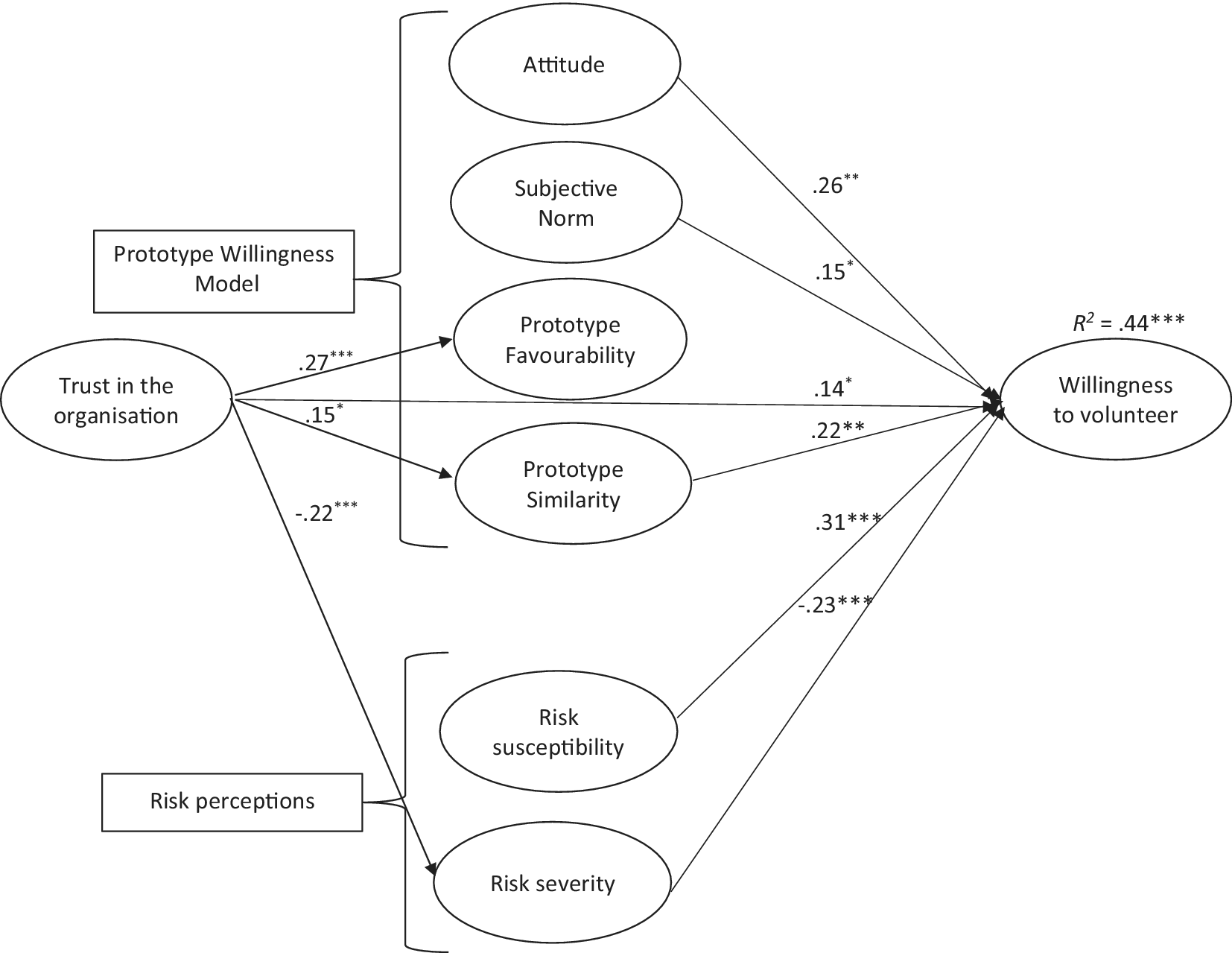
The final model with the added suggested paths was a good fit to the data, χ2(4) = 5.12, p = .275, CFI = .996, RMSEA = .042, SRMR = .040. Inspection of the standardized residual covariances supported good model fit, given that no values exceeded 2.00, indicating no important misspecification issues were evident in the data (Anderson & Gerbing, Reference Anderson and Gerbing1988). In support of Hypotheses 1 and 2, the final model indicated that attitude and subjective norm significantly and positively impacted volunteer willingness to assist in a higher risk country. For prototypical images, however, contrary to Hypothesis 3, the degree of favorability about the image of the prototypical volunteer in this context was not associated with volunteer willingness. Consistent with Hypothesis 4, prototype similarity had a direct positive effect on willingness. Although risk susceptibility showed a significant link with volunteer willingness, it was in the opposite direction proposed by Hypothesis 5, indicating that the stronger the susceptibility to risks, the higher the willingness to volunteer. Consistent with expectations (Hypothesis 6), risk severity had a direct negative effect on volunteer willingness. Aligning with Hypothesis 7, trust also had a direct effect on willingness but, via the modification indices for the structural equation model, was shown to also have indirect effects on intention via the PWM constructs (prototype favorability, prototype similarity), and risk severity. A bootstrapping procedure (1000 samples) tested the significance of the indirect paths for trust on willingness via the PWM constructs and confirmed partial mediation. Modification indices did not suggest any improvements to the model. The final model explained 44.1% of the variance in willingness (see Figure 1).
Structural model for the proposed relationship predicting volunteer willingness.
Note. Circles are latent variables. Path coefficients are standardized parameter estimates. *p < .05, **p < .01, ***p < .001.

Discussion
This study examined what influences young adults’ willingness to volunteer in a higher risk country by using predictive constructs from the PWM, risk perceptions, and trust in the organization. The proposed model accounted for a substantial 44% of the variance in young adults’ willingness to volunteer. The PWM constructs of attitude, subjective norm, and prototype similarity, as well as risk susceptibility, risk severity, and trust in the organization, were significant predictors of willingness. Of note, risk susceptibility was a positive predictor of volunteer willingness and trust in the organization, also informed a number of the antecedents of willingness, including prototypes reflecting the image of a typical volunteer in this context.
Participants reported, on average, a willingness above the midpoint of the scale to volunteer in a higher risk country, reflecting some propensity on the part of young adults to consider the proposed volunteering option. Consistent with the first hypothesis, attitude was a significant predictor whereby young adults with positive outlooks about volunteering in a higher risk country were more willing to volunteer. Aligning with Hypothesis 2, subjective norm significantly positively predicted willingness, showing that perceived positive support from others increased their willingness to volunteer in a high-risk setting. These findings mirror previous research for prosocial and altruistic behaviors where attitude and subjective norm predict people’s willingness to give (Duncan et al., Reference Duncan, Caughey and White2023; Hyde & White, Reference Hyde and White2014).
Prototype favorability did not significantly predict willingness to volunteer in a higher risk country, which was inconsistent with Hypothesis 3. This result suggests that how favorably a young adult views the typical volunteer in this context does not impact their own willingness to volunteer, inconsistent with meta-analytic results for the PWM (Todd et al., Reference Todd, Kothe, Mullan and Monds2016) but aligning with Hyde and White’s (Reference Hyde and White2014) study investigating organ donation willingness. It should be noted that the mean for prototype favorability was high (>6 on a 7-point scale), indicating nearly all participants had a very favorable view of the typical volunteer in this context. In support of Hypothesis 4, prototype similarity was the strongest predictor in the PWM; if a young adult feels more similar to the prototype of a typical person who volunteers, it is associated with an increase in their willingness to volunteer. These results have been supported by studies investigating altruistic and prosocial behaviors using the PWM (Duncan et al., Reference Duncan, Caughey and White2023; Hyde & White, Reference Hyde and White2014). Likewise, Todd et al.’s (Reference Todd, Kothe, Mullan and Monds2016) meta-analysis revealed prototype similarity to have the strongest relationship with willingness. In the context of volunteering in a higher risk country, the more young people view themselves as similar to the favorably viewed prototype, it may enhance their self-image (given the high favorability of the image), making them more willing to engage in volunteering. More research, however, is required to fully test the role self-image plays in this relationship.
The risk perception constructs of risk susceptibility and risk severity significantly predicted volunteer willingness. Risk susceptibility significantly predicted willingness to volunteer in a higher risk country; however, contrary to the expectations of Hypothesis 5, the direction of the finding was unexpectedly in the positive direction. Young adults who perceived they were more susceptible to the risks associated with the volunteering experience were more willing to volunteer. This finding conflicts with much of the extant literature suggesting risk susceptibility reduces engagement in risky behaviors (Hüsser & Ohnmacht, Reference Hüsser and Ohnmacht2023) and increases in risk-related constructs are associated with a general decrease in volunteer involvement (International Federation of Red Cross and Red Crescent Societies, 2013; Tran et al., Reference Tran, Pham, Dao, Pham, Ngo and Dewey2022). However, the finding aligns with previous research indicating it is risk-accepting individuals who are more likely to volunteer than their risk-averse peers (Dong, Reference Dong2015). For young adults who possess a less conservative risk profile than people of other ages (Duell et al., Reference Duell, Steinberg, Icenogle, Chein, Chaudhary, Di Giunta, Dodge, Fanti, Lansford, Oburu, Pastorelli, Skinner, Sorbring, Tapanya, Uribe Tirado, Alampay, Al-Hassan, Takash, Bacchini and Chang2018), their greater impulsivity and less developed risk evaluation abilities may lead to engagement in more socially reactive behavior, such as volunteering in less secure settings. This finding for risk susceptibility, although unexpected, aligns with the foundations of the PWM designed to cater to young people’s greater engagement in risky actions even when the risks are known (Gibbons et al., Reference Gibbons, Gerrard, Lane, Suls and Wallston2003). As the current study explicitly stated the likely risks people would be exposed to, participants may have already been prepared to experience these risks and believe the benefits of volunteering outweigh this potential deterrent. Furthermore, people’s recent experiences with the risks of COVID-19 and the impact it has had on travel may have helped people become more familiar with being around and being susceptible to risks. Thus, acknowledging and understanding the susceptibility of experiencing risks did not decrease young adults’ willingness to volunteer in a higher risk country in the present study; instead, a recognition and likely acceptance of the possible risks enhanced it. As expected and in accordance with Hypothesis 6, risk severity significantly negatively predicted willingness to volunteer in a higher risk country. If the severity of the risks while volunteering in a higher risk country is too high, this perception will decrease young adults’ willingness to volunteer, consistent with previous research (International Federation of Red Cross and Red Crescent Societies, 2013; Suess et al., Reference Suess, Maddock, Dogru, Mody and Lee2022; Tran et al., Reference Tran, Pham, Dao, Pham, Ngo and Dewey2022).
Supporting Hypothesis 7, trust in the organization was a significant predictor of willingness to volunteer, with a greater need for the organization to be reputable associated with increased willingness to volunteer. Emanating from the modification indices for the structural equation model, trust also exhibited indirect effects on willingness via a number of the PWM constructs. Trust also impacted perceptions of the social images of a typical volunteer in this context and risk severity, with a greater trust associated with more positive and favorable images of the typical volunteer and a reduction in perceptions of how severe any risks might be. These results indicate the pervasive effect of trust in the organization in contributing to volunteer willingness directly and indirectly, consistent with previous literature (Hager & Hedberg, Reference Hager and Hedberg2016; Hyde & Knowles, Reference Hyde and Knowles2013) and aligning with meta-analytic evidence of the importance of organizational trust for charitable giving in general (Chapman et al., Reference Chapman, Hornsey and Gillespie2021). Given the effort required to volunteer overseas, people likely want to be reassured they are associating themselves with a trustworthy organization, ensuring their contribution will be beneficial and not cause more damage to the communities and people in need.
Theoretical implications
The study was the first to propose a predictive model for the specific volunteering context of willingness to volunteer abroad in a higher risk setting, an understudied context for theory-informed investigations of volunteering and one devoid of a specific theoretical framework. Drawing upon an established decision-making model devised for risky behaviors among younger people, the present study provided preliminary support for the PWM as a useful organizing framework in this novel context. This model highlights the importance of social images of typical performers and the impact of our similarity to the image of a typical volunteer. Given the nature of the volunteer setting, an explicit consideration of risks revealed an acceptance of the likelihood of experiencing risk, which contributed to a greater willingness to volunteer and was consistent with the risk profile of youth, with potential implications for conceptualizing risk estimates in terms of acceptance rather than aversion in higher risk volunteering scenarios, at least for young adults. Finally, the pervasive nature of trust was also established, pointing to the importance of this construct in determining openness to volunteering in less stable scenarios where young adults with less life experience than older adults likely rely on organizational reputation as a source of reassurance in their volunteer choices. Combined, these findings allowed for the development of a preliminary model to encapsulate the drivers of potential young adult volunteers in the specific setting of volunteering abroad, acknowledging a need to validate, develop, and extend the model as required following this initial examination.
Applied implications
This research has implications for volunteerism to counteract the growing need for aid workers and volunteers in countries and places experiencing increased conflict and disasters (Centre for Research on the Epidemiology of Disasters, 2022). Encouragingly, young adults in the present study were, on average, moderately willing to undertake the volunteer experience, with generally favorable attitudes and a very strong perception of the typical volunteer in this context. The potential avenues organizations and policymakers should focus their recruitment efforts on include encouraging young adults to undertake a cost–benefit analysis to inform their attitudes and consider the level of support they will likely receive from others for choosing to volunteer. Images should be created and displayed showcasing the typical volunteer young adults can relate to (e.g., in recruitment efforts employing images and speakers from a variety of different cultures and backgrounds). Organizations should be upfront about the risks, as acceptance of the likelihood of risks did not comprise a deterrent among the sample of young adults, but address risk severity so people can make informed decisions. Fostering trust in the organization and charities is essential, given its role in directly and indirectly impacting volunteer willingness, suggesting efforts to reassure young people of the credibility of the host organization are vital.
Limitations and future research directions
There are some limitations to note. Trust in the organization was measured using a 1-item scale, and the measurement model reported adequate but not good fit, suggesting greater development of the operationalization of the study’s constructs would be useful in future investigations of this novel behavior. Also, a larger sample size may have enabled additional sub-analyses to be performed based on background factors such as regionality, ethnicity, and previous volunteering experience. Of note, there was an under-representation of young people who identified as Aboriginal/Torres Strait Islander. Examining a young First Nations perspective on volunteering internationally would comprise an important perspective to incorporate in future examinations. Given Australia’s diverse multicultural composition, there are also likely unique cultural considerations to volunteering internationally based on local community norms and family expectations that should be explored in greater depth.
Given the intended focus of the present study on young adults residing in Australia, this sampling limits the ability to generalize these findings to other countries and age groups. For instance, despite the target population exhibiting high prevalence rates of international volunteering and potentially a greater tolerance for risk, the views of additional age groups keen on international volunteering, such as older adults aged 45–54 years old (Lough, Reference Lough2015), and people residing in other countries should be examined. Although pilot participants reported the explanation of higher risk countries to be meaningful, the definition of the volunteering setting may have benefited from concrete examples of countries currently deemed to be higher risk to provide additional context. In addition, the outcome scenario measure comprised a hypothetical situation that removed some of the main potential barriers to volunteering, stating that volunteering fees, accommodation, food, and flights would be free of charge, and there would be no negative impacts on current work and study commitments, which may not reflect the opportunities people would always encounter. This study’s proposed model could also be examined for volunteer tourism, where some of the financial burden of travel and living expenses is placed on the volunteer (International Volunteer HQ, 2023).
Examining current volunteers and their willingness to continue volunteering as part of retention efforts and to volunteer in higher risk scenarios would be beneficial, potentially integrating constructs from established episodic volunteering frameworks (Compion et al., Reference Compion, Meijs, Cnaan, Krasnopolskaya, von Schnurbein and Abu-Rumman2022; Dunn et al., Reference Dunn, Scuffham, Hyde, Stein, Zajdlewicz, Savage, Heneka, Ng and Chambers2022; Hyde et al., Reference Hyde, Dunn, Bax and Chambers2016) to the short-term volunteering abroad context and understanding people’s willingness to engage in short-term spontaneous volunteering to crises abroad (Yang, Reference Yang2021). While risk was set at a fairly high level in the present study, according to country ratings of risk, there are more extreme risk contexts and a willingness to volunteer in scenarios where need is even greater could be examined. Also, as the present study found risk susceptibility to unexpectedly predict willingness in a positive direction, it may suggest willingness is impacted more by the awareness of risks instead of concerns surrounding risk susceptibility, especially among young adults, a finding consistent with some research examining risk propensity in volunteering (Dong, Reference Dong2015), but one that should be validated in future studies. As the first attempt to propose a model in this context of higher risk international volunteering, there may be other approaches offering insight into contributing predictive factors that could be considered. As the proposed model focused heavily on risk perceptions, incorporating a consideration of more positive associations with volunteering, such as need for autonomy, competence, and relatedness, may be useful, especially given evidence constructs based on theories such as self-determination theory have influenced people’s volunteering at least within the context of locals volunteering in developing countries (Owusa-Ansah & Moyo, Reference Owusu-Ansah and Moyo2025).
Overall, the results of this study can be used to guide the recruitment strategies of organizations facilitating volunteering in higher risk countries. It is suggested that organizations and charities should focus their efforts on reminding young adults about the level of support likely to be received from others for choosing to volunteer, creating images of typical volunteers that young adults can relate to, being honest about the risks but addressing their severity, and fostering trust in the organizations seeking assistance. Further research is warranted to provide informative guidance about this unique volunteering context that assists in efforts to address the imbalances of resource distribution globally.
Data availability statement
The data that support the findings of this study are openly available at: https://doi.org/10.25912/RDF_1723171181862
Author contribution
All authors contributed to the study conception and design. Material preparation, data collection, and analysis were performed by Murray Thistlethwaite and Katherine White. The first draft of the manuscript was written by Murray Thistlethwaite, and both authors commented on previous versions of the manuscript. Both authors read and approved the final manuscript.
Funding statement
The authors have no relevant financial or non-financial interests to disclose.
Competing interests
The authors have no relevant financial or non-financial interests to disclose.
Ethical standard
Ethical approval for the study was granted by the Queensland University of Technology (QUT) Human Research Ethics Committee. (Approval Number 7174).
Consent
Informed consent was provided by all participants.



 Open access

