


Reference HaefeliHaefeli (1961); Reference HaefeliHaefeli and Brandenberger (1968, p.278) and Reference WeertmanWeertman (1961) have compared the theoretical and the measured surface profiles of the Greenland ice sheet. Weertman obtained good agreement with a profile measured at lat. 79° N. In this paper the profile at lat. 71°N. is considered For this profile Haefeli's theory, using in Glen's law  the exponent n = 3.5, is in excellent agreement with the E.G.I.G. measurements. The comparison is made on the assumptions that the accumulation A and the temperature distribution are constant in space and time. In this paper we shall investigate the case where these two assumptions do not hold. However we shall keep Haefeli's other assumptions" which are: the general validity of Glen's law, zero ice velocity at the ice-bedrock interface, equilibrium How conditions and a horizontal bed.
Many authors have concluded (see Reference Robin DeRobin, 1055; Reference LIiboutryLliboutry, 1968; Philherth and Federer, to be published), that the. ice is much warmer and more fluid in the vicinity of the bedrock than in the overling layers. I one takes, for example, a thermal gradient of 1/30 deg/m near the bedrock (caused by the geothermal heat and the heat of friction) and in the thermal factor of Glen's generalized formula as modified by Reference LIiboutryLliboutry (1968),  , a temperature coefficient k = 0.15 deg−1, the result, is that at a height h = 300 m above the bedrock the temperature is decreased by 10 deg, which increases the viscosity by a factor exp [0.15 × 10] = 4.5. This means that the ice sheet slips on its lowermost layers as discussed by Reference NyeNye (1959). Therefore we can make a simplifying assumption
(1) The mean horizontal velocity vxm depends only on temperature and shear stress at the bottom of the ice sheet.
Furthermore we assume that
(2) the temperature regime in the ice sheet is stationary.
(3) the difference of the bottom temperature from the pressure melting point is constant, and
(4) the accumulation A is constant in time but increases linearly towards the edge of the ice sheet
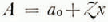
where x is the distance from the ice divide and a 0 and Z are constants; A, a 0 and Z are “ice values”. According to our own measurements during the International Glaciological Expedition to Greenland, E.G.I.G. (Reference FedererFederer, 1969), this linear increase is real between Crête and Carrefour with a 0 = 0.27 m/year and Z = 8 × 10⁻⁴ m/km year. This is also in agreement with the results of Reference BensonBenson (1962), Reference MockMock (1967) and de Reference QuervainQuervain (1968, p. 142). In the second part of this paper, assumption (3) will be dropped. The shear stress τB at the bottom of the ice sheet is approximately (if α is small):

where ρ is the density, g the acceleration due to gravity, y the total height above ground and α the slope of the ice surface.
Let C 2, C 3, …, C 10, be constants, the values of which do not concern us here; they depend on n and m respectively.
The horizontal mean flow velocity vxm is given by:
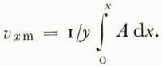
Case (a) (Reference HaefeliHaefeli, 1961)
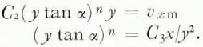
Case (b) (present work):

C 4 is a function of the bottom temperature TB but, according to assumption (3), a constant.

Cases (a) and (b) differ by the quadratic term in the numerator and by a factory in the denominator. The hater can be viewed in the following way; vx and therefore vxm are obtained by integration of  from the bedrock to the ice surface. For a given shear stress at the bottom, this integral is independent of y in case (b), since the soft layer near the bottom is a result of the increased temperature in this region. This means, that its thickness does not increase with y. In case (a), however, the soft layer is a result of shear stress, so that its increase in thickness is proportional to the height y.
It is interesting to see by what amount the exponent m in case (b) differs from n. Division of Equation (5) by Equation (3) yields:

The second factor on the right-hand side of Equation (6) is a decreasing function of x, while the third factor is an increasing function of x. For the Greenland surface profile considered, the right-hand side of Equation (6) is almost constant; it has incidentally the same value at both standard points A (x = 0 km) and c(x = 380 km) of Reference Haefeli and BrandenbergerHaefeli and Brandenburger (1968, p.278). Because of this it is a good approximation to use the average value m = n in Equation (6) for the whole range of x (0 to 500 km).
We can sum up our result in the following way: The thermal softening of the bottom layer and the accumulation which increases with x, should lead to m ≠ n But these two influences are operating in opposite directions; in the region considered here {the E.G.I.G. profile) they approximately cancel each other This means that in both cases (a) and (b) the best description of the measured profile is obtained if, in Glen's law, the exponent is taken as n ≈ 3.5. This result is very satisfactory, since n a 3.5 is also obtained in laboratory measurements on the mechanical properties of ice.
If drop now assumption (3), the bottom temperature TB becomes a function of x.
Using the generalized Glen's law modified by Reference LIiboutryLliboutry (1968), Equation (5) becomes

where S is the pressure melting point.
Division of Equation (7) by Equation (3) yields

To simplify the calculation wc consider, for the moment, the right-hand side of Equation (8) to be constant (compare the remarks following Equation (6)).
Equation (8) now yields

Equation (9) shows that for a given y = y(x), tan α = tan α (x) and S = S(x) there is a definite relationship between the temperature at the bottom and the exponent m (n is always 3.5). Together with Equation (3) and with k = 0.15 deg−1, Equation (9) can be written:
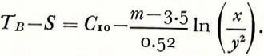
For x → 0, i.e. in the vicinity of the ice divide, Equation (10) is no longer valid; but it is evident that in a small region around the ice divide it is very difficult to detect any difference between the measured and the theoretical surface profiles. In the evaluation of Equation (10) we will consider only values of x > 100 km. The constant C 10 cannot be determined from the surface profile. We will therefore refer to an arbitrarily chosen reference point P0, where the values are denoted by a subscript 0.

In Table I some values for ΔTB, calculated for the Greenland surface profile, are given.
From Table I we can draw two important conclusions:
(1) We expect ΔTB to increase towards the coast, since the heat of friction near the bedrock and the surface temperature both increase; it follows that the exponent m in Glen's law must be smaller than 3.6.
(2) According to the observations of most workers, m cannot be smaller than 3.0; we therefore conclude that the bottom temperature between x = 114 km and x = 380 km cannot increase by more than ≈2.6 deg.
Calculated values of the basal temperature difference

We see that, towards the coast, the increase of the bottom temperature is only small, but the heat of friction in the lowermost layers (Reference LIiboutryLliboutry, 1968) and the surface temperatures increase rapidly. How are these two statements compatible? One can only conclude that, in the outer regions, part of the heat is used in the melting process. This means that the pressure−melting point at the ice−bedrock interface is reached at a relatively small distance from the ice divide (c 150 km), and that friction forces are responsible for the shear stress at the bottom (Reference HaefeliHaefeli, 1968). Finally we would like to mention that by an entirely different reasoning (Philberth and Fédérer, to be published) a higher bottom temperature can be expected than has been assumed hitherto.
Appendix
To simplify the calculations we considered the right−hand side of Equation (B) to be constant. In reality it increases from x = 0 until x = 209 km by 12% and then decreases. Between the reference point (x = 114 km) and point c (x = 380 km) the decrease is 10%. According to Equation (8) this variation corresponds to a change in the bottom temperature TB of 0.6 deg (since exp (0.15 × 0.6) = 1.1). This means that in Table I at x = 380 km the temperature differences ΔTB become lower by 0.6 deg. This change supports the consequences drawn from Table I favourably.



