


1. Introduction
Electronic waste is one of the most rapidly growing waste streams worldwide (Reference Baldé, Kuehr, Yamamoto, McDonald, D’Angelo, Althaf, Bel, Deubzer, Fernandez-Cubillo, Forti, Gray, Herat, Honda, Iattoni, Khetriwal, Cortemiglia, Lobuntsova, Nnorom, Pralat and WagnerBaldé et al., 2024; Reference Rene, Sethurajan, Kumar Ponnusamy, Kumar, Bao Dung, Brindhadevi and PugazhendhiRene et al., 2021), yet currently only 22.3% is documented as having been properly collected and recycled (Reference Bakker, Wang, Huisman and den HollanderBakker et al., 2014; Reference Baldé, Kuehr, Yamamoto, McDonald, D’Angelo, Althaf, Bel, Deubzer, Fernandez-Cubillo, Forti, Gray, Herat, Honda, Iattoni, Khetriwal, Cortemiglia, Lobuntsova, Nnorom, Pralat and WagnerBaldé et al., 2024; Reference Rene, Sethurajan, Kumar Ponnusamy, Kumar, Bao Dung, Brindhadevi and PugazhendhiRene et al., 2021). In a circular economy, strategies such as product lifetime extension and repair are prioritized because they delay waste generation and reduce resource consumption. Recycling is generally seen as a last resort, aimed at recovering products’ constituent materials (Reference Bakker, Balkenende and PoppelaarsBakker et al., 2018; Reference den Hollander, Bakker and Hultinkden Hollander et al., 2017). However, it remains a crucial strategy for electronics due to the scale of the waste stream, its material content, and the rapid innovation and short lifetimes of products (Reference Babbitt, Althaf, Rios, Bilec and GraedelBabbitt et al., 2021; Reference Rene, Sethurajan, Kumar Ponnusamy, Kumar, Bao Dung, Brindhadevi and PugazhendhiRene et al., 2021).
Recycling of e-waste involves the dismantling and disintegration of products and their components, followed by reprocessing of the recovered materials (Reference den Hollander, Bakker and Hultinkden Hollander et al., 2017). In practice, this typically includes collection, manual removal of hazardous components, shredding, sorting, and material reprocessing (Reference Liu, Tan, Yu and WangLiu et al., 2023; Reference Xavier, Ottoni and AbreuXavier et al., 2023). Efforts to improve recycling yields have largely focused on downstream processes such as collection and recycling technologies. However, many challenges originate in the product itself, as material choices and joining methods are determined during the design phase (Reference Babbitt, Althaf, Rios, Bilec and GraedelBabbitt et al., 2021; Reference Xavier, Ottoni and AbreuXavier et al., 2023; Reference Wu, Gao and LiXiaoqing Wu et al., 2025).
Efforts have been made to translate recycling processes into practical Design for Recycling (DfR) methods and guidelines that connect design decisions with recycling outcomes. Yet only a small share of the methods developed in academia find their way into design practice (Reference Gericke, Eckert and StaceyGericke et al., 2022; Reference Matschewsky, Brambila-Macias, Neramballi and SakaoMatschewsky et al., 2024; Reference Schønheyder and NordbySchønheyder & Nordby, 2018), and Design for Recycling methods are no exception.
This paper contributes to research aimed at developing a method that bridges the gap between design and recycling. It presents the setup of the first version of the Design for Recycling of Electronics Guide, showing its foundations and potential. The guide builds on three key Design for Recycling principles:
-
1. Enable removal of hazardous and valuable components
-
2. Use materials that are commonly recycled
-
3. Facilitate separation of incompatible materials
The method is informed by recycling experiments and product case studies, with future collaboration with designers, recyclers, and researchers planned for further refinement and validation.
2. Approach to method development
This section provides background on the development of the Design for Recycling of Electronics Guide. It outlines the method development process used to develop the guide, and presents the results of the first stage, which has been completed and provides the foundation for the guide’s ongoing development and refinement.
2.1. Structuring the method development process
A method can be viewed as a designed artifact in its own right (Reference Daalhuizen and CashDaalhuizen & Cash, 2021). This is why we approached the development of the Design for Recycling of Electronics Guide as a design process itself, structured around three stages: Frame, Create and Evaluate. This approach aligns with the three-stage model of a design process, which moves from framing and defining the problem into a clear set of objectives, to generating possible solutions, and finally to critically assessing these solutions against the initial objectives (Reference Wynn and ClarksonWynn & Clarkson, 2017).
In the first stage, Frame, we developed a thorough understanding of the problem. This stage has been completed and included a review of existing Design for Recycling methods (Reference van Dolderen, Versloot, Aghaeian, Bakker and Balkenendevan Dolderen et al., 2025), shredding tests on different types of products to explore how design choices affect recyclability (Reference van Dolderen, Versloot, Aghaeian, Bakker and Balkenendevan Dolderen et al., 2025), and collaborations with students and companies on explorative redesigns that balance strategies such as recycling and repair. Together, these activities helped us build a comprehensive understanding of the field and define a clear problem statement and set of criteria to guide the next stages.
The second stage, Create, has just begun with translating these insights into a first version of the guide, which is the focus of this paper. This stage is an iterative process: the guide will be continuously refined based on feedback and new findings. Interviews with designers, recyclers, and researchers serve multiple purposes: they strengthen the evidence behind the method, deepen our understanding of current and emerging recycling practices, and provide initial evaluation of both the guide and the previous work that informed it. In particular, the interviews focus on the guide’s relevance to recycling practice, its adaptability to future developments, and its applicability across different product types.
The third stage, Evaluate, will assess whether all the method criteria defined in the first stage have been met. This will involve testing the guide in real design contexts and conducting recycling experiments on redesigned products. The aim is to determine whether use of the method leads to more recyclable products and can be integrated into design practice.
2.2. Results of stage 1: frame
This section describes the analysis of existing DfR methods, as well as shredding tests and explorative redesign exercises to explore the relation between product architecture and recycling results.
2.2.1. Analysis of DfR methods
An in-depth analysis of existing DfR methods using the method assessment framework in the context of method content theory showed gaps in especially method development and validation (Reference Cash, Daalhuizen and HekkertCash et al., 2023; Reference Daalhuizen and CashDaalhuizen & Cash, 2021; Reference van Dolderen, Versloot, Aghaeian, Bakker and Balkenendevan Dolderen et al., 2025). This led to the following set of criteria for a new DfR method:
-
• Clear and well defined: A good DfR method is complete, logically coherent, unambiguously described, and well-documented.
-
• Supported by evidence: A good DfR method is rooted in recycling practice, supported by evidence from recycling tests and input from recyclers.
-
• Adaptable to evolving recycling practices: As electronics design, legislation, and recycling technologies evolve, DfR methods must be updateable and adaptable to context-specific conditions to remain effective.
-
• Measurably improves recycling rates: Ensure that use of the method leads to quantitatively or qualitatively assessable improvements in recyclability (efficacy of the method (Reference Daalhuizen and CashDaalhuizen & Cash, 2021)).
-
• Addresses tensions with other recovery strategies: An effective DfR method should help designers navigate the tensions between different end-of-life strategies by clarifying potential trade-offs.
-
• Adapted to design practice: A good DfR method is understandable, usable, and flexible across different contexts and workflows (effectiveness of the method (Reference Daalhuizen and CashDaalhuizen & Cash, 2021)).
-
• Effectively reaches designers: A DfR method should be clearly presented and disseminated so designers can quickly access, understand, and apply it in practice.
The review also informed the planning of the design guide’s development process, as it made clear which activities are needed to actively address all criteria (Figure 1).
Overview of how activities contribute to meeting the method criteria at different development stages. Purple elements relate to the efficacy of the method; to which extent using the method leads to more recyclable products. Blue elements relate to the effectiveness of the method; its usability in design practice. Grey elements relate to the reporting and completeness of the method, including its logical internal coherence and unambiguous description (Reference Cash, Daalhuizen and HekkertCash et al., 2023; Reference Daalhuizen and CashDaalhuizen & Cash, 2021)

Figure 1 Long description
The matrix is divided into three stages: Frame, Create, and Evaluate. Each stage contains specific activities that are evaluated against seven criteria: Clear and well defined, Supported by evidence, Adaptable to evolving recycling practices, Measurably improves recycling rates, Addresses tensions with other strategies, Adapted to design practice, and Effectively reaches and engages designers. The matrix has three rows for each stage and seven columns for the criteria. The activities include Literature review, Recycling tests and explorative redesigns, Interviews with designers, Interviews with recyclers and researchers, Tests in design practice, and Recycling tests on redesigned products. The matrix uses color coding to indicate reporting/completeness, efficacy, and effectiveness. Notable trends include the concentration of efficacy and effectiveness in the Create and Evaluate stages, with various activities addressing multiple criteria.
2.2.2. Relation between product architecture and recycling results
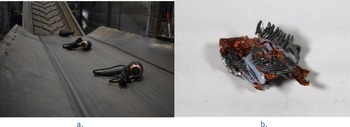
We investigated the recyclability of a range of electronic products, including TVs, different luminaires, vacuum cleaners, hairdryers (Figure 2), electric toothbrushes and agricultural antennas. These studies were carried out as industrial design engineering graduation projects, often in collaboration with companies. Products were first disassembled to assess their product architecture and material composition, after which sets of fully assembled products were shredded to observe how different product architectures break down in a standard recycling process (depollution, shredding, and sorting). The shredding tests produced quantitative results for individual products, including measurements of the breakdown behavior of connections and material losses linked to specific product design decisions, while comparisons across products mainly supported qualitative conclusions due to the diversity of product types. Collaborating with recyclers on these projects offered valuable insights into current recycling practices.
A shredding test on hairdryers. a: Hairdryers on a conveyor belt before shredding. b: A heterogeneous fragment of a hairdryer motor after shredding

Building on these findings, students were tasked with redesigning products to improve their recyclability, while also considering constraints such as durability, repairability, and cost. The project on the recyclability of smart TVs was later developed into a full study (Reference van Dolderen, Versloot, Aghaeian, Bakker and Balkenendevan Dolderen et al., 2025). These projects provided detailed insights into the design features that affect recyclability, such as material choices, connections, and product architecture, thereby validating or expanding existing guidelines. They also revealed the challenges of putting Design for Recycling into practice. Tensions often arise between DfR and other design requirements for circular strategies, such as those related to repairability or durability.
Working with a wide range of products further showed how different design decisions affect recycling processes. Sheet steel parts, for instance, tend to fold rather than break during shredding, encapsulating other materials in the process. This occurred in products such as TVs, luminaires, and motor parts, where steel folded around copper windings (Figure 2). Potting compounds also often lead to material losses, as they are barely liberated during shredding. At the same time, such features often serve essential functions. In an agricultural antenna, for example, potting protects the electronics against moisture, fumes, and physical impact. These examples show the trade-offs inherent in designing for recycling: what benefits one stage of a product’s life may complicate another.
3. The design for recycling of electronics guide v1
At the start of the Create stage of the method development process, we developed the first version of the Design for Recycling of Electronics Guide by bringing together insights from the literature review, shredding tests, and explorative redesign projects. We used the method assessment framework within Method Content Theory (Reference Cash, Daalhuizen and HekkertCash et al., 2023; Reference Daalhuizen and CashDaalhuizen & Cash, 2021) to help structure the content and ensure all the necessary elements of a design method were included.
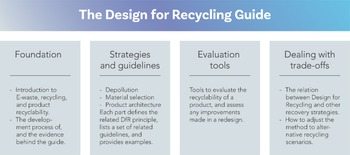
The Guide is structured into four main sections: Foundations, Strategies and Guidelines, Evaluation Tools, and Dealing with Trade-offs (Figure 3). Together, these sections move from the underlying principles of Design for Recycling to design strategies, ways of evaluating design outcomes, and guidance on navigating competing circular goals. The following sections describe the content and purpose of each part in more detail.
The internal structure of the Design for Recycling of Electronics Guide v1

3.1. Foundation
Here the basis for the Design for Recycling of Electronics Guide is established. It explains why designing for recycling is essential, situating the guide within the broader context of the circular economy and the growing challenge of electronic waste. This section outlines how recycling fits within circular strategies and why improving recyclability is a necessary part of responsible product design. It also introduces the basics of recycling practice (Figure 4 ). Designers are guided through the main recycling processes and their implications for design, building an understanding of what recyclability means in practice. The section introduces the three principles of Design for Recycling and illustrates how design choices can support or hinder material recovery in recycling. Together, these insights prepare designers to apply the Design for Recycling strategies and tools in a meaningful way.
A simplified visualization of the E-waste recycling process

Figure 4 Long description
A flowchart illustrating the process of recycling electronic waste. The process begins with a broken smartphone undergoing depollution, where components like batteries are removed. The device is then shredded into smaller pieces. These pieces are separated based on properties such as magnetism, conductivity, color, and density. The separated materials include metals, electronic components, and plastics. Metals and electronic components are sent for smelting, while plastics are sent for compounding.
This section of the guide further clarifies that it is aimed at product designers working to improve recyclability, and that having access to a bill of materials and information on the product’s architecture is beneficial. It explains the rationale behind combining design guidelines with practical evaluation tools: the guidelines present core principles in a way that can be directly applied in the design process, while the evaluation tools allow designers to assess products and see how specific design changes affect recyclability. The section also summarizes the method’s development and initial testing, as described in the previous chapter, showing how it was shaped to be both usable in design practice and effective in improving product recyclability.
3.2. Strategies and guidelines
This section shows how electronics can be designed for recycling, organized around the three Design for Recycling principles, and combines background insights, practical guidelines, and product examples that illustrate how design choices influence recyclability.
The first part explains depollution and helps designers determine through a set of guidelines whether any hazardous or valuable components or materials need to be removed manually, and which parts of the product therefore require manual dismantling. Ideally, hazardous components would be avoided in the design altogether. If this is not possible, such as is often the case with for example batteries, they should at least be easily recognizable and removable.
The second part covers material selection. The focus here is on selecting materials that are not only recyclable, but are recycled in practice. It provides an overview of commonly recycled materials and those that are best avoided, while also discussing the difference between materials that are theoretically recyclable and those that are actually recycled. For example, metals like aluminum and steel are almost always recycled, and plastics such as PP, ABS, PE and PS are often recycled as well. Plastics with a high content of additives, but also theoretically recyclable plastics like PET, on the other hand, often end up being incinerated, and should therefore be avoided in product design.
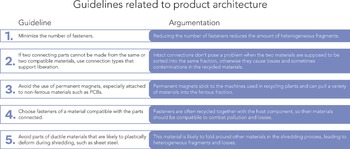
The third part focuses on product architecture, and explores how product design features, in particular connections, can affect the recovery of a product’s constituent materials. Materials that are recyclable can still be lost if they are not properly separated during processing. Figure 5 shows a few examples of guidelines presented here.
An example of guidelines presented in the chapter on product architecture, including their argumentation

3.3. Evaluation tools
Building on the strategies and guidelines, this part introduces tools that help designers assess and compare product recyclability, enabling them to evaluate a design, apply improvements, and measure the impact of their changes.
We chose to focus mostly on qualitative tools in the guide, intended to support the designer rather than calculate an exact outcome. This decision was made for two reasons. First, shredding tests have shown the limitations of assigning a single recyclability score to a product. Recycling performance depends on many factors, and a score can create a false impression of accuracy (Reference van Dolderen, Versloot, Aghaeian, Bakker and Balkenendevan Dolderen et al., 2025). Second, while systematic approaches such as detailed recyclability calculations may offer precise and standardised results, they also require considerable time, effort, and data. Designers may become discouraged if a method feels too complex or detached from their design process (Reference Daalhuizen, Person and GattolDaalhuizen et al., 2014). Although the guide currently focuses on qualitative tools, quantitative methods could be added in future iterations.
An example of the tools presented in the guide is the Recyclability Map, which visualizes material selection by color coding components and fastener selection by color coding the connections between components. This map builds on the Disassembly Map method developed by Reference De Fazio, Bakker, Flipsen and BalkenendeDe Fazio et al. (2021), which was developed to visually evaluate ease of disassembly and repair by showing the product architecture by indicating the disassembly sequence of all parts and the connections involved. The Recyclability Map shifts the focus from repair to recycling. It uses a colour scale for connections based on shredding experiments to indicate how well different parts are expected to separate during shredding. The map clearly indicates which materials and connections should be addressed to improve the recyclability of a product. Figure 5 illustrates the structure and elements of a Recyclability Map, showing how different aspects are visualized to provide a clear product overview, and provides an example.
The Recyclability map. a. Structure and elements of a Recyclability Map, illustrating how materials, connections, and their recyclability are visualized. b. Example of a complete Recyclability Map for a smart TV, showing how recyclability can be assessed and compared at the product level

Figure 6 Long description
Panel A: A diagram explaining the structure and elements of a Recyclability Map. It visualizes materials, connections, and their recyclability. Different parts show the number and types of fasteners, ease of liberation of the connection, valuable and hazardous materials, and recyclability of the component's material. Panel B: An example of a complete Recyclability Map for a smart TV. It shows how recyclability can be assessed and compared at the product level, with various components and their corresponding part numbers, materials, and recyclability indicated.
3.4. Dealing with trade-offs
This section considers how DfR can be integrated into the broader design process alongside other recovery strategies and design constraints. In a circular economy, designers aim to keep products in use and recover them at the highest possible level of integrity (Reference den Hollander, Bakker and Hultinkden Hollander et al., 2017; Reference StahelStahel, 2010). Design for Recycling is therefore only one aspect of circular product design and should not come at the expense of strategies that extend product life.
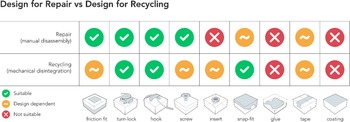
When dealing with trade-offs, it is important to consider the likely end-of-life scenarios of a product and its components, and to identify where design interventions can have the greatest impact. There is no single right answer in circular product design; each case requires its own balance of priorities. To help designers navigate tensions between circular strategies, this section of the guide discusses common design trade-offs. One example concerns connection types (Figure 6), where choices that facilitate repair, such as screws, may complicate recycling, and vice versa. Tangible examples from student redesign projects illustrate how these decisions play out in practice.
An overview of trade-offs between design for repair and design for recycling in choosing connection types in product embodiment, based on disassembly and shredding experiments

In addition to exploring tensions between the different recovery strategies, this section of the guide also discusses how the method can be adapted to different project types and recycling contexts. Recycling is not a single, uniform process: it differs by context, by company, and continues to evolve. For this reason, designers are encouraged not to apply the method mechanically, but to think critically from an end-of-life perspective, engage with recyclers directly, and adjust their approach accordingly.
4. Conclusion
The Design for Recycling of Electronics Guide takes a first step toward bridging the gap between product design and recycling practice. It translates insights from the recycling of products into guidance that designers can apply in their work, helping them to make recyclability a deliberate design consideration rather than an afterthought. While the guide is still in development, it shows how design and recycling can be brought together in a coherent method. The next step is to refine and validate the guide in collaboration with designers, recyclers, and researchers, ensuring it grows into a tool that remains relevant as both design and recycling continue to evolve.
Acknowledgement
This research was carried out as part of the project Circular Circuits (project P20-13) funded by the Dutch Research Council (www.nwo.nl). We thank the master’s students Doris Versloot, Marjolein Laan, Jasmijn Mortier, Daniel Ouwehand, Sophie Thomas and Xavier Huraux, as well as the companies Signify and Nedap, for their contributions to this research.
Declaration of generative AI and AI-assisted technologies in the manuscript preparation process
During the preparation of this work the authors used ChatGPT and DeepL to edit and improve the language of the manuscript at paragraph and sentence level. After using these tools, the authors reviewed and edited the content as needed and take full responsibility for the content of the published article.




 Open access

