


1. General
The Pamiro-Alai mountains have the most extensive glacierized area amongst the other mountains in the U.S.S.R. Sufficiently complete information on the sizes of glaciers in the basins of the Pjange, Vakhsh and Zeravshan Rivers, as well as of the southern part of the Fergana Valley and several others situated within the Pamiro-Alai system was obtained from data from air-photograph surveys in 1957–59 and used to compile the U.S.S.R. inventory of glaciers. Furthermore, these data were used to define average values of glacial nourishment of rivers in Central Asia and their long-term variations. It has been defined, in particular that, in 1935–89, the average contribution of run-off from the glacierized areas in the major basins in the Pamirs and Gissaro-Alai into the total run-off for the June-September period is as follows:
In the basin of the Pjange River (Nizni Pjange gauge) 41% (7.7 km3).
In the basin of the Vakhsh River (Komsomolabad gauge) 44% (5.7 km3).
In the basin of the Zeravshan River (Dupuli gauge) 43% (1.5 km3).
In extremely low-flow years, the role of glacial nourishment in June-September is very important. Table 1 presents data on glacial run-off for a number of such years. It is seen that in the years with negligible winter-spring accumulation of precipitation the rate of stream flow in June-September is mainly provided by run-off from glacierized areas.
Relative (%) and absolute (km3) contributions of glacial nourishment to total run-off of the main rivers in the Pamir-Alai mountains during June-September in low-flow years

In the middle 1980s, an integrated cartographic inventory of natural resources in the Pamiro-Alai mountains (scale of 1 :500 000), including contemporary glacierized areas, was made on the basis of the wide application of space and air photography of the Earth’s surface. The work carried out within this project and observations on fluctuations of the glaciers in the Pamiro-Alai mountains were within the framework of the International Programme and allowed us to reach certain conclusions about the continuing reduction of glacierized areas which had begun in the early 20th century, resulting in a decrease of water storage in the glaciers.
Thus, data in the U.S.S.R. inventory of glaciers on extent of glaciation are at present obsolete, so in 1986–90 they have been corrected for the territory of the Pamiro-Alai mountains in the Glaciology Department of our Institute (SANIGMI).
The modified information on morphometry of glacierized area in the Pamiro-Alai mountains was used to assess the effect of glaciation evolution on the run-off of the rivers. The work completed is extensive in that there is no analogous one in the U.S.S.R. and over the whole world. Here, we bear in mind that the repeated assessment of area and altitudinal characteristics is being made for several thousands of glaciers (>10000). Figure 1 shows the general view of the locations of the main ranges, glacierized regions, hydrological gauges and meteorological stations within the Pamiro-Alai mountains. Data on areal and altitudinal characteristics of the glacierized areas in the river basins of the Pamiro-Alai mountains are given in Tables 2–4.
Schematic representation of glacierized regions in the Pamir and Gissaro-Alai mountains.

Variation in glacierized area and altitudes of glacier termini in the river basins of the Gissaro-Alai in 1957–80

Variation in glacierized area and altitudes of glacier termini in the Pamir mountains in 1957–80

Statistical characteristics of long-term series of annual total glacial melting (Vm) and glacial run-off (Wg1) in some basins of the Gissaro-Alai

2. Variation in the Glacier Ized Area in the Gissaro-Alai Mountains During 1957–60
The modified data in the U.S.S.R. inventory of glaciers indicate that in 1957–59 there were 4287 glaciers in the river basins of the Gissaro-Alai mountains, having a total area of 2183.5 km2. Table 2 gives information on the area of glaciers in separate basins at the beginning and the end of the given period. This table indicates a noticeable reduction in the glacierized area in all river basins where glaciers with areas up to 2.0 km2 are prevalent. About one-third of the reduced glaciation area (36%) refers to the river basins situated on the northern slopes of the Turkestansky and Alaisky Ridges: 61% to the basins of the Amudarya River tributaries and 3% to the Kashgarskaya Kizilsu River basins.
In the period considered here, 19% of the glaciers remained stationary, 4% advanced and 69% retreated in the Gissaro-Alai mountains region. The reduction in the area occurred not only along the fronts of the lower parts of the glacier tongues but also in the glaciers’ nourishment areas. Despite various forms of glacier degradation, 84% of the reduced area of the glaciers belong to both the tongues and glaciers as a whole.
The process of degradation was followed either by reduction in the glacierized area in 1957–80 and/or by an increase in the extent of glacier moraine. Above an altitude of 2.8 km, the moraine area has increased as follows: up to 3 km — by 17%, from 3.0 to 4.0 km by 15%, above 4.0 km — by 35% compared with the moraine area in 1957. The upper moraine limit became 300 m higher, namely, from 4.5 to 4.8 km. The degree of moraine coverage of glaciers, being the ratio between moraine area and glacier area, has increased from 8 to 10%.
In the period considered, mass decrease of glaciers in the Gissaro-Alai mountains was 17% of the initial volume. This means 15 km3 of water. For 1980, the ice volume in the glaciers of Gissaro-Alai is estimated as 87.5 km3.
3. Variation of Sizes and Water Resources of the Glacierized Area in the Pamirs in 1957–80
In the Pamirs, the glacierized area has been reduced by 10% during the period 1957–80. The ratio between advancing, stationary and retreating glaciers is 1.0:0.7:4.1. Table 3 gives information on the glacierized areas in individual basins at the beginning and the end of the period being considered. The number of glaciers there in relation to 1980 is 7260.
The altitudinal distribution of the reduced glacierized area is as follows: below 3.0 km, 0.03%; from 3.0 to 4.0 km, 70.5%; from 5.0 to 6.0 km, 17.6%; above 6.0 km, the glacierized area increased by 4.35 km2.
The degree of moraine coverage of glaciers increased from 5 to 11%. Natural pollution of the glacier surface has also increased in a similar way to that in the glaciers of the Gissaro-Alai mountains.
Direct measurements of glacier volumes were not carried out, so their estimation at the beginning and the end of the period was made by indirect methods, taking into account sizes and other morphometric parameters of the glaciers. Formulae of Reference NyeNye (1952), Reference YerasovYerasov (1968), Reference SteinhauserSteinhauser (1970), Reference Mazo and GlazyrinMazo and Glazyrin (1986) were used.
From the Nye formulae, glacier thickness is deter-mined by the sine of its slope angle

where H is the mean thickness of a glacier, sin α is the sine of its slope angle, which is computed from the length L, and the values of the upper Zmax and Zmm points of the glacier:

It follows from Equation (1) and (2) that the volume V of a glacier having an area F is

Reference YerasovYerasov’s (1968) formulae relate glacier volume V (km3) to its area F:

Reference SteinhauserSteinhauser’s (1970) formulae relate glacier thickness H to its area F:

Finally, Reference Mazo and GlazyrinMazo and Glazyrin’s (1986) formulae take into account not only sizes and morphological parameters of a glacier but also the value of the amount of nourishment P:

where DZ = Zmax − Zmm is the vertical range of the glacier,

The value of P being known, calculations of volume are made by using Equation (6), while
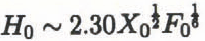
where F0 = 2P.
The above-mentioned indirect ways of calculation resulted in a wide range of scattering in the values: the minimum ones are the estimations using Steinhauser’s formulae, the maximum by Mazo and Glazyrin’s formulae. That is why averaging of the computation results using all four methods was done for the estimation of the total ice volume of all the glaciers of the mountain system.
The ice volume of the glaciers of the Pamiro-Alai mountains was 468.2 km3 in 1980. In the period considered here there was a decrease in ice of 66 km3 (13%) or 56.1 km3 of water, which equals the annual run-off of the Amudarya River at the Kerki gauge (59.9 km3).
4. Hydrological Regime of Contemporary Glacierized Area in the Pamiro-Alai Mountains
Assessment of variations in the glacierized area in Central Asia and other mountainous regions of the U.S.S.R. is closely related to the main processes of glacier activity. The problem considered here requires a description of the annual course of the glacial run-off in years with different rates of stream flow; the effect of the evolution of the glacierized area on the glacial nourishment of rivers in the Pamirs and Gissaro-Alai mountains is estimated.
(Reference KonovalovKonovalov 1979, Reference Konovalov1985) has developed a physical and statistical model of accumulation and ablation processes for the integrity of glaciers in a river basin, which at present is used for detailed computation of the annual course and the long-term hydrological regimes in a number of large glacierized regions of Central Asia.
The model describes the annual course of the hydrological regime of a glacierized area and computes 10d and monthly hydrographs of melting and run-off as well as total volumes of melted glacial water for May-October. Stable parameters for the whole period of computation are used in the model together with information about the annual course of the meteorological elements at a representative alpine station. Generally, it is not difficult to include information on annual or, at least, systematic estimates of morphometric parameters of a glacierized area in the scheme of computation. But, since the time when the U.S.S.R. inventory of glaciers was published, such an investigation has been made for the first time and it is difficult to conceive when regular estimates of glacierized areas of river basins will be made in the future. Therefore, estimates of the effect of the evolution of glaciation on the run-off of rivers in the Pamirs and Gissaro-Alai mountains may be made only for average long-term values.
Table 4 gives only examples of empirical statistics of long-term series of total glacier melting and glacial run-off which were computed using the model of Reference KonovalovKonovalov (1985) for a number of river basins in the Gissaro-Alai mountains. Similar information was obtained for the main tributaries of the Vakhsh River. The data indicate that the index of variation (Cv) for annual total melt volumes changes insignificantly (0.2–0.3) within the glacierized areas in the basins of the Sokh, Kizilsu and Obihingou Rivers. This characteristic is more variable in the basins of the Mubu and Seldara Rivers (Fedchenko glacier).
Long-term fluctuations of glacial run-off in the Pamirs and Gissaro-Alai mountains are almost synchronous in the time interval considered here (Cv changes from 0.4 to 1.2); it can be explained by the similar climatic conditions in the alpine zone.
The combined analysis of long-term variability of river flow in the Pamiro–Alai mountains and the contribution of glacial run-off and total melting in glacierized areas to feeding rivers during May–October showed the contributions of glacial run-off and total melting increase in low-flow years and decrease in high-flow ones. This peculiarity of glacial run-off is extremely important for water supply to users, because it provides natural regulation of run-off.
The values of glacial run-off indicate that, in all the river basins of the Pamirs and the Gissaro-Alai mountains, the years 1954, 1958, 1969, 1972, 1979 and 1981 are extremely low-flow and 1961 and 1973 are high-flow years. The ratio between annual values of glacial run-off in the year with the highest flow to those in the year of the lowest flow is (25–30) : 1 for the Zeravshan and Vakhsh Rivers.
Analysis of the seasonal course (May-October) of total melt distribution in per cent, and of its components, glacial and snow run-off, total run-off of the Vakhsh River at the Komsomolabad gauge on average, high- and low-flow years, allowed us to reach the following conclusions based on the values of glacial nourishment:
-
1. The general shape of the graphs, showing the seasonal course of monthly volumes of total melt, snow run-off and total run-off, is stable despite the water yield during the year. Frequency distribution relative to the modal value of the graphs has a more or less symmetric character (see Fig. 2).
-
2. Maximum values of total melt in the years of average and high flow are observed in August. The river run-off maximum is observed 1 month earlier, coinciding in time with run-off from snowmelt on the glaciers. In low-flow years, the distribution of snow run-off from a glacierized area coincides with the distribution of total melt; it is explained by the negligible volume of icemelt in these years.
-
3. In high-flow years, the distribution of snow run-off in glacierized regions has sharp rises and falls, whereas in the years of average and maximum water the curve becomes smoothed within a season.
-
4. In the years of average and high flow, the maximum of glacial nourishment in the river basins of the Pamirs is in August-September when the reserves of winter-spring snow accumulation are pratically exhausted outside the glacierized areas of the watersheds. This conclusion was reached for the first time and stresses once more the vital role of glaciation as a source of river nourishment in Central Asia.
Intraseasonal distribution of run-off and components of the total melting of glaciers in the years of different water yield in the basin of the Vakhsh River, a and b are the average flow years; N and d are the high-flow years; e and f are low-flow years. Wb if the relative part of the total river run-off, Vm is the relative part of the total melting, Wsn is the relative part of the snowmelt run-off from a glacierized area, Wgl is the relative part of the glacial run-off.

5. Glacio-Hydrological Indices of the Evolution of Glaciation in the Pamirs and Gissaro-Alai mountains and their Changes in 1957–80
A specific layer of run-off from the integrity of glaciers in a river basin is a rather useful index among quantitative indices which allow us to assess the hydrological regime of glacierized areas. Table 5 gives examples of average long-term specific layers of run-off from the glacierized areas of a number of river basins in Central Asia.
Average specific layers of total annual run-off Mi from the glacierized areas of Central Asia (Mi total melt volume/glaciation area)

This table shows that the size of a glacierized area does not determine the value of the specific layer of glacial run-off. This fact smoothes the role of glaciation as the source of a river’s nourishment, despite the large differences in sizes of their glacierized areas.
Thus, there is a 23.4 times difference between the areas of glaciers in the Pskem and Sarydias River basins, while average annual volumes of melt run-off differ by only 4.7 times.
The lack of data on the inter-annual dynamics of glacierized areas predetermines the possible characteris-tics of their evolution effects on river run-off. Evidently, these characteristics should be considered as average long-term values and be expressed as a function of the morphometric parameters of glaciation. Under such conditions, annual specific layers of melting (Mi1) and run-off (Mi2) for a multitude of glaciers in a basin and the variation coefficients of annual volume of total glacial melting (Cv1) and glacial run-off (Cv2) are quite appropriate glacio-hydrological indices.
Statistical processing of experimental data gave us working expressions for the computation of the above indices as a function of mean weighted elevations of the glacier terminus and the Grn line. A highly informative new parameter λ entered into a series of independent variables. The variable λ represents the ratio between the area from the glacier terminus to the firn line and the area from the glacier terminus to its elevation at 4.8 km.
This index allows us to consider in an explicit form the effect of the distribution of glacierized areas in any elevation zone on intensity and volume of snow and ice-melt. Investigation has also revealed that in the conditions of the Pamiro-Alai region an elevation of 4.8 km is the average upper limit of bare-ice melt in the period of 1935–85. Therefore, this is the upper limit for the expenditure of long-term reserves of glacierized areas. So, an assymptotic approach of λ to some limit reflects the increase of ablation area which has favourable conditions for the formation of glacier run-off. For example, in the basin of the Zeravshan River only 1.6% of the total glacierized area is above 4.8 km. Let us compare the basins of the Muksu and Saridjaz Rivers where 62.6% and 31.1% of glacierized areas, respectively, are above 4.8 km. Such a large difference in the area distribution is the reason why the average value of Mi for the Zeravshan River exceeds the same ones in the glacierized regions of the Muksu and Saridjaz Rivers (see Table 5).
The expressions for calculating the statistical para-meters of the glacial run-off series when λ < 2 have the following general form:



where Zt and Zf1 are the elevations of the glacier terminus and firn line, respectively. Mi and Cv have been defined above;


Tables 6 and 7 give the results of the computation of the average long-term volume changes of total glacier melt and run-off in the separate river basins of the Pamirs and the Gissaro-Alai mountains due to the reduction in the glacierized area.
Changes in average annual volumes of total melting ΔV1 and gladal run-off ΔV2 in the river basins of the Pamir mountains due to shrinkage of the glacierized area

Changes in average annual volumes of total melting ΔV1 and glacial run-off ΔV2 in the river basins of the Gissaro-Alai mountain range due to reduction of the glacierized area

To study hydrometeorological conditions causing reduction of the glacierized area in the Pamirs and Gissaro-Alai ranges and the decrease in glacial water yield, we calculated average values of the following parameters: run-off volumes of the Zeravshan, Vakhsh and Pjange Rivers in July-September and separately in August and September; sums of winter-spring precipitation and summer air temperature at the representative meteorological stations; indices of accumulation and ablation balance in the glacierized areas. All of the above-mentioned characteristics are given in Table 8.
Changes of hydrometeorological characteristics in the river basins of the Pamir and Gissaro-Alai mountains during the periods for which glaciation evolution was estimated

Analysis of data in Table 8 allows us to reach the following conclusions:
Despite the reduction of the glacierized area in the Pamirs, average run-off of the Vakhsh and Pjange Rivers in July-September 1966-80 was not less but increased compared with the preceding period of the same duration.
The decrease of run-off volume in July-September 1959–80 observed in the Zeravshan River basin (Gissaro-Alai range) was so insignificant that the average water yield of this basin can be considered invariable in both periods.
Reduction of the glacierized area and volumes of glacial nourishment in the river basins of the Pamiro-Alai mountains resulted in a negligible decrease in total run-off in September.
The average anomaly of the winter-spring precipitation in the later period of time is greater than the average anomaly of the air temperature; this is reflected in the change in the index sign for accumulation and and ablation balance in the basins of the Zeravshan and Vakhsh Rivers, as well as an increase in the balance-index value in the Pjange River basin.
An average decrease of total volumes of glacial melt in the Pamirs is ~5% of the average run-off of the Vakhsh and Pjange Rivers in July-August of 1966–80.
In the Zeravshan River basin (Gissaro-Alai range), the relative value of decrease in the average volume of total glacial run-off is negligibly small (~0.05%).
Therefore, reduction of the glacierized area in the Pamirs and the Gissaro-Alai ranges, as well as a decrease of water-yield volume, was not followed by an adequate decrease of average run-off volumes of the Zeravshan, Vakhsh and Pjange Rivers in July-September 1966–80. Here, the primary reason is that, compared with the previous period, there was higher accumulation of winter–spring snow and its intense melting in these areas had cleared it from the glaciers.
The accuracy of references in the text and in this list is the responsibility of the authors, to whom queries should be addressed.



