

In the universal health coverage context, decisions to include new healthcare interventions in the benefits package are difficult, mainly because of resource constraints. Politically, public resource allocation may result in gains and losses among beneficiaries and other stakeholders (Reference Hauck and Smith1). Given a reimbursable list of health services, patients afflicted by certain diseases can receive curative treatments, while those with other disorders may receive only supportive care. At the same time, suppliers of pharmaceuticals and medical equipment gain significant profits when the use of their products in service delivery is financially subsidized. Owing to these factors, decisions on life-threatening diseases and expensive interventions are highly political (Reference Lehoux and Blume2). In reality, coverage policies are much more complex, because insurance managers need to prioritize wide-ranging service options with varying degrees of costs, health outcomes, and other consequences, especially the short- and long-term financial burden of the benefits schemes. In this regard, it is proposed that health technology assessment (HTA) is helpful for governments to systematically evaluate the effects and/or impacts of technologies and interventions (3). However, the characteristics of HTA introduction vary across settings, including its scope and processes, as well as the translation of evidence into policy and practice (Reference Torbica, Drummond, Ferré, Tarricone and Fattore4).
In Thailand, the policy to provide universal and equitable access to essential health care was initiated in 2002. Among the three tax-based benefits programs, the Universal Coverage Scheme (UCS) is the largest: its beneficiaries account for almost three-fourths of the population (67 million in 2017) (Reference Jongudomsuk, Srithamrongsawat, Patcharanarumol and Tangcharoensathien5). Managed by the National Health Security Office (NHSO), the scheme subsidizes biomedical and public health interventions for treatment, palliative care, disease prevention, and health promotion. Like many other resource-constrained countries, the Thai universal health coverage faces political and economic pressures, in part because the demand for expensive, innovative technologies has been growing over time. In response, in 2010, the NHSO established a participatory technology appraisal mechanism, whereby HTA organizations in the Ministry of Public Health (MOPH) and university faculties are involved in evidence generation (Reference Mohara, Youngkong and Pérez Velasco6). The literature suggests that although cost-effectiveness and budget impact information is influential in guiding most of the UCS coverage policies, equity, and moral aspects of access to health services are deliberated in decision making (Reference Kieslich, Bump, Norheim, Tantivess and Littlejohns7).
As the Sustainable Development Goals (SDGs) cannot be achieved if the poorest and marginalized people are left behind (Reference Stuart, Bird and Bhatkal8), The Thai UCS experience will be useful for governments in other resource-finite countries that are moving toward universal health coverage as one of the SDGs. Document review was conducted on health technology appraisal approaches introduced by the UCS. The review involves health benefit proposals advanced by stakeholders and also meeting minutes of relevant working groups and committees published between 2010 and 2015, this study aims to illustrate how participatory health technology appraisal helps to address the needs of the socially disadvantaged, including people in low socioeconomic groups, ethnic minorities, persons with physical and mental disabilities, and residents of hard-to-reach areas. Policy agenda-setting models are also discussed to offer understanding on key factors of problem recognition and new policy adoption. These include, among others, involvement of stakeholders who advocate for particular policy options.
Agenda Setting and Participatory, Evidence-Informed Health Technology Appraisal
Public policy models suggest that policy change starts from agenda setting, the process whereby policy makers recognize social conditions as problems for which serious attention in the public sector is needed (Reference Brewer and DeLeon9). Furthermore, most policy changes are incremental, while substantial reforms rarely happen because it requires a coincidence of conducive factors. Such factors include the existence of suitable policy options and strong political movement from dedicated policy advocates (Reference Kingdon10). In a policy domain, powerful actors such as people in higher socioeconomic groups, business corporations, and experts have relatively high ability to manage agenda items by constraining the involvement of others that have different ideas and preferences.
However, success in raising a problematic issue and related interventions on the government agenda is also facilitated by compelling problem construction and definition (Reference Cobb and Rooss11). A social phenomenon may be defined differently by stakeholders in terms of its severity, the responsibility of the government, and afflicted populations. As discussed in the literature, policy advocates, some of whom represent the worst-off in society, usually try to convince the government to recognize particular problems by framing arguments, building coalitions, and brokering their ideas and proposals to political supporters and the public (Reference Mintrom12). As such, empirical information, social discourse, and emotional appeals compete with each other, and policy agendas are not always shaped by experts, scientists, and private businesses.
The above-mentioned policy development models can be applied to enhance understanding of the health technology appraisal process. Although HTA is underpinned by the concept of evidence-based policy, it is not purely technical and free from political influences. For example, active stakeholders are likely to propose their preferred service interventions to policy makers (Reference Lehoux and Blume2). In the health policy sphere, medical specialists, health professionals, technical officers, and the health products industry largely dominate policy decisions. This means that the preferences of these actors have high potential for achievement, whereas the health needs of those with less power are not well represented. As a result, there is criticism for such an unfair and biased policy-making process (Reference Hailey13). To achieve a balance, in some countries such as Australia, Canada, Spain, and the United Kingdom, governments established formal pathways to involve lay citizens, patients, and patient advocacy organizations; for example, in developing HTA strategies and guidelines, horizon scanning, selecting technologies for assessment, and undertaking HTA (Reference Whitty14;Reference Oliver, Clarke-Jones and Rees15).
Despite restricted technical competencies in biomedicine and public health, lay people and civil society organizations (CSOs) have contributed to the priority-setting of health interventions based on their value judgments and direct experiences as insurance beneficiaries, service recipients, and caregivers (16). For some services, useful information and examples of lessons learned provided by these actors cannot be found in scientific literature (Reference Hailey17). Nevertheless, universal health coverage experts maintain that public involvement in HTA and a transparent decision-making process are useful in communicating the value of specific health investments as well as gaining support from the government and other stakeholders for pro-poor policies, such as financial protection (Reference Cobb and Rooss11). However, the literature suggests that ensuring representation of relevant stakeholders, such as those who are impacted by policy decisions to achieve a well-balanced perspective is challenging (Reference Hailey13).
In Thailand, seven groups of stakeholders, namely government organizations, academic institutes, health professionals, the health products industry, CSOs, patient groups, and lay people are formally involved in health technology appraisal and coverage decisions (18). It should be noted that CSOs, patient groups, and lay people are organizations registered as constituencies of the National Health Assembly (NHA), which has been convened annually since 2008. In the NHA system, CSOs include not-for-profit, health advocacy organizations, while patient groups is a type of CSO, of which the members are patients with particular diseases and their caregivers. Meanwhile, lay people are lay members of seventy-seven Provincial Health Boards (18).
Explicit rules were established for selection of stakeholders’ representatives and the scope of their involvement in particular activities. In the first step, all stakeholders are eligible to propose new benefits. Given limited HTA capacity, only some of these proposed interventions are selected for assessment by a working group, which comprises academic institutes, professionals, CSOs and patient groups (Reference Mohara, Youngkong and Pérez Velasco6). Technical assistants provide the working group with evidence and information on disease burden and severity of health problems, clinical effectiveness of the interventions, financial burden of households if the services are not subsidized by the UCS, and ethical considerations, especially whether the poor and other vulnerable groups are largely afflicted populations. As other elements relevant to the health problems and interventions, such as personal experiences, may also be raised for discussion, the selection criteria are adapted to each proposal.
In a further step, the selected interventions are assessed for their value for money and budget impact. Subsequently, in accordance with the country's HTA process guidelines, experts, health practitioners, and key stakeholders are invited to comment on the research scope, objectives, and methodology, as well as preliminary results and policy recommendations (Reference Tantivess, Teerawattananon and Mills19). The National Health Security Board considers relevant information and evidence, including HTA findings, and makes the final decisions. In some instances, HTA researchers are requested to conduct additional studies to determine program feasibility and appropriate service delivery models.
As HTA researchers involved in UCS technology appraisal process and related evidence generation, we have observed that lay citizens in Thailand are reluctant to participate in technical discussions about diseases and complicated technologies. On the other hand, CSOs and patient associations are relatively well-equipped to propose new benefits and exchange information and opinions as working group members. However, active cooperation in HTA research has been obtained from most groups of stakeholders. In this regard, the Thai experience is similar to participatory health technology appraisal in some countries. Given the benefits of public participation in policy process, understandings on how and why some stakeholders hesitantly take part in coverage decisions is helpful in finding appropriate strategy to encourage participatory technology assessment and, therefore, improving equitable access to essential health services.
Overview of Stakeholder Submissions to the Universal Coverage Scheme
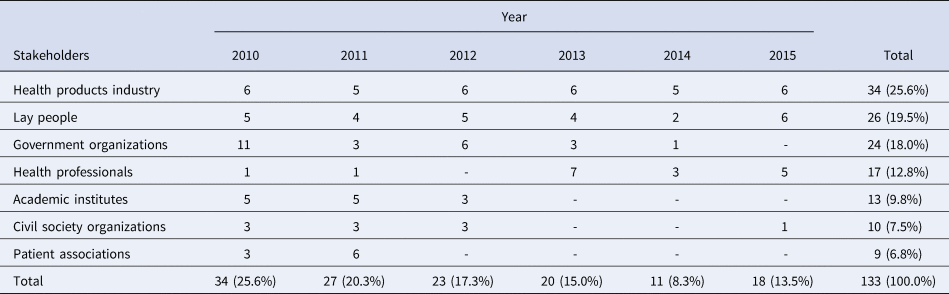
From the establishment of the UCS participatory technology appraisal mechanism in 2010 until 2015, a total of 133 interventions were proposed by different groups of stakeholders. These included a wide range of interventions for disease prevention, screening and diagnosis, treatment, rehabilitation, multiple purposes, and other public health measures (20). Forty-two percent of the proposals involved treatment technologies, and the majority of submissions were made by the industry (25.6 percent), followed by those from lay people (19.5 percent), CSOs (7.5 percent), and patient associations (6.8 percent) (Table 1). The total number of proposed interventions decreased over time, from thirty-four in 2010 to eighteen in 2015 (Table 2). Health products industry consistently nominated five or six interventions every year. In contrast, academic institutes, CSOs, and patients’ associations were active during only the first couple of years.
Numbers of Stakeholder Submissions by Types of Interventions Nominated, 2010–2015
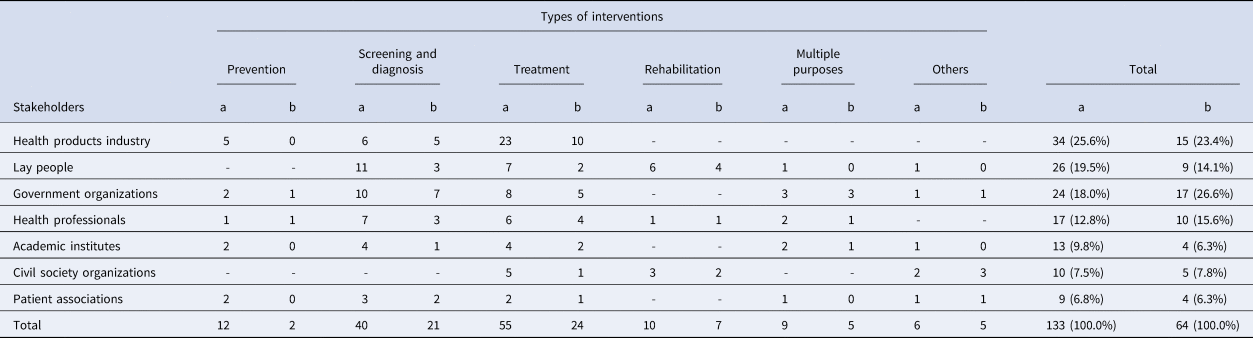
a Number of interventions nominated.
b Number of interventions selected for assessments.
Numbers of Stakeholder Submission in 2010–2015
Out of the 133 submissions, sixty-four were selected, by responsible working group, for assessment. As the working group's decisions and reasons were publicized, those who continued to support the rejected interventions can ask the secretariat for clarification and resubmit their proposals together with supportive evidence or information. As of January 2019, sixteen interventions with HTA results were adopted as UCS benefits, ten were rejected, and the remaining were still under review by HTA units and appraisal by the UCS authority.
Raising Problems of Access to Services on the Universal Health Coverage Agenda in Thailand
This article highlights the proposals that addressed problems with access to care and suggested improvements of existing programs in terms of effective coverage and quality of services. Table 3 provides four examples of the rationales of interventions proposed by CSOs and the pharmaceutical industry, with support from other stakeholders, for the UCS. The four examples were purposively chosen by the authors to illustrate stakeholders’ proposals for new interventions, as UCS benefits, or other types of policies to overcome the barriers to essential health care among socially-disadvantaged people. As shown in the table, key concerns of the stakeholders centered on health problems, poor quality of life, and difficulties in access to services by vulnerable populations. The four examples illustrate interventions that were rejected, accepted, or put forward for further consideration.
Selected Healthcare Interventions Proposed to the UCS and Rationale of the Proposal
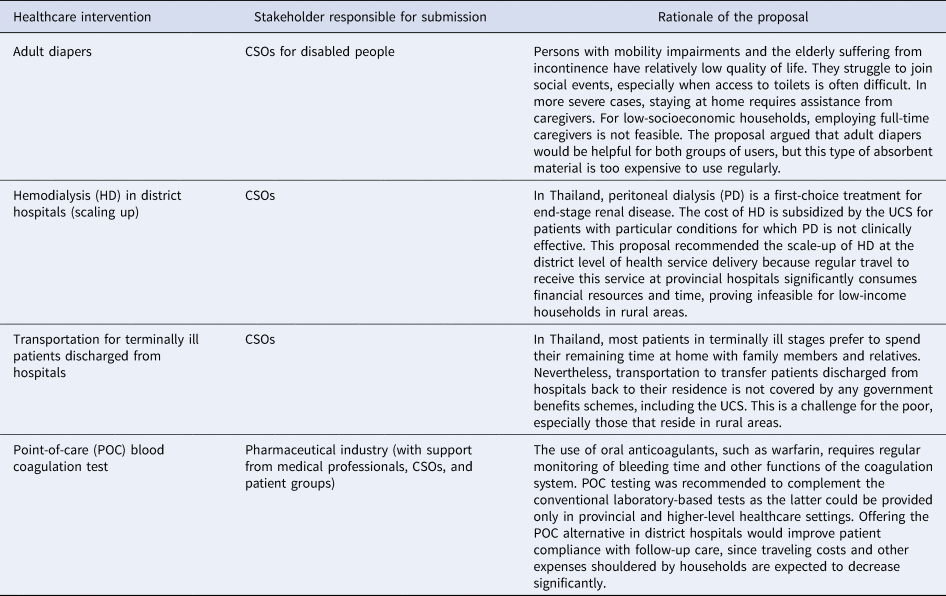
CSO, civil society organizations; UCS, Universal Coverage Scheme.
In 2011, the Benefits Package Committee decided to reject the intervention to provide adult diapers to eligible people because an HTA study indicated that providing diapers would result in financial burden that would be unaffordable for the UCS (Reference Slutsky, Tumilty and Max21). Regarding the intervention to scale up hemodialysis (HD) services in district facilities, it was found that this policy would not be cost-saving from the societal perspective; however, it could reduce traveling costs for each patient with end-stage renal disease by approximately USD 960 per year while the costs shouldered by the UCS would not increase. Due to this, in 2015, the UCS Committee agreed in principle to pursue HD expansion at the district level, and requested for additional studies to determine appropriate service delivery models and program feasibility (22).
In a similar vein, in 2015, the Committee decided to include transportation for terminally ill patients in the existing palliative care package in the UCS to subsidize the costs. Such a decision was informed by evidence, which showed a substantial cost reduction if patients were discharged to receive home-based palliative care (22). In addition, it was recommended that the NHSO collaborate with the MOPH to strengthen the palliative care program to ensure quality of service provision in the community. Lastly, an economic evaluation was conducted on the point of care blood coagulation tests. The study showed that providing this service at the district level as an integral component of the provincial health provider networks would offer value for money and, importantly, would increase access to care among those in rural, remote areas (Reference Santatiwongchai, Kulpeng, Sapu, Sookananchai and Teerawattananon23). This proposal and relevant HTA evidence will be presented to the Benefits Package Committee for consideration.
Lessons Learned
As a resource-limited country, Thailand's endeavor to implement a universal health coverage policy seemed ambitious. Over 15 years after the introduction of the UCS, this reform initiative has been analyzed for its enabling factors, impediments, and problem-solving approaches (Reference Tangcharoensathien, Witthayapipopsakul, Panichkriangkrai, Patcharanarumol and Mills24). This review contributes to the existing literature indicating that specific strategies to address the health needs of disadvantaged populations are indispensable, given that equity and pro-poor financial protection are ultimate goals of the UCS. The Thai experience reaffirms participatory technology appraisal as a supportive measure to providing universal health coverage. The policy-making mechanism allows stakeholders to play an important part, enabling them to direct the attention of policy makers to significant gaps in access to services among vulnerable people, a health system problem rarely brought to discussion by policy elites and clinical specialists.
Although successes in agenda setting cannot guarantee achievements in further stages of policy development and implementation, ideas and advocacy that inspired previous policy change can have “spillover effects” on other innovations in similar or adjacent areas (Reference Baumgartner and Jones25). As such, the perceived value for health equity among stakeholders and decision-makers for the UCS may be influential in mobilizing support for future proposals that aim to reduce the disparities in access to health services among the poor and underserved.
Despite the positive consequences, a major challenge in the introduction of the UCS policy-making mechanism is that stakeholders may be discouraged from participation due to several factors. As mentioned earlier, some groups hesitate to take part in discussions about technical elements of health problems and interventions. Another threat is that the process of technology appraisal until the decisions are made takes a long time, and only a small number of proposed interventions have been adopted as new benefits. Without clear information on the progression and decision on each submission, stakeholders might believe that their involvement is wasteful.
This review aims to share the Thai experience in introducing participatory technology appraisal and how such an approach can contribute to improving access to healthcare among vulnerable people. However, the points of discussion in this study are restricted to the early phase of policy agenda setting. Given that the UCS finances health services for 47 million citizens, its coverage policies are highly political, because they have substantial effects on the beneficiaries, industry, health providers, and the public. To get insight into further stages of policy development and impact on health equity, in-depth studies to assess the influences of key stakeholders, and contextual factors on the policy formulation and implementation, as well as quantitative data analysis of health outcome among people in different socioeconomic groups are necessary.
Acknowledgments
HITAP is funded by the Thailand Research Fund under the senior research scholar on Health Technology Assessment (RTA5980011). HITAP’s international unit has been supported by the international Decision Support Initiative (funded by the Bill & Melinda Gates Foundation and the Department for International Development (DFID), the United Kingdom government department responsible for administering overseas aid to promote sustainable development and eliminate world poverty) and the Rockefeller Foundation to provide technical assistance on health intervention and technology assessment for governments of low- and middle-income countries. The findings, interpretations and conclusions expressed in this article do not necessarily reflect the views of the aforementioned funding agencies. The funders had no role in study design, data collection and analysis, decision to publish, or preparation of the manuscript.
Conflicts of interest
The authors have nothing to disclose.


 Open access

