

Introduction
Grebes (order Podicipediformes) are a monophyletic taxon including 22 species of diving birds. They mainly inhabit fresh waters, but some species visit the sea when migrating and in winter (Fjeldså Reference Fjeldså2004). They represent one of the groups of birds with the highest proportion of species facing the risk of extinction. Three grebe species are considered recently extinct (Alaotra Grebe Tachybaptus rufolavatus, Atitlán Grebe Podilymbus gigas and Colombian Grebe Podiceps andinus) and five of the 19 remaining are threatened, two categorised as “Critically Endangered”, one “Endangered” and two “Vulnerable” (BirdLife International 2012). This high proportion of extinct or at risk species shows the high vulnerability of grebes to anthropogenic changes in their habitats, probably as a result of the elevated degree of specialisation and low capacity of dispersion, which in some cases has resulted in a very restricted range (O’Donnell and Fjeldså 1997, Fjeldså Reference Fjeldså2004). For example, the Colombian Grebe inhabited wetlands in the Eastern Andes of Colombia. This species was last recorded in 1977 and is now considered extinct, as a combined result of wetland drainage, siltation, pesticide pollution, disruption by reed harvesting, hunting and predation by introduced rainbow trout Oncorhynchus mykiss (Fjeldså Reference Fjeldså1993, BirdLife International 2012).
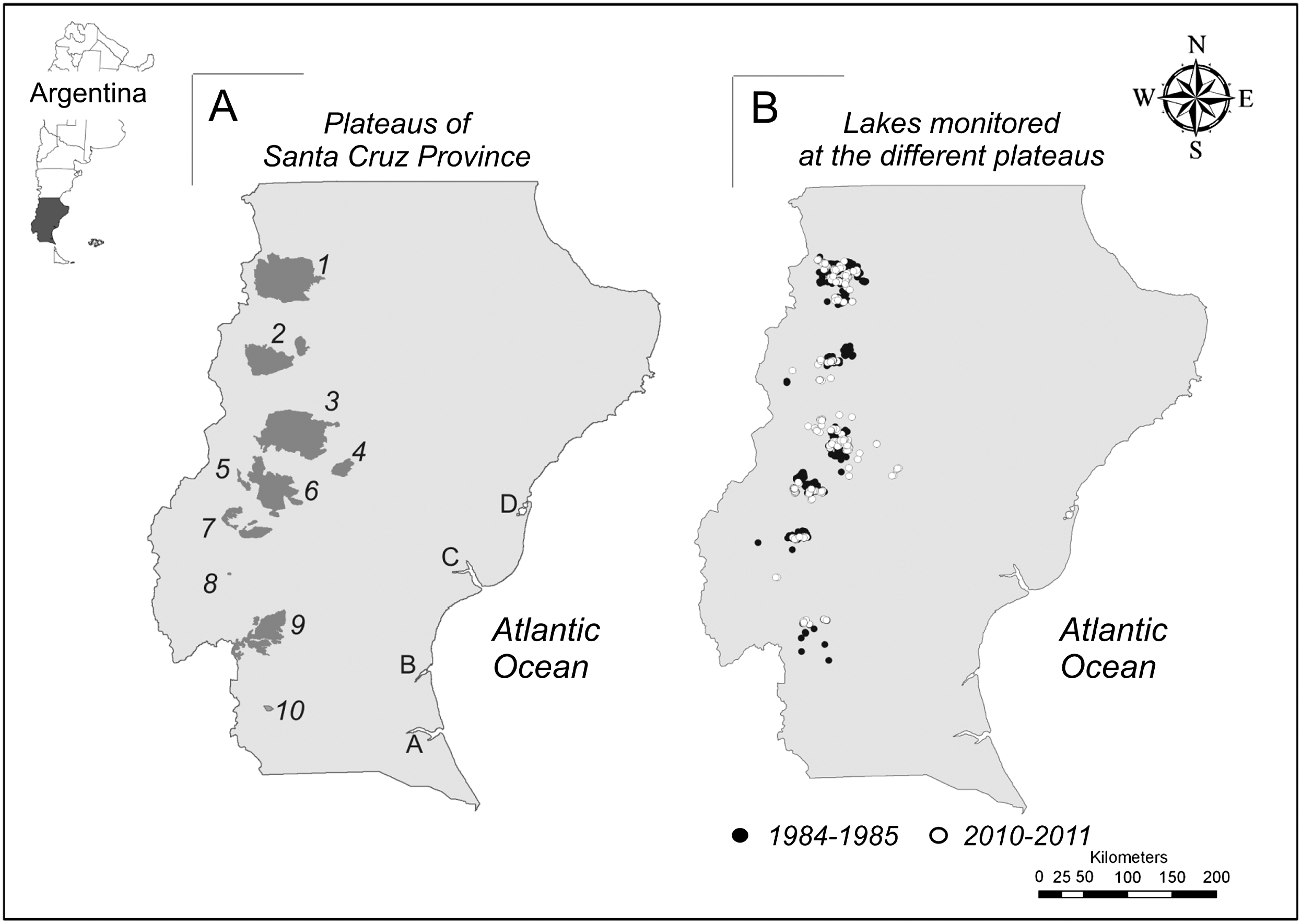
The Hooded Grebe Podiceps gallardoi was discovered in 1974 at Escarchados Lagoon, Santa Cruz province, in the extreme south-west of Argentina (Rumboll Reference Rumboll1974). At that time, because of the presumed very restricted range of the species and the lack of searches in other areas, the population size was estimated at 140–150 individuals (Erize Reference Erize1983) and the species was categorised as globally endangered. During late 1970s and early 1980s, extensive field surveys conducted by Fundación Vida Silvestre Argentina (FVSA) indicated that the distribution of this species included other areas of Santa Cruz province (Johnson Reference Johnson1997), and the population was then estimated at 3,000–5,000 individuals (Fjeldså Reference Fjeldså1986, Beltrán et al. Reference Beltrán, Bertonatti, Johnson, Serret and Sutton1992). Accordingly, in 1994 the species was downlisted to Lower Risk-near threatened. Also in 1994, after a long period of speculation about where this species wintered, 462 adults were discovered at the estuary of the Coyle River, on the Atlantic coast of southern Santa Cruz province (Johnson and Serret Reference Johnson and Serret1994). Extensive surveys during 1998–2004 along the Atlantic coast of southern Argentina and the southern Pacific coast of Chile indicated that the main wintering grounds were the estuaries of the rivers Coyle and Gallegos in the southern part of Santa Cruz province (Imberti et al. Reference Imberti, Sturzenbaum and McNamara2004). The present consensus is that the entire population spends the breeding season (from October to March) at lakes on the high basaltic plateaus of western Santa Cruz, whereas their wintering grounds are at a few estuaries in the Atlantic coast of this province (Figure 1A). They seem to be accidental or marginal visitors in Chile with only one convincing record in Tierra del Fuego (Barros Reference Barros2010).
(A) Numbers indicate the main basaltic plateaus at Santa Cruz province where Hooded Grebes Podiceps gallardoi spend the breeding season (October–March). 1: Buenos Aires, 2: Asador, 3: Strobel, 4: Ventana, 5: Moro, 6: Siberia, 7: Viedma, 8: lake La Gringa, 9: Vizcachas, and 10: La Torre. Letters indicate wintering sites on the Atlantic coast. A and B: estuaries of the rivers Gallegos and Coyle, respectively. C: river Santa Cruz, and D: San Julián bay. (B) Location of the lakes visited on surveys conducted during the breeding seasons 1984/1985 (black dots) and 2010/2011 (open dots).
Counts conducted on the wintering grounds during 1998–2004 (Imberti et al. Reference Imberti, Sturzenbaum and McNamara2004) were not consistent with the results of counts conducted at the breeding grounds in the 1980s (Beltrán et al. Reference Beltrán, Bertonatti, Johnson, Serret and Sutton1992), suggesting a marked decline. Only a single juvenile was observed during these winter counts and surveys conducted in 2000–2008 at key lakes where Hooded Grebes bred in the 1980s, also showed marked declines (S. Imberti unpubl. data, Konter Reference Konter2008). Although numbers may fluctuate considerably at breeding sites from year to year as a result of movements among lakes (Fjeldså Reference Fjeldså1986), the paucity of individuals observed on the wintering and breeding grounds indicates a real population decline. To ascertain this, we conducted extensive surveys on the main plateaus of Santa Cruz province during the breeding seasons 2008/2009, 2009/2010 and 2010/2011 and monitored 251 lakes, including the majority of lakes where Hooded Grebes had been previously reported. Here we present the main results of these surveys. In particular, we report the numbers observed on the different plateaus and the location, number and fate of the nesting attempts observed. We compare our results with those of a similar extensive survey conducted during the breeding season 1984/1985 by FVSA (Johnson Reference Johnson1997), and analyse population trends on most plateaus. Finally, we discuss possible causes of the decline and propose conservation actions to protect this species.
Methods
Study site
The study was conducted in the province of Santa Cruz, Argentina, which is located at the southern tip of continental South America (southern Patagonia), between the Andes on the west and the Atlantic Ocean on the east. Parallel to and east of the Andes, there are several basaltic plateaus or “mesetas”. The main plateaus from north to south are: “Buenos Aires”, “Asador”, “Strobel”, “Ventana”, “Moro”, “Siberia”, “Viedma” and “Vizcachas” (Figure 1A); they extend from 47°S to 51°S, with elevations varying between 500 and 1,500 m asl. These plateaus areas range from 30 to 2,900 km2 and hold endorheic volcanic and non-volcanic lakes that accumulate water from precipitation and snow melt during winter, their number varying greatly among plateaus (Roesler et al. Reference Roesler, Imberti, Casañas and Volpe2012). The physicochemical characteristics of water in these lakes are mainly determined by the composition of the underlying bedrock, which results in a wide diversity of limnological characteristics (Lancelotti et al. Reference Lancelotti, Pozzi, Yorio, Diéguez and Pascual2009). Many of these lakes, naturally devoid of fish, are covered by dense macrophyte stands of water milfoil Myriophillum quitense, and sustain a rich aquatic biodiversity (Fjeldså Reference Fjeldså1986). Because many of these lakes have exceptionally large numbers of colonial bird species and hold significant numbers of globally threatened Hooded Grebes, some plateaus (Buenos Aires, Asador and Strobel) are considered Important Bird Areas (IBAs; Imberti Reference Imberti and Di Giacomo2005a,Reference Imberti and Di Giacomob,Reference Imberti and Di Giacomoc).
Study species
The breeding distribution (early October–late March) of Hooded Grebes extends over high basaltic plateaus of Santa Cruz province (Erize Reference Erize1983, Fjeldså Reference Fjeldså1986, Beltrán et al. Reference Beltrán, Bertonatti, Johnson, Serret and Sutton1992). Hooded Grebes nest from late November to February in clear water lakes with dense floating aggregations of M. quitense, which they use to build their nests. Nesting largely occurs in colonies from several up to more than 100 pairs. They lay two eggs, incubation lasts 20–21 days, hatching is asynchronous and the second egg is usually abandoned (Fjeldså Reference Fjeldså1986, Beltrán et al. Reference Beltrán, Bertonatti, Johnson, Serret and Sutton1992). Chicks are fed with very small items at first (midge pupae, copepods, bugs and larvae of water beetles) and after two weeks their diet switches mainly to larger prey, especially the snail Lymnaea diaphana, which is also the main food item of adults during the breeding season (Fjeldså Reference Fjeldså1986). If the first breeding attempt fails, the pair may undertake a second breeding attempt (Beltrán et al. Reference Beltrán, Bertonatti, Johnson, Serret and Sutton1992) or even a third (I. Roesler unpubl. data). By the end of March–early April, adults and juveniles move to wintering sites on the Atlantic coast (Johnson and Serret Reference Johnson and Serret1994) as most lakes on the plateaus freeze. Main wintering sites are the Gallegos and Coyle estuaries (Imberti et al. Reference Imberti, Sturzenbaum and McNamara2004), with occasional records on the river Santa Cruz and in San Julián bay (Johnson and Serret Reference Johnson and Serret1994, Imberti et al. Reference Imberti, Sturzenbaum and McNamara2004; Figure 1A).
Data collection
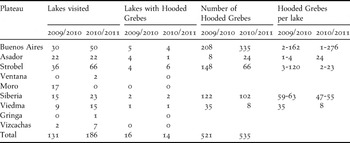
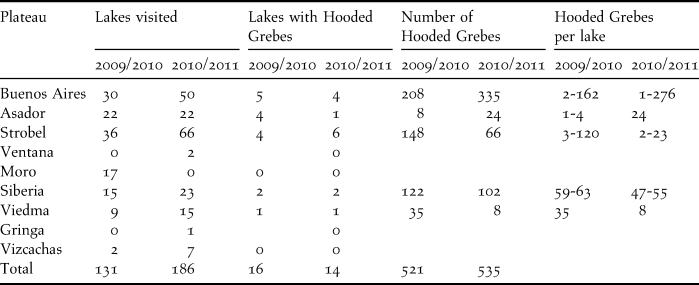
During the breeding seasons 2008/2009, 2009/2010 and 2010/2011 we visited 251 lakes located on the main plateaus of Santa Cruz province (Figure 1A). The 2008/2009 survey was exploratory and included only 38 lakes; those surveys conducted in 2009/2010 and 2010/2011 were more exhaustive and included 131 and 186 lakes, respectively (Table 1). Lakes identified as suitable habitat for Hooded Grebes in 2008/2009 and 2009/2010 were revisited in 2010/2011. During these surveys we visited most lakes at which the presence of Hooded Grebes had been previously reported.
Number of Hooded Grebes on the main plateaus of Santa Cruz province observed during the surveys conducted during the breeding seasons 2009/2010 and 2010/2011. For each plateau we indicate the number of lakes visited, the number of lakes at which we observed Hooded Grebes, the total number of Hooded Grebes and the range of individuals per lake.
At each lake we conducted censuses of Hooded Grebes and other birds. People involved in the censuses had previous experience identifying waterfowl species at Patagonian lakes. Bird identification was done with 15-60 x spotting scopes and 10 x 42 binoculars. Counts were conducted independently by 2–4 observers and each observer performed at least two consecutive counts. We considered that the number of Hooded Grebes in a given lake was the most frequent value of these counts. When weather conditions were not appropriate (i.e. strong winds) we doubled the number of counts. We consider that a pair was nesting only if we observed that one of the members of the pair was incubating, as some individuals can build the nest structure and abandon it before laying. Lakes within the same plateau were visited serially in relatively short periods of time (1–3 days) to minimise the risk of double counting birds that could have moved among lakes. We only included in our analysis counts conducted from January to March. We did not include a few counts conducted early in the breeding season (mid-late October and November) because Hooded Grebes tend to aggregate at a few lakes at first from which they move to those where they actually attempt to breed later (I. Roesler unpubl. data). The inclusion of these early counts could have led us to overestimate the Hooded Grebe population.
Comparison with previous censuses
From 1978 to 1994, FVSA conducted regular surveys to monitor Hooded Grebes in Santa Cruz Province. They visited 470 lakes located on the main plateaus of Santa Cruz province and reported Hooded Grebes in 113 lakes (Johnson Reference Johnson1997). The most intensive survey was conducted during the 1984/1985 breeding season when FVSA visited 90 of the 113 lakes where Hooded Grebes had been previously observed and found them at 78 lakes. The lakes visited are located on Buenos Aires plateau (21 lakes), Asador (13 lakes), Strobel (34 lakes), Moro (2 lakes), Siberia (15 lakes), Viedma (2 lakes), and Vizcachas (2 lakes) and Perito Moreno National Park (1 lake). We compared the data collected on that survey with those obtained in the 2010/2011 breeding season, as surveys visited most lakes where Hooded Grebes had been previously reported.
Results
Present population of Hooded Grebes
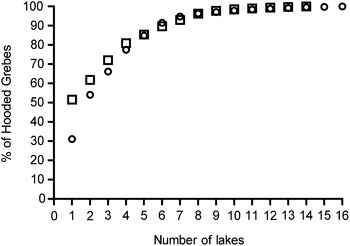
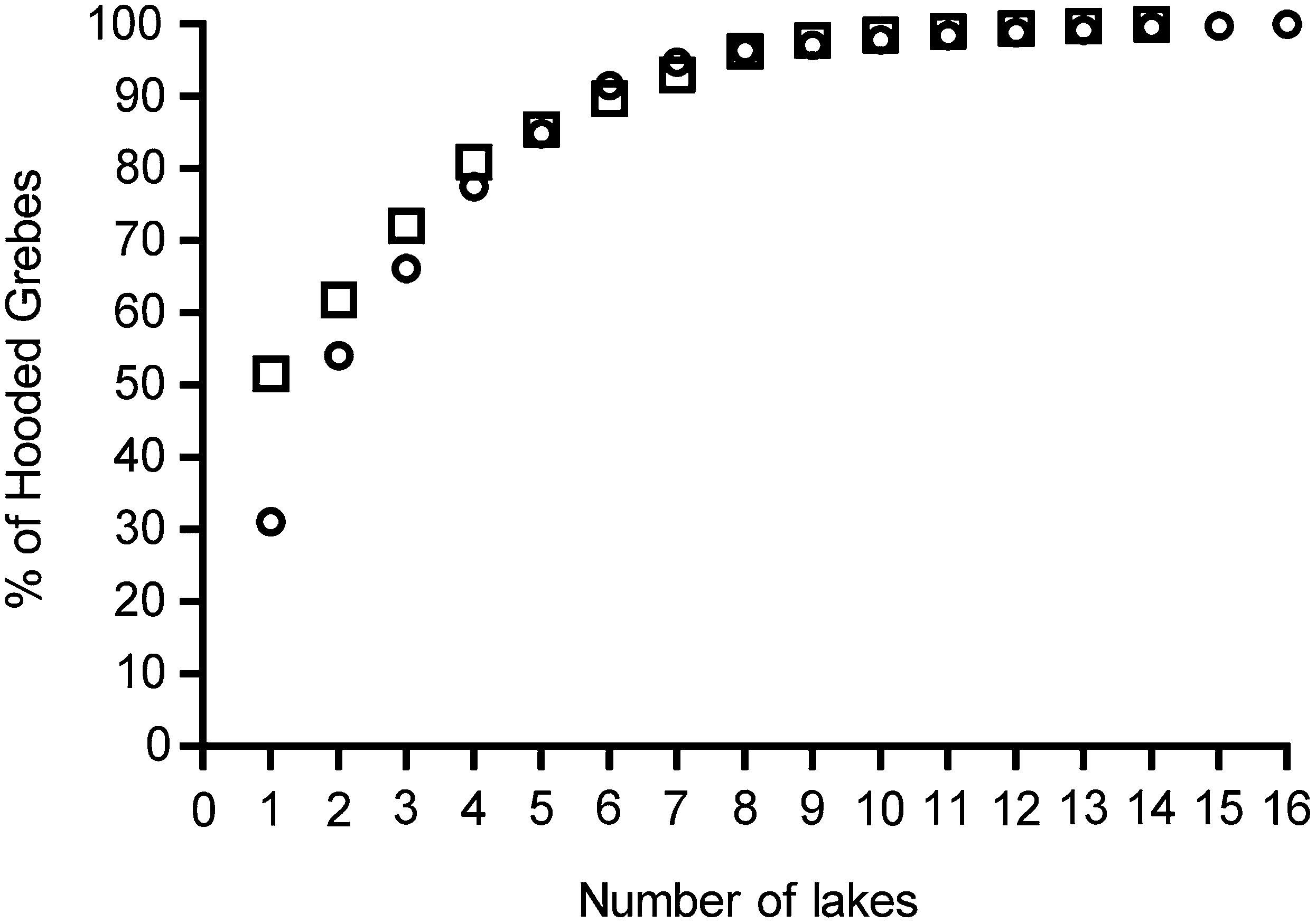
During the breeding seasons 2009/2010 and 2010/2011 we visited 251 different lakes (131 in 2009/2010 and 186 in 2010/2011; Table 1). Thirty-seven lakes in 2009/2010 and 39 in 2010/2011 were dry. In 2009/2010 we observed 521 Hooded Grebes at 16 lakes, whereas in 2010/2011 we observed 535 at 14 lakes (Table 1). The number of Hooded Grebes per lake ranged from one to 162 in 2009/2010 and one to 276 in 2010/2011. In both seasons the same plateaus contained most of the Hooded Grebes: Buenos Aires (first: 40%, and second: 63%), Strobel (28% and 12%), and Siberia (23% and 19%), and five lakes contained nearly 85% of the population (Table 1 and Figure 2).
Cumulative percentage of population as a function of number of lakes with Hooded Grebes. Lakes are ranked according to the number of Hooded Grebes (from the highest to the lowest). Circles show data from the survey conducted during the breeding season 2009/2010. Squares show data from the survey conducted during the breeding season 2010/2011.
Nesting attempts
In 2009/2010 Hooded Grebes attempted to breed at two lakes, both on Buenos Aires plateau. At Toldería Grande there were 38 individuals and a colony of seven nests. This colony started in mid-January and all nests were rapidly abandoned at the egg stage. The cause of abandonment was suspected of being an American mink Neovison vison (one shot, 5 observed; J. Arriagada pers. comm.). By early March, we observed eight individuals and four nests at Jara lake. We suspect that these individuals moved from Toldería Grande after the colony failed, as there were no Hooded Grebes at Jara in January and these lakes are less than 10 km apart. Two chicks hatched in late March, but neither survived due to low temperatures (the lake froze).
In 2010/2011 we observed nesting attempts at two different lakes on Buenos Aires plateau. At El Cervecero there were 55 individuals and a colony of 11 nests, which failed in early February at the egg stage due to very strong winds. Almost immediately, there was a second breeding attempt by the same individuals. This new colony had 21 nests and failed by early March when one American mink killed 33 nesting adults (Roesler et al. Reference Roesler, Imberti, Casañas and Volpe2012). At El Sello there were 276 individuals and a colony of 79 nests, which failed also at the egg stage by early February due to strong winds. A second breeding attempt followed and involved 126 nests. Most (n = 98) failed, probably due to a combination of strong winds and competition with other waterfowl. The other nests (n = 28) hatched chicks by mid-March, but all chicks died as a result of low temperatures.
Comparison between present and past surveys
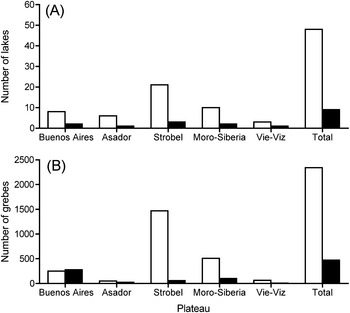
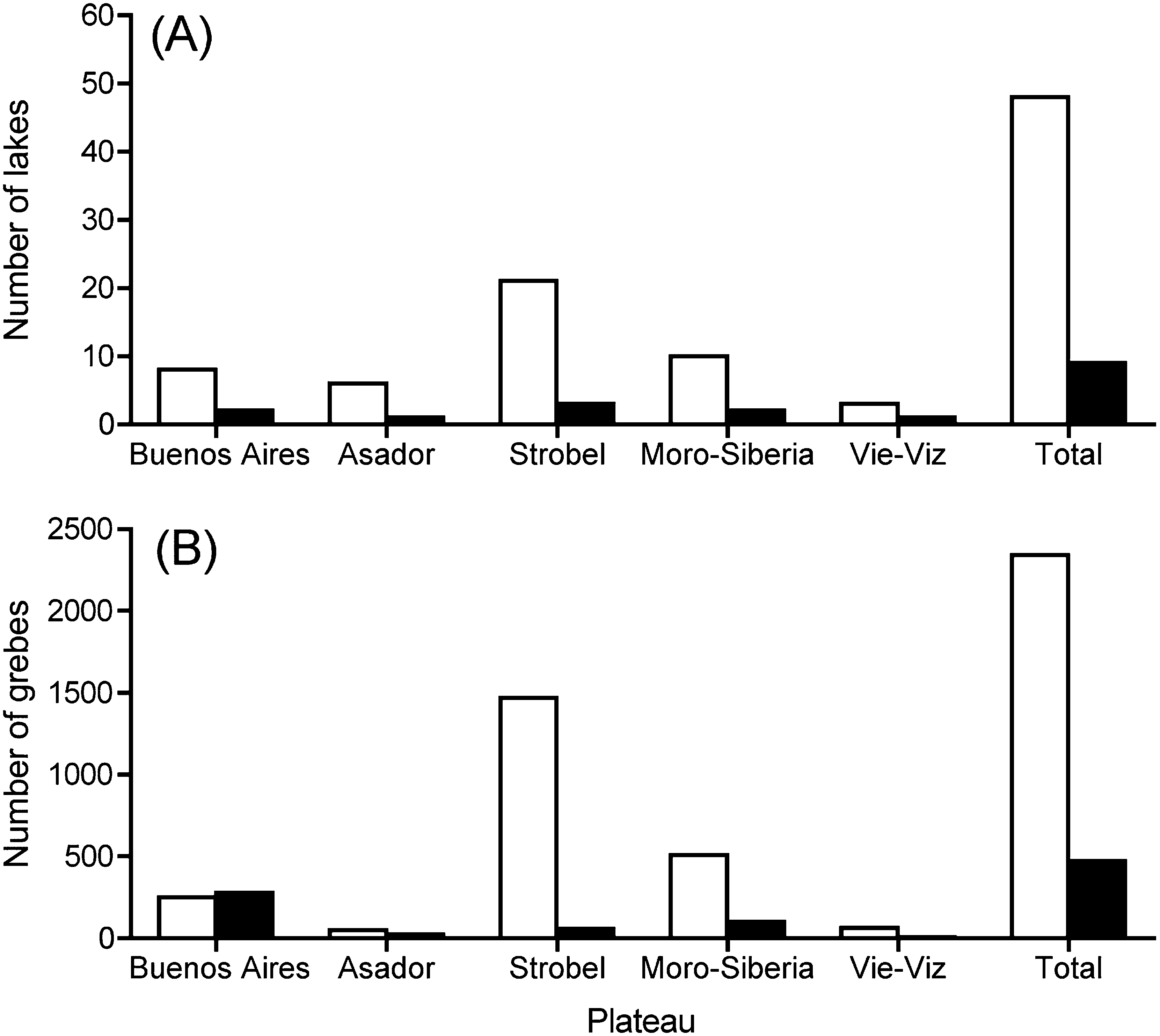
During the breeding season 1984/1985, FVSA conducted a survey of 90 lakes where the presence of Hooded Grebes had been previously reported and observed 2,691 adult Hooded Grebes in 78 lakes. We compared these results with ours (2010/2011) using 58 lakes that were visited on both surveys. These lakes held 87% and 88% of the individuals reported on respective surveys. The number of Hooded Grebes observed in 1984/1985 was 2,352 distributed at 48 lakes vs. 471 at nine lakes in 2010/2011, an overall decline of 80% (Figure 3). The greatest decline (96%) occurred on Strobel plateau (1,469 vs. 58 individuals; Figure 3), largely due to the disappearance of Hooded Grebes at El Islote lake, which had 1,045 individuals in 1984/1985 and none in 2008/2009, 2009/2010 and 2010/2011. In contrast, we did not detect a decline on Buenos Aires plateau (252 vs. 279 individuals; Figure 3). Another important difference is that in 1984/1985 there were 409 juveniles, while we did not observe any juveniles in our surveys.
(A) Bars show the number of lakes and (B) number of Hooded Grebes on the main plateaus of Santa Cruz province in southern Patagonia, Argentina, in 1984/1985 (white bars) and 2010/2011 (black bars) surveys. Due to small numbers, plateaus Moro and Siberia, and Viedma and Vizcachas were grouped.
Discussion
We consider that our surveys at the breeding grounds provide a good estimation of the Hooded Grebe population because: 1) they encompassed 251 lakes on the most important plateaus of Santa Cruz province, including all lakes where Hooded Grebes had been reported in the 1980s; 2) the number of Hooded Grebes observed on these surveys (and also in a recent survey conducted during the 2011/2012 breeding season) was relatively similar (521 in 2009/2010 and 535 in 2010/2011); and 3) the number of Hooded Grebes observed on the breeding grounds was similar to that observed at censuses conducted at the wintering grounds (i.e. the number of Hooded Grebes in the estuaries of the rivers Coyle and Gallegos during May 2011 was 449 and 310 adults, respectively, and there were no juveniles; S. Imberti unpubl. data).
Our results indicate that between 1985 and 2010 the population of Hooded Grebes on the breeding grounds on the plateaus of Santa Cruz diminished by 80%. This decline was greatest on the Strobel plateau (> 95%) and least at Buenos Aires plateau, where there was no evidence of decline. Other populations diminished between 50% and 85%. As a result of these changes, the Buenos Aires plateau now holds 60% of the total population. In addition to this severe decline in the overall population, we did not observe any recruitment of juveniles.
Our results also indicate that most Hooded Grebes now attempt to breed at only a few lakes, where they aggregate in relatively large numbers. For example, in 2009/2010, 78% aggregated at just four lakes and in 2010/2011, the percentage in four lakes was 81%. Three of these lakes were the same in both breeding seasons (El Sello, on Buenos Aires plateau, and C199 and C221 on Siberia plateau), indicating that a great percentage of the population of Hooded Grebes is highly dependent on very few lakes. These lakes share some characteristics, such as shelter from prevailing winds, crystal-clear water and dense floating aggregations of M. quitense. Similar results were reported by Lancelotti et al. (Reference Lancelotti, Pozzi, Yorio, Diéguez and Pascual2010), who after analysing the characteristics of 29 lakes ranging from two to 60 ha on Strobel plateau concluded that medium-sized lakes with mosaics of floating waterweed and areas of open water had the highest probability of Hooded Grebe presence and abundance.
Causes of decline
Several threats have been proposed to explain the decline of Hooded Grebe populations and we have organised them into three main categories: biotic, abiotic and incidental. The first category includes: a) depredation of eggs and chicks by Kelp Gulls Larus dominicanus (Erize Reference Erize1983, Beltrán et al. Reference Beltrán, Bertonatti, Johnson, Serret and Sutton1992), b) competition and depredation by rainbow trout (Imberti and Casañas Reference Imberti and Casañas2010), c) depredation of eggs, chicks and adults by American mink (Roesler et al. Reference Roesler, Imberti, Casañas and Volpe2012) and d) competition or interference with other waterfowl over nest sites (Imberti and Casañas Reference Imberti and Casañas2010). The second category includes: a) soil erosion caused by overgrazing, which may result in colmatation and changes in physicochemical conditions of lakes (Borrelli and Oliva Reference Borrelli and Oliva2001), b) volcanic eruptions, which also may affect, at least temporarily, the availability of suitable breeding lakes, as a result of the influx of volcanic ash (O’Donnell and Fjeldså 1997), c) an apparent increase in the average wind speed during the breeding season (O. Bonfilli pers. comm.), which may affect nest survival, and d) a drought cycle, which may reduce availability of lakes suitable for breeding (O. Bonfilli pers. comm.). The third category includes: a) bycatch in fisheries at the estuaries of the rivers Coyle, Gallegos and Santa Cruz, and b) harmful effects of artificial lights in cities near the wintering grounds, which may confuse migrants and produce collisions (e.g. there are two records for Hooded Grebes at Río Gallegos city, and it has been reported as an important threat for some migratory grebes of North America; Cullen et al. Reference Cullen, Jehl, Nuechterlein and Poole1999).
Below, we discuss in more detail what we consider the most important threats that could be mitigated by conservation actions.
Depredation of eggs and chicks by Kelp Gulls
Populations of Kelp Gulls have been expanding in several regions of the southern hemisphere (Yorio et al. Reference Yorio, Bertellotti and García Borboroglu2005), including northern Patagonia, where the number of breeding pairs increased by 37% in the last 15 years (Lisnizer et al. Reference Lisnizer, García-Borboroglu and Yorio2011). Besides, there is a recent record of a new colony of Kelp Gulls in freshwater environments in western Patagonia (Frixione et al. Reference Frixione, Casaux, Villanueva and Alarcón2012). This species has negative effects on other species of birds through competition, kleptoparasitism and predation on eggs and chicks (Yorio and Quintana Reference Yorio and Quintana1997).
We confirmed the presence of Kelp Gulls on all plateaus except Ventana. In the survey conducted during the 2010/2011 breeding season, we observed 46 Kelp Gulls at 19 lakes. In five of these lakes there were Hooded Grebes, including the two lakes where we observed breeding colonies (El Cervecero and El Sello). In addition, in a survey conducted during the 2011/2012 breeding season we detected a colony of nearly 100 pairs on one lake on Buenos Aires plateau (I. Roesler unpubl. data). We observed that the presence of Kelp Gulls at the colonies was associated with protective behaviour of nesting Hooded Grebes during the period the gulls were in the breeding area (i.e. they flew or swam back to the nest, sat on top of it and emitted distress vocalisations). Beltran et al. (1992) reported that Kelp Gulls destroyed a complete colony of Hooded Grebes in a short period of time. Although we did not directly observe predation of Kelp Gulls on Hooded Grebe chicks, we recorded a Kelp Gull feeding on an abandoned Hooded Grebe nest and observed an attack on a Silvery Grebe Podiceps occipitalis that was nesting together with Hooded Grebes. Besides, there is evidence of predation on a young Hooded Grebe (deposited at the Museo Argentino de Ciencias Naturales) that was killed by a Kelp Gull on Vizcachas plateau in 1981. There are no historical counts of Kelp Gulls on the lakes of most plateaus of Santa Cruz province, but it is likely that the abundance of this species has increased as a result of the growth of human activities at most plateaus, and in particular, as a result of fish waste generated by rainbow trout farms on Strobel plateau.
Interactions (competition – depredation) with rainbow trout
Since 1940, but more intensely in recent years, many lakes of the Patagonian plateaus have been stocked with rainbow trout, generating a growing aquaculture activity (Lancelotti et al. Reference Lancelotti, Pozzi, Yorio, Diéguez and Pascual2009). Rainbow trout has been introduced mainly to lakes on the Strobel plateau, but some lakes on the Buenos Aires plateau connected to rivers may also now have populations.
The introduction of exotic fish species has been identified as the primary cause of ecological disturbance in shallow lakes of Patagonia, as it could affect communities and physicochemical characteristics of lakes, leading to a change in the steady state (i.e. turbid water, without submerged macrophytes), which results in important habitat losses for waterbirds (Ortubay et al. Reference Ortubay, Cussac, Battini, Barriga, Alonso, Macchi, Reissig, Yoshioka and Fox2006, Reissig et al. Reference Reissig, Trochine, Queimaliños, Balseiro and Modenutti2006, Buria et al. Reference Buria, Albariño, Villanueva, Modenutti and Balseiro2007). For example, the introduction of exotic fishes of the families Percichthyidae and Salmonidae into some lakes of northern Patagonia produced a decrease in water transparency and in the abundance of Amphipoda, Cladocera and Copepoda, and a drastic decline of the populations of Red-gartered Coot Fulica armillata and Black-necked Swans Cygnus melancoryphus (Ortubay et al. Reference Ortubay, Cussac, Battini, Barriga, Alonso, Macchi, Reissig, Yoshioka and Fox2006). Similarly, Reissig et al. (Reference Reissig, Trochine, Queimaliños, Balseiro and Modenutti2006) analysed 18 Patagonian lakes (fishless, with introduced fish and with endemic fish) along a latitudinal gradient from 39° to 49° S, and found that the introduction of fish for recreational purposes into fishless lakes has resulted in changes in zooplankton size spectrum that seem to cascade down to phytoplankton, favouring the dominance of cyanobacteria. These authors conclude that introduction of fish into Patagonian lakes is a practice that should be re-evaluated by governments due to its potentially negative impact on lakes and waterbirds.
We observed that many lakes on Strobel plateau (El Islote, Las Encadenadas, La Herradura; Fjeldså Reference Fjeldså1986, Johnson Reference Johnson1997, Beltrán et al. Reference Beltrán, Bertonatti, Johnson, Serret and Sutton1992) lacked Hooded Grebes a few years after the introduction of the rainbow trout. The most dramatic case was El Islote lake, where more than 1,000 individuals and 120 nests were observed in 1984/1985 and which has no Hooded Grebes at present. This lake was stocked with rainbow trout at the beginning of this century and at present it is one of the main lakes dedicated to aquaculture on the Strobel plateau. Although there have been no specific studies analysing changes in aquatic communities and physicochemical characteristics of this lake, it seems reasonable to assume the same transformation experienced by other lakes on Strobel plateau where rainbow trout was introduced (Reissig et al. Reference Reissig, Trochine, Queimaliños, Balseiro and Modenutti2006). As regards direct predation, local farmers told us that large individuals of rainbow trout (they can reach up to 16 kg of body mass) feed on chicks and even adults of different species of waterbirds, most of them bigger than Hooded Grebes.
Some authors (e.g. Lancelotti et al. Reference Lancelotti, Pozzi, Yorio, Diéguez and Pascual2010) reported that trout farmers have mainly stocked large unvegetated lakes, while critical habitat for Hooded Grebes (and also for other waterbirds) is large vegetated lakes. However, these authors also recognise that some large vegetated lakes have been stocked with rainbow trout. Therefore, there is some geographical overlap between waterbird habitat and trout farming that could help to explain the severe decline of Hooded Grebes on Strobel plateau. Competition and depredation by introduced fish have contributed to the extinction of Atitlán (LaBastille Reference LaBastille1984) and Colombian (Fjeldså Reference Fjeldså1993) Grebes. Therefore, the stocking of shallow lakes on Strobel and other plateaus with rainbow trout should be carefully re-evaluated by governments due to its negative impact on Hooded Grebes.
Depredation by American mink
This small semi-aquatic predator originates from North America and has been introduced to many parts of the world where it has negatively affected native species (Bonesi and Palazon Reference Bonesi and Palazon2007). The American mink was brought to Patagonia for fur farming. During the 1940s and 1950s, several breeding farms were opened in Argentina in Chubut and Tierra del Fuego provinces, and later in northern Patagonia. Feral populations were first observed in western Chubut province in the 1960s (Fasola Reference Fasola2009). Now there are two apparently isolated populations, one that extends from northern Neuquén to central Santa Cruz, and another in Tierra del Fuego and nearby areas of continental Chile (Fasola Reference Fasola2009, Fasola et al. Reference Fasola, Muzio, Chehébar, Cassini and MacDonald2011).
In a study of American mink in northern Patagonia, an area where it is expanding, Peris et al. (Reference Peris, Sanguinetti and Pescador2009) found that the number of waterbird species and the abundance of some of them (i.e. Great Grebe Podiceps major, Speckled Teal Anas flavirostris, Chiloe Wigeon Anas sibilatrix and Red-gartered Coot) was higher in lakes without mink. Similarly, Schüttler et al. (Reference Schüttler, Klenke, McGehee, Rozzi and Jax2009) reported a decrease in nest survival of Upland Goose Chloephaga picta and Flightless Steamer Duck Tachyeres pteneres in association with the settlement of a feral population of American mink in Navarino Island in Southern Chile. Roesler et al. (Reference Roesler, Imberti, Casañas and Volpe2012) observed 33 Hooded Grebes killed by American mink at lake El Cervecero, where this predator caused the failure of a colony of 21 nests. We suspect that American mink may have caused the failure of a colony of seven nests at Toldería Grande lake during the 2009/2010 breeding season. Both lakes are on Buenos Aires plateau. The presence of American mink on this plateau, which holds the largest breeding population of Hooded Grebes, and its surplus killing behaviour (i.e. killing of more individuals than the predator could eat), makes this predator an important threat for Hooded Grebes.
Competition with other waterfowl over nest sites
Fjeldså (Reference Fjeldså1986) counted 13,000 individuals of different species of waterbirds at 118 lakes on the Strobel plateau. All of the large lakes he monitored (Strobel, El Islote, Cardiel) are no longer suitable for waterbirds due to the presence of rainbow trout, and many of the smaller lakes are dry as a consequence of the drought that has been affecting Santa Cruz province during recent years (O. Bonfilli pers. comm.). For example, El Sello lake, on Buenos Aires plateau, is relatively similar to El Islote, on Strobel plateau, but devoid of rainbow trout. At this lake we counted over 10,000 waterbirds in 2010/2011 (mainly Chiloe Wigeon, Black-necked Swan and Coscoroba Swan Coscoroba coscoroba), while at El Islote we counted only 210 birds (mainly Upland Goose). We suspect that the presence of rainbow trout at large lakes and the drying of small lakes have increased competition or interference over nesting sites and nesting material between Hooded Grebes and other waterbirds. Accordingly, we observed events at which Black-necked Swans destroyed, and Yellow-billed Pintails Anas spinicauda and Silvery Grebes Podiceps occipitalis usurped, Hooded Grebe nests.
Conservation actions
We estimate that current total population of Hooded Grebes is 800–900 individuals. Taking into account that at present most Hooded Grebes attempt to breed in a few lakes on Buenos Aires and Asador (and perhaps Siberia) plateaus, the first conservation action is to protect these lakes. The main actions at these lakes should be: 1) prevent the introduction of fish, in particular rainbow trout, 2) control and extirpate American mink, and 3) control anthropogenic sources of food for Kelp Gulls. Considering that in the 1980s most Hooded Grebes bred on Strobel plateau, it will be important to start a restoration programme at lakes that were used in the past. In addition, although there are no records of Hooded Grebes in fisheries bycatch at the main wintering grounds (estuaries of the rivers Coyle, Gallegos and Santa Cruz), there have been records of bycatch of other bird species (Flying Steamerduck Tachyeres patachonicus, Magellanic Penguin Spheniscus magellanicus, cormorants Phalacrocorax spp. and Great Grebe; M. B. Alegre, pers. comm.). Therefore, it is important not only to take conservation actions at the breeding grounds but also to study interactions between Hooded Grebes and fisheries at the wintering estuaries of the Atlantic coast of Santa Cruz.
Acknowledgements
We dedicate this work to the memory of Andrés Johnson, who conducted the first extensive surveys of Hooded Grebes in the late 1970s and early 1980s. We would like to thank three anonymous reviewers for their comments that considerably improved a previous version of this manuscript. We also thank Pablo Hernández and Diego Punta Fernández for their invaluable help during the surveys and their commitment with the “Macá Tobiano Project”. Besides, we wish to thank the following volunteers who helped us during the surveys: Martina McNamara, Mariana Martínez, Lorena Martínez, Mariano Bertinat, Hector Slongo, Juan Klavins, Gustavo Aprile, Luciano Bernacchi, Joel Zambrano and Pablo Rosso. National Parks Administration of Argentina helped us in different ways such as lodging, transport and information. For logistical assistance during the surveys we want to thank the owners of the following Estancias: “Punta del Lago”, “La Angostura”, “El Frigorífico” and “La Criolla”, “9 de Julio” and “El Sauce”, “La Vizcaína”, “El Porvenir”, “Laurat Bat”, “Rodeo 13”, and also the following people: A.S. Jara, E. Sandoval, Pancho Chicaguara, Tonchi Kusanovik, María Imas, Ana Rojo and Pedro and Juan Garitaonandia. This project was supported by: Becas Conservar la Argentina (Aves Argentinas/AOP); Pro Natura Japan; Neotropical Bird Club; Canadian Fish and Wildlife Service; Conservation, Research and Educations Opportunities (CREO); Servicios Públicos Sociedad del Estado de Santa Cruz; Kau Yatun Hotel de Campo; AAGE V. Jensen Charity Foundation; The Mohamed Bin Zayed Species Conservation Fund; and Birdlife Preventing Extinctions Programme. The complete team of Aves Argentinas and Ambiente Sur were kindly available to help us at any time. We also wish to thank O. Bonfilli for providing climatological information of the area and L. Fasola who kindly helped with Figure 1 and made very constructive comments on a previous version of this manuscript. I. R. was supported by a doctoral studentship from the Consejo Nacional de Investigaciones Científicas y Técnicas (CONICET). B. M. and J. C. R. are Research Fellows of CONICET.