


Politicians often engage in non-programmatic distribution to retain or attract voters’ support. For example, they may distribute private benefits (such as state-funded transfers or gifts) to individuals or party supporters or allocate a disproportionate number of small local public goods projects to specific communities. As I discuss in Chapter 2, politicians who engage in non-programmatic distribution often ask bureaucrats to manipulate administrative processes such as beneficiary lists or to engage in (or turn a blind eye to) corrupt acts such as the embezzlement of public funds or the uncompetitive awarding of public contracts.
Such acts can enable politicians to convert public funds into fungible assets and then control their distribution. For example, uncompetitive procurement can generate funds for politicians when selected contractors hand over some of the funds they receive to politicians or political parties. Engagement in corruption violates bureaucratic norms of professionalism and jeopardizes public service commitments. Where bureaucrats are recruited through partisan networks, such behavior may be expected. What is more puzzling is when meritocratically hired bureaucrats, who have job security, agree to engage in corrupt practices on behalf of politicians.
Corruption is typically defined as “the abuse of an entrusted power for private gain.”Footnote 1 Importantly, private gain need not mean gains to an individual, but extends to organizations, such as political parties. The dominant model of bureaucratic corruption posits that bureaucrats engage in corrupt acts when the benefits of doing so outweigh the costs.Footnote 2 Accordingly, the risk of corruption is higher if public sector salaries are low, or if bureaucratic monitoring and sanctioning are rare. This model best applies to a specific scenario: an individual bureaucrat is offered a bribe in exchange for a public service. Such acts may be referred to as “individual corruption” – an exchange between two individuals. “Coordinated corruption” requires the recipients to coordinate across multiple actors, often politicians and bureaucrats. In Chapter 4, I focus on a common form of coordinated corruption – the manipulation of public procurement processes – for three main reasons. First, a significant share of public budgets is spent on procuring goods and services from private firms. Second, corruption is often rife in this area. Third, bureaucrats are in charge of administering procurement processes.
Indeed, public procurement processes are inherently administrative. Bureaucrats must plan and design new projects, advertise for firms to respond to a tender, collect applications, and evaluate these applications. They then oversee the implementation of public works. Teams of politicians and bureaucrats who sit on procurement boards, rather than individual bureaucrats, typically make procurement decisions. The calculus of whether a bureaucrat engages in coordinated corruption is fundamentally different – and more complex – than whether they engage in individual corruption. Furthermore, the involvement of politicians – who serve as bureaucrats’ principals – ensures the need to consider the incentives of politicians, and the tools they may have available to influence bureaucrats’ actions. If politicians have leverage over bureaucrats’ careers – for example, over their promotions, work portfolios, or work locations – bureaucrats may be motivated to engage in corruption on behalf of their political principals even if the bureaucrats themselves are not personally compensated (or receive a much smaller kickback than the politician).
In Chapter 4, I present data from surveys and interviews with local bureaucrats across sampled local governments. Using this data, Chapter 4 generates two important findings. First, it demonstrates that corruption may be rife even where bureaucrats are hired based on merit rather than political ties. In Chapter 3, I presented evidence suggesting that highly ranked bureaucrats who work across local governments in Ghana are hired through competitive processes, independent of their partisan affiliations. Even so, the survey data I present below shows that nearly half of local bureaucrats (46%) agreed that public procurement contracts are distributed uncompetitively, with contracts awarded in exchange for party funding. Given their role in administering public contracts, these figures show that a significant share of bureaucrats engage in corruption. Second, the chapter establishes that corruption in public procurement across local governments is driven by the control that local politicians exercise over bureaucrats’ careers. The survey data shows that bureaucrats are more likely to agree that corruption occurs when they believe politicians can influence their careers. I focus on a specific type of career control tool – geographic transfers (politicians’ ability to reassign bureaucrats to alternative work locations). I also present evidence that bureaucrats expect politicians to retaliate with transfers if they stand up against corruption. I begin Chapter 4 by discussing how I measure corruption, before moving on to discuss different types of career control and providing qualitative evidence of which are most often used by local politicians in Ghana.
4.1 The Insufficiency of Meritocratic Recruitment
To engage in non-programmatic distribution, politicians have two primary avenues: (i) (re-)direct public money or (ii) illicitly extract public funds for this purpose. Illicit extraction is often done by manipulating public procurement processes, typically by “selling” public contracts to firms. In other words, firms pay a kickback to a politician in exchange for a public contract. Firms may also agree to direct a share of the money they receive for the project back to the incumbent party. In either case, the result is that public works are constructed to a lower standard than they would have been without the kickback or siphoned party contribution.
Firms often pay kickbacks to political parties or politicians. Yet, given the nature of public procurement processes, politicians generally need the co-operation of several bureaucrats to ensure the firm is awarded the contract. They can ensure such co-operation by employing bureaucrats who are loyal to them personally or to their party. Alternatively, they can hire bureaucrats on the basis of merit, but use career control tools to co-opt them. As I discuss in Chapter 3, bureaucrats who serve in high-level positions across local governments in Ghana are not typically hired based on their partisan ties; they are recruited centrally and then assigned to different local governments across the country depending on the availability of positions. This assignment process limits the influence of personal ties to individual politicians once bureaucrats are hired. Politicians gain from meritocratic recruitment, as it ensures that they get to work with highly competent bureaucrats.
4.1.1 Measuring Corruption in Public Procurement
Because corrupt acts are usually illegal, measuring corruption is inherently difficult. Every data collection method has advantages and disadvantages in terms of reliability. One common data source is experts’ perceptions of corruption such as Transparency International’s Corruption Perceptions Index. Yet for the current case, it would be very difficult for an external expert to get adequate information on the scale of corruption in a local government without working there personally. An alternative source is investigations of public accounts by independent auditors.Footnote 3 Yet while auditors do visit local governments in Ghana,Footnote 4 it is an open secret that mayors and bureaucrats bribe auditors not to report corruption. Therefore, instead of relying on these sources, I use surveys with bureaucrats to measure the prevalence of corruption in public procurement. I surveyed bureaucrats in the same types of positions in eighty local governments (see Chapter 1 for details of the survey).
The advantage of obtaining data from bureaucrats directly is that these actors have accurate information on the extent of corruption. However, there is a risk that they may underreport illegal behavior due to fears that the government will punish them for revealing financial misappropriation or simply a desire not to admit to socially undesirable acts in public.
To mitigate these concerns, I used a randomized-response (RR) indirect survey technique to obtain unbiased estimates of corrupt practices.Footnote 5 Researchers have shown that estimates derived using this method are much closer to observed actual rates of sensitive behavior compared to results based on direct survey techniques.Footnote 6 The RR method seeks to solicit honest answers about sensitive behavior by giving respondents plausible deniability.
Trained survey enumerators conducted the bureaucrat surveys. They gave respondents a dice, which served as a randomization device. Respondents used the dice to determine whether they should provide an honest or predetermined (“forced”) response. The enumerators did not observe what number the respondent rolled. Introducing random noise to responses protects respondents because enumerators do not know if a positive response is because of the roll or because it is the respondent’s honest answer.
Each respondent rolled the dice and followed a simple set of instructions. If they rolled a “1” they answered “yes” regardless of whether this was their truthful answer. If they rolled a “6” they answered “no.” If they rolled any other number, they were instructed to answer honestly. Critics of this method suggest that it is not an appropriate technique to use on respondents with low levels of education. Yet given that almost all of the bureaucrats surveyed have a bachelor’s or master’s degree (see Chapter 3), this is not a significant concern in this study. In addition, before answering the outcome question on corruption, the survey included questions to check that respondents understood the RR technique. The enumerators were instructed to continue to explain the technique if the respondent did not understand.Footnote 7
The dependent variable is a binary (yes = 1; no = 0) response to the following question: In this district, are contracts granted to contractors who are likely to give part of the money to the election campaign of the incumbent party? Local bureaucrats are key actors in the procurement process and have intimate knowledge of how and when politicians attempt to circumvent competitive procedures. I refrain from asking respondents whether they personally engage in corruption and ask more generally whether corruption occurs in their district for two reasons. First, I anticipated that framing the question more generally would solicit more honest responses. Second, it is somewhat misleading to ask bureaucrats if they engage in corruption themselves. As the strategies I discuss in Chapter 5 highlight, there are usually many steps that ultimately result in an uncompetitive transaction. Since no single individual is to blame, many individuals may not think they are individual perpetrators of corrupt acts.
Once I collected the data, I used the following equations to calculate the actual proportion of respondents that reported corruption.  represents the latent binary response to the sensitive question for each respondent,
  . The observed response represents the dependent variable,
  (1 for “yes” and 0 for “no”).
  denotes a latent random variable that can take one of three possible values:
  (
( ) indicates that respondent
  was forced to answer “yes” (“no”), and
  indicates that the respondent provided a truthful answer
  . Then, the forced design implies the following equality:
 (4.1)
(4.1)
where  is the probability of a forced “no” response (
 )), and
  is the probability of a forced “yes” response (
 ). Rearranging equation 4.1 allows us to derive the probability that a respondent truthfully answers “yes” to the sensitive question:
 (4.2)
(4.2)Applying equation 4.2 to the data reveals that just under half of the bureaucrats, 46%, report procurement corruption in their districts (95% CI: 41–51%).Footnote 8
4.2 Varieties of Career Control Tools
Data from the bureaucrat survey indicates high levels of corruption in procurement across local governments. But what motivates bureaucrats to engage in corruption when the main beneficiaries are politicians and political parties? In the survey scenario, donations to the ruling party are exchanged for public contracts. I argue that although Ghana has a competitive recruitment process, bureaucrats’ careers are not adequately separated from political influence, which allows politicians to use their authority to compel bureaucrats to misappropriate state resources. The tools of control I evaluate here require bureaucrats to have job security. However, even where bureaucrats do not have tenure of office, politicians may still prefer to use more discreet career control tools rather than fire individuals. Politicians may wish to avoid jeopardizing their electoral support by firing bureaucrats en masse.
The precise way in which politicians exert control over bureaucrats’ careers will vary according to local institutional arrangements and norms. While few studies have examined the influence of political career control on bureaucrats’ actions, three salient tools are interference in (i) promotions, (ii) work portfolios, and (iii) geographic transfers.
4.2.1 Promotions
Bureaucracies’ hierarchical structure generates a clear promotion schedule, which is an advantage of public sector positions. If politicians interfere in promotions, this imposes two main costs on bureaucrats. First, delays in promotion result in forgone salary and associated financial costs. Second, bureaucrats, like other employees, use promotions to signal their experience and professional status. Interrupting a bureaucrat’s career progression can reduce their professional status and social standing. Politicians may thus interfere in or use promotions to co-opt them. Accordingly, when politicians (as opposed to other technocrats) determine which bureaucrats get promoted, it is harder for bureaucrats to challenge or refuse to engage in corruption.
There is little cross-national evidence on the relationship between the politicization of promotions and corruption. Some scholars have focused on the extent to which internal or external applicants fill top-level positions. Data from thirty-five low-income countries displays no relationship between the extent of internal promotions and bureaucratic performance.Footnote 9
Across a range of countries and global regions, case study evidence suggests that politicians often trade promotions for bureaucratic favors, including engagement in corruption.Footnote 10 Sometimes politicians may expect bureaucrats to engage in or turn a blind eye to corrupt acts or favoritism before they are promoted. In other contexts, individuals may be promoted with the expectation that they will fulfill politicians’ wishes when they enter their new positions. The latter scenario may be particularly likely in cases of grand corruption, which might only involve the most senior bureaucrats. For example, in Thailand, politicians promote bureaucrats into senior positions (e.g. department directors) with the expectation that they will fulfill the wishes of their patron, even if this includes engaging in corrupt practices.Footnote 11 More generally, this discussion highlights that across contexts, political interference in promotions, like hiring, may be confined to particular ranks. For example, politicians may be more likely to attempt to influence promotions to high-level positions as these bureaucrats will have greater control over policy implementation.Footnote 12
The local government bureaucrats I interviewed rarely mentioned interference in promotions as the main way in which politicians tried to co-opt them. Most interviewees stated that promotions followed a predictable structure: individuals become eligible for promotion every 4–5 years. Two facts help explain why promotions are seldom used as a tool of career control in Ghana. First, promotion boards are composed of multiple people, which makes it harder for one individual to control promotion decisions. Second, these boards are comprised of technocrats and academics rather than politicians. Staff at Regional Coordinating Councils or the Public Service Commission chair these boards and control membership. A DCD summarizes the process:
Those who handle the promotion are the PSC (Public Service Commission) and they are more independent. Once you are qualified in terms of the years, the panel is made up of Legon [University of Ghana] and GIMPA [Ghana Institute of Management and Public Administration] lecturers and heads of departments. (Interview with author, February 17, 2016)
Rather than interfere in promotions, politicians tend to rely on two alternative tools – interference in work portfolios or geographic transfers.
4.2.2 Work Portfolio
Meddling in bureaucrats’ day-to-day “work portfolios” imposes three significant costs on them. First, it can prevent bureaucrats from obtaining hands-on experience in tasks that are necessary for promotion, which can have negative financial consequences. Second, when such intrusions result in bureaucrats being assigned mundane tasks, it can decrease their job satisfaction. Third, it can undermine bureaucrats’ professional status among colleagues, which imposes psychological costs.
There is no systematic cross-national evidence on the relationship between corruption and politicians manipulating bureaucrats’ work portfolios. However, some case study evidence highlights it as a way that politicians attempt to control bureaucrats. In Argentina, bureaucrats are said to care not simply about losing their jobs, but about being sidelined or assigned to different activities.Footnote 13 Bureaucrats report that politicians can interfere in their work portfolios so much that they are given nothing to do,Footnote 14 which can greatly affect a worker’s quality of life and career prospects.
The Ghanaian bureaucrats interviewed for this study noted that politicians sometimes interfere in their work portfolios to exert leverage. They highlighted the fear of not being given any work, and discussed how this would affect their career progression, work morale, and personal well-being. One bureaucrat feared that standing up to a mayor who asked them to manipulate public procurement would result in their re-assignment to the central office in Accra and a significant change in work conditions: “At the end of the day all the MCEs [municipal mayors] will say they cannot work with you. You might sit in head office and there will be no work for you. They will render you useless, they will frustrate you.” (Interview with author, February 4, 2016). The main career control tool that interviewees mentioned was threats of geographic transfers.
4.2.3 Geographic Transfers
Some politicians use transfers to influence bureaucrats’ actions. In many contexts, bureaucrats expect to rotate across locations, and regular rotations are sometimes written into their terms of service. One motivation behind routine rotation is to curb corruption: bureaucrats are sometimes thought to have more opportunities to engage in corruption the more embedded in a locality they become. The existence of routine transfers opens up the possibility of politicized transfers – that politicians will use (or threaten) transfers to co-opt bureaucrats.
Transfers are a potent tool of career control for politicians because they impose three main costs on bureaucrats. First, there are financial costs associated with being posted to a new location. Bureaucrats may decide to live apart from their families, especially if they are moved to a rural area because spouses who work outside the public sector may struggle to obtain employment. Maintaining two households incurs additional accommodation, communication, and travel costs. Second, there are social costs, for instance, if bureaucrats are moved to unfamiliar locations or if they do not speak the local language. In general, the evidence suggests that bureaucrats assigned to posts outside the capital city prefer to work in their home regions or states.Footnote 15 Third, there are psychological costs associated with being tagged by a politician as a noncompliant officer. Such tags can influence how new colleagues treat bureaucrats – including incoming politicians changing bureaucrats’ work portfolios.
Prior studies have described transfers as a tool of career control across a variety of contexts. Pakistan’s bureaucratic transfer process has been described as “opaque and subject to political influence.”Footnote 16 Transfers are also regular: approximately a third of tax inspectors are transferred each year in Pakistan.Footnote 17 In India, longitudinal data (1980–2004) tracking bureaucrats’ careers also suggests regular rotations: 53 percent of officers are transferred each year on average.Footnote 18 The data from India demonstrates that transfers are sometimes politically motivated.Footnote 19 First, transfers are more likely when there is a change in political leadership. Second, bureaucrats who are co-ethnics with the ruling party are more likely to be transferred into important positions than similar bureaucrats who are not.Footnote 20
Qualitative evidence from India also documents that politicians use transfers to compel bureaucrats to engage in corruption. A study of bureaucrats in the irrigation sector describes transfers as “politicians’ basic weapon of control over the bureaucracy.”Footnote 21 Politicians transfer bureaucrats who are unwilling to participate in corruption or who abuse their positions to steal in excess. Bureaucrats accept bribes, distort tender processes, and pay politicians for posts that have the potential for self-enrichment and that minimize disruptions to their careers.Footnote 22
Local bureaucrats I interviewed for this study revealed that transfers were the main way in which politicians were able to co-opt them. Two institutional features make transfers easier for politicians to control compared to, for example, promotions. First, politicians only need approval from one other individual to enact a transfer. For transfers across regions, mayors need the support of the head of the LGS. For intra-regional transfers, mayors need the approval of the regional minister. Second, and related, the actors that must approve these transfers are political. The ruling party appoints regional ministers and the head of the LGS, which ensures they have an interest in complying with the wishes of a mayor, who is also appointed by the ruling party/president (see Chapter 3). Transfers within regions are generally more common than inter-regional transfers, because mayors usually find it easier to communicate with the regional minister than the head of the LGS. The bureaucrats I interviewed referred to the tight networks that mayors operate in, especially within regions. Mayors relay information through these networks about bureaucrats – especially those who refuse to facilitate their corrupt deals.
There is no empirical data in Ghana on the regularity or destinations of transfers for bureaucrats working in local governments. A majority of respondents to my bureaucrat survey (61%) agreed that transfers are more likely in the years following an election than in other years, which illustrates they are politicized. Bureaucrats I interviewed noted that rotations occur after elections because some mayors prefer to work with politically “loyal” bureaucrats (co-partisans). The interviewees asserted that mayors thought working with these individuals made it easier to capture campaign funds for the party. Multiple interviewees highlighted their fear of standing up to a mayor who asked them to engage in corruption. One bureaucrat described the potential consequences:
They [the DCE] will go to the regional minister and transfer you. [The] Next district they will say you aren’t a team player. It’s very difficult to apply the rules. This is how they put fear in you. You crawl back into your shell. If they see you as someone who moves around a lot you are tagged as a bad officer. Meanwhile, you are trying to inject some sanity into the whole system. (Interview with author, February 19, 2016)
4.3 Evidence of Bureaucratic Transfers as a Tool of Corruption
In Section 4.3, I present three analyses that provide evidence of the politicized nature of bureaucratic transfers and the link between transfers and corruption. In the first analysis, I leverage variation in how easy it is for mayors to transfer bureaucrats, which depends on the individual connections of both mayors and bureaucrats. Mayors who have strong connections to the relevant regional minister or the head of the LGS will find it easier to enact a transfer. Bureaucrats who are well connected may be able to use their networks with the same individuals to resist transfers. These dynamics lead to variation in “transfer ability” for each politician–bureaucrat dyad. If transfers and corruption are linked in the way that I suggest, we should see that when bureaucrats believe politicians have a greater ability to enact transfers, expectations of corruption will also be higher. The first analysis demonstrates a positive association between transfers and perceptions of corruption. In the second analysis, I exploit the fact that threats of transfers should be more potent when bureaucrats currently work in more desirable locations: these bureaucrats have more to lose from being transferred. This analysis confirms that there is a stronger relationship between transfer threats and corruption in more desirable districts. In the third analysis, I establish that mayors’ use of transfers depresses bureaucrats’ ability to report or stand up against corruption. I show that the majority of bureaucrats believe politicians are likely to transfer them if they attempt to blow the whistle on corruption.
4.3.1 A Positive Association between Politicians’ Control over Transfers and Corruption
I argue that when politicians have the ability to indiscriminately transfer bureaucrats, civil servants are more likely to engage in corruption. I use survey data from bureaucrats to test the relationship between transfers and corruption. The survey asked bureaucrats how much influence their mayor has over the transfer of bureaucrats in their districts. I asked this question at the start of the survey to guard against potential bias. Respondents answered on a four-point scale (1 = no influence; 4 = a lot of influence).Footnote 23 Variation in responses, which I label political discretion, stems from the political connections of both individual politicians and bureaucrats. There may be a concern that bureaucrats may not be adequately informed about their mayor’s authority to enact transfers. However, concerns of inaccuracy are somewhat mitigated because bureaucrats’ perceptions are what shape their behavior. Another potential issue may be that perceptions of corruption influenced bureaucrats’ responses to the transfer question. However, this is unlikely because the question was asked before corruption was discussed.Footnote 24
While the majority of respondents reported that the mayor has a lot of influence in determining transfers in their districts, a small minority said they have no influence. On average, respondents agreed that mayors have a lot of control over the transfer process (mean of 3.4 on a 4-point scale).
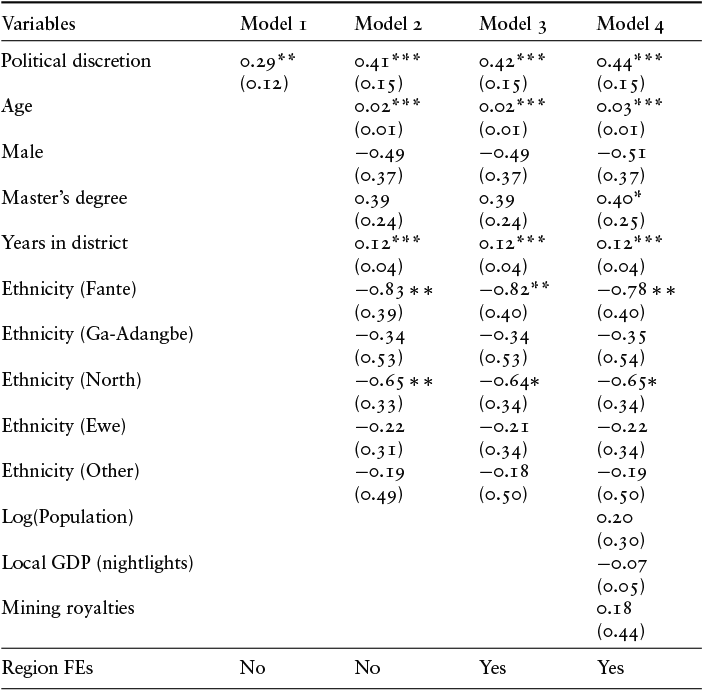
To measure the dependent variable, I use the RR question discussed in Section 4.1. To analyze the relationship between local politicians’ degree of discretion over the careers of bureaucrats and corruption, I conduct a multivariate logistic regression analysis that accounts for the fact that the outcome variable is derived using an RR technique.Footnote 25 I first analyze the bivariate relationship between corruption and political discretion. I find that this relationship is positive and statistically significant at the 2 percent level (column 1). I next introduce bureaucrat-level controls – gender, age, education, time in current district, and ethnicity (column 2).Footnote 26 Next, I add region fixed effects (column 3), and finally district-level controls – population, local GDP, and an indicator of whether the district receives revenues from natural resources (column 4).The regression results indicate that the relationship between political discretion and corruption remains positive and statistically significant in each column.Footnote 27 Table 4.1 presents the coefficients and standard errors.
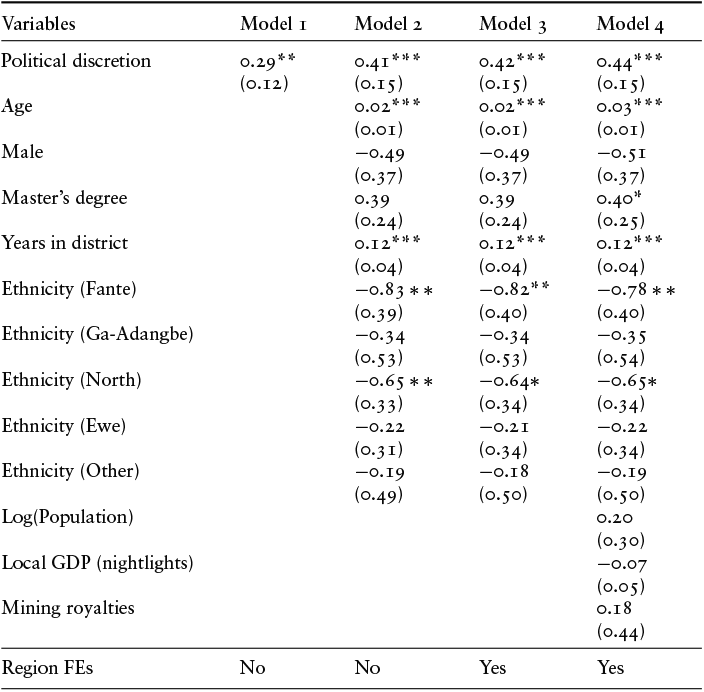
Table 4.1 Long description
Table presenting results from four regression models labeled Model 1 through Model 4. Rows list independent variables with coefficient estimates followed by standard errors in parentheses. Asterisks indicate levels of statistical significance.
Political discretion is positive across all models, increasing from 0.29 in Model 1 to 0.44 in Model 4, with statistical significance in Models 2 through 4.
Demographic variables appear beginning in Model 2. Age has a small positive and statistically significant coefficient in Models 2, 3, and 4, ranging from 0.02 to 0.03. Male has a negative coefficient in all applicable models but is not statistically significant. A master�s degree has a positive coefficient across Models 2 to 4 and becomes weakly significant in Model 4. Years in district is consistently positive and statistically significant across Models 2 through 4.
Ethnicity variables are included in Models 2 through 4. Fante, Ga Adangbe, North, Ewe, and Other ethnic categories all show negative coefficients relative to the omitted reference group. The North category is weakly significant in Models 3 and 4.
Additional contextual variables appear only in Model 4. Log population has a positive coefficient, while local GDP measured using nightlights has a small negative coefficient. Mining royalties show a positive coefficient. None of these additional variables are statistically significant.
The bottom section reports regional fixed effects. Models 1 and 2 do not include region fixed effects, while Models 3 and 4 do.
The table also contains a translucent diagonal watermark reading �PROOFS� across the lower portion of the image.
Note: N = 864 bureaucrats. The dependent variable is a “yes” (1) or “no” (0) response to the following question: In this district, are contracts granted to contractors who are likely to give part of the money to the election campaign of the incumbent party? I report standard errors in parentheses.
***  0.01, **
  0.05, *
  0.1.
0.1.
Since individual responses may be correlated within districts, I also run the same analysis using a block bootstrap approach. The bootstrapped results are consistent with the main results. I also conduct two additional robustness checks. First, I verify that the results are not driven by respondents from a particular district. I demonstrate that the results are robust to dropping all responses from one district at a time. Second, I aggregate responses across districts and classify them according to whether the majority of bureaucrats perceive the mayor as having a high or low level of political discretion. The theory implies that in districts where most bureaucrats believe the mayor has a high level of discretion, a larger share of bureaucrats will agree there is corruption. A cross-tabulation analysis confirms this implication: the share of bureaucrats who report corruption in low-discretion districts is 37% versus 48% in high-discretion districts.
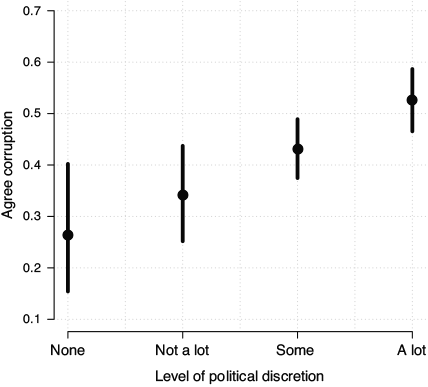
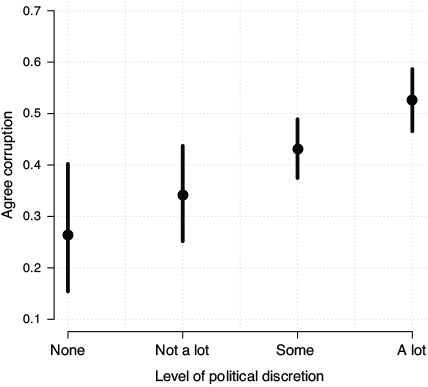
To demonstrate the substantive significance of the positive association I identify between political discretion and corruption, and to provide a more intuitive interpretation of the results, I calculate the predicted probability of a “yes” response varying the mayors’ ability to transfer bureaucrats. Figure 4.1 displays these probabilities. The estimate on the far left is the predicted probability for bureaucrats who report that their mayors have “no influence” on transfers. The right-hand estimate displays the same estimate for bureaucrats who say their mayor has “a lot” of influence. The results demonstrate that more than half of bureaucrats (53%) report corruption when politicians have a lot of discretionary control, compared to just over a quarter (26%) when they have limited influence. This is equivalent to a 51 percent decrease in the probability of corruption. The confidence interval around the far left-hand point estimate is larger because the distribution of the explanatory variable is right skewed: fewer bureaucrats report that politicians have no influence than those who say they have a lot of influence. Overall, these results support the hypothesis that higher levels of corruption are associated with higher levels of political discretion.Footnote 28
Predicted probabilities from RR logistic regression
Note: This figure displays the predicted probability of a “yes” response to the RR question on corruption. I estimate these probabilities using Model 4 of Table 4.1.
An alternative explanation of the positive association between political oversight and corruption is that more perceptive bureaucrats are likely to know that mayors can control bureaucrats, and that mayors award contracts to firms that offer to fund the ruling party. Bureaucrats’ perceptiveness would then be a potential confounding variable. I attempt to quell this concern by controlling for bureaucrat characteristics that may serve as a proxy for their perceptiveness or knowledge of local government operations. My results already control for their level of education and time working in the current district, which may be proxies for perceptiveness. I also add a control for whether the bureaucrat is a member of the District Tender Board, which may indicate that they are more aware of politicians’ informal controls and desire to capture illegal rents. Even after controlling for bureaucratic perceptiveness, I continue to find a positive association between political discretion and corruption, which rules out this alternative explanation.
Another rival hypothesis is that local politicians may have characteristics that drive both their ability to transfer bureaucrats and their propensity to engage in corruption. This would also generate a positive association between these two variables, but political discretion in this case would not be the cause of corruption. In Chapter 2, I argue that politicians’ need to obtain election campaign funds motivates them to participate in corruption. This would suggest that politicians who are actively seeking higher-level political office are more likely to engage in corruption. These politicians, who are aggressively seeking to advance their political careers, may also have more influence on bureaucratic transfers, perhaps because they have been involved in politics longer than those who are not seeking higher office. I attempt to rule out this concern by collecting data on each mayor’s time in office, as well as which mayors in the sample ran in the previous parliamentary primaries (in 2015). I continue to find a positive association between political discretion and corruption after controlling for both variables in further regression analyses.
4.3.2 Disaggregating between Bureaucrats in Rural and Urban Districts
An observable implication of my argument is that political discretion will have a greater effect for bureaucrats who work in more desirable locations. While all local government offices in Ghana are in district capitals, these towns vary in their level of economic development. For bureaucrats working in more economically developed districts, transfers impose higher costs. This grants politicians greater leverage by lowering bureaucrats’ incentives to resist pressure from mayors to facilitate corruption. This analysis confirms that discretion plays a more significant role in determining corruption levels in urban districts. The coefficient on political discretion is 0.56 (significant at the 12% level) for bureaucrats working in urban districts and 0.41 (significant at the 1% level) for those working in rural districts.
4.3.3 Threatening Transfers to Discourage Whistleblowing
Ghana’s Whistleblower Act (Act 720) of 2006 supports individuals who are seeking to report improprieties such as misappropriating or mismanaging public resources. The act states that employers cannot victimize whistleblowers through, for example, dismissal, suspension, denial of promotion, or transfers against their will.Footnote 29 Whistleblowers are offered police security if their physical safety is endangered. Despite the act’s thoroughness, bureaucrats remain hesitant to report corruption that occurs in local government offices.
One important reason that bureaucrats are hesitant to report corruption despite the legal protections that the act offers is the potential for politicians to transfer them. I included a list experiment in the survey of bureaucrats to investigate the extent to which bureaucrats believe taking a stand against corruption may result in negative consequences including transfers. The results of the list experiment support the argument that politicians use, or threaten to use, transfers coercively in response to refusals to enable corrupt activities.
The survey experiment involved asking bureaucrats to identify behavior that is likely to cause them to be moved to a different local government. I ask “how many of these are likely reasons for a bureaucrat to be transferred to work in another district?”Footnote 30 I anticipate that bureaucrats will expect the LGS to base transfers on skills (item 1), and mayors to attempt transfers in response to either bad personal relationships (item 2) or individual bureaucrat behavior (item 3). Item 4 (dislike the local area) is not a valid reason for a transfer and is included to protect against ceiling effects. I exposed half of the respondents at random to the treatment list and half to the control list. The treatment list included “Attempt to expose misconduct” as the sensitive item (see Table 4.2). I focus on whistleblowing as opposed to, for example, not granting a contract to a firm that the mayor wants, because individual bureaucrats have the power to expose misconduct on their own, but lack the authority to award contracts.
| Control | Treatment |
|---|---|
| (1) Skills needed in another district | (1) Skills needed in another district |
| (2) Bad relationship with mayor | (2) Bad relationship with mayor |
| (3) Dislike the local area | (3) Attempt to expose misconduct |
| – | (4) Dislike the local area |
Note: The bold item indicates the treatment statement.
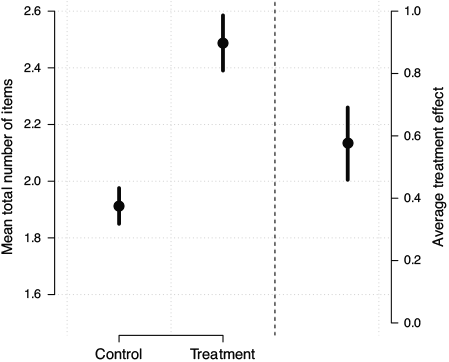
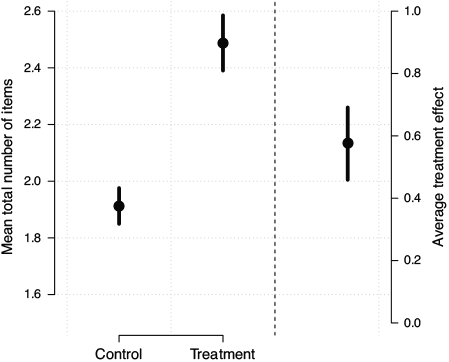
Figure 4.2 displays the results of the experiment. The estimate on the left shows the mean number of items respondents agreed are reasons for transfers in the control list (1.91, compared to 2.49 for the treatment list). These results indicate that 58% of bureaucrats (95% CI: 46–69%) believe speaking up about corruption is likely to result in being transferred. These results support the argument that politicians use bureaucratic transfers to control bureaucrats’ behavior. They complement the data collected from qualitative interviews with bureaucrats and, importantly, show that such sentiments are relatively widespread.
Mean responses and average treatment effect for the sensitive item
Note: The two points on the left display the mean number of items for the control and treatment lists, respectively ( = 864). The far-right point displays the average treatment effect.
4.4 Conclusion
Chapter 4 demonstrates that bureaucrats’ propensity to engage in corruption may depend less on the mode of hiring (merit vs. political patronage) and more on how politicians manage them once in office. The extent to which politicians can influence bureaucrats’ careers is an important determinant of whether bureaucrats will engage in corruption, for instance, through interfering in promotions, work portfolios, and geographic transfers.
Overall, the results suggest that higher levels of political control can increase corruption, and that oversight tools are subject to abuse by politicians. These findings have important implications. They highlight the need to develop models of corruption that take into account the fact that bureaucrats often operate in groups, making decisions with both other bureaucrats and with politicians. Potential leverage that either set of actors has on individual bureaucrats’ careers is likely to influence their behavior. The results also imply that bureaucrats may fear punishment not only for engaging in corruption but also for not engaging in corruption. This implication turns standard models of bureaucratic corruption on their heads, and necessitates the need to develop more complex models of corruption that consider bureaucratic corruption as part of a complex political economy involving interactions between politicians and bureaucrats.
Chapter 4 focused on public procurement decisions mainly to shed light on the means through which politicians can exert control over bureaucrats. Having established that politicians often have the ability to control bureaucrats’ careers, it is next important to consider further consequences of this ability. Chapter 5 continues to investigate public procurement decisions to explain exactly how politicians and bureaucrats manipulate this process. It also investigates the types of firms that typically win contracts, and how these arrangements affect infrastructure quality. In Chapter 6, I explore how career control affects another public sector outcome – the allocation of public goods within districts. Furthermore, in both of these chapters, I consider the effect that high levels of local electoral competition has on both these outcomes, in both cases demonstrating a negative effects of competition on governance.



 Open access