


INTRODUCTION
Studies investigating age of onset (AoO) effects in bilingual populations have compared sequential bilingual (L2) children, that is children who are exposed to the L2 after the age of four years (Schwartz, Reference Schwartz2004; Unsworth, Reference Unsworth2005), with L2 learners who have been exposed to the L2 during or after puberty (Chondrogianni, Reference Chondrogianni, Haznedar and Slabakova2008; Unsworth, Reference Unsworth2005). These studies have examined whether or not these two L2 populations pass through the same developmental stages and reach similar levels of ultimate attainment (Abrahamson & Hyltenstam, Reference Abrahamson and Hyltenstam2008). In recent years, the focus has shifted towards comparing different groups of bilingual children with varying ages of onset to unravel whether AoO effects emerge earlier than previously thought (e.g. Meisel, Reference Meisel2009). In this line of research, simultaneous bilingual children (2L1), that is, children who are exposed to both languages from birth (de Houwer, Reference de Houwer, Fletcher and MacWhinney1995) and within their first year of life (Paradis, Genesee & Crago, Reference Paradis, Genesee, Crago, Paradis, Genesee and Crago2011), are compared with early sequential bilingual (eL2) children, who are exposed to the L2 between the ages of one and three years, and with L2 children. It is generally assumed that 2L1 children will pattern similarly with their monolingual (L1) peers (de Houwer, Reference de Houwer, Fletcher and MacWhinney1995; but see Montrul, Reference Montrul2008, for different results). As Unsworth (Reference Unsworth2013) notes, however, at the moment we know very little about the developmental patterns of children exposed to the two languages between the ages of one and three years, and whether or not they are more similar to simultaneous or to sequential bilingual children. Research on this issue has provided mixed results (Chilla, Reference Chilla2008; Granfeldt, Schlyter & Kihlstedt, Reference Granfeldt, Schlyter and Kihlstedt2007; Meisel, Reference Meisel2009; Rothweiler, Reference Rothweiler and Lleó2006).
According to Meisel (Reference Meisel2009), qualitative differences in the language acquisition capacity may take place significantly earlier than generally assumed, i.e. between the ages of three and four years. In his study on French inflection by German–French eL2 children, the eL2 children in the sample who were exposed to the L2 before the age of 3;7 had higher accuracy rates than the eL2 children with a later AoO. In studies on German verb inflection and placement (Chilla, 2008; Rothweiler, Reference Rothweiler and Lleó2006), eL2 children with an AoO of three years patterned similarly with the (2)L1 children and differed from the L2 children. In contrast, in the study by Granfeldt et al. (Reference Granfeldt, Schlyter and Kihlstedt2007) on Swedish–French bilingual children, the L2 children (AoO between 3 and 6 years) differed from their (2)L1 counterparts and displayed error patterns similar to those found in L2 adults.
Furthermore, recent studies suggest that AoO effects may be mediated by the phenomenon to be acquired, and more specifically by whether or not the structure is late or early acquired by L1 children (Tsimpli, Reference Tsimpli2014). Tsimpli argued that AoO effects in bilingual children should be found for phenomena which are early acquired in L1 acquisition (e.g. around the age of 3 years), because the features associated with these structures are set early. Such phenomena include head directionality (e.g. VO vs. OV) or certain morphological features (e.g. case marking in Greek or German). Conversely, late-acquired phenomena should be less susceptible to AoO effects and more amenable to input or exposure effects. These late-acquired phenomena include complex structures such as passives or relative clauses, but also certain morphosyntactic structures. For example, Unsworth (Reference Unsworth2013) did not find any AoO effects in English–Dutch 2L1 and (e)L2 children acquiring Dutch gender, which is a late-acquired property in L1 Dutch-speaking children. In the study by Unsworth, Argyri, Cornips, Hulk, Sorace, and Tsimpli (Reference Unsworth, Argyri, Cornips, Hulk, Sorace and Tsimpli2014) on Greek 2L1 and (e)L2 children, AoO effects were found in the acquisition of Greek gender, which is an early acquired property. Similarly, in a study with school-aged Turkish–English L2 children with a mean AoO of 3;3 (range: 2;6–5;0), Chondrogianni and Marinis (Reference Chondrogianni and Marinis2011) found effects of length of exposure (LoE) rather than of AoO on the acquisition of complex structures such as wh-questions and passives.
In the present study, we continue this line of research by examining whether German-speaking eL2 children differ from 2L1 and L1 children in the comprehension of wh-questions, which is a late-acquired phenomenon, and how the acquisition of this structure is mediated by the acquisition of an early-acquired phenomenon, such as case marking. We also examine the role of the position of case marking within the wh-question, as well as of AoO and LoE to the L2 in the comprehension of wh-questions.
Previous research has shown that complex structures involving constituent displacement, such as relative clauses (RCs) and wh-questions, are acquired late by L1 children speaking a number of different languages (Guasti, Branchini & Arosio, Reference Guasti, Branchini and Arosio2012; Friedmann & Novogrodsky, Reference Friedmann and Novogrodsky2011; amongst many others). At the same time, the presence of semantic and morphosyntactic cues, such as number (Adani, van der Lely, Forgiarini & Guasti, Reference Adani, van der Lely, Forgiarini and Guasti2010), gender (Guasti et al., Reference Guasti, Branchini and Arosio2012), and case (Arosio, Yatsushiro, Forgiarini & Guasti, Reference Arosio, Yatsushiro, Forgiarini and Guasti2012; Roesch & Chondrogianni, Reference Roesch, Chondrogianni, Hamann and Ruigendijk2015) has been shown to facilitate accuracy on these complex structures. The disambiguating and facilitatory effect of these cues on children's performance has been shown to be mediated by their position in the clause. For example, recent studies have shown that four- to seven-year-old L1 children have great difficulty revising their initial interpretation of an ambiguous sentence when the disambiguating cue appears in a sentence-final position (Choi & Trueswell, Reference Choi and Trueswell2014; Omaki, Davidson-White, Goro, Lidz & Phillips, Reference Omaki, Davidson-White, Goro, Lidz and Phillips2014; Roesch & Chondrogianni, Reference Roesch, Chondrogianni, Hamann and Ruigendijk2015).
Wh-questions in German
German is a morphologically rich language that marks gender, number, and case on determiners and nouns. In declarative sentences, SVO is considered the most canonical and frequent word order (Haider, Reference Haider2010), as in (1a). German is also a V2 language in which the verb always occupies the second position in declarative main clauses and agrees with the subject regardless of its position in the sentence (Grewendorf, Reference Grewendorf2002). Since case denotes the role of the noun within the sentence, object topicalization is possible in German (OSV), as in (1b).
(1)
a. Der Affe jagt den Hasen.
TheNOM monkeyNOM chases theACC rabbitACC
‘The monkey chases the rabbit.’
b. Den Hasen jagt der Affe.
TheACCrabbitACC chases theNOM monkeyNOM
‘The monkey chases the rabbit.’
In German, argumenthood is expressed overtly via case marking on the determiner and/or the noun (Jeuk, Reference Jeuk and Ahrenholz2008; Köpcke, Reference Köpcke2003), as in (1a & b). Subjects carry nominative case, whereas direct objects carry accusative, and indirect objects dative, case. German also has three genders, masculine, feminine, and neuter, marked on the determiner and sometimes also on the noun. There are masculine nouns, which do not carry overt case marking (e.g. as in der NOMHund – den ACCHund ‘the dog’), whereas on other masculine nouns case marking is obligatory (e.g. der NOMBär – den ACCBären ACC ‘the bear’; der NOMHase NOM– den ACCHasen ACC ‘the rabbit’). In feminine and neuter nouns, there is syncretism between the nominative and the accusative case, e.g. die NOM/ACCMaus Ø ‘the mouse’; das NOM/ACCPferd Ø ‘the horse’. Given that German is a V2 language, the correct interpretation of the different syntactic roles within a sentence is contingent upon the ability to understand case marking, as (1b) demonstrates.
Wh-questions are complex structures that involve displacement of constituents (Chomsky, Reference Chomsky1995). In a subject wh-question, such as Which elephant t [t] is painting the bear?, the subject which elephant moves to a sentence initial (SpecCP) position from its SpecIP position (Haider, Reference Haider2010). This movement to the CP position does not change the canonical word order (SVO) of the sentence. In an object wh-question, such as Which elephant tis the bear painting [t]?, the object leaves its original sentence-final position (marked by a silent trace [t]) to move again to the SpecCP, which is a sentence-initial landing site. In this respect, constituent movement in object wh-questions is longer and creates a non-canonical word order (OSV) compared to subject wh-questions (SVO).
In this study, we focused on wh-questions, which were manipulated in terms of the position and number of case-marking cues, and targeted either the subject (agent) or the object (patient) of the transitive action. In German, subject wh-questions remain in a canonical SVO word order, since the wh-phrase remains in a sentence-initial position, as in example (2a) below. In contrast, movement of the wh-phrase to the sentence-initial position in an object wh-question creates a non-canonical word order, where the wh-phrase is first fronted and then followed by an obligatory V2 construction, as in (2b).
(2)
a. Welcher Elefant malt den Bären an?
WhichNOM-MASC elephant MASC-NOM paints theMASC-ACC bearMASC-ACC?
‘Which elephant is painting the bear?’
b.

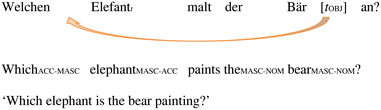
The wh-element, the articles, and other nominal elements can carry distinctive case-marking information depending on the noun's gender, and can help disambiguate their syntactic position. When the noun is masculine, then case is obligatorily marked on the wh-element, the determiner, and sometimes on the noun. When it is feminine or neuter, then there is no distinctive case marking, and the syntactic position and thematic role in the clause are ambiguous, as in (3).
(3)
a. Welche Maus malt den Frosch an ?
WhichFEM-Ø mouseMASC- Ø paints theNOM-ACC frogNOM-ACC?
‘Which mouse is painting the frog?’
b. Welche Maus malt der Frosch an ?
WhichFEM- Ø mouseFEM- Ø paints theMASC-NOM frogMASC-NOM?
‘Which mouse is the frog painting?’
In (3), the wh-phrase welche Maus ‘which mouse’ carries no distinctive case-marking information with respect to its syntactic role in the clause, and is hence ambiguous between an agent or theme interpretation. The learner needs to reach the end of the sentence to disambiguate the thematic role of the different arguments within the clause and to determine whether this is a subject (3a) or an object (3b) wh-question.
In the present study, we examined whether 2L1 and eL2 children are sensitive to the presence of case marking when comprehending wh-questions, and whether case can act as a cue to disambiguate the thematic roles of the different arguments during comprehension.
The acquisition of case marking and wh-questions in monolingual German-speaking children
Cross-linguistic studies on the acquisition of wh-questions have shown that L1 children perform better on subject compared to object wh-questions in a number of languages (for example de Vincenzi, Arduino, Ciccarelli & Job, Reference de Vincenzi, Arduino, Ciccarelli, Job and Bagnara1999; Friedmann & Novogrodsky, Reference Friedmann and Novogrodsky2011; Guasti et al., Reference Guasti, Branchini and Arosio2012; Tyack & Ingram, Reference Tyack and Ingram1977).
In German, wh-questions have been reported to emerge in spontaneous speech at the age of 1;7, and begin to resemble adultlike structures after the age of three years (Penner, Reference Penner, Hoekstra and Schwartz1994; Tracy, Reference Tracy, Tracy and Lattey1994). Case in German is an early-acquired phenomenon, first produced at the age of two years and acquired by the age of three years (Eisenbeiss, Bartke & Clahsen, Reference Eisenbeiss, Bartke and Clahsen2006). The first case that emerges is the nominative, which is sometimes overgeneralized to accusative and dative contexts (2;6–2;11) (Schrey-Dern, Reference Schrey-Dern2006). Nominative and accusative cases are correctly produced by the age of three years (Jeuk, Reference Jeuk and Ahrenholz2008; Schrey-Dern, Reference Schrey-Dern2006; Tracy, Reference Tracy1986).
Case marking has been shown to be a reliable cue for interpreting sentence structure in the context of simple sentences in L1 German-speaking children (Dittmar, Abbot-Smith, Lieven & Tomasello, Reference Dittmar, Abbot-Smith, Lieven and Tomasello2008; Lindner, Reference Lindner2003). When faced with ambiguous case-marking cues, L1 preschool children prefer animacy and word order over case marking to disambiguate sentence meaning (Dittmar et al., Reference Dittmar, Abbot-Smith, Lieven and Tomasello2008). Conversely, when case-marking cues are unambiguous, preschool German-speaking children can use case marking as a reliable cue over word order or animacy (Lindner, Reference Lindner2003).
To date, there is only one study on the comprehension of subject and object wh-questions in German-speaking preschool L1 children (Roesch & Chondrogianni, Reference Roesch, Chondrogianni, Hamann and Ruigendijk2015). Roesch and Chondrogianni used a picture selection task similar to the one in the present study to examine whether five-year-old German-speaking children exhibit a subject–object asymmetry in the acquisition of wh-questions, and whether they can make use of morphosyntactic cues such as case marking to interpret wer and welcher wh-questions. The wh-questions carried case-marking cues either on both the wh-element and the second NP in the sentence, as in (2a & b) mentioned previously, or on the wh-element only, as in (4a & b).
(4)
a. Welcher Igel malt die Maus an ?
WhichMASC-NOM hedgehogMASC-NOM paints theFEM- Ø mouseFEM- Ø?
‘Which hedgehog is painting the mouse?’
b. Welchen Igel malt die Maus an ?
WhichMASC-ACC hedgehogMASC-ACC paints theFEM-Ø mouseFEM-Ø?
‘Which hedgehog is the mouse painting?’
Results showed that preschool L1 German-speaking children had higher accuracy on the comprehension of subject than of object wh-questions. Roesch and Chondrogianni (Reference Roesch, Chondrogianni, Hamann and Ruigendijk2015) also reported that the preschool children had higher accuracy on wh-questions carrying cues on both the wh-phrase and the second NP than on wh-questions carrying cues on the wh-phrase only. These results showed that German-speaking preschool children can use case marking as a cue to assign thematic roles in complex structures, similarly to previous studies on RCs with older school-aged children (Arosio et al., Reference Arosio, Yatsushiro, Forgiarini and Guasti2012). The results from Roesch and Chondrogianni (Reference Roesch, Chondrogianni, Hamann and Ruigendijk2015) were in line with previous studies on the acquisition of case marking in German, in that the five-year-old children were able to use case marking to assign thematic roles (Lindner, Reference Lindner2003). However, Roesch and Chondrogianni did not examine how L1 children perform when the disambiguating cues appear in a sentence-final position and whether preschool German-speaking children will be able to revise the initially assigned sentence interpretation. We address this issue in the present paper.
The acquisition of case marking and wh-questions in German-speaking bilingual children
Studies on the acquisition of case marking in bilingual children have shown that preschool and school-aged 2L1 and eL2 children follow a pattern similar to that of the L1 children (Jeuk, Reference Jeuk and Ahrenholz2008; Kaltenbacher & Klages, Reference Kaltenbacher, Klages and Ahrenholz2006). That is, nominative case precedes accusative case in production, and nominative can be used in the place of accusative or dative case. However, these studies report a general acquisition pattern and do not highlight any differences between 2L1 and eL2 children.
Roesch and Chondrogianni's (Reference Roesch, Chondrogianni, Hamann and Ruigendijk2015) study is the only one to date to examine the comprehension of wh-questions similar to the ones in (1a & b) and (3a & b) in two groups of five-year-old German-speaking 2L1 and eL2 children and in the group of L1 children mentioned previously using a sentence–picture matching task similar to the one in the present study. Results showed that the L1 children had higher accuracy than the 2L1 children, who – in turn – outperformed the eL2 children. However, all groups exhibited a subject–object asymmetry regardless of language background. These results suggested that the eL2 children followed the same developmental path as the (2)L1 children, and that the groups differed only in terms of accuracy.
Roesch and Chondrogianni (Reference Roesch, Chondrogianni, Hamann and Ruigendijk2015) examined children's comprehension of wh-questions only with sentence-initial cues. The present study extends this research to wh-questions with sentence-final cues to investigate whether bilingual children's initial sentence interpretation matches that of monolinguals, that is whether or not bilingual children are able to revise their initial sentence interpretation upon encountering sentence-final cues. In the present study, we also included a larger group of four- and five-year-old children from all three groups to investigate developmental effects in young preschool children, as well as whether LoE, AoO, and knowledge of case marking can predict performance in bilingual children.
Why are wh-questions difficult to acquire?
Difficulties with the comprehension of wh-questions have been attributed to problems with assigning thematic roles to moved constituents, especially when movement creates a non-canonical word order (here called the Canonicity Hypothesis: Friedmann & Novogrodsky, Reference Friedmann and Novogrodsky2004, 2011; Philippe, Coopmans, van Atteveldt & van der Meer, Reference Philippe, Coopmans, van Atteveldt, van der Meer, Do, Dominguez and Johansen2001), or to verbal processing constraints induced by garden-path effects (Choi & Trueswell, Reference Choi and Trueswell2014; Omaki et al., Reference Omaki, Davidson-White, Goro, Lidz and Phillips2014). These accounts have been formulated in the contexts of L1 acquisition. In the present study, we extend them to childhood bilingualism.
Difficulties with thematic role assignment. Friedmann and Novogrodsky (Reference Friedmann and Novogrodsky2011) attributed children's lower accuracy on object wh-questions compared to subject wh-questions to problems with thematic role assignment, in line with their previous research on relative clauses (Friedmann & Novogrodsky, Reference Friedmann and Novogrodsky2004). In the case of subject wh-questions, constituent movement does not change the canonical word order of the sentence. If children follow a linear pattern to assign thematic roles (i.e. first NP is the agent and the second NP is the patient), they will assign the right interpretation to subject wh-questions, because the linear constituent order matches the order of the thematic role assignment. Subject wh-questions maintain a canonical SVO word order and the first argument will be correctly interpreted as the agent of the verb. In other words, there is no mismatch between the linear SVO word order and the syntactic position of thematic roles within the sentence. However, in object wh-questions, the object appears in a sentence-initial position and changes the word order from a canonical SVO to a non-canonical OVS word order. Thus, in an object wh-question, there is a mismatch between the syntactic position of the object and its thematic role. If children adopt a linear pattern when assigning thematic roles in object wh-questions, they are expected to interpret object wh-questions as subject wh-questions and to erroneously assign an agent thematic role to the first NP that they encounter. This account predicts that children will have lower accuracy on object wh-questions than on subject wh-questions and that they will commit more reversal errors when comprehending object wh-questions. Friedmann and Novogrodksy also argue that children may resort to a guessing strategy, and thus show chance performance on object wh-questions. Note that these predictions apply to both monolingual and bilingual children; the first language of the bilingual children in our study is French, which relies on word order and not on case marking to disambiguate thematic roles. In this respect, if they rely on L1 strategies, then they will mis-parse the first constituent of the sentence as being the subject rather than the object.
Verbal processing constraints. Choi and Trueswell (Reference Choi and Trueswell2014) and Omaki et al. (Reference Omaki, Davidson-White, Goro, Lidz and Phillips2014) attributed difficulties with ambiguous clauses in children to what they call ‘verbal processing constraints’. According to this account, when the disambiguating cues, e.g. case marking, appear in a sentence-final position, children, unlike adults, have difficulty recovering from the interpretation they initially assigned to the sentence. This initial sentence interpretation is thought to follow a linear pattern and to lead to a ‘garden-path’ effect (Frazier & Fodor, Reference Frazier and Fodor1978). However, in their study, Choi and Trueswell (Reference Choi and Trueswell2014) and Omaki et al. (Reference Omaki, Davidson-White, Goro, Lidz and Phillips2014) did not independently examine monolingual children's knowledge of case marking, and this is an issue that we address in the present study with both monolingual and bilingual children.
PRESENT STUDY
Given the paucity of previous studies examining the acquisition of complex sentences in bilingual children, the aim of the present study was to investigate whether L1, 2L1, and eL2 children are sensitive to the presence and position of sentence-initial and sentence-final cues when they comprehend subject and object welcher ‘which’ questions in German. We further examined which factors (i.e. AoO, LoE, and knowledge of case marking) can better account for bilingual children's comprehension of wh-questions. More specifically, our research questions were the following:
1. Does syntactic position affect L1, 2L1, and eL2 children's comprehension of welcher-questions?
2. Does the presence and position of case affect L1, 2L1, and eL2 children's performance?
3. Do the three groups differ from one another in terms of accuracy and error types?
4. What is the predictive value of AoO, LoE, and knowledge of case marking for the comprehension of welcher-questions, and which factor or combination of factors has the highest predictive value?
Following the Canonicity Hypothesis (Friedmann & Novogrodsky, Reference Friedmann and Novogrodsky2004, 2011; Novogrodsky & Friedmann, Reference Novogrodsky and Friedmann2006), we expect that all groups will perform better on subject compared to object wh-questions, because object wh-questions involve a non-canonical OVS word order. If children interpret object wh-questions linearly, then we expect them to assign an agent role to the first noun of the sentence. This may lead to high performance on subject wh-questions, because the linear interpretation of the sentence will also lead to the correct interpretation, but to chance or below chance performance on object wh-questions because the linear interpretation of the sentence does not match the thematic role assignment (Novogrodsky & Friedmann, Reference Novogrodsky and Friedmann2006). In terms of errors, we expect children to show more reversal errors for object wh-questions than for subject wh-questions across all cue conditions.
If the verbal processing constraints postulated by Choi and Trueswell (Reference Choi and Trueswell2014) and by Omaki et al. (Reference Omaki, Davidson-White, Goro, Lidz and Phillips2014) are operative in monolingual and bilingual children's sentence processing, we expect these groups to perform better on wh-questions carrying case marking in a sentence-initial position compared to wh-questions carrying case marking in a sentence-final position. According to this account, children will assign a linear interpretation to the sentence. This initial interpretation cannot be revised if the disambiguating cues appear in a sentence-final position, suggesting that children are unable to recover from the ‘garden-path’ effect (Choi & Trueswell, Reference Choi and Trueswell2014; Omaki et al., Reference Omaki, Davidson-White, Goro, Lidz and Phillips2014). In the context of the present study, this predicts that children will show above-chance performance (regardless of syntactic position) in the double cues and the wh-cue conditions because cues appear sentence-initially in both conditions. Chance or below-chance performance is expected in the NP-cue condition, because cues appear only on the second NP at a sentence-final position. When hearing a sentence such as Welche Maus streichelt den Igel? ‘Which mouse strokes theACC hedgehogACC?’, children may initially be misled into interpreting it linearly and may assume that the first NP is the agent and not the patient. It is the information carried by the second NP (den ACCIgel ‘the hedgehog’) that disambiguates whether or not this is a subject or an object wh-question.
In terms of between-group comparisons, we expect that the L1 German-speaking children will have ceiling performance on the double cues condition because they will be able to use case marking, which is an early-acquired property in German, to disambiguate subject–object roles within a sentence (Dittmar et al., Reference Dittmar, Abbot-Smith, Lieven and Tomasello2008; Roesch & Chondrogianni, Reference Roesch, Chondrogianni, Hamann and Ruigendijk2015). For the 2L1 German children, previous research has shown that they have similar performance patterns with their L1 peers on the acquisition of morphophonology (Chilla & Bonnesen, Reference Chilla and Bonnesen2011; Meisel, Reference Meisel2009) and of complex syntax (Roesch & Chondrogianni, Reference Roesch, Chondrogianni, Hamann and Ruigendijk2015). The eL2 children may show lower accuracy on wh-questions, because they have less exposure to the L2 and overall lower verbal abilities than the other two groups (L1 and 2L1), and, more importantly, poorer knowledge of case marking. The analysis of error patterns will further reveal the bilingual children's comprehension strategies.
METHOD
Participants
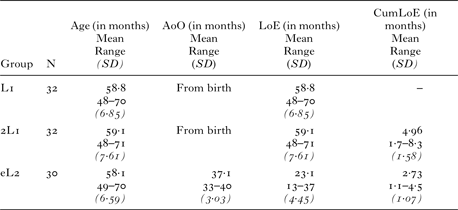
Ninety-four four- to five-year-old children participated in the study. There were thirty-two L1 German-speaking children (mean: 58·81 months; range: 48–70; SD: 6·85), thirty-two 2L1 French–German-speaking age-matched children (mean: 59·09 months; range: 48–71; SD: 7·16), and thirty eL2 children (L1 French; L2 German) (mean age at testing: 58·09 months; range: 48–70; SD: 6·59) (Table 1). All groups of children were matched on age (F(2,93) = 0·6; p = ·55).
Current age, age of onset (AoO), traditional and cumulative length of exposure (LoE; CumLoE) (all in months) for the monolingual (L1), simultaneous bilingual (2L1), and early sequential bilingual (eL2) children

The L1 children were recruited from monolingual nurseries in Cambrai (northern France) and in Essen (northern Germany). The 2L1 and the eL2 children were recruited from bilingual nurseries in La Calamine (east Belgium) and Straßbourg (mid-east France). In terms of language exposure, both bilingual nurseries followed the same bilingual language exposure guidelines: (a) they employed only monolingual French- or German-speaking native speakers, and (b) these French- or German-speaking nursery-school teachers would attend to separate groups of children for two and a half days in the week (approx. 5–7 hours per day and 3 hours on the half day) speaking only French or German, and they would exchange groups, so that each group would get equal exposure to French and German during the week. As a result, children attending these bilingual nurseries were exposed to French and German for approximately 13–17 hours a week in each language.
A parental questionnaire was used to collect information regarding children's language exposure and use. The eL2 children had an AoO to German between ages 2;9 and 3;4, and had no history of speech–language impairment or other disorders (Table 1). We calculated L2 exposure in two ways (Table 1). Traditionally, LoE has been calculated by subtracting the AoO from the child's age at the time of testing. However, in this operationalization of LoE, AoO and LoE are highly correlated and thus confounded (see Unsworth, Reference Unsworth2013). To overcome this confound and to fully capture the exposure patterns of the bilingual children in our sample, we adopted Unsworth's operationalization of cumulative LoE (cumLoE), according to which exposure patterns, such as the frequency, quantity, quality, and the context of the child's daily exposure to both languages are measured over time, from birth to the time of testing. This gives rise to an adjusted LoE, called cumLoE, which is usually lower than the traditional LoE because a bilingual child's experience with one of the two languages is distributed across the two languages over a period of time. This is important for the purposes of our study, since the bilingual children in our sample attended different types of schools, with some of the children attending French–German bilingual schools and with others attending mainstream German schools. This means that, for some children, input in German was halved not only in the home but also at school. This is why cumLoE appears to be reduced in the children in our sample (Table 1). With this in mind, all further statistical analyses were based on cumLoE and not on the traditional LoE calculation.
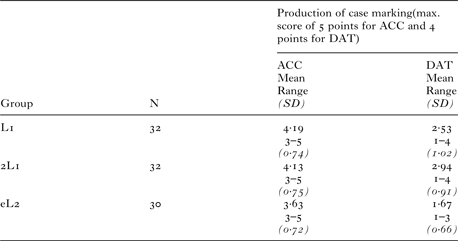
All children were tested on background language measures taken from two standardized German language tests. More specifically, they were tested on the production of accusative and dative cases from the Linguistische Sprachstandserhebung – Deutsch als Zweitsprache (LiSeDaZ; Schulz & Tracy, Reference Schulz and Tracy2011). Table 2 shows the raw scores of the L1, the 2L1, and the eL2 children on the different subtests. Since the children were matched on age, we used their raw scores on the different subtests to compare their performance and to run consecutive statistical analyses.
Raw scores of the monolingual (L1), simultaneous bilingual (2L1), and early sequential bilingual (eL2) children on the case-marking component of the LiSeDaZ (Schulz & Tracy, Reference Schulz and Tracy2011)
notes: ACC = accusative case; DAT = dative case.
Multiple one-way ANOVAs showed that the different groups differed on their performance on the accusative (F(2,93) = 5·21; p < ·01) and the dative (F(2,93) = 16·73; p < ·001) cases. Post-hoc tests with Bonferroni correction revealed that the 2L1 and the L1 children did not differ on case marking (p = ·21), while the (2)L1 children had significantly higher scores than their eL2 peers for accusative (p < ·05) and dative case marking (p < ·001).
Experimental tasks
To examine the comprehension of German subject and object wh-questions, we developed a picture selection task (cf. Adani, Reference Adani2011; Friedmann, Belletti & Rizzi, Reference Friedmann, Belletti and Rizzi2009). In this task, children were shown picture templates displaying animal triplets performing the same action on each other. The two animals on the right and the left of the picture panel were of the same kind, while the middle animal was of a different kind, as can be seen in Figure 1. The direction of the action was counterbalanced and the depicted animal species changed randomly. This was to ensure that the children could not develop response strategies such as always choosing the animal on the right or on the left of the picture, or thinking that a specific animal, e.g. the frog, is always the target.
Item depicting triplets: two frogs and a cat painting.
To examine the effect of Syntactic Position and Cue Types we created subject and object welcher-questions with case marking in three different positions within the wh-question: (i) both sentence-initially and sentence-finally, that is, case marking appearing on both the wh-element and the second NP (this condition is henceforth referred to as the ‘double cues’ condition), as shown in (1a & b) previously; (ii) only sentence-initially, that is on the wh-element (henceforth referred to as the ‘wh-cue’ condition), as in (3a and b); and (iii) only sentence-finally, that is only on the second NP (henceforth referred to as the ‘NP-cue’ condition), as in (2a & b).
In the case of the double cues condition, all nouns were masculine because masculine nouns in German are overtly marked for case and the cue information is unambiguous. In the wh-cue condition, the NP within the wh-element was again masculine whereas the second NP was either a feminine or a neuter noun without overt case marking and thus ambiguous as to its syntactic position and thematic role. In the NP-cue condition, the NP within the wh-element was either feminine or neuter and thus not case marked and ambiguous, whereas the second NP was masculine with overt case marking and thus unambiguous with respect to its syntactic position and thematic role. As a result, the participants could rely on the morphosyntactic information on both the wh-phrase and the second NP in the double cues condition to disambiguate thematic roles. For the wh-cue condition, they could use the case marking on the wh-phrase only to assign thematic roles, whereas they would have to rely on the only case-marked NP in a sentence-final position in the NP-cue condition.
There were eight target items per condition, as well as four distractor items, giving rise to thirty-six items in total. Note that while the experimental stimuli targeted always one of the side animals, the distractor welcher/n-questions targeted the middle animal.
RESULTS
Accuracy
Figure 2 presents the accuracy rates on the comprehension of subject and object wh-questions in the double cues, wh-cue, and NP-cue conditions for the L1, 2L1, and eL2 children.
Accuracy (in %) on subject (S) and object (O) welcher/n-questions with the double-cue, the wh-cue, and the NP-cue conditions in the L1, 2L1, and eL2 children.
To examine whether the groups differed in terms of Syntactic Position and Cue Type we conducted a repeated-measures ANOVA with Syntactic Position (subject, object) and Cue Type (double cues, wh-cue, NP-cue) as the within-subjects factor and Group (L1, 2L1, and eL2) as the between-subjects factor. Results showed an effect of Syntactic Position (F(1,91) = 169·93, p < ·001; η 2 = ·65), an effect of Cues (F(2,91) = 321·01, p < ·001; η 2 = ·78), and an effect of Group (F(2,91) = 54·09, p < ·001; η 2 = ·54). To unpack the three-way interaction between Syntactic Position, Cue, and Group (F(4,182) = 4·9, p < ·001; η 2 = ·22), we ran paired samples t-tests for each group separately.
Results from the L1 children and the 2L1 children showed that subject wh-questions had higher accuracy than the object wh-questions in the double cues and the wh-cue conditions (p < ·001 in all cases). The L1 children also exhibited better performance on subject than on object questions in the NP-cue condition (p < ·001), whereas for the 2L1 children this difference did not reach statistical significance (p = ·08). For the eL2 children, there was only a tendency for subject questions to have higher accuracy than object questions, but this did not reach statistical significance in any of the Cue conditions (p > ·07 in all cases).
In terms of cues, all groups of children had higher accuracy on wh-questions with double cues compared to wh-questions carrying only the wh-cue (L1 & 2L1 children: p < ·001; eL2 children: p < ·05). The wh-questions with the sentence-final cue (NP-cue condition) had the lowest performance across groups (L1 & 2L1 children: p < ·001; eL2 children: p < ·05) compared to the double cues and the wh-cue conditions.
Between-group comparisons showed that the L1 children outperformed the 2L1 children and the eL2 children across conditions (p < ·001 in both cases), apart from the object wh-questions in the NP-cue condition, where there were no statistically significant differences among the three groups (p = ·8 in both cases). The 2L1 children outperformed the eL2 children on subject and object wh-questions carrying double cues and wh-cues (p < ·001), while there were no differences between the groups on object wh-questions with the wh-cues as well as subject and object wh-questions with the NP-cues (p = ·78).
Subsequently, we examined whether children performed at chance on any of the conditions. Chance level was set at 33%, since there were three possible response options (target, reverse, and distractor) that children could choose from. Results from the L1 children suggested that they performed significantly above chance across all conditions (p < ·01), apart from the object NP-cue condition, where they performed significantly below chance (p < ·001). The 2L1 children showed significantly above-chance performance across all conditions (p < ·01), apart from the NP-cue condition, where they performed at chance (p = ·203). In contrast, the eL2 children performed significantly above chance on subject questions in the double cues condition (p < ·05), and at chance on object questions in the double cues and the wh-cue conditions (p = ·4), and significantly below chance on object questions in the NP-cue condition (p < ·001).
Error patterns
Figure 3 presents the error patterns on the subject and the object wh-questions in the L1, 2L1, and eL2 children. A reverse response involved the child pointing to the patient animal instead of the agent for subject wh-questions, or to the agent instead of the patient for object wh-questions. Distractor responses were the ones involving the middle animal (i.e. the animal that appears between the two possible target responses).
Error Patterns (in %) for reversal (R) and distractor (D) errors on the subject (S) and object (O) welcher/n-questions in the double-cue, wh-cue, and NP-cue conditions in the L1, 2L1, and eL2 children.
To examine whether the three groups differed in terms of Error Types, we ran a repeated-measures ANOVA with Syntactic Position (subject, object), Type of Cue (double cue, wh-cue, NP-cue), and Error Type (reversal, distractor) as the within-groups factors and Group (L1, 2L1, eL2) as the between-groups factor. This revealed a four-way interaction between cue type, syntactic position, error type, and group. To unpack the interaction, we ran paired samples t-tests for each group separately.
Across groups, children produced more errors on object than on subject wh-questions (p < ·01 in all cases). All groups of children had more reversal than distractor errors in the object wh-questions regardless of cues ((2)L1: p < ·001; eL2: p < ·04) and in the subject NP-cue condition (L1: p = ·001; 2L1 & eL2: p < ·001). The L1 children had only very few distractor errors in the subject double cues condition (1·04%), whereas the 2L1 and the eL2 children committed the same number of reversal and distractor errors in the same condition (p > ·1 in both cases). The groups also differed in the subject wh-cue condition, where the L1 and the eL2 children committed more distractor than reversal errors (L1: p < ·001; eL2: p < ·01), whereas the 2L1 children committed the two types of errors equally often in this condition (p > ·1).
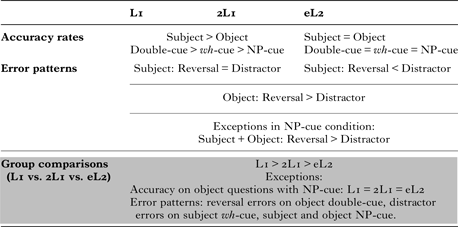
Independent samples t-tests showed that the L1 children committed overall fewer errors than the 2L1 and the eL2 children across conditions (p < ·05 and p < ·001). No significant differences between the groups were found for reversal errors on object wh-questions in the double cues condition, distractor errors on subject wh-questions in the wh-cue condition, and subject and object wh-questions in the NP-cue condition (p > ·7). In object wh-questions in the NP-cue condition, the L1 children produced more reversal errors than the 2L1 and the eL2 children (p < ·001 and p < ·05, respectively). The results from the accuracy rates and error patterns are also summarized in Table 3.
Summary of the results on subject and object wh-questions for the monolingual (L1), simultaneous bilingual (2L1), and early sequential bilingual (eL2) children
note: if < or > , then the difference is significant. If = , then the difference is not significant.
Effects of AoO, cumLoE, and case marking
Subsequently, we focused on object wh-questions, since this type of question was the most difficult to acquire, and we tried to unravel the factors that can explain bilingual children's performance on these structures. First, we examined the relationship between AoO and cumLoE by running non-parametric correlations (Spearman's rho). Results showed a significant weak negative correlation between AoO and cumLoE (r = –0·338, p = ·007), suggesting that the older the AoO the less the cumulative length of exposure. The weak correlation also confirmed that these two variables can be treated independently in further analyses. Subsequently, simple bivariate correlations between the dependent and independent variables were carried out, and, whenever significant correlations were observed, the independent variables were entered into a backward-elimination regression analysis to examine which of the variables explained more of the variation in the children's performance. The variables that were included in the model were knowledge of accusative case marking (ACC), cumLoE, and AoO with accuracy rates on object wh-questions across all cue conditions for all bilingual children. These variables were included in a regression with backward elimination where the first block included case marking as the predictor variable and the second block AoO and cumLoE as the predictor variables.Footnote 1
In the double cues condition, results showed that a combination of AoO and knowledge of case marking explained 41·6% of the variance. CumLoE was kept in the model although it was not significant (adjusted R 2 = ·42; F(3,61) = 15·47, p < ·001, AoO: ß = –0·38, p = ·001, cumLoE: ß = 0·20, p > ·05, case-marking: ß = 0·27, p < ·05). In the wh-cue and the NP-cue conditions, the model that best explained children's performance was the one where AoO and accusative case where excluded, and only cumLoE was kept as a predictor variable (wh-cue: adjusted R 2 = ·394, F(1,61) = 40·58, p < ·001; cumLoE: ß = 0·635, p = ·001; AoO: ß = 0·068, p > ·6; case-marking: ß = 0·147, p > ·2; NP-cue: adjusted R 2 = ·184; F(1,61) = 14·747, p < ·001; cumLoE: ß = 0·444, p < ·001; AoO: ß = 0·12, p > ·3; case-marking: ß = 0·037, p > ·7).
DISCUSSION
This study examined whether eL2 and 2L1 children differ on the comprehension of wh-questions, and which factors can explain performance on these structures. More specifically, we addressed the following research questions: (i) whether 2L1 and eL2 children display a subject–object asymmetry when comprehending wh-questions similarly to their L1 counterparts; (ii) whether they are sensitive to the presence and position of case-marking cues in subject and object wh-questions in German; (iii) whether or not they differ from each other in terms of accuracy and error types; and (iv) whether performance changes as a function of AoO, LoE, and knowledge of case marking.
The results from the present study offer a comprehensive picture of how subject and object wh-questions are comprehended by German-speaking monolingual and bilingual children.
How do monolingual and bilingual preschool German-speaking children comprehend wh-questions?
Starting from the effects of syntactic position on the comprehension of subject and object wh-questions, the results from our study revealed differences between the three groups. These differences were attributed to the presence and position of morphosyntactic cues, and were also contingent upon the children's AoO and cumLoE to the L2. More specifically, the L1 children had better performance on subject than on object wh-questions regardless of the position of case-marking cues. The 2L1 children exhibited this asymmetry when the cue was in sentence-initial position (double-cue and wh-cue conditions) (see Roesch & Chondrogianni, Reference Roesch, Chondrogianni, Hamann and Ruigendijk2015), but not when it was at a sentence-final position (NP-cue); the eL2 children did not exhibit this asymmetry at all despite a general numerical tendency to have higher accuracy on subject than on object questions. In terms of error patterns, all groups produced more distractor errors than reversal errors on subject wh-questions with double cues and wh-cues, while children produced more reversal errors than distractor errors on object wh-questions.
Taken together, the findings from the L1 children can be argued to be in line with previous studies that have found a subject–object asymmetry in the comprehension of wh-questions in L1 children (Friedmann & Novogrodsky, Reference Friedmann and Novogrodsky2011; Roesch & Chondrogianni, Reference Roesch, Chondrogianni, Hamann and Ruigendijk2015) or other structures involving wh-movement, such as relative clauses (Arosio et al., Reference Arosio, Yatsushiro, Forgiarini and Guasti2012; Friedmann & Novogrodsky, Reference Friedmann and Novogrodsky2004; Novogrodsky & Friedmann, Reference Novogrodsky and Friedmann2006). In these studies, children's poorer performance on object wh-questions or object relative clauses has been attributed to difficulties with thematic role assignment in non-canonical sentences, following the Canonicity Hypothesis (Friedmann & Novogrodsky, Reference Friedmann and Novogrodsky2004; Novogrodsky & Friedmann, Reference Novogrodsky and Friedmann2006). The Canonicity Hypothesis predicts that children will follow a linear interpretation when assigning thematic roles to constituents within a sentence, and that they will assign the agent role to the first NP that they encounter in the sentence. This strategy will lead to high accuracy in the case of subject wh-questions, because there is a match between the syntactic position (subject) of the first constituent and its thematic role (agent) within the question. In contrast, their strategy will result in reduced accuracy in the case of object wh-questions, because there is a mismatch between the position of the first constituent of the beginning of the clause and its thematic role (patient).
In the present study and across groups, comprehension was facilitated to different degrees when the thematic role of the agent matched the syntactic position of the subject, as in the case of subject wh-questions. When there was a mismatch between syntactic position and thematic role assignment, as in the case of object wh-questions, then comprehension was compromised. A linear approach to sentence interpretation was also evidenced in the type of errors that the children committed. All groups of children opted for more reversal errors with object wh-questions, suggesting that the first NP in these structures was interpreted as the agent of the clause.
This misanalysis was further accentuated when the first NP did not carry any disambiguating case-marking information, as in the NP-cue condition. Our results indicated that the children's performance was dependent not only on the canonicity of the clause, but also on the number and position of case cues, as the interaction between syntactic position and cue revealed. More specifically, we found that the presence and position of case marking affected accuracy rates. Wh-questions with double case-marking cues in sentence-initial and sentence-final position (double cue condition) had the highest accuracy rates, followed by wh-questions carrying case marking only in sentence-initial position (wh-cue condition), while case marking at sentence-final position only (NP-cue condition) elicited the lowest accuracy rates across the three groups of monolingual and bilingual children.
These results are compatible with previous findings by Choi and Trueswell (Reference Choi and Trueswell2014) as well as by Omaki et al. (Reference Omaki, Davidson-White, Goro, Lidz and Phillips2014), who found that the late position of cues in the sentence can have a detrimental effect on sentence interpretation. According to the verbal processing constraints, children are unable to repair their early interpretation of an ambiguous sentence, even if a contradicting cue appears later within that sentence. This prediction is borne out in the present study. All children in all groups exhibited the lowest performance when cues appeared in a sentence-final position.
The results from the present study bring together an account that assumes linear parsing of canonical and non-canonical sentences (Friedmann & Novogrodsky, Reference Friedmann and Novogrodsky2011) with studies that highlight the importance of the position of morphosyntactic cues in the sentence (Choi & Trueswell, Reference Choi and Trueswell2014; Omaki et al., Reference Omaki, Davidson-White, Goro, Lidz and Phillips2014).
Interestingly, however, the bilingual children did not only perform at or below chance level on subject and object wh-questions in the NP-cue condition, but they also adopted both reversal and distractor errors in this condition for both subject and object wh-questions. These results suggest that the bilingual children did not merely pursue a guessing strategy, or that they only followed a linear pattern in the interpretation of subject and object wh-questions when the cues appeared in a sentence-final position.
If they had adopted a guessing strategy, we would have expected them to perform above chance on subject wh-questions and at chance on object wh-questions (Friedmann & Novogrodsky, Reference Friedmann and Novogrodsky2011). However, the 2L1 children performed at chance on subject and object wh-questions in the NP-cue condition. The eL2 children performed at chance on subject and below chance on object wh-questions within the same condition. If they had adopted a linear interpretation of the sentence, whereby they assigned the agent role to the first noun phrase and the patient role to the second noun phrase, they should have had better performance on subject than on object wh-questions in the NP-cue condition. Such an asymmetry was only observed in the monolingual children, who had above-chance accuracy on the subject compared to the object wh-questions in the NP-cue condition. However, it was not found in the 2L1 or in the eL2 children, who performed below or at chance on subject and object wh-questions when the cues appeared in a sentence-final position.
In the present paper, we would like to suggest that the children's performance results from an opportunistic use of case-marking cues when these cues appear in a sentence-final position.
On the basis of the L1 children's score on the case production task, we can assume that they have acquired case marking in German. For that reason, they can use it successfully to interpret the sentence. However, when the sentence had high processing demands, as in the case of the second NP-cue condition, they could not recover from their initial interpretation and they opted for the reverse interpretation of the sentence. This is highlighted by the number of reversal errors found in the object condition (approx. 70%) compared with the subject condition (approx. 30%).
In the case of the eL2 children, their knowledge of case marking was incomplete, as their performance on the baseline task suggested. Although the presence of case-marking cues facilitated their sentence comprehension, as their higher accuracy on the double-cue condition indicated, their performance remained lower than that of the L1 and the 2L1 children. It is therefore not surprising that they also performed very low on the NP-cue condition.
However, the results from the 2L1 children suggest that the bilingual children may have adopted a different strategy altogether. In the NP-cue condition, the 2L1 and the eL2 children seemed to have used the only case-marked element available in the sentence as a cue to assign thematic roles to the different arguments, and to decide whether the wh-question had an agent or a patient referent. According to this strategy, if the second NP carried accusative case marking, the bilingual children would use this case marking as a cue to assign the patient role to one of the two animals that were depicted undergoing the action expressed by the verb that they heard in the experimental sentence; that is, they would choose one of the two potential patient referents depicted within the triplet. If the second NP carried nominative case, they would choose one of the two animals that were depicted performing the action; in other words, they would choose one of the two potential agent referents depicted in the triplet.
For example, in a triplet depicting two mice and a frog, one mouse would be the agent and the other the patient and the frog the distractor. However, the 2L1 and the eL2 children would point towards either the mouse in a patient role or the frog undergoing the action (distractor) when the second NP was case marked with the accusative case. In contrast, they would choose the mouse performing the action (agent) or the frog also performing the same action (distractor), if the second NP was marked with the nominative. Examples (5a–5b) demonstrate the bilingual children's erroneous response strategies.
(5)
a. Subject wh-question with the NP-cue:
b. Object wh-question with the NP-cue:
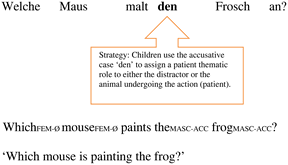
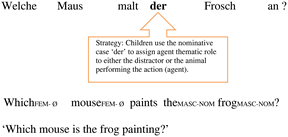
This strategy was further revealed by the error types that the bilingual children committed. Both the 2L1 and the eL2 children committed approximately 50% of reversal errors in both subject and object wh-questions in the NP-cue condition, and approximately 30–40% of distractor errors in the same condition. These error patterns suggest that the bilingual children did not parse these sentences as a whole, but that they merely used the only case marking available in the sentence in an opportunistic way to pick the target referent.
These results suggest that the bilingual children have a direct mapping between case morphology and thematic roles (the nominative denotes the agent; the accusative denotes the patient), but they have difficulty integrating this information to interpret complex wh-questions when the disambiguating information regarding thematic roles appears in a sentence-final position.
Future research would benefit from investigating at what age German-speaking monolingual and bilingual children are able to revise an ambiguous clause upon encountering sentence-final cues. In the present study, the four- and five-year-old bilingual and monolingual children are able to interpret wh-questions correctly when the disambiguating cues appear in a sentence-initial position (double-cue and wh-cue conditions), or, in the case of the L1 children, when the sentence-final cues match a linear parsing of a sentence (subject NP-cue condition). Furthermore, future studies should examine the underlying parsing processes that are at stake when comprehending such ambiguous sentences by using more fine-grained methodologies that can allow us to answer this question. The methodology adopted in the present study allowed us to examine the role of the presence and the position of cues within complex sentences, but did not allow us to fully comprehend the processing mechanisms at stake in bilingual children, especially in the context of sentence-final cues.
What is the contribution of AoO, cumLoE, and knowledge of case marking in the comprehension of wh-questions in German-speaking preschool children?
The final question that we asked in our study was whether children's performance on wh-questions would differ as a function of AoO, cumLoE to the target language, and knowledge of a relevant grammatical property, i.e. case, which is important for understanding the grammatical function of the constituents in a wh-question. Previous studies have shown that child-internal factors, such as language abilities, contribute more to L2 children's performance than child-external factors, such as exposure and quality of input (Paradis, Reference Paradis2011). However, in the study by Unsworth et al. (2014), vocabulary knowledge and degree of exposure had equal bearings on children's performance on gender production in Dutch. In the study by Chondrogianni and Marinis (Reference Chondrogianni and Marinis2011), L2 children's performance on wh-questions and passives was better explained by LoE than by AoO. In the present study, the contribution of grammatical knowledge, LoE, and AoO was a function of the structure to be acquired.
In the double-cue condition, all three variables were retained in the model and explained more than 40% of the variance in children's performance. This result suggests that, to understand wh-questions with case-marking cues across all constituents, one needs to have sufficient knowledge of case marking (nominative and accusative in this case) and sufficient L2 exposure. In this condition, AoO also had an effect on children's performance, suggesting that the younger the age of L2 exposure, the better the performance on wh-questions.
The reason why we find AoO effects in the double-cue condition may be related to the early acquisition of case in German and its importance for the comprehension of wh-questions with case-marking cues. As Tsimpli (Reference Tsimpli2014) notes, one would expect to find AoO effects between 2L1 and (e)L2 children if a structure is early acquired. In Unsworth et al.'s (Reference Unsworth, Argyri, Cornips, Hulk, Sorace and Tsimpli2014) study on the acquisition of Dutch and Greek gender in 2L1 and (e)L2 children, AoO effects were found for Greek gender, which is early acquired (by the age of three years) but not for Dutch gender, which is late acquired (even after the age of eight years). The factors that predicted children's performance on Dutch gender were exposure and vocabulary size.
Turning to our study, case marking in German is an early-acquired property (Eisenbeiss et al., Reference Eisenbeiss, Bartke and Clahsen2006). This finding is corroborated by the results from the L1 children in our study, who by the age of five years had ceiling performance on the case production task. The L1 children also felicitously comprehended wh-questions carrying case marking in both a sentence-initial and a sentence-final position (see also Dittmar et al., Reference Dittmar, Abbot-Smith, Lieven and Tomasello2008; Roesch & Chondrogianni, Reference Roesch, Chondrogianni, Hamann and Ruigendijk2015). Since nominative and accusative case markings are early acquired in German, and L1 children can successfully use these morphosyntactic cues to comprehend simple and complex sentences by the age of five years, we expect to find AoO effects in wh-questions that rely heavily on knowledge of case marking. In the present study, the wh-questions with double-cues was the condition that heavily relied on case marking to disambiguate thematic roles. This prediction was borne out, as the eL2 children's performance on accusative case and on the double-cue condition was significantly poorer compared to that of the 2L1 children. Therefore, it is not surprising that AoO was a significant predictor for the bilingual children's performance in this condition.
In the two other conditions, however, where case marking appeared only in sentence-initial or in sentence-final position, the only predictor variable that was retained in the model was cumLoE.Footnote 2 This was particularly the case in the NP-cue condition where the cues appeared in a sentence-final position. These results suggest that when case-marking cues appear in a sentence-final position, knowledge of case provides little facilitation in comprehending these structures, and that other factors, such as exposure, may play a more important role. However, in the NP-cue condition, cumLoE could only account for 18% of the variance, suggesting that other factors may be at play in the comprehension of wh-questions with single and late-occurring cues, which were not measured in the present study and are subject to a future study.
Taken together, the results from this study point towards length of exposure effects on the acquisition of complex and late-acquired structures. It could be argued that the eL2 children in the present sample are at an earlier developmental stage compared to the 2L1 children, and that they are in the process of developing sensitivity to case marking similarly with their (2)L1 peers. Differences in the comprehension of wh-questions were also found between 2L1 and L1 children. This again could be attributed to the 2L1 children having less exposure than their L1 counterparts, since both groups had the same AoO to the L2. Future studies with older eL2 and 2L1 children with more exposure should shed light on the question of when eL2 children catch up with their L1 peers.
CONCLUSIONS
The present study examined whether German-speaking bilingual children with different AoOs and LoEs would exhibit a subject–object asymmetry in the comprehension of wh-questions, and whether their performance would be mediated by the presence and position of case-marking cues within the wh-questions. Results showed that the bilingual children's performance was mediated by a combination of knowledge of case marking, cumLoE, and AoO, depending on the position and number of case-marking cues in the sentence. The results of the present study raise intriguing questions regarding how early- and late-acquired properties interact in bilingual acquisition, and when and how bilingual children with different AoO and LoE make use of morphosyntactic cues to interpret complex sentences.