

1. Introduction
Le pouvoir est simultanément le pourvoyeur et le fossoyeur des droits humains. Jacques Mourgeon nous autorisera cet emprunt.Footnote 1 À l’apparence provocatrice, cette idée met surtout en évidence la dialectique qui caractérise la mise en œuvre des droits humains. Au cœur de cette mise en œuvre, se trouve la personne de l’État. Entité politique immatérielle,Footnote 2 l’État n’en est pas moins une notion polysémique aussi.Footnote 3 Il ne s’agira pas de bâtir une théorie autour de cette notion. En revanche, nous tenterons de la redéfinir pour la cerner de près afin de reconnaître par la suite à la personne qu’elle incarne, un rôle dans la mise en œuvre des droits humains dont le droit à l’alimentation.
En effet, la notion d’État est généralement disputée entre deux conceptions. Il s’agit d’un côté de la conception objectiviste ou sociologique et d’un autre côté de la conception volontariste. Du point de vue des objectivistes, l’existence de État dépend de la présence d’un territoire, d’une population et d’un gouvernement.Footnote 4 Cette façon de voir l’État rappelle sa conception par la Convention de Montevideo concernant les droits et devoirs des États du 26 décembre 1933, par le truchement de son article 1 notamment.Footnote 5 Loin de s’opposer à l’approche objectiviste, les concepteurs du volontarisme font le cumul de ces éléments constitutifs de l’État en y associant deux autres critères sine qua non, à savoir, la personnalité juridiqueFootnote 6 et la reconnaissance.Footnote 7 Si elles sont pertinentes, ces conceptions de l’État occultent toutefois des limites. Parmi ces limites, deux d’entre elles retiennent notre attention. D’une part, c’est le fait qu’une collectivité territoriale par exemple ou même une province étatique comme la province canadienne de l’Ontario puisse remplir les critères exigés par ces deux conceptions (ou du moins par la conception objectiviste) sans pour autant être un État au sens du droit international pour pouvoir jouer le même rôle que ce dernier.Footnote 8 D’autre part, c’est le fait que ces deux conceptions de l’État n’ont pas d’égard à sa finalité. Si une chose est d’avoir un État, une autre chose doit être de savoir ce à quoi cet État va servir. À ce sujet, les conceptions objectiviste et volontariste ne disent rien.
Loin de les rejeter toutes deux, nous voudrions néanmoins aller voir ailleurs, ne serait-ce que pour nous abreuver d’une conception de l’État qui serait même de faire consensus et nous servir. D’ailleurs, ne dit-on pas que “la recherche est une activité de quête objective de connaissances?”Footnote 9 Dans une telle quête, nous en arrivons à la conception philosophique de l’État. Parmi les principaux adeptes de cette conception, on retrouve Jean-Jacques Rousseau, John Locke, Thomas Hobbes, etc. De leur avis, l’État est parvenu à l’existence par une nécessité historique.Footnote 10 Dit autrement, l’avènement de l’État se justifie par le souci de mettre fin à l’état de nature caractérisé par l’absence de réglementation et l’insécurité générale, c’est-à-dire, l’anarchie.Footnote 11 D’où, Hobbes fit valoir sa doctrine de “Bellum omnium contra omnes,”Footnote 12 c’est-à-dire, “la guerre de tous contre tous,”Footnote 13 qui soutient en partie le concept de la “loi du plus fort et du plus rusé” défendu par des philosophes à l’image de Hobbes lui-même, Baruch Spinoza,Footnote 14 Niccolo MachiavelFootnote 15 et Friedrich Nietzsche.Footnote 16 Il est bien évident qu’une situation menacerait de disparition l’espèce humaine. C’est bien ce qui justifie l’avènement de l’État; les humains ayant passé un contrat pour se dessaisir de leur liberté et de leur force arbitraire au bénéfice d’un des leurs chargé de toute l’autorité et de veiller à l’ordre et à la sécurité de chacun.Footnote 17 De là, est né l’État. Cette réalité fut par la suite traduite par le philosophe allemand, Emmanuel Kant, qui dira qu’“en général, l’iniquité, l’extrême d’injustice, la dureté, la cruauté même, tels sont les principaux traits de la conduite des hommes les uns envers les autres; le contraire n’est que rare et exception. C’est là-dessus […] que reposent la nécessité de l’État et de la legislation.”Footnote 18 Cette conception fait de l’État une personne morale providentielle.Footnote 19 Notre assentiment envers elle ne peut cependant amener à renier la portée des deux autres conceptions. D’où l’idée de les fusionner pour obtenir une vision unique de l’État.
De la sorte, en parlant d’État, nous voudrions croire en une personne morale de droit public interne et international cumulant à la fois les critères d’existence objectivistes et volontaristes et qui est chargé d’une fonction providentielle à l’égard d’une population déterminée et dont elle tient son autorité. Parmi les différents types d’État reconnus en droit constitutionnel en fonction du critère de la répartition du pouvoir, une telle définition écarte la perspective d’un État confédéralFootnote 20 à l’image de l’Union européenne (UE) pour ne retenir que celle d’un État fédéralFootnote 21 comme le Canada et celle d’un État unitaireFootnote 22 à l’image de la France.
À partir d’une telle définition, on peut aisément reconnaître des responsabilités à l’État, c’est-à-dire, des fonctions à exercer. Celles-ci peuvent être de nature sociale, économique ou politique. C’est le cas lorsque l’État doit créer des emplois, adopter des lois et les faire respecter ou réglementer la société, établir l’ordre, garantir la sécurité, assurer l’éducation, créer des infrastructures tant économiques que sociales et sanitaires, etc. Tout ceci doit être au bénéfice de sa population, c’est-à-dire, celle circonscrite à l’intérieur de son territoire et dans une certaine mesure, ses citoyens se trouvant hors de son territoire.Footnote 23 C’est alors que l’on pourra dire d’un État qui assure ces différentes fonctions, qu’il crée le bien-être de sa population. Aristote aurait-il ainsi eu tort de dire que “l’État, c’est la communauté du bien vivre et pour les familles et pour les groupements de famille en vue de la vie parfaite et qui se suffise à elle-même”?Footnote 24 Nous en doutons. Sinon, il n’aurait pas été logique voire possible pour l’Assemblée générale de l’Organisation des Nations Unies (ONU) de soutenir que “chaque État est responsable au premier chef de promouvoir le progrès économique, social et culturel de son peuple” et qu’on “reconnaitra alors à chaque État d’avoir le droit et la responsabilité de choisir ses objectifs et ses moyens de développement, de mobiliser et d’utiliser intégralement ses ressources, d’opérer des réformes économiques progressives et d’assurer la participation de son peuple au processus et aux avantages du développement.”Footnote 25
Droit en tant que prérogative et responsabilité vont de pair, et donc, là où il y a un droit à défendre, on pense également à l’existence d’une responsabilité à accomplir. On n’aurait donc pas tort de dire que la responsabilité est le corollaire du droit.Footnote 26 En parlant de responsabilité de l’État, nous voudrions croire à des obligations qu’il doit remplir en faveur de sa population surtout ou même envers les autres États.Footnote 27 Une telle vision de la notion de responsabilité répond à celle du Tribunal international du droit de la mer.Footnote 28 Pour ce tribunal, en parlant de responsabilité, il y a lieu de faire une distinction entre “obligation au sens primaire” et “obligation au sens secondaire.” Le sens primaire décline la responsabilité comme une obligation qui consiste pour l’État à veiller à l’accomplissement d’un engagement pris en vertu d’une norme internationale dont une convention internationale par exemple.Footnote 29 Au sens secondaire par contre, la responsabilité fait allusion à l’obligation de l’État de payer des dommages et intérêts en faveur des personnes (physiques ou morales) ayant été victimes d’un comportement fautif de sa part et qui aurait abouti à des dommages à leur encontre.Footnote 30
En appliquant ces différentes définitions à notre contexte, on retiendra que la responsabilité de l’État lui implique précisément une obligation de respecter, une obligation de protéger et une obligation de donner effet, au droit à l’alimentation à travers la mise en œuvre des règles juridiques qui l’encadrent. Il ne s’agit pas pour lui de pouvoir nourrir sa population ou de “fournir des denrées alimentaires à tous les individus en toutes circonstances.”Footnote 31 Bien au contraire, il s’agit plutôt pour lui de créer les conditions qui permettent à sa population de se nourrir elle-même.Footnote 32 Ceci dit, “Le droit à l’alimentation ne saurait se réduire à un élément de politique d’assistance, voire d’assistanat, qui viendrait substituer la responsabilité des individus à celle de l’État.”Footnote 33 La mise en œuvre des règles juridiques vaut leur application. Qui parle d’application d’une règle de droit, parle d’“opération consistant à donner effet à une règle de droit ou à une décision administrative ou judiciaire, dans une espèce déterminée ou dans une généralité des cas particuliers.”Footnote 34 C’est alors que l’idée de mise en œuvre de règles juridiques vaut aussi leur effectivité qui, est la variable clé qui permet de déterminer si les règles juridiques ont pu produire des changements dans le comportement d’un groupe (voire d’une entité) visé. C’est ce que David Victor, Kal Raustiala et Eugene Skolnikoff pensent.Footnote 35 Yann Leroy renchérit sur ce point en faisant valoir que l’effectivité vaut deux perspectives. Selon lui, dans une perspective large, est dite effective, une norme qui atteint normalement ses objectifs ou ses effets souhaités tandis que dans une perspective restreinte, la norme dite effective est celle qui est respectée par ses destinataires et sanctionnée en cas de violation.Footnote 36
Pour revenir à ces trois types d’obligations énoncées, ils rappellent la théorie des trois niveaux d’obligations de Henry Shue en matière des droits humains et qui s’imposent à l’État.Footnote 37 Cette théorie “consiste en ce que la mise en œuvre de chaque droit de l’Homme appelle trois types d’obligations juridiques qui s’échelonnent de façon successive ou graduelle.”Footnote 38 Dans le contexte du droit à l’alimentation, l’obligation de respecter implique par exemple que l’État garantisse que “la liberté des individus dans leurs choix alimentaires ne soit pas entravée par l’action publique.”Footnote 39 Pour sa part, Claudia Tofan estime que “the obligation to respect means that the Government should not arbitrarily take away people’s right to food or make it difficult for them to gain access to food.”Footnote 40 Concernant l’obligation de protéger, elle poursuit en disant que “the obligation to protect means that the Government must pass laws to prevent powerful people or organizations from violating the right to food. The Government must also establish bodies to investigate and provide effective remedies if that right is violated.”Footnote 41 Pour faire la jonction entre ces deux types d’obligations, Abdoulaye Soma dira que “si tous les acteurs, particuliers, étatiques et non étatiques, pouvaient observer l’obligation de respecter, l’obligation de protéger se révélerait superfétatoire.”Footnote 42 On reviendra encore à Claudia Tofan à propos cette fois-ci de l’obligation de donner effet. Ainsi, dira-t-elle qu’une telle obligation “could mean improving employment prospects, by introducing an agrarian reform program for landless groups or promoting alternative employment opportunities. It could also include, for example, program of free milk provision in schools in order to improve child nutrition.”Footnote 43 En cela, l’État violerait cette obligation “if it let people starve when they were in desperate need and had no way of helping themselves.”Footnote 44
L’arrêt de la Cour suprême de la Colombie du 3 février 1997 dans l’Affaire relative aux derechos fundamentales de comunidad indigena,Footnote 45 illustre bien l’obligation de protéger ce droit. En effet, elle saisit l’occasion à lui offerte par cette affaire pour ordonner la suspension d’une licence de forage pétrolier sur les terres d’une communauté autochtone (comunidad U’wa) mettant à mal ses moyens de subsistence,Footnote 46 car le processus de consultation n’avait pas été mené de manière formelle et substantielle.Footnote 47 Il en va de même de l’arrêt de la Haute Cour du Kenya dans l’affaire Ibrahim Sangor Osman and Others v Hon. Minister of State for Provincial Administration & Internal Security and Others. Footnote 48 Mais, en plus de l’obligation de protéger le droit à l’alimentation, l’affaire incorporait également des pans de l’obligation de respecter ce droit. En effet, dans cette affaire, cette Cour trancha en faveur des personnes (enfants, femmes et vieillards) qui contestaient l’expulsion dont elles avaient fait l’objet par les autorités provinciales sans avoir été avisées.Footnote 49 Cette expulsion les obligea à vivre et à dormir en plein air, sans eau ni nourriture.Footnote 50 La cour en déduisit que cet acte valait une violation du droit à la vie et de celui à être à l’abri de la faim garantis par l’article 43 de la Constitution du Kenya et par des textes internationaux auxquels cet État est partie.Footnote 51 Par contre, lorsque la Cour suprême de l’Argentine ordonnait en 2007 à la province argentine du Chaco et le gouvernement argentin d’adopter des mesures d’urgence destinées à améliorer les conditions de vie de la communauté Toba en lui assurant l’accès à l’eau et à la nourriture, il s’agissait là de promouvoir plutôt l’obligation de donner effet au droit à l’alimentation.Footnote 52
Selon Olivier De Schutter, qui fut rapporteur spécial pour le droit à l’alimentation du Conseil des droits de l’homme à l’Organisation des Nations unies (ONU), ce droit suppose “le droit de toute personne, seule ou en communauté avec d’autres, d’avoir physiquement et économiquement accès à tout moment à une nourriture suffisante, adéquate et culturellement acceptable, qui soit produite et consommée de façon durable, afin de préserver l’accès à des générations futures à la nourriture.”Footnote 53 On devra reconnaître à cette définition, le mérite d’une définition assez complète de ce droit humain en ce sens qu’elle fait ressortir ses différents paramètres. Ce sont, l’accessibilité à l’alimentation, la disponibilité de l’alimentation, la durabilité de l’alimentation et l’adéquation de l’alimentation. Plus précisément, l’accessibilité à l’alimentation fait référence à la capacité de toute personne d’avoir à tout moment un accès physique et économique à des aliments suffisants, sûrs, nutritifs et adaptés à ses préférences culturelles.Footnote 54 Quant à sa disponibilité, celle-ci renvoie à l’idée que l’alimentation puisse exister physiquement, comme le fait pour l’État de disposer d’importants stocks et réserves d’aliments pour pouvoir faire face à des situations de pénurie alimentaire.Footnote 55 Ces deux paramètres du droit à l’alimentation sont intimément liés, car “sans disponibilité en effet, l’accessibilité est une vue de l’esprit.”Footnote 56 La durabilité de l’alimentation signifie que l’on puisse y avoir accès à long terme et cela concerne tant la génération présente que celles à venir.Footnote 57 Pour sa part, l’adéquation de l’alimentation fait allusion à ce qu’elle puisse répondre aux besoins nutritionnels réels des individus (consommateurs), et ce, d’un point de vue sanitaires et culturel.Footnote 58
Dans sa définition de la sécurité alimentaire, le Sommet mondial de l’alimentation qui s’est tenu en 1996 sous l’égide de l’Organisation des Nations unies pour l’alimentation et l’agriculture (FAO) avait également fait siens ces paramètres du droit à l’alimentation. Il en est ressorti que la “sécurité alimentaire existe lorsque tous les êtres humains ont à tout moment, un accès physique et économique à une nourriture suffisante, saine et nutritive leur permettant de satisfaire leurs besoins énergétiques et leurs préférences alimentaires pour mener une vie saine et active.”Footnote 59 Ceci rappel l’existence d’un lien entre le droit à l’alimentation et la sécurité alimentaire, qui n’entretiennent donc pas de différence en réalité.Footnote 60 Cela dit, ils poursuivent ensemble l’objectif de l’être humain de “se développer pleinement et de conserver ses capacités physiques et mentales,”Footnote 61 en ayant accès à une alimentation adéquate. Aujourd’hui, s’il est vrai que l’existence d’un droit à l’alimentation est admise, il n’en demeure pas moins que son régime juridique souffre encore. D’une part, sa reconnaissance sur le plan international manque de lui avoir accordé une valeur juridique obligatoire dans la plupart des différents textes qui ont jusque-là été adoptés comme il en est d’autres droits humains à l’image du droit à la liberté d’expressionFootnote 62 ou encore de celui relatif à la vie.Footnote 63 Les seuls textes existants et qui portent sur la matière, ont pour le moins une valeur déclarative et non contraignanteFootnote 64 ou obligatoire mais limitée dans leur sphère d’applicabilité.Footnote 65 En la matière, c’est le Traité international sur les ressources phytogénétiques pour l’alimentation et l’agriculture,Footnote 66 qui fait l’exception,Footnote 67 avec le Pacte international relatif aux droits économiques, sociaux et culturels Footnote 68 à travers son article 11. D’autre part, c’est surtout le manque de volonté politique de reconnaitre le droit à l’alimentation dans les constitutions ou dans des lois-cadres, qui cause problème. Claudia Tofan avait également révélé ce fait même si c’était en 2013, parce qu’il ne semble pas y avoir eu d’évolution significative depuis lors. Ainsi, disait-elle que, “the international legal recognition of the right to adequate food and numerous commitments to its fulfillment has not translated into widespread acknowledgement and incorporation domestically by all states.”Footnote 69 L’annexe II du Document d’information relatif à la reconnaissance du droit à l’alimentation à l’échelle nationale, établi par la FAO en 2003, joint aux travaux de Ying Chen en 2014,Footnote 70 permettent aussi de le confirmer. Ce sont seulement trente-cinq États dont des dispositions constitutionnelles mentionnent directement le droit à l’alimentation, applicables à l’ensemble de leurs populations.Footnote 71
Dans ce sens, on conviendra que bien que ce droit fasse partie des droits humains fondamentaux,Footnote 72 sa défense pour le faire valoir, ne peut que souffrir d’insuffisances. Ya-t-il quand même lieu de reconnaître l’existence d’une responsabilité de l’État de mettre en œuvre ce droit? Une réponse affirmative semble appropriée. Ceci tient d’une part, du fait de la nature même du droit à l’alimentation qui relève des droits humains et qu’en raison de leur nature, ces types de droits imposent des obligations juridiques à l’État.Footnote 73 D’autre part, c’est la théorie générale des droits en filigrane qui permet de déduire ou d’extraire d’un droit formellement reconnu et consacré dans un texte juridique, un droit qui ne l’est pas, mais qui est indispensable à la jouissance de ce droit reconnu et consacré,Footnote 74 qui permet une telle réponse. Nous aimérions rappeler que cette dernière théorie est d’origine jurisprudentielle. Notre analyse empruntera la méthode herméneutique. Par herméneutique, nous entendons “l’art d’interpréter correctement les textes.”Footnote 75 En cela, Michelle Cumyn et Mélanie Samson pensent qu’il est celui qui “sied au droit.”Footnote 76 En effet, et comme nous l’avons déjà mentionné, le droit à l’alimentation a été directement ou indirectement pris en compte par différents textes juridiques, peu importe leur valeur. À ce titre, le modèle herméneutique se présente comme un atout pour offrir une meilleure compréhension du cadre juridique et institutionnel qui l’entoure. L’herméneutique a l’avantage “de mettre à l’avant une description plus juste de la qualification juridique comme étant la recherche de la meilleure adéquation possible entre une situation factuelle et le régime juridique qu’il convient de lui appliquer.”Footnote 77 L’attention sera portée précisément aux sources formelles du droit, par référence à la doctrine, la jurisprudence (nationale ou internationale), la coutume internationale et les principes généraux de droit, relatifs aux droits humains. Il en sera autant des constitutions étatiques et des lois nationales qui ont incorporé le droit à l’alimentation. Cet article s’inscrit dans un objectif de faire évoluer la compréhension sur le droit humain à l’alimentation et la sécurité alimentaire en faisant de l’État un acteur déterminant pour contribuer à leur réalisation, et ce, même s’il est vrai qu’une telle mise en œuvre dépend parfois aussi de plusieurs autres aléas qui commandent une action concertée de l’ensemble de la communauté internationale.
Pour cela, d’abord, nous traiterons du régime juridique de la responsabilité de l’État dans la mise en œuvre du droit à l’alimentation, ensuite, nous ferons état des défis liés à une vulgarisation du droit à l’alimentation tant au niveau international que national, et enfin, nous discuterons de quelques perspectives de solutions pour lutter contre l’insécurité alimentaire et promouvoir le droit à l’alimentation.
2. La normativité de la responsabilité de l’État dans la mise en œuvre du droit à l’alimentation
Deux faits majeurs, nous semble-il, donnent écho à cette normativité. Ce sont, d’une part, l’existence de fondements juridiques qui soutiennent une telle responsabilité, et d’autre part, la possibilité de voies de recours contre l’État pour la mise en œuvre du droit à l’alimentation.
A. Les fondements juridiques tenant la responsabilité de l’État dans la mise en œuvre du droit à l’alimentation
Il s’agira de faire état, d’abord, des fondements juridiques internationaux pour la mise en œuvre du droit à l’alimentation, ensuite, des fondements juridiques tenant à l’échelle nationale pour la mise en œuvre de ce droit, et enfin, de ses fondements juridiques sur le plan régional. Ceci rappelle l’idée selon laquelle la justiciabilité du droit à l’alimentation peut être analysée à divers niveaux au-delà du seul cadre national des États.Footnote 78
i. Les fondements juridiques internationaux pour la mise en œuvre du droit à l’alimentation
Comme tout droit humain, le droit à l’alimentation ne dépend pas d’un état particulier qui conditionnerait sa mise en œuvre. Il subsiste peu importe que l’on soit en temps de paix ou en temps de guerre même s’il est vrai que ces deux situations appellent à des règles juridiques différentes. En d’autres termes, “la sécurité alimentaire des populations doit être protégée en temps de paix mais aussi en temps de guerre.”Footnote 79 Dans ce sens, la Charte des Nations Unies Footnote 80 qui “est un pilier du droit international contemporain,”Footnote 81 mérite de figurer en bonne place parmi les fondements juridiques internationaux du droit à l’alimentation. En son article 1, paragraphe 3, elle fait sien le but de réaliser la coopération internationale en résolvant les problèmes internationaux d’ordre économique, social, intellectuel ou humanitaire et en contribuant au respect des droits humains. Dans la mesure où la droit à l’alimentation fait partie de ces droits et qu’elle impose en outre aux États de remplir de bonne foi leurs obligations,Footnote 82 il va de soi qu’elle puisse faire partie du droit applicable relatif au droit à l’alimentation et à la sécurité alimentaire.
Plus précisément, parmi les textes juridiques internationaux qui encadrent le droit à l’alimentation en période de paix, c’est premièrement la Déclaration universelle des droits de l’Homme de 1948Footnote 83 qui attire l’attention. Elle a le mérite d’être le premier texte juridique international à avoir consacré le droit à un niveau de vie suffisant quoiqu’elle n’énonce pas un droit à l’alimentation de manière explicite. À cet effet, le paragraphe 1 de son article 25 stipule que “toute personne a droit à un niveau de vie suffisant pour assurer sa santé, son bien-être et ceux de sa famille, notamment pour l’alimentation, l’habillement, le logement, les soins médicaux ainsi que pour les services sociaux nécessaires […].” S’il est vrai que ce texte a une valeur juridique non contraignante, elle a cependant acquis une nature coutumière.Footnote 84 Toute chose qui justifie la possibilité de son invocation devant les tribunaux contre l’État.Footnote 85 Aussi, n’est-il pas inutile de rappeler que certaines de ses dispositions ont fait l’objet de conventions internationales assorties d’un caractère obligatoire pour leurs États parties. C’est le cas du Pacte international relatif aux droits économiques, sociaux et culturels Footnote 86 de 1966 qui apparaît comme étant le fondement juridique par excellence du droit à l’alimentation par l’entremise de son article 11 qui dispose que:
1. Les États parties au présent Pacte reconnaissent le droit de toute personne à un niveau de vie suffisant pour elle-même et sa famille, y compris une nourriture, un vêtement et un logement suffisants, ainsi qu’à une amélioration constante de ses conditions d’existence. Les États parties prendront des mesures appropriées pour assurer la réalisation de ce droit et ils reconnaissent à cet effet l’importance essentielle d’une coopération internationale librement consentie. 2. Les États parties au présent Pacte, reconnaissant le droit fondamental qu’a toute personne d’être à l’abri de la faim, adopteront, individuellement et au moyen de la coopération internationale, les mesures nécessaires, y compris des programmes concrets: (a) Pour améliorer les méthodes de production, de conservation et de distribution des denrées alimentaires par la pleine utilisation des connaissances techniques et scientifiques, par la diffusion de principes d’éducation nutritionnelle et par le développement ou la réforme des régimes agraires, de manière à assurer au mieux la mise en valeur et l’utilisation des ressources naturelles; (b) Pour assurer une répartition équitable des ressources alimentaires mondiales par rapport aux besoins, compte tenu des problèmes qui se posent tant aux pays importateurs qu’aux pays exportateurs de denrées alimentaires.
Selon Abdelrahman Afifi, “cet instrument international traite du droit à l’alimentation de façon plus complète qu’aucun autre instrument.”Footnote 87
Il y a lieu aussi de tenir compte de la contribution des conférences mondiales à travers des déclarations et résolutions qui en ont résulté et qui ont permis de favoriser l’émergence du concept de la sécurité alimentaire.Footnote 88 À la différence du Pacte suscité, ces autres documents internationaux n’ont pas de valeur juridique contraignante. C’est le cas de la Déclaration universelle pour l’élimination définitive de la faim et de la malnutrition. Adoptée le 16 novembre 1974 à Rome par la Conférence mondiale de l’alimentation, elle dispose que “chaque homme, femme et enfant a le droit inaliénable d’être libéré de la faim et de la malnutrition afin de se développer pleinement et de conserver ses facultés physiques et mentales. […] En conséquence, l’élimination définitive de la faim est un objectif commun de tous les pays de la collectivité internationale, notamment des pays développés et des autres États en mesure de fournir une aide.”Footnote 89 Un autre fait marquant de cette Conférence mondiale, fut la consécration par la Résolution XVII, de “l’engagement internationale sur la sécurité alimentaire mondiale.” Son article 1Footnote 90 mérite une attention particulière. Rappelons aussi la Déclaration de Rome sur la sécurité alimentaire mondiale adoptée au terme du Sommet mondial de l’alimentation du 13 au 17 novembre 1996.Footnote 91 Il conviendra de faire état également de l’action de la FAO qui œuvre pour une réalisation concrète du droit à l’alimentation. Ce fut dans le cadre de cette action que les États ont adopté en 2004 les directives volontaires qui devraient en principe “guider leur action en vue d’une mise en œuvre effective du droit à l’alimentation.”Footnote 92
Comme il en est en temps de paix, les situations de conflit armé ne dispensent pas les États de leur responsabilité de mettre en œuvre le droit à l’alimentation. L’idée des conflits armés, emmène à penser au droit international humanitaire (DIH) qui encadre de telles situations. Ce droit est relatif aux “règles internationales, d’origine conventionnelle ou coutumière, qui sont spécifiquement destinées à régler les problèmes humanitaires découlant directement des conflits armés, internationaux ou non internationaux, et qui restreignent, pour des raisons humanitaires, le droit des parties au conflit d’utiliser les méthodes et moyens de guerre de leur choix ou protègent les personnes et les biens affectés, ou pouvant être affectés par le conflit.”Footnote 93 L’affaire Application de la convention pour la prévention et la répression du crime de génocide dans la bande de Gaza entre l’Afrique du Sud et Israël devant la CIJ est évocatrice en la matière.Footnote 94 La Cour en a profité pour exiger à Israël de permettre la fourniture des services de base et de l’aide humanitaire requis de toute urgence afin de remédier aux difficiles conditions d’existence auxquelles sont soumis les Palestiniens de la bande de Gaza.Footnote 95 Cette exigence concerne la fourniture médicale, l’accès à l’eau, à la nourriture, aux besoins en combustible, aux abris, aux vêtements, etc.Footnote 96
Parmi les textes juridiques internationaux sur lesquels ce droit repose, il y a lieu de parler des quatre Conventions de Genève de 1949 qui forment l’assise principale du droit international humanitaire en vigueur aujourd’hui,Footnote 97 auxquelles s’ajoutent leurs protocoles additionnels du 8 juin 1977. Pour certaines dispositions de ces textes juridiques, l’objectif consiste à prévenir la violation du droit à l’alimentation. Au nombre de celles-ci figurent par exemple l’article 54, paragraphes 1Footnote 98 et 2,Footnote 99 du Protocole additionnel I aux Conventions de Genève du 12 août 1949 relatif à la protection des victimes des conflits armés internationaux, l’article 14Footnote 100 et l’article 17, paragraphe 1,Footnote 101 du Protocole additionnel II aux Conventions de Genève du 12 août 1949 relatif à la protection des victimes des conflits armés non internationaux, l’article 49 de la Convention IV de Genève du 12 août 1949 relative à la protection des personnes civiles en temps de guerre. Footnote 102
À ces dispositions conventionnelles, s’ajoutent les règles du droit international humanitaire coutumier dont l’objet consiste à combler certaines lacunes du droit conventionnel en renforçant la protection dont bénéficient les victimes des conflits armés. En effet, s’il est vrai que les textes conventionnels du droit international humanitaire s’appliquent comme la lex specialis, ils ne peuvent cependant s’appliquer aux États qui n’en sont pas parties.Footnote 103 Dans le domaine des conflits armés, des États nouveaux naissent parfois, sans être liés par les conventions de Genève. C’est le cas de l’Érythrée qui ne l’était pas dans le conflit armé de 1998–2000 avec l’Éthiopie.Footnote 104 Mais, lorsqu’une règle est considérée comme coutumière, à l’image de celles du droit international humanitaire, elle s’impose à tous les États, en dehors de la ratification expresse des traités internationaux.Footnote 105
Joint à cette réalité, les Protocoles additionnels I et II peinent à être ratifiés par tous les États membres de l’ONU.Footnote 106 En plus, les textes sont en droit international humanitaire souvent anciens. Ils datent de 1907 pour ce qui est des Conventions de la Haye (droit international humanitaire de 1907) et de 1949 en ce qui concerne les Conventions de Genève du 12 août 1949 et leurs Protocoles additionnels I et II qui datent du 8 juin 1977.Footnote 107 Ce fait justifie l’idée qu’une interprétation du droit international humanitaire à la lumière de la pratique la plus récente (et donc des règles du droit international humanitaire coutumier) s’impose. Par ailleurs, pour les conflits armés non internationaux, les textes du droit conventionnel contiennent peu de règles. L’exception est constituée par l’article 3 commun aux Conventions de Genève. Footnote 108 L’essentiel des règles pour ce type de conflit s’est développé comme du droit international coutumier. Ce sont toutes ces raisons qui rendent essentielles les règles du droit international humanitaire coutumier. On ne peut donc pas les marginaliser.
Ces règles coutumières s’appliquent aux conflits armés tant internationaux que non internationaux. En l’occurrence, il s’agit de la règle coutumière 53,Footnote 109 de la règle coutumière 54,Footnote 110 de la règle coutumière 55,Footnote 111 et de la règle coutumière 56.Footnote 112 On ne saurait se limiter à ces seules Conventions de Genève dans la mesure où, il existe, dans le Statut de Rome de la Cour pénale internationale,Footnote 113 certaines dispositions qui ont trait à la sécurité alimentaire et qui criminalisent les actes qui lui portent atteinte.Footnote 114 C’est le cas de son article 8, paragraphe 2, alinéa b, point xxv,Footnote 115 qui classe les atteintes au droit à l’alimentation parmi les crimes de guerre, de l’alinéa b,Footnote 116 du paragraphe 2 de son article 7 qui érige les violations du droit à l’alimentation en crimes contre l’humanité. Son article 6, paragraphe c, qui définit le génocide, ne saurait être tenu en marge de cette liste. En effet, l’idée d’une “soumission intentionnelle du groupe à des conditions d’existence devant entraîner sa destruction physique totale ou partielle” qu’il véhicule, peut être interprétée à bien des égards comme le fait de priver ce groupe de la nourriture.Footnote 117 Ces règles juridiques internationales relatives aux conflits armés s’appliquent à toutes les parties (les forces armées étatiques tout comme les groupes armés).Footnote 118
ii. Les fondements juridiques tenant à l’échelle nationale des États pour la mise en œuvre du droit à l’alimentation
La consécration du droit à l’alimentation ne se pas limite pas aux textes juridiques internationaux. On rencontre cette consécration dans l’ordre juridique interne des États également. C’est le cas des lois fondamentales ou constitutions qui l’ont incorporé. De l’avis de Ying Chen, “A constitution is the supreme law for a sovereign State; it establishes the framework and principles of the State as a political entity. Moreover, most States reserve their citizens’ most fundamental rights under their constitutions.”Footnote 119 Pour la plupart des États qui reconnaissent l’existence d’un droit à l’alimentation, l’accès à l’alimentation est inscrit dans leurs loi fondamentale comme un principe, un but ou un objectif social ou politique essentiel.Footnote 120 Ceci n’est pas sans atouts, car cela renforce la justiciabilité de ce droit en offrant aux citoyens davantage de moyens juridiques pour pouvoir s’en prévaloir devant les tribunaux. Parmi les États dont la Constitution a incorporé le droit à l’alimentation, il y a lieu de faire cas de l’Afrique du Sud dont Section 27 de sa Constitution dispose que “everyone has the right to have access to […] sufficient food and water.”Footnote 121
S’y ajoute le Brésil aussi qui, à travers l’article 6 de sa Constitution relatif aux droits sociaux, reconnait à ses citoyens le droit à l’éducation, à la santé, l’alimentation, au travail, au logement, aux transports, aux loisirs, à la sécurité, à la sécurité sociale, à la protection de la maternité et de l’enfance, et à l’assistance aux indigents.Footnote 122 D’autres États ont plutôt une consécration en des termes généraux du droit à l’alimentation ou de la sécurité alimentaire dans leurs constitutions plutôt que d’une consécration directe et précise comme on peut le constater dans le rapport du Groupe de travail intergouvernemental de la FAO.Footnote 123 Suite à notre analyse de ce rapport et des travaux de Ying Chen jointe à nos recherches personnelles, nous sommes arrivé à déceler trente-cinq États qui ont expressément consacré le droit à l’alimentation dans leurs constitutions. Ce sont: L’Afrique du Sud (article 27 de sa Constitution); le Bangladesh (article 15 de sa Constitution); la Biélorussie (article 21 de sa Constitution); la Bolivie (article 16 de sa Constitution); le Brésil (article 6 de sa Constitution); la Colombie (article 65 de sa Constitution); la Corée du Nord (article 25 de sa Constitution); Cuba (article 77 de sa Constitution); l’Équateur (article 23 de sa Constitution); l’Éthiopie (article 90 de sa Constitution); le Guatemala (article 99 de sa Constitution); la Guyane (article 40 de sa Constitution); le Haïti (article 22 de sa Constitution); le Honduras (articles 123, 142 et 347 de sa Constitution); Les Îles Seychelles (préambule de leur Constitution), l’Iran (République islamique d’Iran) (articles 3 et 43 de sa Constitution); le Malawi (articles 13 et 30 de sa Constitution); le Mexique (article 4 de sa Constitution); la Moldavie (article 47 de sa Constitution); Namibie (article 95 de sa Constitution); Nicaragua (article 63 de sa Constitution); le Népal (article 36 de sa Constitution); le Nigéria (article 16 de sa Constitution); l’Ouganda (articles 14 et 22 de sa Constitution); le Pakistan (article 38 de sa Constitution); le Panama (article 106 de sa Constitution); le Paraguay (article 57 de sa Constitution); le Porto Rico (article 2 de sa Constitution); la Moldavie (article 47 de sa Constitution); la République démocratique du Congo (article 47 de sa Constitution); la Sierra Léone (article 7 de sa Constitution); la Suisse (article 104 de sa Constitution); le Sri Lanka (article 25 de sa Constitution); le Suriname (article 24 de sa Constitution) et l’Ukraine (article 48 de sa Constitution).Footnote 124
iii. Les fondements juridiques de la responsabilité de l’État en vertu des textes régionaux
Ces textes régionaux concernent principalement les continents africain, américain et européen.Footnote 125 Au niveau africain, c’est de manière implicite que la Charte africaine des droits de l’Homme et des peuples (CADHP)Footnote 126 fait référence au droit à l’alimentation. Le renvoi à ce droit est effectué par son article 16 qui stipule que “toute personne a le droit de jouir du meilleur état de santé physique et mental qu’elle soit capable d’atteindre” et que “les États, parties à la présente Charte, s’engagent à prendre les mesures nécessaires en vue de protéger la santé de leurs populations et de leur assurer l’assistance médicale en cas de maladie.” C’est aussi le cas de la Charte africaine sur les droits et le Bien-être de l’Enfant Footnote 127 qui rend explicitement compte de ce droit. On le voit avec son article 14, paragraphe 2, c), qui porte que “les États parties à la présente Charte s’engagent à […] assurer la fourniture d’une alimentation adéquate et d’eau potable.” Dans la même logique, son article 20, paragraphe 2, point a), affirme que “les États parties à la présente Charte, […] prennent toutes les mesures appropriées pour assister les parents ou autres personnes responsables de l’enfant, et en cas de besoin, prévoir des programmes d’assistance matérielle et de soutien, notamment en ce qui concerne la nutrition.”
S’agissant du continent américain, les États membres de l’Organisation des États américains sont convenus aux termes de l’article 34, paragraphe j, de la Charte de l’Organisation des États américains,Footnote 128 d’œuvrer aux bénéfices de leurs peuples pour parvenir à une “alimentation équilibrée, grâce surtout à l’intensification des efforts nationaux en vue d’augmenter la production et les disponibilités alimentaires.” Ces États n’en sont pas restés là. Ils ont adopté par la suite le Protocole additionnel à la Convention américaine relative aux droits de l’Homme Footnote 129 reproduit ci‑après et dénommé “Protocole de San Salvador.”Footnote 130 Dans ce texte, le droit à l’alimentation occupe une place de choix, si l’on en croit le paragraphe 1 de son article 12 qui dispose que “toute personne a droit à une alimentation adéquate qui lui assure la possibilité d’atteindre son plein développement physique et son plein épanouissement affectif et intellectuel.”
En Europe en revanche, l’alimentation n’est jusque-là pas apparue sur la liste des domaines de compétence juridique explicitement conférés par les normes juridiques européens. C’est à l’expression “denrées alimentaires” que ces normes ont recours souvent pour parler de l’alimentation sur ce continent. Ainsi, considère-t-on que l’expression désigne aussi des biens ou des marchandises de telle sorte que les normes juridiques qui régissent le marché intérieur européen (c’est-à-dire, la libre circulation des marchandises) puissent régir les denrées alimentaires ou répondre aux problématiques de sécurité alimentaire également.Footnote 131 Nous en avons pour preuve, le Règlement (CE) n°178/2002Footnote 132 qui établit les principes généraux de la législation alimentaire au sein de l’UE et qui crée l’Autorité européenne de sécurité des aliments tout en fixant des procédures relatives à la sécurité des denrées alimentaires. Il en va de même du Règlement (CE) n° 852/2004Footnote 133 qui définit l’hygiène des denrées alimentaires, du Règlement (CE) n° 853/2004Footnote 134 qui établit des règles spécifiques d’hygiène applicables aux denrées alimentaires d’origine animale, du Règlement (CE) n° 854/2004Footnote 135 qui fixe les règles spécifiques d’organisation des contrôles officiels concernant les produits d’origine animale destinés à la consommation humaine et du Règlement (CE) n° 882/2004Footnote 136 relatif aux contrôles officiels effectués pour s’assurer de la conformité avec la législation sur les aliments pour animaux et les denrées alimentaires et avec les dispositions relatives à la santé animale et au bien-être des animaux. On ne saurait tenir en marge le Traité sur le fonctionnement de l’Union européenne Footnote 137 par le truchement de ses articles 168 et 169 qui définissent la politique relative à la sécurité alimentaire sur la santé publique et la protection des consommateurs. La Charte sociale européenne (révisée) par l’entremise de son article 4, paragraphe 1, retient aussi l’attention en ce qui concerne la prise en compte du droit à l’alimentation par les normes juridiques sur le continent européen. Il en ressort qu’“en vue d’assurer l’exercice effectif du droit à une rémunération équitable, les Parties s’engagent […] à reconnaître le droit des travailleurs à une rémunération suffisante pour leur assurer, ainsi qu’à leurs familles, un niveau de vie décent.” La référence faite par cette disposition à l’expression “niveau de vie suffisant” comme ce que l’on rencontre à l’article 11Footnote 138 du Pacte international relatif aux droits économiques, sociaux et culturels, permet de croire que c’est au droit à l’alimentation qu’il est fait référence.
B. L’existence de voies de recours contre l’État pour la mise en œuvre du droit à l’alimentation
Ces voies de recours ont trait d’une part aux recours d’ordre judiciaire et extrajudiciaire auxquels l’État est susceptible de faire face dans un contexte régional. D’autre part, elles font référence à l’influence des mécanismes de contrôle internationaux et d’organisations internationales pour la mise en œuvre du droit à l’alimentation par l’État.
i. Des recours d’ordre judiciaire et extrajudiciaire auxquels l’État est susceptible de faire face dans un contexte régional
On mettra l’accent sur les recours d’ordre judiciaire ouverts contre l’État dans un premier temps, avant d’en venir aux recours d’ordre extrajudiciaire ouverts contre l’État dans un contexte régional dans un second temps.
(a) Les recours d’ordre judiciaire ouverts contre l’État
Le fait que le droit à l’alimentation souffre encore d’un manque de reconnaissance dans plusieurs textes juridiques nationaux, ne peut entacher sa justiciabilité. La raison tient de l’appartenance de ce droit à la catégorie des droits humains, et donc à la théorie des trois niveaux d’obligations de Henry Shue pour mettre en œuvre de tels droits, comme nous l’avons déjà signifié.Footnote 139 La théorie générale des droits en filigrane qui permet de déduire des droits formellement reconnus et consacrés dans des textes juridiques, des droits qui ne le sont pas, mais qui sont indispensables à la jouissance de tels droits reconnus et consacrés,Footnote 140 conforte cette justiciabilité également. En réalité, c’est application d’une telle théorie que la Cour internationale de Justice (CIJ) arrive à ériger les principaux traités relatifs aux droits humains dans le cercle du droit applicable aux obligations des États en matière de changement climatique,Footnote 141 alors même qu’aucune disposition de ces instruments juridiques ne fait expressément mention de la lutte contre les changements climatiques. Il s’agit du Pacte international relatif aux droits économiques, sociaux et culturels et du Pacte international relatif aux droits civils et politiques ainsi que le droit international coutumier relatif aux droits humains.Footnote 142 C’est encore le cas lorsque cette Cour fait de la protection de l’environnement, une condition préalable à la jouissance des droits humains,Footnote 143 comme si l’on devrait pouvoir extraire des droits humains à partir de la mise en œuvre du droit à l’environnement. C’est ainsi que le droit à l’alimentation peut être déduite des droits formellement reconnus et consacrés dans les textes juridiques internationaux comme le droit à la vie, garanti également à l’article 3Footnote 144 de la Déclaration universelle des droits de l’Homme de 1948 et à l’article 6, paragraphe 1,Footnote 145 du Pacte international relatif aux droits civils et politiques. Footnote 146 Martha Jackman est arrivée à son tour à déduire un droit à l’alimentation sur le fondement de l’article 7 de Loi constitutionnelle de 1982 (Charte canadienne des droits et libertés)Footnote 147 qui dispose que “chacun a droit à la vie, à la liberté et à la sécurité de sa personne.” Elle affirme qu’“on ne peut pas imaginer un droit à la vie ou à la sécurité de sa personne lorsqu’on est mal nourri.”Footnote 148 Mise à part cette possibilité, il y a également le fait que plusieurs États aient souscrit aux textes juridiques internationaux relatifs au droit à l’alimentation.Footnote 149 Par l’entremise de leurs engagements internationaux à l’égard de ces instruments juridiques, il est possible de déduire leur obligation de garantir ce droit de sorte que leurs populations puissent l’invoquer devant leurs tribunaux. Prenons l’exemple sur le Burkina Faso qui est à sa quatrième république actuellement. Dans sa Constitution, le droit à l’alimentation n’y est pas consacré expressis verbis. Toutefois, une interprétation de l’article 14Footnote 150 de cette Constitution en conjonction avec son préambule qui prévoit que le Burkina Faso ait souscrit à la Déclaration universelle des droits de l’homme de 1948 (dont l’article 25)Footnote 151 et aux instruments juridiques internationaux traitant des problèmes économiques, sociaux et culturels,Footnote 152 permet de déduire une reconnaissance de ce droit. En conséquence, même au sein des États dont les textes juridiques n’ont pas consacré ce droit, il demeure encore possible pour leurs populations de l’invoquer devant leurs juridictions nationales. Ceci nous permet d’en venir au contexte régional maintenant.
S’agissant du continent africain par exemple, il y a des recours ouverts contre l’État africain devant la Cour africaine des droits de l’Homme. Cette juridiction doit sa création au Protocole relatif à la Charte africaine portant sur la Création d’une Cour Africaine des Droits de l’Homme et des Peuples, adopté à Ouagadougou, Burkina Faso, en 1998.Footnote 153 Sur sa raison d’être, l’article 2 du Protocole rappelle qu’elle intervient au même titre que la Commission Africaine des Droits de l’Homme et des Peuples pour compléter la fonction de cette dernière qui consiste à la protection des droits humains en Afrique.Footnote 154 Sa compétence matérielle s’étend à toutes les affaires et à tous les différends relatifs à l’interprétation et à l’application de la CADHP, de son Protocole de création, et de tout autre instrument pertinent relatif aux droits humains et ratifié par les États concernés.Footnote 155 Dans ce sens, on pourrait penser que cette cour soit aussi compétente pour connaître des différends liés au droit à l’alimentation puisqu’il relève de la catégorie des droits pouvant entraîner sa compétence. L’article 5Footnote 156 du protocole dispose sur sa compétence personnelle, en laissant entendre que celle-ci peut être activée par la commission, l’État partie qui a saisi la commission, l’État partie contre lequel une plainte a été introduite, l’État partie dont le ressortissant est victime d’une violation des droits de l’Homme, les Organisations inter-gouvernementales africaines. À cette liste s’ajoutent également les organisations non gouvernementales (ONG) et les personnes physiques ayant subi des violations de leurs droits humains. Mais, pour une telle éventualité, il faudrait qu’au moment de la ratification du protocole, l’État contre lequel une plainte est introduite ait fait une déclaration acceptant la compétence de la Cour pour recevoir les requêtes des ONG et des individus.Footnote 157 Elle applique les dispositions de la CADHP de même que celles de tout autre instrument juridique pertinent ayant trait aux droits humains et ratifié par l’État concerné.Footnote 158 Ses arrêts sont en principe définitifs et ne peuvent donc faire objet d’appel. Ceci n’exclut pas qu’un recours en interprétation ou en révision d’arrêt puisse être intenté contre une de ses décisions “en cas de survenance de preuves dont elle n’avait pas connaissance au moment de sa décision et dans les conditions déterminées dans le Règlement Intérieur.”Footnote 159
Au niveau européen, on pense à la Cour européenne des droits de l’homme, mise en place par la Convention européenne des droits de l’Homme.Footnote 160 Son institution répond au souci des États membres du Conseil de l’Europe d’assurer la défense des droits fondamentaux comme ceux reconnus dans la Déclaration Universelle des droits de l’Homme de 1948.Footnote 161 Dans la mesure où le droit à l’alimentation est consacré à l’article 25, paragraphe 1, de cette déclaration comme nous l’avons déjà signifié, on pourrait dire que cette Cour soit aussi compétente pour régler des affaires liées à la mise en œuvre du droit à l’alimentation au niveau européen.
Sur le plan américain, c’est la Cour interaméricaine des droits de l’Homme qui attire l’attention. Elle doit son institution à la Résolution nº 448 de l’Assemblée générale l’Organisation des États américains (OEA) adoptée à sa neuvième session ordinaire tenue à La Paz, Bolivie, en octobre 1979 qui l’institue.Footnote 162 Avec son siège est fixé à San José au Costa Rica.Footnote 163 Elle est chargée d’interpréter et d’appliquer la Convention américaine relative aux droits de l’Homme et exerce ses fonctions conformément aux dispositions de cette convention et de son Statut.Footnote 164 Les droits humains défendus par cette convention sont en principe ceux reconnus par la Déclaration Universelle des droits de l’Homme de 1948, en l’occurrence les droits fondamentaux de la personne humaine.Footnote 165 Par voie de conséquence, aurions-nous tort de penser au droit à l’alimentation qui fait partie de tels droits? Évidemment non! Pour ce qui est de sa compétence personnelle, ce sont seulement les États parties à la convention précitée et la commission qui peuvent la saisir.Footnote 166
(b) Les recours d’ordre extrajudiciaire ouverts contre l’État dans un contexte régional
Ce sont des recours qui sont hors des formes judiciaires. Ils témoignent de l’importance et de la spécificité du droit à l’alimentation. Sa mise en œuvre dépasse le seul cadre des juges pour intéresser d’autres institutions munies également de pouvoirs de dissuasion à l’égard des États. C’est le cas de la Commission Africaine des Droits de l’Homme et des Peuples pour ce qui est de l’Afrique par exemple. Il n’est pas exclu que cette commission puisse prendre fait et cause pour un individu ou une organisation ou un État en Afrique et qui serait victime de violations relatives à la mise en œuvre du droit à l’alimentation dont la culpabilité incombe à un État partie à la CADHP. Footnote 167 À juste titre, on pourra faire mention de l’Affaire du peuple Ogoni portée devant son prétoire par un certain nombre d’ONG, ce qui a prouvé sa capacité et son désir d’adopter une interprétation créative et dynamique de la CADHP. Footnote 168 Après avoir reconnu que “le droit à la nourriture est implicite dans la Charte africaine, dans les dispositions telles que le droit à la vie (article 4), le droit à la santé (article 16) et le droit au développement économique, social et culturel (article 22),”Footnote 169 elle déclare que “le droit à l’alimentation est inextricablement lié à la dignité humaine et est par conséquent essentiel à la jouissance et à la réalisation des autres droits.”Footnote 170 Ainsi, se montre-t-elle prête à condamner un État partie à la CADHP pour des violations graves des droits économiques, sociaux et culturels ainsi que pour droits collectifs.Footnote 171
Néanmoins, pour que l’option de la saisine de la commission aboutisse, il faut que ces violations soient consécutives à celle d’un droit inscrit dans la CADHP comme le droit à la vie ou à la santé, puisque le droit à l’alimentation ne figure pas expressément dans la CADHP. Footnote 172 En ce qui concerne les recours (communications) par les individus et les organisations devant elle, ceux-ci doivent remplir sept autres conditions pour pouvoir aboutir. Parmi ces conditions, figure la règle de l’épuisement des voies de recours internes.Footnote 173 C’est l’article 56Footnote 174 de la CADHP qui en parle.
Quant aux communications des États, leur recevabilité ne peut intervenir qu’après l’échec de négociations bilatérales entre les États concernés (l’État victime et l’État mis en cause) ou de toute autre procédure de règlement pacifique.Footnote 175 S’agissant de cette commission, c’est l’article 30Footnote 176 de cette CADHP qui renseigne sur son institution. Sa compétence matérielle s’étend à toutes les violations relatives à la protection des droits et des libertés garanties par la CADHP. Footnote 177 Le droit applicable devant elle est constitué par des textes internationaux et régionaux (africains) relatifs aux droits humains si l’on en croit l’article 60Footnote 178 et 61Footnote 179 de la CADHP. Si ses décisions ne sont pas obligatoires en principe, elles aident néanmoins les États à résoudre les problèmes juridiques relatifs à la jouissance des droits humains et des libertés fondamentales.
Sur le continent américain, la Commission américaine des droits de l’homme joue presque le même rôle la Commission Africaine des Droits de l’Homme et des Peuples en Afrique, dans la mise en œuvre du droit à l’alimentation. Son avènement est relaté par l’article 106 la Charte de l’Organisation des États américains qui stipule qu’“il y aura une Commission interaméricaine des droits de l’Homme, dont la principale fonction consistera à promouvoir le respect et la défense des droits de l’Homme et à servir, dans ce domaine, d’organe consultatif à l’Organisation.” Elle exerce sa compétence à l’égard de tous les États membres de l’Organisation des États américainsFootnote 180 et selon l’article 41 de la Convention américaine relative aux droits de l’Homme, sa tâche principale consiste à promouvoir l’observation et la défense des droits de l’homme, et dont le droit à l’alimentation. En plus de veiller à l’application de la Charte de l’Organisation des États américains et de la Convention américaine relative aux droits de l’Homme, cette commission veille aussi à l’application de Déclaration américaine des droits et devoirs de l’Homme, pour promouvoir la protection des droits humains. S’agissant de cette déclaration, elle va plus loin que les deux autres textes, en faisant spécialement mention du droit à l’alimentation pour imposer sa mise en œuvre à travers son article XI.Footnote 181 Sont habilités à saisir la Commission pour des violations relatives aux droits défendus par ces différents textes, toute personne ou tout groupe de personnes, toute entité non gouvernementale et légalement reconnue dans un ou plusieurs États membres de l’Organisation.Footnote 182
(ii) De l’influence des mécanismes de contrôle internationaux et d’organisations internationales pour la mise en œuvre du droit à l’alimentation par l’État
Nous analyserons successivement l’action des ONG et le mécanisme de l’examen périodique universel, qui interviennent aussi dans la mise en œuvre du droit à l’alimentation par l’État.
(a) De l’influence des mécanismes de contrôle internationaux pour la mise en œuvre du droit à l’alimentation au niveau international par l’État
Ces mécanismes ont trait au rôle joué par le comité des conventions internationales et par le Rapporteur spécial des Nations Unies sur le droit à l’alimentation. En effet, la plupart des traités internationaux prévoient la création d’un organe de contrôle de leur mise en œuvre. Le plus souvent, cet organe prend la forme de comités, composé d’experts indépendants chargés de vérifier le respect par les États parties auxdits traités de leurs obligations. Leurs décisions sont souvent sous forme de recommandations et d’observations l’égard des États ayant manqué à leurs obligations et visent à les encourager dans la marche à suivre pour la réalisation des objectifs poursuivis par ces traités. On en rencontre dans le cadre des textes juridiques internationaux sur le droit à l’alimentation également. C’est le cas du Pacte international relatif aux droits économiques, sociaux et culturels qui constitue le fondement par excellence du droit à l’alimentation par l’entremise de son article 11.Footnote 183 Le Comité des droits économiques, sociaux et culturels mis en place par ce texte est le principal organe de contrôle compétent en matière de droit à l’alimentation.Footnote 184 En 2008, l’Assemblée générale des Nations Unies adopta le Protocole facultatif relatif aux droits économiques, sociaux et culturels. Footnote 185 Entré en vigueur en 2013, le Protocole consacre la justiciabilité des droits contenus dans le Pacte, rappelle la compétence et l’opportunité du Comité des droits économiques, sociaux et culturels habilités donc à recevoir des communications (recours) moyennant l’épuisement des voies de recours internes.Footnote 186 Aux termes de son article 2, on peut lire que “des communications peuvent être présentées par des particuliers ou groupes de particuliers ou au nom de particuliers ou groupes de particuliers relevant de la juridiction d’un État partie, qui affirment être victimes d’une violation par cet État partie d’un des droits économiques, sociaux et culturels énoncés dans le Pacte.” En outre, le Protocole précise que ces communications ne peuvent être reçues que si elles concernent des violations qui ont lieu sur le territoire d’un État partie au Pacte et au Protocole facultatif. Toute chose qui prouve que les possibilités semblent être minces pour engager la responsabilité des États en matière de mise en œuvre du droit à l’alimentation. Ahmed Mahiou avait attiré l’attention sur ce fait en affirmant que “si la reconnaissance formelle du droit à l’alimentation constitue une condition nécessaire pour en assurer le respect, cette condition resterait insuffisante tant que les moyens de mise en œuvre feront défaut.”Footnote 187 L’idée consiste à dire que même s’il existe déjà plusieurs institutions internationales qui s’intéressent au droit à l’alimentation, il appert qu’une institution qui lui serait exclusivement consacrée serait la meilleure solution pour favoriser un “suivi régulier et attentif d’un réseau dense de conception et d’opération relatives à la sécurité alimentaire.”Footnote 188
S’agissant du Rapporteur spécial des Nations Unies sur le droit à l’alimentation, c’est en 2000 que la Commission des droits de l’Homme, la dévancière du Conseil des droits de l’Homme, a pris l’initiative de créer sa fonction. Selon le Haut-Commissariat des Nations Unies pour les droits de l’Homme, le rapporteur spécial est un “un expert indépendant, nommé par le Conseil des droits de l’Homme, chargé d’examiner la situation d’un pays ou un thème particulier lié aux droits de l’Homme et d’en rendre compte.”Footnote 189 Son mandat consistant en trois grands axes a été établi par la Résolution 2000/10 de la Commission des droits de l’Homme en 2006.Footnote 190 D’abord, c’est à lui que revient la charge de rassembler les informations relatives à la mise en œuvre du droit à l’alimentation et d’y répondre. Ensuite, sa mission consiste à instaurer une réelle coopération entre tous les acteurs principaux de la scène internationale dans le but de faire la promotion du droit à l’alimentation et de le faire appliquer de façon effective. Enfin, c’est à lui de recenser les problèmes relatifs à la jouissance du droit à l’alimentation qui se posent de jour en jour à travers le monde.Footnote 191 C’est dans ce sens qu’il faudrait comprendre ses visites au sein des États, au terme desquelles, il dresse un rapport sur ses constats en matière de mise en œuvre du droit à l’alimentation. Rappelons-nous de la visite de Monsieur Olivier de Schutter Rapporteur spécial des Nations Unies sur le droit à l’alimentation, au Canada en 2012 pour y analyser la situation du droit à l’alimentation.Footnote 192 Par ailleurs, s’il est vrai que les recommandations du rapporteur spécial n’ont pas de valeur juridique contraignante, son travail permet néanmoins de mettre en avant des thématiques parfois occultées. À cet effet, Caroline Nivard ne manqua pas de souligner que “les travaux des Rapporteurs successifs ont contribué et contribuent grandement à la promotion de la garantie de ce droit ainsi qu’à la détermination de son contenu.”Footnote 193
(b) De l’influence des ONG et du mécanisme de l’examen périodique universel en matière de mise en œuvre du droit à l’alimentation par l’État
En tant que groupements de personnes privées poursuivant par-dessus les frontières étatiques la satisfaction d’intérêts ou d’idéaux communs et susceptibles d’être consultés par l’ONU et les institutions spécialisées,Footnote 194 les ONG qui apparaissent aujourd’hui comme des actrices de la sécurité alimentaire à travers le monde sont en grand nombre. Il en est ainsi grâce à leur intervention auprès des États pour suivre leurs actions relatives à l’application des textes juridiques tant nationaux qu’internationaux qui ont trait à la matière.Footnote 195 À ce sujet, Stephan Hobe disait que “often, NGOs are established to represent interests that the founders consider to be inadequately represented by nation-state. Indeed, the under-representation of certain fields of interests demonstrates the growing need for the inclusion of NGOs in the international law-making process.”Footnote 196 Marcelo Gustavo Kohen également va dans ce sens. De son avis, les États ne sont pas les seuls acteurs décisionnels sur le plan international en raison de l’existence des organisations internationales, des ONG de même que les entreprises transnationales.Footnote 197 C’est le cas de Food First Information and Action Network (FIAN), World Alliance for Nutrition and Human Rights (WANAHR), Rural Advancement Foundation International (RAFI), ou même de Genetic Resources Action International (GRAIN), etc.
Loin d’être théorique, leur participation se conjugue souvent sur le terrain de la pratique faisant en sorte qu’on ne puisse pas les laisser en marge de la quête de solutions aux problèmes d’insécurité alimentaire. Les approches auprès des populations surtout dans des zones rurales au sein des États, les sorties sur le terrain accompagnés d’agents gouvernementaux, voilà entre autres des initiatives à mettre au compte des ONG et qui leur permettent de toucher du doigt les défis alimentaires qui tiennent les populations y compris le degré réel de leur approvisionnement en aliments. En réalité, ces initiatives visent à attirer l’attention des autorités étatiques sur la nécessité de faire mieux pour favoriser la jouissance du droit à l’alimentation par leurs populations comme elles le font pour la mise en œuvre des autres droits humains. Ceci est d’autant plus important que sur la base de certaines études réalisées, il en ressort que l’aide alimentaire octroyée souvent par les États développés aux États en voie de développement, a souvent du mal à parvenir aux populations les plus nécessiteuses en raison des détournements dont elle fait parfois l’objet de la part des autorités étatiques qui l’utilisent à tort pour monnayer des voix politiques.Footnote 198
Ces initiatives des ONG s’inscrivent également dans l’objectif de pouvoir transposer sur le plan international les défis alimentaires liés à chaque État en particulier dans l’optique de favoriser son accompagnement par l’ensemble de la communauté internationale. C’est dans ce sens qu’il faudra comprendre la raison pour laquelle le Comité des droits économiques, sociaux et culturels invite souvent des ONG dans le cadre de son mandat à lui dresser un rapport des informations qu’elles recueillent à travers leurs activités sur le terrain au sein des États.Footnote 199 En considération de ce rôle que les ONG jouent, on pourrait affirmer que si le droit international évolue, c’est aussi grâce à leur contribution. Si le domaine de la sécurité alimentaire relève plus de la compétence des États parce qu’il leur appartient de mettre en œuvre les textes juridiques en la matière, ceux-ci doivent compter aussi sur les ONG. En plus de jouer un rôle dissuasif à l’égard des États pour les encourager à promouvoir la sécurité alimentaire et le droit à l’alimentation, elles arrivent de plus en plus à sensibiliser les populations locales et à attirer leur attention sur les moyens juridiques à leur portée pour exiger leur jouissance du droit à l’alimentation. D’où, l’idée selon laquelle “l’action des ONG a fait évoluer la conception du droit à la nourriture.”Footnote 200
3. Des défis liés à une vulgarisation du droit à l’alimentation tant au niveau international que national
Ces défis tiennent à l’insuffisance de textes à valeur contraignante sur le droit à l’alimentation sur le plan international d’abord, à l’absence d’inscription d’un droit à l’alimentation dans la majorité des lois fondamentales des États ensuite, et à l’existence d’obstacles à la mise en œuvre du droit à l’alimentation liés au sous-développement économique.
A. De l’insuffisance de textes à valeur contraignante sur le droit à l’alimentation sur le plan international
En réalité, le droit à l’alimentation, et par ricochet la sécurité alimentaire, devrait figurer aussi en bonne place dans les agendas internationaux des États pour la simple raison qu’il fait partie des droits humains et dans la mesure où la protection de tels droits constituent le sujet dominant sur le plan des relations internationales.Footnote 201 La mise en place des institutions internationales à l’image de la FAO afin de pallier les problèmes alimentaires de l’après-guerreFootnote 202 ou du Programme alimentaire mondial (PAM) pour apporter une assistance alimentaire via le système des Nations Unies,Footnote 203 etc., en est une preuve matérielle car elles œuvrent toutes pour la garantie de la sécurité alimentaire mondiale. S’il est aujourd’hui possible d’affirmer l’existence d’un droit humain à l’alimentation, sa vulgarisation à grande échelle souffre encore énormément. L’idée d’une vulgarisation de ce droit fait allusion à son érection en un droit avec une portée générale et qui a une force obligatoire au sein de toute la communauté internationale.Footnote 204 En d’autres termes, un droit qui s’impose à tous les États sans exception comme il en est d’ailleurs de plusieurs autres droits humains.
Ceci consiste à dire qu’il n’y a pas seulement lieu de prendre conscience de l’importance de ce droit. Il faut surtout qu’il y ait un nombre important de textes juridiques internationaux à valeur contraignante qui l’encadrent pour prévenir sa violation et éviter sa marginalisation. En effet, lorsqu’on analyse le cadre juridique du droit à l’alimentation à l’état actuel des choses, on peut conclure que le taux des textes juridiques à valeur contraignante qui y font référence est faible. Comme nous l’avons déjà signifié, le régime juridique de ce droit repose en grande partie sur l’article 11Footnote 205 du Pacte international relatif aux droits économiques, sociaux et culturels car il en est le fondement juridique par excellence.Footnote 206
Ce qui est cependant moins intéressant, c’est le fait que le droit à l’alimentation soit réduit à seulement un article dans tout le dispositif de ce traité. En cela, s’il est vrai qu’en ratifiant ce traité, les États parties acceptent de respecter, de protéger et de donner effet au droit à l’alimentation, l’idée qu’ils l’aient enfermé par la suite dans un seul article, ne peut permettre de présumer leur intention d’accorder une place suffisamment importante à ce droit malgré son importance.Footnote 207 Aussi, l’entrée en vigueur du Protocole facultatif se rapportant au Pacte international relatif aux droits économiques, sociaux et culturels Footnote 208 et qui a pour objectif de renforcer les pouvoirs de l’organe de contrôle du Pacte qui est le comité des droits économiques, sociaux et culturels,Footnote 209 présente des limites liées à sa contribution à une mise en œuvre universelle du droit à l’alimentation. Car, ce protocole n’oblige que les États qui l’ont ratifié.Footnote 210
Néanmoins, il existe une exception en la matière. Celle-ci est constituée par le Traité international sur les ressources phytogénétiques pour l’alimentation et l’agriculture Footnote 211 dont tout le dispositif a directement trait au droit international de l’agroalimentaire, en tant que traité contraignant véritablement aux confins de l’agriculture, de l’environnement et du commerce comme en témoigne son article 1.Footnote 212 Ce texte vise à “assurer une agriculture durable et la sécurité alimentaire.”Footnote 213 Ainsi, à la différence de ce traité, les autres textes internationaux ayant trait au droit à l’alimentation, présentent pour la plupart des limites tenant compte de leur spécificité ou de leur portée.Footnote 214 En clair, soit ils ne couvrent que des catégories limitées de personnes ou de situations (par exemple, les femmes, les enfants, les conflits armés), soit ils n’ont qu’une vocation régionale, soit ils n’ont pas de valeur juridique contraignante (les Déclarations, par exemple).
B. De l’existence d’obstacles endogènes à la mise en œuvre du droit à l’alimentation
De tels obstacles tiennent au phénomène de la pauvreté, d’une part, et aux conflits armés surtout, d’autre part. Le lien entre pauvreté et insécurité alimentaire ne saurait souffrir d’aucun doute. Car, la pauvreté tient compte du pouvoir d’achat d’un individu pris en particulier, ou de sa capacité de se procurer des aliments. Par exemple, de l’avis de l’UE,
une personne est reconnue comme vivant dans la pauvreté si son revenu et ses ressources sont insuffisants au point de l’empêcher d’avoir un niveau de vie considéré comme acceptable pour la société dans laquelle elle vit. En raison de la pauvreté, cette personne peut se trouver défavorisée de multiples manières: chômage, faible revenu, logement insalubre, soins de santé inadéquats et obstacles à son accès à l’apprentissage tout au long de la vie, à la culture, au sport et aux loisirs. Elle est souvent marginalisée et exclue de la participation aux activités [économique, sociale et culturelle] qui sont la norme des autres personnes, et son accès aux droits fondamentaux peut être restreint.Footnote 215
Ainsi, aurait-on tort de penser que “le non-accès à l’alimentation est, dans la plupart des cas, lié à la pauvreté”?Footnote 216 Évidemment non! C’est notamment le cas au Bangladesh où “half of the population, 65 million people, is too poor to be able to afford enough food to sustain a healthy and productive life.”Footnote 217 Selon une consultation réalisée par le Conseil de l’Europe, il s’est avéré que “la pauvreté exclut la possibilité de mener une vie compatible avec la dignité de l’être humain: c’est une réalité vécue au niveau individuel et familial, mais dont il faut chercher les racines dans la structure de la société.”Footnote 218
En assimilant ainsi la pauvreté aux facteurs de l’insécurité alimentaire, l’idée est moins de mettre en cause la seule personne de l’individu pour lui en faire porter la responsabilité. Car, s’il importe de reconnaître à chaque individu un rôle à jouer pour se nourrir et contribuer à sa propre sécurité alimentaire (en s’ouvrant au marché du travail pour avoir une rémunération afin de pourvoir à ses besoins, par exemple), il n’en demeure pas moins que ce rôle incombe particulièrement aux gouvernants. Ceci rappelle les trois niveaux d’obligation relatifs à la mise en œuvre de chaque droit humain, dont le droit à l’alimentation en est l’un et qui incombe particulièrement à l’État, à savoir, l’obligation de respecter, l’obligation de protéger et l’obligation de donner effet, telles qu’expliquées dans l’introduction.Footnote 219
Mais, il n’en demeure pas moins que l’État puisse peiner à remplir ces différents niveaux d’obligation en raison de l’état de sa conjoncture économique surtout. Par conjoncture économique de l’État, on pense à l’état général actuel et à court terme de son économie qui se mesure en fonction de l’évolution du taux de chômage, du taux d’inflation, du taux de croissance, du déficit budgétaire et de la trajectoire de la dette publique.Footnote 220 D’ailleurs, c’est de l’examen d’une telle conjoncture qu’on arrive à mesurer le développement économique ou la richesse d’un État pour déduire sa capacité à mettre en œuvre le droit à l’alimentation en faveur de sa population. En plus de cela, c’est de cet examen que l’on aboutit à la conclusion de l’état de pauvreté d’un État qui l’empêche de contribuer à la sécurité alimentaire de sa population, toute chose qui permet ainsi de confirmer que la pauvreté constitue un obstacle à la réalisation du droit à l’alimentation. C’est pourquoi, Alessandra Aula disait que “la pauvreté […] est un défi pour les droits de l’Homme, car elle atteint leur portée universelle en discriminant une partie de la population de la portée universelle de la mise en œuvre de ces droits universels.”Footnote 221
S’agissant des conflits armés, leur impact sur la mise en œuvre des droits humains en général, et sur le droit à l’alimentation ou la sécurité alimentaire en particulier, est aussi reel.Footnote 222 En effet, les conflits armés altèrent la capacité économique des États à mettre en œuvre le droit à l’alimentation. Cela peut s’expliquer de différentes manières. D’une part, les conflits armés représentent souvent une situation d’urgence qui commande une solution militaire de l’État quitte à sacrifier les investissements qui devraient soutenir sa croissance économique, “laquelle, si elle est équitablement gérée, permet d’accroître les revenus des ménages, leurs disponibilités alimentaires et d’améliorer ainsi la jouissance, par eux, du droit à l’alimentation.”Footnote 223 D’autre part, dans la mesure où les conflits armés sont constitutifs de menace à la paix et la sécurité des personnes,Footnote 224 il est difficile d’imaginer que les populations puissent dans de telles situations, œuvrer pour assurer par elles-mêmes leurs besoins alimentaires moyennant la pratique de l’agriculture vivrière, par exemple. Ainsi, Ellen Messer, J. Marc Cohen et Thomas Marchione disaient-ils que les conflits armés compromettent toujours la sécurité alimentaire voie la sécurité humaine dans son ensemble.Footnote 225 Ils ne sont pas seuls à penser de la sorte, car, avec Jelena Pejic, on a presque le même point de vue. C’est le cas lorsqu’elle soutient que “war disrupts all stages of human nutrition — the production, procurement, preparation, allocation, consumption and biological utilization of food — thereby leaving malnutrition, disease and death in its wake.”Footnote 226 Ceci justifie les différentes interventions militaires pour des raisons humanitaires dans les États en proie à des conflits armés.Footnote 227 Tout ceci confirme qu’“il est des situations où l’État est dans l’incapacité de garantir la sécurité des individus; puis, il en est d’autres où il porte lui-même atteinte à la sécurité de sa propre population.”Footnote 228 Ce fut le cas en Somalie où en raison du conflit armé que cet État traversait, le Conseil de sécurité des Nations Unies procéda à l’adoption de sa Résolution 794Footnote 229 qui obligeait les parties à ce conflit de favoriser l’acheminement de l’aide humanitaire et la protection des populations civiles. À ce titre, il y a lieu de reconnaître aux Conventions de Genève du 12 août 1949 d’avoir renforcer la prise de conscience sur l’obstacle que les conflits armés peuvent représenter sur la mise en œuvre du droit à l’alimentation en temps de conflit armé. Ce n’est donc pas anodin que leurs rédacteurs aient par exemple pris le soin d’insérer l’article 55Footnote 230 dans la quatrième convention relative à la protection des personnes civiles en temps de guerre qui oblige les parties aux conflits à garantir l’approvisionnement en nourriture des populations des zones passées sous leur contrôle.
C. De l’existence d’obstacles exogènes à la mise en œuvre du droit à l’alimentation
Ces obstacles font penser à l’impact des changements climatiquesFootnote 231 et de la désertificationFootnote 232 sur la sécurité alimentaire. On entend par changements climatiques, “des changements de climat qui sont attribués directement ou indirectement à une activité humaine altérant la composition de l’atmosphère mondiale et qui viennent s’ajouter à la variabilité naturelle du climat observée au cours de périodes comparables.”Footnote 233 Selon le Conseil des droits de l’Homme des Nations Unies, ils “font peser une menace immédiate et de grande ampleur sur les populations et les communautés de par le monde et ont des répercussions néfastes sur la jouissance effective des droits de l’homme.”Footnote 234 La CIJ l’a confirmé dans son récent avis consultatif du 23 juillet 2025 sur les Obligations des États en matière de changement climatique en affirmant que “la dégradation du système climatique et d’autres composantes de l’environnement compromet la jouissance de toute une gamme de droits protégés par le droit international des droits de l’homme.”Footnote 235 On sait que le droit à l’alimentation fait partie intégrante de ces droits. On aurait donc pu déduire de ces différentes idées que la dégradation de l’environnement et du climat a des répercussions sur le droit à l’alimentation même sans aucune précision de la Cour sur ce fait. Cependant, la CIJ s’est voulue rassurante en le faisant elle-même. Ainsi, reconnaît-elle qu’ il existe un lien étroit entre l’environnement et le droit à un niveau de vie adéquat, qui inclut quant à lui l’accès à l’alimentation, à l’eau et au logement, tel que prévu à l’article 11 du Pacte international relatif aux droits économiques, sociaux et culturels et à l’article 25 de la Déclaration universelle des Droits de l’Homme.Footnote 236
L’Organisation de Coopération et de Développement Économiques (OCDE) est allée dans le même sens aux termes de sa publication de 2001 en avançant que “le changement climatique aura une incidence sur les habitats, sur la production et la distribution de denrées alimentaires, sur la disponibilité des approvisionnements en eau et sur la diffusion des maladies.”Footnote 237 Plus précisément, c’est à travers leur impact sur la pratique de l’agriculture ou les productions agricoles que les changements climatiques arrivent à compromettre la mise en œuvre du droit à l’alimentation en favorisant ainsi l’insécurité alimentaire. Ainsi, l’agriculture se présente-elle comme un facteur de sécurité alimentaire, un canal par lequel les populations parviennent à la jouissance du droit à l’alimentation. Ce lien entre agriculture et sécurité alimentaire est confirmé par Bruce Campbell et ses coauteurs. De leur point de vue, “agriculture is one of the main drivers of deforestation. Curbing expansion of agriculture into forested areas will require actively addressing the complexity surrounding competing land uses, driven by increasing demands for food, fuel, carbon storage, livelihoods, economic growth, as well as the protection of forests and biodiversity.”Footnote 238
De la sorte, en ayant des répercussions sur les productions agricoles, les changements climatiques causent du tort à la sécurité alimentaire.Footnote 239 L’un des meilleurs moyens de mesurer l’impact des changements climatiques sur les productions agricoles est de penser à l’influence qu’ils exercent sur l’environnement en tant cadre dans lequel les pratiques agricoles se déroulent. Entendons l’environnement au même titre que l’article 2, paragraphe 10, de la Convention sur la responsabilité civile des dommages résultant d’activités dangereuses pour l’environnement Footnote 240 qui stipule que “l’environnement” comprend: les ressources naturelles abiotiques et biotiques, telles que l’air, l’eau, le sol, la faune et la flore, et l’interaction entre les mêmes facteurs; les biens qui composent l’héritage culturel; et les aspects caractéristiques du paysage.” En évoquant une influence des changements climatiques sur l’environnement, on peut faire allusion à la biodiversité dont la reconstitution ne résiste pas à bien des égards aux différentes modifications de la température de manière générale, aux milieux marins et fluviaux en perpétuel bouleversement, aux migrations humaines pour des raisons climatiques, etc.
Toutefois, s’il est vrai que les changements climatiques affectent la sécurité alimentaire à travers leur impact sur l’agriculture, il sied de rappeler aussi que l’agriculture n’en est pas moins l’une de leurs causes. À cet effet, Jonathan Verschuuren soutient que “agriculture contributes to climate change to a considerable extent. […] Agriculture is also among the sectors that will suffer the largest negative impacts of climate change, for which, consequently, huge adaptation efforts are needed.”Footnote 241 L’agriculture favorise les changements climatiques par l’entremise de la déforestation qu’elle occasionne, laquelle représente environ 20 pour cent des sources d’émissions mondiales.Footnote 242 Jean-Pierre Beurier rappelle à juste titre que la déforestation est une cause avérée de l’avancée des changements climatiques.Footnote 243 Sur le gaz à effet de serre directement rattaché aux changements climatiques, Valéry Elisseeff montre la part contributive de l’agriculture en ces termes: “[L]’agriculture intervient dans la production de 3 GES (gaz à effet de serre) principaux qui sont: le CO2 lors de la combustion d’énergie fossile pour réaliser le cycle de production (tracteur, chauffage de serre…), le CH4 lié principalement à l’élevage bovin (fermentation entérique et déjection) et le NO2 lié à la fertilisation azotée.”Footnote 244
Mis à part les changements climatiques, la désertification est également l’une des causes à part entière de l’insécurité alimentaire malgré le lien existant entre ces deux phénomènes.Footnote 245 La désertification “désigne la dégradation des terres dans les zones arides, semi-arides et subhumides sèches par suite de divers facteurs, parmi lesquels les variations climatiques et les activités humaines.”Footnote 246 Elle a un lien direct avec la réduction, la destruction de la valeur biologique des terres qui conduit à une détérioration du niveau de vie voire à une intensification de la desertification.Footnote 247 Elle est aussi à l’origine des différentes aridités que l’on constate parfois. C’est pourquoi, on pense qu’elle a une rétroaction négative sur l’agriculture, en tant que facteur de la sécurité alimentaire, d’autant plus que pour sa pratique, celle-ci nécessite des terres ou des sols riches en micro organiques. On peut le comprendre lorsqu’on en vient même à la définition du phénomène de l’“aridité des terres” qui rappelle la désertification. En effet, l’aridité est “la disponibilité des ressources en eau, qui est faible à cause d’une moyenne de précipitations annuelles basses.”Footnote 248 D’ailleurs, est-ce anodin que les Nations Unies aient contribué à l’adoption d’une convention spéciale en la matière, notamment, la Convention des Nations Unies sur la lutte contre la désertification telle que précitée,Footnote 249 si la désertification ne représentait pas de menace? Assurément non! La prise de conscience autour du danger que la désertification représente est confirmée par le paragraphe 9 du préambule de cette convention. Aux termes de ce paragraphe, les Nations Unies affirment avoir pris conscience que “la désertification et la sécheresse compromettent le développement durable en raison de la corrélation qui existe entre ces phénomènes et d’importants problèmes sociaux comme la pauvreté, une mauvaise situation sanitaire et nutritionnelle et l’insécurité alimentaire, ainsi que ceux qui découlent des migrations, des déplacements de populations et de la dynamique démographique.” Plus lucidement, la désertification atténue les capacités de productions agricoles ou alimentaires des populations. Elle provient de la conversion régulière des prairies et des superficies boisées en terres agricoles et en pâturages. Également, elle provient de la déforestation pour des raisons liées aux activités agricoles. Cela dit, ces différents agissements à l’origine de la désertification ne sont pas sans conséquences dans la mesure où ils conduisent souvent à des pertes historiques de carbone stocké dans les sols du monde entier. C’est le cas de l’Europe. La communication de 2006 de la Commission des Communautés Européennes interpelle à ce titre. Il en ressort que “115 millions d’hectares, soit 12 % environ de la superficie totale des terres en Europe, sont soumis à l’érosion par l’eau, et 42 millions d’hectares subissent l’érosion éolienne; 45 % des sols européens ont une faible teneur en matières organiques, principalement dans le sud de l’Europe, mais également dans des régions de France, du Royaume-Uni et d’Allemagne; le nombre de sites potentiellement contaminés dans l’UE à vingt-cinq avoisine les 3,5 millions.”Footnote 250
De ce qui précède, il convient de retenir que malgré son existence juridique incontestable parmi les droits humains fondamentaux,Footnote 251 le droit à l’alimentation peine dans sa mise en œuvre. Les raisons tiennent d’une part, de l’insuffisance des textes à valeur contraignante qui l’encadrent, et d’autre part, de l’existence d’obstacles d’ordre endogènes et exogènes qui dépassent le seul cadre de la capacité de chaque État pris individuellement de le réaliser. Face à une telle réalité, des perspectives de solutions pour remédier à cette situation s’imposent.
4. La perspective de solutions pour lutter contre l’insécurité alimentaire et promouvoir le droit à l’alimentation
Dans une grande mesure, ce qui manque dans la mise en œuvre du droit à l’alimentation, est surtout une volonté politique des États de le reconnaitre dans leurs constitutions et dans des lois-cadres. Joint à cela, plusieurs autres pistes de solutions peuvent être envisagées afin de pallier l’insécurité alimentaire et promouvoir le droit à l’alimentation au sein des États. Nous pensons par exemple à une coopération effective entre les États ou même au renforcement du régime juridique du droit international de l’agroalimentaire et du droit international des sols.
A. De la nécessité d’une reconnaissance du droit à l’alimentation dans les constitutions nationales ou dans des lois-cadres
Mieux le droit à l’alimentation est reconnu et consacré expressément dans les textes juridiques nationaux, mieux cela vaudra pour sa protection et son bénéfice aux populations. Les textes juridiques nationaux en question consistent en particulier aux constitutions nationales et aux lois-cadres. Commençons par l’hypothèse d’une consécration de ce droit dans les constitutions nationales. De manière générale, la constitutionnalisation d’une matière permet d’apprécier son ascension remarquable parmi les principes fondamentaux de la vie d’une nation. Elle l’élève au rang le plus sacré dans l’ordre juridique étatique et traduit ainsi l’expression d’une priorisation juridique de la matière. Ceci exige que l’État lui accorde une place prépondérante dans ses politiques publiques et lui confère la protection juridique la plus élevée. C’est le lieu de penser à la hiérarchie des normes au sein de l’État. Dans cette hiérarchie, plus une norme a une valeur juridique élevée, plus elle est au sommet. C’est le cas de la constitution. Appelée également loi fondamentale, la constitution est le texte juridique suprême d’un État. Elle fonde la république ou l’organisation et le fonctionnement d’un État.Footnote 252 Elle est la norme de référence au sein d’un État et constitue une sorte de garde-fou contre les dérives du pouvoir. Au risque d’être inopérantes, toutes les autres normes, et ce, peu importe leurs catégories, doivent lui être conformes.Footnote 253 Plus précisément, lorsque nous promouvons la constitutionnalisation du droit à l’alimentation, nous voudrions croire à des bénéfices énormes qu’une telle initiative peut procurer.
En effet, que le droit à l’alimentation soit constitutionnalisé, cela lui accorde une valeur juridique constitutionnelle et une protection juridique maximale par rapport à tout autre droit qui ne l’a pas été. Ceci fait en sorte qu’on ne pourra par aucune loi ordinaire lui venir en concurrence ou lui porter atteinte sans que celle-ci ne soit déclarée inconstitutionnelle.Footnote 254 Joint à cela, l’idée d’une constitutionnalisation du droit à l’alimentation vise à lui assurer une certaine stabilité juridique et une pérennité. S’il est aisé par exemple d’abroger une loi ordinaire ou de la substituer par une autre, il en est autrement d’une constitution dont les procédures de modification sont toujours strictes. En arrière de telles procédures, se cache l’idée d’empêcher les modifications toute azimut au gré des gouvernants ou des majorités politiques du moment. Généralement, c’est la constitution elle-même qui définit ces procedures,Footnote 255 faisant ainsi droit à la logique selon laquelle “law may be made according to law, and not otherwise.”Footnote 256 C’est le cas, lorsqu’il s’avère nécessaire d’obtenir l’approbation par une majorité qualifiée du parlement ou une assemblée constituante spéciale pour amender un article ou des articles d’une constitution, ou de procéder par un référendum en vue d’adopter une nouvelle constitution, ou de recueillir un consensus entre les principaux partis politiques au sein d’un État avant d’autoriser une modification de la constitution.
Par ailleurs, et comme il a été signifié, la constitution est le réceptacle des droits et des principes fondamentaux de la vie d’une nation, c’est-à-dire, des principes expressément mis à part pour être considérés comme essentiels à l’identité nationale.Footnote 257 De la sorte, lorsqu’un droit comme le droit humain à l’alimentation se voit consacré dans une constitution, cela lui vaut une forte reconnaissance symbolique qui fait craindre sa remise en cause. Puisqu’on ne peut appliquer une sanction que dans la mesure où elle est prévue par un texte juridique,Footnote 258 les populations pourront ainsi se servir aisément d’une telle constitutionnalisation contre les décisions et pratiques qui leur paraîtront injustes devant les tribunaux nationaux. La consécration constitutionnelle du droit à l’alimentation répond alors à “une modalité de l’effectivité d’une alimentation disponible, accessible, adéquate et durable, par l’intermédiaire du juge.”Footnote 259 Toute chose qui renforce alors sa justiciabilité comme nous l’avons vu avec l’affaire Ibrahim Sangor Osman and Others v Hon. Minister of State for Provincial Administration & Internal Security and Others devant la Haute Cour du Kenya. Elle se solda par une décision en faveur des requérants parce que les droits dont ces derniers clamaient la violation (droit au logement, droit d’être à l’abri de la faim et de disposer d’une alimentation adéquate et de qualité acceptable, droit d’avoir accès à une eau propre et salubre en quantité suffisante, etc.) sont garantis par l’article 43 la constitution kényane.Footnote 260 Dominique Rosemberg pense qu’une telle justiciabilité du droit à l’alimentation est pour le moins “décisive car, comme tous les autres droits, elle permet de passer d’une prescription générale et abstraite […] à une mise en œuvre singulière et concrete.”Footnote 261
Dans une autre mesure, il est important de rappeler que ce ne sont pas tous les États ayant ratifié les textes juridiques internationaux sur le droit à l’alimentation,Footnote 262 qui ont consacré ce droit dans leurs constitutions. C’est l’un des paradoxes autour de ce droit. En tenant compte de cette réalité, la constitutionnalisation du droit à l’alimentation par un État qui est partie à un traité relatif à ce droit, est une manière de l’introduire formellement dans son ordre juridique interne. Par ce processus d’introduction, l’État se montre respectueux de ses engagements internationaux en la matière, comme le veut d’ailleurs l’article 29Footnote 263 de la Convention de Vienne sur le droit des traités. Footnote 264 Dit autrement, sans ce processus d’introduction, le traité ne peut être exécutoire dans l’ordre juridique interne de l’État pour que ses pouvoirs publics ou ses citoyens puissent s’y conformer. Or, l’on sait que l’exécution des traités est une obligation juridique qui pèse sur tous les organes de l’État, c’est-à-dire, les autorités administratives, politiques, législatives et judiciaires. L’article 26 de la Convention de Vienne sur le droit des traités dispose à cet effet que “tout traité en vigueur lie les parties et doit être exécuté par elles de bonne foi.” Toutefois, il s’agit davantage d’une obligation de résultat que de moyen dans la mesure où chaque État est libre de réglementer l’introduction des traités dans son ordre juridique comme il l’entend.
Dans ce sens, il y a lieu de distinguer entre les États monistes (théorie moniste) comme la France et les États dualistes (théorie dualiste) comme le Canada. Pour les premiers, le droit interne et le droit international ne font qu’un, et ils appartiennent à un même ensemble de règles ou système juridique.Footnote 265 Mais, s’il y a un conflit entre le droit international et le droit interne, la théorie moniste se scinde en deux entre le monisme avec prépondérance du droit international qui prône la primauté de celui-ci et le monisme avec primauté du droit interne qui favorise ce dernier.Footnote 266 Selon cette théorie, la seule ratification d’un traité par un État vaut son consentement à être lié par celui.Footnote 267 Pour les seconds, le droit international et le droit interne sont des systèmes juridiques distincts qui suivent des trajectoires parallèles, sans se rencontrer donc.Footnote 268 À cet effet, pour que le droit international puisse produire des effets dans leur ordre juridique interne, il doit y être introduit formellement par une loi, un règlement d’application ou, à la rigueur, un précédent provenant d’un tribunal supérieur.Footnote 269 Cette introduction peut par ailleurs nécessiter la modification de la législation ou de la réglementation existante. Le cas échéant, le traité ne saurait être leur être opposable pour que leur responsabilité internationale puisse être engagée par la suite. En revanche, ces différentes hypothèses sont à écarter dans le cadre des Self-Executing Treaties qui ne nécessitent pas de mesures législatives complémentaires pour être exécutoires dans l’ordre juridique interne de l’État.Footnote 270 Ceux-ci s’appliquent directement sur le territoire des États parties. C’est généralement le cas des règlements communautaires ou sous-régionaux à l’image du Règlement (CE) n° 852/2004 du Parlement européen et du Conseil du 29 avril 2004 relatif à l’hygiène des denrées alimentaires.Footnote 271
De ce qui précède, on retiendra que la constitutionnalisation du droit à l’alimentation reste un avenu important pour garantir sa jouissance par les populations. C’est “l’une des mesures législatives les plus fondamentales et les plus durables qui puisse être prise au niveau national pour se conformer aux obligations internationales” comme la FAO l’a laissé entendre.Footnote 272 À défaut de sa constitutionnalisation, sa prise en compte dans des lois-cadres (lois spéciales) peut être également un avenu précieux pour renforcer sa juridicité.Footnote 273 En effet, les lois-cadres sont la preuve d’un régime juridique dérogatoire accordé à une matière donnée parce qu’on lui reconnaît une certaine particularité. Elles traduisent la nécessité d’édifier un cadre normatif spécifique dédié à une catégorie particulière d’individus ou de matières. L’existence de ce genre de lois entraine une approche renouvelée et un déplacement du regard vers leur champ d’intervention. Cette existence contribue aussi à un cadre juridique adapté à l’exceptionnisme de la situation ou de la matière sur laquelle ces lois portent. En d’autres termes, le déploiement de ce genre de lois permet d’appréhender efficacement les aspects déterminants d’une matière pour lui accorder un meilleur traitement opérationnel. C’est le cas lorsqu’elles permettent à l’État d’adopter de grandes orientations concernant un sujet qui le préoccupe ou de fixer les principes directeurs qui guideront ses futures décisions, politiques ou règlements relativement à ce sujet.
Toutefois, on ne saurait faire de la constitutionnalisation du droit à l’alimentation ou de sa prise en compte dans des lois-cadres, une solution exhaustive. Malgré sa pertinence, elle ne peut disposer de la question de l’insécurité alimentaire.
B. De la nécessité d’une coopération effective entre les États
On retient de l’article 2 de la Déclaration universelle pour l’élimination définitive de la faim et de la malnutrition que,
c’est aux gouvernements qu’il incombe fondamentalement de collaborer en vue d’accroître la production alimentaire et de parvenir à une répartition plus équitable et plus efficace des produits vivriers entre les divers pays et au sein de ceux-ci. Les gouvernements devraient lancer immédiatement une attaque concertée plus importante contre la malnutrition chronique et les maladies de carence chez les groupes vulnérables et à faible revenu. Afin de garantir une nutrition adéquate pour tous, les gouvernements devraient formuler des politiques alimentaires et nutritionnelles appropriées et les intégrer dans les plans globaux de développement socio-économique et agricole sur la base de connaissances suffisantes sur les ressources alimentaires disponibles et potentielles.
En réalité, c’est la promotion d’une coopération interétatique qui est véhiculée par cet article. Il fait de la coopération entre États, une condition sine qua non pour réussir la lutte contre l’insécurité alimentaire au même titre que le paragraphe 36 de l’Observation 12.Footnote 274 Une telle coopération est régie par le principe de la bonne foi, peu importe qu’elle relève d’un traité ou de l’obligation coutumière de coopérer.Footnote 275 Pour rappel, le devoir de coopérer nécessite des formes de coopération durables et continues plutôt que précaires.Footnote 276 Loin d’une coopération superficielle ou qui n’existerait qu’à travers des mots, il devrait s’agir en réalité d’une coopération effective qui est désirée. Est effectif ce “qui se traduit par un effet, par des actes réels,” ou qui est concret, positif, réel voire tangible.Footnote 277 On rencontre presque la même signification de l’expression dans le Vocabulaire juridique qui précise que l’effectivité a trait au “caractère d’une situation qui existe en fait, réellement.”Footnote 278 En conclusion, pour être effective, cette coopération doit être respectée par ses destinataires qui sont les États et sanctionnée en cas de violation.Footnote 279
On peut reconnaître deux objectifs à cette coopération. D’une part, elle vise à assurer que les États ont une prise de conscience mutuelle face à la menace que l’insécurité alimentaire représente. D’autre part, une telle coopération permet de garantir qu’ils œuvrent communément pour répondre à cette menace. En effet, il peut arriver qu’un État par lui seul peine à couvrir les besoins en alimentation de sa population. C’est surtout le cas lorsqu’il fait face déjà à des menaces existentielles à l’exemple des changements climatiques ou des conflits armés. De tels fléaux nécessitent des actions concertées de l’ensemble de la communauté internationale.
En ce qui concerne les conflits armés,Footnote 280 il y a premièrement lieu de penser à la manière de les éviter. En cela, s’il est vrai que chaque État doit veiller à un climat de paix et de quiétude pour le bien-être de sa population, il n’en demeure pas moins que le Conseil de sécurité des Nations Unies est appelé à jouer un rôle crucial dans ce sens. Comme nous l’avions signifié déjà, les conflits armés sont une menace à la paix et la sécurité internationals.Footnote 281 Or, qui parle de menace à la paix et la sécurité internationales, pense à l’implication directe du Conseil de sécurité qui doit œuvrer pour la prévenir ou pour y mettre fin. C’est ce que l’article 39 de la Charte des Nations Unies nous apprend. Il en ressort que “le Conseil de sécurité constate l’existence d’une menace contre la paix, d’une rupture de la paix ou d’un acte d’agression et fait des recommandations ou décide quelles mesures seront prises conformément aux Articles 41 et 42 pour maintenir ou rétablir la paix et la sécurité internationales.” Autrement dit, c’est au Conseil de sécurité que revient la mission de reconnaître l’existence d’un conflit armé constitutif de menace à la jouissance des droits humains (comme le droit à l’alimentation) et de décider des mesures devant être prises y mettre fin.Footnote 282 Si cela est vrai en théorie, il en est autrement en pratique parfois.
En effet, emportés par le désir de protéger leurs propres intérêts nationaux et parfois géopolitiques, les membres permanents du Conseil de sécurité ont parfois été à l’initiative de conflits armés. L’invasion russe de l’Ukraine en est un témoignage. La justification par la Russie de cette agression militaire par son désir d’éviter un génocide par le fait des forces armées ukrainiennes dans les régions séparatistes ukrainiennes de Lougansk et de Donetsk, après avoir unilatéralement reconnu leur souveraineté,Footnote 283 ou même par sa volonté de garantir sa sécurité contre l’Ukraine qui serait en voie de devenir une base arrière de l’Organisation du Traité de l’Atlantique Nord (OTAN) contre elle,Footnote 284 n’est pas respectueuse des conditions d’emploi de la force.Footnote 285 Mis à part ce conflit armé provoqué par la Russie en tant que membre permanent du Conseil de sécurité, on pourrait également faire mention de l’intervention militaire de cet État en Géorgie en 2008 pour, dit-elle, prévenir un (supposé) génocide qui serait organisé par le gouvernement géorgien,Footnote 286 et sans que le Conseil de sécurité ne l’ait autorisée moyennant une résolution adoptée.Footnote 287 L’intervention militaire de l’OTAN menée par les États-Unis, la France et le Royaume-Uni, en ex-Yougoslavie du 24 mars 1999 au 10 juin 1999 est évocatrice en la matière aussi. Elle a eu lieu alors qu’aucune résolution du Conseil de sécurité ne l’a autorisée puisque la Russie et la Chine s’y étaient opposées.Footnote 288 On aurait tort de ménager, encore, l’intervention militaire menée en Libye 2011 par cette même coalition des États membres de l’OTAN et qui a conduit au renversement du régime libyen dirigé par Mouammar Kadhafi et à la mort de ce dernier.Footnote 289 S’il est vrai qu’il y avait une résolution du Conseil de sécurité en la matière, en l’occurrence, la Résolution 1973, qui autorisait une telle action, il importe de savoir que son objet était limité à la protection des populations civiles,Footnote 290 et non à l’aggravation du conflit et au renversement du régime libyen.
En tirant leçon de ces exemples, on ne peut que recommander aux membres du Conseil de sécurité de prendre conscience du danger que leurs actions peuvent représenter dans la mise en œuvre des droits humains d’une part, et de la portée et du prestige attachés à la responsabilité qui leur incombe de maintenir la paix et la sécurité internationales, d’autre part.Footnote 291 L’idéal serait de les voir agir comme des pourvoyeurs et non comme des fossoyeurs des droits humains, prenant ainsi le contrepied de Jacques Mourgeon.Footnote 292 Pour qu’il en soit ainsi, il faut de la rigueur et du sérieux dans la mise œuvre des prescriptions de la Charte des Nations Unies comme celles ayant trait aux mesures coercitives du chapitre VII.Footnote 293
Par ailleurs, en sus de ce rôle tant attendu des membres permanents du Conseil de sécurité pour prévenir les conflits armés, les États doivent également œuvrer pour prévenir et régler de manière pacifique les conflits armés qui les impliquent. D’ailleurs, c’est ce que l’article 33, paragraphe 1, de la Charte des Nations Unies demande. Il dispose que “les parties à tout différend dont la prolongation est susceptible de menacer le maintien de la paix et de la sécurité internationales doivent en rechercher la solution, avant tout, par voie de négociation, d’enquête, de médiation, de conciliation, d’arbitrage, de règlement judiciaire, de recours aux organismes ou accords régionaux, ou par d’autres moyens pacifiques de leur choix.”
Parmi tous ces mécanismes de règlement des différends, la voie de la négociationFootnote 294 pourrait être un véritable atout dans la mesure où elle se situe en amont et en aval de tout conflit, et en raison de sa souplesse aussi.Footnote 295 Avec la négociation, les parties à un différend ou à un conflit recherchent elles-mêmes les solutions qui leur sied le mieux plutôt que de se voir imposer une décision par un tiers au mépris de leur souveraineté. De façon précise, “les négociations pendant un conflit armé visent soit des buts limités comme un cessez-le-feu ou des arrangements divers, soit la fin des hostilités et le retour vers un état de paix.”Footnote 296 Cela dit, si les conflits armés compromettent la mise en œuvre des droits humains, le mécanisme de la négociation peut permettre de les prévenir et aider les États à les régler.
Joint à cela, dans la mesure où il existe des règles juridiques qui régissent le déroulement des conflits armés, le DIH en l’occurrence,Footnote 297 il importe aux États de l’intégrer dans les formations de leurs forces armées pour prévenir toute violation des droits humains en temps de guerre. C’est de cela que résulte d’ailleurs le fait d’autoriser l’ouverture de couloirs humanitaires en zones en proie à des actions militaires pour l’acheminement d’aides alimentaires et de produits sanitaires en faveur des populations.Footnote 298 C’est de mettre en œuvre le DIH aussi que de veiller à la protection des biens indispensables à la survie de la population civile, en l’occurrence, les denrées alimentaires et les zones agricoles qui les produisent, les récoltes, le bétail, les installations et réserves d’eau potable et les ouvrages d’irrigation.Footnote 299
De là, on perçoit la manière dont la lutte contre l’insécurité alimentaire et la mise en œuvre du droit à l’alimentation en temps de guerre appelle à des initiatives de la part de plusieurs acteurs, que ce soit les belligérants eux-mêmes, le Conseil de sécurité des Nations Unies ou même les autres États non-parties à un conflit armé. S’agissant de ces États, leur contribution consiste parfois en des résolutions dont ils proposent l’adoption par le Conseil de sécurité,Footnote 300 ou en des apports en nourriture et en produits sanitaires directs aux populations civiles en proie à un conflit armé,Footnote 301 ou même en des contributions financières et matérielles aux organisations humanitaires.Footnote 302
C. De la nécessité de renforcer le régime juridique du droit international de l’agroalimentaire
En sollicitant un renforcement du régime juridique du droit international de l’agroalimentation en faveur de la sécurité alimentaire, nous tenons compte des relations connexes que ce droit entretient avec plusieurs autres branches du droit international. Il s’agit surtout du droit international des droits humains, du droit international des investissements, du droit du commerce international et du droit du développement durable. Le dernier repose sur le droit international économique ainsi que le droit international de l’environnement qui, incorpore à son tour le droit international du climat. Mais, la sécurité alimentaire n’est pas l’apanage seul du droit. C’est le cas lorsqu’il ne permet pas par exemple de définir le niveau désirable de sécurité alimentaire d’un point de vue économique, social ou nutritionnel, ou même de reconnaître une nourriture suffisante et salubre ou encore de dire en quoi consiste un niveau d’accès satisfaisant à la nourriture ou quels sont les aliments culturellement acceptables au sein d’une population donnée.Footnote 303 C’est ainsi que d’autres disciplines comme la biologie, la physiologie, la physiopathologie, la biochimie, l’économie, la médecine, la psychologie, etc., peuvent être mises à contribution pour mettre en œuvre la sécurité alimentaire. Ce constat permet de révéler le caractère transversal de la sécurité alimentaire qui reste imbriquée dans plusieurs disciplines et dont aucune d’elles ne peut en particulier s’approprier de son étude.
Pour revenir au droit et s’agissant du droit international de l’agroalimentaire, il fait allusion aux règles juridiques internationales qui encadrent le développement de l’agriculture. La connexité entre “droit international de l’agroalimentaire” et “droit humain à l’alimentation” vise à mettre en évidence la contribution de l’agriculture à l’atteinte de la sécurité alimentaire.Footnote 304 Ceci cadre avec un avis exprimé par José Graziano da Silva qui fut Directeur général de la FAO. Dans cet avis, il disait que “les exploitations agricoles familiales produisent environ 80 pour cent des denrées alimentaires mondiales. Du fait de leur prévalence et de leur production, elles “sont vitales pour la solution du problème de la faim qui afflige plus de 800 millions de personnes dans le monde.”Footnote 305 En parlant d’“exploitations agricoles,” l’allusion n’est faite à autre chose que l’agriculture, en réalité. Toute chose qui témoigne du lien existant entre elle et la disponibilités des denrées alimentaires.Footnote 306 À cet égard, comprenons que lorsqu’on dit par exemple que “le changement climatique aura une incidence, […] sur la production et la distribution de denrées alimentaires,”Footnote 307 on veut en réalité mettre en évidence ses impacts sur l’agriculture en tant que source de ces denrées; comme si l’on disait que “the impacts of climate change on agriculture have significant repercussions on, […] food production.”Footnote 308
Puisqu’il est aussi question de contribution du droit international de l’agroalimentaire à la réalisation du développement durable, il importe avant tout de rendre compte de la définition de ce concept. Selon le ministère de l’Environnement et de la Lutte contre les changements climatiques du Québec, le développement durable est “un développement qui répond aux besoins du présent sans compromettre la capacité des générations futures à répondre aux leurs. Le développement durable s’appuie sur une vision à long terme qui prend en compte le caractère indissociable des dimensions environnementale, sociale et économique des activités de développement.”Footnote 309 En d’autres termes, le développement durable consiste en la réalisation d’activités économiques qui ont des liens avec la protection de l’environnement et le bien-être social et économique.Footnote 310 La protection de l’environnement dont il est question dépend à bien des égards des activités agricoles,Footnote 311 reconnues pour être à la base de la déforestation et de la dégradation des sols, lesquelles favorisent à leur tour, le dérèglement climatique comme il en est ressortit de nos analyses précédentes. De même, le bien-être économique et social des peuples, a jusque-là été aussi possible grâce à l’intégration par les États des enjeux liés à l’agriculture dans la définition de leurs politiques tant nationales qu’internationales.Footnote 312
En ayant ainsi des relations étroites avec non seulement, la lutte contre les changements climatiques qui domine presque l’actualité aujourd’hui,Footnote 313 mais aussi, la réalisation de la sécurité alimentaire et la concrétisation du développement durable, l’agriculture semble occuper une place de choix parmi les enjeux majeurs dans le monde. Pour autant, son encadrement juridique par le droit international est jusque-là entaché de limites importantes comme nous l’avions démontré un peu plus haut. Or, renforcer le droit international de l’agroalimentaire comporte des avantages.
Pour en savoir, venons-en par exemple à l’article scientifique sur “Le droit et la sécurité alimentaire” de Sophie Thériault et Ghislain Otis et à travers lequel ils ont mis en exergue les aspects juridiques de la sécurité alimentaire pour lever les équivoques sur sa juridicité.Footnote 314 Deux points majeurs ont fait l’objet de leur conclusion. Pour eux, à l’égard de la sécurité alimentaire, le droit joue un rôle fondateur en élevant l’alimentation au rang des droits fondamentaux de la personne. Aussi, le droit constitue-t-il un instrument incontournable dans la mise en œuvre des politiques, plans et programmes qui ont trait à la réalisation de la sécurité alimentaire pour tous.Footnote 315 Mais, qu’en est-il lorsque le droit relatif à la sécurité alimentaire qui peut être aussi le droit international de l’agroalimentaire rencontre des insuffisances tant dans son existence que dans sa vulgarisation, à travers des textes juridiques pour l’encadrer au mieux et renforcer sa justiciabilité?Footnote 316 Il va de soi que la réalisation de la sécurité alimentaire puisse buter à des obstacles sur ce point. Par exemple, sur le total des cent-quatre-vingt-dix-sept États que la communauté internationale compte aujourd’hui,Footnote 317 ce sont moins de quarante d’entre eux qui reconnaissent le droit humain à l’alimentation dans leurs lois fondamentales.Footnote 318 Autrement dit, “the international legal recognition of the right to adequate food and numerous commitments to its fulfillment has not translated into widespread acknowledgement and incorporation domestically by all states.”Footnote 319
L’idée d’un renforcement du droit international de l’agroalimentaire emporte celle de lui garantir une assise juridique assez solide en termes de responsabilité des États face à la nécessité de garantir la sécurité alimentaire pour leurs populations. Pour rappel, la réalisation de la sécurité alimentaire dépend des productions agricoles qui,Footnote 320 à leur tour, appellent à des conditions climatiques favorables.Footnote 321 En plus de cela, la réalisation de la sécurité alimentaire dépend de l’état des solsFootnote 322 et de l’environnementFootnote 323 dans certaines mesures. Cela dit, si le fait de renforcer le droit international de l’agroalimentaire peut bénéficier à la sécurité alimentaire, il peut également bénéficier à la protection des sols et de l’environnement voire la lutte contre les changements climatiques, puisque qui dit changements climatiques, dit problème environnemental.Footnote 324 Pour cela, l’idéal pour les États serait d’œuvrer à l’adoption d’un texte juridique à valeur contraignante et à vocation universelle sur la sécurité alimentaire ou l’agriculture en général. Ceci peut par exemple consister en un Protocole à l’Accord de Paris de 2015 sur les changements climatiques.Footnote 325 En effet, dans cet Accord, les questions de sécurité alimentaire et d’agriculture n’ont pas été ignorées. Mais, elles y ont été abordées de manière limitée. C’est le cas lorsque ses États parties y ont reconnu “la priorité fondamentale consistant à protéger la sécurité alimentaire et à venir à bout de la faim, et la vulnérabilité particulière des systèmes de production alimentaire aux effets néfastes des changements climatiques.”Footnote 326 Des organisations internationales telles que la FAO ou même les Nations Unies pourraient largement contribuer à l’adoption d’un tel texte vu la notoriété dont elles jouissent auprès des États.
D. De la nécessité de renforcer le droit international des sols
Situés entre la roche, la nappe aquifère et la couverture végétale, les sols constituent un mélange d’éléments organiques et minéraux.Footnote 327 En parlant de “sol,” on pense également à une notion polysémique que Pascale Steichen a permis de cerner. En effet, cette notion “désigne à la fois une surface, un terrain, et le matériau qui le compose — la terre. Le sol peut être défini comme la couche supérieure de la croûte terrestre, constituée de particules minérales, de matières organiques, d’eau, d’air et d’organismes vivants.”Footnote 328 La perte de substance, le lessivage, la perte de couvert végétal, les activités agricoles,Footnote 329 de même que la maltraitance par excès d’intrants, sont autant d’éléments qui justifient la fragilité des sols et qui appellent à leur protection en raison de leur utilité.Footnote 330 L’utilité des sols s’explique par leur multifonctionnalité qui comprend plusieurs aspects, à savoir: la production agricole végétale, la production de biomasse pour l’énergie et des matériaux, la constitution de réservoir d’eau et régulateur des flux, le filtre pour la qualité de l’eau, la régulation des gaz à effet de serre et du climat (stockage du carbone), le recyclage et la transformation des matières organiques, la constitution d’habitats biologiques, la constitution des réserves de gènes et des réservoirs de biodiversité, la constitution de supports d’activités humaines (habitats, industries, infrastructures), la fourniture de matières premières (gravier, sable, pierre, minerais, colorants, etc.), la constitution du patrimoine géologique, du patrimoine paysager et du patrimoine archéologique.Footnote 331 De ce fait, les sols remplissent des fonctions écologique, économique, sociale et culturelle.Footnote 332 Le schéma en annexe en témoigne également.Footnote 333 Sur la question de la protection des sols, l’article 3 de la Charte mondiale des sols révisée de 2015 interpelle à plus d’un titre en s’imposant comme une référence par excellence. Il dispose que,
les sols sont une ressource essentielle qui sous-tend la création de tout un éventail de biens et de services inhérents aux écosystèmes et au bien-être de l’homme. Il est donc essentiel de maintenir et de développer les ressources pédologiques pour satisfaire aux besoins fondamentaux de l’humanité du point de vue de la sécurité des approvisionnements alimentaires, hydriques et énergétiques, dans le respect des droits souverains de chaque État sur ses propres ressources naturelles.
L’article 8 du même texte affirme que les sols constituent un réservoir essentiel de la diversité biologique mondiale, et donc de la flore. Par ailleurs, les sols ont un rapport avec le climat. L’article 9 du même texte stipule à cet effet que “tous les sols — qu’ils soient ou non gérés — fournissent des services qui sont utiles à la régulation du climat mondial.” On peut le cerner aisément peut-être, et ce, dans la mesure où les sols constituent le support physique des forêts.Footnote 334 L’apport de celles-ci dans la préservation de l’équilibre climatique n’est plus à démontrer. Ceci dit, autant leur destruction favorise le déséquilibre climatique,Footnote 335 autant leur protection contribue à la stabilité du climat mondial par le fait qu’elles soient un puits de carbone.Footnote 336 Malgré tout, des études révèlent que “la protection juridique de la qualité du sol n’est pas à la hauteur de son rôle vital.”Footnote 337 D’ailleurs, c’est pour ne pas passer sous silence cet immobilisme actuel du droit international sur la question de la dégradation des sols que l’Assemblée générale de l’ONU a décidé de “proclamer le 5 décembre Journée mondiale des sols et l’année 2015 Année internationale des sols.”Footnote 338 Cette proclamation a pour but de “contribuer à sensibiliser le public aux problèmes de la désertification, de la dégradation des sols et de la sécheresse, conformément à l’objectif de la Convention des Nations Unies sur la lutte contre la désertification dans les pays gravement touchés par la sécheresse et/ou la désertification, en particulier en Afrique.”Footnote 339
On en déduit qu’il y a lieu de pallier ce manque d’encadrement juridique des sols, moyennant l’élaboration d’un instrument juridique universel relatif à leur protection et à leur utilisation durable.Footnote 340 Le renforcement du régime juridique des sols est comparable à ce qui est souhaité pour le droit international de l’agroalimentaire tel qu’il a été abordé déjà. Ce renforcement vise à faire droit au principe de la légalité des peines en réalité.Footnote 341 Il sous-entend l’idée selon laquelle que “only the law can define a crime and a penalty.”Footnote 342 En d’autres termes, on ne saurait tenir un acte pour crime ou délit en l’absence de toute règle juridique qui l’incrimine. L’article 11, paragraphe 2, de la Déclaration universelle des droits de l’Homme de 1948 va dans le même sens en stipulant que “nul ne sera condamné pour des actions ou omissions qui, au moment où elles ont été commises, ne constituaient pas un acte délictueux d’après le droit national ou international. De même, il ne sera infligé aucune peine plus forte que celle qui était applicable au moment où l’acte délictueux a été commis.” Dans l’Affaire Ambatielos (Grèce c Royaume-Uni),Footnote 343 on a pu voir une illustration parfaite de ce principe. En effet, cette affaire concernait une instance judiciaire introduite devant la CIJ le 9 avril 1951 par la Grèce contre le Royaume-Uni qu’elle accusait d’avoir violé les droits de son ressortissant, le sieur Ambatielos, à la suite de sa condamnation par des tribunaux britanniques à l’issue d’un contrat relatif à l’achat de bateaux à vapeur qu’il avait conclu en 1919 avec le gouvernement de cet État.Footnote 344 Bien que l’objet de cette affaire puisse rentrer dans la sphère de compétence ratione materiae de la Cour, celle-ci débouta la Grèce de sa réclamation. Elle a estimé que les faits évoqués par la requérante n’étaient régis par aucun accord international au moment de leur commission et qui valait entre elle et le Royaume-Uni pour lui donner compétence en la matière.Footnote 345
Ceci permet de cerner la portée du fait de renforcer aussi le régime juridique du droit international des sols pour prévenir et régler tout différend relatif à l’exploitation des sols, supports des activités agricoles. À cet effet, voyons-en avec l’article 1 de la Charte mondiale des sols révisée de 2015. Il en ressort que “les sols sont essentiels à la vie sur la Terre mais les pressions exercées par l’homme sur les ressources pédologiques atteignent aujourd’hui un seuil critique. Une gestion avisée des sols est un élément essentiel de l’agriculture durable. Elle constitue en outre un facteur de régulation du climat et une voie privilégiée pour la conservation des services écosystémiques et de la biodiversité.” Mais, comment une telle gestion avisée des sols peut-elle être une réalité au sein des États s’il y a peu ou pas de textes juridiques (contraignants surtout) qui y font référence? Qu’il est difficile de le savoir! La prise en compte par le droit international de la thématique des sols est pour le moment reléguée à un niveau inférieur. Jean-Marc Lavieille et ses co-auteurs l’ont aussi reconnu lorsqu’ils disent que cette thématique paraît effectivement négligée par le droit international.Footnote 346
L’idée n’est pas de dire que les sols manquent de tout encadrement juridique par des textes en droit international. Mais, c’est surtout la faiblesse en nombre et en degré d’incorporation des enjeux liés aux sols de ces textes qui est problématique. Cette problématique est aussi liées au caractère limité de la vocation de la majorité de ces textes parce qu’ils manquent d’universalité. Par exemple, sur la liste des textes juridiques internationaux à valeur non contraignante (déclaratoire) et relatifs aux sols, il y a la Charte mondiale des sols de 1981 et révisée en 2015, la Charte mondiale de la nature de 1982, l’Agenda 21, la Charte européenne des sols de 1972 et révisée en 2003 (limité à l’Europe). Quant aux textes juridiques à valeur contraignante mais qui ne sont pas spécifiquement liés à la protection des sols, on pourrait mentionner de la Convention de Ramsar relative aux zones humides d’importance internationale particulièrement comme habitats des oiseaux d’eau de 1971, le Protocole de Kyoto relatif à la Convention-cadre des Nations Unies sur les changements climatiques de 1997, la Convention de Rio sur la diversité biologique de 1992.Footnote 347
La Convention des Nations Unies sur la lutte contre la désertification de 1994 qui aurait pu être considérée comme un texte référentiel à propos de la protection des sols au regard de ce qu’elle assimile la désertification à un problème de toute la planète,Footnote 348 comme il en est de sa référence à la protection de la couche d’ozone et à la lutte contre les changements climatiques,Footnote 349 etc., est à son tour, source de préoccupations. Celles-ci relèvent de la difficulté à mesurer l’apport réel de ce texte au quotidien des populations locales, ensuite dans l’influence sur l’évolution du cadre institutionnel et législatif de certains pays, et enfin dans les moyens financiers dégagés par les pays parties développés.Footnote 350 On ne saurait passer sous silence la Convention sur la protection des Alpes, ou notamment, le Protocole d’application de la convention alpine de 1991 dans le domaine de la protection des sols, signé à Bled, le 16 octobre 1998. Celui-ci semble innover à bien des égards à travers surtout son article 1, qui impose aux parties, l’obligation de conserver durablement les sols dans toutes leurs composantes, et son article 2, paragraphe 2, qui porte que “les aspects de protection (des sols) doivent en règle générale primer les aspects d’utilisation.” Toutefois, malgré ces innovations qui sont les siennes, ce protocole pèche par sa sphère d’applicabilité très limitée dans la mesure où n’y sont parties que huit entités à l’exception de la communauté européenne.Footnote 351
Au vu de tout cela, l’idéal pour les États serait de penser aussi au renforcement du régime juridique international de la protection des sols. Ceci peut consister en l’adoption d’une convention internationale sur la protection des sols qui contiendrait des objectifs de conservation, de régénération et d’usage durable des sols. On pourrait aussi envisager d’intégrer explicitement des obligations de préservation des sols dans les mécanismes de mise en œuvre des conventions existantes et qui régissent directement ou indirectement les sols. C’est le cas de la Convention-cadre des Nations Unies sur les changements climatiques,Footnote 352 de la Convention sur la diversité biologique,Footnote 353 ou de l’observation générale n°12 du Comité des droits économiques, sociaux et culturels.Footnote 354 Ce renforcement du régime juridique international de la protection des sols serait une façon de “faciliter la coopération, organiser l’information et financer des projets d’aménagement.”Footnote 355 Pour sa part, Pascale Steichen estime qu’un tel renforcement pourrait contribuer à la constitution d’une politique internationale visant à préserver la qualité des sols à travers la mise en place des outils juridiques de prévention des atteintes et de réparation des dommages qui leur sont causés.Footnote 356 L’auteure poursuit en alléguant que “la protection des sols pourrait prendre la forme soit d’un protocole à la Convention des Nations Unies sur la lutte contre la désertification, soit, idéalement, d’une Convention mondiale sur la sécurité et l’utilisation durable des sols dans un contexte où le lien entre la qualité des sols et la sécurité alimentaire n’est plus à démontrer.”Footnote 357
5. Conclusion
De ce qui précède, il conviendra de retenir que l’existence d’un droit humain à l’alimentation ne peut souffrir de doute encore quand bien même son régime juridique souffre d’insuffisances. En effet, à partir d’une analyse basée sur la théorie des trois niveaux d’obligations de Henry Shue en matière de mise en œuvre des droits humainsFootnote 358 et la théorie générale des droits en filigrane (d’origine jurisprudentielle),Footnote 359 l’article a permis ainsi d’établir à la fois l’existence et la justiciabilité de ce droit. Cette justiciabilité provient aussi de la prise de conscience qui grandit au sujet de ce droit à travers les constitutions et les lois nationales qui l’incorporent de plus en plus sans ignorer l’existence de mécanismes à l’échelle internationale qui contribuent à sa mise en œuvre aussi. Tout ceci a permis de justifier l’existence d’une responsabilité de l’État de le mettre en œuvre pour contribuer ainsi à la sécurité alimentaire de sa population. Cette réalité ne peut toutefois permettre de marginaliser l’existence de difficultés au niveau d’une telle mise en œuvre. C’est le cas du manque de reconnaissance universelle de ce droit, de l’insuffisance des textes juridiques à valeur contraignante qui l’encadrent ou encore de la marginalisation de certaines branches du droit international qui sont pourtant contributives à sa réalisation et à celle de la sécurité alimentaire. C’est le cas du droit international de l’agroalimentaireFootnote 360 et du droit international des sols.Footnote 361 À cela, s’ajoutent d’autres défis. Ceux-ci sont liés aux disparités existantes entre les États au regard de leurs situations économiques différentes, mais aussi des fléaux de plus en plus prononcés comme les changements climatiques et les conflits armés. De la sorte, l’insécurité alimentaire reste une problématique internationale qui nécessite une action collective de l’ensemble de la communauté internationale (États, organisations internationales, ONG) pour être éradiquée.Footnote 362
Annexe
Environnement, “Protection du sol: il est temps de changer nos pratiques pour une construction durable,” en ligne: <www.o2d-environnement.com/observatoires/protection-du-sol/>.

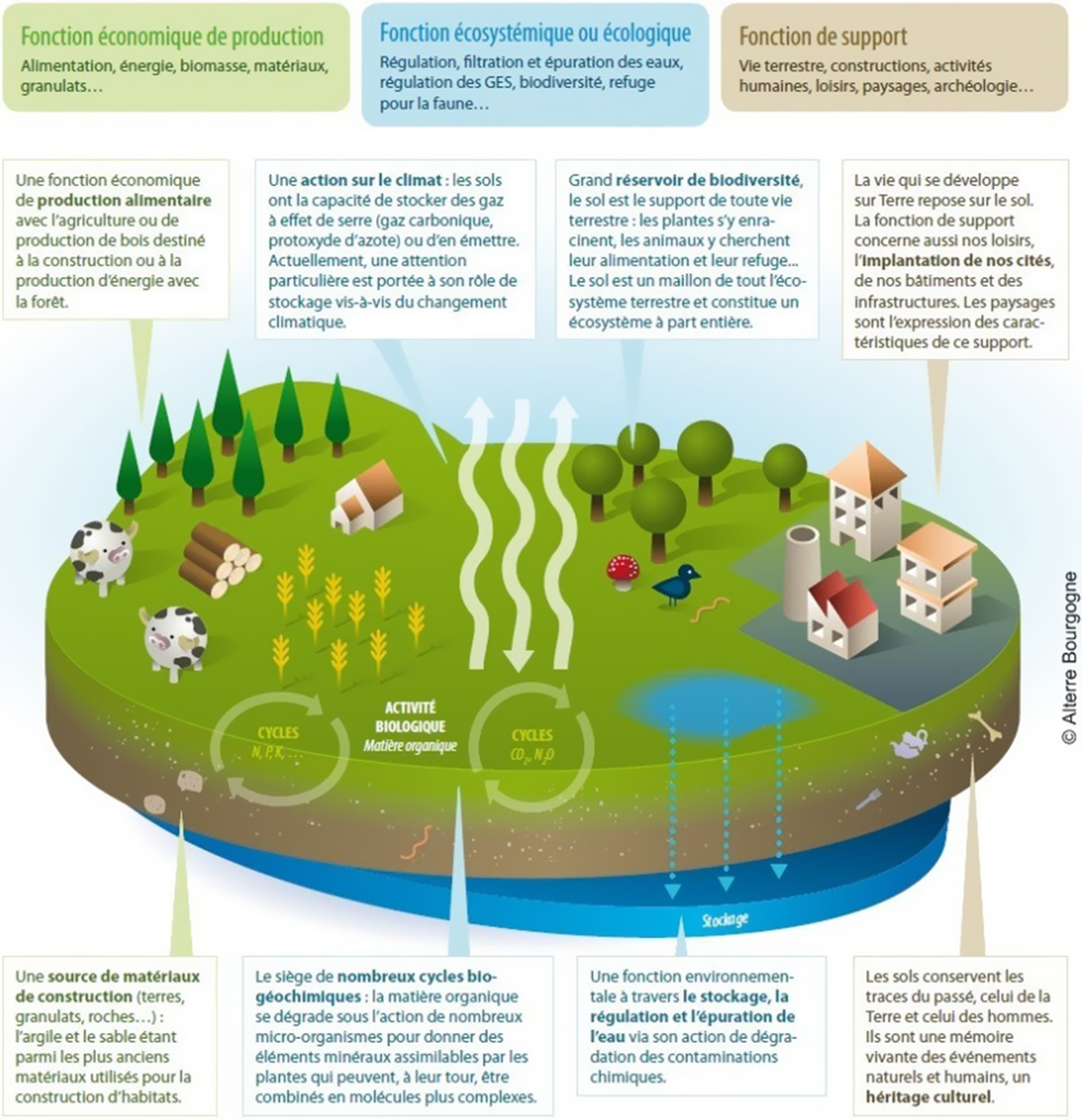

 Open access

