

Introduction
In the early twentieth century, the first scholars working in prehistoric cave art considered chronology to be a key part of their research. Their main proposals for the development of prehistoric art envisaged a linear evolution (Breuil, Reference Breuil1952; Leroi-Gourhan, Reference Leroi-Gourhan1965). Those theories were widely accepted by researchers until new methods for the direct dating of paintings appeared in the 1990s. The data acquired for the chronology of the European Palaeolithic representations modified and/or nuanced the proposed sequences (Pettitt & Pike, Reference Pettitt and Pike2007; Hoffmann et al., Reference Hoffmann, Standish, García-Diez, Pettitt, Milton and Zilhão2018; Ochoa et al., Reference Ochoa, García-Diez, Domingo and & Martins2020).
Our understanding of the development of Palaeolithic cave art is currently disparate. Most parietal art radiocarbon dates and the contextualized portable evidence are concentrated in the later stages of the Upper Palaeolithic (middle Magdalenian and upper–final Magdalenian). For earlier times, the available information is significantly limited. This has important implications for the dating of cave art, which has been based principally on comparison between dated portable and parietal series. Consequently, the development of art in more recent periods of the Upper Palaeolithic is known in detail, while previous periods, such as the pre-Magdalenian and the initial phases of the Magdalenian, are much less well known. In the past few decades, however, AMS radiocarbon dating and other techniques like U-series dating have made it possible to address these key aspects of research with scientific data.
The application of AMS radiocarbon dating to cave art involves working with small samples that have been subjected to largely unknown micro-environmental conditions. This might impose limits on the results due to natural contamination and anthropic impact (Hedges et al., Reference Hedges, Bronk Ramsey, Van Klinken, Pettitt, Nielsen and Etchegoyen1998; Valladas et al., Reference Valladas, Tisnérat, Cachier and Arnold1999, Reference Valladas, Tisnérat, Kaltnecker, Cachier, Arnold and Clottes2006; Fortea, Reference Fortea2002; Scharebereiter-Gurtner et al., Reference Scharebereiter-Gurtner, Saiz-Jimenez, Piñar, Lubitz and Rolleke2002; Clottes & Valladas, Reference Clottes and Valladas2003; Valladas, Reference Valladas2003; Alcolea & Balbín-Behrmann, Reference Alcolea González and Balbín-Behrmann2007; Pettitt & Pike, Reference Pettitt and Pike2007; Hoffmann et al., Reference Hoffmann, Pike, García-Diez, Pettitt and Zilhão2016; Bonneau et al., Reference Bonneau, Staft, Highman, Brock, Pearce and Mitchell2017; Pike et al., Reference Pike, Hoffmann, Pettitt, García-Diez and Zilhão2017; David et al., Reference David, Delannoy, Petchey, Gunn, Huntley and Veth2019; Ochoa et al., Reference Ochoa, García-Diez, Domingo and & Martins2020). To avoid or minimize the effect of contamination on the results, pre-treatment protocols are applied to the samples. Nonetheless, the incoherence of widely-accepted archaeological assumptions or of other scientific results has led some researchers to question the reliability of certain results. This includes interpretive problems linked to the origin of the carbon used, in particular the relation between the time of death of the wood being dated and the graphic event being targeted, which generate archaeological uncertainties and raise new questions. Advancing in our knowledge will involve obtaining new dates, assessing the quality of the results, and discussing their relevance in our interpretations. The results obtained for cave art should thus be assessed critically.
This study presents new radiocarbon dates for Palaeolithic art at Cueva de Las Chimeneas. Their reliability is discussed, and the results are compared with other dates obtained in the 1990s. Their archaeological significance is assessed and working hypotheses are proposed in order to better understand the graphic development of Upper Palaeolithic hunter-gatherer societies before the middle Magdalenian.
Cueva de Las Chimeneas in Summary
The cave of Las Chimeneas is located in Monte Castillo, in the municipal district of Puente Viesgo in Cantabria, northern Spain (Figure 1). It was discovered in 1953. Monte Castillo contains other caves with prehistoric art: El Castillo, Pasiega, Las Monedas, and Cantera I. This concentration of caves emphasizes the symbolic value of the cone-shaped hill, which has been called the ‘Sacred Mountain’ (García-Diez et al., Reference García-Diez, Garrido, Angulo and Fernández-Vega2018) because of the density of motifs and the repeated and continuous decoration and occupation of the sites. UNESCO listed Las Chimeneas as a World Heritage site in 2008 (García-Diez, Reference García-Diez2009).
Location of the cave of Las Chimeneas and topography of the lower level.
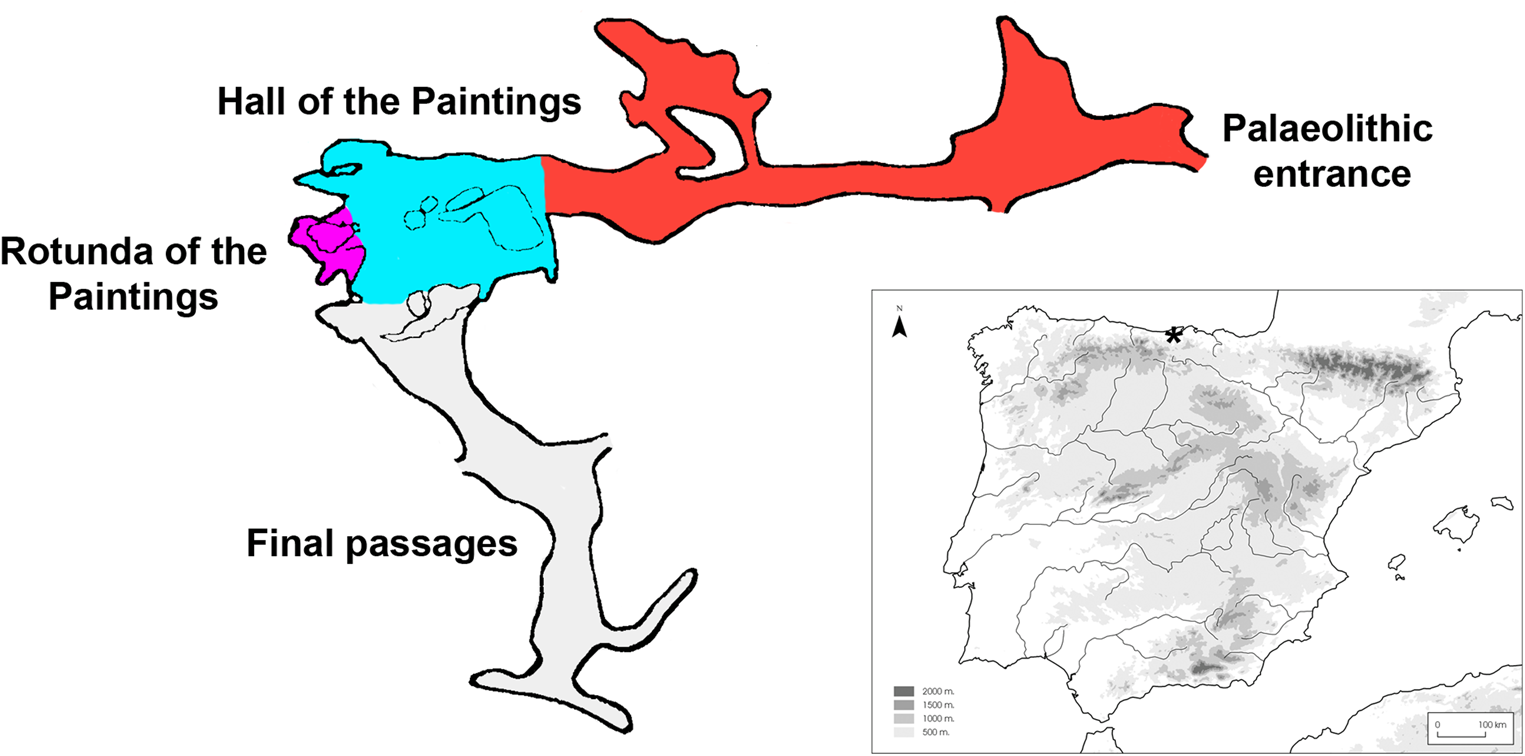
The cave (Figure 1) consists of two levels connected by a shaft or ‘chimney’ 15 m deep (González Echegaray, Reference González Echegaray1974; García-Diez & Garrido, Reference García-Diez, Garrido, Sala; E, Carbonell, Bermúdez de Castro and Arsuaga2014). The upper level, with its modern, artificially made entrance, is a passage with many large speleothems. No anthropic evidence has been found on this level, all the cave art being located in the 160 m-long lower level. The cave's original entrance is now blocked, but it connected with a straight passage that led to the most densely decorated area and a circular chamber called the Hall of the Paintings. From there, the cave continues along smaller and, in some cases, difficult passages. The sedimentary deposits in the old entrance have not yielded any evidence of occupation within the inner cave.
The drawings and engravings are distributed in the different areas of the lower level, mostly at the end of the main passage. The first figure, an incompletely engraved caprid, is found halfway along the main passage, near the shaft that connects the two levels of the cave. Continuing along the main passage, numerous finger tracings stand out because of their cameo chromatic effect on the wall. Above them, two possible bovids face one another, and a possible incomplete hind is depicted below them. A little further on, on the opposite wall, a finger-drawn sign and a stag with large antlers in twisted perspective are located next to a reticulated sign. ‘Macaroni’ designs drawn with fingers, incised with a pointed object, and scraped are visible in the sector just before the Hall of the Paintings. Beneath an overhang, the first black drawing is an incomplete ibex.
At the end of the passage and inside the Hall of the Paintings, black drawings represent at least two simple rectangles, two simple trapezoidal shapes, two rectangles with a double zigzag on their upper side, two large rectangles with different interior patterns, and convergent lines that together with the shape of the wall might depict a zoomorph. To the right, some black lines might correspond to an unfinished rectangle, while a partial figure of a horse may be integrated with the shape of the rock. Above them, in the roof, several engraved lines include a simple rectangle and a dashed line. To the left, in the roof, a large rectangle was drawn with fingers; a smaller rectangle with small parallel lines in the middle is drawn inside the larger rectangle.
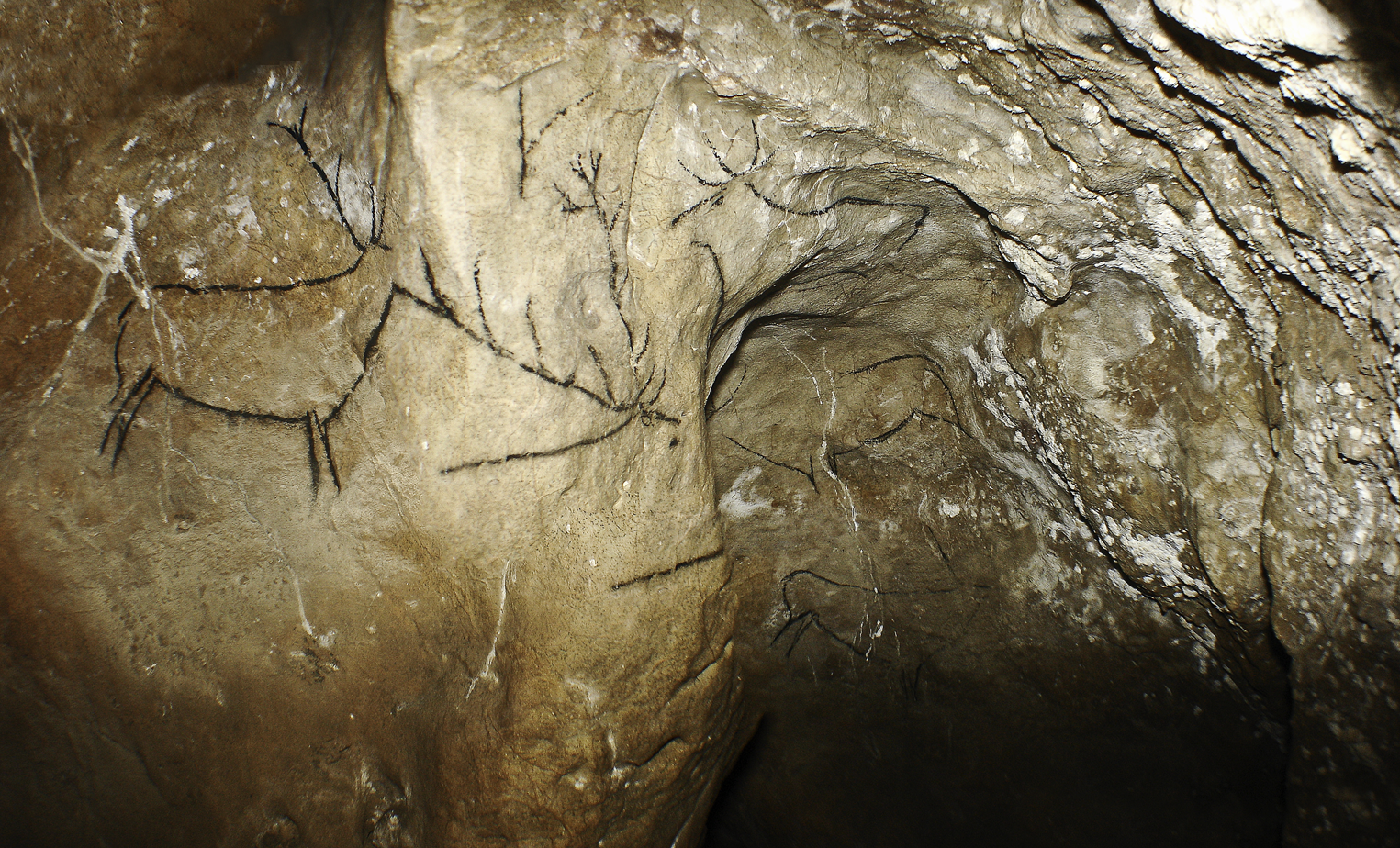
Behind this panel (Figure 2), a small passage called the Rotunda of the Paintings can be reached in two ways. Entering on the left, a horse's head is associated with the edge of the rock and a stag's head. Following the narrow and low passage, a small chamber is reached: it features five stags, together with black lines, a simple rectangle, and macaroni. The stags, four of them complete and one partial, are characterized by the simplicity of the drawings and the absence of the nasal-frontal region. Their accumulation in a small chamber, their arrangement in two pairs of stags, and the variation in their orientation suggest that they form a composition.
General view of the stags of the Rotunda of the Paintings.
Back in the Hall of the Paintings, to the right, a sector with a low irregular roof contains more figures on the different faces of the ribs of rock in the roof. The surface is soft; some motifs were drawn with fingers and others with blunt or sharp implements. Four panels have been distinguished: among numerous lines, a large number of zoomorphs can be identified (eight or nine aurochs, four stags, two hinds, one or two ibex, a chamois, a horse, and two indeterminate animals). They are all incomplete, drawn with a simple outline, and have few internal details.
Materials, Methods, and Results
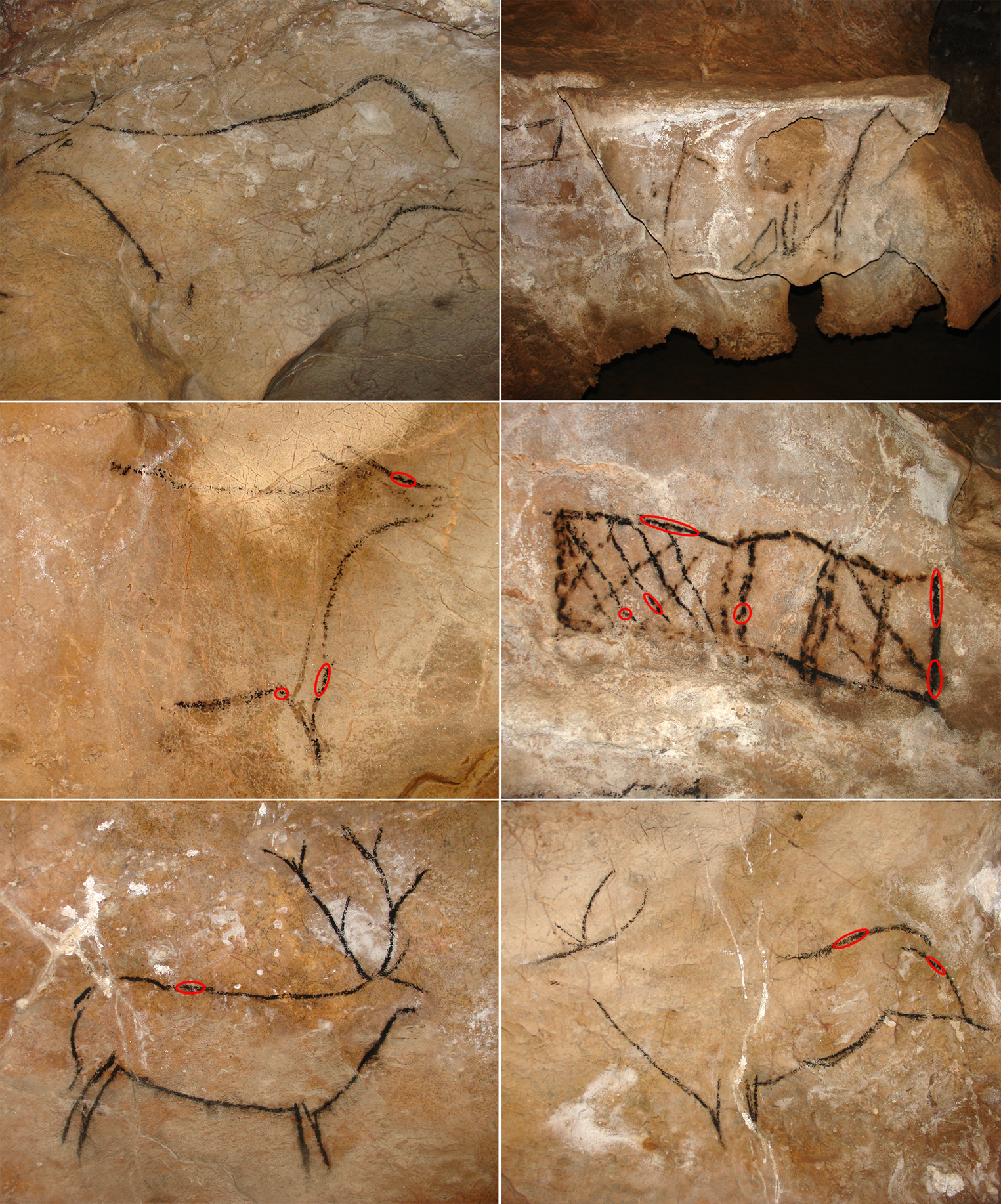
Four new radiocarbon dates for the parietal art in Las Chimeneas (samples CH-1, CH-2, CH-4a, and CH-5) are presented here (Figure 3). The samples were processed by the Oxford Radiocarbon Accelerator Unit (ORAU). Another two dates (Samples 1 and 2) had been published in the past (Moure et al., Reference Moure, González-Sainz, de Quirós, & Cabrera and Moure1996). They were processed in the Laboratoire mixte CNRS-CEA of the Centre des faibles Radioactivés in Gif-sur-Yvette and are included here for discussion and analysis.
• Sample 1 (Figure 3 top left). Stag no. 20, located in the Rotunda of the Paintings. This figure, drawn in charcoal, has a simple outline and rounded anatomical connections. It is formed by part of the maxillary line, frontal line, antlers (brow tines and main beams), neck, cervical-dorsal line, croup (top of rump), rump, hind legs, belly, forelegs, chest, and eye, with indication of the tear duct. Radiocarbon measurement (GifA-95194): 15,070 ± 140 bp, corresponding to 18,715–18,167 cal bp at 95.4% confidence (Table 1 and Figure 4).
• Sample 2 (Figure 3 top right). Black lines to the right of Group 14, in the Hall of the Paintings, drawn in charcoal. Radiocarbon measurement (GifA-95230): 13,940 ± 140 bp (also published as 13,949 ± 140 bp in Moure et al., Reference Moure, González-Sainz, de Quirós, & Cabrera and Moure1996), corresponding to 17,346–16,520 cal bp at 95.4% confidence (Table 1 and Figure 4).
• Sample CH-1 (Figure 3 centre left). Ibex no. 13 (caprid), located in the Hall of the Paintings. It is a partial figure (forequarters) represented only by the outline, drawn with charcoal. It consists of the frontal and maxillary lines, nostril, one ear, two small horns, a longitudinal dividing line on the face, chest, forelimb and front part of the belly, front half of the cervical-dorsal line, and the neck. The lines and anatomical connections are mostly rounded but the connection between the forelimb and belly is angular. The sample was collected from three anatomical regions (frontal line, lower part of the chest, and the back of the forelimb) and from different lines (frontal line, chest, and foreleg). Radiocarbon measurement (OxA-X-2386-21): 16,850 ± 270 bp, corresponding to 20,951–19,610 cal bp at 95.4% confidence; δ13C (‰): -26.27‰. Laboratory comment: ‘this sample was “OxA-X-ed” to reflect very small starting weights of carbon and non-routine chemical preparation applied to preserve a dateable fraction’; ‘OxA-X-ed’ refers to the laboratory number assigned by ORAU; the OxA-X-xxx (where xxx is a number) refers to the dates that are ‘research measurements using non-standard or experimental methods’ (Oxford Radiocarbon Accelerator Unit, n.d.).
• Sample CH-2 (Figure 3 centre right). Rectangular shape to the left of Group 14, in the Hall of the Paintings, drawn with charcoal. This rectangle is divided internally into three parts separated by two vertical lines. The left sector, the largest, is filled by a lattice pattern; the centre is empty and smaller, while the right sector is divided by a cross. The sample was taken from six lines in four areas (upper side, right side, vertical separating line, and oblique lines in the left sector). Radiocarbon measurement (OxA-X-2386-22): 14,610 ± 130 bp, corresponding to 18,200–17,446 cal bp at 95.4% confidence; δ13C (‰): -26.13‰. Laboratory comment: ‘this sample was OxA-X-ed to reflect very small starting weights of carbon and non-routine chemical preparation applied to preserve a dateable fraction’ (Table 1 and Figure 4).
• Sample CH-4a (Figure 3 bottom left). Stag no. 19 in the Rotunda of the Paintings. This outline figure, drawn with simple lines using charcoal, is composed of the maxillary and frontal lines, large antlers (main beams, brow tines, bay tines, royal antlers, and crown), neck, cervical-dorsal line, croup, rump, tail, hind legs, belly, forelegs, and chest. The lines and anatomical connections are mostly rounded except for the connections between the limbs and belly. The sample was collected from a single line in one anatomical region (the back). Radiocarbon measurement (OxA-X-2377-7): 15,540 ± 70 bp, corresponding to 18,946–18,710 cal bp at 95.4% confidence; δ13C (‰): -23.86‰. Laboratory comments: ‘this sample was treated using only an acid preparation step, which is not the full treatment for this type of sample. This was due to extremely small starting weights and to the fact that many other samples of a similar size from the same site had failed. This date should therefore be viewed with a health warning. It is possible that unremoved contaminants might remain to influence the age. For this reason, the sample was OxA-X-ed’ (Table 1 and Figure 4).
• Sample CH-5 (Figure 3 bottom right). Stag no. 21 in the Rotunda of the Paintings. It is an outline figure, drawn with simple lines using charcoal, consisting of the maxillary line, part of the frontal line, antlers (brow tines and main beams), neck possibly suggested by the shape of the wall, back part of the cervical-dorsal line, croup, rump, tail, hind leg, belly, forelimbs, and chest. The lines and anatomical connections are mostly rounded except for the connections between the limbs and the belly. The sample was taken from lines in two anatomical regions, the back and the rump. Radiocarbon measurement (OxA-X-2377-8): 14,730 ± 100 bp, corresponding to 18,252–17,771 cal bp at 95.4% confidence; δ13C (‰): -25.54‰. Laboratory comments: ‘this sample was treated using only an acid preparation step, which is not the full treatment for this type of sample. This was due to extremely small starting weights and to the fact that many other samples of a similar size from the same site had failed. This date should therefore be viewed with a health warning. It is possible that unremoved contaminants might remain to influence the age. For this reason the sample was OxA-X-ed’ (Table 1 and Figure 4).
The AMS-dated figures from Las Chimeneas with sample locations marked in red. Top left: Sample 1, stag no. 20; top right: Sample 2, black lines; centre left: Sample CH-1, ibex no. 13; centre right: Sample CH-2, rectangular shape; bottom left: Sample CH-4a, stag no. 19; bottom right: Sample CH-5, stag no. 21.
AMS dating of the Las Chimeneas images.
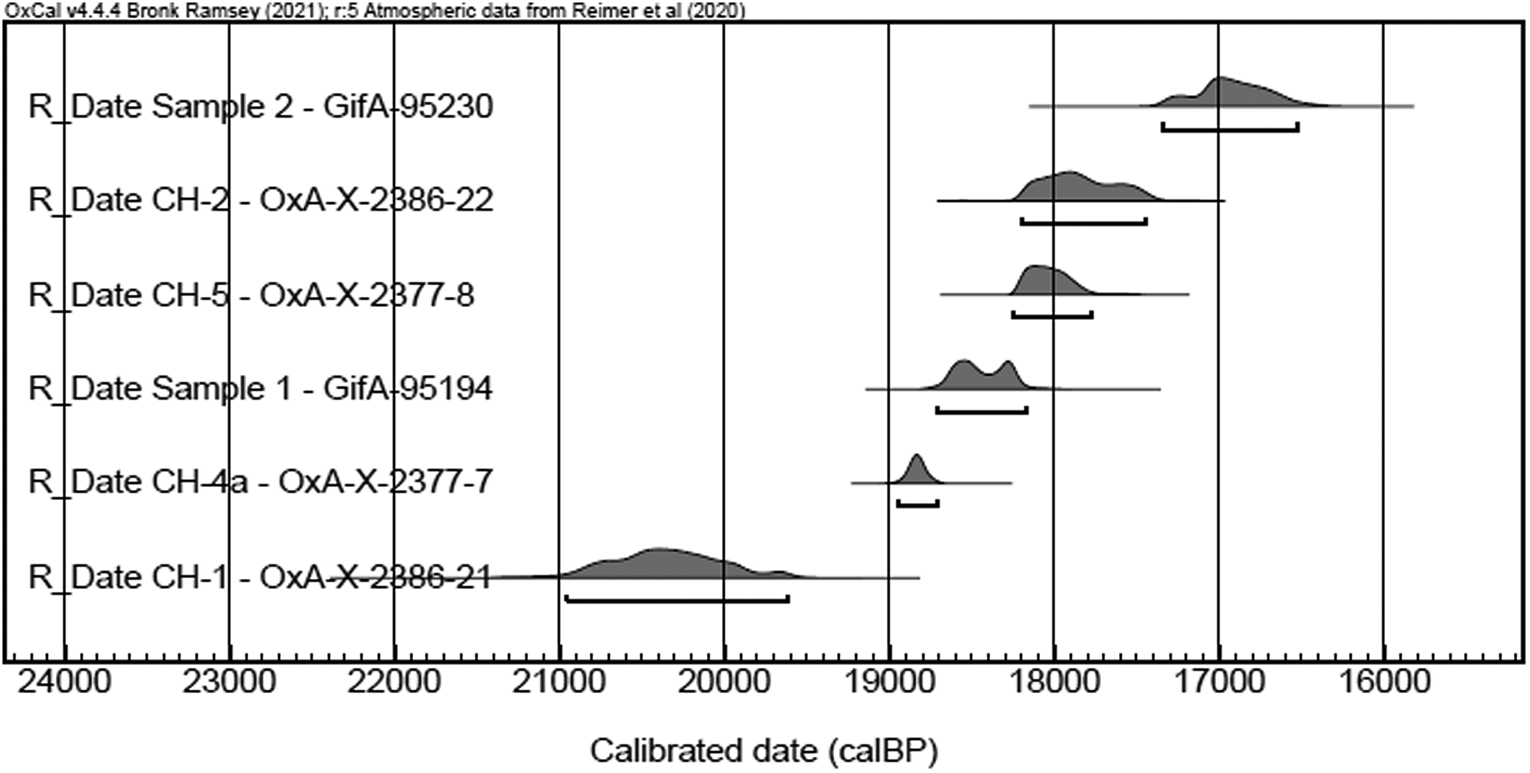
AMS dates obtained for Las Chimeneas. The results were calibrated with the IntCal20 curve (Reimer et al., Reference Reimer, Austin, Bard, Bayliss, Blackwell and Bronk Ramsey2020) using the OxCal 4.4 program (Bronk Ramsey et al., Reference Bronk Ramsey2009).

Discussion
Quality of the results
The cave of Las Chimeneas is in an optimal state of conservation because the works carried out in the lower passage were minimal (lowering and levelling the floors in some areas and barriers in front of the panels, which have been removed), barely affecting or altering the areas where the dated drawings are located (García-Diez et al., Reference García-Diez, Garrido and Ceballos2013). In addition, the number of visits has been, and still is, limited, being normally restricted to small groups and of a short duration. There is no graffiti on the walls. This suggests that any potential anthropic contamination after the discovery of the cave has had very little or no impact on the pigment used for the parietal depictions.
We do not know the quantity of the datable charcoal samples analysed by ORAU, but it must have been small in the case of the samples CH-1, CH-2, CH-4a, and CH-5 because the laboratory informed us that the original weight of the samples was very small (CH-1 and CH-2) or extremely small (CH-4a and CH-5)., i.e. the weight of the datable charcoal was probably less than 0.5 mcg. The same lack of information affects Samples 1 and 2.
Given the initially very low weight of samples CH-1 and CH-2, they were dated following a non-routine chemical preparation (Brock et al., Reference Brock, Higham, Ditchfield and Bronk Ramsey2010). ORAU reports that samples CH-4a and CH-5 were prepared ‘using only an acid preparation step, which is not the full treatment for this type of sample’ (normally an acid-base-acid treatment, ABA), which implies that some contaminants may not have been removed (such as carbonates, humic and fulvic acids, and other unknown pollutants). This might influence the result obtained.
No specific information is available about the preparation treatment for Samples 1 and 2. It probably followed the usual protocol for dating cave art at the Gif-sur-Yvette laboratory, which stipulates the need to halt the pre-treatment before completion to avoid the disappearance of all the dateable carbon. Details of the pre-treatment were not published.
Of the four new determinations, three (CH-1, CH-2, and CH-5) correspond to multiple samples; these were formed by combining small samples of charcoal from different anatomical parts or regions of the same figure, or of different traces (the amount collected in a single movement of the hand) from the same anatomical part or region. The other new determination, CH-4a, corresponds to a single sample. Although it was not specified, Samples 1 and 2 were probably taken by multiple sampling as that was the usual procedure in the early 1990s.
We can therefore be sure that the material dated in CH-4 comes from a single temporal event. In contrast, in the case of CH-1, CH-2, and CH-5 (and probably Samples 1 and 2) we cannot be certain that the different lines that were sampled were all produced at the same time or whether they accumulated in different episodes of artistic production.
This information about the quality of the samples from Las Chimeneas that have been dated means that the results cannot be accepted directly; they must be treated with caution rather than considered indisputable archaeological data. The small weight of the carbon and, especially, the consequent lack of complete pre-treatment and/or application of a non-routine pre-treatment require us to bear in mind the potential limitations of the results. Moreover, it cannot be ascertained beyond doubt that five of the six results are representative of a particular time of production. Therefore, any considerations based on these results must be regarded as working hypotheses to be confirmed by new data in future studies.
Cueva de Las Chimeneas in the context of dated Iberian Palaeolithic portable and parietal art
By considering portable art found in reliable archaeological contexts, the art in Las Chimeneas can be compared within its northern Spanish setting and the Iberian Peninsula in general (Figure 5). In northern Spain, portable art animal figures are, however, few for the upper Solutrean and the first phases of the Magdalenian (Barandiarán, Reference Barandiarán1972, Reference Barandiarán1994; Corchón, Reference Corchón1986, Reference Corchón2004). Comparisons cannot be made in most cases either because the representations are very simple (at Ermittia, Lumentxa, El Buxu, and Las Caldas) or stylistically dissimilar from those of Las Chimeneas (at Bolinkoba and Altamira), or because the use of different artistic techniques (sculpture in El Buxu and El Pendo) cannot be readily compared. The only points of reference are with a bovid found in an early Magdalenian level in Balmori (Figure 5A), related to Las Chimeneas by its very simple outline and the formal treatment of some limbs, and some striated figures from the lower Magdalenian level at the cave of El Castillo (Figure 5B and 5C), where the ends of the limbs are similar to those of Las Chimeneas. Another point of resemblance may be a preference for rectangular or pseudo-rectangular shapes (traditionally referred to as tectiforms) in lower Magdalenian portable art in the region. Even so, the comparison of the Las Chimeneas rectangular motif with portable examples from El Cierro (Figure 5D), Altamira (Figure 5E), and Rascaño (Figure 5F) is limited to basic geometric traits and the presence of internal lines (which are more complex at Las Chimeneas).
Contextualized portable evidence and dated rock art which show graphic affinities with the figures dated at Las Chimeneas. (A–F after Corchón, Reference Corchón1986; G–I after Villaverde & Cantó, Reference Villaverde, Cantó, Paillet, Paillet and Robert2020; J after Breuil & Obermaier, Reference Breuil and Obermaier1935; K after Rogerio-Candelera & Élez Villar, Reference Rogerio-Candelera, Élez Villar, Saiz Carrasco, López Romero, Cano Díaz-Tendero and Calvo García2009; L after Alcalde del Río et al., Reference Alcalde del Río, Breuil and Sierra1911).

In Mediterranean Spain, the collection of portable art from El Parpalló (Villaverde, Reference Villaverde1994) allows comparisons with Las Chimeneas, as regards both upper Solutrean and Solutrean-Gravettian art and the early Magdalenian A figures. The appearance of elongated triangular limbs and open parallel legs, the greater size of the heads, an occasional tendency to represent large hind quarters, linear V-shaped horns, and simple outlines would suggest that Las Chimeneas imagery is attributable to the evolved Solutrean by analogy with El Parpalló. In terms of continuity of the subject matter represented, the early Magdalenian represents a ‘step backwards’; it is characterized by an increase in the number of cervids compared with caprids and a simplification of the anatomical structure which departs from their analytical figurative representation. On the other hand, the quadrangular signs (Figure 5G, 5H, and 5I), most of which are simple rectangular shapes without complex internal divisions, are attributed to the upper and evolved Solutrean at El Parpalló (Villaverde & Cantó, Reference Villaverde, Cantó, Paillet, Paillet and Robert2020).
In the Cantabrian rock art repertoire, there are hardly any figures comparable to those of Las Chimeneas for which reliable dating is available. At Altamira, a painted tectiform-type quadrangular sign (Breuil & Obermaier, Reference Breuil and Obermaier1935: no. 57a) from the Final Gallery (Figure 5J) yielded a result of 19,110–18,270 cal bp at 95.4% confidence (GifA-91185; Moure et al., Reference Breuil and Obermaier1996: 308); this sign has a complex pattern of linear infill, similar to that of other signs next to it. In another space in the same cave, a rather simple doe head, known as the ‘La Hoya Hind’ (Figure 5K) has been dated to 18,767–17,996 cal bp at 95.4% confidence (GifA-96062; Moure et al., Reference Breuil and Obermaier1996: 303); this figure's incompleteness, its contours, its use of twisted perspective, and its position right on the edge of the parietal support shares traits with some of the Las Chimeneas figures. Finally, in the cave of El Castillo, an ibex (Alcalde del Río et al., Reference Alcalde del Río, Breuil and Sierra1911: no. 56–57) (Figure 5L), dated to 18,272–17,522 cal bp at 95.4% confidence (GifA-98156; Moure & González-Sainz, Reference Moure, González-Sainz and Oliveira2000: table 1), shares with some of the dated figures in Las Chimeneas its rounded contour, the opening of the snout area, and the general morphology of the forelimb.
In sum, stylistic and thematic comparisons suggest that the cave art in Las Chimeneas can be attributed generically to a time in the upper Solutrean or initial Magdalenian. Comparison with the Mediterranean evidence would indicate that the zoomorphic representations belong to this entire timespan, whereas the signs would be restricted to the Solutrean period. Contextualized portable art and dated rock art in the nearest contexts in northern Spain would also indicate that the Las Chimeneas cave art belongs to the lower Magdalenian (approximately between 19,000 and 17,500 cal bp).
An internal comparison: synchrony or diachrony?
Based on the style of the motifs in Las Chimeneas, various researchers have proposed several hypotheses for their age. The application of Leroi-Gourhan's (Reference Leroi-Gourhan1965) morpho-stylistic sequence would suggest that it belongs to his Style III (c 19,000-15,000 bp). Leroi-Gourhan maintained that proposal in his general study of Palaeolithic art, and González Echegaray (Reference González Echegaray1974, Reference González Echegaray1992) took up this attribution in his monograph on Las Chimeneas, where he restricted the age to about 17,000–16,500 bp in the transition from the Solutrean to the Magdalenian. Later, other authors, or the same authors nuancing their conclusions, have accepted that chronology. The publication of the first AMS radiocarbon dates (Samples 1 and 2) generated an internal debate about the validity of the results among the researchers who published them (Moure et al., Reference Moure, González-Sainz, de Quirós, & Cabrera and Moure1996: 316-19): the synchrony of the ensemble was generally accepted, although some (González-Sainz) attributed it to the first half (before 17,000 bp) and others (Moure, Bernaldo de Quirós, and Cabrera Valdés) to the second half (after 17,000 bp) of Leroi-Gourhan's Style III.
The presence and absence of overlaps between the different radiocarbon results and the spatial relationships between the motifs leave room for a debate about whether the black drawings in the cave of Las Chimeneas are chronologically and/or culturally synchronic or diachronic.
Our results (Figure 4) show that CH-1 (caprid, ibex no. 13) and Sample 2 (lines no. 14) are the oldest and most recent dates, respectively, and do not overlap with any other sample. They bracket an extended and discontinuous period between 20,951 and 16,520 cal bp for the production of the black parietal art in Las Chimeneas. The other samples (CH-2, CH-4a, CH-5, and Sample 1) overlap chronologically to different degrees (see below and Table 1).
In the Rotunda of the Paintings, Sample 1 (18,715–18,167 cal bp) overlaps with the other two stags that have been dated, i.e. CH-5 (18,252–18,167 cal bp) and CH-4a (18,715–18,710 cal bp), the latter two dates not overlapping each other. This would imply that the group of stags was painted intermittently between 18,715 and 18,167 cal bp.
The timespan between the production of the stags in the Rotunda of the Paintings and the ibex no. 13 (CH-1) in the Hall of the Paintings would range from a minimum of 895 years (between 19,610 and 18,715 cal bp) to a maximum of 2784 years (between 20,951 and 18,167 cal bp). Therefore, the results clearly suggest a temporal difference.
The two non-figurative motifs (the linear Sample 2, 17,346–16,520 cal bp, and the geometric CH-2, 18,200–17,446 cal bp) in the Hall of the Paintings (in the sector just before the access to the Rotunda of the Paintings, and 10 m from the ibex no. 13 in the same chamber) do not overlap with one another; a gap of at least 100 years (between 17,446 and 17, 346 cal bp) suggests that they were created at different times between 18,200 and 16,520 cal bp. On the other hand, the date for the rectangle (CH-2) overlaps with two of the stags: with CH-5 by 429 years (between 18,200 [CH-2] and 17,771 cal bp [CH-5]) and with Sample 1 by 33 years (between 18,200 [CH-2] and 18,167 cal bp [Sample 1]).
Consequently, if all the dates obtained by AMS radiocarbon dating are considered reliable, we should conclude that the series of black drawings in Las Chimeneas was produced in at least three chrono-cultural phases between 20,951 and 16,520 cal bp. These are: Phase 1) the upper Solutrean or initial Magdalenian (20,951 to 19,610 cal bp), when ibex no. 13 was drawn in the Hall of the Paintings; Phase 2) the lower Magdalenian, in a maximum timespan ranging from 18,715 to 18,167 cal bp, when several stag motifs were produced in the Rotunda of the Paintings (stags nos. 19, 20, and 21) and a geometric form (rectangle no. 14) was drawn in the Hall of the Paintings; Phase 3) the middle Magdalenian (17,346 to 16,520 cal bp), when linear forms were drawn in the Hall of the Paintings (lines no. 14). The stylistic comparisons made above would support the identification of Phases 1 and 2, but not that of Phase 3.
Alternatively, the limitations of the quality of the results discussed earlier may require this hypothesis of gradual and discontinuous iconographic activity to be reconsidered. The synchronicity of the Las Chimeneas ensemble would be justified if the greatest importance were ascribed to the result obtained for a single sample (CH-4a, 18,946–18,710 cal bp) and this would agree with the comparisons with portable art in Cantabrian Spain. This timespan coincides with the different overlaps between the parietal figures (CH-2, CH-4a, CH-5, and Sample 1), which gives an overall span bracketed between 18,946 (earliest date for CH-4) and 17,446 cal bp (latest date for CH-2) and a chronological agreement between 18,715 and 18,167 cal bp among the dates obtained.
Given the information currently available and based on the arguments presented here, we consider that the most plausible hypothesis is that the painted depictions at Las Chimeneas were culturally synchronic (but not evidence of synchronicity sensu stricto), although this must be tested with further dates. The potential links between figures in terms of time, as well as technique (black charcoal drawings) and style (simple outline figures with no special attention to secondary anatomy, twisted and semi-twisted perspectives of the antlers, enlarged forequarters, and absence of the nasal-frontal line) suggest that the black drawings in the cave of Las Chimeneas were created in the lower Magdalenian.
The imagery at Las Chimeneas includes other engraved animal figures. Their morpho-stylistic analysis makes it possible to document close graphic links (rounded contour figures, twisted and semi-twisted perspectives, and anatomical simplicity) with those painted in black. The only documented differences between these two ‘technical’ groups consist of the treatment of the snout, which tends to be closed in the engravings and open in the drawings, and a slightly greater thematic diversity in the engravings (which includes bovids). Consequently, it is possible to sustain the argument that the execution of all the art at Las Chimeneas is potentially synchronous.
Conclusion
Clearly, we must date cave art to advance our understanding of the origin of the graphic and symbolic expression of prehistoric hunter-gatherer groups. For this reason, new high-precision dates are needed, and the quality of the samples and the reliability of the results should be discussed. This implies that the full results (including their limitations) must be published.
The application of AMS radiocarbon dating to the Palaeolithic parietal art at the cave of Las Chimeneas has allowed us to discuss the quality of the radiocarbon analysis and its results, including the full or partial decontamination protocols in the pre-treatment of the samples, the weight of dateable carbon, and the type of sampling (single spot or multiple). In the case of Las Chimeneas, the results should be treated with caution and assessed in a wider perspective.
The formal and stylistic assessment of the dated parietal figures in the context of Iberian portable art supports a generic attribution of the Las Chimeneas depictions to the upper Solutrean or early Magdalenian. Within the narrower context of Cantabrian Spain, we suggest that their production can be bracketed between about 19,000 and 17,500 cal bp. The analysis of the quality of the dating results, the chronological overlap of the dates, the morpho-stylistic contextualization, and the consideration of the spatial relationships suggest that the cave art in Las Chimeneas is most probably culturally synchronic and was created in the first stages of the Magdalenian. It is, however, currently impossible to establish whether the figures were drawn in a single graphic event or in more than one episode.
Even if our results are regarded as a hypothesis to be tested with new, better-quality data, it remains that the publication of all the information related to the process of obtaining AMS radiocarbon dates is essential. It is only by considering the quality and reliability of information that archaeological debates can progress and advances in our knowledge of the past can be made.
Acknowledgements
This work was supported by the Ministry of Science and Research of the Government of Spain under Grant PID2020-115347GB-I00.


 Open access

