





Time and again, the same political issues have provoked both normative and nonnormative forms of activism. To name a recent example, the German government’s response to the COVID-19 pandemic sparked both widespread normative protests and more nonnormative, unlawful actions. Although many citizens participated in actions within legal norms – such as a 2021 petition to the Bundestag titled ‘No Mandatory COVID-19 Vaccination for the General Public’, which gained well over 100,000 signatures – others escalated their dissent beyond legal limits. One striking example was the attempted storming of the parliament building in August 2020 by a group of protesters espousing conspiracy theories and far-right ideologies.
A prominent concept in political literature and news media concerning political activism is the ‘conveyor belt’ metaphor, which suggests that individuals typically begin with normative political activism (NPA) and eventually – given sufficient frustration – can transition to nonnormative political activism (NNPA)Footnote 1 . This metaphor implies a continuum between NPA and NNPA, with NNPA representing a more radicalized form of political engagement by the same individuals who initially engaged in normative forms of activism. Put simply, an individual who initially participates in normative acts such as signing a petition may, over time, escalate to more extreme behaviors, such as politically motivated violence. Although this metaphor has garnered some criticism (eg Gøtzsche-Astrup Reference Gøtzsche-Astrup2021; Moskalenko & McCauley Reference Moskalenko and McCauley2009; Pavlović, Moskalenko and McCauley Reference Pavlović, Moskalenko and McCauley2022), it remains popular in political literature and media. Partly in favor of this metaphor, a recent meta-analysis indicates that normative and nonnormative political actions are indeed positively correlated, meta-analytically r = 0.48 [95%-CI: 0.41; 0.64] (Emmelkamp, Asscher, Wissink et al. Reference Emmelkamp, Asscher, Wissink and Stams2020). However, the observed correlation is neither strong enough to fully support nor small enough to clearly refute the notion that the same individuals engage in both forms of activism – potentially under varying circumstances – as the conveyor belt metaphor would suggest. At the very least, this implies that other factors are also at play determining whether an individual will engage in NPA or NNPA.
Beyond the conveyor belt metaphor and its emphasis on intraindividual developments, a promising approach is to also consider interpersonal differences. In particular, the identification of a variable that systematically differentiates individuals who engage in NPA from those who engage in NNPA would be highly informative, in other words, showing that distinct individuals, in general and dispositionally, are drawn to one vs. the other. To this end, past research has mostly focused on sociodemographic factors (eg religious ideology). However, a recent meta-analysis suggests that although such factors have been extensively studied, their effect sizes tend to be small and sometimes even statistically nonsignificant (Wolfowicz, Litmanovitz, Weisburd et al. Reference Wolfowicz, Litmanovitz, Weisburd and Hasisi2020).
Beyond sociodemographic factors, certain personality dispositions may increase the likelihood of engaging in NPA or NNPA, regardless of the specific group or cause (Corner, Taylor, van der Vegt et al. Reference Corner, Taylor, van der Vegt, Salman, Rottweiler, Hetzel, Clemmow, Schulten and Gill2021; Gøtzsche-Astrup Reference Gøtzsche-Astrup2019; Kalmoe Reference Kalmoe2014; Moskalenko & McCauley Reference Moskalenko and McCauley2009). However, the influence of personality traits remains understudied (Stern Reference Stern2016; Wolfowicz, Litmanovitz, Weisburd et al. Reference Wolfowicz, Litmanovitz, Weisburd and Hasisi2020) and existing attempts are rather unsystematic (Górska, Stefaniak, Malinowska et al. Reference Górska, Stefaniak, Malinowska, Lipowska, Marchlewska, Budziszewska and Maciantowicz2020). The most informative case would be a personality trait that demonstrably increases the likelihood of engaging in NPA, but not in NNPA, or vice versa.
One promising personality trait in this regard is the so-called Dark Factor of Personality (D; Moshagen, Hilbig and Zettler Reference Moshagen, Hilbig and Zettler2018), the common core of all socially and/or ethically aversive (‘dark’) traits, which is defined as ‘the general tendency to maximize one’s individual utility – disregarding, accepting, or malevolently provoking disutility for others –, accompanied by beliefs that serve as justifications’ (p. 657). Based on this definition, it can be hypothesized that individuals high in D are more likely to support and/or engage in NNPA, as they are willing to cause disutility in others in pursuit of their goals, especially when aligned with justifying ideologies such as populist beliefs or conspiracy mentality (see Thielmann & Hilbig Reference Thielmann and Hilbig2023). Consequently, one would expect individuals high in D to show a propensity for NNPA.
At the same time, individuals high in D are generally less inclined to engage in prosocial or welfare-enhancing behavior. They tend to refrain from actions that benefit others or the collective, such as promoting social welfare in public goods dilemmas (Hilbig & Thielmann Reference Hilbig and Thielmann2025) or supporting policies designed to serve the common good (eg environmental protection initiatives; Hilbig, Zettler and Moshagen Reference Hilbig, Zettler and Moshagen2024). To the extent that NPA is aimed at advancing the welfare of many, individuals high in D should be less likely to engage in such forms of activism – or at the very least not more likely to do soFootnote 2 .
Taken together, this suggests a specific interaction effect: the higher an individual’s level of D, the more they should be inclined toward NNPA, but the less (or not more) they should engage in NPA, ie a positive interaction. Partially in favor of this reasoning, previous research indicates that specific manifestations of D, such as the Dark Triad traits (Machiavellianism, narcissism, and psychopathy; see Paulhus Reference Paulhus2014; Paulhus & Williams Reference Paulhus and Williams2002) are positively associated with intentions for violent political activism (Nai & Young Reference Nai and Young2024; Rogoza, Marchlewska and Szczepańska Reference Rogoza, Marchlewska and Szczepańska2022). Furthermore, meta-analytical evidence indicates that these traits are indeed risk factors for harboring radical views (Wolfowicz, Litmanovitz, Weisburd et al. Reference Wolfowicz, Litmanovitz, Weisburd and Hasisi2021). Crucially, it appears that their shared component, and thus D, is particularly relevant in the association between dark traits and support for political violence (Pavlović & Wertag Reference Pavlović and Wertag2021) and in distinguishing between nonviolent vs. violent political intentions (Gøtzsche-Astrup Reference Gøtzsche-Astrup2021).
This pattern aligns with a growing number of findings from diverse domains that single specific dark traits (such as Machiavellianism, narcissism, and psychopathy) are associated with aversive behavior due to their common core D (see eg Hilbig & Thielmann Reference Hilbig and Thielmann2025; Scholz Reference Scholz2024). In other words, it is what all dark traits have in common – namely, D – rather than what is unique to each of them that drives aversive behavior. Importantly, the idea of D as the ‘aversive essence’ of all dark traits (see Hilbig, Thielmann, Zettler et al. Reference Hilbig, Thielmann, Zettler and Moshagen2023) may also shed light on the fact that previous researches on political behavior and dark traits also argue for a higher engagement of people high in dark personality traits in NPA to fulfill their ego-specific needs (dark-ego-vehicle; Bertrams & Krispenz Reference Bertrams and Krispenz2024; Krispenz & Bertrams Reference Krispenz and Bertrams2024). In other words, according to dark-ego-vehicle, individuals high in dark personality features engage in NPA as they can use this as a vehicle for their own egocentric needs rather than to achieve prosocial or justice‑related goals. So far, this has only been consistently found for narcissism, but not for other dark traits (Krispenz & Bertrams Reference Krispenz and Bertrams2025). As such, one could argue that narcissism contains unique aspects – which are not shared by other dark traits, eg grandiosity (Krispenz & Bertrams Reference Krispenz and Bertrams2025; Moshagen, Hilbig and Zettler Reference Moshagen, Hilbig and Zettler2018) – that increase the likelihood to engage in NPA. As such, when concentrating on the aversive essence of dark personality, ie D, we would expect the hypothesized diverging pattern: A high score in D increases the likelihood of engaging in NNPA but not (or even decreases the likelihood) for NPA. Taken together, D constitutes a promising candidate for distinguishing NPA vs. NNPA, both from a theoretical and empirical perspective.
To shed light on this issue, we conducted four large online studies (total N = 4,737) across two languages (English and German) investigating the role of D for NPA and NNPA. Study 1 examined the role of D for intentions regarding NPA vs. NNPA with a German-speaking sample (Study 1a) and English speakers (1b). Study 2 is a conceptual replication of Study 1 using a different scale covering a wider range of normative and nonnormative intentions across the same two languages (2a in German, 2b in English). Data, materials, R-code, and supplementary results can be found at the respective repository on the Open Science Framework (OSF; https://osf.io/q6b2w).
Methods
Sample
Participants were recruited through https://darkfactor.org, a publicly accessible website that provides free and fully anonymous self-assessments and personalized feedback on D. There was no specific recruitment involved. Instead, the website has a continuous traffic flow, generated by individuals attracted to the site by media attention, word-of-mouth, invitation by peers, etc., and therefore representing a broad range of demographic backgrounds. All studies complied with ethical standards, and no deception was involved. Data collection through the platform was approved by the local ethics committee (Institutional Review Board [IRB]) of the Department of Psychology, University of Kaiserslautern-Landau (RPTU; approval #LEK-154 and #LEK-567).
Based on a priori power analyses, the minimum sample size for all analyses was set at N = 652, sufficient to detect even small effects (f 2 = 0.02) with 95% statistical power. This effect size assumption was based on the expectation that interaction effects are typically small (see McClelland & Judd Reference McClelland and Judd1993). Maximum sample sizes were set heuristically to N = 2,000.
Participant recruitment for Study 1a occurred in October 2023, for Study 1b in August 2023, for Study 2a between October and November 2023, and for Study 2b in February 2025. As the initial recruitment of Study 1b yielded a sample of only N = 474 – below the set threshold for the desired minimum sample size – an additional recruitment wave was conducted for this study between February 2025 and May 2025 to achieve the desired sample size and thus statistical power.
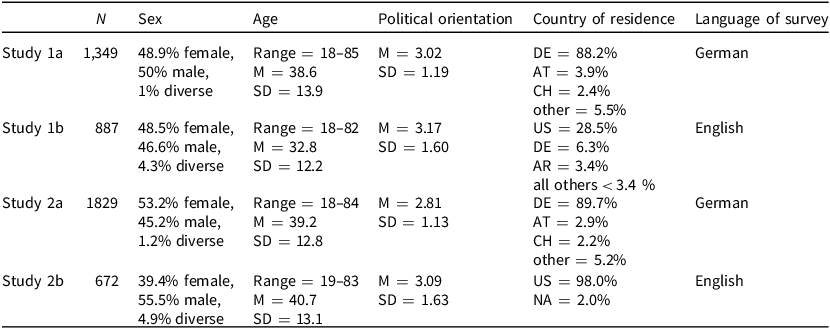
To ensure data quality, participants were excluded based on prespecified validity checks, including speeding, flatlining, language proficiency, and low self-reported credibility. Full details of the exclusion criteria, which are set a priori and held constant across all studies, can be found at https://osf.io/93tw6/. After applying these criteria, the final sample consisted of N = 1,349 for Study 1a, N = 887 for Study 1b, N = 1,829 for Study 2a, and N = 672 for Study 2b. For demographic data of each study, we collected participants’ sex, age at date of participation, their political orientation on a 7-point Likert-type scale (1 = left-wing, 7 = right-wing), and their current country of residence (for details please see Table 1).
Sample characteristics for each study

Table 1. Long description
The table presents sample characteristics for four studies, detailing sex, age, political orientation, country of residence, and language of survey. It has five columns: N, Sex, Age, Political orientation, Country of residence, and Language of survey. The table includes four rows of data for Study 1a, Study 1b, Study 2a, and Study 2b. Row 1: Study 1a, 1349, 48.9 percent female, 50 percent male, 1 percent diverse, Range = 18-85, M = 38.6, SD = 13.9, M = 3.02, SD = 1.19, DE = 88.2 percent, AT = 3.9 percent, CH = 2.4 percent, other = 5.5 percent, German. Row 2: Study 1b, 887, 48.5 percent female, 46.6 percent male, 4.3 percent diverse, Range = 18-82, M = 32.8, SD = 12.2, M = 3.17, SD = 1.60, US = 28.5 percent, DE = 6.3 percent, AR = 3.4 percent, all others < 3.4 percent, English. Row 3: Study 2a, 1829, 53.2 percent female, 45.2 percent male, 1.2 percent diverse, Range = 18-84, M = 39.2, SD = 12.8, M = 2.81, SD = 1.13, DE = 89.7 percent, AT = 2.9 percent, CH = 2.2 percent, other = 5.2 percent, German. Row 4: Study 2b, 672, 39.4 percent female, 55.5 percent male, 4.9 percent diverse, Range = 19-83, M = 40.7, SD = 13.1, M = 3.09, SD = 1.63, US = 98.0 percent, NA = 2.0 percent, English.
Notes. Political orientation was measured using a 7-point Likert-type scale (1 = left-wing, 7 = right wing).
Procedure
Prior to participation, individuals gave informed consent. Then, they completed either the full 70-item or 16-item version of D (see Moshagen, Zettler and Hilbig Reference Moshagen, Zettler and Hilbig2020) and afterward confirmed the sincerity of their responses and indicated whether they agreed to their data being used for scientific purposes. Then, after providing basic demographic information, participants had the opportunity to answer a few follow-up questions before receiving personality feedback. They were informed that completing the additional questions was entirely voluntary, and that they would receive feedback on their D-score regardless of their decision. Those who agreed were then presented with scales measuring their inclination toward NPA and NNPA, respectively (see below). No additional incentives were offered to complete the follow-up questions.
Materials
D was assessed using either the German (Study 1a and Study 2a) or English (Study 1b and Study 2b) item sets, as suggested by Moshagen, Zettler and Hilbig (Reference Moshagen, Zettler and Hilbig2020) and Bader et al. (Reference Bader, Horsten, Hilbig, Zettler and Moshagen2021). Example items are ‘When I get annoyed, tormenting people makes me feel better’ or ‘If I opposed the election of an official, then I would be glad to see him or her fail even if their failure hurt my community’. For the current analysis, we relied on the 16-item version (D16; Moshagen, Zettler and Hilbig Reference Moshagen, Zettler and Hilbig2020). The D16 is highly correlated with the full scale (r = 0.95; Moshagen, Zettler and Hilbig Reference Moshagen, Zettler and Hilbig2020) and shows excellent psychometric properties (Bader, Horsten, Hilbig, et al. Reference Bader, Horsten, Hilbig, Zettler and Moshagen2021)Footnote 3 . Responses were given on a 5-point Likert-type scale (1 = strongly disagree, 5 = strongly agree) and (reverse-keyed) items were (re-)coded such that higher values on the resulting scale (the average across items) indicate a higher D-score.
Intentions for political activism in Study 1a and b were measured using the Activism and Radicalism Intention Scales (ARIS; Moskalenko & McCauley Reference Moskalenko and McCauley2009). This instrument comprises two subscales – the Activism Intention Scale (AIS) and Radicalism Intention Scale (RIS) – consisting of four items each, assessing intentions to engage in NPA and NNPA, respectively. Example items are, ‘I would donate money to an organization that fights for my group’s political and legal rights’ (AIS) or, ‘I would attack police or security forces if I saw them beating members of my group’ (RIS). For the German samples, we used a translated version obtained through independent backtranslation (Brislin Reference Brislin1970). Responses were given on a 5-point Likert-type scale (1 = strongly disagree, 5 = strongly agree), thus higher values indicate higher intentions for political activism.
Intentions for political activism in Study 2a and b were measured using the scales for normative and nonnormative political engagement by Imhoff et al. (Reference Imhoff, Dieterle and Lamberty2021). The scales measure the respective engagement with 10 items each. The scale covers a wider range of political actions than the AIS or RIS. Example items are, ‘I would contact newspapers or journalists to call attention to political problems’ for NPA and, ‘I would refuse to pay taxes, fees, or rents to weaken the system’ for NNPA. The German translation was available from the original authors. Responses were given on a 5-point Likert-type scale (1 = strongly disagree, 5 = strongly agree); thus, higher values indicate higher intentions for political activism.
Analyses
To investigate the current research question, we ran a series of regression models. We used manifest average scale scores for all analyses. All continuous variables included in the regression models were z-standardized to avail comparability of the effect sizes across studies.
First, to examine the zero-order association of D with intentions for political activism, we regressed NPA and NNPA on D in separate models. To test the hypothesized interaction pattern – namely, that D is associated with a divergence between NPA and NNPA – we computed a difference score between NNPA and NPA (after z-standardizing both variables) and regressed this difference score on D. In other words, we tested for a within-subjects interaction effect (Judd, Kenny and McClelland Reference Judd, Kenny and McClelland2001).
To assess the robustness of the findings, each regression model was run again with age, sex, and political orientation included as control variables. Since D is associated with political orientation (Moshagen, Hilbig and Zettler Reference Moshagen, Hilbig and Zettler2024), it is important to ensure that any association between D and NPA vs. NNPA is not simply due to an overlap with political orientation. Thus, we further exploratorily tested whether political orientation moderated the relationship between D and NPA or NNPA, respectively. Previous research indicates that right-wing or authoritarian ideologies may facilitate or legitimize the expression of dark personality traits in political contexts, especially in relation to nonnormative behavior (Duspara & Greitemeyer Reference Duspara and Greitemeyer2017; Moshagen, Hilbig and Zettler Reference Moshagen, Hilbig and Zettler2024).
All analyses were conducted using R – version 4.4.3 (R Core Team 2025). Note that data, materials, R-code, and supplementary results can be found at the respective repository on the OSF (https://osf.io/q6b2w).
Results
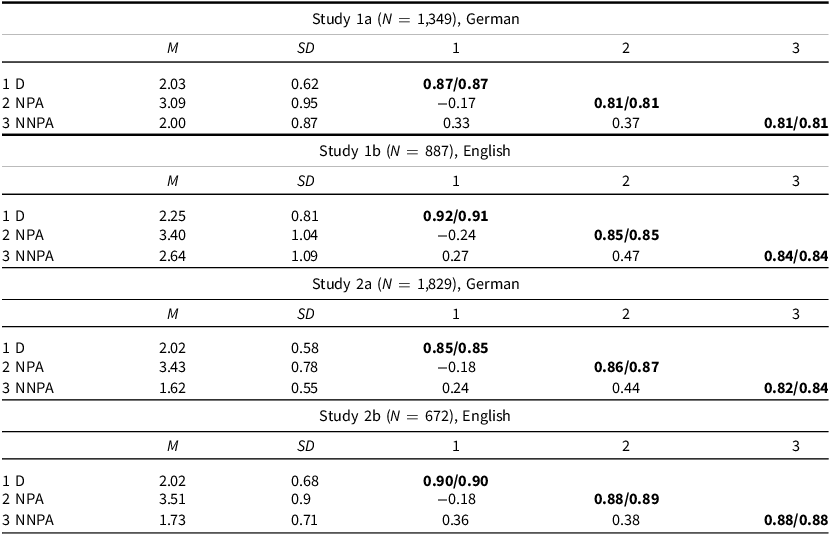
For descriptive statistics of and correlations between all scales, please see Table 2. As found in previous studies, NPA and NNPA were moderately correlated in all studies, 0.37 <= β <= 0.47, all P < 0.001. Furthermore, and in line with our hypotheses, D was significantly and positively correlated with NNPA (0.24 <= β <= 0.36; all P < 0.001), but significantly and negatively correlated with NPA (−0.17 <=β <= −0.24; all P < 0.001) across all studies. As such, the pattern was consistent across languages and the different scales for measuring NPA vs. NNPA. The inclusion of the covariates, ie age, sex, and political orientation, did not alter the pattern of associations in a meaningful way (see OSF for details).
Mean, SD, correlations, and internal consistency (in the diagonal) of all scales for each study
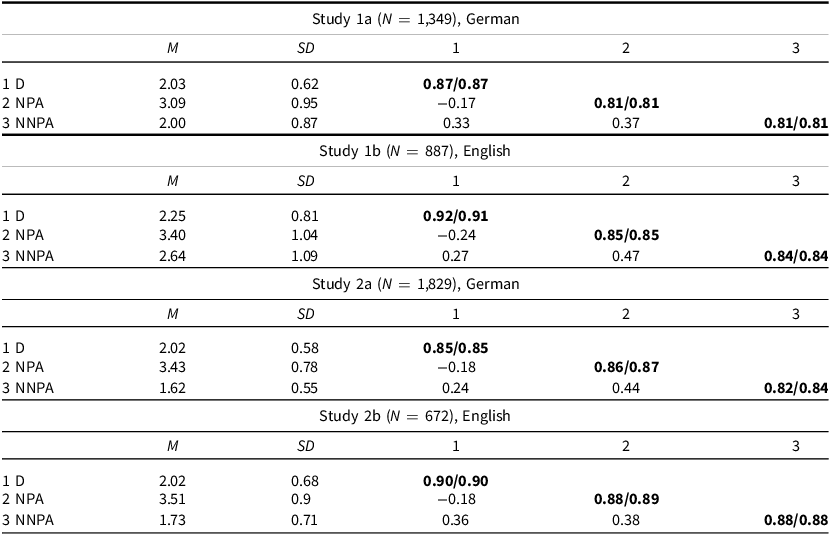
Table 2. Long description
The table presents data on mean, standard deviation, correlations, and internal consistency of scales for four studies. It has four sections: Study 1a, Study 1b, Study 2a, and Study 2b, each with different sample sizes and languages. Each study section contains three rows labeled 1 D, 2 NPA, and 3 NNPA, and three columns labeled 1, 2, and 3. The values in the table include means (M) and standard deviations (SD) for each scale, as well as correlations between the scales. For example, in Study 1a, the mean for 1 D is 2.03 with a standard deviation of 0.62, and the correlation between 1 D and 2 NPA is 0.87. Similar data is presented for the other studies, with variations in means, standard deviations, and correlations. The table provides a detailed comparison of the scales across different studies and languages.
Notes. Bold values on the diagonal indicate Cronbach’s α/McDonald’s Ω; D = Dark Factor of Personality; NPA = normative political activism; NNPA = nonnormative political activism; all correlations are significant, P < 0.001.
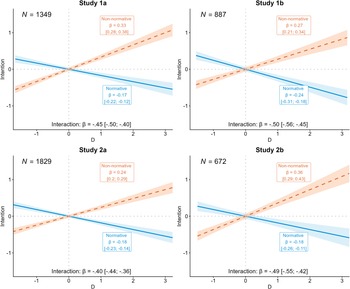
Crucially, the expected (positive) within-subjects interaction was significant, indicating that, as D increases, individuals are less inclined toward NPA and concurrently more inclined toward NNPA. The pattern and exact coefficients are depicted in Figure 1, which shows that the interaction was highly consistent across studies (and thus both languages and scales for measuring NPA vs. NNPA). The size of the interaction effect ranged between β = 0.40 and β = 0.50 (or f 2 = 0.19 and f 2 = 0.33, all p > 0.001), indicating a medium to large effect size. Again, the inclusion of the covariates, ie age, sex, and political orientation, did not alter the interpretation of any of the hypothesized effects (see OSF for details).
Effect of D on intentions for political activism across studies.
Notes. Regression lines and standardized regression coefficients (β) (and their respective 95% confidence intervals in brackets) for NPA are depicted in blue (solid line) and for NNPA in orange (dashed line). Shaded areas around the regression lines represent 95% confidence intervals of the prediction. For better comparability, all variables are z-standardized and thus 0 refers to the sample mean (see dotted lines).

The explorative analyses regarding a possible effect of political orientation revealed somewhat mixed results. Overall, there was a consistent trend across studies that political orientation positively moderated the relation of D and political activism – for both NPA and NNPA. That is, for individuals reporting a more right-leaning political orientation, the negative association of D with NPA was weaker (0.02 < β < 0.07), and the positive association of D with NNPA was stronger (0.04 < β < 0.11). However, the effect was only significant for both NPA and NNPA in three out of four studies. More importantly, the main results always remained unchanged, that is, the dissociation of NPA vs. NNPA by D was independent of political orientation (for details see the supplementary Tables in the OSF).
Discussion
Research on political activism has emphasized the development of political radicalization due to intrapersonal development. For example, the ‘conveyor belt’ metaphor (see Moskalenko & McCauley Reference Moskalenko and McCauley2009 for a critical overview) posits that political activism often begins with NPA but can eventually transfrom into NNPA. In other words, an individual may begin by signing petitions and eventually engage in more radical behaviors, such as participating in violent protests or storming political institutions. However, there is only relatively modest overlap between NPA and NNPA and thus more recent research has suggested that interpersonal factors, such as personality traits, may also play a crucial role in determining the form of political activism individuals pursue (eg Moskalenko & McCauley Reference Moskalenko and McCauley2009). However, the role of personality in shaping political activism remains relatively understudied (Stern Reference Stern2016; Wolfowicz, Litmanovitz, Weisburd et al. Reference Wolfowicz, Litmanovitz, Weisburd and Hasisi2020).
To address this gap, we investigated whether the Dark Factor of Personality (D) can distinguish between NPA and NNPA. Across four well-powered studies in German and English and with different scales to measure NPA and NNPA, we examined the association between D and NPA vs. NNPA. Our findings consistently supported the hypothesized main effects and interaction pattern; individuals high in D were more inclined toward NNPA and concurrently less toward NPA and vice versa for those low in D.
These results also align with prior research highlighting the role of dark traits in intentions for political activism (Nai & Young Reference Nai and Young2024; Rogoza, Marchlewska and Szczepańska Reference Rogoza, Marchlewska and Szczepańska2022; Wolfowicz, Litmanovitz, Weisburd et al. Reference Wolfowicz, Litmanovitz, Weisburd and Hasisi2021) and, in particular, with the notion that it is the common core among such traits – ie D – that primarily drives antisocial or radical political activism (Gøtzsche-Astrup Reference Gøtzsche-Astrup2021). This pattern mirrors findings in other domains, such as unethical behavior (eg Hilbig & Thielmann Reference Hilbig and Thielmann2025) or socially aversive psychopathology (Scholz Reference Scholz2024; Scholz & Hilbig Reference Scholz and Hilbig2024; Scholz, Zimmermann, Moshagen et al. Reference Scholz, Zimmermann, Moshagen, Zettler and Hilbig2024) – showing that it is what all dark traits have in common, ie their common factor D, rather than what is unique to each of these traits that drives aversive behavior. Along these lines, the results also imply that a higher engagement in NPA of individuals scoring high on narcissism (Bertrams & Krispenz Reference Bertrams and Krispenz2024; Krispenz & Bertrams Reference Krispenz and Bertrams2024) does not seem to generalize to the shared aspect of all dark traits, ie D.
Moreover, the moderation analysis by political orientation found some preliminary evidence for the idea that more right-wing stances may be one way to justify socially or/ethically aversive behavior (see also Moshagen, Hilbig and Zettler Reference Moshagen, Hilbig and Zettler2024). That is, individuals high in D and self-reporting a right-wing political orientation tended to refrain even more strongly from NPA and engaged particularly strongly in NNPA. Note, however, that this pattern was not consistent across all studies and thus ought to be replicated and investigated further. In any case, though, the within-interaction effect of primary interest – that D is positively associated with NNPA, but not (or negatively) with NPA – was consistently independent of (ie never moderated by) political orientation.
From a broader perspective, the present results fit well into theoretical models of radicalization processes, which mention personality as one factor of radicalization – among others such as, eg threat and affordance (McGregor, Hayes and Prentice Reference McGregor, Hayes and Prentice2015). Future research may build on the present results by looking at specific subgroups, such as, eg ‘passive’ (low NPA and low NNPA) and ‘radical’ (high NPA and high NNPA) individuals, eg by means of bi-factor models or latent class analyses, and investigate which factors might differentiate those individuals.
Naturally, some limitations should be noted. First, as is common in this field of research, our studies relied on self-reports. This may have led to an overestimation of effect sizes due to common method variance. Second, our sample consisted of individuals who voluntarily visited a website focused on D. Although our samples showed a more diverse distribution of demographics than is typical in psychological studies (Gosling, Sandy, John et al. Reference Gosling, Sandy, John and Potter2010; Henrich, Heine and Norenzayan Reference Henrich, Heine and Norenzayan2010), self-selection may limit the generalizability of the findings to the broader population. At the very least, one may argue that the current samples were interested in (aversive) personality – as there was no incentive for participation other than feedback – and possibly also intrinsically motivated to help science. As such, findings should be replicated in other samples, preferability with other (eg monetary) incentives for participation. Third, the requirement for participation was a sufficient level of German for Studies 1a and 2a and English for Studies 1b and 2b. Thus, differences in the cultural background of the participants are neglected in the current study, although these might influence the likelihood for NPA or NNPA also, as eg violent protests are more common in certain countries than others. Finally, the cross-sectional design of our study does not allow for any conclusions about the development of political activism over time. As such, conclusions about the predictive ability of D regarding political activism over time cannot be drawn from the present data. Future longitudinal work would thus allow for somewhat stronger causal inferences.
In sum, our findings indicate that D is a particularly informative personality trait for the differentiation of NPA vs. NNPA. Specifically, D distinguishes individuals inclined toward nonnormative, potentially violent political actions from those motivated to engage in normative actions. These results add to our understanding of political radicalization by highlighting that a single personality trait, ie D, and thus the aversive essence shared by all dark traits, drives the tendency to engage in NNPA rather than NPA.
Data availability statement
All data, analysis code, and research materials for all studies are available at the OSF (https://osf.io/q6b2w).
Financial support
This research did not receive any specific grant from funding agencies in the public, commercial, or not-for-profit sectors.
Competing interests
The authors report there are no competing interests to declare.
Ethical standards
All studies were conducted in full accordance with the Ethical Guidelines of the American Psychological Association and were run based on approval by the local ethics committee (IRB) of the RPTU University Kaiserslautern-Landau, Department of Psychology (approval numbers LEK-154 and LEK-567).

 Open access

