

Introduction
The population of the pre-Mesolithic cemetery at Al Khiday 2 (16-D-4, Figure 1) in central Sudan must have had a unique outlook on the afterlife. Archaeologists associate flexed inhumation burials common to prehistoric cemeteries worldwide with the foetal position, a formal expression of a 'new life'. However, what explanation can be suggested for burying the deceased in a prone and extended position as found at Al Khiday 2? Here we report on this unique cemetery with its unusual burial rite (Figure 2).
Map showing the location of the Al Khiday sites (16-D-5 and 16-D-4).

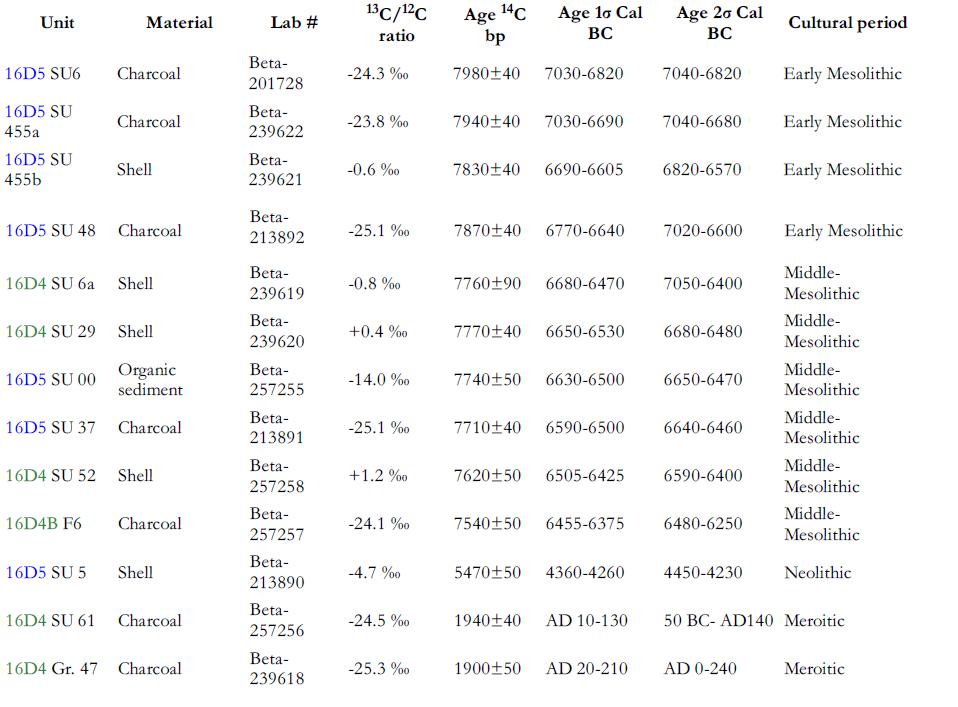
The cemetery is a multi-stratified site on a low fluvial bar, probably deposited by the Nile in the Upper Pleistocene (Williamson 2009), and is located 35km south of Omdurman, on the western bank of the White Nile. The site of Al Khiday 2 was discovered during an extensive survey covering c. 245km². Archaeological work took place in 2006-2008 excavating c. 475m². A total of 120 skeletons have so far been excavated and bioarchaeological studies, including demography, metric and non-metric analysis to establish population differences, as well as skeletal and dental pathology, were carried out. The site was excavated stratigraphically and organic material (charcoals, bones and shells) was collected for radiocarbon dating, performed at BETA Analytic Laboratory, USA (Table 1). Archaeological contexts were defined by pottery decoration, according to a classification proposed by Caneva (Caneva 1988), and supported by layer-feature specific radiometric dating. Calibration (2 in the text) of conventional and AMS radiocarbon results used INTCAL04 under OxCal v.3.10; uncalibrated years are reported as bp while calibrated age is indicated as cal years BC/AD.

So far, 50 individuals (males, females and children of all ages) have been excavated by the Is.I.A.O. (Istituto Italiano per l'Africa e l'Oriente) Archaeological Mission, all buried lying on their front. On the basis of radiocarbon dates (conventional and AMS) and stratigraphy the burials date to a pre-Mesolithic phase. During a well-defined Mesolithic phase (6580-6440 cal BC) the site was used as a settlement and later by a Neolithic population as a burial ground (4360-4250 cal BC). More recently, a Meroitic group selected it as their cemetery (20-140 cal AD). A total of 120 graves have been excavated and, on the basis of surface finds, nearly half of the cemetery has now been investigated. Ongoing bioarchaeological analyses indicate that the three populations differ in robusticity, occurrence of skeletal and dental diseases and tooth modification practices.
The Mesolithic features, consisting of pits of different function, allow the reconstruction of the anthropic and natural disturbances affecting the oldest graveyard phase (Figures 3 and 4). The pre-Mesolithic skeletons cannot be directly dated, being almost completely depleted of organic material (collagen), but they are placed in time through the stratigraphic evidence provided by some of these pits. Three radiocarbon dates on charcoal and shell from pits cutting through the skeletons imply a date for the human remains before 6600 cal BC (6660-6500 cal BC; 7050-6400 cal BC; 6590-6380 cal BC). These dates are supported by the pottery assemblage from the pits, which is also radiocarbon dated from a stratified layer at the nearby Al Khiday 1 settlement (Salvatori & Usai 2009), to about 6640-6450 cal BC. A radiocarbon date of 6650-6470 cal BC on organic matter in a marsh deposit formed during the Mesolithic occupation of the site, after the burial of the prone individuals, supports the attribution to a pre-Mesolithic phase.
One of the prone extended burials.

Archaeological sequence at 16-D-4 cemetery, Al Khiday 2.

Later features cutting pre-Mesolithic burials.

Many skeletons are lying only 10-20cm below the present surface, but their good preservation indicates that the grave pits were originally cut from a higher level and that wind erosion, which affected the site before the Mesolithic habitation episode, had been substantial (Figure 4). The bones appear almost fossilised. However, fossilisation cannot be considered as a proof of the graves' antiquity (Smith et al. 2002), because it depends on a number of taphonomic processes. Chemical pedogenetic processes also influenced bone preservation, which is demonstrated by micropedological analyses of sediments showing several events of calcite mobilisation and recrystallization.
Isotopic analyses of human bones provide the most impressive evidence of a chronological distance between the oldest and youngest cemetery phases, independent from archaeological and radiometric data. Bone samples from each phase were selected for C- and O-isotope analyses. From each sample individual sub-samples were milled and the stable C- and O-isotope values were measured using a Carlo Erba 1110 elemental analyser coupled with a mass spectrometer Finnigan XP plus and results are reported in per mil (), relative to the Vienna PeeDee Belemnite (VPDB) standard. (For further analytical details see Lee-Thorp et al. 1989; Bocherens et al. 1991). Notwithstanding the occurrence of subsequent events of calcite mobilisation and recrystallization, the reliability of isotopic data is confirmed by the phosphate 18O values. Plotting the oxygen values on a phosphate 18O- carbonate 18O diagram the points lay in proximity to the line of un-altered isotope values (Iacumin et al. 1996).
The isotopic analyses (i.e. 18O values; Figure 5) indicate that the pre-Mesolithic individuals lived in a different climate with a greater amount of rainfall, whereas in Neolithic and Meroitic samples the values show an increase in aridity. Isotopic values are in accordance with the Holocene climatic trend established on the basis of independent palaeoclimatic data (Verschuren 2003).
13C and 18O field of variation of human bone carbonate hydroxyapatite of the four different archaeological groups analysed.

A literature review has identified isolated cases of prone burials in Natufian cemeteries (13 000-8000 BC) (Bocquentin 2005), a very ancient skeleton at Wadi Kubbanyia, southern Egypt (c. 20 000 BC) (Wendorf & Schild 1986) and one individual from Dolni Vestonice, Czech Republic (24 000 BC) (Klima 1987). A comparison with these examples suggests a late Pleistocene or very early Holocene date for Al Khiday 2. However, nowhere else does this ritual show the dimensions recorded at Al Khiday 2, making this site one of the most important in the context of African archaeology.
Acknowledgements
We would like to thank the National Corporation for Antiquities and Museums of Sudan. The research was supported by the Is.I.A.O., the Italian Ministry of Foreign Affairs (D.U.), the Michela Schiff-Giorgini Foundation (D.U.) and the University of Parma (P.I.).