

Introduction
For a long time prehistorians accepted as conventional wisdom the idea that Palaeolithic parietal art was confined to caves where it could be kept hidden from uninitiated individuals. So, it was not surprising that the age of hundreds of petroglyphs discovered on exposed cliffs bordering the Portuguese river Côa became a matter of controversy among some rock art specialists (Reference BahnBahn 1995; Reference BednarikBednarik 1995; Reference ZilhãoZilhão 1995; Reference DornDorn 1997), since the animals represented and pictorial compositions showed great affinities with upper Palaeolithic cave art of Spain and France. Objections were raised to attributing so many well-preserved petroglyphs in an open-air site to the Palaeolithic. Miscellaneous attempts to get direct ages for the engravings themselves failed to establish the true antiquity of this site because the dating methods employed were ill-suited to the task. We wish to report below some thermoluminescence (TL) dates for burnt lithic remains from the archaeological levels of the Fariseu site which should close the debate, since some of the levels dated rise above the lower portions of numerous designs. In this letter we show that most if not all of the compositions are undoubtedly more than 14 500 years old.
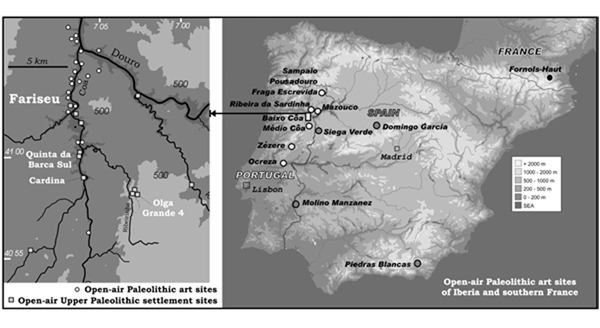
In 1991 over 17km of the cliff faces bordering the river Côa (a tributary of the Douro, in north-eastern Portugal, Figure 1) were found to be covered with carvings of horses, aurochs, deer, and other wild animals. Cave art was believed by many specialists to be associated with magic practices, because it was generally located deep inside caves, far from human occupation sites. Though the animal forms and composition resembled those of French and Spanish cave art (Reference BahnBahn 1995; Clottes et al. 1995; Reference ZilhãoZilhão 1995), not all prehistorians were willing to accept that this astounding open-air site was contemporary with similar cave art, and dates as recent as a few centuries have been proposed (Reference BednarikBednarik 1995; Reference WatchmanWatchman 1995). While there is no reliable method of determining absolute dates of petroglyphs, a number of attempts were made to narrow down the date of execution. Radiocarbon dates obtained on thin mineral accretions formed on petroglyphs gave ages ranging from a few centuries to several millennia (Reference DornDorn 1997).
Location of rock-art and Upper Palaeolithic sites in the Douro and Côa valleys.

Of course, these results give no information on the age of the engravings themselves, since there is no way to tell where the carbon dated came from. Rock-erosion or varnish-deposit techniques (Reference BednarikBednarik 1995) were no more helpful than 14C, since they are strongly dependent on environmental factors (Reference ZilhãoZilhão 1995). Fortunately, archaeological excavations within the valley (Zilhão et al. 1997; Aubry et al. 2002) quickly revealed evidence of human occupation at several sites with levels dated from Gravettian (Olga-Grande 4 and Cardina) to Magdalenian (Quinta da Barca). The initial cultural attributions were confirmed by TL ages of burnt lithics which ranged from c. 28 000 to 12 000 years (Valladas et al. 2001). Of course, those favouring a more recent date pointed out that the upper Palaeolithic humans who inhabited the valley were not necessarily the authors of these petroglyphs. The work reported below establishes a terminus ante quem for the lower levels of these magnificent works of art.
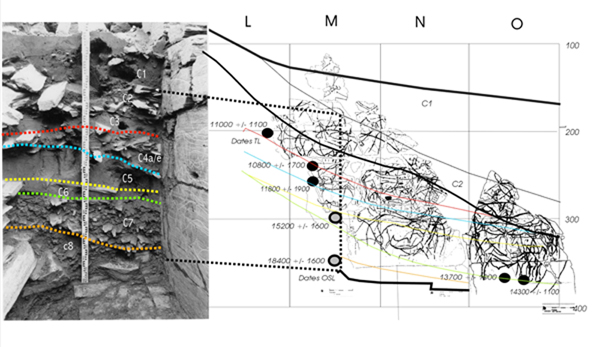
When the Douro river dam, located downstream from Côa, was emptied in December 1999 the lowered water level at Fariseu exposed the lower section of an engraved rock panel (No. 1) partly hidden by a thick layer of sediment (Figure 2a). Excavation carried out soon after to a depth of 2.5m exposed a succession of deposits rich in schist fragments and containing remains of human activity (lithic artefacts) separated by sterile layers of alluvium (Aubry et al. 2002). Of key importance was the fact that these archaeological deposits were in direct contact with and concealed some of the 82 animal figures (horses, deer, aurochs and goats) engraved on a 3m2 rock panel. Moreover, a careful examination of the superposition of the design lines suggested that all the figures of this particular panel were traced within a short span of time (Reference BaptistaBaptista 2001).
The uppermost excavated layer one consisted of modern sediments deposited since the Douro dam was built and layer two contained fragments of ceramics (medieval, modern?). Micromorphological analysis of the lower layers (three to eight), antedating the dam and which are in contact with the decorated rock-face, indicated that the sediments were only affected by pedological processes which are not able to move significantly the soil and disturb the organization of artefact assemblages (Sellami et al. 2001). In the upper part of archaeological level four, the flint tools showed all the characteristics typical of Late Magdalenian industries, whereas those of the lower part could be attributed to Early Magdalenian or Late Gravettian periods. It is important to point out that these archaeological deposits rose well above the bottom of the engraved panel to the extent that the top of layer seven was at the level of the lowest petroglyphs, which were concealed by layer six (Figure 2b). Moreover, two thirds of the upper part of this engraved panel were hidden by archaeological levels three and four.
a) Picture of the Fariseu Palaeolithic sequence in relation to the engraved rock panel No. 1. The site formation process was greatly influenced by the fact that the site is located along a glacis slopping towards the river bed. Layers C3 to C8 are characterized by a succession of pebbly layers, particularly at the lowest strata, and layers rich in silty alluvion in the upper strata: this succession most likely reflects climatic evolution. The lower layers contain numerous schist fragments produced by the erosion of schist formations found higher up the slope. The angular nature of these fragments suggests that they did not travel far before being deposited (Bullock et al. 1985; Fedoroff & Courty 1994). The fact that these rocks fragments show no significant physico-chemical changes suggests that layers seven and eight were deposited primarily during a cold period. The dotted and coloured lines show boundaries between the different layers, which in some case are in direct contact with engravings: note that layers six to three concealed some of the 82 animal figures of this panel, whereas the top of layer seven is located at the base of the lowest petroglyphs. b) Position of some engraved animals of panel No. 1. relative to layer boundaries. The superposition of the figures and the intersection of the drawing lines allow to establish that some of the engravings had already been done when the lowest part of this decorated panel was covered by layer 6, dated to 15 200±1600 years.

Fortunately, the levels containing flint tools also yielded a number of heated quartzite fragments for which age-estimates could be obtained by the thermoluminescence dating method (TL). Among the burnt lithics collected in the course of the excavation, five were suitable for TL dating. Three came from archaeological level four and two from level seven. To get chronological information about some other levels, sediments collected from layers six and eight were dated by optical luminescence (OSL) since they have been exposed to sunlight before being covered by overlaying layers. Dosimetric measurements were carried out on site during the excavation to determine the gamma and cosmic dose-rates the samples experienced during burial. The radioisotopic contents of quartzites and sediment were determined by Neutron Activation Analysis and gamma-ray spectrometry, respectively. The sample preparation and the experimental procedures which were used to get all the relevant radiometric data for the age calculations have been published earlier (Mercier et al. 2001).
The TL and OSL age-estimates, which fall within the Tardiglacial period, range from c. 18 500 for layer eight at the bottom, and c. 14 500 for layers seven and six, to c. 11 000 for layer four, near the top of the archaeological sequence (Table 1). For layers four and seven, the TL age-estimates yield a weighted mean of 11 400±700 and 13 900±800 years, respectively. Moreover, the two methods, though applied to materials with distinctly different luminescence and radiometric characteristics, such as quartzite pebbles for TL and silt-sized quartz grains for OSL, give coherent results that dovetail the stratigraphy. Thus, this set of dates confirms the conclusions derived from the study of the lithic industries which attributed the Fariseu human occupation levels to the Upper Palaeolithic. According to the luminescence results, layers seven and six were deposited in a relatively short time around 14 500 years ago and they antedate by at least 1000 years the deposition of layer four, which falls within the same time interval as the Quinta da Barca Late Magdalenian settlement site (12 100±600 years) at the end of the Pleistocene period. Finally, as the archaeological level six concealed the lowest petroglyphs, the luminescence dates allow us to conclude that some of the designs exposed during excavation must be more than 14 500 years old.

Thus our luminescence dating results should definitively close the controversy raised ten years ago about the antiquity of the Côa petroglyphs by demonstrating that they were carved during the Pleistocene period and not during the last millennium.
The stylistic and morphological similarities between these particular petroglyphs and the thousands that adorn a long stretch of the cliffs enclosing the Côa river valley (Reference BaptistaBaptista 2001) leave little doubt that this amazing creative impulse can definitely be attributed to Upper Palaeolithic humans. It is hard to believe, in view of its sheer magnitude, that this open-air site is unique, so other similar sites executed by the hunter-gatherer groups of the last ice age probably remain to be discovered. The age estimates reported here suggest that, whatever their motivations, Palaeolithic parietal artists were allowed to express their talents elsewhere than in secluded sites hidden from the profane eyes.
Acknowledgements
We thank the Parque Arqueológico do Vale do Côa, the Portuguese Ministry of Culture, CNRS and CEA for financial support.