


1. Introduction
In longevity economics (Reference Lee, Coughlin, Hodara, Yang, de Weck, Klopfer and OchsendorfCoughlin & Yoquinto, 2024; Lee et al., 2024), advancements in healthcare, medical systems, emerging technologies, transportation, social infrastructure, and other factors have extended health and lifespans. As a result, aging in place (AIP) has gained prominence in policy (Reference IecovichMeans, 2007; Reference MeansIecovich, 2014), built environment (Reference Mihailidis, Carmichael and BogerZ. Wang et al., 2012; Reference Wang, Shepley and RodiekMihailidis et al., 2004), service innovation (Reference Liu, Purao and Hwee-PinkCanham et al., 2022; Reference Suppipat, Cheng, Wang, Gao and ZhouSuppipat et al., 2020; Reference Canham, Weldrick, Sussman, Walsh and MahmoodLiu et al., 2016), and technology (Reference Mynatt, Essa and RogersSumner et al., 2021; Reference Sumner, Chong, Bundele and Wei LimMynatt et al., 2000), with most older adults preferring to remain in their homes as they age.
This desire for independence and familiarity raises important questions regarding the conditions and technologies (Reference Peek, Luijkx, Vrijhoef, Nieboer, Aarts, van der Voort, Rijnaard and WoutersEtkin, 2021; Reference Wang, Bolling, Mao, Reichstadt, Jeste, Kim and NebekerS. Wang et al., 2019; Reference EtkinPeek et al., 2019) needed to support AIP effectively. Several countries, particularly Japan, have introduced advanced robotics to address these needs, with mixed outcomes. Despite these initial efforts, the ongoing development of robotics and artificial intelligence (AI) to facilitate AIP seems inevitable (Reference Müller, Roth and KreimeyerAtluri et al., 2024; Reference Atluri, Phelps, Qin, Cutts and JonesMüller et al., 2023).
However, what remains unclear is how older adults and other individuals, such as caregivers, perceive the role of AI (Reference Czaja and CerusoChong & Yang, 2023; Reference Chong and YangCzaja & Ceruso, 2022) and robotics in their lives and the specific functions they envision for these technologies. Therefore, this descriptive study’s primary objective is to explore and understand individuals’ needs and design considerations during their early retirement stage, specifically focusing on the design of potential AI and robotic services and systems, and the forms of assistance desired by those AIP. The proposed conceptual framework was designed to guide more meaningful discussions with participants during virtual semi-structured interviews.
This study aims to investigate and develop a conceptual framework (Figure 1) to understand the role of AI and robotics in the homes of older adults and identify critical design considerations for these technologies. The theoretical foundation of this study is rooted in Charmaz’s (Reference Charmaz2014) constructivist grounded theory (CGT). This research method prioritizes the inductive development of new theories based on participant-derived data rather than adhering to pre-established theoretical frameworks.
A conceptual framework for exploring AI and robotics in the context of AIP

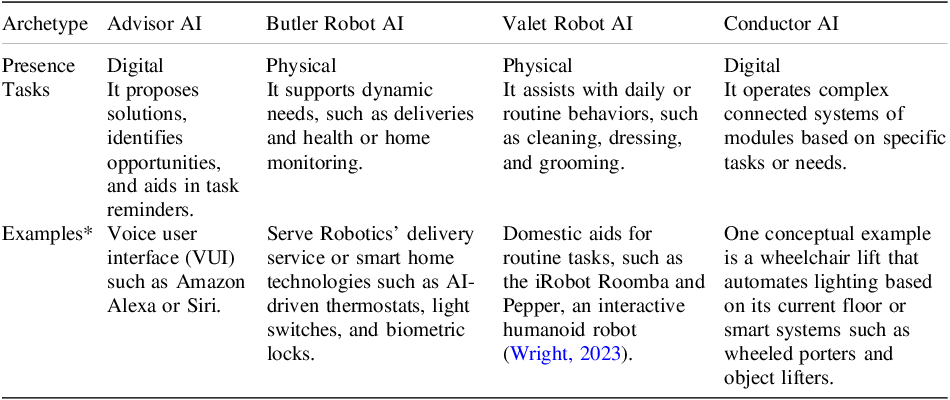
The research commenced with a literature review examining the intersection of AI, robotics, and AIP. Based on the synthesis of the literature review and discussion, four themes for AI and a preliminary framework emerged. The x-axis represents the presence of AI, encompassing both digital and physical forms, while the y-axis distinguishes between cognitive functions (“head” of AI, or auxiliary brain) and physical functions (“hands” of AI, or auxiliary muscle). This framework comprises four archetypes: Advisor AI, Butler AI, Valet AI, and Conductor AI.
Advisor AI is defined by its ability to provide solutions, identify opportunities, and offer reminders, similar to Amazon Alexa, predominantly in a virtual format. Butler AI Robot supports dynamic needs with a physical presence, such as facilitating deliveries and monitoring health (Reference DianeDiane J. Cook, 2006) or home conditions (Reference Wang, Shepley and RodiekZ. Wang et al., 2012), analogous to Serve Robotics’ delivery service and robot design. Valet AI Robot assists with routine physical tasks, including cleaning, dressing, and grooming, similar to iRobot Roomba. Conductor AI operates digitally, managing interconnected systems of modules and services (Reference Canham, Weldrick, Sussman, Walsh and MahmoodCanham et al., 2022), such as wheeled porters and object lifters.
2. Related work
AIP has become a growing trend for various reasons. Beyond staying in a convenient and familiar environment with family, older adults seek to improve quality of life, maintain routines, fear losing community connections, and are emotionally attached to their home and neighborhood (Reference Löfqvist, Granbom, Himmelsbach, Iwarsson, Oswald and HaakLerner, 2019; Reference LernerLöfqvist et al., 2013). This study examines service innovation and the integration of AI and robotics within the aging-in-place context. We emphasize AI’s taxonomies and applications concerning the needs for (Reference Gonzalez de Heredia, Justel, Iriarte and LasaGonzalez de Heredia et al., 2017), benefits of, and barriers to AIP. Czaja and Ceruso (Reference Czaja and Ceruso2022) note AI’s potential role in supporting aging adults, promoting independent living, and enhancing the quality of life for older adults and their families. Atluri et al. (Reference Atluri, Phelps, Qin, Cutts and Jones2024) highlight the potential of AI-driven smart home technologies to address challenges related to security, daily routines, household maintenance, and social engagement.
Regarding service design for AIP, Canham et al. (Reference Atluri, Phelps, Qin, Cutts and Jones2022) propose a conceptual framework of aging in the right place (AIRP) for older adults experiencing homelessness, encompassing eight categories: 1. built and natural environment, 2. housing access and home modification, 3. resources, transportation, technology, safety, 4. physical/mental health and functional abilities, 5. finances, 6. emotional place attachment, 7. meaningful recreation and exercise, and 8. social support, participation, and inclusion. Scharlach et al. (Reference Scharlach, Graham and Lehning2012) employed a user-driven approach to examine the “Village” model, which aims to support older adults in AIP, addressing service needs and enhancing health and life quality.
Yang et al. (Reference Yang, Miao and Shen2015) investigated service design by introducing service concepts, identifying enabling digital technologies, and analyzing distinct service characteristics to propose an implementation framework for digital service innovation in AIP. Suppipat et al. (Reference Suppipat, Cheng, Wang, Gao and Zhou2020) applied seven design methods, including persona, user journey map, PEST analysis, and business model canvas, to explore intercultural co-living services as a potential service-oriented business to support AIP, acquire new skills, and promote economic growth.
Based on this literature review, most studies focus predominantly on the physical performance of AI product or the design and implementation of robotics systems, with limited attention to emotional and social needs. Consequently, substantial opportunities remain for exploring service innovation through the integration of AI and robotics in AIP. Notably, a comprehensive framework for analyzing relationship-building and meaning-making between AI and robotics in the AIP context remains absent. This paper presents a framework for categorizing AI and robotic AIP-service interventions by comparing themes of presence—physical or digital—to impact—cognitive or physical.
3. Research method
The research process of this descriptive study was structured into three phases: data sourcing, data collection, and data analysis. This approach aimed to refine the conceptual framework, analyze interview data, and identify key design considerations (Figure 2).
Research flow

3.1. Data sourcing: participants recruitment
We recruited four Boston-based participants (two male and two female) from the MIT AgeLab database. The participants, with an average age of 70 years, were all in the early stages of retirement and had extensive experience in long-term pension and financial planning. All participants were in good health, possessed at least a bachelor’s degree, and had substantial financial resources, with an average pre-tax household income of $150,000 or more and investable assets exceeding $100,000. Three participants had professional backgrounds in research institutes or universities, with expertise in technology and entrepreneurship. Although the sample size for this preliminary study was small, the participants were sufficiently representative of upper middle class in the US to yield valuable insights into the research question.
3.2. Data collection: think-aloud approach and semi-structured interview
The virtual semi-structured interviews were conducted by the two authors with one participant present. Each interview consisted of three sections: a five-minute self-introduction, a 25-minute discussion prompted by slides with visuals representing the preliminary framework (Figure 1), and a final five-minute segment for open-ended conversations or participant questions.
We employed a think-aloud method (Reference Someren, Barnard and SandbergEccles & Arsal, 2017; Reference Eccles and ArsalSomeren et al., 1994), conducting four interviews, each lasting 35 to 45 minutes, to elucidate the conceptual framework through four key life-relevant examples. The research questions addressed the participants’ perceptions of the proposed four AI and AI Robot archetypes (Table 1). During the explanation process, particular emphasis was placed on understanding the preferences of aging individuals regarding the types of assistance they desire and the specific areas where they seek support.
Four AI and robotics archetypes

* While not all of these products are currently AI-driven, the integration of AI features and increased automation is anticipated soon.
3.3. Data analysis: constructivist grounded theory
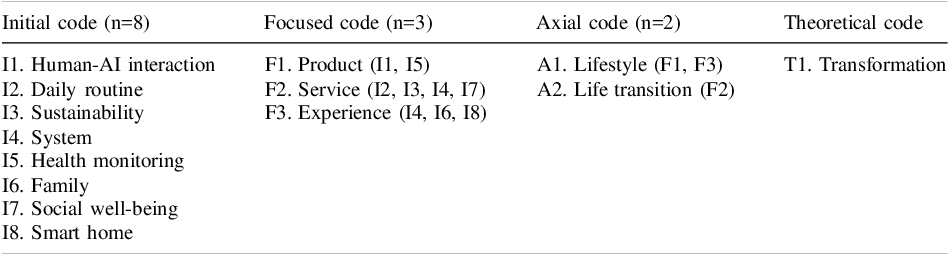
Following the interviews, we analyzed the video transcripts using Charmaz’s (Reference Charmaz2014) CGT, performing three rounds of theoretical sampling on four 35-minute transcripts with the co-authors until sampling saturation was reached. The theoretical sampling involved four coding layers: initial coding, focused coding, axial coding, and theoretical coding. Initial coding captured descriptive raw data and narratives, forming a foundation to open codes in the focused coding phase. Focused coding then grouped similar descriptions and ideas, preparing for axial coding, identifying central themes, and establishing connections among the focused codes. The final step, theoretical coding, aimed to derive the core themes from the transcripts.
This iterative constant comparison process allowed for comprehensive familiarization with the data and the generation of crucial insights. Utilizing CGT, the research team systematically synthesized interview findings and incorporated insights from the literature review to refine the conceptual framework. However, a potential limitation of CGT is its optimal suitability for large dataset analysis.
4. Research result
4.1. Emerging themes from CGT
We employed Charmaz’s (2006) CGT as the primary qualitative data analysis method, utilizing constant comparison and line-by-line coding. This process resulted in eight initial codes, which were subsequently grouped into three focused codes, corresponding to distinct design forms and expressions: product (F1), service (F2), and experience (F3). Two primary axial codes, lifestyle (A1) and life transition (A2), then informed the core code: transformation, which encapsulates the theoretical code developed in this study (Table 2).
The overview of CGT theoretical sampling with selected participants quotes

4.2. Code interpretation
We identified four selected initial codes (1, 2, 5, and 7) along with relevant quotes and insights to strategically elaborate on findings derived from CGT. This approach aimed to further investigate participants’ perceptions of AI and robotics design and application within the context of AIP (Table 3).
Participant focus areas and key considerations

-
Human-AI interaction (Initial code 1): Participants generally perceived AI as embedded within the virtual world. For instance, P2 stated, “I am more considering AI and robotic design on the digital side, such as virtual assistants or chatbots.” The concept of AI’s physical presence prompted P2 to introduce the notion of “eye-level” interaction, suggesting that if a smart speaker is positioned/placed at eye level, it may facilitate a more natural and human-like conversation. Previously, smart speakers with voice commands sought reassurance from users. However, P2 shared that being at home provides reassurance for most retirement individuals. The evolving nature of human-AI interaction, especially with AI assuming a physical presence, has introduced new challenges, particularly as technology won’t just provide verbal responses for reassurance. These novel forms of interaction raised an essential question from P1: “How can we assist individuals with disabilities through AI?” Moreover, participants considered building trust and cultivating new forms of human-AI ecosystems. This concern resonated with P4, who remarked, “Trust is a high bar for AI. What would it take to build trust?”
-
Daily routine (Initial code 2): Reducing the workload of daily routines to alleviate mental stress is a crucial feature that AI and robotic design can effectively address. Regarding the Advisor AI archetype, P3 used Amazon Alexa to provide reminders about time and weather. Similarly, P4 noted, “Linking AI to your calendar is useful.” However, concerns were raised, as P3 stated, “I’ve already spent too much time on my iPhone; why would I want to spend time on other AI devices like my smart toothbrush?” This highlights the emerging latent need among individuals AIP to effectively and efficiently complete daily tasks. P1 captured this sentiment: “The precision of AI and robotic tools is beneficial until it is not.”
-
Health monitoring (Initial code 5): This conceptual framework enabled participants to underscore the significance of health-related concerns. P3 reported using an AI-driven sleep-quality tracking application with his wife to monitor their sleep scores. P4 also remarked, “Monitoring health at home is a good idea. As you get older, you might easily forget things.” The discussion prompted P2 to reflect: “There is a distinction between individuals’ physical and cognitive decline. This makes me reconsider the aging-in-place proposition in light of cognitive impairment. Can Advisor AI help extend the feasibility of AIP?”
Notably, both P1 and P2 highlighted the tendency to focus on designing for healthy seniors. Still, when considering some of their close friends’ spouses who were in poor health, they acknowledged that significant progress is still needed to achieve inclusive and universal AI and robotic designs that accommodate diverse health conditions for AIP.
-
Social well-being (Initial code 7): Social well-being is closely linked to issues of accessibility and transportation in the context of AIP. P2 remarked, “Isolation is the biggest concern while we try to adapt to an innovative AI-driven lifestyle.” This sentiment was echoed by P3, who stated, “Enhance the social aspect of AI and robotic design. Especially for older adults, the social circle has become smaller.” The discussion on social well-being also resonated with P2’s comment: “When designing the mechanized aspects of tasks for AI and robotics, it is crucial not to overlook the psychological, emotional, and social dimensions.”
5. Discussion
5.1. Participant-support for the conceptual framework
We synthesized key insights for each AI archetype using this conceptual framework in semi-structured interviews. Overall, the interview data did not provide evidence that the proposed four categories should be changed. The four participants supported the themes, and interview data helped the authors refine the definitions of the categories, specifically for Butler AI robot. In addition, participants found the System AI archetype challenging to articulate and relate to through examples and their life experiences. Evidence of participant support as follows:
-
Advisor AI: Participants indicated that society is already in an “Advisor AI” era and naturally shared personal experiences with smart home technologies such as Amazon Alexa and Google Home. For instance, P3 stated, “Initially, I was unsure about having Amazon Alexa at home. I got it as my 25th anniversary office party gift. Now I have four, one on each floor, for playing music and listening to podcasts throughout the house.” P1 noted that advisor-type AI systems are already available in the market. For instance, during a recent visit to a CVS store, she observed that the entire self-service checkout process was facilitated by an AI assistant.
-
Butler AI Robot: Butler AI Robot helps monitor our bodies and homes via wearables, smartwatches, and smart-home devices like lighting and thermostats. Participants suggested that AI management of these systems could reduce cognitive load for the elderly or caregivers by automating routine tasks such as medication orders and monitoring blood pressure or sleep patterns.
In order to support these dynamic needs, the Butler AI Robot needs to coordinate services between the home and other establishments such as the grocery store, pharmacy, and doctors’ office. Therefore, participants noted that accessible and safe transportation is critical to maintaining the quality of life for individuals AIP. Consequently, this archetype plays a significant role in facilitating the transportation of people, goods, and medical services. In the preliminary design of the framework, we did not account for the Butler Robot AI’s ability to provide transportation services. However, most participants identified transportation as a primary priority, highlighting not only accessibility to different locations but also the importance of social well-being through visiting friends or hosting visitors.
-
Valet AI Robot:This archetype initially evoked participants’ experiences with home aids, which could be controlled via smartphone or voice commands. For example, P3 referred to the iRobot Roomba, which helps with household cleaning. Participants desired AI-driven devices that recognize their preferences and behavior patterns and reduce their workload related to daily routines. None of the participants raised concerns about privacy or security.
-
Conductor AI: This archetype proved challenging for participants to conceptualize, and they struggled to identify existing products as examples. Representing the “brain” of connected systems, this archetype is responsible for the seamless integration of products, services, and systems. P1 commented, “System one is interesting. The highest level of intelligence.” We observed that the concepts and features of immersive technologies and seamless integration made it difficult for participants to envision these advanced, interconnected scenarios.
5.2. Preliminary design considerations
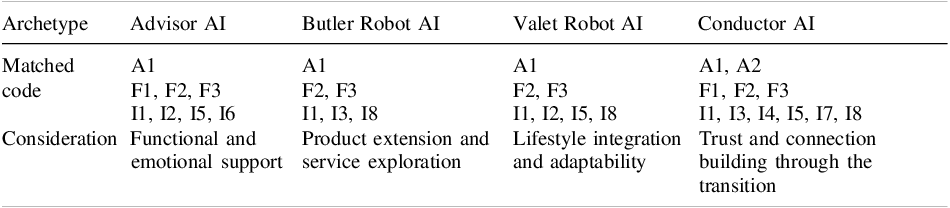
Based on the four semi-structured interviews, coding results, and researchers’ discussion, the preliminary design considerations in the context of AIP were generated by purposefully matching the eight initial codes, three focused codes, and two axial codes to the four AI archetypes (Table 4).
The relationship between 13 codes and four AI and robotics archetypes

In addition to mapping 13 codes to the four proposed AI and robotics archetypes (Table 4), we aimed to ensure the four considerations accurately and authentically reflect participants’ needs. To validate these needs and concerns, the authors analyzed quotes and discussions from the four video transcripts. Based on their respective expertise and debriefing discussions, the authors derived four AIP AI and robot-services best practice for designers and practitioners working in this area:
-
Functional and emotional support:AI and robotic products of the Advisor AI archetype, such as those that assist with daily tasks and routines, should prioritize practical design considerations. Equally important, these products should address the emotional aspects of design to support and empower individuals AIP comprehensively at individual, communal, and societal levels.
-
Product extension and service exploration: The Butler Robot AI archetype of addressing dynamic and complex needs requires designing products with modular features and expanding services to enhance the positive impact of AI and robotics in the context of AIP.
-
Lifestyle integration and adaptability: Intelligent products and software design within the Valet Robot AI archetype should recognize individual life patterns and adapt accordingly, effectively integrating with and enhancing the quality of life. This aligns with P3’s statement during the interview: “Technology or AI can provide a nudge to help individuals quickly adapt to a new lifestyle.”
-
Fostering trust during life transitions: The complexity and ambiguity of the Conductor AI archetype elevate the demands of design considerations. However, individual needs should be accounted for to foster trust and connection, particularly during lifestage transitions such as having children, changing careers, and other significant life events.
5.3. Limitation
This three-month descriptive study proposed a preliminary conceptual framework to investigate the intersections of AI, robotics, and AIP. Given the small sample size (n=4) and the specific Boston-based demographic characterized by financial stability, excellent health, and educational background, further research is needed to validate the findings across diverse socioeconomic backgrounds, age groups, genders, education levels, occupations, locations, and other demographic variables. Future research should also consider additional dimensions—such as psychological, community, and social factors—beyond the functional aspects of the proposed framework.
6. Conclusion
The primary contribution of this study lies in developing a conceptual framework integrating AI and robotics within the context of aging in place. The framework identifies four archetypes—Advisor AI, Butler AI Robot, Valet AI Robot, and Conductor AI—that address cognitive and functional needs through digital or physical presence. Using constructivist grounded theory, the study identifies four critical considerations for advancing aging-in-place solutions: functional and emotional support, product extension and service exploration, lifestyle integration and adaptability, and fostering trust during life transitions. This research aims to enhance awareness and inform future researchers and designers in creating meaningful aging-in-place environments and services, further building aging in the “right” place (Reference Canham, Weldrick, Sussman, Walsh and MahmoodCanham et al., 2022)—considering human needs, AI and robotics technologies, and integrated systems.
Acknowledgment
The authors acknowledge the contributions of the four volunteers who participated in this study, the academic support provided by MIT AgeLab, MIT Ideation Lab, and MIT Engineering Systems Laboratory, and the industry support from Teague.




 Open access

